EP0342126A2 - Distributeur de phéromone à libération prolongée - Google Patents
Distributeur de phéromone à libération prolongée Download PDFInfo
- Publication number
- EP0342126A2 EP0342126A2 EP89401321A EP89401321A EP0342126A2 EP 0342126 A2 EP0342126 A2 EP 0342126A2 EP 89401321 A EP89401321 A EP 89401321A EP 89401321 A EP89401321 A EP 89401321A EP 0342126 A2 EP0342126 A2 EP 0342126A2
- Authority
- EP
- European Patent Office
- Prior art keywords
- film
- thickness
- pheromone
- bag
- range
- Prior art date
- Legal status (The legal status is an assumption and is not a legal conclusion. Google has not performed a legal analysis and makes no representation as to the accuracy of the status listed.)
- Granted
Links
- 238000013268 sustained release Methods 0.000 title claims description 14
- 239000012730 sustained-release form Substances 0.000 title claims description 14
- 239000003016 pheromone Substances 0.000 title abstract description 106
- 150000001875 compounds Chemical class 0.000 claims abstract description 83
- -1 poly(vinyl chloride) Polymers 0.000 claims abstract description 68
- 239000005001 laminate film Substances 0.000 claims abstract description 53
- 229920001577 copolymer Polymers 0.000 claims abstract description 49
- 229920000642 polymer Polymers 0.000 claims abstract description 33
- XTXRWKRVRITETP-UHFFFAOYSA-N Vinyl acetate Chemical compound CC(=O)OC=C XTXRWKRVRITETP-UHFFFAOYSA-N 0.000 claims abstract description 23
- 239000000877 Sex Attractant Substances 0.000 claims abstract description 20
- OEPOKWHJYJXUGD-UHFFFAOYSA-N 2-(3-phenylmethoxyphenyl)-1,3-thiazole-4-carbaldehyde Chemical compound O=CC1=CSC(C=2C=C(OCC=3C=CC=CC=3)C=CC=2)=N1 OEPOKWHJYJXUGD-UHFFFAOYSA-N 0.000 claims abstract description 18
- VGGSQFUCUMXWEO-UHFFFAOYSA-N Ethene Chemical compound C=C VGGSQFUCUMXWEO-UHFFFAOYSA-N 0.000 claims abstract description 16
- 239000005977 Ethylene Substances 0.000 claims abstract description 16
- BZHJMEDXRYGGRV-UHFFFAOYSA-N Vinyl chloride Chemical compound ClC=C BZHJMEDXRYGGRV-UHFFFAOYSA-N 0.000 claims abstract description 14
- 229920000098 polyolefin Polymers 0.000 claims abstract description 12
- 241000238631 Hexapoda Species 0.000 claims abstract description 11
- 229920000915 polyvinyl chloride Polymers 0.000 claims abstract description 7
- 239000004800 polyvinyl chloride Substances 0.000 claims abstract description 7
- 239000007788 liquid Substances 0.000 claims description 11
- 229920001328 Polyvinylidene chloride Polymers 0.000 claims description 10
- 125000005396 acrylic acid ester group Chemical group 0.000 claims description 6
- SMZOUWXMTYCWNB-UHFFFAOYSA-N 2-(2-methoxy-5-methylphenyl)ethanamine Chemical compound COC1=CC=C(C)C=C1CCN SMZOUWXMTYCWNB-UHFFFAOYSA-N 0.000 claims description 4
- NIXOWILDQLNWCW-UHFFFAOYSA-N 2-Propenoic acid Natural products OC(=O)C=C NIXOWILDQLNWCW-UHFFFAOYSA-N 0.000 claims description 4
- 229920003086 cellulose ether Polymers 0.000 claims description 4
- NLHHRLWOUZZQLW-UHFFFAOYSA-N Acrylonitrile Chemical compound C=CC#N NLHHRLWOUZZQLW-UHFFFAOYSA-N 0.000 claims description 3
- 150000001242 acetic acid derivatives Chemical class 0.000 claims description 3
- 125000004432 carbon atom Chemical group C* 0.000 claims description 3
- 229920002678 cellulose Polymers 0.000 claims description 3
- 150000002430 hydrocarbons Chemical class 0.000 claims description 3
- 239000000178 monomer Substances 0.000 claims description 3
- LGXVIGDEPROXKC-UHFFFAOYSA-N 1,1-dichloroethene Chemical group ClC(Cl)=C LGXVIGDEPROXKC-UHFFFAOYSA-N 0.000 claims description 2
- QTBSBXVTEAMEQO-UHFFFAOYSA-M Acetate Chemical compound CC([O-])=O QTBSBXVTEAMEQO-UHFFFAOYSA-M 0.000 claims 1
- 229930195735 unsaturated hydrocarbon Natural products 0.000 claims 1
- 241000607479 Yersinia pestis Species 0.000 abstract description 5
- 239000010410 layer Substances 0.000 description 77
- 239000004698 Polyethylene Substances 0.000 description 18
- 229940117958 vinyl acetate Drugs 0.000 description 17
- 229920000573 polyethylene Polymers 0.000 description 16
- LKMWDVVIKGSQPP-NMUNODQISA-N (z)-dodec-8-en-1-ol;[(e)-dodec-8-enyl] acetate Chemical class CCC\C=C/CCCCCCCO.CCC\C=C\CCCCCCCOC(C)=O LKMWDVVIKGSQPP-NMUNODQISA-N 0.000 description 15
- 239000000543 intermediate Substances 0.000 description 11
- 230000004888 barrier function Effects 0.000 description 10
- 239000002985 plastic film Substances 0.000 description 9
- 229920006255 plastic film Polymers 0.000 description 9
- 239000002952 polymeric resin Substances 0.000 description 8
- 229920003002 synthetic resin Polymers 0.000 description 8
- 238000007789 sealing Methods 0.000 description 7
- 239000004743 Polypropylene Substances 0.000 description 6
- 239000004702 low-density polyethylene Substances 0.000 description 6
- 229940099514 low-density polyethylene Drugs 0.000 description 6
- 229920001155 polypropylene Polymers 0.000 description 6
- FIHBHSQYSYVZQE-UHFFFAOYSA-N 6-prop-2-enoyloxyhexyl prop-2-enoate Chemical compound C=CC(=O)OCCCCCCOC(=O)C=C FIHBHSQYSYVZQE-UHFFFAOYSA-N 0.000 description 5
- 230000009471 action Effects 0.000 description 5
- 230000007423 decrease Effects 0.000 description 5
- 238000002474 experimental method Methods 0.000 description 5
- 229920001684 low density polyethylene Polymers 0.000 description 5
- ZDHCZVWCTKTBRY-UHFFFAOYSA-N omega-Hydroxydodecanoic acid Natural products OCCCCCCCCCCCC(O)=O ZDHCZVWCTKTBRY-UHFFFAOYSA-N 0.000 description 5
- 230000000052 comparative effect Effects 0.000 description 4
- 230000003247 decreasing effect Effects 0.000 description 4
- 238000000034 method Methods 0.000 description 4
- 239000003094 microcapsule Substances 0.000 description 4
- 150000001299 aldehydes Chemical class 0.000 description 3
- 239000005667 attractant Substances 0.000 description 3
- 230000031902 chemoattractant activity Effects 0.000 description 3
- 229940125898 compound 5 Drugs 0.000 description 3
- 230000007547 defect Effects 0.000 description 3
- 239000000463 material Substances 0.000 description 3
- 239000000203 mixture Substances 0.000 description 3
- 230000035699 permeability Effects 0.000 description 3
- 239000011347 resin Substances 0.000 description 3
- 229920005989 resin Polymers 0.000 description 3
- YJINQJFQLQIYHX-UHFFFAOYSA-N trans-11-tetradecenyl acetate Natural products CCC=CCCCCCCCCCCOC(C)=O YJINQJFQLQIYHX-UHFFFAOYSA-N 0.000 description 3
- 239000005683 (Z)-11-Hexadecenal Substances 0.000 description 2
- AMTITFMUKRZZEE-WAYWQWQTSA-N (Z)-hexadec-11-enal Chemical compound CCCC\C=C/CCCCCCCCCC=O AMTITFMUKRZZEE-WAYWQWQTSA-N 0.000 description 2
- NAEZQVWAWSVOSD-UHFFFAOYSA-N -14-Methyl-1-octadecene Natural products CCCCC(C)CCCCCCCCCCCC=C NAEZQVWAWSVOSD-UHFFFAOYSA-N 0.000 description 2
- YJINQJFQLQIYHX-PLNGDYQASA-N 11Z-Tetradecenyl acetate Chemical compound CC\C=C/CCCCCCCCCCOC(C)=O YJINQJFQLQIYHX-PLNGDYQASA-N 0.000 description 2
- MUZGQHWTRUVFLG-SREVYHEPSA-N 7Z-Dodecenyl acetate Chemical compound CCCC\C=C/CCCCCCOC(C)=O MUZGQHWTRUVFLG-SREVYHEPSA-N 0.000 description 2
- SUCYDSJQVVGOIW-WAYWQWQTSA-N 8Z-Dodecenyl acetate Chemical compound CCC\C=C/CCCCCCCOC(C)=O SUCYDSJQVVGOIW-WAYWQWQTSA-N 0.000 description 2
- AMTITFMUKRZZEE-UHFFFAOYSA-N Z11-16:Ald Natural products CCCCC=CCCCCCCCCCC=O AMTITFMUKRZZEE-UHFFFAOYSA-N 0.000 description 2
- MUZGQHWTRUVFLG-UHFFFAOYSA-N Z7-12:OAc Natural products CCCCC=CCCCCCCOC(C)=O MUZGQHWTRUVFLG-UHFFFAOYSA-N 0.000 description 2
- 239000006096 absorbing agent Substances 0.000 description 2
- 239000000654 additive Substances 0.000 description 2
- 229910052782 aluminium Inorganic materials 0.000 description 2
- XAGFODPZIPBFFR-UHFFFAOYSA-N aluminium Chemical compound [Al] XAGFODPZIPBFFR-UHFFFAOYSA-N 0.000 description 2
- 239000001913 cellulose Substances 0.000 description 2
- 235000010980 cellulose Nutrition 0.000 description 2
- 239000011248 coating agent Substances 0.000 description 2
- 238000000576 coating method Methods 0.000 description 2
- 230000008021 deposition Effects 0.000 description 2
- 150000002148 esters Chemical class 0.000 description 2
- 239000011888 foil Substances 0.000 description 2
- NIOYUNMRJMEDGI-UHFFFAOYSA-N hexadecanal Chemical compound CCCCCCCCCCCCCCCC=O NIOYUNMRJMEDGI-UHFFFAOYSA-N 0.000 description 2
- 229910052751 metal Inorganic materials 0.000 description 2
- 239000002184 metal Substances 0.000 description 2
- 125000005397 methacrylic acid ester group Chemical group 0.000 description 2
- 229920003023 plastic Polymers 0.000 description 2
- 239000004033 plastic Substances 0.000 description 2
- 239000005020 polyethylene terephthalate Substances 0.000 description 2
- 229920000139 polyethylene terephthalate Polymers 0.000 description 2
- 239000000126 substance Substances 0.000 description 2
- 238000012360 testing method Methods 0.000 description 2
- 238000003466 welding Methods 0.000 description 2
- WONIGEXYPVIKFS-UHFFFAOYSA-N (+)-cis-Verbenol Natural products CC1=CC(O)C2C(C)(C)C1C2 WONIGEXYPVIKFS-UHFFFAOYSA-N 0.000 description 1
- ZTJGMVSDMQAJPE-UHFFFAOYSA-N (11E,13E)-11,13-hexadecadienal Natural products CCC=CC=CCCCCCCCCCC=O ZTJGMVSDMQAJPE-UHFFFAOYSA-N 0.000 description 1
- ZTJGMVSDMQAJPE-OUPQRBNQSA-N (11z,13z)-hexadeca-11,13-dienal Chemical compound CC\C=C/C=C\CCCCCCCCCC=O ZTJGMVSDMQAJPE-OUPQRBNQSA-N 0.000 description 1
- WONIGEXYPVIKFS-YIZRAAEISA-N (1s,2s,5s)-4,6,6-trimethylbicyclo[3.1.1]hept-3-en-2-ol Chemical compound CC1=C[C@H](O)[C@@H]2C(C)(C)[C@H]1C2 WONIGEXYPVIKFS-YIZRAAEISA-N 0.000 description 1
- XXPBOEBNDHAAQH-UHFFFAOYSA-N (Z)-12-Tetradecenyl acetate Natural products CCCCC=CCCCCCCCCOC(C)=O XXPBOEBNDHAAQH-UHFFFAOYSA-N 0.000 description 1
- 239000005685 (Z)-13-Octadecenal Substances 0.000 description 1
- QIRGIHPYVVKWTO-UHFFFAOYSA-N (Z)-13-Octadecenal Natural products CCCCC=CCCCCCCCCCCCC=O QIRGIHPYVVKWTO-UHFFFAOYSA-N 0.000 description 1
- 239000005686 (Z)-7-Tetradecenal Substances 0.000 description 1
- 239000005690 (Z)-9-Hexadecenal Substances 0.000 description 1
- QFPVVMKZTVQDTL-UHFFFAOYSA-N (Z)-9-hexadecenal Natural products CCCCCCC=CCCCCCCCC=O QFPVVMKZTVQDTL-UHFFFAOYSA-N 0.000 description 1
- IGOWHGRNPLFNDJ-ZPHPHTNESA-N (z)-9-tricosene Chemical compound CCCCCCCCCCCCC\C=C/CCCCCCCC IGOWHGRNPLFNDJ-ZPHPHTNESA-N 0.000 description 1
- QIRGIHPYVVKWTO-WAYWQWQTSA-N (z)-octadec-13-enal Chemical compound CCCC\C=C/CCCCCCCCCCCC=O QIRGIHPYVVKWTO-WAYWQWQTSA-N 0.000 description 1
- ANBOMSJGDBBKMR-UHFFFAOYSA-N 11-Dodecenyl acetate Chemical compound CC(=O)OCCCCCCCCCCC=C ANBOMSJGDBBKMR-UHFFFAOYSA-N 0.000 description 1
- SPFYVVCZIOLVOK-ARJAWSKDSA-N 11Z-Tetradecenal Chemical compound CC\C=C/CCCCCCCCCC=O SPFYVVCZIOLVOK-ARJAWSKDSA-N 0.000 description 1
- NWRSOYAGXTXEMK-NHRIVICHSA-N 2E,13Z-Octadecadienyl acetate Chemical compound CCCC\C=C/CCCCCCCCC\C=C\COC(C)=O NWRSOYAGXTXEMK-NHRIVICHSA-N 0.000 description 1
- HNVRRHSXBLFLIG-UHFFFAOYSA-N 3-hydroxy-3-methylbut-1-ene Chemical compound CC(C)(O)C=C HNVRRHSXBLFLIG-UHFFFAOYSA-N 0.000 description 1
- VVJPJXKHBZNADP-ZSTZHTMOSA-N 3E,13Z-Octadecadienyl acetate Chemical compound CCCC\C=C/CCCCCCCC\C=C\CCOC(C)=O VVJPJXKHBZNADP-ZSTZHTMOSA-N 0.000 description 1
- VVJPJXKHBZNADP-DNNFRFAMSA-N 3Z,13Z-Octadecadienyl acetate Chemical compound CCCC\C=C/CCCCCCCC\C=C/CCOC(C)=O VVJPJXKHBZNADP-DNNFRFAMSA-N 0.000 description 1
- VTUFOIHYMMMNOM-VOTSOKGWSA-N 5E-Decenyl acetate Chemical compound CCCC\C=C\CCCCOC(C)=O VTUFOIHYMMMNOM-VOTSOKGWSA-N 0.000 description 1
- HVUBXNQWXJBVHB-SQFISAMPSA-N 7Z-Eicosen-11-one Chemical compound CCCCCCCCCC(=O)CC\C=C/CCCCCC HVUBXNQWXJBVHB-SQFISAMPSA-N 0.000 description 1
- BLJFSPZWKBTYHR-KTKRTIGZSA-N 7Z-Hexadecenal Chemical compound CCCCCCCC\C=C/CCCCCC=O BLJFSPZWKBTYHR-KTKRTIGZSA-N 0.000 description 1
- AVHNDAZRNRAYTP-FPLPWBNLSA-N 7Z-Tetradecenal Chemical compound CCCCCC\C=C/CCCCCC=O AVHNDAZRNRAYTP-FPLPWBNLSA-N 0.000 description 1
- MFFQOUCMBNXSBK-SNAWJCMRSA-N 9E-Dodecenyl acetate Chemical compound CC\C=C\CCCCCCCCOC(C)=O MFFQOUCMBNXSBK-SNAWJCMRSA-N 0.000 description 1
- RFEQLTBBKNKGGJ-DEQVHDEQSA-N 9Z,11E-Tetradecadienyl acetate Chemical compound CC\C=C\C=C/CCCCCCCCOC(C)=O RFEQLTBBKNKGGJ-DEQVHDEQSA-N 0.000 description 1
- MFFQOUCMBNXSBK-PLNGDYQASA-N 9Z-Dodecenyl acetate Chemical compound CC\C=C/CCCCCCCCOC(C)=O MFFQOUCMBNXSBK-PLNGDYQASA-N 0.000 description 1
- QFPVVMKZTVQDTL-FPLPWBNLSA-N 9Z-Hexadecenal Chemical compound CCCCCC\C=C/CCCCCCCC=O QFPVVMKZTVQDTL-FPLPWBNLSA-N 0.000 description 1
- ANJAOCICJSRZSR-WAYWQWQTSA-N 9Z-Tetradecenal Chemical compound CCCC\C=C/CCCCCCCC=O ANJAOCICJSRZSR-WAYWQWQTSA-N 0.000 description 1
- XXPBOEBNDHAAQH-SREVYHEPSA-N 9Z-Tetradecenyl acetate Chemical compound CCCC\C=C/CCCCCCCCOC(C)=O XXPBOEBNDHAAQH-SREVYHEPSA-N 0.000 description 1
- 229920000298 Cellophane Polymers 0.000 description 1
- 244000114635 Dombeya acutangula Species 0.000 description 1
- 239000001856 Ethyl cellulose Substances 0.000 description 1
- ZZSNKZQZMQGXPY-UHFFFAOYSA-N Ethyl cellulose Chemical compound CCOCC1OC(OC)C(OCC)C(OCC)C1OC1C(O)C(O)C(OC)C(CO)O1 ZZSNKZQZMQGXPY-UHFFFAOYSA-N 0.000 description 1
- 239000006057 Non-nutritive feed additive Substances 0.000 description 1
- 239000004677 Nylon Substances 0.000 description 1
- 229920002319 Poly(methyl acrylate) Polymers 0.000 description 1
- 239000004372 Polyvinyl alcohol Substances 0.000 description 1
- 241000255993 Trichoplusia ni Species 0.000 description 1
- LLRZUAWETKPZJO-DEQVHDEQSA-N [(7z,9e)-dodeca-7,9-dienyl] acetate Chemical compound CC\C=C\C=C/CCCCCCOC(C)=O LLRZUAWETKPZJO-DEQVHDEQSA-N 0.000 description 1
- ZZGJZGSVLNSDPG-FZWLCVONSA-N [(9e,12e)-tetradeca-9,12-dienyl] acetate Chemical compound C\C=C\C\C=C\CCCCCCCCOC(C)=O ZZGJZGSVLNSDPG-FZWLCVONSA-N 0.000 description 1
- DUCVQKMNGSZPAV-ZHACJKMWSA-N [(e)-tridec-4-enyl] acetate Chemical compound CCCCCCCC\C=C\CCCOC(C)=O DUCVQKMNGSZPAV-ZHACJKMWSA-N 0.000 description 1
- BTKXLQSCEOHKTF-SREVYHEPSA-N [(z)-hexadec-11-enyl] acetate Chemical compound CCCC\C=C/CCCCCCCCCCOC(C)=O BTKXLQSCEOHKTF-SREVYHEPSA-N 0.000 description 1
- 239000000853 adhesive Substances 0.000 description 1
- 230000001070 adhesive effect Effects 0.000 description 1
- 239000003463 adsorbent Substances 0.000 description 1
- 230000002411 adverse Effects 0.000 description 1
- 239000003963 antioxidant agent Substances 0.000 description 1
- 235000006708 antioxidants Nutrition 0.000 description 1
- 230000008901 benefit Effects 0.000 description 1
- 238000007664 blowing Methods 0.000 description 1
- 229940106135 cellulose Drugs 0.000 description 1
- 229920002301 cellulose acetate Polymers 0.000 description 1
- 238000007796 conventional method Methods 0.000 description 1
- 239000011162 core material Substances 0.000 description 1
- 230000000694 effects Effects 0.000 description 1
- 238000005538 encapsulation Methods 0.000 description 1
- 230000007613 environmental effect Effects 0.000 description 1
- 229920001249 ethyl cellulose Polymers 0.000 description 1
- 235000019325 ethyl cellulose Nutrition 0.000 description 1
- 230000001747 exhibiting effect Effects 0.000 description 1
- 229920001903 high density polyethylene Polymers 0.000 description 1
- 239000004700 high-density polyethylene Substances 0.000 description 1
- 229930195733 hydrocarbon Natural products 0.000 description 1
- 238000011835 investigation Methods 0.000 description 1
- 150000002576 ketones Chemical class 0.000 description 1
- 238000010030 laminating Methods 0.000 description 1
- 239000000314 lubricant Substances 0.000 description 1
- 229920003145 methacrylic acid copolymer Chemical class 0.000 description 1
- VBPSVYDSYVJIPX-UHFFFAOYSA-N methylbutenol Natural products CCC=C(C)O VBPSVYDSYVJIPX-UHFFFAOYSA-N 0.000 description 1
- 238000000465 moulding Methods 0.000 description 1
- 229920001778 nylon Polymers 0.000 description 1
- SECPZKHBENQXJG-FPLPWBNLSA-M palmitoleate Chemical compound CCCCCC\C=C/CCCCCCCC([O-])=O SECPZKHBENQXJG-FPLPWBNLSA-M 0.000 description 1
- 235000011837 pasties Nutrition 0.000 description 1
- 239000000088 plastic resin Substances 0.000 description 1
- 239000004014 plasticizer Substances 0.000 description 1
- 229920002451 polyvinyl alcohol Polymers 0.000 description 1
- 238000002360 preparation method Methods 0.000 description 1
- 230000008569 process Effects 0.000 description 1
- 230000002035 prolonged effect Effects 0.000 description 1
- 239000004576 sand Substances 0.000 description 1
- 229920006395 saturated elastomer Polymers 0.000 description 1
- 239000003381 stabilizer Substances 0.000 description 1
- 230000000087 stabilizing effect Effects 0.000 description 1
- 230000002459 sustained effect Effects 0.000 description 1
- IGOWHGRNPLFNDJ-UHFFFAOYSA-N tricos-9t-ene Natural products CCCCCCCCCCCCCC=CCCCCCCCC IGOWHGRNPLFNDJ-UHFFFAOYSA-N 0.000 description 1
- 238000009966 trimming Methods 0.000 description 1
- 238000009834 vaporization Methods 0.000 description 1
- 230000008016 vaporization Effects 0.000 description 1
- XLYOFNOQVPJJNP-UHFFFAOYSA-N water Substances O XLYOFNOQVPJJNP-UHFFFAOYSA-N 0.000 description 1
- 239000002023 wood Substances 0.000 description 1
Images

Classifications
-
- B—PERFORMING OPERATIONS; TRANSPORTING
- B32—LAYERED PRODUCTS
- B32B—LAYERED PRODUCTS, i.e. PRODUCTS BUILT-UP OF STRATA OF FLAT OR NON-FLAT, e.g. CELLULAR OR HONEYCOMB, FORM
- B32B27/00—Layered products comprising a layer of synthetic resin
- B32B27/06—Layered products comprising a layer of synthetic resin as the main or only constituent of a layer, which is next to another layer of the same or of a different material
- B32B27/08—Layered products comprising a layer of synthetic resin as the main or only constituent of a layer, which is next to another layer of the same or of a different material of synthetic resin
-
- A—HUMAN NECESSITIES
- A01—AGRICULTURE; FORESTRY; ANIMAL HUSBANDRY; HUNTING; TRAPPING; FISHING
- A01M—CATCHING, TRAPPING OR SCARING OF ANIMALS; APPARATUS FOR THE DESTRUCTION OF NOXIOUS ANIMALS OR NOXIOUS PLANTS
- A01M1/00—Stationary means for catching or killing insects
- A01M1/02—Stationary means for catching or killing insects with devices or substances, e.g. food, pheronones attracting the insects
-
- A—HUMAN NECESSITIES
- A01—AGRICULTURE; FORESTRY; ANIMAL HUSBANDRY; HUNTING; TRAPPING; FISHING
- A01M—CATCHING, TRAPPING OR SCARING OF ANIMALS; APPARATUS FOR THE DESTRUCTION OF NOXIOUS ANIMALS OR NOXIOUS PLANTS
- A01M1/00—Stationary means for catching or killing insects
- A01M1/20—Poisoning, narcotising, or burning insects
- A01M1/2022—Poisoning or narcotising insects by vaporising an insecticide
- A01M1/2027—Poisoning or narcotising insects by vaporising an insecticide without heating
- A01M1/2044—Holders or dispensers for liquid insecticide, e.g. using wicks
-
- A—HUMAN NECESSITIES
- A01—AGRICULTURE; FORESTRY; ANIMAL HUSBANDRY; HUNTING; TRAPPING; FISHING
- A01N—PRESERVATION OF BODIES OF HUMANS OR ANIMALS OR PLANTS OR PARTS THEREOF; BIOCIDES, e.g. AS DISINFECTANTS, AS PESTICIDES OR AS HERBICIDES; PEST REPELLANTS OR ATTRACTANTS; PLANT GROWTH REGULATORS
- A01N25/00—Biocides, pest repellants or attractants, or plant growth regulators, characterised by their forms, or by their non-active ingredients or by their methods of application, e.g. seed treatment or sequential application; Substances for reducing the noxious effect of the active ingredients to organisms other than pests
- A01N25/18—Vapour or smoke emitting compositions with delayed or sustained release
-
- B—PERFORMING OPERATIONS; TRANSPORTING
- B32—LAYERED PRODUCTS
- B32B—LAYERED PRODUCTS, i.e. PRODUCTS BUILT-UP OF STRATA OF FLAT OR NON-FLAT, e.g. CELLULAR OR HONEYCOMB, FORM
- B32B27/00—Layered products comprising a layer of synthetic resin
- B32B27/30—Layered products comprising a layer of synthetic resin comprising vinyl (co)polymers; comprising acrylic (co)polymers
- B32B27/304—Layered products comprising a layer of synthetic resin comprising vinyl (co)polymers; comprising acrylic (co)polymers comprising vinyl halide (co)polymers, e.g. PVC, PVDC, PVF, PVDF
-
- B—PERFORMING OPERATIONS; TRANSPORTING
- B32—LAYERED PRODUCTS
- B32B—LAYERED PRODUCTS, i.e. PRODUCTS BUILT-UP OF STRATA OF FLAT OR NON-FLAT, e.g. CELLULAR OR HONEYCOMB, FORM
- B32B2327/00—Polyvinylhalogenides
- B32B2327/06—PVC, i.e. polyvinylchloride
Definitions
- the present invention relates to a sustained-release pheromone dispenser or, more particularly, to a pheromone dispenser capable of sustainedly emitting a sex pheromone compound used for population control of an insectan pest to the environment at a constant rate over a long period of time.
- 4,017,030 discloses a pheromone dispenser in which the sex pheromone compound is contained in a capillary tube having an open end and emitted from the open end of the tube.
- Pheromone dispensers of this type have a defect in respect of the usually very short serviceable life because a single dispenser can contain only an extremely small amount of the pheromone compound.
- 4,160,335 discloses a pheromone dispenser having a multilayered laminate of polymeric films to serve as a carrier of the pheromone compound with an object of controlling the rate of pheromone emission from a pheromone-carrying layer of a polymeric resin admixed with the pheromone compound.
- Pheromone dispensers of this type have a serious disadvantage that, while the rate of pheromone emission is sometimes too large in the initial stage of exposure thereof to the open field, the rate gradually decreases in the lapse of time and, moreover, a conside-able amount of the pheromone compound initially contained in the dispenser remains unreleased out of the dispenser to cause a large loss of the expensive compound.
- West German Patent No. 2,832,248 discloses a dispenser of (S)-cis-verbenol and methyl butenol as an attractant of wood borers, i.e. Limonoria lignorum , in which the attractant compounds are absorbed by a porous carrier and wrapped with a film of a plastic resin such as polyethylene and the like.
- West German Patent No. 2,945,655 discloses a dispenser of the same attractant in which the chemicals are mixed with a pasty base and a plastic bag is filled with the mixture.
- 4,445,641 describe a pheromone dispenser in which the pheromone compound is absorbed by a porous carrier and the pheromone-holding carrier is coated with a coating film of polyethylene and the like to control the emission rate of the pheromone compound through the coating film.
- These pheromone dispensers have a disadvantage in common that a considerable proportion of the pheromone compound absorbed in the carrier remains in the carrier unreleased even after prolonged exposure to the atmosphere to cause a large loss of the pheromone compound.
- a dispenser in which a liquid pheromone compound is contained and sealed in a container having a wall provided with a barrier layer capable of exhibiting an adequate permeability to the liquid compound contained therein.
- microcapsules of the above mentioned first class are not so widely utilized in practice because of the high costs for the preparation, large loss of the pheromone compound in the process of encapsulation into microcapsules and too large rate of pheromone emission and short serviceable life as a consequence of the extremely large surface area of the microcapsules.
- various improvements have been attempted by using a polyethylene tube of adequate wall thickness or by combining the polyethylene tube with a metal wire side-by-side to facilitate the hanging works on the tree twigs.
- the journal article recited for the plastic sheet- or bag-wrapped pheromone dispenser describes an example in which (Z)-7-dodecenyl acetate, which is a sex pheromone of cabbage loopers, is enclosed and sealed together with sand in a bag of 3 cm by 5 cm wide made of a polyethylene film having a thickness of 50 to 150 ⁇ m and is used for the purpose of intercommunication disruption.
- pheromone dispensers of this type have a disadvantage of a short life of service for only about two weeks or so because polyethylene works only insufficiently as a barrier against permeation of the pheromone compound.
- Dispensers of the third type in the prior art are proposed in U.S. Patent No. 3,343,663, No. 3,785,556 and No. 4,161,283 and elsewhere in which a biologically active vaporizable substance other than sex pheromones of insects and the like, is wrapped with a sheet or a bag made of a plastic film and the compound is emitted to the atmosphere at a controlled rate through the plastic film.
- pheromone dispensers Although a variety of different types have been proposed as is described above, those by using a capillary tube made of polyethylene and by using a plastic film or bag are the only examples of the pheromone dispensers used for the purpose of intercommunication disruption or population control of pests each containing at least 40 mg of a sex pheromone compound which is an unsaturated aliphatic ester, aldehyde or ketone having 12 to 20 carbon atoms in a molecule. These dispensers are all made by using polyethylene as a material of the dispenser body.
- this polymeric material has an adequate affinity with pheromone compounds but is inert thereto absorbing only a very small amount thereof, has excellent workability such as good weldability in the sealing works of the dispenser body containing the pheromone compound and has excellent mechanical strengths and resistance against water as the essential properties required for pheromone dispensers.
- the tubular dispensers have a defect that, although the rate of pheromone emission can be controlled over two months or longer as a consequence of the wall thickness of at least 300 ⁇ m of the capillary tube of polyethylene, the rate of pheromone emission is subject to a considerable decrease in the latter half of the life for service.
- the bag-like dispensers are under a limitation in respect of the workability of a plastic film into bags that the plastic film must have a thickness not exceeding 200 ⁇ m so that bag-type dispensers made from polyethylene alone have a limited life of service and are not suitable for the purpose of emission control over two months or longer as in the tubular dispensers because polyethylene cannot provide a sufficient barrier.
- the vaporization velocity of the pheromone compound from the dispenser walls would be too low to dissipate the whole amount of the pheromone compound having reached the outer surface of the dispenser after permeation through the polyethylene walls so that the outer surface the dispenser is always wettish with the pheromone compound oozing out to increase deposition of dusts with great troubles in the outdoor use of the dispensers.
- the inventors have continued extensive investigations to develop a sustained-release dispenser of a sex pheromone compound of insects which is an aliphatic unsaturated acetate, aldehyde or ketone compound, of which the amount of the pheromone compound contained in a single dispenser is at least 40 mg, and arrived at a conclusion that a sustained-release pheromone dispenser could well satisfy the requirements without the problems and disadvantages in the tubular or bag-like dispensers in the prior art.
- sustained-release pheromone dispenser of the present invention comprises:
- the above mentioned laminate film is composed of three layers of which the intermediate layer is made of a film of a polymer or copolymer of vinylidene chloride having a thickness in the range from 4 to 20 ⁇ m, the outer layer is a film of a polyolefin or a copolymer of ethylene and vinyl acetate having a thickness in the range from 10 to 100 ⁇ m and the inner layer is a film of a polymer selected from the group consisting of polyolefins, copolymers of ethylene and vinyl acetate, poly(vinyl chloride) and copolymers of vinyl chloride and vinyl acetate having a thickness in the range from 5 to 100 ⁇ m.
- the intermediate layer is made of a film of a polymer or copolymer of vinylidene chloride having a thickness in the range from 4 to 20 ⁇ m
- the outer layer is a film of a polyolefin or a copolymer of ethylene and vinyl
- the body of the inventive pheromone dispenser is a bag made of a plastic film and at least a part of the bag walls is made of a laminate film composed of at least two different plastic films of a specific polymeric resin.
- the cross sectional structure of the bag body is described in detail with reference to the accompanying drawing.
- Figure 1 illustrates a cross sectional view of the inventive sustained-release pheromone dispenser 1, the body of which is a bag 2 formed of a laminated film 3 by adhesively bonding or welding two sheets of the same along the periphery 4 to contain a liquid pheromone compound 5 enclosed therein.
- the laminate film 3 is composed of at least two layers of which one is a film A of a poly(vinylidene chloride) or a copolymer mainly composed of vinylidene chloride and the other or each of the others B is a film of a polymer different from polymers of vinylidene chloride.
- the film A forms the outer layer or inner layer, respectively, with the film B forming the inner layer or the outer layer.
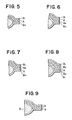
- the laminating order of these films and the film A is also not limitative including the orders of, for example, B1-A-B2 in a three-ply laminate shown in Figure 5, B1-A-B2-B3 in a four-ply laminate shown in Figure 6, B1-B2-A-B3 in a four-ply laminate shown in Figure 7, B1-B2-A-B2-B1 in a five-ply laminate shown in Figure 8 and so on to be selected according to need.
- one of the layers in these multi-ply laminates is a film of a poly(vinylidene chloride) or a copolymer mainly composed of vinylidene chloride having a thickness in the range from 4 to 20 ⁇ m.
- a film A of the specific polymeric resin can overcome the problems and disadvantages in the conventional bag-like pheromone dispensers that the barrier action against permeation of the pheromone compound through the bag walls is low and effective control of the emission rate of the pheromone can be obtained only for a very limited period of time and that, when the pheromone dispenser is exposed to an ambience at a relatively high temperature under weak wind blow, the permeation rate of the pheromone compound through the polymeric bag wall is so high as to exceed the vaporization rate of the pheromone compound from the bag surface so that the surface of the bag is wettish with the liquid pheromone compound to accelerate deposition of dusts on the surface resulting in an undesirable decrease in the performance of the pheromone dispenser.
- the copolymer of vinylidene chloride here implied is a copolymer of which at least 50% by weight is the moiety of vinylidene chloride, the rest being the moiety of other monomers such as vinyl chloride, acrylic acid, acrylic acid esters, vinyl acetate, acrylonitrile and the like.
- the other layer or layers than the layer A is a film or are films made from a polymer selected from the group consisting of polyolefins, e.g., polyethylene and polypropylene, copolymers of ethylene and vinyl acetate, poly(vinyl chloride) and copolymers of vinyl chloride, polymers and copolymers of acrylic acid esters, polymers and copolymers of methacrylic acid esters, cellulose esters and cellulose ethers such as ethyl cellulose.
- the barrier action of these layers is lower than the layer A made from a poly(vinylidene chloride) or a copolymer of vinylidene chloride to permit permeation of the pheromone compound therethrough.
- these layers B serve to reinforce the layer A having a thickness of 4 to 20 ⁇ m which alone has low mechanical strengths not to ensure practical use of the bag-like dispensers made of such a film alone.
- the above mentioned polymers have a relatively high affinity with the pheromone compound so that the layer or layers B exhibit a buffer action to impart the dispenser with adaptability to the changes in the outer environmental conditions such as temperature and wind velocity so that the problem of wettish bag surface with the pheromone compound due to adverse changes in the meteorological elements can be solved more completely.
- the layer B is used as the inner layer of the bag, moreover, the heat-sealability of the laminate films can be greatly improved.
- the layer A is sandwiched with the layers of B forming the outermost and innermost layers.
- the overall thickness of the layers B should be in the range from 10 to 196 ⁇ m.
- Figure 5 illustrates a particular example of such a laminate film by a cross section, which is composed of the outermost layer B1 of a polyolefin, e.g., polyethylene or polypropylene, or a copolymer of ethylene and vinyl acetate having a thickness of 10 to 100 ⁇ m, the intermediate layer A of a polymer or copolymer of vinylidene chloride having a thickness of 4 to 20 ⁇ m and the innermost layer B2 of a polymeric resin with good heat-sealability and relatively high permeability to the pheromone compound such as a polyolefin, e.g., polyethylene and polypropylene, copolymer of ethylene and vinyl acetate, poly(vinyl chloride), copolymer of vinyl chloride and vinyl acetate and the like having a thickness of 5 to 100 ⁇ m.
- a polyolefin e.g., polyethylene or polypropylene
- the outermost layer B1 When the outermost layer B1 has a thickness smaller than 10 ⁇ m, the performance of the laminate film is undesirably decreased. When the outermost layer has a thickness larger than 100 ⁇ m, on the other hand, the workability of the laminate film into bags is undesirably decreased.
- the innermost layer B2 not only plays a role to impart heat-sealability to the laminate film but also contributes to reinforce and stabilize the intermediate layer. These effects of the innermost layer would be decreased when the thickness thereof is smaller than 5 ⁇ m while the workability of the laminate film into bags would be decreased when the thickness of the layer is larger than 100 ⁇ m.
- the overall thickness of the laminate film is essentially in the range from 20 to 200 ⁇ m.
- the uniformity of the emission rate of the pheromone compound which is the largest advantage of the bag-like pheromone dispensers, cannot be ensured in addition to the decrease in the workability of the laminate film into bags.
- the thickness of the laminate film is smaller than 20 ⁇ m, on the other hand, the laminate film is poor in the mechanical strengths so that the dispenser body made therefrom cannot withstand handling in the practical use.
- each of the above mentioned polymeric resins forming the layers A and B is admixed with various kinds of additives such as ultraviolet absorbers, plasticizers, stabilizers, stabilizing aids, processing aids, lubricants and others.
- the pheromone compound contained in the bag-like pheromone dispenser is released to the environment by permeating the laminate film. Needless to say, the rate of pheromone emission de pends on the surface area of the bag-like dispenser body increasing as the surface area increases. In this regard, it is important that the effective surface area of the bag made of the laminate film and available for the emission of the pheromone compound is in the range from 100 to 6000 mm2 excepting the sealed portions by appropriately designing the dispenser body.
- the laminate film can be fabricated into a bag-like dispenser body in a variety of ways. For example, two rectangular sheets of the laminate film having the same size are laid one on the other and the two sheets are bonded by welding along the four sides of the rectangular form to give a four way-sealed bag. Alternatively, a single rectangular sheet of the laminate film is folded along the center line and the two flaps of the thus folded sheet are bonded together by heat-sealing along the three free sides to give a three way-sealed bag. Pillow wrapping bags and stick-wrapping bags can also be used.
- the dispenser body can be a four way-sealed bag made of two different polymeric sheets of which one is a layer 3 of the laminate film and the other is a layer 9 of a film of a polymer having no permeability to the pheromone compound.
- a four way-sealed bag is advantageous in respect of the relatively large capacity of the pheromone compound contained in the bag per unit area of the effective surface so that portionwise enclosing work of the pheromone compound is facilitated, especially, when it is required that each pheromone dispenser has a limited effective surface area.
- the above mentioned pheromone-impermeable sheet can be made from various kinds of materials such as a foil of a metal, e.g., aluminum, cellophane, films of polyvinyl alcohol, films of nylon or a poly(ethylene terephthalate) having a thickness of 20 ⁇ m or larger and the like. If necessary, these pheromone-impermeable sheets can be laminated with a film of a polymer having heat-sealability such as polyethylene, copolymers of ethylene and vinyl acetate and the like. Such a laminate film can be prepared by a conventional method including bonding by using an adhesive, co-extrusion molding and so on.
- the liquid pheromone compound 5 to be enclosed in the bag 2 is mostly a compound selected from the group of aliphatically unsaturated hydrocarbons, acetates, aldehydes and ketones having 12 to 20 carbon atoms in a molecule known as a sex pheromone compound of a pest belonging to the genera of lepidopteran insects.
- Examples of such a pheromone compound include hydrocarbon compounds such as (Z)-9-tricosene, 14-methyl-1-octadecene and the like, acetate compounds such as (E)-5-decenyl acetate, (E)-4-tridecenyl acetate, (Z)-7-dodecenyl acetate, (Z)-8-dodecenyl acetate, (Z)-9-dodecenyl acetate, (E)-9-dodecenyl acetate, 11-dodecenyl acetate, (E,Z)-7,9-dodecadienyl acetate, (Z)-7-tetradecenyl acetate, (Z)-9-tetradecenyl acetate, (Z)-11-tetradecenyl acetate, (Z)-11-hexadecenyl acetate, (E,Z)
- the pheromone dispensers of the invention can be manufactured by using known machines for the respective steps including the bag making step from the laminate film 3 into bags 2, filling of the bags 2 with the liquid pheromone compound 5, sealing of the bags 2, and cutting and trimming of the individual bags 2. Sealing of the laminate films is performed preferably by the heat-sealing method, impulse-sealing method or ultrasonic-sealing method. It is optional that the surface of the bag-like dispenser is covered with a film impermeable to the pheromone compound which is removed just before the dispenser is brought to use in the field.
- the laminate film is composed of three layers including the intermediate layer made of a film of a polymer or copolymer of vinylidene chloride having a thickness in the range from 4 ro 20 ⁇ m, the outer layer made of a film of a polyolefin or a copolymer of ethylene and vinyl acetate having a thickness in the range from 10 to 100 ⁇ m and the inner layer made of a film of a polymer selected from the group consisting of polyolefins, copolymers of ethylene and vinyl acetate, poly(vinyl chloride) and copolymers of vinyl chloride and vinyl acetate having a thickness in the range from 5 to 100 ⁇ m and the overall thickness of the laminate film is in the range from 20 to 200 ⁇ m.
- the dispenser body should preferably have an effective area made of the above defined laminate film and available for the emission of the phe
- Figure 2 illustrates a partial cross sectional view of a bag-like pheromone dispenser made of the above defined three-layered laminate film composed of the outer layer 6, intermediate layer 7 and inner layer 8.
- the intermediate layer is made of a polymer or copolymer of vinylidene chloride.
- the copolymer of vinylidene chloride here implied is a copolymer composed of at least 50% by weight of the vinylidene chloride moiety and the balance is a moiety of vinyl chloride, acrylic acid, esters of acrylic acid, vinyl acetate, acrylonitrile and the like.
- This intermediate layer serves as a barrier against permeation of the pheromone compound contained in the dispenser and, in this regard, the thickness thereof is necessarily in the range from 4 to 20 ⁇ m.
- the outer layer of the laminate film forming the inventive pheromone dispenser is made of a film of a polyolefin, e.g., polyethylene and polypropylene, or a copolymer of ethylene and vinyl acetate having a thickness of 10 to 100 ⁇ m.
- the polymer has high affinity with the pheromone compound to comply with the changes in the ambient conditions such as temperature and wind velocity to exhibit a buffer action although the layer made from such a polymer serves less as a barrier for the permeation of the pheromone compound than the intermediate layer.
- Such advantageous performance cannot be fully exhibited when the outer layer has a thickness smaller than 10 ⁇ m while the laminate film is poor in the workability into bags when the outer layer has a thickness larger than 100 ⁇ m.
- the inner layer made from the above specified polymer serves to impart the laminate film with heat-sealability and also to reinforce and stabilize the intermediate layer. Such effects cannot be fully exhibited when the inner layer has a thickness smaller than 5 ⁇ m while the laminate film is poor in the workability into bags when the inner layer has a thickness larger than 100 ⁇ m.
- sustained-release pheromone dispenser of the present invention is described in more detail by way of examples and comparative examples.
- a three-layered laminate film having an overall thickness of 63 ⁇ m was prepared by sandwiching a film of a poly(vinylidene chloride) having a thickness of 9 ⁇ m as the intermediate layer with two films of a low-density polyethylene each having a thickness of 27 ⁇ m. Two rectangular sheets of this laminate film were stacked one on the other and heat-sealed together along the four sides of a 20 mm by 30 mm rectangle in the inside measure to form a bag which had an effective surface area of 1200 mm2. This bag was filled with 80 mg of (Z,Z/E)-7,11-hexadecadienyl acetate known as the sex pheromone compound of pinkball worms.
- This sustained-release pheromone dispenser was kept standing at a temperature of 30 °C in a wind blowing at a velocity of 0.5 meter/second and the rate of pheromone emission therefrom was monitored over a period of 120 days or longer to find that the rate of pheromone emission was quite uniform over the testing period at 0.5 mg/day. No wettishness was found on the surface of the bag which might possibly be caused by the overly permeation of the liquid pheromone compound through the laminate film.
- the experimental procedure was the same as in Example 1 excepting replacement of the three-layered laminate film with a single-layered low-density polyethylene film having a thickness of 60 ⁇ m.
- the results were that the surface of the bag-like dispenser body was wettish with the liquid pheromone compound due to the excessively large permeation velocity of the pheromone compound through the film so that satisfactory performance could not be expected for the pheromone dispenser.
- the experimental procedure was substantially the same as in Example 1 excepting replacement of the three-layered laminate film with a single-layered film of a poly(vinylidene chloride) resin having a thickness of 9 ⁇ m.
- the results were that the rate of pheromone emission was uniform at 0.5 mg/day over the testing period and the surface of the dispenser bag was little wettish.
- a problem, however, was that the bag had low mechanical strengths and was liable to be broken unless it was handled with great care so that the practical value of such a pheromone dispenser was found low.
- the experimental procedure was substantially the same as in Example 1 excepting replacement of the three-layered laminate film fith another three-layered laminate film having an overall thickness of 90 ⁇ m and prepared by sandwiching a film of a poly(vinylidene chloride) resin having a thickness of 30 ⁇ m with two low-density polyethylene films each having a thickness of 30 ⁇ m.
- the results were that the rate of pheromone emission therefrom was extremely low with a low practical value as a pheromone dispenser.
- the experimental procedure was substantially the same as in Example 1 excepting replacement of the three-layered laminate film with another three-layered laminate film having an overall thickness of 24 ⁇ m and prepared by sandwiching a film of a poly(vinylidene chloride) resin having a thickness of4 ⁇ m as the inter mediate layer with a polypropylene film having a thickness of 10 ⁇ m as the outer layer and a film of a copolymer of ethylene and vinyl acetate having a thickness of 10 ⁇ m as the inner layer.
- the results were that a uniform emission rate of 0.7 mg/day of the pheromone compound could be maintained for 100 days or longer and no wettishness of the bag surface was noted indicating usefulness of the pheromone dispenser in practical applications.
- the experimental procedure was substantially the same as in Example 1 excepting replacement of the three-layered laminate film with a two-layered laminate film having an overall thickness of35 ⁇ m and composed of a film of a poly(vinylidene chloride) having a thickness of 5 ⁇ m as the outer layer and a film of a copolymer of 88% by weight of ethylene and 12 % by weight of vinyl acetate having a thickness of 30 ⁇ m as the inner layer.
- the results were that a uniform emission rate of 0.7 mg/day of the pheromone compound could be maintained for 100 days or longer and no wettishness of the bag surface was noted indicating usefulness of the pheromone dispenser in practical applications.
- each laminate film is shown in the table by the kinds of the polymeric resins A1 and A2 and B1 to B6 shown below and the thickness in ⁇ m of each layer in brackets in an order from the outermost layer to the innermost layer.
- the bags in Examples 6 and 10 were prepared by using the pheromone-permeable laminate film for one side alone and the other side of the bag was formed of a pheromone-impermeable film which was a laminate film of a poly(ethylene terephthalate) film and a low-density polyethylene film in Example 6 and a laminate film of an aluminum foil and a low-density polyethylene film in Example 10.
- the amount of the enclosed pheromone compound was increased to 160 mg in Exa,ple 13.
- A1 poly(vinylidenechloride) A2: 8:2 by weight copolymer of vinylidene chloride and vinyl chloride
- B1 low-density polyethylene
- B2 high-density polyethylene
- B3 polypropylene
- B4 poly(vinylchloride)
- B5 poly(methyl acrylate)
- B6 cellulose acetate
Landscapes
- Life Sciences & Earth Sciences (AREA)
- Pest Control & Pesticides (AREA)
- Environmental Sciences (AREA)
- General Health & Medical Sciences (AREA)
- Engineering & Computer Science (AREA)
- Wood Science & Technology (AREA)
- Zoology (AREA)
- Health & Medical Sciences (AREA)
- Toxicology (AREA)
- Insects & Arthropods (AREA)
- Agronomy & Crop Science (AREA)
- Plant Pathology (AREA)
- Dentistry (AREA)
- Agricultural Chemicals And Associated Chemicals (AREA)
- Catching Or Destruction (AREA)
Applications Claiming Priority (4)
| Application Number | Priority Date | Filing Date | Title |
|---|---|---|---|
| JP11665088 | 1988-05-13 | ||
| JP116650/88 | 1988-05-13 | ||
| JP63245417A JPH0818927B2 (ja) | 1988-05-13 | 1988-09-29 | 徐放性フェロモン製剤 |
| JP245417/88 | 1988-09-29 |
Publications (3)
| Publication Number | Publication Date |
|---|---|
| EP0342126A2 true EP0342126A2 (fr) | 1989-11-15 |
| EP0342126A3 EP0342126A3 (en) | 1990-05-30 |
| EP0342126B1 EP0342126B1 (fr) | 1993-12-01 |
Family
ID=26454945
Family Applications (1)
| Application Number | Title | Priority Date | Filing Date |
|---|---|---|---|
| EP89401321A Expired - Lifetime EP0342126B1 (fr) | 1988-05-13 | 1989-05-11 | Distributeur de phéromone à libération prolongée |
Country Status (4)
| Country | Link |
|---|---|
| US (1) | US4923119A (fr) |
| EP (1) | EP0342126B1 (fr) |
| JP (1) | JPH0818927B2 (fr) |
| DE (1) | DE68911027T2 (fr) |
Cited By (11)
| Publication number | Priority date | Publication date | Assignee | Title |
|---|---|---|---|---|
| EP0540932A1 (fr) * | 1991-11-02 | 1993-05-12 | BASF Aktiengesellschaft | Distributeur pour la libération controlée des phéromones |
| EP0753253A1 (fr) * | 1995-07-13 | 1997-01-15 | Shin-Etsu Chemical Co., Ltd. | Préparations contenant des phéromones, à diffusion prolongée |
| WO1997032474A1 (fr) * | 1996-03-08 | 1997-09-12 | The Procter & Gamble Company | Article insectifuge possedant un aspect mouille reduit au contact |
| US6065687A (en) * | 1994-05-24 | 2000-05-23 | Shin-Etsu Chemical Co., Ltd. | Sustained release preparations |
| EP1459626A1 (fr) * | 2003-03-17 | 2004-09-22 | Shin-Etsu Chemical Co., Ltd. | Distributeur à libération lente de phéromones sexuelles avec deux ou plus de phéromones secuelles ainsi qu'un procédé pour combattre les insectes nuisibles |
| WO2007026082A1 (fr) * | 2005-09-02 | 2007-03-08 | Evergreen Land Limited | Materiau a liberation progressive d’une substance active liquide par evaporation, et bracelet anti-moustique integrant un tel materiau |
| WO2010076316A1 (fr) | 2008-12-30 | 2010-07-08 | Basf Se | Distributeur de phéromone |
| EP2005821A4 (fr) * | 2006-04-11 | 2010-12-01 | Shinetsu Chemical Co | Preparation a liberation prolongee enfermee dans un tube extensible |
| US8304047B2 (en) | 2002-01-31 | 2012-11-06 | Vestergaard Frandsen Sa | Laminated insecticide dispenser |
| US8828374B2 (en) | 2004-10-29 | 2014-09-09 | Shin-Etsu Chemical Co., Ltd. | Sustained pheromone releaser |
| US8900611B2 (en) | 2004-09-15 | 2014-12-02 | Shin-Etsu Chemical Co., Ltd. | Sustained releaser comprising sex pheromone substances |
Families Citing this family (35)
| Publication number | Priority date | Publication date | Assignee | Title |
|---|---|---|---|---|
| JP2851120B2 (ja) * | 1989-04-25 | 1999-01-27 | 日本たばこ産業株式会社 | ヒラタコクヌストモドキのための誘引剤 |
| US5082636A (en) * | 1989-10-04 | 1992-01-21 | H. W. Andersen Products, Inc. | Maintaining relative humidity in gas sterilizers and humidifying device for use with gas sterilizers |
| US5503839A (en) * | 1991-10-16 | 1996-04-02 | Shin-Etsu Chemical Co., Ltd. | Method for the preparation of a sustained-release dispenser of sex pheromone of pest insects |
| JPH0665007A (ja) * | 1992-08-19 | 1994-03-08 | Shin Etsu Chem Co Ltd | 交信攪乱によるワタアカミムシの防除方法 |
| US5750129A (en) * | 1992-08-28 | 1998-05-12 | Phero Tech Inc. | Composite polymer matrices for controlled release of semiochemicals |
| DE4236886C2 (de) * | 1992-10-31 | 1997-11-20 | Klocke Verpackungs Service | Behälter zur Aufnahme von aromatischen Substanzen |
| US5611486A (en) * | 1993-12-06 | 1997-03-18 | Paul; Leonard | Air freshening and/or deodorizing system |
| US5372303A (en) * | 1993-12-06 | 1994-12-13 | Paul; Leonard | Air freshener and/or deodorizer dispensing system |
| US5497942A (en) * | 1994-01-21 | 1996-03-12 | W. L. Gore & Associates, Inc. | Dispersant delivery system and method for producing and using same |
| US5670145A (en) * | 1996-01-30 | 1997-09-23 | Troy Biosciences, Inc. | Biologically active system for dispersion of pheromones |
| US5845847A (en) * | 1996-05-14 | 1998-12-08 | S. C. Johnson & Son, Inc. | Air freshener dispenser device |
| DE69824935T2 (de) * | 1997-10-17 | 2005-07-07 | Shin-Etsu Chemical Co., Ltd. | Ringförmiger Pheromondispenser mit verlängerter Freisetzung und Installationswerkzeug dafür |
| DE69912012T2 (de) * | 1998-01-30 | 2004-08-19 | Shin-Etsu Chemical Co., Ltd. | Pheromonspender mit verzögerter Abgabe |
| US6900347B2 (en) | 1998-09-01 | 2005-05-31 | Tilliechem, Inc. | Impurity inhibition in olefin metathesis reactions |
| US6696597B2 (en) | 1998-09-01 | 2004-02-24 | Tilliechem, Inc. | Metathesis syntheses of pheromones or their components |
| US6215019B1 (en) | 1998-09-01 | 2001-04-10 | Tilliechem, Inc. | Synthesis of 5-decenyl acetate and other pheromone components |
| US7507854B2 (en) * | 1998-09-01 | 2009-03-24 | Materia, Inc. | Impurity reduction in Olefin metathesis reactions |
| US6554887B1 (en) * | 2000-08-15 | 2003-04-29 | Autopax, Inc. | Containment device for vapor phase transfer materials |
| US20020125419A1 (en) * | 2001-02-06 | 2002-09-12 | Callahan Philip S. | Solid-state organic maser |
| DE102005026020A1 (de) * | 2005-06-03 | 2006-12-14 | Tufty Gmbh | Vorrichtung zur Freisetzung von Wirkstoffen |
| WO2009059415A1 (fr) * | 2007-11-07 | 2009-05-14 | Contech Enterprises Inc. | Dispositif à libération lente pour délivrer une phéromone de couvain d'abeilles stabilisée à l'intérieur de la ruche |
| US8024889B2 (en) | 2008-06-25 | 2011-09-27 | Brett Bunker | Pest control method and apparatus |
| AR081523A1 (es) * | 2010-03-24 | 2012-10-03 | Shinetsu Chemical Co | Preparacion anular de liberacion prolongada y su metodo de preparacion |
| DE102010014713A1 (de) | 2010-04-12 | 2011-10-13 | Klocke Verpackungs-Service Gmbh | Dispenser für ein leicht flüchtiges Medium |
| US20120028742A1 (en) * | 2010-05-14 | 2012-02-02 | Jay Edward Van Der Linden | Scent shooter |
| CA138227S (en) | 2010-06-23 | 2012-02-23 | Shinetsu Chemical Co | Device for release of pest control agent |
| US9173389B2 (en) | 2010-11-18 | 2015-11-03 | Auburn University | Systems and methods to deliver and maintain volatile compounds |
| US9185897B2 (en) | 2010-11-18 | 2015-11-17 | Auburn University | Methods to deliver and maintain volatile compounds |
| CA2833370A1 (fr) * | 2011-04-20 | 2012-10-26 | Sterling International Inc. | Methode et distributeur pour la liberation regulee de substances semiochimiques |
| WO2012151110A2 (fr) * | 2011-05-03 | 2012-11-08 | Sterling International Inc. | Antioxydants et huiles végétales utilisés comme stabilisants de substances sémiochimiques de lutte contre les insectes |
| EP3367790A4 (fr) | 2015-10-29 | 2018-09-05 | Newseal Minerals And Coatings Ltd. | Composites et articles pour la libération lente de composés de liquides volatils non polaires et procédés de préparation |
| US10561127B2 (en) * | 2016-09-09 | 2020-02-18 | Verily Life Sciences Llc | Blood feeding system using nonwoven fabric materials |
| DE202023000706U1 (de) | 2022-03-29 | 2023-07-03 | Flügel GmbH | System zum Überwachen von vorgebbaren Arten von Lebewesen oder von bestimmten Lebewesen und deren Umgebungsbedingungen an einem vorgebbaren Standort |
| US20240261529A1 (en) * | 2023-02-03 | 2024-08-08 | John Laurence STRAUSS | Diffuser device |
| US12564185B2 (en) | 2023-02-03 | 2026-03-03 | SIS Development, Inc. | Automatic optimizing pest control substance delivery system |
Family Cites Families (10)
| Publication number | Priority date | Publication date | Assignee | Title |
|---|---|---|---|---|
| US4666767A (en) * | 1972-11-09 | 1987-05-19 | Herculite Protective Fabrics Corporation | Dispensers for the controlled release of pest controlling agents and method for combatting pest therewith |
| US4014334A (en) * | 1976-02-02 | 1977-03-29 | Alza Corporation | Laminated osmotic system for dispensing beneficial agent |
| US4161283A (en) * | 1977-06-03 | 1979-07-17 | Sy Hyman | Article for the dispensing of volatiles |
| GB2038183A (en) * | 1978-10-23 | 1980-07-23 | Bush Boake Allen Ltd | Polymeric fragrance materials and processes for their manufacture |
| DE2945655A1 (de) * | 1979-11-12 | 1981-05-21 | Celamerck Gmbh & Co Kg, 6507 Ingelheim | Vorrichtung fuer die abgabe von phermonen |
| JPS56115356A (en) * | 1980-02-16 | 1981-09-10 | St Kagaku Kogyo Kk | Packaging material for volatile insecticidal deodorant |
| US4445641A (en) * | 1982-01-08 | 1984-05-01 | Bend Research, Inc. | Controlled-release dispenser |
| US4605165A (en) * | 1984-06-13 | 1986-08-12 | International Flavors & Fragrances Inc. | Constant rate volatile composition dispensing article and process for using same |
| JPS62223101A (ja) * | 1986-03-25 | 1987-10-01 | Shin Etsu Chem Co Ltd | 徐放性フエロモンデイスペンサ− |
| JPS62258301A (ja) * | 1986-04-23 | 1987-11-10 | Shin Etsu Chem Co Ltd | 徐放性フエロモンデイスペンサ− |
-
1988
- 1988-09-29 JP JP63245417A patent/JPH0818927B2/ja not_active Expired - Fee Related
-
1989
- 1989-05-11 DE DE68911027T patent/DE68911027T2/de not_active Expired - Fee Related
- 1989-05-11 EP EP89401321A patent/EP0342126B1/fr not_active Expired - Lifetime
- 1989-05-12 US US07/351,200 patent/US4923119A/en not_active Expired - Lifetime
Cited By (15)
| Publication number | Priority date | Publication date | Assignee | Title |
|---|---|---|---|---|
| EP0540932A1 (fr) * | 1991-11-02 | 1993-05-12 | BASF Aktiengesellschaft | Distributeur pour la libération controlée des phéromones |
| US5316148A (en) * | 1991-11-02 | 1994-05-31 | Basf Aktiengesellschaft | Dispenser for the controlled release of pheromones |
| US6065687A (en) * | 1994-05-24 | 2000-05-23 | Shin-Etsu Chemical Co., Ltd. | Sustained release preparations |
| EP0753253A1 (fr) * | 1995-07-13 | 1997-01-15 | Shin-Etsu Chemical Co., Ltd. | Préparations contenant des phéromones, à diffusion prolongée |
| WO1997032474A1 (fr) * | 1996-03-08 | 1997-09-12 | The Procter & Gamble Company | Article insectifuge possedant un aspect mouille reduit au contact |
| US8304047B2 (en) | 2002-01-31 | 2012-11-06 | Vestergaard Frandsen Sa | Laminated insecticide dispenser |
| EP1459626A1 (fr) * | 2003-03-17 | 2004-09-22 | Shin-Etsu Chemical Co., Ltd. | Distributeur à libération lente de phéromones sexuelles avec deux ou plus de phéromones secuelles ainsi qu'un procédé pour combattre les insectes nuisibles |
| US8834910B2 (en) | 2003-03-17 | 2014-09-16 | Shin-Etsu Chemical Co., Ltd. | Sustained release dispenser comprising two or more sex pheromone substances |
| US8900611B2 (en) | 2004-09-15 | 2014-12-02 | Shin-Etsu Chemical Co., Ltd. | Sustained releaser comprising sex pheromone substances |
| US8828374B2 (en) | 2004-10-29 | 2014-09-09 | Shin-Etsu Chemical Co., Ltd. | Sustained pheromone releaser |
| WO2007026082A1 (fr) * | 2005-09-02 | 2007-03-08 | Evergreen Land Limited | Materiau a liberation progressive d’une substance active liquide par evaporation, et bracelet anti-moustique integrant un tel materiau |
| EP2005821A4 (fr) * | 2006-04-11 | 2010-12-01 | Shinetsu Chemical Co | Preparation a liberation prolongee enfermee dans un tube extensible |
| AU2007239649B2 (en) * | 2006-04-11 | 2013-01-24 | Shin-Etsu Chemical Co., Ltd. | Sustained-release preparation enclosed in expandable tube |
| US9131673B2 (en) | 2006-04-11 | 2015-09-15 | Shin-Etsu Chemical Co., Ltd. | Sustained release preparation comprising a foamed capillary tube |
| WO2010076316A1 (fr) | 2008-12-30 | 2010-07-08 | Basf Se | Distributeur de phéromone |
Also Published As
| Publication number | Publication date |
|---|---|
| US4923119A (en) | 1990-05-08 |
| JPH0249702A (ja) | 1990-02-20 |
| EP0342126B1 (fr) | 1993-12-01 |
| JPH0818927B2 (ja) | 1996-02-28 |
| EP0342126A3 (en) | 1990-05-30 |
| DE68911027D1 (de) | 1994-01-13 |
| DE68911027T2 (de) | 1994-05-26 |
Similar Documents
| Publication | Publication Date | Title |
|---|---|---|
| EP0342126A2 (fr) | Distributeur de phéromone à libération prolongée | |
| EP0367835B1 (fr) | Recipient en plastique multicouche | |
| US5296291A (en) | Heat resistant breathable films | |
| KR101536827B1 (ko) | 수동 및 능동 산소 장벽 층을 갖는 다층 필름 | |
| EP0665102A1 (fr) | Feuille stratifiée thermoplastique en polyéthylène destinée à contenir des composants de produit odoriférants | |
| KR950703370A (ko) | 휘발성 액체용 발산기(emanator for volatile liquids) | |
| CA2081728A1 (fr) | Appareil distributeur pour la liberation controlee de pheromones | |
| JP2021146296A (ja) | 透明吸湿フィルム | |
| JP2024083410A (ja) | 吸湿用透明積層体 | |
| JPS63225303A (ja) | 交信撹乱用徐放性フエロモン製剤 | |
| AU617931B2 (en) | Composite insecticide and package thereof | |
| EP0243263B1 (fr) | Distributeur pour libérer lentement des phéromones sexuelles d'insectes | |
| JP3853187B2 (ja) | 包装体 | |
| JPH11320739A (ja) | ガスバリア性多層ヒートシールフィルムとそれを用いた袋体 | |
| JPH0296502A (ja) | 徐放性フェロモン製剤 | |
| JP2021147086A (ja) | 包装体 | |
| JP2600329B2 (ja) | ガスバリヤー性積層フィルムとその製造方法 | |
| JP3157561B2 (ja) | 積層樹脂製袋 | |
| JPH0246374B2 (fr) | ||
| EP0537783B1 (fr) | Méthode d'interruption d'accouplement des insectes nuisibles utilisant un distributeur à libération lente de phéromones sexuelles | |
| JP4626242B2 (ja) | 衣料用防虫剤用包装材料および衣料防虫用品 | |
| JPH03118301A (ja) | 徐放性フェロモン製剤 | |
| JP3000484B2 (ja) | 透明性を有する包装用積層シート | |
| JP2002079620A (ja) | ポリアミド系複層フィルム | |
| JP4857680B2 (ja) | 害虫防除剤保存方法 |
Legal Events
| Date | Code | Title | Description |
|---|---|---|---|
| PUAI | Public reference made under article 153(3) epc to a published international application that has entered the european phase |
Free format text: ORIGINAL CODE: 0009012 |
|
| AK | Designated contracting states |
Kind code of ref document: A2 Designated state(s): DE FR GB |
|
| PUAL | Search report despatched |
Free format text: ORIGINAL CODE: 0009013 |
|
| AK | Designated contracting states |
Kind code of ref document: A3 Designated state(s): DE FR GB |
|
| 17P | Request for examination filed |
Effective date: 19901102 |
|
| 17Q | First examination report despatched |
Effective date: 19920827 |
|
| GRAA | (expected) grant |
Free format text: ORIGINAL CODE: 0009210 |
|
| AK | Designated contracting states |
Kind code of ref document: B1 Designated state(s): DE FR GB |
|
| ET | Fr: translation filed | ||
| REF | Corresponds to: |
Ref document number: 68911027 Country of ref document: DE Date of ref document: 19940113 |
|
| PLBE | No opposition filed within time limit |
Free format text: ORIGINAL CODE: 0009261 |
|
| STAA | Information on the status of an ep patent application or granted ep patent |
Free format text: STATUS: NO OPPOSITION FILED WITHIN TIME LIMIT |
|
| 26N | No opposition filed | ||
| REG | Reference to a national code |
Ref country code: GB Ref legal event code: IF02 |
|
| PGFP | Annual fee paid to national office [announced via postgrant information from national office to epo] |
Ref country code: GB Payment date: 20040505 Year of fee payment: 16 |
|
| PGFP | Annual fee paid to national office [announced via postgrant information from national office to epo] |
Ref country code: FR Payment date: 20040510 Year of fee payment: 16 |
|
| PGFP | Annual fee paid to national office [announced via postgrant information from national office to epo] |
Ref country code: DE Payment date: 20040520 Year of fee payment: 16 |
|
| PG25 | Lapsed in a contracting state [announced via postgrant information from national office to epo] |
Ref country code: GB Free format text: LAPSE BECAUSE OF NON-PAYMENT OF DUE FEES Effective date: 20050511 |
|
| PG25 | Lapsed in a contracting state [announced via postgrant information from national office to epo] |
Ref country code: DE Free format text: LAPSE BECAUSE OF NON-PAYMENT OF DUE FEES Effective date: 20051201 |
|
| GBPC | Gb: european patent ceased through non-payment of renewal fee |
Effective date: 20050511 |
|
| PG25 | Lapsed in a contracting state [announced via postgrant information from national office to epo] |
Ref country code: FR Free format text: LAPSE BECAUSE OF NON-PAYMENT OF DUE FEES Effective date: 20060131 |
|
| REG | Reference to a national code |
Ref country code: FR Ref legal event code: ST Effective date: 20060131 |