EP0347829A2 - Nappe de fibres composite, et procédé pour la fabriquer - Google Patents
Nappe de fibres composite, et procédé pour la fabriquer Download PDFInfo
- Publication number
- EP0347829A2 EP0347829A2 EP89111170A EP89111170A EP0347829A2 EP 0347829 A2 EP0347829 A2 EP 0347829A2 EP 89111170 A EP89111170 A EP 89111170A EP 89111170 A EP89111170 A EP 89111170A EP 0347829 A2 EP0347829 A2 EP 0347829A2
- Authority
- EP
- European Patent Office
- Prior art keywords
- fibers
- short fibers
- substrate
- nonwoven
- fiber
- Prior art date
- Legal status (The legal status is an assumption and is not a legal conclusion. Google has not performed a legal analysis and makes no representation as to the accuracy of the status listed.)
- Granted
Links
Images
Classifications
-
- D—TEXTILES; PAPER
- D04—BRAIDING; LACE-MAKING; KNITTING; TRIMMINGS; NON-WOVEN FABRICS
- D04H—MAKING TEXTILE FABRICS, e.g. FROM FIBRES OR FILAMENTARY MATERIAL; FABRICS MADE BY SUCH PROCESSES OR APPARATUS, e.g. FELTS, NON-WOVEN FABRICS; COTTON-WOOL; WADDING ; NON-WOVEN FABRICS FROM STAPLE FIBRES, FILAMENTS OR YARNS, BONDED WITH AT LEAST ONE WEB-LIKE MATERIAL DURING THEIR CONSOLIDATION
- D04H1/00—Non-woven fabrics formed wholly or mainly of staple fibres or like relatively short fibres
- D04H1/40—Non-woven fabrics formed wholly or mainly of staple fibres or like relatively short fibres from fleeces or layers composed of fibres without existing or potential cohesive properties
- D04H1/42—Non-woven fabrics formed wholly or mainly of staple fibres or like relatively short fibres from fleeces or layers composed of fibres without existing or potential cohesive properties characterised by the use of certain kinds of fibres insofar as this use has no preponderant influence on the consolidation of the fleece
- D04H1/425—Cellulose series
-
- B—PERFORMING OPERATIONS; TRANSPORTING
- B32—LAYERED PRODUCTS
- B32B—LAYERED PRODUCTS, i.e. PRODUCTS BUILT-UP OF STRATA OF FLAT OR NON-FLAT, e.g. CELLULAR OR HONEYCOMB, FORM
- B32B5/00—Layered products characterised by the non- homogeneity or physical structure, i.e. comprising a fibrous, filamentary, particulate or foam layer; Layered products characterised by having a layer differing constitutionally or physically in different parts
- B32B5/22—Layered products characterised by the non- homogeneity or physical structure, i.e. comprising a fibrous, filamentary, particulate or foam layer; Layered products characterised by having a layer differing constitutionally or physically in different parts characterised by the presence of two or more layers which are next to each other and are fibrous, filamentary, formed of particles or foamed
- B32B5/24—Layered products characterised by the non- homogeneity or physical structure, i.e. comprising a fibrous, filamentary, particulate or foam layer; Layered products characterised by having a layer differing constitutionally or physically in different parts characterised by the presence of two or more layers which are next to each other and are fibrous, filamentary, formed of particles or foamed one layer being a fibrous or filamentary layer
- B32B5/26—Layered products characterised by the non- homogeneity or physical structure, i.e. comprising a fibrous, filamentary, particulate or foam layer; Layered products characterised by having a layer differing constitutionally or physically in different parts characterised by the presence of two or more layers which are next to each other and are fibrous, filamentary, formed of particles or foamed one layer being a fibrous or filamentary layer another layer next to it also being fibrous or filamentary
-
- B—PERFORMING OPERATIONS; TRANSPORTING
- B32—LAYERED PRODUCTS
- B32B—LAYERED PRODUCTS, i.e. PRODUCTS BUILT-UP OF STRATA OF FLAT OR NON-FLAT, e.g. CELLULAR OR HONEYCOMB, FORM
- B32B5/00—Layered products characterised by the non- homogeneity or physical structure, i.e. comprising a fibrous, filamentary, particulate or foam layer; Layered products characterised by having a layer differing constitutionally or physically in different parts
- B32B5/02—Layered products characterised by the non- homogeneity or physical structure, i.e. comprising a fibrous, filamentary, particulate or foam layer; Layered products characterised by having a layer differing constitutionally or physically in different parts characterised by structural features of a fibrous or filamentary layer
- B32B5/022—Non-woven fabric
-
- D—TEXTILES; PAPER
- D04—BRAIDING; LACE-MAKING; KNITTING; TRIMMINGS; NON-WOVEN FABRICS
- D04H—MAKING TEXTILE FABRICS, e.g. FROM FIBRES OR FILAMENTARY MATERIAL; FABRICS MADE BY SUCH PROCESSES OR APPARATUS, e.g. FELTS, NON-WOVEN FABRICS; COTTON-WOOL; WADDING ; NON-WOVEN FABRICS FROM STAPLE FIBRES, FILAMENTS OR YARNS, BONDED WITH AT LEAST ONE WEB-LIKE MATERIAL DURING THEIR CONSOLIDATION
- D04H1/00—Non-woven fabrics formed wholly or mainly of staple fibres or like relatively short fibres
- D04H1/40—Non-woven fabrics formed wholly or mainly of staple fibres or like relatively short fibres from fleeces or layers composed of fibres without existing or potential cohesive properties
- D04H1/42—Non-woven fabrics formed wholly or mainly of staple fibres or like relatively short fibres from fleeces or layers composed of fibres without existing or potential cohesive properties characterised by the use of certain kinds of fibres insofar as this use has no preponderant influence on the consolidation of the fleece
- D04H1/4326—Condensation or reaction polymers
- D04H1/435—Polyesters
-
- D—TEXTILES; PAPER
- D04—BRAIDING; LACE-MAKING; KNITTING; TRIMMINGS; NON-WOVEN FABRICS
- D04H—MAKING TEXTILE FABRICS, e.g. FROM FIBRES OR FILAMENTARY MATERIAL; FABRICS MADE BY SUCH PROCESSES OR APPARATUS, e.g. FELTS, NON-WOVEN FABRICS; COTTON-WOOL; WADDING ; NON-WOVEN FABRICS FROM STAPLE FIBRES, FILAMENTS OR YARNS, BONDED WITH AT LEAST ONE WEB-LIKE MATERIAL DURING THEIR CONSOLIDATION
- D04H1/00—Non-woven fabrics formed wholly or mainly of staple fibres or like relatively short fibres
- D04H1/40—Non-woven fabrics formed wholly or mainly of staple fibres or like relatively short fibres from fleeces or layers composed of fibres without existing or potential cohesive properties
- D04H1/44—Non-woven fabrics formed wholly or mainly of staple fibres or like relatively short fibres from fleeces or layers composed of fibres without existing or potential cohesive properties the fleeces or layers being consolidated by mechanical means, e.g. by rolling
- D04H1/46—Non-woven fabrics formed wholly or mainly of staple fibres or like relatively short fibres from fleeces or layers composed of fibres without existing or potential cohesive properties the fleeces or layers being consolidated by mechanical means, e.g. by rolling by needling or like operations to cause entanglement of fibres
- D04H1/492—Non-woven fabrics formed wholly or mainly of staple fibres or like relatively short fibres from fleeces or layers composed of fibres without existing or potential cohesive properties the fleeces or layers being consolidated by mechanical means, e.g. by rolling by needling or like operations to cause entanglement of fibres by fluid jet
-
- A—HUMAN NECESSITIES
- A41—WEARING APPAREL
- A41D—OUTERWEAR; PROTECTIVE GARMENTS; ACCESSORIES
- A41D13/00—Professional, industrial or sporting protective garments, e.g. surgeons' gowns or garments protecting against blows or punches
- A41D13/12—Surgeons' or patients' gowns or dresses
-
- B—PERFORMING OPERATIONS; TRANSPORTING
- B32—LAYERED PRODUCTS
- B32B—LAYERED PRODUCTS, i.e. PRODUCTS BUILT-UP OF STRATA OF FLAT OR NON-FLAT, e.g. CELLULAR OR HONEYCOMB, FORM
- B32B38/00—Ancillary operations in connection with laminating processes
- B32B38/0012—Mechanical treatment, e.g. roughening, deforming, stretching
- B32B2038/0028—Stretching, elongating
-
- B—PERFORMING OPERATIONS; TRANSPORTING
- B32—LAYERED PRODUCTS
- B32B—LAYERED PRODUCTS, i.e. PRODUCTS BUILT-UP OF STRATA OF FLAT OR NON-FLAT, e.g. CELLULAR OR HONEYCOMB, FORM
- B32B2262/00—Composition or structural features of fibres which form a fibrous or filamentary layer or are present as additives
- B32B2262/02—Synthetic macromolecular fibres
- B32B2262/0276—Polyester fibres
-
- B—PERFORMING OPERATIONS; TRANSPORTING
- B32—LAYERED PRODUCTS
- B32B—LAYERED PRODUCTS, i.e. PRODUCTS BUILT-UP OF STRATA OF FLAT OR NON-FLAT, e.g. CELLULAR OR HONEYCOMB, FORM
- B32B2307/00—Properties of the layers or laminate
- B32B2307/70—Other properties
- B32B2307/732—Dimensional properties
- B32B2307/734—Dimensional stability
-
- Y—GENERAL TAGGING OF NEW TECHNOLOGICAL DEVELOPMENTS; GENERAL TAGGING OF CROSS-SECTIONAL TECHNOLOGIES SPANNING OVER SEVERAL SECTIONS OF THE IPC; TECHNICAL SUBJECTS COVERED BY FORMER USPC CROSS-REFERENCE ART COLLECTIONS [XRACs] AND DIGESTS
- Y10—TECHNICAL SUBJECTS COVERED BY FORMER USPC
- Y10T—TECHNICAL SUBJECTS COVERED BY FORMER US CLASSIFICATION
- Y10T428/00—Stock material or miscellaneous articles
- Y10T428/25—Web or sheet containing structurally defined element or component and including a second component containing structurally defined particles
- Y10T428/253—Cellulosic [e.g., wood, paper, cork, rayon, etc.]
-
- Y—GENERAL TAGGING OF NEW TECHNOLOGICAL DEVELOPMENTS; GENERAL TAGGING OF CROSS-SECTIONAL TECHNOLOGIES SPANNING OVER SEVERAL SECTIONS OF THE IPC; TECHNICAL SUBJECTS COVERED BY FORMER USPC CROSS-REFERENCE ART COLLECTIONS [XRACs] AND DIGESTS
- Y10—TECHNICAL SUBJECTS COVERED BY FORMER USPC
- Y10T—TECHNICAL SUBJECTS COVERED BY FORMER US CLASSIFICATION
- Y10T442/00—Fabric [woven, knitted, or nonwoven textile or cloth, etc.]
- Y10T442/60—Nonwoven fabric [i.e., nonwoven strand or fiber material]
- Y10T442/689—Hydroentangled nonwoven fabric
-
- Y—GENERAL TAGGING OF NEW TECHNOLOGICAL DEVELOPMENTS; GENERAL TAGGING OF CROSS-SECTIONAL TECHNOLOGIES SPANNING OVER SEVERAL SECTIONS OF THE IPC; TECHNICAL SUBJECTS COVERED BY FORMER USPC CROSS-REFERENCE ART COLLECTIONS [XRACs] AND DIGESTS
- Y10—TECHNICAL SUBJECTS COVERED BY FORMER USPC
- Y10T—TECHNICAL SUBJECTS COVERED BY FORMER US CLASSIFICATION
- Y10T442/00—Fabric [woven, knitted, or nonwoven textile or cloth, etc.]
- Y10T442/60—Nonwoven fabric [i.e., nonwoven strand or fiber material]
- Y10T442/697—Containing at least two chemically different strand or fiber materials
Definitions
- the present invention relates to a nonwoven composite with high dimensional stability, in particular with regard to the dimensions, and to a method for producing such a nonwoven.
- the treatment of a nonwoven fabric with water jets after cross-stretching improves the cross-direction / machine direction strength ratio by the fiber entangling treatment only by primary water jets, but the ratio of the original tensile strength in both directions with respect to the desired dimensional stability in the transverse and longitudinal directions of the nonwoven fabric was able to this procedure cannot be adequately improved.
- Such a problem arises, for example, as a phenomenon that a machine direction tensile easily causes a change in the dimension in the transverse direction (shrinkage) and a tensile strain in the cross direction causes a change in the dimension (a shrinkage).
- the invention has for its object to provide a composite fiber fleece that is stable in size and has excellent properties in terms of suppleness.
- the object is achieved according to the invention in the case of a composite nonwoven fabric, with a nonwoven fabric substrate on which and in which first and second short fibers are intertwined under the action of a fluid, in that the substrate consists of an approximately 20 to 200% elongated fiber-interwoven nonwoven, and that the traces of the fluid jets formed on a layer of the nonwoven fabric, which predominantly consists of second short fibers, are at a closer distance from one another than the traces of the fluid jets formed on a layer of the fleece, which predominantly comprises first short fibers.
- the present invention also includes a method for producing the composite fiber fleece with the following method steps: - Treating a fibrous web consisting of first short fibers with a water jet on a base in order to obtain a non-woven fiber substrate; Stretching the substrate transversely by about 20 to 200%; - Introducing second short fibers in the form of a layer or as a slurry on the transversely stretched substrate; - Treating the lamellar material, consisting of the transversely stretched substrate and the second short fibers placed thereon, with water jets at a speed of 40 m / sec.
- the composite fiber fleece produced according to the invention has a high dimensional stability, since the original tensile strength is high enough to withstand any significant elongation and also has excellent properties in terms of suppleness and feel. Therefore, the composite fiber fleece according to the invention can be used well as a starting material for disposable towels and laundry, in particular also for use in the medical field, for example for clothes, curtains, throws and bed sheets in operating rooms.
- the composite nonwoven fabric of the present invention is made by a process which includes the following process steps: transverse stretching of a nonwoven fabric consisting of first short fibers which are subjected to a first entangling treatment by water jets, then placing second short fibers on the transversely stretched nonwoven fabric and subjecting this lamellar material to a second fiber entangling treatment Water jets.
- a fibrous web such as a batt made of first short fibers
- a fibrous web is subjected to fiber entanglement treatment by water jets in the known manner, for example as described in US Pat. No. 3,508,308, in order to obtain the desired initial nonwoven.
- This initial nonwoven is stretched about 20 to 200% of the original width in the transverse direction to form a nonwoven substrate whose machine direction / cross direction strength ratio is improved.
- the transverse expansion ratio is preferably about 20 to 100%.
- the first short fibers preferably have a fiber length of 20 to 130 mm and a fineness of 0.7 to 6d, they are preferably made of from the group: polyester fibers, acrylic fibers, nylon fibers and polyolefin fibers selected.
- polyester fibers alone.
- Cross-stretching agents of a known type such as, for example, a stretching frame, can be used for the transverse stretching treatment.
- the transverse stretching treatment increases the internal bond of the substrate, which improves the initial tensile strength. As a result, any significant stretch that could damage dimensional stability is suppressed once the substrate is transversely stretched in the predetermined ratio.
- the second short fibers applied to the nonwoven substrate preferably comprise fibers with a fiber length of about 25 mm or less, most preferably between 2 to 5 mm, because these second short fibers are primarily intended to be combined with the substrate and fill in the blanks and loose sections that occur in the substrate as a result of the transverse expansion in a corresponding manner.
- the second short fibers are preferably applied to the substrate in a disordered orientation of the fibers, for example in the form of a layer or a pulp.
- the selection of the second short fibers is not critical. Practically any of the materials listed below or a combination thereof can be used for the second short fibers; the choice depends on the particular field of application of the product. Polyester, polyacrylic, polyolefin, nylon, cellulose (incl.
- Fibers with a particular cross-section such as a flat cross-section, are preferred because such particular cross-sections prevent the second short fibers from sliding out of the substrate and facilitate entanglement.
- wood pulp fibers or other cellulose pulp fibers in the form of a layer or a pulp are applied to the substrate as a single layer or in multiple layers.
- this lamellar material is again subjected to a fiber entanglement treatment by means of water jets in order to combine the two components with one another.
- sheet-like pulp fibers such as tissue paper and so-called pulp layers, which are usually used for paper production, are also used here; they have a desired basis weight and can be easily dissolved and loosened by the water jets.
- the composite fleece according to the invention is used as material for the equipment of operating rooms, for example for clothing, curtains, covers and bed linen, then it is advantageous to mix pulp fibers and synthetic fibers beforehand and then apply them to the substrate, or the two can Fiber types are mixed together on the substrate in order to achieve a pleasant feel and a pleasant softness, instead of applying the pulp fibers alone as second short fibers to the substrate.
- the most preferred composition of such a nonwoven fabric consists of a substrate with a basis weight of at least 20 g / m 2, the second short fibers comprise 30 to 90 percent by weight of the synthetic fibers, for example polyester fibers with a fiber length of 3 to 5 mm and a fineness of 0 , 1 to 3d and 10 to 70 percent by weight of the pulp fibers, so that the nonwoven fabric has a total weight of 25 to 100 g / m2.
- Such a fleece is also advantageous for the above-mentioned application, for example as surgical clothing, because such a fleece has a high level resistance, fluid barrier properties and breathability.
- a weight ratio of the second short fibers with respect to the first short fibers of approximately 1: 4 is advantageous.
- a fiber entangling method for fiber entangling treatment by means of second water jets, a fiber entangling method from the prior art, e.g. from U.S. Patent 3,485,706.
- a plurality of continuous lines are formed in the nonwoven fabric during the fiber entangling with a relatively high degree of entanglement; these lines or traces are spaced from one another by a distance corresponding to the spacing of the nozzle openings which are adapted to the high pressure jets.
- This distance between the beam traces is increased as a result of the subsequent transverse stretching treatment for the purpose of the initial nonwoven and the aforementioned openings and loose areas appear mainly in the regions defined between a pair of adjacent beam traces.
- the second jet of fibers for the entanglement of fibers are arranged at a shorter distance from one another than the distance between each pair neighboring ray traces, which are formed in the transversely stretched nonwoven fabric, which is referred to as the start or initial nonwoven fabric.
- the fiber entanglement treatment is carried out using two water jets as follows: Second short fibers in the form of a layer or a slurry are placed on the transversely stretched nonwoven substrate and then water jets from above onto the second short fibers at a speed of 40 m / sec or higher and a pressure of at least 10 kg / cm2 on a base which is one mesh-like layer of less than 60 mesh or a perforated plate with an opening ratio of 2.5 to 50%, blasted.
- This lamellar fiber layer can be dewatered by suction means arranged under the plate. Suction drainage is very effective in order to avoid the undesirable phenomenon that the second short fibers float on the substrate in water that is dammed up and thereby deteriorate the filling efficiency.
- openings are preferably used with a diameter of 0.05 to 0.25 mm and a distance of less than 1 mm, preferably one Distance from 0.25 to 0.7 mm. Such diameters and distances are preferred in view of the effect with which the substrate is filled with second short fibers.
- the nonwoven composite according to the invention produced in this way now receives its regions, which are mainly defined between each pair of opposing nozzle jets, filled and devoured with second short fibers, so that the openings and loose areas are effectively reinforced.
- the traces of the jet streams formed on a sheet mainly containing second short fibers at intervals are narrower than the intervals between the traces of the jet streams, which are formed on a layer with predominantly first short fibers of this nonwoven composite.
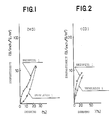
- the nonwoven fabric according to the invention shows in the diagram that a correlation between the tensile strength and the tensile strength reflects a steeply increasing S-curve. This steep S curve appears not only in the MD direction, but also in the CD direction.
- the nonwoven composite has the required property for dimensional stability, ie the initial tensile strength is sufficiently high to suppress any significant elongation.
- this nonwoven composite can be treated with any known repellent and can be subjected to any known plasticizer treatment if desired.
- a carded web of 100% 1.4d x 44 mm polyester fiber was subjected to a first entangling treatment by means of column water jets at a pressure of 50 kg / cm2 in order to obtain an initial fleece of 40 g / m2.
- the nonwoven fabric was subjected to a second fiber entangling treatment using fluid at a pressure of 50 kg / cm 2.
- openings with an opening diameter of 0.13 mm and a distance of 1 mm were used
- openings with a diameter of 0.92 mm and a distance of 0.5 mm were used.
- a carded sheet of 100% 1.4d x 44mm polyester fiber was subjected to a first fiber entanglement treatment by columnar water jets at a pressure of 50 kg / cm2 to obtain a nonwoven fabric of 52 g / m2.
- a paper-like pulp fiber layer with 20 g / m2 was placed on this nonwoven fabric and subjected to a second fiber entangling treatment by columnar water jets at a pressure of 50 kg / cm2 to form a nonwoven fabric with a weight of about 60 g / m2 to obtain.
- the nozzle diameter and the nozzle spacing were both at the first and the second fiber entangling treatment the same dimensions as in Example 1.
- a carded sheet of 100% 1.4d x 44mm polyester fiber was subjected to fiber entanglement treatment with columnar water jets at a pressure of 50 kg / cm2 to obtain a nonwoven fabric weighing 80 g / m2. After a transverse elongation of about 30%, this nonwoven fabric was again subjected to a fiber entanglement treatment by columnar water jet at a pressure of 50 kg / cm2 to obtain a nonwoven fabric weighing about 60 g / m2.
- Example 2 The strain / tensile strength correlation in both MD and CD direction were determined for Example 2 and Comparative Example 2, respectively, and entered in the table.
- Table 2 shows the dimensional CD / MD changes (reduction ratio) that occurs due to the MD / CD pull depending on the change in the weight ratio of the first and second fibers.
Landscapes
- Engineering & Computer Science (AREA)
- Textile Engineering (AREA)
- Chemical & Material Sciences (AREA)
- Chemical Kinetics & Catalysis (AREA)
- Mechanical Engineering (AREA)
- Health & Medical Sciences (AREA)
- General Health & Medical Sciences (AREA)
- Physical Education & Sports Medicine (AREA)
- Nonwoven Fabrics (AREA)
Applications Claiming Priority (2)
| Application Number | Priority Date | Filing Date | Title |
|---|---|---|---|
| JP63152985A JPH0791754B2 (ja) | 1988-06-21 | 1988-06-21 | 複合不織布 |
| JP152985/88 | 1988-06-21 |
Publications (3)
| Publication Number | Publication Date |
|---|---|
| EP0347829A2 true EP0347829A2 (fr) | 1989-12-27 |
| EP0347829A3 EP0347829A3 (en) | 1990-09-19 |
| EP0347829B1 EP0347829B1 (fr) | 1994-09-07 |
Family
ID=15552442
Family Applications (1)
| Application Number | Title | Priority Date | Filing Date |
|---|---|---|---|
| EP89111170A Expired - Lifetime EP0347829B1 (fr) | 1988-06-21 | 1989-06-20 | Nappe de fibres composite, et procédé pour la fabriquer |
Country Status (8)
| Country | Link |
|---|---|
| US (1) | US4883709A (fr) |
| EP (1) | EP0347829B1 (fr) |
| JP (1) | JPH0791754B2 (fr) |
| KR (1) | KR950009488B1 (fr) |
| CA (1) | CA1279178C (fr) |
| DE (1) | DE58908303D1 (fr) |
| FI (1) | FI95055C (fr) |
| GB (1) | GB2220010B (fr) |
Cited By (4)
| Publication number | Priority date | Publication date | Assignee | Title |
|---|---|---|---|---|
| EP0423619A1 (fr) * | 1989-10-13 | 1991-04-24 | Fiberweb North America, Inc. | Etoffe à essuyer et procédé de fabrication |
| EP0557678A1 (fr) * | 1992-02-25 | 1993-09-01 | The Dexter Corporation | Aiguilletage hydraulique d'une étoffe composite Spunbonded et sa procédé de fabrication |
| EP0796940A4 (fr) * | 1995-10-06 | 1999-01-27 | Nippon Petrochemicals Co Ltd | Etoffe non tissee enchevetree par un jet d'eau et procede pour la fabriquer |
| RU2188884C1 (ru) * | 2001-10-01 | 2002-09-10 | Общество с ограниченной ответственностью "Коомед" | Текстильный материал |
Families Citing this family (25)
| Publication number | Priority date | Publication date | Assignee | Title |
|---|---|---|---|---|
| US5144729A (en) * | 1989-10-13 | 1992-09-08 | Fiberweb North America, Inc. | Wiping fabric and method of manufacture |
| JP2975396B2 (ja) * | 1990-05-22 | 1999-11-10 | ダイニック株式会社 | エアーフィルター素材 |
| US5137600A (en) * | 1990-11-01 | 1992-08-11 | Kimberley-Clark Corporation | Hydraulically needled nonwoven pulp fiber web |
| US5328759A (en) * | 1991-11-01 | 1994-07-12 | Kimberly-Clark Corporation | Process for making a hydraulically needled superabsorbent composite material and article thereof |
| GB2264512A (en) * | 1992-02-28 | 1993-09-01 | Lantor | Hydro-entangled non-woven fabric |
| US5252386A (en) * | 1992-03-13 | 1993-10-12 | Chicopee | Fire retardant entangled polyester nonwoven fabric |
| US5290628A (en) * | 1992-11-10 | 1994-03-01 | E. I. Du Pont De Nemours And Company | Hydroentangled flash spun webs having controllable bulk and permeability |
| CA2107169A1 (fr) * | 1993-06-03 | 1994-12-04 | Cherie Hartman Everhart | Materiau permettant le passage de liquides |
| US5540976A (en) * | 1995-01-11 | 1996-07-30 | Kimberly-Clark Corporation | Nonwoven laminate with cross directional stretch |
| DE19843000C2 (de) | 1998-09-21 | 2000-07-13 | Freudenberg Carl Fa | Luftfilter |
| BR9914659A (pt) * | 1998-10-23 | 2001-07-17 | Dexter Corp | Compósito não tecido, processo para a produção do mesmo, artigo, e, método de fabricação do mesmo. |
| KR20000018170A (ko) * | 2000-01-15 | 2000-04-06 | 김종엽 | 화이버 직립형 부직포 제조 방법과 그 적용. |
| AU778886B2 (en) * | 2000-03-24 | 2004-12-23 | Kao Corporation | Bulky sheet and process for producing the same |
| US6838399B1 (en) | 2000-12-01 | 2005-01-04 | Kimberly-Clark Worldwide, Inc. | Fibrous layer providing improved porosity control for nonwoven webs |
| US20040087924A1 (en) * | 2002-11-06 | 2004-05-06 | Kimberly-Clark Worldwide, Inc. | Semi-hydrophobic cover for an absorbent product |
| EP1567701A1 (fr) * | 2002-11-27 | 2005-08-31 | Fleissner GmbH | Procede et dispositif de renforcement uniforme d'un non-tisse |
| US7416638B2 (en) * | 2003-11-18 | 2008-08-26 | Georgia-Pacific Consumer Products Lp | Apparatus and method for manufacturing a multi-layer web product |
| FR2870263B1 (fr) * | 2004-05-11 | 2006-07-07 | Rieter Perfojet Sa | Nontisse large et ses procedes et machine de fabrication |
| US20060230727A1 (en) * | 2005-04-19 | 2006-10-19 | Morgan Howard W | Filtration element having a variable density sidewall |
| WO2008084139A1 (fr) * | 2007-01-12 | 2008-07-17 | Ahlstrom Corporation | Procédé de formation d'un produit non tissé parcheminé renforcé, et produit résultant |
| EP2115200B1 (fr) | 2007-02-15 | 2014-11-05 | Suominen Corporation | Reproduction hydraulique de motifs sur une bande non tissee fibreuse a cotes |
| DE102009016194A1 (de) * | 2008-04-23 | 2009-10-29 | Heidelberger Druckmaschinen Ag | Verfahren zur Herstellung eines Sicherheitsmerkmals auf einem flachen Substrat |
| US20100272938A1 (en) * | 2009-04-22 | 2010-10-28 | Bemis Company, Inc. | Hydraulically-Formed Nonwoven Sheet with Microfibers |
| KR101958482B1 (ko) * | 2012-10-08 | 2019-03-14 | 도레이케미칼 주식회사 | 흡음성능이 우수한 섬유집합체 및 그 제조방법 |
| CN103741372A (zh) * | 2012-12-28 | 2014-04-23 | 辽东学院 | 一种柞蚕丝纤维无纺布及其制造方法 |
Family Cites Families (5)
| Publication number | Priority date | Publication date | Assignee | Title |
|---|---|---|---|---|
| US3747161A (en) * | 1971-08-20 | 1973-07-24 | Johnson & Johnson | Method for producing a rearranged fabric having improved cross-strength |
| JPS58132157A (ja) * | 1982-01-31 | 1983-08-06 | ユニ・チヤ−ム株式会社 | 植毛不織布及びその製造方法 |
| US4442161A (en) * | 1982-11-04 | 1984-04-10 | E. I. Du Pont De Nemours And Company | Woodpulp-polyester spunlaced fabrics |
| JPS59204960A (ja) * | 1983-05-04 | 1984-11-20 | 旭化成株式会社 | 長繊維不織布の製造方法 |
| US4705712A (en) * | 1986-08-11 | 1987-11-10 | Chicopee Corporation | Operating room gown and drape fabric with improved repellent properties |
-
1988
- 1988-06-21 JP JP63152985A patent/JPH0791754B2/ja not_active Expired - Lifetime
- 1988-10-24 US US07/261,426 patent/US4883709A/en not_active Expired - Lifetime
- 1988-12-29 CA CA000587259A patent/CA1279178C/fr not_active Expired - Lifetime
-
1989
- 1989-01-17 FI FI890236A patent/FI95055C/fi not_active IP Right Cessation
- 1989-01-25 KR KR1019890000739A patent/KR950009488B1/ko not_active Expired - Fee Related
- 1989-02-07 GB GB8902625A patent/GB2220010B/en not_active Expired - Lifetime
- 1989-06-20 EP EP89111170A patent/EP0347829B1/fr not_active Expired - Lifetime
- 1989-06-20 DE DE58908303T patent/DE58908303D1/de not_active Expired - Fee Related
Cited By (4)
| Publication number | Priority date | Publication date | Assignee | Title |
|---|---|---|---|---|
| EP0423619A1 (fr) * | 1989-10-13 | 1991-04-24 | Fiberweb North America, Inc. | Etoffe à essuyer et procédé de fabrication |
| EP0557678A1 (fr) * | 1992-02-25 | 1993-09-01 | The Dexter Corporation | Aiguilletage hydraulique d'une étoffe composite Spunbonded et sa procédé de fabrication |
| EP0796940A4 (fr) * | 1995-10-06 | 1999-01-27 | Nippon Petrochemicals Co Ltd | Etoffe non tissee enchevetree par un jet d'eau et procede pour la fabriquer |
| RU2188884C1 (ru) * | 2001-10-01 | 2002-09-10 | Общество с ограниченной ответственностью "Коомед" | Текстильный материал |
Also Published As
| Publication number | Publication date |
|---|---|
| GB2220010A (en) | 1989-12-28 |
| FI95055C (fi) | 1995-12-11 |
| FI890236L (fi) | 1989-12-22 |
| GB2220010B (en) | 1992-06-24 |
| KR900000529A (ko) | 1990-01-30 |
| FI95055B (fi) | 1995-08-31 |
| GB8902625D0 (en) | 1989-03-30 |
| US4883709A (en) | 1989-11-28 |
| KR950009488B1 (ko) | 1995-08-23 |
| FI890236A0 (fi) | 1989-01-17 |
| EP0347829B1 (fr) | 1994-09-07 |
| EP0347829A3 (en) | 1990-09-19 |
| JPH01321959A (ja) | 1989-12-27 |
| JPH0791754B2 (ja) | 1995-10-04 |
| CA1279178C (fr) | 1991-01-22 |
| DE58908303D1 (de) | 1994-10-13 |
Similar Documents
| Publication | Publication Date | Title |
|---|---|---|
| EP0347829B1 (fr) | Nappe de fibres composite, et procédé pour la fabriquer | |
| DE69529768T2 (de) | Verfahren und herstellung zur hydroverwirrung von vliesstoffen | |
| DE69107784T2 (de) | Papierhandtuch mit voluminöser Lage. | |
| DE3889522T2 (de) | Vliesstoff aus hydraulisch genadelten, elastischen und nichtelastischen Filamenten. | |
| DE68919492T2 (de) | Elastomerischer Vliesstoff und Verfahren zu dessen Herstellung. | |
| DE68913057T2 (de) | Nichtgewebtes, faseriges, nichtelastisches Material und Verfahren zu dessen Herstellung. | |
| DE69310167T2 (de) | Gemusterte wasserstrahlenverfestigte vliesstoffe aus holzpulpe und/oder holzpulpeartigen fasern | |
| DE68923719T2 (de) | Gebundenes, nichtgewebtes Material und Verfahren und Vorrichtung zu dessen Herstellung. | |
| DE69129991T2 (de) | Anlage und verfahren zur gewebeverbesserung mittels wasserstrahlbehandlung | |
| DE69212458T2 (de) | Verbund Spinnvlies mit Wasserstrahlen verfestigt und das Herstellverfahren | |
| DE3889460T2 (de) | Papiermaschinendruckfilz. | |
| DE69600146T2 (de) | Verfahren zur herstellung einer musterfreien vliesstoffbahn unter verwendung von hochdruckwasserstrahlung und vorrichtung dafür | |
| DE69021147T2 (de) | Verfahren zur Hydroverwirrung von nichtgewebten faserigen Flächen. | |
| DE69404144T2 (de) | Bauschiger, stabiler vliesstoff | |
| DE3689328T2 (de) | Leichter verwickelter nichtgewobener Vliesstoff mit guter Reissfestigkeit in der Maschinen- und Querrichtung und Verfahren zur Herstellung desselben. | |
| DE3688644T2 (de) | Zusammengesetztes Bahnmaterial für Kunstleder und Verfahren zur Herstellung desselben. | |
| DE69130638T2 (de) | Wirkfaservliesstoffe aus Acryl/Polyester | |
| EP3289131B1 (fr) | Installation et procédé de consolidation et de structuration de fibres à un non-tissé | |
| DE2731291A1 (de) | Wildlederartiges bahnmaterial und verfahren zu seiner herstellung | |
| DE69513013T2 (de) | Reinigungsartikel, Substrat dafür und sein Herstellungsverfahren | |
| DE60123437T2 (de) | Verfahren und vorrichtung zur verbesserung der isotropie von vliesstoffen | |
| DE3886304T2 (de) | Kontinuierliches Verfahren zur Herstellung eines Verbundvliesstoffes. | |
| DE69123853T2 (de) | Verfahren und anlage zur spinnvliesherstellung und fertigerzeugnisse | |
| DE2042798C3 (de) | Verfahren zur Herstellung eines Bündels aus feinen Fäden mit Fibrillen | |
| DE2718036A1 (de) | Papiermacherfilz und verfahren zu seiner herstellung |
Legal Events
| Date | Code | Title | Description |
|---|---|---|---|
| PUAI | Public reference made under article 153(3) epc to a published international application that has entered the european phase |
Free format text: ORIGINAL CODE: 0009012 |
|
| AK | Designated contracting states |
Kind code of ref document: A2 Designated state(s): DE FR IT SE |
|
| PUAL | Search report despatched |
Free format text: ORIGINAL CODE: 0009013 |
|
| AK | Designated contracting states |
Kind code of ref document: A3 Designated state(s): DE FR IT SE |
|
| 17P | Request for examination filed |
Effective date: 19910319 |
|
| 17Q | First examination report despatched |
Effective date: 19921006 |
|
| GRAA | (expected) grant |
Free format text: ORIGINAL CODE: 0009210 |
|
| AK | Designated contracting states |
Kind code of ref document: B1 Designated state(s): DE FR IT SE |
|
| REF | Corresponds to: |
Ref document number: 58908303 Country of ref document: DE Date of ref document: 19941013 |
|
| ITF | It: translation for a ep patent filed | ||
| ET | Fr: translation filed | ||
| EAL | Se: european patent in force in sweden |
Ref document number: 89111170.0 |
|
| PLBE | No opposition filed within time limit |
Free format text: ORIGINAL CODE: 0009261 |
|
| STAA | Information on the status of an ep patent application or granted ep patent |
Free format text: STATUS: NO OPPOSITION FILED WITHIN TIME LIMIT |
|
| 26N | No opposition filed | ||
| PGFP | Annual fee paid to national office [announced via postgrant information from national office to epo] |
Ref country code: FR Payment date: 20060608 Year of fee payment: 18 |
|
| PGFP | Annual fee paid to national office [announced via postgrant information from national office to epo] |
Ref country code: SE Payment date: 20070607 Year of fee payment: 19 |
|
| PGFP | Annual fee paid to national office [announced via postgrant information from national office to epo] |
Ref country code: DE Payment date: 20070614 Year of fee payment: 19 |
|
| PGFP | Annual fee paid to national office [announced via postgrant information from national office to epo] |
Ref country code: IT Payment date: 20070626 Year of fee payment: 19 |
|
| REG | Reference to a national code |
Ref country code: FR Ref legal event code: ST Effective date: 20080229 |
|
| PG25 | Lapsed in a contracting state [announced via postgrant information from national office to epo] |
Ref country code: FR Free format text: LAPSE BECAUSE OF NON-PAYMENT OF DUE FEES Effective date: 20070702 |
|
| EUG | Se: european patent has lapsed | ||
| PG25 | Lapsed in a contracting state [announced via postgrant information from national office to epo] |
Ref country code: DE Free format text: LAPSE BECAUSE OF NON-PAYMENT OF DUE FEES Effective date: 20090101 |
|
| PG25 | Lapsed in a contracting state [announced via postgrant information from national office to epo] |
Ref country code: IT Free format text: LAPSE BECAUSE OF NON-PAYMENT OF DUE FEES Effective date: 20080620 |
|
| PG25 | Lapsed in a contracting state [announced via postgrant information from national office to epo] |
Ref country code: SE Free format text: LAPSE BECAUSE OF NON-PAYMENT OF DUE FEES Effective date: 20080621 |