EP0351588A2 - Farbfotografisches Aufzeichnungsmaterial - Google Patents
Farbfotografisches Aufzeichnungsmaterial Download PDFInfo
- Publication number
- EP0351588A2 EP0351588A2 EP89111523A EP89111523A EP0351588A2 EP 0351588 A2 EP0351588 A2 EP 0351588A2 EP 89111523 A EP89111523 A EP 89111523A EP 89111523 A EP89111523 A EP 89111523A EP 0351588 A2 EP0351588 A2 EP 0351588A2
- Authority
- EP
- European Patent Office
- Prior art keywords
- layer
- optionally substituted
- compounds
- alkyl
- dyes
- Prior art date
- Legal status (The legal status is an assumption and is not a legal conclusion. Google has not performed a legal analysis and makes no representation as to the accuracy of the status listed.)
- Granted
Links
- 239000000463 material Substances 0.000 title claims abstract description 31
- 238000012937 correction Methods 0.000 claims abstract description 22
- 239000000975 dye Substances 0.000 claims description 60
- -1 silver halide Chemical class 0.000 claims description 54
- 239000000839 emulsion Substances 0.000 claims description 43
- 229910052709 silver Inorganic materials 0.000 claims description 37
- 239000004332 silver Substances 0.000 claims description 37
- 125000004178 (C1-C4) alkyl group Chemical group 0.000 claims description 22
- 230000035945 sensitivity Effects 0.000 claims description 20
- 230000003595 spectral effect Effects 0.000 claims description 12
- 229910052736 halogen Inorganic materials 0.000 claims description 11
- 150000002367 halogens Chemical class 0.000 claims description 10
- 229910052739 hydrogen Inorganic materials 0.000 claims description 9
- 125000006274 (C1-C3)alkoxy group Chemical group 0.000 claims description 8
- 125000000041 C6-C10 aryl group Chemical group 0.000 claims description 8
- 150000004989 p-phenylenediamines Chemical class 0.000 claims description 5
- 238000005691 oxidative coupling reaction Methods 0.000 claims description 4
- 125000001424 substituent group Chemical group 0.000 claims description 3
- 125000000229 (C1-C4)alkoxy group Chemical group 0.000 claims description 2
- 125000000882 C2-C6 alkenyl group Chemical group 0.000 claims description 2
- 125000003601 C2-C6 alkynyl group Chemical group 0.000 claims description 2
- 229910052801 chlorine Inorganic materials 0.000 claims description 2
- 125000004093 cyano group Chemical group *C#N 0.000 claims description 2
- 229910052731 fluorine Inorganic materials 0.000 claims description 2
- 125000004404 heteroalkyl group Chemical group 0.000 claims description 2
- 238000003860 storage Methods 0.000 abstract description 18
- 239000010410 layer Substances 0.000 description 118
- 150000001875 compounds Chemical class 0.000 description 46
- SQGYOTSLMSWVJD-UHFFFAOYSA-N silver(1+) nitrate Chemical compound [Ag+].[O-]N(=O)=O SQGYOTSLMSWVJD-UHFFFAOYSA-N 0.000 description 36
- 229920000159 gelatin Polymers 0.000 description 33
- 235000019322 gelatine Nutrition 0.000 description 33
- 108010010803 Gelatin Proteins 0.000 description 32
- 235000011852 gelatine desserts Nutrition 0.000 description 32
- 239000008273 gelatin Substances 0.000 description 30
- 235000013339 cereals Nutrition 0.000 description 25
- 238000011161 development Methods 0.000 description 19
- WSFSSNUMVMOOMR-UHFFFAOYSA-N Formaldehyde Chemical compound O=C WSFSSNUMVMOOMR-UHFFFAOYSA-N 0.000 description 15
- OKKJLVBELUTLKV-UHFFFAOYSA-N Methanol Chemical compound OC OKKJLVBELUTLKV-UHFFFAOYSA-N 0.000 description 15
- YSMRWXYRXBRSND-UHFFFAOYSA-N TOTP Chemical compound CC1=CC=CC=C1OP(=O)(OC=1C(=CC=CC=1)C)OC1=CC=CC=C1C YSMRWXYRXBRSND-UHFFFAOYSA-N 0.000 description 14
- 239000003795 chemical substances by application Substances 0.000 description 13
- 238000000034 method Methods 0.000 description 12
- XMBWDFGMSWQBCA-UHFFFAOYSA-N hydrogen iodide Chemical compound I XMBWDFGMSWQBCA-UHFFFAOYSA-N 0.000 description 11
- 239000000047 product Substances 0.000 description 11
- XLYOFNOQVPJJNP-UHFFFAOYSA-N water Substances O XLYOFNOQVPJJNP-UHFFFAOYSA-N 0.000 description 11
- 125000003118 aryl group Chemical group 0.000 description 10
- 230000008878 coupling Effects 0.000 description 10
- 238000010168 coupling process Methods 0.000 description 10
- 238000005859 coupling reaction Methods 0.000 description 10
- DOIRQSBPFJWKBE-UHFFFAOYSA-N dibutyl phthalate Chemical compound CCCCOC(=O)C1=CC=CC=C1C(=O)OCCCC DOIRQSBPFJWKBE-UHFFFAOYSA-N 0.000 description 10
- 239000000203 mixture Substances 0.000 description 10
- 239000000523 sample Substances 0.000 description 9
- 206010070834 Sensitisation Diseases 0.000 description 8
- 229910052794 bromium Inorganic materials 0.000 description 8
- 239000003112 inhibitor Substances 0.000 description 8
- 229910052740 iodine Inorganic materials 0.000 description 8
- 230000008313 sensitization Effects 0.000 description 8
- UFHFLCQGNIYNRP-UHFFFAOYSA-N Hydrogen Chemical compound [H][H] UFHFLCQGNIYNRP-UHFFFAOYSA-N 0.000 description 7
- 238000004061 bleaching Methods 0.000 description 7
- 238000005266 casting Methods 0.000 description 7
- 238000006243 chemical reaction Methods 0.000 description 7
- 150000004820 halides Chemical class 0.000 description 7
- 239000001257 hydrogen Substances 0.000 description 7
- 230000003647 oxidation Effects 0.000 description 7
- 238000007254 oxidation reaction Methods 0.000 description 7
- 125000001997 phenyl group Chemical group [H]C1=C([H])C([H])=C(*)C([H])=C1[H] 0.000 description 7
- 238000001556 precipitation Methods 0.000 description 7
- 238000012545 processing Methods 0.000 description 7
- 238000005406 washing Methods 0.000 description 7
- XEKOWRVHYACXOJ-UHFFFAOYSA-N Ethyl acetate Chemical compound CCOC(C)=O XEKOWRVHYACXOJ-UHFFFAOYSA-N 0.000 description 6
- NQRYJNQNLNOLGT-UHFFFAOYSA-N Piperidine Chemical compound C1CCNCC1 NQRYJNQNLNOLGT-UHFFFAOYSA-N 0.000 description 6
- 239000011230 binding agent Substances 0.000 description 6
- 150000002431 hydrogen Chemical class 0.000 description 6
- 238000004519 manufacturing process Methods 0.000 description 6
- 239000004848 polyfunctional curative Substances 0.000 description 6
- 229920000642 polymer Polymers 0.000 description 6
- 230000008569 process Effects 0.000 description 6
- 238000009877 rendering Methods 0.000 description 6
- 238000011160 research Methods 0.000 description 6
- ISWSIDIOOBJBQZ-UHFFFAOYSA-N Phenol Chemical compound OC1=CC=CC=C1 ISWSIDIOOBJBQZ-UHFFFAOYSA-N 0.000 description 5
- BQCADISMDOOEFD-UHFFFAOYSA-N Silver Chemical compound [Ag] BQCADISMDOOEFD-UHFFFAOYSA-N 0.000 description 5
- 230000015572 biosynthetic process Effects 0.000 description 5
- 230000015556 catabolic process Effects 0.000 description 5
- 239000013078 crystal Substances 0.000 description 5
- 238000006731 degradation reaction Methods 0.000 description 5
- 230000000694 effects Effects 0.000 description 5
- 239000011241 protective layer Substances 0.000 description 5
- 150000003839 salts Chemical class 0.000 description 5
- 239000002904 solvent Substances 0.000 description 5
- 230000000087 stabilizing effect Effects 0.000 description 5
- 239000000126 substance Substances 0.000 description 5
- KJCVRFUGPWSIIH-UHFFFAOYSA-N 1-naphthol Chemical compound C1=CC=C2C(O)=CC=CC2=C1 KJCVRFUGPWSIIH-UHFFFAOYSA-N 0.000 description 4
- QIGBRXMKCJKVMJ-UHFFFAOYSA-N Hydroquinone Chemical compound OC1=CC=C(O)C=C1 QIGBRXMKCJKVMJ-UHFFFAOYSA-N 0.000 description 4
- GLUUGHFHXGJENI-UHFFFAOYSA-N Piperazine Chemical compound C1CNCCN1 GLUUGHFHXGJENI-UHFFFAOYSA-N 0.000 description 4
- WQDUMFSSJAZKTM-UHFFFAOYSA-N Sodium methoxide Chemical compound [Na+].[O-]C WQDUMFSSJAZKTM-UHFFFAOYSA-N 0.000 description 4
- 239000002253 acid Substances 0.000 description 4
- 125000000217 alkyl group Chemical group 0.000 description 4
- ROOXNKNUYICQNP-UHFFFAOYSA-N ammonium persulfate Chemical compound [NH4+].[NH4+].[O-]S(=O)(=O)OOS([O-])(=O)=O ROOXNKNUYICQNP-UHFFFAOYSA-N 0.000 description 4
- 230000006866 deterioration Effects 0.000 description 4
- 230000006870 function Effects 0.000 description 4
- DZVCFNFOPIZQKX-LTHRDKTGSA-M merocyanine Chemical compound [Na+].O=C1N(CCCC)C(=O)N(CCCC)C(=O)C1=C\C=C\C=C/1N(CCCS([O-])(=O)=O)C2=CC=CC=C2O\1 DZVCFNFOPIZQKX-LTHRDKTGSA-M 0.000 description 4
- 229910052751 metal Inorganic materials 0.000 description 4
- 239000002184 metal Substances 0.000 description 4
- 125000001570 methylene group Chemical group [H]C([H])([*:1])[*:2] 0.000 description 4
- IOLCXVTUBQKXJR-UHFFFAOYSA-M potassium bromide Chemical compound [K+].[Br-] IOLCXVTUBQKXJR-UHFFFAOYSA-M 0.000 description 4
- 150000003378 silver Chemical class 0.000 description 4
- GEHJYWRUCIMESM-UHFFFAOYSA-L sodium sulfite Chemical compound [Na+].[Na+].[O-]S([O-])=O GEHJYWRUCIMESM-UHFFFAOYSA-L 0.000 description 4
- 125000006850 spacer group Chemical group 0.000 description 4
- QGKMIGUHVLGJBR-UHFFFAOYSA-M (4z)-1-(3-methylbutyl)-4-[[1-(3-methylbutyl)quinolin-1-ium-4-yl]methylidene]quinoline;iodide Chemical compound [I-].C12=CC=CC=C2N(CCC(C)C)C=CC1=CC1=CC=[N+](CCC(C)C)C2=CC=CC=C12 QGKMIGUHVLGJBR-UHFFFAOYSA-M 0.000 description 3
- YMWUJEATGCHHMB-UHFFFAOYSA-N Dichloromethane Chemical compound ClCCl YMWUJEATGCHHMB-UHFFFAOYSA-N 0.000 description 3
- VTLYFUHAOXGGBS-UHFFFAOYSA-N Fe3+ Chemical class [Fe+3] VTLYFUHAOXGGBS-UHFFFAOYSA-N 0.000 description 3
- 239000006096 absorbing agent Substances 0.000 description 3
- 230000002378 acidificating effect Effects 0.000 description 3
- 150000001412 amines Chemical class 0.000 description 3
- 125000003277 amino group Chemical group 0.000 description 3
- 150000001565 benzotriazoles Chemical class 0.000 description 3
- 125000003178 carboxy group Chemical group [H]OC(*)=O 0.000 description 3
- 239000001913 cellulose Substances 0.000 description 3
- 229920002678 cellulose Polymers 0.000 description 3
- 235000010980 cellulose Nutrition 0.000 description 3
- 239000008139 complexing agent Substances 0.000 description 3
- 239000006185 dispersion Substances 0.000 description 3
- 238000009826 distribution Methods 0.000 description 3
- 125000000623 heterocyclic group Chemical group 0.000 description 3
- 125000002887 hydroxy group Chemical group [H]O* 0.000 description 3
- RAXXELZNTBOGNW-UHFFFAOYSA-N imidazole Natural products C1=CNC=N1 RAXXELZNTBOGNW-UHFFFAOYSA-N 0.000 description 3
- 150000002739 metals Chemical class 0.000 description 3
- 230000007935 neutral effect Effects 0.000 description 3
- 229910052757 nitrogen Inorganic materials 0.000 description 3
- 239000002245 particle Substances 0.000 description 3
- 150000002989 phenols Chemical class 0.000 description 3
- 230000005070 ripening Effects 0.000 description 3
- QAOWNCQODCNURD-UHFFFAOYSA-N sulfuric acid Substances OS(O)(=O)=O QAOWNCQODCNURD-UHFFFAOYSA-N 0.000 description 3
- 230000008961 swelling Effects 0.000 description 3
- 238000003786 synthesis reaction Methods 0.000 description 3
- 125000006273 (C1-C3) alkyl group Chemical group 0.000 description 2
- WNWHHMBRJJOGFJ-UHFFFAOYSA-N 16-methylheptadecan-1-ol Chemical compound CC(C)CCCCCCCCCCCCCCCO WNWHHMBRJJOGFJ-UHFFFAOYSA-N 0.000 description 2
- ULOIAOPTGWSNHU-UHFFFAOYSA-N 2-butyl radical Chemical group C[CH]CC ULOIAOPTGWSNHU-UHFFFAOYSA-N 0.000 description 2
- QGZKDVFQNNGYKY-UHFFFAOYSA-N Ammonia Chemical compound N QGZKDVFQNNGYKY-UHFFFAOYSA-N 0.000 description 2
- CPELXLSAUQHCOX-UHFFFAOYSA-M Bromide Chemical compound [Br-] CPELXLSAUQHCOX-UHFFFAOYSA-M 0.000 description 2
- 0 C*C(C1)C(*)CC(C(C)(*)C2)=C1C2(CC1(C)C)C2C1=CC(*)=C(*)C2 Chemical compound C*C(C1)C(*)CC(C(C)(*)C2)=C1C2(CC1(C)C)C2C1=CC(*)=C(*)C2 0.000 description 2
- BZVZOFXXJNWFDY-UHFFFAOYSA-N CCCCCCCCCCCCCOOP(=O)(O)O Chemical compound CCCCCCCCCCCCCOOP(=O)(O)O BZVZOFXXJNWFDY-UHFFFAOYSA-N 0.000 description 2
- 229920002284 Cellulose triacetate Polymers 0.000 description 2
- KCXVZYZYPLLWCC-UHFFFAOYSA-N EDTA Chemical compound OC(=O)CN(CC(O)=O)CCN(CC(O)=O)CC(O)=O KCXVZYZYPLLWCC-UHFFFAOYSA-N 0.000 description 2
- MHAJPDPJQMAIIY-UHFFFAOYSA-N Hydrogen peroxide Chemical compound OO MHAJPDPJQMAIIY-UHFFFAOYSA-N 0.000 description 2
- YNAVUWVOSKDBBP-UHFFFAOYSA-N Morpholine Chemical group C1COCCN1 YNAVUWVOSKDBBP-UHFFFAOYSA-N 0.000 description 2
- CWNSVVHTTQBGQB-UHFFFAOYSA-N N,N-Diethyldodecanamide Chemical compound CCCCCCCCCCCC(=O)N(CC)CC CWNSVVHTTQBGQB-UHFFFAOYSA-N 0.000 description 2
- 238000001016 Ostwald ripening Methods 0.000 description 2
- KDLHZDBZIXYQEI-UHFFFAOYSA-N Palladium Chemical compound [Pd] KDLHZDBZIXYQEI-UHFFFAOYSA-N 0.000 description 2
- NBIIXXVUZAFLBC-UHFFFAOYSA-N Phosphoric acid Chemical compound OP(O)(O)=O NBIIXXVUZAFLBC-UHFFFAOYSA-N 0.000 description 2
- ZLMJMSJWJFRBEC-UHFFFAOYSA-N Potassium Chemical compound [K] ZLMJMSJWJFRBEC-UHFFFAOYSA-N 0.000 description 2
- KAESVJOAVNADME-UHFFFAOYSA-N Pyrrole Chemical compound C=1C=CNC=1 KAESVJOAVNADME-UHFFFAOYSA-N 0.000 description 2
- UIIMBOGNXHQVGW-UHFFFAOYSA-M Sodium bicarbonate Chemical compound [Na+].OC([O-])=O UIIMBOGNXHQVGW-UHFFFAOYSA-M 0.000 description 2
- NINIDFKCEFEMDL-UHFFFAOYSA-N Sulfur Chemical compound [S] NINIDFKCEFEMDL-UHFFFAOYSA-N 0.000 description 2
- WYURNTSHIVDZCO-UHFFFAOYSA-N Tetrahydrofuran Chemical compound C1CCOC1 WYURNTSHIVDZCO-UHFFFAOYSA-N 0.000 description 2
- GWEVSGVZZGPLCZ-UHFFFAOYSA-N Titan oxide Chemical compound O=[Ti]=O GWEVSGVZZGPLCZ-UHFFFAOYSA-N 0.000 description 2
- UYXTWWCETRIEDR-UHFFFAOYSA-N Tributyrin Chemical compound CCCC(=O)OCC(OC(=O)CCC)COC(=O)CCC UYXTWWCETRIEDR-UHFFFAOYSA-N 0.000 description 2
- NNLVGZFZQQXQNW-ADJNRHBOSA-N [(2r,3r,4s,5r,6s)-4,5-diacetyloxy-3-[(2s,3r,4s,5r,6r)-3,4,5-triacetyloxy-6-(acetyloxymethyl)oxan-2-yl]oxy-6-[(2r,3r,4s,5r,6s)-4,5,6-triacetyloxy-2-(acetyloxymethyl)oxan-3-yl]oxyoxan-2-yl]methyl acetate Chemical compound O([C@@H]1O[C@@H]([C@H]([C@H](OC(C)=O)[C@H]1OC(C)=O)O[C@H]1[C@@H]([C@@H](OC(C)=O)[C@H](OC(C)=O)[C@@H](COC(C)=O)O1)OC(C)=O)COC(=O)C)[C@@H]1[C@@H](COC(C)=O)O[C@@H](OC(C)=O)[C@H](OC(C)=O)[C@H]1OC(C)=O NNLVGZFZQQXQNW-ADJNRHBOSA-N 0.000 description 2
- 150000007513 acids Chemical class 0.000 description 2
- 239000000654 additive Substances 0.000 description 2
- 125000003545 alkoxy group Chemical group 0.000 description 2
- 125000002947 alkylene group Chemical group 0.000 description 2
- 229910001870 ammonium persulfate Inorganic materials 0.000 description 2
- 235000019395 ammonium persulphate Nutrition 0.000 description 2
- 125000000129 anionic group Chemical group 0.000 description 2
- 150000001450 anions Chemical class 0.000 description 2
- 125000003710 aryl alkyl group Chemical group 0.000 description 2
- 125000004429 atom Chemical group 0.000 description 2
- 244000052616 bacterial pathogen Species 0.000 description 2
- 230000008901 benefit Effects 0.000 description 2
- JEHKKBHWRAXMCH-UHFFFAOYSA-N benzenesulfinic acid Chemical compound O[S@@](=O)C1=CC=CC=C1 JEHKKBHWRAXMCH-UHFFFAOYSA-N 0.000 description 2
- 239000007844 bleaching agent Substances 0.000 description 2
- 238000009835 boiling Methods 0.000 description 2
- 229910052793 cadmium Inorganic materials 0.000 description 2
- 239000011248 coating agent Substances 0.000 description 2
- 238000000576 coating method Methods 0.000 description 2
- 229920001577 copolymer Polymers 0.000 description 2
- 238000004132 cross linking Methods 0.000 description 2
- 238000009792 diffusion process Methods 0.000 description 2
- 125000000524 functional group Chemical group 0.000 description 2
- PCHJSUWPFVWCPO-UHFFFAOYSA-N gold Chemical compound [Au] PCHJSUWPFVWCPO-UHFFFAOYSA-N 0.000 description 2
- 229910052737 gold Inorganic materials 0.000 description 2
- 239000010931 gold Substances 0.000 description 2
- 229910052741 iridium Inorganic materials 0.000 description 2
- 239000007800 oxidant agent Substances 0.000 description 2
- 230000001590 oxidative effect Effects 0.000 description 2
- 150000003014 phosphoric acid esters Chemical class 0.000 description 2
- 238000005554 pickling Methods 0.000 description 2
- BASFCYQUMIYNBI-UHFFFAOYSA-N platinum Chemical compound [Pt] BASFCYQUMIYNBI-UHFFFAOYSA-N 0.000 description 2
- 229920000120 polyethyl acrylate Polymers 0.000 description 2
- KMUONIBRACKNSN-UHFFFAOYSA-N potassium dichromate Chemical compound [K+].[K+].[O-][Cr](=O)(=O)O[Cr]([O-])(=O)=O KMUONIBRACKNSN-UHFFFAOYSA-N 0.000 description 2
- UGZVCHWAXABBHR-UHFFFAOYSA-O pyridin-1-ium-1-carboxamide Chemical class NC(=O)[N+]1=CC=CC=C1 UGZVCHWAXABBHR-UHFFFAOYSA-O 0.000 description 2
- 239000002516 radical scavenger Substances 0.000 description 2
- 238000000926 separation method Methods 0.000 description 2
- ADZWSOLPGZMUMY-UHFFFAOYSA-M silver bromide Chemical compound [Ag]Br ADZWSOLPGZMUMY-UHFFFAOYSA-M 0.000 description 2
- 235000010265 sodium sulphite Nutrition 0.000 description 2
- 230000006641 stabilisation Effects 0.000 description 2
- 238000011105 stabilization Methods 0.000 description 2
- 229910052717 sulfur Inorganic materials 0.000 description 2
- 239000011593 sulfur Substances 0.000 description 2
- 239000004094 surface-active agent Substances 0.000 description 2
- 150000003568 thioethers Chemical class 0.000 description 2
- LUMLZKVIXLWTCI-NSCUHMNNSA-N (e)-2,3-dichloro-4-oxobut-2-enoic acid Chemical compound OC(=O)C(\Cl)=C(/Cl)C=O LUMLZKVIXLWTCI-NSCUHMNNSA-N 0.000 description 1
- WBYWAXJHAXSJNI-VOTSOKGWSA-M .beta-Phenylacrylic acid Natural products [O-]C(=O)\C=C\C1=CC=CC=C1 WBYWAXJHAXSJNI-VOTSOKGWSA-M 0.000 description 1
- IAUKWGFWINVWKS-UHFFFAOYSA-N 1,2-di(propan-2-yl)naphthalene Chemical compound C1=CC=CC2=C(C(C)C)C(C(C)C)=CC=C21 IAUKWGFWINVWKS-UHFFFAOYSA-N 0.000 description 1
- IRFSXVIRXMYULF-UHFFFAOYSA-N 1,2-dihydroquinoline Chemical class C1=CC=C2C=CCNC2=C1 IRFSXVIRXMYULF-UHFFFAOYSA-N 0.000 description 1
- FTNJQNQLEGKTGD-UHFFFAOYSA-N 1,3-benzodioxole Chemical class C1=CC=C2OCOC2=C1 FTNJQNQLEGKTGD-UHFFFAOYSA-N 0.000 description 1
- YXIWHUQXZSMYRE-UHFFFAOYSA-N 1,3-benzothiazole-2-thiol Chemical class C1=CC=C2SC(S)=NC2=C1 YXIWHUQXZSMYRE-UHFFFAOYSA-N 0.000 description 1
- BCMCBBGGLRIHSE-UHFFFAOYSA-N 1,3-benzoxazole Chemical class C1=CC=C2OC=NC2=C1 BCMCBBGGLRIHSE-UHFFFAOYSA-N 0.000 description 1
- YHMYGUUIMTVXNW-UHFFFAOYSA-N 1,3-dihydrobenzimidazole-2-thione Chemical class C1=CC=C2NC(S)=NC2=C1 YHMYGUUIMTVXNW-UHFFFAOYSA-N 0.000 description 1
- ZRHUHDUEXWHZMA-UHFFFAOYSA-N 1,4-dihydropyrazol-5-one Chemical compound O=C1CC=NN1 ZRHUHDUEXWHZMA-UHFFFAOYSA-N 0.000 description 1
- 150000005208 1,4-dihydroxybenzenes Chemical class 0.000 description 1
- OXLXSOPFNVKUMU-UHFFFAOYSA-N 1,4-dioctoxy-1,4-dioxobutane-2-sulfonic acid Chemical compound CCCCCCCCOC(=O)CC(S(O)(=O)=O)C(=O)OCCCCCCCC OXLXSOPFNVKUMU-UHFFFAOYSA-N 0.000 description 1
- FCTDKZOUZXYHNA-UHFFFAOYSA-N 1,4-dioxane-2,2-diol Chemical compound OC1(O)COCCO1 FCTDKZOUZXYHNA-UHFFFAOYSA-N 0.000 description 1
- CBCKQZAAMUWICA-UHFFFAOYSA-N 1,4-phenylenediamine Chemical compound NC1=CC=C(N)C=C1 CBCKQZAAMUWICA-UHFFFAOYSA-N 0.000 description 1
- MZFSRQQVIKFYON-UHFFFAOYSA-N 1-(3-acetyl-5-prop-2-enoyl-1,3,5-triazinan-1-yl)prop-2-en-1-one Chemical compound CC(=O)N1CN(C(=O)C=C)CN(C(=O)C=C)C1 MZFSRQQVIKFYON-UHFFFAOYSA-N 0.000 description 1
- GGZHVNZHFYCSEV-UHFFFAOYSA-N 1-Phenyl-5-mercaptotetrazole Chemical compound SC1=NN=NN1C1=CC=CC=C1 GGZHVNZHFYCSEV-UHFFFAOYSA-N 0.000 description 1
- YGDWUQFZMXWDKE-UHFFFAOYSA-N 1-oxido-1,3-thiazole Chemical class [O-]S1=CN=C=C1 YGDWUQFZMXWDKE-UHFFFAOYSA-N 0.000 description 1
- VQNVPKIIYQJWCF-UHFFFAOYSA-N 1-tetradecylpyrrolidin-2-one Chemical compound CCCCCCCCCCCCCCN1CCCC1=O VQNVPKIIYQJWCF-UHFFFAOYSA-N 0.000 description 1
- RWKSBJVOQGKDFZ-UHFFFAOYSA-N 16-methylheptadecyl 2-hydroxypropanoate Chemical compound CC(C)CCCCCCCCCCCCCCCOC(=O)C(C)O RWKSBJVOQGKDFZ-UHFFFAOYSA-N 0.000 description 1
- CARFETJZUQORNQ-UHFFFAOYSA-N 1h-pyrrole-2-thiol Chemical class SC1=CC=CN1 CARFETJZUQORNQ-UHFFFAOYSA-N 0.000 description 1
- JAAIPIWKKXCNOC-UHFFFAOYSA-N 1h-tetrazol-1-ium-5-thiolate Chemical class SC1=NN=NN1 JAAIPIWKKXCNOC-UHFFFAOYSA-N 0.000 description 1
- PRAJOOPKIIUZRM-UHFFFAOYSA-N 2,2-dichloro-1,4-dioxane Chemical compound ClC1(Cl)COCCO1 PRAJOOPKIIUZRM-UHFFFAOYSA-N 0.000 description 1
- HGQDBHBWRAYRMJ-UHFFFAOYSA-N 2,2-diethyldodecanamide Chemical compound CCCCCCCCCCC(CC)(CC)C(N)=O HGQDBHBWRAYRMJ-UHFFFAOYSA-N 0.000 description 1
- WMVJWKURWRGJCI-UHFFFAOYSA-N 2,4-bis(2-methylbutan-2-yl)phenol Chemical compound CCC(C)(C)C1=CC=C(O)C(C(C)(C)CC)=C1 WMVJWKURWRGJCI-UHFFFAOYSA-N 0.000 description 1
- YKUDHBLDJYZZQS-UHFFFAOYSA-N 2,6-dichloro-1h-1,3,5-triazin-4-one Chemical compound OC1=NC(Cl)=NC(Cl)=N1 YKUDHBLDJYZZQS-UHFFFAOYSA-N 0.000 description 1
- SMZOUWXMTYCWNB-UHFFFAOYSA-N 2-(2-methoxy-5-methylphenyl)ethanamine Chemical compound COC1=CC=C(C)C=C1CCN SMZOUWXMTYCWNB-UHFFFAOYSA-N 0.000 description 1
- VTIMKVIDORQQFA-UHFFFAOYSA-N 2-Ethylhexyl-4-hydroxybenzoate Chemical compound CCCCC(CC)COC(=O)C1=CC=C(O)C=C1 VTIMKVIDORQQFA-UHFFFAOYSA-N 0.000 description 1
- NIXOWILDQLNWCW-UHFFFAOYSA-N 2-Propenoic acid Natural products OC(=O)C=C NIXOWILDQLNWCW-UHFFFAOYSA-N 0.000 description 1
- URDCARMUOSMFFI-UHFFFAOYSA-N 2-[2-[bis(carboxymethyl)amino]ethyl-(2-hydroxyethyl)amino]acetic acid Chemical compound OCCN(CC(O)=O)CCN(CC(O)=O)CC(O)=O URDCARMUOSMFFI-UHFFFAOYSA-N 0.000 description 1
- XNCSCQSQSGDGES-UHFFFAOYSA-N 2-[2-[bis(carboxymethyl)amino]propyl-(carboxymethyl)amino]acetic acid Chemical compound OC(=O)CN(CC(O)=O)C(C)CN(CC(O)=O)CC(O)=O XNCSCQSQSGDGES-UHFFFAOYSA-N 0.000 description 1
- CDAWCLOXVUBKRW-UHFFFAOYSA-N 2-aminophenol Chemical class NC1=CC=CC=C1O CDAWCLOXVUBKRW-UHFFFAOYSA-N 0.000 description 1
- BITBMHVXCILUEX-UHFFFAOYSA-N 2-chloroethylurea Chemical compound NC(=O)NCCCl BITBMHVXCILUEX-UHFFFAOYSA-N 0.000 description 1
- LJKDOMVGKKPJBH-UHFFFAOYSA-N 2-ethylhexyl dihydrogen phosphate Chemical compound CCCCC(CC)COP(O)(O)=O LJKDOMVGKKPJBH-UHFFFAOYSA-N 0.000 description 1
- KRTDQDCPEZRVGC-UHFFFAOYSA-N 2-nitro-1h-benzimidazole Chemical compound C1=CC=C2NC([N+](=O)[O-])=NC2=C1 KRTDQDCPEZRVGC-UHFFFAOYSA-N 0.000 description 1
- CBHTTYDJRXOHHL-UHFFFAOYSA-N 2h-triazolo[4,5-c]pyridazine Chemical class N1=NC=CC2=C1N=NN2 CBHTTYDJRXOHHL-UHFFFAOYSA-N 0.000 description 1
- OWIRCRREDNEXTA-UHFFFAOYSA-N 3-nitro-1h-indazole Chemical compound C1=CC=C2C([N+](=O)[O-])=NNC2=C1 OWIRCRREDNEXTA-UHFFFAOYSA-N 0.000 description 1
- XRZDIHADHZSFBB-UHFFFAOYSA-N 3-oxo-n,3-diphenylpropanamide Chemical compound C=1C=CC=CC=1NC(=O)CC(=O)C1=CC=CC=C1 XRZDIHADHZSFBB-UHFFFAOYSA-N 0.000 description 1
- NYYSPVRERVXMLJ-UHFFFAOYSA-N 4,4-difluorocyclohexan-1-one Chemical compound FC1(F)CCC(=O)CC1 NYYSPVRERVXMLJ-UHFFFAOYSA-N 0.000 description 1
- XVEPKNMOJLPFCN-UHFFFAOYSA-N 4,4-dimethyl-3-oxo-n-phenylpentanamide Chemical compound CC(C)(C)C(=O)CC(=O)NC1=CC=CC=C1 XVEPKNMOJLPFCN-UHFFFAOYSA-N 0.000 description 1
- ZNBNBTIDJSKEAM-UHFFFAOYSA-N 4-[7-hydroxy-2-[5-[5-[6-hydroxy-6-(hydroxymethyl)-3,5-dimethyloxan-2-yl]-3-methyloxolan-2-yl]-5-methyloxolan-2-yl]-2,8-dimethyl-1,10-dioxaspiro[4.5]decan-9-yl]-2-methyl-3-propanoyloxypentanoic acid Chemical compound C1C(O)C(C)C(C(C)C(OC(=O)CC)C(C)C(O)=O)OC11OC(C)(C2OC(C)(CC2)C2C(CC(O2)C2C(CC(C)C(O)(CO)O2)C)C)CC1 ZNBNBTIDJSKEAM-UHFFFAOYSA-N 0.000 description 1
- QNGVNLMMEQUVQK-UHFFFAOYSA-N 4-n,4-n-diethylbenzene-1,4-diamine Chemical compound CCN(CC)C1=CC=C(N)C=C1 QNGVNLMMEQUVQK-UHFFFAOYSA-N 0.000 description 1
- INVVMIXYILXINW-UHFFFAOYSA-N 5-methyl-1h-[1,2,4]triazolo[1,5-a]pyrimidin-7-one Chemical compound CC1=CC(=O)N2NC=NC2=N1 INVVMIXYILXINW-UHFFFAOYSA-N 0.000 description 1
- 102000009027 Albumins Human genes 0.000 description 1
- 108010088751 Albumins Proteins 0.000 description 1
- NLXLAEXVIDQMFP-UHFFFAOYSA-N Ammonium chloride Substances [NH4+].[Cl-] NLXLAEXVIDQMFP-UHFFFAOYSA-N 0.000 description 1
- VHUUQVKOLVNVRT-UHFFFAOYSA-N Ammonium hydroxide Chemical compound [NH4+].[OH-] VHUUQVKOLVNVRT-UHFFFAOYSA-N 0.000 description 1
- LSNNMFCWUKXFEE-UHFFFAOYSA-M Bisulfite Chemical compound OS([O-])=O LSNNMFCWUKXFEE-UHFFFAOYSA-M 0.000 description 1
- KAKZBPTYRLMSJV-UHFFFAOYSA-N Butadiene Chemical class C=CC=C KAKZBPTYRLMSJV-UHFFFAOYSA-N 0.000 description 1
- 125000001313 C5-C10 heteroaryl group Chemical group 0.000 description 1
- FSEXTLBCZZWLNH-UHFFFAOYSA-N CN(C(C(N1)N2)NC1=O)C2=O Chemical compound CN(C(C(N1)N2)NC1=O)C2=O FSEXTLBCZZWLNH-UHFFFAOYSA-N 0.000 description 1
- WSNMPAVSZJSIMT-UHFFFAOYSA-N COc1c(C)c2COC(=O)c2c(O)c1CC(O)C1(C)CCC(=O)O1 Chemical compound COc1c(C)c2COC(=O)c2c(O)c1CC(O)C1(C)CCC(=O)O1 WSNMPAVSZJSIMT-UHFFFAOYSA-N 0.000 description 1
- 229920002134 Carboxymethyl cellulose Polymers 0.000 description 1
- VEXZGXHMUGYJMC-UHFFFAOYSA-M Chloride anion Chemical compound [Cl-] VEXZGXHMUGYJMC-UHFFFAOYSA-M 0.000 description 1
- 239000004803 Di-2ethylhexylphthalate Substances 0.000 description 1
- PGIBJVOPLXHHGS-UHFFFAOYSA-N Di-n-decyl phthalate Chemical compound CCCCCCCCCCOC(=O)C1=CC=CC=C1C(=O)OCCCCCCCCCC PGIBJVOPLXHHGS-UHFFFAOYSA-N 0.000 description 1
- QSJXEFYPDANLFS-UHFFFAOYSA-N Diacetyl Chemical group CC(=O)C(C)=O QSJXEFYPDANLFS-UHFFFAOYSA-N 0.000 description 1
- JYFHYPJRHGVZDY-UHFFFAOYSA-N Dibutyl phosphate Chemical compound CCCCOP(O)(=O)OCCCC JYFHYPJRHGVZDY-UHFFFAOYSA-N 0.000 description 1
- VOWAEIGWURALJQ-UHFFFAOYSA-N Dicyclohexyl phthalate Chemical compound C=1C=CC=C(C(=O)OC2CCCCC2)C=1C(=O)OC1CCCCC1 VOWAEIGWURALJQ-UHFFFAOYSA-N 0.000 description 1
- RWSOTUBLDIXVET-UHFFFAOYSA-N Dihydrogen sulfide Chemical class S RWSOTUBLDIXVET-UHFFFAOYSA-N 0.000 description 1
- 239000004593 Epoxy Substances 0.000 description 1
- PNKUSGQVOMIXLU-UHFFFAOYSA-N Formamidine Chemical class NC=N PNKUSGQVOMIXLU-UHFFFAOYSA-N 0.000 description 1
- 239000001828 Gelatine Substances 0.000 description 1
- SXRSQZLOMIGNAQ-UHFFFAOYSA-N Glutaraldehyde Chemical compound O=CCCCC=O SXRSQZLOMIGNAQ-UHFFFAOYSA-N 0.000 description 1
- CTKINSOISVBQLD-UHFFFAOYSA-N Glycidol Chemical class OCC1CO1 CTKINSOISVBQLD-UHFFFAOYSA-N 0.000 description 1
- DGAQECJNVWCQMB-PUAWFVPOSA-M Ilexoside XXIX Chemical compound C[C@@H]1CC[C@@]2(CC[C@@]3(C(=CC[C@H]4[C@]3(CC[C@@H]5[C@@]4(CC[C@@H](C5(C)C)OS(=O)(=O)[O-])C)C)[C@@H]2[C@]1(C)O)C)C(=O)O[C@H]6[C@@H]([C@H]([C@@H]([C@H](O6)CO)O)O)O.[Na+] DGAQECJNVWCQMB-PUAWFVPOSA-M 0.000 description 1
- VVQNEPGJFQJSBK-UHFFFAOYSA-N Methyl methacrylate Chemical compound COC(=O)C(C)=C VVQNEPGJFQJSBK-UHFFFAOYSA-N 0.000 description 1
- HSHXDCVZWHOWCS-UHFFFAOYSA-N N'-hexadecylthiophene-2-carbohydrazide Chemical compound CCCCCCCCCCCCCCCCNNC(=O)c1cccs1 HSHXDCVZWHOWCS-UHFFFAOYSA-N 0.000 description 1
- QPCDCPDFJACHGM-UHFFFAOYSA-N N,N-bis{2-[bis(carboxymethyl)amino]ethyl}glycine Chemical compound OC(=O)CN(CC(O)=O)CCN(CC(=O)O)CCN(CC(O)=O)CC(O)=O QPCDCPDFJACHGM-UHFFFAOYSA-N 0.000 description 1
- MNSGOOCAMMSKGI-UHFFFAOYSA-N N-(hydroxymethyl)phthalimide Chemical compound C1=CC=C2C(=O)N(CO)C(=O)C2=C1 MNSGOOCAMMSKGI-UHFFFAOYSA-N 0.000 description 1
- 239000000020 Nitrocellulose Substances 0.000 description 1
- CGSLYBDCEGBZCG-UHFFFAOYSA-N Octicizer Chemical compound C=1C=CC=CC=1OP(=O)(OCC(CC)CCCC)OC1=CC=CC=C1 CGSLYBDCEGBZCG-UHFFFAOYSA-N 0.000 description 1
- 206010034960 Photophobia Diseases 0.000 description 1
- 239000004698 Polyethylene Substances 0.000 description 1
- 239000004793 Polystyrene Substances 0.000 description 1
- 239000004372 Polyvinyl alcohol Substances 0.000 description 1
- BUGBHKTXTAQXES-UHFFFAOYSA-N Selenium Chemical compound [Se] BUGBHKTXTAQXES-UHFFFAOYSA-N 0.000 description 1
- VYPSYNLAJGMNEJ-UHFFFAOYSA-N Silicium dioxide Chemical compound O=[Si]=O VYPSYNLAJGMNEJ-UHFFFAOYSA-N 0.000 description 1
- 229910021607 Silver chloride Inorganic materials 0.000 description 1
- CDBYLPFSWZWCQE-UHFFFAOYSA-L Sodium Carbonate Chemical compound [Na+].[Na+].[O-]C([O-])=O CDBYLPFSWZWCQE-UHFFFAOYSA-L 0.000 description 1
- 229920002125 Sokalan® Polymers 0.000 description 1
- 229920002472 Starch Polymers 0.000 description 1
- 238000006887 Ullmann reaction Methods 0.000 description 1
- FJWGYAHXMCUOOM-QHOUIDNNSA-N [(2s,3r,4s,5r,6r)-2-[(2r,3r,4s,5r,6s)-4,5-dinitrooxy-2-(nitrooxymethyl)-6-[(2r,3r,4s,5r,6s)-4,5,6-trinitrooxy-2-(nitrooxymethyl)oxan-3-yl]oxyoxan-3-yl]oxy-3,5-dinitrooxy-6-(nitrooxymethyl)oxan-4-yl] nitrate Chemical compound O([C@@H]1O[C@@H]([C@H]([C@H](O[N+]([O-])=O)[C@H]1O[N+]([O-])=O)O[C@H]1[C@@H]([C@@H](O[N+]([O-])=O)[C@H](O[N+]([O-])=O)[C@@H](CO[N+]([O-])=O)O1)O[N+]([O-])=O)CO[N+](=O)[O-])[C@@H]1[C@@H](CO[N+]([O-])=O)O[C@@H](O[N+]([O-])=O)[C@H](O[N+]([O-])=O)[C@H]1O[N+]([O-])=O FJWGYAHXMCUOOM-QHOUIDNNSA-N 0.000 description 1
- OOIOHEBTXPTBBE-UHFFFAOYSA-N [Na].[Fe] Chemical compound [Na].[Fe] OOIOHEBTXPTBBE-UHFFFAOYSA-N 0.000 description 1
- 239000002250 absorbent Substances 0.000 description 1
- 230000002745 absorbent Effects 0.000 description 1
- 238000010521 absorption reaction Methods 0.000 description 1
- 230000001133 acceleration Effects 0.000 description 1
- 230000002411 adverse Effects 0.000 description 1
- 150000001298 alcohols Chemical class 0.000 description 1
- 229920000615 alginic acid Polymers 0.000 description 1
- 235000010443 alginic acid Nutrition 0.000 description 1
- 150000003973 alkyl amines Chemical class 0.000 description 1
- 230000002152 alkylating effect Effects 0.000 description 1
- 229910000147 aluminium phosphate Inorganic materials 0.000 description 1
- 150000001408 amides Chemical class 0.000 description 1
- 150000001413 amino acids Chemical class 0.000 description 1
- 150000001414 amino alcohols Chemical class 0.000 description 1
- 229910021529 ammonia Inorganic materials 0.000 description 1
- 235000011114 ammonium hydroxide Nutrition 0.000 description 1
- SOIFLUNRINLCBN-UHFFFAOYSA-N ammonium thiocyanate Chemical compound [NH4+].[S-]C#N SOIFLUNRINLCBN-UHFFFAOYSA-N 0.000 description 1
- XYXNTHIYBIDHGM-UHFFFAOYSA-N ammonium thiosulfate Chemical compound [NH4+].[NH4+].[O-]S([O-])(=O)=S XYXNTHIYBIDHGM-UHFFFAOYSA-N 0.000 description 1
- 150000001448 anilines Chemical class 0.000 description 1
- 239000003945 anionic surfactant Substances 0.000 description 1
- 239000003963 antioxidant agent Substances 0.000 description 1
- 150000001491 aromatic compounds Chemical class 0.000 description 1
- 125000006615 aromatic heterocyclic group Chemical group 0.000 description 1
- 125000000732 arylene group Chemical group 0.000 description 1
- 150000001541 aziridines Chemical class 0.000 description 1
- 239000000987 azo dye Substances 0.000 description 1
- QVQLCTNNEUAWMS-UHFFFAOYSA-N barium oxide Chemical compound [Ba]=O QVQLCTNNEUAWMS-UHFFFAOYSA-N 0.000 description 1
- 229910001864 baryta Inorganic materials 0.000 description 1
- 150000001558 benzoic acid derivatives Chemical class 0.000 description 1
- 150000008366 benzophenones Chemical class 0.000 description 1
- IOJUPLGTWVMSFF-UHFFFAOYSA-N benzothiazole Chemical class C1=CC=C2SC=NC2=C1 IOJUPLGTWVMSFF-UHFFFAOYSA-N 0.000 description 1
- 230000033228 biological regulation Effects 0.000 description 1
- BJQHLKABXJIVAM-UHFFFAOYSA-N bis(2-ethylhexyl) phthalate Chemical compound CCCCC(CC)COC(=O)C1=CC=CC=C1C(=O)OCC(CC)CCCC BJQHLKABXJIVAM-UHFFFAOYSA-N 0.000 description 1
- 229910052797 bismuth Inorganic materials 0.000 description 1
- KKAXNAVSOBXHTE-UHFFFAOYSA-N boranamine Chemical class NB KKAXNAVSOBXHTE-UHFFFAOYSA-N 0.000 description 1
- BDOSMKKIYDKNTQ-UHFFFAOYSA-N cadmium atom Chemical compound [Cd] BDOSMKKIYDKNTQ-UHFFFAOYSA-N 0.000 description 1
- 150000001718 carbodiimides Chemical class 0.000 description 1
- 125000004432 carbon atom Chemical group C* 0.000 description 1
- WIKQEUJFZPCFNJ-UHFFFAOYSA-N carbonic acid;silver Chemical compound [Ag].[Ag].OC(O)=O WIKQEUJFZPCFNJ-UHFFFAOYSA-N 0.000 description 1
- 239000001768 carboxy methyl cellulose Substances 0.000 description 1
- 235000010948 carboxy methyl cellulose Nutrition 0.000 description 1
- 150000001732 carboxylic acid derivatives Chemical class 0.000 description 1
- 239000008112 carboxymethyl-cellulose Substances 0.000 description 1
- 239000005018 casein Substances 0.000 description 1
- BECPQYXYKAMYBN-UHFFFAOYSA-N casein, tech. Chemical compound NCCCCC(C(O)=O)N=C(O)C(CC(O)=O)N=C(O)C(CCC(O)=N)N=C(O)C(CC(C)C)N=C(O)C(CCC(O)=O)N=C(O)C(CC(O)=O)N=C(O)C(CCC(O)=O)N=C(O)C(C(C)O)N=C(O)C(CCC(O)=N)N=C(O)C(CCC(O)=N)N=C(O)C(CCC(O)=N)N=C(O)C(CCC(O)=O)N=C(O)C(CCC(O)=O)N=C(O)C(COP(O)(O)=O)N=C(O)C(CCC(O)=N)N=C(O)C(N)CC1=CC=CC=C1 BECPQYXYKAMYBN-UHFFFAOYSA-N 0.000 description 1
- 235000021240 caseins Nutrition 0.000 description 1
- 229920006317 cationic polymer Polymers 0.000 description 1
- 239000003093 cationic surfactant Substances 0.000 description 1
- 229920002301 cellulose acetate Polymers 0.000 description 1
- 229920001727 cellulose butyrate Polymers 0.000 description 1
- 230000008859 change Effects 0.000 description 1
- 239000003638 chemical reducing agent Substances 0.000 description 1
- GZCJJOLJSBCUNR-UHFFFAOYSA-N chroman-6-ol Chemical class O1CCCC2=CC(O)=CC=C21 GZCJJOLJSBCUNR-UHFFFAOYSA-N 0.000 description 1
- 150000001843 chromanes Chemical class 0.000 description 1
- OIDPCXKPHYRNKH-UHFFFAOYSA-J chrome alum Chemical compound [K]OS(=O)(=O)O[Cr]1OS(=O)(=O)O1 OIDPCXKPHYRNKH-UHFFFAOYSA-J 0.000 description 1
- 229930016911 cinnamic acid Natural products 0.000 description 1
- 235000013985 cinnamic acid Nutrition 0.000 description 1
- KRKNYBCHXYNGOX-UHFFFAOYSA-N citric acid Chemical class OC(=O)CC(O)(C(O)=O)CC(O)=O KRKNYBCHXYNGOX-UHFFFAOYSA-N 0.000 description 1
- 150000001868 cobalt Chemical class 0.000 description 1
- 239000000084 colloidal system Substances 0.000 description 1
- 238000004440 column chromatography Methods 0.000 description 1
- 238000009833 condensation Methods 0.000 description 1
- 230000005494 condensation Effects 0.000 description 1
- 238000010276 construction Methods 0.000 description 1
- 239000012043 crude product Substances 0.000 description 1
- QSAWQNUELGIYBC-UHFFFAOYSA-N cyclohexane-1,2-dicarboxylic acid Chemical compound OC(=O)C1CCCCC1C(O)=O QSAWQNUELGIYBC-UHFFFAOYSA-N 0.000 description 1
- 230000006378 damage Effects 0.000 description 1
- 230000006735 deficit Effects 0.000 description 1
- 235000014113 dietary fatty acids Nutrition 0.000 description 1
- 230000029087 digestion Effects 0.000 description 1
- 150000002012 dioxanes Chemical class 0.000 description 1
- 239000002270 dispersing agent Substances 0.000 description 1
- AFOSIXZFDONLBT-UHFFFAOYSA-N divinyl sulfone Chemical class C=CS(=O)(=O)C=C AFOSIXZFDONLBT-UHFFFAOYSA-N 0.000 description 1
- KWKXNDCHNDYVRT-UHFFFAOYSA-N dodecylbenzene Chemical compound CCCCCCCCCCCCC1=CC=CC=C1 KWKXNDCHNDYVRT-UHFFFAOYSA-N 0.000 description 1
- 239000003480 eluent Substances 0.000 description 1
- 238000005516 engineering process Methods 0.000 description 1
- 238000005562 fading Methods 0.000 description 1
- 239000000194 fatty acid Substances 0.000 description 1
- 229930195729 fatty acid Natural products 0.000 description 1
- 230000002349 favourable effect Effects 0.000 description 1
- 239000011888 foil Substances 0.000 description 1
- LNTHITQWFMADLM-UHFFFAOYSA-N gallic acid Chemical class OC(=O)C1=CC(O)=C(O)C(O)=C1 LNTHITQWFMADLM-UHFFFAOYSA-N 0.000 description 1
- 150000002314 glycerols Chemical class 0.000 description 1
- 238000000227 grinding Methods 0.000 description 1
- 125000005842 heteroatom Chemical group 0.000 description 1
- 150000002391 heterocyclic compounds Chemical class 0.000 description 1
- 150000002429 hydrazines Chemical class 0.000 description 1
- 229930195733 hydrocarbon Natural products 0.000 description 1
- 150000002430 hydrocarbons Chemical class 0.000 description 1
- 230000002209 hydrophobic effect Effects 0.000 description 1
- 229920013821 hydroxy alkyl cellulose Polymers 0.000 description 1
- 229910000378 hydroxylammonium sulfate Inorganic materials 0.000 description 1
- 239000001866 hydroxypropyl methyl cellulose Substances 0.000 description 1
- 235000010979 hydroxypropyl methyl cellulose Nutrition 0.000 description 1
- 229920003088 hydroxypropyl methyl cellulose Polymers 0.000 description 1
- 238000003384 imaging method Methods 0.000 description 1
- 150000002460 imidazoles Chemical class 0.000 description 1
- NBZBKCUXIYYUSX-UHFFFAOYSA-N iminodiacetic acid Chemical compound OC(=O)CNCC(O)=O NBZBKCUXIYYUSX-UHFFFAOYSA-N 0.000 description 1
- 239000012535 impurity Substances 0.000 description 1
- 238000010348 incorporation Methods 0.000 description 1
- LOCAIGRSOJUCTB-UHFFFAOYSA-N indazol-3-one Chemical compound C1=CC=C2C(=O)N=NC2=C1 LOCAIGRSOJUCTB-UHFFFAOYSA-N 0.000 description 1
- 239000001013 indophenol dye Substances 0.000 description 1
- 239000002563 ionic surfactant Substances 0.000 description 1
- 150000002500 ions Chemical class 0.000 description 1
- GKOZUEZYRPOHIO-UHFFFAOYSA-N iridium atom Chemical compound [Ir] GKOZUEZYRPOHIO-UHFFFAOYSA-N 0.000 description 1
- 229910052742 iron Inorganic materials 0.000 description 1
- XEEYBQQBJWHFJM-UHFFFAOYSA-N iron Substances [Fe] XEEYBQQBJWHFJM-UHFFFAOYSA-N 0.000 description 1
- 239000012948 isocyanate Substances 0.000 description 1
- 150000002513 isocyanates Chemical class 0.000 description 1
- 150000002545 isoxazoles Chemical class 0.000 description 1
- 229920000126 latex Polymers 0.000 description 1
- 229910052745 lead Inorganic materials 0.000 description 1
- 208000013469 light sensitivity Diseases 0.000 description 1
- 239000004611 light stabiliser Substances 0.000 description 1
- 239000006224 matting agent Substances 0.000 description 1
- 238000002844 melting Methods 0.000 description 1
- 230000008018 melting Effects 0.000 description 1
- QSHDDOUJBYECFT-UHFFFAOYSA-N mercury Chemical compound [Hg] QSHDDOUJBYECFT-UHFFFAOYSA-N 0.000 description 1
- 229910052753 mercury Inorganic materials 0.000 description 1
- WSFSSNUMVMOOMR-NJFSPNSNSA-N methanone Chemical compound O=[14CH2] WSFSSNUMVMOOMR-NJFSPNSNSA-N 0.000 description 1
- 125000001434 methanylylidene group Chemical group [H]C#[*] 0.000 description 1
- WBYWAXJHAXSJNI-UHFFFAOYSA-N methyl p-hydroxycinnamate Natural products OC(=O)C=CC1=CC=CC=C1 WBYWAXJHAXSJNI-UHFFFAOYSA-N 0.000 description 1
- 238000012986 modification Methods 0.000 description 1
- 230000004048 modification Effects 0.000 description 1
- 239000000178 monomer Substances 0.000 description 1
- ZAKLKBFCSHJIRI-UHFFFAOYSA-N mucochloric acid Natural products OC1OC(=O)C(Cl)=C1Cl ZAKLKBFCSHJIRI-UHFFFAOYSA-N 0.000 description 1
- 150000004780 naphthols Chemical class 0.000 description 1
- 229930014626 natural product Natural products 0.000 description 1
- MGFYIUFZLHCRTH-UHFFFAOYSA-N nitrilotriacetic acid Chemical compound OC(=O)CN(CC(O)=O)CC(O)=O MGFYIUFZLHCRTH-UHFFFAOYSA-N 0.000 description 1
- 229920001220 nitrocellulos Polymers 0.000 description 1
- 229910017464 nitrogen compound Inorganic materials 0.000 description 1
- 239000002736 nonionic surfactant Substances 0.000 description 1
- JRZJOMJEPLMPRA-UHFFFAOYSA-N olefin Natural products CCCCCCCC=C JRZJOMJEPLMPRA-UHFFFAOYSA-N 0.000 description 1
- 229910052763 palladium Inorganic materials 0.000 description 1
- 239000000123 paper Substances 0.000 description 1
- 239000012188 paraffin wax Substances 0.000 description 1
- 235000015927 pasta Nutrition 0.000 description 1
- 229960003330 pentetic acid Drugs 0.000 description 1
- 230000000737 periodic effect Effects 0.000 description 1
- JRKICGRDRMAZLK-UHFFFAOYSA-L persulfate group Chemical group S(=O)(=O)([O-])OOS(=O)(=O)[O-] JRKICGRDRMAZLK-UHFFFAOYSA-L 0.000 description 1
- 150000003008 phosphonic acid esters Chemical class 0.000 description 1
- 150000003009 phosphonic acids Chemical class 0.000 description 1
- 150000004714 phosphonium salts Chemical class 0.000 description 1
- 125000002270 phosphoric acid ester group Chemical group 0.000 description 1
- 125000001557 phthalyl group Chemical group C(=O)(O)C1=C(C(=O)*)C=CC=C1 0.000 description 1
- 239000000049 pigment Substances 0.000 description 1
- 229910052697 platinum Inorganic materials 0.000 description 1
- 229920003229 poly(methyl methacrylate) Polymers 0.000 description 1
- 229920002401 polyacrylamide Polymers 0.000 description 1
- 239000004584 polyacrylic acid Substances 0.000 description 1
- 229920000515 polycarbonate Polymers 0.000 description 1
- 239000004417 polycarbonate Substances 0.000 description 1
- 238000006068 polycondensation reaction Methods 0.000 description 1
- 229920000573 polyethylene Polymers 0.000 description 1
- 229920000139 polyethylene terephthalate Polymers 0.000 description 1
- 239000005020 polyethylene terephthalate Substances 0.000 description 1
- 230000000379 polymerizing effect Effects 0.000 description 1
- 229920000193 polymethacrylate Polymers 0.000 description 1
- 239000004926 polymethyl methacrylate Substances 0.000 description 1
- 229920000098 polyolefin Polymers 0.000 description 1
- 229920002223 polystyrene Polymers 0.000 description 1
- 229920002451 polyvinyl alcohol Polymers 0.000 description 1
- 229920000915 polyvinyl chloride Polymers 0.000 description 1
- 239000004800 polyvinyl chloride Substances 0.000 description 1
- 239000011591 potassium Substances 0.000 description 1
- 229910000343 potassium bisulfate Inorganic materials 0.000 description 1
- BWHMMNNQKKPAPP-UHFFFAOYSA-L potassium carbonate Substances [K+].[K+].[O-]C([O-])=O BWHMMNNQKKPAPP-UHFFFAOYSA-L 0.000 description 1
- 229910000027 potassium carbonate Inorganic materials 0.000 description 1
- RWPGFSMJFRPDDP-UHFFFAOYSA-L potassium metabisulfite Chemical compound [K+].[K+].[O-]S(=O)S([O-])(=O)=O RWPGFSMJFRPDDP-UHFFFAOYSA-L 0.000 description 1
- 229940043349 potassium metabisulfite Drugs 0.000 description 1
- 235000010263 potassium metabisulphite Nutrition 0.000 description 1
- USHAGKDGDHPEEY-UHFFFAOYSA-L potassium persulfate Chemical compound [K+].[K+].[O-]S(=O)(=O)OOS([O-])(=O)=O USHAGKDGDHPEEY-UHFFFAOYSA-L 0.000 description 1
- 235000019394 potassium persulphate Nutrition 0.000 description 1
- 239000002244 precipitate Substances 0.000 description 1
- 125000002924 primary amino group Chemical group [H]N([H])* 0.000 description 1
- 238000007639 printing Methods 0.000 description 1
- 238000003672 processing method Methods 0.000 description 1
- 235000018102 proteins Nutrition 0.000 description 1
- 108090000623 proteins and genes Proteins 0.000 description 1
- 102000004169 proteins and genes Human genes 0.000 description 1
- CZJWRCGMJPIJSJ-UHFFFAOYSA-O pyridin-1-ium-1-yl carbamate Chemical class NC(=O)O[N+]1=CC=CC=C1 CZJWRCGMJPIJSJ-UHFFFAOYSA-O 0.000 description 1
- 150000003222 pyridines Chemical class 0.000 description 1
- HBCQSNAFLVXVAY-UHFFFAOYSA-N pyrimidine-2-thiol Chemical class SC1=NC=CC=N1 HBCQSNAFLVXVAY-UHFFFAOYSA-N 0.000 description 1
- GZTPJDLYPMPRDF-UHFFFAOYSA-N pyrrolo[3,2-c]pyrazole Chemical compound N1=NC2=CC=NC2=C1 GZTPJDLYPMPRDF-UHFFFAOYSA-N 0.000 description 1
- 150000003242 quaternary ammonium salts Chemical class 0.000 description 1
- 239000001397 quillaja saponaria molina bark Substances 0.000 description 1
- 230000009257 reactivity Effects 0.000 description 1
- 230000009467 reduction Effects 0.000 description 1
- 229910052703 rhodium Inorganic materials 0.000 description 1
- 229930182490 saponin Natural products 0.000 description 1
- 150000007949 saponins Chemical class 0.000 description 1
- 229910052711 selenium Inorganic materials 0.000 description 1
- 239000011669 selenium Substances 0.000 description 1
- 230000001235 sensitizing effect Effects 0.000 description 1
- 150000004756 silanes Chemical class 0.000 description 1
- 239000000741 silica gel Substances 0.000 description 1
- 229910002027 silica gel Inorganic materials 0.000 description 1
- AQRYNYUOKMNDDV-UHFFFAOYSA-M silver behenate Chemical compound [Ag+].CCCCCCCCCCCCCCCCCCCCCC([O-])=O AQRYNYUOKMNDDV-UHFFFAOYSA-M 0.000 description 1
- LKZMBDSASOBTPN-UHFFFAOYSA-L silver carbonate Substances [Ag].[O-]C([O-])=O LKZMBDSASOBTPN-UHFFFAOYSA-L 0.000 description 1
- HKZLPVFGJNLROG-UHFFFAOYSA-M silver monochloride Chemical compound [Cl-].[Ag+] HKZLPVFGJNLROG-UHFFFAOYSA-M 0.000 description 1
- KQTXIZHBFFWWFW-UHFFFAOYSA-L silver(I) carbonate Inorganic materials [Ag]OC(=O)O[Ag] KQTXIZHBFFWWFW-UHFFFAOYSA-L 0.000 description 1
- MCKXPYWOIGMEIZ-UHFFFAOYSA-M silver;2h-benzotriazole-4-carboxylate Chemical compound [Ag+].[O-]C(=O)C1=CC=CC2=NNN=C12 MCKXPYWOIGMEIZ-UHFFFAOYSA-M 0.000 description 1
- 239000002356 single layer Substances 0.000 description 1
- 229910052708 sodium Inorganic materials 0.000 description 1
- 239000011734 sodium Substances 0.000 description 1
- 229910000030 sodium bicarbonate Inorganic materials 0.000 description 1
- 235000017557 sodium bicarbonate Nutrition 0.000 description 1
- WBHQBSYUUJJSRZ-UHFFFAOYSA-M sodium bisulfate Chemical compound [Na+].OS([O-])(=O)=O WBHQBSYUUJJSRZ-UHFFFAOYSA-M 0.000 description 1
- 229910000342 sodium bisulfate Inorganic materials 0.000 description 1
- 235000019832 sodium triphosphate Nutrition 0.000 description 1
- 239000003381 stabilizer Substances 0.000 description 1
- 235000019698 starch Nutrition 0.000 description 1
- 239000008107 starch Substances 0.000 description 1
- 238000003756 stirring Methods 0.000 description 1
- 125000005504 styryl group Chemical group 0.000 description 1
- 239000000758 substrate Substances 0.000 description 1
- 235000000346 sugar Nutrition 0.000 description 1
- IIACRCGMVDHOTQ-UHFFFAOYSA-N sulfamic acid Chemical class NS(O)(=O)=O IIACRCGMVDHOTQ-UHFFFAOYSA-N 0.000 description 1
- 150000003455 sulfinic acids Chemical class 0.000 description 1
- 125000000020 sulfo group Chemical group O=S(=O)([*])O[H] 0.000 description 1
- 229920001059 synthetic polymer Polymers 0.000 description 1
- 229910052714 tellurium Inorganic materials 0.000 description 1
- PORWMNRCUJJQNO-UHFFFAOYSA-N tellurium atom Chemical compound [Te] PORWMNRCUJJQNO-UHFFFAOYSA-N 0.000 description 1
- 238000005496 tempering Methods 0.000 description 1
- YLQBMQCUIZJEEH-UHFFFAOYSA-N tetrahydrofuran Natural products C=1C=COC=1 YLQBMQCUIZJEEH-UHFFFAOYSA-N 0.000 description 1
- AWDBHOZBRXWRKS-UHFFFAOYSA-N tetrapotassium;iron(6+);hexacyanide Chemical compound [K+].[K+].[K+].[K+].[Fe+6].N#[C-].N#[C-].N#[C-].N#[C-].N#[C-].N#[C-] AWDBHOZBRXWRKS-UHFFFAOYSA-N 0.000 description 1
- 229910052716 thallium Inorganic materials 0.000 description 1
- JJJPTTANZGDADF-UHFFFAOYSA-N thiadiazole-4-thiol Chemical class SC1=CSN=N1 JJJPTTANZGDADF-UHFFFAOYSA-N 0.000 description 1
- 150000003567 thiocyanates Chemical class 0.000 description 1
- 125000003396 thiol group Chemical group [H]S* 0.000 description 1
- 239000004408 titanium dioxide Substances 0.000 description 1
- 150000003852 triazoles Chemical class 0.000 description 1
- IELLVVGAXDLVSW-UHFFFAOYSA-N tricyclohexyl phosphate Chemical compound C1CCCCC1OP(OC1CCCCC1)(=O)OC1CCCCC1 IELLVVGAXDLVSW-UHFFFAOYSA-N 0.000 description 1
- 150000003639 trimesic acids Chemical class 0.000 description 1
- APVVRLGIFCYZHJ-UHFFFAOYSA-N trioctyl 2-hydroxypropane-1,2,3-tricarboxylate Chemical compound CCCCCCCCOC(=O)CC(O)(C(=O)OCCCCCCCC)CC(=O)OCCCCCCCC APVVRLGIFCYZHJ-UHFFFAOYSA-N 0.000 description 1
- XZZNDPSIHUTMOC-UHFFFAOYSA-N triphenyl phosphate Chemical compound C=1C=CC=CC=1OP(OC=1C=CC=CC=1)(=O)OC1=CC=CC=C1 XZZNDPSIHUTMOC-UHFFFAOYSA-N 0.000 description 1
- 238000000108 ultra-filtration Methods 0.000 description 1
- 229910052725 zinc Inorganic materials 0.000 description 1
- ZXAUZSQITFJWPS-UHFFFAOYSA-J zirconium(4+);disulfate Chemical compound [Zr+4].[O-]S([O-])(=O)=O.[O-]S([O-])(=O)=O ZXAUZSQITFJWPS-UHFFFAOYSA-J 0.000 description 1
- 239000004711 α-olefin Substances 0.000 description 1
Classifications
-
- C—CHEMISTRY; METALLURGY
- C09—DYES; PAINTS; POLISHES; NATURAL RESINS; ADHESIVES; COMPOSITIONS NOT OTHERWISE PROVIDED FOR; APPLICATIONS OF MATERIALS NOT OTHERWISE PROVIDED FOR
- C09B—ORGANIC DYES OR CLOSELY-RELATED COMPOUNDS FOR PRODUCING DYES, e.g. PIGMENTS; MORDANTS; LAKES
- C09B55/00—Azomethine dyes
- C09B55/009—Azomethine dyes, the C-atom of the group -C=N- being part of a ring (Image)
-
- G—PHYSICS
- G03—PHOTOGRAPHY; CINEMATOGRAPHY; ANALOGOUS TECHNIQUES USING WAVES OTHER THAN OPTICAL WAVES; ELECTROGRAPHY; HOLOGRAPHY
- G03C—PHOTOSENSITIVE MATERIALS FOR PHOTOGRAPHIC PURPOSES; PHOTOGRAPHIC PROCESSES, e.g. CINE, X-RAY, COLOUR, STEREO-PHOTOGRAPHIC PROCESSES; AUXILIARY PROCESSES IN PHOTOGRAPHY
- G03C1/00—Photosensitive materials
- G03C1/76—Photosensitive materials characterised by the base or auxiliary layers
- G03C1/825—Photosensitive materials characterised by the base or auxiliary layers characterised by antireflection means or visible-light filtering means, e.g. antihalation
- G03C1/83—Organic dyestuffs therefor
- G03C1/832—Methine or polymethine dyes
-
- G—PHYSICS
- G03—PHOTOGRAPHY; CINEMATOGRAPHY; ANALOGOUS TECHNIQUES USING WAVES OTHER THAN OPTICAL WAVES; ELECTROGRAPHY; HOLOGRAPHY
- G03C—PHOTOSENSITIVE MATERIALS FOR PHOTOGRAPHIC PURPOSES; PHOTOGRAPHIC PROCESSES, e.g. CINE, X-RAY, COLOUR, STEREO-PHOTOGRAPHIC PROCESSES; AUXILIARY PROCESSES IN PHOTOGRAPHY
- G03C7/00—Multicolour photographic processes or agents therefor; Regeneration of such processing agents; Photosensitive materials for multicolour processes
- G03C7/18—Processes for the correction of the colour image in subtractive colour photography
-
- G—PHYSICS
- G03—PHOTOGRAPHY; CINEMATOGRAPHY; ANALOGOUS TECHNIQUES USING WAVES OTHER THAN OPTICAL WAVES; ELECTROGRAPHY; HOLOGRAPHY
- G03C—PHOTOSENSITIVE MATERIALS FOR PHOTOGRAPHIC PURPOSES; PHOTOGRAPHIC PROCESSES, e.g. CINE, X-RAY, COLOUR, STEREO-PHOTOGRAPHIC PROCESSES; AUXILIARY PROCESSES IN PHOTOGRAPHY
- G03C7/00—Multicolour photographic processes or agents therefor; Regeneration of such processing agents; Photosensitive materials for multicolour processes
- G03C7/30—Colour processes using colour-coupling substances; Materials therefor; Preparing or processing such materials
- G03C7/392—Additives
- G03C7/39208—Organic compounds
- G03C7/39292—Dyes
Definitions
- the invention relates to a light-sensitive color photographic recording material with a layer support and at least three light-sensitive silver halide emulsion layers of different spectral sensitivity arranged thereon, to which a cyan coupler, a magenta coupler and a yellow coupler are each spectrally assigned.
- a cyan coupler, a magenta coupler and a yellow coupler are each spectrally assigned.
- mass production of copies requires compatible photographic materials.
- the different recording materials can be based on the characteristic color density curves of the three partial color images be compared to each other. For this purpose, a gray wedge with a defined illuminance is exposed on the photographic material. After the color development, the photo material is measured with the step wedge copied on behind a blue, green or red filter on a densitometer.
- the graphical representation of the color density measured values as a function of the logarithm of the exposure gives the characteristic color density curves of the individual partial color images. With regard to neutral color rendering, these curves should have a parallel course. Furthermore, the density differences between the yellow and purple partial color image and the purple and blue-green partial color image when imaging a neutral object of medium brightness with different recording materials should be as similar as possible in order to obtain comparable image results in the copying process, since the printing systems are then used with the same memory setting can and thus a selection of different photographic materials is omitted.
- correction dyes depending on the emulsion batch.
- the respective correction dye In order for the image results to be optimal even in the overexposure and underexposure range and to have no color cast, the respective correction dye must be comparable with the dye formed in the chromogenic development.
- the object of the invention was to develop cyan correction dyes for a color photographic recording material which have no negative effects on the stability of the latent image when stored under tropical conditions.
- the invention relates to a color photographic recording material with a layer support and at least three light-sensitive silver halide emulsion layers of different spectral sensitivity arranged thereon, to which a cyan coupler, a magenta coupler and a yellow coupler are each spectrally assigned, characterized in that the color photographic recording material contains azomethine dyes as cyan correction dyes, for example by oxidizing agents Coupling of p-phenylenediamine derivatives of the general formula (I) in what mean R1, R2 H, optionally substituted C1-C4 alkyl, C6-C10 aryl and C1-C3 alkoxy, R3 H, optionally substituted C1-C4-alkyl, C6-C10-aryl and C1-C3-alkoxy, halogen, n 1 or 2 with cyan couplers of the general formulas (II) or (III) in which mean: R4 H, optionally substituted C1-C4 alkyl and C
- cyan couplers according to formula (II) are the following compounds:
- Couplers of structure II are described in EP-A-161 626, EP-A-67 689 and DE-OS 33 00 412.
- ballast residues in formula (IV) are given below:
- silver salts such as AgNO3, AgCl, AgBr, Ag2CO3 on cellite, potassium hexacyanoferrate, potassium dichromate, potassium peroxydisulfate, hydrogen peroxide etc. come into consideration.
- the oxidation product formed during the oxidation of the p-phenylenediamine derivatives reacts with the color couplers to form the corresponding dyes.
- 45 G II-1 are with 33 G I-6 in 900 ml Dissolved methanol and with 90 ml Sodium methylate solution (30 wt .-%) added. Then a solution of 36 G Ammonium peroxydisulfate in 90 ml water and 180 ml Methanol added. It will be in afterwards 300 ml Water stirred in, the precipitate is suction filtered, washed and washed with 500 ml Boiled out methanol. Yield: 43 g, melting point: 220 ° C.
- the dyes according to the general formulas (IV) and (V) are distinguished by a suitable long-wave absorption in the red spectral range between 650 and 730 nm as well as small half-bandwidths and low secondary densities in the green spectral range.
- the real advantage of the above-mentioned azomethine dyes is the surprising property that they are not, however, able to oxidatively destroy latent image nuclei. Even under tropical conditions with temperatures of 35 ° C and 90% relative humidity, there is no degradation of the latent image.
- the correction dyes are emulsified, for example, in accordance with the following regulation: 100 g of the respective dye were dissolved in a mixture of 300 ml of ethyl acetate and 200 ml of tetrahydrofuran, and 100 g of tricresyl phosphate and 100 g of diethyl lauramide were additionally added. After tempering to 50 ° C., the mixture was emulsified in 2 kg of 5% gelatin heated to 50 ° C. with 10 g of dodecylbenzenesulphosaur sodium mixed with a high-pressure homogenizer of the type 15 M-8TA with a two-stage homogenizing valve from Manton-Goulin SA. The volatile solvent was then evaporated in vacuo and the remaining dispersion solidified at 8 ° C.
- Suitable supports for the production of color photographic materials are, for example, films and foils of semisynthetic and synthetic polymers, such as cellulose nitrate, cellulose acetate, cellulose butyrate, polystyrene, polyvinyl chloride, polyethylene terephthalate and polycarbonate and paper laminated with a baryta layer or ⁇ -olefin polymer layer (e.g. polyethylene).
- These supports can be colored with dyes and pigments, for example titanium dioxide. They can also be colored black for the purpose of shielding light.
- the surface of the support is generally subjected to a treatment in order to improve the adhesion of the photographic emulsion layer, for example a corona discharge with subsequent application of a substrate layer.
- the color photographic materials usually contain at least one red-sensitive, green-sensitive and blue-sensitive silver halide emulsion layer and, if appropriate, intermediate layers and protective layers.
- correction dyes according to the invention are preferably located in a layer which is arranged closer to the support than any light-sensitive layer.
- Binding agents, silver halide grains and color couplers are essential components of the photographic emulsion layers.
- Gelatin is preferably used as the binder. However, this can be replaced in whole or in part by other synthetic, semi-synthetic or naturally occurring polymers.
- Synthetic gelatin substitutes are, for example, polyvinyl alcohol, poly-N-vinylpyrolidone, polyacrylamides, polyacrylic acid and their derivatives, in particular their copolymers.
- Naturally occurring gelatin substitutes are available from for example, other proteins such as albumin or casein, cellulose, sugar, starch or alginates.
- Semi-synthetic gelatin substitutes are usually modified natural products.
- Cellulose derivatives such as hydroxyalkyl cellulose, carboxymethyl cellulose and phthalyl cellulose and gelatin derivatives which have been obtained by reaction with alkylating or acylating agents or by grafting on polymerizable monomers are examples of this.
- the binders should have a sufficient amount of functional groups so that enough resistant layers can be produced by reaction with suitable hardening agents.
- functional groups are in particular amino groups, but also carboxyl groups, hydroxyl groups and active methylene groups.
- the gelatin which is preferably used can be obtained by acidic or alkaline digestion. Oxidized gelatin can also be used. The production of such gelatins is described, for example, in The Science and Technology of Gelatine, published by A.G. Ward and A. Courts, Academic Press 1977, page 295 ff.
- the gelatin used in each case should contain the lowest possible level of photographically active impurities (inert gelatin). High viscosity, low swelling gelatins are particularly advantageous.
- the silver halide as a photosensitive component in the photographic material can be used as Halide chloride, bromide or iodide or mixtures thereof.
- the halide content of at least one layer can consist of 0 to 15 mol% of iodide, 0 to 100 mol% of chloride and 0 to 100 mol% of bromide.
- the crystals can be predominantly compact, which are, for example, regularly cubic or octahedral or can have transitional forms.
- platelet-shaped crystals can preferably also be present, the average ratio of diameter to thickness of which is preferably at least 5: 1, the diameter of a grain being defined as the diameter of a circle with a circle content corresponding to the projected area of the grain.
- the layers can also have tabular silver halide crystals in which the ratio of diameter to thickness is substantially greater than 5: 1, for example 12: 1 to 30: 1.
- the silver halide grains can also have a multi-layered grain structure, in the simplest case with an inner and an outer grain area (core / shell), the halide composition and / or other modifications, such as doping of the individual grain areas, being different.
- the average grain size of the emulsions is preferably between 0.2 ⁇ m and 2.0 ⁇ m, the grain size distribution can be both homo- and heterodisperse. Homodisperse grain size distribution means that 95% of the grains do not deviate from the mean grain size by more than ⁇ 30%. Mixtures of several homodisperse emulsions and mixtures of homodisperse and / or hetero disperse emulsions are present.
- the emulsions can also contain organic silver salts, for example silver benzotriazolate or silver behenate.
- Two or more kinds of silver halide emulsions, which are prepared separately, can be used as a mixture.
- the photographic emulsions can be prepared using various methods (e.g. P. Glafkides, Chimie et Physique Photographique, Paul Montel, Paris (1967), GF Duffin, Photographic Emulsion Chemistry, The Focal Press, London (1966), VL Zelikman et al, Making and Coating Photographic Emulsion, The Focal Press, London (1966) from soluble silver salts and soluble halides.
- various methods e.g. P. Glafkides, Chimie et Physique Photographique, Paul Montel, Paris (1967), GF Duffin, Photographic Emulsion Chemistry, The Focal Press, London (1966), VL Zelikman et al, Making and Coating Photographic Emulsion, The Focal Press, London (1966) from soluble silver salts and soluble halides.
- the silver halide is preferably precipitated in the presence of the binder, for example the gelatin, and can be carried out in the acidic, neutral or alkaline pH range, silver halide complexing agents preferably being additionally used.
- the latter include, for example, ammonia, thioether, imidazole, ammonium thiocyanate or excess halide.
- the water-soluble silver salts and the halides are combined either in succession by the single-jet process or simultaneously by the double-jet process or by any combination of the two processes. Dosing with increasing inflow rates is preferred, the "critical" feed rate, at which no new germs are being produced, should not be exceeded.
- the pAg range can be changed during the Precipitation can vary within wide limits; the so-called pAg-controlled method is preferably used, in which a certain pAg value is kept constant or a defined pAg profile is traversed during the precipitation.
- so-called inverse precipitation with an excess of silver ions is also possible.
- the silver halide crystals can also grow through physical ripening (Ostwald ripening), in the presence of excess halide and / or silver halide complexing agent.
- the growth of the emulsion grains can even take place predominantly by Ostwald ripening, a fine-grained, so-called Lippmann emulsion preferably being mixed with a less soluble emulsion and being redissolved on the latter.
- Salts or complexes of metals such as Cd, Zn, Pb, Tl, Bi, Ir, Rh, Fe can also be present during the precipitation and / or physical ripening of the silver halide grains.
- the precipitation can also be carried out in the presence of sensitizing dyes.
- Complexing agents and / or dyes can be rendered ineffective at any time, e.g. by changing the pH or by an oxidative treatment.
- the soluble salts are removed from the emulsion, for example by pasta and washing, by flaking and washing, by ultrafiltration or by ion exchanger.
- the silver halide emulsion is generally subjected to chemical sensitization under defined conditions - pH, pAg, temperature, gelatin, silver halide and sensitizer concentration - until the optimum sensitivity and fog are reached.
- the procedure is e.g. described by H. Frieser "The basics of photographic processes with silver halides" page 675-734, Akademische Verlagsgesellschaft (1968).
- Chemical sensitization can be carried out with the addition of compounds of sulfur, selenium, tellurium and / or compounds of the metals of I and / or VIII.
- Subgroup of the periodic table for example gold, platinum, palladium, iridium.
- Thiocyanate compounds, surface-active compounds, such as thioethers, heterocyclic nitrogen compounds (eg imidazoles, azaindenes) or spectral sensitizers are added.
- a reduction sensitization with the addition of reducing agents can be carried out by hydrogen, by low pAg (eg less than 5) and / or high pH (eg above 8) .
- the photographic emulsions can be compounds to prevent fogging or to stabilize the photographic function during production Storage or photographic processing included.
- Azaindenes are particularly suitable, preferably tetra- and penta-azaindenes, in particular those which are substituted by hydroxyl or amino groups. Such connections are for example from Birr, Z. Wiss. Phot. 47 (1952), pp. 2-58. Salts of metals such as mercury or cadmium, aromatic sulfonic or sulfinic acids such as benzenesulfinic acid, or nitrogen-containing heterocycles such as nitrobenzimidazole, nitroindazole, optionally substituted benzotriazoles or benzothiazolium salts can also be used as antifoggants.
- metals such as mercury or cadmium, aromatic sulfonic or sulfinic acids such as benzenesulfinic acid, or nitrogen-containing heterocycles such as nitrobenzimidazole, nitroindazole, optionally substituted benzotriazoles or benzothiazolium salts can also be used as antifoggants.
- Heterocycles containing mercapto groups for example mercaptobenzthiazoles, mercaptobenzimidazoles, mercaptotetrazoles, mercaptothiadiazoles, mercaptopyrimidines, are particularly suitable, these mercaptoazoles also being able to contain a water-solubilizing group, for example a carboxyl group or sulfo group.
- mercaptobenzthiazoles for example mercaptobenzthiazoles, mercaptobenzimidazoles, mercaptotetrazoles, mercaptothiadiazoles, mercaptopyrimidines
- these mercaptoazoles also being able to contain a water-solubilizing group, for example a carboxyl group or sulfo group.
- a water-solubilizing group for example a carboxyl group or sulfo group.
- the stabilizers can be added to the silver halide emulsions before, during or after their ripening.
- the compounds can also be added to other photographic layers which are assigned to a halogen silver layer.
- the photographic emulsion layers or other hydrophilic colloid layers of the light-sensitive material produced according to the invention can contain surface-active agents for various purposes, such as coating aids, to prevent electrical charging, to improve the sliding properties, to emulsify the dispersion, to prevent adhesion and to improve the photographic characteristics (eg acceleration of development, high contrast, sensitization etc.).
- surface-active agents for various purposes, such as coating aids, to prevent electrical charging, to improve the sliding properties, to emulsify the dispersion, to prevent adhesion and to improve the photographic characteristics (eg acceleration of development, high contrast, sensitization etc.).
- surface-active compounds e.g. Saponin
- non-ionic surfactants e.g. Alkylene oxide compounds, glycerin compounds or glycidol compounds
- cationic surfactants e.g.
- alkyl amines quaternary ammonium salts, pyridine compounds and other heterocyclic compounds, sulfonium compounds or phosphonium compounds, anionic surfactants containing an acid group, e.g. Carboxylic acid, sulfonic acid, a phosphoric acid, sulfuric acid ester or phosphoric acid ester group, ampholytic surfactants, e.g. Amino acid and aminosulfonic acid compounds as well as sulfuric or phosphoric acid esters of an amino alcohol.
- an acid group e.g. Carboxylic acid, sulfonic acid, a phosphoric acid, sulfuric acid ester or phosphoric acid ester group
- ampholytic surfactants e.g. Amino acid and aminosulfonic acid compounds as well as sulfuric or phosphoric acid esters of an amino alcohol.
- the photographic emulsions can be spectrally sensitized using methine dyes or other dyes.
- Particularly suitable dyes are cyanine dyes, merocyanine dyes and complex merocyanine dyes.
- Sensitizers can be dispensed with if they are self-sensitive for a certain spectral range speed of the silver halide is sufficient, for example the blue sensitivity of silver bromides.
- the differently sensitized emulsion layers are assigned non-diffusing monomeric or polymeric color couplers, which can be located in the same layer or in a layer adjacent to it.
- cyan couplers are assigned to the red-sensitive layers, purple couplers to the green-sensitive layers and yellow couplers to the blue-sensitive layers.
- Color couplers for producing the blue-green partial color image are usually couplers of the phenol or ⁇ -naphthol type; suitable examples are
- Color couplers for producing the purple partial color image are generally couplers of the 5-pyrazolone, indazolone or pyrazoloazole type; suitable examples are
- Color couplers for producing the yellow partial color image are generally couplers with an open-chain ketomethylene group, in particular couplers of the ⁇ -acylacetamide type; suitable examples of this are ⁇ -benzoylacetanilide couplers and ⁇ -pivaloylacetanilide couplers of the formulas
- the color couplers can be 4-equivalent couplers, but also 2-equivalent couplers.
- the latter are derived from the 4-equivalent couplers in that they contain a substituent in the coupling site which is split off during the coupling.
- the 2-equivalent couplers include those that are colorless, as well as those that have an intense intrinsic color that disappears when the color is coupled or is replaced by the color of the image dye produced (mask coupler), and the white couplers that react with color developer oxidation products yield essentially colorless products.
- the 2-equivalent couplers also include those couplers that contain a cleavable residue in the coupling point, which is released upon reaction with color developer oxidation products and thereby either directly or after one or more further groups have been cleaved from the primarily cleaved residue (eg DE-A-27 03-145, DE-A-28 55 697, DE-A-31 05 026, DE-A-33 19 428), a certain desired photographic activity unfolds, for example as a development inhibitor or accelerator.
- Examples of such 2-equivalent couplers are the known DIR couplers as well as DAR and FAR couplers.
- white couplers are:
- DIR couplers which release development inhibitors of the azole type, for example triazoles and benzotriazoles, are described in DE-A-2 414 006, 2 610 546, 2 659 417, 2 754 281, 2 726 180, 3 626 219, 3 630 564, 3 636 824, 3 644 416 and 2 842 063. Further advantages for color rendering, that is, color separation and color purity, and for detail rendering, that is, sharpness and granularity, can be achieved with those DIR couplers which, for example, do not split off the development inhibitor directly as a result of the coupling with an oxidized color developer, but only after a further follow-up reaction, which is achieved, for example, with a timing group.
- DIR couplers which release a development inhibitor which is decomposed into essentially photographically ineffective products in the developer bath are described, for example, in DE-A-32 09 486 and in EP-A-167 168 and 219 713. This measure ensures trouble-free development and processing consistency.
- the DIR couplers can be added to a wide variety of layers in a multilayer photographic material, for example also light-insensitive or intermediate layers. However, they are preferably added to the light-sensitive silver halide emulsion layers, the characteristic properties of the silver halide emulsion, for example its iodide content, the structure of the silver halide grains or their grain size distribution having an influence on the photographic properties achieved.
- the influence of the inhibitors released can be limited, for example, by incorporating an inhibitor scavenger layer in accordance with DE-A-24 31 223. For reasons of reactivity or stability, it may be advantageous to insert a DIR coupler set, which forms in the respective layer in which it is introduced, a color different from the color to be generated in this layer in the coupling.
- DAR or FAR couplers can be used, which release a development accelerator or an fogger.
- Compounds of this type are, for example, in DE-A-2 534 466, 3 209 110, 3 333 355, 3 410 616, 3 429 545, 3 441 823, in EP-A-89 834, 110 511, 118 087, 147 765 and described in US-A-4,618,572 and 4,656,123.
- DIR, DAR or FAR couplers Since with DIR, DAR or FAR couplers the effectiveness of the residue released during coupling is mainly desired and the color-forming properties of these couplers are less important, such DIR, DAR or FAR couplers are also suitable, which give essentially colorless products on coupling (DE-A-1 547 640).
- the cleavable residue can also be a ballast residue, so that upon reaction with color developer oxidation products coupling products are obtained which are diffusible or at least have a weak or restricted mobility (US Pat. No. 4,420,556).
- the material may further contain compounds other than couplers, which can, for example, release a development inhibitor, a development accelerator, a bleaching accelerator, a developer, a silver halide solvent, a fogging agent or an antifoggant, for example so-called DIR-hydroquinones and other compounds, as described for example in US-A-4 636 546, 4 345 024, 4 684 604 and in DE-A-3 145 640, 2 515 213, 2 447 079 and in EP-A-198 438. These compounds perform the same function as the DIR, DAR or FAR couplers, except that they do not form coupling products.
- couplers can, for example, release a development inhibitor, a development accelerator, a bleaching accelerator, a developer, a silver halide solvent, a fogging agent or an antifoggant, for example so-called DIR-hydroquinones and other compounds, as described for example in US-A-4 636 546, 4 345 024, 4 684 604 and
- High molecular weight color couplers are described, for example, in DE-C-1 297 417, DE-A-24 07 569, DE-A-31 48 125, DE-A-32 17 200, DE-A-33 20 079, DE-A-33 24 932, DE-A-33 31 743, DE-A-33 40 376, EP-A-27 284, US-A-4 080 211.
- the high molecular weight color couplers are usually produced by polymerizing ethylenically unsaturated monomeric color couplers. However, they can also be obtained by polyaddition or polycondensation.
- the couplers or other compounds can be incorporated into silver halide emulsion layers by first preparing a solution, a dispersion or an emulsion of the compound in question and then adding it to the casting solution for the layer in question. Choosing the right one Solvents or dispersants depend on the solubility of the compound.
- Hydrophobic compounds can also be introduced into the casting solution using high-boiling solvents, so-called oil formers. Corresponding methods are described for example in US-A-2 322 027, US-A-2 801 170, US-A-2 801 171 and EP-A-0 043 037.
- oligomers or polymers instead of the high-boiling solvents, oligomers or polymers, so-called polymeric oil formers, can be used.
- the compounds can also be introduced into the casting solution in the form of loaded latices.
- anionic water-soluble compounds eg dyes
- pickling polymers e.g. acrylic acid
- Suitable oil formers are e.g. Alkyl phthalates, phosphonic acid esters, phosphoric acid esters, citric acid esters, benzoic acid esters, amides, fatty acid esters, trimesic acid esters, alcohols, phenols, aniline derivatives and hydrocarbons.
- oil formers examples include dibutyl phthalate, dicyclohexyl phthalate, di-2-ethylhexyl phthalate, decyl phthalate, triphenyl phosphate, tricresyl phosphate, 2-ethylhexyl diphenyl phosphate, tricyclohexyl phosphate, tri-2-ethylhexyl phosphate, tridecoxy phosphate, 2-ethylhexyl phosphate, tridecoxy phosphate, 2-ethylhexyl phylate, , 2-ethylhexyl p-hydroxybenzoate, diethyldodecanamide, N-tetradecylpyrrolidone, isostearyl alcohol, 2,4-di-tert-amylphenol, dioctyl acylate, glycerol tributyrate, isostearyl lactate, trioctyl citrate, N,
- Each of the differently sensitized, light-sensitive layers can consist of a single layer or can also comprise two or more silver halide emulsion partial layers (DE-C-1 121 470).
- Red-sensitive silver halide emulsion layers are often arranged closer to the support than green-sensitive silver halide emulsion layers and these are in turn closer than blue-sensitive layers, with a non-light-sensitive yellow filter layer generally being located between green-sensitive layers and blue-sensitive layers.
- green or red-sensitive layers are suitably low in their own sensitivity, other layer arrangements can be selected without the yellow filter layer, in which e.g. the blue-sensitive, then the red-sensitive and finally the green-sensitive layers follow.
- the non-light-sensitive intermediate layers which are generally arranged between layers of different spectral sensitivity, can contain agents which prevent undesired diffusion of developer oxidation products from one light-sensitive layer into another light-sensitive layer with different spectral sensitization.
- Suitable agents which are also called scavengers or EOP scavengers, are described in Research Disclosure 17.643 / 1978, Chapter VII, 17.842 / 1979, pages 94-97 and 18.716 / 1979, page 650 and in EP-A-69 070, 98 072 , 124 877, 125 522 and in US-A-463 226.
- sub-layers of the same spectral sensitization can differ with regard to their composition, in particular with regard to the type and amount of the silver halide grains.
- the sublayer with higher sensitivity will be located further from the support than the sublayer with lower sensitivity.
- Partial layers of the same spectral sensitization can be adjacent to one another or through other layers, for example through Separate layers of other spectral sensitization.
- all highly sensitive and all low-sensitive layers can be combined to form a layer package (DE-A 1 958 709, DE-A 2 530 645, DE-A 2 622 922).
- the photographic material may further contain UV light absorbing compounds, whiteners, spacers, filter dyes, formalin scavengers, light stabilizers, antioxidants, correction dyes, additives for improving dye, coupler and white stabilization and for reducing the color fog and others.
- Compounds that absorb UV light are intended on the one hand to protect the image dyes from fading by UV-rich daylight and, on the other hand, as filter dyes to absorb the UV light in daylight upon exposure and thus improve the color rendering of a film.
- Connections of different structures are usually used for the two tasks. Examples are aryl-substituted benzotriazole compounds (US Pat. No. 3,533,794), 4-thiazolidone compounds (US Pat. Nos. 3,314,794 and 3,352,681), benzophenone compounds (JP-A 2784/71), cinnamic acid ester compounds (US Pat. Nos. 3,705,805 and 3,707) 375), butadiene compounds (US-A 4 045 229) or benzoxazole compounds (US-A 3 700 455).
- Ultraviolet absorbing couplers such as ⁇ -naphthol type cyan couplers
- ultraviolet absorbing polymers can also be used. These ultraviolet absorbents can be fixed in a special layer by pickling.
- Filter dyes suitable for visible light include oxonol dyes, hemioxonol dyes, styryl dyes, merocyanine dyes, cyanine dyes and azo dyes. Of these dyes, oxonol dyes, hemioxonol dyes and merocyanine dyes are used particularly advantageously.
- Suitable white toners are e.g. in Research Disclosure December 1978, page 22 ff, Unit 17,643, Chapter V, in US-A-2,632,701, 3,269,840 and in GB-A-852,075 and 1,319,763.
- binder layers in particular the most distant layer from the support, but also occasionally intermediate layers, especially if they are the most distant layer from the support during manufacture, may contain photographically inert particles of inorganic or organic nature, e.g. as a matting agent or as a spacer (DE-A 3 331 542, DE-A 3 424 893, Research Disclosure December 1978, page 22 ff, Unit 17 643, Chapter XVI).
- photographically inert particles of inorganic or organic nature e.g. as a matting agent or as a spacer (DE-A 3 331 542, DE-A 3 424 893, Research Disclosure December 1978, page 22 ff, Unit 17 643, Chapter XVI).
- the average particle diameter of the spacers is in particular in the range from 0.2 to 10 ⁇ m.
- the spacers are water-insoluble and can be alkali-insoluble or alkali-soluble, the alkali-soluble ones generally being removed from the photographic material in the alkaline development bath.
- suitable polymers are polymethyl methacrylate, copolymers of acrylic acid and methyl methacrylate and hydroxypropyl methyl cellulose hexahydrophthalate.
- Suitable formalin scavengers include
- Additives to improve dye, coupler and whiteness stability and to reduce the color fog can belong to the following chemical substance classes: hydroquinones, 6-hydroxychromanes, 5-hydroxycoumarans, spirochromanes, spiroindanes, p- Alkoxyphenols, sterically hindered phenols, gallic acid derivatives, methylenedioxybenzenes, aminophenols, sterically hindered amines, derivatives with esterified or etherified phenolic hydroxyl groups, metal complexes.
- the layers of the photographic material can be hardened with the usual hardening agents.
- Suitable curing agents are, for example, formaldehyde, glutaraldehyde and similar aldehyde compounds, diacetyl, cyclopentadione and similar ketone compounds, bis (2-chloroethyl urea), 2-hydroxy-4,6-dichloro-1,3,5-triazine and other compounds, the reactive halogen contain (US-A-3 288 775, US-A-2 732 303, GB-A-974 723 and GB-A 1 167 207) divinyl sulfone compounds, 5-acetyl-1,3-diacryloylhexahydro-1,3,5-triazine and other compounds containing a reactive olefin bond (US-A-3 635 718, US-A-3 232 763 and GB-A 994 869); N-hydroxymethylphthalimide and other N-methylol compounds (US-A 2
- the hardening can be effected in a known manner by adding the hardening agent to the casting solution for the layer to be hardened or by overlaying the layer to be hardened with a layer which contains a diffusible hardening agent.
- Immediate hardeners are understood to mean compounds which crosslink suitable binders in such a way that the hardening is completed to such an extent immediately after casting, at the latest after 24 hours, preferably at the latest after 8 hours, that no further change in the sensitometry caused by the crosslinking reaction and the swelling of the layer structure occurs .
- Swelling is understood to mean the difference between the wet film thickness and the dry film thickness during the aqueous processing of the film (Photogr. Sci., Eng. 8 (1964), 275; Photogr. Sci. Eng. (1972), 449).
- hardening agents which react very quickly with gelatin are, for example, carbamoylpyridinium salts which are able to react with free carboxyl groups of the gelatin, so that the latter react with free amino groups of the gelatin with the formation of peptide bonds and crosslinking of the gelatin.
- Color photographic negative materials are usually processed by developing, bleaching, fixing and washing or by developing, bleaching and stabilizing without subsequent washing, whereby bleaching and fixing can be combined into one processing cut.
- All developer compounds which have the ability to react in the form of their oxidation product with color couplers to form azomethine or indophenol dyes can be used as the color developer compound.
- Suitable color developer compounds are aromatic compounds of the p-phenylenediamine type containing at least one primary amino group, for example N, N-dialkyl-p-phenylenediamines such as N, N-diethyl-p-phenylenediamine, 1- (N-ethyl-N-methanesulfonamidoethyl) -3 -methyl-p-phenylenediamine, 1- (N-ethyl-N-hydroxyethyl) -3-methyl-p-phenylenediamine and 1- (N-ethyl-N-methoxyethyl) -3-methyl-p-phenylenediamine.
- Further useful color developers are described, for example, in J. Amer. Chem. Soc. 73 , 3106 (1951) and G. Haist, Modern Photographic Processing, 1979, John Wiley and Sons, New York, page 545 ff.
- bleaching agents e.g. Fe (III) salts and Fe (III) complex salts such as ferricyanides, dichromates, water-soluble cobalt complexes can be used.
- Iron (III) complexes of aminopolycarboxylic acids are particularly preferred, especially e.g. of ethylenediaminetetraacetic acid, propylenediaminetetraacetic acid, diethylenetriaminepentaacetic acid, nitrilotriacetic acid, iminodiacetic acid, N-hydroxyethylethylenediaminetriacetic acid, alkyliminodicarboxylic acids and corresponding phosphonic acids.
- Persulphates are also suitable as bleaching agents.
- the bleach-fixing bath or fixing bath is usually followed by washing, which is designed as countercurrent washing or consists of several tanks with their own water supply.
- the washing can be completely replaced by a stabilizing bath, which is usually carried out in countercurrent.
- this stabilizing bath also functions as a final bath.
- the cyan correction dyes are added in the form of the emulsions described above for the casting solutions for the antihalation layer.
- the color development, bleaching, fixing and stabilizing baths had the following composition.
- the quantities refer to 1000 ml.
- the same cyan correction dyes are used as in layer example 1.
- the use of the cyan correction dyes according to the invention effectively reduces the decrease in sensitivity and the maximum density when the exposed photographic material is stored in tropical conditions. Oxidative destruction of the latent image germs therefore no longer takes place.
Landscapes
- Physics & Mathematics (AREA)
- General Physics & Mathematics (AREA)
- Chemical & Material Sciences (AREA)
- Organic Chemistry (AREA)
- Spectroscopy & Molecular Physics (AREA)
- Engineering & Computer Science (AREA)
- Materials Engineering (AREA)
- Silver Salt Photography Or Processing Solution Therefor (AREA)
- Nitrogen Condensed Heterocyclic Rings (AREA)
Abstract
Description
- Die Erfindung betrifft ein lichtempfindliches farbfotografisches Aufzeichnungsmaterial mit einem Schichtträger und mindestens drei darauf angeordneten lichtempfindlichen Silberhalogenidemulsionsschichten unterschiedlicher Spektralempfindlichkeit, denen ein Blaugrünkuppler, ein Purpurkuppler und ein Gelbkuppler jeweils spektral zugeordnet ist. Durch Auswahl spezieller Blaugrünkorrekturfarbstoffe, deren Formeln den erfindungsgemäßen Farbstoffen entsprechen wird die Stabilität des Latentbildes gegenüber den Materialien mit den bisher üblichen Blaugrünkorrekturfarbstoffen unter Tropenbedingungen verbessert.
- Bei der Herstellung von Silberhalogenidemulsionen treten Schwankungen auf, die sich bei verarbeitetem farbfotografischem Material durch unterschiedliche Minimaldichten äußern. Die Massenproduktion von Kopien erfordert jedoch kompatible Fotomaterialien. Die unterschiedlichen Aufnahmematerialien können anhand der charakteristischen Farbdichtekurven der drei Teilfarbenbilder mit einander verglichen werden. Zu diesem Zweck wird auf das fotografische Material ein Graukeil mit definierter Beleuchtungsstärke aufbelichtet. Nach der Farbentwicklung wird das Fotomaterial mit dem aufkopierten Stufenkeil hinter Blau-, Grün- oder Rotfilter an einem Densitometer gemessen.
- Die grafische Darstellung der Farbdichtemeßwerte in Abhängigkeit von Logarithmus der Belichtung ergibt die charakteristischen Farbdichtekurven der einzelnen Teilfarbenbilder. Diese Kurven sollten im Hinblick auf neutrale Farbwiedergabe einen parallelen Verlauf haben. Weiterhin sollten die Dichtedifferenzen zwischen dem gelben und purpurnen Teilfarbenbild und dem purpurnen und blaugrünen Teilfarbenbild bei der Abbildung eines neutralen Objekts mittlerer Helligkeit bei unterschiedlichen Aufnahmematerialien möglichst gleich sein um vergleichbare Bildergebnisse beim Kopierprozeß zu erhalten, da dann beim Kopieren mit jeweils gleicher Speichereinstellung der Printsysteme gearbeitet werden kann und somit eine Selektion unterschiedlicher Fotomaterialien entfällt.
- Die endgültige Einstellung der Farbdichtekurven der einzelnen Teilfarbenbilder und damit auch die Dichtedifferenzen zwischen ihnen wird je nach Emulsionscharge mit sogenannten Korrekturfarbstoffen vorgenommen. Damit die Bildergebnisse auch im Über- und Unterbelichtungsbreich optimal sind und keine Farbstichigkeit aufweisen, muß der jeweilige Korrekturfarbstoff mit dem bei der chromogenen Entwicklung gebildetem Farbstoff vergleichbar sein.
- In der Praxis hat sich jedoch gezeigt, daß die üblicherweise eingesetzten, aus naphtholischen Kupplern gewonnenen Blaugrünkorrekturfarbstoffe die Stabilität des latenten Bildes bei Lagerung unter Tropenbedingungen (z.B. bei 90 % relativer Feuchte und 35°C) vermindern.
- Aufgabe der Erfindung war es nun, für ein farbfotografisches Aufzeichnungsmaterial Blaugrünkorrekturfarbstoffe zu entwickeln, die keinerlei negative Auswirkungen auf die Stabilität des Latentbildes bei Lagerung unter Tropenbedingungen bewirken.
- Gegenstand der Erfindung ist ein farbfotografisches Aufzeichnungsmaterial mit einem Schichtträger und mindestens drei darauf angeordneten lichtempfindlichen Silberhalogenidemulsionsschichten unterschiedlicher Spektralempfindlichkeit, denen ein Blaugrünkuppler, ein Purpurkuppler und ein Gelbkuppler jeweils spektral zugeordnet ist, dadurch gekennzeichnet, daß das farbfotografische Aufzeichnungsmaterial als Blaugrünkorrekturfarbstoffe Azomethinfarbstoffe enthält, die beispielsweise durch oxidative Kupplung von p-Phenylendiaminderivaten der allgemeinen Formel (I)

R₁, R₂ H, gegebenenfalls substituiertes C₁-C₄-Alkyl, C₆-C₁₀-Aryl und C₁-C₃-Alkoxy,
R₃ H, gegebenenfalls substituiertes C₁-C₄-Alkyl, C₆-C₁₀-Aryl und C₁-C₃-Alkoxy, Halogen,
n 1 oder 2
mit Blaugrünkupplern der allgemeinen Formeln (II) oder (III)
R₄ H, gegebenenfalls substituiertes C₁-C₄-Alkyl und C₁-C₃-Alkoxy, -CN, Halogen, -SO₂R₇, -COOR₇, -SO₂OR₇, -COR₇, -SO₂NR₇R₈, -CONR₇R₈,
R₅ -NHCOR₉, -NHCOOR₉, -NHSO₂R₉, -NHPO(R₉)₂
R₆ -CON(R₉)₂, -NHCOR₉, -NHCOOR₉, -NHSO₂R₉, -NHCON(R₉)₂, -NHSO₂N(R₉)₂
R₇ gegebenenfalls substituiertes C₁-C₄-Alkyl und C₆-C₁₀-Aryl
R₈ H, R₇, wobei R₇ und R₈ einen fünf- oder sechsgliedrigen, gegebenenfalls substituierten Ring bilden können
R₉ H, gegebenenfalls substituiertes C₁-C₄-Alkyl, C₂-C₆-Alkenyl, C₂-C₆-Alkinyl, C₆-C₁₀-Aryl, C₅-C₁₀-Heteroaryl oder Heteroalkyl, C₁-C₃-Alkoxy,
Ballast übliche Ballastreste
X₁, X₂ H, F, Cl, und gegebenenfalls substituiertes C₁-C₄-Alkoxy
zu den Farbstoffen der allgemeinen Formeln (IV) oder (V)

- Beispiele für p-Phenylendiaminderivate gemäß allgemeiner Formel (I) sind im folgenden aufgelistet:


- Beispiele für Blaugrünkuppler gemäß Formel (II) sind die folgenden Verbindungen:


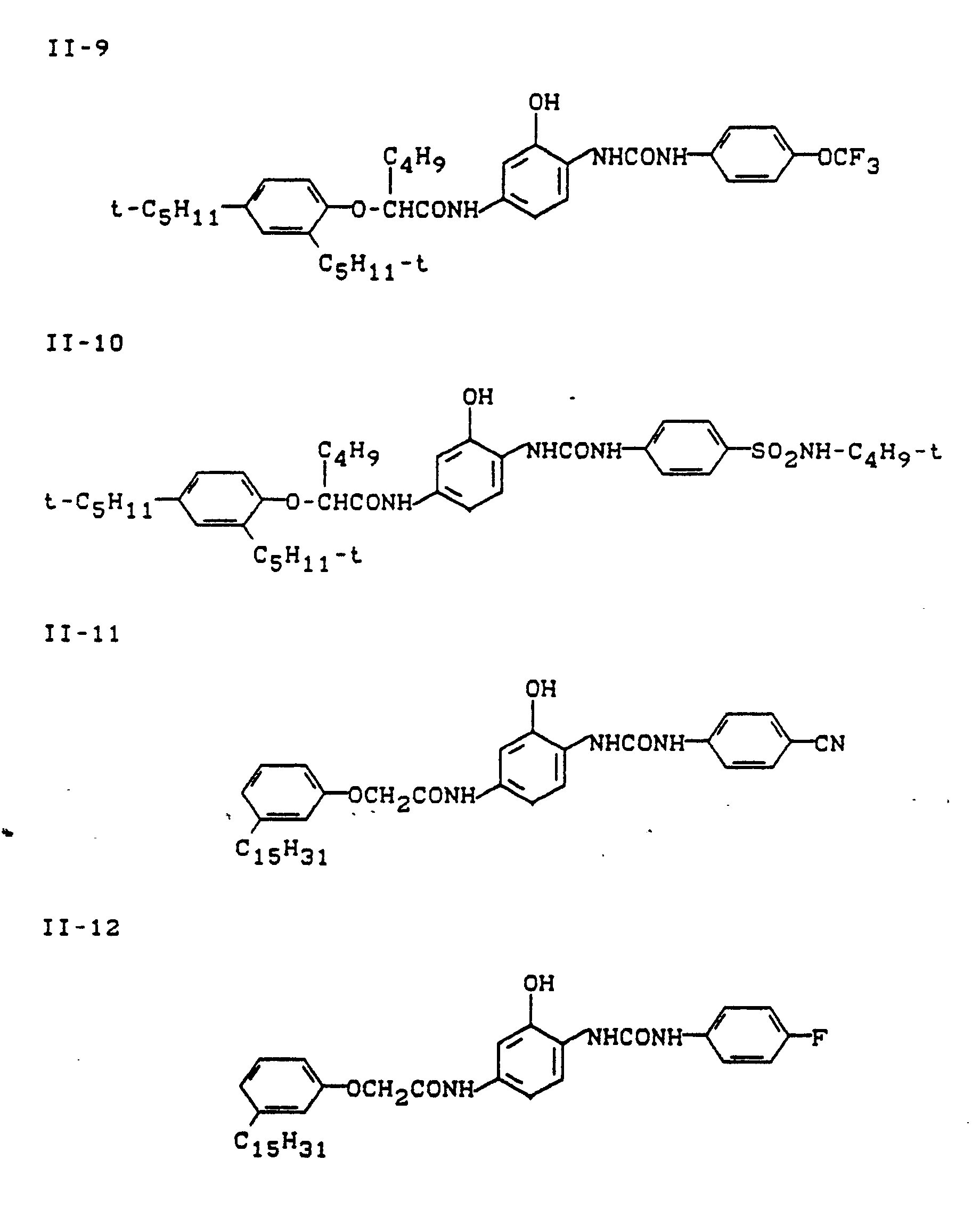


- Kuppler der Struktur II sind in EP-A-161 626, EP-A-67 689 und DE-OS 33 00 412 beschrieben.
- Beispielhafte Verbindungen gemäß Formel (III) sind im folgenden aufgeführt:


- Beispiele für Ballastreste in Formel (IV) sind im folgenden angegeben:
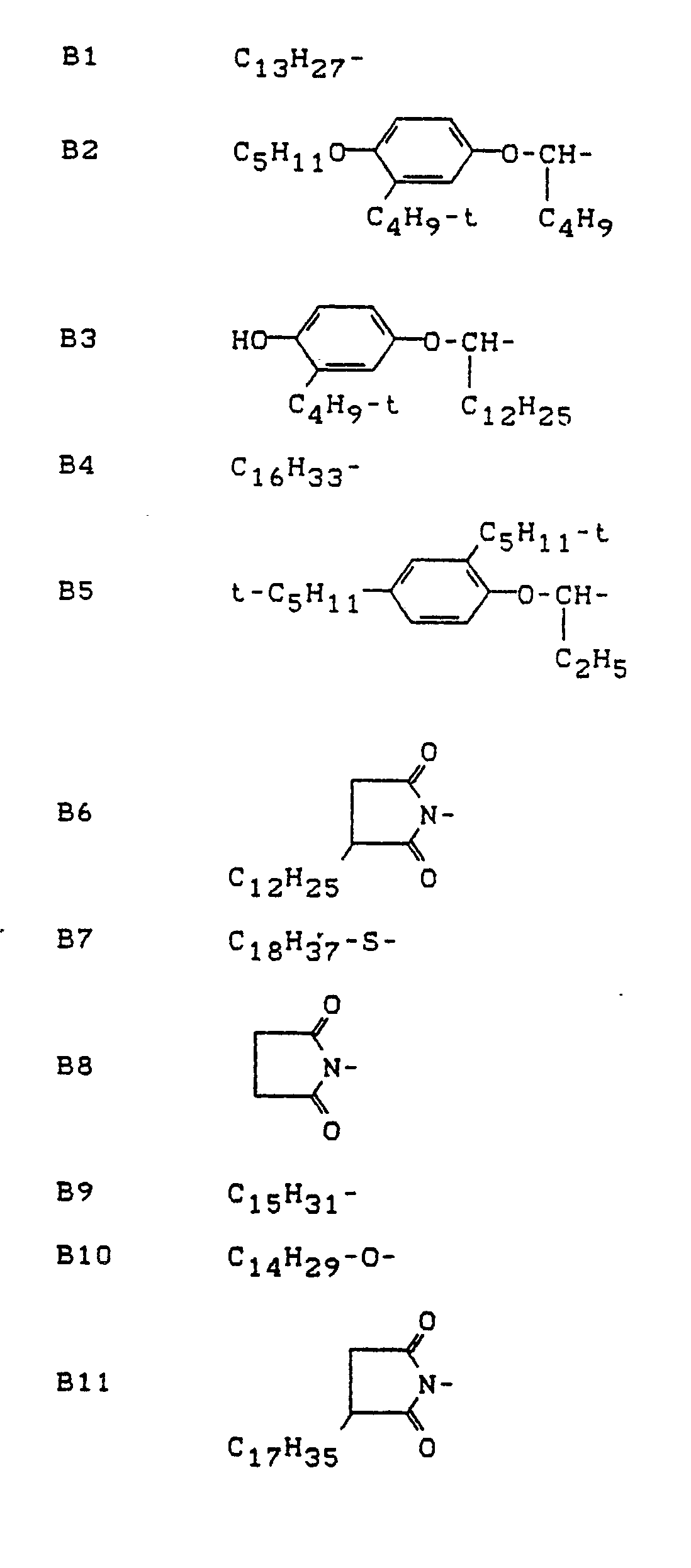

- Die Synthese der erfindungsgemäßen Farbstoffe kann neben der schon erwähnten oxidativen Kupplung von p-Phenylendiaminderivaten mit Phenolen bzw. Naphtholen auch durch Kondensation von p-Nitroso-N,N-dialkylanilinen mit Blaugrünkupplern der Formeln (II) bzw. (III) erfolgen (X₁X₂ = H).
- Als Oxidationsmittel für die 1. Methode kommen Silbersalze wie AgNO₃, AgCl, AgBr, Ag₂CO₃ auf Cellit, Kaliumhexacyanoferrat, Kaliumdichromat, Kaliumperoxidisulfat, Wasserstoffperoxid usw. in Betracht. Das bei der Oxidation der p-Phenylendiaminderivate entstehende Oxidationsprodukt reagiert mit den Farbkupplern zu den entsprechenden Farbstoffen.
-

45 g II-1 werden mit 33 g I-6 in 900 ml Methanol gelöst und mit 90 ml Natriummethylatlösung (30 gew.-%ig) versetzt. Anschließend wird eine Lösung von 36 g Ammoniumperoxydisulfat in 90 ml Wasser und 180 ml Methanol zugegeben. Es wird in anschließend 300 ml Wasser eingerührt, der Niederschlag abgesaugt, gewaschen und mit 500 ml Methanol ausgekocht. Ausbeute: 43 g, Schmelzpunkt: 220°C -

52,8 g 5-i-Butoxycarbonylamino-1-naphthol-2-carbonsäure-dodecyl-oxy-propylamid (III-20) werden mit 31 g 2-Methyl-4-N-ethyl-N-hydroxyethyl-anilin (I-6) in 900 ml Methanol gelöst und mit 100 ml Natrium-methylat-Lösung (30 gew.-%ig) versetzt. Nach Zugabe von 50 g Ammoniumperoxydisulfat in 120 ml Wasser und 240 ml Methanol wird 15 Minuten nachgerührt und anschließend der Farbstoff durch Ausrühren in 3 l Eis/Wasser ausgefällt. Das Rohprodukt wird durch Säulenchromatographie an Kieselgel mit Essigester/Methylenchlorid (1:1) als Laufmittel gereinigt Ausbeute: 58 g, Schmp.: 168°C - Die Farbstoffe gemäß der allgemeinen Formeln (IV) und (V) zeichnen sich durch eine geeignete langwellige Absorption im roten Spektralbereich zwischen 650 und 730 nm sowie geringe Halbbandbreiten und geringe Nebendichten im grünen Spektralbereich aus.
- Der eigentliche Vorteil der obengenannten Azomethinfarbstoffe besteht in der überraschenden Eigenschaft, daß sie nicht aber in der Lage sind, Latentbildkeime oxidativ zu zerstören. Selbst unter Tropenbedingungen mit Temperaturen von 35°C mit 90 % relativer Feuchte findet keinerlei Abbau des latenten Bildes statt.
- Die Korrekturfarbstoffe werden beispielsweise gemäß folgender Vorschrift emulgiert:
100 g des jeweiligen Farbstoffes wurden in einer Mischung aus 300 ml Essigester und 200 ml Tetrahydrofuran gelöst und zusätzlich mit 100 g Trikresylphosphat und 100 g Diethyllauramid versetzt. Nach Temperierung auf 50°C wurde das Gemisch in 2 kg auf 50°C erhitzte mit 10 g dodecylbenzolsulfosaurem Natrium versetzte 5 %ige Gelatine mit einem Hochdruckhomogenisator des Typs 15 M-8TA mit zweistufigem Homogenisierventil der Firma Manton-Goulin S.A. einemulgiert. Das leicht flüchtige Lösungsmittel wurde anschließend im Vakuum verdampft und die zurückbleibende Dispersion bei 8°C erstarrt. - Geeignete Träger zur Herstellung farbfotografischer Materialien sind z.B. Filme und Folien von halbsynthetischen und synthetischen Polymeren, wie Cellulosenitrat, Celluloseacetat, Cellulosebutyrat, Polystyrol, Polyvinylchlorid, Polyethylenterephthalat und Polycarbonat und mit einer Barytschicht oder α-Olefinpolymerschicht (z.B. Polyethylen) laminiertes Papier. Diese Träger können mit Farbstoffen und Pigmenten, beispielsweise Titandioxid, gefärbt sein. Sie können auch zum Zwecke der Abschirmung von Licht schwarz gefärbt sein. Die Oberfläche des Trägers wird im allgemeinen einer Behandlung unterzogen, um die Adhäsion der fotografischen Emulsionsschicht zu verbessern, beispielsweise einer Corona-Entladung mit nachfolgendem Antrag einer Substratschicht.
- Die farbfotografischen Materialien enthalten üblicherweise mindestens je eine rotempfindliche, grünempfindliche und blauempfindliche Silberhalogenidemulsionsschicht sowie gegebenenfalls Zwischenschichten und Schutzschichten.
- Vorzugsweise befinden sich die erfindungsgemäßen Korrekturfarbstoffe in einer Schicht, die dem Träger näher angeordnet ist als jede licht-empfindliche Schicht.
- Wesentliche Bestandteile der fotografischen Emulsionsschichten sind Bindemittel, Silberhalogenidkörnchen und Farbkuppler.
- Als Bindemittel wird vorzugsweise Gelatine verwendet. Diese kann jedoch ganz oder teilweise durch andere synthetische, halbsynthetische oder auch natürlich vorkommende Polymere ersetzt werden. Synthetische Gelatineersatzstoffe sind beispielsweise Polyvinylalkohol, Poly-N-vinylpyrolidon, Polyacrylamide, Polyacrylsäure und deren Derivate, insbesondere deren Mischpolymerisate, Natürlich vorkommende Gelatineersatzstoffe sind bei spielsweise andere Proteine wie Albumin oder Casein, Cellulose, Zucker, Stärke oder Alginate. Halbsynthetische Gelatineersatzstoffe sind in der Regel modifizierte Naturprodukte. Cellulosederivate wie Hydroxyalkylcellulose, Carboxymethylcellulose und Phthalylcellulose sowie Gelatinederivate, die durch Umsetzung mit Alkylierungs- oder Acylierungsmittel oder durch Aufpfropfung von polymerisierbaren Monomeren erhalten worden sind, sind Beispiele hierfür.
- Die Bindemittel sollen über eine ausreichende Menge an funktionellen Gruppen verfügen, so daß durch Umsetzung mit geeigneten Härtungsmitteln genügend widerstandsfähige Schichten erzeugt werden können. Solche funktionellen Gruppen sind insbesondere Aminogruppen, aber auch Carboxylgruppen, Hydroxylgruppen und aktive Methylengruppen.
- Die vorzugsweise verwendete Gelatine kann durch sauren oder alkalischen Aufschluß erhalten sein. Es kann auch oxidierte Gelatine verwendet werden. Die Herstellung solcher Gelatinen wird beispielsweise in The Science and Technology of Gelatine, herausgegeben von A.G. Ward und A. Courts, Academic Press 1977, Seite 295 ff beschrieben. Die jeweils eingesetzte Gelatine soll einen möglichst geringen Gehalt an fotografisch aktiven Verunreinigungen enthalten (Inertgelatine). Gelatinen mit hoher Viskosität und niedriger Quellung sind besonders vorteilhaft.
- Das als lichtempfindlicher Bestandteil in dem fotografischen Material befindliche Silberhalogenid kann als Halogenid Chlorid, Bromid oder Iodid bzw. Mischungen davon enthalten. Beispielsweise kann der Halogenidanteil wenigstens einer Schicht zu 0 bis 15 Mol-% aus Iodid, zu 0 bis 100 Mol-% aus Chlorid und zu 0 bis 100 Mol-% aus Bromid bestehen. Es kann sich um überwiegend kompakte Kristalle handeln, die z.B. regulär kubisch oder oktaedrisch sind oder Übergangsformen aufweisen können. Vorzugsweise können aber auch plättchenförmige Kristalle vorliegen, deren durchschnittliches Verhältnis von Durchmesser zu Dicke bevorzugt wenigstens 5:1 ist, wobei der Durchmesser eines Kornes definiert ist als der Durchmesser eines Kreises mit einem Kreisinhalt entsprechend der projizierten Fläche des Kornes. Die Schichten können aber auch tafelförmige Silberhalogenidkristalle aufweisen, bei denen das Verhältnis von Durchmesser zu Dicke wesentlich größer als 5:1 ist, z.B. 12:1 bis 30:1.
- Die Silberhalogenidkörner können auch einen mehrfach geschichteten Kornaufbau aufweisen, im einfachsten Fall mit einem inneren und einem äußeren Kornbereich (core/shell), wobei die Halogenidzusammensetzung und/oder sonstige Modifizierungen, wie z.B. Dotierungen der einzelnen Kornbereiche unterschiedlich sind. Die mittlere Korngröße der Emulsionen liegt vorzugsweise zwischen 0,2 µm und 2,0 µm, die Korngrößenverteilung kann sowohl homo- als auch heterodispers sein. Homodisperse Korngrößenverteilung bedeutet, daß 95 % der Körner nicht mehr als ± 30% von der mittleren Korngröße abweichen. Es können auch Gemische mehrerer homodisperser Emulsionen und Gemische aus homodispersen und/oder hetero disperser Emulsionen vorliegen. Die Emulsionen können neben dem Silberhalogenid auch organische Silbersalze enthalten, z.B. Silberbenztriazolat oder Silberbehenat.
- Es können zwei oder mehrere Arten von Silberhalogenidemulsionen, die getrennt hergestellt werden, als Mischung verwendet werden.
- Die fotografischen Emulsionen können nach verschiedenen Methoden (z.B. P. Glafkides, Chimie et Physique Photographique, Paul Montel, Paris (1967), G.F. Duffin, Photographic Emulsion Chemistry, The Focal Press, London (1966), V.L. Zelikman et al, Making and Coating Photographic Emulsion, The Focal Press, London (1966) aus löslichen Silbersalzen und löslichen Halogeniden hergestellt werden.
- Die Fällung des Silberhalogenids erfolgt bevorzugt in Gegenwart des Bindemittels, z.B. der Gelatine und kann im sauren, neutralen oder alkalischen pH-Bereich durchgeführt werden, wobei vorzugsweise Silberhalogenidkomplexbildner zusätzlich verwendet werden. Zu letzteren gehören z.B. Ammoniak, Thioether, Imidazol, Ammoniumthiocyanat oder überschüssiges Halogenid. Die Zusammenführung der wasserlöslichen Silbersalze und der Halogenide erfolgt wahlweise nacheinander nach dem single-jet- oder gleichzeitig nach dem double-jet-Verfahren oder nach beliebiger Kombination beider Verfahren. Bevorzugt wird die Dosierung mit steigenden Zuflußraten, wobei die "kritische" Zufuhrgeschwindigkeit, bei der gerade noch keine Neukeime entstehen, nicht überschritten werden sollte. Der pAg-Bereich kann während der Fällung in weiten Grenzen variieren, vorzugsweise wird das sogenannte pAg-gesteuerte Verfahren benutzt, bei dem ein bestimmter pAg-Wert konstant gehalten oder ein definiertes pAg-Profil während der Fällung durchfahren wird. Neben der bevorzugten Fällung bei Halogenidüberschuß ist aber auch die sogenannte inverse Fällung bei Silberionenüberschluß möglich. Außer durch Fällung können die Silberhalogenidkristalle auch durch physikalische Reifung (Ostwaldreifung), in Gegenwart von überschüssigem Halogenid und/oder Silberhalogenidkomplexierungsmittel wachsen. Das Wachstum der Emulsionskörner kann sogar überwiegend durch Ostwaldreifung erfolgen, wobei vorzugsweise eine feinkörnige, sogenannte Lippmann-Emulsion, mit einer schwerer löslichen Emulsion gemischt und auf letzterer umgelöst wird.
- Während der Fällung und/oder der physikalischen Reifung der Silberhalogenidkörner können auch Salze oder Komplexe von Metallen, wie Cd, Zn, Pb, Tl, Bi, Ir, Rh, Fe vorhanden sein.
- Ferner kann die Fällung auch in Gegenwart von Sensibilisierungsfarbstoffen erfolgen. Komplexierungsmittel und/oder Farbstoffe lassen sich zu jedem beliebigen Zeitpunkt unwirksam machen, z.B. durch Änderung des pH-Wertes oder durch eine oxidative Behandlung.
- Nach abgeschlossener Kristallbildung oder auch schon zu einem früheren Zeitpunkt werden die löslichen Salze aus der Emulsion entfernt, z.B. durch Nudeln und Waschen, durch Flocken und Waschen, durch Ultrafiltration oder durch Ionenaustauscher.
- Die Silberhalogenidemulsion wird im allgemeinen einer chemischen Sensibilisierung unter definierten Bedingungen - pH, pAg, Temperatur, Gelatine-, Silberhalogenid- und Sensibilisatorkonzentration - bis zum Erreichen des Empfindlichkeits- und Schleieroptimums unterworfen. Die Verfahrensweise ist z.B. bei H. Frieser "Die Grundlagen der Photographischen Prozesse mit Silberhalogeniden" Seite 675-734, Akademische Verlagsgesellschaft (1968) beschrieben.
- Dabei kann die chemische Sensibilisierung unter Zusatz von Verbindungen von Schwefel, Selen, Tellur und/oder Verbindungen der Metalle der I und/oder VIII. Nebengruppe des Periodensystems (z.B. Gold, Platin, Palladium, Iridium) erfolgen, weiterhin können Thiocyanatverbindungen, oberflächenaktive Verbindungen, wie Thioether, heterocyclische Stickstoffverbindungen (z.B. Imidazole, Azaindene) oder auch spektrale Sensibilisatoren (beschrieben z.B. bei F. Hamer "The Cyanine Dyes and Related Compounds", 1964, bzw. Ullmanns Encyclopädie der technischen Chemie, 4. Auflage, Bd. 18, S. 431 ff. und Research Disclosure Nr. 17643, Abschnitt III) zugegeben werden. Ersatzweise oder zusätzlich kann eine Reduktionssensibilisierung unter Zugabe von Reduktionsmitteln (Zinn-II-Salze, Amine, Hydrazinderivate, Aminoborane, Silane, Formamidinsulfinsäure) durch Wasserstoff, durch niedrigen pAg (z.B. kleiner 5) und/oder hohen pH (z.B. über 8) durchgeführt werden.
- Die fotografischen Emulsionen können Verbindungen zur Verhinderung der Schleierbildung oder zur Stabilisierung der fotografischen Funktion während der Produktion, der Lagerung oder der fotografischen Verarbeitung enthalten.
- Besonders geeignet sind Azaindene, vorzugsweise Tetra- und Pentaazaindene, insbesondere solche, die mit Hydroxyl- oder Aminogruppen substituiert sind. Derartige Verbindungen sind z.B. von Birr, Z. Wiss. Phot. 47 (1952), S. 2-58 beschrieben worden. Weiter können als Antischleiermittel Salze von Metallen wie Quecksilber oder Cadmium, aromatische Sulfon- oder Sulfinsäuren wie Benzolsulfinsäure, oder stickstoffhaltige Heterocyclen wie Nitrobenzimidazol, Nitroindazol, gegebenenfalls substituierte Benztriazole oder Benzthiazoliumsalze eingesetzt werden. Besonders geeignet sind Mercaptogruppen enthaltende Heterocyclen, z.B. Mercaptobenzthiazole, Mercaptobenzimidazole, Mercaptotetrazole, Mercaptothiadiazole, Mercaptopyrimidine, wobei diese Mercaptoazole auch eine wasserlöslichmachende Gruppe, z.B. eine Carboxylgruppe oder Sulfogruppe, enthalten können. Weitere geeignete Verbindungen sind in Research Disclosure Nr. 17643 (1978), Abschnitt VI, veröffentlicht.
- Die Stabilisatoren können den Silberhalogenidemulsionen vor, während oder nach deren Reifung zugesetzt werden. Selbstverständlich kann man die Verbindungen auch anderen fotografischen Schichten, die einer Halogensilberschicht zugeordnet sind, zusetzen.
- Es können auch Mischungen aus zwei oder mehreren der genannten Verbindungen eingesetzt werden.
- Die fotografischen Emulsionsschichten oder andere hydrophile Kolloidschichten des erfindungsgemäß hergestellten lichtempfindlichen Materials können oberflächenaktive Mittel für verschiedene Zwecke enthalten, wie Überzugshilfen, zur Verhinderung der elektrischen Aufladung, zur Verbesserung der Gleiteigenschaften, zum Emulgieren der Dispersion, zur Verhinderung der Adhäsion und zur Verbesserung der fotografischen Charakteristika (z.B. Entwicklungsbeschleunigung, hoher Kontrast, Sensibilisierung usw.). Neben natürlichen oberflächenaktiven Verbindungen, z.B. Saponin, finden hauptsächlich synthetische oberflächenaktive Verbindungen (Tenside) Verwendung: nicht-ionische Tenside, z.B. Alkylenoxidverbindungen, Glycerinverbindungen oder Glycidolverbindungen, kationische Tenside, z.B. höhere Alkylamine, quartäre Ammoniumsalze, Pyridinverbindungen und andere heterocyclische Verbindungen, Sulfoniumverbindungen oder Phosphoniumverbindungen, anionische Tenside, enthaltend eine Säuregruppe, z.B. Carbonsäure-, Sulfonsäure-, eine Phosphorsäure-, Schwefelsäureester- oder Phosphorsäureestergruppe, ampholytische Tenside, z.B. Aminosäure- und Aminosulfonsäureverbindungen sowie Schwefel- oder Phosphorsäureester eines Aminoalkohols.
- Die fotografischen Emulsionen können unter Verwendung von Methinfarbstoffen oder anderen Farbstoffen spektral sensibilisiert werden. Besonders geeignete Farbstoffe sind Cyaninfarbstoffe, Merocyaninfarbstoffe und komplexe Merocyaninfarbstoffe.
- Auf Sensibilisatoren kann verzichtet werden, wenn für einen bestimmten Spektralbereich die Eigenempfindlich keit des Silberhalogenids ausreichend ist, beispielsweise die Blauempfindlichkeit von Silberbromiden.
- Den unterschiedlich sensibilisierten Emulsionsschichten werden nicht diffundierende monomere oder polymere Farbkuppler zugeordnet, die sich in der gleichen Schicht oder in einer dazu benachbarten Schicht befinden können. Gewöhnlich werden den rotempfindlichen Schichten Blaugrünkuppler, den grünempfindlichen Schichten Purpurkuppler und den blauempfindlichen Schichten Gelbkuppler zugeordnet.
- Farbkuppler zur Erzeugung des blaugrünen Teilfarbenbildes sind in der Regel Kuppler vom Phenol- oder α-Naphtholtyp; geeignete Beispiele hierfür sind


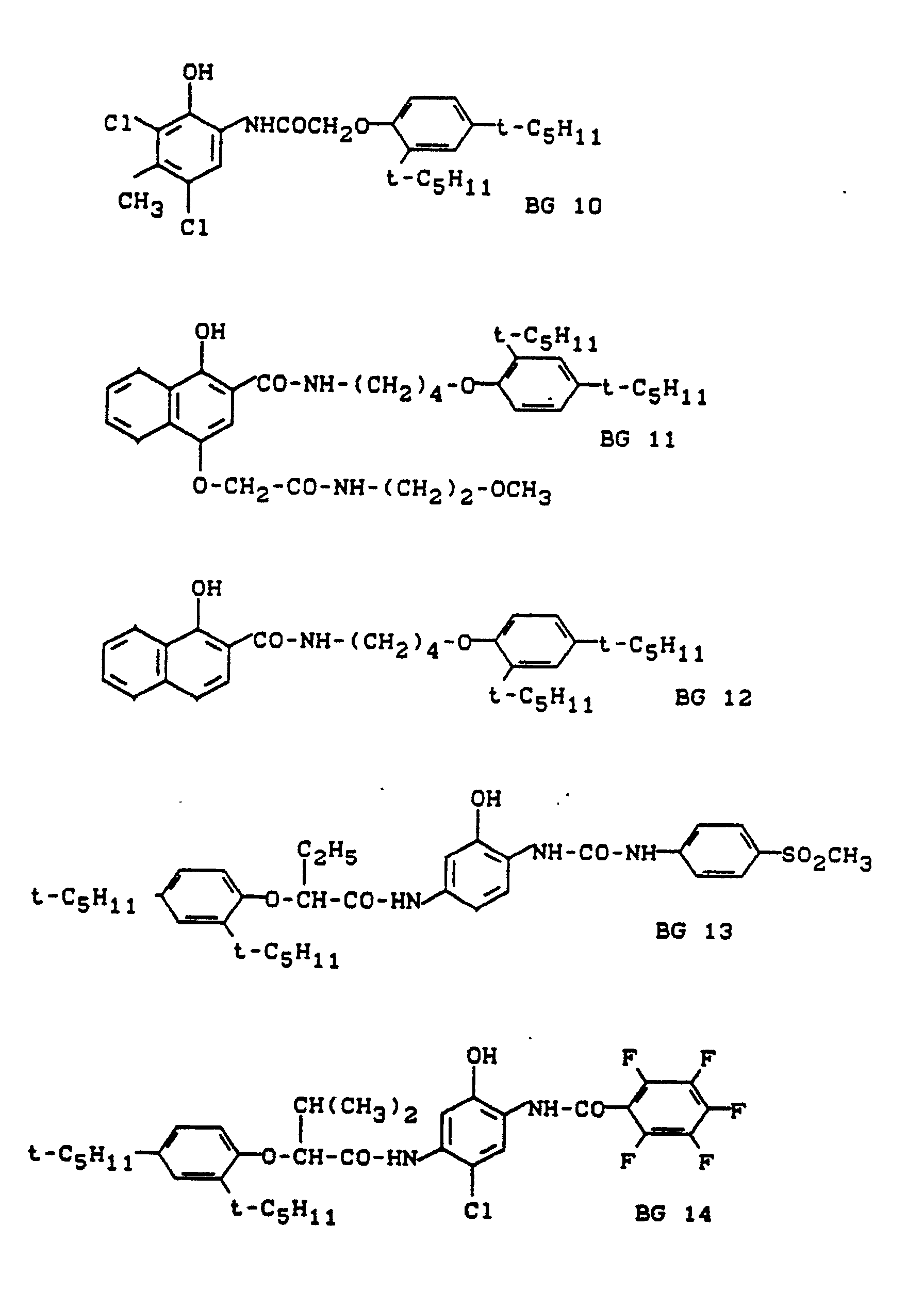


- Farbkuppler zur Erzeugung des purpurnen Teilfarbenbildes sind in der Regel Kuppler vom Typ des 5-Pyrazolons, des Indazolons oder der Pyrazoloazole; geeignete Beispiele hierfür sind


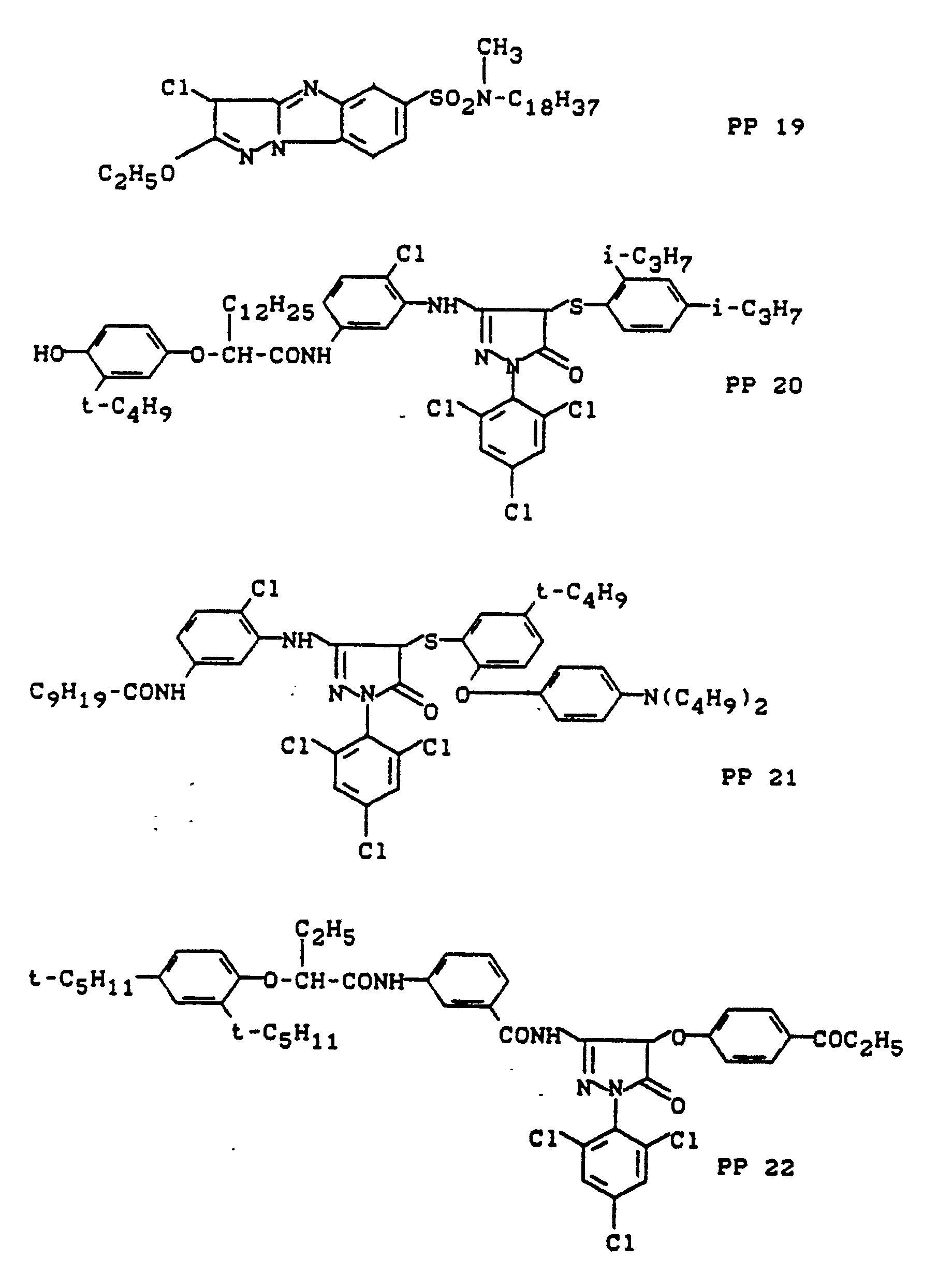

- Farbkuppler zur Erzeugung des gelben Teilfarbenbildes sind in der Regel Kuppler mit einer offenkettigen Ketomethylengruppierung, insbesondere Kuppler vom Typ des α-Acylacetamids; geeignete Beispiele hierfür sind α-Benzoylacetanilidkuppler und α-Pivaloylacetanilidkuppler der Formeln


- Bei den Farbkupplern kann es sich um 4-Äquivalentkuppler, aber auch um 2-Äquivalentkuppler handeln. Letztere leiten sich von den 4-Äquivalentkupplern dadurch ab, daß sie in der Kupplungsstelle einen Substituenten enthalten, der bei der Kupplung abgespalten wird. Zu den 2-Äquivalentkupplern sind solche zu rechnen, die farblos sind, als auch solche, die eine intensive Eigenfarbe aufweisen, die bei der Farbkupplung verschwindet bzw. durch die Farbe des erzeugten Bildfarbstoffes ersetzt wird (Maskenkuppler), und die Weißkuppler, die bei Reaktion mit Farbentwickleroxidationsprodukten im wesentlichen farblose Produkte ergeben. Zu den 2-Äquivalentkupplern sind ferner solche Kuppler zu rechnen, die in der Kupplungsstelle einen abspaltbaren Rest enthalten, der bei Reaktion mit Farbentwickleroxidationsprodukten in Freiheit gesetzt wird und dabei entweder direkt oder nachdem aus dem primär abgespaltenen Rest eine oder mehrere weitere Gruppen abgespalten worden sind (z.B. DE-A-27 03-145, DE-A-28 55 697, DE-A-31 05 026, DE-A-33 19 428), eine bestimmte erwünschte fotografische Wirksamkeit entfaltet, z.B. als Entwicklungsinhibitor oder -accelerator. Beispiele für solche 2-Äquivalentkuppler sind die bekannten DIR-Kuppler wie auch DAR- bzw. FAR-Kuppler.
- Beispiele für Weißkuppler sind:


- Beispiele für Maskenkuppler sind


- DIR-Kuppler, die Entwicklungsinhibitoren vom Azoltyp, z.B. Triazole und Benzotriazole freisetzen, sind in DE-A-2 414 006, 2 610 546, 2 659 417, 2 754 281, 2 726 180, 3 626 219, 3 630 564, 3 636 824, 3 644 416 und 2 842 063 beschrieben. Weitere Vorteile für die Farbwidergabe, d.h., Farbtrennung und Farbreinheit, und für die Detailwidergabe, d.h., Schärfe und Körnigkeit, sind mit solchen DIR-Kupplern zu erzielen, die z.B. den Entwicklungsinhibitor nicht unmittelbar als Folge der Kupplung mit einem oxidierten Farbentwickler abspalten, sondern erst nach einer weiteren Folgereaktion, die beispielsweise mit einer Zeitsteuergruppe erreicht wird. Beispiele dafür sind in DE-A-28 55 697, 32 99 671, 38 18 231, 35 18 797, in EP-A-157 146 und 204 175, in US-A-4 146 396 und 4 438 393 sowie in GB-A-2 072 363 beschrieben.
- DIR-Kuppler, die einen Entwicklungsinhibitor freisetzen, der im Entwicklerbad zu im wesentlichen fotografisch unwirksamen Produkten zersetzt wird, sind beispielsweise in DE-A-32 09 486 und in EP-A-167 168 und 219 713 beschrieben. Mit dieser Maßnahme wird eine störungsfreie Entwicklung und Verarbeitungskonstanz erreicht.
- Bei Einsatz von DIR-Kupplern, insbesondere von solchen, die einen gut diffundierbaren Entwicklungsinhibitor abspalten, lassen sich durch geeignete Maßnahmen bei der optischen Sensibilisierung Verbesserungen der Farbwidergabe, z.B. eine differenziertere Farbwidergabe, erzielen, wie beispielsweise in EP-A-115 304, 167 173, GB-A-2 165 058, DE-A-3 700 419 und US-A-4 707 436 beschrieben.
- Die DIR-Kuppler können in einem mehrschichtigen fotografischen Material den unterschiedlichsten Schichten zugesetzt werden, z.B. auch lichtunempfindlichen oder Zwischenschichten. Vorzugsweise werden sie jedoch den lichtempfindlichen Silberhalogenidemulsionsschichten zugesetzt, wobei die charakteristischen Eigenschaften der Silberhalogenidemulsion, z.B. deren Iodidgehalt, die Struktur der Silberhalogenidkörner oder deren Korngrößenverteilung von Einfluß auf die erzielten fotografischen Eigenschaften sind. Der Einfluß der freigesetzten Inhibitoren kann beispielsweise durch den Einbau einer Inhibitorfängerschicht gemäß DE-A-24 31 223 begrenzt werden. Aus Gründen der Reaktivität oder Stabilität kann es vorteilhaft sein, einen DIR-Kuppler einzu setzen, der in der jeweiligen Schicht, in der er eingebracht ist, eine von der in dieser Schicht zu erzeugenden Farbe abweichende Farbe bei der Kupplung bildet.
- Zur Steigerung der Empfindlichkeit, des Kontrastes und der maximalen Dichte können vor allem DAR- bzw. FAR-Kuppler eingesetzt werden, die einen Entwicklungsbeschleuniger oder ein Schleiermittel abspalten. Verbindungen dieser Art sind beispielsweise in DE-A-2 534 466, 3 209 110, 3 333 355, 3 410 616, 3 429 545, 3 441 823, in EP-A-89 834, 110 511, 118 087, 147 765 und in US-A-4 618 572 und 4 656 123 beschrieben.
- Als Beispiel für den Einsatz von DAR-Kuppler wird auf EP-A-193 389 verwiesen.
- Es kann vorteilhaft sein, die Wirkung einer aus einem Kuppler abgespaltenen fotografisch wirksamen Gruppe dadurch zu modifizieren, daß eine intermolekulare Reaktion dieser Gruppe nach ihrer Freisetzung mit einer anderen Gruppe gemäß DE-A-3 506 805 eintritt.


- Beispiele für DAR-Kuppler


- Da bei den DIR-, DAR- bzw. FAR-Kupplern hauptsächlich die Wirksamkeit des bei der Kupplung freigesetzten Restes erwünscht ist und es weniger auf die farbbildenden Eigenschaften dieser Kuppler ankommt, sind auch solche DIR-, DAR- bzw. FAR-Kuppler geeignet, die bei der Kupplung im wesentlichen farblose Produkte ergeben (DE-A-1 547 640).
- Der abgespaltbare Rest kann auch ein Ballastrest sein, so daß bei der Reaktion mit Farbentwickleroxidationsprodukten Kupplungsprodukte erhalten werden, die diffusionsfähig sind oder zumindest eine schwache bzw. eingeschränkte Beweglichkeit aufweisen (US-A-4 420 556).
- Das Material kann weiterhin von Kupplern verschiedene Verbindungen enthalten, die beispielsweise einen Entwicklungsinhibitor, einen Entwicklungsbeschleuniger, einen Bleichbeschleuniger, einen Entwickler, ein Silberhalogenidlösungsmittel, ein Schleiermittel oder ein Antischleiermittel in Freiheit setzen können, beispielsweise sogenannte DIR-Hydrochinone und andere Verbindungen, wie sie beispielsweise in US-A-4 636 546, 4 345 024, 4 684 604 und in DE-A-3 145 640, 2 515 213, 2 447 079 und in EP-A-198 438 beschrieben sind. Diese Verbindungen erfüllen die gleiche Funktion wie die DIR-, DAR- oder FAR-Kuppler, außer daß sie keine Kupplungs-produkte bilden.
- Hochmolekulare Farbkuppler sind beispielsweise in DE-C-1 297 417, DE-A-24 07 569, DE-A-31 48 125, DE-A-32 17 200, DE-A-33 20 079, DE-A-33 24 932, DE-A-33 31 743, DE-A-33 40 376, EP-A-27 284, US-A-4 080 211 beschrieben. Die hochmolekularen Farbkuppler werden in der Regel durch Polymerisation von ethylenisch ungesättigten monomeren Farbkupplern hergestellt. Sie können aber auch durch Polyaddition oder Polykondensation erhalten werden.
- Die Einarbeitung der Kuppler oder anderer Verbindungen in Silberhalogindemulsionsschichten kann in der Weise erfolgen, daß zunächst von der betreffenden Verbindung eine Lösung, eine Dispersion oder eine Emulsion hergestellt und dann der Gießlösung für die betreffende Schicht zugefügt wird. Die Auswahl des geeigneten Lösungs- oder Dispersionsmittel hängt von der jeweiligen Löslichkeit der Verbindung ab.
- Methoden zum Einbringen von in Wasser im wesentlichen unlöslichen Verbindungen durch Mahlverfahren sind beispielsweise in DE-A-2 609 741 und DE-A-2 609 742 beschrieben.
- Hydrophobe Verbindungen können auch unter Verwendung von hochsiedenden Lösungsmitteln, sogenannten Ölbildnern, in die Gießlösung eingebracht werden. Entsprechende Methoden sind beispielsweise in US-A-2 322 027, US-A-2 801 170, US-A-2 801 171 und EP-A-0 043 037 beschrieben.
- Anstelle der hochsiedenden Lösungsmitteln können Oligomere oder Polymere, sogenannte polymere Ölbildner Verwendung finden.
- Die Verbindungen können auch in Form beladener Latices in die Gießlösung eingebracht werden. Verwiesen wird beispielsweise auf DE-A-2 541 230, DE-A-2 541 274, DE-A-2 835 856, EP-A-0 014 921, EP-A-0 069 671, EP-A-0 130 115, US-A-4 291 113.
- Die diffusionsfeste Einlagerung anionischer wasserlöslicher Verbindungen (z.B. von Farbstoffen) kann auch mit Hilfe von kationischen Polymeren, sogenannten Beizenpolymeren erfolgen.
- Geeignete Ölbildner sind z.B. Phthalsäurealkylester, Phosphonsäureester, Phosphorsäureester, Citronensäureester, Benzoesäureester, Amide, Fettsäureester, Trimesinsäureester, Alkohole, Phenole, Anilinderivate und Kohlenwasserstoffe.
- Beispiele für geeignete Ölbildner sind Dibutylphthalat, Dicyclohexylphthalat, Di-2-ethylhexylphthalat, Decylphthalat, Triphenylphosphat, Tricresylphosphat, 2-Ethylhexyldiphenylphosphat, Tricyclohexylphosphat, Tri-2-ethylhexylphosphat, Tridecylphosphat, Tributoxyethylphosphat, Trichlorpropylphosphat, Di-2-ethylhexylphenylphosphat, 2-Ethylhexylbenzoat, Dodecylbenzoat, 2-Ethylhexyl-p-hydroxybenzoat, Diethyldodecanamid, N-Tetradecylpyrrolidon, Isostearylalkohol, 2,4-Di-tert.-amylphenol, Dioctylacelat, Glycerintributyrat, Isostearyllactat, Trioctylcitrat, N,N-Dibutyl-2-butoxy-5-tert.-octylanilin, Paraffin, Dodecylbenzol und Diisopropylnaphthalin.
- Jede der unterschiedlich sensibilisierten, lichtempfindlichen Schichten kann aus einer einzigen Schicht bestehen oder auch zwei oder mehr Silberhalogenidemulsionsteilschichten umfassen (DE-C-1 121 470). Dabei sind rotempfindliche Silberhalogenidemulsionsschichten dem Schichtträger häufig näher angeordnet als grünempfindliche Silberhalogenidemulsionsschichten und diese wiederum näher als blauempfindliche, wobei sich im allgemeinen zwischen grünempfindlichen Schichten und blauempfindlichen Schichten eine nicht lichtempfindliche gelbe Filterschicht befindet.
- Bei geeignet geringer Eigenempfindlichkeit der grün- bzw. rotempfindlichen Schichten kann man unter Verzicht auf die Gelbfilterschicht andere Schichtanordnungen wählen, bei denen auf den Träger z.B. die blauempfindlichen, dann die rotempfindlichen und schließlich die grünempfindlichen Schichten folgen.
- Die in der Regel zwischen Schichten unterschiedlicher Sprektralempfindlichkeit angeordneten nicht lichtempfindlichen Zwischenschichten können Mittel enthalten, die eine unerwünschte Diffusion von Entwickleroxidationsprodukten aus einer lichtempfindlichen in eine andere lichtempfindliche Schicht mit unterschiedlicher spektraler Sensibilisierung verhindern.
- Geeignete Mittel, die auch Scavenger oder EOP-Fänger genannt werden, werden in Research Disclosure 17.643/1978, Kapitel VII, 17.842/1979, Seite 94-97 und 18.716/1979, Seite 650 sowie in EP-A-69 070, 98 072, 124 877, 125 522 und in US-A-463 226 beschrieben.
- Beispiele für besonders geeignete Verbindungen sind:


- Liegen mehrere Teilschichten gleicher spektraler Sensibilisierung vor, so können sich diese hinsichtlich ihrer Zusammensetzung, insbesondere was Art und Menge der Silberhalogenidkörnchen betrifft unterscheiden. Im allgemeinen wird die Teilschicht mit höherer Empfindlichkeit von Träger entfernter angeordnet sein als die Teilschicht mit geringerer Empfindlichkeit. Teilschichten gleicher spektraler Sensibilisierung können zueinander benachbart oder durch andere Schichten, z.B. durch Schichten anderer spektraler Sensibilisierung getrennt sein. So können z.B. alle hochempfindlichen und alle niedrigempfindlichen Schichten jeweils zu einem Schichtpaket zusammengefaßt sein (DE-A 1 958 709, DE-A 2 530 645, DE-A 2 622 922).
- Das fotografische Material kann weiterhin UV-Licht absorbierende Verbindungen, Weißtöner, Abstandshalter, Filterfarbstoffe, Formalinfänger, Lichtschutzmittel, Antioxidantien, Korrektur-Farbstoffe, Zusätze zur Verbesserung der Farbstoff-, Kuppler- und Weißenstabilisierung sowie zur Verringerung des Farbschleiers und anderes enthalten.
- UV-Licht absorbierende Verbindungen sollen einerseits die Bildfarbstoffe vor dem Ausbleichen durch UV-reiches Tageslicht schützen und andererseits als Filterfarbstoffe das UV-Licht im Tageslicht bei der Belichtung absorbieren und so die Farbwiedergabe eines Films verbessern. Üblicherweise werden für die beiden Aufgaben Verbindungen unterschiedlicher Struktur eingesetzt. Beispiele sind arylsubstituierte Benzotriazolverbindungen (US-A 3 533 794), 4-Thiazolidonverbindungen (US-A 3 314 794 und 3 352 681), Benzophenonverbindungen (JP-A 2784/71), Zimtsäureesterverbindungen (US-A 3 705 805 und 3 707 375), Butadienverbindungen (US-A 4 045 229) oder Benzoxazolverbindungen (US-A 3 700 455).
- Beispiele besonders geeigneter Verbindungen sind

R = H; R₁, R₂ = t-C₄H₉
R = H; R₁, R₂ = t-C₅H₁₁-tert.
R = H; R₁ = sec-C₄H₉; R₂ = t-C₄H₉
R = Cl; R₁ = t-C₄H₉; R₂ = sec-C₄H₉
R = Cl; R₁, R₂ = t-C₄H₉
R = Cl; R₁ = t-C₄H₉-tert.; R₂ = -CH₂-CH₂-COOC₈H₁₇
R = H; R = iso-C₁₂H₂₅; R₂ = CH₃
R, R₁, R₂ = t-C₄H₉
R₁, R₂ = C₂H₅;
R₁, R = C₂H₅;
R₁, R₂ = CH₂=CH-CH₂; R₃, R₄ = CN
R₁, R₂ = CH₃; R₃ = CN; R₄ = CO-NHC₁₂H₂₅
- Es können auch ultraviolettabsorbierende Kuppler (wie Blaugrünkuppler des α-Naphtholtyps) und ultraviolettabsorbierende Polymere verwendet werden. Diese Ultraviolettabsorbentien können durch Beizen in einer speziellen Schicht fixiert sein.
- Für sichtbares Licht geeignete Filterfarbstoffe umfassen Oxonolfarbstoffe, Hemioxonolfarbstoffe, Styrylfarbstoffe, Merocyaninfarbstoffe, Cyaninfarbstoffe und Azo farbstoffe. Von diesen Farbstoffen werden Oxonolfarbstoffe, Hemioxonolfarbstoffe und Merocyaninfarbstoffe besonders vorteilhaft verwendet.
- Geeignete Weißtöner sind z.B. in Research Disclosure Dezember 1978, Seite 22 ff, Referat 17 643, Kapitel V, in US-A-2 632 701, 3 269 840 und in GB-A-852 075 und 1 319 763 beschrieben.
- Bestimmte Bindemittelschichten, insbesondere die vom Träger am weitesten entfernte Schicht, aber auch gelegentlich Zwischenschichten, insbesondere, wenn sie während der Herstellung die vom Träger am weitesten entfernte Schicht darstellen, können fotografisch inerte Teilchen anorganischer oder organischer Natur enthalten, z.B. als Mattierungsmittel oder als Abstandshalter (DE-A 3 331 542, DE-A 3 424 893, Research Disclosure Dezember 1978, Seite 22 ff, Referat 17 643, Kapitel XVI).
- Der mittlere Teilchendurchmesser der Abstandshalter liegt insbesondere im Bereich von 0,2 bis 10 µm. Die Abstandshalter sind wasserunlöslich und können alkaliunlöslich oder alkalilöslich sein, wobei die alkalilöslichen im allgemeinen im alkalischen Entwicklungsbad aus dem fotografischen Material entfernt werden. Beispiele für geeignete Polymere sind Polymethylmethacrylat, Copolymere aus Acrylsäure und Methylmethacrylat sowie Hydroxypropylmethylcellulosehexahydrophthalat.
- Geeignete Formalinfänger sind z.B.

- Zusätze zur Verbesserung der Farbstoff-, Kuppler- und Weißenstabilität sowie zur Verringerung des Farbschleiers (Research Disclosure 17 643/1978, Kapitel VII) können den folgenden chemischen Stoffklasen angehöhren: Hydrochinone, 6-Hydroxychromane, 5-Hydroxycumarane, Spirochromane, Spiroindane, p-Alkoxyphenole, sterische gehinderte Phenole, Gallussäurederivate, Methylendioxybenzole, Aminophenole, sterisch gehinderte Amine, Derivate mit veresterten oder verätherten phenolischen Hydroxylgurppen, Metallkomplexe.
- Verbindungen, die sowohl eine sterisch gehinderte Amin-Partialstruktur als auch eine sterisch gehinderte Phenol-Partialstruktur in einem Molekül aufweisen (US-A-4 268 593), sind besonders wirksam zur Verhinderung der Beeinträchtigung (Verschlechterung bzw. Abbau) von gelben Farbbildern als Folge der Entwicklung von Wärme, Feuchtigkeit und Licht. Um die Beeinträchtigung (Verschlechterung bzw. den Abbau) von purpurroten Farbbildern, insbesondere ihre Beeinträchtigung (Verschlechterung bzw. Abbau) als Folge der Einwirkung von Licht, zu verhindern, sind Spiroindane (JP-A-159 644/81) und Chromane, die durch Hydrochinondiether oder -monoether substiutiert sind (JP-A- 89 835/80) besonders wirksam.
- Beispiele besonders geeigneter Verbindungen sind:


- Die Schichten des fotografischen Materials können mit den üblichen Härtungsmitteln gehärtet werden. Geeignete Härtungsmittel sind z.B. Formaldehyd, Glutaraldehyd und ähnliche Aldehydverbindungen, Diacetyl, Cyclopentadion und ähnliche Ketonverbindungen, Bis-(2-chlorethylharnstoff), 2-Hydroxy-4,6-dichlor-1,3,5-triazin und andere Verbindungen, die reaktives Halogen enthalten (US-A 3 288 775, US-A-2 732 303, GB-A-974 723 und GB-A 1 167 207) Divinylsulfonverbindungen, 5-Acetyl-1,3-diacryloylhexahydro-1,3,5-triazin und andere Verbindungen, die eine reaktive Olefinbindung enthalten (US-A 3 635 718, US-A-3 232 763 und GB-A 994 869); N-Hydroxymethylphthalimid und andere N-Methylolverbindungen (US-A 2 732 316 und US-A 2 586 168); Isocyanate (US-A 3 103 437); Aziridinverbindungen (US-A 3 017 280 und US-A 2 983 611); Säurederivate (US-A 2 725 294 und US-A 2 725 295); Verbindungen vom Carbodiimidtyp (US-A 3 100 704); Carbamoylpyridiniumsalze (DE-A 2 225 230 und DE-A 2 439 551); Carbamoyloxypyridiniumverbindungen (DE-A-2 408 814); Verbindungen mit einer Phosphor-Halogen-Bindung (JP-A- 113 929/83); N-Carbonyloximid-Verbindungen (JP-A- 43353/81); N-Sulfonyloximido-Verbindungen (US-A- 4 111 926), Dihydrochinolinverbindungen (US-A- 4 013 468), 2-Sulfonyloxypyridiniumsalze (JP-A- 110 762/81), Formamidiniumsalze (EP-A 0 162 308), Verbindungen mit zwei oder mehr N-Acyloximino-Gruppen (US-A 4 052 373), Epoxyverbindungen (US-A 3 091 537), Verbindungen vom Isoxazoltyp (US-A 3 321 313 und US-A- 3 543 292); Halogencarboxyaldehyde, wie Mucochlorsäure; Dioxanderivate, wie Dihydroxydioxan und Di-chlordioxan; und anorganischer Härter, wie Chromalaun und Zirkonsulfat.
- Die Härtung kann in bekannter Weise dadurch bewirkt werden, daß das Härtungsmittel der Gießlösung für die zu härtende Schicht zugesetzt wird, oder dadurch, daß die zu härtende Schicht mit einer Schicht überschichtet wird, die ein diffusionsfähiges Härtungsmittel enthält.
- Unter den aufgeführten Klassen gibt es langsam wirkende und schnell wirkende Härtungsmittel sowie sogenannte Soforthärter, die besonders vorteilhaft sind. Unter Soforthärtern werden verbindungen verstanden, die geeignete Bindemittel so vernetzen, daß unmittelbar nach Beguß, spätestens nach 24 Stunden, vorzugsweise spätestens nach 8 Stunden die Härtung so weit abgeschlossen ist, daß keine weitere durch die Vernetzungsreaktion bedingte Änderung der Sensitometrie und der Quellung des Schichtverbandes auftritt. Unter Quellung wird die Differenz von Naßschichtdicke und Trockenschichtdicke bei der wäßrigen Verarbeitung des Films verstanden (Photogr. Sci., Eng. 8 (1964), 275; Photogr. Sci. Eng. (1972), 449).
- Bei diesen mit Gelatine sehr schnell reagierenden Härtungsmitteln handelt es sich z.B. um Carbamoylpyridiniumsalze, die mit freien Carboxylgruppen der Gelatine zu reagieren vermögen, so daß letztere mit freien Aminogruppen der Gelatine unter Ausbildung von Peptidbindungen und Vernetzung der Gelatine reagieren.
- Geeignete Beispiele für Soforthärter sind z.B. Verbindungen der allgemeinen Formeln
- (a)

R₁ Alkyl, Aryl oder Aralkyl bedeutet,
R₂ die gleiche Bedeutung wie R₁ hat oder Alkylen, Arylen, Aralkylen oder Alkaralkylen bedeutet, wobei die zweite Bindung mit einer Gruppe der Formel
R₁ und R₂ zusammen die zur Vervollständigung eines gegebenenfalls substituierten heterocyclischen Ringes, beispielsweise eines Piperidin, Piperazin- oder Morpholinringes erforderlichen Atome bedeuten, wobei der Ring z.B. durch C₁-C₃-Alkyl oder Halogen substituiert sein kann,
R₃ für Wasserstoff, Alkyl, Aryl, Alkoxy, -NR₄-COR₅, -(CH₂)m-NR₈R₉, -(CH₂)n-CONR₁₃R₁₄ oder
R₄, R₆, R₇, R₉, R₁₄, R₁₅, R₁₇, R₁₈, und R₁₉ Wasserstoff oder C₁-C₄-Alkyl,
R₅ Wasserstoff, C₁-C₄-Alkyl oder NR₆R₇,
R₈ -COR₁₀
R₁₀ NR₁₁R₁₂
R₁₁ C₁-C₄-Alkyl oder Aryl, insbesondere Phenyl,
R₁₂ Wasserstoff, C₁-C₄-Alkyl oder Aryl, insbesondere Phenyl,
R₁₃ Wasserstoff, C₁-C₄-Alkyl oder Aryl, insbesondere Phenyl,
R₁₆ Wasserstoff, C₁-C₄-Alkyl, COR₁₈ oder CONHR₁₉,
m eine Zahl 1 bis 3
n eine Zahl 0 bis 3
p eine Zahl 2 bis 3 und
Y O oder NR₁₇ bedeuten oder
R₁₃ und R₁₄ gemeinsam die zur Vervollständigung eines gegebenenfalls substituierten heterocyclischen Ringes, beispielsweise eines Piperidin-, Piperazin- oder Morpholinringes erforderlichen Atome darstellen, wobei der Ring z.B. durch C₁-C₃-Alkyl oder Halogen substituiert sein kann,
Z die zur Vervollständigung eines 5- oder 6-gliedrigen aromatischen heterocyclischen Ringes, gegebenenfalls mit anelliertem Benzolring, erforderlichen C-Atome und
X⊖ ein Anion bedeuten, das entfällt, wenn bereits eine anionische Gruppe mit dem übrigen Molekül verknüpft ist; - (b)

R₁, R₂, R₃ und X⊖ die für Formel (a) angegebene Bedeutung besitzen. - Es gibt diffusionsfähige Härtungsmittel, die auf alle Schichten innerhalb eines Schichtverbandes in gleicher Weise härtend wirken. Es gibt aber auch schichtbegrenzt wirkende, nicht diffundierende, niedermolekulare und hochmolekulare Härter. Mit ihnen kann man einzelnen Schichten, z.B. die Schutzschicht besonders stark vernetzen. Dies ist wichtig, wenn mann die Silberhalogenid-Schicht wegen der Silberdeckkrafterhöhung wenig härtet und mit der Schutzschicht die mechanischen Eigenschaften verbessern muß (EP-A 0 114 699).
- Farbfotografische Negativmaterialien weden üblicherweise durch Entwickeln, Bleichen, Fixieren und Wässern oder durch Entwickeln, Bleichen und Stabilisieren ohne nachfolgende Wässerung verarbeitet, wobei Bleichen und Fixieren zu einem Verarbeitungsschnitt zusammengefaßt sein können. Als Farbentwicklerverbindung lassen sich sämtliche Entwicklerverbindungen verwenden, die die Fähigkeit besitzen, in Form ihres Oxidationsproduktes mit Farbkupplern zu Azomethin- bzw. Indophenolfarbstoffen zu reagieren. Geeignete Farbentwicklerverbindungen sind aromatische, mindestens eine primäre Aminogruppe enthaltende Verbindungen vom p-Phenylendiamintyp, beispielsweise N,N-Dialkyl-p-phenylendiamine wie N,N-Diethyl-p-phenylendiamin, 1-(N-Ethyl-N-methansulfonamidoethyl)-3-methyl-p-phenylendiamin, 1-(N-Ethyl-N-hydroxyethyl)-3-methyl-p-phenylendiamin und 1-(N-Ethyl-N-methoxyethyl)-3-methyl-p-phenylendiamin. Weitere brauchbare Farbentwickler sind beispielsweise in J. Amer. Chem. Soc. 73, 3106 (1951) und G. Haist, Modern Photographic Processing, 1979, John Wiley and Sons, New York, Seite 545 ff. beschrieben.
- Nach der Farbentwicklung kann ein saures Stoppbad oder eine Wässerung folgen.
- Üblicherweise wird das Material unmittelbar nach der Farbentwicklung gebleicht und fixiert. Als Bleichmittel können z.B. Fe(III)-Salze und Fe(III)-Komplexsalze wie Ferricyanide, Dichromate, wasserlösliche Kobaltkomplexe verwendet werden. Besonders bevorzugt sind Eisen-(III)-Komplexe von Aminopolycarbonsäuren, insbesondere z.B. von Ethylendiamintetraessigsäure, Propylendiamintetraessigsäure, Diethylentriaminpentaessigsäure, Nitrilotriessigsäure, Iminodiessigsäure, N-Hydroxyethyl-ethylendiamintriessigsäure, Alkyliminodicarbonsäuren und von entsprechenden Phosphonsäuren. Geeignete als Bleichmittel sind weiterhin Persulfate.
- Auf das Bleichfixierbad oder Fixierbad folgt meist eine Wässerung, die als Gegenstromwässerung ausgeführt ist oder aus mehreren Tanks mit eigener Wasserzufuhr besteht.
- Günstige Ergebnisse können bei Verwendung eines darauf folgenden Schlußbades, das keinen oder nur wenig Formaldehyd enthält, erhalten werden.
- Die Wässerung kann aber durch ein Stabilisierbad vollständig ersetzt werden, das üblicherweise im Gegenstrom geführt wird. Dieses Stabilisierbad übernimmt bei Formaldehydzusatz auch die Funktion eines Schlußbades.
- Auf einen transparenten Schichtträger aus Cellulosetriacetat wurden jeweils folgende Schichten in der hier angegebenen Reihenfolge aufgetragen.
- Die Mengenangaben beziehen sich jeweils auf 1 m². Für den Silberhalogenidauftrag werden die äquivalenten Mengen an AgNO₃ angegeben.
- Die Blaugrün-Korrekturfarbstoffe werden in Form der oben beschriebenen Emulgate der Gießlösungen für die Antihaloschicht zugegeben.
1. Schicht (= Antihaloschicht) 0,3 g/m² schwarzes kolloidales Silber, 1,4 g/m² Gelatine 0,03 g/m² Blaugrün-Korrekturfarbstoff nach Angabe, 0,05 g/m² 2,5-Di-t-pentadecylhydrochinon, 0,03 g/m² Diethyllauramid 0,08 g/m² Trikresylphosphat 
3. Schicht (Härtungs- und Schutzschicht) 1,0 g/m² Gelatine 0,3 g/m² Härtungsmittel H1 - Dabei wurden in der 1. Schicht folgende Blaugrün-Korrekturfarbstoffe verwendet:


- Von diesen Güssen 1a bis 1e wurde je 1 Probe
- A: zuerst (unbelichtet) bei Normalklima (50 % relative Feuchte, 20°C) gelagert und dann belichtet,
- B: je 1 Probe zuerst belichtet und dann bei diesem Normalklima gelagert,
- C: je 1 Probe zuerst (unbelichtet) Feucht-warm gelagert (bei 90 % relativer Feuchte, 35°C) und dann belichtet,
- D: je 1 Probe zuerst belichtet und dann bei diesem Feucht-Warm-Klima gelagert.
- Die Lagerungsdauer betrug 14 Tage, die Belichtung erfolgte mit weißem Licht hinter einem grauen Stufenkeil, Belichtungszeit = 1/100 Sek.
- Nach dieser Behandlung (Belichtung, Lagerung) wurden die Proben nach dem im folgenden beschriebenen Color-Negativ-Verarbeitungsverfahren verarbeitet:
Farbentwicklung 3 min 15 sec 38,0°C Bleichen 4 min 20 sec 38,0°C Wässern 1 min 05 sec 38,0°C Fixieren 4 min 20 sec 38,0°C Waschen 3 min 15 sec 38,0°C Stabilisierung 1 min 05 sec 24,0°C Trocknen <43°C 17 min 20 sec - Die Farbentwicklungs-, Bleich-, Fixier- und Stabilisierungsbäder hatten folgende Zusammensetzung. Die Mengenangaben beziehen sich auf 1000 ml.
Farbentwicklungsbad: Natriumtripolyphosphat 2,0 g Natriumsulfit (wasserfrei) 2,0 g Natriumhydrogencarbonat 8,0 g Kalium- oder Natriumhydrogensulfat 7,0 g Kaliumbromid 1,8 g Kalium- oder Natriumcarbonat (wasserfrei) 30,0 g Hydroxylaminsulfat 3,0 g N¹-Ethyl-N¹-(2-hydroxyethyl)-3-methyl-1,4-phenylendiammoniumsulfat (Monohydrat) = CD 4 2,6 g Wasser, um auf 1000 ml aufzufüllen pH = 10,2 Bleichbad: Ethylendiamintetraessigsäure (Natrium-Eisen-Salz) 100,0 g Kaliumbromid 50,0 g 20 %ige Ammoniaklösung 6,0 g Wasser, um auf 1000 ml aufzufüllen pH = 5,9 bis 6,1 Fixierbad: Ammoniumthiosulfat 120,0 g Natriumsulfit (wasserfrei) 20,0 g Kaliummetabisulfit (kristallin) 20,0 g Wasser, um auf 1000 ml aufzufüllen Stabilisierbad: Sulfobernsteinsäuredi-n-octylester (10 %ige Lösung) 10,0 ml Formalin 35-37 %ig 6,0 ml Wasser, um auf 1000 ml aufzufüllen - Als Ergebnisse sind die hinter einem Rotfilter gemessenen sensitometrischen Daten (Blaugrün-Maximalfarbdichte und Empfindlichkeit) in nachfolgender Tabelle zusammengestellt.
Tabelle 1 Ergebnisse von Schichtbeispiel 1 Probe Nr. Lagerungen bei Normalklima (50 % r.F. 20°C) Feucht-Warm-Lagerung (90 % r.F. 35°C) A: Belichtung nach der Lagerung B: Belichtung vor der Lagerung Differenz (A - B) C: Belichtung nach der Lagerung D: Belichtung vor der Lagerung Differenz (C - D) Empfindlichkeit (DIN) Dmax Empfindlichkeit (DIN) Dmax Empfindlichkeit Dmax Empfindlichkeit (DIN) Dmax Empfindlichkeit (DIN) Dmax Empfindlichkeit Dmax 1a 23,8 2,67 23,2 2,60 -0,6 -0,07 23,4 2,62 20,6 1,73 -2,8 -0,89 1b 23,6 2,63 22,9 2,59 -0,7 -0,04 23,4 2,60 20,4 1,59 -3,0 -1,01 1c 23,7 2,65 23,6 2,64 -0,1 -0,01 23,5 2,65 23,2 2,60 -0,3 -0,05 1d 23,8 2,69 23,6 2,67 -0,2 -0,02 23,3 2,66 22,9 2,59 -0,4 -0,07 1e 23,7 2,68 23,5 2,66 -0,2 -0,02 23,4 2,66 23,0 2,60 -0,4 -0,06 -
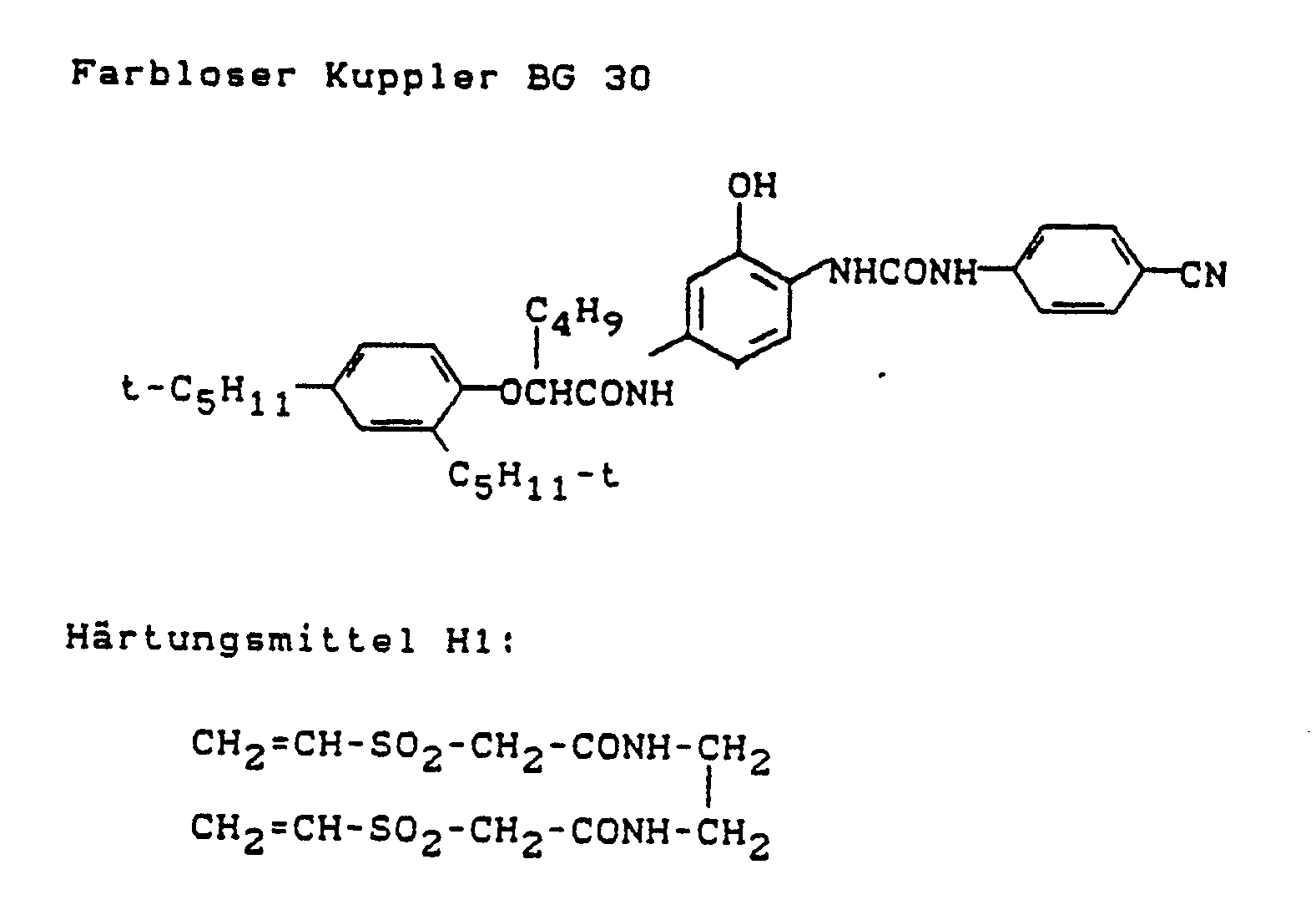
- Auf einen transparenten Schichtträger aus Cellulosetriacetat wurden jeweils folgende Schichten in der hier angegebenen Reihenfolge aufgetragen.
- Die Mengenangaben beziehen sich jeweils auf 1 m². Für den Silberhalogenidauftrag werden die äquivalenten Mengen an AgNO₃ angegeben.
- Alle Silberhalogenidemulsionen waren chemisch schwefel- und goldgereift auf maximale Lichtempfindlichkeit und mit 0,4 g 4-Hydroxy-6-methyl-1,3,3a,7-tetraazainden pro 100 g AgNO₃ stabilisiert.
1. Schicht (Antihalo-Schicht) 0,25 g/m² schwarzes kolloidales Silber 1,3 g/m² Gelatine 0,025 g/m² Blaugrün-Korrekturfarbstoff nach Angabe 0,4 g/m² UV-Absorber UV 1 0,05 g/m² Trikresylphosphat 0,03 g/m² Dibutylphthalat 2. Schicht (Mikrat-Zwischenschicht) 0,25 g AgNO₃ einer Mikrat-Ag (Br,I)-Emulsion: mittlerer Korndurchmesser = 0,07 µm, 0,5 Mol-% Iodid 1,0 g/m² Gelatine 0,05 g/m² farbiger Kuppler RM 0,10 g/m² Trikresylphosphat 3. Schicht (niedrig-rotempfindliche Schicht) 2,8 g/m² AgNO₃ einer spektral rotsensibilisierten Ag (Br,I)-Emulsion, 4,5 Mol-% Iodid, mittlerer Korndurchmesser = 0,45 µm 1,8 g/m² Gelatine 0,6 g/m² farbloser Kuppler BG 32 0,03 g/m² DIR-Kuppler DIR-25 0,04 g/m² farbiger Kuppler RM 0,36 g/m² Trikresylphosphat 0,16 g/m² Dibutylphthalat 4. Schicht (hoch-rotempfindliche Schicht) 2,4 g/m² AgNO₃ einer spektral rotsensibilisierten Ag (Br,I)-Emulsion, 8,0 Mol-% Iodid, mittlerer Korndurchmesser = 0,8 µm 1,5 g/m² Gelatine 0,12 g/m² farbloser Kuppler BG 33 0,02 g/m² farbiger Kuppler RM 0,01 g/m² Trikresylphosphat 0,08 g/m² Dibutylphosphat 5. Schicht (Trennschicht) 0,8 g/m² Gelatine 0,05 g/m² 2,5-Di-t-pentadecylhydrochinon 0,05 g/m² Trikresylphosphat 0,05 g/m² Dibutylphthalat 6. Schicht (niedrig-grünempfindliche Schicht) 1,8 g/m² AgNO₃ einer spektral grünsensibilisierten Ag (Br,I)-Emulsion, 5,2 Mol-% Iodid, mittlerer Korndurchmesser = 0,45 µm, 1,2 g/m² Gelatine 0,52 g/m² farbloser Kuppler PP 24 0,06 g/m² DIR-Kuppler DIR-25 0,15 g/m² farbiger Kuppler YM 0,6 g/m² Trikresylphosphat 7. Schicht (hoch-grünempfindliche Schicht) 2,0 g/m² AgNO₃ einer spektral grünsensibilisierten Ag (Br,I)-Emulsion, 8,5 Mol-% Iodid, mittlerer Korndurchmesser 0,84 µm, 1,3 g/m² Gelatine 0,14 g/m² farbloser Kuppler PP 2 0,04 g/m² farbiger Kuppler YM 0,20 g/m² Trikresylphosphat 8. Schicht (Gelbfilterschicht) 0,04 g/m² gelbes kolloidales Silber, passiviert durch 6 mg 1-Phenyl-5-mercaptotetrazol/g Ag 0,8 g/m² Gelatine 0,15 g/m² 2,5-Di-t-pentadecylhydrochinon 0,2 g/m² Trikresylphosphat 9. Schicht (niedrig-blauempfindliche Schicht) 0,65 g/m² AgNO₃ einer spektral blausensibilisierten Ag (Br,I)-Emulsion, 4,9 Mol-% Iodid, mittlerer Korndurchmesser= 0,40 µm 1,0 g/m² Gelatine 0,75 g/m² farbloser Kuppler GB 24 0,20 g/m² DIR-Kuppler DIR-26 0,10 g/m² DIR-Kuppler DIR-25 0,30 g/m² Trikresylphosphat 0,25 g/m² Poly-ethylacrylat 10. Schicht (hoch-blauempfindliche Schicht) 1,05 g/m² AgNO₃ einer spektral blausensibilisierten Ag (Br,I)-Emulsion, 9,0 Mol-% Iodid, mittlerer Korndurchmesser = 0,9 µm 0,8 g/m² Gelatine 0,25 g/m² farbloser Kuppler GB 24 0,15 g/m² Trikresylphosphat 0,15 g/m² Poly-ethylacrylat 11. Schicht (Schutzschicht) 1,5 g/m² Gelatine 0,1 g/m² UV-Absorber UV1 0,2 g/m² UV-Absorber UV2 0,02 g/m² Trikresylphosphat 0,02 g/m² Dibutylphthalat 12. Schicht (Härtungsschutzschicht) 0,5 g/m² AgNO₃ einer Mikrat-Ag(Br,I)-Emulsion, mittlerer Korndurchmesser = 0,07 µm, 0,5 Mol-% Iodid, 1,2 g/m² Gelatine 0,4 g/m² Härtungsmittel (H2) 1,0 g/m² Formaldehydfänger (F) 0,25 g/m² Polymethacrylat-Teilchen vom mittleren Durchmesser um 1,5 µm - In der 1. Schicht (Antihaloschicht) werden hierbei die gleichen Blaugrün-Korrekturfarbstoffe verwendet wie bei Schichtbeispiel 1.
Schichtaufbau Nr. Farbstoff 2a VF-1 Vergleich 2b VF-2 Vergleich 2c F-1 Erfindung 2d F-3 Erfindung 2e F-2 Erfindung -
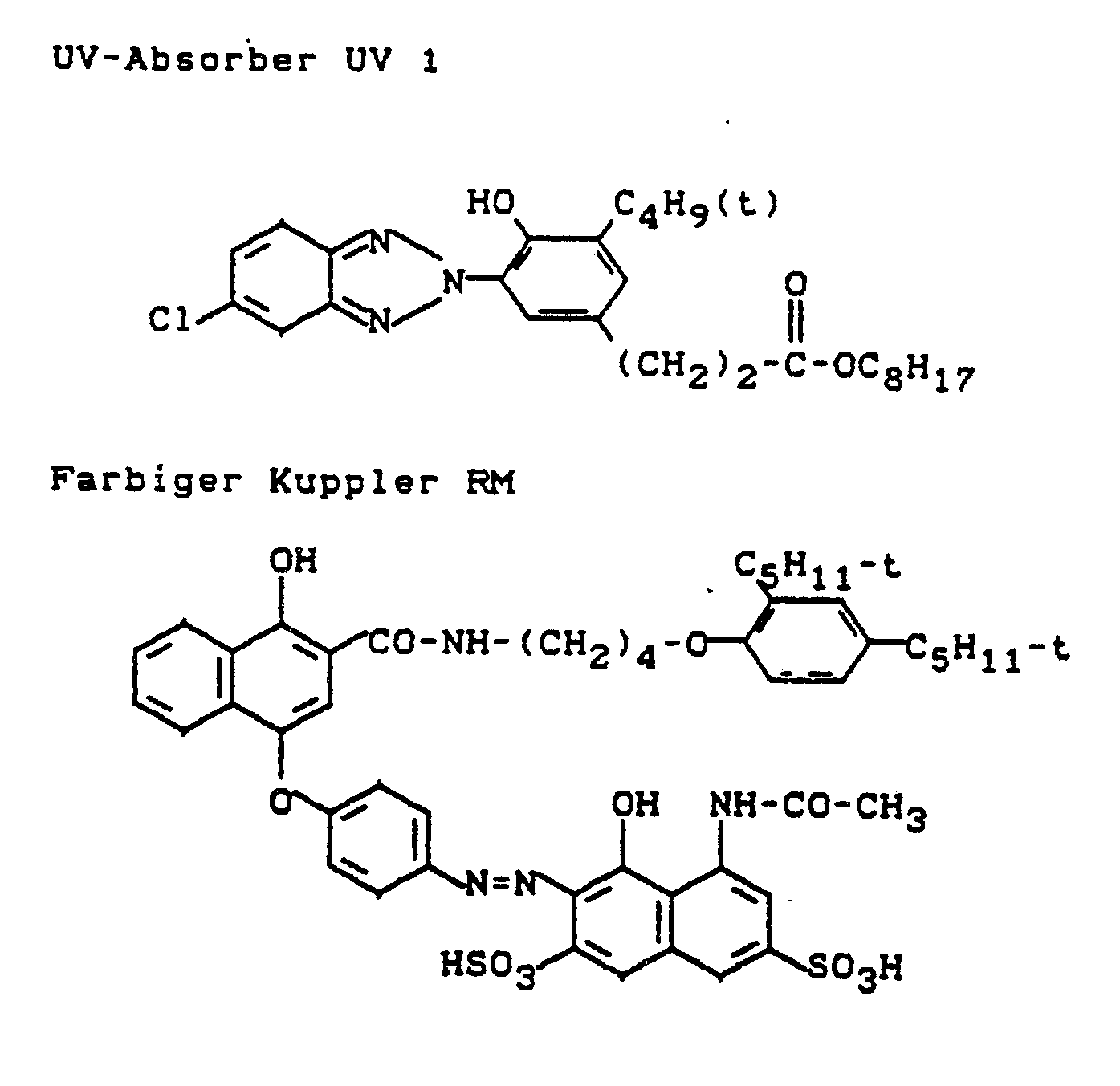
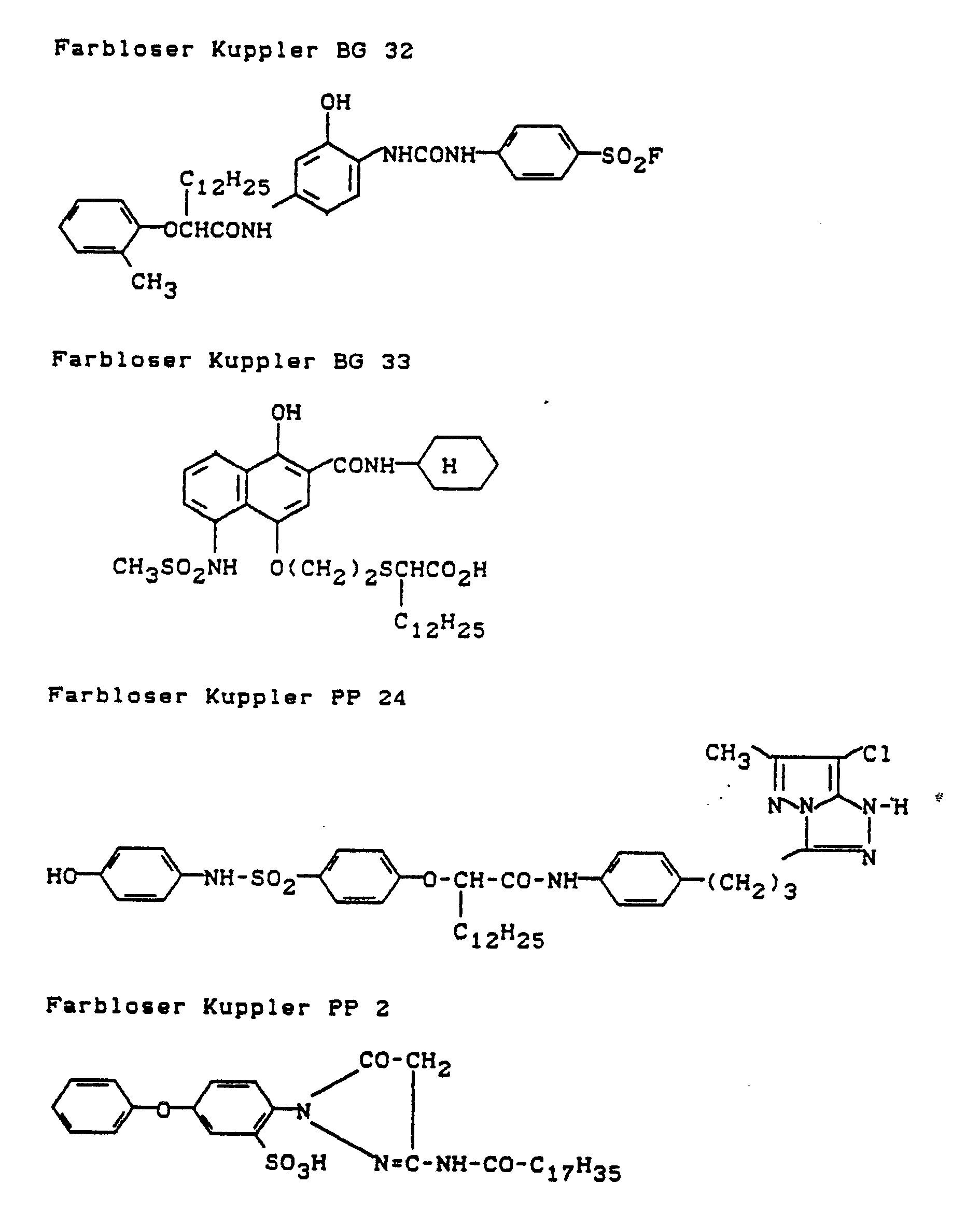


- Die Belichtung, Lagerung und Verarbeitung der Proben von Schichtbeispiel 2 erfolgte wie die von Schichtbeispiel 1.
- Die Ergebnisse sind in nachfolgender Tabelle zusammengestellt. Da von den beiden rotempfindlichen, den Blaugrün-Bildfarbstoff liefernden Teilschichten die hochempfindliche Teilschicht Nr. 4 die (Rotlicht-)empfindlichkeit des Blaugrün-Schichtpaketes dominierend bestimmt, andererseits aber der Blaugrün-Korrekturfarbstoff aus der 1. Schicht bei der Feucht-Warmlagerung jedoch vorwiegend auf die im Schichtverband höher gelegenen Teilschicht Nr. 3 einwirkt, hat in solchen Aufbauten dieser Blaugrün-Korrekturbarbstoff beim Feucht-Warmlagern der belichteten Proben nur auf die Blaugrün-Maximalfarbdichte einen starken nachteiligen Einfluß und nicht auf die (von der 4. Teilschicht bestimmten) Schwellen-Empfindlichkeit. Deshalb ist in der nachfolgenden Tabelle nur die Auswirkung auf die Blaugrün-Maximalfarbdichte eingetragen.
Tabelle 2 Ergebnisse von Schichtbeispiel 2 Probe Nr. Lagerungen bei Normalklima (50 % r.F. 20°C) Feucht-Warm-Lagerungen (90 % r.F. 35°C) Belichtung nach der Lagerung Belichtung vor der Lagerung Differenz (A-B) Belichtung nach der Lagerung Belichtung vor der Lagerung Differenz (C-D) A: Dmax B: Dmax C: Dmax D: Dmax Vergleich 2a 2,45 2,36 -0,09 2,42 1,80 -0,62 2b 2,48 2,42 -0,06 2,40 1,72 -0,68 Erfindung 2c 2,44 2,41 -0,03 2,42 2,34 -0,08 2d 2,46 2,41 -0,05 2,41 2,34 -0,07 2e 2,47 2,42 -0,05 2,45 2,36 -0,09 - Wie aus den Beispielen klar ersichtlicht ist, vermindert der Einsatz der erfindungsgemäßen Blaugrün-Korrekturfarbstoffe wirkungsvoll die Abnahme der Empfindlichkeit und der Maximaldichte bei Lagerung des belichteten fotografischen Materials bei Tropenbedingungen. Eine oxidative Zerstörung der Latentbildkeime findet somit nicht mehr statt.
Claims (3)

R₁, R₂ H gegebenenfalls substituiertes C₁-C₄-Alkyl, C₆-C₁₀-Aryl und C₁-C₃-Alkoxy,
R₃ H, gegebenenfalls substituiertes C₁-C₄-Alkyl, C₆-C₁₀-Aryl und C₁-C₃-Alkoxy, Halogen,
R₄ H, gegebenenfalls substituieres C₁-C₄-Alkyl und C₁-C₃-Alkoxy, -CN, Halogen, -SO₂R₇, -COOR₇, -SO₂OR₇, -COR₇, -SO₂NR₇R₈, -CONR₇R₈,
R₅ -NHCOR₉, -NHCOOR₉, -NHSO₂R₉, -NHO(R₉)2,
R₆ -CON(R₉)₂, -NHCOR₉, -NHCOOR₉, -NHSO₂R₉, -NCON(R₉)₂, -NHSO₂N(R₉)₂,
R₇ gegebenenfalls substituiertes C₁-C₄-Alkyl und C₆-C₁₀-Aryl,
R₈, H, R₇, wobei R₇ und R₈ einen fünf- oder sechsgliedrigen, gegebenenfalls substituierten Ring bilden können,
R₉ H, gegebenenfalls substituiertes C₁-C₄-Alkyl, C₅-C₁₀-Cycloalkyl, C₂-C₆-Alkenyl, C₂-C₆-Alkinyl, C₆-C₁₀-Aryl, C₅-C₁₀-Herteroaryl oder Heteroalkyl und C₁-C₃-Alkoxy,
Ballast übliche Ballastreste,
n 1 oder 2.


X₁, X₂, H, F, Cl und gegebenenfalls substituiertes C₁-C₄-Alkoxy darstellen.
Applications Claiming Priority (2)
| Application Number | Priority Date | Filing Date | Title |
|---|---|---|---|
| DE3823020A DE3823020A1 (de) | 1988-07-07 | 1988-07-07 | Farbfotografisches aufzeichnungsmaterial |
| DE3823020 | 1988-07-07 |
Publications (3)
| Publication Number | Publication Date |
|---|---|
| EP0351588A2 true EP0351588A2 (de) | 1990-01-24 |
| EP0351588A3 EP0351588A3 (de) | 1991-01-30 |
| EP0351588B1 EP0351588B1 (de) | 1994-03-30 |
Family
ID=6358165
Family Applications (1)
| Application Number | Title | Priority Date | Filing Date |
|---|---|---|---|
| EP89111523A Expired - Lifetime EP0351588B1 (de) | 1988-07-07 | 1989-06-24 | Farbfotografisches Aufzeichnungsmaterial |
Country Status (4)
| Country | Link |
|---|---|
| US (1) | US5108883A (de) |
| EP (1) | EP0351588B1 (de) |
| JP (1) | JP2841341B2 (de) |
| DE (2) | DE3823020A1 (de) |
Families Citing this family (8)
| Publication number | Priority date | Publication date | Assignee | Title |
|---|---|---|---|---|
| JP2676284B2 (ja) * | 1991-09-17 | 1997-11-12 | 富士写真フイルム株式会社 | ハロゲン化銀写真感光材料 |
| JPH05323501A (ja) * | 1992-05-18 | 1993-12-07 | Fuji Photo Film Co Ltd | ハロゲン化銀写真感光材料 |
| JP2884280B2 (ja) * | 1992-05-18 | 1999-04-19 | 富士写真フイルム株式会社 | ハロゲン化銀写真感光材料 |
| US5460930A (en) * | 1993-10-28 | 1995-10-24 | Eastman Kodak Company | Photographic elements containing indoaniline dummy dyes |
| US5441856A (en) * | 1993-12-17 | 1995-08-15 | Eastman Kodak Company | Photographic elements containing indoaniline dummy dyes |
| DE69931246D1 (de) * | 1999-05-25 | 2006-06-14 | Ferrania Technologies Spa | Träger für photographische lichtempfindliche Elemente |
| DE10013135A1 (de) * | 2000-03-17 | 2001-10-04 | Agfa Gevaert Ag | Farbfotografisches Silberhalogenidmaterial |
| KR20250162766A (ko) * | 2023-03-20 | 2025-11-19 | 세키스이가가쿠 고교가부시키가이샤 | 근적외선 투과 흑색 입자, 잉크 및 성형체 |
Family Cites Families (6)
| Publication number | Priority date | Publication date | Assignee | Title |
|---|---|---|---|---|
| US3547640A (en) * | 1967-03-09 | 1970-12-15 | Eastman Kodak Co | Multicolor photographic elements |
| US4333999A (en) * | 1979-10-15 | 1982-06-08 | Eastman Kodak Company | Cyan dye-forming couplers |
| EP0148536B1 (de) * | 1981-06-11 | 1989-09-06 | Konica Corporation | Lichtempfindliche Silberhalogenidmaterialien für Farbphotographie |
| DE3580785D1 (de) * | 1984-05-10 | 1991-01-17 | Fuji Photo Film Co Ltd | Farbphotographisches lichtempfindliches silberhalogenidmaterial. |
| US4851327A (en) * | 1986-07-17 | 1989-07-25 | Fuji Photo Film Co., Ltd. | Photographic color photosensitive material with two layer reflective support |
| US4749641A (en) * | 1986-09-15 | 1988-06-07 | Eastman Kodak Company | Imaging element containing dye masking coupler |
-
1988
- 1988-07-07 DE DE3823020A patent/DE3823020A1/de not_active Withdrawn
-
1989
- 1989-06-24 EP EP89111523A patent/EP0351588B1/de not_active Expired - Lifetime
- 1989-06-24 DE DE89111523T patent/DE58907331D1/de not_active Expired - Fee Related
- 1989-07-03 JP JP1171779A patent/JP2841341B2/ja not_active Expired - Fee Related
-
1990
- 1990-11-09 US US07/613,454 patent/US5108883A/en not_active Expired - Lifetime
Also Published As
| Publication number | Publication date |
|---|---|
| EP0351588A3 (de) | 1991-01-30 |
| DE58907331D1 (de) | 1994-05-05 |
| EP0351588B1 (de) | 1994-03-30 |
| US5108883A (en) | 1992-04-28 |
| DE3823020A1 (de) | 1990-01-11 |
| JP2841341B2 (ja) | 1998-12-24 |
| JPH0262539A (ja) | 1990-03-02 |
Similar Documents
| Publication | Publication Date | Title |
|---|---|---|
| EP0320776B1 (de) | Farbfotografisches Silberhalogenidmaterial | |
| EP0358071B1 (de) | Fotografisches Aufzeichnungsmaterial | |
| EP0351588B1 (de) | Farbfotografisches Aufzeichnungsmaterial | |
| DE3830522A1 (de) | Fotografisches aufzeichnungsmaterial | |
| EP0515873B1 (de) | Farbfotografisches Aufzeichnungsmaterial | |
| EP0652474B1 (de) | Farbfotografisches Aufzeichnungsmaterial | |
| EP0345514B1 (de) | Farbfotografisches Silberhalogenidmaterial | |
| EP0369235B1 (de) | Fotografisches Aufzeichnungsmaterial | |
| EP0413204A2 (de) | Farbfotografisches Silberhalogenidmaterial | |
| EP0377889B1 (de) | Silberhalogenidaufzeichnungsmaterial | |
| EP0363820A2 (de) | Farbfotografisches Silberhalogenidmaterial | |
| EP0550907B1 (de) | Fotografisches Aufzeichnungsmaterial | |
| EP0377181A2 (de) | Farbfotografisches Material | |
| EP0373339B1 (de) | Silberhalogenidaufzeichnungsmaterial | |
| EP0616256B1 (de) | Farbfotografisches Aufzeichnungsmaterial | |
| DE3838467C2 (de) | Fotografisches Aufzeichnungsmaterial | |
| EP0697624B1 (de) | Farbphotographisches Aufzeichnungsmaterial | |
| DE4027373A1 (de) | Farbfotografisches farbkupplerhaltiges aufzeichnungsmaterial | |
| EP0330948A2 (de) | Verfahren zur Erzeugung von Colorbildern | |
| EP0447657B1 (de) | Fotografisches Aufzeichnungsmaterial | |
| EP0709731A2 (de) | Farbfotografisches Silberhalogenidmaterial | |
| DE3833387A1 (de) | Farbfotografisches silberhalogenidmaterial | |
| EP0554756A1 (de) | Farbfotografisches Aufzeichnungsmaterial | |
| DE4031159A1 (de) | Farbfotogafisches farbkupplerhaltiges aufzeichnungsmaterial | |
| EP0722117A2 (de) | Farbfotografisches Silberhalogenidmaterial |
Legal Events
| Date | Code | Title | Description |
|---|---|---|---|
| PUAI | Public reference made under article 153(3) epc to a published international application that has entered the european phase |
Free format text: ORIGINAL CODE: 0009012 |
|
| 17P | Request for examination filed |
Effective date: 19890624 |
|
| AK | Designated contracting states |
Kind code of ref document: A2 Designated state(s): BE DE FR GB IT NL |
|
| PUAL | Search report despatched |
Free format text: ORIGINAL CODE: 0009013 |
|
| AK | Designated contracting states |
Kind code of ref document: A3 Designated state(s): BE DE FR GB IT NL |
|
| RHK1 | Main classification (correction) |
Ipc: G03C 7/18 |
|
| 17Q | First examination report despatched |
Effective date: 19930414 |
|
| GRAA | (expected) grant |
Free format text: ORIGINAL CODE: 0009210 |
|
| AK | Designated contracting states |
Kind code of ref document: B1 Designated state(s): BE DE FR GB IT NL |
|
| REF | Corresponds to: |
Ref document number: 58907331 Country of ref document: DE Date of ref document: 19940505 |
|
| ITF | It: translation for a ep patent filed | ||
| ITTA | It: last paid annual fee | ||
| GBT | Gb: translation of ep patent filed (gb section 77(6)(a)/1977) |
Effective date: 19940704 |
|
| ET | Fr: translation filed | ||
| PLBE | No opposition filed within time limit |
Free format text: ORIGINAL CODE: 0009261 |
|
| STAA | Information on the status of an ep patent application or granted ep patent |
Free format text: STATUS: NO OPPOSITION FILED WITHIN TIME LIMIT |
|
| 26N | No opposition filed | ||
| PGFP | Annual fee paid to national office [announced via postgrant information from national office to epo] |
Ref country code: BE Payment date: 20010425 Year of fee payment: 13 |
|
| PGFP | Annual fee paid to national office [announced via postgrant information from national office to epo] |
Ref country code: NL Payment date: 20010427 Year of fee payment: 13 |
|
| PGFP | Annual fee paid to national office [announced via postgrant information from national office to epo] |
Ref country code: FR Payment date: 20010516 Year of fee payment: 13 Ref country code: GB Payment date: 20010516 Year of fee payment: 13 |
|
| REG | Reference to a national code |
Ref country code: GB Ref legal event code: IF02 |
|
| PG25 | Lapsed in a contracting state [announced via postgrant information from national office to epo] |
Ref country code: GB Free format text: LAPSE BECAUSE OF NON-PAYMENT OF DUE FEES Effective date: 20020624 |
|
| PG25 | Lapsed in a contracting state [announced via postgrant information from national office to epo] |
Ref country code: BE Free format text: LAPSE BECAUSE OF NON-PAYMENT OF DUE FEES Effective date: 20020630 |
|
| BERE | Be: lapsed |
Owner name: *AGFA-GEVAERT A.G. Effective date: 20020630 |
|
| PG25 | Lapsed in a contracting state [announced via postgrant information from national office to epo] |
Ref country code: NL Free format text: LAPSE BECAUSE OF NON-PAYMENT OF DUE FEES Effective date: 20030101 |
|
| GBPC | Gb: european patent ceased through non-payment of renewal fee |
Effective date: 20020624 |
|
| PG25 | Lapsed in a contracting state [announced via postgrant information from national office to epo] |
Ref country code: FR Free format text: LAPSE BECAUSE OF NON-PAYMENT OF DUE FEES Effective date: 20030228 |
|
| NLV4 | Nl: lapsed or anulled due to non-payment of the annual fee |
Effective date: 20030101 |
|
| REG | Reference to a national code |
Ref country code: FR Ref legal event code: ST |
|
| PG25 | Lapsed in a contracting state [announced via postgrant information from national office to epo] |
Ref country code: IT Free format text: LAPSE BECAUSE OF NON-PAYMENT OF DUE FEES;WARNING: LAPSES OF ITALIAN PATENTS WITH EFFECTIVE DATE BEFORE 2007 MAY HAVE OCCURRED AT ANY TIME BEFORE 2007. THE CORRECT EFFECTIVE DATE MAY BE DIFFERENT FROM THE ONE RECORDED. Effective date: 20050624 |
|
| PGFP | Annual fee paid to national office [announced via postgrant information from national office to epo] |
Ref country code: DE Payment date: 20051223 Year of fee payment: 17 |
|
| PG25 | Lapsed in a contracting state [announced via postgrant information from national office to epo] |
Ref country code: DE Free format text: LAPSE BECAUSE OF NON-PAYMENT OF DUE FEES Effective date: 20070103 |
|
| PG25 | Lapsed in a contracting state [announced via postgrant information from national office to epo] |
Ref country code: DE Free format text: LAPSE BECAUSE OF NON-PAYMENT OF DUE FEES Effective date: 20060102 |