EP0352970A2 - Système et méthode pour détecter les limites des caractères dans un flux de données codées en série - Google Patents
Système et méthode pour détecter les limites des caractères dans un flux de données codées en série Download PDFInfo
- Publication number
- EP0352970A2 EP0352970A2 EP89307383A EP89307383A EP0352970A2 EP 0352970 A2 EP0352970 A2 EP 0352970A2 EP 89307383 A EP89307383 A EP 89307383A EP 89307383 A EP89307383 A EP 89307383A EP 0352970 A2 EP0352970 A2 EP 0352970A2
- Authority
- EP
- European Patent Office
- Prior art keywords
- character
- code
- bit
- detecting
- responsive
- Prior art date
- Legal status (The legal status is an assumption and is not a legal conclusion. Google has not performed a legal analysis and makes no representation as to the accuracy of the status listed.)
- Granted
Links
- 238000000034 method Methods 0.000 title claims abstract description 12
- 230000008878 coupling Effects 0.000 claims abstract description 14
- 238000010168 coupling process Methods 0.000 claims abstract description 14
- 238000005859 coupling reaction Methods 0.000 claims abstract description 14
- 238000001514 detection method Methods 0.000 claims abstract description 5
- 230000002401 inhibitory effect Effects 0.000 claims abstract description 5
- 238000011010 flushing procedure Methods 0.000 claims 1
- 230000005540 biological transmission Effects 0.000 description 9
- 239000000835 fiber Substances 0.000 description 3
- 230000003287 optical effect Effects 0.000 description 3
- 238000010586 diagram Methods 0.000 description 2
- 238000001228 spectrum Methods 0.000 description 2
- 230000000694 effects Effects 0.000 description 1
- 239000011159 matrix material Substances 0.000 description 1
- 230000003071 parasitic effect Effects 0.000 description 1
- 230000000630 rising effect Effects 0.000 description 1
- 238000007493 shaping process Methods 0.000 description 1
Images


Classifications
-
- H—ELECTRICITY
- H04—ELECTRIC COMMUNICATION TECHNIQUE
- H04L—TRANSMISSION OF DIGITAL INFORMATION, e.g. TELEGRAPHIC COMMUNICATION
- H04L25/00—Baseband systems
- H04L25/38—Synchronous or start-stop systems, e.g. for Baudot code
- H04L25/40—Transmitting circuits; Receiving circuits
- H04L25/49—Transmitting circuits; Receiving circuits using code conversion at the transmitter; using predistortion; using insertion of idle bits for obtaining a desired frequency spectrum; using three or more amplitude levels ; Baseband coding techniques specific to data transmission systems
- H04L25/4906—Transmitting circuits; Receiving circuits using code conversion at the transmitter; using predistortion; using insertion of idle bits for obtaining a desired frequency spectrum; using three or more amplitude levels ; Baseband coding techniques specific to data transmission systems using binary codes
- H04L25/4908—Transmitting circuits; Receiving circuits using code conversion at the transmitter; using predistortion; using insertion of idle bits for obtaining a desired frequency spectrum; using three or more amplitude levels ; Baseband coding techniques specific to data transmission systems using binary codes using mBnB codes
Definitions
- This invention relates to character synchronisation of a data stream encoded in a serial code and more particularly to determining the character boundaries in the data stream.
- transmission codes The primary purpose of transmission codes is to transform the frequency spectrum of a serial data stream so that clocking can be recovered readily and a.c. coupling is possible.
- the code must also provide special characters outside the data alphabet for a function such as character synchronisation, frame delimiters and perhaps abort, reset, idle, diagnostics, etc. Codes are also used, often in combination with signal waveform shaping, to adapt the signal spectrum more closely to the specific channel requirements. In most cases a reduction in bandwidth by constraints on both the high and low frequency components is desirable to reduce distortion in the transmission media, especially electromagnetic cables, or in the band limited receiver, and reduce the effects on intrinsic noise.
- the high gain fibre optic receivers need an a.c. coupling stage near the front end.
- the control of the drive level, receiver gain, and equalisation is simplified and the precision of control is improved, if it can be based on the average signal power, especially at top rates.
- D.C. restore circuits tend to lose precision with rising data rates and cease to operate properly below the maximum rates for other circuits required in a transceiver.
- the time constants associated with the parasitic capacitances at the front end of a receiver are comparable to or longer than a baud interval, a signal with reduced low frequency content will suffer less distortion and will enable many links to operate without an equalising circuit.
- the Manchester and related codes are simple two-level codes and solve the clocking and low frequency problems as well. They translate each bit into two bits for transmission and are a good choice whenever the high clocking rates cause no problems in logic or analog circuits, the transducers or on the transmission line. They also reduce the data transmission rate by a factor of two since they encode 2 bits for every data bit.
- Simple 5 bit/6 bit codes translate 5 binary bits into 6 binary bits and raise the number of information bits transmitted per baud interval to 0.833.
- the implementation of a 5 bit/6 bit code in a byte-oriented (8 bit) system causes burdens in complexity. It is for this reason that an 8-bit/10-bit (8/10) partitioned block transmission code invented by Franaczek et al. and described in US-A-4,486,739 is highly desirable when dealing with an 8-bit byte system.
- This patent is incorporated herein by reference. In this patent a binary d.c. balance code encoder circuit for effecting the same is described which translates the 8-bit byte of information into 10 binary bits for transmission over electromagnetic or optical transmission lines subject to timing and low frequency constraints.
- the significance of this code is that it combines the low circuit count for implementation with excellent performance near the limits and measured with respect to the criteria.
- the 8-bit/10-bit code is partitioned into a 5-bit/6-bit block plus a 3-bit/4-bit block code which, when used in concert, allow a byte of data plus a control bit called the "K" bit to be encoded into 10 bits.
- the resulting encoded data is put into a serial data stream, the data is put into the serial data stream with the least significant bit going first.
- the receiver of this serial data will have to figure out where each of the 10 bits of the code lies in the serial data stream. It turns out there are ten possible places - which are referred to as "character boundaries" - where each of the group of 10 bits may lie.
- bits are encoded bit by bit, not in groups.
- the concept of character boundary does not mean anything for biphase, Manchester, and other bit oriented codes.
- the object of the present invention is to provide an improved system and method for detecting character boundaries in a data stream encoded in a serial code.
- the present invention relates to a system for detecting a character boundary in a data stream encoded in a serial code comprising means responsive to the transmitted data stream for coupling a number of character bits to a utilisation means, the coupling means being responsive to a skip bit signal for moving the character boundary by one bit, means coupled to the coupling means and responsive to the number of character bits for detecting if there is a zero character disparity and a code error, skip signal providing means responsive to a code error for providing a skip signal to the coupling means in the presence of a detected code error, and means, coupled to the skip signal providing means, and responsive to detection of a zero disparity character for inhibiting said skip signal.
- the present invention also relates to a method for detecting a character boundary in a data stream encoded in a serial code comprising the steps of determining the absence of a zero disparity character, detecting code errors, and shifting the character boundary of the serial data stream by one bit when there is absence of a zero disparity character and presence of detected code errors.
- the ten bits of an 8/10 encoded data stream are referred to as: a b c d e i f g h j where a is the least significant bit and the first to arrive at the deserialiser and j is the most significant bit and the last to arrive at the deserialiser.
- Fig. 1 shows the ten ways these bits can be arranged in the serial data stream in any 20-bit snapshot of the serial data stream.
- the 8/10 decoder needs to receive the 10 bits with the "a" bit in the least significant bit position and the other nine bits alongside it and in their correct positions with respect to "a".
- the character synchronisation boundary is determined by hunting through all of the ten possible character boundaries one at a time until a boundary is found where error-free 8/10 data has been seen for an extended period.
- each new character boundary is reached by moving the 10 bits decoded over by 1 bit in the incoming data stream.
- the new character is tested for a zero disparity character and error code violations.
- these 10 bit characters are partitioned into blocks of 6 bits followed by 4 bits.
- a character's disparity is determined by the number of logic 1's compared to the number of logic 0's in each block.
- a block with equal logic 1's and 0's has zero disparity except for the D.7 6-bit sub-block and the D/K.X.3 4-bit sub-block.
- a block with more logic 1's than logic 0's has positive disparity and a block with less logic 1's than logic 0's has negative disparity.
- the character disparity is zero if both its 6-bit and 4-bit blocks taken individually have an equal number of ones and zeros and the 6-bit block is not equal to D.7 and the 4-bit block is not equal to D/K.X.3.
- Block disparity is represented by D0 in Table 1 of US-A-4,486,739.
- Running disparity is the disparity after each bit, and can vary within the range of -3 to +3 to avoid a disparity error.
- the running disparity after both the 6-bit and 4-bit blocks must equal +1 or -1 to avoid a disparity error.
- Running disparity at the beginning of each block or character is represented by D-1 in Tables 1, 2 and 3 of US
- the deserialiser 11 is of the type which has a skip function input which changes its character boundary one bit at a time when a skip pulse is applied as shown.
- a skip function input which changes its character boundary one bit at a time when a skip pulse is applied as shown.
- the output of the deserialiser is coupled to two parallel five place parallel registers 13 which in turn are coupled to a ten bit parallel register 15.
- the output from register 15 is then coupled to the 8/10 bit decoder 17 producing 8 bit and K bit outputs.
- the output of the decoder is passed to unit 19 which produces conventional bus and tag control bits which can be coupled, for example, to a control unit.
- serial signals to the deserialiser 11 may be sent, for example, from a serial bus line of the electromagnetic or optical type and the input of the deserialiser may include an optical electromagnetic receiver of conventional type.
- the input signals may be sent for example from a computer which itself transmits serial signals or, in the alternative, may be on conventional parallel bus and tag bits which are serialised by a serialiser well known in the state of the art.
- serialisers and deserialisers are well known in the state of the art.
- One such serialiser system using serialisers and deserialisers is the 3044 Fiber-Optic Channel Extended Link Models C01 and D01 product of IBM Corporation.
- US-A-4,366,478 or US-A-4,642,629 incorporated herein by reference, describe systems using serialisers and deserialisers.
- the character synchronisation described herein may be used for character synchronisation in the decoder described in co-pending European Patent Application (Ref. KI9-88-009).
- the output of register 15 is also coupled to an 8/10 error detector 21.
- the output of the 8/10 error detector is held in latch 22.
- the output from the register 15 is also coupled to an 8/10 bit disparity computation unit 23.
- the running disparity is coupled or held in a disparity latch 25.
- the outputs from the error detector and the disparity computation are coupled to skip control signal generator 27.
- the output from the skip control signal generator is applied as the skip control signal to the skip control input of the deserialiser 11.
- the skip control generator circuit is shown in Fig. 3.
- the skip control generator circuit 27 includes a counter 30 and comparator 31 for producing a logic 1 level signal when the counter 30 has detected a predetermined number of machine cycles (x cycles) following reset which occurs when a new skip signal is provided to the deserialiser.
- the number of cycles (x) is equal to the number of system clock pulses it takes to flush out the bits from the old character boundary so that the circuitry is using bits from the new character boundary. This may take for example three system clock pulses.
- This logic "1" level from comparator 31 provides one input to AND gate 33.
- the disparity computation circuit 23 has two outputs. This first output provides a running disparity to latch 25. The second output presents a signal (stop skip) if there is a zero disparity character.
- the output from disparity computation is inverted at inverter 32 and applied to the AND gate 33 to enable the AND gate 33 when there is not a zero disparity character, in other words when the character disparity is positive or negative.
- the enabled output from AND gate 33 sets latch 35 to provide an enable signal to AND gate 37.
- AND gate 37 when enabled couples any error signal from 8/10 error detector to enable skip latch 39 and provide a skip signal to the deserialiser, reset the counter 30 and reset the allow skip latch 35 via OR gate 40.
- the system includes a character synchronisation decision circuit 29 which, when this decision circuit decides that the character boundary is lost, provides a "hunt for sync" signal to Fig. 3.
- the "hunt for sync” is inverted by inverter 41, degating OR gate 40, which stops resetting latch 35, allowing latch 35 to set to permit the skip function.
- This character synchronisation circuit 29 is described by Leon Skarshinski in IBM Technical Disclosure Bulletin Vol. 28, No. 12, May 1986 entitled “Character Synchronization Method".
- the referenced "allow character sync” signal is the "hunt for sync” signal.
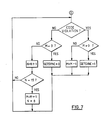
- Figs. 6 and 7 of this Application are from the above Technical Disclosure Bulletin.
- a problem in implementing a serial protocol with run-length-limited code is to determine reliably when character synchronisation is lost, and when it is reacquired. This is because the high-speed logic, if allowed, will reset the character clock every time that a predetermined character is encountered, potentially slivering character clocks and producing unexpected results in low speed logic.
- a loss of character synchronisation poses a problem only when a frame is being received and processed by a port; this loss of sync at the beginning of a long frame will not be noticed until a frame trailer or an idle sequence is encountered.
- the method being described uses code violation statistics to recognise when the character clock is aligned with the incoming characters.
- the N counter will count up to N character clock cycles when started by a code violation. If no additional code violations are detected during this time, the M counter would be incremented; if a code violation is encountered, the N counter is reset and the M counter is decremented. (The M counter cannot increment through the all '1' state and cannot decrement through the all '0' state.)
- the state of the M counter will indicate in or out of character synchronism, as shown below: Whenever the M counter decrements from the all '1' state, a code violation error is signalled to a controller and the state of the port logic is frozen while it is read out and logged by the controller. No additional requests to the matrix controller will be generated by the port in this state. The port will be freed when the M counter returns to the all '1' state and the controller resets the code violation indicator.
- the high speed character clock counter will be permitted to reset on idle characters, thereby resynchronising the character clock.
- the character counter may be allowed either to skip or to add one count; then the M and N counters would again test for character synchronisation.
- the ten bits of the 8/10 encoded data stream are referred to as a, b, c, d, e, i, f, g, h, j where a is the least significant bit and the first to arrive at the deserialiser 11 and j is the most significant bit and the last to arrive at the deserialiser.
- the disparity computation may be made using logic circuits to perform these functions directly or may be provided by a program in a microprocessor in connection with a processor that performs these computations. Note also that the output from running disparity positive (+) or negative (-) is coupled back to the input of the 8/10 error detector 21 and the disparity computation circuit 23.
- a test for zero disparity character is made using a zero disparity character detection circuit. If there is true positive or negative disparity the latch 35 is set to present an enable signal to AND gate 37. This is represented in Fig. 5 by decision block 51. When the character disparity is known and is positive or negative the 8/10 code violation represented by Y at decision block 52 produces a skip pulse to the deserialiser. If there is not an 8/10 violation, there is no skipping as represented by decision N in block 52.
Landscapes
- Physics & Mathematics (AREA)
- Spectroscopy & Molecular Physics (AREA)
- Engineering & Computer Science (AREA)
- Computer Networks & Wireless Communication (AREA)
- Signal Processing (AREA)
- Dc Digital Transmission (AREA)
- Synchronisation In Digital Transmission Systems (AREA)
Applications Claiming Priority (2)
| Application Number | Priority Date | Filing Date | Title |
|---|---|---|---|
| US07/225,106 US4975916A (en) | 1988-07-26 | 1988-07-26 | Character snychronization |
| US225106 | 1988-07-26 |
Publications (3)
| Publication Number | Publication Date |
|---|---|
| EP0352970A2 true EP0352970A2 (fr) | 1990-01-31 |
| EP0352970A3 EP0352970A3 (fr) | 1991-10-16 |
| EP0352970B1 EP0352970B1 (fr) | 1996-01-31 |
Family
ID=22843543
Family Applications (1)
| Application Number | Title | Priority Date | Filing Date |
|---|---|---|---|
| EP89307383A Expired - Lifetime EP0352970B1 (fr) | 1988-07-26 | 1989-07-20 | Système et méthode pour détecter les limites des caractères dans un flux de données codées en série |
Country Status (4)
| Country | Link |
|---|---|
| US (1) | US4975916A (fr) |
| EP (1) | EP0352970B1 (fr) |
| JP (1) | JPH0273738A (fr) |
| DE (1) | DE68925547T2 (fr) |
Cited By (1)
| Publication number | Priority date | Publication date | Assignee | Title |
|---|---|---|---|---|
| EP0514777A3 (en) * | 1991-05-20 | 1993-06-16 | Fujitsu Limited | A disparity detection circuit for a 2-bit to 4-bit coded signal decoder |
Families Citing this family (30)
| Publication number | Priority date | Publication date | Assignee | Title |
|---|---|---|---|---|
| JPH01208769A (ja) * | 1988-02-16 | 1989-08-22 | Csk Corp | バーストエラー訂正装置 |
| US5229769A (en) * | 1992-02-21 | 1993-07-20 | Advanced Micro Devices, Inc. | Method and circuit for performing running disparity measurements |
| US5304996A (en) * | 1992-02-21 | 1994-04-19 | Advanced Micro Devices, Inc. | 8B/10B encoder providing one of pair of noncomplementary, opposite disparity codes responsive to running disparity and selected commands |
| US5387911A (en) * | 1992-02-21 | 1995-02-07 | Gleichert; Marc C. | Method and apparatus for transmitting and receiving both 8B/10B code and 10B/12B code in a switchable 8B/10B transmitter and receiver |
| JP3083011B2 (ja) * | 1992-12-28 | 2000-09-04 | キヤノン株式会社 | データ記録方法及び装置 |
| US5519830A (en) * | 1993-06-10 | 1996-05-21 | Adc Telecommunications, Inc. | Point-to-multipoint performance monitoring and failure isolation system |
| US5517519A (en) * | 1993-06-14 | 1996-05-14 | International Business Machines Corporation | Apparatus for repowering and monitoring serial links |
| US5485476A (en) * | 1993-06-14 | 1996-01-16 | International Business Machines Corporation | Method and system for error tolerant synchronization character detection in a data storage system |
| US6334219B1 (en) | 1994-09-26 | 2001-12-25 | Adc Telecommunications Inc. | Channel selection for a hybrid fiber coax network |
| USRE42236E1 (en) | 1995-02-06 | 2011-03-22 | Adc Telecommunications, Inc. | Multiuse subcarriers in multipoint-to-point communication using orthogonal frequency division multiplexing |
| US7280564B1 (en) | 1995-02-06 | 2007-10-09 | Adc Telecommunications, Inc. | Synchronization techniques in multipoint-to-point communication using orthgonal frequency division multiplexing |
| US5825824A (en) * | 1995-10-05 | 1998-10-20 | Silicon Image, Inc. | DC-balanced and transition-controlled encoding method and apparatus |
| US5999571A (en) * | 1995-10-05 | 1999-12-07 | Silicon Image, Inc. | Transition-controlled digital encoding and signal transmission system |
| US5974464A (en) * | 1995-10-06 | 1999-10-26 | Silicon Image, Inc. | System for high speed serial video signal transmission using DC-balanced coding |
| US5781544A (en) * | 1996-01-17 | 1998-07-14 | Lsi Logic Corporation | Method for interleaving network traffic over serial lines |
| US5956370A (en) * | 1996-01-17 | 1999-09-21 | Lsi Logic Corporation | Wrap-back test system and method |
| US5787114A (en) * | 1996-01-17 | 1998-07-28 | Lsi Logic Corporation | Loop-back test system and method |
| US5790563A (en) * | 1996-02-05 | 1998-08-04 | Lsi Logic Corp. | Self test of core with unpredictable latency |
| US5896426A (en) * | 1996-02-05 | 1999-04-20 | Lsi Logic Corporation | Programmable synchronization character |
| US5781038A (en) * | 1996-02-05 | 1998-07-14 | Lsi Logic Corporation | High speed phase locked loop test method and means |
| KR100198448B1 (ko) * | 1996-12-20 | 1999-06-15 | 이계철 | Nb2p 부호화 장치 및 nb2p 복호화 장치 |
| US6438728B1 (en) * | 1999-12-15 | 2002-08-20 | Intel Corporation | Error character generation |
| KR100358353B1 (ko) * | 1999-12-27 | 2002-10-25 | 한국전자통신연구원 | 러닝 디스패리티 에러 검출 장치 및 방법 |
| US6865231B1 (en) * | 2000-06-20 | 2005-03-08 | Hewlett-Packard Development Company, L.P. | High-speed interconnection adapter having automated crossed differential pair correction |
| US7013422B2 (en) * | 2001-06-15 | 2006-03-14 | International Business Machines Corporation | Noise removal in multibyte text encodings using statistical models |
| JP3581112B2 (ja) * | 2001-06-21 | 2004-10-27 | シャープ株式会社 | データ送信方法および送信回路並びに通信機器 |
| EP1486079B1 (fr) * | 2002-03-15 | 2015-12-30 | Silicon Laboratories Inc. | Appareil radiofrequence |
| US7372928B1 (en) * | 2002-11-15 | 2008-05-13 | Cypress Semiconductor Corporation | Method and system of cycle slip framing in a deserializer |
| KR100520302B1 (ko) * | 2002-11-23 | 2005-10-13 | 한국전자통신연구원 | 8b/10b 선로부호그룹 적절성 검출장치 및 방법 |
| US8201071B2 (en) * | 2006-11-15 | 2012-06-12 | Qimonda Ag | Information transmission and reception |
Family Cites Families (8)
| Publication number | Priority date | Publication date | Assignee | Title |
|---|---|---|---|---|
| JPS5698051A (en) * | 1980-01-07 | 1981-08-07 | Hitachi Ltd | Signal transmitting device of lsi component |
| JPS6028171B2 (ja) * | 1980-09-02 | 1985-07-03 | 富士通株式会社 | Romを用いた符号復号回路 |
| US4486739A (en) * | 1982-06-30 | 1984-12-04 | International Business Machines Corporation | Byte oriented DC balanced (0,4) 8B/10B partitioned block transmission code |
| JPS6347848A (ja) * | 1986-08-18 | 1988-02-29 | Hitachi Cable Ltd | パリテイチエツク方法 |
| JPS6349947A (ja) * | 1986-08-20 | 1988-03-02 | Hitachi Cable Ltd | パリテイチエツク方法 |
| JPS63169144A (ja) * | 1987-01-06 | 1988-07-13 | Kokusai Electric Co Ltd | フレ−ム同期方法 |
| JPH0817378B2 (ja) * | 1987-03-16 | 1996-02-21 | 日本電信電話株式会社 | ブロツク同期方式 |
| JPS6446342A (en) * | 1987-08-14 | 1989-02-20 | Nec Corp | Block synchronization detection circuit |
-
1988
- 1988-07-26 US US07/225,106 patent/US4975916A/en not_active Expired - Fee Related
-
1989
- 1989-07-10 JP JP1175773A patent/JPH0273738A/ja active Pending
- 1989-07-20 EP EP89307383A patent/EP0352970B1/fr not_active Expired - Lifetime
- 1989-07-20 DE DE68925547T patent/DE68925547T2/de not_active Expired - Fee Related
Non-Patent Citations (3)
| Title |
|---|
| ELECTRONICS & COMMUNICATIONS IN JAPAN, vol. 67, no. 5, May 1984, pages 37-46; K. OHUE et al.: "Analog and digital amplitude-domain-multiplexed signal transmission systems using DC-balance mB-nB codes" * |
| IBM TECHNICAL DISCLOSURE BULLETIN, vol. 27, no. 9, February 1985, pages 5272-5279, New York, US; G.N.N. MARTIN: "A rate 8/10 DC balanced code with local parity" * |
| IBM TECHNICAL DISCLOSURE BULLETIN, vol. 28, no. 12, May 1986, pages 5577-5579, New York, US; "Character synchronization method" * |
Cited By (2)
| Publication number | Priority date | Publication date | Assignee | Title |
|---|---|---|---|---|
| EP0514777A3 (en) * | 1991-05-20 | 1993-06-16 | Fujitsu Limited | A disparity detection circuit for a 2-bit to 4-bit coded signal decoder |
| US5283576A (en) * | 1991-05-20 | 1994-02-01 | Fujitsu Limited | Disparity detection circuit for a 2-bit to 4-bit coded signal decoder |
Also Published As
| Publication number | Publication date |
|---|---|
| EP0352970A3 (fr) | 1991-10-16 |
| EP0352970B1 (fr) | 1996-01-31 |
| DE68925547T2 (de) | 1996-09-05 |
| DE68925547D1 (de) | 1996-03-14 |
| JPH0273738A (ja) | 1990-03-13 |
| US4975916A (en) | 1990-12-04 |
Similar Documents
| Publication | Publication Date | Title |
|---|---|---|
| EP0352970B1 (fr) | Système et méthode pour détecter les limites des caractères dans un flux de données codées en série | |
| EP0097763B1 (fr) | Procédé et dispositif pour produire un code à courant continu équilibré et à longueur de course limitée (0,4) de rapport 8B/10B à partir d'un flux de données d'entrée | |
| US5592487A (en) | Communication protocol for transferring information across a serial communication link | |
| EP0074587B1 (fr) | Technique de codage indépendante de la fréquence et à autocadence ainsi que dispositif pour communications numériques | |
| EP0725486B1 (fr) | Transmission de code à parité locale | |
| US5999571A (en) | Transition-controlled digital encoding and signal transmission system | |
| US5018142A (en) | Technique for organizing and coding serial binary data from a plurality of data lines for transmission over a single transmission line | |
| US5237590A (en) | Timing extraction circuit and communication system utilizing the same | |
| CA1119305A (fr) | Correction d'erreur pour signaux utilisant le code duobinaire modifie | |
| EP0199088B1 (fr) | Méthode et appareil pour modifier un code à longueur de course limitée | |
| EP1715485B1 (fr) | Appareil et procédé de formation de signaux | |
| EP0040632B1 (fr) | Systeme de traitement de donnees avec transmission serielle de donnees entre des sous systemes | |
| USRE31311E (en) | DC Free encoding for data transmission system | |
| JPH08223048A (ja) | データ変換方式 | |
| EP0548415B1 (fr) | Procédé de transmission de données utilisant une pluralité de lois de codage pour transmettre un flux principale et un flux auxiliare de bits | |
| EP0091215A2 (fr) | Démodulateur pour un signal binaire asynchrone | |
| US5131015A (en) | Combined BAUD rate generator and digital phase locked loop | |
| US5734341A (en) | Encoding digital data | |
| CA1314937C (fr) | Methode de transmission de donnees entre deux stations au moyen de guides de lumiere | |
| JPH0455010B2 (fr) | ||
| US5295163A (en) | Synchronization method for a run length-limited (1,7)-code, and circuit arrangement for said method | |
| US5101198A (en) | Method and device for the transmission of data between stations of a communications network, in particular for motor vehicles | |
| WO1984002432A1 (fr) | Codage et decodage ternaire de donnees numeriques | |
| EP0556982A1 (fr) | Méthode et appareil pour synchroniser l'émetteur et le récepteur | |
| GB2032228A (en) | DC free encoding for data transmission |
Legal Events
| Date | Code | Title | Description |
|---|---|---|---|
| PUAI | Public reference made under article 153(3) epc to a published international application that has entered the european phase |
Free format text: ORIGINAL CODE: 0009012 |
|
| AK | Designated contracting states |
Kind code of ref document: A2 Designated state(s): DE FR GB |
|
| 17P | Request for examination filed |
Effective date: 19900512 |
|
| PUAL | Search report despatched |
Free format text: ORIGINAL CODE: 0009013 |
|
| AK | Designated contracting states |
Kind code of ref document: A3 Designated state(s): DE FR GB |
|
| 17Q | First examination report despatched |
Effective date: 19930727 |
|
| GRAA | (expected) grant |
Free format text: ORIGINAL CODE: 0009210 |
|
| AK | Designated contracting states |
Kind code of ref document: B1 Designated state(s): DE FR GB |
|
| REF | Corresponds to: |
Ref document number: 68925547 Country of ref document: DE Date of ref document: 19960314 |
|
| ET | Fr: translation filed | ||
| PGFP | Annual fee paid to national office [announced via postgrant information from national office to epo] |
Ref country code: GB Payment date: 19960621 Year of fee payment: 8 |
|
| PGFP | Annual fee paid to national office [announced via postgrant information from national office to epo] |
Ref country code: DE Payment date: 19960724 Year of fee payment: 8 |
|
| PLBE | No opposition filed within time limit |
Free format text: ORIGINAL CODE: 0009261 |
|
| STAA | Information on the status of an ep patent application or granted ep patent |
Free format text: STATUS: NO OPPOSITION FILED WITHIN TIME LIMIT |
|
| 26N | No opposition filed | ||
| PG25 | Lapsed in a contracting state [announced via postgrant information from national office to epo] |
Ref country code: FR Effective date: 19970328 |
|
| REG | Reference to a national code |
Ref country code: FR Ref legal event code: ST |
|
| PG25 | Lapsed in a contracting state [announced via postgrant information from national office to epo] |
Ref country code: GB Free format text: LAPSE BECAUSE OF NON-PAYMENT OF DUE FEES Effective date: 19970720 |
|
| GBPC | Gb: european patent ceased through non-payment of renewal fee |
Effective date: 19970720 |
|
| PG25 | Lapsed in a contracting state [announced via postgrant information from national office to epo] |
Ref country code: DE Free format text: LAPSE BECAUSE OF NON-PAYMENT OF DUE FEES Effective date: 19980401 |