EP0353215A2 - Reinigung von Alkylglyoxylate - Google Patents
Reinigung von Alkylglyoxylate Download PDFInfo
- Publication number
- EP0353215A2 EP0353215A2 EP89870115A EP89870115A EP0353215A2 EP 0353215 A2 EP0353215 A2 EP 0353215A2 EP 89870115 A EP89870115 A EP 89870115A EP 89870115 A EP89870115 A EP 89870115A EP 0353215 A2 EP0353215 A2 EP 0353215A2
- Authority
- EP
- European Patent Office
- Prior art keywords
- bottoms
- glycolate
- glyoxylate
- distillation
- stream
- Prior art date
- Legal status (The legal status is an assumption and is not a legal conclusion. Google has not performed a legal analysis and makes no representation as to the accuracy of the status listed.)
- Granted
Links
Images
Classifications
-
- B—PERFORMING OPERATIONS; TRANSPORTING
- B01—PHYSICAL OR CHEMICAL PROCESSES OR APPARATUS IN GENERAL
- B01D—SEPARATION
- B01D1/00—Evaporating
- B01D1/22—Evaporating by bringing a thin layer of the liquid into contact with a heated surface
- B01D1/222—In rotating vessels; vessels with movable parts
-
- B—PERFORMING OPERATIONS; TRANSPORTING
- B01—PHYSICAL OR CHEMICAL PROCESSES OR APPARATUS IN GENERAL
- B01D—SEPARATION
- B01D3/00—Distillation or related exchange processes in which liquids are contacted with gaseous media, e.g. stripping
- B01D3/14—Fractional distillation or use of a fractionation or rectification column
- B01D3/143—Fractional distillation or use of a fractionation or rectification column by two or more of a fractionation, separation or rectification step
- B01D3/146—Multiple effect distillation
-
- B—PERFORMING OPERATIONS; TRANSPORTING
- B01—PHYSICAL OR CHEMICAL PROCESSES OR APPARATUS IN GENERAL
- B01D—SEPARATION
- B01D3/00—Distillation or related exchange processes in which liquids are contacted with gaseous media, e.g. stripping
- B01D3/34—Distillation or related exchange processes in which liquids are contacted with gaseous media, e.g. stripping with one or more auxiliary substances
- B01D3/36—Azeotropic distillation
-
- B—PERFORMING OPERATIONS; TRANSPORTING
- B01—PHYSICAL OR CHEMICAL PROCESSES OR APPARATUS IN GENERAL
- B01D—SEPARATION
- B01D5/00—Condensation of vapours; Recovering volatile solvents by condensation
- B01D5/0078—Condensation of vapours; Recovering volatile solvents by condensation characterised by auxiliary systems or arrangements
- B01D5/0093—Removing and treatment of non condensable gases
-
- C—CHEMISTRY; METALLURGY
- C07—ORGANIC CHEMISTRY
- C07C—ACYCLIC OR CARBOCYCLIC COMPOUNDS
- C07C67/00—Preparation of carboxylic acid esters
- C07C67/48—Separation; Purification; Stabilisation; Use of additives
- C07C67/52—Separation; Purification; Stabilisation; Use of additives by change in the physical state, e.g. crystallisation
- C07C67/54—Separation; Purification; Stabilisation; Use of additives by change in the physical state, e.g. crystallisation by distillation
-
- Y—GENERAL TAGGING OF NEW TECHNOLOGICAL DEVELOPMENTS; GENERAL TAGGING OF CROSS-SECTIONAL TECHNOLOGIES SPANNING OVER SEVERAL SECTIONS OF THE IPC; TECHNICAL SUBJECTS COVERED BY FORMER USPC CROSS-REFERENCE ART COLLECTIONS [XRACs] AND DIGESTS
- Y10—TECHNICAL SUBJECTS COVERED BY FORMER USPC
- Y10S—TECHNICAL SUBJECTS COVERED BY FORMER USPC CROSS-REFERENCE ART COLLECTIONS [XRACs] AND DIGESTS
- Y10S203/00—Distillation: processes, separatory
- Y10S203/20—Power plant
-
- Y—GENERAL TAGGING OF NEW TECHNOLOGICAL DEVELOPMENTS; GENERAL TAGGING OF CROSS-SECTIONAL TECHNOLOGIES SPANNING OVER SEVERAL SECTIONS OF THE IPC; TECHNICAL SUBJECTS COVERED BY FORMER USPC CROSS-REFERENCE ART COLLECTIONS [XRACs] AND DIGESTS
- Y10—TECHNICAL SUBJECTS COVERED BY FORMER USPC
- Y10S—TECHNICAL SUBJECTS COVERED BY FORMER USPC CROSS-REFERENCE ART COLLECTIONS [XRACs] AND DIGESTS
- Y10S203/00—Distillation: processes, separatory
- Y10S203/90—Particular type of heating
Definitions
- This invention relates to the manufacture of glyoxylic acid esters obtained by oxidation of the corresponding esters of glycolic acid and, more particularly, to an improved process for removing from said glyoxylic acid esters low concentrations of acetic acid other acids and hemiacetals formed in the manufacturing process as well as the efficient recovery of glycolic acid esters.
- Polyacetal carboxylates have been demonstrated to be useful as builders in detergent formulations.
- Crutchfield U.S. Patent 4,144,226 describes the preparation of polyacetal carboxylates by polymerization of an ester of glyoxylic acid, preferably methyl glyoxylate.
- the glyoxylic acid ester monomer may be prepared by vapor phase oxidation of the corresponding ester of glycolic acid.
- Side reactions occurring under the oxidation reaction conditions result in the contamination of the reaction product with water, an alkanol derived from the ester, and minor concentrations of acids such as acetic, formic, glycolic and glyoxylic as well as hemiacetals.
- the oxidation reaction is carried out with a deficiency of oxygen, so that the reaction mixture also contains a substantial fraction of unreacted glycolate ester.
- the glyoxylate monomer be of high purity and that, in particular, it be purified to be substantially free of water, alkanol, carboxylic acids and unreacted glycolate ester.
- a typical process for recovering high quality glyoxylate ester is described in U.S. Patent 4,502,923, wherein the product of the oxidation reaction is subjected to multiple distillation operations, first at low temperature under vacuum for removal of low boilers, primarily water and methanol, then at higher temperature under vacuum for removal of glycolate ester as an overhead stream, and finally at atmospheric pressure for removal of glyoxylate ester as an overhead stream.
- glycolate ester As indicated by an inflection in the vapor/liquid equilibrium curve, more glycolate ester can be removed from a mixture containing glyoxylate ester at low absolute pressure than at atmospheric pressure. The converse is true for glyoxylate ester. Bottoms from the glyoxylate atmospheric pressure distillation contain the glycolate that has not been removed as overhead in the glycolate vacuum still, as well as the hemiacetal of the glycolate and glyoxylate, and other high boilers. This stream is recycled to an earlier step in the process, typically the feed to the low boiler still.
- Glyoxylate ester reacts with water to form the hydrate, and with both alkanol and glycolate to form the corresponding hemiacetals. These are equilibrium reactions which may proceed in either direction not only in the reaction step but also in the distillation steps and beyond.
- the first vacuum distillation step may be effective for removal of free water and alkanol
- glyoxylate hydrate and glyoxylate/alkanol hemiacetal remain in the still bottoms and are carried forward to subsequent steps where they may dissociate to form additional free water and alkanol.
- removal of glyoxylate ester from the liquid phase tends to promote the dissociation of hydrate and alkanol hemiacetal.
- acetic acid increases the acidity of the system which in turn accelerates the autocatalytic decomposition of methyl glycolate and methyl glyoxylate, thereby reducing the recovery of those esters.
- an improved process whereby, in the separation of alkyl glyoxylate (monomer) from the reaction mass obtained by the oxidation of methyl glycolate, by one or more distillation operations, acetic acid as well as other acid components and hemiacetals are removed in a manner which avoids contamination of the glyoxylate ester without causing any loss in yield of such ester and provides improved recovery of alkyl glyoxylate ester.
- the improved process involves combining the glycolate rich stream from the monomer (glyoxylate ester) separation operation and at least a portion of the glycolate rich stream from a finishing distillation operation and returning, after treatment, the combined stream, which contains glycolate ester and acetic acid, to the oxidation operation.
- the improved process comprises separating monomer from the glyoxylate/glycolate reaction mass by a first distillation, passing a glyoxylate rich stream from said first distillation to a second, finishing distillation to provide a second bottoms stream, combining a glycolate/glyoxylate containing bottoms stream from the monomer distillation with all, or a portion of the finishing distillation bottoms stream to an evaporation distillation operation to recover a glycolate/acetic acid stream which can be returned to the oxidation operation.
- a further improvement in the process of the invention resides in the manner in which the evaporation operation of the combined bottoms stream is conducted.
- the evaporation operation comprises multi-step evaporations in which methyl glyoxylate content is reduced and the combined bottoms stream is evaporated to separate alkyl glycolate ester and acids which are recycled to the oxidation step.
- the present invention is directed to an improvement in a process for the preparation of an alkyl ester of glyoxylic acid having such quality as to be highly suited for the preparation of polyacetal carboxylate polymer.
- the process comprises oxidizing an ester of glycolic acid to the glyoxylic acid ester and producing a mixture comprising the glyoxylic acid ester, the glycolic acid ester, alcohol and water. Minor amounts of acids, such as acetic, formic, glycolic and glyoxylic are also present as well as hemiacetals.
- the crude reaction mixture is then distilled to remove the majority of low boilers.
- Glyoxylic acid ester is then recovered from the treated monomer mixture by a distillation operation, preferably an azeotropic distillation operation at atmospheric pressure.
- the monomer mixture is fed to a multi-stage distillation column, in the upper stages of which a concentration of an azeotroping agent is maintained, the azeotroping agent forming a low boiling binary azeotrope with water and being immiscible with water to permit gravity separation of water from the agent. Vapor from the uppermost stage of the distillation column is condensed, thereby producing an overheads condensate.
- the azeotroping agent is separated from the water of the overheads condensate and returned above the uppermost stage of the monomer column as reflux.
- the glyoxylic ester fraction is removed from the side of the column at a stage intermediate the feed point and the uppermost stage; and a fraction comprising glycolic acid ester, glyoxylic acid ester hydrate and glyoxylic acid ester hemiacetals is removed from the bottom of the column.
- Removal of residual water is substantially accomplished in the same atmospheric distillation operation in which the principal separation of glycolic acid ester from glyoxylic acid ester is carried out.
- the glyoxylic acid ester fraction is preferably fed to a third distillation column, the finishing column.
- the finishing column In the finishing column a similar azeotropic distillation is carried out, again preferably at atmospheric head pressure for additional removal of residual moisture.
- the finishing column also effects separation of acetic acid and residual alkanol from the glyoxylic acid ester fraction, the acid and alkanol located in the bottoms fraction of the finishing column.
- This fraction also comprises glycolic acid ester, glyoxylic acid ester, ester hydrates, water, various other acids as described above, and hemiacetals.
- a concentration of azeotroping agent is maintained in the upper stages of the finishing column as described above with respect to the second distillation.
- Preferably combined bottoms fractions are first passed to a glycolate ester recovery operation which comprises passing the combined bottoms fractions to an evaporator, operated at below about 100 mm and preferably at about 10 mm pressure, wherein a glycolate ester/acid stream is taken as an overhead and returned to the oxidation operation.
- the bottoms from the evaporator are fed to a tar still where remaining glycolate ester and glyoxylate ester and also alkanol and water, are removed as an overhead stream and returned as feed to the low boilers treatment operation.
- the bottoms stream from the third distillation (finishing) column is combined with the bottoms stream from the second distillation (monomer) column, it is contemplated that the bottoms stream from the third (finishing) column can be split into two fractions, one fraction being combined with the bottoms stream from the monomer column and the other fraction serving as part of the feed to the first distillation operation.
- at least 25% of the bottoms stream from the third distillation step is combined with the bottoms stream from the second distillation step in order to insure a meaningful acid purge level.
- the process of the invention provides for the preparation of a high quality glyoxylic acid ester product in high yield without the necessity of operating with substantial excesses of gylcolic acid ester in the system as described in U.S. Patent 4,502,923. Thus, both the productivity penalty and yield loss associated with the presence of excess glycolic acid ester are avoided.
- the process of the invention further provides high quality and high yield without the necessity of chemical reagents such as anhydrous phosphoric acid for conversion of the hemiacetal to the desired ester.
- the only foreign material in the system is the azeotropic agent, and this agent is highly volatile and readily separated from the glyoxylic acid ester.
- a number of azeotroping agents may be used in carrying out the process of the invention. There are, however, certain criteria which govern the selection of the azeotroping agent.
- the agent should not be reactive with any of the components of the system, especially glyoxylic acid or the glyoxylic acid ester. It should not only be sufficiently immiscible in water to effect rapid and clean separation of the phases of the overheads condensate, but it should have limited solubility in water to minimize overheads losses and any environmental problems that might arise from its contamination of the overheads condensate water fraction, which is discarded. It should, of course, form a low boiling binary azeotrope with water, and also have an atmospheric boiling point sufficiently below that of the glyoxylic acid ester to provide for separation of water and ester.
- suitable azeotroping agents include aromatic hydrocarbons and halogenated alkanes. Particularly preferred is methylene chloride, but 1,1,1-trichloroethane and benzene are also advantageously used.
- the process of the invention is especially advantageous in the preparation, isolation and purification of methyl glyoxylate. However, it is effective for the production of other lower alkyl glyoxylates in high yield and quality.
- the process may be used in the production of ethyl glyoxylate, n-propyl glyoxylate, isopropyl glyoxylate, and various butyl glyoxylates.
- such a product is typically obtained when glycolic acid ester and air are fed continuously to a glycolic ester vaporizer thereby generating a vapor phase reactant mixture that is, in turn, fed to an oxidation reactor.
- the oxidation reaction produces a gaseous mixture of alkyl glyoxylate, alkyl glycolate, water, alkanol, carbon monoxide, carbon dioxide, residual oxygen, and nitrogen.
- This gaseous mixture is treated by passing it into a condenser from which the non-condensibles are vented, and where a condensed liquid phase mixture, comprising alkyl glyoxylate, alkyl glycolate, water, and alkanol is recovered.
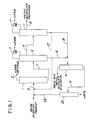
- Figure 1 shows a system in which a crude alkylglycolate ester oxidation reaction product comprising alkyl glycolate, alkyl glyoxylate, water and alkanol is fed to a low boiler still 1 (first distillation) through line 3 where a major portion of the water and a substantial portion of alkanol are taken off under vacuum through line 2.
- the bottom fraction from low boiler still 1 is fed through line 7 to a monomer still 5 (second distillation) operated under atmospheric pressure.
- the side draw 9 from column 5 is fed to a multi-stage finishing column 11 (third distillation) for recovery of glyoxlic ester.
- the side draw 13 from column 11 constitutes a dehydrated glyoxylic ester fraction suitable for the preparation of polyacetal carboxylate polymers.
- the second and third distillation steps are preferably performed with an azeotrope recovered by top condensers 17 which remove water and returns the azeotrope agent to the top of the column.
- Bottoms from columns 5 and 11 are mixed thru lines 15 and 18 and fed to a recovery system comprising a glycolate recovery column 19 whereby glycolate is obtained as overhead and the bottoms fraction fed through line 21 to a tar column 23 to recover residual glyoxylate and glycolate as overhead.
- the overhead from column 23 can be returned to the system through line 25 for recovery.
- the amount of bottoms from column 11 combined with bottoms fraction from column 5 is controlled by returning a portion of the bottoms from column 11 to column 1 through line 27.
- the feed to column 19 is typically composed of blends of from about 4:1 to about 6:1 of bottoms product from columns 5 and 11 respectively.
- the feed mixture to the monomer still contains 40-50% by weight alkyl glyoxylate, 45-55% by weight alkyl glycolate, 1 to 2.5% by weight alkanol, and 0.3-1% water.
- the monomer still typically has 70 to 90 sieve trays and is preferably operated at atmospheric pressure, with a feed point between about the 40th and 60th tray. Operation at atmospheric pressure represents an optimal compromise between separation efficiency and degradation of product, since higher temperatures give a higher equilibrium factor of glyoxylate ester in the vapor phase but also conduct to thermal degradation of product. Where the top of the column is maintained at atmospheric pressure, the temperature at the bottom of the column is typically 150-170°C.
- An azeotroping agent is concentrated in the top five to ten sieve trays of the column, with the temperature control point and azetroping agent makeup addition point being at about the fifth to tenth sieve tray. Vapor leaving the top sieve tray is essentially comprised of the binary azeotrope. Upon condensation, the moisture component of the azeotrope is drawn off and discarded while the azeotroping agent is returned to the top tray of the column as reflux. The side drawn glyoxylic acid ester fraction is taken at between about tray five and tray fifteen, but is in any case at least about five trays below the point for addition of makeup azeotroping agent.
- the glyoxylic ester fraction may contain 85-95% by weight alkyl glyoxylate, 2-4% by weight alkyl glycolate, 3-7% by weight alkanol, and 0.3-1% water.
- the monomer column 5 bottoms fraction using a feed composition as described, may contain by weight, from 70% to 80% alkyl glycolate, 18% to 24% alkyl glyoxylate, 0.1% to 1% alkanol and 2% to 5% other acids.
- Stages inside of the monomer column 5 can be established in any conventional manner as, for exam ple, by bubble cap trays or sieve trays.
- the residence time in the column is preferably kept to a minimum.
- sieve trays are preferred to bubble cap trays.
- the use of a packed column is particularly preferred because this provides the least liquid holdup and the shortest residence time. If packing is employed, the residence time inside the column can be limited to between about 4 and about 7 minutes, between about 8 and about 2 minutes in the stripping section.
- the use of packing also allows column pressure drop to be limited to between about 30 and about 77mm Hg.
- the column is purged with an inert gas, such as nitrogen, prior to column startup, and an inert gas blanket is maintained in the column during its operation.
- an inert gas such as nitrogen
- Finishing column 11 typically contains between about thirty and about fifty sieve trays, with the feed point between about the 20th and 40th sieve tray. Like the monomer column, the finishing column is preferably operated at atmospheric pressure so that alkyl glycolate remaining in the feed stream is quantitatively separated from the glyoxylate fraction. Thus, temperature at the bottom of the column is in the range of 125-150°C. The system at the upper portion of the column, i.e., above the feed sieve tray, is substantially identical to that for the monomer column. Thus, the azeotroping agent is concentrated in the top five to ten sieve trays of the column, with the temperature control point and azeotroping agent makeup addition point being at about the fifth to tenth sieve tray.
- Vapor having a composition comprising the binary azeotrope is condensed and separated, with the azeotroping agent being refluxed to the top sieve tray of the column.
- the side draw for the dehydrated glyoxylic acid ester fraction is at between about sieve tray five and about sieve tray fifteen, and in any case at least about five sieve trays below the point at which makeup azeotroping agent is added. Between about 10% and about 50%, preferably about one-fourth of the liquid flowing to the side draw stage is removed as the side draw fraction. Oxygen is also excluded from this column, preferably by means of inert gas as described above with respect to the monomer column.
- sieve trays are preferred to bubble cap trays, and packed column is most preferred.
- the finishing column is operated continuously to produce a dehydrated glyoxylic ester fraction containing 97-99% by weight glyoxylic acid ester, less the 0.2% by weight of combined water and alkanol, the balance being essentially constituted of the azeotroping agent.
- the bottom fraction from the finishing column comprises typically 75-85% by weight alkyl glyoxylate, 3-10% alkyl glycolate, 7-15% by weight alkanol, 0.1-1% acids, and less than 0.8% water.
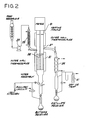
- the apparatus employed as the glycolate recovery column 19 in developing the process of the invention was a 50-mm I.D. wiped-film evaporator equipped with an external condenser.
- the evaporator had a non-jacketed borosilicate glass body with 5-mm thick wall. Heat input to the wiped surface was provided by a single electric heating mantle (340 watts). An identical mantle and local wire tracing were used to heat other parts of the apparatus.
- a constant-speed motor (450 rpm) rotated the wiper assembly.
- the carbon wipers were 20.3 cm long, notched to provide a downward flow bias. Residence time of material in the evaporator is estimated to vary from 7-30 seconds for the flow rates employed, based upon dye experiments. Likewise, the volume of liquid in the wiped-film region is estimated to be 0.8 cc.
- a schematic of the apparatus is shown in Figure 2.
- a peristaltic pump 29 delivered room temperature feed to the evaporator 31 at a fixed rate of 486 g/hr. Steady, smooth flow was provided by directing the feed downward through a Grahm (coil-type) condenser 33 connected to the evaporator feed port. The feed was not preheated and trickled down the interior evaporator wall to wipers 35. The vapor exit port 37 was located opposite the feed port. Vapors were routed directly (i.e., no reflux) to the external condenser 39 via an electrically traced line. Ambient-temperature cooling water was utilized in the condenser.
- the feed to the glycolate column is typically composed of, by weight, 61% methyl glycolate, 33% methyl glyoxylate, 2.9% methanol, 0.15% water and plus residual ingredients.
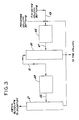
- FIG. 3 there is shown the preferred embodiment of ths invention.
- Column bottoms from columns 5 and 11 are brought combined as shown through line 43 or separately if desired to holding tank 45. From tank 45 the bottoms are fed through line 47 to a first step evaporator 49 operated under vacuum.
- the overhead stream from evaporator 49 is fed through line 51 to a second holding tank 53 then through line 55 to a second step evaporator 57 also operated under vacuum.
- the overhead stream from column 57 contains a concentration of alkyl glycolate suitable for return to the oxidation step referred to above for the production of alkyl glyoxylate.
- the bottoms fraction from evaporator 49 is fed to a tar or residual recovery column such as described above with respect to Figure 1 and the bottoms fraction from evaporator 57 is recycled to holding tank 45.
- the evaporation steps employed to remove the alkyl glycolate from the bottoms fraction are operated at low temperature and short retention times so as to maintain as much glyoxylate present in the form of a hemiacetal complex. Any reduction in temperature below that at which the bottoms fractions are delivered from columns 5 and 11 improve glycolate recovery efficiency.
- column bottoms fed to evaporator 49 is desirably below about 100°C and more desirably below 70°C.
- the temperature of the column bottoms fed to evaporator 49 and 57 is about 55°C. Even ambient temperature is desirable if production scale, etc. economically permits such temperature reduction.
- Holding tank 53 is employed to reduce the temperature of the feed to column 57 thereby maintaining the glyoxylate content at the lowest level suitable for large scale production.
- the evaporator is run at relatively low temperature and short retention time. Lower temperatures are achieved by conventional methods such as employing low pressure. Accordingly the evaporation steps are operated at a pressure below about 100 mm and preferably at about 10 mm and with retention times in the range of from about 3 minutes to about 7 seconds.
- Another feature of the present invention is the elimination from the glyoxylate production system of low boiling acids which are by-products of the oxidation reaction.
- the most prevalent acid is acetic acid which has been found to build up concentration in prior art systems for the production of alkyl glyoxylate.
- the amount of acetic acid in the glyoxylate production system is controlled in accordance with this invention by returning at least a portion of the column bottoms from the finishing column 11 to the glycolate recovery system such s described above with respect to Figure 3. Up to 98 percent of the acetic acid entering the system may be conveniently removed from the system in accordance with this invention.
- Feed material was provided as described above and the retention time varied in the glycolate column. The product was analyzed and the results shown below. Methyl glyocolate (Gc) and glyoxylate (Gx) were produced. Table I Effect of Retention Time on Separation Retention Time Pressure Temp GX in Feed GX in Dist' Fract'n Dist'd Sep'n Factor 0.1 13 58 21.3 2.1 0.51 37. 2.3 10 70 20.2 8.2 0.51 6.4 2.7 10 71 20.9 7.5 0.51 7.7 2.8 10 59 20.3 5.8 0.53 9.4 0.1 100 101 20.0 15.1 0.50 2.1
- evaporator pressure is varied to show the desirable low pressure condition to produce desirably higher Separation Factors.
- TABLE II Effect of Pressure on Separation Retention Time Pressure Temp GX in Feed GX in Dist' Fract'n Dist'd Sep'n Factor 0.1 13 63 21.3 9.6 0.67 9.0 0.1 100 101 21.2 14.0 0.71 5.0 2.3 100 101 20.0 15.1 0.50 2.1 2.6 20 84 21.2 12.8 0.50 4.4 2.8 10 59 20.3 5.8 0.53 9.4
- Table III shows the improved separation of glycolate when the temperature of the feed is lowered to provide conversion of the alkyl glyoxylate to alkyl glycolate - alkyl glyoxylate hemiacetal in the feed to the evaporator.
- the acid analytical results can be deemed valid upon close examination.
- the component acid balances in Table V leave very little doubt that acetic acid is concentrating in the distillate.
- Acid concentrations in various streams was determined by ion chromatography.
- the methanol concentration in the feed to the methyl glycolate recovery operation is a significant variable. Only 0.1-0.3 wt% methanol is inconsequential. However, almost 3 wt% methanol (i.e., combination of monomer column and finishing column bottom product), is substantial. This high level of methanol virtually eliminates the option of recycling the ensuing tar column distillate to the monomer column. Instead, the tar column distillate is routed to the low-boiler column as shown in Figure 1, where a majority of the methanol can be purged.
- the distillate product from the methyl glycolate removal step contains about 2-3 weight percent.
- the following example shows the unfavorable effect methanol has on glycolate separation employing an apparatus of Figure 2.
- Example VI shows the lower Separation Factors obtained with increasing amounts of methanol in the feed to the evaporator.
- the following example demonstrates that a two step evaporation procedure overcomes the problem.
Landscapes
- Chemical & Material Sciences (AREA)
- Chemical Kinetics & Catalysis (AREA)
- Organic Chemistry (AREA)
- Crystallography & Structural Chemistry (AREA)
- Organic Low-Molecular-Weight Compounds And Preparation Thereof (AREA)
- Polysaccharides And Polysaccharide Derivatives (AREA)
Applications Claiming Priority (2)
| Application Number | Priority Date | Filing Date | Title |
|---|---|---|---|
| US07/224,045 US4867849A (en) | 1988-07-25 | 1988-07-25 | Purification of alkyl glyoxylate |
| US224045 | 1998-12-31 |
Publications (3)
| Publication Number | Publication Date |
|---|---|
| EP0353215A2 true EP0353215A2 (de) | 1990-01-31 |
| EP0353215A3 EP0353215A3 (en) | 1990-08-08 |
| EP0353215B1 EP0353215B1 (de) | 1994-06-15 |
Family
ID=22839075
Family Applications (1)
| Application Number | Title | Priority Date | Filing Date |
|---|---|---|---|
| EP89870115A Expired - Lifetime EP0353215B1 (de) | 1988-07-25 | 1989-07-24 | Reinigung von Alkylglyoxylate |
Country Status (7)
| Country | Link |
|---|---|
| US (1) | US4867849A (de) |
| EP (1) | EP0353215B1 (de) |
| JP (1) | JPH0745435B2 (de) |
| AT (1) | ATE107272T1 (de) |
| CA (1) | CA1324103C (de) |
| DE (1) | DE68916123T2 (de) |
| ES (1) | ES2013588T3 (de) |
Cited By (1)
| Publication number | Priority date | Publication date | Assignee | Title |
|---|---|---|---|---|
| EP1080766A1 (de) * | 1999-09-03 | 2001-03-07 | Air Products And Chemicals, Inc. | Verfahren zur Trennung von Mehrkomponentengemischen |
Families Citing this family (7)
| Publication number | Priority date | Publication date | Assignee | Title |
|---|---|---|---|---|
| AT392638B (de) * | 1989-06-05 | 1991-05-10 | Chemie Linz Gmbh | Verfahren zur kontinuierlichen herstellung einer konzentrierten waessrigen loesung von glyoxylsaeure |
| US5217582A (en) * | 1990-06-20 | 1993-06-08 | E. I. Du Pont De Nemours And Company | Process for the isolation of alkyl glyoxylate |
| JP3150909B2 (ja) * | 1996-09-05 | 2001-03-26 | 株式会社日本触媒 | グリオキシル酸エステル類の精製方法 |
| NL1013682C2 (nl) * | 1999-11-26 | 2001-05-30 | Purac Biochem Bv | Werkwijze en inrichting voor het zuiveren van een waterige oplossing van melkzuur. |
| US9114328B2 (en) | 2012-05-16 | 2015-08-25 | Eastman Chemical Company | Reactive distillation of a carboxylic acid and a glycol |
| US9040748B2 (en) | 2012-06-08 | 2015-05-26 | Eastman Chemical Company | Hydrocarboxylation of aqueous formaldehyde using a dehydrating recycle stream to decrease water concentration |
| DE102013222343A1 (de) | 2013-11-04 | 2015-05-07 | Matthias Enzenhofer | Vorrichtung und Verfahren für den Kontakt einer Gasphase mit einem flüssigen Medium |
Family Cites Families (12)
| Publication number | Priority date | Publication date | Assignee | Title |
|---|---|---|---|---|
| US1627091A (en) * | 1923-03-05 | 1927-05-03 | Boehringer Sohn Ingelheim | Making keto and aldo aliphatic carboxylic acids |
| US3476656A (en) * | 1968-06-07 | 1969-11-04 | Universal Oil Prod Co | Fractional distillation and recovery of styrene containing sulfur with subsequent bottoms separation |
| FR2383911A1 (fr) * | 1977-03-17 | 1978-10-13 | Hoechst France | Procede permettant d'augmenter les rendements en hemiacetal-esters de l'acide glyoxylique au cours de leur obtention ou leurs taux de recuperation dans les milieux les contenant |
| US4144226A (en) * | 1977-08-22 | 1979-03-13 | Monsanto Company | Polymeric acetal carboxylates |
| US4234739A (en) * | 1978-12-05 | 1980-11-18 | Stauffer Chemical Company | Method for preparing glyoxylic acids and derivatives thereof |
| DE2904775C2 (de) * | 1979-02-08 | 1985-03-21 | Hoechst Ag, 6230 Frankfurt | Verfahren zur Herstellung von Glyoxylsäureestern |
| JPS57176929A (en) * | 1981-04-24 | 1982-10-30 | Nippon Synthetic Chem Ind Co Ltd:The | Preparation of glyoxylic ester |
| DE3323372A1 (de) * | 1983-06-29 | 1985-01-10 | Hoechst Ag, 6230 Frankfurt | Verfahren zur herstellung eines glyoxylsaeureesters |
| US4502923A (en) * | 1983-10-06 | 1985-03-05 | Monsanto Company | Production of high purity alkyl glyoxylate by plural stage distillation |
| JPS61109221A (ja) * | 1984-10-31 | 1986-05-27 | 田中貴金属工業株式会社 | 孔あき型クラツドボタン接点の製造方法 |
| DE3446528A1 (de) * | 1984-12-20 | 1986-06-26 | Hoechst Ag, 6230 Frankfurt | Verfahren zur herstellung von glyoxylsaeurehemiacetalestern |
| DE3602274A1 (de) * | 1986-01-25 | 1987-07-30 | Hoechst Ag | Halbacetale von glyoxylsaeureestern sowie verfahren zur isolierung von glyoxylsaeureestern |
-
1988
- 1988-07-25 US US07/224,045 patent/US4867849A/en not_active Expired - Lifetime
-
1989
- 1989-07-24 ES ES89870115T patent/ES2013588T3/es not_active Expired - Lifetime
- 1989-07-24 DE DE68916123T patent/DE68916123T2/de not_active Expired - Fee Related
- 1989-07-24 AT AT89870115T patent/ATE107272T1/de not_active IP Right Cessation
- 1989-07-24 JP JP1189028A patent/JPH0745435B2/ja not_active Expired - Lifetime
- 1989-07-24 EP EP89870115A patent/EP0353215B1/de not_active Expired - Lifetime
- 1989-07-24 CA CA000606487A patent/CA1324103C/en not_active Expired - Fee Related
Cited By (1)
| Publication number | Priority date | Publication date | Assignee | Title |
|---|---|---|---|---|
| EP1080766A1 (de) * | 1999-09-03 | 2001-03-07 | Air Products And Chemicals, Inc. | Verfahren zur Trennung von Mehrkomponentengemischen |
Also Published As
| Publication number | Publication date |
|---|---|
| ES2013588A4 (es) | 1990-05-16 |
| EP0353215A3 (en) | 1990-08-08 |
| CA1324103C (en) | 1993-11-09 |
| JPH0745435B2 (ja) | 1995-05-17 |
| DE68916123D1 (de) | 1994-07-21 |
| ATE107272T1 (de) | 1994-07-15 |
| EP0353215B1 (de) | 1994-06-15 |
| ES2013588T3 (es) | 1994-08-01 |
| JPH0273040A (ja) | 1990-03-13 |
| DE68916123T2 (de) | 1994-12-01 |
| US4867849A (en) | 1989-09-19 |
Similar Documents
| Publication | Publication Date | Title |
|---|---|---|
| US5831124A (en) | Purification of acrylic acid and methacrylic acid | |
| JP5485501B2 (ja) | 脱水方法 | |
| KR920003774B1 (ko) | 에틸렌 카보네이트에서 유도된 에틸렌글리콜 정제법 | |
| US4518462A (en) | Distillation process for purifying methyl methacrylate | |
| KR100591625B1 (ko) | 포름 알데히드 함유 혼합물의 처리 | |
| EP0353215B1 (de) | Reinigung von Alkylglyoxylate | |
| EP0140866B1 (de) | Herstellung von Alkylglyoxylaten grosser Reinheit | |
| KR100551461B1 (ko) | 미정제 액상 비닐 아세테이트의 후처리방법 | |
| US4353783A (en) | Process for separating water from mixtures thereof with vinyl acetate and acetic acid | |
| US4934519A (en) | Process for working up crude liquid vinyl acetate | |
| US5061349A (en) | Method of isolating trioxane from aqueous trioxane solutions by distillative separation | |
| KR100549449B1 (ko) | 말레산 무수물의 정제방법 | |
| EP0616607B1 (de) | Verfahren zur entfernung von aceton aus einem carbonylierungsprozess | |
| US4820385A (en) | Purification of alkyl glyoxylate in a continuous column by azeotropic distillation | |
| EP0501374B1 (de) | Verfahren zur Reinigung von Dimethylcarbonat | |
| JP2006514087A (ja) | 蒸留による1,3−プロパンジオールの精製 | |
| US6494996B2 (en) | Process for removing water from aqueous methanol | |
| US5585502A (en) | Process and plant for the purification of raw maleic anhydride recovered from gaseous reaction mixtures | |
| WO2001046109A1 (en) | Process for enhanced acetone removal from carbonylation processes | |
| US5772854A (en) | Use of paired reboilers in the purification of propylene oxide by extractive distillation | |
| RU2317970C2 (ru) | Очистка 1,3-пропандиола путем перегонки | |
| EP0079671A2 (de) | Verfahren zur Herstellung von Tetraacetylalkylendiaminen | |
| GB2106903A (en) | Preparation of tetraacetyl alkylene diamines | |
| JPH09309858A (ja) | アセトンの精製方法 | |
| JPH09301914A (ja) | アセトンの精製方法 |
Legal Events
| Date | Code | Title | Description |
|---|---|---|---|
| PUAI | Public reference made under article 153(3) epc to a published international application that has entered the european phase |
Free format text: ORIGINAL CODE: 0009012 |
|
| AK | Designated contracting states |
Kind code of ref document: A2 Designated state(s): AT BE CH DE ES FR GB GR IT LI LU NL SE |
|
| PUAL | Search report despatched |
Free format text: ORIGINAL CODE: 0009013 |
|
| AK | Designated contracting states |
Kind code of ref document: A3 Designated state(s): AT BE CH DE ES FR GB GR IT LI LU NL SE |
|
| 17P | Request for examination filed |
Effective date: 19901227 |
|
| 17Q | First examination report despatched |
Effective date: 19920821 |
|
| GRAA | (expected) grant |
Free format text: ORIGINAL CODE: 0009210 |
|
| AK | Designated contracting states |
Kind code of ref document: B1 Designated state(s): AT BE CH DE ES FR GB GR IT LI LU NL SE |
|
| REF | Corresponds to: |
Ref document number: 107272 Country of ref document: AT Date of ref document: 19940715 Kind code of ref document: T |
|
| REF | Corresponds to: |
Ref document number: 68916123 Country of ref document: DE Date of ref document: 19940721 |
|
| ET | Fr: translation filed | ||
| REG | Reference to a national code |
Ref country code: ES Ref legal event code: FG2A Ref document number: 2013588 Country of ref document: ES Kind code of ref document: T3 |
|
| ITF | It: translation for a ep patent filed | ||
| EPTA | Lu: last paid annual fee | ||
| REG | Reference to a national code |
Ref country code: GR Ref legal event code: FG4A Free format text: 3012992 |
|
| EAL | Se: european patent in force in sweden |
Ref document number: 89870115.6 |
|
| PLBE | No opposition filed within time limit |
Free format text: ORIGINAL CODE: 0009261 |
|
| STAA | Information on the status of an ep patent application or granted ep patent |
Free format text: STATUS: NO OPPOSITION FILED WITHIN TIME LIMIT |
|
| 26N | No opposition filed | ||
| REG | Reference to a national code |
Ref country code: FR Ref legal event code: TP |
|
| REG | Reference to a national code |
Ref country code: GB Ref legal event code: 732E |
|
| NLS | Nl: assignments of ep-patents |
Owner name: ASTARIS LLC;SOLUTIA INC. |
|
| REG | Reference to a national code |
Ref country code: CH Ref legal event code: PUE Owner name: MONSANTO COMPANY TRANSFER- SOLUTIA INC. * SOLUTIA Ref country code: CH Ref legal event code: NV Representative=s name: ICB INGENIEURS CONSEILS EN BREVETS SA |
|
| BECA | Be: change of holder's address |
Free format text: 20000531 *ASTARIS LLC:62 EMERSON ROAD SUITE 500, ST LOUIS MISSOURI 63141 |
|
| BECH | Be: change of holder |
Free format text: 20000531 *ASTARIS LLC |
|
| REG | Reference to a national code |
Ref country code: ES Ref legal event code: PC2A |
|
| REG | Reference to a national code |
Ref country code: GB Ref legal event code: 732E |
|
| PGFP | Annual fee paid to national office [announced via postgrant information from national office to epo] |
Ref country code: FR Payment date: 20010702 Year of fee payment: 13 |
|
| PGFP | Annual fee paid to national office [announced via postgrant information from national office to epo] |
Ref country code: SE Payment date: 20010703 Year of fee payment: 13 Ref country code: GB Payment date: 20010703 Year of fee payment: 13 Ref country code: DE Payment date: 20010703 Year of fee payment: 13 |
|
| PGFP | Annual fee paid to national office [announced via postgrant information from national office to epo] |
Ref country code: CH Payment date: 20010704 Year of fee payment: 13 Ref country code: AT Payment date: 20010704 Year of fee payment: 13 |
|
| PGFP | Annual fee paid to national office [announced via postgrant information from national office to epo] |
Ref country code: LU Payment date: 20010709 Year of fee payment: 13 |
|
| PGFP | Annual fee paid to national office [announced via postgrant information from national office to epo] |
Ref country code: BE Payment date: 20010712 Year of fee payment: 13 |
|
| PGFP | Annual fee paid to national office [announced via postgrant information from national office to epo] |
Ref country code: NL Payment date: 20010717 Year of fee payment: 13 |
|
| PGFP | Annual fee paid to national office [announced via postgrant information from national office to epo] |
Ref country code: GR Payment date: 20010731 Year of fee payment: 13 |
|
| PGFP | Annual fee paid to national office [announced via postgrant information from national office to epo] |
Ref country code: ES Payment date: 20010808 Year of fee payment: 13 |
|
| REG | Reference to a national code |
Ref country code: GB Ref legal event code: IF02 |
|
| PG25 | Lapsed in a contracting state [announced via postgrant information from national office to epo] |
Ref country code: LU Free format text: LAPSE BECAUSE OF NON-PAYMENT OF DUE FEES Effective date: 20020724 Ref country code: GB Free format text: LAPSE BECAUSE OF NON-PAYMENT OF DUE FEES Effective date: 20020724 Ref country code: AT Free format text: LAPSE BECAUSE OF NON-PAYMENT OF DUE FEES Effective date: 20020724 |
|
| PG25 | Lapsed in a contracting state [announced via postgrant information from national office to epo] |
Ref country code: SE Free format text: LAPSE BECAUSE OF NON-PAYMENT OF DUE FEES Effective date: 20020725 Ref country code: ES Free format text: LAPSE BECAUSE OF NON-PAYMENT OF DUE FEES Effective date: 20020725 |
|
| PG25 | Lapsed in a contracting state [announced via postgrant information from national office to epo] |
Ref country code: LI Free format text: LAPSE BECAUSE OF NON-PAYMENT OF DUE FEES Effective date: 20020731 Ref country code: CH Free format text: LAPSE BECAUSE OF NON-PAYMENT OF DUE FEES Effective date: 20020731 Ref country code: BE Free format text: LAPSE BECAUSE OF NON-PAYMENT OF DUE FEES Effective date: 20020731 |
|
| BERE | Be: lapsed |
Owner name: *ASTARIS LLC Effective date: 20020731 |
|
| PG25 | Lapsed in a contracting state [announced via postgrant information from national office to epo] |
Ref country code: NL Free format text: LAPSE BECAUSE OF NON-PAYMENT OF DUE FEES Effective date: 20030201 Ref country code: DE Free format text: LAPSE BECAUSE OF NON-PAYMENT OF DUE FEES Effective date: 20030201 |
|
| PG25 | Lapsed in a contracting state [announced via postgrant information from national office to epo] |
Ref country code: GR Free format text: LAPSE BECAUSE OF NON-PAYMENT OF DUE FEES Effective date: 20030206 |
|
| EUG | Se: european patent has lapsed | ||
| REG | Reference to a national code |
Ref country code: CH Ref legal event code: PL |
|
| GBPC | Gb: european patent ceased through non-payment of renewal fee |
Effective date: 20020724 |
|
| PG25 | Lapsed in a contracting state [announced via postgrant information from national office to epo] |
Ref country code: FR Free format text: LAPSE BECAUSE OF NON-PAYMENT OF DUE FEES Effective date: 20030331 |
|
| NLV4 | Nl: lapsed or anulled due to non-payment of the annual fee |
Effective date: 20030201 |
|
| REG | Reference to a national code |
Ref country code: FR Ref legal event code: ST |
|
| REG | Reference to a national code |
Ref country code: ES Ref legal event code: FD2A Effective date: 20030811 |
|
| PG25 | Lapsed in a contracting state [announced via postgrant information from national office to epo] |
Ref country code: IT Free format text: LAPSE BECAUSE OF NON-PAYMENT OF DUE FEES;WARNING: LAPSES OF ITALIAN PATENTS WITH EFFECTIVE DATE BEFORE 2007 MAY HAVE OCCURRED AT ANY TIME BEFORE 2007. THE CORRECT EFFECTIVE DATE MAY BE DIFFERENT FROM THE ONE RECORDED. Effective date: 20050724 |