EP0353635B1 - Régulateur de pression de fluide pour dispositif de freinage d'antiblocage - Google Patents
Régulateur de pression de fluide pour dispositif de freinage d'antiblocage Download PDFInfo
- Publication number
- EP0353635B1 EP0353635B1 EP89113884A EP89113884A EP0353635B1 EP 0353635 B1 EP0353635 B1 EP 0353635B1 EP 89113884 A EP89113884 A EP 89113884A EP 89113884 A EP89113884 A EP 89113884A EP 0353635 B1 EP0353635 B1 EP 0353635B1
- Authority
- EP
- European Patent Office
- Prior art keywords
- spool
- flow
- passage
- outlet port
- inlet port
- Prior art date
- Legal status (The legal status is an assumption and is not a legal conclusion. Google has not performed a legal analysis and makes no representation as to the accuracy of the status listed.)
- Expired - Lifetime
Links
- 239000012530 fluid Substances 0.000 title claims description 21
- 239000010720 hydraulic oil Substances 0.000 description 15
- 230000002093 peripheral effect Effects 0.000 description 3
- 238000010276 construction Methods 0.000 description 2
- 230000000694 effects Effects 0.000 description 2
- JEIPFZHSYJVQDO-UHFFFAOYSA-N iron(III) oxide Inorganic materials O=[Fe]O[Fe]=O JEIPFZHSYJVQDO-UHFFFAOYSA-N 0.000 description 1
Images

Classifications
-
- B—PERFORMING OPERATIONS; TRANSPORTING
- B60—VEHICLES IN GENERAL
- B60T—VEHICLE BRAKE CONTROL SYSTEMS OR PARTS THEREOF; BRAKE CONTROL SYSTEMS OR PARTS THEREOF, IN GENERAL; ARRANGEMENT OF BRAKING ELEMENTS ON VEHICLES IN GENERAL; PORTABLE DEVICES FOR PREVENTING UNWANTED MOVEMENT OF VEHICLES; VEHICLE MODIFICATIONS TO FACILITATE COOLING OF BRAKES
- B60T15/00—Construction arrangement, or operation of valves incorporated in power brake systems and not covered by groups B60T11/00 or B60T13/00
-
- B—PERFORMING OPERATIONS; TRANSPORTING
- B60—VEHICLES IN GENERAL
- B60T—VEHICLE BRAKE CONTROL SYSTEMS OR PARTS THEREOF; BRAKE CONTROL SYSTEMS OR PARTS THEREOF, IN GENERAL; ARRANGEMENT OF BRAKING ELEMENTS ON VEHICLES IN GENERAL; PORTABLE DEVICES FOR PREVENTING UNWANTED MOVEMENT OF VEHICLES; VEHICLE MODIFICATIONS TO FACILITATE COOLING OF BRAKES
- B60T8/00—Arrangements for adjusting wheel-braking force to meet varying vehicular or ground-surface conditions, e.g. limiting or varying distribution of braking force
- B60T8/32—Arrangements for adjusting wheel-braking force to meet varying vehicular or ground-surface conditions, e.g. limiting or varying distribution of braking force responsive to a speed condition, e.g. acceleration or deceleration
- B60T8/88—Arrangements for adjusting wheel-braking force to meet varying vehicular or ground-surface conditions, e.g. limiting or varying distribution of braking force responsive to a speed condition, e.g. acceleration or deceleration with failure responsive means, i.e. means for detecting and indicating faulty operation of the speed responsive control means
- B60T8/92—Arrangements for adjusting wheel-braking force to meet varying vehicular or ground-surface conditions, e.g. limiting or varying distribution of braking force responsive to a speed condition, e.g. acceleration or deceleration with failure responsive means, i.e. means for detecting and indicating faulty operation of the speed responsive control means automatically taking corrective action
- B60T8/94—Arrangements for adjusting wheel-braking force to meet varying vehicular or ground-surface conditions, e.g. limiting or varying distribution of braking force responsive to a speed condition, e.g. acceleration or deceleration with failure responsive means, i.e. means for detecting and indicating faulty operation of the speed responsive control means automatically taking corrective action on a fluid pressure regulator
-
- B—PERFORMING OPERATIONS; TRANSPORTING
- B60—VEHICLES IN GENERAL
- B60T—VEHICLE BRAKE CONTROL SYSTEMS OR PARTS THEREOF; BRAKE CONTROL SYSTEMS OR PARTS THEREOF, IN GENERAL; ARRANGEMENT OF BRAKING ELEMENTS ON VEHICLES IN GENERAL; PORTABLE DEVICES FOR PREVENTING UNWANTED MOVEMENT OF VEHICLES; VEHICLE MODIFICATIONS TO FACILITATE COOLING OF BRAKES
- B60T8/00—Arrangements for adjusting wheel-braking force to meet varying vehicular or ground-surface conditions, e.g. limiting or varying distribution of braking force
- B60T8/32—Arrangements for adjusting wheel-braking force to meet varying vehicular or ground-surface conditions, e.g. limiting or varying distribution of braking force responsive to a speed condition, e.g. acceleration or deceleration
- B60T8/34—Arrangements for adjusting wheel-braking force to meet varying vehicular or ground-surface conditions, e.g. limiting or varying distribution of braking force responsive to a speed condition, e.g. acceleration or deceleration having a fluid pressure regulator responsive to a speed condition
- B60T8/40—Arrangements for adjusting wheel-braking force to meet varying vehicular or ground-surface conditions, e.g. limiting or varying distribution of braking force responsive to a speed condition, e.g. acceleration or deceleration having a fluid pressure regulator responsive to a speed condition comprising an additional fluid circuit including fluid pressurising means for modifying the pressure of the braking fluid, e.g. including wheel driven pumps for detecting a speed condition, or pumps which are controlled by means independent of the braking system
-
- B—PERFORMING OPERATIONS; TRANSPORTING
- B60—VEHICLES IN GENERAL
- B60T—VEHICLE BRAKE CONTROL SYSTEMS OR PARTS THEREOF; BRAKE CONTROL SYSTEMS OR PARTS THEREOF, IN GENERAL; ARRANGEMENT OF BRAKING ELEMENTS ON VEHICLES IN GENERAL; PORTABLE DEVICES FOR PREVENTING UNWANTED MOVEMENT OF VEHICLES; VEHICLE MODIFICATIONS TO FACILITATE COOLING OF BRAKES
- B60T8/00—Arrangements for adjusting wheel-braking force to meet varying vehicular or ground-surface conditions, e.g. limiting or varying distribution of braking force
- B60T8/32—Arrangements for adjusting wheel-braking force to meet varying vehicular or ground-surface conditions, e.g. limiting or varying distribution of braking force responsive to a speed condition, e.g. acceleration or deceleration
- B60T8/34—Arrangements for adjusting wheel-braking force to meet varying vehicular or ground-surface conditions, e.g. limiting or varying distribution of braking force responsive to a speed condition, e.g. acceleration or deceleration having a fluid pressure regulator responsive to a speed condition
- B60T8/50—Arrangements for adjusting wheel-braking force to meet varying vehicular or ground-surface conditions, e.g. limiting or varying distribution of braking force responsive to a speed condition, e.g. acceleration or deceleration having a fluid pressure regulator responsive to a speed condition having means for controlling the rate at which pressure is reapplied to or released from the brake
- B60T8/5018—Pressure reapplication using restrictions
- B60T8/5025—Pressure reapplication using restrictions in hydraulic brake systems
- B60T8/5037—Pressure reapplication using restrictions in hydraulic brake systems closed systems
Definitions
- the present invention relates to a fluid pressure controller for use in an antilock brake control device for a motor vehicle and having a flow changeover valve for controlling the braking pressure.
- a flow changeover valve 3 is employed to increase the braking pressure in a controlled manner in place of a solenoid valve as used in the former Publication.
- This flow changeover valve 3 comprises a housing 31 formed with an inlet port 31a communicating with a master cylinder 2, an outlet port 31b communicating with a wheel brake 4 and a discharge port 31c communicating with a solenoid valve 5 serving as a discharge valve, and a spool 32 slidably mounted in the housing 31 and biased by a spring 34 to open and close fluid communication among these ports.
- a large-flow channel is formed extending from the inlet port 31a to the outlet port 31b through a peripheral groove 32a formed in the outer periphery of the spool 32.
- the solenoid valve 5 When the solenoid valve 5 is energized and opened in the antilock control, hydraulic oil will be discharged through the discharge port 31c into a reservoir 63. This will move the spool 32 to the position shown in Fig. 4B owing to a difference of pressures on both ends thereof. In this state, the abovementioned large-flow channel is closed by an edge 32b on the spool 32.
- the spool 32 will further move to the position shown in Fig. 4C where part,of the peripheral groove 32a at the side of an edge 32c opens to a passageway 31e.
- a discharge channel is formed from the outlet port 31b to the discharge port 31c through the groove 32a and the passageway 31e, allowing hydraulic oil in the wheel brake 4 to be discharged into the reservoir 63 through the solenoid valve 5 to reduce the braking pressure.
- the hydraulic oil discharged is sucked and pressurized by a pump 61 driven by a motor 62 so as to be returned to the line between the master cylinder 2 and the inlet port 31a.
- the spool 32 When the solenoid valve 5 is deactivated in the state shown in Fig. 4C to increase the braking pressure, the spool 32 will perform metering action at its edge 32d, forming a restricted-flow channel connecting the inlet port 31a with the outlet port 31b through a passage 31d, an orifice 33, a pressure reducing chamber 36, the passage 31e and the annular groove 32a. The wheel braking pressure will rise slowly. When the pressure difference between the inlet port 31a and the outlet port 31b reduces to a certain level, the spool 32 will return to its original positon shown in Fig. 4A.
- the flow rate of hydraulic oil through the orifice 33 is determined by the pressure difference at both ends thereof which is in turn determined by the effective sectional area of the spool 32 and the biasing force of the spring 34.
- the pressure difference at both ends of the orifice 33 can be limited to a minimum. This will not only serve to keep constant the flow rate through the orifice irrespective of the pressure difference between the inlet port 31a and the outlet port 31b, but also make it possible to reduce the flow rate through the orifice even if it has a rather large diameter.
- this system will be advantageously applied to a compact car having a small-sized brake which has to be controlled with a small amount of hydraulic oil.
- the spool when the braking pressure is being reduced for antilock control, the spool is adapted to move to such a position as to bring the inlet 31a and the outlet 31b into communication with each other as shown in Fig. 4B and further move to the positon shown in Fig. 4C, where the outlet port 31b is brought into communication with the discharge port 31c.
- the spool will move to open the restricted-flow channel through the orifice. If the spool is in a position between the position shown in Fig. 4B and the position shown in Fig. 4C, both the large-flow channel as well as the restricted-flow channel are closed up by the edge 32b and the 32c, respectively. If the spool should get stuck in this position owing to rust or foreign matter, it will become impossible to increase the braking pressure to the wheel brake 4 by increasing the pressure in the master cylinder 2.
- a pressure control valve according to the preamble part of the claim 1 is known from US-A-3 856 047.
- This control valve shows a flapper valve controlled by a solenoid.
- this flapper valve it is not possible, to allow a fluid flow from the inlet port to the outlet port of the valve and thereby to prohibit a fluid flow in the reverse direction.
- An object of the present invention is to provide a fluid pressure controller for antilock brake control which obviates the abovesaid shortcomings.
- a fluid pressure controller for use in an antilock brake control device for a motor vehicle having a master cylinder and a wheel brake, the controller having a flow rate changeover valve comprising: a housing formed with an inlet port communicating with the master cylinder and an outlet port communicating with the wheel brake; a spool slidably mounted in the housing and formed with a passage and an orifice for changing over the communication between the inlet port and the outlet port; the spool being moved under fluid pressure between a first position where a large-flow passage is formed between the inlet port and the outlet port and a second position where a restricted-flow passage through the orifice is formed between the inlet port and the outlet port with the large-flow passage blocked; and a check valve provided in a passage in parallel with the restricted-flow passage and adapted to allow a fluid flow from the inlet port toward the outlet port to pass even if both of the large-flow passage and the restricted-flow passage are blocked.
- hydraulic oil can be supplied through a check valve in the passage provided in parallel with the restricted-flow channel formed between the housing and the sleeve into the wheel brake to increase the braking pressure.
- the check valve serves to permit the fluid flow from the inlet toward the outlet but not the flow in a reverse direction.
- the braking pressure can be reduced by reducing the pressure in the master cylinder and thus the inlet pressure even if the spool gets stuck.
- the pressure at the inlet pressure in the master cylinder
- the pressure at the outlet braking pressure
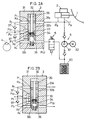
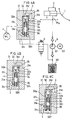
- Figs. 1A to 1C show the first embodiment which differs from the prior art controller shown in Fig. 4A in that the housing 31 is formed with a passage 31g and that a check valve 37 comprising a ball and a fixed valve seat 31h is provided in the passage 31g, which extends in parallel with the restricted-flow channel.
- this valve operates in the same way as the prior art valve shown in Fig. 4A. Namely, while the valve is in the position shown in Fig. 1, where the antilock control is not activated, hydraulic oil does not flow through the orifice 33 but flows through the large-flow channel. The pressures at both sides of the check valve 37 are kept equal.
- Figs. 2A and 2B show the second embodiment which employs a flow rate changeover valve 3 of a different type from that of the first embodiment. Other parts are identical to those used in the first embodiment.
- the flow rate changeover valve 3 comprises a housing 31 formed with an inlet port 31a communicating with the master cylinder 2, a port P01 communicating with the wheel brake 4 and a port P02 communicating with the discharge line, and a spool 32 formed with channels for fluid communication and slidably mounted in the housing 31 so that the communications among the ports can be changed over.
- the spool 32 is biased by a spring 34 in one direction.
- This flow rate changeover valve 3 is formed in its housing 31 with channels R3 and R4 and provided in the lines leading from the respective channels R3 and R4 to the wheel brake 4 with check valves 37 and 37′, respectively, to assure reliable braking in case of emergency. In normal conditions, whether in the antilock control mode or not, these circuits are kept inoperative.
- a large-flow channel is formed extending from the inlet port 31a to the outlet port P01 through a passage P1, a pressure application chamber 35 and passages P2 and R1.
- the solenoid 5 is activated to open it and discharge hydraulic oil into the discharge line through the discharge port P02.
- the pressure in the pressure reducing chamber 6 will drop, creating a pressure difference between the chamber 6 and the pressure application chamber 35.
- This pressure difference will move the spool 32 to such a position that the large-flow channel is closed by its edge portion 32b.
- the edge 32c will be opened to form a channel connecting the outlet port P01 to the discharge port P02.
- the fluid pressure on the wheel brake 4 will drop.
- the inlet and outlet ports formed in the housing 31 and the passages formed in the spool 32 are arranged so that when the outlet P01 is shut off from the passage P2 by the edge portion 32b, the inlet port 31a communicates with the passage P1 while keeping the passage P3 out of communication with the outlet port P01, and so that when the spool 32 further descends to the position shown in Fig. 2B, the passage P3 communcates with the outlet port P01 and the inlet port 31a and the passage P1 communicate with each other through a small gap.
- the relative positions of the parts are determined so that the spool 32 will stop at this position with a balance established between the biassing force of the spring 34 and the force urging the spool 32 downwardly.
- the spool 32 should stick to the housing 31 and get immovable during antilock control at such a position that the edge portions 32b and 32c close the large-flow channel extending through the passages P2 and R1 in the spool 32 and the restricted-flow channel extending through the passage P3 and R2, no braking pressure can be supplied to the wheel brake through either of the above two channels.
- the passage R4 branches off from the wide channel in parallel with the edge 32c adapted to close the narrow channel and the check valve 37 is provided in the line connecting the passage R4 with the wheel brake 4.
- the solenoid valve 5 is supposed to be closed in such an emergency situation.
- the hydraulic oil in the wheel brake 4 will return to the master cylinder 5 through the other check valve 37', the passage R3 and the inlet port 31a.
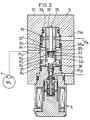
- Fig. 3 shows only a flow rate changeover valve 3 for simplification. It has essentially the same construction as the valve in the second embodiment (Fig. 2A) and differs therefrom only in that a sleeve 38 is provided between the housing 31 and the spool 32, that the solenoid valve 5 is integral with the valve 3, and that check valves have a different construction from those in the second embodiment. The function of check valves is completely the same as with the second embodiment.
- cup seals which serve as the check valves 37 and 37' are fitted in annular grooves formed in the outer periphery of the sleeve 38.
- Other annular grooves R0 and R4 serve as channels for the check valves 37 and 37′.
Landscapes
- Engineering & Computer Science (AREA)
- Physics & Mathematics (AREA)
- Fluid Mechanics (AREA)
- Transportation (AREA)
- Mechanical Engineering (AREA)
- Regulating Braking Force (AREA)
Claims (3)
- Régulateur de pression de fluide pour dispositif de commande de freinage antiblocage de véhicule automobile, comportant un maître-cylindre et un frein de roue, ledit dispositif de commande (3) étant muni d'une soupape de modification d'écoulement comportant :
un carter (31) constitué avec un orifice d'entrée (31a) communiquant avec le maître-cylindre (2) et avec un orifice de sortie (31b) communiquant avec le frein de roue (4), un piston (32) monté pour coulisser dans ledit carter (31) et réalisé avec un passage (32a) et un orifice (33) pour modifier la communication entre ledit orifice d'entrée (31a) et ledit orifice de sortie (31b), ledit piston (32) étant déplacé par pression de fluide entre une première position, dans laquelle un passage d'écoulement important est formé entre ledit orifice d'entrée (31a) et ledit orifice de sortie, et une deuxième position, dans laquelle un passage d'écoulement restreint à travers ledit orifice (33) est formé entre ledit orifice d'entrée et ledit orifice de sortie, tandis que le passage d'écoulement important est bloqué, caractérisé en ce qu'un clapet de retenue (37) est monté dans un passage (31g) disposé en parallèle audit passage d'écoulement restreint, ce clapet étant constitué pour permettre l'écoulement du fluide depuis ledit orifice d'entrée vers ledit orifice de sortie même si le passage d'écoulement important et le passage d'écoulement restreint sont bloqués tous les deux, ledit clapet étant constitué pour empêcher l'écoulement du fluide en sens inverse. - Régulateur de pression de fluide selon la revendication 1 comportant en outre un ressort agissant sur ledit piston (32) dans un sens.
- Régulateur de pression de fluide selon la revendication 1 ou la revendication 2, comportant en outre un autre clapet de retenue (37) monté entre ledit orifice d'entrée et ledit orifice de sortie, ce clapet étant constitué pour permettre l'écoulement du fluide depuis ledit orifice de sortie vers ledit orifice d'entrée.
Applications Claiming Priority (2)
| Application Number | Priority Date | Filing Date | Title |
|---|---|---|---|
| JP63196399A JPH0245247A (ja) | 1988-08-04 | 1988-08-04 | アンチロック用液圧制御装置 |
| JP196399/88 | 1988-08-04 |
Publications (2)
| Publication Number | Publication Date |
|---|---|
| EP0353635A1 EP0353635A1 (fr) | 1990-02-07 |
| EP0353635B1 true EP0353635B1 (fr) | 1993-07-14 |
Family
ID=16357220
Family Applications (1)
| Application Number | Title | Priority Date | Filing Date |
|---|---|---|---|
| EP89113884A Expired - Lifetime EP0353635B1 (fr) | 1988-08-04 | 1989-07-27 | Régulateur de pression de fluide pour dispositif de freinage d'antiblocage |
Country Status (5)
| Country | Link |
|---|---|
| US (1) | US5002344A (fr) |
| EP (1) | EP0353635B1 (fr) |
| JP (1) | JPH0245247A (fr) |
| KR (1) | KR920004576B1 (fr) |
| DE (1) | DE68907530T2 (fr) |
Cited By (7)
| Publication number | Priority date | Publication date | Assignee | Title |
|---|---|---|---|---|
| GB2244769A (en) * | 1990-05-25 | 1991-12-11 | Teves Gmbh Alfred | Brake pressure control arrangement. |
| EP0546729A1 (fr) * | 1991-12-11 | 1993-06-16 | Lucas Industries Public Limited Company | Systèmes hydrauliques pour véhicules |
| US5310253A (en) * | 1990-11-16 | 1994-05-10 | Alfred Teves Gmbh | Braking pressure control device |
| DE4427905A1 (de) * | 1994-08-06 | 1996-02-08 | Teves Gmbh Alfred | Ventilvorrichtung, insbesondere für hydraulische Bremsanlagen mit Blockier- und/oder Antriebsschlupfregelung |
| US5509729A (en) * | 1991-01-18 | 1996-04-23 | Itt Automotive Europe Gmbh | Anti-lock hydraulic brake system with a flow control valve |
| DE4441150A1 (de) * | 1994-11-18 | 1996-05-23 | Teves Gmbh Alfred | Druckregelventil |
| US5628550A (en) * | 1991-10-18 | 1997-05-13 | Itt Automotive Europe Gmbh | Anti-lock hydraulic brake system |
Families Citing this family (19)
| Publication number | Priority date | Publication date | Assignee | Title |
|---|---|---|---|---|
| KR920702660A (ko) * | 1989-06-17 | 1992-10-06 | 하.-체하.클라인, 페.포르트 비치 | 항 제동 유압식 제동장치 |
| DE4015745A1 (de) * | 1989-10-06 | 1991-04-18 | Teves Gmbh Alfred | Blockiergeschuetzte, hydraulische bremsanlage |
| DE4016744A1 (de) * | 1990-05-25 | 1991-11-28 | Teves Gmbh Alfred | Bremsdruckregelvorrichtung |
| US5445447A (en) * | 1990-09-28 | 1995-08-29 | Lucas Industries Public Limited Company | Hydraulic anti-locking systems for vehicles |
| DE4132037A1 (de) * | 1991-09-26 | 1993-04-01 | Teves Gmbh Alfred | Blockiergeschuetzte hydraulische bremsanlage |
| DE4134490A1 (de) * | 1991-10-18 | 1993-04-22 | Teves Gmbh Alfred | Blockiergeschuetzte hydraulische bremsanlage |
| DE4134493A1 (de) * | 1991-10-18 | 1993-04-22 | Teves Gmbh Alfred | Blockiergeschuetzte hydraulische bremsanlage |
| DE4134459A1 (de) * | 1991-10-18 | 1993-04-22 | Teves Gmbh Alfred | Blockiergeschuetzte hydraulische bremsanlage |
| DE4141751A1 (de) * | 1991-12-18 | 1993-06-24 | Bosch Gmbh Robert | Verfahren zum schalten einer drucksteuereinrichtung |
| GB9211852D0 (en) * | 1992-06-04 | 1992-07-15 | Lucas Ind Plc | Improvements in solenoid-operated fluid-flow control valves |
| JP3536444B2 (ja) * | 1995-07-10 | 2004-06-07 | トヨタ自動車株式会社 | 液圧ブレーキ装置 |
| JP3821325B2 (ja) * | 1996-08-28 | 2006-09-13 | ボッシュ株式会社 | ブレーキ倍力システム |
| KR20010029331A (ko) * | 1999-09-30 | 2001-04-06 | 김용우 | 숯을 포함하는 음식물 쓰레기를 이용한 사료 |
| KR20010039534A (ko) * | 1999-10-26 | 2001-05-15 | 전영웅 | 닭사료조성물 및 닭사료조성물을 이용한 계란의 생산방법 |
| KR100303422B1 (ko) * | 1999-11-15 | 2001-10-17 | 유광진 | 멀티시스템을 적용한 납골용 시설물 |
| EP1230461A4 (fr) | 1999-11-15 | 2005-02-09 | Gwang-Jin Yoo | Systeme d'ossuaire a cellules independantes |
| KR100303421B1 (ko) * | 1999-11-15 | 2001-10-17 | 유광진 | 아파트먼트 빌딩형 납골용 시설물 |
| DE102013021057B4 (de) * | 2013-12-18 | 2017-06-08 | Grammer Ag | Druckminderer |
| KR20250108231A (ko) | 2024-01-08 | 2025-07-15 | 고성훈 | 오메가3와 오메가6의 균형육 생산을 위한 양계사료의 제조 방법 |
Family Cites Families (5)
| Publication number | Priority date | Publication date | Assignee | Title |
|---|---|---|---|---|
| JPS5421912B2 (fr) * | 1971-12-02 | 1979-08-02 | ||
| FR2174757B1 (fr) * | 1972-03-09 | 1974-09-13 | Citroen Sa | |
| GB2045372B (en) * | 1979-02-23 | 1983-09-14 | Lucas Industries Ltd | Anti-skid brake control systems |
| GB8512610D0 (en) * | 1985-05-18 | 1985-06-19 | Lucas Ind Plc | Hydraulic anti-skid braking systems |
| JPH0717188B2 (ja) * | 1985-12-10 | 1995-03-01 | 曙ブレーキ工業株式会社 | 車両のアンチスキツド制御装置 |
-
1988
- 1988-08-04 JP JP63196399A patent/JPH0245247A/ja active Pending
-
1989
- 1989-07-27 EP EP89113884A patent/EP0353635B1/fr not_active Expired - Lifetime
- 1989-07-27 DE DE89113884T patent/DE68907530T2/de not_active Expired - Fee Related
- 1989-07-31 KR KR1019890010889A patent/KR920004576B1/ko not_active Expired
- 1989-08-03 US US07/388,837 patent/US5002344A/en not_active Expired - Fee Related
Cited By (12)
| Publication number | Priority date | Publication date | Assignee | Title |
|---|---|---|---|---|
| GB2244769A (en) * | 1990-05-25 | 1991-12-11 | Teves Gmbh Alfred | Brake pressure control arrangement. |
| US5188439A (en) * | 1990-05-25 | 1993-02-23 | Alfred Teves Gmbh | Brake pressure control |
| GB2244769B (en) * | 1990-05-25 | 1994-07-20 | Teves Gmbh Alfred | Brake pressure control arrangement |
| US5310253A (en) * | 1990-11-16 | 1994-05-10 | Alfred Teves Gmbh | Braking pressure control device |
| US5509729A (en) * | 1991-01-18 | 1996-04-23 | Itt Automotive Europe Gmbh | Anti-lock hydraulic brake system with a flow control valve |
| US5628550A (en) * | 1991-10-18 | 1997-05-13 | Itt Automotive Europe Gmbh | Anti-lock hydraulic brake system |
| EP0546729A1 (fr) * | 1991-12-11 | 1993-06-16 | Lucas Industries Public Limited Company | Systèmes hydrauliques pour véhicules |
| DE4427905A1 (de) * | 1994-08-06 | 1996-02-08 | Teves Gmbh Alfred | Ventilvorrichtung, insbesondere für hydraulische Bremsanlagen mit Blockier- und/oder Antriebsschlupfregelung |
| WO1996005090A1 (fr) * | 1994-08-06 | 1996-02-22 | Itt Automotive Europe Gmbh | Dispositif a soupape, notamment pour des systemes de freins hydrauliques equipes d'antiblocage ou et/ou d'antipatinage, et procede de reglage d'un dispositif a soupape |
| US5975654A (en) * | 1994-08-06 | 1999-11-02 | Itt Manufacturing Enterprises Inc. | Valve unit, in particular for hydraulic brake systems with antilock and/or wheel-slip control |
| DE4441150A1 (de) * | 1994-11-18 | 1996-05-23 | Teves Gmbh Alfred | Druckregelventil |
| WO1996015928A1 (fr) * | 1994-11-18 | 1996-05-30 | Itt Automotive Europe Gmbh | Soupape de regulation de la pression |
Also Published As
| Publication number | Publication date |
|---|---|
| EP0353635A1 (fr) | 1990-02-07 |
| KR920004576B1 (ko) | 1992-06-11 |
| DE68907530D1 (de) | 1993-08-19 |
| KR900003012A (ko) | 1990-03-23 |
| DE68907530T2 (de) | 1994-02-10 |
| US5002344A (en) | 1991-03-26 |
| JPH0245247A (ja) | 1990-02-15 |
Similar Documents
| Publication | Publication Date | Title |
|---|---|---|
| EP0353635B1 (fr) | Régulateur de pression de fluide pour dispositif de freinage d'antiblocage | |
| EP0363845B1 (fr) | Valve de commande d'écoulement pour système de commande de freinage avec antiblocage | |
| JPS6033158A (ja) | 車両用アンチスキッドブレ−キ装置 | |
| US5026123A (en) | Flow control valve for antilock brake control device | |
| JPS60255562A (ja) | 液圧ブレーキシステム | |
| JPH0580382B2 (fr) | ||
| JP2567473B2 (ja) | 車両のアンチロック装置用流量制御弁 | |
| JPH07503204A (ja) | アンチロック制御付き液圧ブレーキシステム | |
| EP0218823B1 (fr) | Soupape antipatinage pour système de freinage assisté | |
| JPH0356217B2 (fr) | ||
| EP0364499B1 (fr) | Soupape d'isolation actionnee par la pression | |
| US4955674A (en) | Anti-locking hydraulic brake system | |
| US5678901A (en) | Anti-skid brake control system having spool valves | |
| US4822112A (en) | Modulator with two-stage orificed master cylinder bypass valve | |
| EP0323053B1 (fr) | Dispositif de freinage pour véhicules | |
| US5018798A (en) | Isolation valve | |
| JPH0512344U (ja) | アンチロツクブレーキ装置 | |
| JP3561357B2 (ja) | 車両用アンチロックブレーキ制御装置 | |
| JPH0771928B2 (ja) | アンチロック用流量制御弁 | |
| JPH0428288Y2 (fr) | ||
| JPH0665542B2 (ja) | アンチスキツド制御装置 | |
| JPS60209351A (ja) | アンチスキツド装置 | |
| JPH04334647A (ja) | アンチスキッドブレーキ制御装置用モジュレータ | |
| JPH0260866A (ja) | アンチロック用液圧制御装置 | |
| JPH09202222A (ja) | アンチロックブレーキ装置 |
Legal Events
| Date | Code | Title | Description |
|---|---|---|---|
| PUAI | Public reference made under article 153(3) epc to a published international application that has entered the european phase |
Free format text: ORIGINAL CODE: 0009012 |
|
| AK | Designated contracting states |
Kind code of ref document: A1 Designated state(s): DE GB |
|
| 17P | Request for examination filed |
Effective date: 19900528 |
|
| 17Q | First examination report despatched |
Effective date: 19910812 |
|
| GRAA | (expected) grant |
Free format text: ORIGINAL CODE: 0009210 |
|
| AK | Designated contracting states |
Kind code of ref document: B1 Designated state(s): DE GB |
|
| REF | Corresponds to: |
Ref document number: 68907530 Country of ref document: DE Date of ref document: 19930819 |
|
| PLBE | No opposition filed within time limit |
Free format text: ORIGINAL CODE: 0009261 |
|
| STAA | Information on the status of an ep patent application or granted ep patent |
Free format text: STATUS: NO OPPOSITION FILED WITHIN TIME LIMIT |
|
| 26N | No opposition filed | ||
| PGFP | Annual fee paid to national office [announced via postgrant information from national office to epo] |
Ref country code: GB Payment date: 19970718 Year of fee payment: 9 |
|
| PGFP | Annual fee paid to national office [announced via postgrant information from national office to epo] |
Ref country code: DE Payment date: 19970801 Year of fee payment: 9 |
|
| PG25 | Lapsed in a contracting state [announced via postgrant information from national office to epo] |
Ref country code: GB Free format text: LAPSE BECAUSE OF NON-PAYMENT OF DUE FEES Effective date: 19980727 |
|
| GBPC | Gb: european patent ceased through non-payment of renewal fee |
Effective date: 19980727 |
|
| PG25 | Lapsed in a contracting state [announced via postgrant information from national office to epo] |
Ref country code: DE Free format text: LAPSE BECAUSE OF NON-PAYMENT OF DUE FEES Effective date: 19990501 |