EP0356925B1 - Elément et procédé photographique comprenant un coupleur libérant un inhibiteur de développement et un coupleur formateur de colorant jaune - Google Patents
Elément et procédé photographique comprenant un coupleur libérant un inhibiteur de développement et un coupleur formateur de colorant jaune Download PDFInfo
- Publication number
- EP0356925B1 EP0356925B1 EP89115693A EP89115693A EP0356925B1 EP 0356925 B1 EP0356925 B1 EP 0356925B1 EP 89115693 A EP89115693 A EP 89115693A EP 89115693 A EP89115693 A EP 89115693A EP 0356925 B1 EP0356925 B1 EP 0356925B1
- Authority
- EP
- European Patent Office
- Prior art keywords
- coupler
- formula
- forming
- silver halide
- represented
- Prior art date
- Legal status (The legal status is an assumption and is not a legal conclusion. Google has not performed a legal analysis and makes no representation as to the accuracy of the status listed.)
- Expired - Lifetime
Links
- 238000011161 development Methods 0.000 title claims description 38
- 239000003112 inhibitor Substances 0.000 title claims description 34
- 230000003578 releasing effect Effects 0.000 title claims description 19
- 238000000034 method Methods 0.000 title claims description 10
- 230000008569 process Effects 0.000 title claims description 8
- 239000000839 emulsion Substances 0.000 claims description 62
- -1 silver halide Chemical class 0.000 claims description 48
- 229910052709 silver Inorganic materials 0.000 claims description 45
- 239000004332 silver Substances 0.000 claims description 45
- 125000004432 carbon atom Chemical group C* 0.000 claims description 24
- 125000000217 alkyl group Chemical group 0.000 claims description 17
- 239000003795 chemical substances by application Substances 0.000 claims description 13
- 125000003545 alkoxy group Chemical group 0.000 claims description 5
- 125000003118 aryl group Chemical group 0.000 claims description 5
- 125000001424 substituent group Chemical group 0.000 claims description 5
- 125000000547 substituted alkyl group Chemical group 0.000 claims description 4
- 125000004429 atom Chemical group 0.000 claims description 3
- 125000003178 carboxy group Chemical group [H]OC(*)=O 0.000 claims description 3
- 125000000623 heterocyclic group Chemical group 0.000 claims description 3
- 125000003107 substituted aryl group Chemical group 0.000 claims description 3
- 230000002411 adverse Effects 0.000 claims description 2
- 125000002947 alkylene group Chemical group 0.000 claims description 2
- 125000001246 bromo group Chemical group Br* 0.000 claims description 2
- 125000001309 chloro group Chemical group Cl* 0.000 claims description 2
- ISWSIDIOOBJBQZ-UHFFFAOYSA-N phenol group Chemical group C1(=CC=CC=C1)O ISWSIDIOOBJBQZ-UHFFFAOYSA-N 0.000 claims description 2
- 125000001174 sulfone group Chemical group 0.000 claims description 2
- 239000010410 layer Substances 0.000 description 93
- 239000000975 dye Substances 0.000 description 20
- 238000011160 research Methods 0.000 description 20
- ZUNKMNLKJXRCDM-UHFFFAOYSA-N silver bromoiodide Chemical compound [Ag].IBr ZUNKMNLKJXRCDM-UHFFFAOYSA-N 0.000 description 16
- XMBWDFGMSWQBCA-UHFFFAOYSA-N hydrogen iodide Chemical compound I XMBWDFGMSWQBCA-UHFFFAOYSA-N 0.000 description 14
- 108010010803 Gelatin Proteins 0.000 description 13
- 230000000694 effects Effects 0.000 description 13
- 229920000159 gelatin Polymers 0.000 description 13
- 239000008273 gelatin Substances 0.000 description 13
- 235000019322 gelatine Nutrition 0.000 description 13
- 235000011852 gelatine desserts Nutrition 0.000 description 13
- 150000001875 compounds Chemical class 0.000 description 10
- 239000000203 mixture Substances 0.000 description 9
- 238000001228 spectrum Methods 0.000 description 8
- 238000006243 chemical reaction Methods 0.000 description 6
- 239000011229 interlayer Substances 0.000 description 5
- 238000012545 processing Methods 0.000 description 5
- 239000001043 yellow dye Substances 0.000 description 5
- 125000001495 ethyl group Chemical group [H]C([H])([H])C([H])([H])* 0.000 description 4
- AJDUTMFFZHIJEM-UHFFFAOYSA-N n-(9,10-dioxoanthracen-1-yl)-4-[4-[[4-[4-[(9,10-dioxoanthracen-1-yl)carbamoyl]phenyl]phenyl]diazenyl]phenyl]benzamide Chemical compound O=C1C2=CC=CC=C2C(=O)C2=C1C=CC=C2NC(=O)C(C=C1)=CC=C1C(C=C1)=CC=C1N=NC(C=C1)=CC=C1C(C=C1)=CC=C1C(=O)NC1=CC=CC2=C1C(=O)C1=CC=CC=C1C2=O AJDUTMFFZHIJEM-UHFFFAOYSA-N 0.000 description 4
- 125000001436 propyl group Chemical group [H]C([*])([H])C([H])([H])C([H])([H])[H] 0.000 description 4
- BQCADISMDOOEFD-UHFFFAOYSA-N Silver Chemical compound [Ag] BQCADISMDOOEFD-UHFFFAOYSA-N 0.000 description 3
- 230000015572 biosynthetic process Effects 0.000 description 3
- 125000000484 butyl group Chemical group [H]C([*])([H])C([H])([H])C([H])([H])C([H])([H])[H] 0.000 description 3
- 238000005859 coupling reaction Methods 0.000 description 3
- 125000002496 methyl group Chemical group [H]C([H])([H])* 0.000 description 3
- 125000001997 phenyl group Chemical group [H]C1=C([H])C([H])=C(*)C([H])=C1[H] 0.000 description 3
- 230000005855 radiation Effects 0.000 description 3
- 239000002516 radical scavenger Substances 0.000 description 3
- 230000009257 reactivity Effects 0.000 description 3
- 241001479434 Agfa Species 0.000 description 2
- 229920002284 Cellulose triacetate Polymers 0.000 description 2
- NNLVGZFZQQXQNW-ADJNRHBOSA-N [(2r,3r,4s,5r,6s)-4,5-diacetyloxy-3-[(2s,3r,4s,5r,6r)-3,4,5-triacetyloxy-6-(acetyloxymethyl)oxan-2-yl]oxy-6-[(2r,3r,4s,5r,6s)-4,5,6-triacetyloxy-2-(acetyloxymethyl)oxan-3-yl]oxyoxan-2-yl]methyl acetate Chemical compound O([C@@H]1O[C@@H]([C@H]([C@H](OC(C)=O)[C@H]1OC(C)=O)O[C@H]1[C@@H]([C@@H](OC(C)=O)[C@H](OC(C)=O)[C@@H](COC(C)=O)O1)OC(C)=O)COC(=O)C)[C@@H]1[C@@H](COC(C)=O)O[C@@H](OC(C)=O)[C@H](OC(C)=O)[C@H]1OC(C)=O NNLVGZFZQQXQNW-ADJNRHBOSA-N 0.000 description 2
- 125000004397 aminosulfonyl group Chemical group NS(=O)(=O)* 0.000 description 2
- 125000004104 aryloxy group Chemical group 0.000 description 2
- 125000003917 carbamoyl group Chemical group [H]N([H])C(*)=O 0.000 description 2
- 230000000052 comparative effect Effects 0.000 description 2
- 230000008878 coupling Effects 0.000 description 2
- 238000010168 coupling process Methods 0.000 description 2
- 239000000463 material Substances 0.000 description 2
- 229910000510 noble metal Inorganic materials 0.000 description 2
- 230000001235 sensitizing effect Effects 0.000 description 2
- 241000894007 species Species 0.000 description 2
- 239000003381 stabilizer Substances 0.000 description 2
- 239000000126 substance Substances 0.000 description 2
- 125000005420 sulfonamido group Chemical group S(=O)(=O)(N*)* 0.000 description 2
- 229910052717 sulfur Inorganic materials 0.000 description 2
- GVEYRUKUJCHJSR-UHFFFAOYSA-N (4-azaniumyl-3-methylphenyl)-ethyl-(2-hydroxyethyl)azanium;sulfate Chemical compound OS(O)(=O)=O.OCCN(CC)C1=CC=C(N)C(C)=C1 GVEYRUKUJCHJSR-UHFFFAOYSA-N 0.000 description 1
- ILKZXYARHQNMEF-UHFFFAOYSA-N (4-azaniumyl-3-methylphenyl)-ethyl-(2-methoxyethyl)azanium;4-methylbenzenesulfonate Chemical compound CC1=CC=C(S(O)(=O)=O)C=C1.CC1=CC=C(S(O)(=O)=O)C=C1.COCCN(CC)C1=CC=C(N)C(C)=C1 ILKZXYARHQNMEF-UHFFFAOYSA-N 0.000 description 1
- JKFYKCYQEWQPTM-UHFFFAOYSA-N 2-azaniumyl-2-(4-fluorophenyl)acetate Chemical compound OC(=O)C(N)C1=CC=C(F)C=C1 JKFYKCYQEWQPTM-UHFFFAOYSA-N 0.000 description 1
- RYGMFSIKBFXOCR-UHFFFAOYSA-N Copper Chemical compound [Cu] RYGMFSIKBFXOCR-UHFFFAOYSA-N 0.000 description 1
- VGGSQFUCUMXWEO-UHFFFAOYSA-N Ethene Chemical compound C=C VGGSQFUCUMXWEO-UHFFFAOYSA-N 0.000 description 1
- 239000005977 Ethylene Substances 0.000 description 1
- BUGBHKTXTAQXES-UHFFFAOYSA-N Selenium Chemical compound [Se] BUGBHKTXTAQXES-UHFFFAOYSA-N 0.000 description 1
- 229910021607 Silver chloride Inorganic materials 0.000 description 1
- 229910021612 Silver iodide Inorganic materials 0.000 description 1
- NINIDFKCEFEMDL-UHFFFAOYSA-N Sulfur Chemical compound [S] NINIDFKCEFEMDL-UHFFFAOYSA-N 0.000 description 1
- MPLZNPZPPXERDA-UHFFFAOYSA-N [4-(diethylamino)-2-methylphenyl]azanium;chloride Chemical compound [Cl-].CC[NH+](CC)C1=CC=C(N)C(C)=C1 MPLZNPZPPXERDA-UHFFFAOYSA-N 0.000 description 1
- SJOOOZPMQAWAOP-UHFFFAOYSA-N [Ag].BrCl Chemical compound [Ag].BrCl SJOOOZPMQAWAOP-UHFFFAOYSA-N 0.000 description 1
- HOLVRJRSWZOAJU-UHFFFAOYSA-N [Ag].ICl Chemical compound [Ag].ICl HOLVRJRSWZOAJU-UHFFFAOYSA-N 0.000 description 1
- 125000002252 acyl group Chemical group 0.000 description 1
- 125000004423 acyloxy group Chemical group 0.000 description 1
- 125000004453 alkoxycarbonyl group Chemical group 0.000 description 1
- 125000004390 alkyl sulfonyl group Chemical group 0.000 description 1
- 125000004414 alkyl thio group Chemical group 0.000 description 1
- 229940051880 analgesics and antipyretics pyrazolones Drugs 0.000 description 1
- 150000003931 anilides Chemical class 0.000 description 1
- 239000002216 antistatic agent Substances 0.000 description 1
- 125000005161 aryl oxy carbonyl group Chemical group 0.000 description 1
- 125000004391 aryl sulfonyl group Chemical group 0.000 description 1
- 125000001797 benzyl group Chemical group [H]C1=C([H])C([H])=C(C([H])=C1[H])C([H])([H])* 0.000 description 1
- 230000008033 biological extinction Effects 0.000 description 1
- 229910052797 bismuth Inorganic materials 0.000 description 1
- JCXGWMGPZLAOME-UHFFFAOYSA-N bismuth atom Chemical compound [Bi] JCXGWMGPZLAOME-UHFFFAOYSA-N 0.000 description 1
- 238000004061 bleaching Methods 0.000 description 1
- 229910052793 cadmium Inorganic materials 0.000 description 1
- BDOSMKKIYDKNTQ-UHFFFAOYSA-N cadmium atom Chemical compound [Cd] BDOSMKKIYDKNTQ-UHFFFAOYSA-N 0.000 description 1
- 229910052798 chalcogen Inorganic materials 0.000 description 1
- 150000001787 chalcogens Chemical class 0.000 description 1
- 239000011248 coating agent Substances 0.000 description 1
- 238000000576 coating method Methods 0.000 description 1
- 230000000295 complement effect Effects 0.000 description 1
- 229910052802 copper Inorganic materials 0.000 description 1
- 239000010949 copper Substances 0.000 description 1
- 125000006612 decyloxy group Chemical group 0.000 description 1
- 238000013461 design Methods 0.000 description 1
- 238000006073 displacement reaction Methods 0.000 description 1
- 238000001035 drying Methods 0.000 description 1
- 125000004185 ester group Chemical group 0.000 description 1
- FPVGTPBMTFTMRT-NSKUCRDLSA-L fast yellow Chemical compound [Na+].[Na+].C1=C(S([O-])(=O)=O)C(N)=CC=C1\N=N\C1=CC=C(S([O-])(=O)=O)C=C1 FPVGTPBMTFTMRT-NSKUCRDLSA-L 0.000 description 1
- 235000019233 fast yellow AB Nutrition 0.000 description 1
- 239000010946 fine silver Substances 0.000 description 1
- PCHJSUWPFVWCPO-UHFFFAOYSA-N gold Chemical compound [Au] PCHJSUWPFVWCPO-UHFFFAOYSA-N 0.000 description 1
- 229910052737 gold Inorganic materials 0.000 description 1
- 239000010931 gold Substances 0.000 description 1
- 150000004820 halides Chemical class 0.000 description 1
- 229910052736 halogen Inorganic materials 0.000 description 1
- 150000002367 halogens Chemical class 0.000 description 1
- 125000004051 hexyl group Chemical group [H]C([H])([H])C([H])([H])C([H])([H])C([H])([H])C([H])([H])C([H])([H])* 0.000 description 1
- 125000004356 hydroxy functional group Chemical group O* 0.000 description 1
- PTFYQSWHBLOXRZ-UHFFFAOYSA-N imidazo[4,5-e]indazole Chemical class C1=CC2=NC=NC2=C2C=NN=C21 PTFYQSWHBLOXRZ-UHFFFAOYSA-N 0.000 description 1
- 230000006872 improvement Effects 0.000 description 1
- LOCAIGRSOJUCTB-UHFFFAOYSA-N indazol-3-one Chemical class C1=CC=C2C(=O)N=NC2=C1 LOCAIGRSOJUCTB-UHFFFAOYSA-N 0.000 description 1
- 230000002401 inhibitory effect Effects 0.000 description 1
- 239000000314 lubricant Substances 0.000 description 1
- 239000006224 matting agent Substances 0.000 description 1
- 230000007246 mechanism Effects 0.000 description 1
- 125000001570 methylene group Chemical group [H]C([H])([*:1])[*:2] 0.000 description 1
- 238000002156 mixing Methods 0.000 description 1
- 239000003607 modifier Substances 0.000 description 1
- KYPIASPTMDEDQB-UHFFFAOYSA-N n,2-diphenylacetamide Chemical class C=1C=CC=CC=1NC(=O)CC1=CC=CC=C1 KYPIASPTMDEDQB-UHFFFAOYSA-N 0.000 description 1
- FECCTLUIZPFIRN-UHFFFAOYSA-N n-[2-[2-amino-5-(diethylamino)phenyl]ethyl]methanesulfonamide;hydrochloride Chemical compound Cl.CCN(CC)C1=CC=C(N)C(CCNS(C)(=O)=O)=C1 FECCTLUIZPFIRN-UHFFFAOYSA-N 0.000 description 1
- 125000004108 n-butyl group Chemical group [H]C([H])([H])C([H])([H])C([H])([H])C([H])([H])* 0.000 description 1
- 150000004780 naphthols Chemical class 0.000 description 1
- 239000002667 nucleating agent Substances 0.000 description 1
- 230000000269 nucleophilic effect Effects 0.000 description 1
- 125000002347 octyl group Chemical group [H]C([*])([H])C([H])([H])C([H])([H])C([H])([H])C([H])([H])C([H])([H])C([H])([H])C([H])([H])[H] 0.000 description 1
- FWFGVMYFCODZRD-UHFFFAOYSA-N oxidanium;hydrogen sulfate Chemical compound O.OS(O)(=O)=O FWFGVMYFCODZRD-UHFFFAOYSA-N 0.000 description 1
- 150000004989 p-phenylenediamines Chemical class 0.000 description 1
- 125000001147 pentyl group Chemical group C(CCCC)* 0.000 description 1
- 150000002989 phenols Chemical class 0.000 description 1
- 125000000951 phenoxy group Chemical group [H]C1=C([H])C([H])=C(O*)C([H])=C1[H] 0.000 description 1
- 239000004014 plasticizer Substances 0.000 description 1
- 239000004848 polyfunctional curative Substances 0.000 description 1
- 229920000642 polymer Polymers 0.000 description 1
- 238000001556 precipitation Methods 0.000 description 1
- QQONPFPTGQHPMA-UHFFFAOYSA-N propylene Natural products CC=C QQONPFPTGQHPMA-UHFFFAOYSA-N 0.000 description 1
- 125000004805 propylene group Chemical group [H]C([H])([H])C([H])([*:1])C([H])([H])[*:2] 0.000 description 1
- JEXVQSWXXUJEMA-UHFFFAOYSA-N pyrazol-3-one Chemical class O=C1C=CN=N1 JEXVQSWXXUJEMA-UHFFFAOYSA-N 0.000 description 1
- MCSKRVKAXABJLX-UHFFFAOYSA-N pyrazolo[3,4-d]triazole Chemical class N1=NN=C2N=NC=C21 MCSKRVKAXABJLX-UHFFFAOYSA-N 0.000 description 1
- 230000009467 reduction Effects 0.000 description 1
- 229910052711 selenium Inorganic materials 0.000 description 1
- 239000011669 selenium Substances 0.000 description 1
- 238000000926 separation method Methods 0.000 description 1
- ADZWSOLPGZMUMY-UHFFFAOYSA-M silver bromide Chemical compound [Ag]Br ADZWSOLPGZMUMY-UHFFFAOYSA-M 0.000 description 1
- 229940045105 silver iodide Drugs 0.000 description 1
- HKZLPVFGJNLROG-UHFFFAOYSA-M silver monochloride Chemical compound [Cl-].[Ag+] HKZLPVFGJNLROG-UHFFFAOYSA-M 0.000 description 1
- 230000003595 spectral effect Effects 0.000 description 1
- 125000005504 styryl group Chemical group 0.000 description 1
- 239000011593 sulfur Substances 0.000 description 1
- 125000004434 sulfur atom Chemical group 0.000 description 1
- 238000003786 synthesis reaction Methods 0.000 description 1
- 229910052714 tellurium Inorganic materials 0.000 description 1
- PORWMNRCUJJQNO-UHFFFAOYSA-N tellurium atom Chemical compound [Te] PORWMNRCUJJQNO-UHFFFAOYSA-N 0.000 description 1
- 125000000999 tert-butyl group Chemical group [H]C([H])([H])C(*)(C([H])([H])[H])C([H])([H])[H] 0.000 description 1
- 229910052716 thallium Inorganic materials 0.000 description 1
- BKVIYDNLLOSFOA-UHFFFAOYSA-N thallium Chemical compound [Tl] BKVIYDNLLOSFOA-UHFFFAOYSA-N 0.000 description 1
- 125000003396 thiol group Chemical class [H]S* 0.000 description 1
- 238000001429 visible spectrum Methods 0.000 description 1
- 238000005406 washing Methods 0.000 description 1
Classifications
-
- G—PHYSICS
- G03—PHOTOGRAPHY; CINEMATOGRAPHY; ANALOGOUS TECHNIQUES USING WAVES OTHER THAN OPTICAL WAVES; ELECTROGRAPHY; HOLOGRAPHY
- G03C—PHOTOSENSITIVE MATERIALS FOR PHOTOGRAPHIC PURPOSES; PHOTOGRAPHIC PROCESSES, e.g. CINE, X-RAY, COLOUR, STEREO-PHOTOGRAPHIC PROCESSES; AUXILIARY PROCESSES IN PHOTOGRAPHY
- G03C7/00—Multicolour photographic processes or agents therefor; Regeneration of such processing agents; Photosensitive materials for multicolour processes
- G03C7/30—Colour processes using colour-coupling substances; Materials therefor; Preparing or processing such materials
- G03C7/32—Colour coupling substances
- G03C7/36—Couplers containing compounds with active methylene groups
-
- G—PHYSICS
- G03—PHOTOGRAPHY; CINEMATOGRAPHY; ANALOGOUS TECHNIQUES USING WAVES OTHER THAN OPTICAL WAVES; ELECTROGRAPHY; HOLOGRAPHY
- G03C—PHOTOSENSITIVE MATERIALS FOR PHOTOGRAPHIC PURPOSES; PHOTOGRAPHIC PROCESSES, e.g. CINE, X-RAY, COLOUR, STEREO-PHOTOGRAPHIC PROCESSES; AUXILIARY PROCESSES IN PHOTOGRAPHY
- G03C7/00—Multicolour photographic processes or agents therefor; Regeneration of such processing agents; Photosensitive materials for multicolour processes
- G03C7/30—Colour processes using colour-coupling substances; Materials therefor; Preparing or processing such materials
- G03C7/305—Substances liberating photographically active agents, e.g. development-inhibiting releasing couplers
- G03C7/30511—Substances liberating photographically active agents, e.g. development-inhibiting releasing couplers characterised by the releasing group
- G03C7/30517—2-equivalent couplers, i.e. with a substitution on the coupling site being compulsory with the exception of halogen-substitution
- G03C7/30535—2-equivalent couplers, i.e. with a substitution on the coupling site being compulsory with the exception of halogen-substitution having the coupling site not in rings of cyclic compounds
Definitions
- This invention relates to a photographic element and process comprising a particular development inhibitor releasing coupler and a particular yellow dye-forming coupler.
- Images are commonly obtained in the photographic art by a coupling reaction between the development product of a silver halide color developing agent, particularly an oxidized aromatic primary amino developing agent, and a color forming compound commonly described as a coupler.
- the dyes formed depend upon the composition of the chemical composition of the coupler and the developing agent.
- the subtractive process is commonly employed in multicolor photographic elements and the resulting image dyes are typically cyan, magenta and yellow dyes that are formed in or adjacent to silver halide layers sensitive to the radiation complementary to the radiation absorbed by the image dye.
- One of the ways recognized in the photographic art for improving the quality of such dye images formed in color photographic silver halide elements includes improvement of graininess, sharpness and color tonal rendition of such images by the use of compounds capable of providing a diffusible development inhibitor moiety as a function of silver halide development.
- These compounds are typically described in the patent and technical literature as development inhibitor releasing compounds or couplers (DIR compounds and DIR couplers).
- DIR compounds and DIR couplers Such representative DIR compounds and DIR couplers are described in, for example, U.S. Patents 3,227,554; 3,701,783; 3,615,506; 3,617,291; 3,379,529; 3,620,746; 3,384,657; 3,733,201; 4,248,962; and 4,409,323.
- DIR couplers Within these DIR couplers is a class of coupler that enables release of the development inhibitor moiety by means of an anchimeric release mechanism.
- This class of DIR couplers is typically described as DIAR couplers and includes those described in, for example, U.S. Patent 4,248,962.
- DIR compounds and couplers are described in U.K Patent Specification 2,099,167 that involves design of the development inhibitor molecule to enable the inhibitor moiety to form a species that is inactive as a development inhibitor in the processing solution after the inhibitor moiety is diffused from the element into such a solution.
- Such couplers described in U.K. Patent Specification 2,099,167 include, for example, DIAR couplers. While many of such DIR compounds and couplers, including DIAR couplers, are effective for such purposes, the combination of such DIR couplers with known yellow dye forming couplers does not provide the desired combination of the desired degree of interimage effect with the desired rate of reaction matching the rate of reaction of the image dye-forming coupler.
- yellow dye-forming couplers Another class of yellow dye-forming couplers is illustrated by those described in, for example, U.S. Patent 4,022,620 having a coupling-off group. Such couplers are illustrated in the yellow dye-forming coupler of the formula: This known yellow dye-forming coupler also does not provide the combination of desired interimage effect and desired matching of reactivity when used in combination with a known DIR coupler, such as the described illustrative DIR coupler from U.K. Patent Specification 2,099,167. This is also illustrated in the following comparative examples.
- a continuing need has existed to provide a combination of a DIAR coupler that enables release of a mercapto development inhibitor that is converted to an inactive species in the photographic processing solution and a yellow dye-forming coupler that enables formation of a dye of desired hue and wherein the combination of couplers has desired matched reactivity rates and enables desired interimage effects.
- a continuing need has also existed to provide such a combination with a particular cyan dye-forming coupler and a particular magenta dye-forming coupler with DIR couplers for these couplers that enables an improved full color image in a photographic silver halide element and process.
- a photographic element comprising a support bearing in a (at least one photographic) silver halide emulsion layer or an adjacent layer a (at least one) photographic development inhibitor releasing coupler, herein described as DIAR coupler I, represented by the formula: wherein R1 is a substituent that does not adversely affect the development inhibitor releasing properties of the coupler, such as an unsubstituted or substituted alkyl group; n is 0, 1 or 2; R2 is a ballast group; R3 is unsubstituted or substituted alkyl, such as methyl, ethyl, propyl, t-butyl or n-butyl; or unsubstituted or substituted aryl, such as phenyl; R4 is alkyl containing 2 to 5 carbon atoms, such as ethyl, propyl, butyl and pentyl; and X is alkylene containing 1 to 3 carbon atoms, such
- the described photographic element preferably comprises a support bearing at least one red-sensitive silver halide emulsion layer comprising a phenolic cyan dye-forming coupler having in the 5-position a ballast group comprising a sulfone group and in the 2-position a para-cyanophenylureido group; at least one green-sensitive silver halide emulsion layer comprising a pyrazolo[3,2-c]-s-triazole magenta dye-forming coupler comprising an alkyl group containing 1 to 4 carbon atoms in the 6-position, a ballast group in the 3-position, particularly one having a terminal carboxy group, and a coupling-off group in the 7-position; and at least one blue-sensitive silver halide emulsion layer comprising a yellow dye-forming coupler as described above and in at least one of the layers of the photographic element a photographic development inhibitor releasing coupler represented by the formula DIAR I as described above.
- Combinations of DIAR couplers within the formula DIAR I can be used if desired. Also, combinations of yellow dye-forming couplers within the formula Y-I can be used if desired.
- the described DIAR coupler I contains a coupling-off group that enables desired control over the time of release of the development inhibitor moiety and the rate of release of the development inhibitor moiety.
- the coupling-off group structure between the coupling position and the sulfur atom of the development inhibitor moiety functions as a timing group for release of the development inhibitor moiety.
- the reaction of the DIAR coupler I with oxidized color developing agent cleaves the bond between the timing group and the coupling moiety.
- an intramolecular nucleophilic displacement reaction cleaves the bond between the development inhibitor moiety and the timing group. This sequence of reactions takes place at the appropriate time during processing to enable the yellow dye image to form from the described yellow dye-forming coupler and enable desired interimage effects.
- Coupler refers to the entire compound including the coupler moiety and the coupling-off group.
- coupler moiety refers to that portion of the compound other than the coupling-off group.
- a preferred development inhibitor releasing coupler is represented by the formula: wherein R12 is alkyl containing 8 to 32 carbon atoms; and R13 is alkyl containing 2 to 5 carbon atoms.
- DIAR couplers Z in the above formula is as follows:
- ballast group as described herein is an organic radical of such size and configuration as to confer on the coupler molecule sufficient bulk to render the coupler substantially non-diffusible from the layer in which it is coated in the described photographic element.
- Coupler moieties as described can be attached to ballast groups, or to polymeric chains through one of the groups on the anilide portion of the coupler moiety.
- ballast groups include substituted or unsubstituted alkyl or aryl groups containing 8 to 40 carbon atoms; sulfonamido groups containing 8 to 40 carbon atoms (-NHSO2R); sulfamyl groups containing 8 to 40 carbon atoms (-SO2NHR); carbonamido groups containing 8 to 40 carbon atoms (-NHCOR); carbamoyl groups containing 8 to 40 carbon atoms (-NHCOOR); ester groups containing 8 to 40 carbon atoms (-COOR); alkoxy groups containing 8 to 40 carbon atoms; aryloxy groups.
- substituents on such groups include alkyl, aryl, alkoxy, aryloxy, alkylthio, hydroxy, halogen, alkoxycarbonyl, aryloxycarbonyl, carboxy, acyl, acyloxy, amino, anilino, carbonamido, carbamoyl, alkylsulfonyl, arylsulfonyl, sulfonamido, and sulfamyl groups wherein the substituents typically contain 1 to 40 carbon atoms, such as 8 to 32 carbon atoms. Such substituents can also be further substituted with such groups.
- the described yellow dye-forming coupler enables formation of a yellow dye image that has particularly high dye extinction.
- a preferred yellow dye-forming coupler within the described formula is represented by the formula: wherein R10 is alkyl containing 8 to 32 carbon atoms; and, R11 is alkyl containing 2 to 4 carbon atoms.
- Examples of preferred yellow dye-forming couplers are:
- the described DIAR coupler I and the described yellow dye-forming coupler can be used in a photographic silver halide element comprising at least one layer sensitive to the blue region of the spectrum.
- the described element can also contain a layer or layers sensitive to other regions of the spectrum.
- the photographic element can contain at least one red-sensitive silver halide emulsion layer containing at least one cyan dye-forming coupler.
- cyan dye-forming couplers are preferably phenols or naphthols. Representative cyan dye-forming couplers are described in, for example, the following patents and publications: U.S. Patent Nos.
- cyan dye-forming couplers are those described in, for example, U.S. patent 4,775,616.
- a preferred example of such a cyan dye-forming coupler is:
- the described photographic element can also contain a layer or layers that are sensitive to the green region of the spectrum and contain at least one magenta dye-forming coupler.
- Preferred couplers that form magenta dyes upon reaction with oxidized color developing agent are pyrazolones, pyrazolotriazoles, pyrazolobenzimidazoles and indazolones.
- Representative couplers that form magenta dyes are described in, for example: U.S. Patent Nos.
- a preferred magenta dye-forming coupler is a pyrazolo[3,2-c]-s-triazole, such as described in European patent applications 285,274 and 284,240. Examples of such preferred magenta dye-forming couplers are: or
- yellow dye-forming couplers While it is highly preferred to use the described yellow dye-forming couplers as the only yellow image dye-forming coupler in the described blue-sensitive silver halide emulsion layer, it is possible to use other yellow dye-forming couplers in combination with the described yellow dye-forming couplers.
- Such other yellow dye-forming couplers are preferably acylacetanilides such as benzolylacetanilides. Examples of such other yellow dye-forming couplers are:
- the described red-sensitive layer or layers and green-sensitive layer or layers can comprise DIR compounds or couplers, particularly DIAR compounds or DIAR couplers, that enable desired interimage effects for these layers.
- these layers can comprise DIAR couplers that are within those described in U.S. Patent 4,248,962 and development inhibitor releasing couplers within U.S. Patent 4,409,323.
- a preferred DIAR coupler in the green-sensitive layer and/or in a layer that is contiguous to the green-sensitive layer is a DIAR coupler as described in U.S. Patent 4,782,012.
- a preferred development inhibitor releasing coupler in the red-sensitive layer is or
- the compounds employed can be prepared by synthetic procedures known in the art.
- the synthesis involves first attaching the timing group to the appropriate coupler moiety followed by the attachment of the appropriate derivative of the inhibitor group to form the desired DIAR coupler.
- the timing group can be attached to the coupler moiety after first combining the timing group and the inhibitor moiety by an appropriate reaction.
- the inhibitor moiety can be synthesized according to the scheme shown in J. Heterocyclic Chem., 15, 981 (1978).
- the described yellow dye-forming coupler can also be prepared by synthetic procedures known in the art, such as described in U.S. Patent 4,022,620.
- the described couplers can be used and incorporated in photographic elements in the ways that couplers have been used and incorporated in photographic elements in the photographic art.
- the described photographic element is preferably a multicolor element.
- Multicolor elements preferably contain dye image-forming units sensitive to each of the three primary regions of the visible spectrum. Each unit can be comprised of a single emulsion layer or of multiple emulsion layers sensitive to a given region of the spectrum.
- the couplers can be incorporated in silver halide emulsions and the emulsions can be coated on a support to form a photographic element.
- at least one of the couplers can be incorporated in photographic elements adjacent the silver halide emulsion where, during development, the coupler will be in reactive association with development products such as oxidized color developing agent.
- the photographic elements can be either single color or multicolor elements.
- the yellow dye-forming coupler and the DIAR coupler I are usually associated with a blue-sensitive emulsion, although they could be associated with an unsensitized emulsion or an emulsion sensitized to a different region of the spectrum.
- Multicolor elements contain dye image-forming units sensitive to each of the three primary regions of the spectrum. Each unit can be comprised of a single emulsion layer or of multiple emulsion layers sensitive to a given region of the spectrum.
- the layers of the element, including the layers of the image-forming units, can be arranged in various orders as known in the art.
- a typical multicolor photographic element comprises a support bearing a cyan dye image-forming unit comprising at least one red-sensitive silver halide emulsion layer having associated therewith at least one cyan dye-forming coupler, a magenta image-forming unit comprising at least one green-sensitive silver halide emulsion layer having associated therewith at least one magenta dye-forming coupler and a yellow dye image-forming unit comprising at least one blue-sensitive silver halide emulsion layer having associated therewith at least one yellow dye-forming coupler.
- the element can contain additional layers, such as filter layers, interlayers, overcoat layers, subbing layers, and the like.
- the silver halide emulsions employed in the elements of this invention can be comprised of silver bromide, silver chloride, silver iodide, silver chlorobromide, silver chloroiodide, silver bromoiodide, silver chlorobromoiodide or mixtures thereof.
- the emulsions can include silver halide grains of any conventional shape or size. Specifically, the emulsions can include coarse, medium or fine silver halide grains. High aspect ratio tabular grain emulsions are specifically contemplated, such as those disclosed by Wilgus et al U.S. Patent 4,434,226, Daubendiek et al U.S. Patent 4,414,310, Wey U.S.
- Patent 4,399,215 Solberg et al U.S. Patent 4,433,048, Mignot U.S. Patent 4,386,156, Evans et al U.S. Patent 4,504,570, Maskasky U.S. Patent 4,400,463, Wey et al U.S. Patent 4,414,306, Maskasky U.S. Patents 4,435,501 and 4,643,966 and Daubendiek et al U.S. Patents 4,672,027 and 4,693,964.
- silver bromoiodide grains with a higher molar proportion of iodide in the core of the grain than in the periphery of the grain such as those described in GB 1,027,146; JA 54/48,521; US 4,379,837: US 4,444,877; US 4,665,012; US 4,686,178; US 4,565,778; US 4,728,602; US 4,668,614; US 4,636,461; EP 264,954.
- the silver halide emulsions can be either monodisperse or polydisperse as precipitated.
- the grain size distribution of the emulsions can be controlled by silver halide grain separation techniques or by blending silver halide emulsions of differing grain sizes.
- Sensitizing compounds such as compounds of copper, thallium, lead, bismuth, cadmium and Group VIII noble metals, can be present during precipitation of the silver halide emulsion.
- the emulsions can be surface-sensitive emulsions, i.e., emulsions that form latent images primarily on the surfaces of the silver halide grains, or internal latent image-forming emulsions, i.e., emulsions that form latent images predominantly in the interior of the silver halide grains.
- the emulsions can be negative-working emulsions, such as surface-sensitive emulsions or unfogged internal latent image-forming emulsions, or direct-positive emulsions of the unfogged, internal latent image-forming type, which are positive-working when development is conducted with uniform light exposure or in the presence of a nucleating agent.
- the silver halide emulsions can be surface sensitized.
- Noble metal e.g., gold
- middle chalcogen e.g., sulfur, selenium, or tellurium
- reduction sensitizers employed individually or in combination, are specifically contemplated.
- Typical chemical sensitizers are listed in Research Disclosure , Item 17643, cited above, Section III.
- the silver halide emulsions can be spectrally sensitized with dyes from a variety of classes, including the polymethine dye class, which includes the cyanines, merocyanines, complex cyanines and merocyanines (i.e., tri-, tetra-, and poly-nuclear cyanines and merocyanines), oxonols, hemioxonols, styryls, merostyryls, and streptocyanines.
- Illustrative spectral sensitizing dyes are disclosed in Research Disclosure , Item 17643, cited above, Section IV.
- Suitable vehicles for the emulsion layers and other layers of elements of this invention are described in Research Disclosure Item 17643, Section IX and the publications cited therein.
- the elements of this invention can include additional couplers as described in Research Disclosure Section VII, paragraphs D, E, F and G and the publications cited therein. These additional couplers can be incorporated as described in Research Disclosure Section VII, paragraph C and the publications cited therein.
- the photographic elements of this invention can contain brighteners (Research Disclosure Section V), antifoggants and stabilizers (Research Disclosure Section VI), antistain agents and image dye stabilizers (Research Disclosure Section VII, paragraphs I and J), light absorbing and scattering materials (Research Disclosure Section VIII), hardeners (Research Disclosure Section X), coating aids (Research Disclosure Section XI), plasticizers and lubricants (Research Disclosure Section XII), antistatic agents (Research Disclosure Section XIII), matting agents (Research Disclosure Section XVI) and development modifiers (Research Disclosure Section XXI).
- the photographic elements can be coated on a variety of supports as described in Research Disclosure Section XVII and the references described therein.
- Photographic elements can be exposed to actinic radiation, typically in the visible region of the spectrum, to form a latent image as described in Research Disclosure Section XVIII and then processed to form a visible dye image as described in Research Disclosure Section XIX.
- Processing to form a visible dye image includes the step of contacting the element with a color developing agent to reduce developable silver halide and oxidize the color developing agent. Oxidized color developing agent in turn reacts with the coupler to yield a dye.
- Preferred color developing agents are p-phenylene diamines.
- 4-amino-3-methyl-N,N-diethylaniline hydrochloride 4-amino-3-methyl-N-ethyl-N- ⁇ -(methanesulfonamido)-ethylaniline sulfate hydrate, 4-amino-3-methyl-N-ethyl-N- ⁇ -hydroxyethylaniline sulfate, 4-amino-3- ⁇ -(methanesulfonamido)ethyl-N,N-diethylaniline hydrochloride and 4-amino-N-ethyl-N-(2-methoxyethyl)-m-toluidine di-p-toluene sulfonic acid.
- the processing step described above provides a negative image.
- the described elements are preferably processed in the known C-41 color process as described in, for example, the British Journal of Photography Annual of 1982, pages 209 - 211.
- the color development step can be preceded by development with a non-chromogenic developing agent to develop exposed silver halide, but not form dye, and then uniformly fogging the element to render unexposed silver halide developable.
- a direct positive emulsion can be employed to obtain a positive image.
- a magenta dye-forming layer comprising a green-sensitized, polydisperse silver bromoiodide emulsion (12 mole percent iodide) (average grain size: 0.065 »m) (1.08).
- a magenta dye-forming coupler of the following structure was incorporated in this layer (0.86): This layer also contained gelatin (1.6).
- An interlayer was coated on the first layer comprising a yellow filter dye (0.11), an oxidized developer scavenger (0.11) and gelatin (2.15).
- a yellow dye-forming layer was coated on the second layer comprising a blend of three blue-sensitive, tabular grain silver bromoiodide emulsions (3 mole percent iodide) (0.81 of total blend) and gelatin (2.15).
- the blend comprised (A) blue-sensitized, tabular grain silver bromoiodide emulsion (3 mole percent iodide) (grain size: 1.0 »m in diameter and 0.10 »m thick); (B) blue-sensitized, tabular grain silver bromoiodide emulsion (3 mole percent iodide) (grain size: 0.4 »m in diameter and 0.08 »m thick); and, (C) blue-sensitized, tabular grain silver bromoiodide emulsion (3 mole percent iodide) (grain size: 2.0 »m in diameter and 0.11 »m thick).
- the third layer also contained a yellow image-forming coupler and a development inhibitor releasing coupler as designated in following Table I.
- An overcoat layer was then applied to the third layer.
- the overcoat comprised gelatin (2.69).
- the photographic elements were imagewise exposed for one-tenth of a second through a graduated step wedge to a light source at 5500°K and a 2B Wratten filter (Wratten is a trademark of Eastman Kodak Co., U.S.A.).
- the exposed elements were processed in a standard C-41 process as described in the British Journal of Photography Annual, 1977, pages 201 - 205.
- Interimage effects were evaluated in the processed elements.
- Interimage effect in the described bilayer format herein means the ratio of the gamma of the blue-sensitive layer to the gamma of the green-sensitive layer.
- the preferred interimage effect is represented by maximizing this ratio while adequately inhibiting the green-sensitive layer.
- the preferred combination according to the data in the Table is the combination of couplers Y-Z and DIAR-Z.
- a cellulose triacetate film support having an antihalation layer was coated with the following layers, in sequence (coverages are in grams per meter squared):
- This layer comprised a blend of (A) red-sensitized, cubic, silver bromoiodide emulsion (3 mole percent iodide) (0.2 »m grain size) (0.32) and (B) red-sensitized, tabular grain, silver bromoiodide emulsion (3 mole percent iodide) (0.51 »m diameter by 0.11 »m thick) (1.29).
- a cyan dye-forming coupler C-X was incorporated in this layer (0.97).
- a DIAR coupler designated as DIAR-C was also incorporated in this layer (0.05). Gelatin was also included (2.52).
- This layer comprised a red-sensitized, tabular grain silver bromoiodide emulsion (3 mole percent iodide) having a diameter of 1.10 »m and a thickness of 0.12 »m (0.81).
- the layer also comprised a cyan image dye-forming coupler that was coupler C-X (0.32).
- a DIAR coupler was incorporated in the layer that was DIAR-C (0.04).
- a colored coupler designated as C-X1 (0.04) and gelatin (1.29) were also incorporated in the layer.
- This layer comprised an oxidized developer scavenger (0.05) and gelatin (1.29).
- This layer comprised a blend of (A) green-sensitized, 0.2 »m, cubic silver bromoiodide emulsion (0.27) and (B) green-sensitized, tabular grain silver bromoiodide emulsion (3 mole percent iodide) (grain diameter of 0.51 »m and a thickness of 0.11 »m) (1.08).
- a magenta dye-forming coupler designated as M-X (0.61) was incorporated in the layer.
- a colored coupler designated as M-X1 (0.08) and a DIR coupler designated as DIR-M (0.008) were also added with gelatin (1.61).
- This layer comprised a green-sensitized, tabular grain silver bromoiodide (3 mole percent iodide) (grain size of 1.1 »m with a thickness of 0.12 »m) (0.81).
- the same couplers were present in this layer as in the slow magenta dye-forming layer: coupler M-X (0.23), coupler M-X1 (0.04), and coupler DIR-M (0.005).
- Gelatin was also added (1.08).
- This layer comprised Carey-Lea Silver (0.04) and an oxidized developer scavenger (0.05) with gelatin (0.86).
- This layer comprised a blend of (A) blue-sensitized, tabular grain silver bromoiodide emulsion (3 mole percent iodide) (grain size: 1.0 »m in diameter and 0.10 »m thick) (0.18) and (B) blue-sensitized, tabular grain silver bromoiodide emulsion (3 mole percent iodide) (grain size: 0.4 »m in diameter and 0.08 »m thick) (0.25).
- This layer comprised a blue-sensitized, tabular grain silver bromoiodide emulsion (3 mole percent iodide) (grain size: 2.0 »m in diameter and 0.11 »m thick) (0.37).
- the yellow dye-forming coupler Y-Z was also incorporated in this layer (0.30). Gelatin was also added (0.81).
- the resulting fast yellow dye-forming layer was overcoated with a gelatin layer (1.21).
- the DIAR couplers as designated in following Table II were added to both the fast and slow yellow dye-forming layers.
- the concentration of the couplers in each layer was as designated in the following Table II.
- the resulting film was imagewise exposed and processed as described in Example 1, with the exception that no 2B filter was used.
- Interimage effect onto the green-sensitive layer was evaluated by the ratio of the blue gamma to the green gamma and the interimage effect onto the red-sensitive layer was evaluated by the ratio of the blue gamma to the red gamma as long as the green or red gamma was adequately inhibited.
- the maximum ratio was provided by the preferred combination of coupler Y-Z with DIAR-Z.
- Example 2 The photographic element as described in Example 2 was prepared with the exception that an interlayer was coated between the fast magenta dye-forming layer and the slow magenta dye-forming layer.
- This interlayer contained DIAR-Z (0.03) and MX-1 (0.04).
- the MX-1 was omitted from the fast magenta dye-forming layer.
- Example 2 The photographic element was exposed and processed as in Example 2 to provide similar results as in Example 2.
Landscapes
- Physics & Mathematics (AREA)
- General Physics & Mathematics (AREA)
- Silver Salt Photography Or Processing Solution Therefor (AREA)
Claims (9)
- produit photographique comprenant un support sur lequel se trouve une couche d'émulsion aux halogénures d'argent ou dans une couche adjacente, un coupleur photographique libérant un inhibiteur de développement de formule :
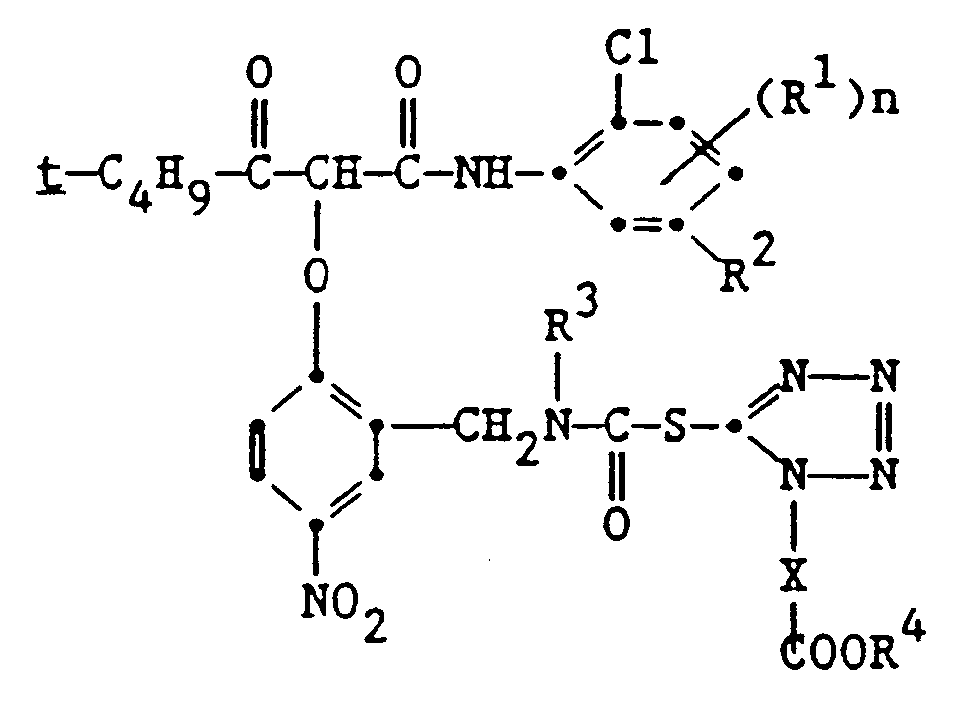
R¹ est un substituant qui n'influe pas défavorablement sur les propriétés de libération de l'inhibiteur de développement du coupleur ;
n est 0, 1 ou 2;
R² est un groupe ballast ;
R³ est alkyle ou aryle ;
R⁴ est alkyle de 2 à 5 atomes de carbone ;
X est un alkylène contenant de 1 à 3 atomes de carbone ;
et un coupleur formateur de colorant jaune de formule :
R⁵ et R⁷ sont chacun séparément alkyle substitué ou non, aryle, chloro, bromo ou alkoxy ;
m et q sont chacun séparément 0,1 ou 2 ;
R⁶ est un groupe ballast ;
R⁸ est un alkyle substitué ou non ;
Z est un groupe qui se sépare au couplage qui est
R⁹ est un aryle substitué ou non ; et
Y représente le nombre d'atomes nécessaire pour compléter un hétérocycle à 5 chaînons substitué ou non. - Produit photographique selon la revendication 1 dans lequel le coupleur formateur de colorant jaune a la formule :

R¹⁰ est un alkyle de 8 à 32 atomes de carbone ; et
R¹¹ est un alkyle de 2 à 4 atomes de carbone. - Produit photographique selon la revendication 1 ou 2 dans lequel le coupleur formateur de colorant jaune a la formule :

- Produit photographique selon la revendication 1 dans lequel le coupleur libérant l'inhibiteur de développement a la formule :

R¹² est alkyle de 8 à 32 atomes de carbone ; et
R¹³ est alkyle de 2 à 5 atomes de carbone. - Produit photographique selon l'une quelconque des revendications 1 à 4 dans lequel le coupleur libérant l'inhibiteur de développement a la formule :

- Produit photographique selon l'une quelconque des revendications 1 à 4 dans lequel le coupleur formateur de colorant jaune a la formule :


- Produit photographique selon la revendication 1 comprenant un support recouvert d'une couche d'émulsion aux halogénures d'argent sensible au rouge comprenant un coupleur phénolique formateur de colorant cyan ayant en position 5 un groupe ballast comprenant un groupe sulfone et en position 2 un groupe para-cyanophényluréido ; au moins une couche d'émulsion aux halogénures d'argent sensible au vert comprenant un coupleur pyrazolo[3,2-c]-s-triazole formateur de colorant magenta comprenant un groupe alkyle contenant 1 à 4 atomes de carbone en position 6, un groupe ballast en position 3 ayant un groupe terminal carboxy et un groupe se séparant au couplage en position 7 ; et au moins une couche d'émulsion aux halogénures d'argent sensible au bleu comprenant le coupleur formateur de colorant jaune de la revendication 1, et le coupleur photographique libérant l'inhibiteur de développement de la revendication 1.
- Produit photographique selon la revendication 1 comprenant un support recouverta) d'une couche d'émulsion aux halogénures d'argent sensible au rouge comprenant un coupleur formateur de colorant cyan de formule :


un coupleur libérant un inhibiteur de développement de formule :
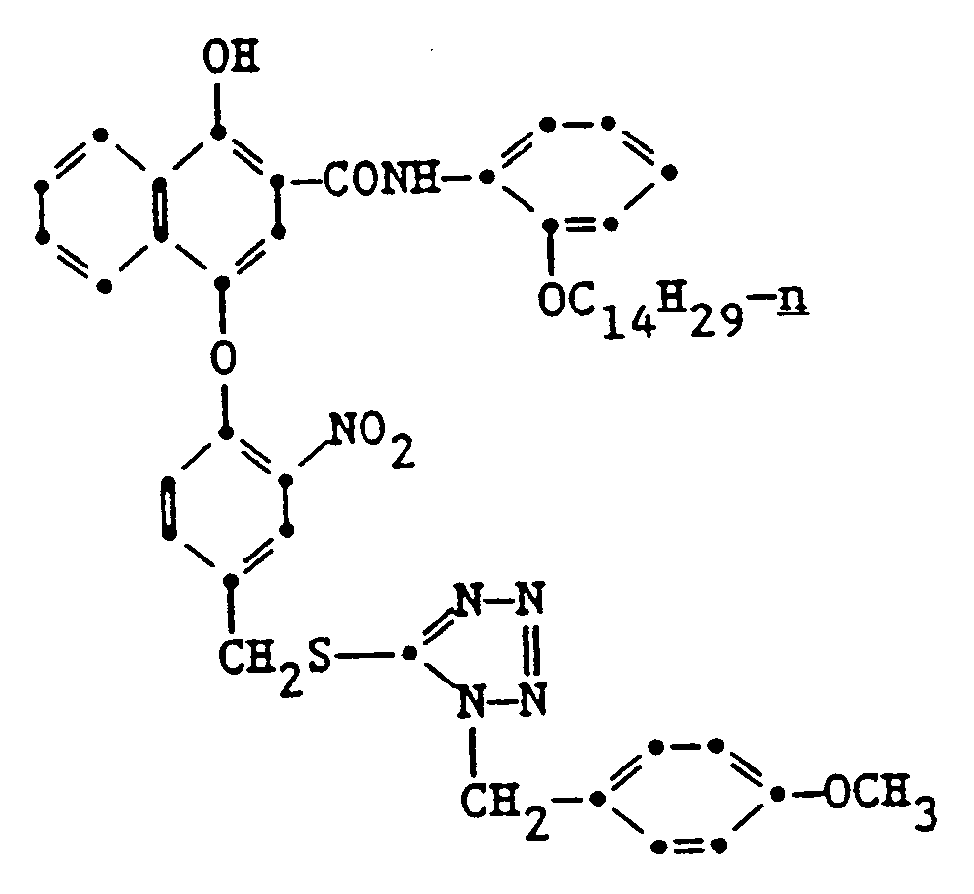 b) une unité de couches d'émulsions aux halogénures d'argent sensibles au vert comprenant au moins deux couches d'émulsion aux halogénures d'argent sensibles au vert comprenant un coupleur formateur de colorant magenta de formule :

 c) une couche d'émulsion aux halogénures d'argent sensible au bleu comprenant un coupleur formateur de colorant jaune de formule :
- Procédé pour former une image de colorant dans un produit photographique exposé tel que défini dans l'une quelconque des revendications 1 à 8, procédé dans lequel on développe le produit photographique exposé avec un développateur chromogène des halogénures d'argent.
Applications Claiming Priority (2)
| Application Number | Priority Date | Filing Date | Title |
|---|---|---|---|
| US238369 | 1988-08-30 | ||
| US07/238,369 US4980267A (en) | 1988-08-30 | 1988-08-30 | Photographic element and process comprising a development inhibitor releasing coupler and a yellow dye-forming coupler |
Publications (3)
| Publication Number | Publication Date |
|---|---|
| EP0356925A2 EP0356925A2 (fr) | 1990-03-07 |
| EP0356925A3 EP0356925A3 (en) | 1990-10-10 |
| EP0356925B1 true EP0356925B1 (fr) | 1995-05-24 |
Family
ID=22897569
Family Applications (1)
| Application Number | Title | Priority Date | Filing Date |
|---|---|---|---|
| EP89115693A Expired - Lifetime EP0356925B1 (fr) | 1988-08-30 | 1989-08-25 | Elément et procédé photographique comprenant un coupleur libérant un inhibiteur de développement et un coupleur formateur de colorant jaune |
Country Status (4)
| Country | Link |
|---|---|
| US (1) | US4980267A (fr) |
| EP (1) | EP0356925B1 (fr) |
| JP (1) | JPH02106740A (fr) |
| DE (1) | DE68922803T2 (fr) |
Families Citing this family (15)
| Publication number | Priority date | Publication date | Assignee | Title |
|---|---|---|---|---|
| JP2684252B2 (ja) * | 1991-03-08 | 1997-12-03 | 富士写真フイルム株式会社 | ハロゲン化銀カラー写真感光材料 |
| EP0518101B1 (fr) * | 1991-05-31 | 1996-04-24 | Eastman Kodak Company | Elément photographique et procédé comprenant un coupleur inhibiteur de développement et un coupleur formateur de colorant jaune |
| US5272043A (en) * | 1991-06-28 | 1993-12-21 | Eastman Kodak Company | Photographic material and process comprising DIR coupler |
| IT1256017B (it) * | 1992-04-07 | 1995-11-20 | Minnesota Mining & Mfg | Materiale fotografico a colori agli alogenuri d'argento sensibile alla luce |
| US5288598A (en) * | 1992-10-30 | 1994-02-22 | Eastman Kodak Company | Photographic light-sensitive elements |
| US5378577A (en) * | 1992-10-30 | 1995-01-03 | Eastman Kodak Company | Photographic light-sensitive elements |
| US5300411A (en) * | 1992-10-30 | 1994-04-05 | Eastman Kodak Company | Photographic light-sensitive elements |
| DE69320354T2 (de) * | 1993-12-10 | 1999-01-07 | Imation Corp., Oakdale, Minn. | Farbphotographisches lichtempfindliches Silberhalogenidmaterial |
| US5451492A (en) * | 1994-03-17 | 1995-09-19 | Eastman Kodak Company | Photographic elements containing certain acylacetanilide couplers in combination with development inhibitor releasing couplers |
| US5451493A (en) * | 1994-03-17 | 1995-09-19 | Eastman Kodak Company | Photographic element containing a certain sulfonated acylacetanilide coupler in combination with a development inhibitor releasing coupler |
| US5472833A (en) * | 1994-04-14 | 1995-12-05 | Eastman Kodak Company | Silver halide photographic film utilizing cellulose triacetate support with two antistatic layers |
| US5789146A (en) * | 1995-08-21 | 1998-08-04 | Eastman Kodak Company | Blends of couplers with homologous ballasts |
| GB9827966D0 (en) | 1998-12-19 | 1999-02-10 | Eastman Kodak Co | Photographic element containing a dir coupler |
| JPWO2003100367A1 (ja) | 2002-05-08 | 2005-09-22 | コナミ株式会社 | 模型用受光装置、模型、及び模型用信号光検出方法 |
| US7836843B2 (en) * | 2007-10-24 | 2010-11-23 | Sulzer Metco (Us), Inc. | Apparatus and method of improving mixing of axial injection in thermal spray guns |
Family Cites Families (21)
| Publication number | Priority date | Publication date | Assignee | Title |
|---|---|---|---|---|
| BE619301A (fr) * | 1959-04-06 | |||
| CA1041343A (fr) * | 1971-12-28 | 1978-10-31 | Akio Okumura | Methode de formation d'images photographiques jaunes |
| JPS51102636A (en) * | 1974-04-03 | 1976-09-10 | Fuji Photo Film Co Ltd | Karaashashingazo no keiseihoho |
| JPS5223933A (en) * | 1975-08-19 | 1977-02-23 | Fuji Photo Film Co Ltd | Silver halide color photographic light sensitive material |
| US4248962A (en) * | 1977-12-23 | 1981-02-03 | Eastman Kodak Company | Photographic emulsions, elements and processes utilizing release compounds |
| JPS56114946A (en) * | 1980-02-15 | 1981-09-09 | Konishiroku Photo Ind Co Ltd | Silver halide photographic sensitive material |
| JPS5763531A (en) * | 1980-10-03 | 1982-04-17 | Konishiroku Photo Ind Co Ltd | Multilayer color photographic material |
| JPS57151944A (en) * | 1981-03-16 | 1982-09-20 | Fuji Photo Film Co Ltd | Color photosensitive silver halide material |
| US4434226A (en) * | 1981-11-12 | 1984-02-28 | Eastman Kodak Company | High aspect ratio silver bromoiodide emulsions and processes for their preparation |
| JPS58156932A (ja) * | 1982-03-11 | 1983-09-19 | Fuji Photo Film Co Ltd | ハロゲン化銀カラ−写真感光材料 |
| JPS58217932A (ja) * | 1982-06-11 | 1983-12-19 | Fuji Photo Film Co Ltd | ハロゲン化銀カラ−感光材料 |
| JPS5960437A (ja) * | 1982-09-30 | 1984-04-06 | Fuji Photo Film Co Ltd | ハロゲン化銀カラ−写真感光材料 |
| JPS59131933A (ja) * | 1983-01-19 | 1984-07-28 | Fuji Photo Film Co Ltd | ハロゲン化銀カラ−写真感光材料 |
| JPS60221750A (ja) * | 1984-04-18 | 1985-11-06 | Fuji Photo Film Co Ltd | 画像形成方法 |
| JPS6172242A (ja) * | 1984-09-14 | 1986-04-14 | Konishiroku Photo Ind Co Ltd | 感光性ハロゲン化銀カラ−写真材料 |
| US4725529A (en) * | 1985-04-30 | 1988-02-16 | Konishiroku Photo Industry Co., Ltd. | Developing inhibitor arrangment in light-sensitive silver halide color photographic materials |
| FR2591355B1 (fr) * | 1985-12-09 | 1990-11-30 | Kodak Pathe | Produit photographique inversible formateur d'image en couleurs avec effets interimage ameliores |
| JPS62153954A (ja) * | 1985-12-27 | 1987-07-08 | Fuji Photo Film Co Ltd | ハロゲン化銀カラ−写真感光材料 |
| JPS63127242A (ja) * | 1986-11-17 | 1988-05-31 | Fuji Photo Film Co Ltd | ハロゲン化銀カラ−写真感光材料 |
| US4775616A (en) * | 1986-12-12 | 1988-10-04 | Eastman Kodak Company | Cyan dye-forming couplers and photographic materials containing same |
| US4782012A (en) * | 1987-07-17 | 1988-11-01 | Eastman Kodak Company | Photographic material containing a novel dir-compound |
-
1988
- 1988-08-30 US US07/238,369 patent/US4980267A/en not_active Expired - Fee Related
-
1989
- 1989-08-25 EP EP89115693A patent/EP0356925B1/fr not_active Expired - Lifetime
- 1989-08-25 DE DE68922803T patent/DE68922803T2/de not_active Expired - Fee Related
- 1989-08-29 JP JP1220490A patent/JPH02106740A/ja active Pending
Also Published As
| Publication number | Publication date |
|---|---|
| EP0356925A2 (fr) | 1990-03-07 |
| US4980267A (en) | 1990-12-25 |
| DE68922803T2 (de) | 1996-02-29 |
| EP0356925A3 (en) | 1990-10-10 |
| DE68922803D1 (de) | 1995-06-29 |
| JPH02106740A (ja) | 1990-04-18 |
Similar Documents
| Publication | Publication Date | Title |
|---|---|---|
| US4980267A (en) | Photographic element and process comprising a development inhibitor releasing coupler and a yellow dye-forming coupler | |
| EP0349331B1 (fr) | Materiau photographique couleur | |
| JPH05188543A (ja) | Dirカプラー含有写真要素 | |
| EP0649056B1 (fr) | Elément photographique et procédé employant des coupleurs permettant de corriger la teinte d'image colorée | |
| US4960685A (en) | Color photographic element and process | |
| US5389504A (en) | Color photographic elements containing a combination of pyrazolone and pyrazoloazole couplers | |
| US5188926A (en) | Photographic elements having carbonamide coupler solvents and addenda to reduce sensitizing dye stain | |
| US5387500A (en) | Color photographic elements containing a combination of pyrazoloazole couplers | |
| US5051343A (en) | Photographic elements containing removable couplers | |
| US5021555A (en) | Color photographic material | |
| US5192646A (en) | Photographic elements having sulfoxide coupler solvents and addenda to reduce sensitizing dye stain | |
| JP3779379B2 (ja) | 画質を向上したハロゲン化銀カラー写真用感光性要素 | |
| EP0518101B1 (fr) | Elément photographique et procédé comprenant un coupleur inhibiteur de développement et un coupleur formateur de colorant jaune | |
| US5360713A (en) | Yellow dye-forming couplers and color photographic elements containing these couplers | |
| US5118594A (en) | Photographic elements containing removable couplers | |
| JPH06347956A (ja) | 写真用カラーカプラーおよびそれを含む写真要素 | |
| JP3464543B2 (ja) | スルホン基又はスルホキシド基を含有するバラストを有する写真カプラー | |
| EP0492442B1 (fr) | Eléments photographiques contenant un colorant filtre, éliminable | |
| EP0443159B1 (fr) | Coupleurs formateurs de cyan et produits photographiques de reproduction les contenant | |
| EP0600561B1 (fr) | Copulants jaune ayant groupes libérés aryloxy ionisables et/ou solubilisants | |
| US5019489A (en) | Color photographic element and process | |
| JPH0572685A (ja) | 写真ハロゲン化銀材料及びプロセス | |
| JPH07175189A (ja) | 色濁りが低減した写真要素 |
Legal Events
| Date | Code | Title | Description |
|---|---|---|---|
| PUAI | Public reference made under article 153(3) epc to a published international application that has entered the european phase |
Free format text: ORIGINAL CODE: 0009012 |
|
| AK | Designated contracting states |
Kind code of ref document: A2 Designated state(s): AT BE CH DE ES FR GB GR IT LI LU NL SE |
|
| PUAL | Search report despatched |
Free format text: ORIGINAL CODE: 0009013 |
|
| AK | Designated contracting states |
Kind code of ref document: A3 Designated state(s): AT BE CH DE ES FR GB GR IT LI LU NL SE |
|
| 17P | Request for examination filed |
Effective date: 19901218 |
|
| 17Q | First examination report despatched |
Effective date: 19931221 |
|
| RBV | Designated contracting states (corrected) |
Designated state(s): BE DE FR GB |
|
| GRAA | (expected) grant |
Free format text: ORIGINAL CODE: 0009210 |
|
| AK | Designated contracting states |
Kind code of ref document: B1 Designated state(s): BE DE FR GB |
|
| REF | Corresponds to: |
Ref document number: 68922803 Country of ref document: DE Date of ref document: 19950629 |
|
| PGFP | Annual fee paid to national office [announced via postgrant information from national office to epo] |
Ref country code: GB Payment date: 19950713 Year of fee payment: 7 |
|
| ET | Fr: translation filed | ||
| PGFP | Annual fee paid to national office [announced via postgrant information from national office to epo] |
Ref country code: FR Payment date: 19950818 Year of fee payment: 7 |
|
| PGFP | Annual fee paid to national office [announced via postgrant information from national office to epo] |
Ref country code: BE Payment date: 19950829 Year of fee payment: 7 |
|
| PGFP | Annual fee paid to national office [announced via postgrant information from national office to epo] |
Ref country code: DE Payment date: 19950831 Year of fee payment: 7 |
|
| PLBE | No opposition filed within time limit |
Free format text: ORIGINAL CODE: 0009261 |
|
| STAA | Information on the status of an ep patent application or granted ep patent |
Free format text: STATUS: NO OPPOSITION FILED WITHIN TIME LIMIT |
|
| 26N | No opposition filed | ||
| PG25 | Lapsed in a contracting state [announced via postgrant information from national office to epo] |
Ref country code: GB Effective date: 19960825 |
|
| PG25 | Lapsed in a contracting state [announced via postgrant information from national office to epo] |
Ref country code: BE Effective date: 19960831 |
|
| BERE | Be: lapsed |
Owner name: EASTMAN KODAK CY Effective date: 19960831 |
|
| GBPC | Gb: european patent ceased through non-payment of renewal fee |
Effective date: 19960825 |
|
| PG25 | Lapsed in a contracting state [announced via postgrant information from national office to epo] |
Ref country code: FR Effective date: 19970430 |
|
| PG25 | Lapsed in a contracting state [announced via postgrant information from national office to epo] |
Ref country code: DE Effective date: 19970501 |
|
| REG | Reference to a national code |
Ref country code: FR Ref legal event code: ST |