EP0357458A2 - Leuchtende Vorrichtung - Google Patents
Leuchtende Vorrichtung Download PDFInfo
- Publication number
- EP0357458A2 EP0357458A2 EP89308891A EP89308891A EP0357458A2 EP 0357458 A2 EP0357458 A2 EP 0357458A2 EP 89308891 A EP89308891 A EP 89308891A EP 89308891 A EP89308891 A EP 89308891A EP 0357458 A2 EP0357458 A2 EP 0357458A2
- Authority
- EP
- European Patent Office
- Prior art keywords
- layer
- zns
- resistivity
- current injection
- type
- Prior art date
- Legal status (The legal status is an assumption and is not a legal conclusion. Google has not performed a legal analysis and makes no representation as to the accuracy of the status listed.)
- Granted
Links
Images


Classifications
-
- H—ELECTRICITY
- H10—SEMICONDUCTOR DEVICES; ELECTRIC SOLID-STATE DEVICES NOT OTHERWISE PROVIDED FOR
- H10H—INORGANIC LIGHT-EMITTING SEMICONDUCTOR DEVICES HAVING POTENTIAL BARRIERS
- H10H20/00—Individual inorganic light-emitting semiconductor devices having potential barriers, e.g. light-emitting diodes [LED]
- H10H20/80—Constructional details
- H10H20/84—Coatings, e.g. passivation layers or antireflective coatings
-
- H—ELECTRICITY
- H01—ELECTRIC ELEMENTS
- H01S—DEVICES USING THE PROCESS OF LIGHT AMPLIFICATION BY STIMULATED EMISSION OF RADIATION [LASER] TO AMPLIFY OR GENERATE LIGHT; DEVICES USING STIMULATED EMISSION OF ELECTROMAGNETIC RADIATION IN WAVE RANGES OTHER THAN OPTICAL
- H01S5/00—Semiconductor lasers
- H01S5/30—Structure or shape of the active region; Materials used for the active region
- H01S5/32—Structure or shape of the active region; Materials used for the active region comprising PN junctions, e.g. hetero- or double- heterostructures
- H01S5/327—Structure or shape of the active region; Materials used for the active region comprising PN junctions, e.g. hetero- or double- heterostructures in AIIBVI compounds, e.g. ZnCdSe-laser
-
- H—ELECTRICITY
- H05—ELECTRIC TECHNIQUES NOT OTHERWISE PROVIDED FOR
- H05B—ELECTRIC HEATING; ELECTRIC LIGHT SOURCES NOT OTHERWISE PROVIDED FOR; CIRCUIT ARRANGEMENTS FOR ELECTRIC LIGHT SOURCES, IN GENERAL
- H05B33/00—Electroluminescent light sources
- H05B33/12—Light sources with substantially two-dimensional [2D] radiating surfaces
-
- H—ELECTRICITY
- H05—ELECTRIC TECHNIQUES NOT OTHERWISE PROVIDED FOR
- H05B—ELECTRIC HEATING; ELECTRIC LIGHT SOURCES NOT OTHERWISE PROVIDED FOR; CIRCUIT ARRANGEMENTS FOR ELECTRIC LIGHT SOURCES, IN GENERAL
- H05B33/00—Electroluminescent light sources
- H05B33/12—Light sources with substantially two-dimensional [2D] radiating surfaces
- H05B33/14—Light sources with substantially two-dimensional [2D] radiating surfaces characterised by the chemical or physical composition or the arrangement of the electroluminescent material, or by the simultaneous addition of the electroluminescent material in or onto the light source
- H05B33/145—Arrangements of the electroluminescent material
-
- H—ELECTRICITY
- H10—SEMICONDUCTOR DEVICES; ELECTRIC SOLID-STATE DEVICES NOT OTHERWISE PROVIDED FOR
- H10H—INORGANIC LIGHT-EMITTING SEMICONDUCTOR DEVICES HAVING POTENTIAL BARRIERS
- H10H20/00—Individual inorganic light-emitting semiconductor devices having potential barriers, e.g. light-emitting diodes [LED]
- H10H20/052—Light-emitting semiconductor devices having Schottky type light-emitting regions; Light emitting semiconductor devices having Metal-Insulator-Semiconductor type light-emitting regions
-
- H—ELECTRICITY
- H10—SEMICONDUCTOR DEVICES; ELECTRIC SOLID-STATE DEVICES NOT OTHERWISE PROVIDED FOR
- H10H—INORGANIC LIGHT-EMITTING SEMICONDUCTOR DEVICES HAVING POTENTIAL BARRIERS
- H10H20/00—Individual inorganic light-emitting semiconductor devices having potential barriers, e.g. light-emitting diodes [LED]
- H10H20/80—Constructional details
- H10H20/81—Bodies
- H10H20/822—Materials of the light-emitting regions
- H10H20/823—Materials of the light-emitting regions comprising only Group II-VI materials, e.g. ZnO
-
- H—ELECTRICITY
- H10—SEMICONDUCTOR DEVICES; ELECTRIC SOLID-STATE DEVICES NOT OTHERWISE PROVIDED FOR
- H10H—INORGANIC LIGHT-EMITTING SEMICONDUCTOR DEVICES HAVING POTENTIAL BARRIERS
- H10H20/00—Individual inorganic light-emitting semiconductor devices having potential barriers, e.g. light-emitting diodes [LED]
- H10H20/80—Constructional details
- H10H20/81—Bodies
- H10H20/822—Materials of the light-emitting regions
- H10H20/823—Materials of the light-emitting regions comprising only Group II-VI materials, e.g. ZnO
- H10H20/8232—Materials of the light-emitting regions comprising only Group II-VI materials, e.g. ZnO characterised by the dopants
-
- H—ELECTRICITY
- H10—SEMICONDUCTOR DEVICES; ELECTRIC SOLID-STATE DEVICES NOT OTHERWISE PROVIDED FOR
- H10H—INORGANIC LIGHT-EMITTING SEMICONDUCTOR DEVICES HAVING POTENTIAL BARRIERS
- H10H20/00—Individual inorganic light-emitting semiconductor devices having potential barriers, e.g. light-emitting diodes [LED]
- H10H20/80—Constructional details
- H10H20/81—Bodies
- H10H20/816—Bodies having carrier transport control structures, e.g. highly-doped semiconductor layers or current-blocking structures
Definitions
- the present invention relates to a compound semiconductor luminescent device. More particularly, it relates to a II-VI group compound semiconductor luminescent device capable of emitting ultraviolet light.
- Compound semiconductor luminescent devices capable of emitting ultraviolet light of a short wavelength are usually produced with aluminum nitride (AlN) or boron nitride (BN), both of which are nitride-type III-V group semiconductor compounds.
- AlN aluminum nitride
- BN boron nitride
- FIG. 5 of the drawings accompanying the present application shows a conventional semiconductor compound luminescent device with a metal-semiconductor (MS) structure using AlN.
- This luminescent device has a structure in which a metal electrode 52 made of niobium (Nb) and a metal electrode 53 made of Al are disposed on an AlN semiconductor 51.
- current of about 0.1 to 20 mA flows when a voltage of several tens to a hundred of volts is applied to this luminescent device, so that light emission over a wide range of about 215 to 500 nm can be obtained.
- FIG. 6 also of the drawings accompanying the present application shows a conventional pn junction luminescent device using BN.
- This luminescent device is produced by growing an Si-doped n-type BN semi conductor 61 and a Be-doped p-type semiconductor 62 under a very high pressure at a high temperature, and by providing the n-type BN semiconductor 61 and the p-type BN semiconductor 62 with silver paste electrodes 63 and 64, respectively.
- a voltage of several tens of volts or more is applied to such a luminescent device, current of 0.1 to 3 mA flows, so that light emission over a wide range of about 215 to 600 nm can be obtained.
- AlN semiconductor used in the luminescent device shown in accompanying Figure 5 has a problem in that substrate crystals cannot readily be obtained. For this reason, AlN is deposited on a substrate made of, for example, sapphire (Al2O3), to form an AlN crystal film. Thus, the quality of the crystal is very poor.
- a BN semiconductor used in the luminescent device shown in accompanying Figure 6 also has a problem that substrate crystals cannot readily be obtained. Therefore, the luminescent device is produced by growing a very small crystal of about 1 mm in diameter, and by forming electrodes on this crystal particle.
- luminescent devices in which these semiconductor materials are used requires the application of a high voltage of several tens of volts, and the wavelength of light emitted is over a wide range. Furthermore, these luminescent devices have a disadvantage in that the brightness of the emitted light is low. For these reasons, ultraviolet light emitting devices with luminescent characteristics excellent in wavelength selectivity and luminous efficiency cannot be obtained.
- ZnS, ZnS x Se 1-x which are II-VI group semiconductor compounds
- ZnS has an energy gap of a direct transition type.
- ZnS has a high energy gap of about 3.7 eV (corresponding to about 340nm) at room temperature
- ZnS 0.75 Se 0.25 has a high energy gap of about 2.95 eV (corresponding to about 420 nm) at room temperature.
- the wavelength of ultraviolet light can be selected in the range of 420 to 340 nm by changing the mole fraction of S (i.e., x) from 0.75 to 0.95. From these reasons, ZnS and ZnS x Se 1-x are believed to be a suitable material for an ultraviolet light emitting device.
- a II-VI group compound semiconductor such as, for example, ZnS, ZnS x Se 1-x , and ZnSe
- GaAs, GaP, Si is used as an epitaxial growth substrate, so that ZnS, ZnSe, and ZnS x Se 1-x cannot be grown on any of these substrates as a high-quality epitaxial crystal.
- luminescent devices obtained cannot be allowed to emit ultraviolet light with high luminous efficiency under well-controlled conditions.
- a compound semiconductor luminescent device which overcomes the above-discussed and numerous other disadvantages and deficiencies of the prior art, and which comprises a semiconductor substrate and a multi-layered structure disposed on the substrate, the multi-layered structure comprising at least one conductive layer, a luminescent layer, and a current injection layer, wherein the substrate and the layers are made of at least one type of II-VI group compound semiconductor.
- the luminescent layer is formed on the conductive layer and the current injection layer is formed on the luminescent layer.
- the current injection layer is formed on the conductive layer and the luminescent layer is formed on the current injection layer.
- the compound semiconductor luminescent device of the present invention further comprises a protective layer disposed on the multi-layered structure.
- the II-VI group compound semiconductor is preferably selected from ZnS, ZnSe, ZnS x Se 1-x (0 ⁇ x ⁇ 1), and ZnS y Te 1-y (0 ⁇ y ⁇ 1).
- the present invention makes it possible to provide a compound semiconductor luminescent device in which a multi-layered structure comprising at least one conductive layer, a luminescent layer, and a current injection layer, all of which are made of II-VI group compound semiconductors, is disposed on a II-VI group semiconductor substrate, so that carriers can be effectively injected in the luminescent layer and laser light can be effectively taken out from the luminescent region to the outside of the device, resulting in an ultraviolet light emission with excellent brightness.
- Figure 1 shows a compound semiconductor luminescent device of the present invention, in which an n-type ZnS conductive layer 12, an n-type ZnS luminescent layer 13, and a ZnS high-resistivity current injection layer 14 capable of transmitting ultraviolet light are successively formed on an n-type ZnS single-crystal substrate 11 by an epitaxial growth method.
- a metal electrode 15 which serves as a negative electrode is disposed on the n-type ZnS single-crystal substrate 11, and a positive metal electrode 16 for current injection is disposed on the ZnS high-resistivity current injection layer 14.
- the current injection metal electrode 16 and the ZnS high-resistivity current injection layer 14 are covered with a protective film 17 capable of transmitting ultraviolet light, except for the connecting terminal portion of the metal electrode 16.
- the n-type ZnS single-crystal substrate 11 has a thickness of about 200 to 500 ⁇ m, and the resistivity thereof is in the range of 1 to 10 ⁇ cm.
- the n-type Zns single-crystal substrate 11 is prepared by, for example, heat treatment of a ZnS high-resistivity bulk single crystal, which has been grown by an iodine transport method or the like, in a melt of Zn-Al (the ratio of Al being 10%) kept at about 1000 o C for about 100 hours.
- the n-type ZnS conductive layer 12, the n-type ZnS luminescent layer 13, and the ZnS high-resistivity current injection layer 14 successively formed on the n-type ZnS single-crystal substrate 11 are grown by, for example, molecular beam epitaxy (MBE).
- MBE molecular beam epitaxy
- the n-type ZnS conductive layer 12 is doped with an n-type impurity such as, for example Al so as to have a low resistance of about a few ohms or less.
- an n-type impurity such as, for example Al so as to have a low resistance of about a few ohms or less.
- the conductive layer 12 can have an electron concentration substantially the same as the Al concentration therein.
- the resistance on the surface of the conductive layer 12 can be several ohms.
- the resistance on the surface of the conductive layer 12 can be 10 ⁇ or less.
- gallium (Ga), indium (In), thallium (Tl), chlorine (Cl), fluorine (F), bromine (Br), iodine (I), silicon (Si), germanium (Ge), or the like can also be used, as well as Al mentioned above.
- the n-type ZnS luminescent layer 13 is doped with an n-type impurity in the same way as for the above-mentioned conductive layer 12.
- the luminescent layer 13 in this Example has a resistivity of about 10 ⁇ 2 to 10 ⁇ cm and a carrier concentration of 1019cm ⁇ 3 or less.
- the luminescent layer 13 to convert energy released by the recombination of injected carriers to ultraviolet light with high efficiency, the luminescent centres which cause light emission other than ultraviolet light, that is, the luminescent centers in deep energy levels must be reduced as much as possible.
- the luminescent layer 13 is composed of a homoepitaxial ZnS layer with high crystallinity, ultraviolet light of high intensity can be emitted when the carrier concentration is 2 x 1019cm ⁇ 3 or less.
- the thickness of the luminescent layer 13 varies depending on the carrier concentration, ultraviolet light of sufficiently high intensity can be emitted when the thickness of the luminescent layer 13 is 0.5 ⁇ m or more.
- the ZnS high-resistivity current injection layer 14 is a layer for injecting holes to the luminescent layer 13.
- the current injection layer 14 must have high resistance and high crystallinity.
- an impurity is effective.
- an impurity element to be added it is preferable to use lithium (Li), sodium (Na), potassium (K), calcium (Ca), strontium (Sr), copper (Cu), silver (Ag), gold (Au), nitrogen (N), phosphorus (P), arsenic (As), antimony (Sb), silicon (Si), germanium (Ge), carbon (C), oxygen (O), or the like.
- the thickness of this layer is required to be about 0.5 ⁇ m or less.
- the layer thickness is preferably set to 0.1 ⁇ m or less.
- the layer thickness is set to 2 nm or more so tht the current injection layer 14 is not damaged when a voltage is applied thereto.
- the metal electrode 16 for current injection (i.e., for the hole injection) disposed on the high-resistivity current injection layer 14 is preferably made of gold or platinum.
- a very stable electrode with high density can be obtained by thermal deposition or electron-beam deposition of these metals under a very highly reduced pressure of 10 ⁇ 8 to 10 ⁇ 9 Torr which is higher than the ordinary reduced pressure of 10 ⁇ 5 to 10 ⁇ 6 Torr for vacuum deposition of forming an electrode.
- the metal thin film with a thickness of about 2.5 nm is sufficient to function as an electrode.
- the metal electrode 16 with such a thickness can transmit ultraviolet light.
- the metal electrode 16 When the metal electrode 16 is a thin film with a thickness of about 2.5 to 10 nm, internal resistance of the metal electrode increases. To decrease the internal resis tance, the connecting terminal portion of the metal electrode is formed to have a thickness of about 50 to 100 nm, or the metal electrode is divided into two or more portions.
- the ultraviolet light transmitting protective film 17, which is disposed to cover both the metal electrode 16 and the current injection layer 14, is an insulating film with a high transmittance to light in the region of ultraviolet light.
- the protective film 17 is formed by a method such as sputtering, or optical or thermal chemical vapor deposition. As described above, both the high-resistivity current injection layer 14 and the metal electrode 16 for current injection are thin, so that they may deteriorate in an atmosphere when ultraviolet light is emitted. However, the coating of the high-resistive current injection layer 14 and the metal electrode 16 for current injection with the protective film 17 in this way prevent them from deteriorating.
- At least one type of compounds including Al2O3, Si3N4, AlN, BN, KCl, KBr, KF, NaCl, NaBr, NaF, CaF2, CaBr2, SrF2, SrBr2, CaCl2, SrCl2, BaF2, CaS, CaSe, SrS, SrSe, BaS, and BaSe, or with the use of at least one kind of mixtures of these compounds with ZnS or ZnS x Se 1-x , as the protective film 17, it is possible to obtain a luminescent device with excellent heat resistance (100 o C or less) and excellent moisture resistance (90% or less).
- the metal electrode 15 as the negative electrode disposed on the n-type ZnS single-crystal substrate 11 is formed by vacuum deposition of at least one kind of In, Al, or Ga on the substrate 11.
- the metal electrode 15 formed in this way has an excellent ohmic contact with the ZnS substrate 11. Also, when the metal electrode 15 is deposed at a very highly reduced pressure of 10 ⁇ 8 to 10 ⁇ 9 Torr, the contact resistance of this electrode is further decreased.
- the compound semiconductor luminescent device with such a structure operates very stably at an applied voltage of 5-10 V and at a current value of 0.1-100 mA, and ultraviolet light emission of 338 nm is obtained.
- the carrier concentration in the luminescent layer 13 is 2 x 1018cm ⁇ 3 or more, a wide blue luminescent band having a peak at around 460 nm is produced by doping. Because the intensity of light emission is one half or less than the intensity of light having a peak at 338 nm, only the intensity of ultraviolet light having a peak at 338 nm is increased when the amount of injection current is increased.
- Example 1 the ZnS conductive layer 12, the ZnS luminescent layer 13, and the ZnS high-resistivity current injection layer 14 are successively grown on the ZnS single-crystal substrate 11 by an MBE method to produce a compound semiconductor luminescent device, a compound semiconductor luminescent device with the same structure can also be obtained by a MOCVD method.
- epitaxially grown layers including a luminescent layer have the same composition as that of the substrate (i.e., homoepitaxial growth), the quality of the epitaxially grown layers is considerably improved, and the density of defects is about one hundredth that of conventional luminescent devices.
- a ZnS epitaxially grown layer is formed on a substrate such as, for example, gallium arsenide (GaAs), gallium phosphide (GaP), or silicon (Si), (i.e., a heteroepitaxially grown layer)
- GaAs gallium arsenide
- GaP gallium phosphide
- Si silicon
- Figure 2 shows another compound semiconductor luminescent device of the present invention.
- an n-type ZnS low-resistivity conductive layer 22 is formed on a high-resistivity ZnS single-crystal substrate 21 by an epitaxial growth method.
- an n-type ZnS x Se 1-x low-resistivity conductive layer 23 is formed on the conductive layer 22 except for its one edge portion.
- an n-type ZnS x Se 1-x low-resistivity conductive layer 23 an n-type ZnS x Se 1-x low-resistivity luminescent layer 24, and a ZnS high-resistivity current injection layer 25 are successively formed by an epitaxial growth method, for example, an MBE method.
- a negative electrode 27 is disposed on the portion of the conductive layer 22 other than the edge portion on which the n-type ZnS x Se 1-x low-resistivity conductive layer 23 is formed.
- a positive electrode 26 is disposed on the bottom surface of the recessed portion.
- the upper surface of the ZnS high-resistivity current injection layer 25 and the upper surface of the positive electrode 26 are coated with a protective film 28, except for the connecting terminal portion of the electrode 26.
- the luminescent device has cleavage planes perpendicular to each epitaxially grown layer, and ultraviolet light is emitted from these cleavage planes and the upper surface of the ZnS high-resistivity current injection layer 25.
- a high-resistivity ZnS single-crystal substrate 21 is used in place of the n-type single-crystal substrate 11 of the Example 1. Therefore, the ZnS single-crystal substrate 21 can be formed by an iodine transport method, a sublimation method, or the like, but heat treatment of the substrate 21 is not required as was the case for the substrate 11 of Example 1.
- the n-type ZnS low-resistivity conductive layer 22 formed on the substrate 21, is doped with an n-type impurity such as, for example, Al at a concentration of 4 x 1019cm ⁇ 3 in the same way as that of Example 1, so that the concentration of carriers is 3.5 x 1019cm ⁇ 3, and further the n-type ZnS low-resistivity conductive layer 22 has a thickness of 3 ⁇ m, so that the surface resistance within the layer is 5 ⁇ or less.
- an n-type impurity such as, for example, Al at a concentration of 4 x 1019cm ⁇ 3 in the same way as that of Example 1, so that the concentration of carriers is 3.5 x 1019cm ⁇ 3, and further the n-type ZnS low-resistivity conductive layer 22 has a thickness of 3 ⁇ m, so that the surface resistance within the layer is 5 ⁇ or less.
- the n-type ZnS x Se 1-x conductive layer 23 formed on the n-type ZnS low-resistivity conductive layer 22 is also doped with Al as an n-type impurity so as to have low resistance in the same level as that of the n-type ZnS low-resistivity conductive layer 22.
- the mole fraction x of S in the n-type ZnS x Se 1-x conductive layer 23 is set to a value in the range of 0.75 to 0.95 so that the ultraviolet light emission wavelength of the luminescent device of this Example falls in the range of 340 to 420 nm.
- the laminate structure composed of the n-type ZnS low-resistivity conductive layer 22 and the n-type ZnS x Se 1-x conductive layer 23 when an n-type ZnS x Se 1-x low-resistivity layer is epitaxially grown on the n-type ZnS low-resistivity conductive layer 22, a difference between the lattice constants will occur. However, by gradually increasing the ratio of Se when the ZnS x Se 1-x low-resistivity conductive layer 23 is grown, the ZnS x Se 1-x low-resistivity conductive layer 23 with excellent crystallinity can be obtained.
- these constituent elements of these low-resistivity conductive layers 22 and 23 are group II and VI elements, these constituent elements do not have a tendency to become an impurity for each other, so that electrical and optical properties of each layer can be controlled very readily. This feature is quite different from the case where a heteroepitaxial growth is performed by the use of a substrate of GaAs, GaP, Si, or the like.
- the carrier concentration increases as the mole fraction x decreases. Therefore, even when the mole fraction x of S is about 0.75, the thickness of the conductive layer of 0.5 ⁇ m or more is sufficient.
- n-type ZnS x Se 1-x low-resistivity luminescent layer 24 formed on the n-type ZnS x Se 1-x conductive layer 23 when the concentration of Al added as an n-type impurity is 5 x 1018cm ⁇ 3 or less, light emission from the luminescent layer 23 give substantially ultraviolet light with a wavelength of 340 to 420 nm, so that light emission in the wave length range of in the wavelength range of 470 to 600 nm from deep energy levels generated by doping can virtually be ignored.
- ultraviolet light emitted from the n-type ZnS x Se 1-x low-resistivity luminescent layer 24 is of a wavelength equal to or longer than the absorption edge wavelength (i.e., 335 nm) of the ZnS high-resistivity current injection layer 25, no consideration of the absorption by the ZnS high-resistivity current injection layer 25 is required.
- the thickness of the thin film portion, which is formed by the recessed portion provided in the centre of the ZnS high-resistivity current injection layer 25, is set to a value of 2 to 100 nm so that carriers (i.e., holes) can sufficiently be injected.
- the thickness of the peripheral portion of the ZnS high-resistivity current injection layer 25 is set to 1 ⁇ m or more.
- Such a structure of the ZnS high-resistivity current injection layer 25 allows the ultraviolet light emitted from the luminescent layer 24 to be guided along the junction plane between the luminescent layer 24 and the high-resistivity current injection layer 25, so that the ultraviolet light can be taken out from the cleavage planes as well as from the upper surface of the high-resistivity current injection layer 25.
- the recessed portion of the ZnS high-resistivity current injection layer 25 is formed by irradiating with light while the ZnS high-resistivity current injection layer 25 is grown by an MBE method.
- the irradiation light is generated by, for example, a He-Cd laser with an output power of 20 mW at a wavelength of 325 nm.
- the laser light is irradiated at an output power of 1 to 5 mW, within a circle of 1 mm in diameter at the center of the ZnS high-resistivity current injection layer 25.
- the laser light is irradiated at the time when the thin film portion, in which current will be injected, of the ZnS high-resistivity current injection layer 25 is grown to have a desired thickness (e.g., 30 nm). Then, the growth of ZnS in the irradiated region is stopped, and ZnS is grown only on the peripheral portion other than the irradiated region for about 30 minutes to 3 hours so that the thickness of the ZnS is about 1 to 5 ⁇ m, resulting in a ZnS high- resistivity current injection layer 25 with a recessed portion.
- a desired thickness e.g. 30 nm
- Xe lamp light containing ultraviolet light with an output power of about 10 mW/nm or more SHG light of either an excimer laser or Ar laser, or THG light of a YAG laser, or the like, can be used, as well as He-Cd laser light.
- the high-resistivity current injection layer 25 is not limited to ZnS, but ZnS y Te 1-y (the mole fraction y of S being 0.9 to 1.0) can be used. In this case, a high-resistivity current injection layer with high quality can be obtained, which improves current injection efficiency.
- the impurity added to the ZnS high resistivity current injection layer 14 of Example 1 can also be used.
- the protective film 28 which covers the ZnS high-resistivity current injection layer 25 and the positive electrode 26 is the same as the protective film 17 of Example 1, and the negative electrode 27 is the same as the negative electrode 15 of Example 1.
- the peak wavelength of ultraviolet light emitted depends on the mole fraction x of S in the n-type ZnS x Se 1-x low-resistivity luminescent layer 24, and ultraviolet light with a wavelength in the range of 340 to 420 nm is emitted with high brightness at a half-value width of about 2 to 5 nm.
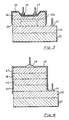
- FIG. 3 shows still another compound semiconductor luminescent device of the present invention.
- an n-type ZnS low-resistivity conductive layer 32 is formed on a ZnS high-resistivity single crystal substrate 31 by an epitaxial method.
- an n-type ZnS luminescent layer 33 and a p-type ZnS current injection layer 34 are successively formed by an epitaxial method.
- a pair of positive electrodes 35 are provided at an appropriate interval.
- a low-resistivity conductive region 33a formed by ion beam doping is provided so as to face the thin portion of the p-type ZnS high-resistivity current injection layer 34.
- the upper surface of the p-type ZnS current injection layer 34 and the respective positive electrodes 35 are covered with an insulating protective film 36, except for the connecting terminal portions of the respective positive electrodes 35.
- the protective film 36 covers the side surfaces of the current injection layer 34 and most of the side surfaces of the n-type ZnS low-resistivity luminescent layer 33 under the current injection layer 34.
- a negative electrode 37 is disposed on one edge portion of the n-type ZnS low-resistivity conductive layer 32.
- the n-type ZnS low-resistivity conductive layer 32 is doped with Al or the like as an n-type impurity in the same way as in Examples 1 and 2, so that the concentration of carriers is 5 x 1019cm ⁇ 3, and the layer thickness is set to 2 ⁇ m.
- the n-type ZnS low-resistivity luminescent layer 33 formed on the conductive layer 32 is doped with the same n-type impurity as above, so that the concentration of carriers is 5 x 1018cm ⁇ 3. From the luminescent layer 33, ultraviolet light of 335 to 338 nm corresponding to the energy gap of ZnS is emitted.
- the low-resistivity conductive region 33a is formed within the luminescent layer 33 by the use of focused ion beams such as, for example, Al, In, Ga, Cl, I, F, or Br, together with the above n-type impurity, at the early stage of the formation of the luminescent layer 33 formation.
- the conductive region 33a is doped with the use of ion beams so that a predetermined region within the luminescent layer 33 has a thickness of about 0.5 to 3 ⁇ m, resulting in a high carrier concentration (in the range of 1 x 10¹⁹ to 2 x 1020cm ⁇ 3).
- the resistance value of the conductive region 33a is set smaller than that of the luminescent layer 33 by a factor 10, so that a current density in the luminescent region within the luminescent layer can be increased. Accordingly, ultraviolet light by band-to-band light emission can be increased at substantially the same increment as that of the current density.
- the p-type ZnS current injection layer 34 is formed on the luminescent layer 33 so as to have a thin portion with a thickness of part 0.5 ⁇ m or less at the centre thereof, and a thick portion surrounding this thin portion is set to have a thickness of 1 to 5 ⁇ m.
- the luminescent device of such a construction emits high-brightness ultraviolet light with a wavelength of 337 to 338 nm from both the upper surface and the cleaved end surfaces at room temperature.
- current begins to flow at an applied voltage near 3 V, and current of 1 to 100 mA flows at a voltage of 3.5 to 4 V.
- the emitted ultraviolet light has such a brightness that green or blue fluorescent substances for use in cathode ray tube color displays can emit light with a sufficient brightness, and the luminous efficiency can be increased 102- to 103-fold as compared with that of a conventional luminescent device.
- FIG. 4 shows yet another compound semiconductor luminescent device of the present invention.
- an n-type ZnS low-resistivity conductive layer 42 is formed on a ZnS single-crystal substrate 41 by an epitaxial growth method.
- a negative electrode 43 is disposed on one edge portion of the conductive layer 42.
- an n-type ZnS z Se 1-z low-resistivity conductive layer 44, an n-type ZnS z Se 1-z low-resistivity luminescent layer 45, a p-type ZnS z Se 1-z current injection layer 46, and a p-type ZnS t Se 1-t protective layer 47 are successively formed by an epitaxial growth method.
- a positive electrode 48 is disposed on the protective layer 47.
- the upper surface of the protective layer 47 except for the region of the electrode 48 disposed, and both side surfaces of the protective layer 47, the current injection layer 46, the luminescent layer 45, and the conductive layer 44 are covered with an insulating protective film 49.
- the n-type ZnS low-resistivity conductive layer 42 and the n-type ZnS z Se 1-z low-resistivity conductive layer 44 are doped with an n-type impurity so as to have low resistance, in the same way as the n-type ZnS low-resistivity conductive layer 22 and the n-type ZnS x Se 1-x low-resistivity conductive layer 23 of Example 2.
- the molar ratio z of S which determines the wavelength of ultraviolet light to be emitted, is set to a value of 0.95 to 0.75, so that ultraviolet light with a wavelength of 340 to 420 nm is emitted in a similar manner to that of Example 2.
- the p-type ZnS z Se 1-z current injection layer 46 is doped with a p-type impurity such as As, and the concentration of carriers is 1 x 1017cm ⁇ 3.
- a p-type impurity such as As
- the concentration of carriers is 1 x 1017cm ⁇ 3.
- the p-type impurity at least one selected from O, C, N, P, Sb, Cu, Ag, Li, Na, K, Rb, Tl, Si, and Ge, can be used.
- the carrier concentration of the current injection layer 46 is 1 x 1018cm ⁇ 3 or less, a sufficiently high-quality layer can be obtained, and luminescent centres at deep energy levels, which are formed by the addition of a p-type impurity to the current injection layer 46, are not generated to the extent that they have an effect on the light emission characteristics.
- the carrier concentration of the current injection layer 46 exceeds the above limit, an added impurity becomes highly concentrated.
- As is used as a p-type impurity, a very wide reddish-orange light emission, the peak wavelength of which is in the neighborhood of 600 nm, is predominant, so that ultraviolet light cannot be emitted with high efficiency.
- the amount of As supplied at the time of the epitaxial growth by an MBE method must be increased to about 1 x 1020cm ⁇ 3.
- the crystallinity of the current injection layer 46 decreases.
- the thickness of the current injection layer 46 is preferably 2 ⁇ m or more.
- the mole fraction t of S is set to satisfy the inequality z + 0.05 ⁇ t ⁇ 1 with respect to the mole fraction z of S for the p-type ZnS z Se 1-z current injection layer so that ultraviolet light emitted from the luminescent layer 45 can be taken out of the luminescent device effectively.
- the ultraviolet light can pass through protective layer 47, and is emitted to the outside.
- the p-type impurity added to the protective layer 47 the same p-type impurity as that added to the current injection layer 46 can be used.
- the carrier concentration determined by the addition of a p-type impurity determines resistivity.
- the carrier concentration is set to about 5 x 1017cm ⁇ 3 or less.
- the thickness of the protective layer 47 is set to 2 ⁇ m or more.
- the luminescent device of this Example can emit ultraviolet light with high efficiency in a similar manner to the luminescent device of Example 3.
- the luminescent device of this Example 4 is produced by the growth of compound semiconductors using an MBE method, but it can also be produced by the growth of compound semiconductors using an MOCVD method.
- the n-type and p-type layers can be interchanged with each other. That is, the p-type ZnS low-resistivity conductive layer 42′, the p-type ZnS z Se 1-z low-resistivity conductive layer 44′, the p-type ZnS z Se 1-z current injection layer 45′, an n-type ZnS z Se 1-z low-resistivity luminescent layer 46′, and the n-type ZnS t Se 1-t protective layer 47′ are successively formed on the ZnS single-crystal sub strate 41 by an epitaxial growth method.
- the electrical and optical properties of the p-type and n-type epitaxially grown layers can be controlled well over a wide range with ease. Therefore, the excellent electrical characteristics (i.e., carrier concentration) rather than the optical characteristics of the p-type layer 45′ as a current injection layer are secured. That is, the efficiency of carrier injection to the luminescent layer 46′ can be improved by increasing the carrier concentration of the p-type layer 45′ to 5 x 1018cm ⁇ 3.
- the intensity of light emission having peaks at around 550 and 630 nm from deep levels is predominant, so that the optical characteristics of the p-type layer 45′ is poor.
- the p-type 45′ layer has little contribution to the light emission, this layer does not exert an undesirable effect to device characteristics.
- the injection of carriers to the n-type luminescent layer 46′ at a sufficient concentration enables current injection light emission to occur under conditions in which light emission from deep levels is sufficiently reduced and ultraviolet light emission is made predominant by setting the carrier concentration in this n-type luminescent layer 46′ to a relatively low value of 5 x 10¹⁶ to 5 x 1018cm ⁇ 3.
- the luminous efficiency of ultraviolet light can be improved.
- the carrier concentration is about 1 x 1018cm ⁇ 3
- luminous efficiency about three times higher as compared with the luminescent device of Example 4 was obtained.
- a ZnS single crystal was used as a substrate in all the Examples described above, a ZnSe single crystal, ZnS u Se 1-u single crystal, or the like, can also be used, which is grown by a high-pressure melting method, a sublimation method such as the Piper-Polich method, an iodine transport method, or the like.
Landscapes
- Physics & Mathematics (AREA)
- Condensed Matter Physics & Semiconductors (AREA)
- General Physics & Mathematics (AREA)
- Electromagnetism (AREA)
- Optics & Photonics (AREA)
- Led Devices (AREA)
- Recrystallisation Techniques (AREA)
- Physical Deposition Of Substances That Are Components Of Semiconductor Devices (AREA)
Applications Claiming Priority (2)
| Application Number | Priority Date | Filing Date | Title |
|---|---|---|---|
| JP63221081A JPH0268968A (ja) | 1988-09-02 | 1988-09-02 | 化合物半導体発光素子 |
| JP221081/88 | 1988-09-02 |
Publications (3)
| Publication Number | Publication Date |
|---|---|
| EP0357458A2 true EP0357458A2 (de) | 1990-03-07 |
| EP0357458A3 EP0357458A3 (en) | 1990-10-31 |
| EP0357458B1 EP0357458B1 (de) | 1993-11-24 |
Family
ID=16761191
Family Applications (1)
| Application Number | Title | Priority Date | Filing Date |
|---|---|---|---|
| EP89308891A Expired - Lifetime EP0357458B1 (de) | 1988-09-02 | 1989-09-01 | Leuchtende Vorrichtung |
Country Status (4)
| Country | Link |
|---|---|
| US (2) | US5113233A (de) |
| EP (1) | EP0357458B1 (de) |
| JP (1) | JPH0268968A (de) |
| DE (1) | DE68910906T2 (de) |
Cited By (6)
| Publication number | Priority date | Publication date | Assignee | Title |
|---|---|---|---|---|
| GB2250862A (en) * | 1990-11-26 | 1992-06-17 | Sharp Kk | Electroluminescent diode |
| US5198690A (en) * | 1990-11-26 | 1993-03-30 | Sharp Kabushiki Kaisha | Electroluminescent device of II-IV compound semiconductor |
| US5237182A (en) * | 1990-11-29 | 1993-08-17 | Sharp Kabushiki Kaisha | Electroluminescent device of compound semiconductor with buffer layer |
| WO1999010936A3 (en) * | 1997-08-29 | 1999-05-14 | Cree Research Inc | Robust group iii nitride light emitting diode for high reliability in standard applications |
| WO2003098712A3 (en) * | 2002-05-14 | 2004-06-10 | Cree Inc | High-reliability group iii-nitride light emitting diode |
| US8101961B2 (en) | 2006-01-25 | 2012-01-24 | Cree, Inc. | Transparent ohmic contacts on light emitting diodes with growth substrates |
Families Citing this family (15)
| Publication number | Priority date | Publication date | Assignee | Title |
|---|---|---|---|---|
| JPH0456176A (ja) * | 1990-06-21 | 1992-02-24 | Stanley Electric Co Ltd | 2―6族間化合物半導体装置 |
| WO1994015369A1 (en) * | 1992-12-22 | 1994-07-07 | Research Corporation Technologies, Inc. | Group ii-vi compound semiconductor light emitting devices and an ohmic contact therefor |
| JP2770717B2 (ja) * | 1993-09-21 | 1998-07-02 | 日亜化学工業株式会社 | 窒化ガリウム系化合物半導体発光素子 |
| EP0952617B1 (de) | 1993-04-28 | 2004-07-28 | Nichia Corporation | Halbleitervorrichtung aus einer galliumnitridartigen III-V-Halbleiterverbindung |
| US5422902A (en) * | 1993-07-02 | 1995-06-06 | Philips Electronics North America Corporation | BeTe-ZnSe graded band gap ohmic contact to p-type ZnSe semiconductors |
| US5796120A (en) * | 1995-12-28 | 1998-08-18 | Georgia Tech Research Corporation | Tunnel thin film electroluminescent device |
| EP1928034A3 (de) * | 1997-12-15 | 2008-06-18 | Philips Lumileds Lighting Company LLC | Lichtemittierende Vorrichtung |
| US6570186B1 (en) * | 2000-05-10 | 2003-05-27 | Toyoda Gosei Co., Ltd. | Light emitting device using group III nitride compound semiconductor |
| JP2002198563A (ja) * | 2000-12-25 | 2002-07-12 | Mitsubishi Cable Ind Ltd | 半導体素子 |
| JP2003168823A (ja) | 2001-09-18 | 2003-06-13 | Toyoda Gosei Co Ltd | Iii族窒化物系化合物半導体発光素子 |
| US7098589B2 (en) * | 2003-04-15 | 2006-08-29 | Luminus Devices, Inc. | Light emitting devices with high light collimation |
| US9484499B2 (en) | 2007-04-20 | 2016-11-01 | Cree, Inc. | Transparent ohmic contacts on light emitting diodes with carrier substrates |
| CN101937959A (zh) * | 2010-08-12 | 2011-01-05 | 武汉华灿光电有限公司 | 带滤光膜的发光二极管及其制造方法 |
| EP3206283A3 (de) * | 2015-04-07 | 2017-11-22 | GETRAG B.V. & Co. KG | Elektrische maschinenanordnung, kraftfahrzeuggetriebe und verfahren zum herstellen einer elektrischen maschinenanordnung |
| US12046471B1 (en) * | 2018-06-06 | 2024-07-23 | United States Of America As Represented By The Secretary Of The Air Force | Optimized thick heteroepitaxial growth of semiconductors with in-situ substrate pretreatment |
Family Cites Families (12)
| Publication number | Priority date | Publication date | Assignee | Title |
|---|---|---|---|---|
| GB1571620A (en) * | 1976-10-29 | 1980-07-16 | Secr Defence | Electroluminescent phosphor panels |
| US4482841A (en) * | 1982-03-02 | 1984-11-13 | Texas Instruments Incorporated | Composite dielectrics for low voltage electroluminescent displays |
| JPS5911688A (ja) * | 1982-07-12 | 1984-01-21 | Sanyo Electric Co Ltd | 青色発光素子 |
| JPS59172279A (ja) * | 1983-03-18 | 1984-09-28 | Sanyo Electric Co Ltd | ZnS発光素子 |
| JPS6055678A (ja) * | 1983-09-06 | 1985-03-30 | Nec Corp | 発光ダイオ−ド |
| JPS60124397A (ja) * | 1983-12-08 | 1985-07-03 | コーア株式会社 | エレクトロルミネツセンス素子 |
| JPS631081A (ja) * | 1986-06-20 | 1988-01-06 | Matsushita Electric Ind Co Ltd | 発光ダイオ−ド |
| JP2723227B2 (ja) * | 1986-09-26 | 1998-03-09 | 株式会社東芝 | 半導体発光素子の製造方法 |
| JPS63213377A (ja) * | 1987-03-02 | 1988-09-06 | Toshiba Corp | 半導体発光素子 |
| JPH0734484B2 (ja) * | 1987-12-14 | 1995-04-12 | 日本電信電話株式会社 | 半導体発光素子 |
| JP2708183B2 (ja) * | 1988-07-21 | 1998-02-04 | シャープ株式会社 | 化合物半導体発光素子 |
| JP2588280B2 (ja) * | 1989-07-10 | 1997-03-05 | シャープ株式会社 | 化合物半導体発光素子 |
-
1988
- 1988-09-02 JP JP63221081A patent/JPH0268968A/ja active Pending
-
1989
- 1989-09-01 EP EP89308891A patent/EP0357458B1/de not_active Expired - Lifetime
- 1989-09-01 DE DE89308891T patent/DE68910906T2/de not_active Expired - Fee Related
- 1989-09-01 US US07/402,691 patent/US5113233A/en not_active Expired - Lifetime
-
1991
- 1991-07-30 US US07/737,706 patent/US5616937A/en not_active Expired - Fee Related
Cited By (11)
| Publication number | Priority date | Publication date | Assignee | Title |
|---|---|---|---|---|
| GB2250862A (en) * | 1990-11-26 | 1992-06-17 | Sharp Kk | Electroluminescent diode |
| US5198690A (en) * | 1990-11-26 | 1993-03-30 | Sharp Kabushiki Kaisha | Electroluminescent device of II-IV compound semiconductor |
| GB2250862B (en) * | 1990-11-26 | 1994-10-19 | Sharp Kk | Electroluminescent device of compound semiconductor |
| US5237182A (en) * | 1990-11-29 | 1993-08-17 | Sharp Kabushiki Kaisha | Electroluminescent device of compound semiconductor with buffer layer |
| WO1999010936A3 (en) * | 1997-08-29 | 1999-05-14 | Cree Research Inc | Robust group iii nitride light emitting diode for high reliability in standard applications |
| US6825501B2 (en) | 1997-08-29 | 2004-11-30 | Cree, Inc. | Robust Group III light emitting diode for high reliability in standard packaging applications |
| US6946682B2 (en) | 1997-08-29 | 2005-09-20 | Cree, Inc. | Robust group III light emitting diode for high reliability in standard packaging applications |
| US7125737B2 (en) | 1997-08-29 | 2006-10-24 | Cree, Inc. | Robust Group III light emitting diode for high reliability in standard packaging applications |
| US7473938B2 (en) | 1997-08-29 | 2009-01-06 | Cree, Inc. | Robust Group III light emitting diode for high reliability in standard packaging applications |
| WO2003098712A3 (en) * | 2002-05-14 | 2004-06-10 | Cree Inc | High-reliability group iii-nitride light emitting diode |
| US8101961B2 (en) | 2006-01-25 | 2012-01-24 | Cree, Inc. | Transparent ohmic contacts on light emitting diodes with growth substrates |
Also Published As
| Publication number | Publication date |
|---|---|
| EP0357458A3 (en) | 1990-10-31 |
| US5616937A (en) | 1997-04-01 |
| JPH0268968A (ja) | 1990-03-08 |
| DE68910906T2 (de) | 1994-03-17 |
| US5113233A (en) | 1992-05-12 |
| EP0357458B1 (de) | 1993-11-24 |
| DE68910906D1 (de) | 1994-01-05 |
Similar Documents
| Publication | Publication Date | Title |
|---|---|---|
| EP0357458B1 (de) | Leuchtende Vorrichtung | |
| US7132691B1 (en) | Semiconductor light-emitting device and method for manufacturing the same | |
| RU2127478C1 (ru) | Сине-зеленый лазерный диод | |
| JP3270476B2 (ja) | オーミックコンタクト及びii−vi族化合物半導体素子並びにこれらの製造方法 | |
| USRE37177E1 (en) | Semiconductor laser | |
| JPH07254732A (ja) | 半導体発光装置 | |
| US5296718A (en) | Light emitting semiconductor device having multilayer structure | |
| US5633514A (en) | Semiconductor light emitting device with lattice-matching and lattice-mismatching | |
| US5317583A (en) | Semiconductor laser screen of a cathode-ray tube | |
| US6206962B1 (en) | Semiconductor light emitting device and method of manufacturing same | |
| Yu et al. | Light emission from quantum well structures containing ZnS, ZnSe, and related alloys | |
| EP0552023A1 (de) | Elektroden-Struktur für Halbleiteranordnung | |
| JPH08148765A (ja) | 半導体発光素子 | |
| KR100693407B1 (ko) | p형 산화아연 반도체를 이용한 산화아연 단파장 발광소자 제작방법 | |
| JP3065780B2 (ja) | 窒化ガリウム系発光素子および製造法 | |
| RU2151457C1 (ru) | Способ изготовления омического контактного слоя и полупроводниковое устройство ii-vi групп | |
| US4284467A (en) | Method for making semiconductor material | |
| JP3501299B2 (ja) | 半導体装置 | |
| US5382813A (en) | Light emission diode comprising a pn junction of p-type and n-type A1-containing ZnS compound semiconductor layers | |
| JPH0728097B2 (ja) | 半導体レ−ザ | |
| US5694412A (en) | Epitaxial visible-light-emitting devices with light extracted through the substrate and method of making same | |
| KR100719915B1 (ko) | 산화아연을 이용한 단파장 발광소자 제조방법 | |
| KR20020026938A (ko) | 발광용 혼합 박막 및 그 제조방법 | |
| Ohkawa et al. | Compound‐Source MBE for ZnSe‐Based Lasers | |
| JPH11238914A (ja) | Ii−vi族化合物半導体素子 |
Legal Events
| Date | Code | Title | Description |
|---|---|---|---|
| PUAI | Public reference made under article 153(3) epc to a published international application that has entered the european phase |
Free format text: ORIGINAL CODE: 0009012 |
|
| 17P | Request for examination filed |
Effective date: 19890908 |
|
| AK | Designated contracting states |
Kind code of ref document: A2 Designated state(s): DE FR GB |
|
| PUAL | Search report despatched |
Free format text: ORIGINAL CODE: 0009013 |
|
| AK | Designated contracting states |
Kind code of ref document: A3 Designated state(s): DE FR GB |
|
| 17Q | First examination report despatched |
Effective date: 19930118 |
|
| GRAA | (expected) grant |
Free format text: ORIGINAL CODE: 0009210 |
|
| AK | Designated contracting states |
Kind code of ref document: B1 Designated state(s): DE FR GB |
|
| ET | Fr: translation filed | ||
| REF | Corresponds to: |
Ref document number: 68910906 Country of ref document: DE Date of ref document: 19940105 |
|
| PLBE | No opposition filed within time limit |
Free format text: ORIGINAL CODE: 0009261 |
|
| STAA | Information on the status of an ep patent application or granted ep patent |
Free format text: STATUS: NO OPPOSITION FILED WITHIN TIME LIMIT |
|
| 26N | No opposition filed | ||
| REG | Reference to a national code |
Ref country code: GB Ref legal event code: IF02 |
|
| PGFP | Annual fee paid to national office [announced via postgrant information from national office to epo] |
Ref country code: GB Payment date: 20020828 Year of fee payment: 14 |
|
| PGFP | Annual fee paid to national office [announced via postgrant information from national office to epo] |
Ref country code: DE Payment date: 20020904 Year of fee payment: 14 |
|
| PGFP | Annual fee paid to national office [announced via postgrant information from national office to epo] |
Ref country code: FR Payment date: 20020910 Year of fee payment: 14 |
|
| PG25 | Lapsed in a contracting state [announced via postgrant information from national office to epo] |
Ref country code: GB Free format text: LAPSE BECAUSE OF NON-PAYMENT OF DUE FEES Effective date: 20030901 |
|
| PG25 | Lapsed in a contracting state [announced via postgrant information from national office to epo] |
Ref country code: DE Free format text: LAPSE BECAUSE OF NON-PAYMENT OF DUE FEES Effective date: 20040401 |
|
| GBPC | Gb: european patent ceased through non-payment of renewal fee | ||
| PG25 | Lapsed in a contracting state [announced via postgrant information from national office to epo] |
Ref country code: FR Free format text: LAPSE BECAUSE OF NON-PAYMENT OF DUE FEES Effective date: 20040528 |
|
| REG | Reference to a national code |
Ref country code: FR Ref legal event code: ST |