EP0365413B1 - Dispersions d'halogenures de terres rares en milieu huileux - Google Patents
Dispersions d'halogenures de terres rares en milieu huileux Download PDFInfo
- Publication number
- EP0365413B1 EP0365413B1 EP89402850A EP89402850A EP0365413B1 EP 0365413 B1 EP0365413 B1 EP 0365413B1 EP 89402850 A EP89402850 A EP 89402850A EP 89402850 A EP89402850 A EP 89402850A EP 0365413 B1 EP0365413 B1 EP 0365413B1
- Authority
- EP
- European Patent Office
- Prior art keywords
- rare
- dispersions
- radical
- active agent
- earth halides
- Prior art date
- Legal status (The legal status is an assumption and is not a legal conclusion. Google has not performed a legal analysis and makes no representation as to the accuracy of the status listed.)
- Expired - Lifetime
Links
Classifications
-
- C—CHEMISTRY; METALLURGY
- C10—PETROLEUM, GAS OR COKE INDUSTRIES; TECHNICAL GASES CONTAINING CARBON MONOXIDE; FUELS; LUBRICANTS; PEAT
- C10M—LUBRICATING COMPOSITIONS; USE OF CHEMICAL SUBSTANCES EITHER ALONE OR AS LUBRICATING INGREDIENTS IN A LUBRICATING COMPOSITION
- C10M161/00—Lubricating compositions characterised by the additive being a mixture of a macromolecular compound and a non-macromolecular compound, each of these compounds being essential
-
- C—CHEMISTRY; METALLURGY
- C10—PETROLEUM, GAS OR COKE INDUSTRIES; TECHNICAL GASES CONTAINING CARBON MONOXIDE; FUELS; LUBRICANTS; PEAT
- C10M—LUBRICATING COMPOSITIONS; USE OF CHEMICAL SUBSTANCES EITHER ALONE OR AS LUBRICATING INGREDIENTS IN A LUBRICATING COMPOSITION
- C10M163/00—Lubricating compositions characterised by the additive being a mixture of a compound of unknown or incompletely defined constitution and a non-macromolecular compound, each of these compounds being essential
-
- C—CHEMISTRY; METALLURGY
- C10—PETROLEUM, GAS OR COKE INDUSTRIES; TECHNICAL GASES CONTAINING CARBON MONOXIDE; FUELS; LUBRICANTS; PEAT
- C10M—LUBRICATING COMPOSITIONS; USE OF CHEMICAL SUBSTANCES EITHER ALONE OR AS LUBRICATING INGREDIENTS IN A LUBRICATING COMPOSITION
- C10M125/00—Lubricating compositions characterised by the additive being an inorganic material
- C10M125/18—Compounds containing halogen
-
- C—CHEMISTRY; METALLURGY
- C10—PETROLEUM, GAS OR COKE INDUSTRIES; TECHNICAL GASES CONTAINING CARBON MONOXIDE; FUELS; LUBRICANTS; PEAT
- C10M—LUBRICATING COMPOSITIONS; USE OF CHEMICAL SUBSTANCES EITHER ALONE OR AS LUBRICATING INGREDIENTS IN A LUBRICATING COMPOSITION
- C10M135/00—Lubricating compositions characterised by the additive being an organic non-macromolecular compound containing sulfur, selenium or tellurium
- C10M135/08—Lubricating compositions characterised by the additive being an organic non-macromolecular compound containing sulfur, selenium or tellurium containing a sulfur-to-oxygen bond
-
- C—CHEMISTRY; METALLURGY
- C10—PETROLEUM, GAS OR COKE INDUSTRIES; TECHNICAL GASES CONTAINING CARBON MONOXIDE; FUELS; LUBRICANTS; PEAT
- C10M—LUBRICATING COMPOSITIONS; USE OF CHEMICAL SUBSTANCES EITHER ALONE OR AS LUBRICATING INGREDIENTS IN A LUBRICATING COMPOSITION
- C10M137/00—Lubricating compositions characterised by the additive being an organic non-macromolecular compound containing phosphorus
- C10M137/02—Lubricating compositions characterised by the additive being an organic non-macromolecular compound containing phosphorus having no phosphorus-to-carbon bond
- C10M137/04—Phosphate esters
- C10M137/06—Metal salts
-
- C—CHEMISTRY; METALLURGY
- C10—PETROLEUM, GAS OR COKE INDUSTRIES; TECHNICAL GASES CONTAINING CARBON MONOXIDE; FUELS; LUBRICANTS; PEAT
- C10M—LUBRICATING COMPOSITIONS; USE OF CHEMICAL SUBSTANCES EITHER ALONE OR AS LUBRICATING INGREDIENTS IN A LUBRICATING COMPOSITION
- C10M145/00—Lubricating compositions characterised by the additive being a macromolecular compound containing oxygen
- C10M145/18—Macromolecular compounds obtained otherwise than by reactions only involving carbon-to-carbon unsaturated bonds
- C10M145/24—Polyethers
- C10M145/26—Polyoxyalkylenes
- C10M145/36—Polyoxyalkylenes etherified
-
- C—CHEMISTRY; METALLURGY
- C10—PETROLEUM, GAS OR COKE INDUSTRIES; TECHNICAL GASES CONTAINING CARBON MONOXIDE; FUELS; LUBRICANTS; PEAT
- C10M—LUBRICATING COMPOSITIONS; USE OF CHEMICAL SUBSTANCES EITHER ALONE OR AS LUBRICATING INGREDIENTS IN A LUBRICATING COMPOSITION
- C10M145/00—Lubricating compositions characterised by the additive being a macromolecular compound containing oxygen
- C10M145/18—Macromolecular compounds obtained otherwise than by reactions only involving carbon-to-carbon unsaturated bonds
- C10M145/24—Polyethers
- C10M145/26—Polyoxyalkylenes
- C10M145/38—Polyoxyalkylenes esterified
-
- C—CHEMISTRY; METALLURGY
- C10—PETROLEUM, GAS OR COKE INDUSTRIES; TECHNICAL GASES CONTAINING CARBON MONOXIDE; FUELS; LUBRICANTS; PEAT
- C10M—LUBRICATING COMPOSITIONS; USE OF CHEMICAL SUBSTANCES EITHER ALONE OR AS LUBRICATING INGREDIENTS IN A LUBRICATING COMPOSITION
- C10M149/00—Lubricating compositions characterised by the additive being a macromolecular compound containing nitrogen
- C10M149/12—Macromolecular compounds obtained otherwise than by reactions only involving carbon-to-carbon unsaturated bonds
-
- C—CHEMISTRY; METALLURGY
- C10—PETROLEUM, GAS OR COKE INDUSTRIES; TECHNICAL GASES CONTAINING CARBON MONOXIDE; FUELS; LUBRICANTS; PEAT
- C10M—LUBRICATING COMPOSITIONS; USE OF CHEMICAL SUBSTANCES EITHER ALONE OR AS LUBRICATING INGREDIENTS IN A LUBRICATING COMPOSITION
- C10M151/00—Lubricating compositions characterised by the additive being a macromolecular compound containing sulfur, selenium or tellurium
- C10M151/04—Macromolecular compounds obtained otherwise than by reactions only involving carbon-to-carbon unsaturated bonds
-
- C—CHEMISTRY; METALLURGY
- C10—PETROLEUM, GAS OR COKE INDUSTRIES; TECHNICAL GASES CONTAINING CARBON MONOXIDE; FUELS; LUBRICANTS; PEAT
- C10M—LUBRICATING COMPOSITIONS; USE OF CHEMICAL SUBSTANCES EITHER ALONE OR AS LUBRICATING INGREDIENTS IN A LUBRICATING COMPOSITION
- C10M153/00—Lubricating compositions characterised by the additive being a macromolecular compound containing phosphorus
- C10M153/04—Macromolecular compounds obtained otherwise than by reactions only involving carbon-to-carbon unsaturated bonds
-
- C—CHEMISTRY; METALLURGY
- C10—PETROLEUM, GAS OR COKE INDUSTRIES; TECHNICAL GASES CONTAINING CARBON MONOXIDE; FUELS; LUBRICANTS; PEAT
- C10M—LUBRICATING COMPOSITIONS; USE OF CHEMICAL SUBSTANCES EITHER ALONE OR AS LUBRICATING INGREDIENTS IN A LUBRICATING COMPOSITION
- C10M2201/00—Inorganic compounds or elements as ingredients in lubricant compositions
- C10M2201/08—Inorganic acids or salts thereof
-
- C—CHEMISTRY; METALLURGY
- C10—PETROLEUM, GAS OR COKE INDUSTRIES; TECHNICAL GASES CONTAINING CARBON MONOXIDE; FUELS; LUBRICANTS; PEAT
- C10M—LUBRICATING COMPOSITIONS; USE OF CHEMICAL SUBSTANCES EITHER ALONE OR AS LUBRICATING INGREDIENTS IN A LUBRICATING COMPOSITION
- C10M2201/00—Inorganic compounds or elements as ingredients in lubricant compositions
- C10M2201/08—Inorganic acids or salts thereof
- C10M2201/081—Inorganic acids or salts thereof containing halogen
-
- C—CHEMISTRY; METALLURGY
- C10—PETROLEUM, GAS OR COKE INDUSTRIES; TECHNICAL GASES CONTAINING CARBON MONOXIDE; FUELS; LUBRICANTS; PEAT
- C10M—LUBRICATING COMPOSITIONS; USE OF CHEMICAL SUBSTANCES EITHER ALONE OR AS LUBRICATING INGREDIENTS IN A LUBRICATING COMPOSITION
- C10M2201/00—Inorganic compounds or elements as ingredients in lubricant compositions
- C10M2201/08—Inorganic acids or salts thereof
- C10M2201/082—Inorganic acids or salts thereof containing nitrogen
-
- C—CHEMISTRY; METALLURGY
- C10—PETROLEUM, GAS OR COKE INDUSTRIES; TECHNICAL GASES CONTAINING CARBON MONOXIDE; FUELS; LUBRICANTS; PEAT
- C10M—LUBRICATING COMPOSITIONS; USE OF CHEMICAL SUBSTANCES EITHER ALONE OR AS LUBRICATING INGREDIENTS IN A LUBRICATING COMPOSITION
- C10M2201/00—Inorganic compounds or elements as ingredients in lubricant compositions
- C10M2201/08—Inorganic acids or salts thereof
- C10M2201/084—Inorganic acids or salts thereof containing sulfur, selenium or tellurium
-
- C—CHEMISTRY; METALLURGY
- C10—PETROLEUM, GAS OR COKE INDUSTRIES; TECHNICAL GASES CONTAINING CARBON MONOXIDE; FUELS; LUBRICANTS; PEAT
- C10M—LUBRICATING COMPOSITIONS; USE OF CHEMICAL SUBSTANCES EITHER ALONE OR AS LUBRICATING INGREDIENTS IN A LUBRICATING COMPOSITION
- C10M2209/00—Organic macromolecular compounds containing oxygen as ingredients in lubricant compositions
- C10M2209/10—Macromolecular compoundss obtained otherwise than by reactions only involving carbon-to-carbon unsaturated bonds
- C10M2209/103—Polyethers, i.e. containing di- or higher polyoxyalkylene groups
- C10M2209/104—Polyethers, i.e. containing di- or higher polyoxyalkylene groups of alkylene oxides containing two carbon atoms only
-
- C—CHEMISTRY; METALLURGY
- C10—PETROLEUM, GAS OR COKE INDUSTRIES; TECHNICAL GASES CONTAINING CARBON MONOXIDE; FUELS; LUBRICANTS; PEAT
- C10M—LUBRICATING COMPOSITIONS; USE OF CHEMICAL SUBSTANCES EITHER ALONE OR AS LUBRICATING INGREDIENTS IN A LUBRICATING COMPOSITION
- C10M2209/00—Organic macromolecular compounds containing oxygen as ingredients in lubricant compositions
- C10M2209/10—Macromolecular compoundss obtained otherwise than by reactions only involving carbon-to-carbon unsaturated bonds
- C10M2209/103—Polyethers, i.e. containing di- or higher polyoxyalkylene groups
- C10M2209/105—Polyethers, i.e. containing di- or higher polyoxyalkylene groups of alkylene oxides containing three carbon atoms only
-
- C—CHEMISTRY; METALLURGY
- C10—PETROLEUM, GAS OR COKE INDUSTRIES; TECHNICAL GASES CONTAINING CARBON MONOXIDE; FUELS; LUBRICANTS; PEAT
- C10M—LUBRICATING COMPOSITIONS; USE OF CHEMICAL SUBSTANCES EITHER ALONE OR AS LUBRICATING INGREDIENTS IN A LUBRICATING COMPOSITION
- C10M2209/00—Organic macromolecular compounds containing oxygen as ingredients in lubricant compositions
- C10M2209/10—Macromolecular compoundss obtained otherwise than by reactions only involving carbon-to-carbon unsaturated bonds
- C10M2209/103—Polyethers, i.e. containing di- or higher polyoxyalkylene groups
- C10M2209/107—Polyethers, i.e. containing di- or higher polyoxyalkylene groups of two or more specified different alkylene oxides covered by groups C10M2209/104 - C10M2209/106
-
- C—CHEMISTRY; METALLURGY
- C10—PETROLEUM, GAS OR COKE INDUSTRIES; TECHNICAL GASES CONTAINING CARBON MONOXIDE; FUELS; LUBRICANTS; PEAT
- C10M—LUBRICATING COMPOSITIONS; USE OF CHEMICAL SUBSTANCES EITHER ALONE OR AS LUBRICATING INGREDIENTS IN A LUBRICATING COMPOSITION
- C10M2209/00—Organic macromolecular compounds containing oxygen as ingredients in lubricant compositions
- C10M2209/10—Macromolecular compoundss obtained otherwise than by reactions only involving carbon-to-carbon unsaturated bonds
- C10M2209/103—Polyethers, i.e. containing di- or higher polyoxyalkylene groups
- C10M2209/108—Polyethers, i.e. containing di- or higher polyoxyalkylene groups etherified
-
- C—CHEMISTRY; METALLURGY
- C10—PETROLEUM, GAS OR COKE INDUSTRIES; TECHNICAL GASES CONTAINING CARBON MONOXIDE; FUELS; LUBRICANTS; PEAT
- C10M—LUBRICATING COMPOSITIONS; USE OF CHEMICAL SUBSTANCES EITHER ALONE OR AS LUBRICATING INGREDIENTS IN A LUBRICATING COMPOSITION
- C10M2209/00—Organic macromolecular compounds containing oxygen as ingredients in lubricant compositions
- C10M2209/10—Macromolecular compoundss obtained otherwise than by reactions only involving carbon-to-carbon unsaturated bonds
- C10M2209/103—Polyethers, i.e. containing di- or higher polyoxyalkylene groups
- C10M2209/109—Polyethers, i.e. containing di- or higher polyoxyalkylene groups esterified
-
- C—CHEMISTRY; METALLURGY
- C10—PETROLEUM, GAS OR COKE INDUSTRIES; TECHNICAL GASES CONTAINING CARBON MONOXIDE; FUELS; LUBRICANTS; PEAT
- C10M—LUBRICATING COMPOSITIONS; USE OF CHEMICAL SUBSTANCES EITHER ALONE OR AS LUBRICATING INGREDIENTS IN A LUBRICATING COMPOSITION
- C10M2215/00—Organic non-macromolecular compounds containing nitrogen as ingredients in lubricant Compositions
- C10M2215/02—Amines, e.g. polyalkylene polyamines; Quaternary amines
- C10M2215/04—Amines, e.g. polyalkylene polyamines; Quaternary amines having amino groups bound to acyclic or cycloaliphatic carbon atoms
- C10M2215/042—Amines, e.g. polyalkylene polyamines; Quaternary amines having amino groups bound to acyclic or cycloaliphatic carbon atoms containing hydroxy groups; Alkoxylated derivatives thereof
-
- C—CHEMISTRY; METALLURGY
- C10—PETROLEUM, GAS OR COKE INDUSTRIES; TECHNICAL GASES CONTAINING CARBON MONOXIDE; FUELS; LUBRICANTS; PEAT
- C10M—LUBRICATING COMPOSITIONS; USE OF CHEMICAL SUBSTANCES EITHER ALONE OR AS LUBRICATING INGREDIENTS IN A LUBRICATING COMPOSITION
- C10M2217/00—Organic macromolecular compounds containing nitrogen as ingredients in lubricant compositions
- C10M2217/04—Macromolecular compounds from nitrogen-containing monomers obtained otherwise than by reactions only involving carbon-to-carbon unsaturated bonds
-
- C—CHEMISTRY; METALLURGY
- C10—PETROLEUM, GAS OR COKE INDUSTRIES; TECHNICAL GASES CONTAINING CARBON MONOXIDE; FUELS; LUBRICANTS; PEAT
- C10M—LUBRICATING COMPOSITIONS; USE OF CHEMICAL SUBSTANCES EITHER ALONE OR AS LUBRICATING INGREDIENTS IN A LUBRICATING COMPOSITION
- C10M2219/00—Organic non-macromolecular compounds containing sulfur, selenium or tellurium as ingredients in lubricant compositions
- C10M2219/04—Organic non-macromolecular compounds containing sulfur, selenium or tellurium as ingredients in lubricant compositions containing sulfur-to-oxygen bonds, i.e. sulfones, sulfoxides
-
- C—CHEMISTRY; METALLURGY
- C10—PETROLEUM, GAS OR COKE INDUSTRIES; TECHNICAL GASES CONTAINING CARBON MONOXIDE; FUELS; LUBRICANTS; PEAT
- C10M—LUBRICATING COMPOSITIONS; USE OF CHEMICAL SUBSTANCES EITHER ALONE OR AS LUBRICATING INGREDIENTS IN A LUBRICATING COMPOSITION
- C10M2219/00—Organic non-macromolecular compounds containing sulfur, selenium or tellurium as ingredients in lubricant compositions
- C10M2219/04—Organic non-macromolecular compounds containing sulfur, selenium or tellurium as ingredients in lubricant compositions containing sulfur-to-oxygen bonds, i.e. sulfones, sulfoxides
- C10M2219/042—Sulfate esters
-
- C—CHEMISTRY; METALLURGY
- C10—PETROLEUM, GAS OR COKE INDUSTRIES; TECHNICAL GASES CONTAINING CARBON MONOXIDE; FUELS; LUBRICANTS; PEAT
- C10M—LUBRICATING COMPOSITIONS; USE OF CHEMICAL SUBSTANCES EITHER ALONE OR AS LUBRICATING INGREDIENTS IN A LUBRICATING COMPOSITION
- C10M2221/00—Organic macromolecular compounds containing sulfur, selenium or tellurium as ingredients in lubricant compositions
- C10M2221/04—Macromolecular compounds obtained otherwise than by reactions only involving carbon-to-carbon unsaturated bonds
-
- C—CHEMISTRY; METALLURGY
- C10—PETROLEUM, GAS OR COKE INDUSTRIES; TECHNICAL GASES CONTAINING CARBON MONOXIDE; FUELS; LUBRICANTS; PEAT
- C10M—LUBRICATING COMPOSITIONS; USE OF CHEMICAL SUBSTANCES EITHER ALONE OR AS LUBRICATING INGREDIENTS IN A LUBRICATING COMPOSITION
- C10M2221/00—Organic macromolecular compounds containing sulfur, selenium or tellurium as ingredients in lubricant compositions
- C10M2221/04—Macromolecular compounds obtained otherwise than by reactions only involving carbon-to-carbon unsaturated bonds
- C10M2221/041—Macromolecular compounds obtained otherwise than by reactions only involving carbon-to-carbon unsaturated bonds involving sulfurisation of macromolecular compounds, e.g. polyolefins
-
- C—CHEMISTRY; METALLURGY
- C10—PETROLEUM, GAS OR COKE INDUSTRIES; TECHNICAL GASES CONTAINING CARBON MONOXIDE; FUELS; LUBRICANTS; PEAT
- C10M—LUBRICATING COMPOSITIONS; USE OF CHEMICAL SUBSTANCES EITHER ALONE OR AS LUBRICATING INGREDIENTS IN A LUBRICATING COMPOSITION
- C10M2221/00—Organic macromolecular compounds containing sulfur, selenium or tellurium as ingredients in lubricant compositions
- C10M2221/04—Macromolecular compounds obtained otherwise than by reactions only involving carbon-to-carbon unsaturated bonds
- C10M2221/043—Polyoxyalkylene ethers with a thioether group
-
- C—CHEMISTRY; METALLURGY
- C10—PETROLEUM, GAS OR COKE INDUSTRIES; TECHNICAL GASES CONTAINING CARBON MONOXIDE; FUELS; LUBRICANTS; PEAT
- C10M—LUBRICATING COMPOSITIONS; USE OF CHEMICAL SUBSTANCES EITHER ALONE OR AS LUBRICATING INGREDIENTS IN A LUBRICATING COMPOSITION
- C10M2223/00—Organic non-macromolecular compounds containing phosphorus as ingredients in lubricant compositions
- C10M2223/02—Organic non-macromolecular compounds containing phosphorus as ingredients in lubricant compositions having no phosphorus-to-carbon bonds
- C10M2223/04—Phosphate esters
-
- C—CHEMISTRY; METALLURGY
- C10—PETROLEUM, GAS OR COKE INDUSTRIES; TECHNICAL GASES CONTAINING CARBON MONOXIDE; FUELS; LUBRICANTS; PEAT
- C10M—LUBRICATING COMPOSITIONS; USE OF CHEMICAL SUBSTANCES EITHER ALONE OR AS LUBRICATING INGREDIENTS IN A LUBRICATING COMPOSITION
- C10M2223/00—Organic non-macromolecular compounds containing phosphorus as ingredients in lubricant compositions
- C10M2223/02—Organic non-macromolecular compounds containing phosphorus as ingredients in lubricant compositions having no phosphorus-to-carbon bonds
- C10M2223/04—Phosphate esters
- C10M2223/041—Triaryl phosphates
-
- C—CHEMISTRY; METALLURGY
- C10—PETROLEUM, GAS OR COKE INDUSTRIES; TECHNICAL GASES CONTAINING CARBON MONOXIDE; FUELS; LUBRICANTS; PEAT
- C10M—LUBRICATING COMPOSITIONS; USE OF CHEMICAL SUBSTANCES EITHER ALONE OR AS LUBRICATING INGREDIENTS IN A LUBRICATING COMPOSITION
- C10M2223/00—Organic non-macromolecular compounds containing phosphorus as ingredients in lubricant compositions
- C10M2223/02—Organic non-macromolecular compounds containing phosphorus as ingredients in lubricant compositions having no phosphorus-to-carbon bonds
- C10M2223/04—Phosphate esters
- C10M2223/042—Metal salts thereof
-
- C—CHEMISTRY; METALLURGY
- C10—PETROLEUM, GAS OR COKE INDUSTRIES; TECHNICAL GASES CONTAINING CARBON MONOXIDE; FUELS; LUBRICANTS; PEAT
- C10M—LUBRICATING COMPOSITIONS; USE OF CHEMICAL SUBSTANCES EITHER ALONE OR AS LUBRICATING INGREDIENTS IN A LUBRICATING COMPOSITION
- C10M2225/00—Organic macromolecular compounds containing phosphorus as ingredients in lubricant compositions
- C10M2225/04—Organic macromolecular compounds containing phosphorus as ingredients in lubricant compositions obtained by phosphorisation of macromolecualr compounds not containing phosphorus in the monomers
-
- C—CHEMISTRY; METALLURGY
- C10—PETROLEUM, GAS OR COKE INDUSTRIES; TECHNICAL GASES CONTAINING CARBON MONOXIDE; FUELS; LUBRICANTS; PEAT
- C10M—LUBRICATING COMPOSITIONS; USE OF CHEMICAL SUBSTANCES EITHER ALONE OR AS LUBRICATING INGREDIENTS IN A LUBRICATING COMPOSITION
- C10M2225/00—Organic macromolecular compounds containing phosphorus as ingredients in lubricant compositions
- C10M2225/04—Organic macromolecular compounds containing phosphorus as ingredients in lubricant compositions obtained by phosphorisation of macromolecualr compounds not containing phosphorus in the monomers
- C10M2225/041—Hydrocarbon polymers
Definitions
- the subject of the present invention is dispersions of rare earth halides in an oily medium and their process of preparation. More specifically, the invention relates to dispersions of rare earth fluorides in an oily medium. The invention also relates to their application in the field of lubrication.
- Lubricants based on mineral or synthetic oils are the most commonly used. They generally contain various additives: additives improving the viscosity index, additives lowering the pour point, anti-wear and extreme pressure additives, neutralizing additives, oxidation inhibitors, corrosion inhibitors, dispersant and detergent additives, additives anti-foam.
- rare earth fluorides can be used as extreme pressure additives, preventing direct contact with metal surfaces, under severe operating conditions (seizure).
- the aim of the present invention is to provide dispersions of rare earth halides in an oily medium intended, in particular, to be incorporated into a conventional lubrication formulation.
- Another object of the invention is to have dispersions having sufficient stability properties with regard to the envisaged application and generally, stability is required in a temperature range from - 10 ° C to + 45 ° C.
- the dispersions of rare earth halides in an oily medium are characterized in that they comprise at least one rare earth halide, an oil base and at least one surfactant comprising a hydrophobic part and a hydrophilic part consisting of ethylene oxide and / or propylene oxide units and, optionally, a hydrophilic functional group.
- rare earth used in accordance with the invention includes the rare earth elements having atomic numbers from 57 to 71 inclusive and the yttrium with atomic number equal to 39.
- the preferred rare earth elements are ceric rare earths such as lanthanum, cerium, praseodymium, neodymium and samarium. among these, cerium is preferably chosen.
- rare earth halides there may be mentioned, in particular, chlorides or fluorides: the latter being preferred.
- the size of the aggregates in the case of a rare earth trifluoride, ranging between 0.05 and 3.0 f..lm with a particle size distribution more or less tightened according to the method of obtaining said fluoride, it is interesting that the oily dispersion of the invention can be obtained from any rare earth fluoride, whatever its particle size.
- Cerium trifluoride the subject of French patent application FR-A-2,633,603, which has a fine and tight particle size, constitutes a raw material of choice.
- It has an average diameter of its aggregates varying between 0.1 and 0.5 ⁇ m and preferably between 0.15 and 0.30 ⁇ m: the particle size fraction greater than 1 and 2 ⁇ m being respectively less than 10 and 5% by weight.
- the monodisperse nature of the size distribution of the aggregates is highlighted by the dispersion index defined by the ratio which is in the range from 0.3 to 0.6 and preferably from 0.3 to 0.45.
- oil involved in the dispersions of rare earth halides of the invention use may be made of a vegetable, mineral or synthetic oil.
- vegetable oils examples include rapeseed oil, linseed oil, soybean oil, coconut oil.
- Mineral oils from petroleum cracking are the oils most often used. They consist of a mixture of a large number of hydrocarbons which can be classified as saturated straight chain hydrocarbons (n-paraffins) or branched (isoparaffins) into alicyclic hydrocarbons, aromatic hydrocarbons.
- paraffinic oils essentially contain paraffinic and isoparaffinic hydrocarbons, substantially less alicyclic hydrocarbons and very little aromatic hydrocarbons.
- naphthenic oils have higher alicyclic and aromatic hydrocarbon contents.
- Paraffinic or naphthenic oils or their mixture are preferred according to the invention.
- the organic esters generally correspond to the formula R'OOC (CH 2 ) n COOR 'in which R' is a linear or branched alkyl radical having approximately 6 to 9 carbon atoms and n is a number between 2 and approximately 20.
- R' is a linear or branched alkyl radical having approximately 6 to 9 carbon atoms and n is a number between 2 and approximately 20.
- the alkyl esters of adipic, azelaic or sebacic acids are preferred.
- the phosphoric esters which can be used correspond to the formula OP (OR ") 3 in which R" can be an alkyl or aryl radical having approximately 4 to 20 carbon atoms.
- R" can be an alkyl or aryl radical having approximately 4 to 20 carbon atoms.
- Tricresylphosphate is an example of this class of synthetic oils.
- oils of the polyalkylene glycol type mention may be made of polypropylene glycol and mixtures of polyethylene glycol and polypropylene glycol.
- silicone oils mention may be made of dimethyl-polysiloxanes, diphenyl-polysiloxanes, methylphenyl-polysiloxanes.
- the surfactant involved in the dispersions of rare earth halides of the invention has a hydrophobic part having, preferably, the same chemical nature as the oil base in order to allow its solubilization in oil.
- the hydrophobic part can be constituted by a hydrocarbon group such as, for example, a linear or branched alkyl group or saturated or unsaturated cycloalkyl, a phenyl or alkylphenyl group, a naphthyl or alkylnaphthyl group.
- a hydrocarbon group such as, for example, a linear or branched alkyl group or saturated or unsaturated cycloalkyl, a phenyl or alkylphenyl group, a naphthyl or alkylnaphthyl group.
- the hydrophilic part of the surfactant is capable of adsorbing on the surface of the solid, namely the rare earth halide. It can include oxyethylenated and / or oxypropylenated units and optionally anionic groups such as sulfonate, sulfate or phosphate.
- the number of ethylene oxide and / or propylene oxide units per mole of surfactant is advantageously less than or equal to 12. It is preferably chosen between 2 and 8.
- the term “residue of an inorganic or organic base” means a metal atom, most often an alkali such as sodium or potassium, an ammonium radical or an ammonium residue of formula N (R k R I R m R n ) in which R k represents hydrogen and R ,, R m , R n identical or different, represented sense hydrogen, linear or branched alkyl or hydroxyalkyl radicals having from 1 to about 4 carbon atoms or phenyl radicals: two of the alkyl radicals can form a single divalent radical possibly containing an oxygen atom.
- fatty alcohols involved in one of the formulas (I) to (III) use is made in particular of primary alcohols resulting from OXO synthesis and in particular to mixtures of isomeric alcohols sold under the name of primary alcohol "amyl “,” isohexanol “,” isodecanol “,” tridecanol “,” hexadecanol “or with linear aliphatic alcohols obtained by the Ziegler process, available in the form of cuts which are mixtures of alcohols C 6 to C 10 and C 12 to C 20 .
- polyoxyalkylene fatty alcohols suitable for the invention mention may be made in particular of those derived from lauric, stearic, oleic alcohols and tridecanol ex-synthesis OXO.
- Polyoxyethylenated derivatives of octylphenol, nonylphenol, dodecylphenol and dinonylphenol are preferred.
- polyoxyalkylene fatty acid amides for example, lauric acid or coconut oil.
- fatty acids examples include lauric acid, myristic acid, palmitic acid, stearic acid, oleic acid and natural fatty acids mixed in soybean, coconut oils, copra or in fats, especially tallow.
- the preferred dispersions of cerium trifluoride in an oily medium of the invention comprise a mineral oil of the paraffinic type and a polyoxyethylenated surfactant derived from linear saturated aliphatic fatty alcohol (s) or branched (s) or of an amine of synthetic or natural fatty acid (s): the number of moles of ethylene oxide per mole of alcohol or amine is preferably lower to 10 and even more preferably between 2 and 6.
- One method of obtaining dispersions of rare earth halides in an oily medium consists in preparing a solution of the surfactant as defined in the oil base which constitutes the dispersion medium, to be dispersed with stirring , at least one rare earth halide, then grinding the dispersion and optionally degassing the dispersion obtained.
- the preparation of the dispersion medium presents no difficulty. It is carried out with stirring, by conventional stirring means (anchor, propeller or turbine stirring).
- the dispersion of the rare earth halide is carried out with stirring.
- the grinding operation is continued until an average fineness of approximately 4 ⁇ m is obtained. It is preferable that no particle exceeds 50 f..lm.
- the dispersion can be ground in a vertical or horizontal ball mill.
- the degassing operation is carried out while maintaining the dispersion with gentle agitation.
- any additives required in the intended application for example, viscosity index modifiers (thickeners or thinners), oxidation inhibitors , corrosion inhibitors.
- Dispersions of rare earth halides in oily medium can be used in all applications where such dispersions are used, in particular, in the field of lubrication and corrosion.
- the dispersions of rare earth fluorides in an oily medium can be incorporated in the oily phase of conventional lubrication formulations in liquid, greasy or pasty form.
- the dispersion of cerium trifluoride dispersion is carried out in an oily medium: the cerium trifluoride having an average diameter of aggregates of 0.3 ⁇ m.
- the dispersion medium is first prepared, by dissolving 101 g of the surfactant defined in the various examples, in 1000 g of a PRIMOL 352 oil, which is a so-called paraffinic mineral oil containing 70% of hydrocarbons paraffinic and 30% naphthenic hydrocarbons (% carbon).
- a PRIMOL 352 oil which is a so-called paraffinic mineral oil containing 70% of hydrocarbons paraffinic and 30% naphthenic hydrocarbons (% carbon).
- a predispersion is thus obtained which is then ground in a "Mini Motor Mill” marketed by EIGER ENGINEERING Ltd; the grinding chamber is filled with 59 g of glass beads 1 mm in diameter, the rotation being 4000 rpm. The grinding is carried out for approximately 4 min.
- the stability properties of said dispersion are assessed by subjecting it to an accelerated aging test, which consists in heating the dispersion in an oven at 40 ° C for 1 week.
Landscapes
- Chemical & Material Sciences (AREA)
- Chemical Kinetics & Catalysis (AREA)
- General Chemical & Material Sciences (AREA)
- Oil, Petroleum & Natural Gas (AREA)
- Organic Chemistry (AREA)
- Inorganic Chemistry (AREA)
- Colloid Chemistry (AREA)
- Lubricants (AREA)
- Emulsifying, Dispersing, Foam-Producing Or Wetting Agents (AREA)
- Compounds Of Alkaline-Earth Elements, Aluminum Or Rare-Earth Metals (AREA)
- Pharmaceuticals Containing Other Organic And Inorganic Compounds (AREA)
- Medicines Containing Plant Substances (AREA)
- Organic Low-Molecular-Weight Compounds And Preparation Thereof (AREA)
- Hard Magnetic Materials (AREA)
- Permanent Magnet Type Synchronous Machine (AREA)
- Inorganic Compounds Of Heavy Metals (AREA)
Description
- La présente invention a pour objet des dispersions d'halogénures de terres rares, en milieu huileux et leur procédé de préparation. plus précisément, l'invention a trait à des dispersions de fluorures de terres rares, en milieu huileux. L'invention vise également leur application, dans le domaine de la lubrification.
- Lorsque deux surfaces, le plus souvent métalliques, sont mises en contact, il est usuel afin d'adoucir le frottement de placer entre les deux surfaces, un film d'un lubrifiant.
- Les lubrifiants à base d'huiles minérales ou synthétiques sont les plus couramment utilisés. Ils renferment généralement des additifs divers : additifs améliorant l'indice de viscosité, additifs abaissant le point d'écoulement, additifs anti-usure et extrême-pression, additifs neutralisants, inhibiteurs d'oxydation, inhibiteurs de corrosion, additifs dispersants et détergents, additifs anti-mousse.
- Parmi les additifs précités, les fluorures de terres rares peuvent être utilisés comme additifs extrême-pression, empêchant le contact direct des surfaces métalliques, dans des conditions sévères de fonctionnement (grippage).
- Le but poursuivi par la présente invention est de fournir des dispersions d'alogénures de terres rares en milieu huileux destinées, notamment, à être incorporées dans une formulation classique de lubrification.
- Un autre but de l'invention est de disposer de dispersions présentant des propriétés de stabilité suffisantes eu égard à l'application envisagée et généralement, une stabilité est demandée dans une gamme de température allant de - 10°C à + 45°C.
- Les dispersions d'halogénures de terres rares en milieu huileux, objet de la présente invention, sont caractérisées par le fait qu'elles comprennent au moins un halogénure de terre rare, une base d'huile et au moins un agent tensio-actif comportant une partie hydrophobe et une partie hydrophile constituée par des motifs d'oxyde d'éthylène et/ou d'oxyde de propylène et, éventuellement, un groupe fonctionnel hydrophile.
- Interviennent donc, dans les dispersions huileuses d'halogénures de terres rares, au moins un halogénure d'une terre rare.
- Le terme "terre rare" utilisé conformément à l'invention comprend les éléments terres rares ayant des numéros atomiques de 57 à 71 inclus et l'yttrium de numéro atomique égal à 39.
- Les éléments terres rares préférés sont les terres rares cériques telles que lanthane, cérium, praséodyme, néodyme et samarium. parmi celles-ci, le cérium est choisi préférentiellement.
- Comme halogénures de terres rares, on peut citer, notamment, les chlorures ou les fluorures : ces derniers étant préférés.
- La taille des agrégats, dans le cas d'un trifluorure de terre rare, s'échelonnant entre 0,05 et 3,0 f..lm avec une répartition granulométrique plus ou moins resserrée selon le mode d'obtention dudit fluorure, il est intéressant que la dispersion huileuse de l'invention puisse être obtenue à partir de n'importe quel fluorure de terre rare, quelle que soit sa granulométrie.
- Le trifluorure de cérium, objet de la demande de brevet français FR-A- 2 633 603, qui présente une granulométrie fine et resserrée, constitue une matière première de choix.
- Il présente un diamètre moyen de ses agrégats variant entre 0,1 et 0,5 f..lm et, de préférence, entre 0,15 et 0,30 µm : la fraction granulométrique supérieure à 1 et 2 µm étant respectivement inférieure à 10 et 5 % en poids.
- Le caractère monodisperse de la distribution de la taille des agrégats est mis en évidence par l'indice de dispersion défini par le rapport

- S'agissant de l'huile intervenant dans les dispersions d'halogénures de terres rares de l'invention, on peut faire appel à une huile végétale, minérale ou synthétique.
- A titre d'exemples d'huiles végétales, on peut citer l'huile de colza, l'huile de lin, l'huile de soja, l'huile de coco.
- Les huiles minérales provenant du cracking pétrolier sont les huiles le plus souvent utilisées. Elles sont constituées par un mélange d'un grand nombre d'hydrocarbures qui peuvent être classés en hydrocarbures saturés à chaîne droite (n-paraffines) ou ramifiée (isoparaffines) en hydrocarbures alicycliques, en hydrocarbures aromatiques.
- Les huiles dites paraffiniques contiennent essentiellement des hydrocarbures paraffiniques et isoparaffi- niques, sensiblement moins d'hydrocarbures alicycliques et très peu d'hydrocarbures aromatiques.
- Les huiles dites naphténiques ont des teneurs en hydrocarbures alicycliques et aromatiques plus élevées.
- Les huiles paraffiniques, naphténiques ou leur mélange sont préférées selon l'invention.
- Il est également possible de faire appel à une huile synthétique et l'on peut citer, sans caractère limitatif, les esters organiques, les esters phosphoriques, les polyalcoylèneglycols, les hydrocarbures synthétiques, les huiles silicones, etc...
- Les esters organiques répondent généralement à la formule R'OOC(CH2)nCOOR' dans laquelle R' est un radical alcoyle linéaire ou ramifié ayant environ de 6 à 9 atomes de carbone et n est un nombre compris entre 2 et environ 20. Les esters d'alcoyle des acides adipique, azélaïque ou sébacique sont préférés.
- Les esters phosphoriques susceptibles d'être mis en oeuvre répondent à la formule OP(OR")3 dans laquelle R" peut être un radical alkyle ou aryle ayant environ 4 à 20 atomes de carbone. Le tricrésylphosphate est un exemple de cette classe d'huiles synthétiques.
- Comme exemples d'huiles du type polyalcoylèneglycols, on peut mentionner le polypropylèneglycol et des mélanges de polyéthylèneglycol et de polypropylèneglycol.
- On peut également mettre en oeuvre une huile synthétique préparée par polymérisation d'une oléfine, notamment de l'isobutylène.
- Comme exemples d'huiles silicones, on peut citer les diméthyl-polysiloxanes, les diphényl-polysiloxanes, les méthylphényl-polysiloxanes.
- L'agent tensio-actif intervenant dans les dispersions d'halogénures de terres rares de l'invention présente une partie hydrophobe ayant, de préférence, la même nature chimique que la base d'huile afin de permettre sa solubilisation dans l'huile.
- La partie hydrophobe peut être constituée par un groupe hydrocarboné tel que, par exemple, un groupe alkyle linéaire ou ramifié ou cycloalkyle saturé ou insaturé, un groupe phényle ou alkylphényle, un groupe naphtyle ou alkylnaphtyle.
- La partie hydrophile du tensio-actif est capable de s'adsorber à la surface du solide, à savoir l'halogénure de terre rare. Elle peut comprendre des motifs oxyéthylénés et/ou oxypropylénés et éventuellement des groupes anioniques tels que sulfonate, sulfate ou phosphate.
- Le nombre de motifs d'oxyde d'éthylène et/ou d'oxyde de propylène par mole de tensio-actif est avantageusement inférieur ou égal à 12. Il est choisi, préférentiellement, entre 2 et 8.
- Comme agents tensio-actifs susceptibles d'être mis en oeuvre dans les dispersions d'halogénures de terres rares de l'invention, on peut faire appel :
- - aux alcools gras aliphatiques polyoxyalcoylénés, éventuellement sulfatés ou phosphatés.
- - aux alkylphénols polyoxyalcoylénés, éventuellement sulfatés ou phosphatés.
- - aux poly(phényl-1 alkyl)phénols polyoxyalcoylénés, éventuellement sulfatés ou phosphatés.
- - aux amides ou les amines d'acides gras, huiles ou graisses polyoxyalcoylénés.
- Conviennent tout-à-fait à la mise en oeuvre de l'invention, les alcools gras polyoxyalcoylénés, les sulfates mixtes d'alcools gras polyoxyalcoylénés ou les esters phosphoriques des alcools gras polyoxyalcoylénés répondant à l'une des formules (I) à (III) suivantes :



- - n est compris entre 1 et environ 12,
- - X est un atome d'hydrogène ou un reste d'une base minérale ou organique
- - R est un radical alcoylène ayant 2 et/ou 3 atomes de carbone
- - R2 est :
- . soit un reste X : les deux restes X (quand R2 = X) pouvant être identiques ou différents,
- . soit l'un des radicaux R1 ( O - R: les radicaux R2 et R1 (̵ O - R
 pouvant être identiques ou différents.
- - R1 représente un radical aliphatique linéaire ou ramifié, saturé ou insaturé contenant d'environ 4 à environ 30 atomes de carbone
- Dans l'exposé qui suit de l'invention, on entend par reste d'une base minérale ou organique, un atome de métal, le plus souvent alcalin tel que sodium ou potassium, un radical ammonium ou un reste d'ammonium de formule N(RkRIRmRn) dans laquelle Rk représente de l'hydrogène et R,, Rm, Rn identiques ou différents, représentent de l'hydrogène, des radicaux alcoyle ou hydroxyalcoyle linéaires ou ramifiés ayant de 1 à environ 4 atomes de carbone ou des radicaux phényle : deux des radicaux alcoyles pouvant former un radical unique divalent contenant éventuellement un atome d'oxygène.
- Les agents tensio-actifs préférés répondent à l'une des formules (I) à (III) dans lesquelles :
- - n est compris entre 2 et 8
- - X est un atome d'hydrogène, un atome de sodium, de potassium, un radical ammonium, une monoétha- nolamine, une diéthanolamine, une triéthanolamine
- - R est un radical éthylène et/ou propylène
- - R1 représente un radical aliphatique linéaire ou ramifié saturé ou insaturé ayant de 6 à 20 atomes de carbone
- - R2 est :
- . soit un reste X : les deux restes X étant identiques quant R2 = X
- . soit un radical R1 (̵ O - R: les radicaux R2 et R1 (̵ O - R
 étant identiques.
- A titre d'alcools gras intervenant dans l'une des formules (I) à (III), on fait appel tout particulièrement aux alcools primaires résultant de synthèse OXO et notamment aux mélanges d'alcools isomériques vendus sous l'appellation alcool primaire "amylique", "isohexanol", "isodécanol", "tridécanol", "hexadécanol" ou aux alcools aliphatiques linéaires obtenus par le procédé Ziegler, disponibles sous forme de coupes qui sont des mélanges d'alcools C6 à C10 et C12 à C20. Comme exemples d'alcools gras polyoxyalcoylénés convenant à l'invention, on peut citer notamment ceux dérivés des alcools laurique, stéarique, oléique et le tridécanol ex-synthèse OXO.
- Sont également bien adaptés à l'invention, les alcoylphénols polyoxyalcoylénés, les sulfates mixtes d'alcoylphénols polyoxyalcoylénés ou les esters phosphoriques d'alcoylphénols polyoxyalcoylénés répondant à l'une des formules (IV) à (VI) suivantes :

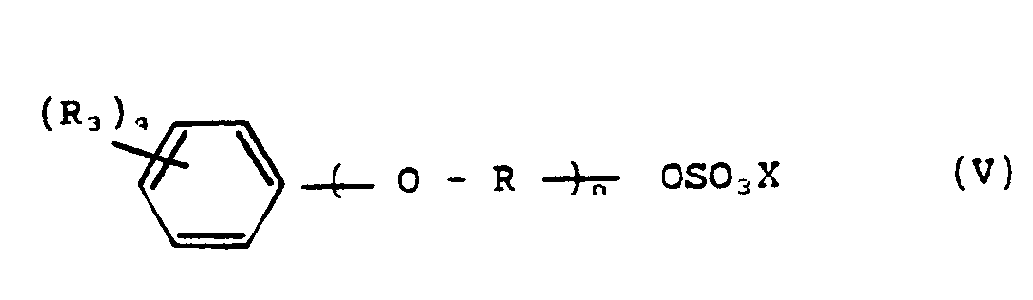

- - n est compris entre 1 et environ 12
- - q est compris entre 1 et 3
- - X est un atome d'hydrogène ou un reste d'une base minérale ou organique
- - R est un radical alcoylène ayant 2 et/ou 3 atomes de carbone
- - R4 est :
- . soit un reste X : les deux restes X (quand R4 = X) pouvant être identiques ou différents
- . soit l'un des radicaux

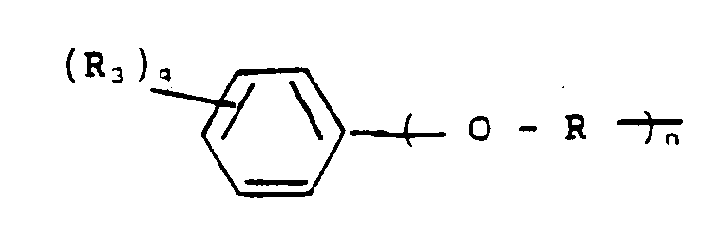
- - R3 représente un radical aliphatique linéaire ou ramifié, saturé ou insaturé contenant d'environ 6 à environ 20 atomes de carbone : les radicaux R3 pouvant être identiques ou différents
- Les agents tensio-actifs préférés répondent à l'une des formules (IV) à (VI) dans lesquelles :
- - n est compris entre 2 et 8
- - q est égal à 1
- - X est un atome d'hydrogène, un atome de sodium, de potassium, un radical ammonium, une monoétha- nolamine, une diéthanolamine, une triéthanolamine
- - R est un radical éthylène et/ou propylène
- - R3 est un radical aliphatique saturé linéaire ou ramifié ayant de 6 à 12 atomes de carbone
- - R4 est :
- . soit un reste X : les deux restes identiques étant identiques quand R4 = X
- . soit un radical


- Les dérivés polyoxyéthylénés de l'octylphénol, du nonylphénol, du dodécylphénol et du dinonylphénol sont préférés.
- Comme agents tensio-actifs, on peut faire appel à des poly-(phényl-1 alkyl)phénols polyoxyalcoylénés, aux sulfates mixtes de poly(phényl-1 alkyl)phénols polyoxyalcoylénés ou aux esters phosphoriques de poly(phényl-1 alkyl) phénols polyoxyalcoylénés répondant à l'une des formules (VII) à (IX) suivantes :

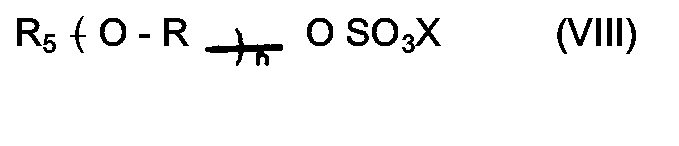

- - n est compris entre 1 et environ 12
- - X représente un atome d'hydrogène ou un reste d'une base minérale ou organique tel que défini précédemment
- - R est un radical alcoylène ayant 2 et/ou 3 atomes de carbone
- - R6 est :
- . soit un reste X : les deux restes X (quand R6 = X) pouvant être identiques ou différents
- . soit l'un des radicaux R5 (̵ O - R : les radicaux R6 et R5 (̵ O - R
 pouvant être identiques ou différents
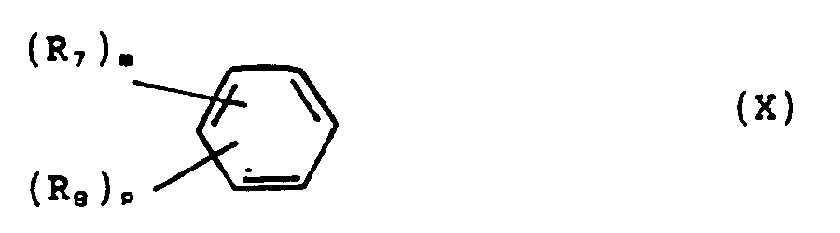
- - R5 représente l'un des radicaux symbolisés par la formule (X) :


- Les agents tensio-actif préférés répondent à l'une des formules (VII) à (IX) dans lesquelles :
- - R représente un radical éthylène et/ou propylène
- - R5 représente un radical de formule (X) dans laquelle m est un nombre égal à 2 ou 3 ; R8 est un atome d'hydrogène ; le radical R7 un radical de formule (XI)

- - R6 est :
- . soit un reste X : les deux restes X étant identiques quand R6 = X
- . soit un radical R5 (̵ O - R : les radicaux R6 et R5 (̵ O - R
 étant identiques.
- Dans ce groupe préféré d'agents tensio-actifs, conviennent tout particulièrement bien à l'invention, les agents tensio-actifs de formules (VII) à (IX) dans lesquelles :
- - n est compris entre 2 et 10
- - X est un atome d'hydrogène, un atome de sodium, de potassium, un radical ammonium, une monoétha- nolamine, une diéthanolamine, une triéthanolamine
- - R est un radical éthylène et/ou propylène
- - R5 représente un radical de formule (X) dans laquelle m est un nombre égal à 2; R8 est un atome d'hydrogène ; le radical R7 est un radical de formule (XI) :

- - R6 est :
- . soit un reste X : les deux restes X étant identiques quand R6 = X
- . soit un radical R5 (̵ O - R les radicaux R6 et R5 (̵ O - R étant identiques.
- Les agents tensio-actifs choisis préférentiellement sont les suivants :
- A-les di-(phényl-1 éthyl)phénols polyoxyéthylénés ayant de 3 à 12 moles d'oxyde d'éthylène par mole de phénol.
- B - les sulfates de di-(phényl-1 éthyl)phénols polyoxyéthylénés ayant de 3 à 12 moles d'oxyde d'éthylène par mole de phénol, sous forme acide ou neutralisée.
- C - les mono- et diesters phosphoriques de di-(phényl-1 éthyl)phénols polyoxyéthylénés ayant de 3 à 12 moles d'oxyde d'éthylène par mole de phénol, sous forme acide ou neutralisée.
- Les différents agents tensio-actifs précités sont des produits connus et disponibles dans le commerce. On peut faire appel notamment aux produits commerciaux de la Société Rhône-Poulenc :
- - les sulfates de di(phényl-1 éthyl)phénols polyoxyéthylénés vendus sous les dénominations de SOPROPHOR DSS 5 (5 O.E.), DSS 7 (7 O.E.), DSS 11 (11 O.E.) (forme acide ou neutralisée)
- - les mono- et diesters phosphoriques de di-(phényl-1 éthyl) phénols polyoxyéthylénés vendus sous les dénominations de SOPROPHOR 10 D 12/5 (5 O.E.), 10 D 12/7 (7 O.E.), 10 D 12/11 (11 O.E.) (forme acide ou neutralisée)
- Il doit être bien entendu que l'on peut utiliser les composés de formule (VII) à (IX) séparément ou en mélange. Les esters phosphoriques de formule (IX) peuvent être utilisés séparément ou plus généralement sous forme de mélanges de monoester avec le diester correspondant.
- Comme autres tensio-actifs, on peut mentionner les amides d'acides gras polyoxyalcoylénés, par exemple, de l'acide laurique ou de l'huile de coco.
- Constituent également un tensio-actif de choix, les amines d'acides gras polyoxyalcoylénés et tout particulièrement les acides gras monocarboxyliques ou dicarboxyliques saturés ou insaturés ayant 8 à 24 atomes de carbone polycondensés avec 2 à 10 moles d'oxyde d'alcoylène.
- Comme exemples d'acides gras, on peut citer l'acide laurique, l'acide myristique, l'acide palmitique, l'acide stéarique, l'acide oléique et les acides gras naturels en mélange dans les huiles de soja, de coco, de coprah ou dans les graisses, notamment le suif.
- Plus particulièrement, les dispersions préférées de trifluorure de cérium en milieu huileux de l'invention comprennent une huile minérale du type paraffinique et un tensio-actif polyoxyéthyléné dérivé d'alcool(s) gras aliphatique(s) saturé(s) linéaire(s) ou ramifié(s) ou d'une amine d'acide(s) gras synthétique(s) ou naturel(s) : le nombre de moles d'oxyde d'éthylène par mole d'alcool ou d'amine étant de préférence inférieur à 10 et encore plus préférentiellement compris entre 2 et 6.
- Pour ce qui est des proportions pondérales des différents constituants des dispersions de l'invention, elles sont généralement les suivantes :
- - de 5 à 80 % d'un ou des halogénure(s) de terre(s) rare(s)
- - de 0,1 à 12 % d'au moins un desdits agents tensio-actifs
- - de l'huile en quantité suffisante pour obtenir 100 %
- On donne, ci-après, les compositions préférées des dispersions obtenues :
- - de 20 à 60 % d'un ou des halogénure(s) de terre(s) rare(s)
- - de 2 à 8 % d'au moins un desdits agents tensio-actifs
- - de l'huile en quantité suffisante pour obtenir 100 %
- Un mode d'obtention des dispersions d'halogénures de terres rares en milieu huileux consiste à préparer une solution de l'agent tensio-actif tel que défini dans la base d'huile qui constitue le milieu de dispersion, à mettre en dispersion sous agitation, au moins un halogénure de terre rare, puis à effectuer le broyage de la dispersion et éventuellement à dégazer la dispersion obtenue.
- La préparation du milieu de dispersion ne présente aucune difficulté. Elle s'effectue sous agitation, par des moyens classiques d'agitation (agitation à ancre, à hélice ou à turbine).
- La mise en dispersion de l'halogénure de terre rare s'effectue sous agitation.
- L'opération de broyage est poursuivie jusqu'à obtention d'une finesse moyenne de 4 µm environ. Il est préférable qu'aucune particule ne dépasse 50 f..lm.
- Le broyage de la dispersion peut se faire dans un broyeur à billes vertical ou horizontal.
- L'opération de dégazage est conduite en maintenant la dispersion sous faible agitation.
- Il est également possible d'ajouter, soit au cours du broyage, soit lors du dégazage, d'éventuels additifs requis dans l'application envisagée, parexemple, des modificateurs d'indice de viscosité (épaississants ou fluidifiants), des inhibiteurs d'oxydation, des inhibiteurs de corrosion.
- Conformément à l'invention, on obtient des dispersions d'halogénures de terres rares en milieu huileux présentant les propriétés suivantes :
- - une très bonne stabilité au stockage,
- - une teneur élevée en halogénure de terre rare,
- - une viscosité faible.
- Les dispersions d'halogénures de terres rares en milieu huileux sont utilisables dans toutes les applications où l'on fait appel à de telles dispersions, en particulier, dans le domaine de la lubrification et de la corrosion.
- En particulier, les dispersions de fluorures de terres rares en milieu huileux peuvent être incorporées dans la phase huileuse des formulations classiques de lubrification sous forme liquide, graisseuse ou pâteuse.
- Les exemples suivants sont donnés à titre indicatif et ne peuvent être considérés comme une limite du domaine et de l'esprit de l'invention.
- Dans les exemples 1 à 9, on effectue la préparation de dispersion de trifluorure de cérium en milieu huileux : le trifluorure de cérium présentant un diamètre moyen d'agrégats de 0,3 f..lm.
- Dans tous les exemples, on suit le même protocole opératoire tel que défini ci-après.
- On prépare d'abord le milieu de dispersion, en dissolvant 101 g de l'agent tensio-actif défini dans les différents exemples, dans 1000 g d'une huile PRIMOL 352, qui est une huile minérale dite paraffinique contenant 70 % d'hydrocarbures paraffiniques et 30 % d'hydrocarbures naphténiques (% en carbone).
- On ajoute 664 g de trifluorure de cérium sous agitation au moyen d'une turbine ULTRA-TURAX tournant à 1500 tours/minute.
- L'agitation est maintenue pendant environ 3 mn pour obtenir un mélange homogène.
- On obtient ainsi une prédispersion qui est ensuite broyée dans un "Mini Motor Mill" commercialisé par EIGER ENGINEERING Ltd ; la chambre de broyage est remplie par 59 g de billes de verre de 1 mm de diamètre, la rotation étant de 4000 tours/mn. Le broyage est effectué pendant environ 4 mn.
- Les propriétés de stabilité de ladite dispersion sont appréciées en soumettant celle-ci à un test de vieillissement accéléré, qui consiste à chauffer la dispersion dans une étuve à 40°C, pendant 1 semaine.
- On apprécie la stabilité de la dispersion obtenue après stockage, en déterminant le pourcentage de surnageant huileux sur la dispersion, ledit phénomène étant appelé "synérèse".
- Dans les exemples 1 à 9, on suit le même protocole opératoire que décrit précédemment, en mettant en oeuvre les agents tensio-actifs suivants :
- - exemple 1 : amine d'acide oléique polyoxyéthyléné ayant 2 moles d'oxyde d'éthylène par mole d'amine (SOPROMINE 0 12)
- - exemple 2 : coupe d'alcools primaires linéaires en C12-C14 polyoxyéthylénés ayant 4 moles d'oxyde d'éthylène par mole d'alcool (SOPROPHOR LA 40)
- - exemple 3 : ester phosphorique acide d'alcool OXO "tridécanol" polyoxyéthyléné ayant 3,2 moles d'oxyde d'éthylène par mole d'alcool (SOPROPHOR MB)
- - exemple 4 : ester phosphorique acide de nonylphénol polyoxyéthyléné ayant 6 moles d'oxyde d'éthylène par mole de phénol (SOPROPHOR PA 15)
- - exemple 5 : alcool oxo "tridécanol" polyoxyéthyléné ayant 3,2 moles d'oxyde d'éthylène par mole d'alcool (SOPROPHOR 840)
- - exemple 6: nonylphénol polyoxyéthyléné ayant4 moles d'oxyde d'éthylène par mole de phénol (SOPROPHOR BC 4)
- - exemple 7 : alcool oxo "tridécanol" polyoxyéthyléné et polyoxypropyléné contenant 1,5 moles d'oxyde de propylène et 2,5 moles d'oxyde d'éthylène par mole d'alcool (SOPROPHOR OX 135)
- - exemple 8 : alcool oxo "tridécanol" polyoxyéthyléné contenant 6 moles d'oxyde d'éthylène par mole d'alcool (SOPROPHOR 860 P)
- - exemple 9: nonylphénolpolyoxyéthyléné ayant 2 moles d'oxyde d'éthylène par mole de phénol (SOPROPHOR BC 2)
- Les résultats obtenus sont consignés dans le tableau suivant :

Claims (34)




Priority Applications (1)
| Application Number | Priority Date | Filing Date | Title |
|---|---|---|---|
| AT89402850T ATE78511T1 (de) | 1988-10-21 | 1989-10-16 | Dispersionen von halogeniden seltener erder in oel. |
Applications Claiming Priority (2)
| Application Number | Priority Date | Filing Date | Title |
|---|---|---|---|
| FR8813796 | 1988-10-21 | ||
| FR8813796A FR2638168A1 (fr) | 1988-10-21 | 1988-10-21 | Dispersions d'halogenures de terres rares en milieu huileux |
Publications (2)
| Publication Number | Publication Date |
|---|---|
| EP0365413A1 EP0365413A1 (fr) | 1990-04-25 |
| EP0365413B1 true EP0365413B1 (fr) | 1992-07-22 |
Family
ID=9371183
Family Applications (1)
| Application Number | Title | Priority Date | Filing Date |
|---|---|---|---|
| EP89402850A Expired - Lifetime EP0365413B1 (fr) | 1988-10-21 | 1989-10-16 | Dispersions d'halogenures de terres rares en milieu huileux |
Country Status (13)
| Country | Link |
|---|---|
| US (1) | US4946608A (fr) |
| EP (1) | EP0365413B1 (fr) |
| JP (1) | JPH02158691A (fr) |
| KR (1) | KR920009631B1 (fr) |
| AT (1) | ATE78511T1 (fr) |
| AU (1) | AU613803B2 (fr) |
| BR (1) | BR8905339A (fr) |
| DE (1) | DE68902215T2 (fr) |
| FI (1) | FI895009A7 (fr) |
| FR (1) | FR2638168A1 (fr) |
| GR (1) | GR3005885T3 (fr) |
| NO (1) | NO894162L (fr) |
| ZA (1) | ZA897961B (fr) |
Families Citing this family (11)
| Publication number | Priority date | Publication date | Assignee | Title |
|---|---|---|---|---|
| BR9306999A (pt) * | 1992-09-04 | 1999-01-12 | Henkel Corp | Aditivo de lubrificante adequado para combinação com uma mistura de revestimento de papel ou papelão composição de revestimento de papel ou paprelão e processo para aplicar uma composição de revestimento a base de água a uma tela de papel ou papelão |
| US20050203068A1 (en) * | 2002-04-08 | 2005-09-15 | Peggy Wingard | Pharmaceutical compositions containing water-soluble prodrugs of propofol and methods of administering same |
| AU2003901149A0 (en) * | 2003-03-13 | 2003-03-27 | Monash University School Of Physics And Materials Engineering | Rare earth - organic corrosion inhibiting coatings |
| US20060046940A1 (en) * | 2004-08-27 | 2006-03-02 | Mohannad Almalki | Aqueous conveyor and cutting lubricant |
| EP1963417A1 (fr) * | 2005-12-15 | 2008-09-03 | Cabot Corporation | Composites polymeres transparents |
| US7470974B2 (en) * | 2006-07-14 | 2008-12-30 | Cabot Corporation | Substantially transparent material for use with light-emitting device |
| WO2008094812A2 (fr) * | 2007-01-29 | 2008-08-07 | The Lubrizol Corporation | Compositions de lubrification |
| JP5278732B2 (ja) * | 2008-06-10 | 2013-09-04 | 日立化成株式会社 | 希土類磁石用処理液及びそれを用いた希土類磁石 |
| JP2011051851A (ja) * | 2009-09-03 | 2011-03-17 | Hitachi Chem Co Ltd | 希土類フッ化物微粒子分散液、この分散液の製造方法、この分散液を用いた希土類フッ化物薄膜の製造方法、この分散液を用いた高分子化合物/希土類フッ化物複合フィルムの製造方法、及び、この分散液を用いた希土類焼結磁石 |
| KR102500507B1 (ko) | 2018-02-07 | 2023-02-16 | 에네오스 가부시키가이샤 | 냉동기유 및 냉동기용 작동 유체 조성물 |
| KR102516452B1 (ko) | 2018-02-07 | 2023-03-31 | 에네오스 가부시키가이샤 | 냉동기유 및 냉동기용 작동 유체 조성물 |
Family Cites Families (15)
| Publication number | Priority date | Publication date | Assignee | Title |
|---|---|---|---|---|
| US3117929A (en) * | 1958-08-08 | 1964-01-14 | Texaco Inc | Transparent dispersion lubricants |
| DE1594511A1 (de) * | 1966-01-21 | 1970-12-17 | Dow Corning Gmbh | Gesenkschmierstoffe |
| BE791231Q (fr) * | 1968-11-04 | 1973-03-01 | Continental Oil Co | Agents de dispersion des huiles repandues |
| US3830280A (en) * | 1971-01-25 | 1974-08-20 | Mallory & Co Inc P R | Rare earth flouride lubricant for die casting components |
| US4034133A (en) * | 1973-05-14 | 1977-07-05 | International Business Machines Corporation | Magnetic recording medium with lubricant |
| DE2932687A1 (de) * | 1979-08-11 | 1981-02-26 | Bayer Ag | Emulgatorsystem und seine verwendung als entschaeumungs- und schaumverhuetungsmittel |
| DE2934951A1 (de) * | 1979-08-29 | 1981-04-02 | Bayer Ag, 5090 Leverkusen | Waessrige dispersionen von epoxidverbindungen |
| DE3163160D1 (en) * | 1980-05-08 | 1984-05-24 | Exxon Research Engineering Co | Lubricating oil composition containing sediment-reducing additive |
| EP0043963A1 (fr) * | 1980-06-30 | 1982-01-20 | Union Carbide Corporation | Procédé d'éthoxylation d'alcools primaires de poids moléculaires très variés |
| DE3240309A1 (de) * | 1982-10-30 | 1984-05-03 | Bayer Ag, 5090 Leverkusen | Verwendung von aralkyl-polyalkylen-glykolethern zur herstellung von waessrigen kohle-aufschlaemmungen |
| US4507214A (en) * | 1983-11-02 | 1985-03-26 | Union Oil Company Of California | Rare earth halide grease compositions |
| CH668265A5 (de) * | 1985-09-09 | 1988-12-15 | Lonza Ag | Verfahren zur herstellung von schmierwirkstoffen in pulvriger bis pastoeser form. |
| CH665847A5 (de) * | 1985-10-02 | 1988-06-15 | Lonza Ag | Verfahren zum suspendieren von festschmierstoffen. |
| US4715972A (en) * | 1986-04-16 | 1987-12-29 | Pacholke Paula J | Solid lubricant additive for gear oils |
| GB2193224A (en) * | 1986-05-27 | 1988-02-03 | Grace W R & Co | Fuel oil additives |
-
1988
- 1988-10-21 FR FR8813796A patent/FR2638168A1/fr active Pending
-
1989
- 1989-10-16 DE DE8989402850T patent/DE68902215T2/de not_active Expired - Fee Related
- 1989-10-16 AT AT89402850T patent/ATE78511T1/de not_active IP Right Cessation
- 1989-10-16 EP EP89402850A patent/EP0365413B1/fr not_active Expired - Lifetime
- 1989-10-17 JP JP1268282A patent/JPH02158691A/ja active Pending
- 1989-10-19 NO NO89894162A patent/NO894162L/no unknown
- 1989-10-19 AU AU43565/89A patent/AU613803B2/en not_active Ceased
- 1989-10-20 ZA ZA897961A patent/ZA897961B/xx unknown
- 1989-10-20 FI FI895009A patent/FI895009A7/fi not_active IP Right Cessation
- 1989-10-20 KR KR1019890015127A patent/KR920009631B1/ko not_active Expired
- 1989-10-20 BR BR898905339A patent/BR8905339A/pt unknown
- 1989-10-23 US US07/425,236 patent/US4946608A/en not_active Expired - Fee Related
-
1992
- 1992-10-05 GR GR920402216T patent/GR3005885T3/el unknown
Also Published As
| Publication number | Publication date |
|---|---|
| AU4356589A (en) | 1990-04-26 |
| JPH02158691A (ja) | 1990-06-19 |
| FR2638168A1 (fr) | 1990-04-27 |
| GR3005885T3 (fr) | 1993-06-07 |
| BR8905339A (pt) | 1990-05-22 |
| ZA897961B (en) | 1990-07-25 |
| KR920009631B1 (ko) | 1992-10-22 |
| KR900006495A (ko) | 1990-05-08 |
| AU613803B2 (en) | 1991-08-08 |
| NO894162D0 (no) | 1989-10-19 |
| NO894162L (no) | 1990-04-23 |
| EP0365413A1 (fr) | 1990-04-25 |
| US4946608A (en) | 1990-08-07 |
| DE68902215D1 (de) | 1992-08-27 |
| DE68902215T2 (de) | 1993-01-14 |
| FI895009A7 (fi) | 1990-04-22 |
| ATE78511T1 (de) | 1992-08-15 |
| FI895009A0 (fi) | 1989-10-20 |
Similar Documents
| Publication | Publication Date | Title |
|---|---|---|
| EP2652099B1 (fr) | Composition de graisse | |
| EP0034132B1 (fr) | Procédé pour le travail mécanique des métaux et concentrat de lubrifiant | |
| EP0365413A1 (fr) | Dispersions d'halogenures de terres rares en milieu huileux | |
| EP2652100B1 (fr) | Composition de graisse | |
| EP0164286B1 (fr) | Procédé de préparation d'additifs détergents-dispersants pour huiles lubrifiantes à base d'alkylarylsulfonates de métaux alcalino-terreux ne moussant pas | |
| FR2547311A1 (fr) | Composition a base d'huile pour le travail des metaux, contenant au moins un sel d'acide phosphore et d'une amine | |
| EP0332172B1 (fr) | Agent dispersant pour systèmes non aqueux et dispersion non aqueuse le contenant | |
| EP0115708A2 (fr) | Lubrifiant aqueux gélifié substantiellement neutre | |
| FR2547312A1 (fr) | Composition lubrifiante pour le travail des metaux, a base de polyether-polyol contenant des fonctions azotees | |
| KR20220089673A (ko) | 금속-가공 유체 조성물 및 제조 방법 | |
| KR20050055783A (ko) | 저점도 중합체 분산액 및 이의 제조방법 | |
| EP0102254B1 (fr) | Nouvel additif détergent-dispersant suralcalinisé pour huiles lubrifiantes | |
| EP0141758A1 (fr) | Compositions lubrifiantes contenant des additifs solides | |
| JPH06179888A (ja) | アルミニウム及びアルミニウム合金の冷間圧延油及びそれを用いる冷間圧延方法 | |
| JPH05202377A (ja) | 非イオン性フルオロケミカルポリマを含む潤滑剤用添加剤塑性物およびその使用方法 | |
| WO2002090473A1 (fr) | Graisse lubrifiante, sa preparation et son utilisation, notamment pour la lubrification des contacts faisant intervenir des elastomeres | |
| US4218331A (en) | Extreme pressure lubricating compositions | |
| EP0364328B1 (fr) | Dispersions d'halogénures de terres rares en milieu aqueux | |
| EP4496851A1 (fr) | Emulsion concentrée d'antimousse silicone | |
| EP0931126A1 (fr) | Utilisation de surfactants de bas poids moleculaires comme agents ameliorant la filtrabilite dans des lubrifiants hydrauliques | |
| WO1999060002A1 (fr) | Compositions d'orthophosphates soufres, leur preparation et leur utilisation | |
| WO2017102726A1 (fr) | Esters de phosphate alcoxylés pour compositions lubrifiantes | |
| WO1992007053A1 (fr) | Fluide pour usinage de metal | |
| EP0620249A1 (fr) | Emulsion de silicone | |
| US2675357A (en) | Flushing compositions |
Legal Events
| Date | Code | Title | Description |
|---|---|---|---|
| PUAI | Public reference made under article 153(3) epc to a published international application that has entered the european phase |
Free format text: ORIGINAL CODE: 0009012 |
|
| AK | Designated contracting states |
Kind code of ref document: A1 Designated state(s): AT BE CH DE ES FR GB GR IT LI LU NL SE |
|
| 17P | Request for examination filed |
Effective date: 19900703 |
|
| 17Q | First examination report despatched |
Effective date: 19910308 |
|
| ITF | It: translation for a ep patent filed | ||
| GRAA | (expected) grant |
Free format text: ORIGINAL CODE: 0009210 |
|
| AK | Designated contracting states |
Kind code of ref document: B1 Designated state(s): AT BE CH DE ES FR GB GR IT LI LU NL SE |
|
| REF | Corresponds to: |
Ref document number: 78511 Country of ref document: AT Date of ref document: 19920815 Kind code of ref document: T |
|
| REF | Corresponds to: |
Ref document number: 68902215 Country of ref document: DE Date of ref document: 19920827 |
|
| GBT | Gb: translation of ep patent filed (gb section 77(6)(a)/1977) | ||
| PGFP | Annual fee paid to national office [announced via postgrant information from national office to epo] |
Ref country code: FR Payment date: 19920923 Year of fee payment: 4 |
|
| PGFP | Annual fee paid to national office [announced via postgrant information from national office to epo] |
Ref country code: BE Payment date: 19921013 Year of fee payment: 4 |
|
| PGFP | Annual fee paid to national office [announced via postgrant information from national office to epo] |
Ref country code: GR Payment date: 19921016 Year of fee payment: 4 |
|
| PGFP | Annual fee paid to national office [announced via postgrant information from national office to epo] |
Ref country code: ES Payment date: 19921019 Year of fee payment: 4 |
|
| PGFP | Annual fee paid to national office [announced via postgrant information from national office to epo] |
Ref country code: SE Payment date: 19921020 Year of fee payment: 4 |
|
| PGFP | Annual fee paid to national office [announced via postgrant information from national office to epo] |
Ref country code: AT Payment date: 19921028 Year of fee payment: 4 |
|
| PGFP | Annual fee paid to national office [announced via postgrant information from national office to epo] |
Ref country code: CH Payment date: 19921030 Year of fee payment: 4 |
|
| PGFP | Annual fee paid to national office [announced via postgrant information from national office to epo] |
Ref country code: NL Payment date: 19921031 Year of fee payment: 4 |
|
| PGFP | Annual fee paid to national office [announced via postgrant information from national office to epo] |
Ref country code: LU Payment date: 19921103 Year of fee payment: 4 |
|
| PGFP | Annual fee paid to national office [announced via postgrant information from national office to epo] |
Ref country code: DE Payment date: 19921110 Year of fee payment: 4 |
|
| PG25 | Lapsed in a contracting state [announced via postgrant information from national office to epo] |
Ref country code: ES Free format text: LAPSE BECAUSE OF THE APPLICANT RENOUNCES Effective date: 19930105 |
|
| EPTA | Lu: last paid annual fee | ||
| REG | Reference to a national code |
Ref country code: GR Ref legal event code: FG4A Free format text: 3005885 |
|
| PLBE | No opposition filed within time limit |
Free format text: ORIGINAL CODE: 0009261 |
|
| STAA | Information on the status of an ep patent application or granted ep patent |
Free format text: STATUS: NO OPPOSITION FILED WITHIN TIME LIMIT |
|
| 26N | No opposition filed | ||
| PG25 | Lapsed in a contracting state [announced via postgrant information from national office to epo] |
Ref country code: LU Free format text: LAPSE BECAUSE OF NON-PAYMENT OF DUE FEES Effective date: 19931016 Ref country code: GB Effective date: 19931016 Ref country code: AT Effective date: 19931016 |
|
| PG25 | Lapsed in a contracting state [announced via postgrant information from national office to epo] |
Ref country code: SE Effective date: 19931017 |
|
| PG25 | Lapsed in a contracting state [announced via postgrant information from national office to epo] |
Ref country code: LI Effective date: 19931031 Ref country code: CH Effective date: 19931031 Ref country code: BE Effective date: 19931031 |
|
| BERE | Be: lapsed |
Owner name: RHONE-POULENC CHIMIE Effective date: 19931031 |
|
| PG25 | Lapsed in a contracting state [announced via postgrant information from national office to epo] |
Ref country code: GR Free format text: THE PATENT HAS BEEN ANNULLED BY A DECISION OF A NATIONAL AUTHORITY Effective date: 19940430 |
|
| PG25 | Lapsed in a contracting state [announced via postgrant information from national office to epo] |
Ref country code: NL Effective date: 19940501 |
|
| GBPC | Gb: european patent ceased through non-payment of renewal fee |
Effective date: 19931016 |
|
| NLV4 | Nl: lapsed or anulled due to non-payment of the annual fee | ||
| PG25 | Lapsed in a contracting state [announced via postgrant information from national office to epo] |
Ref country code: FR Effective date: 19940630 |
|
| REG | Reference to a national code |
Ref country code: CH Ref legal event code: PL |
|
| PG25 | Lapsed in a contracting state [announced via postgrant information from national office to epo] |
Ref country code: DE Effective date: 19940701 |
|
| REG | Reference to a national code |
Ref country code: FR Ref legal event code: ST |
|
| REG | Reference to a national code |
Ref country code: GR Ref legal event code: MM2A Free format text: 3005885 |
|
| EUG | Se: european patent has lapsed |
Ref document number: 89402850.5 Effective date: 19940510 |
|
| PG25 | Lapsed in a contracting state [announced via postgrant information from national office to epo] |
Ref country code: IT Free format text: LAPSE BECAUSE OF NON-PAYMENT OF DUE FEES;WARNING: LAPSES OF ITALIAN PATENTS WITH EFFECTIVE DATE BEFORE 2007 MAY HAVE OCCURRED AT ANY TIME BEFORE 2007. THE CORRECT EFFECTIVE DATE MAY BE DIFFERENT FROM THE ONE RECORDED. Effective date: 20051016 |