EP0365719A2 - Verfahren zur Herstellung von dotiertem Material, bestehend aus Barium oder Strontium und Eisen - Google Patents
Verfahren zur Herstellung von dotiertem Material, bestehend aus Barium oder Strontium und Eisen Download PDFInfo
- Publication number
- EP0365719A2 EP0365719A2 EP88309989A EP88309989A EP0365719A2 EP 0365719 A2 EP0365719 A2 EP 0365719A2 EP 88309989 A EP88309989 A EP 88309989A EP 88309989 A EP88309989 A EP 88309989A EP 0365719 A2 EP0365719 A2 EP 0365719A2
- Authority
- EP
- European Patent Office
- Prior art keywords
- halide
- particles
- barium
- doped
- fe3o4
- Prior art date
- Legal status (The legal status is an assumption and is not a legal conclusion. Google has not performed a legal analysis and makes no representation as to the accuracy of the status listed.)
- Withdrawn
Links
Images
Classifications
-
- B—PERFORMING OPERATIONS; TRANSPORTING
- B82—NANOTECHNOLOGY
- B82Y—SPECIFIC USES OR APPLICATIONS OF NANOSTRUCTURES; MEASUREMENT OR ANALYSIS OF NANOSTRUCTURES; MANUFACTURE OR TREATMENT OF NANOSTRUCTURES
- B82Y30/00—Nanotechnology for materials or surface science, e.g. nanocomposites
-
- C—CHEMISTRY; METALLURGY
- C01—INORGANIC CHEMISTRY
- C01G—COMPOUNDS CONTAINING METALS NOT COVERED BY SUBCLASSES C01D OR C01F
- C01G1/00—Methods of preparing compounds of metals not covered by subclasses C01B, C01C, C01D, or C01F, in general
- C01G1/02—Oxides
-
- C—CHEMISTRY; METALLURGY
- C01—INORGANIC CHEMISTRY
- C01G—COMPOUNDS CONTAINING METALS NOT COVERED BY SUBCLASSES C01D OR C01F
- C01G49/00—Compounds of iron
- C01G49/0018—Mixed oxides or hydroxides
-
- C—CHEMISTRY; METALLURGY
- C01—INORGANIC CHEMISTRY
- C01G—COMPOUNDS CONTAINING METALS NOT COVERED BY SUBCLASSES C01D OR C01F
- C01G49/00—Compounds of iron
- C01G49/0018—Mixed oxides or hydroxides
- C01G49/0036—Mixed oxides or hydroxides containing one alkaline earth metal, magnesium or lead
-
- C—CHEMISTRY; METALLURGY
- C01—INORGANIC CHEMISTRY
- C01G—COMPOUNDS CONTAINING METALS NOT COVERED BY SUBCLASSES C01D OR C01F
- C01G49/00—Compounds of iron
- C01G49/009—Compounds containing iron, with or without oxygen or hydrogen, and containing two or more other elements
-
- C—CHEMISTRY; METALLURGY
- C01—INORGANIC CHEMISTRY
- C01G—COMPOUNDS CONTAINING METALS NOT COVERED BY SUBCLASSES C01D OR C01F
- C01G51/00—Compounds of cobalt
- C01G51/80—Compounds containing cobalt, with or without oxygen or hydrogen, and containing one or more other elements
- C01G51/82—Compounds containing cobalt, with or without oxygen or hydrogen, and containing two or more other elements
-
- C—CHEMISTRY; METALLURGY
- C01—INORGANIC CHEMISTRY
- C01G—COMPOUNDS CONTAINING METALS NOT COVERED BY SUBCLASSES C01D OR C01F
- C01G53/00—Compounds of nickel
- C01G53/80—Compounds containing nickel, with or without oxygen or hydrogen, and containing one or more other elements
- C01G53/82—Compounds containing nickel, with or without oxygen or hydrogen, and containing two or more other elements
-
- C—CHEMISTRY; METALLURGY
- C04—CEMENTS; CONCRETE; ARTIFICIAL STONE; CERAMICS; REFRACTORIES
- C04B—LIME, MAGNESIA; SLAG; CEMENTS; COMPOSITIONS THEREOF, e.g. MORTARS, CONCRETE OR LIKE BUILDING MATERIALS; ARTIFICIAL STONE; CERAMICS; REFRACTORIES; TREATMENT OF NATURAL STONE
- C04B35/00—Shaped ceramic products characterised by their composition; Ceramics compositions; Processing powders of inorganic compounds preparatory to the manufacturing of ceramic products
- C04B35/01—Shaped ceramic products characterised by their composition; Ceramics compositions; Processing powders of inorganic compounds preparatory to the manufacturing of ceramic products based on oxide ceramics
- C04B35/26—Shaped ceramic products characterised by their composition; Ceramics compositions; Processing powders of inorganic compounds preparatory to the manufacturing of ceramic products based on oxide ceramics based on ferrites
- C04B35/265—Compositions containing one or more ferrites of the group comprising manganese or zinc and one or more ferrites of the group comprising nickel, copper or cobalt
-
- G—PHYSICS
- G11—INFORMATION STORAGE
- G11B—INFORMATION STORAGE BASED ON RELATIVE MOVEMENT BETWEEN RECORD CARRIER AND TRANSDUCER
- G11B5/00—Recording by magnetisation or demagnetisation of a record carrier; Reproducing by magnetic means; Record carriers therefor
- G11B5/62—Record carriers characterised by the selection of the material
- G11B5/68—Record carriers characterised by the selection of the material comprising one or more layers of magnetisable material homogeneously mixed with a bonding agent
- G11B5/70—Record carriers characterised by the selection of the material comprising one or more layers of magnetisable material homogeneously mixed with a bonding agent on a base layer
- G11B5/706—Record carriers characterised by the selection of the material comprising one or more layers of magnetisable material homogeneously mixed with a bonding agent on a base layer characterised by the composition of the magnetic material
- G11B5/70626—Record carriers characterised by the selection of the material comprising one or more layers of magnetisable material homogeneously mixed with a bonding agent on a base layer characterised by the composition of the magnetic material containing non-metallic substances
- G11B5/70642—Record carriers characterised by the selection of the material comprising one or more layers of magnetisable material homogeneously mixed with a bonding agent on a base layer characterised by the composition of the magnetic material containing non-metallic substances iron oxides
- G11B5/70678—Ferrites
-
- C—CHEMISTRY; METALLURGY
- C01—INORGANIC CHEMISTRY
- C01P—INDEXING SCHEME RELATING TO STRUCTURAL AND PHYSICAL ASPECTS OF SOLID INORGANIC COMPOUNDS
- C01P2002/00—Crystal-structural characteristics
- C01P2002/50—Solid solutions
- C01P2002/52—Solid solutions containing elements as dopants
- C01P2002/54—Solid solutions containing elements as dopants one element only
-
- C—CHEMISTRY; METALLURGY
- C01—INORGANIC CHEMISTRY
- C01P—INDEXING SCHEME RELATING TO STRUCTURAL AND PHYSICAL ASPECTS OF SOLID INORGANIC COMPOUNDS
- C01P2004/00—Particle morphology
- C01P2004/54—Particles characterised by their aspect ratio, i.e. the ratio of sizes in the longest to the shortest dimension
-
- C—CHEMISTRY; METALLURGY
- C01—INORGANIC CHEMISTRY
- C01P—INDEXING SCHEME RELATING TO STRUCTURAL AND PHYSICAL ASPECTS OF SOLID INORGANIC COMPOUNDS
- C01P2004/00—Particle morphology
- C01P2004/60—Particles characterised by their size
- C01P2004/62—Submicrometer sized, i.e. from 0.1-1 micrometer
-
- C—CHEMISTRY; METALLURGY
- C01—INORGANIC CHEMISTRY
- C01P—INDEXING SCHEME RELATING TO STRUCTURAL AND PHYSICAL ASPECTS OF SOLID INORGANIC COMPOUNDS
- C01P2004/00—Particle morphology
- C01P2004/60—Particles characterised by their size
- C01P2004/64—Nanometer sized, i.e. from 1-100 nanometer
-
- C—CHEMISTRY; METALLURGY
- C01—INORGANIC CHEMISTRY
- C01P—INDEXING SCHEME RELATING TO STRUCTURAL AND PHYSICAL ASPECTS OF SOLID INORGANIC COMPOUNDS
- C01P2006/00—Physical properties of inorganic compounds
- C01P2006/12—Surface area
-
- C—CHEMISTRY; METALLURGY
- C01—INORGANIC CHEMISTRY
- C01P—INDEXING SCHEME RELATING TO STRUCTURAL AND PHYSICAL ASPECTS OF SOLID INORGANIC COMPOUNDS
- C01P2006/00—Physical properties of inorganic compounds
- C01P2006/42—Magnetic properties
-
- C—CHEMISTRY; METALLURGY
- C01—INORGANIC CHEMISTRY
- C01P—INDEXING SCHEME RELATING TO STRUCTURAL AND PHYSICAL ASPECTS OF SOLID INORGANIC COMPOUNDS
- C01P2006/00—Physical properties of inorganic compounds
- C01P2006/80—Compositional purity
Definitions
- the particle size distribution should be as narrow as possible to obtain good uniform dispersibility on the recording substrate. If the particles sizes vary over a wide range, the resulting dispersed film of particles on the recording substrate will be uneven. It would be particularly advantageous that at least 95 percent of all of the particles, particularly at least 99%, be in a range from about 0.01 to about 0.2 micrometre.
- Acceptable remanence magnetization (B r ) values of the particles are generally in the range from about 18-40 emu/g in a magnetic field of 10K Oe (800 KA/m). If the B r values of the particles are too low, the signal output of the resulting media may not be strong enough for recording purposes.
- the coercive force of the hexaferrite particles in the magnetic recording media should be in the range from about 200 to about 1500 Oe. For most high density recording applications, this range is suitable in the range from about 400 to about 1100 Oe. It is known that the partial replacement of iron atoms in the ferrite crystalline structure with selected dopants will lower the coercive force from unacceptably high levels (e.g., about 3000 Oe or higher) to these desired levels. However, the use of these dopants in too large quantities may also lower the specific magnetization levels to below the above-noted acceptable levels.
- This process is relatively expensive to run because of the need for large amounts of glass-forming chemicals, the high temperatures used for making the glass melt and the need for special equipment and materials of construction (e.g. platinum). Furthermore, this process requires the extensive handling and recycling of large amounts of glass-forming compounds. Still further, the reaction of the acid with the glassy substance in the acid washing step may result in a residue in the hexaferrite particles, which may interfere with other constituents in the end products (e.g. polyethylene binders).
- the particles produced from the autoclave reactor generally have undesirably low specific magnetization ( ⁇ s ) values (e.g. 30-45 emu/g on a magnetic field of 10K Oe (800 KA/m)).
- ⁇ s specific magnetization
- these particles require further processing (e.g. calcination and milling). This further processing increases the cost of making the particles and the milling may be harmful to the particle crystals for the reasons stated above.
- the process of this invention for making hexaferrite particles involves the production of certain doped coprecipitates of magnetite and barium and/or strontium carbonate.
- Co-precipitated magnetite/barium carbonate mixtures are known to be useful in the production of barium ferrite powder, the latter in turn being useful in making composite plastic-ferrite magnets. See for example U.S. Patent Specification US-A-4,120,807.
- the co-precipitated mixture is prepared by mixing a solution of FeCl2 and BaCl2 containing equimolar Fe2+ and Ba2+ ions with a solution of equimolarly mixed alkalis such as NaOH or KOH and Na2CO3. Air is then bubbled into the mixed solution, which is maintained in agitation and at a specified range of temperature and pH.
- such a co-precipitate containing, as first dopant, cobalt, zinc and/or nickel and, as second dopant, titanium and/or ruthenium is prepared by reacting together, in an aqueous medium containing effective amounts of ions of the two dopants, a ferric halide, a ferous halide, a barium or strontium halide and an alkali metal carbonate.
- the halogen in all the halides is preferably chlorine and the alkali metal carbonate is preferably sodium or potassium carbonate.
- the invention also provides a doped magnetite/barium carbonate composition having the molecular formula: BaCO3 ⁇ (4- 7y 6 )Fe3O4 ⁇ ( 3y 2 )FeO ⁇ yTiO2 ⁇ yCoO in which y is from 0.4 to 1.0, and preferably from 0.7 to 0.9, which can be obtained by the process of the embodiment of the invention set forth above.
- This novel composition is a highly useful intermediate material in making doped barium or strontium ferrite particles having excellent properties or attributes for use in the production of high quality magnetic recording tapes.
- Magnetite is sometimes referred to in the art as a combination of FeO and Fe2O3. Accordingly, as used throughout the present specification and claims, the term “magnetite” and the formula "Fe3O4" include the FeO/Fe2O3 combination.
- chloride bromide, iodide or fluoride, including their hydrates.
- chlorides and bromides are especially preferred, particularly the chlorides.
- Barium chloride is preferred to strontium chloride, and the preferred dopants are cobalt chloride (CoCl2) and titanium trichloride (TiCl3).
- An alkali metal hydroxide is also preferably included in the reaction mixture. Sodium and potassium hydroxides are preferred.
- an aqueous solution can be prepared containing the desired proportions of ferric compound, ferrous compound, barium or strontium compound and the dopant compounds. Then the required amount of the alkali metal carbonate (and alkali metal hydroxide, if used) is added to the solution.
- an aqueous solution of the alkali metal carbonate, and optionally the alkali metal hydroxide is prepared separately and then this is mixed with the iron-dopant solution.
- the co-precipitation reaction is preferably carried out at a temperature within the range of about 40°C to about 120°C, especially 60-110°C, particularly 75-105°C. It is also preferable to maintain the reaction mixture at a pH above about 10, especially 10.5 to 13.5.
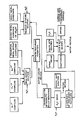
- the present invention encompasses a multi-step process. This process will be described in detail below in terms of the especially preferred embodiment, namely making cobalt- and titanium-doped barium hexaferrite particles of the formula BaFe 12-r-s Co r Ti s O19. Of course, other hexaferrite compositions of the present invention may be carried out following this example.
- This multi-step process preferably starts with separately forming an aqueous iron-dopant solution and an aqueous alkaline solution.
- the aqueous iron-dopant solution is formed by mixing a ferric compound (e.g., FeCl3), a ferrous compound (e.g., FeCl2), a barium compound (e.g., BaCl2) and the above-noted metal dopant compounds in water.
- a ferric compound e.g., FeCl3
- a ferrous compound e.g., FeCl2
- a barium compound e.g., BaCl2
- each component when making BaFe 10.2 Co 0.9 Ti 0.9 O19 in this solution is as follows: Component Preferred Range Particularly Preferred Range BaCl2 0.21-3.34% 0.47-2.29% FeCl2 0.43-6.90 0.97-4.75 FeCl3 1.10-17.67 2.48-12.15 CoCl2 0.12-1.87 0.26-1.29 TiCl3 0.14-2.22 0.31-1.53 Water 98-68 95.5-78
- r and s are preferably equal and in the range 0.6 to 1.0.
- Nickel or zinc compounds may be substituted for cobalt components when cobalt is not readily available. Ruthenium has been found to provide equivalent results to titanium dopants, but at lower dopant concentrations.
- the aqueous alkaline solution is preferably made by adding to water an alkali metal carbonate, either alone or in combination with an alkali metal hydroxide.
- the especially preferred alkali metal cation for both the carbonate and the hydroxide is sodium.
- the total amount of alkali metal compounds should preferably be at least about 10% molar excess, particularly 20% to 100% molar excess, of that needed to precipitate all of the solids in the iron-dopant solution.
- the minimum amount of carbonate ions to be used is preferably at least 10% molar excess over the molar amount of barium ions in the iron-dopant solution.
- the remainder of the alkali may be either carbonate alone, or a combination of carbonate and hydroxide, in an amount sufficient to precipitate the other constituents of the iron-dopant solution.
- the pH of the aqueous alkaline solution will usually be in the range 10 to 14, e.g. 10.5 to 13.5.
- the above-mentioned iron-dopant solution and aqueous alkaline solution are admixed together to form a co-precipitate of cobalt- and titanium-doped Fe3O4/Ba CO3 particles in an aqueous alkaline mother liquor.
- Suitable volume ratios of the iron-dopant solution to the aqueous alkaline solution for admixture are from 1:5 to 1:0.5.
- These co-precipitated precursors form particles that usually have a nearly uniform average particle size in the range from about 0.005 to about 0.5 micrometres.
- the amounts of barium, iron and dopants contained in these precursor co-precipitates are in the mole ratio desired for the final product.
- the co-precipitated particles are magnetic due to the formation of Fe3O4 (magnetite) from the combined Fe+2 and Fe+3 addition.
- This admixing step preferably occurs at a temperature from about 40°C to about 130°C, particularly 90°C to 120°C.
- This admixing step may be carried out with conventional liquid/liquid mixing apparatus such as a continuously stirred tank reactor (CSTR), batch-tank reactor or a plug-flow reactor.
- CSTR continuously stirred tank reactor
- the preferred mode of admixing in a large-scale system is a CSTR equipped with an external steam jacket.
- One admixing mode is to add the iron-dopant solution into the aqueous alkaline solution.
- the alkaline solution heated to 40-100°C, is added to the alkaline-earth metal/dopant solution, then maintaining the temperature at 40-120°C, preferably 60-100°C.
- the formed co-precipitated precursor particles are then separated from the aqueous alkaline mother liquor.
- Centrifugation is the preferred separation method. Any conventional centrifugation method may be used including basket, disk and scroll methods. Alternatively, a magnetic roller separator is effective. If centrifugation is used, less mother liquor is left in the wet cake than when a magnetic roll separator is used. It is not known how the magnetite and the barium carbonate are combined together, but that they do combine is confirmed by the fact that it is not possible to separate them from one another by magnetic or gravitational techniques. Filtration may alternatively be used but is not favoured because of the lengthy time required for separation to occur.
- the separated mother liquor may be recycled back to form more of the above-noted aqueous alkaline solution.
- the overall reaction and product can be summarized in the following equation, in which the symbol"y" represents the molar amount of each of the cobalt chloride and titanium chloride used, which molar amount, as indicated above, ranges from about 0.2 to about 1.2, preferably 0.4-1.0.
- the above equation illustrates the particularly preferred embodiments of the invention in which, for every 1 to 1.2 moles (e.g. about 1.05 moles) of barium halide, about (8- 4y 3 ) moles of ferric halide, about (4- 2y 3 ) moles of ferrous halide, and about y moles each of the titanium halide and the cobalt halide are used, the values of the symbol "y" being as defined above.
- the alkali metal carbonate is used in an amount at least equal to, and preferably in excess of, the stoichiometric amount required to react with the barium halide, resulting in the formation of the barium carbonate precipitate.
- this product has been found to have unique attributes when used as a precursor for the manufacture of doped barium hexaferrite magnetic particles.
- the resulting particles have excellent coercivity (Hc) and specific magnetization values. As such they would be eminently suited for use in making high quality magnetic recording tapes.
- acceptable residual alkaline content of the cake may be from 0.01% to 2% by weight of the cake.
- the co-precipitate cake is then suspended in a concentrated (i.e. at least about 15% by weight) aqueous solution of a halide (e.g. alkali metal halides such as NaCl or KCl or alkaline earth metal halides such as BaCl2).
- a halide e.g. alkali metal halides such as NaCl or KCl or alkaline earth metal halides such as BaCl2.
- the preferred halide salt solution is preferably a saturated aqueous solution, to reduce the water content during the following spray drying step.
- the weight ratio of the co-precipitated particles to alkali halide salt solids is preferably from about 1:1 to about 1:9, particularly 1:1.15 to 1:3, on a solid weight basis.
- the preferred halide salt is NaCl because its sodium anions and chloride anions match the sodium and chloride ions used in the preferred reactants and thus avoids mixing anions and cations which may be difficult to separate and recycle.
- This halide salt keeps the co-precipitated particles in suspension and appears to counteract the magnetic attractive forces between these particles.
- the suspension may be formed by any conventional solids/liquid mixing apparatus such as dispersers, homogenizers, ultrasonicators, high-speed turbine-type mixers or other high shear mixing apparatus.
- the formed suspension is then spray-dried to produce a dry powder.
- the co-precipitated Fe3O4/BaCO3 particles preferably comprise about 2-50%, particularly 25%-45%, by weight of the powder.
- the halide salt makes up the balance.
- This dry powder is generally made up of hollow spherical particles having a 5-100 micrometre average particle size, preferably 10-50 micrometres, where the co-precipitated particles are distributed throughout in small clusters on the surfaces of the halide crystals. This distribution keeps substantially all of the magnetic co-precipitated particles separated from each other so as to not undesirably form large clusters of sintered particles during calcination.
- the spray dried powder is then calcined at temperatures from about 700°C to about 900°C.
- the specific calcination temperature should be below the melting point of the alkali halide chosen.
- the preferred temperatures are from about 750°C to about 790°C.
- the calcination time will mainly depend upon the exact temperature and the salt used. Preferred times range from 0.25 to 5 hours.
- the small clusters of magnetic co-precipitated particles on halide salt crystals react and fuse together to form small individual hexaferrite crystals.
- the halide crystals thus provide the substrate on which these hexaferrite crystals grow, and the resulting hexaferrite particles therefore have a larger average particle size than the Fe3O4/BaCO3 precursor particles.
- Standard tray calciners and rotary tub calciners may be used.
- An oxygen or air sweep during calcination is preferred to remove the CO2 gas produced as a by-product and promote oxidation of the Fe3O4 component of the co-precipitate into the final hexaferrite product.
- the calcined hexaferrite product may be recovered from the halide salt by any conventional means. It is preferred to first cool the calcines product, followed by dilute acid-washing (e.g. in HCl), to dissolve and separate the halide salt and any remaining unreacted carbonate or other acid-soluble impurities from the hexaferrite product. A suitable dilute acid solution would be 0.25%-5% by weight HCl in water. The acid-washing may be followed by water-washes to remove any residual acid or salt. Finally, the washed hexaferrite product may be dried by conventional drying equipment (e.g. convection ovens, vacuum dryers or rotary dryers) at 100°-250°C to produce a dried product.
- conventional drying equipment e.g. convection ovens, vacuum dryers or rotary dryers
- the process of the present invention results in finely divided, non-sintered hexaferrite particles of the platelet type. These particles have little or no crystal defects.
- the average particle diameter of these particles may range from about 0.01 to about 0.3, preferably 0.03 to 0.1 micrometre. Average particle size may be finally adjusted by slightly varying the above-noted process parameters such as the ratio of co-precipitate to halide salt and calcination temperature and time.
- the particles also generally will have a narrow particle size distribution with over 95% of the particles within the range 0.01-0.2 micrometre. Aspect ratios of these particles may be from about 2:1 to about 10:1.
- the specific surface area (BET) accordingly would vary from 15 m2/g to about 42 m2/g.
- the hexagonal ferrite particles also generally have excellent specific magnetization values in the range from about 50 to 60 emu/g or higher. They also usually have high remanence magnetization (B r ) values in the range from about 18-26 emu/g.
- the coercivity (H c ) values generally are from about 350-1100 Oe (27.8 to 87.5 MA/m). These physical and chemical properties are suitable for most high density magnetic recording applications. Moreover, small adjustments in these physical and chemical properties may be easily accomplished by making small variations in the process parameters. For example, the magnetization values may be slightly changed by varying the calcination time, particle size, particle shape and amount and type of dopants. Particle coercivity may be slightly altered by slight changes in average particle size of the precursor particles or by slightly varying the particle aspect ratio and amount or type of dopants.
- the hexaferrite products obtained by this process are free-flowing and possess excellent dispersibility on magnetic recording media substrates.
- the doped barium ferrite particles produced by the process of the present invention may be incorporated into magnetic recording media substrates by means of any conventional thermoplastic, or any conventional thermosettable, or any conventional elastomeric binder utilizing conventional coating processes.
- these doped barium ferrite particles may be formed on a substrate as a film or the like by a sputtering process, a vacuum deposition process or other conventional deposition processes that do not require binders.
- a iron-dopant feed solution was prepared by mixing the following solids and aqueous solutions into deionized water: Iron-Dopant Components Component Total Kg Wt. % Assay Reactant Moles FeCl3 Solution 43.540 38.30 102.80 FeCl2 Solution 22.350 29.15 51.40 CoCl2 ⁇ 6H2O Crystal 3.069 -- 12.90 TiCl3 Solution 7.770 25.60 12.90 BaCl2 ⁇ 2H2O Crystal (2% Excess BaCl2) 3.737 -- 15.30
- An aqueous NaOH/Na2CO3 alkaline solution was also prepared by mixing the following components in deionized water: Aqueous Alkaline Components Component Total Kg Wt. % Assay Reactant Moles 50% NaOH Solution 85.18 50 1064.75 Na2CO3 Anhydrous 12.81 -- 120.84
- the aqueous alkaline solution was heated to a temperature of 90-95°C using a steam heated shell and tube heat exchanger.
- the hot (90-95°C) alkaline solution and room temperature iron-dopant solution ( ⁇ 25°C) were then pumped into a steam jacketed continuous stirred tank reactor with overflow at the following conditions: alkaline flowrate: 1.33 US GPM (5.03 LPM) iron-dopant flowrate: 0.68 US GPM (2.57 LPM) agitator RPM: 1100 reactor temperature: 96-98°C reactor volume: 7.92 gallons (30 liters) reactor residence time: 4 minutes baffles: 4 agitator type: one 5.9 inch (150-mm) Lightning A-310 impeller
- This CSTR reactor was designed to ensure adequate mixing of the two solution streams to form the magnetic precursor co-precipitate particles.
- the alkaline solution flowed into the reactor by an upflow from the bottom.
- the iron-dopant solution was introduced into the reactor through pin-holes in a circular sparger ring positioned below the impeller.
- the reactor overflow was positioned near the top of the reactor.
- the continuous output from the reactor overflow was sent into a recirculating quench tank to cool this output reactor stream to below about 40°C and thereby reduce any further precursor particle growth. Cooling was done using a water cooled heat exchanger.
- the cooler precursor solution was then passed from the quench tank to a settling tank.
- the precursor co-precipitate particles settled to the bottom and a portion of the clear alkaline supernatant was decanted to form a slurry of about 100 US gallons (380 litres).
- the slurry was then washed with an additional 300 US gallons (1140 litres) of deionized water.
- the washed precursor slurry was then centrifuged using a 12-inch (300-mm) imperforate bowl basket centrifuge with a G-force of about 1500. This step separated out 95 pounds (43 kg) of a wet cake (33% by weight total precursor solids having 0.06% by weight total alkali impurities). This wet cake then suspended in 360 pounds (163 kg) of saturated 25% by weight NaCl solution using a high-speed homogenizer. Analysis of the mother liquor showed only trace amounts of metal thereby confirming that substantially all of the metallic components of the reactants had been precipitated.
- the precursor/brine slurry was spray-dried in a Bowen BLSA direct gas-fired spray dryer at the following conditions: inlet temperature: 500°C outlet temperature: 260°C atomizer: centrifugal disk type AT-4 (40,000 RPM) collection: cyclone and baghouse
- the recovered spray dried powder ( ⁇ 120 pounds, 54 kg), was brown in colour and contained 25% by weight precursor and 75% NaCl.
- the recovered calcined powder ( ⁇ 100 pounds, 45 kg) was mixed with agitation with 30 US gallons (114 litres) of water containing 0.5 wt. % HCl for one-half hour. The solids were then settled and supernate decanted. This was followed by additional deionized water washings. After the last water washing, the solids were centrifuged in the previously noted basket centrifuge to get a 40-45 wt. % product cake.
- the product cake was then placed in trays and dried in a convection type laboratory batch oven dryer for 18-24 hours.
- the product cake was then delumped to a powder size of less than 100 mesh (0.15 mm) and yielded about 23 pounds (10 kg) of final product.
- Solution A (iron-dopant solution) was prepared by dissolving the following components in 500 ml of deionized H2O: Component Weight FeCl3 ⁇ 6H2O 23.651 gm FeCl2 ⁇ 4H2O 8.698 gm BaCl2 ⁇ 2H2O 3.053 gm CoCl2 ⁇ 6H2O 2.230 gm Ti metal dissolved in conc. HCl 0.449 gm (excluding HCl)
- the TiCl3 was added last to the dissolved salts.
- Solution B was prepared by mixing 60 gm of 50 wt. % NaOH in 500 ml of N2 purged deionized H2O.
- Solution C was prepared by dissolving 10 gm of Na2CO3 in 500 ml of deionized H2O.
- Solutions B and C were mixed in a 1500 ml beaker to form an aqueous alkaline solution.
- the beaker was then put on a hot plate equipped with a stirrer and heated to a temperature of 90°C.
- Solution A was slowly added to the stirred and heated B plus C solution over a 5 minute period.
- temperature of the combined solutions dropped to 75°C. Formation of a black magnetic precipitate was noted during the addition of solution A to solution B plus C.
- the resulting solution mixture was maintained at 95°C to 100°C for a period of 30 minutes.
- the solution then was removed from the heat and placed on a plate magnet to increase the settling rate of the magnetic precursor co-precipitate particles.
- the supernatant was decanted and the separated precursor particles were washed 3 times with deionized H2O.
- the washed precursor particles were then centrifuged to remove residual water.
- the resultant precursor particle cake (44.46 gm) was suspended in 153.59 gm of an aqueous NaCl solution (25 wt. %) with a high speed blender.
- the resultant precursor/NaCl suspension was then spray dried using a two-fluid spray nozzle (Model 600-1 manufactured by Heat Systems-Ultrasonics, Inc. located in Farmingdale, New York) to form a very fine, 10-15 micron-sized powder.
- a two-fluid spray nozzle Model 600-1 manufactured by Heat Systems-Ultrasonics, Inc. located in Farmingdale, New York
- the product had a specific magnetization ⁇ s of 54.4 emu/gm at 10K Oe with remanence magnetization B r of 24.1 emu/gm and coercivity H c of 680 Oe.
- the product consisted of hexagonal-shaped platelets with a total particle size distribution range of 0.01-0.15 microns, with an average particle size of about 0.05 microns.
- the particle diameter to thickness ratio ranged between 3:1 to 5:1.
- Ninety-five percent of the particles were in the size range of 0.01-0.09 microns.
- BET specific surface area was 36.4 m2gm.
- Solution A (iron-dopant solution) was prepared by dissolving the following components in 500 ml of deionized H2O.
- the RuCl3 solution was added last in the mixture.
- the pH of the solution was 1.35.
- Solutions B and C were prepared the same as in Example 2. The B plus C solution was then heated, solution A was then added thereto, and the aqueous alkaline solution combination heated thereafter as in Example 2.
- the black magnetic precursor co-precipitated particles were then separated from the supernatant, washed with deionized H2O, and centrifuged. 47.66 Grams of the washed particles were then mixed with 215.00 gm of aqueous NaCl solution (25% by wt.) and dispersed in a high speed blender. The precursor/NaCl solution was then spray dried in the same apparatus as in Example 2.
- the final product weighed 2.507 gm. This dark brown product had a ⁇ s of 55.6 emu/gm at 10K Oe with a B r of 25.7 emu/gm and H c of 710 Oe. Particle size distribution was 0.01-0.20 microns with an average particle size of about 0.06 microns. Ninety-five percent of the particles were in the size distribution of 0.01-0.15 microns. BET specific surface area was 40.4 m2/gm. Average aspect ratio was about 6:1 to 8:1.
- the final product weighed 3.375 gm. This dark brown product had a ⁇ s of 52.9 emu/gm at 10K Oe with a B r of 20.9 emu/gm and H c of 570 Oe. Particle size diameter range was 0.01-0.05 microns with an average particle diameter size of 0.05 microns. Ninety-five percent of the particles were in the size range of 0.01-0.10 microns. BET specific surface area was 37.2 m2/gm. Average aspect ratio was about 6:1.
- the final product weighed 2.550 gm. This dark brown product had a ⁇ s of 57.7 emu/gm at 10K Oe with a B r of 24.8 emu/gm and H c of 394 Oe.
- Particle diameter size range was 0.01-0.18 microns with an average particle diameter size of 0.055 microns. Ninety-five percent of the particles were in the size range of 0.01-0.12 microns.
- BET specific surface area was 33.3 m2/gm. Average aspect ratio was about 6:1.
Landscapes
- Chemical & Material Sciences (AREA)
- Organic Chemistry (AREA)
- Engineering & Computer Science (AREA)
- Inorganic Chemistry (AREA)
- Materials Engineering (AREA)
- Nanotechnology (AREA)
- Ceramic Engineering (AREA)
- Life Sciences & Earth Sciences (AREA)
- Physics & Mathematics (AREA)
- Crystallography & Structural Chemistry (AREA)
- General Physics & Mathematics (AREA)
- Composite Materials (AREA)
- General Life Sciences & Earth Sciences (AREA)
- Geology (AREA)
- Manufacturing & Machinery (AREA)
- Condensed Matter Physics & Semiconductors (AREA)
- Structural Engineering (AREA)
- Compounds Of Iron (AREA)
- Hard Magnetic Materials (AREA)
Applications Claiming Priority (1)
| Application Number | Priority Date | Filing Date | Title |
|---|---|---|---|
| US06/923,063 US4781852A (en) | 1986-10-24 | 1986-10-24 | Process for making selected doped barium and strontium hexaferrite particles |
Publications (2)
| Publication Number | Publication Date |
|---|---|
| EP0365719A2 true EP0365719A2 (de) | 1990-05-02 |
| EP0365719A3 EP0365719A3 (de) | 1990-10-10 |
Family
ID=25448056
Family Applications (1)
| Application Number | Title | Priority Date | Filing Date |
|---|---|---|---|
| EP19880309989 Withdrawn EP0365719A3 (de) | 1986-10-24 | 1988-10-24 | Verfahren zur Herstellung von dotiertem Material, bestehend aus Barium oder Strontium und Eisen |
Country Status (2)
| Country | Link |
|---|---|
| US (1) | US4781852A (de) |
| EP (1) | EP0365719A3 (de) |
Cited By (3)
| Publication number | Priority date | Publication date | Assignee | Title |
|---|---|---|---|---|
| EP1044926A3 (de) * | 1999-04-13 | 2001-10-10 | Toda Kogyo Corporation | Pulver aus Strontium-Eisenoxid-Teilchen und Verfahren zu seiner Herstellung |
| US7137534B2 (en) | 2000-10-26 | 2006-11-21 | Abdul Ebrahim Patel | Cleansing agent and air freshener dispenser |
| RU2373593C2 (ru) * | 2007-10-11 | 2009-11-20 | Государственное учебно-научное учреждение Факультет Наук о Материалах Московского Государственного Университета им. М.В. Ломоносова | Способ получения высококоэрцитивных материалов на основе гексаферрита стронция |
Families Citing this family (11)
| Publication number | Priority date | Publication date | Assignee | Title |
|---|---|---|---|---|
| US5645774A (en) * | 1989-09-19 | 1997-07-08 | Ferronics Incorporated | Method for establishing a target magnetic permeability in a ferrite |
| AU6352690A (en) * | 1989-09-25 | 1991-04-18 | Olin Hunt Specialty Products Inc. | Process for electrostatographically or magnetographically developing a composite colored image |
| FR2660650B1 (fr) * | 1990-04-09 | 1993-01-08 | Centre Nat Rech Scient | Procede de preparation de particules d'hexaferrites. |
| US5378384A (en) * | 1991-09-19 | 1995-01-03 | Minnesota Mining And Manufacturing Company | Process of making hexagonal magnetic ferrite pigment for high density magnetic recording applications |
| US5660772A (en) * | 1993-09-27 | 1997-08-26 | Alfred University | Process for making ultra-fine barium hexaferrite particles |
| US5616414A (en) * | 1993-12-28 | 1997-04-01 | Imation Corp. | Hexagonal magnetic ferrite pigment for high density magnetic recording applications |
| US20030124052A1 (en) * | 2001-12-28 | 2003-07-03 | Mauldin Lloyd Ballard | Production of alkaline earth metal ferrites |
| JP5165231B2 (ja) * | 2006-11-29 | 2013-03-21 | 旭化成イーマテリアルズ株式会社 | 磁性粉含有樹脂組成物 |
| KR101105595B1 (ko) * | 2008-08-13 | 2012-01-18 | 주식회사 이엠따블유 | 페라이트 제조방법 |
| US7964072B2 (en) * | 2008-10-03 | 2011-06-21 | Delphi Technologies, Inc. | Sensor material and gas sensor element and gas sensor derived therefrom |
| US20110250264A1 (en) | 2010-04-09 | 2011-10-13 | Pacira Pharmaceuticals, Inc. | Method for formulating large diameter synthetic membrane vesicles |
Family Cites Families (37)
| Publication number | Priority date | Publication date | Assignee | Title |
|---|---|---|---|---|
| US3582266A (en) * | 1968-09-24 | 1971-06-01 | Merck & Co Inc | Process for producing barium ferrite |
| US3634254A (en) * | 1969-06-16 | 1972-01-11 | Gen Motors Corp | Method of coprecipitating hexagonal ferrites |
| GB1331868A (en) * | 1970-01-23 | 1973-09-26 | Nippon Electric Co | Hexogonal ferrites |
| US3793443A (en) * | 1972-11-29 | 1974-02-19 | Gen Electric | Method of preparing ferrites |
| US3810973A (en) * | 1973-01-12 | 1974-05-14 | Gen Electric | Method of preparing ferrites |
| JPS5820890B2 (ja) * | 1974-03-01 | 1983-04-26 | サカイカガクコウギヨウ カブシキガイシヤ | フエライト粒子の製造法 |
| US4025449A (en) * | 1975-10-21 | 1977-05-24 | The Dow Chemical Company | Process to produce barium and strontium ferrite |
| US4120806A (en) * | 1976-08-30 | 1978-10-17 | Dowa Mining Co., Ltd. | Hexagonal-system ferrite powder, composite plastic-ferrite magnet comprising same and process for production thereof |
| US4120807A (en) * | 1976-08-30 | 1978-10-17 | Dowa Mining Co., Ltd. | Process for producing hexagonal-system ferrite powder |
| RO71644A2 (ro) * | 1977-11-24 | 1981-06-30 | Intreprinderea De Ferite,Ro | Procedeu de obtinere a feritei de bariu |
| US4259197A (en) * | 1978-02-09 | 1981-03-31 | Aimants Ugimag S.A. | Process of preparing ferrite powders |
| DE2850108A1 (de) * | 1978-11-18 | 1980-06-04 | Dornier System Gmbh | Hartferritpulver und verfahren zu seiner herstellung |
| JPS5667904A (en) * | 1979-11-08 | 1981-06-08 | Toshiba Corp | Preparation method of megnetic powder for high density magnetic recording |
| US4279763A (en) * | 1980-04-09 | 1981-07-21 | Aimants Ugimag S.A. | Process of preparing ferrite powders |
| JPS6012973B2 (ja) * | 1980-05-08 | 1985-04-04 | 株式会社東芝 | Ba−フエライト粉末の製造方法 |
| US4400431A (en) * | 1980-09-04 | 1983-08-23 | The Dow Chemical Company | Magnesium aluminum spinels |
| US4372865A (en) * | 1980-09-26 | 1983-02-08 | Spang Industries, Inc. | Carbonate/hydroxide coprecipitation process |
| DE3042959A1 (de) * | 1980-11-14 | 1982-07-08 | Basf Ag, 6700 Ludwigshafen | Verfahren zur herstellung von feinteiligem hochkoerzitivem bariumferrit, sowie seine verwendung zur herstellung von magnetischen aufzeichnungstraegern |
| JPS582223A (ja) * | 1981-06-25 | 1983-01-07 | Toshiba Corp | 磁気記録用磁性粉末の製造方法 |
| JPS582224A (ja) * | 1981-06-25 | 1983-01-07 | Toshiba Corp | バリウムフエライト粉末の製造方法 |
| JPS586525A (ja) * | 1981-07-02 | 1983-01-14 | Toshiba Corp | 磁気記録媒体 |
| DE3273566D1 (en) * | 1981-08-19 | 1986-11-06 | Basf Ag | Process for the preparation of finely divided ferrite powder |
| EP0072437B1 (de) * | 1981-08-19 | 1987-01-07 | BASF Aktiengesellschaft | Verfahren zur Herstellung feinteiliger Ferritpulver |
| JPS6020327B2 (ja) * | 1981-10-16 | 1985-05-21 | セントラル硝子株式会社 | マグネトプランバイト型フエライト微粒子の湿式製造法 |
| JPS58203625A (ja) * | 1982-05-24 | 1983-11-28 | Toshiba Corp | 磁気記録媒体 |
| JPS58205928A (ja) * | 1982-05-25 | 1983-12-01 | Toshiba Corp | 磁気記録媒体 |
| JPS5941806A (ja) * | 1982-08-31 | 1984-03-08 | Toda Kogyo Corp | 磁気記録用板状Baフエライト粒子粉末の製造法 |
| US4440713A (en) * | 1982-09-30 | 1984-04-03 | International Business Machines Corp. | Process for making fine magnetic ferrite powder and dense ferrite blocks |
| JPS59161002A (ja) * | 1983-02-05 | 1984-09-11 | Toda Kogyo Corp | 磁気記録用板状Baフェライト微粒子粉末及びその製造法 |
| JPS59151339A (ja) * | 1983-02-16 | 1984-08-29 | Fuji Photo Film Co Ltd | 磁気記録用フエライト磁性体とその製法 |
| JPS59175707A (ja) * | 1983-03-26 | 1984-10-04 | Toda Kogyo Corp | 磁気記録用板状Baフエライト微粒子粉末及びその製造法 |
| GB2144114B (en) * | 1983-07-28 | 1986-08-06 | Central Glass Co Ltd | Preparing ferrite of magnetoplumbite structure |
| JPS6095902A (ja) * | 1983-10-31 | 1985-05-29 | Toda Kogyo Corp | 磁気記録用板状Baフエライト微粒子粉末の製造法 |
| JPS60137002A (ja) * | 1983-12-26 | 1985-07-20 | Toda Kogyo Corp | 磁気記録用板状Baフエライト微粒子粉末の製造法 |
| KR900000429B1 (ko) * | 1984-05-31 | 1990-01-30 | 도다 교오교오 가부시끼가이샤 | 자기 기록용 판상 아철산 바륨입자와 그 제조방법 |
| JPS61196709A (ja) * | 1985-02-25 | 1986-08-30 | 株式会社 日本ピツト | 平型配線の取出構造 |
| JPS61199674A (ja) * | 1985-03-01 | 1986-09-04 | Fuji Electric Co Ltd | 薄膜太陽電池モジユ−ル |
-
1986
- 1986-10-24 US US06/923,063 patent/US4781852A/en not_active Expired - Fee Related
-
1988
- 1988-10-24 EP EP19880309989 patent/EP0365719A3/de not_active Withdrawn
Cited By (3)
| Publication number | Priority date | Publication date | Assignee | Title |
|---|---|---|---|---|
| EP1044926A3 (de) * | 1999-04-13 | 2001-10-10 | Toda Kogyo Corporation | Pulver aus Strontium-Eisenoxid-Teilchen und Verfahren zu seiner Herstellung |
| US7137534B2 (en) | 2000-10-26 | 2006-11-21 | Abdul Ebrahim Patel | Cleansing agent and air freshener dispenser |
| RU2373593C2 (ru) * | 2007-10-11 | 2009-11-20 | Государственное учебно-научное учреждение Факультет Наук о Материалах Московского Государственного Университета им. М.В. Ломоносова | Способ получения высококоэрцитивных материалов на основе гексаферрита стронция |
Also Published As
| Publication number | Publication date |
|---|---|
| EP0365719A3 (de) | 1990-10-10 |
| US4781852A (en) | 1988-11-01 |
Similar Documents
| Publication | Publication Date | Title |
|---|---|---|
| EP0365719A2 (de) | Verfahren zur Herstellung von dotiertem Material, bestehend aus Barium oder Strontium und Eisen | |
| JPH0623055B2 (ja) | 新規な色の純粋な酸化鉄顔料類、それらの製造方法およびそれらの使用 | |
| US4469669A (en) | Preparation of ferrites from iron (II) sulfate | |
| US3810973A (en) | Method of preparing ferrites | |
| AU657358B2 (en) | Hexagonal magnetic ferrite pigment for high density magnetic recording applications | |
| US4990189A (en) | Iron oxide pigments, a process for their preparation and their use | |
| US4358431A (en) | Production of magnetic iron oxides | |
| US6203774B1 (en) | Method for producing iron oxide powder using a particle size and shape controller | |
| Deininger | United States Patent [t9J | |
| JPH02116632A (ja) | ドープされた六方晶バリウムおよびストロンチウムフエライト粒子およびその共沈前駆体の製造方法 | |
| JPS60245704A (ja) | 高保磁性六方晶系針状結晶フエライト粉末の製造方法 | |
| EP0434762B1 (de) | Nichtpigmentarisches titandioxydpulver | |
| JPH0581533B2 (de) | ||
| US5078984A (en) | Process for producing microcrystalline barium ferrite platelets | |
| US4780232A (en) | Process for preparing selected, doped magnetite/carbonate co-precipitates | |
| JPH0359008B2 (de) | ||
| JPH0359007B2 (de) | ||
| JPH0193427A (ja) | 板状ヘマタイト粒子粉末の製造方法 | |
| JP2950892B2 (ja) | 六角板状バリウムフェライトの製造方法 | |
| JPS59232920A (ja) | イツトリウムを固溶した酸化ジルコニウム粉体の製法 | |
| JPS63159224A (ja) | 磁気記録用Baフエライト微粒子の製造方法 | |
| JPS6110030A (ja) | マグネツトプランバイト型フエライト粉末の製造方法 | |
| JPS60115204A (ja) | 高密度磁気記録用フエライト粉末の製造方法 | |
| JPS62252908A (ja) | 磁気記録用バリウムフエライト微粒子の製造方法 | |
| KR930011235B1 (ko) | 코발트함유 강자성 산화철 분말의 제조방법 |
Legal Events
| Date | Code | Title | Description |
|---|---|---|---|
| PUAI | Public reference made under article 153(3) epc to a published international application that has entered the european phase |
Free format text: ORIGINAL CODE: 0009012 |
|
| AK | Designated contracting states |
Kind code of ref document: A2 Designated state(s): BE DE FR IT NL |
|
| PUAL | Search report despatched |
Free format text: ORIGINAL CODE: 0009013 |
|
| AK | Designated contracting states |
Kind code of ref document: A3 Designated state(s): BE DE FR IT NL |
|
| STAA | Information on the status of an ep patent application or granted ep patent |
Free format text: STATUS: THE APPLICATION IS DEEMED TO BE WITHDRAWN |
|
| 18D | Application deemed to be withdrawn |
Effective date: 19910411 |