EP0366301B1 - Préparation de 1,4-diazabicyclo[3.2.2]nonane - Google Patents
Préparation de 1,4-diazabicyclo[3.2.2]nonane Download PDFInfo
- Publication number
- EP0366301B1 EP0366301B1 EP89310389A EP89310389A EP0366301B1 EP 0366301 B1 EP0366301 B1 EP 0366301B1 EP 89310389 A EP89310389 A EP 89310389A EP 89310389 A EP89310389 A EP 89310389A EP 0366301 B1 EP0366301 B1 EP 0366301B1
- Authority
- EP
- European Patent Office
- Prior art keywords
- substituted
- alkyl
- formula
- compound
- benzoyl
- Prior art date
- Legal status (The legal status is an assumption and is not a legal conclusion. Google has not performed a legal analysis and makes no representation as to the accuracy of the status listed.)
- Expired - Lifetime
Links
- 0 CCCC1N(*)CCNCC1 Chemical compound CCCC1N(*)CCNCC1 0.000 description 3
Classifications
-
- C—CHEMISTRY; METALLURGY
- C07—ORGANIC CHEMISTRY
- C07D—HETEROCYCLIC COMPOUNDS
- C07D471/00—Heterocyclic compounds containing nitrogen atoms as the only ring hetero atoms in the condensed system, at least one ring being a six-membered ring with one nitrogen atom, not provided for by groups C07D451/00 - C07D463/00
- C07D471/02—Heterocyclic compounds containing nitrogen atoms as the only ring hetero atoms in the condensed system, at least one ring being a six-membered ring with one nitrogen atom, not provided for by groups C07D451/00 - C07D463/00 in which the condensed system contains two hetero rings
- C07D471/08—Bridged systems
-
- C—CHEMISTRY; METALLURGY
- C07—ORGANIC CHEMISTRY
- C07C—ACYCLIC OR CARBOCYCLIC COMPOUNDS
- C07C229/00—Compounds containing amino and carboxyl groups bound to the same carbon skeleton
- C07C229/02—Compounds containing amino and carboxyl groups bound to the same carbon skeleton having amino and carboxyl groups bound to acyclic carbon atoms of the same carbon skeleton
- C07C229/04—Compounds containing amino and carboxyl groups bound to the same carbon skeleton having amino and carboxyl groups bound to acyclic carbon atoms of the same carbon skeleton the carbon skeleton being acyclic and saturated
- C07C229/24—Compounds containing amino and carboxyl groups bound to the same carbon skeleton having amino and carboxyl groups bound to acyclic carbon atoms of the same carbon skeleton the carbon skeleton being acyclic and saturated having more than one carboxyl group bound to the carbon skeleton, e.g. aspartic acid
-
- C—CHEMISTRY; METALLURGY
- C07—ORGANIC CHEMISTRY
- C07D—HETEROCYCLIC COMPOUNDS
- C07D243/00—Heterocyclic compounds containing seven-membered rings having two nitrogen atoms as the only ring hetero atoms
- C07D243/06—Heterocyclic compounds containing seven-membered rings having two nitrogen atoms as the only ring hetero atoms having the nitrogen atoms in positions 1 and 4
- C07D243/08—Heterocyclic compounds containing seven-membered rings having two nitrogen atoms as the only ring hetero atoms having the nitrogen atoms in positions 1 and 4 not condensed with other rings
Definitions
- the present invention relates to processes and intermediates for the preparation of 1,4-diazabicyclo[3.2.2]nonane.
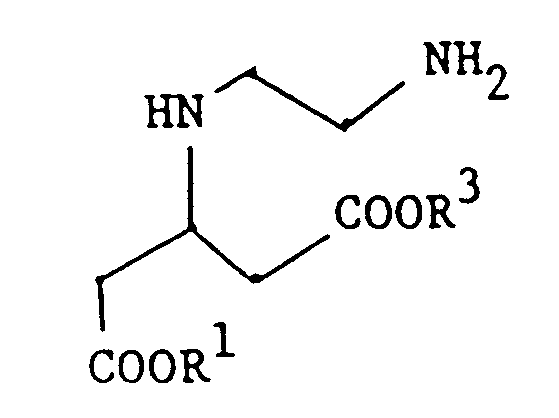
- the present invention relates to a process for the preparation of a compound of the formula wherein R1 is C1-C4 alkyl or C1-C4 alkyl substituted with 1 to 6 halo groups; and R2 is hydrogen, naphthoyl, substituted naphthoyl, benzyl, substituted benzyl, benzoyl or substituted benzoyl, wherein each of said substituted naphthoyl, substituted benzyl, and substituted benzoyl is substituted with one to three substituents selected from halo, C1-C4 alkoxy and C1-C4 alkyl, comprising reacting a compound of the formula wherein R1 and R3 are independently selected from C1-C4 alkyl and C1-C4 alkyl substituted with 1 to 6 halo groups with an alkyl stannane or a trialkyl aluminum and, if desired, reacting the resulting compound of the formula III wherein R2 is hydrogen with a reagent selected
- the benzoyl group and the substituted benzoyl group may be reduced, respectively, to a benzyl group and a substituted benzyl group and the naphthoyl group and the substituted naphthoyl group may be reduced, respectively, to a methylnaphthyl group and a substituted methylnaphthyl group.
- the present invention also relates to a process for preparing a compound of the formula comprising reacting a compound of the formula V, as defined above, with a reagent, such as thionyl chloride or thionyl bromide, that is capable of replacing the hydroxy group by a leaving group, such as chloro or bromo, effecting ring closure with a base, and then replacing the optionally substituted benzyl, optionally substituted methylnaphthyl or optionally substituted benzoyl group with hydrogen.
- a reagent such as thionyl chloride or thionyl bromide
- halo includes fluoro, chloro, bromo and iodo. Generally, fluoro, chloro and bromo are preferred.
- reaction 1 of Scheme 1 a compound of the formula I wherein R1 and R3 are independently selected from C1-C4 alkyl and C1-C4 alkyl substituted with 1-6 halo groups is reacted with H2NCH2CH2NH2 to prepare a compound of the formula II.
- R1 and R3 are the same so that two products do not form in step 2 .
- the solvent should be an inert solvent. Suitable solvents include 1,2 ethylenediamine, tetrahydrofuran, diethylether, dioxane, dimethoxyethane, benzene, toluene and dimethylformamide.
- a compound of the formula II is reacted in an inert solvent with an alkyl stannane, such as tri-n-butyltin triflate, mesylate, tosylate or halide, or with a trialkyl aluminum such as trimethylaluminum, or with triethylaluminum or triisobutylaluminum.
- an alkyl stannane such as tri-n-butyltin triflate, mesylate, tosylate or halide
- a trialkyl aluminum such as trimethylaluminum, or with triethylaluminum or triisobutylaluminum.
- the tri-n-butyltin triflate is the most reactive.
- This compound was prepared by the procedure of Corey ( Tetrahedron Letters , 2419 (1984). Suitable solvents include tetrahydrofuran, dimethoxyethane and dioxane.
- the reaction temperature is not critical but will generally be in the range of about 55° to about 100°C, with 67°C being optimum.
- Each of the alkyl groups of the stannane will preferably have about one to about ten carbon atoms, more preferably about one to about four carbon atoms.
- the alkyl groups of the trialkylaluminum will preferably have about one to about ten carbon atoms with trimethylaluminum being preferred.
- This material can be purchased from the Aldrich Chemical Co. as a solution in toluene or as the neat reagent.
- the product (III) of reaction 2 is not generally isolated but is carried directly into reaction 3 .
- a compound of the formula III is reacted in an inert solvent in the presence of an organic base such as triethylamine or dimethylaminopyridine or a mixture of the foregoing bases with a reagent selected from the group consisting of optionally substituted naphthoyl chloride, naphthoyl bromide, naphthoyl triflate, benzoyl chloride, benzoyl bromide, benzoyl triflate, benzyl chloride, benzyl bromide and benzyl triflate, wherein the substituents on the substituted naphthoyl, substituted benzyl and substituted benzoyl are as defined above.
- an organic base such as triethylamine or dimethylaminopyridine or a mixture of the foregoing bases
- a reagent selected from the group consisting of optionally substituted naphthoyl chloride, naphthoyl bromide, naphthoyl triflate
- Suitable solvents include tetrahydrofuran, dimethoxyethane, dioxane and methylene chloride.
- the reaction temperature is not critical but will generally be in the range of about -10°C to about 25°C, preferably about 0°C.
- the specific nitrogen protecting group illustrated in formula IVA is benzoyl. If desired, one of the other protecting groups mentioned above can be substituted for the benzoyl group.
- the product from reaction 3 when the nitrogen is protected by benzoyl is isolated by chromatography on silica gel to remove residual alkyl tin oxides.
- the trialkyl tin fluoride which precipitates is removed by filtration and the desired product is obtained after evaporation of the solvent and crystallization from methylene chloride and ethyl ether.
- residual tin oxides may be removed by extraction with aqueous ammonium hydroxide solution.
- a compound of the formula IVA is reacted with a reducing agent to obtain a compound of the formula VA.
- Suitable reducing agents include lithium aluminum hydride, Vitride (trademark) (a solution of sodium bis(2-methoxyethoxy)aluminum hydride in toluene), borane in tetrahydrofuran (THF), borane in dimethylsulfide, and diisobutylaluminum hydride (dibal).
- the solvent should either be inert or it should function as or assist in the functioning of the reducing agent. The optimum solvent will depend on the reducing agent chosen. In general, etheral solvents such as THF, ether or dimethoxyethane are preferred.
- the reaction may also be conducted in toluene, benzene or hexane when Vitride (trademark) or dibal is used.
- benzoyl nitrogen protecting group of the compound of formula IVA is reduced to a benzyl group in reaction 4 but that the latter group continues to function as a nitrogen protecting group.
- reaction 5 of Scheme 1 a compound of the formula VA is reacted with a reagent capable of converting the hydroxy group to a leaving group, designated by X in the compound of the formula VIA.
- the foregoing reaction may be conducted in an inert solvent.
- the preferred solvent will be selected based on the choice of the desired leaving group.
- suitable solvents include dichloroethane, toluene, and benzene.
- the solvent can serve as the halogenation agent.
- the reaction temperature is not critical but will generally be in the range of about 70 to about 120°C.
- the preferred leaving group is chloro.
- Said chloro group may be introduced by reacting the compound of the formula VA with neat SOCl2 at elevated temperature to form a compound of the formula VI wherein X is chloro.
- the temperature for this reaction is not critical but will generally be in the range of about 75° to about 85°C.
- ring closure is effected by reacting the compound of formula VIA in an inert solvent with a nonnucleophilic base. If aqueous base is used, the base must be concentrated in order to avoid dissolving the water soluble product.
- Suitable bases include alkaline hydroxides (e.g., sodium and potassium hydroxide).
- Suitable solvents include water.
- the preferred reagent for effecting ring closure is 50% aqueous sodium hydroxide.
- the temperature of reaction 6 is not critical but will generally range from about 15°C to about 35°C. When ring closure is effected with 50% aqueous sodium hydroxide, the preferred temperature range is about 20 to 25°C.
- the protecting group on the nitrogen of the compound of the formula VIIA is removed by standard techniques to yield the compound of formula VIII.
- Such removal of the protecting group may be by hydrogenation at a temperature of about 55°C to 75°C using Pd(OH)2 as the catalyst.
- the pressure is preferably about 3 to about 6 atmospheres.
- Suitable solvents include alcohols (e.g., C1-C4 alcohols).
- a preferred solvent is methanol.
- Other suitable hydrogenation catalysts include palladium on carbon.
- the pressure of the foregoing reactions is generally not critical. Except for the hydrogenation reaction discussed above, the pressures of the foregoing reactions should preferably be in the range of about 0.5 to about 2 atmospheres, more preferably ambient pressure (i.e. about 1 atmosphere).
- reaction 8 the compound of the formula VIII is reacted with 1-ethyl-6,7-difluoro-1,4-dihydro-4-oxo-3-quinoline carboxylic acid as described in European Patent Application Publication Number 0215650 to form 7-(1,4-diazabicyclo[3.2.2]non-4-yl)-1-ethyl-6-fluoro-1,4-dihydro-4-oxo-3-quinolinecarboxylic acid methane sulfonate salt, which may be represented by formula IX.
Landscapes
- Chemical & Material Sciences (AREA)
- Organic Chemistry (AREA)
- Nitrogen Condensed Heterocyclic Rings (AREA)
- Pharmaceuticals Containing Other Organic And Inorganic Compounds (AREA)
- Nitrogen And Oxygen Or Sulfur-Condensed Heterocyclic Ring Systems (AREA)
- Plural Heterocyclic Compounds (AREA)
Claims (9)
- Procédé de production d'un composé de formule


- Procédé de production d'un composé de formule


- Procédé de production d'un composé de formule


- Composé de formule

- Composé suivant la revendication 4, répondant à la formule

- Composé suivant la revendication 5, dans lequel R² est un groupe benzyle.
- Composé suivant la revendication 4, caractérisé par la formule

- Composé suivant la revendication 4, caractérisé en ce qu'il répond à la formule

- Composé de formule
Applications Claiming Priority (2)
| Application Number | Priority Date | Filing Date | Title |
|---|---|---|---|
| US07/262,542 US4895943A (en) | 1988-10-25 | 1988-10-25 | Preparation of 1,4-diazabicyclo(3.2.2)nonane |
| US262542 | 1988-10-25 |
Publications (3)
| Publication Number | Publication Date |
|---|---|
| EP0366301A2 EP0366301A2 (fr) | 1990-05-02 |
| EP0366301A3 EP0366301A3 (fr) | 1991-07-31 |
| EP0366301B1 true EP0366301B1 (fr) | 1994-08-31 |
Family
ID=22997941
Family Applications (1)
| Application Number | Title | Priority Date | Filing Date |
|---|---|---|---|
| EP89310389A Expired - Lifetime EP0366301B1 (fr) | 1988-10-25 | 1989-10-11 | Préparation de 1,4-diazabicyclo[3.2.2]nonane |
Country Status (17)
| Country | Link |
|---|---|
| US (1) | US4895943A (fr) |
| EP (1) | EP0366301B1 (fr) |
| JP (1) | JPH0699408B2 (fr) |
| KR (1) | KR910007887B1 (fr) |
| AT (1) | ATE110724T1 (fr) |
| AU (1) | AU616062B2 (fr) |
| CA (1) | CA2001211A1 (fr) |
| DE (1) | DE68917853T2 (fr) |
| DK (1) | DK526989A (fr) |
| HU (1) | HU205116B (fr) |
| IE (1) | IE893416L (fr) |
| IL (1) | IL92025A (fr) |
| MY (1) | MY104455A (fr) |
| NO (1) | NO172050C (fr) |
| NZ (1) | NZ231108A (fr) |
| PT (1) | PT92087A (fr) |
| ZA (1) | ZA898047B (fr) |
Families Citing this family (12)
| Publication number | Priority date | Publication date | Assignee | Title |
|---|---|---|---|---|
| AU2959397A (en) * | 1996-05-31 | 1998-01-05 | Novartis Ag | Process for the preparation of hydrazine derivatives useful as intermediates for the preparation of peptide analogues |
| SE0202430D0 (sv) * | 2002-08-14 | 2002-08-14 | Astrazeneca Ab | New Compounds |
| SE0202465D0 (sv) * | 2002-08-14 | 2002-08-14 | Astrazeneca Ab | New compounds |
| MXPA05003317A (es) * | 2002-09-25 | 2005-07-05 | Memory Pharm Corp | Indazoles, benzotiazoles y benzoisotiazoles asi como preparacion y usos de los mismos. |
| DE602004006767T2 (de) | 2003-09-26 | 2008-02-07 | Astrazeneca Ab | Nichtamidnonane |
| RU2389729C2 (ru) * | 2003-12-22 | 2010-05-20 | Мемори Фармасьютиклз Корпорейшн | 1н-индазолы, 1, 2-бензизоксазолы и 1, 2-бензизотиазолы, их получение и применение |
| EP1735306A2 (fr) | 2004-03-25 | 2006-12-27 | Memory Pharmaceuticals Corporation | Indazoles, benzothiazoles, benzoisothiazoles, benzisoxazoles, et leur preparation et leurs utilisations |
| CA2567977A1 (fr) * | 2004-04-22 | 2006-01-05 | Memory Pharmaceutical Corporation | Indoles, 1h-indazoles, 1,2-benzisoxazoles, 1,2-benzoisothiazoles, leur preparation et leurs utilisations |
| NZ551712A (en) * | 2004-05-07 | 2010-07-30 | Memory Pharm Corp | 1H-indazoles, benzothiazoles, 1,2-benzoisoxazoles, 1,2-benzoisothiazoles, and chromones and preparations and uses thereof |
| CA2591817A1 (fr) | 2004-12-22 | 2006-06-29 | Memory Pharmaceuticals Corporation | Ligands du recepteur alpha-7 nicotinique ainsi que preparation et utilisations de ceux-ci |
| US8106066B2 (en) * | 2005-09-23 | 2012-01-31 | Memory Pharmaceuticals Corporation | Indazoles, benzothiazoles, benzoisothiazoles, benzisoxazoles, pyrazolopyridines, isothiazolopyridines, and preparation and uses thereof |
| CN103450064A (zh) * | 2013-07-30 | 2013-12-18 | 中国科学院上海微系统与信息技术研究所 | 一种芳基乙烯基丙二酰亚胺的制备及伯胺的检测方法 |
Family Cites Families (5)
| Publication number | Priority date | Publication date | Assignee | Title |
|---|---|---|---|---|
| US3883533A (en) * | 1973-12-27 | 1975-05-13 | Universal Oil Prod Co | Process for preparing 1,4-diazabicyclo octane |
| EP0076089A3 (fr) * | 1981-09-28 | 1983-05-25 | Beecham Group Plc | Dérivés azabicycloalkyles, leur procédé de préparation, et compositions pharmaceutiques les contenant |
| US4571396A (en) * | 1984-04-16 | 1986-02-18 | Warner-Lambert Company | Antibacterial agents |
| GB8518236D0 (en) * | 1985-07-19 | 1985-08-29 | Beecham Group Plc | Compounds |
| IN166416B (fr) * | 1985-09-18 | 1990-05-05 | Pfizer |
-
1988
- 1988-10-25 US US07/262,542 patent/US4895943A/en not_active Expired - Fee Related
-
1989
- 1989-10-11 EP EP89310389A patent/EP0366301B1/fr not_active Expired - Lifetime
- 1989-10-11 DE DE68917853T patent/DE68917853T2/de not_active Expired - Fee Related
- 1989-10-11 AT AT89310389T patent/ATE110724T1/de not_active IP Right Cessation
- 1989-10-17 IL IL9202589A patent/IL92025A/en not_active IP Right Cessation
- 1989-10-23 CA CA002001211A patent/CA2001211A1/fr not_active Abandoned
- 1989-10-23 MY MYPI89001469A patent/MY104455A/en unknown
- 1989-10-24 KR KR1019890015276A patent/KR910007887B1/ko not_active Expired
- 1989-10-24 NO NO894230A patent/NO172050C/no unknown
- 1989-10-24 ZA ZA898047A patent/ZA898047B/xx unknown
- 1989-10-24 NZ NZ231108A patent/NZ231108A/en unknown
- 1989-10-24 AU AU43700/89A patent/AU616062B2/en not_active Ceased
- 1989-10-24 HU HU895422A patent/HU205116B/hu not_active IP Right Cessation
- 1989-10-24 PT PT92087A patent/PT92087A/pt unknown
- 1989-10-24 IE IE893416A patent/IE893416L/xx unknown
- 1989-10-24 DK DK526989A patent/DK526989A/da not_active Application Discontinuation
- 1989-10-25 JP JP1278301A patent/JPH0699408B2/ja not_active Expired - Lifetime
Non-Patent Citations (1)
| Title |
|---|
| organostannyl oxides as catalytic neutral esterification agents in thepreparation of macrolides" * |
Also Published As
| Publication number | Publication date |
|---|---|
| DE68917853T2 (de) | 1995-01-12 |
| NO172050C (no) | 1993-06-02 |
| AU4370089A (en) | 1990-05-03 |
| ATE110724T1 (de) | 1994-09-15 |
| NO172050B (no) | 1993-02-22 |
| IL92025A (en) | 1994-10-07 |
| NZ231108A (en) | 1992-03-26 |
| DK526989D0 (da) | 1989-10-24 |
| PT92087A (pt) | 1990-04-30 |
| JPH0699408B2 (ja) | 1994-12-07 |
| HUT54366A (en) | 1991-02-28 |
| HU205116B (en) | 1992-03-30 |
| EP0366301A3 (fr) | 1991-07-31 |
| AU616062B2 (en) | 1991-10-17 |
| IE893416L (en) | 1990-04-25 |
| KR910007887B1 (ko) | 1991-10-04 |
| NO894230D0 (no) | 1989-10-24 |
| KR900006301A (ko) | 1990-05-07 |
| HU895422D0 (en) | 1990-01-28 |
| IL92025A0 (en) | 1990-07-12 |
| MY104455A (en) | 1994-03-31 |
| CA2001211A1 (fr) | 1990-04-25 |
| JPH02174769A (ja) | 1990-07-06 |
| ZA898047B (en) | 1991-06-26 |
| US4895943A (en) | 1990-01-23 |
| DK526989A (da) | 1990-04-26 |
| DE68917853D1 (de) | 1994-10-06 |
| NO894230L (no) | 1990-04-26 |
| EP0366301A2 (fr) | 1990-05-02 |
Similar Documents
| Publication | Publication Date | Title |
|---|---|---|
| JP5202635B2 (ja) | インテグラーゼ阻害剤の調製のためのプロセスおよび中間体 | |
| US5599994A (en) | Amino acid-derived diaminopropanols | |
| EP0366301B1 (fr) | Préparation de 1,4-diazabicyclo[3.2.2]nonane | |
| CZ2003477A3 (cs) | Způsob přípravy N-aryl-anthranilových kyselin a jejich derivátů | |
| CN103080088B (zh) | 用于合成药物的中间体化合物的制备方法 | |
| EP0629189B1 (fr) | Preparation d'intermediaires dans la synthese d'antibiotiques a la quinoline | |
| EA002499B1 (ru) | Способ получения защищенного 4-аминометилпирролидин-3-она, промежуточные соединения и способ получения 3-аминометил-4-алкоксииминопирролидина | |
| JP4208463B2 (ja) | キノロンカルボン酸誘導体の製造に関する中間体 | |
| US5026845A (en) | 1,4-diazabicyclo[3.2.2.]nonane and intermediates for the preparation thereof | |
| KR20030032011A (ko) | 치환된 이미다조피리딘 화합물의 제조 방법 | |
| CA1137083A (fr) | Methode de preparation de derives de 15-hydroxyimino-e-homoeburnane | |
| KR20180118054A (ko) | 의약품 합성용 중간체 화합물의 제조 방법 | |
| JP3046258B2 (ja) | 1−クロロカルボニル−4−ピペリジノピペリジンまたはその塩酸塩の製造方法 | |
| JPH05140157A (ja) | フエノチアジン誘導体 | |
| CN110894186B (zh) | 匹莫范色林及其中间体的制备方法 | |
| US6426417B1 (en) | Processes and intermediates useful to make antifolates | |
| JPH04368377A (ja) | 4−アミノ−3−ヒドロキシフタリドおよびその製造法 | |
| JP3126775B2 (ja) | 環状アミンの光学分割法と該方法によって得られた光学活性体 | |
| PL196498B1 (pl) | Sposób wytwarzania aminoalkoholu lub jego soli | |
| JPH0446175A (ja) | 5―ヒドロキシ―3,4―メチレンジオキシ安息香酸誘導体の製造法 | |
| EP1698611A1 (fr) | Procede de production d'un derive de l'acide phenylacetique | |
| JP2001131145A (ja) | 光学活性3−アミノピロリジン誘導体の製造法 | |
| JPH03130285A (ja) | 光学活性2―アルキル―2,5―ジアザビシクロ[2,2,1]ヘプタンの製法 | |
| JPH0912546A (ja) | アザビシクロ環化合物および製造方法 | |
| EP0075868A2 (fr) | Amino-alcools optiquement actifs et leur production |
Legal Events
| Date | Code | Title | Description |
|---|---|---|---|
| PUAI | Public reference made under article 153(3) epc to a published international application that has entered the european phase |
Free format text: ORIGINAL CODE: 0009012 |
|
| 17P | Request for examination filed |
Effective date: 19891020 |
|
| AK | Designated contracting states |
Kind code of ref document: A2 Designated state(s): AT BE CH DE ES FR GB GR IT LI LU NL SE |
|
| PUAL | Search report despatched |
Free format text: ORIGINAL CODE: 0009013 |
|
| AK | Designated contracting states |
Kind code of ref document: A3 Designated state(s): AT BE CH DE ES FR GB GR IT LI LU NL SE |
|
| 17Q | First examination report despatched |
Effective date: 19930719 |
|
| GRAA | (expected) grant |
Free format text: ORIGINAL CODE: 0009210 |
|
| AK | Designated contracting states |
Kind code of ref document: B1 Designated state(s): AT BE CH DE ES FR GB GR IT LI LU NL SE |
|
| PG25 | Lapsed in a contracting state [announced via postgrant information from national office to epo] |
Ref country code: ES Free format text: THE PATENT HAS BEEN ANNULLED BY A DECISION OF A NATIONAL AUTHORITY Effective date: 19940831 Ref country code: BE Effective date: 19940831 Ref country code: IT Free format text: LAPSE BECAUSE OF FAILURE TO SUBMIT A TRANSLATION OF THE DESCRIPTION OR TO PAY THE FEE WITHIN THE PRE;WARNING: LAPSES OF ITALIAN PATENTS WITH EFFECTIVE DATE BEFORE 2007 MAY HAVE OCCURRED AT ANY TIME BEFORE 2007. THE CORRECT EFFECTIVE DATE MAY BE DIFFERENT FROM THE ONE RECORDED.SCRIBED TIME-LIMIT Effective date: 19940831 Ref country code: FR Effective date: 19940831 Ref country code: GR Free format text: LAPSE BECAUSE OF FAILURE TO SUBMIT A TRANSLATION OF THE DESCRIPTION OR TO PAY THE FEE WITHIN THE PRESCRIBED TIME-LIMIT Effective date: 19940831 Ref country code: NL Effective date: 19940831 Ref country code: AT Effective date: 19940831 |
|
| REF | Corresponds to: |
Ref document number: 110724 Country of ref document: AT Date of ref document: 19940915 Kind code of ref document: T |
|
| REF | Corresponds to: |
Ref document number: 68917853 Country of ref document: DE Date of ref document: 19941006 |
|
| PG25 | Lapsed in a contracting state [announced via postgrant information from national office to epo] |
Ref country code: LU Free format text: LAPSE BECAUSE OF NON-PAYMENT OF DUE FEES Effective date: 19941031 Ref country code: CH Effective date: 19941031 Ref country code: LI Effective date: 19941031 |
|
| PG25 | Lapsed in a contracting state [announced via postgrant information from national office to epo] |
Ref country code: SE Effective date: 19941130 Ref country code: GB Effective date: 19941130 |
|
| EN | Fr: translation not filed | ||
| NLV1 | Nl: lapsed or annulled due to failure to fulfill the requirements of art. 29p and 29m of the patents act | ||
| REG | Reference to a national code |
Ref country code: CH Ref legal event code: PL |
|
| PG25 | Lapsed in a contracting state [announced via postgrant information from national office to epo] |
Ref country code: DE Effective date: 19950701 |
|
| PLBE | No opposition filed within time limit |
Free format text: ORIGINAL CODE: 0009261 |
|
| STAA | Information on the status of an ep patent application or granted ep patent |
Free format text: STATUS: NO OPPOSITION FILED WITHIN TIME LIMIT |
|
| GBPC | Gb: european patent ceased through non-payment of renewal fee |
Effective date: 19941130 |
|
| 26N | No opposition filed |