EP0367195A2 - Eléments émetteurs d'électrons à cathode froide MIM et leurs procédés de fabrication - Google Patents
Eléments émetteurs d'électrons à cathode froide MIM et leurs procédés de fabrication Download PDFInfo
- Publication number
- EP0367195A2 EP0367195A2 EP89120124A EP89120124A EP0367195A2 EP 0367195 A2 EP0367195 A2 EP 0367195A2 EP 89120124 A EP89120124 A EP 89120124A EP 89120124 A EP89120124 A EP 89120124A EP 0367195 A2 EP0367195 A2 EP 0367195A2
- Authority
- EP
- European Patent Office
- Prior art keywords
- electron emission
- layer
- insulating layer
- metal layer
- portions
- Prior art date
- Legal status (The legal status is an assumption and is not a legal conclusion. Google has not performed a legal analysis and makes no representation as to the accuracy of the status listed.)
- Withdrawn
Links
Images







Classifications
-
- H—ELECTRICITY
- H01—ELECTRIC ELEMENTS
- H01J—ELECTRIC DISCHARGE TUBES OR DISCHARGE LAMPS
- H01J9/00—Apparatus or processes specially adapted for the manufacture, installation, removal, maintenance of electric discharge tubes, discharge lamps, or parts thereof; Recovery of material from discharge tubes or lamps
- H01J9/02—Manufacture of electrodes or electrode systems
- H01J9/022—Manufacture of electrodes or electrode systems of cold cathodes
-
- B—PERFORMING OPERATIONS; TRANSPORTING
- B82—NANOTECHNOLOGY
- B82Y—SPECIFIC USES OR APPLICATIONS OF NANOSTRUCTURES; MEASUREMENT OR ANALYSIS OF NANOSTRUCTURES; MANUFACTURE OR TREATMENT OF NANOSTRUCTURES
- B82Y10/00—Nanotechnology for information processing, storage or transmission, e.g. quantum computing or single electron logic
-
- H—ELECTRICITY
- H01—ELECTRIC ELEMENTS
- H01J—ELECTRIC DISCHARGE TUBES OR DISCHARGE LAMPS
- H01J1/00—Details of electrodes, of magnetic control means, of screens, or of the mounting or spacing thereof, common to two or more basic types of discharge tubes or lamps
- H01J1/02—Main electrodes
- H01J1/30—Cold cathodes, e.g. field-emissive cathode
- H01J1/312—Cold cathodes, e.g. field-emissive cathode having an electric field perpendicular to the surface, e.g. tunnel-effect cathodes of metal-insulator-metal [MIM] type
Definitions
- the present invention relates to structures and methods of manufacture for an electron emission element which can be utilized as a source of electron emission, for use in various types of apparatus which utilize an electron beam, such as electron microscopes, CRTs, etc.
- the invention is directed towards improved structures and methods of manufacture for thin-film electron emission elements which are basically of a metal - insulation - metal layer configuration.
- a heated cathode is used for electron emission in equipment which uses an electron beam, such as electron microscopes and CRTs.
- an electron beam such as electron microscopes and CRTs.
- a heated cathode it is of course necessary to provide heating means to produce electron emission, and this has the disadvantage of high energy consumption.
- various types of electron emission elements have been researched which provide electron emission without heating, i.e. cold-cathode electron emission elements.
- a reverse bias voltage is applied to a PN junction, then an avalanche condition can be produced whereby electron emission from the PN junction can be obtained.
- a localized high-intensity electric field can be applied to a metal electrode, causing field-effect electron emission to occur.
- Another method is to use a device having a metal - insulator - metal layer configuration (i.e. an MIM type of electron emission element), where the insulating layer and one of the metal layers are respectively formed as extremely thin films, and with the thin metal layer being disposed in a vacuum, and to apply a voltage between the two metal layers whereby electrons execute tunnelling through the insulating layer and a proportion of these are then emitted from the thin metal layer.
- the MIM electron emission element has the advantage of a simple type of construction, and will be described in the following.
- a metal layer (conducting material layer) 41 has a very thin insulating layer 42 formed thereon, and a very thin metal layer 43 is formed upon the insulating layer 42.
- the upper surface of the metal layer 43 is exposed to a vacuum, or low pressure gas.
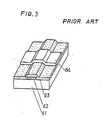
- Figs. 2 and 3 show respective specific examples of a prior art type of MIM electron emission element.
- a metal layer 52 consisting of Al and a metal layer 55 consisting of Au are successively formed on a surface of a glass substrate 51.
- An insulating layer 52 consisting of Al2O3 and an electrically insulating layer 54 consisting of SiO2 are formed between the metal layers 52 and 55.
- a voltage is applied between the metal layers 52 and 55, electrons are emitted from the electron emission region 56 of the metal layer 55. This is described in the Electronic Apparatus Reasearch Conference Papers of the Television Society, with the title “Cathode Ray Tube Using Tunnel Cathode", 1968, 4, 30.
- the metal layer 62 is formed as a strip upon the surface of an electrically insulating layer 61, then an electrically insulating layer 63 is formed on the metal layer 62.
- a metal layer 64 is formed upon the insulating layer 63, also in the shape of a strip, positioned such as to perpendicularly intersect the metal layer 62.
- the reason for the non-uniformity of electron emission distribution is as follows. In order to maximize the efficiency of electron emission from the metal layer that is formed on the insulating layer, that metal layer must be made extremely thin within the electron emission region. However since it is difficult to form the electron emission region with a very uniform thickness of thin metal film, there will inevitably be some variations in thickness within the electron emission region. This results in non-uniformity of electron emission distribution in the electron emission region. Furthermore, due to the fact that the metal layer is very thin, successive voltage drops will occur within that layer, from the point of connection of the metal layer to a power source. Thus, the effective electric field strength within the electron emission region will be non-uniform, causing the electron emission to be uneven within that region.
- the reasons for the poor conduction of the metal layer are as follows. With the electron emission element of Fig. 3, there are step variations in the height of the surface of the insulating layer, and corresponding step changes are produced in the metal layer that is formed on the insulating layer. Due to these step changes in shape of the layers, corners are formed, and as a result of these corners formed in the layers, defects are produced in the thin metal layer, so that poor electrical conduction in that layer will occur.
- the insulating layer is formed in the prior art as a very thin film, having a thickness of approximately 50 to 200 ⁇ , by a process such as evaporative deposition, anodic oxidation, etc.and is not formed with a crystal structure, i.e. is an amorphous layer.
- a process such as evaporative deposition, anodic oxidation, etc.and is not formed with a crystal structure, i.e. is an amorphous layer.
- the electrons which enter this thin metal layer will also be dispersed, and suffer a further energy loss thereby.
- that layer In order to reduce this dispersion within the thin metal layer, that layer must be made as thin as possible, however if that layer is made very thin, then a substantial voltage drop will occur between the point of connection of that metal layer to a power source terminal and an electron emission region of the metal layer, as described above.
- the intensity of the electric field that is produced in a region of the insulating layer immediately below an electron emission region of the thin metal layer is reduced, and hence effective electron emission cannot be achieved.
- This reduction of effective electric field strength within the electron emission region can be counteracted to some extent by increasing the level of voltage supplied by the power source.
- Joule heating will occur due to the electrical power which will be dissipated within the metal layer, resulting in non-uniform electron emission and the danger of open-circuits in the thin metal layer.
- both the thin-film insulating layer (through which the tunnelling electrons pass) and the thin-film metal layer (from which electrons are emitted) are formed upon an underlying layer which has an upwardly protruding portion and/or an inwardly recessed portion, i.e. which has an upper surface that exhibits step changes in height.
- each of the thin insulating layer and thin metal layer will also have corresponding step changes in height, so that the respective film thicknesses of these layers will be non-uniform.
- the operating characteristics of such an electron emission element are unstable.
- the thin metal layer is formed with such step variations in height, then internal defects may be produced within that layer in regions which are close to these step changes, i.e. at corner portions. This can result in localized variations in electrical conduction at these portions, as well as non-uniformity of film thickness, thereby further contributing to deterioration of the electrical characteristics.
- an array is formed of a plurality of such MIM electron emission elements, the characteristics of respective elements of the array will vary significantly from one another.
- an electron emission element comprises an electrically insulating material formed on a layer of electrically conducting material (or a bulk conducting body), with a metal layer formed over the insulating layer.
- the insulating layer is formed as an extremely thin film, while the metal layer within the electron emission region is formed as an array of thick and thin portions which are distributed throughout that region.
- the thick portions of the metal layer serve to ensure that a sufficient level of voltage will be applied to the thin portions, while the thin portions are made sufficiently thin to ensure high efficiency of electron emission.
- the thin insulating layer portion corresponding to the electron emission region can be formed by providing an upwardly protruding portion of the conducting layer, and forming an insulating layer which covers the upwardly protruding portion and surrounding regions of the conducting layer and has a flat upper surface.
- a first insulating layer can be formed surrounding the upwardly protruding portion of the conducting layer, to the same height as that upwardly protruding portion, and a thin insulating layer then formed overall, with a flat upper surface. It is also possible to form the latter thin insulating layer as an oxide film on the upwardly protruding portion of the conducting layer.
- the thin insulating layer below the electron emission region is formed as an epitaxially grown layer of single-crystal material, with the crystal planes oriented with respect to the layer surface such as to minimize dispersion of electrons which pass through that insulating layer by tunnelling.
- the efficiency of electron emission can thereby be substantially increased.
- one embodiment of the invention is an electron emission element comprising an electrically conducting layer, an electrically insulating layer formed on the conducting layer, and a metal layer formed on the insulating layer, wherein the metal layer is formed with an electron emission region comprising a plurality of relatively thick portions of the metal layer and a plurality of relatively thin portions of the metal layer, the thick and thin portions being distributed throughout the electron emission region.
- an electron emission element comprising an electrically conducting body having an electrically insulating layer formed thereon, and a metal layer formed on the insulating layer, with respective values of thickness of at least portions of the insulating layer and metal layer being selected such as to permit electron emission from an electron emission region of the metal layer in response to application of a specific level of voltage between the conducting body and the metal layer, wherein at least a part of the insulating layer corresponding in position to the electron emission region comprises a single-crystal layer of an electrically insulating material having crystal planes thereof oriented in predetermined directions.
- Another emodiment of the invention is an electron emission element comprising a substrate, an electrically conducting layer formed on a predetermined region of a surface of the substrate, a first electrically insulating layer formed on the conducting layer, a second insulating layer formed on a region of the substrate outside the first insulating layer, with an upper surface of the second insulating layer being co-planar with an upper surface of the first insulating layer, and a metal layer formed on the first and second insulating layers.
- Yet another embodiment of the invention is an electron emission element comprising an electrically conducting body having a surface thereof formed with an upwardly protruding portion, an electrically insulating layer formed to cover the conducting body and having a flat upper surface, and a metal layer formed upon the insulating layer surface, the metal layer extending above the upwardly protruding portion of the conducting body and at least partially overlapping a boundary of the upwardly protruding portion.
- a further embodiment of the invention is an electron emission element comprising an electrically conducting body formed on a portion of a surface of a substrate, an electrically insulating layer formed upon the conducting body and the surface, the insulating layer having a flat upper surface, and a metal layer formed on the insulating layer surface, extending above the conducting body.
- the invention further describes a method of manufacture for an electron emission element, comprising successive steps of: forming a layer of an electrically conducting material on a surface of a glass substrate; forming a layer of an electrically insulating material on the conducting material layer; forming a metal layer upon the layer of insulating material; forming a patterned photoresist layer on the metal layer; and executing photo-lithography etching of the metal layer, employing the photoresist layer, to selectively remove portions of the metal layer.
- the invention moreover includes aa method of manufacture for an electron emission element, comprising successive steps of: forming a layer of an electrically insulating material on a region of a conducting body corresponding to an electron emission region, the thickness of the layer of insulating material being selected such as to permit an electron tunnelling effect to occur in the layer of insulating material; and executing evaporative deposition of a metal onto a surface of the insulating layer through a mask, the mask having a predetermined pattern of apertures formed therein, and the mask being spaced apart from the layer of insulating material by a predetermined distance; for thereby forming a plurality of thick portions and a plurality of sloping portions of the metal layer within the electron emission region, each of the sloping portions being integrally formed with a corresponding one of the thick portions and being of gradually varying thickness, the thick portions and thin portions being distributed throughout the electron emission region.
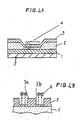
- Fig. 4A is a general cross-sectional view of a first embodiment of an electron emission element according to the present invention.
- Fig. 4B is an expanded view of a portion of an electron emission region that is located within a broken-line outline shown in Fig 4A.
- numeral 1 denotes a layer of an electrically conducting material which is formed on a substrate 5
- numeral 2 denotes an insulating layer which is formed on the conducting layer 1
- numeral 3 denotes a metal layer formed on the insulating layer 2
- numeral 4 denotes an electron emission region at the center of the metal layer 3
- numeral 5 denotes a substrate which is the lowest layer
- numeral 6 denotes electrons which are emitted from the electron emission region 4.
- each of the thin portions of the metal layer within the electron emission region is integrally connected to at least one corresponding thick portion.
- a voltage between the conducting layer 1 and the metal layer 3 of such an MIM electron emission element, such that the metal layer 3 is made positive a voltage is applied through the thick portions 3a of the metal layer 3 to the thin portions 3b. Since the voltage drop which occurs in the thick portions 3a is very small, substantially uniform values of voltage are applied to the thin portions 3b, whereby uniform emission of electrons 6 is obtained from the thin portions 3a in the electron emission region.
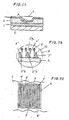
- Figs. 5A to 5C illustrate a second embodiment of an electron emission element according to the present invention.
- an electrically conducting layer 1 (consisting of a material such as Al) is formed on an electrically insulating substrate 5 (consisting of a material such as glass) .
- An electrically insulating layer 2 (consisting of a material such as Al2O3 of SiO2) is formed as a thin film on the conducting layer 1.
- a thin metal film 3 (e.g. consisting of Au) is formed on the insulating layer 2.
- the thickness of the conducting layer 1 is approximately 1000 to 5000 ⁇ .
- the thickness of the insulating layer 2 is approximately 50 to 200 ⁇ , within an electron emission region 4, and is 2000 to 5000 ⁇ in areas outside the electron emission region 4.
- the thickness of the thin metal film 3 is 500 to 2000 ⁇ in areas outside the electron emission region 4.
- the configuration of the electron emission region 4 of the thin metal film 3 is as follows. As shown in Fig 5C, the electron emission region 4 is formed with a plurality of mutually parallel narrow stripe-shaped portions 3′, with regions of the surface of the insulating layer 2 between these stripe portions 3′ being left exposed (i.e without metal having been deposited thereon). As shown in Fig. 5B, which is an expanded cross-sectional view of the portion A of Fig. 5A, each of these portions 3′ of the thin metal film 3 has a flat-topped portion 3′a and sloping portions 3′b. Each of these sloping portions 3′b gradually decreases in thickness from a maximum value to a value of zero, i.e to finally reach the surface of the insulating layer 2.
- the configuration of the electron emission region 4 of the metal layer 3 is similar to that of the preceding embodiment.
- the electron emission region 4 has a plurality of parallel narrow stripe-shaped portions 3′, with regions of the surface of the insulating layer 2 between these stripe portions 3′ being left exposed.
- each of these portions 3′ of the metal layer 3 has a flat-topped portion 3′a and sloping portions 3′b which gradually decrease in thickness to finally reach the surface of the insulating layer 2.
- the surface of the conducting layer 1 has an upwardly protruding portion 1a corresponding to the position of the electron emission region 4, and the thickness of the portion of the insulating layer 2 that is immediately above this upwardly protruding portion 1a is accordingly decreased.
- the boundary of the electron emission region 4 is defined by the shape of the upper surface of this upwardly protruding portion 1a.
- the surface of the insulating layer 2 is flat, so that the metal layer 3 is formed over this entire surface without any step changes in height of the layer 3, i.e. the interface between the insulating layer 2 and the metal layer 3 is a single plane, which extends inside and outside the electron emission region 4.
- the metal layer 3 is thinner within the electron emission region 4 than it is outside the region 4, so that it is easy to ensure that both a high efficiency of electron emission and low electrical resistance are attained.
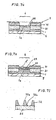
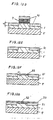
- a metal layer (consisting of a material such as Al or Ta) is formed on the surface of an insulating substrate 5, consisting of a material such as glass.
- the metal layer can be formed by by a process such as resistive evaporative deposition, electron beam evaporative deposition, or sputtering deposition deposition; and is formed to a thickness of approximately 1000 to 10,000 ⁇ .
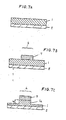
- an electrically conducting layer 1 is deposited as shown in Fig 7A.
- Fig. 7B a layer of photoresist 7 is selectively formed at positions where the electron emission region 4 is to be formed.
- the photoresist layer 7 can be formed by the usual photolithography technique.
- the photoresist layer 7 After forming the photoresist layer 7, ion milling or liquid etching is executed to etch those regions of the conducting layer 1 that are not covered with the photoresist, with etching being performed to a depth d of for example 500 to 5,000 ⁇ .
- the upwardly protruding portion 1a is thereby formed.
- the insulating layer 21 (consisting of a material such as SiO2, Al2O3, or Ta2O5) is formed overall, to the same height as that of the upwardly protruding portion 1a (i.e. to a thickness which is equal to the etching depth d), by a process such as resistive evaporative deposition, electron beam evaporative deposition, or sputtering deposition.
- the metal layer 31 is formed to a thickness of approximately 200 to 1,000 ⁇ (consisting of a material such as Au, Al, Mo or W) , by a process such as resistive heating evaporative deposition, electron beam evaporative deposition, or sputtering deposition.
- oxidation of the surface of the upwardly protruding portion 1a is performed, to a thickness of approximately 50 to 200 ⁇ , whereby as shown in Fig. 7F the thin insulating layer (i.e. oxide insulation film) 22 is formed This is done by a process such as thermal oxidation in an oxygen atmosphere, or anodic oxidation, to form a layer of a material such as Al2O3, Ta2O5, etc.
- an electrically insulating layer has been formed from the insulating layers 21 and 22 which has a flat surface.
- a mask 8 is positioned with a fixed small amount of separation from the surface of the insulating layer 22, then a metal layer (consisting of a material such as Au, Al, Mo, W, etc) is deposited by evaporative deposition through the mask 8, to a thickness of 100 to 500 ⁇ approximately, by a process such as resistive heating evaporative deposition, electron beam evaporative deposition or sputtering deposition.
- the mask 8 is provided with open slits at specific positions which correspond to positions where the metal layer is to be formed. These can be for example a parallel array of slits, each having a width of 0.01 to 0.05 mm, a length of 0.5 mm to 1 mm, and a pitch of 0.05 to 0.1 mm.
- a metal layer 32 is formed in the electron emission region 4.
- Fig. 7I is an expanded view of the portion A′ of this metal layer 32. As shown, this consists of flat-topped portions 32a and sloping portions 32b , which result from the mask 8 having been positioned with a slight separation from the surface of the insulating layer 22.
- the metal layer of the electron emission region by first forming a metal layer to the desired thickness for the flat-topped portions over the entire area of the electron emission region, and to then execute selective removal of that layer to a predetermined thickness, at positions such as to ensure that the thick portions and the thin portions (for electron emission) of the metal layer will be uniformly distributed throughout the electron emission region.
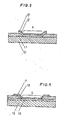
- the insulating layer 12 within the electron emission region 4 is a thin film of epitaxially-grown single-crystal insulating material, having the crystal planes thereof appropriately oriented such as to minimize the degree of dispersion of electrons within the thin insulating layer 12 due to interaction with the electrons and atoms of the thin insulating layer 12. For this reason, dispersion and energy loss of tunnelling electrons within the thin insulating layer 12 is substantially reduced by comparison with the prior art, and the number of electrons which reach the thin thin metal layer 13 is correspondingly increased, while in addition the number of electrons reaching the thin thin metal layer 13 which have a sufficiently high energy level to be emitted from the thin thin metal layer 13 is also increased.
- the number of electrons which are emitted from the surface of the thin thin metal layer 13 is substantially increased over the prior art, with a correspondingly high value of electron emission efficiency.
- the electrically conducting body 10 Si having a specific resistivity of 0.02 ⁇ /cm is used as the electrically conducting body 10.
- the insulating layer 11 consists of a film of SiO2 having a thickness of 1000 ⁇ , formed on a region of the conducting layer 10 outside a region which corresponds to the electron emission region 4.
- the electron emission region 4 has a diameter of 100 ⁇ m.
- a film of Al2O3 is formed by epitaxial growth on the electron emission region 4 as the thin insulating layer 12, using the MBE (molecular beam evaporative deposition) process, with the ⁇ 111> plane of the crystal structure aligned parallel to the layer surface, and with the film having a thickness of 50 to 200 ⁇ .
- a layer of Au is formed by evaporative deposition to a thickness of 100 to 200 ⁇ upon the thin insulating layer 12, thereby completing the formation of the electron emission element.
- FIG. 9 A fifth embodiment of the present invention, will be described in the following, referring to Fig. 9.
- numeral 10 denotes an electrically conducting body
- 11 denotes an electrically insulating layer
- numeral 12 denotes an electrically insulating layer formed of a thin film of epitaxially grown crystal, with the crystal planes oriented in predetermined directions
- 13 denotes a metal layer
- 4 denotes an electron emission region.
- the configuration of this embodiment is as follows.
- the insulating layer 12 is first formed on the electrically conducting body 10, then the insulating layer 11 is formed over regions other than the electron emission region 4.
- the thin metal layer 13 is formed on the electron emission region 4.
- the insulating layer below the electron emission region 4 is a thin film of epitaxially-grown crystal, with the crystal planes oriented to minimize energy loss of electrons which pass through that layer due to the tunnelling effect, as for the preceding embodiment, electrons which pass through the insulating layer 12 experience a low degree of dispersion and hence the electron emission efficiency is high.
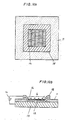
- Figs. 10A and 10B show a sixth embodiment of an electron emission element according to the present invention, in which numeral 10 denotes an electrically conducting body which can consist of a layer of electrically conducting material formed on a substrate or can be an electrically conducting substrate, numeral 11 denotes an electrically insulating layer, numeral 12 denotes an electrically insulating layer formed of a thin film of epitaxially grown crystal, with the crystal planes oriented in predetermined directions, 14 denotes a first metal layer, 15 denotes a second metal layer, and 16 denotes a power source.
- numeral 10 denotes an electrically conducting body which can consist of a layer of electrically conducting material formed on a substrate or can be an electrically conducting substrate
- numeral 11 denotes an electrically insulating layer
- numeral 12 denotes an electrically insulating layer formed of a thin film of epitaxially grown crystal, with the crystal planes oriented in predetermined directions
- 14 denotes a first metal layer
- 15
- a relatively thick insulating layer 11 is formed on regions of the conducting layer 10 other than an electron emission region 4, while the crystal plane-oriented insulating layer 12, which is very thin (50 to 200 ⁇ ) covers the electron emission region 4.
- the first and second metal layers 14 and 15 are formed on this insulating layer 12.
- the first metal layer 14 is formed as an extremely thin film, while the second metal layer 15 is substantially thicker than the metal layer 14, and has a grid shape. All of the portions of the second metal layer 15 are mutually electrically connected.
- the first and second metal layers 14 and 15 are mutually electrically connected.
- a voltage from the power source 16 is applied between the electrically conducting body 10 and the metal layers 14, 15.
- the voltage of the power source is transferred through the thick metal layer 15 (which is made sufficiently thick to ensure that almost no vd occurs therein) to be applied to the first metal layer 14.
- a sufficiently high voltage can be applied to the metal layer 14 (i.e. substantially 100% of the power source voltage)
- a strong electric field can be produced in the electron emission region 4, so that a large number of electrons are emitted from the surface of the metal layer 14. This is achieved without the need for increasing the voltage of the power source 16, so that there is no danger of damage occurring to the thin first metal layer 14 because of Joule heat being generated by power dissipation therein.
- the electrically conducting body 10 is formed as a film of Al, as a single-crystal layer with crystal axes oriented in predetermined directions, upon an electrically insulating substrate (not shown in the drawings, consisting of a material such as Pyrex glass), by MBE deposition.
- a layer of amorphous Al2O3 is formed to a thickness of 1,000 ⁇ upon regions of the electrically conducting body 10 other than a region corresponding to the electron emission region 4, as the insulating layer 11.
- a film of Al2O3 having a thickness of 50 to 200 ⁇ is then formed overall, including the region corresponding to the electron emission region 4, as a single-crystal layer with crystal axes oriented in predetermined directions to thereby form the the insulating layer 12, also by an MBE epitaxial growth process.
- a film of Au is formed to a thickness of 1,000 ⁇ with a grid-shaped configuration, for example as shown in Fig. 10A, by using a photolithographic process, to thereby form the second metal layer 15.
- the first metal layer 14 is then formed as a thin film of Au having a thickness of 100 to 200 ⁇ , by MBE deposition. It has been found by measurement that the electron emission ratio ⁇ n for an MIM electron emission element manufactured by the above method is equal to 0.07 approximately.
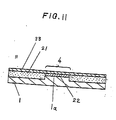
- Fig. 11 is a general cross-sectional view of a seventh embodiment of an electron emission element according to the present invention, in which numeral 1 denotes an electrically conducting layer, 22 denotes an electrically insulating layer which is formed as a thin film, 21 denotes an electrically insulating layer, 33 denotes a metal layer which is formed as a thin film, and 4 denotes an electron emission region of the metal layer 33
- the conducting layer 1 is formed with an upwardly protruding portion 1a, over which is formed the thin insulating layer 22.
- the insulating layer 21 is formed on regions of the conducting layer 1 outside of the aforementioned upwardly protruding portion 1a of the conducting layer 7, with the upper surface of the insulating layer 21 being coplanar with the upper surface of the insulating layer 22.
- the metal layer 33 is formed as a continuous layer over the insulating layer 22 and insulating layer 21. When a voltage is applied by connecting the metal layer 33 to a positive potential and the conducting layer 1 to a negative potential, a strong electric field is formed in the insulating layer 22, immediately below the electron emission region 4. Electrons are thereby drawn out of the conducting layer 1, and as a result of the tunnelling phenomenon within the insulating layer 22, the electrons pass into the metal layer 33. Those electrons which have an energy that is greater than the work function of the metal layer 33 are emitted from the electron emission region 4.
- the insulating layer 22 and the metal layer 33 can easily be formed as a respective uniform thin films, so that stable electron emission characteristics can be obtained.
- an array consisting of a plurality of such electron emission elements is formed, then uniformity of electrical characteristics for the respective electron emission elements of the array can be ensured.
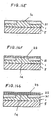
- a method of manufacture for such an electron emission element will be described referring to Figs 12A to 12G.
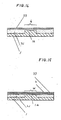
- a layer of a metal such as Al or Ta is formed by a process such as resistive heating evaporative deposition, electron beam evaporative deposition, or sputtering deposition, to a thickness of 0.1 to 1 ⁇ m approximately, upon a surface of a glass substrate 5, to thereby form an electrically conducting layer 1 (Fig 12A).
- a layer of photoresist 7 is formed by the usual photolithographic process on the insulating layer 1 (Fig. 12B) .
- Etching of the conducting layer 1 is then executed to a depth d, where d is for example 0.05 to 0.5 ⁇ m approximately.
- FIG. 13 An eighth embodiment of an electron emission element according to the present invention will be described, referring to the general cross-sectional view of Fig. 13, in which numeral 5 denotes a substrate, 1 denotes an electrically conducting layer, 21 denotes an electrically insulating layer, 22 denotes a thin-film electrically insulating layer, 33 denotes a thin-film metal layer.
- the method of manufacture of such an electron emission element is as follows.
- the conducting layer 1 is formed on a predetermined region of the substrate 5, the thin insulating layer 22 is then formed on the conducting layer 1, and the insulating layer 21 is formed on a specific region of the substrate 5 other than the region in which the conducting layer 1 is formed.
- the insulating layer 21 is formed such that the upper surface thereof is co-planar with the upper surface of the thin insulating layer 22.
- a thin metal layer 33 is then formed over both the insulating layers 21 and 22.
- the respective upper surfaces of the thin first insulating layer 22 and the second insulating layer 21 are co-planar, with no step changes in height.
- the thin metal layer 33 that is formed thereon is completely flat and of uniform thickness.
- the formation of internal defects in the metal layer 33 can be prevented, so that high reliability and stability of operation is obtained. If an array of such electron emission elements is manufactured by the above process, a high degree of uniformity of characteristics of the respective elements of the array can be obtained, together with a high degree of electron emission efficiency.
- Fig. 14 shows a general cross-sectional view of a ninth embodiment of an electron emission element according to the present invention.
- the configuration of this electron emission element is: conducting layer (conducting material) 1 - insulating layer 21 - metal layer 33.
- the conducting layer 1 has an upwardly protruding portion 1a.
- the insulating layer 21, which is sandwiched between the conducting layer 1 and the metal layer 33, is formed such that an upper surface thereof extends over both the upwardly protruding portion 1a of the conducting layer 1 and the remaining region of the conducting layer 1.
- the upwardly protruding portion 1a corresponds in position to an electron emission region 4.
- the metal layer 33 is formed over an electrically insulating layer (21 or 22) having a flat surface.
- the metal layer 33 is thereby formed with a flat surface, and of uniform thickness. As a result, the formation of internal defects in the metal layer 33 can be prevented, so that high reliability of electrical conduction within that layer and stability of electron emission are obtained.
- a layer of photoresist 7 is formed selectively on a portion of the conducting layer 1 that corresponds to the electron emission region.
- the photoresist 7 is formed by the usual photo-lithography method.
- the metal layer 33 is formed as a layer of Au, Al, Mo, W, etc, over the flat surface of the second insulating layer 22, to thereby complete the formation of the electron emission element.
- the metal layer 33 is formed by a process such as resistive heating evaporative deposition, vacuum evaporative deposition, CVD, MBE, ion beam deposition, etc, and is preferably formed to a thickness of 50 to 200 ⁇ .
- the upwardly protruding portion 1a of the insulating layer 1 defines the electron emission region 4.
- the upwardly protruding portion 1a can be formed to any desired shape, by a process such as etching, and hence the shape of an electron beam that is formed of the electrons produced from the electron emission region can be made of any arbitrary form.
- Fig. 17 shows a general cross-sectional view of an eleventh embodiment of an electron emission element according to the present invention.
- the configuration of this electron emission is basically: electrically insulating substrate 5 - electrically conducting layer (or conducting body) 1 - electrically insulating layer 21 - metal layer 33.
- the conducting layer 1 is formed on a region of the insulating substrate 5, of specific shape and position.
- the insulating layer 21 that is sandwiched between the conducting layer 1 and the metal layer 33 is configured such as to cover both a region of the surface of the insulating substrate 5 that is not covered by the conducting layer 1 and also the surface of the conducting layer 1, and is formed with a flat upper surface.
- the upper surface of the conducting layer 1 defines the shape and position of the electron emission region 4.
- Fig. 18 shows a general cross-sectional view of a twelfth embodiment of an electron emission element according to the present invention.
- the configuration is basically: insulating substrate 31 - electrically conducting layer 1 - electrically insulating layers 21, 22 - metal layer 33.
- the insulating layers that are sandwiched between the conducting layer 1 and the metal layer 33 consist of a first insulating layer 21 which covers a region of the substrate 31 that is not covered by the conducting layer 1 and which has an upper surface that is co-planar with the upper surface of the conducting layer 1, and a second insulating layer 22 which covers the upper surfaces of both the first insulating layer 21 and the conducting layer 1.
- the electron emission region 4 is defined by the area of intersection between the conducting layer 1 and the metal layer 33.
- the metal layer 33 is formed over a flat upper surface of the insulating layers 21, 22, thereby ensuring that the metal layer 33 can be made of precisely uniform thickness, with no variations in height, so that a high degree of reliability of electrical conduction within that metal layer is obtained.
- the conducting layer 1 that is formed on a region of a surface of the substrate 5 defines the shape and position of the electron emission region 4. Since the shape (i.e. as seen in plan) of the conducting layer 1 can be freely selected, any arbitrary shape can be selected for an electron beam that is formed from the electrons that are emitted from the electron emission region.
- the metal layer 33 it is not essential that the metal layer 33 be formed above the entire upper surface of the upwardly protruding portion 1a of the conducting layer 1, and that it would be equally possible to arrange that the metal layer 33 is formed over only a portion of the upwardly protruding portion 1a. In that case, the electron emission region would be defined by the region of intersection of the upwardly protruding portion 1a and the metal layer 33, as viewed in plan.
- a metal layer 33 is formed over a completely flat surface of an electrically insulating layer (21 or 22) .
- the metal layer 33 can be made completely flat and of uniform thickness, ensuring that a high degree of reliability of electrical conduction within that metal layer is achieved, together with stable and uniform electron emission throughout the electron emission region.
- any arbitrary shape of the electron emission region can be easily selected, the shape of the beam spot of an electron beam produced by utilizing such an electron emission element can be easily determined in accordance with a specific application. Thus these embodiments are highly practical.
- An MIM type of electron emission element having a thin insulating film (2) formed below an electron emission region (4) of a metal layer (3), with that electron emission region of the metal layer consisting of an array of thick and thin portions (3a, 3b), distributed throughout the electron emission region. Improved efficiency and uniformity of of emission are obtained, due to the low resistance of the thick portions, which effectively apply a supply voltage to the thin portions of the metal layer, while the thin portions can be made sufficiently thin to maximize the electron emission level.
Landscapes
- Engineering & Computer Science (AREA)
- Chemical & Material Sciences (AREA)
- Nanotechnology (AREA)
- Manufacturing & Machinery (AREA)
- Physics & Mathematics (AREA)
- Mathematical Physics (AREA)
- Theoretical Computer Science (AREA)
- Crystallography & Structural Chemistry (AREA)
- Cold Cathode And The Manufacture (AREA)
Applications Claiming Priority (10)
| Application Number | Priority Date | Filing Date | Title |
|---|---|---|---|
| JP63274852A JPH02121227A (ja) | 1988-10-31 | 1988-10-31 | 電子放出素子及びその製造方法 |
| JP274852/88 | 1988-10-31 | ||
| JP63278702A JPH02126531A (ja) | 1988-11-04 | 1988-11-04 | 電子放出素子 |
| JP278707/88 | 1988-11-04 | ||
| JP63278707A JPH02126532A (ja) | 1988-11-04 | 1988-11-04 | 電子放出素子 |
| JP278702/88 | 1988-11-04 | ||
| JP324107/88 | 1988-12-22 | ||
| JP63324107A JPH02170327A (ja) | 1988-12-22 | 1988-12-22 | 電子放出素子 |
| JP326613/88 | 1988-12-23 | ||
| JP63326613A JPH02172127A (ja) | 1988-12-23 | 1988-12-23 | 電子放出素子およびその製造方法 |
Publications (2)
| Publication Number | Publication Date |
|---|---|
| EP0367195A2 true EP0367195A2 (fr) | 1990-05-09 |
| EP0367195A3 EP0367195A3 (fr) | 1991-10-02 |
Family
ID=27530596
Family Applications (1)
| Application Number | Title | Priority Date | Filing Date |
|---|---|---|---|
| EP19890120124 Withdrawn EP0367195A3 (fr) | 1988-10-31 | 1989-10-30 | Eléments émetteurs d'électrons à cathode froide MIM et leurs procédés de fabrication |
Country Status (2)
| Country | Link |
|---|---|
| US (1) | US5202605A (fr) |
| EP (1) | EP0367195A3 (fr) |
Cited By (11)
| Publication number | Priority date | Publication date | Assignee | Title |
|---|---|---|---|---|
| EP0394698A3 (fr) * | 1989-03-30 | 1991-10-02 | Canon Kabushiki Kaisha | Machine de lithographie à rayons cathodiques et dispositif d'affichage |
| EP0878820A3 (fr) * | 1997-05-15 | 1998-12-09 | Pioneer Electronic Corporation | Dispositif émetteur d'électrons et dispositif d'affichage utilisant celui-ci |
| EP0878819A3 (fr) * | 1997-05-15 | 1998-12-09 | Pioneer Electronic Corporation | Dispositif émetteur d'électrons et dispositif d'affichage utilisant celui-ci |
| WO1999065050A1 (fr) * | 1998-06-11 | 1999-12-16 | Petr Viscor | Emetteur d'electrons plan |
| EP1117117A1 (fr) * | 2000-01-14 | 2001-07-18 | Pioneer Corporation | Dispositif de prise d'images comprenant des dispositifs émetteurs d'électrons |
| EP1117118A1 (fr) * | 2000-01-13 | 2001-07-18 | Pioneer Corporation | Dispositif émetteur d'électrons et procédé de fabrication et appareil d'affichage utilisant ce dispositif |
| EP1302964A1 (fr) * | 2001-10-12 | 2003-04-16 | Hewlett-Packard Company | Emetteurs d'électrons à structure mis/mim, améliorés par champ électrique |
| EP1251503A3 (fr) * | 2001-04-16 | 2004-09-08 | Hewlett-Packard Company | Dispositif de stockage de données |
| US6872964B2 (en) | 2003-08-20 | 2005-03-29 | Hewlett-Packard Development Company, L.P. | Data storage device |
| EP1220279A3 (fr) * | 2000-12-28 | 2006-03-22 | Pioneer Corporation | Dispositif d'affichage à écran plat utilisant des dispositifs émetteurs d'électrons |
| EP1523025B1 (fr) * | 2002-03-25 | 2012-12-19 | Panasonic Corporation | Source d'électrons à émission de champ |
Families Citing this family (6)
| Publication number | Priority date | Publication date | Assignee | Title |
|---|---|---|---|---|
| GB9702348D0 (en) * | 1997-02-05 | 1997-03-26 | Smiths Industries Plc | Electron emitter devices |
| JP3765671B2 (ja) * | 1998-08-10 | 2006-04-12 | パイオニア株式会社 | 電子放出素子及びこれを用いた電子放出表示装置 |
| JP3863325B2 (ja) * | 1999-09-10 | 2006-12-27 | 株式会社日立製作所 | 画像表示装置 |
| US6738336B2 (en) * | 2001-05-16 | 2004-05-18 | Hewlett-Packard Development Company, L.P. | Data storage device |
| US20050017624A1 (en) * | 2003-07-23 | 2005-01-27 | Thomas Novet | Electron emitter with epitaxial layers |
| DE102010043277A1 (de) | 2010-11-03 | 2012-05-03 | Robert Bosch Gmbh | Mikroelektromechanischer Sensor zur Messung einer Kraft sowie entsprechendes Verfahren |
Family Cites Families (11)
| Publication number | Priority date | Publication date | Assignee | Title |
|---|---|---|---|---|
| US3325733A (en) * | 1960-12-27 | 1967-06-13 | Jerome H Lemelson | Measuring device using variable thickness thin film tunneling layer |
| US3184636A (en) * | 1961-06-15 | 1965-05-18 | Sylvania Electric Prod | Cold cathode |
| DE1252818B (fr) * | 1962-03-22 | 1900-01-01 | ||
| US3184659A (en) * | 1962-08-13 | 1965-05-18 | Gen Telephone & Elect | Tunnel cathode having a metal grid structure |
| US3447043A (en) * | 1966-12-29 | 1969-05-27 | Itt | Tunnel cathode in matrix form with integral storage feature |
| DE1589822A1 (de) * | 1967-04-26 | 1970-03-26 | Gentsch Dr Horst | Emitter-Diode zur Erzeugung von Ionen und freien Elektronen |
| BE716262A (fr) * | 1967-07-25 | 1968-11-04 | ||
| JPS62272421A (ja) * | 1986-05-20 | 1987-11-26 | Canon Inc | 電子放出素子 |
| JPH0736453B2 (ja) * | 1986-06-11 | 1995-04-19 | 株式会社リコー | 金属−絶縁物−金属型素子 |
| JPH0797475B2 (ja) * | 1986-06-25 | 1995-10-18 | キヤノン株式会社 | 電子放出素子 |
| JPS636717A (ja) * | 1986-06-26 | 1988-01-12 | Canon Inc | 電子放出装置 |
-
1989
- 1989-10-30 EP EP19890120124 patent/EP0367195A3/fr not_active Withdrawn
- 1989-10-31 US US07/429,526 patent/US5202605A/en not_active Expired - Fee Related
Cited By (17)
| Publication number | Priority date | Publication date | Assignee | Title |
|---|---|---|---|---|
| US5569974A (en) * | 1989-03-30 | 1996-10-29 | Canon Kabushiki Kaisha | Electron-emitting device and electron beam lithograph machine and image display apparatus making use of it |
| EP0394698A3 (fr) * | 1989-03-30 | 1991-10-02 | Canon Kabushiki Kaisha | Machine de lithographie à rayons cathodiques et dispositif d'affichage |
| US6147443A (en) * | 1997-05-15 | 2000-11-14 | Pioneer Electronic Corporation | Electron emission device and display device using the same |
| EP0878820A3 (fr) * | 1997-05-15 | 1998-12-09 | Pioneer Electronic Corporation | Dispositif émetteur d'électrons et dispositif d'affichage utilisant celui-ci |
| EP0878819A3 (fr) * | 1997-05-15 | 1998-12-09 | Pioneer Electronic Corporation | Dispositif émetteur d'électrons et dispositif d'affichage utilisant celui-ci |
| AU755927B2 (en) * | 1998-06-11 | 2003-01-02 | Armin Delong | Planar electron emitter (PEE) |
| WO1999065050A1 (fr) * | 1998-06-11 | 1999-12-16 | Petr Viscor | Emetteur d'electrons plan |
| US7399987B1 (en) | 1998-06-11 | 2008-07-15 | Petr Viscor | Planar electron emitter (PEE) |
| EP1117118A1 (fr) * | 2000-01-13 | 2001-07-18 | Pioneer Corporation | Dispositif émetteur d'électrons et procédé de fabrication et appareil d'affichage utilisant ce dispositif |
| EP1117117A1 (fr) * | 2000-01-14 | 2001-07-18 | Pioneer Corporation | Dispositif de prise d'images comprenant des dispositifs émetteurs d'électrons |
| US6744063B2 (en) | 2000-01-14 | 2004-06-01 | Pioneer Corporation | Image pickup device including electron-emitting devices |
| EP1220279A3 (fr) * | 2000-12-28 | 2006-03-22 | Pioneer Corporation | Dispositif d'affichage à écran plat utilisant des dispositifs émetteurs d'électrons |
| EP1251503A3 (fr) * | 2001-04-16 | 2004-09-08 | Hewlett-Packard Company | Dispositif de stockage de données |
| EP1302964A1 (fr) * | 2001-10-12 | 2003-04-16 | Hewlett-Packard Company | Emetteurs d'électrons à structure mis/mim, améliorés par champ électrique |
| US6822380B2 (en) | 2001-10-12 | 2004-11-23 | Hewlett-Packard Development Company, L.P. | Field-enhanced MIS/MIM electron emitters |
| EP1523025B1 (fr) * | 2002-03-25 | 2012-12-19 | Panasonic Corporation | Source d'électrons à émission de champ |
| US6872964B2 (en) | 2003-08-20 | 2005-03-29 | Hewlett-Packard Development Company, L.P. | Data storage device |
Also Published As
| Publication number | Publication date |
|---|---|
| EP0367195A3 (fr) | 1991-10-02 |
| US5202605A (en) | 1993-04-13 |
Similar Documents
| Publication | Publication Date | Title |
|---|---|---|
| US5202605A (en) | Mim cold-cathode electron emission elements | |
| US5556316A (en) | Clustered field emission microtips adjacent stripe conductors | |
| EP1113478B1 (fr) | Dispositif d'émission de champ à structure triode | |
| EP0495436B1 (fr) | Transistor à interférence de phases quantiques | |
| US5541466A (en) | Cluster arrangement of field emission microtips on ballast layer | |
| US6417606B1 (en) | Field emission cold-cathode device | |
| US6281621B1 (en) | Field emission cathode structure, method for production thereof, and flat panel display device using same | |
| US5394006A (en) | Narrow gate opening manufacturing of gated fluid emitters | |
| US5569975A (en) | Cluster arrangement of field emission microtips | |
| JPH0636680A (ja) | ダイヤモンドフイルム電子源を用いた電子素子 | |
| KR100366805B1 (ko) | 전계 방사형 전자원 및 그 제조방법과 사용법 | |
| US5378182A (en) | Self-aligned process for gated field emitters | |
| KR100750411B1 (ko) | 반도체 디바이스 제조 방법 | |
| US5847496A (en) | Field emission device including a resistive layer | |
| EP0633594A1 (fr) | Elément d'émission de champ pourvu d'une cathode avec un rayon petit et procédé de fabrication de cet élément | |
| US5717278A (en) | Field emission device and method for fabricating it | |
| US5557159A (en) | Field emission microtip clusters adjacent stripe conductors | |
| US6084245A (en) | Field emitter cell and array with vertical thin-film-edge emitter | |
| US5727976A (en) | Method of producing micro vacuum tube having cold emitter | |
| US5791961A (en) | Uniform field emission device | |
| JP3033178B2 (ja) | 電界放出型エミッタ | |
| US20020190622A1 (en) | Field emitter cell and array with vertical thin-film-edge emitter | |
| JP3539305B2 (ja) | 電界放射型電子源およびその製造方法 | |
| EP0713236A1 (fr) | Dispositif émitteur d'électrons | |
| JPH02172127A (ja) | 電子放出素子およびその製造方法 |
Legal Events
| Date | Code | Title | Description |
|---|---|---|---|
| PUAI | Public reference made under article 153(3) epc to a published international application that has entered the european phase |
Free format text: ORIGINAL CODE: 0009012 |
|
| 17P | Request for examination filed |
Effective date: 19891030 |
|
| AK | Designated contracting states |
Kind code of ref document: A2 Designated state(s): DE FR GB |
|
| PUAL | Search report despatched |
Free format text: ORIGINAL CODE: 0009013 |
|
| AK | Designated contracting states |
Kind code of ref document: A3 Designated state(s): DE FR GB |
|
| 17Q | First examination report despatched |
Effective date: 19930928 |
|
| STAA | Information on the status of an ep patent application or granted ep patent |
Free format text: STATUS: THE APPLICATION IS DEEMED TO BE WITHDRAWN |
|
| 18D | Application deemed to be withdrawn |
Effective date: 19940209 |