EP0367220B1 - Préparation d'albumine et son procédé d'obtention - Google Patents
Préparation d'albumine et son procédé d'obtention Download PDFInfo
- Publication number
- EP0367220B1 EP0367220B1 EP89120186A EP89120186A EP0367220B1 EP 0367220 B1 EP0367220 B1 EP 0367220B1 EP 89120186 A EP89120186 A EP 89120186A EP 89120186 A EP89120186 A EP 89120186A EP 0367220 B1 EP0367220 B1 EP 0367220B1
- Authority
- EP
- European Patent Office
- Prior art keywords
- albumin
- polymer
- haptoglobin
- solution
- preparation
- Prior art date
- Legal status (The legal status is an assumption and is not a legal conclusion. Google has not performed a legal analysis and makes no representation as to the accuracy of the status listed.)
- Revoked
Links
Images

Classifications
-
- A—HUMAN NECESSITIES
- A61—MEDICAL OR VETERINARY SCIENCE; HYGIENE
- A61K—PREPARATIONS FOR MEDICAL, DENTAL OR TOILETRY PURPOSES
- A61K38/00—Medicinal preparations containing peptides
-
- C—CHEMISTRY; METALLURGY
- C07—ORGANIC CHEMISTRY
- C07K—PEPTIDES
- C07K14/00—Peptides having more than 20 amino acids; Gastrins; Somatostatins; Melanotropins; Derivatives thereof
- C07K14/435—Peptides having more than 20 amino acids; Gastrins; Somatostatins; Melanotropins; Derivatives thereof from animals; from humans
- C07K14/76—Albumins
- C07K14/765—Serum albumin, e.g. HSA
-
- A—HUMAN NECESSITIES
- A61—MEDICAL OR VETERINARY SCIENCE; HYGIENE
- A61L—METHODS OR APPARATUS FOR STERILISING MATERIALS OR OBJECTS IN GENERAL; DISINFECTION, STERILISATION OR DEODORISATION OF AIR; CHEMICAL ASPECTS OF BANDAGES, DRESSINGS, ABSORBENT PADS OR SURGICAL ARTICLES; MATERIALS FOR BANDAGES, DRESSINGS, ABSORBENT PADS OR SURGICAL ARTICLES
- A61L2/00—Disinfection or sterilisation of materials or objects, in general; Accessories therefor
- A61L2/02—Disinfection or sterilisation of materials or objects, in general; Accessories therefor using physical processes
- A61L2/04—Heat
-
- A—HUMAN NECESSITIES
- A61—MEDICAL OR VETERINARY SCIENCE; HYGIENE
- A61P—SPECIFIC THERAPEUTIC ACTIVITY OF CHEMICAL COMPOUNDS OR MEDICINAL PREPARATIONS
- A61P7/00—Drugs for disorders of the blood or the extracellular fluid
-
- A—HUMAN NECESSITIES
- A61—MEDICAL OR VETERINARY SCIENCE; HYGIENE
- A61P—SPECIFIC THERAPEUTIC ACTIVITY OF CHEMICAL COMPOUNDS OR MEDICINAL PREPARATIONS
- A61P9/00—Drugs for disorders of the cardiovascular system
-
- A—HUMAN NECESSITIES
- A61—MEDICAL OR VETERINARY SCIENCE; HYGIENE
- A61L—METHODS OR APPARATUS FOR STERILISING MATERIALS OR OBJECTS IN GENERAL; DISINFECTION, STERILISATION OR DEODORISATION OF AIR; CHEMICAL ASPECTS OF BANDAGES, DRESSINGS, ABSORBENT PADS OR SURGICAL ARTICLES; MATERIALS FOR BANDAGES, DRESSINGS, ABSORBENT PADS OR SURGICAL ARTICLES
- A61L2103/00—Materials or objects being the target of disinfection or sterilisation
- A61L2103/05—Living organisms or biological materials
Definitions
- This invention relates to an albumin preparation and a process for preparing the same. More particularly, it relates to a serum albumin preparation having a reduced content of agglomerates and a reduced content of contaminating proteins and to a process for preparing the same.
- Serum albumin is present in blood plasma in a proportion higher than any other plasma protein and functions to maintain an osmotic pressure or to carry nutrients, metabolites, etc. as a combination therewith in blood.
- Preparations containing serum albumin are used in the treatment of hypoalbuminemia, hemorrhagic shock, etc. caused by albumin depletion or reduction of albumin biosynthesis.
- a heat treatment of an albumin-containing aqueous solution is generally carried out.
- commercially available albumin preparations obtained from the thus treated albumin aqueous solution contain agglomerates (hereinafter referred to as polymers as such agglomerates are commonly called) which have been formed during preparation. From the fact that no substantial polymers are found before the above-described heat treatment, it is believed that heat-labile proteins are partially denatured by the heat treatment to form polymers.
- the commercially available albumin preparations have been widely used with safety, these polymers are not regarded particularly harmful to human bodies. However, it is desired that the preparations contain no polymers because the polymers are heat denaturation products.
- albumin preparations also contain ⁇ 1 -acid glycoprotein (hereinafter referred to as ⁇ 1 -AGP), having an immunosuppressive activity, as an impurity.
- ⁇ 1 -AGP is a protein somewhat similar to albumin in physicochemical properties and, therefore, it is difficult to efficiently separate ⁇ 1 -AGP from albumin by commonly employed means, such as fractionation.
- usual albumin preparations contain residual ⁇ 1 -AGP having an immunosuppressive activity, and it is desired to remove ⁇ 1 -AGP from the preparations to the extent possible.
- FR 2327256 discloses albumin having a purity of not less than 96% and a polymer content of not more than 3.5% D1 does not describe the possibility of contamination with haptoglobin, ⁇ 1 -AGP and prealbumin. D1 also discloses an anion exchanger treatment at pH 4.5 to 4.9 for purification of albumin.
- EP 121 468 discloses that albumin having a purity of 100% can be prepared. However, it is described in Example 5 that ⁇ 1 -anti-trypsin and haptoglobin were detected in the purified albumin. D2 also discloses an anion exchanger treatment at pH 4.4 to 4.8 for purification of albumin.
- DE 2537123 discloses an anion exchanger treatment at pH 6.5 for purification of albumin, in which DEAE-cellulose named Protion is used as an anion exchanger.
- US 4228154 discloses the preparation of albumin having a maximal purity of 98.9%, but there is no description of a polymer content and the possibility of contamination with haptoglobin, ⁇ 1 -AGP and prealbumin.
- D4 also discloses an anion exchanger treatment at pH 4.7 for purification of albumin.
- US 4075197 discloses the preparation of albumin having a purity of 95.2%, but does not disclose a polymer content and contamination with haptoglobin, ⁇ 1 -AGP and prealbumin.
- D5 also discloses an anion exchanger treatment for purification of albumin, which comprises allowing albumin to be adsorbed by an anion exchanger at pH 5.0 to 5.5 and eluting the albumin at pH 3.5 to 4.5.
- J.M. Curling (Methods of Plasma Protein Fractionation, Ed. J. M. Curling, Acedemic Press, London, 1980, pages 77-91) discloses an anion exchanger treatment for purification of albumin, which comprises allowing albumin to be adsorbed by an anion exchanger at pH 5.2 and eluting the albumin at pH 4.5.
- An object of this invention is to provide an albumin preparation having a reduced polymer content and a reduced ⁇ 1 -AGP content.
- Another object of this invention is to provide a process for preparing the above-described albumin preparation.
- the present invention relates to an albumin preparation having a polymer content of not more than 3% by weight based on the serum albumin content and an ⁇ 1 -AGP content of less than 4 mg/dl in a 25% adjusted serum albumin solution.
- the present invention also relates to a process for preparing an albumin preparation in which a polymer-forming factor comprising proteins having an isoelectric point lower than that of albumin and mainly comprising haptoglobin is removed which comprises subjecting a serum albumin aqueous solution to a step removing said polymer forming factor present in the solution, said step being carried out by at least one of ion exchange separation at a pH between 4.9 to 5.5 using an ion exchanger and affinity chromatography, and then subjecting the solution to a heat treatment sufficient to inactivate virus.
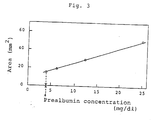
- Figures 1 to 3 each shows a standard curve obtained by primary immunodiffusion against ⁇ 1 -acid glycoprotein, haptoglobin, and prealbumin, respectively.
- Albumin which is the main ingredient of the preparation according to the present invention and also a starting material to be used in the process according to the present invention, is not particularly limited in its origin and includes albumin obtained from mammals, e.g., humans, cattle, rabbits, etc., with human-origin albumin being preferred.
- the starting material for preparing albumin includes the Fraction V obtained by Cohn's cold alcohol fractionation.
- the albumin preparation of the present invention can be obtained by subjecting an albumin-containing aqueous solution to a step of removing a polymer-forming factor present in the solution and then subjecting the solution to a heat treatment.
- the albumin-containing aqueous solution is usually adjusted to have an albumin content of from 0.1 to 30% (weight/volume, hereinafter the same unless otherwise specified), preferably from about 1 to 10%.
- the polymer-forming factor e.g., haptoglobin
- ⁇ 1 -AGP which have an isoelectric point lower than that of albumin
- suitable techniques include ion exchange separation using an anion exchanger and affinity chromatography.
- Haptoglobin the main component of the polymer-forming factor, is hardly separated from albumin by fractionation because of its relative similarity to albumin in physicochemical properties.
- any insoluble carrier e.g., dextran (Sephadex®, etc.) agarose (Sepharose®, etc.) cellulose (Cellulofine®, etc.), polyacrylamide, vinylpolymer (Toyopearl®, etc.) having an anion exchange group (e.g., dietylaminoethyl (DEAE) group, quarternarized amino ethyl group (QAE)) which is commonly employed in the art can be used.
- DEAE dietylaminoethyl
- QAE quarternarized amino ethyl group
- anion exchangers are DEAE-Sephadex®, QAE-Sephadex®, DEAE-Sepharose® and Q-Sepharose® (produced by Pharmacia); DEAE-Toyopearl® and QAE-Toyopearl® (produced by Tosoh); A200 Cellulofine® (produced by Seikagaku Kogyo Co., Ltd.); and anion exchange resins. From the standpoint of polymer-forming factor removal efficiency, strong anion exchangers, e.g., Q-Sepharose® and QAE-Toyopearl®, are preferred.
- Removal of the polymer-forming factor by using an anion exchanger can be effected by bringing the albumin-containing aqueous solution into contact with the anion exchanger.
- the amount of the anion exchanger to be used is selected appropriately depending on the polymer-forming factor content in the albumin aqueous solution, exchange capacity of the anion exchanger, and the like, usually ranging from 2 to 5 ml, particularly about 3 ml, per gram of albumin.
- the contact may be carried out either in a column system (ion exchange chromatography) or in a batch system, with the latter being preferred in view of removal efficiency.
- an albumin aqueous solution is adjusted so as to have a pH between 4.9 and 5.5, more preferably 5.1, and a salt concentration of from 0.001 to 0.2M, preferably from 0.001 to 0.05M.
- the column is then developed with the eluent, and the non-adsorbed fraction is collected.
- these procedures are preferably carried out at low temperatures, usually 10°C or lower, not less than 0°C.
- an anion exchanger is added to an albumin aqueous solution having been adjusted in the same manner as described above, and the system is mixed at a temperature of 10°C or less for about 30 minutes to 2 hours.
- the anion exchanger is then separated by appropriate means, such as centrifugation, and the supernatant liquor is recovered.
- the carrier to be used is an insoluble carrier to which a substance exhibiting specific affinity for the polymer-forming factor, e.g., haptoglobin, is immobilized (hereinafter referred to as affinity carrier).
- affinity carrier a substance exhibiting specific affinity for the polymer-forming factor
- suitable insoluble carriers are cellulose, agarose and dextran.
- the substance having specific affinity for the polymer-forming factor, e.g., haptoglobin is selected according to the kind of the contaminating proteins. For example, an anti-haptoglobin antibody or hemoglobin is used for haptoglobin, and an anti- ⁇ 1 -AGP antibody is used for ⁇ 1 -AGP.
- These antibodies can be prepared by known antibody production techniques. Bonding between the substance having a specific affinity and the insoluble carrier can be carried out in a usual manner. For example, agarose, e.g., Sepharose®, activated by cyanogen bromide is swollen, and a substance having a specific affinity is coupled with the insoluble carrier in a basic buffer, followed by thoroughly washing with a buffer to obtain an affinity carrier.
- agarose e.g., Sepharose®
- activated by cyanogen bromide is swollen, and a substance having a specific affinity is coupled with the insoluble carrier in a basic buffer, followed by thoroughly washing with a buffer to obtain an affinity carrier.
- Affinity chromatography is performed by contacting an albumin-containing aqueous solution containing the polymer-forming factor, e.g., haptoglobin, with the affinity carrier.
- the albumin-containing aqueous solution may be contacted with an affinity carrier to which a plurality of substances each having a specific affinity for the respective contaminating protein are immobilized; or it may be first contacted with an affinity carrier to which a substance having a specific affinity for haptoglobin is immobilized and then with an affinity carrier to which a substance having a specific affinity for ⁇ 1 -AGP is immobilized, if desired, followed by contact with other affinity carriers having specific affinities for other contaminating proteins.
- the amount of the affinity carrier to be used ranges from 2 to 5 ml, usually about 4 ml, per gram of albumin, though depending on the content of the polymer-forming factor, e.g., haptoglobin, in the albumin-containing aqueous solution and adsorption capacity of the affinity carrier. From the viewpoint of efficiency in removal of the polymer-forming factor, it is preferable to carry out affinity chromatography in a column.
- the albumin-containing aqueous solution is adjusted to a pH of from about 4.0 to 9.0, preferably from 5.0 to 8.0, more preferably 6.8, and passed through a column packed with the above-described affinity carrier having been equilibrated with a solvent used for dissolving albumin. If desired, the column is washed with the solvent for dissolving albumin to recover the non-adsorbed fraction. To inhibit denaturation of albumin, these procedures are preferably conducted at low temperatures (usually 10°C or less).
- the contaminating proteins can thus be removed to obtain an albumin-containing aqueous solution having its polymer-forming factor content reduced.
- the albumin-containing aqueous solution having the thus reduced content of the polymer-forming factor is adjusted to have an appropriate concentration and formulated into any desired dose form, for example, charged into vials, followed by a heat treatment for deactivation of viruses.
- the heat treatment is generally given to an aqueous solution having an albumin concentration of from about 5 to 30% (w/v), usually about 5% (w/v) or from about 20 to 25% (w/v).
- the heat treatment is carried out under temperature and time conditions selected so as to sufficiently deactivate viruses, for example, at 50 to 70°C, preferably about 60°C, for 5 to 20 hours, preferably about 10 hours.
- a stabilizer for albumin e.g., sodium N-acetyltryptophan and sodium caprylate, may be added either alone or as a mixture thereof to the albumin-containing aqueous solution to be heat-treated.
- the albumin stabilizer is added in an amount of from about 20 to 60 mg, preferably about 40 mg, per gram of albumin.
- the thus obtained albumin preparation contains not more than 3% by weight of polymers based on albumin and contains not more than a detectable limit of ⁇ 1 -AGP based on albumin.
- the albumin preparation according to the present invention can be used at the same dose in the same manner as for the conventional albumin preparations.
- the albumin preparations of the present invention have the contaminating viruses deactivated by a heat treatment and the content of polymers and ⁇ 1 -AGP markedly reduced and are, therefore, excellent in safety, stability and the like.
- viruses which may be incorporated into the preparations can be deactivated by a heat treatment, and since heat-labile contaminating proteins which form polymers on heat treating (polymer-forming factor), e.g., haptoglobin, have been removed before the heat treatment, the resulting albumin preparations have reduced content of polymers and contaminating proteins.
- heat-labile contaminating proteins which form polymers on heat treating e.g., haptoglobin
- Fraction V of plasma obtained by Cohn's cold alcohol fractionation was dealcoholized with acetone to obtain an acetone-dried powder, which was then dissolved in water to prepare an aqueous solution having an albumin concentration of 10%.
- the solution was passed through a column of DEAE-Sephadex® equilibrated with 0.02 M sodium acetate (pH 5.1) at 4°C.
- To the effluent were added 20 mM of sodium N-acetyltryptophan and 20 mM of sodium caprylate, and the solution was poured into a vial and heat-treated at 60°C for 10 hours to obtain an albumin preparation.
- the polymer content in the resulting preparation was determined by gel chromatography through 4 replicate runs and was found to be 3.0% or less (relative percent by weight based on the albumin content, hereinafter the same with respect to polymer content).
- an albumin preparation was prepared in the same manner as described above, except that the treatment with DEAE-Sephadex was not conducted.
- the polymer content of the resulting preparation was found to be 6.3% (an average of the results of four replicate runs).
- the substance adsorbed onto DEAE-Sephadex® was eluted with 5 M magnesium chloride solution at room temperature, and the eluate was analyzed by gel chromatography and cellulose acetate electrophoresis.
- the adsorbed substance was found to be proteins mainly comprising haptoglobin.
- 100 mg of human hemoglobin 100 mg of human hemoglobin, and 20 ml of the above obtained swollen gel was added thereto, followed by stirring for 2 hours.
- the gel collected was thoroughly washed with the same basic buffer as used above and equilibrated with a phosphoric acid-buffered sodium chloride aqueous solution to prepare human hemoglobin-immobilized Sepharose.
- the acetone-dried powder of the Fraction V as used in Example 1 was dissolved in water to prepare a 10% albumin aqueous solution, and the solution was adjusted to a pH of 6.8 with sodium carbonate and sodium hydroxide.
- the solution (200 ml) was passed through a column packed with 20 ml of the above prepared Sepharose gel at 4°C, and an effluent was collected in 20 ml fractions.
- Haptoglobin in each of fraction Nos. 2 to 8 was determined by primary immunodiffusion (Mancini test described in Mancini et al., Immunochemistry , Vol. 2, No. 3, pp. 295-254, 1985).
- each fraction sample (5 ml) was concentrated to 2 ml by means of Centricut-50, and 280 ⁇ l of a stabilizer solution containing 36 mg of sodium N-acetyltryptophan and 24 mg of sodium caprylate per ml was added to the concentrate, followed by heating at 60°C for 10 hours to obtain an albumin preparation.
- the polymer content in the preparation was determined by gel chromatography.
- the haptoglobin (Hp) concentration of the effluent and the polymer content of the albumin preparation obtained therefrom are shown in Table 1 below.
- Fraction No. Hp Concentration Polymer content (mg/dl) (%) 2 0 0.94 3 41.8 0.82 4 267.4 2.70 5 377.1 2.87 6 367.9 3.12 7 366.9 3.13 8 392.6 3.01
- Fraction V obtained by Cohn's cold alcohol fractionation 300 g; albumin content: 110.2 g was dissolved in 1.2 l of cold germ-free distilled water, followed by stirring for about 1 hour. After adjusting to a pH of 4.6 with a 10 v/v% acetic acid aqueous solution, the solution was filtered (pore size: 0.45 ⁇ m) at about -2°C. To the filtrate was further added 1.2 l of cold germ-free distilled water, and the solution was adjusted to a pH of 5.1 with 0.8M sodium hydrogencarbonate to prepare an albumin aqueous solution.
- albumin preparation To the adjusted albumin solution was added 39.6 ml of a stabilizer solution containing 5.55 g of sodium N-acetyltryptophan and 3.89 g of sodium caprylate per 100 ml, and the solution was adjusted to a pH of 6.85 with 0.1N sodium hydroxide, followed by sterilization by filtration. After adjusting the albumin concentration to 25%, a prescribed amount of the solution was poured into a vial and heat treated at 60°C for 10 hours to obtain an albumin preparation.
- the polymer content in the resulting preparation was found to be 1.99% by gel chromatography.
- an albumin preparation was obtained in the same manner as described above, except that the treatment with the QAE-Toyopearl column was not conducted.
- the polymer content after the heat treatment was found to be 6.49%, revealing that the polymer content of the albumin preparation according to the present invention is markedly lower than that of the comaprative preparation.
- the contents of contaminating proteins in the adjusted albumin solution and the albumin preparation of the present invention were determined by primary immunodiffusion method (Mancini test) using a gel for primary immunodiffusion prepared using anti- ⁇ 1 -AGP, anti-haptoglobin or anti-prealbumin as an antibody.
- the results obtained are shown in Table 2 below.
- the anti- ⁇ 1 -AGP serum, anti-haptoglobin serum, and anti-prealbumin serum used were prepared from immunized rabbits in a usual manner.
- a standard curve of precipitated ring area formed by the reaction between each of the anti-serum and the corresponding contaminating protein is shown in Figs. 1 to 3.
- the adjusted albumin solution and the albumin preparation according to the present invention have extremely reduced contents of contaminating proteins.
- the detectable limits of haptoglobin, ⁇ 1 -AGP, and prealbumin were 6.5 mg/dl, 4 mg/dl, and 4 mg/dl, respectively.
- Contaminating Protein Content Adjusted Albumin Solution Albumin Preparation Haptoblobin below detectable limit below detectable limit ⁇ 1 -AGP " " Prealbumin " "
Landscapes
- Health & Medical Sciences (AREA)
- Life Sciences & Earth Sciences (AREA)
- Chemical & Material Sciences (AREA)
- General Health & Medical Sciences (AREA)
- Veterinary Medicine (AREA)
- Public Health (AREA)
- Medicinal Chemistry (AREA)
- Animal Behavior & Ethology (AREA)
- Organic Chemistry (AREA)
- Engineering & Computer Science (AREA)
- Bioinformatics & Cheminformatics (AREA)
- Pharmacology & Pharmacy (AREA)
- General Chemical & Material Sciences (AREA)
- Epidemiology (AREA)
- Chemical Kinetics & Catalysis (AREA)
- Proteomics, Peptides & Aminoacids (AREA)
- Nuclear Medicine, Radiotherapy & Molecular Imaging (AREA)
- Zoology (AREA)
- Biophysics (AREA)
- Diabetes (AREA)
- Toxicology (AREA)
- Cardiology (AREA)
- Gastroenterology & Hepatology (AREA)
- Biochemistry (AREA)
- Hematology (AREA)
- Genetics & Genomics (AREA)
- Molecular Biology (AREA)
- Heart & Thoracic Surgery (AREA)
- Immunology (AREA)
- Medicines That Contain Protein Lipid Enzymes And Other Medicines (AREA)
- Peptides Or Proteins (AREA)
Claims (9)
- Procédé de préparation d'une préparation d'albumine dans lequel un facteur formant des polymères et comprenant des protéines ayant un point isoélectrique inférieur à celui de l'albumine et comprenant essentiellement de l'haptoglobine est séparé, lequel procédé comprend la soumission d'une solution aqueuse de sérumalbumine à une étape de séparation dudit facteur formant des polymères présent dans la solution, ladite étape étant mise en .uvre par au moins une séparation par échange d'ions à un pH compris entre 4,9 et 5 au moyen d'un échangeur d'anions et de la chromatographie d'affinité, puis la soumission de la solution à un traitement thermique suffisant pour inactiver les virus.
- Procédé selon la revendication 1, où ladite séparation par échange d'ions ou ladite chromatographie d'affinité est mise en .uvre dans un système à colonne.
- Procédé selon la revendication 1, où est utilisé un échangeur d'anions.
- Procédé selon la revendication 1, où est employée la chromatographie d'affinité utilisant une substance ayant une affinité spécifique pour le facteur formant des polymères.
- Procédé selon la revendication 4, où la substance à affinité spécifique comprend une ou plusieurs substances ayant une affinité spécifique pour l'haptoglobine et l'α1-AGP.
- Procédé selon la revendication 2, lequel est mis en .uvre dans un système par lots.
Applications Claiming Priority (4)
| Application Number | Priority Date | Filing Date | Title |
|---|---|---|---|
| JP277082/88 | 1988-10-31 | ||
| JP27708288 | 1988-10-31 | ||
| JP111681/89 | 1989-04-28 | ||
| JP11168189A JP3554796B2 (ja) | 1988-10-31 | 1989-04-28 | アルブミン製剤及びその製造方法 |
Publications (3)
| Publication Number | Publication Date |
|---|---|
| EP0367220A2 EP0367220A2 (fr) | 1990-05-09 |
| EP0367220A3 EP0367220A3 (fr) | 1991-10-09 |
| EP0367220B1 true EP0367220B1 (fr) | 1998-01-07 |
Family
ID=26451019
Family Applications (1)
| Application Number | Title | Priority Date | Filing Date |
|---|---|---|---|
| EP89120186A Revoked EP0367220B1 (fr) | 1988-10-31 | 1989-10-31 | Préparation d'albumine et son procédé d'obtention |
Country Status (7)
| Country | Link |
|---|---|
| EP (1) | EP0367220B1 (fr) |
| JP (1) | JP3554796B2 (fr) |
| KR (1) | KR100201195B1 (fr) |
| AU (1) | AU624436B2 (fr) |
| CA (1) | CA2001911A1 (fr) |
| DE (1) | DE68928527T2 (fr) |
| ES (1) | ES2110947T3 (fr) |
Cited By (3)
| Publication number | Priority date | Publication date | Assignee | Title |
|---|---|---|---|---|
| US11739166B2 (en) | 2020-07-02 | 2023-08-29 | Davol Inc. | Reactive polysaccharide-based hemostatic agent |
| US12151045B2 (en) | 2020-12-28 | 2024-11-26 | Davol Inc. | Reactive dry powdered hemostatic materials comprising a protein and a multifunctionalized modified polyethylene glycol based crosslinking agent |
| US12161777B2 (en) | 2020-07-02 | 2024-12-10 | Davol Inc. | Flowable hemostatic suspension |
Families Citing this family (20)
| Publication number | Priority date | Publication date | Assignee | Title |
|---|---|---|---|---|
| JPH0768137B2 (ja) * | 1989-06-15 | 1995-07-26 | 株式会社ミドリ十字 | アルブミン製剤及びその製法 |
| US5250662A (en) * | 1989-10-05 | 1993-10-05 | Alpha Therapeutic Corporation | Albumin purification |
| CA2022165C (fr) * | 1989-10-05 | 1999-11-23 | Chong E. Chang | Purification d'albumine |
| JP2949846B2 (ja) * | 1990-11-30 | 1999-09-20 | 吉富製薬株式会社 | アルブミン製剤の保存方法 |
| FR2672604B1 (fr) * | 1991-02-07 | 1995-05-05 | Pasteur Merieux Serums Vacc | Procede pour isoler de l'albumine humaine a partir du surnageant iv, notamment iv-4, ou de la fraction v de cohn ou d'un surnageant ou fraction analogue. |
| FR2690444B1 (fr) * | 1992-04-22 | 1995-07-13 | Rucheton Marcel | Procede de preparation d'une solution d'albumine plasmatique purifiee. |
| US5521287A (en) * | 1992-05-20 | 1996-05-28 | The Green Cross Corporation | Recombinant human serum albumin, process for producing the same and pharmaceutical preparation containing the same |
| JPH07102148B2 (ja) * | 1992-05-20 | 1995-11-08 | 株式会社ミドリ十字 | 遺伝子操作により得られるヒト血清アルブミンの製造方法、およびそれにより得られるヒト血清アルブミン含有組成物 |
| US5440018A (en) * | 1992-05-20 | 1995-08-08 | The Green Cross Corporation | Recombinant human serum albumin, process for producing the same and pharmaceutical preparation containing the same |
| US5728553A (en) * | 1992-09-23 | 1998-03-17 | Delta Biotechnology Limited | High purity albumin and method of producing |
| JPH07126182A (ja) * | 1993-10-27 | 1995-05-16 | Green Cross Corp:The | 組換えヒト血清アルブミン製剤の滅菌方法 |
| AUPM388494A0 (en) * | 1994-02-16 | 1994-03-10 | Csl Limited | Process for removing endotoxins |
| JP3702474B2 (ja) * | 1994-06-01 | 2005-10-05 | 三菱ウェルファーマ株式会社 | 血清アルブミン製剤の製造方法 |
| GB9902000D0 (en) | 1999-01-30 | 1999-03-17 | Delta Biotechnology Ltd | Process |
| JP4798832B2 (ja) * | 2000-10-24 | 2011-10-19 | 一般財団法人化学及血清療法研究所 | ヒト血清アルブミン多量体の除去方法 |
| US7252799B2 (en) | 2001-08-31 | 2007-08-07 | Clearant, Inc. | Methods for sterilizing preparations containing albumin |
| BR0316563A (pt) * | 2002-11-25 | 2005-10-04 | Octapharma Ag | Fração de albumina derivada de plasma exaurido de prekallikrein |
| US8258264B2 (en) | 2003-04-09 | 2012-09-04 | Juridical Foundation The Chemo-Sero-Therapeutic Research Institute | Process for producing albumin preparation |
| GB0423196D0 (en) * | 2004-10-19 | 2004-11-24 | Nat Blood Authority | Method |
| ES2294976B1 (es) * | 2007-11-12 | 2008-12-16 | Grifols, S.A. | "procedimiento de obtencion de albumina humana de alta eficacia para su uso en terapia de detoxificacion". |
Citations (1)
| Publication number | Priority date | Publication date | Assignee | Title |
|---|---|---|---|---|
| US4043997A (en) * | 1976-05-28 | 1977-08-23 | Cutter Laboratories, Inc. | Method for isolating albumin using insoluble supports coupled to a dye |
Family Cites Families (6)
| Publication number | Priority date | Publication date | Assignee | Title |
|---|---|---|---|---|
| DE2537123A1 (de) * | 1975-08-20 | 1977-03-03 | New Zealand Inventions Dev | Verfahren zur herstellung von albumin |
| SE405549B (sv) * | 1975-10-09 | 1978-12-18 | Pharmacia Fine Chemicals Ab | Forfarande for isolering av albumin ur plasmaprodukter genom kromatografisk fraktionering |
| US4075197A (en) * | 1976-09-20 | 1978-02-21 | Monsanto Company | Serum albumin production |
| US4228154A (en) * | 1979-02-26 | 1980-10-14 | Armour Pharmaceutical Company | Purification of plasma albumin by ion exchange chromatography |
| FR2543448A1 (fr) * | 1983-04-01 | 1984-10-05 | Rhone Poulenc Spec Chim | Procede de fractionnement du plasma |
| DE3344656A1 (de) * | 1983-12-09 | 1985-06-13 | Lentia GmbH Chem. u. pharm. Erzeugnisse - Industriebedarf, 8000 München | Verfahren zur herstellung einer serumproteinloesung |
-
1989
- 1989-04-28 JP JP11168189A patent/JP3554796B2/ja not_active Expired - Lifetime
- 1989-10-31 KR KR1019890015661A patent/KR100201195B1/ko not_active Expired - Fee Related
- 1989-10-31 ES ES89120186T patent/ES2110947T3/es not_active Expired - Lifetime
- 1989-10-31 CA CA002001911A patent/CA2001911A1/fr not_active Abandoned
- 1989-10-31 DE DE68928527T patent/DE68928527T2/de not_active Expired - Fee Related
- 1989-10-31 AU AU43943/89A patent/AU624436B2/en not_active Ceased
- 1989-10-31 EP EP89120186A patent/EP0367220B1/fr not_active Revoked
Patent Citations (1)
| Publication number | Priority date | Publication date | Assignee | Title |
|---|---|---|---|---|
| US4043997A (en) * | 1976-05-28 | 1977-08-23 | Cutter Laboratories, Inc. | Method for isolating albumin using insoluble supports coupled to a dye |
Non-Patent Citations (2)
| Title |
|---|
| Nesbakken (1981) "Compte-rendu de la réunion coopération intérnationale et dérivés sanguins", 1981, Annecy, France, Fondation Marcel Mérieux, Lyon * |
| Tayot et al (1981) "Compte-rendu de la réunion coopération intérnationale et dérivés sanguins" 1981, Annecy, France, Fondation Mercel Méerieux, Lyon * |
Cited By (3)
| Publication number | Priority date | Publication date | Assignee | Title |
|---|---|---|---|---|
| US11739166B2 (en) | 2020-07-02 | 2023-08-29 | Davol Inc. | Reactive polysaccharide-based hemostatic agent |
| US12161777B2 (en) | 2020-07-02 | 2024-12-10 | Davol Inc. | Flowable hemostatic suspension |
| US12151045B2 (en) | 2020-12-28 | 2024-11-26 | Davol Inc. | Reactive dry powdered hemostatic materials comprising a protein and a multifunctionalized modified polyethylene glycol based crosslinking agent |
Also Published As
| Publication number | Publication date |
|---|---|
| JPH02191226A (ja) | 1990-07-27 |
| KR900005987A (ko) | 1990-05-07 |
| DE68928527D1 (de) | 1998-02-12 |
| AU624436B2 (en) | 1992-06-11 |
| CA2001911A1 (fr) | 1990-04-30 |
| JP3554796B2 (ja) | 2004-08-18 |
| DE68928527T2 (de) | 1998-05-28 |
| EP0367220A2 (fr) | 1990-05-09 |
| KR100201195B1 (ko) | 1999-06-15 |
| ES2110947T3 (es) | 1998-03-01 |
| AU4394389A (en) | 1990-05-03 |
| EP0367220A3 (fr) | 1991-10-09 |
Similar Documents
| Publication | Publication Date | Title |
|---|---|---|
| EP0367220B1 (fr) | Préparation d'albumine et son procédé d'obtention | |
| JP4359347B2 (ja) | 抗体の高収率精製およびウイルス不活性化のためのクロマトグラフイー法 | |
| EP0428758B1 (fr) | Methode pour produire une preparation de l'albumine | |
| EP0378208B1 (fr) | Procédé pour la production d'une composition contenant une protéine | |
| US6955917B2 (en) | Chromatographic method for high yield purification and viral inactivation of antibodies | |
| CZ328795A3 (en) | Concentrate of immunoglobulins g for therapeutical use and process for preparing thereof | |
| EP0374625A2 (fr) | Procédé d'inactivation de virus | |
| EP0469985B1 (fr) | Procédé de fabrication de facteur Von Willebrand ayant une très haute pureté | |
| AU549584B2 (en) | Heat stabilization of plasma proteins | |
| US5410022A (en) | Method of producing a factor VIII preparation | |
| US5277818A (en) | Albumin preparation and process for preparing the same | |
| NO169875B (no) | Fremgangsmaate for fremstilling av et konsentrat av den anti-hemofile faktor viii | |
| US5371195A (en) | Method for purifying factor VIII and preparations obtained | |
| PL165402B1 (pl) | Sposób wydzielania oczyszczonego roztworu albuminy PL | |
| US5616691A (en) | Process for producing albumin preparation | |
| EP0011739B1 (fr) | Procédé pour obtenir le facteur XIII de coagulation du sang dérivant du placenta humain | |
| EP0339919B1 (fr) | Méthode pour la purification de l'antithrombine III et préparation d'antithrombine III contenant cette antithrombine III | |
| JP2001055340A (ja) | アルブミン製剤の製造方法 | |
| US4694074A (en) | Process for the purification of HBsAg | |
| JPH04234326A (ja) | アルブミン製剤及びその製法 | |
| EP0449897B1 (fr) | Proteine pure de facteur i et procede de production | |
| WO1987000755A1 (fr) | Isolation d'un agent inactivateur d'endotoxines a partir du plasma humain | |
| HK1072372B (en) | Alpha-1 proteinase inhibitor preparation | |
| HK1072372A1 (zh) | α-1蛋白質抑制劑的製劑 | |
| JPH11349490A (ja) | アルブミン製剤 |
Legal Events
| Date | Code | Title | Description |
|---|---|---|---|
| PUAI | Public reference made under article 153(3) epc to a published international application that has entered the european phase |
Free format text: ORIGINAL CODE: 0009012 |
|
| AK | Designated contracting states |
Kind code of ref document: A2 Designated state(s): BE CH DE ES FR GB IT LI NL SE |
|
| PUAL | Search report despatched |
Free format text: ORIGINAL CODE: 0009013 |
|
| AK | Designated contracting states |
Kind code of ref document: A3 Designated state(s): BE CH DE ES FR GB IT LI NL SE |
|
| 17P | Request for examination filed |
Effective date: 19920224 |
|
| 17Q | First examination report despatched |
Effective date: 19940221 |
|
| GRAG | Despatch of communication of intention to grant |
Free format text: ORIGINAL CODE: EPIDOS AGRA |
|
| GRAG | Despatch of communication of intention to grant |
Free format text: ORIGINAL CODE: EPIDOS AGRA |
|
| GRAH | Despatch of communication of intention to grant a patent |
Free format text: ORIGINAL CODE: EPIDOS IGRA |
|
| GRAH | Despatch of communication of intention to grant a patent |
Free format text: ORIGINAL CODE: EPIDOS IGRA |
|
| GRAA | (expected) grant |
Free format text: ORIGINAL CODE: 0009210 |
|
| AK | Designated contracting states |
Kind code of ref document: B1 Designated state(s): BE CH DE ES FR GB IT LI NL SE |
|
| REG | Reference to a national code |
Ref country code: CH Ref legal event code: NV Representative=s name: BOVARD AG PATENTANWAELTE Ref country code: CH Ref legal event code: EP |
|
| ITF | It: translation for a ep patent filed | ||
| REF | Corresponds to: |
Ref document number: 68928527 Country of ref document: DE Date of ref document: 19980212 |
|
| REG | Reference to a national code |
Ref country code: ES Ref legal event code: FG2A Ref document number: 2110947 Country of ref document: ES Kind code of ref document: T3 |
|
| ET | Fr: translation filed | ||
| PLBQ | Unpublished change to opponent data |
Free format text: ORIGINAL CODE: EPIDOS OPPO |
|
| PLBI | Opposition filed |
Free format text: ORIGINAL CODE: 0009260 |
|
| PLBQ | Unpublished change to opponent data |
Free format text: ORIGINAL CODE: EPIDOS OPPO |
|
| PLBI | Opposition filed |
Free format text: ORIGINAL CODE: 0009260 |
|
| PLBF | Reply of patent proprietor to notice(s) of opposition |
Free format text: ORIGINAL CODE: EPIDOS OBSO |
|
| 26 | Opposition filed |
Opponent name: DELTA BIOTECHNOLOGY LIMITED Effective date: 19981002 |
|
| 26 | Opposition filed |
Opponent name: CENTEON PHARMA GMBH Effective date: 19981006 Opponent name: DELTA BIOTECHNOLOGY LIMITED Effective date: 19981002 |
|
| NLR1 | Nl: opposition has been filed with the epo |
Opponent name: CENTEON PHARMA GMBH Opponent name: DELTA BIOTECHNOLOGY LIMITED |
|
| PLBF | Reply of patent proprietor to notice(s) of opposition |
Free format text: ORIGINAL CODE: EPIDOS OBSO |
|
| PLBF | Reply of patent proprietor to notice(s) of opposition |
Free format text: ORIGINAL CODE: EPIDOS OBSO |
|
| NLS | Nl: assignments of ep-patents |
Owner name: YOSHITOMI PHARMACEUTICAL INDUSTRIES, LTD. |
|
| REG | Reference to a national code |
Ref country code: GB Ref legal event code: 732E |
|
| REG | Reference to a national code |
Ref country code: FR Ref legal event code: TP |
|
| REG | Reference to a national code |
Ref country code: ES Ref legal event code: PC2A |
|
| REG | Reference to a national code |
Ref country code: CH Ref legal event code: PFA Free format text: THE GREEN CROSS CORPORATION TRANSFER- YOSHITOMI PHARMACEUTICAL INDUSTRIES, LTD. |
|
| REG | Reference to a national code |
Ref country code: CH Ref legal event code: PFA Free format text: YOSHITOMI PHARMACEUTICAL INDUSTRIES, LTD. TRANSFER- WELFIDE CORPORATION |
|
| RAP2 | Party data changed (patent owner data changed or rights of a patent transferred) |
Owner name: YOSHITOMI PHARMACEUTICAL INDUSTRIES, LTD. |
|
| PLBQ | Unpublished change to opponent data |
Free format text: ORIGINAL CODE: EPIDOS OPPO |
|
| PLAB | Opposition data, opponent's data or that of the opponent's representative modified |
Free format text: ORIGINAL CODE: 0009299OPPO |
|
| NLT1 | Nl: modifications of names registered in virtue of documents presented to the patent office pursuant to art. 16 a, paragraph 1 |
Owner name: WELFIDE CORPORATION |
|
| R26 | Opposition filed (corrected) |
Opponent name: DELTA BIOTECHNOLOGY LIMITED * 19981006 AVENTIS BEH Effective date: 19981002 |
|
| RAP2 | Party data changed (patent owner data changed or rights of a patent transferred) |
Owner name: WELFIDE CORPORATION |
|
| NLT2 | Nl: modifications (of names), taken from the european patent patent bulletin |
Owner name: YOSHITOMI PHARMACEUTICAL INDUSTRIES, LTD. |
|
| REG | Reference to a national code |
Ref country code: FR Ref legal event code: CD |
|
| NLR1 | Nl: opposition has been filed with the epo |
Opponent name: AVENTIS BEHRING GMBH Opponent name: DELTA BIOTECHNOLOGY LIMITED |
|
| PGFP | Annual fee paid to national office [announced via postgrant information from national office to epo] |
Ref country code: NL Payment date: 20011031 Year of fee payment: 13 Ref country code: GB Payment date: 20011031 Year of fee payment: 13 |
|
| PGFP | Annual fee paid to national office [announced via postgrant information from national office to epo] |
Ref country code: DE Payment date: 20011112 Year of fee payment: 13 |
|
| PGFP | Annual fee paid to national office [announced via postgrant information from national office to epo] |
Ref country code: CH Payment date: 20011114 Year of fee payment: 13 |
|
| REG | Reference to a national code |
Ref country code: GB Ref legal event code: IF02 |
|
| RAP2 | Party data changed (patent owner data changed or rights of a patent transferred) |
Owner name: MITSUBISHI PHARMA CORPORATION |
|
| NLT2 | Nl: modifications (of names), taken from the european patent patent bulletin |
Owner name: MITSUBISHI PHARMA CORPORATION |
|
| PLAW | Interlocutory decision in opposition |
Free format text: ORIGINAL CODE: EPIDOS IDOP |
|
| PLAW | Interlocutory decision in opposition |
Free format text: ORIGINAL CODE: EPIDOS IDOP |
|
| REG | Reference to a national code |
Ref country code: CH Ref legal event code: PUE Owner name: WELFIDE CORPORATION TRANSFER- MITSUBISHI PHARMA CO |
|
| PGFP | Annual fee paid to national office [announced via postgrant information from national office to epo] |
Ref country code: SE Payment date: 20021004 Year of fee payment: 14 |
|
| PGFP | Annual fee paid to national office [announced via postgrant information from national office to epo] |
Ref country code: FR Payment date: 20021008 Year of fee payment: 14 |
|
| PG25 | Lapsed in a contracting state [announced via postgrant information from national office to epo] |
Ref country code: LI Free format text: LAPSE BECAUSE OF NON-PAYMENT OF DUE FEES Effective date: 20021031 Ref country code: GB Free format text: LAPSE BECAUSE OF NON-PAYMENT OF DUE FEES Effective date: 20021031 Ref country code: CH Free format text: LAPSE BECAUSE OF NON-PAYMENT OF DUE FEES Effective date: 20021031 |
|
| PGFP | Annual fee paid to national office [announced via postgrant information from national office to epo] |
Ref country code: ES Payment date: 20021031 Year of fee payment: 14 |
|
| PGFP | Annual fee paid to national office [announced via postgrant information from national office to epo] |
Ref country code: BE Payment date: 20021219 Year of fee payment: 14 |
|
| PG25 | Lapsed in a contracting state [announced via postgrant information from national office to epo] |
Ref country code: NL Free format text: LAPSE BECAUSE OF NON-PAYMENT OF DUE FEES Effective date: 20030501 |
|
| RDAH | Patent revoked |
Free format text: ORIGINAL CODE: EPIDOS REVO |
|
| REG | Reference to a national code |
Ref country code: CH Ref legal event code: PL |
|
| GBPC | Gb: european patent ceased through non-payment of renewal fee | ||
| NLV4 | Nl: lapsed or anulled due to non-payment of the annual fee |
Effective date: 20030501 |
|
| RDAG | Patent revoked |
Free format text: ORIGINAL CODE: 0009271 |
|
| STAA | Information on the status of an ep patent application or granted ep patent |
Free format text: STATUS: PATENT REVOKED |
|
| 27W | Patent revoked |
Effective date: 20030227 |
|
| REG | Reference to a national code |
Ref country code: SE Ref legal event code: ECNC |