EP0367396A2 - Objet moulé de polypropylène - Google Patents
Objet moulé de polypropylène Download PDFInfo
- Publication number
- EP0367396A2 EP0367396A2 EP89309521A EP89309521A EP0367396A2 EP 0367396 A2 EP0367396 A2 EP 0367396A2 EP 89309521 A EP89309521 A EP 89309521A EP 89309521 A EP89309521 A EP 89309521A EP 0367396 A2 EP0367396 A2 EP 0367396A2
- Authority
- EP
- European Patent Office
- Prior art keywords
- ppm
- polypropylene
- molded article
- content
- odor
- Prior art date
- Legal status (The legal status is an assumption and is not a legal conclusion. Google has not performed a legal analysis and makes no representation as to the accuracy of the status listed.)
- Granted
Links
Images


Classifications
-
- C—CHEMISTRY; METALLURGY
- C08—ORGANIC MACROMOLECULAR COMPOUNDS; THEIR PREPARATION OR CHEMICAL WORKING-UP; COMPOSITIONS BASED THEREON
- C08F—MACROMOLECULAR COMPOUNDS OBTAINED BY REACTIONS ONLY INVOLVING CARBON-TO-CARBON UNSATURATED BONDS
- C08F6/00—Post-polymerisation treatments
- C08F6/06—Treatment of polymer solutions
- C08F6/10—Removal of volatile materials, e.g. solvents
-
- C—CHEMISTRY; METALLURGY
- C08—ORGANIC MACROMOLECULAR COMPOUNDS; THEIR PREPARATION OR CHEMICAL WORKING-UP; COMPOSITIONS BASED THEREON
- C08L—COMPOSITIONS OF MACROMOLECULAR COMPOUNDS
- C08L23/00—Compositions of homopolymers or copolymers of unsaturated aliphatic hydrocarbons having only one carbon-to-carbon double bond; Compositions of derivatives of such polymers
- C08L23/02—Compositions of homopolymers or copolymers of unsaturated aliphatic hydrocarbons having only one carbon-to-carbon double bond; Compositions of derivatives of such polymers not modified by chemical after-treatment
- C08L23/10—Homopolymers or copolymers of propene
-
- C—CHEMISTRY; METALLURGY
- C08—ORGANIC MACROMOLECULAR COMPOUNDS; THEIR PREPARATION OR CHEMICAL WORKING-UP; COMPOSITIONS BASED THEREON
- C08L—COMPOSITIONS OF MACROMOLECULAR COMPOUNDS
- C08L23/00—Compositions of homopolymers or copolymers of unsaturated aliphatic hydrocarbons having only one carbon-to-carbon double bond; Compositions of derivatives of such polymers
- C08L23/02—Compositions of homopolymers or copolymers of unsaturated aliphatic hydrocarbons having only one carbon-to-carbon double bond; Compositions of derivatives of such polymers not modified by chemical after-treatment
- C08L23/10—Homopolymers or copolymers of propene
- C08L23/12—Polypropene
-
- C—CHEMISTRY; METALLURGY
- C08—ORGANIC MACROMOLECULAR COMPOUNDS; THEIR PREPARATION OR CHEMICAL WORKING-UP; COMPOSITIONS BASED THEREON
- C08L—COMPOSITIONS OF MACROMOLECULAR COMPOUNDS
- C08L23/00—Compositions of homopolymers or copolymers of unsaturated aliphatic hydrocarbons having only one carbon-to-carbon double bond; Compositions of derivatives of such polymers
- C08L23/02—Compositions of homopolymers or copolymers of unsaturated aliphatic hydrocarbons having only one carbon-to-carbon double bond; Compositions of derivatives of such polymers not modified by chemical after-treatment
- C08L23/10—Homopolymers or copolymers of propene
- C08L23/14—Copolymers of propene
- C08L23/142—Copolymers of propene at least partially crystalline copolymers of propene with other olefins
-
- C—CHEMISTRY; METALLURGY
- C08—ORGANIC MACROMOLECULAR COMPOUNDS; THEIR PREPARATION OR CHEMICAL WORKING-UP; COMPOSITIONS BASED THEREON
- C08L—COMPOSITIONS OF MACROMOLECULAR COMPOUNDS
- C08L53/00—Compositions of block copolymers containing at least one sequence of a polymer obtained by reactions only involving carbon-to-carbon unsaturated bonds; Compositions of derivatives of such polymers
Definitions
- the present invention relates to a polypropylene molded article having a greatly lowered level of odor, and more particularly, it is concerned with a polypropylene molded article suitable for food packaging.
- Polypropylene is widely used alone or in the form of blend with other resins to produce film, extruded articles, and injection-molded articles on account of its superior mechanical properties, moldability, and appearance.
- molded articles produced from polypropylene have a characteristic odor which poses a serious problem when they are applied to food packaging containers and bags and food storage containers. This odor has an adverse effect on the flavor of foods and deteriorates the value of foods and diminishes the appetite. Therefore, there has been a strong demand for the reduction of this odor.
- the gist of the present invention resides in a polypropylene molded article characterized in that the content of hexane and/or heptane therein is less than 5 ppm and the content of 2,4-dimethyl-heptene-1 therein is less than 5 ppm.
- Polypropylene is produced industrially in large quantities by slurry polymerization, bulk polymerization, or gas-phase polymerization using a Ziegler-Natta catalyst and a hydrocarbon medium such as hexane and/or heptane. It is usually obtained in the form of powder, and the powder is processed into molded articles directly or after pelletization.
- polypropylene undergoes a great deal of thermal and mechanical stress and hence partly decomposes to give degradation products. They are a cause of the characteristic odor of polypropylene molded articles. They include a variety of hydrocarbon compounds, typical of which is 2,4-dimethyl-heptene-1.
- the present invention is based on the finding that it is possible to greatly lower the level of odor of polypropylene molded articles by reducing the content of 2,4-dimethyl-heptene-1 (as one of the degradation products of polypropylene formed during molding process) and the content of hexane and/or heptane (used as the solvent in the production of polypropylene).
- the invention will be described in more detail in the following.
- polypropylene used in the present invention to denote the resin component of the polypropylene molded article embraces not only propylene homopolymers but also binary or ternary random copolymers and block copolymers of propylene with ⁇ -olefins such as ethylene, butene-1, hexene-1, and 4-methylpentene-1.
- polypropylene resin composition formed by blending the above-mentioned propylene-containing polymers with one or more of polyethylene, polybutene-1, poly-4-methyl-pentene-1, petroleum resin, and synthetic rubbers (such as ethylene-propylene copolymer rubber, ethylene-butene-1 copolymer rubber, ethylene-propylene-nonconjugated diene copolymer rubber, polybutadiene, polyisoprene, styrene-butadiene rubber, styrene-butadiene-styrene block copolymer, styrene-isoprene-styrene block copolymer, and styrene-ethylene-butylene-styrene block copolymer).
- synthetic rubbers such as ethylene-propylene copolymer rubber, ethylene-butene-1 copolymer rubber, ethylene-propylene-nonconjugated dien
- the polypropylene molded article of the present invention includes containers, films, and sheets (primary molded articles) formed from the above-defined polypropylene by T-die film extrusion, tubular film extrusion, uniaxial orientation, biaxial orientation, calendering, injection molding, blow molding, injection blow molding, etc. It also includes secondary molded articles such as food packaging bags and food storage containers formed by fabricating the primary molded article alone or laminating it with other films or sheets.
- the content of 2,4-dimethyl-heptene-1 should be less than 5 ppm, preferably less than 3 ppm, and more preferably less than 2 ppm, and the content of hexane and/or heptane should be less than 5 ppm, preferably less than 3 ppm, and more preferably less than 2 ppm.
- the object of the present invention is achieved when the content of 2,4-dimethyl-heptene-1 and hexane and/or heptane in the polypropylene molded articles are in the specific ranges. Reducing the total amount of volatile substances (including 2,4-dimethyl-heptene-1 and hexane and/or heptane) in the polypropylene molded article is an effective means to lower the level of odor of the polypropylene molded articles. Therefore, the total amount of volatile substances in the polypropylene molded article should usually be less than 30 ppm, preferably less than 25 ppm, and more preferably less than 20 ppm.
- the content of volatile substances (such as hexane, heptane, and 2,4-dimethyl-heptene-1) in the polypropylene molded article may be determined by gas chromatography using a fully automatic headspace analytical system consisting of a gas chromatograph (Model GC-9APF) and a headspace sampler (Model HSS-2A) (both made by Shimadzu Seisakusho Ltd.) Gas chromatography with this system is carried out in the following manner.
- a gas chromatograph Model GC-9APF
- HSS-2A headspace sampler
- the polypropylene molded article of the present invention which has a lowered level of odor can be obtained by drying the polypropylene molded article, which may be in the form of powder, pellets, film, or sheet produced in the usual way, at a temperature higher than 50°C, preferably higher than 80°C, but lower than the melting point of polypropylene.
- This drying may be carried out by heating under a stream of an inert gas such as nitrogen or under reduced pressure.
- the drying time depends on the content of volatile substances; it is usually longer than 2 hours, preferably longer than 3 hours, and more preferably longer than 30 hours.
- One way of lowering the level of odor of the polypropylene molded article is to reduce the degradation products which occur during molding process. This is accomplished by increasing the stability of polypropylene in molding process.
- the stability of polypropylene is easily evaluated by measuring the increase of melt flow rate (MFR) which takes place when polypropylene undergoes repeated pelletization. ln other words, the stability is expressed by the k value in the following formula.
- k MFR2/MFR0 where MFR0 denotes an MFR of a polypropylene sample which has undergone pelletization only once, and MFR2 denotes an MFR of the same polypropylene sample which has undergone repeated pelletization at a specified temperature (say, twice at 280°C).
- MFR0 denotes an MFR of a polypropylene sample which has undergone pelletization only once
- MFR2 denotes an MFR of the same polypropylene sample which has undergone repeated pelletization at a specified temperature (say, twice at 280°C).
- the smaller the k value the better the stability of polypropylene.
- the polypropylene in the present invention generally should have a k value smaller than 5.0, preferably smaller than 4.0.
- the stability of polypropylene may be effectively increased by incorporating polypropylene with a variety of additives, especially antioxidants, such as phenol-type antioxidants, phosphorus-containing antioxidants, and tocopherols. It is desirable that the antioxidant itself has a low level of odor.
- phenol-type antioxidants include the following. 2,6-di- t -butyl- p -cresol (BHT), octadecyl-3-(3,5-di- t -butyl-4-hydroxyphenyl)propionate, pentaerythritol-tetrakis[3-(3,5-di- t -butyl-4-hydroxyphenyl)propionate], triethyleneglycol-bis[3-(3- t -butyl-5-methyl-4-hydroxyphenyl)propionate], 1,3,5-trimethyl-2,4,6-tris(3,5-di- t -butyl-4-hydroxybenzyl)benzene, tris-(3,5-di- t -butyl-4-hydroxybenzyl)isocyanurate, 2,2′-methylene-bis-(4-methyl-6- t -butylphenol), 2,2′-ethylene-bis-(
- Preferred examples of phosphorus-containing antioxidants include the following. tris(2,4-di- t -butylphenyl) phosphite, tetrakis(2,4-di- t -butylphenyl)-4,4′-biphenylene phosphonite, tris(nonylphenyl) phosphite, distearylpentaerythritol diphosphite, bis(2,4-di- t -butylphenyl)pentaerythriol diphosphite, and bis(2,6-di- t -butyl-4-methylphenyl)pentaerythritol diphosphite.
- tocopherols include the following. ⁇ -tocopherol, ⁇ -tocopherol, ⁇ -tocopherol, and ⁇ -tocopherol.
- antioxidants should be used alone or in combination with one another in an amount of 0.01 to 5 parts by weight, preferably 0.03 to 1 part by weight, for 100 parts by weight of polypropylene, so that the k value is lower than 5.
- the polypropylene may be incorporated with, in addition to the above-mentioned antioxidant, other additives such as slip agent, antistatic agent, UV light absorber, photostabilizer, filler, antiblocking agent, pigment, and coloring agent, according to need.
- other additives such as slip agent, antistatic agent, UV light absorber, photostabilizer, filler, antiblocking agent, pigment, and coloring agent, according to need.
- An ethylene-propylene block copolymer (containing 5.0 wt% of ethylene) in the form of powder is prepared by slurry polymerization (in heptane) using a titanium trichloride-organoaluminum catalyst.
- This block copolymer (100 parts by weight) is incorporated with 0.05 parts by weight of calcium stearate, 0.1 parts by weight of "Irganox 1010" (trade name of pentaerythrityl-tetrakis[3-(3,5-di- t -butyl-4-hydroxyphenyl)propionate], made by Ciba-Geigy Corp.), 0.1 parts by weight of "Goodrite 3114" (trade name of tris(3,5-di- t -butyl-4-hydroxybenzyl)isocyanurate, made by B. F.
- the resulting composition is pelletized at 230°C using a vented extruder (40 mm in diameter).
- the pelletized composition has an MFR0 of 3.0 g/10 min.
- the pellets undergo repeated pelletization twice at 280°C using a vented extruder (40 mm in diameter) running at 50 rpm.
- the composition after repeated pelletization has an MFR2 of 5.7 g/10 min, and the k value is 1.9.
- the pellets of the composition before the repeated pelletization are dried under reduced pressure in a large-size drier at 130°C for 4 hours.
- the dried pellets are extruded at a stock temperature of 230°C from a 50-mm extruder equipped with a T-die.
- the extrudate is cooled and solidified with a cooling roll at 25°C.
- a cooling roll at 25°C.
- This film is tested for volatile substances in the following manner using a fully automatic headspace analyzing system composed of a gas chromatograph (GC-9APF) and a headspace sampler (HSS-2A) (both made by Shimadzu Seisakusho Ltd.).
- GC-9APF gas chromatograph
- HSS-2A headspace sampler
- the above-mentioned film sample is examined for odor by smelling air in a 250-ml wide mouthed bottle with a glass lid which is charged with 20 g of the film sample cut into small pieces (several millimeters square), after conditioning in an oven at 70°C for 30 minutes.
- the odor level is evaluated by five panelists and is rated in five grades according to the following criteria. The result of the evaluation is an average value.
- the film sample has a rating of 2.
- a polypropylene homopolymer in the form of powder is prepared by slurry polymerization (in heptane) using the same titanium trichloride-organoaluminum catalyst as in Example 1.
- This homopolymer (100 parts by weight) is incorporated with 0.05 parts by weight of calcium stearate, 0.20 parts by weight of "Irganox 1010" (trade name), and 0.20 parts by weight of "Ultranox 626” (trade name of (2,4-di- t -butylphenyl)pentaerythritol diphosphite, made by Borg-Warner Co.).
- the resulting composition is pelletized using a vented extruder (40 mm in diameter).
- the pelletized composition has an MFR0 of 0.5 g/10 min.
- the pellets undergo repeated pelletization twice at 280°C in the same manner as in Example 1.
- the k value after repeated pelletization is 2.9.
- the pellets of the composition before the repeated pelletization are dried under reduced pressure in a large-size drier at 130°C for 6 hours.
- the dried pellets are extruded at a stock temperature of 280°C from a 60-mm extruder equipped with a T-die.
- the extrudate is cooled and solidified with a first cooling roll at 60°C and a second cooling roll at 20°C, both equipped with an airknife.
- a 0.8-mm thick sheet there is obtained a 0.8-mm thick sheet.
- This sheet is examined for volatile substances in the same manner as in Example 1. There is obtained a gas chromatogram as shown in Fig. 2.
- the content of heptane in the sheet sample is 0.78 ppm and the content of 2,4-dimethyl-heptene-1 is 1.8 ppm, and the total amount of volatile components is 21.5 ppm.
- the rating of odor is 2.2.
- An ethylene-propylene random copolymer (containing 4.0 wt% of ethylene) in the form of powder is prepared by slurry polymerization (in heptane) using the same titanium trichloride-organoaluminum catalyst as in Example 1. After drying at 120°C for 8 hours under reduced pressure, 100 parts by weight of this copolymer is incorporated with 0.05 parts by weight of calcium stearate, 0.20 parts of BHT, and 0.10 parts by weight of "Irganox 1010". The resulting composition is pelletized using a vented extruder (40 mm in diameter). The pelletized composition has an MFR0 of 5.3 g/10 min.
- the pellets undergo repeated pelletization twice at 280°C in the same manner as in Example 1.
- the k value after repeated pelletization is 1.7.
- This film is examined for volatile substances in the same manner as in Example 1. There is obtained a gas chromatogram as shown in Fig. 3.
- the content of heptane in the film sample is 0.66 ppm and the content of 2,4-dimethyl-heptene-1 is 0.40 ppm, and the total amount of volatile components is 12 ppm.
- the rating of odor is 1.4.
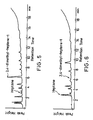
- Example 2 The same procedure as in Example 1 is repeated to give a 30- ⁇ m thick undrawn film, except that the pellets are not dried. This film gives a chromatogram as shown in Fig. 4.
- the content of heptane in the film sample is 18 ppm and the content of 2,4-dimethyl-heptene-1 is 1.2 ppm, and the total amount of volatile components is 37 ppm.
- the rating of odor is 4.6.
- Example 2 The same procedure as in Example 1 is repeated to give a 30- ⁇ m thick undrawn film, except that 100 parts by weight of propylene homopolymer powder is incorporated with 0.05 parts by weight of calcium stearate, 0.03 parts by weight of "Irganox 1010", and 0.03 parts by weight of "Phosphite 168". This film gives a chromatogram as shown in Fig. 5.
- the pelletized composition has an MFR0 of 3.5 g/10 minutes, and the k value is 6.0 after repeated pelletization (twice) at 280°C.
- the content of heptane in the film sample is 0.71 ppm and the content of 2,4-dimethyl-heptene-1 is 6.4 ppm, and the total amount of volatile components is 31.2 ppm.
- the rating of odor is 4.4.
- Example 3 The same procedure as in Example 3 is repeated to give a 30- ⁇ m thick undrawn film, except that the ethylene-propylene random copolymer powder is dried at 120°C for 1 hour under reduced pressure. This film gives a chromatogram as shown in Fig. 6.
- the pelletized composition has an MFR0 of 5.2 g/10 minutes, and the k value is 1.8 after repeated pelletization (twice) at 280°C.
- the content of heptane in the film sample is 5.4 ppm and the content of 2,4-dimethyl-heptene-1 is 0.62 ppm, and the total amount of volatile components is 28 ppm.
- the rating of odor is 4.2.
- the present invention provides a polypropylene molded article which has a greatly lowered level of odor and hence is suitable for food packaging.
Landscapes
- Chemical & Material Sciences (AREA)
- Health & Medical Sciences (AREA)
- Chemical Kinetics & Catalysis (AREA)
- Medicinal Chemistry (AREA)
- Polymers & Plastics (AREA)
- Organic Chemistry (AREA)
- Manufacture Of Macromolecular Shaped Articles (AREA)
- Compositions Of Macromolecular Compounds (AREA)
- Wrappers (AREA)
- Packging For Living Organisms, Food Or Medicinal Products That Are Sensitive To Environmental Conditiond (AREA)
Applications Claiming Priority (2)
| Application Number | Priority Date | Filing Date | Title |
|---|---|---|---|
| JP234385/88 | 1988-09-19 | ||
| JP63234385A JP2565753B2 (ja) | 1988-09-19 | 1988-09-19 | ポリプロピレン成形品 |
Publications (3)
| Publication Number | Publication Date |
|---|---|
| EP0367396A2 true EP0367396A2 (fr) | 1990-05-09 |
| EP0367396A3 EP0367396A3 (fr) | 1991-09-04 |
| EP0367396B1 EP0367396B1 (fr) | 1996-03-06 |
Family
ID=16970169
Family Applications (1)
| Application Number | Title | Priority Date | Filing Date |
|---|---|---|---|
| EP89309521A Revoked EP0367396B1 (fr) | 1988-09-19 | 1989-09-19 | Objet moulé de polypropylène |
Country Status (5)
| Country | Link |
|---|---|
| US (1) | US5109056A (fr) |
| EP (1) | EP0367396B1 (fr) |
| JP (1) | JP2565753B2 (fr) |
| CA (1) | CA1332648C (fr) |
| DE (1) | DE68925860T2 (fr) |
Cited By (3)
| Publication number | Priority date | Publication date | Assignee | Title |
|---|---|---|---|---|
| EP2154190A1 (fr) * | 2008-08-01 | 2010-02-17 | Borealis AG | Composition de polypropylène faiblement volatile |
| WO2017012891A1 (fr) * | 2015-07-20 | 2017-01-26 | Sabic Global Technologies B.V. | Procédé de préparation de granulés de polypropylène |
| CN108727683A (zh) * | 2017-04-20 | 2018-11-02 | 中国石化扬子石油化工有限公司 | 一种聚丙烯组合物的制备方法 |
Families Citing this family (36)
| Publication number | Priority date | Publication date | Assignee | Title |
|---|---|---|---|---|
| EP1741725B1 (fr) * | 2005-07-08 | 2014-04-09 | Borealis Technology Oy | Composition à base de polypropylène |
| JP2009040998A (ja) | 2007-07-18 | 2009-02-26 | Sumitomo Chemical Co Ltd | ポリプロピレン樹脂組成物およびそれからなる成形体 |
| DE112008001952T5 (de) | 2007-07-26 | 2010-06-02 | Sumitomo Chemical Co., Ltd. | Verfahren zur Herstellung einer Polyolefinharzzusammensetzung |
| JP5602352B2 (ja) | 2007-09-21 | 2014-10-08 | 住友化学株式会社 | 光安定化ポリプロピレン |
| CN101691435B (zh) * | 2009-03-07 | 2011-11-30 | 从化市聚赛龙工程塑料有限公司 | 一种低voc高性能汽车内饰件专用pp复合材料及其制备方法 |
| US8431634B2 (en) | 2009-09-07 | 2013-04-30 | Sumitomo Chemical Company, Limited | Polypropylene resin composition and process for producing the same |
| CN102190765B (zh) | 2010-02-09 | 2015-04-08 | 住友化学株式会社 | 丙烯系共聚物和由其制成的膜 |
| CN103319781B (zh) | 2012-03-22 | 2016-12-28 | 住友化学株式会社 | 丙烯树脂组合物及其注射成型体 |
| US9303112B2 (en) | 2012-09-24 | 2016-04-05 | Sumitomo Chemical Company, Limited | Propylene resin material and method for the production thereof |
| US9315657B2 (en) | 2013-07-12 | 2016-04-19 | Sumitomo Chemical Company, Limited | Propylene resin composition |
| JP6614640B2 (ja) * | 2015-06-29 | 2019-12-04 | 出光興産株式会社 | ポリオレフィンの製造方法 |
| WO2015166666A2 (fr) | 2015-08-24 | 2015-11-05 | Sumitomo Chemical Company, Limited | Article moulé par injection pour matériau d'emballage, article moulé par injection pour pièce automobile, film industriel et film d'emballage alimentaire |
| WO2015166665A2 (fr) | 2015-08-24 | 2015-11-05 | Sumitomo Chemical Company, Limited | Article moulé par injection pour matériau d'emballage, article moulé par injection pour pièce automobile, film industriel et film d'emballage alimentaire |
| US10907035B2 (en) | 2016-06-07 | 2021-02-02 | Sumitomo Chemical Company, Limited | Propylene resin composition and injection-molded article thereof |
| JP7061003B2 (ja) | 2017-04-14 | 2022-04-27 | 住友化学株式会社 | プロピレン樹脂組成物及び射出成形体 |
| JP6948977B2 (ja) | 2017-04-14 | 2021-10-13 | 住友化学株式会社 | プロピレン樹脂組成物及び射出成形体 |
| CN108727688B (zh) | 2017-04-14 | 2022-04-08 | 住友化学株式会社 | 丙烯树脂组合物和成型制品 |
| CN110527182A (zh) * | 2018-05-23 | 2019-12-03 | 天津泰煜辉新材料科技有限公司 | 一种低气味聚丙烯组合物及其制备方法 |
| CN109161082A (zh) * | 2018-09-06 | 2019-01-08 | 江苏圣纳米科技有限公司 | 一种聚丙烯voc抑制增强母粒及其制备方法 |
| US11753535B2 (en) | 2018-10-23 | 2023-09-12 | Sumitomo Chemical Company, Limited | Propylene resin composition and shaped body comprising same |
| WO2020149284A1 (fr) | 2019-01-18 | 2020-07-23 | 住友化学株式会社 | Composition de polymère de propylène |
| EP3960812A4 (fr) | 2019-04-24 | 2023-01-18 | Sumitomo Chemical Company, Limited | Composition de résine de propylène et corps moulé |
| CN116134080A (zh) | 2020-07-29 | 2023-05-16 | 住友化学株式会社 | 丙烯树脂组合物 |
| JPWO2022030480A1 (fr) | 2020-08-06 | 2022-02-10 | ||
| CN112080076A (zh) * | 2020-09-29 | 2020-12-15 | 重庆长安汽车股份有限公司 | 一种低气味、低voc微孔发泡改性聚丙烯材料及制备方法 |
| CN112159564A (zh) * | 2020-09-30 | 2021-01-01 | 重庆长安汽车股份有限公司 | 一种低密度、低散发性聚丙烯材料及制备方法 |
| CN116323789A (zh) | 2020-10-16 | 2023-06-23 | 住友化学株式会社 | 聚丙烯类树脂组合物 |
| CN114456411B (zh) * | 2020-10-21 | 2024-08-06 | 中国石油化工股份有限公司 | 一种低voc含量聚丙烯树脂及其制备方法 |
| EP4279541A4 (fr) | 2021-01-13 | 2025-01-01 | Sumitomo Chemical Company, Limited | Composition de résine à base de propylène |
| US20240059881A1 (en) | 2021-01-13 | 2024-02-22 | Sumitomo Chemical Company, Limited | Olefin resin composition and molded body containing same |
| JP7752480B2 (ja) | 2021-03-25 | 2025-10-10 | 住友化学株式会社 | オレフィン系重合体組成物、および、フィルム |
| WO2024029335A1 (fr) | 2022-08-05 | 2024-02-08 | 住友化学株式会社 | Composition |
| EP4663698A1 (fr) | 2023-02-07 | 2025-12-17 | Sumitomo Chemical Company, Limited | Composition de résine de propylène, et corps moulé |
| WO2024203878A1 (fr) | 2023-03-24 | 2024-10-03 | 住友化学株式会社 | Composition de résine et article moulé |
| JP7466742B1 (ja) | 2023-05-29 | 2024-04-12 | 住友化学株式会社 | プロピレン系樹脂組成物 |
| JP7518269B1 (ja) | 2023-10-23 | 2024-07-17 | 住友化学株式会社 | プロピレン樹脂組成物及び成形体 |
Family Cites Families (8)
| Publication number | Priority date | Publication date | Assignee | Title |
|---|---|---|---|---|
| JPS6045646B2 (ja) * | 1978-06-29 | 1985-10-11 | 住友化学工業株式会社 | ポリα−オレフインの乾燥法 |
| EP0006421A3 (fr) * | 1978-06-29 | 1980-01-23 | Sumitomo Chemical Company, Limited | Procédé de séchage de polyoléfines, et dispositif à cet effet |
| JPS5575410A (en) * | 1978-11-30 | 1980-06-06 | Sumitomo Chem Co Ltd | Drying method and apparatus for polyolefin |
| US4372758A (en) * | 1980-09-02 | 1983-02-08 | Union Carbide Corporation | Degassing process for removing unpolymerized monomers from olefin polymers |
| JPS60104145A (ja) * | 1983-11-10 | 1985-06-08 | Mitsubishi Petrochem Co Ltd | 臭気の改良されたプロピレン重合体組成物 |
| JPS60195141A (ja) * | 1984-03-16 | 1985-10-03 | Mitsubishi Petrochem Co Ltd | 結晶性プロピレン重合体組成物 |
| DE3425041A1 (de) * | 1984-07-06 | 1986-02-06 | Hilti Ag, Schaan | Mittels aushaertender masse verankerbares befestigungselement |
| JPH0615644B2 (ja) * | 1985-02-25 | 1994-03-02 | 三菱油化株式会社 | シラン架橋性共重合体組成物 |
-
1988
- 1988-09-19 JP JP63234385A patent/JP2565753B2/ja not_active Expired - Lifetime
-
1989
- 1989-09-14 CA CA000611363A patent/CA1332648C/fr not_active Expired - Lifetime
- 1989-09-19 DE DE68925860T patent/DE68925860T2/de not_active Revoked
- 1989-09-19 EP EP89309521A patent/EP0367396B1/fr not_active Revoked
-
1990
- 1990-11-16 US US07/614,245 patent/US5109056A/en not_active Expired - Fee Related
Cited By (3)
| Publication number | Priority date | Publication date | Assignee | Title |
|---|---|---|---|---|
| EP2154190A1 (fr) * | 2008-08-01 | 2010-02-17 | Borealis AG | Composition de polypropylène faiblement volatile |
| WO2017012891A1 (fr) * | 2015-07-20 | 2017-01-26 | Sabic Global Technologies B.V. | Procédé de préparation de granulés de polypropylène |
| CN108727683A (zh) * | 2017-04-20 | 2018-11-02 | 中国石化扬子石油化工有限公司 | 一种聚丙烯组合物的制备方法 |
Also Published As
| Publication number | Publication date |
|---|---|
| JPH0280433A (ja) | 1990-03-20 |
| EP0367396B1 (fr) | 1996-03-06 |
| EP0367396A3 (fr) | 1991-09-04 |
| DE68925860T2 (de) | 1996-09-05 |
| JP2565753B2 (ja) | 1996-12-18 |
| CA1332648C (fr) | 1994-10-18 |
| US5109056A (en) | 1992-04-28 |
| DE68925860D1 (de) | 1996-04-11 |
Similar Documents
| Publication | Publication Date | Title |
|---|---|---|
| EP0367396A2 (fr) | Objet moulé de polypropylène | |
| US5100930A (en) | Food container | |
| US5508318A (en) | Compositions of irradiated and non-irradiated olefin polymer materials with reduced gloss | |
| CA3135081C (fr) | Melanges de polyethylene-polypropylene recycles comprenant un agent de compatibilite | |
| EP3873979B1 (fr) | Mélange de polypropylène de polyéthylène recyclé valorisé | |
| CA1239723A (fr) | Pellicule de melange polymerique renfermant un polymere de 4-methyl-1-pentene | |
| CA3152079A1 (fr) | Utilisation de polyethylene recycle dans des capsules pour bouteilles | |
| EP3947554B1 (fr) | Compatibilization de mélanges polyéthylène-polypropylène recyclés | |
| EP0254236B1 (fr) | Compositions filmogènes et films antibués obtenus à partir de ces compositions | |
| JP3304280B2 (ja) | 金属化可能なポリプロピレンランダム共重合体組成物 | |
| CA2204211A1 (fr) | Composition stabilisatrice pour matieres thermoplastiques | |
| EP0919585B1 (fr) | Film de polypropylene a orientation biaxiale | |
| NZ505644A (en) | Polyolefin resin composition comprising an ethylene-based polyolefin, a phosphorus compound and a phenol or tocepherol-based heat stabilizer | |
| WO2024184525A1 (fr) | Recyclats de polypropylène de haute pureté | |
| JP2000109617A (ja) | 安定化ポリオレフィン系樹脂組成物 | |
| JPH0341136A (ja) | 食品包装容器 | |
| EP3775018B1 (fr) | Composition de polypropylène destinée à être utilisée dans une application bopp, procédé de préparation de films bopp et ledit film bopp | |
| JP2565753C (fr) | ||
| CN117089145B (zh) | 含聚丙烯的组合物、聚丙烯材料及其制备方法、聚丙烯薄膜 | |
| CA3135074C (fr) | Compatibilisation de melanges de polyethylene-polypropylene recycles | |
| EP4735522A1 (fr) | Produit de mélange de recyclats polymères et procédé | |
| EP4677010A1 (fr) | Recyclats de polypropylène de haute pureté | |
| WO2024184522A1 (fr) | Recyclats de polypropylène de haute pureté | |
| WO2025252987A2 (fr) | Composition de polypropylène pour applications automobiles extérieures | |
| JPS6226663B2 (fr) |
Legal Events
| Date | Code | Title | Description |
|---|---|---|---|
| PUAI | Public reference made under article 153(3) epc to a published international application that has entered the european phase |
Free format text: ORIGINAL CODE: 0009012 |
|
| AK | Designated contracting states |
Kind code of ref document: A2 Designated state(s): DE FR GB IT |
|
| PUAL | Search report despatched |
Free format text: ORIGINAL CODE: 0009013 |
|
| AK | Designated contracting states |
Kind code of ref document: A3 Designated state(s): DE FR GB IT |
|
| 17P | Request for examination filed |
Effective date: 19911212 |
|
| 17Q | First examination report despatched |
Effective date: 19920626 |
|
| GRAA | (expected) grant |
Free format text: ORIGINAL CODE: 0009210 |
|
| AK | Designated contracting states |
Kind code of ref document: B1 Designated state(s): DE FR GB IT |
|
| REF | Corresponds to: |
Ref document number: 68925860 Country of ref document: DE Date of ref document: 19960411 |
|
| ITF | It: translation for a ep patent filed | ||
| ET | Fr: translation filed | ||
| PLBQ | Unpublished change to opponent data |
Free format text: ORIGINAL CODE: EPIDOS OPPO |
|
| PLBI | Opposition filed |
Free format text: ORIGINAL CODE: 0009260 |
|
| PLBF | Reply of patent proprietor to notice(s) of opposition |
Free format text: ORIGINAL CODE: EPIDOS OBSO |
|
| PLAB | Opposition data, opponent's data or that of the opponent's representative modified |
Free format text: ORIGINAL CODE: 0009299OPPO |
|
| 26 | Opposition filed |
Opponent name: MONTELL NORTH AMERICA INC. Effective date: 19961206 Opponent name: HOECHST AKTIENGESELLSCHAFT PATENT- UND LIZENZABTEI Effective date: 19961206 Opponent name: CIBA-GEIGY AG PATENTABTEILUNG Effective date: 19961204 |
|
| PLAB | Opposition data, opponent's data or that of the opponent's representative modified |
Free format text: ORIGINAL CODE: 0009299OPPO |
|
| R26 | Opposition filed (corrected) |
Opponent name: NOVARTIS AG PATENT AND TRADEMARK DEPT. * 961206 HO Effective date: 19961204 |
|
| R26 | Opposition filed (corrected) |
Opponent name: CIBA SPECIALTY CHEMICALS HOLDING INC. * 961206 HOE Effective date: 19961204 |
|
| PLBF | Reply of patent proprietor to notice(s) of opposition |
Free format text: ORIGINAL CODE: EPIDOS OBSO |
|
| PLBF | Reply of patent proprietor to notice(s) of opposition |
Free format text: ORIGINAL CODE: EPIDOS OBSO |
|
| PLBF | Reply of patent proprietor to notice(s) of opposition |
Free format text: ORIGINAL CODE: EPIDOS OBSO |
|
| PLBQ | Unpublished change to opponent data |
Free format text: ORIGINAL CODE: EPIDOS OPPO |
|
| PLAB | Opposition data, opponent's data or that of the opponent's representative modified |
Free format text: ORIGINAL CODE: 0009299OPPO |
|
| R26 | Opposition filed (corrected) |
Opponent name: CIBA SPECIALTY CHEMICALS HOLDING INC. * 961206 TAR Effective date: 19961204 |
|
| PLAW | Interlocutory decision in opposition |
Free format text: ORIGINAL CODE: EPIDOS IDOP |
|
| APAC | Appeal dossier modified |
Free format text: ORIGINAL CODE: EPIDOS NOAPO |
|
| APAE | Appeal reference modified |
Free format text: ORIGINAL CODE: EPIDOS REFNO |
|
| APAC | Appeal dossier modified |
Free format text: ORIGINAL CODE: EPIDOS NOAPO |
|
| PGFP | Annual fee paid to national office [announced via postgrant information from national office to epo] |
Ref country code: FR Payment date: 20010911 Year of fee payment: 13 |
|
| PGFP | Annual fee paid to national office [announced via postgrant information from national office to epo] |
Ref country code: GB Payment date: 20010919 Year of fee payment: 13 |
|
| REG | Reference to a national code |
Ref country code: GB Ref legal event code: IF02 |
|
| PLBQ | Unpublished change to opponent data |
Free format text: ORIGINAL CODE: EPIDOS OPPO |
|
| PGFP | Annual fee paid to national office [announced via postgrant information from national office to epo] |
Ref country code: DE Payment date: 20020925 Year of fee payment: 14 |
|
| PLAB | Opposition data, opponent's data or that of the opponent's representative modified |
Free format text: ORIGINAL CODE: 0009299OPPO |
|
| APAC | Appeal dossier modified |
Free format text: ORIGINAL CODE: EPIDOS NOAPO |
|
| R26 | Opposition filed (corrected) |
Opponent name: CIBA SPEZIALITAETENCHEMIE HOLDING AG * 19961206 BA Effective date: 19961204 |
|
| RDAH | Patent revoked |
Free format text: ORIGINAL CODE: EPIDOS REVO |
|
| RDAG | Patent revoked |
Free format text: ORIGINAL CODE: 0009271 |
|
| STAA | Information on the status of an ep patent application or granted ep patent |
Free format text: STATUS: PATENT REVOKED |
|
| 27W | Patent revoked |
Effective date: 20021115 |
|
| GBPR | Gb: patent revoked under art. 102 of the ep convention designating the uk as contracting state |
Free format text: 20021115 |
|
| APAH | Appeal reference modified |
Free format text: ORIGINAL CODE: EPIDOSCREFNO |