EP0367831A1 - Procede de production de feuilles d'acier electrique non oriente - Google Patents
Procede de production de feuilles d'acier electrique non oriente Download PDFInfo
- Publication number
- EP0367831A1 EP0367831A1 EP89903253A EP89903253A EP0367831A1 EP 0367831 A1 EP0367831 A1 EP 0367831A1 EP 89903253 A EP89903253 A EP 89903253A EP 89903253 A EP89903253 A EP 89903253A EP 0367831 A1 EP0367831 A1 EP 0367831A1
- Authority
- EP
- European Patent Office
- Prior art keywords
- finish rolling
- roughing
- reduction rate
- rolling
- carried out
- Prior art date
- Legal status (The legal status is an assumption and is not a legal conclusion. Google has not performed a legal analysis and makes no representation as to the accuracy of the status listed.)
- Granted
Links
Images


Classifications
-
- C—CHEMISTRY; METALLURGY
- C21—METALLURGY OF IRON
- C21D—MODIFYING THE PHYSICAL STRUCTURE OF FERROUS METALS; GENERAL DEVICES FOR HEAT TREATMENT OF FERROUS OR NON-FERROUS METALS OR ALLOYS; MAKING METAL MALLEABLE, e.g. BY DECARBURISATION OR TEMPERING
- C21D8/00—Modifying the physical properties of ferrous metals or ferrous alloys by deformation combined with, or followed by, heat treatment
- C21D8/12—Modifying the physical properties of ferrous metals or ferrous alloys by deformation combined with, or followed by, heat treatment during manufacturing of articles with special electromagnetic properties
- C21D8/1216—Modifying the physical properties of ferrous metals or ferrous alloys by deformation combined with, or followed by, heat treatment during manufacturing of articles with special electromagnetic properties characterised by the working steps
- C21D8/1222—Hot rolling
-
- C—CHEMISTRY; METALLURGY
- C21—METALLURGY OF IRON
- C21D—MODIFYING THE PHYSICAL STRUCTURE OF FERROUS METALS; GENERAL DEVICES FOR HEAT TREATMENT OF FERROUS OR NON-FERROUS METALS OR ALLOYS; MAKING METAL MALLEABLE, e.g. BY DECARBURISATION OR TEMPERING
- C21D8/00—Modifying the physical properties of ferrous metals or ferrous alloys by deformation combined with, or followed by, heat treatment
- C21D8/12—Modifying the physical properties of ferrous metals or ferrous alloys by deformation combined with, or followed by, heat treatment during manufacturing of articles with special electromagnetic properties
Definitions
- This invention relates to a method of making non-oriented electrical steel sheets.
- Japanese Patent Laid-Open Specification 38814/74 checks di-solution of the coarse A1N during a slab soaking by lowering the soaking temperature thereof; Japanese Patent Laid-Open Specification 22,931/81 lowers amounts of S and O which precipitates as non-metallic inclusions; Japanese Patent Laid-Open Specification 8,409/80 controls formation of sulphides by addition of Ca or REM; Same 108,318/77, 41,219/79 and 123,825/83 coasen AlN by brief soaking in the slab before the hot rolling; and Same 76,422/79 utilizes selfannealing effect by coiling at super high temperature after hot rolling for coarsening A1N and accelerating growth of ferrite grain.
- the soaking time is short, such a process which once transfers the slab into the heating and soaking furnaces, could not enjoy merits of saving energy brought about by the hot direct rolling, and further for providing precipitation of AIN, if the soaking time is short, the precipitation will be non-uniform at the inside and outside of the slab.
- the slab is directly sent to the hot rolling without the brief soaking, whereby others than AlN inevitably precipitated check the precipitation of AIN, and a delay time is taken between the roughing and the finish rolling, the temperature of which is performed at not more than Ar 3 , so that precipitating nuclei of A1N are effectively introduced into the steel, and uniform and coarse A1N precipitation is formed by a coiling at temperature of higher than 700°C, thereby to enable to provide uniform and satisfied ferrite grain growth during the recrystallization annealing.
- the invention comprises roughing a slab immediately after continuously casting thereof to thickness of more than 20mm at reduction rate of more than 10% without brief soaking at specified temperature range, said slab containing C: not more than 0.005 wt%, Si: 0.1 to 1.5 wt%, Mn: 0.1 to 1.0 wt%, P: 0.01 to 0.15 wt%, and S: not more than 0.005 wt%; having a time interval of more than 30 sec at temperature range where the surface temperature of the roughed bar is higher than 950°C till a following finish rolling; performing a finish rolling at lower than Ar 3 and at reduction rate of more than 25% and coiling at temperature of higher than 700°C.
- Fig. 1 shows influences of the roughing reduction rate on sizes of precipitating nuclei
- Fig. 2 shows influences of the waiting time of the roughed bar on sizes of the precipitating nuclei of A1N in the hot rolled band
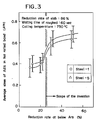
- Fig. 3 shows influences of the reduction rate at lower than Ar 3 during finish rolling on sizes of precipitating sizes of A1N in the hot rolled band.
- the roughing is performed on the slab immediately after continuously casting thereof to the thickness of more than 20 mm at the reduction rate of more than 10%, without brief soaking at specified temperature range, said slab containing C: not more than 0.005 wt%, Si: 0.1 to 1.5 wt%, Mn: 0.1 to 1.0 wt%, P: 0.01 to 0.15 wt% and S: not more than 0.005 wt%, and subsequently the finish rolling is performed after having the specified time interval (called as "waiting time” hereinafter).
- the precipitating nuclei of AlN are introduced into the steel in the waiting time so as to rapidly provide the uniform and coarse A1N precipitation after the coiling.
- the electrical steel sheets of low and middle grades have low contents of Si and Al, and fine textures by ⁇ - ⁇ transformation and fine precipitation of A1N give bad influences on the magnetic properties of the low magnetic field and the iron loss.
- the hot direct rolling is carried out for saving energy, it is difficult to coarse A1N in the slab and more difficult to improve the magnetic properties.
- the present invention has the above stated waiting time after the roughing, aiming at strain induced precipitation of A1N in phase.
- the above roughing accelerates the introduction of the uniform dispersion of precipitating of AlN nuclei in a short period of time by the introduction of the strain and destruction of the solidified texture, for which the reduction rate of more than 10%, preferably more than 20%
- Fig. 1 takes up examples of 0.1% Si steel and 1% Si steel (Steels 1 and 5 of Table 1) for investigating influences of the reduction rate on average sizes of the precipitating nuclei of A1N in the slab, where the sample of 8.0 ⁇ mm x 12 tmm was heated for 20 minutes in the vacuum at the temperature by which AlN was perfectly molten, and rolled 0 to 87% at the temperature of 1050°C, and rapidly cooled by the gas, and the sizes of precipitating nuclei of A1N precipitated in the steel were measured, from which it is seen that if the reduction rate is less than 10%, the fine precipitation of A1N in the slab is a problem.
- the thickness of the roughed bar should be 20mm in the lower limit, preferably 30mm.
- the surface temperature of the roughed bar is kept higher than 950°C for the purpose of securing the temperature of the finish rolling and usefully accelerating the nucleation of the precipitation nuclei of A1N at its precipitating nose.
- the waiting time is determined more than 30 sec.
- Fig. 2 takes up examples of 0.1 and 1% silicon steels (Steel Nos.1 and 5 of Table 1), and shows the influences of the waiting time (time from ending of the roughing to starting of the finish rolling) after the roughing on sizes of the precipitating nuclei of A1N in the hot rolled band. It is seen that the waiting time of more than 40 sec, preferably 60 sec should be secured for fully introducing the precipitating nuclei. On the other hand, if the waiting time is taken too much, the surface temperature of the roughed bar becomes lower than 950°C and it will difficult to secure the finish rolling temperature and the coiling temperatrue of higher than 700°C. Thus, the waiting time should be determined not to lower the starting temperature of the finish rolling down 950°C in response to the ending temperature of the roughing and the thickness of the roughed bar.
- the waiting time herein designates a time until the starting temperature of the finish rolling from the ending of the roughing including the strip's normal running time and a delay time (an intentional waiting time). It will be assumed normally necessary to have the delay time for practising the present invention, but if the running time between the rollings satisfies the above waiting time the delay time is not necessary.
- the reduction rate at lower than Ar 3 is more than 25%, preferably more than 30% in view of the introduction of the nuclei of Goss texture, aiming at the induction and growth of the strain of the precipitating nuclei of AIN, the uniformarization of the ferrite structure and the improvement of the magnetic flux density.
- Fig.3 takes up examples of 0.1% Si steel and 1% Si steel for investigating influences of the reduction rate at lower than Ar 3 in the finish rolling on the average sizes of the precipitating nuclei of A1N in the hot rolled band, from which it is seen that the reduction rate of more than 25% (preferably more than 30%) should be secured for fully introducing the precipitating nuclei of AlN.
- A1N precipitated in the preceeding process is coarsened effectively and rapidly, for which the coiling is done at the temperature of more than 700°C after the finish rolling.
- the thus produced hot rolled band is normally subjected to the cold rollings of once or more than twice interposing the intermediate annealing, and finally to the annealing.
- C is set not more than 0.005 wt% when producing steel slabs so as to secure the ferrite grain growth by lowering C during heating treatment of the hot rolled band and affect coarsening of A1N via decreasing of the solubility limit of the solute A1N accompanied with stabilization of ferrite phases.
- Si has an upper limit of 1.5 wt% for keeping the level of the magnetic flux density to be required to electrical steel sheets of low and middle grades and since the present invention aims at steel sorts having ⁇ - ⁇ transformation, and for lowering the iron loss value to be indispensable to the electrical steel sheets.
- S is determined in its upper limit for improving the magnetic properties by decreasing an absolute amount of MnS. By setting not more than 0.005 wt%, bad influences of MnS in the hot direct rolling may be brought to a negligible level.
- the upper limit is 0.001 wt% except that it is added intentionally. But when a slab is made by the continuously casting process, it should be added in the necessary amount aiming at lowering oxygen level in the steel and fixing nitrogen after the final annealing, and in this case its amount is 0.005 to 0.5 wt%. When adding Al intentionally, and if being less than 0.005 wt%, it is difficult to coarsen A1N satisfactorily, though depending on the present invention.
- the upper limit is determined to be 0.5 wt% for keeping the level of the magnetic flux density to be required to the low and middle grade materials.
- the continuously cast slabs (Steels 1, 2, 4, 6 and 7) having the chemical compositions of Table 1 were passed through Hot Rolling - Annealing - Pickling - Cold Rolling - Final Continuous Annealing, and the non-oriented electrical steel sheets.
- the magnetic properties of the produced electrical steel sheets and the characteristics of the hot rolled bands are shown in Table 2 together with the hot rolling conditions.
- the continuously cast slabs (Steels 1, 3 and 5) having the chemical compositions of Table 1 were passed through Hot Rolling - Annealing - Pickling - Cold Rolling - Final Continuous Annealing, and the non-oriented electrical steel sheets.
- the magnetic properties of the produced electrical steel sheets and the characteristics of the hot rolled bands are shown in Table 3 together with the hot rolling conditions.
- the present invention is applied to the production of non-oriented electrical steel sheets.
Landscapes
- Engineering & Computer Science (AREA)
- Chemical & Material Sciences (AREA)
- Physics & Mathematics (AREA)
- Electromagnetism (AREA)
- Manufacturing & Machinery (AREA)
- Thermal Sciences (AREA)
- Crystallography & Structural Chemistry (AREA)
- Mechanical Engineering (AREA)
- Materials Engineering (AREA)
- Metallurgy (AREA)
- Organic Chemistry (AREA)
- Manufacturing Of Steel Electrode Plates (AREA)
Abstract
Applications Claiming Priority (2)
| Application Number | Priority Date | Filing Date | Title |
|---|---|---|---|
| JP51785/88 | 1988-03-07 | ||
| JP63051785A JPH01225726A (ja) | 1988-03-07 | 1988-03-07 | 無方向性電磁鋼板の製造方法 |
Publications (3)
| Publication Number | Publication Date |
|---|---|
| EP0367831A1 true EP0367831A1 (fr) | 1990-05-16 |
| EP0367831A4 EP0367831A4 (fr) | 1990-07-03 |
| EP0367831B1 EP0367831B1 (fr) | 1993-08-11 |
Family
ID=12896598
Family Applications (1)
| Application Number | Title | Priority Date | Filing Date |
|---|---|---|---|
| EP89903253A Expired - Lifetime EP0367831B1 (fr) | 1988-03-07 | 1989-03-07 | Procede de production de feuilles d'acier electrique non oriente |
Country Status (5)
| Country | Link |
|---|---|
| US (1) | US5062906A (fr) |
| EP (1) | EP0367831B1 (fr) |
| JP (1) | JPH01225726A (fr) |
| DE (1) | DE68908345T2 (fr) |
| WO (1) | WO1989008721A1 (fr) |
Cited By (3)
| Publication number | Priority date | Publication date | Assignee | Title |
|---|---|---|---|---|
| FR2643386A1 (fr) * | 1989-02-21 | 1990-08-24 | Nippon Kokan Kk | Procede de fabrication de feuillards d'acier magnetique non oriente |
| EP0609190A1 (fr) * | 1993-01-29 | 1994-08-03 | CENTRE DE RECHERCHES METALLURGIQUES CENTRUM VOOR RESEARCH IN DE METALLURGIE Association sans but lucratif | Procédé de fabrication d'une tôle d'acier laminée à chaud présentant des propriétés magnétiques |
| EP1420072A1 (fr) * | 2002-11-14 | 2004-05-19 | ThyssenKrupp Stahl AG | Procédé de fabrication de bandes laminées à chaud pour la production de bandes d'acier électrique à grains non-orientés , bande laminée à chaud et tôle d'acier électrique à grains non-orientés ainsi obtenues |
Families Citing this family (4)
| Publication number | Priority date | Publication date | Assignee | Title |
|---|---|---|---|---|
| KR100340503B1 (ko) * | 1997-10-24 | 2002-07-18 | 이구택 | 무방향성전기강판의제조방법 |
| JP4626046B2 (ja) * | 2000-11-21 | 2011-02-02 | 住友金属工業株式会社 | セミプロセス無方向性電磁鋼板の製造方法 |
| CN103305748A (zh) * | 2012-03-15 | 2013-09-18 | 宝山钢铁股份有限公司 | 一种无取向电工钢板及其制造方法 |
| CN108866286B (zh) * | 2018-05-31 | 2020-03-31 | 浙江智造热成型科技有限公司 | 无取向电工钢的生产工艺 |
Family Cites Families (11)
| Publication number | Priority date | Publication date | Assignee | Title |
|---|---|---|---|---|
| JPS5037127B2 (fr) * | 1972-07-08 | 1975-12-01 | ||
| JPS532332A (en) * | 1976-06-29 | 1978-01-11 | Nippon Steel Corp | Production of nondirectional electrical steel sheet having excellent surface property |
| AU505774B2 (en) * | 1977-09-09 | 1979-11-29 | Nippon Steel Corporation | A method for treating continuously cast steel slabs |
| JPS58123825A (ja) * | 1982-01-20 | 1983-07-23 | Kawasaki Steel Corp | 無方向性電磁鋼板の製造方法 |
| JPS58151453A (ja) * | 1982-01-27 | 1983-09-08 | Nippon Steel Corp | 鉄損が低くかつ磁束密度のすぐれた無方向性電磁鋼板およびその製造法 |
| JPS58136718A (ja) * | 1982-02-10 | 1983-08-13 | Kawasaki Steel Corp | 磁気特性の優れた無方向性電磁鋼帯の製造方法 |
| JPS59123715A (ja) * | 1982-12-29 | 1984-07-17 | Kawasaki Steel Corp | 無方向性電磁鋼板の製造方法 |
| JPS61127817A (ja) * | 1984-11-26 | 1986-06-16 | Kawasaki Steel Corp | リジングの少ない無方向性けい素鋼板の製造方法 |
| JPH07113129B2 (ja) * | 1986-01-31 | 1995-12-06 | 日本鋼管株式会社 | けい素鋼板の製造方法 |
| JPH06112817A (ja) * | 1992-09-25 | 1994-04-22 | Fujitsu Ltd | Pll 周波数シンセサイザ回路 |
| JPH06227227A (ja) * | 1993-02-01 | 1994-08-16 | Unisia Jecs Corp | 車両懸架装置 |
-
1988
- 1988-03-07 JP JP63051785A patent/JPH01225726A/ja active Granted
-
1989
- 1989-03-07 DE DE89903253T patent/DE68908345T2/de not_active Expired - Fee Related
- 1989-03-07 US US07/427,108 patent/US5062906A/en not_active Expired - Lifetime
- 1989-03-07 WO PCT/JP1989/000242 patent/WO1989008721A1/fr not_active Ceased
- 1989-03-07 EP EP89903253A patent/EP0367831B1/fr not_active Expired - Lifetime
Cited By (3)
| Publication number | Priority date | Publication date | Assignee | Title |
|---|---|---|---|---|
| FR2643386A1 (fr) * | 1989-02-21 | 1990-08-24 | Nippon Kokan Kk | Procede de fabrication de feuillards d'acier magnetique non oriente |
| EP0609190A1 (fr) * | 1993-01-29 | 1994-08-03 | CENTRE DE RECHERCHES METALLURGIQUES CENTRUM VOOR RESEARCH IN DE METALLURGIE Association sans but lucratif | Procédé de fabrication d'une tôle d'acier laminée à chaud présentant des propriétés magnétiques |
| EP1420072A1 (fr) * | 2002-11-14 | 2004-05-19 | ThyssenKrupp Stahl AG | Procédé de fabrication de bandes laminées à chaud pour la production de bandes d'acier électrique à grains non-orientés , bande laminée à chaud et tôle d'acier électrique à grains non-orientés ainsi obtenues |
Also Published As
| Publication number | Publication date |
|---|---|
| EP0367831A4 (fr) | 1990-07-03 |
| JPH01225726A (ja) | 1989-09-08 |
| EP0367831B1 (fr) | 1993-08-11 |
| US5062906A (en) | 1991-11-05 |
| WO1989008721A1 (fr) | 1989-09-21 |
| DE68908345D1 (de) | 1993-09-16 |
| JPH0571652B2 (fr) | 1993-10-07 |
| DE68908345T2 (de) | 1993-12-16 |
Similar Documents
| Publication | Publication Date | Title |
|---|---|---|
| EP0357800B1 (fr) | Procede de production de feuilles d'acier au silicium non oriente presentant d'excellentes proprietes magnetiques | |
| JPH06322443A (ja) | 鉄損が優れた一方向性電磁鋼板の製造方法 | |
| US5102478A (en) | Method of making non-oriented magnetic steel strips | |
| US4493739A (en) | Process for producing a grain-oriented electromagnetic steel sheet or strip having a low watt loss and a grain-oriented electromagnetic steel strip having uniform magnetic properties | |
| EP0367831B1 (fr) | Procede de production de feuilles d'acier electrique non oriente | |
| EP0076109B2 (fr) | Procédé de fabrication de tôles d'acier au silicium à grains orientés ayant de propriétés magnétiques excellentes | |
| EP0357796B1 (fr) | Procede de production de feuilles d'acier electrique non oriente | |
| US5108521A (en) | Method of making non-oriented magnetic steel strips | |
| JP2000282142A (ja) | 一方向性電磁鋼板の製造方法 | |
| US5545263A (en) | Process for production of grain oriented electrical steel sheet having superior magnetic properties | |
| EP0422223B1 (fr) | Procede pour fabriquer des toles d'acier electromagnetiques non orientees presentant d'excellentes caracteristiques magnetiques | |
| JPH02258927A (ja) | 一方向性高磁束密度電磁鋼板の製造方法 | |
| JP2784687B2 (ja) | 磁気特性の優れた一方向性電磁鋼板の製造方法 | |
| JP2514447B2 (ja) | 磁気特性および表面性状の優れた無方向性電磁鋼板の製造方法 | |
| JPH06256847A (ja) | 磁気特性の優れた一方向性電磁鋼板の製造方法 | |
| JPH075975B2 (ja) | 方向性電磁鋼板の製造方法 | |
| KR920006582B1 (ko) | 무방향성 전자강판의 제조방법 | |
| JP4626046B2 (ja) | セミプロセス無方向性電磁鋼板の製造方法 | |
| KR970007162B1 (ko) | 철손 특성이 우수한 저온 스라브 가열방식의 방향성 전기강판의 제조방법 | |
| KR960006025B1 (ko) | 자성이 우수한 고자속밀도 방향성 전기강판의 제조방법 | |
| JPH0699751B2 (ja) | 電磁特性の良好な方向性けい素鋼板の製造方法 | |
| JPS6055567B2 (ja) | 鉄損の低い無方向性けい素鋼板の製造方法 | |
| JPH09194941A (ja) | 磁束密度の高い一方向性電磁鋼板の製造方法 | |
| JPH06279859A (ja) | 鉄損および磁束密度が極めて優れた無方向性電磁鋼板の製造方法 | |
| JPH07258737A (ja) | 高磁束密度一方向性電磁鋼板の製造方法 |
Legal Events
| Date | Code | Title | Description |
|---|---|---|---|
| PUAI | Public reference made under article 153(3) epc to a published international application that has entered the european phase |
Free format text: ORIGINAL CODE: 0009012 |
|
| 17P | Request for examination filed |
Effective date: 19891030 |
|
| AK | Designated contracting states |
Kind code of ref document: A1 Designated state(s): DE FR |
|
| A4 | Supplementary search report drawn up and despatched |
Effective date: 19900703 |
|
| 17Q | First examination report despatched |
Effective date: 19921006 |
|
| GRAA | (expected) grant |
Free format text: ORIGINAL CODE: 0009210 |
|
| AK | Designated contracting states |
Kind code of ref document: B1 Designated state(s): DE FR |
|
| PG25 | Lapsed in a contracting state [announced via postgrant information from national office to epo] |
Ref country code: FR Effective date: 19930811 |
|
| REF | Corresponds to: |
Ref document number: 68908345 Country of ref document: DE Date of ref document: 19930916 |
|
| EN | Fr: translation not filed | ||
| PLBE | No opposition filed within time limit |
Free format text: ORIGINAL CODE: 0009261 |
|
| STAA | Information on the status of an ep patent application or granted ep patent |
Free format text: STATUS: NO OPPOSITION FILED WITHIN TIME LIMIT |
|
| 26N | No opposition filed | ||
| PGFP | Annual fee paid to national office [announced via postgrant information from national office to epo] |
Ref country code: DE Payment date: 19950524 Year of fee payment: 7 |
|
| PG25 | Lapsed in a contracting state [announced via postgrant information from national office to epo] |
Ref country code: DE Effective date: 19961203 |