EP0369819B1 - Calculateur sur table - Google Patents
Calculateur sur table Download PDFInfo
- Publication number
- EP0369819B1 EP0369819B1 EP89311953A EP89311953A EP0369819B1 EP 0369819 B1 EP0369819 B1 EP 0369819B1 EP 89311953 A EP89311953 A EP 89311953A EP 89311953 A EP89311953 A EP 89311953A EP 0369819 B1 EP0369819 B1 EP 0369819B1
- Authority
- EP
- European Patent Office
- Prior art keywords
- constant
- accessing
- calculator
- accessed
- memory
- Prior art date
- Legal status (The legal status is an assumption and is not a legal conclusion. Google has not performed a legal analysis and makes no representation as to the accuracy of the status listed.)
- Expired - Lifetime
Links
Images


Classifications
-
- G—PHYSICS
- G06—COMPUTING OR CALCULATING; COUNTING
- G06F—ELECTRIC DIGITAL DATA PROCESSING
- G06F3/00—Input arrangements for transferring data to be processed into a form capable of being handled by the computer; Output arrangements for transferring data from processing unit to output unit, e.g. interface arrangements
- G06F3/01—Input arrangements or combined input and output arrangements for interaction between user and computer
- G06F3/048—Interaction techniques based on graphical user interfaces [GUI]
- G06F3/0487—Interaction techniques based on graphical user interfaces [GUI] using specific features provided by the input device, e.g. functions controlled by the rotation of a mouse with dual sensing arrangements, or of the nature of the input device, e.g. tap gestures based on pressure sensed by a digitiser
- G06F3/0489—Interaction techniques based on graphical user interfaces [GUI] using specific features provided by the input device, e.g. functions controlled by the rotation of a mouse with dual sensing arrangements, or of the nature of the input device, e.g. tap gestures based on pressure sensed by a digitiser using dedicated keyboard keys or combinations thereof
-
- G—PHYSICS
- G06—COMPUTING OR CALCULATING; COUNTING
- G06F—ELECTRIC DIGITAL DATA PROCESSING
- G06F15/00—Digital computers in general; Data processing equipment in general
- G06F15/02—Digital computers in general; Data processing equipment in general manually operated with input through keyboard and computation using a built-in program, e.g. pocket calculators
- G06F15/0225—User interface arrangements, e.g. keyboard, display; Interfaces to other computer systems
Definitions
- the present invention relates to a desk-top calculator, such as a scientific electronic calculator, having a function for accessing constants stored anteriorly for calculation uses.
- Some of the conventional desk-top calculators for example a scientific electronic calculator for scientific calculations, are arranged such that constants stored anteriorly, universal gravitation constant, gas constant and the like, may be accessed for calculation uses whenever occasion calls.
- Such a desk-top calculator is provided for example with a CNST key, as a constant access key.
- a CNST key as a constant access key.
- the different types of constants stored in the desk-top calculator are accessed successively and displayed, as shown in the following Table 1. That is to say the desired constant is accessed by operating the CNST key an appropriate number of times.
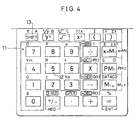
- some of the conventional desk-top calculators are arranged such that, they are provided with a shift key 13, and use the numeric keys 11 both as keys for entering numeric values and as keys for accessing constants.
- the desired constant is accessed by operating the shift key 13 and a numeric key 11 in combination.
- the gas constant R is accessed by operating the shift key 13 and the key 12 of the numeric value "5", successively.
- the CNST key in order to access a constant, the CNST key always needs to be operated a predetermined number of times corresponding to the particular constant.
- two keys i.e. the shift key 13 and a numeric key 11, need to be operated each time a constant is being accessed.
- a conventional desk-top calculator presents the problem that its operation tends to be complicated. Especially when accessing constants frequently, the operational efficiency of a conventional desk-top calculator is extremely low.
- the object of the present invention is thus to improve the operational efficiency of a desk-top calculator when it is being used to access constants frequently.
- the present invention provides a calculator having memory means in which a plurality of numerical constants for use in calculations is pre-stored, and accessing means for successively accessing in a predetermined sequence each of said numerical constants in response to repeated successive operations of the accessing means until a required constant is accessed, characterised in that the accessing means is arranged to re-access directly the most recently accessed one of said numerical constants in response to the first operation of the accessing means after an intervening operation has been performed.
- the present invention provides a method of operating a calculator, for accessing one of a plurality of numerical constants which are pre-stored in memory means of the calculator and are ordinarily accessible in a predetermined sequence only in response to repeated successive operation of a constant access key thereof, characterised by the steps of determining if a key of the calculator other than the constant access key has been operated after the constant access key was last operated, and in that case accessing directly the constant accessed by that last operation of the constant access key, when the constant access key is next operated.
- the constant accessed previously is accessed directly.
- a constant which has been accessed once can be generally regarded as having a high possibility of being accessed again consecutively.
- the constant access key needs to be operated only once, operation of the desk-top calculator is greatly simplified.
- FIG. 1 to Figure 3 show an embodiment of the present invention.
- Figure 1 is a flow chart illustrating the operation in a CPU.
- Figure 2 is a block diagram illustrating the composition of a control unit.
- Figure 3 is a front view showing the composition of a scientific electronic calculator.
- Figure 4 is a partial enlarged front view showing the composition of a conventional desk-top calculator.
- the scientific electronic calculator 21 is provided with an LCD display section 22 which displays numeric values, characters and the like.
- This LCD display section 22 is composed of the character display section 22a, which displays characters according to the dot matrix, and of the numeric value display section 22b, which displays essentially numeric values according to the 7-segment display.
- This function keys group 23 used for calculating the values of the functions y X , sin, cos and the like.
- This function keys group 23 includes the CNST key 24, which is the constant access key for accessing the constants stored anteriorly in a ROM 33 described later, the ON/C key 25 to clear the display of the LCD display section 22, and the like.
- numeric value keys group 26 to enter numeric values
- operation keys group 27 to effect arithmetic calculations
- numeric value memory keys group 28 for the use of the numeric value memory.
- control unit 31 as access sequence control means, which is composed like the example shown in Figure 2.
- This control unit 31 is composed of a CPU 32, which performs the control of the whole scientific electronic calculator 21, the ROM 33 in which the program to be executed by the CPU 32 is stored, a RAM 34 used, for instance as work area comprising an access pointer DISPP, a storage pointer CNSTP and the like, during the program execution of the CPU 32, and as numeric value memory, the key matrix section 35 which detects which key of the function keys group 23 and the like has been operated, and the LCD driving circuit 36 which drives the LCD display section 22.
- the above CPU 32 accesses successively the different types of constants stored in the ROM 33 each time the CNST key 24 is operated consecutively.
- the CPU 32 also functions so that, after one of the constants has been accessed through the operation of the CNST key 24, when another key is operated and the CNST key 24 operated again thereafter, the constant accessed previously is accessed first.
- the ROM 33 functions also, for example as shown in the following Table 2, as constant storage means, in which different types of constants, the light velocity, the universal gravitation constant and the like, are stored anteriorly on and after the address shown by CNSTADRS.
- the RAM 34 is connected with a battery backup unit so that, even when the scientific electronic calculator is in the OFF state or when the calculation mode has been changed, the values stored therein are preserved.
- the program moves on to S2.
- the CNSTADRS the first address of the region in which the constants are stored in the ROM 33, is written in the access pointer DISPP which accesses the constants, and the program moves on to S3.
- the constant stored in the address of the value written in the access pointer DISPP is accessed and displayed in the LCD display section 22 (S4).
- the LCD display section 22 is composed of the character display section 22a and the numeric value display section 22b and in the example described, together with the constant value, a character identifying that value, is displayed. But it is not intended to limit the invention to the precise forms disclosed.
- the different types of constants are accessed in the order of the storage in the ROM 33. But this not exhaustive, and for example the desk-top calculator may be arranged such that the constants are accessed according to their frequency in access.
- the constant access key when accessing again a constant accessed once through the operation of the access key, the constant access key needs to be operated only once and not successively. Therefore the operation is simplified and especially when accessing constants frequently, the operational efficiency is sharply improved.
Landscapes
- Engineering & Computer Science (AREA)
- General Engineering & Computer Science (AREA)
- Theoretical Computer Science (AREA)
- Computer Hardware Design (AREA)
- Computing Systems (AREA)
- Human Computer Interaction (AREA)
- Physics & Mathematics (AREA)
- General Physics & Mathematics (AREA)
- Calculators And Similar Devices (AREA)
Claims (13)
- Calculatrice ayant un moyen de mémoire (33) dans lequel une pluralité de constantes destinées à être utilisées dans des calculs est pré-enregistrée, et des moyens d'accès (32, 34, 35) pour accéder successivement, dans un ordre prédéterminé, à chacune desdites constantes numériques, en réponse à des actionnements successifs et répétés des moyens d'accès jusqu'à l'accès à une constante souhaitée, caractérisée en ce que les moyens d'accès (32, 34, 35) sont configurés de façon à ce que l'on ré-accède directement à celle desdites constantes numériques à laquelle on a accédé en dernier, en réponse au premier actionnement des moyens d'accès après que l'actionnement intermédiaire d'une autre touche soit intervenu.
- Calculatrice selon la revendication 1, dans laquelle les moyens d'accès comprennent une mémoire d'adresses (34, DISPP) dont le contenu est déterminé par l'actionnement d'une touche d'accès à une constante (24)et qui sert à adresser ledit moyen de mémoire (33) pour accéder auxdites constantes numériques, et une mémoire supplémentaire (34, CNSTP) configurée pour stocker le contenu de la mémoire d'adresses pendant la durée dudit actionnement intermédiaire, le contenu de la mémoire supplémentaire étant transféré à la mémoire d'adresses pour accéder, dans ledit moyen de mémoire (33), à ladite constante à laquelle on a accédé en dernier, quand la touche d'accès à une constante (24) est ensuite actionnée.
- Calculatrice selon la revendication 1 ou la revendication 2, dans laquelle ledit moyen de mémoire comporte une mémoire morte (ROM -Read Only Memory) (33).
- Calculatrice selon la revendication 3, dans laquelle lesdits moyens d'accès comportent:une partie matrice de touches (35) pour détecter laquelle d'une pluralité de touches a été actionnée;une CPU (32) pour commander l'ensemble de la calculatrice; etune mémoire vive (RAM - Random Acess Memory) (34) servant de zone de travail pendant le fonctionnement de ladite CPU et de mémoire de valeurs numériques.
- Calculatrice selon l'une quelconque des revendications 1 à 4, dans laquelle ledit ordre prédéterminé correspond à l'ordre dans lequel lesdites constantes numériques ont été enregistrées dans ledit moyen de mémoire (33).
- Calculatrice selon l'une quelconque des revendications 1 à 4, dans laquelle ledit ordre prédéterminé correspond à un ordre décroissant de fréquence d'accès habituel auxdites constantes numériques.
- Calculatrice selon l'une quelconque des revendications précédentes, comprenant une partie affichage LCD (22) comportant:une partie affichage de caractères (22a) pour afficher des caractères et autres; etune partie affichage de valeurs numériques (22b) pour afficher essentiellement des valeurs numériques.
- Calculatrice selon la revendication 7, dans laquelle ladite partie affichage de valeurs numériques (22b) comprend un afficheur à 7 segments.
- Calculatrice selon la revendication 7 ou la revendication 8, dans laquelle ladite partie affichage de caractères (22a) comprend un dispositif d'affichage à cristaux liquides de type à matrice de points.
- Calculatrice selon la revendication 4, comprenant une batterie de secours pour sauvegarder les informations enregistrées dans ladite mémoire RAM (34).
- Calculatrice selon la revendication 4, dans laquelle ladite mémoire RAM (34) comprend:un pointeur d'accès (DISPP) formant la zone de mémoire dans laquelle est enregistrée l'adresse de ladite constante à laquelle on doit accéder; etun pointeur de mémoire (CNSTP) formant la zone de mémoire dans laquelle est enregistrée l'adresse de la constante à laquelle on a accédé.
- Procédé de fonctionnement d'une calculatrice, pour accéder à l'une d'une pluralité de constantes numériques, qui sont pré-enregistrées dans un moyen de mémoire de la calculatrice et qui sont normalement accessibles selon un ordre prédéterminé, seulement en réponse à des actionnement successifs et répétés d'une touche d'accès à une constante de la calculatrice, caractérisé par les étapes de détermination du fait qu'une touche de la calculatrice autre que la touche d'accès à une constante a été ou non actionnée après le dernier actionnement de la touche d'accès à une constante, et, dans ce cas, d'accès direct à la constante à laquelle on a accédé par le dernier actionnement de la touche d'accès à une constante, quand la touche d'accès à une constante est ensuite actionnée.
- Procédé de fonctionnement d'une calculatrice selon la revendication 12, comportant l'enregistrement de l'adresse dudit moyen de mémoire qui correspond à la constante à laquelle on a accédé par ledit dernier actionnement, et dans lequel l'étape d'accès comporte l'accès à ladite constante dans le moyen de mémoire en utilisant l'adresse enregistrée.
Applications Claiming Priority (2)
| Application Number | Priority Date | Filing Date | Title |
|---|---|---|---|
| JP293019/88 | 1988-11-18 | ||
| JP63293019A JPH02138653A (ja) | 1988-11-18 | 1988-11-18 | 卓上計算機 |
Publications (3)
| Publication Number | Publication Date |
|---|---|
| EP0369819A2 EP0369819A2 (fr) | 1990-05-23 |
| EP0369819A3 EP0369819A3 (fr) | 1991-10-30 |
| EP0369819B1 true EP0369819B1 (fr) | 1996-03-13 |
Family
ID=17789430
Family Applications (1)
| Application Number | Title | Priority Date | Filing Date |
|---|---|---|---|
| EP89311953A Expired - Lifetime EP0369819B1 (fr) | 1988-11-18 | 1989-11-17 | Calculateur sur table |
Country Status (4)
| Country | Link |
|---|---|
| US (1) | US5065359A (fr) |
| EP (1) | EP0369819B1 (fr) |
| JP (1) | JPH02138653A (fr) |
| DE (1) | DE68925943T2 (fr) |
Families Citing this family (2)
| Publication number | Priority date | Publication date | Assignee | Title |
|---|---|---|---|---|
| DE69319679T2 (de) * | 1992-09-14 | 1998-11-12 | Sony Corp | Eingabe von Sonderbuchstaben |
| CN1949204A (zh) * | 2005-10-13 | 2007-04-18 | 信利电子有限公司 | 计算器 |
Family Cites Families (8)
| Publication number | Priority date | Publication date | Assignee | Title |
|---|---|---|---|---|
| US3760370A (en) * | 1971-04-26 | 1973-09-18 | Tektronix Inc | Calculator with a number processing system |
| US4107782A (en) * | 1975-10-10 | 1978-08-15 | Texas Instruments Incorporated | Prompting programmable calculator |
| DE3242627A1 (de) * | 1981-11-18 | 1983-05-26 | Sharp K.K., Osaka | Programmierbarer elektronischer rechner mit einer anzeigeeinrichtung |
| US4713749A (en) * | 1985-02-12 | 1987-12-15 | Texas Instruments Incorporated | Microprocessor with repeat instruction |
| JPS61250768A (ja) * | 1985-04-30 | 1986-11-07 | Casio Comput Co Ltd | 変換辞書更新装置 |
| JPS63159963A (ja) * | 1986-12-23 | 1988-07-02 | Sharp Corp | 電子計算機 |
| JPS6418356U (fr) * | 1987-07-21 | 1989-01-30 | ||
| FR2619460B1 (fr) * | 1987-08-13 | 1994-03-25 | Texas Instruments France | Machine a calculer pedagogique destinee notamment aux eleves des classes primaires |
-
1988
- 1988-11-18 JP JP63293019A patent/JPH02138653A/ja active Pending
-
1989
- 1989-11-15 US US07/436,905 patent/US5065359A/en not_active Expired - Lifetime
- 1989-11-17 EP EP89311953A patent/EP0369819B1/fr not_active Expired - Lifetime
- 1989-11-17 DE DE68925943T patent/DE68925943T2/de not_active Expired - Lifetime
Also Published As
| Publication number | Publication date |
|---|---|
| JPH02138653A (ja) | 1990-05-28 |
| EP0369819A2 (fr) | 1990-05-23 |
| DE68925943D1 (de) | 1996-04-18 |
| EP0369819A3 (fr) | 1991-10-30 |
| DE68925943T2 (de) | 1996-08-22 |
| US5065359A (en) | 1991-11-12 |
Similar Documents
| Publication | Publication Date | Title |
|---|---|---|
| US5990888A (en) | Method and system for manipulating graphical objects | |
| EP0369829B1 (fr) | Dispositif de recherche d'information | |
| US4811257A (en) | Electronic calculator having means for directly inputting variables into a prestored and displayed equation | |
| US4947370A (en) | Word processor for simultaneously displaying and scrolling documents and the corresponding titles | |
| US5020012A (en) | Method and apparatus for matching menu labels with keys | |
| KR880001872B1 (ko) | 액정표시 캐랙터 발생회로 | |
| EP0369819B1 (fr) | Calculateur sur table | |
| US4755814A (en) | Attribute control method and apparatus | |
| EP0313207A2 (fr) | Méthode et appareil pour l'entrée de caractères | |
| US4208720A (en) | Calculator with algebraic operating system | |
| US4935889A (en) | Multi-level display for small computer | |
| US5150316A (en) | Electronic apparatus | |
| US4831569A (en) | Display system for indicating standby operations of electronic data processing apparatus | |
| US4864530A (en) | Display system for a compact electronic apparatus | |
| EP0405504B1 (fr) | Système d'affichage d'information convenant à des appareils électroniques compacts ayant des formats d'affichage différents | |
| US5218675A (en) | Information display system suitable for compact electronic appliances having different display sizes | |
| KR950009762B1 (ko) | 전자계산기의 메모리 기능키 데이타 표시방법 | |
| KR930005809B1 (ko) | 콤팩트 전자장치용 디스플레이 시스템 | |
| EP0352065A2 (fr) | Appareil de traitement de textes | |
| JPH0744451A (ja) | データ記憶装置 | |
| JPH0715623B2 (ja) | ディスプレイ装置 | |
| JPS5931745B2 (ja) | 未使用プログラム番号表示方式 | |
| JP3498323B2 (ja) | 電子式計算機及び演算処理方法 | |
| JPH0124660Y2 (fr) | ||
| JP3684640B2 (ja) | 自動販売機の表示装置 |
Legal Events
| Date | Code | Title | Description |
|---|---|---|---|
| PUAI | Public reference made under article 153(3) epc to a published international application that has entered the european phase |
Free format text: ORIGINAL CODE: 0009012 |
|
| 17P | Request for examination filed |
Effective date: 19891208 |
|
| AK | Designated contracting states |
Kind code of ref document: A2 Designated state(s): DE FR GB |
|
| PUAL | Search report despatched |
Free format text: ORIGINAL CODE: 0009013 |
|
| AK | Designated contracting states |
Kind code of ref document: A3 Designated state(s): DE FR GB |
|
| 17Q | First examination report despatched |
Effective date: 19940422 |
|
| GRAH | Despatch of communication of intention to grant a patent |
Free format text: ORIGINAL CODE: EPIDOS IGRA |
|
| GRAA | (expected) grant |
Free format text: ORIGINAL CODE: 0009210 |
|
| AK | Designated contracting states |
Kind code of ref document: B1 Designated state(s): DE FR GB |
|
| REF | Corresponds to: |
Ref document number: 68925943 Country of ref document: DE Date of ref document: 19960418 |
|
| ET | Fr: translation filed | ||
| PLBE | No opposition filed within time limit |
Free format text: ORIGINAL CODE: 0009261 |
|
| STAA | Information on the status of an ep patent application or granted ep patent |
Free format text: STATUS: NO OPPOSITION FILED WITHIN TIME LIMIT |
|
| 26N | No opposition filed | ||
| REG | Reference to a national code |
Ref country code: GB Ref legal event code: IF02 |
|
| PGFP | Annual fee paid to national office [announced via postgrant information from national office to epo] |
Ref country code: DE Payment date: 20081114 Year of fee payment: 20 |
|
| PGFP | Annual fee paid to national office [announced via postgrant information from national office to epo] |
Ref country code: FR Payment date: 20081112 Year of fee payment: 20 |
|
| PGFP | Annual fee paid to national office [announced via postgrant information from national office to epo] |
Ref country code: GB Payment date: 20081112 Year of fee payment: 20 |
|
| REG | Reference to a national code |
Ref country code: GB Ref legal event code: PE20 Expiry date: 20091116 |
|
| PG25 | Lapsed in a contracting state [announced via postgrant information from national office to epo] |
Ref country code: GB Free format text: LAPSE BECAUSE OF EXPIRATION OF PROTECTION Effective date: 20091116 |