EP0369829B1 - Informationssuchvorrichtung - Google Patents
Informationssuchvorrichtung Download PDFInfo
- Publication number
- EP0369829B1 EP0369829B1 EP89312010A EP89312010A EP0369829B1 EP 0369829 B1 EP0369829 B1 EP 0369829B1 EP 89312010 A EP89312010 A EP 89312010A EP 89312010 A EP89312010 A EP 89312010A EP 0369829 B1 EP0369829 B1 EP 0369829B1
- Authority
- EP
- European Patent Office
- Prior art keywords
- information
- address
- bank
- data
- block
- Prior art date
- Legal status (The legal status is an assumption and is not a legal conclusion. Google has not performed a legal analysis and makes no representation as to the accuracy of the status listed.)
- Expired - Lifetime
Links
Images

Classifications
-
- G—PHYSICS
- G06—COMPUTING OR CALCULATING; COUNTING
- G06F—ELECTRIC DIGITAL DATA PROCESSING
- G06F15/00—Digital computers in general; Data processing equipment in general
- G06F15/02—Digital computers in general; Data processing equipment in general manually operated with input through keyboard and computation using a built-in program, e.g. pocket calculators
- G06F15/025—Digital computers in general; Data processing equipment in general manually operated with input through keyboard and computation using a built-in program, e.g. pocket calculators adapted to a specific application
- G06F15/0283—Digital computers in general; Data processing equipment in general manually operated with input through keyboard and computation using a built-in program, e.g. pocket calculators adapted to a specific application for data storage and retrieval
-
- G—PHYSICS
- G06—COMPUTING OR CALCULATING; COUNTING
- G06F—ELECTRIC DIGITAL DATA PROCESSING
- G06F16/00—Information retrieval; Database structures therefor; File system structures therefor
- G06F16/90—Details of database functions independent of the retrieved data types
- G06F16/901—Indexing; Data structures therefor; Storage structures
- G06F16/9017—Indexing; Data structures therefor; Storage structures using directory or table look-up
-
- G—PHYSICS
- G06—COMPUTING OR CALCULATING; COUNTING
- G06F—ELECTRIC DIGITAL DATA PROCESSING
- G06F16/00—Information retrieval; Database structures therefor; File system structures therefor
- G06F16/90—Details of database functions independent of the retrieved data types
- G06F16/901—Indexing; Data structures therefor; Storage structures
- G06F16/9017—Indexing; Data structures therefor; Storage structures using directory or table look-up
- G06F16/902—Indexing; Data structures therefor; Storage structures using directory or table look-up using more than one table in sequence, i.e. systems with three or more layers
-
- G—PHYSICS
- G06—COMPUTING OR CALCULATING; COUNTING
- G06F—ELECTRIC DIGITAL DATA PROCESSING
- G06F40/00—Handling natural language data
- G06F40/20—Natural language analysis
- G06F40/237—Lexical tools
- G06F40/247—Thesauruses; Synonyms
-
- Y—GENERAL TAGGING OF NEW TECHNOLOGICAL DEVELOPMENTS; GENERAL TAGGING OF CROSS-SECTIONAL TECHNOLOGIES SPANNING OVER SEVERAL SECTIONS OF THE IPC; TECHNICAL SUBJECTS COVERED BY FORMER USPC CROSS-REFERENCE ART COLLECTIONS [XRACs] AND DIGESTS
- Y10—TECHNICAL SUBJECTS COVERED BY FORMER USPC
- Y10S—TECHNICAL SUBJECTS COVERED BY FORMER USPC CROSS-REFERENCE ART COLLECTIONS [XRACs] AND DIGESTS
- Y10S707/00—Data processing: database and file management or data structures
- Y10S707/99931—Database or file accessing
Definitions
- the present invention relates to an information searching apparatus to be used in an electronic-type dictionary, an electronic-type learning machine or the like, which is adapted to search and display, with respect to an input index word, the meanings and/or the translated terms, the synonyms, the antonyms, the phonetic symbols, and the like.
- a memory apparatus for storing a large quantity of information to be searched which comprises a plurality of banks serving as memory units set according to the circuit restrictions and the like such as the number of address signal lines.
- To read such information stored in such a memory apparatus it is required to designate the bank No. representing the bank containing the information, and the real address representing the area in this bank in which the information is being stored.
- a conventional information searching apparatus has a table memory unit containing the bank No. and the real address of each information to be searched, and is arranged such that the information stored in the memory is read by referring to this table memory unit.
- the table memory unit should contain bank Nos. and real addresses, the number of each of which is the same as the number of information items to be searched. Accordingly, the memory capacity required for the information searching apparatus in its entirety is apt to be increased. In particular, when the increased number of banks is set so that a large quantity of information to be searched may be stored and searched, a further increased memory capacity is required.
- a memory unit in which a plurality of types of information to be searched are arranged in one block to which a bank No. is given, and there are stored bank Nos. of which the number is the same as the number of the blocks.
- a bank No. if one block extends over two or more banks, one bank No. cannot correspond to one block. This not only makes it complicated to control the bank Nos., but also prevents the memory capacity required for the table memory unit from being minimized. This presents the problem that there cannot be readily stored and searched a large quantity of information of which the lengths are not always constant.
- this invention provides an information searching apparatus, comprising: information memory means for storing a plurality of information items to be searched, the information items being stored in a plurality of blocks, each block comprising two or more memory banks; said information searching apparatus being characterized by comprising secondary table memory means for storing, in respect of each information item to be searched, respective second address data comprising a number of changed banks and a real address, said number of changed banks being a difference between (a) a base bank No. indicating a top memory bank of the block containing the information item to be searched and (b) a bank No.
- secondary table reading means for reading, from said secondary table memory means, a said secondary address data according to the secondary table bank No. and the secondary table address indicated by the read first address data, and an in-block information No. indicating where, in said secondary table bank, the real address of the target information item is stored; and information reading means for reading, from said information memory means, the target information item according to the base bank No. indicated by the read first address data, the number of changed banks and the real address indicated by the read second address data, the target memory bank being determined by adding the number of changed banks to the base bank No.
- the primary table reading means reads, from the primary table memory means, the base bank No. of the block containing the information item to be searched, the secondary table bank No. and the secondary table address, based on the block No.
- the secondary table reading means reads, from the secondary table memory means, the number of changed banks for the information item to be searched and the real address of the information item to be searched, based on the in-block information No., the secondary table bank No. and the secondary table address.
- the information reading means reads, from the information memory means, the information item to be searched, based on (i) the bank No. obtained by adding the base bank No. to the number of changed banks, and (ii) the real address of the information to be searched.
- the base bank No. stored in the primary table memory means is added to the number of changed banks stored in the secondary table memory means. Accordingly, even though one block extends over two or more banks, the bank No. of each information item to be searched may be obtained. Therefore, the information item to be searched may be readily read.
- this invention provides a method of accessing from inputted source data, information items stored at respective addresses in respective memory banks, the method being characterized by the steps of producing first and second codes from said source data, using the first code to look up a base bank No., indicating a top memory bank of a block containing the information item to be retrieved and a first address, combining said first address with the second code to look up an offset and a second address, and then accessing said information item from said second address in a memory bank which is determined by combining said base bank No. and said offset.
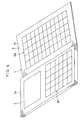
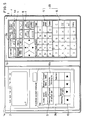
- the electronic-type dictionary apparatus has an openable body 1 in the form of a pocket notebook.
- the body 1 is provided at the upper part of the left-hand portion 1a thereof with a liquid crystal display device (hereinafter referred to as LCD) 2 serving as display means for displaying data contents such as a message, a calculation result, an index word, the meanings thereof, and the like.
- the LCD 2 has a dot matrix arrangement.
- Input key groups 3a, 3b for entering a variety of information are respectively disposed at the right-hand portion 1b of the body 1 and at the the lower part of the LCD 2. These input key groups 3a, 3b form an input device 3.
- the input key group 3a is provided at the upper part thereof with a mode setting key group 4 for calling and setting a variety of functions of the electronic-type dictionary apparatus.
- the mode setting key group 4 includes an English-English dictionary key 4a for setting an English-English dictionary mode, and a variety of keys for respectively setting modes of calendar, schedule, calculation, telephone number and memo.
- the input key group 3a is provided at the centre part thereof with an alphabet key group 5 (for entering the characters from A to O) for entering character information in alphabet.
- the input key group 3a is also provided at the lower part thereof with a numerical value input key group 6 for entering numerical information when the apparatus is used as a calculator. Provision is made such that the numerical value input key group 6 is also used for entering character information in alphabet (characters from P to Z).
- the alphabet key group 5 and the numerical value input key group 6 form index word input keys 20 for entering English index words.
- a power-ON key 7, a power-OFF key 8 and other keys are disposed between the mode setting key group 4 and the alphabet key group 5.
- the English-English dictionary key 4a also serves as the power-ON key 7, and vice versa. More specifically, provision is made such that, for example when the power-ON key 7 is operated, the English-English dictionary mode is set.
- an operation key group 9 including an index word searching key 9a for executing a search for an index word, and other input keys.
- a scroll key group 10 Disposed under the operation key group 9 is a scroll key group 10 for scrolling the display screen.
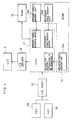
- the control unit is housed in the body 1 and composed of a microcomputer with a CPU 11 centred.
- the CPU 11 is connected to the LCD 2 through an LCD driver 12.
- the LCD driver 12 is a driving circuit for driving the LCD 2 according to an instruction from the CPU 11.
- the various input keys of the input key groups 3a, 3b are connected to the CPU 11 through an I/O port 13. Accordingly, the CPU 11 may judge which input key has been pressed, based on the address of the I/O port 13.
- the body 1 of the electronic-type dictionary apparatus includes a ROM 14, a RAM 15 and an RTC (Real Time Clock) 16 each of which is connected to the CPU 11.
- the ROM 14 is a read-only memory having a plurality of banks and contains an operation program of the electronic-type dictionary apparatus and dictionary data such as index word data and the spelling characters thereof, and the like.
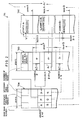
- the ROM 14 includes: a meaning data memory unit 14c serving as information memory means for storing meaning data which are a plurality of types of information to be searched and which represent the meanings of a word corresponding to the spelling characters of each index word entered from the alphabet key group 5; a secondary table memory unit 14b serving as secondary table memory means containing (i) the number of changed banks which is the difference between (a) the base bank No. i.e., the top bank No. in the area of the meaning data memory unit 14c containing the first meaning data of the block containing the meaning data, each block being formed by the meaning data of, for example, 1024 words, and (b) the top bank No.
- a meaning data memory unit 14c serving as information memory means for storing meaning data which are a plurality of types of information to be searched and which represent the meanings of a word corresponding to the spelling characters of each index word entered from the alphabet key group 5
- a secondary table memory unit 14b serving as secondary table memory means containing (i) the number of changed banks which is the
- the meaning data real address which is the top address in the area containing each meaning data, such number of changed banks and meaning data real address being stored for each meaning data; and a primary table memory unit 14a serving as primary table memory means containing, for each block, (i) the top bank No. in the area of the meaning data memory unit 14c containing the number of changed banks and the meaning data real address of the first meaning data in the block, (ii) the secondary table bank No. serving as an address, and (iii) the secondary table address.
- the RAM 15 is a read/write random-access memory to be used for recording data entered from the input key groups 3a and 3b or at the time when the CPU 11 is operated.
- the RTC 16 is a real time clock which is a circuit for counting, in real time, current date and time according to a calendar based on the date and time initially set by the input key group 3a and the like.
- the body 1 of the electronic-type dictionary apparatus further incorporates batteries 17 for supplying power to the circuits above-mentioned.
- the batteries 17 are so arranged as to support the RAM 15 while the power of the electronic-type dictionary apparatus is turned OFF, so that the memory contents are held.
- the CPU 11 executes a processing operation according to data entered from the input keys.
- the CPU 11 then executes a variety of functions after the processing result has been displayed on the LCD 2.
- the CPU 11 is adapted to serve as primary table reading means which obtains (i) a block No. representing the block containing the meaning data to be searched, based on the spelling characters of an index word entered from the alphabet key group 5, and (ii) an in-block meaning data No. representing where the real address of the meaning data to be searched is stored in the block.
- the primary table reading means also reads, from the primary table memory unit 14a, the base bank No. of the block containing the meaning data, the secondary table bank No. and the secondary table address, based on the block No.
- the CPU 11 is also adapted to serve as secondary table reading means which reads, from the secondary table memory unit 14b, the number of the changed banks for the meaning data to be searched and the meaning data real address, based on the in-block meaning data No., the secondary table bank No. and the secondary table address.
- the CPU 11 is also adapted to serve as information reading means for reading, as information to be searched, the meaning data from the meaning data memory unit 14c based on the base bank No., the number of changed banks and the meaning data real address.
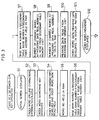
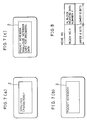
- the English-English dictionary mode is set. For example as shown in Fig. 7 (a), the initial screen requiring the entry of spelling characters of an index word is then displayed on the LCD 2 (S1). Then, the spelling characters of the index word are entered by operating the alphabet key group 5 and displayed on the LCD 2 (S2). For example, when an index word "pocket notebook" is entered from the alphabet key group 5, data are displayed as shown in Fig. 7 (b).
- the RAM 15 holds the word No. set for the searched index word (S5).
- the word No. has (i) upper 6 bits serving as a block No. X which represents the block containing the meaning data to be searched, and (ii) lower 10 bits serving as the in-block meaning data No. Y which represents where the real address of the meaning data to be searched is stored in the block in the secondary table memory unit 14b.
- the secondary table bank No. P and the secondary table address p per block in the primary table memory unit 14a are read and held the data stored in an area of ⁇ bytes on and after the address of block No. X x ⁇ in the primary table memory unit 14a.
- the meaning data are read from the meaning data memory unit 14c (S10).
- meaning data stored on and after the address represented by the meaning data real address a Y in the bank represented by (base bank No. A + the number of changed banks A Y ′) in the meaning data memory unit 14c i.e., the meaning data representing the meanings of the word corresponding to the index word spelling characters entered from the index word searching key 9a.
- the index word data held in the RAM 15 and the meaning data read from the meaning data memory unit 14c are coded-data. These coded data are then developed in a display pattern (S11) and displayed on the LCD 2 (S12). For example, when the index word "pocket notebook” is entered from the alphabet key group 5 as shown above, there are displayed the index word “pocket notebook” and a string representing the meanings of "pocket notebook", i.e., " ⁇ a small-size notebook used for recording data".
- the respective bank Nos. for the meaning data may be readily obtained by adding the base bank No. A to the number of changed banks A Y '. Accordingly, even though a bank No. has not been stored for each meaning data, there may be securely searched meaning data contained in a block extending over two or more banks. Further, it is sufficient to store the base bank Nos. of which the number is identical with the number of blocks. Accordingly, a great memory capacity is not required, even though a large quantity of data having different lengths such as the meaning data above-mentioned, are stored.
- the bank Nos. of the respective information data to be searched may be readily obtained. Therefore, the information data to be searched having different lengths, may be stored and searched without any complication of the control of the bank Nos. or the like. Further, the memory area for storing the bank Nos. and the like may be small. Accordingly, even though a large quantity of information is to be stored and searched, no considerable increase in memory capacity is required. Therefore, a large quantity of information data to be searched having different lengths may be readily stored and searched.
Landscapes
- Engineering & Computer Science (AREA)
- Theoretical Computer Science (AREA)
- Physics & Mathematics (AREA)
- Databases & Information Systems (AREA)
- General Physics & Mathematics (AREA)
- General Engineering & Computer Science (AREA)
- Software Systems (AREA)
- Data Mining & Analysis (AREA)
- General Health & Medical Sciences (AREA)
- Computational Linguistics (AREA)
- Audiology, Speech & Language Pathology (AREA)
- Computing Systems (AREA)
- Computer Hardware Design (AREA)
- Health & Medical Sciences (AREA)
- Artificial Intelligence (AREA)
- Machine Translation (AREA)
- Information Retrieval, Db Structures And Fs Structures Therefor (AREA)
Claims (15)
- Informationssuchvorrichtung mit:- einer Informationsspeichereinrichtung (14c) zum Abspeichern mehrerer zu suchender Einzelinformationen, die in mehreren Blöcken (X; X+1) abgespeichert sind, von denen jeder zwei oder mehr Speicherbänke (A...; B...) aufweist; welche Informationssuchvorrichtung dadurch gekennzeichnet ist, daß sie folgendes aufweist:- eine Sekundärtabelle-Speichereinrichtung (14b) zum Abspeichern, für jede zu suchende Einzelinformation, jeweiliger Sekundäradreßdaten, zu denen die Anzahl geänderter Bänke (AY') und eine Absolutadresse (aY) gehören, wobei die Anzahl geänderter Bänke (AY') die Differenz zwischen (a) einer Basisbanknummer (A), die die oberste Speicherbank des Blocks (X) repräsentiert, der die zu suchende Einzelinformation enthält, und (b) einer Banknummer (A+AY') ist, die die Zielbank für den Block (X) kennzeichnet, wobei die Zielbank die zu suchende Einzelinformation enthält, und wobei die Absolutadresse (aY) die oberste Adresse eines Bereichs in der Zielbank angibt, der die zu suchende Einzelinformation enthält, wobei jede Gruppe der Sekundäradreßdaten, die sich auf die Einzelinformationen eines Blocks beziehen, in einer jeweiligen Sekundärtabellenbank (P; Q) abgespeichert sind;- eine Primärtabelle-Speichereinrichtung (14a) zum Abspeichern, für jeden Block, zugehöriger Primäradreßdaten, die die genannte Basisbanknummer (A), eine Sekundärtabelle-Banknummer (P) und eine Sekundärtabellenadresse (p) enthalten, wobei die Sekundärtabelle-Banknummer (P) und die Sekundärtabellenadresse (p) die Sekundärtabellenbank bzw. deren Absolutadresse anzeigen, in der der oberste Sekundäradressen-Datenwert (A₁', a₁) der Gruppe abgespeichert ist;- eine Primärtabelle-Leseeinrichtung (11) zum Lesen, aus der Primärtabelle-Speichereinrichtung (14a) des genannten Primäradressen-Datenwerts (A, P, p) abhängig von einer Blocknummer (X), die den Block anzeigt, in dem die Ziel-Einzelinformation abgespeichert ist;- eine Sekundärtabelle-Leseeinrichtung (11) zum Auslesen, aus der Sekundärtabelle-Speichereinrichtung (14b), eines Sekundäradressen-Datenwerts (AY', aY) abhängig von der Sekundärtabelle-Banknummer (P) und der Sekundärtabellenadresse (p), wie sie vom gelesenen Primäradressen-Datenwert angezeigt werden, und einer Im-Block-Informationsnummer (Y), die anzeigt, wo in der Sekundärtabellenbank (P) die Absolutadresse (aY) für die Ziel-Einzelinformation abgespeichert ist; und- eine Informationsleseeinrichtung (11) zum Auslesen, aus der Informationsspeichereinrichtung (14c), der Ziel-Informationseinzelgröße abhängig von der Basisbanknummer (A), wie sie vom gelesenen Primäradressen-Datenwert angezeigt wird, der Anzahl geänderter Bänke (AY') und der Absolutadresse (aY), wie sie durch den gelesenen Sekundäradressen-Datenwert angezeigt wird, wobei die Ziel-Speicherbank (A+AY') dadurch ermittelt wird, daß die Anzahl geänderter Bänke (AY') zur Basisbanknummer (A) addiert wird.
- Informationssuchvorrichtung nach Anspruch 1, bei der die Einzelinformationen Wörterbuchdaten sind, die jeweiligen Suchwörtern entsprechen, die von einem Benutzer eingegeben werden können.
- Informationssuchvorrichtung nach Anspruch 2, bei der für jedes Suchwort eine Wortnummer abgespeichert ist, die aus folgendem besteht: (i) der Nummer des Blocks (X), der die dem Suchwort entsprechenden Wörterbuchdaten enthält, und (ii) eine Im-Block-Informationsnummer (Y).
- Informationssuchvorrichtung nach einem der Ansprüche 1 bis 3, bei der die Adresse für den Primäradressen-Datenwert (A, P, p) in der Primärtabelle-Speichereinrichtung (14a) durch das Produkt aus (i) der Blocknummer (X), die den Block anzeigt, in dem die Ziel-Einzelinformation abgespeichert ist, und (ii) der Anzahl von Bytes (α) jedes Primäradressen-Datenwerts bestimmt wird.
- Informationssuchvorrichtung nach einem der Ansprüche 1 bis 4, bei der die Adresse des Sekundäradressen-Datenwerts (AY', aY) in der Sekundärtabelle-Speichereinrichtung (14b) durch die Summe aus (i) der Sekundärtabellenadresse (p), wie sie durch den Primäradressen-Datenwert angezeigt wird, und (ii) dem Produkt aus der Im-Block-Informationsnummer und der Anzahl von Bytes (β) jedes Sekundäradressen-Datenwerts bestimmt wird.
- Informationssuchvorrichtung nach einem der vorstehenden Ansprüche, ferner mit einer Flüssigkristall-Anzeigevorrichtung (2) mit einer Punktmatrixanordnung zum Anzeigen gefundener Information.
- Informationssuchvorrichtung nach einem der vorstehenden Ansprüche, ferner mit einer Moduseinstelleinrichtung, die durch eine Tastengruppe (4) in Matrixanordnung oder durch einen Mausklick gebildet wird, durch die mehrere Modi wahlweise eingestellt werden können, wie ein Englisch/Englisch-Wörterbuchmodus, ein Kalendermodus, ein Terminkalendermodus, ein Rechenmodus, ein Telefonnummernmodus oder ein Notizmodus.
- Informationssuchvorrichtung nach einem der vorstehenden Ansprüche, ferner mit:- einer als zentrale Verarbeitungseinrichtung dienenden CPU (11) zum Ausführen von Betriebsvorgängen der gesamten Vorrichtung;- einem E/A-Port (13), über den Daten eingegeben und von der Vorrichtung ausgegeben werden;- einem als Festwertspeicher dienenden ROM (14), der das Betriebsprogramm für die Vorrichtung enthält;- einem als Lese/Schreib-Direktzugriffsspeicher dienenden RAM (15) zum Abspeichern von Daten, wie sie von einem Benutzer eingegeben werden, und zum zeitweiligen Einschreiben von Daten, während die CPU betrieben wird; und- einer Echtzeituhr (16), die als Schaltung zum Zählen, in Echtzeit, des aktuellen Datums und der Zeit dient.
- Informationssuchvorrichtung nach Anspruch 2 oder nach einem der von diesem abhängigen Ansprüche, bei der die Informationsspeichereinrichtung eine Anordnung aufweist, die eine Bedeutungsdaten-Speichereinheit (14c) aufweist, um Bedeutungsdaten abzuspeichern, die Buchstabierzeichen der Suchwörter entsprechen.
- Informationssuchvorrichtung nach Anspruch 8, bei der der ROM (14) eine Anordnung aufweist, die die Primärtabelle-Speichereinrichtung (14a), die Sekundärtabelle-Speichereinrichtung (14b) und die Informationsspeichereinrichtung (14c) enthält.
- Informationssuchvorrichtung nach Anspruch 8, bei der die CPU (11) eine Anordnung aufweist, die die Primärtabelle-Leseeinrichtung, die Sekundärtabelle-Leseeinrichtung und die Informationsleseeinrichtung enthält.
- Informationssuchvorrichtung nach einem der vorstehenden Ansprüche, die in Form eines elektronischen Taschennotizbuchs (1) vorliegt.
- Verfahren zum Zugreifen, ausgehend von eingegebenen Ursprungsdaten, auf Einzelinformationen, die an jeweiligen Adressen in jeweiligen Speicherbänken abgespeichert sind, wobei das Verfahren durch folgende Schritte gekennzeichnet ist: Erzeugen eines ersten und eines zweiten Codes (X, Y) aus den Ursprungsdaten, Verwenden des ersten Codes (X) zum Nachschlagen einer Basisbanknummer (A), die die oberste Speicherbank eines Blocks (X) anzeigt, der die zu suchende Einzelinformation enthält, und einer ersten Adresse (Pp), Kombinieren der ersten Adresse (Pp) mit dem zweiten Code (Y) zum Nachschlagen eines Versatzes (AY') und einer zweiten Adresse (aY), und anschließendes Abrufen der Einzelinformation aus der zweiten Adresse (aY) in einer Speicherbank (A+AY'), die dadurch festgelegt wird, daß die Basisbanknummer (A) und der Versatz (AY') kombiniert werden.
- Verfahren zum Zugreifen auf Einzelinformationen gemäß Anspruch 13, bei dem die Einzelinformationen aus Wörterbuchdaten bestehen, die jeweilige Suchwörter betreffen.
- Verfahren zum Zugreifen auf Einzelinformationen gemäß Anspruch 14, bei dem für jedes Suchwort eine Wortnummer vorhanden ist, die aus dem ersten Code (X) und dem zweiten Code (Y) besteht.
Applications Claiming Priority (8)
| Application Number | Priority Date | Filing Date | Title |
|---|---|---|---|
| JP63293021A JPH02137882A (ja) | 1988-11-18 | 1988-11-18 | 類語対語表示装置 |
| JP293020/88 | 1988-11-18 | ||
| JP293021/88 | 1988-11-18 | ||
| JP63293022A JPH02138660A (ja) | 1988-11-18 | 1988-11-18 | 訳語表示装置 |
| JP293022/88 | 1988-11-18 | ||
| JP63293020A JPH02138663A (ja) | 1988-11-18 | 1988-11-18 | 情報検索装置 |
| JP304815/88 | 1988-11-30 | ||
| JP63304815A JPH02148361A (ja) | 1988-11-30 | 1988-11-30 | 意味訳語表示装置 |
Publications (3)
| Publication Number | Publication Date |
|---|---|
| EP0369829A2 EP0369829A2 (de) | 1990-05-23 |
| EP0369829A3 EP0369829A3 (de) | 1992-01-08 |
| EP0369829B1 true EP0369829B1 (de) | 1994-07-27 |
Family
ID=27479595
Family Applications (1)
| Application Number | Title | Priority Date | Filing Date |
|---|---|---|---|
| EP89312010A Expired - Lifetime EP0369829B1 (de) | 1988-11-18 | 1989-11-20 | Informationssuchvorrichtung |
Country Status (4)
| Country | Link |
|---|---|
| US (1) | US5210853A (de) |
| EP (1) | EP0369829B1 (de) |
| CA (1) | CA2003043C (de) |
| DE (1) | DE68917090T2 (de) |
Families Citing this family (22)
| Publication number | Priority date | Publication date | Assignee | Title |
|---|---|---|---|---|
| GB8929158D0 (en) * | 1989-12-23 | 1990-02-28 | Int Computers Ltd | Database system |
| EP0519101A1 (de) * | 1991-06-19 | 1992-12-23 | Siemens Aktiengesellschaft | Verfahren zur Adressierung von Datensätzen eines Datenbanksystems |
| JP2875075B2 (ja) * | 1991-10-30 | 1999-03-24 | シャープ株式会社 | 電子辞書 |
| CH686984A5 (de) * | 1993-09-07 | 1996-08-15 | Max Hugentobler | Elektronisches Uebersetzungsgeraet. |
| JP3243365B2 (ja) * | 1994-04-19 | 2002-01-07 | シャープ株式会社 | キー入力装置 |
| JP3003915B2 (ja) * | 1994-12-26 | 2000-01-31 | シャープ株式会社 | 単語辞書検索装置 |
| JPH08241325A (ja) * | 1995-03-03 | 1996-09-17 | Matsushita Electric Ind Co Ltd | 電子辞書及びその製造方法並びにインデックス圧縮・伸長装置 |
| DE69514502T2 (de) * | 1995-05-05 | 2000-08-03 | Stmicroelectronics S.R.L., Agrate Brianza | Nichtflüchtige Speicheranordnung mit Sektoren, deren Grösse und Anzahl bestimmbar sind |
| EP0745995B1 (de) * | 1995-05-05 | 2001-04-11 | STMicroelectronics S.r.l. | Anordnung von nichtflüchtigen EEPROM,insbesondere Flash-EEPROM |
| EP0741415A1 (de) * | 1995-05-05 | 1996-11-06 | STMicroelectronics S.r.l. | Flash-EEPROM-Speicher mit kontaktlosen Speicherzellen |
| JPH09311861A (ja) * | 1996-05-21 | 1997-12-02 | Sharp Corp | データ処理装置 |
| JPH11149481A (ja) * | 1997-11-19 | 1999-06-02 | Sharp Corp | 情報処理装置 |
| US6708311B1 (en) | 1999-06-17 | 2004-03-16 | International Business Machines Corporation | Method and apparatus for creating a glossary of terms |
| US7062452B1 (en) * | 2000-05-10 | 2006-06-13 | Mikhail Lotvin | Methods and systems for electronic transactions |
| US6898605B2 (en) | 2000-09-11 | 2005-05-24 | Snap-On Incorporated | Textual data storage system and method |
| US20030217025A1 (en) * | 2000-09-11 | 2003-11-20 | David Costantino | Textual data storage system and method |
| JP4630163B2 (ja) * | 2005-09-12 | 2011-02-09 | セイコーエプソン株式会社 | テーププリンタの画像編集装置、テーププリンタの画像編集方法、プログラムおよびテーププリンタ |
| US8756063B2 (en) * | 2006-11-20 | 2014-06-17 | Samuel A. McDonald | Handheld voice activated spelling device |
| USD673562S1 (en) * | 2011-02-10 | 2013-01-01 | Vernadetti Johnson | Electronic dictionary with speech function |
| US20140242557A1 (en) * | 2012-01-13 | 2014-08-28 | Aderonke Akinsanya | Audible dictionary device and method |
| US9336196B2 (en) * | 2013-12-06 | 2016-05-10 | Sap Se | Methods, systems, and apparatus for optimization using statistical estimation |
| KR20170005428A (ko) * | 2014-05-17 | 2017-01-13 | 칼리드 오마르 타빗 | 간접적 메모리 어드레싱 및 ascii 인코딩의 2개의 컴퓨터 하드웨어 프로세싱 성질에 기초한 텍스트 검색 방법 |
Family Cites Families (4)
| Publication number | Priority date | Publication date | Assignee | Title |
|---|---|---|---|---|
| US4117542A (en) * | 1977-07-07 | 1978-09-26 | Judah Klausner | Electronic pocket directory |
| JPS595380A (ja) * | 1982-06-30 | 1984-01-12 | Sharp Corp | 情報検索装置 |
| JPS6237742A (ja) * | 1985-08-12 | 1987-02-18 | Sharp Corp | 情報検索装置 |
| US5007019A (en) * | 1989-01-05 | 1991-04-09 | Franklin Electronic Publishers, Incorporated | Electronic thesaurus with access history list |
-
1989
- 1989-11-15 CA CA002003043A patent/CA2003043C/en not_active Expired - Lifetime
- 1989-11-15 US US07/437,431 patent/US5210853A/en not_active Expired - Lifetime
- 1989-11-20 DE DE68917090T patent/DE68917090T2/de not_active Expired - Lifetime
- 1989-11-20 EP EP89312010A patent/EP0369829B1/de not_active Expired - Lifetime
Also Published As
| Publication number | Publication date |
|---|---|
| CA2003043A1 (en) | 1990-05-18 |
| EP0369829A3 (de) | 1992-01-08 |
| CA2003043C (en) | 1994-04-05 |
| EP0369829A2 (de) | 1990-05-23 |
| DE68917090T2 (de) | 1995-03-16 |
| DE68917090D1 (de) | 1994-09-01 |
| US5210853A (en) | 1993-05-11 |
Similar Documents
| Publication | Publication Date | Title |
|---|---|---|
| US5210853A (en) | Electronic device/dictionary with improved information storage: memory capacity ratio | |
| US4579533A (en) | Method of teaching a subject including use of a dictionary and translator | |
| US4460973A (en) | Electronic translator for marking words or sentences | |
| US4567573A (en) | Electronic language interpreter with faculties for memorizing and erasing new words externally applied thereto | |
| US4597056A (en) | Language translator having circuitry for retrieving full words after single letter input | |
| US5063534A (en) | Electronic translator capable of producing a sentence by using an entered word as a key word | |
| US4648070A (en) | Electronic translator with means for selecting words to be translated | |
| US4636970A (en) | Personal type computer with execution of programs in ROM and RAM | |
| US4432056A (en) | Programmable electronic computer | |
| JPS6356581B2 (de) | ||
| US4864530A (en) | Display system for a compact electronic apparatus | |
| JPS61250768A (ja) | 変換辞書更新装置 | |
| EP0107724A4 (de) | Elektronisches wörterbuch mit sprachensynthese. | |
| US5065359A (en) | Desk top calculator with access sequence control system for various constants | |
| JPS60135983A (ja) | 電子式学習機 | |
| JPH02297658A (ja) | 文書処理装置 | |
| JPH02138660A (ja) | 訳語表示装置 | |
| JPH02138663A (ja) | 情報検索装置 | |
| JPH068609Y2 (ja) | 電子漢字辞書 | |
| JPS5814688B2 (ja) | 同音異義語順次表示を行なう漢字まじり文入力装置 | |
| JPH02137882A (ja) | 類語対語表示装置 | |
| JPS61110260A (ja) | 文字処理装置 | |
| JPH0261061B2 (de) | ||
| JPS63142463A (ja) | 電子漢字辞書 | |
| JPH0418665A (ja) | 小型電子機器 |
Legal Events
| Date | Code | Title | Description |
|---|---|---|---|
| PUAI | Public reference made under article 153(3) epc to a published international application that has entered the european phase |
Free format text: ORIGINAL CODE: 0009012 |
|
| 17P | Request for examination filed |
Effective date: 19891214 |
|
| AK | Designated contracting states |
Kind code of ref document: A2 Designated state(s): DE FR GB |
|
| PUAL | Search report despatched |
Free format text: ORIGINAL CODE: 0009013 |
|
| AK | Designated contracting states |
Kind code of ref document: A3 Designated state(s): DE FR GB |
|
| 17Q | First examination report despatched |
Effective date: 19930421 |
|
| GRAA | (expected) grant |
Free format text: ORIGINAL CODE: 0009210 |
|
| AK | Designated contracting states |
Kind code of ref document: B1 Designated state(s): DE FR GB |
|
| REF | Corresponds to: |
Ref document number: 68917090 Country of ref document: DE Date of ref document: 19940901 |
|
| ET | Fr: translation filed | ||
| PLBE | No opposition filed within time limit |
Free format text: ORIGINAL CODE: 0009261 |
|
| STAA | Information on the status of an ep patent application or granted ep patent |
Free format text: STATUS: NO OPPOSITION FILED WITHIN TIME LIMIT |
|
| 26N | No opposition filed | ||
| REG | Reference to a national code |
Ref country code: GB Ref legal event code: IF02 |
|
| PGFP | Annual fee paid to national office [announced via postgrant information from national office to epo] |
Ref country code: DE Payment date: 20081114 Year of fee payment: 20 |
|
| PGFP | Annual fee paid to national office [announced via postgrant information from national office to epo] |
Ref country code: FR Payment date: 20081112 Year of fee payment: 20 |
|
| PGFP | Annual fee paid to national office [announced via postgrant information from national office to epo] |
Ref country code: GB Payment date: 20081119 Year of fee payment: 20 |
|
| REG | Reference to a national code |
Ref country code: GB Ref legal event code: PE20 Expiry date: 20091119 |
|
| PG25 | Lapsed in a contracting state [announced via postgrant information from national office to epo] |
Ref country code: GB Free format text: LAPSE BECAUSE OF EXPIRATION OF PROTECTION Effective date: 20091119 |