EP0373565B1 - Méthode de commande d'unité d'affichage - Google Patents
Méthode de commande d'unité d'affichage Download PDFInfo
- Publication number
- EP0373565B1 EP0373565B1 EP89122847A EP89122847A EP0373565B1 EP 0373565 B1 EP0373565 B1 EP 0373565B1 EP 89122847 A EP89122847 A EP 89122847A EP 89122847 A EP89122847 A EP 89122847A EP 0373565 B1 EP0373565 B1 EP 0373565B1
- Authority
- EP
- European Patent Office
- Prior art keywords
- display unit
- voltage
- potential
- driving
- signal
- Prior art date
- Legal status (The legal status is an assumption and is not a legal conclusion. Google has not performed a legal analysis and makes no representation as to the accuracy of the status listed.)
- Expired - Lifetime
Links
Images








Classifications
-
- G—PHYSICS
- G09—EDUCATION; CRYPTOGRAPHY; DISPLAY; ADVERTISING; SEALS
- G09G—ARRANGEMENTS OR CIRCUITS FOR CONTROL OF INDICATING DEVICES USING STATIC MEANS TO PRESENT VARIABLE INFORMATION
- G09G3/00—Control arrangements or circuits, of interest only in connection with visual indicators other than cathode-ray tubes
- G09G3/20—Control arrangements or circuits, of interest only in connection with visual indicators other than cathode-ray tubes for presentation of an assembly of a number of characters, e.g. a page, by composing the assembly by combination of individual elements arranged in a matrix no fixed position being assigned to or needed to be assigned to the individual characters or partial characters
- G09G3/34—Control arrangements or circuits, of interest only in connection with visual indicators other than cathode-ray tubes for presentation of an assembly of a number of characters, e.g. a page, by composing the assembly by combination of individual elements arranged in a matrix no fixed position being assigned to or needed to be assigned to the individual characters or partial characters by control of light from an independent source
- G09G3/36—Control arrangements or circuits, of interest only in connection with visual indicators other than cathode-ray tubes for presentation of an assembly of a number of characters, e.g. a page, by composing the assembly by combination of individual elements arranged in a matrix no fixed position being assigned to or needed to be assigned to the individual characters or partial characters by control of light from an independent source using liquid crystals
-
- G—PHYSICS
- G09—EDUCATION; CRYPTOGRAPHY; DISPLAY; ADVERTISING; SEALS
- G09G—ARRANGEMENTS OR CIRCUITS FOR CONTROL OF INDICATING DEVICES USING STATIC MEANS TO PRESENT VARIABLE INFORMATION
- G09G3/00—Control arrangements or circuits, of interest only in connection with visual indicators other than cathode-ray tubes
- G09G3/20—Control arrangements or circuits, of interest only in connection with visual indicators other than cathode-ray tubes for presentation of an assembly of a number of characters, e.g. a page, by composing the assembly by combination of individual elements arranged in a matrix no fixed position being assigned to or needed to be assigned to the individual characters or partial characters
- G09G3/34—Control arrangements or circuits, of interest only in connection with visual indicators other than cathode-ray tubes for presentation of an assembly of a number of characters, e.g. a page, by composing the assembly by combination of individual elements arranged in a matrix no fixed position being assigned to or needed to be assigned to the individual characters or partial characters by control of light from an independent source
- G09G3/36—Control arrangements or circuits, of interest only in connection with visual indicators other than cathode-ray tubes for presentation of an assembly of a number of characters, e.g. a page, by composing the assembly by combination of individual elements arranged in a matrix no fixed position being assigned to or needed to be assigned to the individual characters or partial characters by control of light from an independent source using liquid crystals
- G09G3/3611—Control of matrices with row and column drivers
- G09G3/3648—Control of matrices with row and column drivers using an active matrix
- G09G3/3655—Details of drivers for counter electrodes, e.g. common electrodes for pixel capacitors or supplementary storage capacitors
-
- G—PHYSICS
- G09—EDUCATION; CRYPTOGRAPHY; DISPLAY; ADVERTISING; SEALS
- G09G—ARRANGEMENTS OR CIRCUITS FOR CONTROL OF INDICATING DEVICES USING STATIC MEANS TO PRESENT VARIABLE INFORMATION
- G09G3/00—Control arrangements or circuits, of interest only in connection with visual indicators other than cathode-ray tubes
- G09G3/20—Control arrangements or circuits, of interest only in connection with visual indicators other than cathode-ray tubes for presentation of an assembly of a number of characters, e.g. a page, by composing the assembly by combination of individual elements arranged in a matrix no fixed position being assigned to or needed to be assigned to the individual characters or partial characters
- G09G3/34—Control arrangements or circuits, of interest only in connection with visual indicators other than cathode-ray tubes for presentation of an assembly of a number of characters, e.g. a page, by composing the assembly by combination of individual elements arranged in a matrix no fixed position being assigned to or needed to be assigned to the individual characters or partial characters by control of light from an independent source
- G09G3/36—Control arrangements or circuits, of interest only in connection with visual indicators other than cathode-ray tubes for presentation of an assembly of a number of characters, e.g. a page, by composing the assembly by combination of individual elements arranged in a matrix no fixed position being assigned to or needed to be assigned to the individual characters or partial characters by control of light from an independent source using liquid crystals
- G09G3/3611—Control of matrices with row and column drivers
- G09G3/3648—Control of matrices with row and column drivers using an active matrix
-
- G—PHYSICS
- G09—EDUCATION; CRYPTOGRAPHY; DISPLAY; ADVERTISING; SEALS
- G09G—ARRANGEMENTS OR CIRCUITS FOR CONTROL OF INDICATING DEVICES USING STATIC MEANS TO PRESENT VARIABLE INFORMATION
- G09G3/00—Control arrangements or circuits, of interest only in connection with visual indicators other than cathode-ray tubes
- G09G3/20—Control arrangements or circuits, of interest only in connection with visual indicators other than cathode-ray tubes for presentation of an assembly of a number of characters, e.g. a page, by composing the assembly by combination of individual elements arranged in a matrix no fixed position being assigned to or needed to be assigned to the individual characters or partial characters
- G09G3/34—Control arrangements or circuits, of interest only in connection with visual indicators other than cathode-ray tubes for presentation of an assembly of a number of characters, e.g. a page, by composing the assembly by combination of individual elements arranged in a matrix no fixed position being assigned to or needed to be assigned to the individual characters or partial characters by control of light from an independent source
- G09G3/36—Control arrangements or circuits, of interest only in connection with visual indicators other than cathode-ray tubes for presentation of an assembly of a number of characters, e.g. a page, by composing the assembly by combination of individual elements arranged in a matrix no fixed position being assigned to or needed to be assigned to the individual characters or partial characters by control of light from an independent source using liquid crystals
- G09G3/3611—Control of matrices with row and column drivers
- G09G3/3648—Control of matrices with row and column drivers using an active matrix
- G09G3/3659—Control of matrices with row and column drivers using an active matrix the addressing of the pixel involving the control of two or more scan electrodes or two or more data electrodes, e.g. pixel voltage dependant on signal of two data electrodes
-
- G—PHYSICS
- G09—EDUCATION; CRYPTOGRAPHY; DISPLAY; ADVERTISING; SEALS
- G09G—ARRANGEMENTS OR CIRCUITS FOR CONTROL OF INDICATING DEVICES USING STATIC MEANS TO PRESENT VARIABLE INFORMATION
- G09G2300/00—Aspects of the constitution of display devices
- G09G2300/08—Active matrix structure, i.e. with use of active elements, inclusive of non-linear two terminal elements, in the pixels together with light emitting or modulating elements
- G09G2300/0876—Supplementary capacities in pixels having special driving circuits and electrodes instead of being connected to common electrode or ground; Use of additional capacitively coupled compensation electrodes
-
- G—PHYSICS
- G09—EDUCATION; CRYPTOGRAPHY; DISPLAY; ADVERTISING; SEALS
- G09G—ARRANGEMENTS OR CIRCUITS FOR CONTROL OF INDICATING DEVICES USING STATIC MEANS TO PRESENT VARIABLE INFORMATION
- G09G2310/00—Command of the display device
- G09G2310/06—Details of flat display driving waveforms
-
- G—PHYSICS
- G09—EDUCATION; CRYPTOGRAPHY; DISPLAY; ADVERTISING; SEALS
- G09G—ARRANGEMENTS OR CIRCUITS FOR CONTROL OF INDICATING DEVICES USING STATIC MEANS TO PRESENT VARIABLE INFORMATION
- G09G2320/00—Control of display operating conditions
- G09G2320/02—Improving the quality of display appearance
- G09G2320/0204—Compensation of DC component across the pixels in flat panels
-
- G—PHYSICS
- G09—EDUCATION; CRYPTOGRAPHY; DISPLAY; ADVERTISING; SEALS
- G09G—ARRANGEMENTS OR CIRCUITS FOR CONTROL OF INDICATING DEVICES USING STATIC MEANS TO PRESENT VARIABLE INFORMATION
- G09G2320/00—Control of display operating conditions
- G09G2320/02—Improving the quality of display appearance
- G09G2320/0219—Reducing feedthrough effects in active matrix panels, i.e. voltage changes on the scan electrode influencing the pixel voltage due to capacitive coupling
-
- G—PHYSICS
- G09—EDUCATION; CRYPTOGRAPHY; DISPLAY; ADVERTISING; SEALS
- G09G—ARRANGEMENTS OR CIRCUITS FOR CONTROL OF INDICATING DEVICES USING STATIC MEANS TO PRESENT VARIABLE INFORMATION
- G09G2320/00—Control of display operating conditions
- G09G2320/02—Improving the quality of display appearance
- G09G2320/0247—Flicker reduction other than flicker reduction circuits used for single beam cathode-ray tubes
-
- G—PHYSICS
- G09—EDUCATION; CRYPTOGRAPHY; DISPLAY; ADVERTISING; SEALS
- G09G—ARRANGEMENTS OR CIRCUITS FOR CONTROL OF INDICATING DEVICES USING STATIC MEANS TO PRESENT VARIABLE INFORMATION
- G09G2320/00—Control of display operating conditions
- G09G2320/02—Improving the quality of display appearance
- G09G2320/0257—Reduction of after-image effects
Definitions
- the present invention relates to a method of AC driving a display unit made of display material such as liquid crystal by using an active matrix constructed of switching elements such as thin film transistors (hereinafter called TFT) and pixel electrodes, and also to a method of setting its drive voltages, respectively aiming at a) reduction of drive power, b) improvement on display quality, and c) improvement on drive reliability.
- TFT thin film transistors
- the first document “JAPAN DISPLAY” by T. Yanagisawa, et al, ′86, p. 192 intends to compensate for the DC voltage by using an image signal voltage (Vsig) having different positive and negative amplitudes relative to a base or center voltage (Vc).
- the second document “Euro Display” by K. Suzuki, ′87, p. 107 intends to compensate for the DC voltage by adding a negative signal (Ve) after a scan signal.
- the third problem is that a DC potential difference occurs between the average potential at an image signal line and that at a pixel electrode because a scan signal adversely effects the pixel electrode potential via a parasitic capacitor Cgd between the gate and drain of a TFT. If the potentials at various circuit portions of a display unit are set so as to make zero the average DC potential difference between the pixel electrodes and opposing electrode during the AC drive of liquid crystal, there is unavoidably generated the DC potential difference between the image signal line and opposing electrode. This DC potential difference results in a serious defect such as the image memory phenomenon. There is not known, however, a method of compensating for such DC potential difference.
- the fourth problem is that contrary to the characteristic feature of small drive power of a liquid crystal display unit, in an actual case, the conventional drive circuit processes analog signals by using a great number of signal output circuits so that it consumes a large power (several hundreds mW) which is not suitable for operating it with a battery or the like in a portable apparatus. It has therefore been desired to develop a method of driving a display unit with low power consumption.
- a method according to the precharacterizing clause of claim 1 is known from EP-A-0 112 700. According to this known method a modulating signal is used for preventing lowering an image signal voltage due to parasitic capacitances by compensating the voltage drop at said parasitic capacitances.
- GB-A-2 188 471 discloses to reduce power consumption by feeding rectangular wave forms to the opposing electrode mentioned in the precharacterizing clause of claim 1 in order to reduce the amplitude of signal wave forms.
- the object underlying the invention is to provide a method according to the precharacterizing clause of claim 1, said method overcoming the above problems to thereby improve the display quality and drive reliability and reduce the drive power of a display unit.
- the potential change of the scan signal Vg gives the image signal a potential change Cgd x Vg in the negative direction through electrostatic induction of the gate-drain capacitor Cgd.
- the modulating signal whose amplitude changes between Ve(+) and Ve(-) alternately for each field is applied to the pixel electrode via the storage capacitor Cs so that a potential changes Cs x Ve(+) in the positive direction and Cs x Ve(-) in the negative direction are generated at the pixel electrode, and superposed upon the potential change Cgd x Vg.
- Each display element includes a TFT 3 at the intersection between a scan signal line 1 and image signal line 2.
- a TFT has as its parasitic capacitors a gate-drain capacitor Cgd 4, source-drain capacitor Csd 5 and gate-source capacitor Cgs 6.
- a scan signal Vg is applied to the scan signal line 1, an image signal voltage Vsig to the image signal line 2, a modulating signal reversing its polarities Ve(+) and Ve(-) alternately for each field to one electrode of the storage capacitor Cs, and a voltage constant for all fields to the opposing electrode of the liquid crystal capacitor Clc*.
- the influence of the drive voltages is reflected upon the pixel electrode (at point A in Fig. 1) through electrostatic induction via the above-described parasitic capacitors and intentionally provided capacitors.
- the second terms of the equations (1) and (2) represent a potential change induced to the pixel electrode by the scan signal Vg via the parasitic capacitor Cgd.
- the first terms represent the effect of the first modulating voltage.
- the third terms represent a potential change induced to the pixel electrode by the image signal voltage via the parasitic capacitor.
- Clc* represents the capacitance of the liquid crystal which capacitance changes with the dielectric anisotropy as the orientation state of the liquid crystal changes with the amplitude of the signal voltage Vsig.
- ⁇ V* accordingly changes with the magnitude of the liquid crystal capacitance which may take a large value Clc(h) or small value Clc(l).
- the gate-source capacitor Cgs can be neglected because this capacitor does not directly influence the pixel electrode potential and also because both the scan signal line and image signal line are driven with low impedance power sources.
- the first point to be notified is that the potential ⁇ V* induced to the pixel electrode relative to the opposing electrode can be made equal for even and odd fields, irrespective of the liquid crystal capacitance.
- the third point is that under the conditions satisfying the equations (3) and (4), it is possible to cancel out the DC voltage induced across the image signal line and pixel electrode by the scan signal Vg through the parasitic capacitor Cgd.
- a signal is used which changes its polarity alternately for each field, between negative and positive relative to the opposing electrode potential, so that as viewed from the odd and even two fields, DC voltage field is not generated among the pixel electrode, signal electrode and opposing electrode. This drive method which generates no DC voltage across the liquid crystal, allows improved reliability.
- conditional equations (3) and (4) include two voltage parameters Ve(+) and Ve(-) which can be arbitrarily set on the side of the display unit.
- the value of the potential change ⁇ V* at the pixel electrode can be arbitrarily set. If the value ⁇ V* is set larger than or equal to the threshold voltage of the liquid crystal, the signal Vsig of a smaller amplitude can be used. With a smaller amplitude signal Vsig, the amplitude of signals outputted from the image signal drive circuit dealing with analog signals can be made small so that the power consumption of the drive circuit can be reduced in proportion to the square of the amplitude.
- Waveforms shown at (e) and (f) in Fig. 2 represent the potential change at the pixel electrode (point A in Fig. 1) when the drive signal Vg, Vsig, and modulating signal Ve are applied to the electrode terminals shown in Fig. 1.
- Vsig takes a phase as shown by a solid line at (d) in Fig. 1 relative to the modulating signal Ve
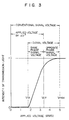
- Fig. 3 shows the relationship between a voltage applied to a liquid crystal and the transmission light intensity, and the voltage range for controlling the transmitted light with ⁇ V* and Vsig.
- the intensity of a transmitted light at liquid crystal changes within the voltage range from the threshold voltage Vth of liquid crystal to its saturation voltage Vmax. If ⁇ V* is set larger than or equal to Vth without amplitude and phase control of signal voltages, the maximum necessary image signal voltage becomes (Vmax - Vth). If on the other hand ⁇ V* is set at Vct with the amplitude and phase control of signal voltages, the maximum necessary image signal voltage can be reduced to about (Vmax - Vth)/2, thereby achieving one of the above-described objects of this invention which is to make smaller the image signal amplitude.
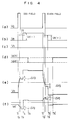
- Fig. 4 shows voltage waveforms aiming at improving the drive method shown in Fig. 2, wherein used is a voltage waveform indicated at (b) in Fig. 4 different from that in Fig. 2.
- the modulating signal Ve is applied as in the following.
- T T2′
- T4′ after the completion of scanning by the signal Vg (after TRT turns off)
- the modulating signal is changed in the negative direction by the amount Ve(+).
- the voltage difference 2.45 V therebetween is given by changing the potential Ve during the on-period of TFT as shown in Fig. 4.
- the display unit of the first embodiment of this invention is shown in Fig. 5.
- Reference numeral 11 designates a scan signal drive circuit
- 12 an image signal drive circuit
- 13 a first modulating circuit
- 14 a second modulating circuit.
- 15a, 15b, ..., 15z designates scan signal lines, 16a, 16b, ..., 16z image signal lines, 17a, 17b, ..., 17z common electrodes of storage capacitors Cs, and 18a, 18b, ..., 18z opposing electrodes of liquid crystals.
- ⁇ V* and Vsig are essentially the same as that shown in Fig. 2. Namely, the polarities of the image signal and modulating signals are reversed alternately for each field.
- all the range from black to white could be driven by a signal voltage with its amplitude only 3Vpp, while retaining a good display contrast with less flickers.
- the DC components among respective electrodes were almost zero with a good reliability of the liquid crystal for a long period.
- the brightness control of a display image was carried out by changing the amplitude of the modulating signal and hence of ⁇ V*.
- a voltage waveform of Ve shown in Fig. 7 is used which is different from that of the first embodiment.
- the voltage of Ve is different between the even and odd fields.
- the modulating signals Ve(N) and Ve(N+1) are changed two steps in the negative direction. Specifically, the Ve potential is changed during the on-period of TFT, and after TFT turns off, changed further in the negative direction by the amount smaller than the change in the positive direction.
- this embodiment has another advantage that since the change of Ve in the negative direction during the on-period of TFT is small, the gate voltage necessary for a given image signal voltage is reduced.
- the waveform of Vt at each scan line is reversed alternately for each field.
- the waveform of Vt changes its polarity during the on-period of TFT in the direction opposite to that the waveform Ve changes after the turning-off of TFT.
- the modulating voltages Ve(+) and Ve(-) become smaller than those of the first and second embodiments.
- FIG. 8 The circuit of the display unit of the fourth embodiment is shown in Fig. 8 and the voltage waveforms applied to this circuit are shown in Fig. 9.
- reference numeral 21a designates a first scan signal line, 21a′ a common electrode line of storage capacitors at the first scan signal line, 21z the last scan signal line, and 21z′ a scan signal line at the stage before the last stage.
- This embodiment is different from the first and second embodiments in that the common electrode of storage capacitors is connected to the scan line at the preceding stage.
- the modulating signal is therefore applied to the preceding stage scan signal line.
- a delay time ⁇ d lapses after scanning the (N+1)-th scan signal line, the polarity of the modulating signal applied to the N-th scan signal line is reversed.
- the polarity of the modulating signal may be reversed both for the N-th and (N+1)-th scan lines and for the even and odd fields, or only for the even and odd fields.
- the potential changes of the modulating signal by the amount Ve(+) in the positive direction and by the amount Ve(-) in the negative direction are made variable independently of each other.
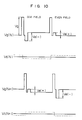
- the display unit having the same circuit as the fourth embodiment is driven by the signals having the waveforms shown in Fig. 10.
- the voltage Vg after modulation is the same for both the even and odd fields, whereas in this embodiment it is different between the even and odd fields.
- the waveforms shown in Fig. 10 not only the advantages of the fourth embodiment are obtained, but also the gate amplitude required for driving the gate is made smaller.
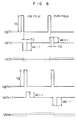
- the circuit of the display unit of the sixth embodiment is shown in Fig. 11, and the voltage waveforms applied to this circuit are shown in Fig. 12.
- This embodiment is the same as the fourth embodiment in that the modulating signal is applied to the scan signal line, but is different from the already described embodiments in that the opposing electrodes are not grouped into each scan signal line but all the electrodes within the display unit are supplied with a same potential, and in that the polarity of the potential between the pixel electrode and opposing electrode is changed alternately for each one scan period (1 H).
- reference numeral 22 designates a scan signal drive circuit, 25 an image signal drive circuit, and 26 a second modulation signal generating circuit.
- Reference numerals 25a, 25b, ..., 25z designate image signal lines.
- Ch(N) and Ch(N+1) represent the voltage waveforms applied to the N-th and (N+1)-th scan signal lines, respectively.
- Vt represents the opposing electrode potential
- Vsig represents the image signal voltage waveform.
- the voltage waveforms for AC driving the liquid crystal have their polarities reversed alternately for the even and odd fields, as shown in Figs. 12A and 12B.
- the potentials Ve(+) and VE(-) of the modulating signal immediately after the scan signal Vg in the waveforms Ch(N) and Ch(N+1) are changed independently of each other.
- the duration Ts of the scan signal Vg is made variable within the period smaller than one scan period. After the lapse of a delay time ⁇ d after scanning the succeeding stage Ch(N+1) scan line, the modulating signal is applied.
- the number of second modulating signal output lines for the opposing electrodes can be reduced.
- the occurrence of the image memory phenomenon was checked by displaying a fixed pattern such as window pattern, color bar, and resolution chart on the display unit and by using the drive method of this embodiment. After displaying a window pattern for four hours, the whole screen of the display unit was set at the halftone display condition. The burning phenomenon of the fixed pattern was not observed.
- the image burning phenomenon of two display panels driven in accordance with the conventional method was also checked for comparison therebetween.
- the first display panel has no storage capacitor for each pixel. With this display panel, the internal DC potential difference between the image signal line and pixel electrode induced by the scan signal via the parasitic capacitor Cgd is 3.5 to 4.0 V. After displaying a window pattern on this display panel for three minutes, the burning phenomenon was clearly observed. Also, after displaying a window pattern on this display panel for one hour, the burning phenomenon did not disappear for three hours. Other fixed patterns also resulted in the same burning phenomenon.
- the second display panel has a storage capacitor of 1 pF for each pixel, and the internal DC potential difference is 0.7 to 1.0 V. After displaying a fixed pattern for several minutes on this display panel, the burning phenomenon was not observed definitely, but after the one hour consecutive display, it was observed and continued thereafter for several hours.
- the voltage waveforms of the fifth embodiment are used while the potential of the second modulating signal generator shown in Fig. 11 is made floated, i.e., while the opposing electrode are not connected to any circuit portion.
- the modulating signal Ve applied to the scan signal line is induced, via the internal electrostatic capacitor within the display unit, also to the opposing electrode.
- the image signal line is held at the potential irrelevant to the modulating signal Ve so that the amplitude of the second demodulating signal appearing at the opposing electrode is in general smaller than Ve, thereby not satisfying the conditional equation (4b′) correctly.
- the second modulating signal generator can be omitted, resulting in a large reduction of power consumption. An image of good quality can be displayed also in this case, satisfying almost all of the objects of the present invention.
- the storage capacitor common lines 17a, 17b, ..., 17z are connected together and the opposing electrode common lines 18a, 18b, ..., 18z are connected together in the first embodiment shown in Fig. 5, and the display panel is driven in an analogous way to sixth embodiment which changes the potential polarity of the pixel electrode alternately for each one scan period.
- the circuit shown in Fig. 11 is used and the voltage waveforms shown in Fig. 13 are applied to the display unit.
- the voltage waveforms Ch(N) and Ch(N+1) shown in Fig. 13 are modifications of those of the sixth embodiment shown in Fig. 12.
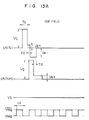
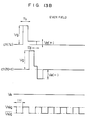
- the voltage waveform Ch(N) in the odd field shown in Fig. 13A takes a potential Ve(+) after the on-period Ts of TFT, and after the lapse of a delay time ⁇ d′ (0 ⁇ ⁇ d′ ⁇ Ts) after turning-on of TFT at the succeeding scan line as shown by Ch(N+1), takes a potential Ve(-).
- the voltage waveform Ch(N+1) takes the same waveform as that of Ch(N) in the odd field.
- the voltage waveforms shown in Fig. 13 it is possible that the potential change given to the succeeding pixel electrode during the on-period of TFT at the Ch(N) be made the same for both the even and odd fields. Flickers are thereby reduced more than that by the voltage waveforms shown in Fig. 12.
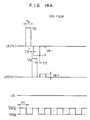
- This embodiment uses the circuit shown in Fig. 11 and the applied voltage waveforms shown in Fig. 14 which shows another modification of the voltage waveforms Ch(N) and Ch(N+1) of the sixth embodiment shown in Fig. 12.
- the voltage waveform Ch(N) in the odd field shown in Fig. 14A takes a zero potential after the on-period Ts of TFT, and after the lapse of a delay time ⁇ d′ (0 ⁇ ⁇ d′ ⁇ Ts) after turning-on of TFT at the succeeding scan line as shown by Ch(N+1), takes a potential Ve(-).
- the voltage waveform Ch(N+1) in the even field takes a zero potential after the on-period of TFT, and after the lapse of a delay time ⁇ d′ (0 ⁇ ⁇ d′ ⁇ Ts) after turning-on of TFT at the succeeding scan line as shown by Ch(N+1), takes a potential Ve(+).
- Ch(N) in the odd field and Ch(N+1) in the even field are the same voltage waveform, and Ch(N) in the even field and Ch(N+1) in the odd field are the same voltage waveform.
- the ninth and tenth embodiments are modifications of the sixth embodiment, and the same advantages as the sixth embodiment are obtained by the ninth and tenth embodiments.
- the present invention has the following distinctive advantages.
- the amplitude of voltage signals to be generated from the signal drive circuits in an active matrix display unit is considerably lowered, resulting in a reduction of power consumption by the drive circuits which deal with analog signals. Further, in the case of a color display, the amplitude of signals of chroma ICs are lowered to thus reduce power consumption. The drive power for the display unit as a whole can thus be reduced.
- the lower amplitude of voltage signals makes it easy to fabricate electronic circuitries which nowadays require more and more high integration and high frequency drive signals.
- the drive circuit can be operated within the region having a good linearity, thereby allowing a secondary advantage of improving the display quality.
- the display quality can be improved. Even in AC driving the display unit alternately for each field as shown in the second and third embodiments, the causes of flickers can be eliminated. With the fourth embodiment, the display brightness can be made uniform and the gradation display performance can be considerably improved.
- the reliability of a display unit can be improved, because there is removed the DC voltage conventionally generated unavoidably within the unit due to the anisotropy of liquid crystal, due to capacitive coupling of a scan signal via Cgd, or due to other causes.
- the DC voltage is the cause of inducing various display defects.
- the drive conditions satisfying the equation (4) are not adversely affected by the dielectric anisotropy of liquid crystal. This means that even if the dielectric constant itself changes, e.g., when a display unit is used within a broad temperature region, such change does not influence the operation of the display unit, thereby allowing a stable drive.
Landscapes
- Engineering & Computer Science (AREA)
- Chemical & Material Sciences (AREA)
- Crystallography & Structural Chemistry (AREA)
- Physics & Mathematics (AREA)
- Computer Hardware Design (AREA)
- General Physics & Mathematics (AREA)
- Theoretical Computer Science (AREA)
- Power Engineering (AREA)
- Liquid Crystal Display Device Control (AREA)
- Liquid Crystal (AREA)
- Control Of Indicators Other Than Cathode Ray Tubes (AREA)
- Control Of El Displays (AREA)
Claims (11)
- Procédé de commande d'unité d'affichage comportant des électrodes de pixels (A) agencées matriciellement, reliées chacune, via un condensateur (8), à une première ligne, chaque électrode de pixels étant reliée à un élément de commutation (3) qui est relié électriquement à une ligne (2) pour signal d'image et à une ligne (1) pour signal de balayage, et comportant un matériau d'affichage enserré entre ladite électrode de pixels (A) et une électrode opposée et étant alimenté en courant alternatif, dans lequel une tension de signal d'image (Vsig) est transmise sur ladite électrode de pixels (A) pendant une période de conduction dudit élément de commutation (3), et un signal de modulation (Ve) est appliqué sur ladite première ligne pendant une période de non conduction dudit élément de commutation, modifiant par conséquent le potentiel de ladite électrode de pixels, caractérisé en ce que ledit signal de modulation (Ve) est engendré de telle sorte que ledit potentiel modifié soit superposé à ladite tension de signal d'image (Vsig) ou lui soit soustrait, la polarité de ladite tension de signal d'image (Vsig), transmise pendant la période de conduction dudit élément de commutation (3) étant inversée de manière alternée à chaque période de balayage vertical, et la polarité dudit signal de modulation (Ve) appliqué sur ladite première ligne pendant la période de non conduction dudit élément de commutation (3) étant inversée de manière alternée à chaque période de balayage vertical, la tension résultante étant appliquée aux bornes dudit matériau d'affichage.
- Procédé de commande d'unité d'affichage selon la revendication 1, dans lequel les valeurs absolues des tensions Ve(+) et Ve(-) dudit signal de modulation (Ve) dont la polarité est inversée, sont différentes, ledit signal de modulation (Ve) étant appliqué sur ladite première ligne pendant la période de non conduction dudit élément de commutation (3).
- Procédé de commande d'unité d'affichage selon la revendication 2, dans lequel une partie du potentiel dudit signal de modulation (Ve) est modifiée avant la fin de la période de non conduction dudit élément de commutation (3).
- Procédé de commande d'unité d'affichage selon l'une quelconque des revendications 1 à 3, dans lequel ledit élément de commutation (3) est un transistor à couches minces (TFT), et la relation existant entre les tensions Ve(+) et Ve(-) dudit signal de modulation (Ve), dont la polarité s'inverse de manière alternée à chaque ligne de balayage, et une tension de signal de balayage (Vg) est donnée par :

- Procédé de commande d'unité d'affichage selon l'une quelconque des revendications 1 à 4, dans lequel le potentiel de ladite électrode opposée de l'unité d'affichage est constant, au moins pendant chaque période de trame.
- Procédé de commande d'unité d'affichage selon l'une quelconque des revendications 1 à 4, dans lequel le potentiel de ladite électrode opposée de l'unité d'affichage est constant et est égal au potentiel-milieu moyen desdites tensions de signaux d'image (Vsig).
- Procédé de commande d'unité d'affichage selon l'une quelconque des revendications 1 à 4, dans lequel le potentiel de ladite électrode opposée est un potentiel électriquement flottant.
- Procédé de commande d'unité d'affichage selon l'une quelconque des revendications 1 à 7, dans lequel ladite première ligne est utilisée en commun avec ladite ligne de signal de balayage (1), et ledit signal de modulation (Ve) est appliqué sur ladite ligne de signal de balayage en superposition avec ledit signal de balayage (Vg).
- Procédé de commande d'unité d'affichage selon l'une quelconque des revendications 1 à 8, dans lequel la tension continue moyenne entre ladite électrode opposée, ladite ligne de signal d'image (2) et ladite électrode de pixels (A) est inférieure à CgdVg/Σ C, où Σ C est la capacité électrostatique totale par pixel.
- Procédé de commande d'unité d'affichage selon l'une quelconque des revendications 1 à 9, dans lequel les valeurs Ve(+) et Ve(-) de ladite tension de signal de modulation (Ve) sont établies de manière à satisfaire la formule suivante :


- Procédé de commande d'unité d'affichage selon la revendication 10, dans lequel ΔV* est établi de manière à satisfaire l'équation suivante :

Applications Claiming Priority (2)
| Application Number | Priority Date | Filing Date | Title |
|---|---|---|---|
| JP313456/88 | 1988-12-12 | ||
| JP63313456A JP2568659B2 (ja) | 1988-12-12 | 1988-12-12 | 表示装置の駆動方法 |
Publications (3)
| Publication Number | Publication Date |
|---|---|
| EP0373565A2 EP0373565A2 (fr) | 1990-06-20 |
| EP0373565A3 EP0373565A3 (fr) | 1991-09-11 |
| EP0373565B1 true EP0373565B1 (fr) | 1995-11-15 |
Family
ID=18041521
Family Applications (1)
| Application Number | Title | Priority Date | Filing Date |
|---|---|---|---|
| EP89122847A Expired - Lifetime EP0373565B1 (fr) | 1988-12-12 | 1989-12-11 | Méthode de commande d'unité d'affichage |
Country Status (5)
| Country | Link |
|---|---|
| US (1) | US5296847A (fr) |
| EP (1) | EP0373565B1 (fr) |
| JP (1) | JP2568659B2 (fr) |
| KR (1) | KR920009030B1 (fr) |
| DE (1) | DE68924836T2 (fr) |
Cited By (2)
| Publication number | Priority date | Publication date | Assignee | Title |
|---|---|---|---|---|
| US6046716A (en) | 1996-12-19 | 2000-04-04 | Colorado Microdisplay, Inc. | Display system having electrode modulation to alter a state of an electro-optic layer |
| US6078303A (en) | 1996-12-19 | 2000-06-20 | Colorado Microdisplay, Inc. | Display system having electrode modulation to alter a state of an electro-optic layer |
Families Citing this family (95)
| Publication number | Priority date | Publication date | Assignee | Title |
|---|---|---|---|---|
| JPH03168617A (ja) * | 1989-11-28 | 1991-07-22 | Matsushita Electric Ind Co Ltd | 表示装置の駆動方法 |
| GB2245741A (en) * | 1990-06-27 | 1992-01-08 | Philips Electronic Associated | Active matrix liquid crystal devices |
| JP2950949B2 (ja) * | 1990-08-28 | 1999-09-20 | 三洋電機株式会社 | 液晶表示装置の駆動方法 |
| JP2730286B2 (ja) * | 1990-10-05 | 1998-03-25 | 松下電器産業株式会社 | 表示装置の駆動方法 |
| DE69225105T2 (de) * | 1991-10-04 | 1999-01-07 | Kabushiki Kaisha Toshiba, Kawasaki, Kanagawa | Flüssigkristallanzeigegerät |
| JP2806098B2 (ja) * | 1991-10-09 | 1998-09-30 | 松下電器産業株式会社 | 表示装置の駆動方法 |
| JP2820336B2 (ja) * | 1991-10-22 | 1998-11-05 | シャープ株式会社 | アクティブマトリクス型液晶表示装置の駆動方法 |
| EP0588019A3 (en) * | 1992-07-21 | 1994-09-21 | Matsushita Electric Industrial Co Ltd | Active matrix liquid crystal display |
| JP2626451B2 (ja) * | 1993-03-23 | 1997-07-02 | 日本電気株式会社 | 液晶表示装置の駆動方法 |
| JPH06289817A (ja) * | 1993-04-01 | 1994-10-18 | Sharp Corp | 表示装置の駆動方法及び駆動回路 |
| EP0622655A3 (fr) * | 1993-04-22 | 1995-09-13 | Matsushita Electric Industrial Co Ltd | Dispositif d'affichage, méthode de commande, et appareil d'affichage à projection qui l'utilise. |
| JPH07140441A (ja) * | 1993-06-25 | 1995-06-02 | Hosiden Corp | アクティブマトリックス液晶表示素子の駆動方法 |
| TW270198B (fr) | 1994-06-21 | 1996-02-11 | Hitachi Seisakusyo Kk | |
| US5528256A (en) | 1994-08-16 | 1996-06-18 | Vivid Semiconductor, Inc. | Power-saving circuit and method for driving liquid crystal display |
| US5986631A (en) * | 1995-07-05 | 1999-11-16 | Matsushita Electric Industrial Co., Ltd. | Method for driving active matrix LCD using only three voltage levels |
| KR100230793B1 (ko) * | 1995-07-28 | 1999-11-15 | 김영환 | 엘씨디의구동방식 |
| TW315456B (fr) * | 1995-11-06 | 1997-09-11 | Matsushita Electric Industrial Co Ltd | |
| JP3069280B2 (ja) * | 1995-12-12 | 2000-07-24 | 松下電器産業株式会社 | アクティブマトリックス型液晶表示素子及びその駆動方法 |
| JP3037886B2 (ja) | 1995-12-18 | 2000-05-08 | インターナショナル・ビジネス・マシーンズ・コーポレイション | 液晶表示装置の駆動方法 |
| US6911962B1 (en) | 1996-03-26 | 2005-06-28 | Semiconductor Energy Laboratory Co., Ltd. | Driving method of active matrix display device |
| JP4307574B2 (ja) * | 1996-09-03 | 2009-08-05 | 株式会社半導体エネルギー研究所 | アクティブマトリクス表示装置 |
| WO1998027540A1 (fr) * | 1996-12-19 | 1998-06-25 | Colorado Microdisplay, Inc. | Systeme d'afficheur a modification de l'etat de la couche electro-optique par modulation d'une tension d'electrode |
| CN100533528C (zh) | 1997-02-17 | 2009-08-26 | 精工爱普生株式会社 | 显示装置 |
| US6462722B1 (en) | 1997-02-17 | 2002-10-08 | Seiko Epson Corporation | Current-driven light-emitting display apparatus and method of producing the same |
| TW388857B (en) * | 1997-06-13 | 2000-05-01 | Matsushita Electronic Compon | Liquid crystal display panel and driving method therefor |
| JP2001504953A (ja) | 1997-08-26 | 2001-04-10 | コーニンクレッカ フィリップス エレクトロニクス エヌ ヴィ | 表示装置 |
| US6140993A (en) * | 1998-06-16 | 2000-10-31 | Atmel Corporation | Circuit for transferring high voltage video signal without signal loss |
| TW512303B (en) | 1998-08-21 | 2002-12-01 | Dar Chyi Technology Corp | Driving method of liquid crystal display |
| US6868154B1 (en) * | 1999-08-02 | 2005-03-15 | Robert O. Stuart | System and method for providing a service to a customer via a communication link |
| JP2001249319A (ja) * | 2000-03-02 | 2001-09-14 | Hitachi Ltd | 液晶表示装置 |
| KR100491205B1 (ko) * | 2000-03-30 | 2005-05-25 | 세이코 엡슨 가부시키가이샤 | 표시장치 |
| CN100365474C (zh) * | 2000-04-24 | 2008-01-30 | 松下电器产业株式会社 | 显示装置及其驱动方法 |
| JP3723747B2 (ja) * | 2000-06-16 | 2005-12-07 | 松下電器産業株式会社 | 表示装置およびその駆動方法 |
| US8130187B2 (en) | 2000-07-19 | 2012-03-06 | Toshiba Matsushita Display Technology Co., Ltd. | OCB liquid crystal display with active matrix and supplemental capacitors and driving method for the same |
| US7034790B2 (en) * | 2000-10-25 | 2006-04-25 | Matsushita Electric Industrial Co., Ltd. | Liquid crystal display drive method and liquid crystal display |
| JP2002333870A (ja) | 2000-10-31 | 2002-11-22 | Matsushita Electric Ind Co Ltd | 液晶表示装置、el表示装置及びその駆動方法、並びに副画素の表示パターン評価方法 |
| JP3832240B2 (ja) | 2000-12-22 | 2006-10-11 | セイコーエプソン株式会社 | 液晶表示装置の駆動方法 |
| JP2002278517A (ja) * | 2001-03-15 | 2002-09-27 | Hitachi Ltd | 液晶表示装置 |
| JP2002311414A (ja) * | 2001-04-17 | 2002-10-23 | Matsushita Electric Ind Co Ltd | 液晶表示装置、画像表示応用機器、マトリックス型表示装置駆動方法、およびプログラム |
| US20020190942A1 (en) * | 2001-06-06 | 2002-12-19 | Lee Yu-Tuan | Driving method for thin film transistor liquid crystal display |
| JP2003005720A (ja) * | 2001-06-21 | 2003-01-08 | Matsushita Electric Ind Co Ltd | 液晶表示方法、液晶表示装置、プログラム、および媒体 |
| JP2003029719A (ja) * | 2001-07-16 | 2003-01-31 | Hitachi Ltd | 液晶表示装置 |
| JP2003122358A (ja) * | 2001-10-11 | 2003-04-25 | Sega Corp | 音響信号出力方法、音響信号生成装置及びプログラム |
| JP2005062396A (ja) | 2003-08-11 | 2005-03-10 | Sony Corp | 表示装置及びその駆動方法 |
| JP2004046235A (ja) * | 2003-09-05 | 2004-02-12 | Matsushita Electric Ind Co Ltd | 液晶表示装置 |
| US20050140634A1 (en) | 2003-12-26 | 2005-06-30 | Nec Corporation | Liquid crystal display device, and method and circuit for driving liquid crystal display device |
| JP4555063B2 (ja) * | 2003-12-26 | 2010-09-29 | Nec液晶テクノロジー株式会社 | 液晶表示装置、その駆動方法及び駆動回路 |
| US20080150928A1 (en) * | 2004-02-19 | 2008-06-26 | Koninklijke Philips Electronic, N.V. | Display Unit |
| TWI284879B (en) * | 2004-06-08 | 2007-08-01 | Fujitsu Ltd | Liquid crystal display apparatus and driving method thereof |
| CN100446079C (zh) | 2004-12-15 | 2008-12-24 | 日本电气株式会社 | 液晶显示装置、其驱动方法及其驱动电路 |
| JP4580775B2 (ja) * | 2005-02-14 | 2010-11-17 | 株式会社 日立ディスプレイズ | 表示装置及びその駆動方法 |
| JP4843268B2 (ja) * | 2005-07-08 | 2011-12-21 | 東芝モバイルディスプレイ株式会社 | 液晶表示装置の駆動方法及び液晶表示装置 |
| US8866717B2 (en) | 2005-08-18 | 2014-10-21 | Japan Display, Inc. | Display device and drive method providing improved signal linearity |
| TWI449009B (zh) * | 2005-12-02 | 2014-08-11 | Semiconductor Energy Lab | 顯示裝置和使用該顯示裝置的電子裝置 |
| KR20070078522A (ko) * | 2006-01-27 | 2007-08-01 | 삼성전자주식회사 | 표시 장치 및 액정 표시 장치 |
| KR101246830B1 (ko) * | 2006-06-09 | 2013-03-28 | 삼성디스플레이 주식회사 | 표시 장치 및 이의 구동 방법 |
| JP2008015282A (ja) * | 2006-07-06 | 2008-01-24 | Toshiba Matsushita Display Technology Co Ltd | 液晶表示装置 |
| KR101337261B1 (ko) * | 2006-07-24 | 2013-12-05 | 삼성디스플레이 주식회사 | 액정 표시 장치 및 그의 구동 방법 |
| JP4241781B2 (ja) | 2006-08-10 | 2009-03-18 | エプソンイメージングデバイス株式会社 | 電気光学装置、駆動回路および電子機器 |
| JP5186913B2 (ja) | 2007-01-22 | 2013-04-24 | セイコーエプソン株式会社 | ソースドライバ、電気光学装置及び電子機器 |
| US7928941B2 (en) | 2007-03-20 | 2011-04-19 | Sony Corporation | Electro-optical device, driving circuit and electronic apparatus |
| JP4428401B2 (ja) * | 2007-05-21 | 2010-03-10 | エプソンイメージングデバイス株式会社 | 電気光学装置、駆動回路および電子機器 |
| US7830346B2 (en) * | 2007-07-12 | 2010-11-09 | Au Optronics Corporation | Liquid crystal display panel with color washout improvement by scanning line coupling and applications of same |
| JP5072489B2 (ja) | 2007-08-30 | 2012-11-14 | 株式会社ジャパンディスプレイウェスト | 表示装置およびその駆動方法、電子機器 |
| TWI390279B (zh) | 2007-08-30 | 2013-03-21 | Japan Display West Inc | 顯示裝置及電子設備 |
| JP5137744B2 (ja) | 2007-08-30 | 2013-02-06 | 株式会社ジャパンディスプレイウェスト | 表示装置およびその駆動方法、電子機器 |
| CN101681608A (zh) | 2007-09-11 | 2010-03-24 | 夏普株式会社 | 显示装置以及其驱动电路及驱动方法 |
| US8791928B2 (en) * | 2007-11-06 | 2014-07-29 | Hannstar Display Corp. | Pixel driving method, pixel driving device and liquid crystal display using thereof |
| JP2009198981A (ja) * | 2008-02-25 | 2009-09-03 | Seiko Epson Corp | 電気光学装置の駆動回路、電気光学装置の駆動方法、電気光学装置および電子機器 |
| US20110001743A1 (en) * | 2008-03-11 | 2011-01-06 | Asahi Yamato | Drive circuit, drive method, liquid crystal display panel, liquid crystal module, and liquid cystal display device |
| GB2458957B (en) * | 2008-04-04 | 2010-11-24 | Sony Corp | Liquid crystal display module |
| US7916108B2 (en) * | 2008-04-21 | 2011-03-29 | Au Optronics Corporation | Liquid crystal display panel with color washout improvement and applications of same |
| JP2009300530A (ja) * | 2008-06-10 | 2009-12-24 | Seiko Epson Corp | 電気光学装置の駆動装置及び方法、並びに電気光学装置及び電子機器 |
| JP2010008576A (ja) * | 2008-06-25 | 2010-01-14 | Toshiba Mobile Display Co Ltd | 液晶表示装置および液晶表示装置の駆動方法 |
| US20100007591A1 (en) * | 2008-07-10 | 2010-01-14 | Himax Display, Inc. | Pixel unit for a display device and driving method thereof |
| TWI390498B (zh) * | 2008-07-21 | 2013-03-21 | Chimei Innolux Corp | 主動矩陣液晶顯示器及液晶顯示面板 |
| CN102112911B (zh) * | 2008-08-05 | 2014-05-07 | 夏普株式会社 | 液晶显示装置及其制造方法 |
| JP2010197417A (ja) * | 2009-02-23 | 2010-09-09 | Toppoly Optoelectronics Corp | ディスプレイ装置及びこれを備える電子機器 |
| US20120086700A1 (en) * | 2009-06-29 | 2012-04-12 | Sharp Kabushiki Kaisha | Display Device And Method For Driving Same |
| US8866720B2 (en) | 2009-09-16 | 2014-10-21 | Sharp Kabushiki Kaisha | Memory device and display device equipped with memory device |
| JPWO2011058647A1 (ja) * | 2009-11-13 | 2013-03-28 | パイオニア株式会社 | アクティブマトリクス型モジュール及びその駆動方法 |
| KR102329671B1 (ko) * | 2009-12-18 | 2021-11-23 | 가부시키가이샤 한도오따이 에네루기 켄큐쇼 | 반도체 장치 |
| US20110234605A1 (en) * | 2010-03-26 | 2011-09-29 | Nathan James Smith | Display having split sub-pixels for multiple image display functions |
| US8633889B2 (en) | 2010-04-15 | 2014-01-21 | Semiconductor Energy Laboratory Co., Ltd. | Display device, driving method thereof, and electronic appliance |
| TWI534773B (zh) | 2010-04-23 | 2016-05-21 | 半導體能源研究所股份有限公司 | 顯示裝置的驅動方法 |
| GB2481008A (en) | 2010-06-07 | 2011-12-14 | Sharp Kk | Active storage pixel memory |
| JP5189149B2 (ja) * | 2010-09-17 | 2013-04-24 | 奇美電子股▲ふん▼有限公司 | アクティブマトリクス型ディスプレイ装置及びこれを有する電子機器 |
| US8836680B2 (en) | 2011-08-04 | 2014-09-16 | Sharp Kabushiki Kaisha | Display device for active storage pixel inversion and method of driving the same |
| US8896512B2 (en) | 2011-08-04 | 2014-11-25 | Sharp Kabushiki Kaisha | Display device for active storage pixel inversion and method of driving the same |
| WO2013101022A1 (fr) * | 2011-12-29 | 2013-07-04 | Intel Corporation | Panneau arrière de transistor à couches minces pour dispositifs d'affichage |
| US20130328758A1 (en) * | 2012-06-08 | 2013-12-12 | Apple Inc. | Differential active-matrix displays |
| CN102831871B (zh) * | 2012-08-31 | 2015-06-24 | 京东方科技集团股份有限公司 | 一种显示器及其显示图像帧的方法 |
| KR102170439B1 (ko) * | 2013-09-09 | 2020-10-29 | 삼성디스플레이 주식회사 | 잔상 후보 영역 검출 장치 및 이를 포함하는 잔상 방지 장치 |
| CN107195280B (zh) | 2017-07-31 | 2020-12-29 | 京东方科技集团股份有限公司 | 一种像素电压补偿方法、像素电压补偿系统和显示装置 |
| JPWO2024202779A1 (fr) * | 2023-03-24 | 2024-10-03 |
Family Cites Families (19)
| Publication number | Priority date | Publication date | Assignee | Title |
|---|---|---|---|---|
| DE2953769C2 (de) * | 1978-02-08 | 1985-02-14 | Sharp K.K., Osaka | Flüssigkristall-Anzeigematrix mit Dünnfilmtransistor-Anordnung |
| JPS5957288A (ja) * | 1982-09-27 | 1984-04-02 | シチズン時計株式会社 | マトリクス表示装置の駆動方法 |
| JPS59119390A (ja) * | 1982-12-25 | 1984-07-10 | 株式会社東芝 | 薄膜トランジスタ回路 |
| JPS603698A (ja) * | 1983-06-21 | 1985-01-10 | ソニー株式会社 | 液晶デイスプレイ装置 |
| JPS6039620A (ja) * | 1983-08-12 | 1985-03-01 | Asahi Glass Co Ltd | 筋肉を制御する装置及び肢を動かすための装置 |
| JPS6066236A (ja) * | 1983-09-21 | 1985-04-16 | Canon Inc | 液晶デイスプレイパネルの駆動法 |
| JPS6083477A (ja) * | 1983-10-13 | 1985-05-11 | Sharp Corp | 液昇表示装置の駆動回路 |
| JPS60151615A (ja) * | 1984-01-19 | 1985-08-09 | Matsushita Electric Ind Co Ltd | 液晶表示デバイス駆動法 |
| US4728172A (en) * | 1984-08-08 | 1988-03-01 | Energy Conversion Devices, Inc. | Subassemblies for displays having pixels with two portions and capacitors |
| JPS60156095A (ja) * | 1984-11-22 | 1985-08-16 | ソニー株式会社 | 液晶デイスプレイ装置 |
| JP2583211B2 (ja) * | 1985-05-10 | 1997-02-19 | シチズン時計株式会社 | 液晶表示装置 |
| JPS61275823A (ja) * | 1985-05-31 | 1986-12-05 | Seiko Epson Corp | 液晶表示装置 |
| JPS61275824A (ja) * | 1985-05-31 | 1986-12-05 | Seiko Epson Corp | 液晶表示装置 |
| JPS61275822A (ja) * | 1985-05-31 | 1986-12-05 | Seiko Epson Corp | 液晶表示装置の駆動方法 |
| JPS62218943A (ja) * | 1986-03-19 | 1987-09-26 | Sharp Corp | 液晶表示装置 |
| JPS63249896A (ja) * | 1987-04-06 | 1988-10-17 | 松下電器産業株式会社 | 液晶表示装置 |
| EP0288011A3 (fr) * | 1987-04-20 | 1991-02-20 | Hitachi, Ltd. | Dispositif d'affichage à cristaux liquides et méthode de commande pour ce dispositif |
| KR920007167B1 (ko) * | 1987-04-20 | 1992-08-27 | 가부시기가이샤 히다씨세이사구쇼 | 액정표시장치 및 그 구동방법 |
| JP2737209B2 (ja) * | 1988-03-11 | 1998-04-08 | 松下電器産業株式会社 | 表示装置の駆動方法 |
-
1988
- 1988-12-12 JP JP63313456A patent/JP2568659B2/ja not_active Expired - Lifetime
-
1989
- 1989-12-11 EP EP89122847A patent/EP0373565B1/fr not_active Expired - Lifetime
- 1989-12-11 DE DE68924836T patent/DE68924836T2/de not_active Expired - Lifetime
- 1989-12-12 KR KR1019890018362A patent/KR920009030B1/ko not_active Expired
-
1992
- 1992-06-22 US US07/902,564 patent/US5296847A/en not_active Expired - Lifetime
Cited By (6)
| Publication number | Priority date | Publication date | Assignee | Title |
|---|---|---|---|---|
| US6046716A (en) | 1996-12-19 | 2000-04-04 | Colorado Microdisplay, Inc. | Display system having electrode modulation to alter a state of an electro-optic layer |
| US6078303A (en) | 1996-12-19 | 2000-06-20 | Colorado Microdisplay, Inc. | Display system having electrode modulation to alter a state of an electro-optic layer |
| US6104367A (en) | 1996-12-19 | 2000-08-15 | Colorado Microdisplay, Inc. | Display system having electrode modulation to alter a state of an electro-optic layer |
| US6144353A (en) | 1996-12-19 | 2000-11-07 | Colorado Microdisplay, Inc. | Display system having electrode modulation to alter a state of an electro-optic layer |
| US6304239B1 (en) | 1996-12-19 | 2001-10-16 | Zight Corporation | Display system having electrode modulation to alter a state of an electro-optic layer |
| US6329971B2 (en) | 1996-12-19 | 2001-12-11 | Zight Corporation | Display system having electrode modulation to alter a state of an electro-optic layer |
Also Published As
| Publication number | Publication date |
|---|---|
| EP0373565A2 (fr) | 1990-06-20 |
| EP0373565A3 (fr) | 1991-09-11 |
| DE68924836D1 (de) | 1995-12-21 |
| JP2568659B2 (ja) | 1997-01-08 |
| KR900010633A (ko) | 1990-07-09 |
| JPH02157815A (ja) | 1990-06-18 |
| US5296847A (en) | 1994-03-22 |
| DE68924836T2 (de) | 1996-07-04 |
| KR920009030B1 (ko) | 1992-10-12 |
Similar Documents
| Publication | Publication Date | Title |
|---|---|---|
| EP0373565B1 (fr) | Méthode de commande d'unité d'affichage | |
| EP0336570B1 (fr) | Méthode de contrôle d'un dispositif d'affichage | |
| US5151805A (en) | Capacitively coupled driving method for TFT-LCD to compensate for switching distortion and to reduce driving power | |
| JP2806098B2 (ja) | 表示装置の駆動方法 | |
| US5995074A (en) | Driving method of liquid crystal display device | |
| US6753835B1 (en) | Method for driving a liquid crystal display | |
| US7321352B2 (en) | Liquid crystal display and method for driving the same | |
| US20040104881A1 (en) | Active matrix liquid crystal display | |
| EP0436384B1 (fr) | Circuit de commande pour un dispositif d'affichage à cristaux liquides | |
| US5926160A (en) | Apparatus for displaying image on liquid crystal pixels arranged in matrix layout | |
| US7215310B2 (en) | Liquid crystal display device | |
| JP2737209B2 (ja) | 表示装置の駆動方法 | |
| JP2730286B2 (ja) | 表示装置の駆動方法 | |
| JP2003029726A (ja) | 液晶表示装置及びその駆動方法 | |
| JP2629360B2 (ja) | 液晶表示装置の駆動方法 | |
| JPS60134293A (ja) | 液晶表示装置の駆動方法 | |
| JPH11161237A (ja) | 液晶表示装置 | |
| JP3140088B2 (ja) | 液晶表示装置の駆動方法 | |
| KR100443830B1 (ko) | 액정표시장치 및 그 구동방법 | |
| JPH05210088A (ja) | 液晶表示装置の駆動方法 | |
| JP3437866B2 (ja) | 表示装置の駆動方法 | |
| KR100617611B1 (ko) | 다중 레벨을 갖는 게이트 구동 신호 발생 회로 | |
| JPH0343786A (ja) | アクティブマトリックス液晶パネル用信号処理回路 | |
| JPH0667146A (ja) | 液晶表示装置の駆動方法 | |
| JPH06141269A (ja) | 液晶表示装置及びその駆動方法 |
Legal Events
| Date | Code | Title | Description |
|---|---|---|---|
| PUAI | Public reference made under article 153(3) epc to a published international application that has entered the european phase |
Free format text: ORIGINAL CODE: 0009012 |
|
| AK | Designated contracting states |
Kind code of ref document: A2 Designated state(s): DE FR GB |
|
| 17P | Request for examination filed |
Effective date: 19901228 |
|
| PUAL | Search report despatched |
Free format text: ORIGINAL CODE: 0009013 |
|
| AK | Designated contracting states |
Kind code of ref document: A3 Designated state(s): DE FR GB |
|
| 17Q | First examination report despatched |
Effective date: 19930908 |
|
| GRAA | (expected) grant |
Free format text: ORIGINAL CODE: 0009210 |
|
| AK | Designated contracting states |
Kind code of ref document: B1 Designated state(s): DE FR GB |
|
| REF | Corresponds to: |
Ref document number: 68924836 Country of ref document: DE Date of ref document: 19951221 |
|
| ET | Fr: translation filed | ||
| PLBE | No opposition filed within time limit |
Free format text: ORIGINAL CODE: 0009261 |
|
| STAA | Information on the status of an ep patent application or granted ep patent |
Free format text: STATUS: NO OPPOSITION FILED WITHIN TIME LIMIT |
|
| 26N | No opposition filed | ||
| REG | Reference to a national code |
Ref country code: GB Ref legal event code: IF02 |
|
| REG | Reference to a national code |
Ref country code: GB Ref legal event code: 746 Effective date: 20031002 |
|
| REG | Reference to a national code |
Ref country code: FR Ref legal event code: D6 |
|
| REG | Reference to a national code |
Ref country code: GB Ref legal event code: 732E |
|
| REG | Reference to a national code |
Ref country code: FR Ref legal event code: TP |
|
| PGFP | Annual fee paid to national office [announced via postgrant information from national office to epo] |
Ref country code: DE Payment date: 20081205 Year of fee payment: 20 |
|
| PGFP | Annual fee paid to national office [announced via postgrant information from national office to epo] |
Ref country code: GB Payment date: 20081210 Year of fee payment: 20 |
|
| REG | Reference to a national code |
Ref country code: GB Ref legal event code: PE20 Expiry date: 20091210 |
|
| PG25 | Lapsed in a contracting state [announced via postgrant information from national office to epo] |
Ref country code: GB Free format text: LAPSE BECAUSE OF EXPIRATION OF PROTECTION Effective date: 20091210 |
|
| PGFP | Annual fee paid to national office [announced via postgrant information from national office to epo] |
Ref country code: FR Payment date: 20080830 Year of fee payment: 20 |