EP0373780B1 - Adressenübersetzung für Seiten mehrfacher Grösse - Google Patents
Adressenübersetzung für Seiten mehrfacher Grösse Download PDFInfo
- Publication number
- EP0373780B1 EP0373780B1 EP89312189A EP89312189A EP0373780B1 EP 0373780 B1 EP0373780 B1 EP 0373780B1 EP 89312189 A EP89312189 A EP 89312189A EP 89312189 A EP89312189 A EP 89312189A EP 0373780 B1 EP0373780 B1 EP 0373780B1
- Authority
- EP
- European Patent Office
- Prior art keywords
- page
- dlat
- virtual
- pages
- address
- Prior art date
- Legal status (The legal status is an assumption and is not a legal conclusion. Google has not performed a legal analysis and makes no representation as to the accuracy of the status listed.)
- Expired - Lifetime
Links
Images


Classifications
-
- G—PHYSICS
- G06—COMPUTING OR CALCULATING; COUNTING
- G06F—ELECTRIC DIGITAL DATA PROCESSING
- G06F12/00—Accessing, addressing or allocating within memory systems or architectures
- G06F12/02—Addressing or allocation; Relocation
- G06F12/08—Addressing or allocation; Relocation in hierarchically structured memory systems, e.g. virtual memory systems
- G06F12/10—Address translation
- G06F12/1027—Address translation using associative or pseudo-associative address translation means, e.g. translation look-aside buffer [TLB]
- G06F12/1036—Address translation using associative or pseudo-associative address translation means, e.g. translation look-aside buffer [TLB] for multiple virtual address spaces, e.g. segmentation
-
- G—PHYSICS
- G06—COMPUTING OR CALCULATING; COUNTING
- G06F—ELECTRIC DIGITAL DATA PROCESSING
- G06F2212/00—Indexing scheme relating to accessing, addressing or allocation within memory systems or architectures
- G06F2212/65—Details of virtual memory and virtual address translation
- G06F2212/652—Page size control
Definitions
- the present invention relates to an address translation apparatus and method involving multiple-sized pages as set out in the appended claims.
- the present invention equally provides corresponding sub-system, system and process. Some or all of the following devices are thought to provide advantage, some more so than others in particular circumstances - arranging the system so that there is no overlap between pages, whatever their size; arranging the memory so that pages, particularly the largest size pages, reside on natural page boundaries; arranging the page sizes to correspond to the natural system address partitions - i.e., system segments and system pages; and arranging the directory look-aside tables DLATs to be set associative.
- Dynamic address translation provides the ability to interrupt the execution of a program, record it and its data in auxiliary storage, such as a direct access storage device (DASD), and at a later time return the program and data to different main storage locations for resumption of execution. It can provide a user a system wherein storage appears to be larger than the main storage.
- This apparent storage uses virtual addresses to designate locations therein and it is normally maintained in auxiliary storage. It occurs in blocks of addresses, called pages, and only the most recently referred-to pages are assigned to occupy blocks of physical main storage.
- Virtual addressing has become a key feature in the architecture of many large computers. Virtual addressing allows programs to appear logically contiguous to the user while not being physically contiguous in the storage system. Recently accessed portions of the virtual space are mapped into the main storage unit.
- the mapping information is often stored hierarchically in a directory comprising a segment table with entries corresponding to contiguous 1MB (megabyte) segments and page tables with entries for 4KB (kilobyte) pages within a segment.
- Translation of the virtual address to a real address requires the mapping information that can be gained by searching the appropriate segment and page tables. As this searching process is time consuming, the number of full searches is reduced by retaining information for some of the recent translations in a Directory-Look-Aside-Table (DLAT).
- DLAT Directory-Look-Aside-Table
- the translation process which is required for almost every storage access, requires only a couple of machine cycles.
- the process of searching the directory ranges from about 15 to 60 cycles if the segment and page tables are in main storage.
- Each DLAT entry contains the information for mapping an entire page of storage, frequently 4KB. The amount of storage covered by the DLAT depends on the number of entries in the DLAT and the size of the page.
- vector fetches and stores benefit from large pages simply by decreasing the number of possible page crossings. Even if the next required page is resident in physical storage, the vector pipe may be interrupted on a page crossing to verify that the page has been brought into the memory. This interruption can result in a noticeable performance degradation.
- the CDC (registered trademark of Control Data Corporation) 7600 and CYBER 205 have both small and large pages.
- the CYBER 205 offers small (4KB, 16KB, and 64KB) pages in which the page size selection must be made "via an operating system software installation parameter". Therefore, a given job can allow only one size of small page. However, a large page (512KB) is also allowed.
- the CYBER translation unit handles multiple-sized pages by creating a list of "associative words". Each word contains information similar to a DLAT entry. This list is stored in main storage and the upper (most recently used) 16 entries can be loaded into an internal set of registers by instruction. The translation process consists of first searching within the internal registers.
- a match (a "hit") is found, the entry is moved to the top of the list and the address is resolved. If no match is found in the first 16 entries, the rest of the list, in memory, is searched two entries at a time. If a matching entry is found, it is moved to the top of the list. Otherwise, a page fault is generated. This can require a large number of machine cycles.
- U.S. Patent #4,285,040 shows the support of multiple (two) page sizes, 128B and 4KB.
- the patented solution has many shortcomings. It is not feasible with large address spaces such as those required in high-performance scientific and engineering processors.
- the implementation described requires that registers be available to concurrently retain the base address values for all of the segments in the virtual address space. Even for large pages, such as 1MB, current address spaces (2GB) would require 2048 such registers.
- it is expected that user requirements will force the designers to allow substantially larger address spaces in the near future, thereby dramatically increasing the number of segment registers required for the approach described in the patent.
- the number of equivalent registers can be substantially reduced to approximately forty or fifty and still provide acceptable "hit-ratios", thereby allowing nearly optimal performance.
- U.S. Patent #3,675,215 describes a sequential search process which "continues with the count being incremented by one for each mismatch until the ID of the fetched entry matches the requested virtual address, or until the count exceeds the number of addresses in the subset, in which case a missing address exception occurs".
- a set of "chains" of translation information is maintained.
- the virtual address translation process consists of searching a chain. For each "page fault", an entire chain is searched to detect the occurrence of the page fault.
- Data storage apparatus comprising a virtual address memory, an external data transfer interface and control logic, the apparatus being arranged, in operation, to satisfy memory data transfer requests either immediately or after data transfer over the external data transfer interface, the unit of data transfer being a page, wherein at least some of the resident pages are identifiable by reference to directory lookaside tables DLAT maintained by the control logic.
- Such apparatus is described in, for example, EP-A-239359 and Electronic Design 35 (1987) April, No 9, pp107-113.
- This invention provides apparatus of this type characterised in that a currently transferred page can be one of a predetermined plurality of sizes and the control logic is arranged to maintain one independent DLAT for each page size and to permit, when a virtual page is mapped, a virtual memory address entry to only one of the DLATs by assigning a size value to all of the virtual addresses in that page, thus allowing parallel interrogation of all potentially appropriate DLAT entries when attempting to provide immediate satisfaction of a received data request.
- the DLAT access of this arrangement is always as fast (sometimes tens of times faster) as the chain approach in providing the information required to translate the virtual address. This is primarily due to the associative (parallel) search inherent in the DLAT structure whereas the "chain" structure requires a serial search.
- the minimum and maximum number of cycles for finding a translated page in the "cache-like" structure of the disclosed arrangement is approximately two cycles.
- recognition of the fault is dramatically quicker with the DLAT/segment/page table scheme in comparison to the chain approach.
- the disclosed arrangement includes a set associative arrangement which is used in systems such as the 308X and 3090 families marketed by International Business Machines, Inc.
- Set associative arrangements are well known; and, for example, are used in the structures described in U.S. Patents 4,638,426 and 4,695,950.
- Some of the virtual address bits are used to select one set of entries; the set of entries (usually two) is then associatively searched.
- the set associative arrangement allows fast access to a large number of entries (usually 256 to 512) but requires a small associative search (usually two or four entries). The problem in applying this method to include multiple-sized pages comes in the selection of the bits which are used to select the set of entries.
- DLAT entries can cover different page sizes, the bits must be selected from those which differentiate between storage segments that are at least as large as the largest page size. However, if these bits are used to select a set of DLAT entries, when the entries are for small pages, only a small contiguous block of memory can be covered. If a two-way set associative scheme is used with both 4KB and 1MB pages, the congruence class must cover a contiguous segment which is at least 1MB. However, when entries correspond to 4KB, only 8KB (two entries) of the 1MB contiguous space can be covered.
- the disclosed arrangement has a DLAT structure which can handle multiple-size pages concurrently.
- the two page sizes used in this description will be 4KB and 1MB.
- a 1MB page is considered since it is the equivalent of a non-pageable segment and segments are currently part of the preferred translation process.
- segment information Once the segment information has been obtained, rather than continuing the process (determining a page within a segment), an entire segment would be considered a single entity. Since segments are on 1MB virtual boundaries, this forces the 1MB virtual pages to be on 1MB boundaries. This diminishes the fragmentation problem encountered in multiple-size page systems and allows simplified hardware, the low order page offset bits simply pass through unchanged.
- the IBM 3090 Since the IBM 3090 is a well-known machine, its DLAT facility is used to describe aspects of the disclosed arrangement.
- the DLAT is two-way set associative with 128 pairs of entries, each entry representing a 4KB page.
- the pair of DLAT entries are selected using the congruence class selection address bits immediately above the offset bits which define words within a page, i.e. adjacent pages are covered by different DLAT pairs.
- the 128 pairs of entries only provide coverage for a small portion (e.g. 1024KB in one arrangement) of a presumed 2GB space.
- This arrangement provides, in high performance data processing systems having very large fast main storage devices, a dynamic address translation mechanism which is capable of far more efficient performance than those described in the prior art.
- both the virtual address space 1 and the real address space 2 are divided into a number of 1MB blocks from 0MB to nMB.
- the virtual space blocks 3 and 4 beginning with 0MB and 50MB address values are divided into groups of 256 4KB pages 3-0 to 3-255 and 4-0 to 4-255.
- the 1MB blocks 5-8 with starting virtual addresses of 1MB, 63MB, 64MB and 65MB define 1MB pages in the virtual address space.
- the blocks 5-8 are mapped into real address blocks 9-12 respectively.
- the congruence classes 0-63 for DLAT 20 are assigned to page addresses 0, 4K, 8K ... 252K; for DLAT 21, to page addresses 0, 1M, 2M, 3M ... 63M.
- Each DLAT 20 and 21 of the disclosed arrangement is preferably a two-way set associative array with sixty-four (64) pairs of entries (22-0 to 22-63 and 23-0 to 23-63) each pair representing one congruence class for 4KB and 1MB pages respectively.
- the two entries in each pair are labelled A and B respectively.
- DLAT entry pairs 22-1 and 22-63 contain valid entries (tag bit values and real page addresses) for virtual pages 4-1, 3-65, 3-255, and 3-63 of Fig. 1 and the main store 2 page frames into which their contents have been stored.
- entry pair 23-1A, B and entry 23-63A include valid entries for virtual pages 5, 8 and 6 respectively and the main store pages 9, 12 and 10 into which their contents have been stored.
- the operating system when it maps a virtual block (4K or 1MB), permits a virtual memory entry to only one of the DLATS 20 and 21 by assigning a block size (4KB or 1MB) to all of the virtual addresses in that block (page).
- a block size (4KB or 1MB)
- hardware notes the page size, assigns the virtual page to the appropriate DLAT 20 or 21, and stores the appropriate tag bits A0-A13 into DLAT 20 or A0-A5 into DLAT 21.
- FIG. 4 shows the DLATS 20 and 21 and the virtual address bits A0-A31 received on processor address bus lines B0-B31.
- Congruence selection bits A14-A19 and A6-A11 are applied to DLATS 20 and 21 via bus lines B14-B19 and B6-B11.
- the DLAT 20 has entry A and B outputs 25, 26, 27 and 28, 29 and 30.
- DLAT 21 has entry A and B outputs 31, 32, 33 and 34, 35, 36.
- Virtual address tag bits A0-A13 in one pair of A and B DLAT entries selected by congruence class bits A14-19 are applied to outputs 25 and 28; valid bits in the entry pair are applied to outputs 26 and 29; and real address bits are applied to outputs 27 and 30.
- tag, valid and real address bits in one DLAT entry pair, selected by congruence class bits A6-A11, are applied to outputs 31, 34 and 32, 35 and 33, 36 of DLAT 21.
- Outputs 25 and 28 form inputs to compare circuits 40, 41 respectively; bus lines B0-B13 form second inputs to the compare circuits 40, 41.
- the outputs 42, 43 of compare circuits 40, 41 form inputs to logical AND circuits 44, 45 and entry A and B valid outputs 26, 27 form second inputs to the AND circuits 44, 45.
- the outputs 46, 467 of the AND circuits 44, 45 are applied to a logical OR circuit 48; and output 46 forms a select input to a multiplexor 50.
- the real address outputs 27 and 30 form inputs to the multiplexor 50.
- the output 51 of multiplexor 50 is concatenated to the offset bit bus lines B20-B31 at junction 52 and applied to one input to a multiplexor 53.
- DLAT 21 Identical logical means and connections are provided for DLAT 21, including entry A and B compare circuits 55, 56, AND gates 57, 58, OR circuit 59 and multiplexor 60.
- the output of multiplexor 60 is concatenated at junction 61 to page offset bit bus lines B12-B31 and both are coupled to second inputs to the multiplexor 53.
- OR circuits 48 and 59 are used to gate signals on the lines at junction 52 or 61 through the multiplexor 53 to the real address lines A0-A31 main of 1 storage address bus 64.
- OR circuit 48 produces a logical "1" signal on 4KB page hit line 62 or OR circuit 59 produces a logical "1" signal on 1MB page hit line 63, only if a compare equal occurs in one of the circuits 40, 41 or 55, 56 and the valid bit (corresponding to the one compare circuit) equals "1".
- the outputs on lines 62, 63 notify the processor (not shown) that (1) a directory (DLAT) "hit” was made in a 4KB or 1MB page and the real address is on bus 64 or (2) no directory "hit” was made; and the real address must be obtained by searching the segment and page tables in main storage (as shown in Fig. 5).
- DLAT directory
- Such table search operations are well known and are shown and described at page 205 of an Introduction to Operating Systems by HM Deitel reprinted 1984 and in greater detail in the IBM System/370 Principles of Operation (GA22-7000-10) published by International Business Machines in September 1987 starting at page 3-20.
- the processor In the event of a page fault, ie: the desired page has no entry in the segment page tables because the page is not in main store 2, the processor must access the page from an auxiliary device such as DASD via an I/O operation.
- auxiliary device such as DASD
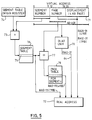
- a DLAT unit 70 (Fig. 5) is comprised of DLAT arrays and associated hardware logic of the type shown and described with respect to Fig. 4 herein.
- the unit 70 is coupled to a source 71 of the virtual address for a desired unit of information.
- the virtual address includes a segment number (bits A0-A11), a page number (bits A12-A19) and a displacement (or offset) address value (bits A20-A31). This assumes that segments are on 1MB boundaries in the virtual address space, and pages are on 4KB boundaries.
- segment/page table mechanism of Fig. 5 is rendered active to locate the desired page.
- the segment number is added at 73 to a segment table origin value in register 74 to access an entry 75 in a segment table 76 in main storage 2.
- entry 75 will have been filled with the starting address of page table 79 of the segment defined by entry 75.
- the address value in entry 75 is concatenated with the page number at 77 to access an entry 78 in a page table 79 in main storage 2.
- the entry 78 includes the page frame bits RA0-RA19 of the real address of the desired page.
- the page offset bits RA20-RA31 are concatenated with bits RA0-RA19 at 72.
- each DLAT is a two-way set associative array, each with 64 pairs of entries.
- the virtual address is partitioned into three fields.
- the low order bits which describe a byte within a page are the displacement bits (A20-A31 for 4KB pages and A12-31 for the 1MB pages).
- the 6 bits adjacent to the displacement bits are the congruence class selection bits. These bits (A14-A19 for 4KB and A6-A11 for 1MB pages) determine which pair of entries are referenced in each DLAT facility.
- the remaining (high-order) bits are the "tag" field.
- each DLAT facility a first pair of entries are assigned to any pages having a congruence class selection field of "0".
- a second pair of entries are assigned to any page having a congruence class selection field of "1", another pair for "2”, and so on until the final pair of entries which are assigned any page in the "63" congruence class.
- Each entry in the DLAT includes a first portion which consists of the bits of the tag field of the corresponding virtual page, a second portion which includes the real page frame address of this page in real storage and a third section includes a validity bit indicating whether or not the tag and the associated real page frame number are in fact valid, that is such a page does presently exist in main storage.
- Non-pertinent DLAT fields, such as keys, etc. are not included in the present description.
- respective congruence class selection bits (A14-19 or A6-11) read a pair of entries from each respective DLAT, and logic compares the tag field of each entry with corresponding bits of the virtual address presented to the DLATS. If there is an equal compare, i.e. a directory hit, and the valid bit is "on", the real page address of the entry which caused the hit is placed on the real address bus of the system for accessing main store. At the same time the displacement address bits are concatenated to the real page address for addressing the selected bits or bytes in main storage.
- 4KB pages and 1MB pages are used exclusively with only one DLAT.
- Each page has an entry in only one of the DLATS; an address (virtual or real) is in either a 4KB page or a 1MB page.
- Hardware allows 4KB and 1MB page table entries to be placed only in the DLAT for 4KB and 1MB pages respectively. Therefore a hit in one of the two DLATS guarantees a miss in the other DLAT.
- the operating system plays a role in enforcing certain restrictions. It is assumed that the operating system will keep 1MB pages (real and virtual) on 1MB boundaries. Currently 4KB pages (real and virtual) are maintained on 4KB boundaries. The 1MB page size is preferred since System 370 operating systems support 1MB segments. A 1MB page (virtual) is therefore almost equivalent to existing segments in these operating systems which are on 1MB boundaries.
- a conceptual dividing line (which can be varied) can be used to partition the upper portion of the storage (1MB pages) from the lower portion (4KB pages).
Landscapes
- Engineering & Computer Science (AREA)
- Theoretical Computer Science (AREA)
- Physics & Mathematics (AREA)
- General Engineering & Computer Science (AREA)
- General Physics & Mathematics (AREA)
- Memory System Of A Hierarchy Structure (AREA)
Claims (9)
- Datenspeicherungsvorrichtung mit einem virtuellen Adreßspeicher, einer externen Datenübertragungsschnittstelle und Steuerlogik, wobei die Vorrichtung angeordnet wird, um in Betrieb die Anforderungen zur Speicherdatenübertragung entweder sofort oder nach der Datenübertragung über die externe Datenübertragungsschnittstelle zu erfüllen, wobei die Einheit zur Datenübertragung eine Seite ist, bei der wenigstens einige der residenten Seiten durch Bezug auf die Directory-Look-Aside-Tables DLAT (20, 21), die von der Steuerlogik gehalten wird, identifizierbar ist, und in der Seiten sind, von denen sich wenigstens eine von den zuvor bestimmten Größen unterscheidet, dadurch gekennzeichnet, daß eine aktuell übertragene Seite eine aus einer zuvor bestimmten Vielzahl von Größen sein kann und die Steuerlogik angeordnet ist, um eine unabhängige DLAT für jede Seitengröße zu halten und, wenn eine virtuelle Seite abgebildet wird, eine virtuelle Speicheradreßeingabe in nur eine der DLAT's zu ermöglichen, indem ein Größenwert allen virtuellen Adressen auf dieser Seite zugewiesen wird, und somit die parallele Abfrage von allen potentiell geeigneten DLAT Eingaben zu gewähren, wenn versucht wird, schnell eine empfangene Datenanforderung zu erfüllen.
- Vorrichtung wie in Anspruch 1 angemeldet, wobei die behaltenen DLAT's satz-assoziativ sind, und die Steuerlogik angeordnet ist, um einen unterschiedlichen Teil von der Adresse aus der aktuellen Datenanforderung zur Satzbestimmung zu kombinieren, die für jede DLAT passend ist.
- Vorrichtung wie in Anspruch 1 oder Anspruch 2 angemeldet, wobei jede DLAT Eingabe in jedem Satz ein "gültiges" Bit enthält, und teilweise den Zugriff auf die Inhalte der angegebenen echten Seite ermöglicht.
- Vorrichtung wie in irgendeinem vorhergehenden Anspruch angemeldet, wobei die Steuerlogik angeordnet ist, um einen Ausgleichsteil von den angeforderten Adreßdaten mit der echten Adresse zu verketten.
- Vorrichtung wie in irgendeinem vorhergehenden Anspruch angemeldet, wobei eine der Seitengrößen 1MB beträgt und eine andere Seitengröße 4KB beträgt.
- Ein Speicher-Subsystem, das eine Vorrichtung wie in irgendeinem vorhergehenden Anspruch und Massenspeichereinrichtungen enthält, die mit der externen Datenübertragungsschnittstelle verbunden sind.
- Ein Subsystem wie in Anspruch 8 angemeldet, wobei die Seitendaten in passenden Grenzen gespeichert werden.
- Ein Datenverarbeitungssystem mit einem Subsystem wie in Anspruch 6 oder Anspruch 7 angemeldet, das einen Prozessor enthält, der mit der externen Datenübertragungsschnittstelle verbunden ist, wobei das System so angeordnet ist, daß es, ungeachtet der Seitengröße, keine Seitenüberlappung gibt.
- Ein Verfahren zum Zugriff auf virtuell adressierte, satzassoziative Speicherdatenseiten von unterschiedlichen, zuvor bestimmten Größen in einem Datenverarbeitungssystem mit Massenspeicher und Seitenspeicher, wobei Daten über virtuelle Adresse angefordert werden und auf den Seitenspeicher über die echten Adressen zugegriffen wird,
wobei das Verfahren dadurch gekennzeichnet wird, daß
für jede Seitengröße eine Directory-Look-Aside-Table DLAT (20, 21) bereitgestellt wird;
bei Abbildung einer virtuellen Seite, eine virtuelle Speicheradreßeingabe in nur eine der DLAT's ermöglicht wird, indem ein Größenwert allen virtuellen Adressen in einer Speicherdatenseite, die abzubilden ist, zugewiesen wird, und somit die parallele Abfrage von allen potentiell geeigneten DLAT Eingaben zu gewähren, wobei nur eine DLAT auf die parallele Abfrage reagieren wird, indem ein einzelner Zugriff auf die gesuchte Seite geliefert wird.
Applications Claiming Priority (2)
| Application Number | Priority Date | Filing Date | Title |
|---|---|---|---|
| US285176 | 1988-12-15 | ||
| US07/285,176 US5058003A (en) | 1988-12-15 | 1988-12-15 | Virtual storage dynamic address translation mechanism for multiple-sized pages |
Publications (3)
| Publication Number | Publication Date |
|---|---|
| EP0373780A2 EP0373780A2 (de) | 1990-06-20 |
| EP0373780A3 EP0373780A3 (de) | 1991-04-10 |
| EP0373780B1 true EP0373780B1 (de) | 1995-07-12 |
Family
ID=23093089
Family Applications (1)
| Application Number | Title | Priority Date | Filing Date |
|---|---|---|---|
| EP89312189A Expired - Lifetime EP0373780B1 (de) | 1988-12-15 | 1989-11-23 | Adressenübersetzung für Seiten mehrfacher Grösse |
Country Status (5)
| Country | Link |
|---|---|
| US (1) | US5058003A (de) |
| EP (1) | EP0373780B1 (de) |
| JP (1) | JPH02189659A (de) |
| CA (1) | CA2005463C (de) |
| DE (1) | DE68923437T2 (de) |
Families Citing this family (71)
| Publication number | Priority date | Publication date | Assignee | Title |
|---|---|---|---|---|
| JP2858795B2 (ja) * | 1989-07-14 | 1999-02-17 | 株式会社日立製作所 | 実記憶割り当て方法 |
| CA2045789A1 (en) * | 1990-06-29 | 1991-12-30 | Richard Lee Sites | Granularity hint for translation buffer in high performance processor |
| US5222222A (en) * | 1990-12-18 | 1993-06-22 | Sun Microsystems, Inc. | Apparatus and method for a space saving translation lookaside buffer for content addressable memory |
| US5263140A (en) * | 1991-01-23 | 1993-11-16 | Silicon Graphics, Inc. | Variable page size per entry translation look-aside buffer |
| EP0506236A1 (de) * | 1991-03-13 | 1992-09-30 | International Business Machines Corporation | Adressübersetzungseinrichtung |
| EP0508577A1 (de) * | 1991-03-13 | 1992-10-14 | International Business Machines Corporation | Adressübersetzungseinrichtung |
| JPH04360252A (ja) * | 1991-06-06 | 1992-12-14 | Mitsubishi Electric Corp | 計算機の仮想記憶におけるアドレス変換方式 |
| JPH0546447A (ja) * | 1991-08-08 | 1993-02-26 | Hitachi Ltd | 空き領域検索方法 |
| JPH0581133A (ja) * | 1991-09-19 | 1993-04-02 | Nec Corp | 情報処理装置 |
| GB2260628A (en) * | 1991-10-11 | 1993-04-21 | Intel Corp | Line buffer for cache memory |
| CA2285089C (en) * | 1991-11-12 | 2000-05-09 | Ibm Canada Limited-Ibm Canada Limitee | Logical mapping of data objects using data spaces |
| JPH05165715A (ja) * | 1991-12-12 | 1993-07-02 | Nec Corp | 情報処理装置 |
| JP3183719B2 (ja) * | 1992-08-26 | 2001-07-09 | 三菱電機株式会社 | アレイ型記録装置 |
| US5712998A (en) * | 1993-07-13 | 1998-01-27 | Intel Corporation | Fast fully associative translation lookaside buffer with the ability to store and manage information pertaining to at least two different page sizes |
| US5479627A (en) * | 1993-09-08 | 1995-12-26 | Sun Microsystems, Inc. | Virtual address to physical address translation cache that supports multiple page sizes |
| US5526504A (en) * | 1993-12-15 | 1996-06-11 | Silicon Graphics, Inc. | Variable page size translation lookaside buffer |
| JPH07182239A (ja) * | 1993-12-24 | 1995-07-21 | Nec Corp | セグメント分割管理システム |
| DE69428881T2 (de) * | 1994-01-12 | 2002-07-18 | Sun Microsystems, Inc. | Logisch adressierbarer physikalischer Speicher für ein Rechnersystem mit virtuellem Speicher, das mehrere Seitengrössen unterstützt |
| US5652872A (en) * | 1994-03-08 | 1997-07-29 | Exponential Technology, Inc. | Translator having segment bounds encoding for storage in a TLB |
| US5440710A (en) * | 1994-03-08 | 1995-08-08 | Exponential Technology, Inc. | Emulation of segment bounds checking using paging with sub-page validity |
| WO1996002035A1 (de) * | 1994-07-09 | 1996-01-25 | Gmd-Forschungszentrum Informationstechnik Gmbh | Verfahren zum umsetzen einer virtuellen adresse in eine reale adresse |
| US5907867A (en) * | 1994-09-09 | 1999-05-25 | Hitachi, Ltd. | Translation lookaside buffer supporting multiple page sizes |
| US5946715A (en) * | 1994-09-23 | 1999-08-31 | Ati Technologies Inc. | Page address space with varying page size and boundaries |
| US5682495A (en) * | 1994-12-09 | 1997-10-28 | International Business Machines Corporation | Fully associative address translation buffer having separate segment and page invalidation |
| US5752275A (en) * | 1995-03-31 | 1998-05-12 | Intel Corporation | Translation look-aside buffer including a single page size translation unit |
| US6643765B1 (en) * | 1995-08-16 | 2003-11-04 | Microunity Systems Engineering, Inc. | Programmable processor with group floating point operations |
| US5802594A (en) * | 1995-09-06 | 1998-09-01 | Intel Corporation | Single phase pseudo-static instruction translation look-aside buffer |
| US5784701A (en) * | 1995-09-19 | 1998-07-21 | International Business Machines Corporation | Method and system for dynamically changing the size of a hardware system area |
| US5708790A (en) * | 1995-12-12 | 1998-01-13 | International Business Machines Corporation | Virtual memory mapping method and system for address translation mapping of logical memory partitions for BAT and TLB entries in a data processing system |
| US6026476A (en) * | 1996-03-19 | 2000-02-15 | Intel Corporation | Fast fully associative translation lookaside buffer |
| US5765190A (en) * | 1996-04-12 | 1998-06-09 | Motorola Inc. | Cache memory in a data processing system |
| US5918251A (en) * | 1996-12-23 | 1999-06-29 | Intel Corporation | Method and apparatus for preloading different default address translation attributes |
| US5930830A (en) * | 1997-01-13 | 1999-07-27 | International Business Machines Corporation | System and method for concatenating discontiguous memory pages |
| US6088780A (en) * | 1997-03-31 | 2000-07-11 | Institute For The Development Of Emerging Architecture, L.L.C. | Page table walker that uses at least one of a default page size and a page size selected for a virtual address space to position a sliding field in a virtual address |
| US6012132A (en) * | 1997-03-31 | 2000-01-04 | Intel Corporation | Method and apparatus for implementing a page table walker that uses a sliding field in the virtual addresses to identify entries in a page table |
| US6000014A (en) * | 1997-04-14 | 1999-12-07 | International Business Machines Corporation | Software-managed programmable congruence class caching mechanism |
| US6026470A (en) * | 1997-04-14 | 2000-02-15 | International Business Machines Corporation | Software-managed programmable associativity caching mechanism monitoring cache misses to selectively implement multiple associativity levels |
| US5983322A (en) * | 1997-04-14 | 1999-11-09 | International Business Machines Corporation | Hardware-managed programmable congruence class caching mechanism |
| US6182089B1 (en) | 1997-09-23 | 2001-01-30 | Silicon Graphics, Inc. | Method, system and computer program product for dynamically allocating large memory pages of different sizes |
| US6112285A (en) * | 1997-09-23 | 2000-08-29 | Silicon Graphics, Inc. | Method, system and computer program product for virtual memory support for managing translation look aside buffers with multiple page size support |
| JP2000276404A (ja) * | 1999-03-29 | 2000-10-06 | Nec Corp | 仮想記憶装置および仮想記憶方法、並びに記録媒体 |
| US6970992B2 (en) * | 1999-10-04 | 2005-11-29 | Intel Corporation | Apparatus to map virtual pages to disparate-sized, non-contiguous real pages and methods relating thereto |
| US6857058B1 (en) * | 1999-10-04 | 2005-02-15 | Intel Corporation | Apparatus to map pages of disparate sizes and associated methods |
| US6665785B1 (en) * | 2000-10-19 | 2003-12-16 | International Business Machines, Corporation | System and method for automating page space optimization |
| US6760826B2 (en) * | 2000-12-01 | 2004-07-06 | Wind River Systems, Inc. | Store data in the system memory of a computing device |
| US7028139B1 (en) | 2003-07-03 | 2006-04-11 | Veritas Operating Corporation | Application-assisted recovery from data corruption in parity RAID storage using successive re-reads |
| US7076632B2 (en) | 2003-10-16 | 2006-07-11 | International Business Machines Corporation | Fast paging of a large memory block |
| US7278008B1 (en) | 2004-01-30 | 2007-10-02 | Nvidia Corporation | Virtual address translation system with caching of variable-range translation clusters |
| US7334108B1 (en) | 2004-01-30 | 2008-02-19 | Nvidia Corporation | Multi-client virtual address translation system with translation units of variable-range size |
| US7296139B1 (en) | 2004-01-30 | 2007-11-13 | Nvidia Corporation | In-memory table structure for virtual address translation system with translation units of variable range size |
| US7475219B2 (en) | 2004-08-27 | 2009-01-06 | Marvell International Ltd. | Serially indexing a cache memory |
| US20080028181A1 (en) * | 2006-07-31 | 2008-01-31 | Nvidia Corporation | Dedicated mechanism for page mapping in a gpu |
| JP2009009545A (ja) * | 2007-01-31 | 2009-01-15 | Hewlett-Packard Development Co Lp | データ処理システム及び方法 |
| US8117417B2 (en) | 2008-01-11 | 2012-02-14 | International Business Machines Corporation | Dynamic address translation with change record override |
| US8037278B2 (en) * | 2008-01-11 | 2011-10-11 | International Business Machines Corporation | Dynamic address translation with format control |
| US8019964B2 (en) * | 2008-01-11 | 2011-09-13 | International Buisness Machines Corporation | Dynamic address translation with DAT protection |
| US8335906B2 (en) * | 2008-01-11 | 2012-12-18 | International Business Machines Corporation | Perform frame management function instruction for clearing blocks of main storage |
| US8677098B2 (en) | 2008-01-11 | 2014-03-18 | International Business Machines Corporation | Dynamic address translation with fetch protection |
| US8103851B2 (en) | 2008-01-11 | 2012-01-24 | International Business Machines Corporation | Dynamic address translation with translation table entry format control for indentifying format of the translation table entry |
| US8151083B2 (en) * | 2008-01-11 | 2012-04-03 | International Business Machines Corporation | Dynamic address translation with frame management |
| US8082405B2 (en) * | 2008-01-11 | 2011-12-20 | International Business Machines Corporation | Dynamic address translation with fetch protection |
| US8041922B2 (en) * | 2008-01-11 | 2011-10-18 | International Business Machines Corporation | Enhanced dynamic address translation with load real address function |
| US8417916B2 (en) * | 2008-01-11 | 2013-04-09 | International Business Machines Corporation | Perform frame management function instruction for setting storage keys and clearing blocks of main storage |
| US8041923B2 (en) * | 2008-01-11 | 2011-10-18 | International Business Machines Corporation | Load page table entry address instruction execution based on an address translation format control field |
| US8086811B2 (en) | 2008-02-25 | 2011-12-27 | International Business Machines Corporation | Optimizations of a perform frame management function issued by pageable guests |
| US8095773B2 (en) | 2008-02-26 | 2012-01-10 | International Business Machines Corporation | Dynamic address translation with translation exception qualifier |
| US8862859B2 (en) * | 2010-05-07 | 2014-10-14 | International Business Machines Corporation | Efficient support of multiple page size segments |
| US8745307B2 (en) | 2010-05-13 | 2014-06-03 | International Business Machines Corporation | Multiple page size segment encoding |
| US10114752B2 (en) | 2014-06-27 | 2018-10-30 | International Business Machines Corporation | Detecting cache conflicts by utilizing logical address comparisons in a transactional memory |
| US20150378904A1 (en) * | 2014-06-27 | 2015-12-31 | International Business Machines Corporation | Allocating read blocks to a thread in a transaction using user specified logical addresses |
| KR20220048864A (ko) * | 2020-10-13 | 2022-04-20 | 에스케이하이닉스 주식회사 | 저장 장치 및 그 동작 방법 |
Family Cites Families (12)
| Publication number | Priority date | Publication date | Assignee | Title |
|---|---|---|---|---|
| USRE37305E1 (en) * | 1982-12-30 | 2001-07-31 | International Business Machines Corporation | Virtual memory address translation mechanism with controlled data persistence |
| US4823259A (en) * | 1984-06-29 | 1989-04-18 | International Business Machines Corporation | High speed buffer store arrangement for quick wide transfer of data |
| US4695950A (en) * | 1984-09-17 | 1987-09-22 | International Business Machines Corporation | Fast two-level dynamic address translation method and means |
| JPS61148551A (ja) * | 1984-12-24 | 1986-07-07 | Hitachi Ltd | アドレス変換方式 |
| JPH0656594B2 (ja) * | 1985-05-07 | 1994-07-27 | 株式会社日立製作所 | ベクトルプロセツサ |
| JPS62222344A (ja) * | 1986-03-25 | 1987-09-30 | Hitachi Ltd | アドレス変換機構 |
| US4774659A (en) * | 1986-04-16 | 1988-09-27 | Astronautics Corporation Of America | Computer system employing virtual memory |
| US4797814A (en) * | 1986-05-01 | 1989-01-10 | International Business Machines Corporation | Variable address mode cache |
| JPH0812636B2 (ja) * | 1986-12-24 | 1996-02-07 | 株式会社東芝 | 仮想記憶制御方式の計算機システム |
| US4914577A (en) * | 1987-07-16 | 1990-04-03 | Icon International, Inc. | Dynamic memory management system and method |
| US4980816A (en) * | 1987-12-18 | 1990-12-25 | Nec Corporation | Translation look-aside buffer control system with multiple prioritized buffers |
| US4905141A (en) * | 1988-10-25 | 1990-02-27 | International Business Machines Corporation | Partitioned cache memory with partition look-aside table (PLAT) for early partition assignment identification |
-
1988
- 1988-12-15 US US07/285,176 patent/US5058003A/en not_active Expired - Fee Related
-
1989
- 1989-11-23 EP EP89312189A patent/EP0373780B1/de not_active Expired - Lifetime
- 1989-11-23 DE DE68923437T patent/DE68923437T2/de not_active Expired - Fee Related
- 1989-12-08 JP JP1317881A patent/JPH02189659A/ja active Granted
- 1989-12-13 CA CA002005463A patent/CA2005463C/en not_active Expired - Fee Related
Also Published As
| Publication number | Publication date |
|---|---|
| CA2005463C (en) | 1995-06-27 |
| DE68923437T2 (de) | 1996-03-07 |
| DE68923437D1 (de) | 1995-08-17 |
| EP0373780A2 (de) | 1990-06-20 |
| CA2005463A1 (en) | 1990-06-15 |
| US5058003A (en) | 1991-10-15 |
| JPH02189659A (ja) | 1990-07-25 |
| EP0373780A3 (de) | 1991-04-10 |
| JPH0555900B2 (de) | 1993-08-18 |
Similar Documents
| Publication | Publication Date | Title |
|---|---|---|
| EP0373780B1 (de) | Adressenübersetzung für Seiten mehrfacher Grösse | |
| US5375214A (en) | Single translation mechanism for virtual storage dynamic address translation with non-uniform page sizes | |
| US5475827A (en) | Dynamic look-aside table for multiple size pages | |
| US6014732A (en) | Cache memory with reduced access time | |
| US4332010A (en) | Cache synonym detection and handling mechanism | |
| KR960001946B1 (ko) | 우선 변환 참조버퍼 | |
| US5787494A (en) | Software assisted hardware TLB miss handler | |
| KR920005280B1 (ko) | 고속 캐쉬 시스템 | |
| US4654790A (en) | Translation of virtual and real addresses to system addresses | |
| US6493812B1 (en) | Apparatus and method for virtual address aliasing and multiple page size support in a computer system having a prevalidated cache | |
| EP0642086B1 (de) | Adressumsetzungscache-Speicher zur Umwandlung von virtuellen Adressen in physikalische Adressen, der mehrere Seitengrössen unterstützt | |
| US5265227A (en) | Parallel protection checking in an address translation look-aside buffer | |
| JP4065660B2 (ja) | 機能が並列に分散された変換索引バッファ | |
| US5230045A (en) | Multiple address space system including address translator for receiving virtual addresses from bus and providing real addresses on the bus | |
| US5555395A (en) | System for memory table cache reloads in a reduced number of cycles using a memory controller to set status bits in the main memory table | |
| EP0243724A2 (de) | Mehrebenen-Speicherhierarchie mit variabler Adressierungsart | |
| JPH0619793A (ja) | キャッシュ・アクセスのための仮想アドレス変換予測の履歴テーブル | |
| JPH07200405A (ja) | 情報をキャッシュするための回路および方法 | |
| JPH07104816B2 (ja) | コンピュータシステムを動作する方法及びコンピュータシステムにおけるメモリ管理装置 | |
| JPH06180672A (ja) | 変換索引緩衝機構 | |
| US4757447A (en) | Virtual memory system having identity marking for common address space | |
| US5414821A (en) | Method of and apparatus for rapidly loading addressing environment by checking and loading multiple registers using a specialized instruction | |
| US5341485A (en) | Multiple virtual address translation per computer cycle | |
| JP3210637B2 (ja) | データ処理システム内のキャッシュ・メモリにアクセスするための方法およびシステム | |
| JPH0529942B2 (de) |
Legal Events
| Date | Code | Title | Description |
|---|---|---|---|
| PUAI | Public reference made under article 153(3) epc to a published international application that has entered the european phase |
Free format text: ORIGINAL CODE: 0009012 |
|
| AK | Designated contracting states |
Kind code of ref document: A2 Designated state(s): DE FR GB |
|
| 17P | Request for examination filed |
Effective date: 19901025 |
|
| PUAL | Search report despatched |
Free format text: ORIGINAL CODE: 0009013 |
|
| AK | Designated contracting states |
Kind code of ref document: A3 Designated state(s): DE FR GB |
|
| 17Q | First examination report despatched |
Effective date: 19940606 |
|
| GRAA | (expected) grant |
Free format text: ORIGINAL CODE: 0009210 |
|
| AK | Designated contracting states |
Kind code of ref document: B1 Designated state(s): DE FR GB |
|
| PG25 | Lapsed in a contracting state [announced via postgrant information from national office to epo] |
Ref country code: FR Effective date: 19950712 |
|
| REF | Corresponds to: |
Ref document number: 68923437 Country of ref document: DE Date of ref document: 19950817 |
|
| PGFP | Annual fee paid to national office [announced via postgrant information from national office to epo] |
Ref country code: GB Payment date: 19951024 Year of fee payment: 7 |
|
| PGFP | Annual fee paid to national office [announced via postgrant information from national office to epo] |
Ref country code: DE Payment date: 19951123 Year of fee payment: 7 |
|
| EN | Fr: translation not filed | ||
| PLBE | No opposition filed within time limit |
Free format text: ORIGINAL CODE: 0009261 |
|
| STAA | Information on the status of an ep patent application or granted ep patent |
Free format text: STATUS: NO OPPOSITION FILED WITHIN TIME LIMIT |
|
| 26N | No opposition filed | ||
| PG25 | Lapsed in a contracting state [announced via postgrant information from national office to epo] |
Ref country code: GB Effective date: 19961123 |
|
| GBPC | Gb: european patent ceased through non-payment of renewal fee |
Effective date: 19961123 |
|
| PG25 | Lapsed in a contracting state [announced via postgrant information from national office to epo] |
Ref country code: DE Effective date: 19970801 |