EP0375272B1 - Démodulateur cohérent pour modulation à déplacements de phase - Google Patents
Démodulateur cohérent pour modulation à déplacements de phase Download PDFInfo
- Publication number
- EP0375272B1 EP0375272B1 EP89313062A EP89313062A EP0375272B1 EP 0375272 B1 EP0375272 B1 EP 0375272B1 EP 89313062 A EP89313062 A EP 89313062A EP 89313062 A EP89313062 A EP 89313062A EP 0375272 B1 EP0375272 B1 EP 0375272B1
- Authority
- EP
- European Patent Office
- Prior art keywords
- phase
- carrier signal
- components
- phase angle
- input
- Prior art date
- Legal status (The legal status is an assumption and is not a legal conclusion. Google has not performed a legal analysis and makes no representation as to the accuracy of the status listed.)
- Expired - Lifetime
Links
- 230000010363 phase shift Effects 0.000 title claims description 28
- 230000001427 coherent effect Effects 0.000 title description 27
- 230000015654 memory Effects 0.000 claims description 11
- 238000005070 sampling Methods 0.000 claims description 11
- 230000004044 response Effects 0.000 claims description 5
- 238000006243 chemical reaction Methods 0.000 claims description 3
- 238000012937 correction Methods 0.000 claims description 3
- 230000000694 effects Effects 0.000 claims description 3
- 238000001914 filtration Methods 0.000 claims description 3
- 230000006870 function Effects 0.000 description 16
- 238000000034 method Methods 0.000 description 15
- 230000008859 change Effects 0.000 description 8
- 238000011084 recovery Methods 0.000 description 8
- 238000010586 diagram Methods 0.000 description 7
- 230000008569 process Effects 0.000 description 6
- 230000000875 corresponding effect Effects 0.000 description 5
- 230000014509 gene expression Effects 0.000 description 5
- 238000012545 processing Methods 0.000 description 5
- 238000001514 detection method Methods 0.000 description 4
- 230000007246 mechanism Effects 0.000 description 4
- 230000005540 biological transmission Effects 0.000 description 3
- 230000003247 decreasing effect Effects 0.000 description 3
- 238000012935 Averaging Methods 0.000 description 2
- 230000008901 benefit Effects 0.000 description 2
- 230000002596 correlated effect Effects 0.000 description 2
- 238000006467 substitution reaction Methods 0.000 description 2
- 238000013459 approach Methods 0.000 description 1
- 230000003111 delayed effect Effects 0.000 description 1
- 230000000977 initiatory effect Effects 0.000 description 1
- 230000003534 oscillatory effect Effects 0.000 description 1
- 230000000737 periodic effect Effects 0.000 description 1
- 238000000926 separation method Methods 0.000 description 1
- 230000011664 signaling Effects 0.000 description 1
- 230000009466 transformation Effects 0.000 description 1
- 238000000844 transformation Methods 0.000 description 1
Images



Classifications
-
- H—ELECTRICITY
- H04—ELECTRIC COMMUNICATION TECHNIQUE
- H04L—TRANSMISSION OF DIGITAL INFORMATION, e.g. TELEGRAPHIC COMMUNICATION
- H04L27/00—Modulated-carrier systems
- H04L27/18—Phase-modulated carrier systems, i.e. using phase-shift keying
- H04L27/22—Demodulator circuits; Receiver circuits
- H04L27/227—Demodulator circuits; Receiver circuits using coherent demodulation
- H04L27/2275—Demodulator circuits; Receiver circuits using coherent demodulation wherein the carrier recovery circuit uses the received modulated signals
Definitions
- the present invention relates to apparatus for demodulating phase modulated carrier signals, and, although not limited thereto, particularly to modems for transmitting and receiving digital data via communications network such as telephone networks.
- EP-A-0-349-185 which claims a priority date before but was published after the priority date of this specification describes that one type of phase modulation data transmission systems is a differential detection system which detects transmitted data by looking at changes in the phase of input differential phase modulated carrier signal.
- a carrier recovery circuit is used to reconstruct in-phase and quadrature-phase reference signals which are multiplied against the received signal and phase shifted version of the received signal. The results are then linearly combined to produce a pair of demodulated signals representing the two modulation components of the received signal.
- no carrier recovery circuit is used in the non-coherent demodulation method. Instead, a delayed version of the received signal is multiplied against the received signal to produce the demodulated signal.
- Non-coherent demodulation has the advantage of being simple to implement, as it does not require a carrier recovery circuit. Moreover, the input filtering is less complex since a phase splitting filter is not required to generate the complex form of the received signal. However, for the non-coherent method, typically a post detection filter is needed to eliminate double frequency terms generated by the multiplication process. In digital signal processing (where demodulating functions are performed using digital number values obtained from a periodic sampling of the received signal) the coherent method becomes more attractive because many of the calculations can be done at the symbol or baud rate which may range from approximately 600 Hz to 2400 Hz. Digital implementation of the non-coherent method requires operations at the higher sampling rate of at least 8 Hz, for the post detection filter.
- EP-A-0-349-185 discloses that estimates of the in-phase and quadrature-phase components of the input demodulated carrier signal may be used in the demodulation process for generating a so-called "pseudo-coherent" demodulator.
- the EP-A-0-349-185 device has the structure of a typical coherent demodulator, but does not have any carrier recovery circuits, using instead the instantaneous estimates of the input carrier signal components. These carrier estimates are obtained directly from the received carrier signal, with a delay of one baud between the calculation of the carrier estimates and their use in the demodulator, for effecting a differential phase shifted demodulated signal at the output of the demodulator.
- this demodulator is "pseudo-coherent", the fact remains that it still is not coherent per se . Therefore, in order to obtain better signal-to-noise ratios and better modem performance, a coherent demodulator is still deemed desirable.
- US Patent 4,466,108 describes a demodulator for demodulating a phase modulated input carrier signal.
- the received phase modulated signal is demodulated before the phase error is determined.
- the base band signal is then sampled to determine the phase error which, in turn, is used to correct the samples.
- the detector includes a Doppler estimation portion in which in-phase and quadrature phase components of a phase modulated input carrier signal is means for sampling demodulator for demodulating a phase modulated carrier signal are correlated with the input. The correlated signals are then sampled, accumulated, and integrated to produce an estimate of the Doppler shift. Sine and Cosines of the estimate are then used to remove the Doppler shift form the in-phase and quadrature detection channels.
- a demodulator for demodulating a phase modulated input carrier signal, comprising: conversion means for sampling an input carrier signal at baud periods, converting each sample of the input carrier signal into a binary input word representative of the amplitude of input carrier signal at the moment of sampling, and generating in-phase and quadrature-phase components for a current sample of the input carrier signal; first control means for comparing the in-phase and quadrature-phase components of the current sample with corresponding stored ideal components of an existing sample of the input carrier signal to determine phase angle deviation between the current components and ideal components; second control means for summing the phase deviation with a phase angle of the existing sample and phase shift proportional to the differential phase shift between the baud period in which the current sample was taken and the baud period from which the existing sample was taken to effect a new phase angle for deriving new ideal components of the input carrier signal for comparing with a next sample of the input carrier signal thereby phase-locking the stored ideal components of the input carrier signal in
- the present invention provides for a demodulator which uses estimates of the in-phase (or cosine) and quadrature-phase (or sine) components as inputs into a carrier recovery mechanism in order to derive the proper phase and to average out any instantaneous variations in the in-phase and quadrature-phase components, in order to obtain improved signal-to-noise ratios and to have a structure which can be switched from non-coherent to coherent signal processing.
- the instantaneous carrier estimates are input to a carrier recovery circuit and compared with ideal components which have pre-existing phase angles for generating a phase error signal, i.e. a phase angle deviation between the instantaneous estimates of the components and the ideal components, which then is combined with a pre-existing phase angle and a phase shift for generating a new phase angle.
- the newly generated phase angle is then used as an input to a sine table which, in response to the new phase angle, outputs new ideal sine and cosine components, to be fed back and compared with the phase error signal.
- the phase error signal is incrementally decreased, thereby eventually leading to substantially ideal sine and cosine components, which are fed to multiplier and adder means, to be recovered as a coherent demodulated carrier signal, minus any phase angle deviations.
- the coherent demodulator of the invention uses instantaneous estimates of the components of a sample of the input carrier signal, it, like the "pseudo- coherent" demodulator of EP-A-0 349 185, is able to operate at the baud rate, instead of the sampling rate.
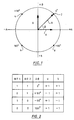
- FIG. 1 there is shown a vector diagram of a carrier signal R which is to be input to the demodulator of the present invention.
- This carrier signal is a four-phase type signal, which means that at any given moment its phase angle may be at any one of four different values.
- the outer end of vector R may be located at any one of four points 2, 4, 6 and 8, at any given instant that ⁇ is a multiple of 2 ⁇ .
- the peak magnitude "C" (in Equation 1) of vector R is represented by the length of the vector, i.e. the radius of the circle in Figure 1; and the instantaneous amplitude of R is represented by its projection onto the real (horizontal) axis.
- the angle " ⁇ " denotes the phase difference between the transmitted signal R and the reference signal cosine ⁇ .
- the first part of the Equation 1 describes the received carrier signal R in terms of its in-phase and quadrature-phase components.
- the in-phase component (cosine ⁇ ) lies on the horizontal axis in Figure 1 and has a peak amplitude value of "A", which is equal to either +1 or -1, depending on the value of the data being transmitted at that moment.
- the quadrature-phase component (sine ⁇ ) lies along the vertical axis of Figure 1 and has a peak amplitude value of "B”, which is equal to +1 or -1, depending on the value of the data being transmitted. It should be appreciated that the vector addition of the in-phase and quadrature-phase components produces the received carrier signal R in Figure 1.
- the data bits to be transmitted are divided into, or organized as, pairs of bits (sometimes also called "dibits").
- One pair of the data bits is transmitted during each transmission interval, or baud period.
- the first bit in each data bit pair determines the amplitude value A of the in-phase component cos ⁇ while the second data bit in each pair determines the amplitude value B of the quadrature-phase component sin ⁇ .
- each of the amplitude values A and B is binary in nature, i.e. having a value of either +1 or -1, there are four possible phase angles, or phase values, for the carrier signal R. These phase angles are represented by the four points 2, 4, 6 and 8 shown in Figure 1.
- the first data bit in each dibit pair modulates the in-phase component and the second data bit of each dibit pair modulates the quadrature-phase component of the carrier signal R.
- each of the four possible phase angles for the carrier signal R would represent a different two-bit binary value.
- a differential phase demodulator such as that of the instant invention, it is not the actual phase angle at any given moment that determines the two-bit binary value, but rather it is the change in phase angle from one transmission interval (baud period) to the next which determines the two-bit binary value.
- a phase modulated carrier signal R is input to a sampling means, such as an analog-to- digital converter 10.
- the analog input carrier signal is then converted by analog-to-digital converter 10 into a multi-bit input carrier signal which is transmitted to first and second bandpass filters 12 and 14.
- analog-to-digital converter 10 periodically samples input carrier signal R and produces for each sample a multi-bit input carrier number representing the amplitude value of the input carrier signal R at the moment of sampling.
- analog-to-digital converter 10 there appears at the output of analog-to-digital converter 10 a continuous stream of multi-bit binary numbers, varying in the same manner as the amplitude of the input phase modulator carrier signal R.
- filter 12 and 14 which may be of the finite impulse response (FIR) type.
- Filter 12 in essence filters out extraneous noise and signals that are beyond its bandwidth so that only the original transmitted signal (in the form of a multi-bit signal) is output therefrom as R.
- the output from filter 14, likewise, is the original transmitted signal, but with a phase shift of 90°.
- Implementing filter 14 can be accomplished by means of well known sine and cosine transformations for non-integrating phase shifting of the output signal from filter 14 relative to that from filter 12.
- the output of filter 14 is represented as the signal S.
- the respective signals R and S are fed to corresponding dividers 16 and 18 whereby the signals are scaled, with the dividers acting as scalers for halving, for example, the amplitudes of the respective signals.
- the scaled signals R′ and S′ are input respectively to a subtracter 20 and an adder 22. From there, instantaneous estimates x and y based on signal R′ (the scaled in-phase or cosine component) and signal S′ (the scaled quadrature-phase or sine component), respectively, of the input carrier signal are provided.
- the instantaneous estimates of the in-phase and quadrature-phase of the input carrier signal, output from subtracter 20 and adder 22, which together with dividers 16 and 18, form an estimator circuit 36 enclosed by dotted lines, are fed to a differential carrier recovery mechanism, designated 38.
- the instantaneous estimates x and y are fed into a computational block 40 which has two multipliers 42 and 44, as well as a subtracter 46.
- the x and y components when they are input to computational block 40, have information regarding only the sine and cosine components of the input carrier signal.
- Equation 4 the phase implied in Equations 2 and 3 is never calculated directly via inverse sine and cosine functions since Equation 4 does not require the actual sine and cosine angles.
- the actual phase error, or phase angle deviation can be found by taking the sine of the phase error found in Equation 4, and performing an inverse sine function on the value via a table lookup or other possible methods. This process, however, can be avoided by noting that for small angles, the sine of the angle is approximately equal to the magnitude of the angle, in radian measure. Therefore, as the recovered carrier approaches the actual phase of the transmitted carrier, Equation 4 becomes a very good estimate of the actual phase error of the carrier, and thus can be used for adjusting the carrier phase to achieve a very accurate phase synchronization.
- This phase error is output from computational block 40, via line 48, and fed into a multiplier 50, which acts as a scaler for multiplying the phase error with a multiplication factor D.
- the reason for requiring a multiplier 50 is that when the phase error is first output from computational block (for instance when the system is first initiated) it tends to be very large.
- the invention employs a convergence process so this large phase error can be incrementally decreased, by means of feedback. While Equation 4, at the beginning of its computation, is an invalid expression of the actual phase error, the sign of the output phase error does correspond to the sign of the actual phase error. Hence, continuously converging the phase error (or phase angle deviation) output from computational block 40, with some ideal numbers, the phase error eventually will be corrected to reflect the actual phase error.
- the scaled phase error is sent next to a summer 52 which has as its inputs, besides the scaled phase error signal (from multiplier 50), a phase angle from an existing sample of the input carrier signal and a phase shift proportional to the differential phase shift between the baud period in which the current sample of the input carrier signal was taken and the baud period in which the existing sample of the input carrier was taken.
- the phase shift is represented by the expression Q(n ⁇ Ts), which is determined from the output of the demodulator, represented by U and V, as shown in Fig. 2.
- the expression Q(n ⁇ Ts) is the actual differential phase shift detected by the demodulator.
- a "pseudo-coherent" demodulator such as that disclosed in the EP-A-0 349 185 is used to provide initial estimates of the phase shifts.
- the demodulator can be switched (by either conventional firmware or software, not shown) to a coherent mode in order to obtain better performance.
- phase angle ⁇ ′ output from summer 52 is fed to a delay line 54, which may be implemented as a memory.
- Delay line 54 insures that the new phase angle ⁇ ′ output of summer 52 has in fact, as part of its calculation, the existing angle ⁇ which was provided as an output by delay line 54 and fed back to summer 52, by means of feed back line 56.
- the separation of new phase angle ⁇ ′ and phase angle ⁇ is by one baud period. Accordingly, as new phase angles ⁇ ′ are constantly being produced by summer 52, constantly updated phase angle ⁇ are led back to summer 52, thereby effecting an averaging circuit for incrementally decreasing the phase error signal from computational block 40.
- phase angle ⁇ is next fed to a sine table 58 which may be a memory or a collection of memories.
- phase angle ⁇ is assumed to have an eight bit value (since it is in a digital format), and the eight bit value of ⁇ is used as an address for selecting one of, for example, 256 possible entries (or trigonometric functions) which had previously been stored in sine table 58.
- sine table 58 provides a corresponding trigonometric function comprising sine and cosine components to line 60 and 62, respectively, to be fed back to computational block 40.
- sine and cosine components from sine table 58 although being multi-bit numbers, actually do represent the amplitudes of the sine wave and cosine wave of the input carrier signal at the phase angle ⁇ which has just been provided as an input to sine table 58.
- These sine and cosine waveforms are coherent, although it must be kept in mind that they only represent one sample of the sine wave and one sample of the cosine wave for their particular baud period; and it takes a plurality of these components to fully represent the sine and cosine wave of the input carrier signal.
- the coherent sine and cosine components are next fed to multipliers 24 and 30 and are combined in pairs by adder 32 and subtracter 34 to provide output components U and V, as represented in Fig. 2 and defined by the equations below.
- the U and V represent the amplitude values of the modulation components of the input carrier signal R.
- U +1 and V equals +1
- a zero (0) degree phase shift is represented.
- a U of -1 and a V of +1 are obtained, then it can be said that a phase shift of +90°, corresponding to an information dibit pair of (0,1) has been detected.
- the dibit information relates to the actual data information that is being conveyed by the analog input carrier signal R, which is to be sent for additional processing, as for example to a slicer whose output may be fed back to summer block 52 as Q(n ⁇ Ts).
- the discrete components of the Fig. 3 embodiment can be replaced as functions and be performed by certain specialized digital signal processing (DSP) microprocessors, such as that shown in Fig. 4.
- DSP digital signal processing
- a microprocessor 64 is connected through a combination instruction data bus and address bus 66 to a number of components.
- the phase modulated input carrier signal R is fed to an analog-to-digital converter such as 10 shown in Fig. 3.
- the steady stream of multi-bit binary numbers are fed from analog- to-digital converter 10 to data bus 66 and stored in sequential storage locations of a random access read-write memory (RAM) 68.
- RAM random access read-write memory
- Also included in the Fig. 4 embodiment are a random-access read only memory (ROM) 70 and an input/output interface mechanism 72, which is connected by another data bus 74 to other input/output interface mechanisms.
- ROM random-access read only memory
- Microprocessor 64 in addition to performing other chores, controls the movement of the input carrier multi- bit numbers from analog-to-digit converter 10 to RAM 48.
- a typical hardware multiplier (not shown) may be added to this type of microprocessor to aid the computation of the different previously discussed equations.
- the microprocessor 64 executes various program routines representing the different functions performed by the components shown in the Fig. 3 embodiment.
- program routines are permanently stored in ROM 70, which is also coupled to microprocessor 64.
- a first of these function program routines may be analogous to the function performed by bandpass filter 12.
- a second function program routine may correspond to the function performed by estimator circuit 36, i.e. the earlier discussed Equations 2 and 3.
- a further function program routine may be used for calculating Equation 4, also performed by computational block 40 of the Fig. 3 embodiment.
- these different function program routines are performed in a microcode format and the resulting coherent sine and cosine components of the input carrier signal may still be multiplied and added to form demodulator signal numbers which represent the amplitude values of the input carrier signal, as U and V.
- a memory may be partitioned in RAM 68 for effecting the delay function of delay block 54, while a portion of memory ROM 70 may be reserved for storing the values representing the ideal sine and cosine components stored in sine table 58 of the Fig. 3 embodiment.
- the resulting demodulator signal numbers U and V are in turn stored in RAM 68 and are to be used for further signal processing operations such as slicing, decoding, descrambling, and deserialization.
- a baud is a unit of signaling speed and refers to the number of times the state or condition of a signal line may change per second.
- a baud period is the time interval in which the state or condition of the signal is required to remain the same.
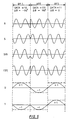
- the upper waveform in Fig. 5 represents the input carrier signal at the output of bandpass filter 12; while the second waveform represents the phase shifted signal at the output of bandpass filter 14.
- waveforms representing the coherent sine and cosine components of the carrier signal -- provided as outputs from sine table 58 -- are output, as shown by the middle two waveforms of Fig. 5.
- the sine and cosine waveforms are shifted by 90° in baud period BP 2, from baud period BP 1. Also, even though there is no phase shift between baud period BP 2 and baud period BP 3, there is still a change in the patterns of sine and cosine waveforms for those baud periods based on the phase shift detected in BP 2.
- the last two waveform patterns are representative of the amplitude values of the modulation components of the input carrier signal R and, as can be seen at the center of the respective baud periods, U and V do represent the amplitude values of the input carrier signal.
- U has a +1 value while in has a -1 value, which correspond to a dibit pair information of (1,0).
- both U and V in have -1 amplitudes. This translates to a dibit pair information of (0,0).
- both in U and V have +1 amplitudes values, the dibit pair information contact becoming (1,1).
- phase change shown in Fig. 2 and discussed so far relates to a change in the phase angle
- an absolute phase may also be used.
- absolute phase scenario instead of 0°, 90°, 180°, and -90°, corresponding 45°, 135°, 225° and 315° are used. The results remain the same.
- FIG. 6 An analog embodiment of the demodulator of the present invention is shown in Fig. 6.
- carrier signal R is fed through a bandpass filter 76 to a signal distribution line 78.
- a phase shifter 80 phase shifts carrier signal R ninety degrees, for generating the signal S.
- the R and S signals are fed to modulators 82 to 88 and to respective attenuators 90 and 92 in an estimator circuit 94 (within the dotted block).
- the carrier signals after attenuation, are fed to difference circuits 96 and 98.
- the outputs of the different circuits are provided to the differential carrier recovery circuit 100, more specifically to modulators 102 and 104 of computational block 106 within circuit 100.
- the input signals are modulated by ideal analog signals, provided in this embodiment by a voltage controlled oscillator 108, in response to a predetermined phase angle ⁇ .
- the modulated signals from computational block 106 are provided as a phase error signal (or a phase angle deviation) to an amplifier 112, to be multiplied with a constant D.
- D is a fractional constant for assuring that the correction of the phase error signal is only performed in incremental steps, instead of correcting for the entire error in one single step, so that the signal will not become unstable and oscillatory.
- the thus amplified signal is then summed by a summer 114 with the predetermined phase angle provided by a sample and hold circuit 116 and a differential phase shift, Q(n ⁇ Ts), which is proportional to the differential phase shifts between the input carrier signal and the predetermined input carrier signal.
- a new phase angle 0 is calculated and transmitted to sample and hold circuit 116, from whence a new phase angle 0 is calculated.
- this new phase angle 0 is fed back to summer 114 for further calculations of new phase angles, and to voltage controlled oscillator 108 for providing an input thereto so that ideal cosine and sine waveforms can be output therefrom.
- the ideal cosine and sine waveforms are fed back by feedback lines 118 and 120, respectively, to computational block 106, thereby effecting a feedback loop for averaging out the phase error signal.
- the thus produced sine and cosine waveforms are next fed, in conjunction with carrier signals R and S, to modulators 82 and 88, paired and added or subtracted by the respective sum and difference circuits 122 and 124, for generating coherent demodulated signals U and V.
- the demodulated signal U represents the in-phase baseband component of the transmitted carrier signal, and for the present invention, represents the binary value of the first data bit in each transmitted dibit pair.
- the demodulated signal V represents the quadrature-phase baseband component of the transmitted carrier signal, and is representative of the binary value of the second bit in the transmitted dibit pair.
- Both waveforms of the demodulated signals U and V are similar to that shown for the U and V waveforms patterns in Fig.5.
Landscapes
- Engineering & Computer Science (AREA)
- Computer Networks & Wireless Communication (AREA)
- Signal Processing (AREA)
- Digital Transmission Methods That Use Modulated Carrier Waves (AREA)
Claims (10)
- Un démodulateur pour démoduler un signal porteur d'entrée modulé en phase, comprenant:- des moyens de conversion (10, 12, 14) pour échantillonner un signal porteur d'entrée (R) aux périodes de Baud, convertissant chaque échantillon du signal porteur d'entrée (R) en un mot d'entrée binaire représentatif de l'amplitude du signal porteur d'entrée (R) au moment d'échantillonnage, et générant des composants en phase et en quadrature de phase (R, S) pour un échantillon courant du signal porteur d'entrée,- des premiers moyens de commande (40) pour comparer les composants en phase et en quadrature de phase (R, S) de l'échantillon courant (R) avec des composants idéaux emmagasinés correspondants (60, 62) d'un échantillon existant du signal porteur d'entrée (R) pour déterminer la déviation d'angle de phase (48) entre les composants courants (R, S) et les composants idéaux (60, 62), et- des seconds moyens de commande (52, 54, 56, 58) pour sommer la déviation de phase (48) avec un angle de phase (φ) de l'échantillon existant et le décalage de phase (Q(n*Ts)) proportionnel au décalage de phase différentiel entre la période de Baud dans laquelle l'échantillon courant a été pris et la période de Baud depuis laquelle l'échantillon existant a été pris pour établir un nouvel angle de phase (φ′) afin de dériver de nouveaux composants idéaux (COS, SIN) du signal porteur d'entrée (R) pour comparaison avec un nouvel échantillon du signal porteur d'entrée (R), verrouillant ainsi en phase les composants idéaux emmagasinés (COS, SIN) du signal porteur d'entrée (R) dans un état permanent, et établissant ainsi par incréments des composants en phase et en quadrature de phase démodulés de manière cohérente et pratiquement idéaux (U, V) du signal porteur d'entrée (R).
- Un démodulateur selon la revendication 1 dans lequel les premiers moyens de commande (40) comprennent:
- une pluralité d'éléments multiplicateurs (44, 42) multipliant chacun l'un des composants courant (R, 5) avec un composant correspondant des composants idéaux (SIN, COS). - Un démodulateur selon la revendication 1, comprenant:
- des moyens de cadrage (50) pour multiplier la déviation d'angle de phase (48) par une constante de correction fractionnelle (D). - Un démodulateur selon la revendication 1, dans lequel les moyens de conversion (10, 12, 14) comprennent:- un premier filtre (12) pour filtrer le mot d'entrée binaire afin de générer un signal porteur d'entrée filtré (R) ayant les mêmes valeurs d'amplitude que le signal porteur d'entrée (R) et- un second filtre (14) pour filtrer et décaler en phase le mot d'entrée binaire afin de générer un signal porteur décalé en phase et filtré (S) ayant les mêmes valeurs d'amplitude que le signal porteur d'entrée (R).
- Un démodulateur selon la revendication 1 dans lequel les second moyens de commande (52, 54, 56, 58) comprennent:- un premier additionneur (52) pour sommer la déviation d'angle de phase (48) avec l'angle de phase (56) de l'échantillon existant et le décalage de phase différentiel proportionnel (Q(n*Ts)) et pour délivrer en sortie le nouvel angle de phase (φ) et- un élément de retard (54) pour délivrer à sa sortie l'angle de phase (φ) de l'échantillon existant au premier additionneur (52) et pour recevoir à son entrée, le nouvel angle de phase (φ′) délivré en sortie par le premier additionneur (52), l'élément de retard (54) délivrant un retard d'au moins une période de Baud entre la sortie de l'angle de phase (φ) de celui ci et le nouvel angle de phase (φ′) qu'il reçoit en entrée.
- Un démodulateur selon la revendication 5 comprenant en outre:
- une mémoire (58) sensible à l'angle de phase (φ) délivré à la sortie de l'élément de retard (54) pour délivrer en sortie des composants cosinus et sinus idéaux emmagasinés (COS, SIN) correspondant à la sortie d'angle de phase de l'élément de retard (54), ce qui fait que les composants cosinus et sinus emmagasinés (COS, SIN) sont ré-alimentés aux premiers moyens de commande pour être comparés à des estimations instantanées des composants en phase et en quadrature de phase (R, 5) de l'échantillon suivant du signal porteur d'entrée (R). - Un démodulateur selon la revendication 6, comprenant en outre:- des moyens multiplicateurs (24, 30) pour multiplier les composants cosinus et sinus emmagasinés (COS.SIN) du signal porteur d'entrée (R) correspondant à la sortie d'angle de phase (φ) du moyen de retard (54), avec l'échantillon courant (R,S), et- un second additionneur (32, 34) pour sommer des résultats des moyens multiplicateurs (26, 28), donnant les composants en phase et en quadrature de phase démodulés de manière cohérente (U, V) du signal porteur d'entrée (R).
- Un démodulateur selon la revendication 7 dans lequel l'élément de retard (54) comprend un circuit d'échantillonnage et de maintien et dans lequel la mémoire (58) comprend un oscillateur commandé en tension.
- Un démodulateur selon la revendication 8, comprenant en outre:
- des moyens amplificateurs (50) pour appliquer un gain de correction (D) à la déviation d'angle de phase. - Appareil selon la revendication 1 dans lequel les seconds moyens de commande (52, 54, 56, 58) comprennent:- une mémoire (58) pour délivrer en sortie une valeur pré-emmagasinée (SIN, COS) en réponse à l'angle de phase courant (φ) du signal porteur d'entrée (R) comme une réaction pour éliminer par incréments la déviation d'angle de phase,- des moyens (24, 30) pour multiplier la valeur (SIN, COS) issue de la mémoire (58) avec le mot d'entrée binaire (R) et un mot d'entrée binaire décalé en phase correspondant (S), des moyens NP (32, 34) pour ajouter les résultats des moyens de multiplication (24, 30) afin de générer des composants en phase et en quadrature de phase démodulés de manière cohérente (U, V) du signal porteur d'entrée (R).
Applications Claiming Priority (2)
| Application Number | Priority Date | Filing Date | Title |
|---|---|---|---|
| US07/289,064 US4871974A (en) | 1988-12-23 | 1988-12-23 | Coherent phase shift keyed demodulator |
| US289064 | 1988-12-23 |
Publications (3)
| Publication Number | Publication Date |
|---|---|
| EP0375272A2 EP0375272A2 (fr) | 1990-06-27 |
| EP0375272A3 EP0375272A3 (en) | 1990-10-31 |
| EP0375272B1 true EP0375272B1 (fr) | 1994-09-21 |
Family
ID=23109887
Family Applications (1)
| Application Number | Title | Priority Date | Filing Date |
|---|---|---|---|
| EP89313062A Expired - Lifetime EP0375272B1 (fr) | 1988-12-23 | 1989-12-13 | Démodulateur cohérent pour modulation à déplacements de phase |
Country Status (5)
| Country | Link |
|---|---|
| US (1) | US4871974A (fr) |
| EP (1) | EP0375272B1 (fr) |
| JP (1) | JPH0666818B2 (fr) |
| CA (1) | CA2000007C (fr) |
| DE (1) | DE68918421T2 (fr) |
Families Citing this family (33)
| Publication number | Priority date | Publication date | Assignee | Title |
|---|---|---|---|---|
| US4849706A (en) * | 1988-07-01 | 1989-07-18 | International Business Machines Corporation | Differential phase modulation demodulator |
| JPH0687541B2 (ja) * | 1989-06-22 | 1994-11-02 | シャープ株式会社 | 直交振幅変調波復調器 |
| US5134634A (en) * | 1989-08-31 | 1992-07-28 | Nec Corporation | Multilevel quadrature amplitude demodulator capable of compensating for a quadrature phase deviation of a carrier signal pair |
| EP0535591B1 (fr) * | 1991-09-30 | 1997-01-22 | Nec Corporation | Circuit d'asservissement de phase capable d'être mise rapidement en un état d'asservissement |
| US5841816A (en) * | 1992-10-22 | 1998-11-24 | Ericsson Inc. | Diversity Pi/4-DQPSK demodulation |
| US5801895A (en) * | 1996-05-28 | 1998-09-01 | Hewlett Packard Company | Disk drive servo demodulation system which suppresses noise on the position error signal |
| EP1017201A1 (fr) * | 1998-12-29 | 2000-07-05 | Alcatel | Récepteur MAQ à détection séparée de phase et d'amplitude |
| US7277494B2 (en) * | 2003-06-04 | 2007-10-02 | Honeywell Federal Manufacturing & Technologies, Llc | Method of differential-phase/absolute-amplitude QAM |
| US7995648B2 (en) * | 2004-04-09 | 2011-08-09 | Trident Microsystems (Far East) Ltd. | Advanced digital receiver |
| CN101002385B (zh) | 2004-04-09 | 2010-10-06 | 上海奇普科技有限公司 | 控制均衡器的前馈滤波器的装置和方法 |
| US20080298518A1 (en) * | 2004-08-12 | 2008-12-04 | Gopalan Krishnamurthy | Automatic Gain Control Unit of a Receiver |
| US9198608B2 (en) | 2005-04-28 | 2015-12-01 | Proteus Digital Health, Inc. | Communication system incorporated in a container |
| CA2650920C (fr) | 2006-05-02 | 2016-10-18 | Proteus Biomedical, Inc. | Regimes therapeutiques personnalises pour un patient |
| MY158019A (en) | 2006-10-25 | 2016-08-30 | Proteus Digital Health Inc | Controlled activation ingestible identifier |
| US8718193B2 (en) * | 2006-11-20 | 2014-05-06 | Proteus Digital Health, Inc. | Active signal processing personal health signal receivers |
| PT3785599T (pt) | 2007-02-01 | 2022-10-21 | Otsuka Pharma Co Ltd | Sistemas de marcadores de eventos ingeríveis |
| CA2676280C (fr) | 2007-02-14 | 2018-05-22 | Proteus Biomedical, Inc. | Source d'energie integree au corps ayant une electrode de zone de surface superieure |
| US8115618B2 (en) | 2007-05-24 | 2012-02-14 | Proteus Biomedical, Inc. | RFID antenna for in-body device |
| DK2192946T3 (da) | 2007-09-25 | 2022-11-21 | Otsuka Pharma Co Ltd | Kropsintern anordning med virtuel dipol signalforstærkning |
| US8258962B2 (en) | 2008-03-05 | 2012-09-04 | Proteus Biomedical, Inc. | Multi-mode communication ingestible event markers and systems, and methods of using the same |
| CA3039236C (fr) | 2008-07-08 | 2022-05-17 | Proteus Digital Health, Inc. | Structure de donnees pour marqueurs d'evenements d'ingestion |
| RU2390101C1 (ru) * | 2008-12-01 | 2010-05-20 | Государственное образовательное учреждение высшего профессионального образования Военно-космическая академия имени А.Ф. Можайского | Демодулятор фазоманипулированных сигналов |
| SG172846A1 (en) | 2009-01-06 | 2011-08-29 | Proteus Biomedical Inc | Ingestion-related biofeedback and personalized medical therapy method and system |
| TWI517050B (zh) | 2009-11-04 | 2016-01-11 | 普羅托斯數位健康公司 | 供應鏈管理之系統 |
| TWI557672B (zh) | 2010-05-19 | 2016-11-11 | 波提亞斯數位康健公司 | 用於從製造商跟蹤藥物直到患者之電腦系統及電腦實施之方法、用於確認將藥物給予患者的設備及方法、患者介面裝置 |
| EP2538596B1 (fr) | 2011-06-21 | 2014-05-14 | Alcatel Lucent | Procédé de décodage d'un signal de données optique différentiellement modulé codé par phase |
| WO2015112603A1 (fr) | 2014-01-21 | 2015-07-30 | Proteus Digital Health, Inc. | Produit ingérable pouvant être mâché et système de communication associé |
| US9756874B2 (en) | 2011-07-11 | 2017-09-12 | Proteus Digital Health, Inc. | Masticable ingestible product and communication system therefor |
| CA2842952C (fr) | 2011-07-21 | 2019-01-08 | Proteus Digital Health, Inc. | Dispositif de communication mobile, systeme et procede |
| CN104181558A (zh) * | 2013-05-24 | 2014-12-03 | 凹凸电子(武汉)有限公司 | Gps接收机及判断gps接收机跟踪环路状态的方法 |
| JP6511439B2 (ja) | 2013-06-04 | 2019-05-15 | プロテウス デジタル ヘルス, インコーポレイテッド | データ収集および転帰の査定のためのシステム、装置、および方法 |
| US10084880B2 (en) | 2013-11-04 | 2018-09-25 | Proteus Digital Health, Inc. | Social media networking based on physiologic information |
| MX2019000888A (es) | 2016-07-22 | 2019-06-03 | Proteus Digital Health Inc | Percepcion y deteccion electromagnetica de marcadores de evento ingeribles. |
Family Cites Families (22)
| Publication number | Priority date | Publication date | Assignee | Title |
|---|---|---|---|---|
| GB1431119A (en) * | 1973-05-04 | 1976-04-07 | Siemens Ag | Data transmission systems |
| DE2354718C3 (de) * | 1973-11-02 | 1981-12-17 | Licentia Patent-Verwaltungs-Gmbh, 6000 Frankfurt | Demodulationsverfahren für phasenumgetastete Schwingungen und Schaltungsanordnung zur Durchführung des Verfahrens |
| FR2368184A1 (fr) * | 1976-10-18 | 1978-05-12 | Ibm France | Systeme de synchronisation de porteuse pour demodulateur de phase coherent |
| US4169246A (en) * | 1976-12-06 | 1979-09-25 | Motorola, Inc. | Digital carrier correction circuit |
| JPS5580950A (en) * | 1978-12-08 | 1980-06-18 | Fujitsu Ltd | Arrier wave regenerating circuit |
| US4206320A (en) * | 1978-08-21 | 1980-06-03 | University Of Illinois Foundation | High speed modem suitable for operating with a switched network |
| US4224575A (en) * | 1978-11-29 | 1980-09-23 | E-Systems, Inc. | Phase/frequency controlled phase shift keyed signal carrier reconstruction circuit |
| US4246654A (en) * | 1979-01-09 | 1981-01-20 | Northrop Corporation | Digital coherent phase demodulator |
| US4328587A (en) * | 1979-02-19 | 1982-05-04 | Kokusai Denshin Denwa Kabushiki Kaisha | Phase slip detector and systems employing the detector |
| US4379266A (en) * | 1980-04-03 | 1983-04-05 | Ford Aerospace & Communications Corporation | PSK Demodulator with automatic compensation of delay induced phase shifts |
| US4313205A (en) * | 1980-07-07 | 1982-01-26 | Communications Satellite Corporation | Carrier synchronization and symbol synchronization for offset-QPSK burst communications |
| US4461014A (en) * | 1980-09-23 | 1984-07-17 | Mitsubishi Denki Kabushiki Kaisha | Carrier regenerating circuit |
| US4397039A (en) * | 1980-12-29 | 1983-08-02 | International Business Machines Corporation | Instantaneous phase tracking in single sideband systems |
| US4423390A (en) * | 1981-01-09 | 1983-12-27 | Harris Corporation | Side lock avoidance network for PSK demodulator |
| JPS5825746A (ja) * | 1981-08-10 | 1983-02-16 | Fujitsu Ltd | 搬送波再生回路 |
| US4466108A (en) * | 1981-10-06 | 1984-08-14 | Communications Satellite Corporation | TDMA/PSK Carrier synchronization without preamble |
| US4457005A (en) * | 1981-12-07 | 1984-06-26 | Motorola, Inc. | Digital coherent PSK demodulator and detector |
| JPS58114654A (ja) * | 1981-12-28 | 1983-07-08 | Fujitsu Ltd | 基準搬送波再生回路 |
| US4740997A (en) * | 1985-08-05 | 1988-04-26 | Hayes Microcomputer Products, Inc. | Band clock offset phase locked loop |
| US4670887A (en) * | 1985-08-05 | 1987-06-02 | Hayes Microcomputer Products, Inc. | Multiplexed PSK demodulator |
| US4712221A (en) * | 1986-08-29 | 1987-12-08 | International Business Machines Corporation | Carrier recovery of modulated signals |
| US4849706A (en) * | 1988-07-01 | 1989-07-18 | International Business Machines Corporation | Differential phase modulation demodulator |
-
1988
- 1988-12-23 US US07/289,064 patent/US4871974A/en not_active Expired - Fee Related
-
1989
- 1989-10-02 CA CA002000007A patent/CA2000007C/fr not_active Expired - Fee Related
- 1989-12-13 DE DE68918421T patent/DE68918421T2/de not_active Expired - Fee Related
- 1989-12-13 EP EP89313062A patent/EP0375272B1/fr not_active Expired - Lifetime
- 1989-12-15 JP JP1324163A patent/JPH0666818B2/ja not_active Expired - Lifetime
Also Published As
| Publication number | Publication date |
|---|---|
| DE68918421T2 (de) | 1995-03-30 |
| JPH02219339A (ja) | 1990-08-31 |
| JPH0666818B2 (ja) | 1994-08-24 |
| CA2000007A1 (fr) | 1990-06-23 |
| EP0375272A2 (fr) | 1990-06-27 |
| CA2000007C (fr) | 1994-10-25 |
| EP0375272A3 (en) | 1990-10-31 |
| DE68918421D1 (de) | 1994-10-27 |
| US4871974A (en) | 1989-10-03 |
Similar Documents
| Publication | Publication Date | Title |
|---|---|---|
| US4871974A (en) | Coherent phase shift keyed demodulator | |
| JP2526931B2 (ja) | Psk信号復調装置 | |
| US5838737A (en) | Method and apparatus for estimating PSK modulated signals | |
| CA2025232C (fr) | Systeme de restitution de porteuse | |
| US4985900A (en) | Non-intrusive channel-impairment analyzer | |
| EP0639914B1 (fr) | Procédé d'acquisition et asservissement de phase pour signaux "MSK" | |
| JP3728573B2 (ja) | 復調装置 | |
| US5581582A (en) | Automatic frequency control method and apparatus therefor | |
| JPH0552101B2 (fr) | ||
| EP0413153B1 (fr) | Démodulation de phase en quadrature employant un signal d'initialisation et un signal local décalé de la fréquence de la porteuse reçue | |
| US4054838A (en) | QAM phase jitter and frequency offset correction system | |
| US6996191B1 (en) | Efficient accurate controller for envelope feedforward power amplifiers | |
| US5627861A (en) | Carrier phase estimation system using filter | |
| EP0349185B1 (fr) | Démodulation de porteuse modulée en phase | |
| US4942592A (en) | Synchronous receiver for minimum shift keying transmission | |
| JP3517056B2 (ja) | Vsb変調信号におけるサンプリングタイミング位相誤差検出器 | |
| AU678950B2 (en) | Digital demodulator | |
| EP0154503A2 (fr) | Dispositif de traitement de signaux numériques | |
| EP0484914B1 (fr) | Démodulateur et procédé de démodulation pour signaux numériques modulés en MSK | |
| US4439737A (en) | Phase locked loop, as for MPSK signal detector | |
| JP3479882B2 (ja) | 復調器 | |
| JPH06237277A (ja) | Psk搬送波信号再生装置 | |
| JPH05211532A (ja) | ビット同期方式及びバースト復調装置 | |
| EP0215166A2 (fr) | Système de communication numérique | |
| JPH06132996A (ja) | π/4シフトQPSK復調回路 |
Legal Events
| Date | Code | Title | Description |
|---|---|---|---|
| PUAI | Public reference made under article 153(3) epc to a published international application that has entered the european phase |
Free format text: ORIGINAL CODE: 0009012 |
|
| AK | Designated contracting states |
Kind code of ref document: A2 Designated state(s): DE FR GB |
|
| PUAL | Search report despatched |
Free format text: ORIGINAL CODE: 0009013 |
|
| AK | Designated contracting states |
Kind code of ref document: A3 Designated state(s): DE FR GB |
|
| 17P | Request for examination filed |
Effective date: 19910618 |
|
| 17Q | First examination report despatched |
Effective date: 19930604 |
|
| GRAA | (expected) grant |
Free format text: ORIGINAL CODE: 0009210 |
|
| AK | Designated contracting states |
Kind code of ref document: B1 Designated state(s): DE FR GB |
|
| REF | Corresponds to: |
Ref document number: 68918421 Country of ref document: DE Date of ref document: 19941027 |
|
| ET | Fr: translation filed | ||
| PLBE | No opposition filed within time limit |
Free format text: ORIGINAL CODE: 0009261 |
|
| STAA | Information on the status of an ep patent application or granted ep patent |
Free format text: STATUS: NO OPPOSITION FILED WITHIN TIME LIMIT |
|
| 26N | No opposition filed | ||
| PGFP | Annual fee paid to national office [announced via postgrant information from national office to epo] |
Ref country code: GB Payment date: 19951127 Year of fee payment: 7 |
|
| PGFP | Annual fee paid to national office [announced via postgrant information from national office to epo] |
Ref country code: FR Payment date: 19951128 Year of fee payment: 7 |
|
| PGFP | Annual fee paid to national office [announced via postgrant information from national office to epo] |
Ref country code: DE Payment date: 19951229 Year of fee payment: 7 |
|
| PG25 | Lapsed in a contracting state [announced via postgrant information from national office to epo] |
Ref country code: GB Effective date: 19961213 |
|
| GBPC | Gb: european patent ceased through non-payment of renewal fee |
Effective date: 19961213 |
|
| PG25 | Lapsed in a contracting state [announced via postgrant information from national office to epo] |
Ref country code: FR Effective date: 19970829 |
|
| PG25 | Lapsed in a contracting state [announced via postgrant information from national office to epo] |
Ref country code: DE Effective date: 19970902 |
|
| REG | Reference to a national code |
Ref country code: FR Ref legal event code: ST |