EP0376202A2 - Elektrostatographische Toner sowie Verfahren zur Herstellung - Google Patents
Elektrostatographische Toner sowie Verfahren zur Herstellung Download PDFInfo
- Publication number
- EP0376202A2 EP0376202A2 EP89123803A EP89123803A EP0376202A2 EP 0376202 A2 EP0376202 A2 EP 0376202A2 EP 89123803 A EP89123803 A EP 89123803A EP 89123803 A EP89123803 A EP 89123803A EP 0376202 A2 EP0376202 A2 EP 0376202A2
- Authority
- EP
- European Patent Office
- Prior art keywords
- toner
- complex
- styrene
- particles
- silica
- Prior art date
- Legal status (The legal status is an assumption and is not a legal conclusion. Google has not performed a legal analysis and makes no representation as to the accuracy of the status listed.)
- Granted
Links
- 238000004519 manufacturing process Methods 0.000 title claims description 5
- 239000000203 mixture Substances 0.000 claims abstract description 52
- VYPSYNLAJGMNEJ-UHFFFAOYSA-N Silicium dioxide Chemical compound O=[Si]=O VYPSYNLAJGMNEJ-UHFFFAOYSA-N 0.000 claims abstract description 44
- 239000000178 monomer Substances 0.000 claims abstract description 37
- 229920000642 polymer Polymers 0.000 claims abstract description 37
- 239000000375 suspending agent Substances 0.000 claims abstract description 24
- 238000000034 method Methods 0.000 claims abstract description 20
- 239000003795 chemical substances by application Substances 0.000 claims abstract description 18
- 239000000725 suspension Substances 0.000 claims abstract description 11
- 229920001909 styrene-acrylic polymer Polymers 0.000 claims abstract description 9
- 229920001477 hydrophilic polymer Polymers 0.000 claims abstract description 5
- 239000002245 particle Substances 0.000 claims description 54
- PPBRXRYQALVLMV-UHFFFAOYSA-N Styrene Chemical compound C=CC1=CC=CC=C1 PPBRXRYQALVLMV-UHFFFAOYSA-N 0.000 claims description 38
- 239000011324 bead Substances 0.000 claims description 19
- -1 alkylene dicarboxylic acid Chemical compound 0.000 claims description 14
- 239000000377 silicon dioxide Substances 0.000 claims description 14
- 239000000843 powder Substances 0.000 claims description 11
- 229920000728 polyester Polymers 0.000 claims description 10
- 239000003999 initiator Substances 0.000 claims description 9
- WNLRTRBMVRJNCN-UHFFFAOYSA-N adipic acid Chemical compound OC(=O)CCCCC(O)=O WNLRTRBMVRJNCN-UHFFFAOYSA-N 0.000 claims description 8
- 125000005250 alkyl acrylate group Chemical group 0.000 claims description 8
- 238000006116 polymerization reaction Methods 0.000 claims description 7
- 229920001577 copolymer Polymers 0.000 claims description 6
- 230000002209 hydrophobic effect Effects 0.000 claims description 6
- XLYOFNOQVPJJNP-UHFFFAOYSA-N water Substances O XLYOFNOQVPJJNP-UHFFFAOYSA-N 0.000 claims description 6
- CERQOIWHTDAKMF-UHFFFAOYSA-M Methacrylate Chemical compound CC(=C)C([O-])=O CERQOIWHTDAKMF-UHFFFAOYSA-M 0.000 claims description 5
- 239000012736 aqueous medium Substances 0.000 claims description 5
- 230000005291 magnetic effect Effects 0.000 claims description 5
- 125000002924 primary amino group Chemical group [H]N([H])* 0.000 claims description 5
- 150000003254 radicals Chemical class 0.000 claims description 5
- 235000011037 adipic acid Nutrition 0.000 claims description 4
- 239000001361 adipic acid Substances 0.000 claims description 4
- 238000001816 cooling Methods 0.000 claims description 4
- 238000010298 pulverizing process Methods 0.000 claims description 4
- OFOBLEOULBTSOW-UHFFFAOYSA-N Malonic acid Chemical compound OC(=O)CC(O)=O OFOBLEOULBTSOW-UHFFFAOYSA-N 0.000 claims description 3
- OPKOKAMJFNKNAS-UHFFFAOYSA-N N-methylethanolamine Chemical compound CNCCO OPKOKAMJFNKNAS-UHFFFAOYSA-N 0.000 claims description 3
- ZBCBWPMODOFKDW-UHFFFAOYSA-N diethanolamine Chemical compound OCCNCCO ZBCBWPMODOFKDW-UHFFFAOYSA-N 0.000 claims description 3
- 238000002156 mixing Methods 0.000 claims description 3
- 239000003431 cross linking reagent Substances 0.000 claims description 2
- 229920002313 fluoropolymer Polymers 0.000 claims 1
- 239000000155 melt Substances 0.000 claims 1
- 239000011230 binding agent Substances 0.000 abstract description 12
- 239000008119 colloidal silica Substances 0.000 abstract description 10
- 239000003086 colorant Substances 0.000 abstract description 10
- 230000008569 process Effects 0.000 abstract description 6
- 230000000379 polymerizing effect Effects 0.000 abstract 1
- 230000007613 environmental effect Effects 0.000 description 13
- 238000010557 suspension polymerization reaction Methods 0.000 description 10
- 229920005989 resin Polymers 0.000 description 7
- 239000011347 resin Substances 0.000 description 7
- MYRTYDVEIRVNKP-UHFFFAOYSA-N 1,2-Divinylbenzene Chemical compound C=CC1=CC=CC=C1C=C MYRTYDVEIRVNKP-UHFFFAOYSA-N 0.000 description 6
- 239000006229 carbon black Substances 0.000 description 6
- KMUONIBRACKNSN-UHFFFAOYSA-N potassium dichromate Chemical group [K+].[K+].[O-][Cr](=O)(=O)O[Cr]([O-])(=O)=O KMUONIBRACKNSN-UHFFFAOYSA-N 0.000 description 6
- 238000012360 testing method Methods 0.000 description 6
- 230000008901 benefit Effects 0.000 description 5
- 230000000052 comparative effect Effects 0.000 description 5
- 238000002360 preparation method Methods 0.000 description 5
- OZAIFHULBGXAKX-UHFFFAOYSA-N 2-(2-cyanopropan-2-yldiazenyl)-2-methylpropanenitrile Chemical compound N#CC(C)(C)N=NC(C)(C)C#N OZAIFHULBGXAKX-UHFFFAOYSA-N 0.000 description 4
- XEEYBQQBJWHFJM-UHFFFAOYSA-N Iron Chemical compound [Fe] XEEYBQQBJWHFJM-UHFFFAOYSA-N 0.000 description 4
- 150000001412 amines Chemical class 0.000 description 4
- CQEYYJKEWSMYFG-UHFFFAOYSA-N butyl acrylate Chemical compound CCCCOC(=O)C=C CQEYYJKEWSMYFG-UHFFFAOYSA-N 0.000 description 4
- 239000000839 emulsion Substances 0.000 description 4
- 238000007720 emulsion polymerization reaction Methods 0.000 description 4
- 239000000463 material Substances 0.000 description 4
- 239000000047 product Substances 0.000 description 4
- 239000007787 solid Substances 0.000 description 4
- 238000005406 washing Methods 0.000 description 4
- 238000012644 addition polymerization Methods 0.000 description 3
- 125000004432 carbon atom Chemical group C* 0.000 description 3
- 238000006243 chemical reaction Methods 0.000 description 3
- 239000011248 coating agent Substances 0.000 description 3
- 238000000576 coating method Methods 0.000 description 3
- 239000002270 dispersing agent Substances 0.000 description 3
- 239000007788 liquid Substances 0.000 description 3
- 150000003242 quaternary ammonium salts Chemical class 0.000 description 3
- 239000000126 substance Substances 0.000 description 3
- 239000004094 surface-active agent Substances 0.000 description 3
- 229910000859 α-Fe Inorganic materials 0.000 description 3
- BQCIDUSAKPWEOX-UHFFFAOYSA-N 1,1-Difluoroethene Chemical compound FC(F)=C BQCIDUSAKPWEOX-UHFFFAOYSA-N 0.000 description 2
- AVTLBBWTUPQRAY-UHFFFAOYSA-N 2-(2-cyanobutan-2-yldiazenyl)-2-methylbutanenitrile Chemical compound CCC(C)(C#N)N=NC(C)(CC)C#N AVTLBBWTUPQRAY-UHFFFAOYSA-N 0.000 description 2
- LTERAWRIKDPXBF-UHFFFAOYSA-N 3-(dodecanoylamino)propyl-trimethylazanium;methyl sulfate Chemical compound COS([O-])(=O)=O.CCCCCCCCCCCC(=O)NCCC[N+](C)(C)C LTERAWRIKDPXBF-UHFFFAOYSA-N 0.000 description 2
- NLXLAEXVIDQMFP-UHFFFAOYSA-N Ammonia chloride Chemical compound [NH4+].[Cl-] NLXLAEXVIDQMFP-UHFFFAOYSA-N 0.000 description 2
- SOGAXMICEFXMKE-UHFFFAOYSA-N Butylmethacrylate Chemical compound CCCCOC(=O)C(C)=C SOGAXMICEFXMKE-UHFFFAOYSA-N 0.000 description 2
- 229920006370 Kynar Polymers 0.000 description 2
- BAPJBEWLBFYGME-UHFFFAOYSA-N Methyl acrylate Chemical compound COC(=O)C=C BAPJBEWLBFYGME-UHFFFAOYSA-N 0.000 description 2
- ROOXNKNUYICQNP-UHFFFAOYSA-N ammonium persulfate Chemical compound [NH4+].[NH4+].[O-]S(=O)(=O)OOS([O-])(=O)=O ROOXNKNUYICQNP-UHFFFAOYSA-N 0.000 description 2
- 230000015572 biosynthetic process Effects 0.000 description 2
- 238000004581 coalescence Methods 0.000 description 2
- 239000011162 core material Substances 0.000 description 2
- 239000007771 core particle Substances 0.000 description 2
- 230000007423 decrease Effects 0.000 description 2
- 239000000975 dye Substances 0.000 description 2
- 239000012530 fluid Substances 0.000 description 2
- 238000010528 free radical solution polymerization reaction Methods 0.000 description 2
- 150000002430 hydrocarbons Chemical group 0.000 description 2
- 230000006872 improvement Effects 0.000 description 2
- 239000003112 inhibitor Substances 0.000 description 2
- 229910052742 iron Inorganic materials 0.000 description 2
- 239000011541 reaction mixture Substances 0.000 description 2
- 238000010008 shearing Methods 0.000 description 2
- LPXPTNMVRIOKMN-UHFFFAOYSA-M sodium nitrite Chemical compound [Na+].[O-]N=O LPXPTNMVRIOKMN-UHFFFAOYSA-M 0.000 description 2
- 238000003786 synthesis reaction Methods 0.000 description 2
- 230000002194 synthesizing effect Effects 0.000 description 2
- 229920002554 vinyl polymer Polymers 0.000 description 2
- WHBAYNMEIXUTJV-UHFFFAOYSA-N 2-chloroethyl prop-2-enoate Chemical compound ClCCOC(=O)C=C WHBAYNMEIXUTJV-UHFFFAOYSA-N 0.000 description 1
- WDQMWEYDKDCEHT-UHFFFAOYSA-N 2-ethylhexyl 2-methylprop-2-enoate Chemical compound CCCCC(CC)COC(=O)C(C)=C WDQMWEYDKDCEHT-UHFFFAOYSA-N 0.000 description 1
- CFVWNXQPGQOHRJ-UHFFFAOYSA-N 2-methylpropyl prop-2-enoate Chemical compound CC(C)COC(=O)C=C CFVWNXQPGQOHRJ-UHFFFAOYSA-N 0.000 description 1
- JLBJTVDPSNHSKJ-UHFFFAOYSA-N 4-Methylstyrene Chemical compound CC1=CC=C(C=C)C=C1 JLBJTVDPSNHSKJ-UHFFFAOYSA-N 0.000 description 1
- JIGUQPWFLRLWPJ-UHFFFAOYSA-N Ethyl acrylate Chemical compound CCOC(=O)C=C JIGUQPWFLRLWPJ-UHFFFAOYSA-N 0.000 description 1
- FYYHWMGAXLPEAU-UHFFFAOYSA-N Magnesium Chemical compound [Mg] FYYHWMGAXLPEAU-UHFFFAOYSA-N 0.000 description 1
- VVQNEPGJFQJSBK-UHFFFAOYSA-N Methyl methacrylate Chemical compound COC(=O)C(C)=C VVQNEPGJFQJSBK-UHFFFAOYSA-N 0.000 description 1
- 239000002033 PVDF binder Substances 0.000 description 1
- 229910000831 Steel Inorganic materials 0.000 description 1
- WNLRTRBMVRJNCN-UHFFFAOYSA-L adipate(2-) Chemical compound [O-]C(=O)CCCCC([O-])=O WNLRTRBMVRJNCN-UHFFFAOYSA-L 0.000 description 1
- 238000013019 agitation Methods 0.000 description 1
- 125000000217 alkyl group Chemical group 0.000 description 1
- 125000002947 alkylene group Chemical group 0.000 description 1
- XAGFODPZIPBFFR-UHFFFAOYSA-N aluminium Chemical compound [Al] XAGFODPZIPBFFR-UHFFFAOYSA-N 0.000 description 1
- 229910052782 aluminium Inorganic materials 0.000 description 1
- 235000019270 ammonium chloride Nutrition 0.000 description 1
- 229910001870 ammonium persulfate Inorganic materials 0.000 description 1
- 239000008346 aqueous phase Substances 0.000 description 1
- 239000012431 aqueous reaction media Substances 0.000 description 1
- 239000007864 aqueous solution Substances 0.000 description 1
- 229910052788 barium Inorganic materials 0.000 description 1
- DSAJWYNOEDNPEQ-UHFFFAOYSA-N barium atom Chemical compound [Ba] DSAJWYNOEDNPEQ-UHFFFAOYSA-N 0.000 description 1
- 239000000440 bentonite Substances 0.000 description 1
- 229910000278 bentonite Inorganic materials 0.000 description 1
- SVPXDRXYRYOSEX-UHFFFAOYSA-N bentoquatam Chemical compound O.O=[Si]=O.O=[Al]O[Al]=O SVPXDRXYRYOSEX-UHFFFAOYSA-N 0.000 description 1
- BOFBUPWQQRTHQX-UHFFFAOYSA-M benzyl-dimethyl-octadecylazanium;3-nitrobenzenesulfonate Chemical compound [O-][N+](=O)C1=CC=CC(S([O-])(=O)=O)=C1.CCCCCCCCCCCCCCCCCC[N+](C)(C)CC1=CC=CC=C1 BOFBUPWQQRTHQX-UHFFFAOYSA-M 0.000 description 1
- 239000004927 clay Substances 0.000 description 1
- 239000011362 coarse particle Substances 0.000 description 1
- 239000000084 colloidal system Substances 0.000 description 1
- 238000013329 compounding Methods 0.000 description 1
- 239000007859 condensation product Substances 0.000 description 1
- 239000000356 contaminant Substances 0.000 description 1
- 238000011109 contamination Methods 0.000 description 1
- 238000010924 continuous production Methods 0.000 description 1
- 150000001879 copper Chemical class 0.000 description 1
- FXYSEEGSLVWSIE-UHFFFAOYSA-M dimethyl-[(4-nitrophenyl)methyl]-octadecylazanium;chloride Chemical compound [Cl-].CCCCCCCCCCCCCCCCCC[N+](C)(C)CC1=CC=C([N+]([O-])=O)C=C1 FXYSEEGSLVWSIE-UHFFFAOYSA-M 0.000 description 1
- GTZOYNFRVVHLDZ-UHFFFAOYSA-N dodecane-1,1-diol Chemical compound CCCCCCCCCCCC(O)O GTZOYNFRVVHLDZ-UHFFFAOYSA-N 0.000 description 1
- 150000002148 esters Chemical class 0.000 description 1
- SUPCQIBBMFXVTL-UHFFFAOYSA-N ethyl 2-methylprop-2-enoate Chemical compound CCOC(=O)C(C)=C SUPCQIBBMFXVTL-UHFFFAOYSA-N 0.000 description 1
- 239000003302 ferromagnetic material Substances 0.000 description 1
- 238000001914 filtration Methods 0.000 description 1
- NBVXSUQYWXRMNV-UHFFFAOYSA-N fluoromethane Chemical compound FC NBVXSUQYWXRMNV-UHFFFAOYSA-N 0.000 description 1
- 230000004927 fusion Effects 0.000 description 1
- 238000000227 grinding Methods 0.000 description 1
- 125000001165 hydrophobic group Chemical group 0.000 description 1
- 239000012535 impurity Substances 0.000 description 1
- UQSXHKLRYXJYBZ-UHFFFAOYSA-N iron oxide Inorganic materials [Fe]=O UQSXHKLRYXJYBZ-UHFFFAOYSA-N 0.000 description 1
- 230000001788 irregular Effects 0.000 description 1
- 239000004816 latex Substances 0.000 description 1
- 229920000126 latex Polymers 0.000 description 1
- PBOSTUDLECTMNL-UHFFFAOYSA-N lauryl acrylate Chemical compound CCCCCCCCCCCCOC(=O)C=C PBOSTUDLECTMNL-UHFFFAOYSA-N 0.000 description 1
- 229910052749 magnesium Inorganic materials 0.000 description 1
- 239000011777 magnesium Substances 0.000 description 1
- 239000000696 magnetic material Substances 0.000 description 1
- 239000006249 magnetic particle Substances 0.000 description 1
- 239000011159 matrix material Substances 0.000 description 1
- 150000002734 metacrylic acid derivatives Chemical class 0.000 description 1
- AWJZTPWDQYFQPQ-UHFFFAOYSA-N methyl 2-chloroprop-2-enoate Chemical compound COC(=O)C(Cl)=C AWJZTPWDQYFQPQ-UHFFFAOYSA-N 0.000 description 1
- CXKWCBBOMKCUKX-UHFFFAOYSA-M methylene blue Chemical compound [Cl-].C1=CC(N(C)C)=CC2=[S+]C3=CC(N(C)C)=CC=C3N=C21 CXKWCBBOMKCUKX-UHFFFAOYSA-M 0.000 description 1
- 229960000907 methylthioninium chloride Drugs 0.000 description 1
- ANISOHQJBAQUQP-UHFFFAOYSA-N octyl prop-2-enoate Chemical compound CCCCCCCCOC(=O)C=C ANISOHQJBAQUQP-UHFFFAOYSA-N 0.000 description 1
- 239000012860 organic pigment Substances 0.000 description 1
- PNJWIWWMYCMZRO-UHFFFAOYSA-N pent‐4‐en‐2‐one Natural products CC(=O)CC=C PNJWIWWMYCMZRO-UHFFFAOYSA-N 0.000 description 1
- 150000002989 phenols Chemical class 0.000 description 1
- WRAQQYDMVSCOTE-UHFFFAOYSA-N phenyl prop-2-enoate Chemical compound C=CC(=O)OC1=CC=CC=C1 WRAQQYDMVSCOTE-UHFFFAOYSA-N 0.000 description 1
- 239000000049 pigment Substances 0.000 description 1
- 229920006149 polyester-amide block copolymer Polymers 0.000 description 1
- 229920002451 polyvinyl alcohol Polymers 0.000 description 1
- 229920002981 polyvinylidene fluoride Polymers 0.000 description 1
- 239000011802 pulverized particle Substances 0.000 description 1
- 238000000746 purification Methods 0.000 description 1
- 230000009467 reduction Effects 0.000 description 1
- 230000004044 response Effects 0.000 description 1
- 230000001932 seasonal effect Effects 0.000 description 1
- 230000035945 sensitivity Effects 0.000 description 1
- 235000010288 sodium nitrite Nutrition 0.000 description 1
- 239000002904 solvent Substances 0.000 description 1
- SFVFIFLLYFPGHH-UHFFFAOYSA-M stearalkonium chloride Chemical compound [Cl-].CCCCCCCCCCCCCCCCCC[N+](C)(C)CC1=CC=CC=C1 SFVFIFLLYFPGHH-UHFFFAOYSA-M 0.000 description 1
- 239000010959 steel Substances 0.000 description 1
- 238000003756 stirring Methods 0.000 description 1
- 229910052712 strontium Inorganic materials 0.000 description 1
- CIOAGBVUUVVLOB-UHFFFAOYSA-N strontium atom Chemical compound [Sr] CIOAGBVUUVVLOB-UHFFFAOYSA-N 0.000 description 1
- 238000010558 suspension polymerization method Methods 0.000 description 1
- 229920001169 thermoplastic Polymers 0.000 description 1
- 239000004416 thermosoftening plastic Substances 0.000 description 1
- 125000000391 vinyl group Chemical group [H]C([*])=C([H])[H] 0.000 description 1
- KAKZBPTYRLMSJV-UHFFFAOYSA-N vinyl-ethylene Natural products C=CC=C KAKZBPTYRLMSJV-UHFFFAOYSA-N 0.000 description 1
Images


Classifications
-
- G—PHYSICS
- G03—PHOTOGRAPHY; CINEMATOGRAPHY; ANALOGOUS TECHNIQUES USING WAVES OTHER THAN OPTICAL WAVES; ELECTROGRAPHY; HOLOGRAPHY
- G03G—ELECTROGRAPHY; ELECTROPHOTOGRAPHY; MAGNETOGRAPHY
- G03G9/00—Developers
- G03G9/08—Developers with toner particles
- G03G9/0802—Preparation methods
- G03G9/0804—Preparation methods whereby the components are brought together in a liquid dispersing medium
- G03G9/0806—Preparation methods whereby the components are brought together in a liquid dispersing medium whereby chemical synthesis of at least one of the toner components takes place
-
- G—PHYSICS
- G03—PHOTOGRAPHY; CINEMATOGRAPHY; ANALOGOUS TECHNIQUES USING WAVES OTHER THAN OPTICAL WAVES; ELECTROGRAPHY; HOLOGRAPHY
- G03G—ELECTROGRAPHY; ELECTROPHOTOGRAPHY; MAGNETOGRAPHY
- G03G9/00—Developers
- G03G9/08—Developers with toner particles
- G03G9/0802—Preparation methods
- G03G9/081—Preparation methods by mixing the toner components in a liquefied state; melt kneading; reactive mixing
-
- G—PHYSICS
- G03—PHOTOGRAPHY; CINEMATOGRAPHY; ANALOGOUS TECHNIQUES USING WAVES OTHER THAN OPTICAL WAVES; ELECTROGRAPHY; HOLOGRAPHY
- G03G—ELECTROGRAPHY; ELECTROPHOTOGRAPHY; MAGNETOGRAPHY
- G03G9/00—Developers
- G03G9/08—Developers with toner particles
- G03G9/087—Binders for toner particles
- G03G9/08702—Binders for toner particles comprising macromolecular compounds obtained by reactions only involving carbon-to-carbon unsaturated bonds
- G03G9/08726—Polymers of unsaturated acids or derivatives thereof
- G03G9/08728—Polymers of esters
-
- G—PHYSICS
- G03—PHOTOGRAPHY; CINEMATOGRAPHY; ANALOGOUS TECHNIQUES USING WAVES OTHER THAN OPTICAL WAVES; ELECTROGRAPHY; HOLOGRAPHY
- G03G—ELECTROGRAPHY; ELECTROPHOTOGRAPHY; MAGNETOGRAPHY
- G03G9/00—Developers
- G03G9/08—Developers with toner particles
- G03G9/087—Binders for toner particles
- G03G9/08742—Binders for toner particles comprising macromolecular compounds obtained otherwise than by reactions only involving carbon-to-carbon unsaturated bonds
- G03G9/08755—Polyesters
-
- G—PHYSICS
- G03—PHOTOGRAPHY; CINEMATOGRAPHY; ANALOGOUS TECHNIQUES USING WAVES OTHER THAN OPTICAL WAVES; ELECTROGRAPHY; HOLOGRAPHY
- G03G—ELECTROGRAPHY; ELECTROPHOTOGRAPHY; MAGNETOGRAPHY
- G03G9/00—Developers
- G03G9/08—Developers with toner particles
- G03G9/087—Binders for toner particles
- G03G9/08784—Macromolecular material not specially provided for in a single one of groups G03G9/08702 - G03G9/08775
- G03G9/08793—Crosslinked polymers
-
- G—PHYSICS
- G03—PHOTOGRAPHY; CINEMATOGRAPHY; ANALOGOUS TECHNIQUES USING WAVES OTHER THAN OPTICAL WAVES; ELECTROGRAPHY; HOLOGRAPHY
- G03G—ELECTROGRAPHY; ELECTROPHOTOGRAPHY; MAGNETOGRAPHY
- G03G9/00—Developers
- G03G9/08—Developers with toner particles
- G03G9/097—Plasticisers; Charge controlling agents
- G03G9/09708—Inorganic compounds
- G03G9/09716—Inorganic compounds treated with organic compounds
Definitions
- This invention relates to electrostatography and more particularly to an electrostatographic dry toner composition of excellent chargeability and environmental stability and to a method of making such a composition.
- Electrostatography broadly includes the forming and developing of electrostatic image patterns either with or without light exposure through the use of an electrostatically charged toner composition. It includes electrophotography, as used, for example, in office copying machines, as well as processes such as dielectric recording which require no light exposure.
- a principal type of electrostatically chargeable toner composition for such processes is a dry fusible powder composed mainly of a thermoplastic binder resin and a colorant such as carbon black or an organic pigment or dye.
- This kind of dry toner powder is normally used in a developer composition in admixture with carrier particles (usually larger in size than the toner particles). These tribo-electrically charge the toner particles so that they can then be electrostatically attracted to oppositely charged areas of an electrostatic latent image to develop the image, the toner thereafter being transferred to and fixed by fusion or other means to an image receiving sheet, e.g., a sheet of paper.
- One successful type of dry toner composition employs as the binder resin a fusible styrene-acrylic copolymer which, advantageously, can be lightly cross-linked, as disclosed in U.S. Reissue Patent Re. 31,072 of November 2, 1982.
- styrene-acrylic toners have been made by synthesizing the binder polymer in an emulsion polymerization or suspension polymerization reaction. The polymer is then melt blended with carbon black or other colorant and with a charge control agent and possibly other addenda. The blend is solidified and mechanically pulverized to small particle size. Styrene-acrylic toners made in this way have had at least one drawback - the polymer often contains a high concentration of surfactant or other materials required in the polymerization. These are difficult to remove by any economically feasible means. As a consequence the toners tend to be environmentally unstable. That is to say, their chargeability or ability to maintain a high level of electrostatic charge varies with the environmental conditions of temperature and humidity. As a consequence, low relative humidity can cause an increase in image mottle and low solid area density in the copies. High relative humidity results in increased image density and background development. Daily and seasonal fluctuations in the environment can thus result in unstable performance of the copying apparatus.
- Vinyl polymers have also been made by a suspension polymerization method of the kind described in U.S. Patent 2,932,629.
- the patent which does not relate to toner manufacture, calls the method "quiescent suspension polymerization.”
- polymer beads of small and uniform size are obtained in a suspension polymerization process by dispersing a liquid vinyl monomer in an aqueous medium that contains a colloidal suspending agent such as bentonite clay.
- a colloidal suspending agent such as bentonite clay.
- the latter functions to limit the coalescence of the polymerizable monomer droplets, the result being small, uniform polymer beads.
- the suspending agent or dispersant remains firmly bound to the surfaces of the polymer beads in a high concentration. Unless removed in some way, this suspending agent will harm the electrical properties of the beads.
- the toner will not be chargeable to a high stable voltage.
- the suspending agent e.g., hydrophilic silica
- the problem has been recognized in recent patents, though described in somewhat different terms. See, for example U.S. 4,601,968 and U.S. 4,507,378. Both comment on attempts to wash a dispersant from the toner but, as the latter patent indicates, too much of the dispersant will remain on the toner surfaces.
- An objective of this invention is to provide electrostatographic toner particles and developers containing such particles which have excellent chargeability and environmental stability and excellent fusing properties. It is also an objective to provide such materials without the need for costly washing procedures.
- the invention provides a method of making a fusible styrene-acrylic copolymer electrostatographic toner, characterized in forming a suspension in an aqueous medium of droplets of a hydrophobic monomer composition comprising a styrene and an alkyl acrylate or methacrylate, the styrene content being at least 60 weight percent, forming on the surfaces of the monomer droplets a complex of hydrophilic silica and a polyester of a lower alkylene dicarboxylic acid and an amino alkanol, the complex being less hydrophilic than the silica alone and sufficiently hydrophobic to be attracted to the monomer droplets, subjecting the suspension to polymerization conditions in admixture with a free radical initiator which is soluble in the monomer and insoluble in water, recovering the polymerization product comprising polymer beads having said complex on their surfaces, melt blending the polymer beads with toner addenda to obtain a homogeneous blend and cooling and pulver
- the electrostatographic toner powder resulting from the method of this invention comprises mechanically pulverized particles of a toner polymer. Dispersed within each particle are toner addenda and a complex of hydrophilic silica with said polyester. On the surfaces of the particles there is no more than a small concentration of the complex.
- the electrostatographic developer of this invention comprises a mixture of carrier particles and the aforementioned toner powder.
- the toner binder polymer is synthesized by suspension polymerization of the monomers.
- Water-insoluble monomers comprising styrene and an alkyl acrylate or methacrylate ester, are dispersed as small droplets in an aqueous medium.
- the droplets are stabilized by a water-dispersable but water-insoluble suspending agent.
- the suspending agent used in the method of the invention is negatively-charged, solid colloidal silica. It is used with a water-soluble "promoter" that affects the hydrophobic-hydrophilic balance of the solid colloidal particles. More specifically, the promoter forms a complex with the suspending agent which is less hydrophilic than the colloidal particles of the suspending agent. The promoter has both hydrophilic and hydrophobic groups and reduces the hydrophilicity of the silica. The resulting complex is hydrophilic but less so than the silica. As stated in U.S. Patent U.S. 2,932,629, the promoter drives the particles of the solid colloid to the liquid-liquid interface of the oleophilic or hydrophobic monomer droplets and the aqueous medium.
- the colloidal silica particles have dimensions from 1 to 100 nanometers and preferably from 5 to 70 nanometers. The size and concentration of these particles controls the size of the polymer particles.
- Hydrophilic colloidal silica useful as the suspending agent is available commercially, for example, under the trade names and in the particle sizes as follows: LUDOX TM, 20 nm; LUDOX HS-40, 12 nm; LUDOX SM, 7 nm; and LUDOX AM, 12 nm; all supplied by E. I. du Pont de Nemours Company; and NALCOAG 1060, 60 nm supplied by Nalco Chemical Company.
- the promoter used in the method of the invention is a condensation product of a lower alkylene dicarboxylic acid and an alkanol amine.
- the dicarboxylic acid can have an alkylene chain from 2 to 6 carbon atoms in length.
- the preferred diacid of this class is adipic acid.
- the alkanol amine preferably is a lower alkanol amine, of which the alkanol groups contain from 1 to 4 carbon atoms.
- Particularly useful alkanol amines are diethanolamine and methyl amino ethanol. With adipic acid these form the polyesters (by which term we also include polyesteramides), poly(diethanolamine adipate) and poly(methylamino ethanol adipate).
- polyesters form a complex with hydrophilic colloidal silica, which is also hydrophilic but is less hydrophilic than the silica alone.
- the complex is compatible with the hydrophobic or oleophilic monomers dispersed in the aqueous reaction medium. The complex coats the monomer droplets and inhibits their coalescence.
- a water-soluble substance to prevent the emulsion or solution polymerization of the monomers in the aqueous phase.
- a preferred example of such a water-soluble polymerization inhibitor is potassium dichromate.
- Others include sodium nitrite, copper salts, methylene blue or phenols.
- oil soluble, free radical initiator is required for the addition polymerization of the monomer or monomer mixture.
- oil soluble is meant that the initiator is soluble in the water-insoluble monomer or monomer mixture.
- a range of known oil soluble, hydrophobic initiators for addition polymerization can be used. Examples include azo compounds such as 2,2′-azobis(2-methylbutyronitrile), 2,2′-azobis(isobutyronitrile). Commercial products of this type include VAZO 67, VAZO 64 and VAZO 52 initiators supplied by E. I. du Pont.
- a mixture is formed of water, an inhibitor of solution polymerization (such as potassium dichromate), the promoter, i.e., the polyester of a lower alkylene dicarboxylic acid with an amino alkanol and the suspending agent, i.e., colloidal silica.
- an inhibitor of solution polymerization such as potassium dichromate
- the promoter i.e., the polyester of a lower alkylene dicarboxylic acid with an amino alkanol
- the suspending agent i.e., colloidal silica.
- the free radical initiator is dissolved in the liquid monomer or mixture of monomers.
- the monomer or monomer mixture is then added to the aqueous mixture in the reaction vessel with high shearing agitation to obtain a suspension of monomer droplets.
- the heavy shearing forces reduce the size of the monomer droplets and during this time an equilibrium is reached.
- the size of the droplets is stabilized or limited by the suspending agent complex which coats their surfaces.
- the mixture is then heated and stirred in the reaction vessel to polymerize the monomer droplets.
- the resulting polymer beads are isolated by filtration and can, if desired, be slurried with water to remove water-soluble impurities and free suspending agent complex. No extensive washing or other purification is needed.
- the polymer beads are next mixed with toner addenda.
- toner addenda These normally include a colorant, such as carbon black and a charge control agent such as a quaternary ammonium salt.
- the mixture is then melt mixed or compounded on a hot roll mill or an extruder.
- the resulting homogeneous blend is solidified by cooling, crushed to a coarse particle size and then ground or pulverized to a fine powder by mechanical means such as a fluid energy mill.
- the average particle size of the powdered toner can be in the range from 0.1 to 100 micrometers, a range from 2 to 20 micrometers being preferred and a range of 5 to 10 micrometers being most preferred for current office copying machines.
- the particles of the resulting finely ground toner powder comprise a binder polymer which has dispersed therein the toner addenda and the suspending agent, e.g., the complex of hydrophilic colloidal silica and the promoter.
- This toner has unexpected advantages. First it has good environmental stability or, as often called, RH stability. This means that the electrostatic charge which the toner is capable of developing triboelectrically by contact with carrier particles does not decrease substantially when the relative humidity (RH) of the environment increases and likewise does not increase substantially when RH decreases. The charge stays substantially constant.
- a second advantage is that, without the need for extensive washing, the toner will triboelectrically charge to high voltages when contacted with appropriate carrier particles such as magnetic particles thinly coated with a fluorocarbon resin.
- suspending agent promoter acts as a solvent for the charge control agent which normally is included as a toner addendum. The theory then is that the charge control agent, because it is soluble in the promoter of the suspending agent complex, is more effectively utilized by the toner particles.
- Still another advantage of the new toner composition is that it has excellent fusing characteristics, i.e., it has a relatively low onset of fusing temperature and, perhaps because of its cohesive strength, the toner is resistant to hot offset during fusing.
- the new toner composition is unexpectedly superior to toners made from styrene-acrylic polymers which contain higher alkyl acrylates, e.g., 2-ethylhexyl methacrylate when made by suspension polymerization with a hydrophilic polymer suspending agent such as poly(vinyl alcohol) and superior to toners containing emulsion polymerized polymers.
- the method and toner compositions of the invention can utilize certain other related monomers which are capable of addition polymerization and which yield polymers useful as toner binders.
- the largest component of the monomer composition is a styrene monomer such as styrene or a styrene homolog such as methyl styrene.
- the styrene monomer is used in an amount of at least 60 weight percent and preferably at least 75 weight percent of the monomer composition.
- the composition also contains at least one alkyl acrylate or methacrylate. Preferably, this is a lower alkyl acrylate or methacrylate, i.e., the alkyl group contains from 1 to 4 carbon atoms.
- esters of alphamethylene aliphatic monocarboxylic acids such as methyl acrylate, ethyl acrylate, n-butylacrylate, isobutyl acrylate, dodecyl acrylate, n-octyl acrylate, 2-chloroethyl acrylate, phenyl acrylate, methylalphachloroacrylate, methyl methacrylate, ethyl methacrylate, and butyl methacrylate.
- Especially useful toner binders are fusible styrene polymers of from 75 to 95 percent by weight of styrene or styrene homologs and from 5 to 25 percent, by weight, of one or more lower alkyl acrylates or methacrylates. Fusible styrene-acrylic copolymers which are covalently lightly crosslinked with a divinyl compound such as divinylbenzene, as disclosed in U.S. Reissue Patent Re 31,072, are especially useful.
- Fusible toner particles prepared according to this invention can have fusing temperatures in the range from 100°C to 250°C so they can readily be fused to paper receiving sheets.
- Preferred toners fuse in the range of from 150°C to 200°C. If the toner transfer is made to receiving sheets which can withstand higher temperatures, polymers of higher fusing temperatures can be used.
- colorant selected from a wide variety of dyes and pigments such as disclosed for example, in U.S. Reissue Patent Re. 31,072 can be used.
- a particularly useful colorant for toners to be used in black-and-white electrophotography is carbon black.
- the amount of colorant in the toner can be from 1 to 30 percent , based on the weight of the toner, with from 1 to 8 percent, by weight, of colorant being preferred.
- Charge control agents useful in toner compositions of the invention are disclosed, for example, in U.S. Patent Nos. 3,893,935; 4,079,014; and 4,323,634 Charge control agents are employed in small quantities such as, from 0.1 to 3, weight percent, and preferably from 0.2 to 1.5 weight percent, based on the weight of the toner.
- Preferred charge control agents are quaternary ammonium salts which have long hydrocarbon groups. Examples include stearyl dimethyl benzyl ammonium chloride, lauramidopropyl trimethyl ammonium methylsulfate and p-nitrobenzyl dimethyloctadecyl ammonium chloride. These quaternary ammonium salts having long hydrocarbon chains are compatible or soluble with the silica-promoter complex which is present in the toner compositions of the invention.
- Toners prepared in accordance with this invention are mixed with carrier particles to form developer compositions.
- the carrier particles can be selected from a variety of materials. Such materials include carrier core particles and core particles overcoated with a thin layer of film-forming resin.
- the carrier core materials can comprise conductive, non-conductive, magnetic, or non-magnetic materials. See, for example, U.S. Patents 3,850,663 and 3,970,571. Especially useful in magnetic brush development systems are iron particles such as porous iron particles having oxidized surfaces, steel particles, and other magnetically "hard” or “soft” ferromagnetic materials such as gamma ferric oxides or ferrites, such as ferrites of barium, strontium, lead, magnesium, or aluminum. See for example, U.S. Patents 4,042,518; 4,478,925; and 4,546,060.
- the carrier particles can be overcoated with a thin layer of a film-forming resin for the purpose of establishing the correct triboelectric relationship and charge level with the toner employed.
- a film-forming resin for the purpose of establishing the correct triboelectric relationship and charge level with the toner employed.
- suitable resins are described in U.S. Patent Nos. 3,547,822; 3,632,512; 3,795,618; 3,898,170; 4,545,060; 4,478,925; 4,076,857; and 3,970,571.
- Especially useful as a thin coating for magnetic carrier particles is the "Kynar" vinylidene fluoride copolymer supplied by Pennwalt Corp.
- a typical developer composition of the invention containing the above-described toner and a carrier vehicle comprises from 1 to 20 percent, by weight, of particulate toner particles and from 80 to 99 percent, by weight, carrier particles.
- the carrier particles are larger than the toner particles.
- Carrier particles can have a particle size on the order of from 20 to 1200 micrometers, usually 30-300 micrometers being preferred.
- toner binder polymer 46.2 kg styrene, 13,8 kg butyl acrylate and 0.246 kg divinylbenzene (crosslinking agent) were mixed together and 1.7 kg of the free radical initiator, 2,2′-azobis(2-methylbutyronitrile) was dissolved in the mixture. To this was added 63.5 kg of demineralized water, 5.25 g of potassium dichromate, 0.335 kg poly(2-methylaminoethanol) adipate and 0.650 kg of colloidal silica (NALCOAG 1060 colloidal silica supplied by Nalco Chemical Company). The mixture was stirred rapidly to form a suspension and then the rate was reduced to gentle stirring. The suspension was heated to 77°C for four hours followed by 90°C for three hours. The product was cooled to 25°C, collected on a vacuum filter and dried for forty eight hours at 50°C.
- the poly(styrene-co-butylacrylate) binder polymer prepared as in (a) above was melt mixed on hot rolls to form a blended composition containing 92.5% by weight, of the styrene/butylacrylate copolymer, 6% by weight, of carbon black and 1.5% by weight, of the charge control agent, stearyl dimethyl bennzyl ammonium chloride, referred to as CA-A. After cooling, the blend was coarsely ground in a mechanical grinder and then pulverized in a fluid energy mill to a toner particle size of 10 to 12 ⁇ m volume average.
- a developer composition was prepared by blending together in a cone blender 12% by weight, of the above-described toner composition and 88% by weight of carrier particles. These comprised a ferrite core coated with 1.25% by weight of a polymer coating containing 20% by weight of carbon black and 80% by weight of polyvinylidene fluoride copolymer ("Kynar" resin supplied by Pennwalt Corp.).
- a toner composition and developer were prepared as in Example 1 except that the charge agent was lauramidopropyl trimethyl ammonium methylsulfate (CA-B) in the amount of 0.5% by weight.
- CA-B lauramidopropyl trimethyl ammonium methylsulfate
- a toner composition and developer were prepared as in Example 1 except that the charge agent was benzyl dimethyloctadecyl ammonium 3-nitrobenzenesulfonate (CA-C) in the amount of 0.5% by weight.
- CA-C benzyl dimethyloctadecyl ammonium 3-nitrobenzenesulfonate
- Tests were carried out on Ektaprint 250 Duplicator (a trademark of Eastman Kodak Company) electrophotographic copying machines in which the toner stations were modified for the use of small particle, magnetic developer compositions of the kind described in U.S. Patent 4,546,060. The tests were carried out over environmental extremes from 75°F (24°C) and 75% relative humidity (75/75) to 80°F (27°C) and 10% relative humidity (80/10). Each toner was equilibrated for 20 K (thousand) copies of a standard test pattern. Then 15 K copies were each imaged at the following environments: 80/10, 70/50, 75/75 and 70/50.
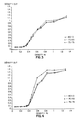
- Reflection density Din/Dout curves plotting density of the test pattern (Din) vs density of the copy image (Dout) were also generated to determine the sensitivity of a toner composition to environmental conditions. To generate these curves, the voltage applied to the film was held constant at -500V and the Din and Dout values were measured and plotted for the various environment as described hereinafter.
- Toners like those of Examples 1 and 3 were prepared except that the toner binder polymer was synthesized by emulsion polymerization.
- the synthesis involved preparing a monomer mixture containing 75.7 weight percent styrene, 22.6 weight percent butylacrylate, 1.3 weight percent divinylbenzene and 0.2 weight percent n-dodecanediol. This was mixed in a continuous process with an aqueous solution of a water soluble initiator (ammonium persulfate) and a surfactant under reaction conditions including a temperature of 80°C and a residence time of 80 hours. The latex was coagulated, filtered and dried. Powdered toner compositions and developers were prepared from the resulting copolymer as in Example 1, using the charge agents CA-A and CA-C, as in Examples 1 and 3. The developers were tested as in Example 1.
- the data of the table show that the range for the film set-up voltages required for the emulsion polymerized (EP) toners with either charge agent was significantly greater than that required for the suspension polymerized (SP) toners with either charge agent. From 90 to 110 volts more was required to sei up the EP toners than the SP toners containing the Example 1 and 3 charge agents. The charge to mass value range was 10 and 14 for the EP toners but only 0 to 4 ⁇ C/g for the SP toners with the same charge agents. This data clearly illustrates that toners prepared using the process of this invention exhibited a significant improvement in environmental stability.
- the SP toner of Example 2 performed similarly to the other SP toners of Examples 1 and 3.
- Figures 1-5 are plots of Din/Dout values for copies imaged under the same conditions with the five different toners.
- “Din” is the density of the test pattern
- “Dout” is the density of the electrophotographic copy. These curves reveal the contrast response to the environmental changes.
- the suspending agent/promoter complex and other addenda are homogeneously dispersed within the toner polymer
- another advantage is that the mechanically pulverized toner particles are irregular in shape.
- the toner particles of the present invention have superior image transfer properties in the electrostatic transfer of a toner image from a photoconductor to paper or other receiving sheets.
Landscapes
- Physics & Mathematics (AREA)
- General Physics & Mathematics (AREA)
- Chemical & Material Sciences (AREA)
- Spectroscopy & Molecular Physics (AREA)
- Chemical Kinetics & Catalysis (AREA)
- Inorganic Chemistry (AREA)
- Developing Agents For Electrophotography (AREA)
- Polymerisation Methods In General (AREA)
Applications Claiming Priority (2)
| Application Number | Priority Date | Filing Date | Title |
|---|---|---|---|
| US07/292,470 US4912009A (en) | 1988-12-30 | 1988-12-30 | Toner composition and method of making |
| US292470 | 1988-12-30 |
Publications (3)
| Publication Number | Publication Date |
|---|---|
| EP0376202A2 true EP0376202A2 (de) | 1990-07-04 |
| EP0376202A3 EP0376202A3 (de) | 1991-03-20 |
| EP0376202B1 EP0376202B1 (de) | 1994-06-01 |
Family
ID=23124820
Family Applications (1)
| Application Number | Title | Priority Date | Filing Date |
|---|---|---|---|
| EP89123803A Expired - Lifetime EP0376202B1 (de) | 1988-12-30 | 1989-12-22 | Elektrostatographische Toner sowie Verfahren zur Herstellung |
Country Status (4)
| Country | Link |
|---|---|
| US (1) | US4912009A (de) |
| EP (1) | EP0376202B1 (de) |
| JP (1) | JPH02226258A (de) |
| DE (1) | DE68915723T2 (de) |
Cited By (4)
| Publication number | Priority date | Publication date | Assignee | Title |
|---|---|---|---|---|
| EP0479275A1 (de) * | 1990-10-03 | 1992-04-08 | Kao Corporation | Verfahren zur Herstellung von Bindemittelharzen und Entwicklerzusammensetzung für die Elektrophotographie |
| EP0488238A1 (de) * | 1990-11-30 | 1992-06-03 | Mitsubishi Rayon Co., Ltd | Harz für Toner |
| EP0533172A1 (de) * | 1991-09-19 | 1993-03-24 | Canon Kabushiki Kaisha | Toner für die Entwicklung elektrostatischer Bilder und Entwickler vom Zwei-Komponententyp für die Entwicklung elektrostatischer Bilder |
| EP0621511A1 (de) * | 1993-04-20 | 1994-10-26 | Canon Kabushiki Kaisha | Toner für die Entwicklung elektrostatischer Bilder und Verfahren zu dessen Herstellung |
Families Citing this family (42)
| Publication number | Priority date | Publication date | Assignee | Title |
|---|---|---|---|---|
| US5262269A (en) * | 1990-03-30 | 1993-11-16 | Eastman Kodak Company | Process for making toner particles wherein the pigment is dispersed in the toner |
| US5118588A (en) * | 1990-03-30 | 1992-06-02 | Eastman Kodak Company | Toner particles having improved transfer efficiency and which comprise a pigment surface modifier |
| US6025103A (en) * | 1992-04-24 | 2000-02-15 | Fujitsu Limited | Highly pure material for electrophotographic printing, and method of manufacturing such highly pure material |
| US5629367A (en) * | 1992-05-26 | 1997-05-13 | Eastman Kodak Company | Method of making pigment concentrate particles and product of same |
| US5518809A (en) * | 1992-09-18 | 1996-05-21 | Minnesota Mining And Manufacturing Company | Water-based transparent image recording sheet for plain paper copiers |
| US5238736A (en) * | 1992-09-18 | 1993-08-24 | Minnesota Mining And Manufacturing Company | Polymeric microspheres for low-friction surfaces |
| US5310591A (en) * | 1992-09-18 | 1994-05-10 | Minnesota Mining And Manufacturing Company | Image-receptive sheets for plain paper copiers |
| US5310595A (en) * | 1992-09-18 | 1994-05-10 | Minnesota Mining And Manufacturing Company | Water-based transparent image recording sheet for plain paper copiers |
| US5370963A (en) * | 1993-06-25 | 1994-12-06 | Xerox Corporation | Toner emulsion aggregation processes |
| US5358814A (en) * | 1993-08-31 | 1994-10-25 | Eastman Kodak Company | Toner compositions containing as a negative charge-controlling agent a mixture of ortho-benzoic sulfimide and para-anisic acid |
| US5332637A (en) * | 1993-08-31 | 1994-07-26 | Eastman Kodak Company | Electrostatographic dry toner and developer compositions with hydroxyphthalimide |
| US5358817A (en) * | 1993-08-31 | 1994-10-25 | Eastman Kodak Company | Toner compositions containing as a negative charge-controlling agent the calcium salt of ortho-benzoic sulfimide |
| US5358818A (en) * | 1993-08-31 | 1994-10-25 | Eastman Kodak Company | Ortho-benzoic sulfimide as charge-controlling agent |
| US5358815A (en) * | 1993-08-31 | 1994-10-25 | Eastman Kodak Company | Toner compositions containing negative charge-controlling additive |
| US5358816A (en) * | 1993-08-31 | 1994-10-25 | Eastman Kodak Company | Zinc salt of ortho-benzoic sulfimide as negative charge-controlling additive for toner and developer compositions |
| US5445866A (en) * | 1993-10-19 | 1995-08-29 | Minnesota Mining And Manufacturing Company | Water-based transparent image recording sheet |
| US5464900A (en) * | 1993-10-19 | 1995-11-07 | Minnesota Mining And Manufacturing Company | Water soluble organosiloxane compounds |
| EP0690355A1 (de) | 1994-06-08 | 1996-01-03 | Eastman Kodak Company | Gegen Feuchtigkeit stabilisierte Toner und Entwickler |
| US5510169A (en) * | 1994-10-14 | 1996-04-23 | Minnesota Mining And Manufacturing Company | Magnetic recording medium with backside coating containing polymeric particles |
| US5521268A (en) * | 1995-03-29 | 1996-05-28 | Eastman Kodak Company | Odor reduction in toner polymers |
| US6057072A (en) * | 1997-03-31 | 2000-05-02 | Eastman Kodak Company | Toner compositions containing activated carbons |
| US6696212B2 (en) | 2001-03-27 | 2004-02-24 | Heidelberger Druckmaschinen Ag | Single component toner for improved magnetic image character recognition |
| US6797448B2 (en) | 2001-05-14 | 2004-09-28 | Eastman Kodak Company | Electrophotographic toner and development process with improved image and fusing quality |
| US6692880B2 (en) | 2001-05-14 | 2004-02-17 | Heidelberger Druckmaschinen Ag | Electrophotographic toner with stable triboelectric properties |
| US7314696B2 (en) | 2001-06-13 | 2008-01-01 | Eastman Kodak Company | Electrophotographic toner and development process with improved charge to mass stability |
| ES2248460T3 (es) * | 2001-09-05 | 2006-03-16 | Eastman Kodak Company | Toneres electrofotograficos que contienen ceras de polialquileno de alta cristalinidad. |
| JP2004163879A (ja) * | 2002-06-13 | 2004-06-10 | Heidelberger Druckmas Ag | ワックスが均一に分散したエレクトロフォトグラフトナー |
| JP2004252402A (ja) * | 2002-06-24 | 2004-09-09 | Heidelberger Druckmas Ag | 化学的に調製されたトナーを用いるエレクトロフォトグラフィックトナーおよび現像法 |
| US20050220518A1 (en) * | 2004-03-31 | 2005-10-06 | Eastman Kodak Company | Treatment of preprinted media for improved toner adhesion |
| US20050266332A1 (en) * | 2004-05-28 | 2005-12-01 | Pavlisko Joseph A | Oil-free process for full color digital printing |
| US7615327B2 (en) * | 2004-11-17 | 2009-11-10 | Xerox Corporation | Toner process |
| US7445879B2 (en) * | 2005-08-23 | 2008-11-04 | Nukote International, Inc. | Preparation of suspension polymerized toners |
| US8221947B2 (en) | 2008-12-18 | 2012-07-17 | Eastman Kodak Company | Toner surface treatment |
| US8626015B2 (en) | 2010-10-26 | 2014-01-07 | Eastman Kodak Company | Large particle toner printer |
| US8147948B1 (en) | 2010-10-26 | 2012-04-03 | Eastman Kodak Company | Printed article |
| US8530126B2 (en) | 2010-10-26 | 2013-09-10 | Eastman Kodak Company | Large particle toner |
| US8465899B2 (en) | 2010-10-26 | 2013-06-18 | Eastman Kodak Company | Large particle toner printing method |
| JP2013092748A (ja) | 2011-10-26 | 2013-05-16 | Cabot Corp | 複合体粒子を含むトナー添加剤 |
| US9201323B2 (en) * | 2013-07-31 | 2015-12-01 | Canon Kabushiki Kaisha | Toner |
| PT3027699T (pt) * | 2013-07-31 | 2020-10-01 | Polyplex Corporation Ltd | Composição de revestimento para película de poliéster |
| WO2015095154A1 (en) | 2013-12-20 | 2015-06-25 | Cabot Corporation | Metal oxide-polymer composite particles for chemical mechanical planarization |
| US9683064B2 (en) | 2015-09-30 | 2017-06-20 | Eastman Kodak Company | Method of making a resin |
Family Cites Families (12)
| Publication number | Priority date | Publication date | Assignee | Title |
|---|---|---|---|---|
| US2932629A (en) * | 1955-03-28 | 1960-04-12 | Dow Chemical Co | Quiescent suspension polymerization |
| USRE31072E (en) * | 1973-07-18 | 1982-11-02 | Eastman Kodak Company | Electrographic developing composition and process |
| US4148741A (en) * | 1976-08-02 | 1979-04-10 | Xerox Corporation | Polymerization and attrition method for producing toner with reduced processing steps |
| FR2430427A1 (fr) * | 1978-07-07 | 1980-02-01 | Sinloihi Co Ltd | Particules spheriques fines de polymeres contenant des pigments mineraux et/ou des colorants noirs et leur preparation |
| JPS5646250A (en) * | 1979-09-21 | 1981-04-27 | Nippon Paint Co Ltd | Electrophotographic toner |
| GB2070036B (en) * | 1980-02-06 | 1984-05-16 | Konishiroku Photo Ind | Toner composition for electrophotography and a method for manufacturing the same |
| US4299903A (en) * | 1980-07-03 | 1981-11-10 | Xerox Corporation | Emulsion polymerization process for dry positive toner compositions employs charge control agent as wetting agent |
| JPS5957252A (ja) * | 1982-09-27 | 1984-04-02 | Canon Inc | トナ−の製造方法 |
| JPS62151862A (ja) * | 1985-12-26 | 1987-07-06 | Canon Inc | 重合トナ−の製造方法 |
| US4849318A (en) * | 1986-10-31 | 1989-07-18 | Mita Industrial Co., Ltd. | Processes for producing electrophotographic toner |
| JPH07117773B2 (ja) * | 1987-02-13 | 1995-12-18 | キヤノン株式会社 | 重合トナ−の製造方法 |
| US4833060A (en) * | 1988-03-21 | 1989-05-23 | Eastman Kodak Company | Polymeric powders having a predetermined and controlled size and size distribution |
-
1988
- 1988-12-30 US US07/292,470 patent/US4912009A/en not_active Expired - Lifetime
-
1989
- 1989-12-22 DE DE68915723T patent/DE68915723T2/de not_active Expired - Lifetime
- 1989-12-22 EP EP89123803A patent/EP0376202B1/de not_active Expired - Lifetime
- 1989-12-28 JP JP1338826A patent/JPH02226258A/ja active Pending
Cited By (7)
| Publication number | Priority date | Publication date | Assignee | Title |
|---|---|---|---|---|
| EP0479275A1 (de) * | 1990-10-03 | 1992-04-08 | Kao Corporation | Verfahren zur Herstellung von Bindemittelharzen und Entwicklerzusammensetzung für die Elektrophotographie |
| US5391695A (en) * | 1990-10-03 | 1995-02-21 | Kao Corporation | Process for producing binder resin and developer composition for electrophotography |
| EP0488238A1 (de) * | 1990-11-30 | 1992-06-03 | Mitsubishi Rayon Co., Ltd | Harz für Toner |
| EP0533172A1 (de) * | 1991-09-19 | 1993-03-24 | Canon Kabushiki Kaisha | Toner für die Entwicklung elektrostatischer Bilder und Entwickler vom Zwei-Komponententyp für die Entwicklung elektrostatischer Bilder |
| US5558967A (en) * | 1991-09-19 | 1996-09-24 | Canon Kabushiki Kaisha | Toner for developing electrostatic image and two-component type developer for developing electrostatic image |
| EP0621511A1 (de) * | 1993-04-20 | 1994-10-26 | Canon Kabushiki Kaisha | Toner für die Entwicklung elektrostatischer Bilder und Verfahren zu dessen Herstellung |
| US5529873A (en) * | 1993-04-20 | 1996-06-25 | Canon Kabushiki Kaisha | Toner for developing electrostatic images and process for producing toner |
Also Published As
| Publication number | Publication date |
|---|---|
| DE68915723T2 (de) | 1995-01-12 |
| EP0376202A3 (de) | 1991-03-20 |
| DE68915723D1 (de) | 1994-07-07 |
| JPH02226258A (ja) | 1990-09-07 |
| US4912009A (en) | 1990-03-27 |
| EP0376202B1 (de) | 1994-06-01 |
Similar Documents
| Publication | Publication Date | Title |
|---|---|---|
| EP0376202B1 (de) | Elektrostatographische Toner sowie Verfahren zur Herstellung | |
| CA1173687A (en) | Two component electrophotographic developer comprising magnetic carrier particles and toner including alkyl-dimethylbenzyl-ammonium salt charge control agent | |
| US8394565B2 (en) | Positively charged developer for development of electrostatic image and production process thereof | |
| EP0334126A2 (de) | Polymerische Teilchen, Herstellung nach einem Suspensionsverfahren mit kolloidaler Stabilisierung, polymerteilchenhaltiger Kapseltoner | |
| JPS63109446A (ja) | カプセル化トナー組成物の製造方法 | |
| US4816365A (en) | Electrostatic recording dry toner | |
| US7018764B2 (en) | Toner for developing electrostatic images, process for preparing toner for developing electrostatic images, developer for developing electrostatic images and images forming method | |
| US6156473A (en) | Monodisperse spherical toner particles containing aliphatic amides or aliphatic acids | |
| JP2000347445A (ja) | 静電荷像現像用トナー | |
| KR910007721B1 (ko) | 정전하상 현상용 토우너 및 그 제조방법 | |
| EP0703505A1 (de) | Toner für Zweikomponentenentwickler | |
| DE69423428T2 (de) | Kapseltoner zur Wärme- und Druckfixierung und Verfahren zur dessen Herstellung | |
| EP0253290A2 (de) | Kugelförmige Tonerteilchen | |
| US5334480A (en) | Capsule toner | |
| US5783346A (en) | Toner compositions including polymer binders with adhesion promoting and charge control monomers | |
| GB2070036A (en) | A toner composition for electrophotography and a method for manufacturing the same | |
| JPS61163347A (ja) | 電子写真用トナ− | |
| US4895785A (en) | Spherical toner particle | |
| JPH07301949A (ja) | 静電荷像現像用トナー | |
| US5009979A (en) | Electrostatographic particulate toner and developer compositions | |
| EP0757294A1 (de) | Tonerzusammensetzungen die vernetztes polymeres Bindemittel und N-Alkylsarcosinseifen enthalten | |
| DE3103972A1 (de) | Tonerzusammensetzung fuer die elektrophotographie und verfahren zu ihrer herstellung | |
| JPH06102709A (ja) | 磁性粒子およびその製造方法 | |
| EP0703504A1 (de) | Toner für Zweikomponentenentwickler | |
| JPS6269275A (ja) | 静電荷像現像用トナ−の製造方法 |
Legal Events
| Date | Code | Title | Description |
|---|---|---|---|
| PUAI | Public reference made under article 153(3) epc to a published international application that has entered the european phase |
Free format text: ORIGINAL CODE: 0009012 |
|
| AK | Designated contracting states |
Kind code of ref document: A2 Designated state(s): DE FR GB NL |
|
| PUAL | Search report despatched |
Free format text: ORIGINAL CODE: 0009013 |
|
| AK | Designated contracting states |
Kind code of ref document: A3 Designated state(s): DE FR GB NL |
|
| 17P | Request for examination filed |
Effective date: 19910408 |
|
| 17Q | First examination report despatched |
Effective date: 19930817 |
|
| GRAA | (expected) grant |
Free format text: ORIGINAL CODE: 0009210 |
|
| AK | Designated contracting states |
Kind code of ref document: B1 Designated state(s): DE FR GB NL |
|
| REF | Corresponds to: |
Ref document number: 68915723 Country of ref document: DE Date of ref document: 19940707 |
|
| ET | Fr: translation filed | ||
| PLBE | No opposition filed within time limit |
Free format text: ORIGINAL CODE: 0009261 |
|
| STAA | Information on the status of an ep patent application or granted ep patent |
Free format text: STATUS: NO OPPOSITION FILED WITHIN TIME LIMIT |
|
| 26N | No opposition filed | ||
| REG | Reference to a national code |
Ref country code: GB Ref legal event code: 732E |
|
| NLS | Nl: assignments of ep-patents |
Owner name: NEXPRESS SOLUTIONS LLC |
|
| REG | Reference to a national code |
Ref country code: GB Ref legal event code: IF02 |
|
| PGFP | Annual fee paid to national office [announced via postgrant information from national office to epo] |
Ref country code: NL Payment date: 20021112 Year of fee payment: 14 |
|
| PGFP | Annual fee paid to national office [announced via postgrant information from national office to epo] |
Ref country code: FR Payment date: 20021202 Year of fee payment: 14 |
|
| PG25 | Lapsed in a contracting state [announced via postgrant information from national office to epo] |
Ref country code: NL Free format text: LAPSE BECAUSE OF NON-PAYMENT OF DUE FEES Effective date: 20040701 |
|
| PG25 | Lapsed in a contracting state [announced via postgrant information from national office to epo] |
Ref country code: FR Free format text: LAPSE BECAUSE OF NON-PAYMENT OF DUE FEES Effective date: 20040831 |
|
| NLV4 | Nl: lapsed or anulled due to non-payment of the annual fee |
Effective date: 20040701 |
|
| REG | Reference to a national code |
Ref country code: FR Ref legal event code: ST |
|
| REG | Reference to a national code |
Ref country code: GB Ref legal event code: 732E |
|
| PGFP | Annual fee paid to national office [announced via postgrant information from national office to epo] |
Ref country code: DE Payment date: 20081230 Year of fee payment: 20 |
|
| PGFP | Annual fee paid to national office [announced via postgrant information from national office to epo] |
Ref country code: GB Payment date: 20081110 Year of fee payment: 20 |
|
| REG | Reference to a national code |
Ref country code: GB Ref legal event code: PE20 Expiry date: 20091221 |
|
| PG25 | Lapsed in a contracting state [announced via postgrant information from national office to epo] |
Ref country code: GB Free format text: LAPSE BECAUSE OF EXPIRATION OF PROTECTION Effective date: 20091221 |