EP0377284A2 - Méthode et appareil de régulation du flux ionique transmembranaire - Google Patents
Méthode et appareil de régulation du flux ionique transmembranaire Download PDFInfo
- Publication number
- EP0377284A2 EP0377284A2 EP89312405A EP89312405A EP0377284A2 EP 0377284 A2 EP0377284 A2 EP 0377284A2 EP 89312405 A EP89312405 A EP 89312405A EP 89312405 A EP89312405 A EP 89312405A EP 0377284 A2 EP0377284 A2 EP 0377284A2
- Authority
- EP
- European Patent Office
- Prior art keywords
- magnetic field
- predetermined
- flux density
- magnetic flux
- frequency
- Prior art date
- Legal status (The legal status is an assumption and is not a legal conclusion. Google has not performed a legal analysis and makes no representation as to the accuracy of the status listed.)
- Withdrawn
Links
- 238000000034 method Methods 0.000 title claims abstract description 22
- 230000001105 regulatory effect Effects 0.000 title claims abstract description 16
- 230000004907 flux Effects 0.000 claims abstract description 102
- 239000002131 composite material Substances 0.000 claims abstract description 45
- 239000012528 membrane Substances 0.000 claims abstract description 29
- 230000001276 controlling effect Effects 0.000 claims description 8
- 230000002708 enhancing effect Effects 0.000 claims 1
- 230000035699 permeability Effects 0.000 claims 1
- 230000037427 ion transport Effects 0.000 abstract description 9
- 230000004044 response Effects 0.000 abstract description 2
- 150000002500 ions Chemical class 0.000 description 21
- 210000004027 cell Anatomy 0.000 description 13
- 210000001519 tissue Anatomy 0.000 description 12
- 230000012010 growth Effects 0.000 description 6
- 210000000170 cell membrane Anatomy 0.000 description 5
- 230000008859 change Effects 0.000 description 5
- 230000005355 Hall effect Effects 0.000 description 4
- 230000010355 oscillation Effects 0.000 description 3
- 210000002808 connective tissue Anatomy 0.000 description 2
- 230000007423 decrease Effects 0.000 description 2
- 230000003247 decreasing effect Effects 0.000 description 2
- 238000010586 diagram Methods 0.000 description 2
- 238000012986 modification Methods 0.000 description 2
- 230000004048 modification Effects 0.000 description 2
- 230000008467 tissue growth Effects 0.000 description 2
- BVKZGUZCCUSVTD-UHFFFAOYSA-M Bicarbonate Chemical compound OC([O-])=O BVKZGUZCCUSVTD-UHFFFAOYSA-M 0.000 description 1
- OYPRJOBELJOOCE-UHFFFAOYSA-N Calcium Chemical compound [Ca] OYPRJOBELJOOCE-UHFFFAOYSA-N 0.000 description 1
- ZAMOUSCENKQFHK-UHFFFAOYSA-N Chlorine atom Chemical compound [Cl] ZAMOUSCENKQFHK-UHFFFAOYSA-N 0.000 description 1
- DGAQECJNVWCQMB-PUAWFVPOSA-M Ilexoside XXIX Chemical compound C[C@@H]1CC[C@@]2(CC[C@@]3(C(=CC[C@H]4[C@]3(CC[C@@H]5[C@@]4(CC[C@@H](C5(C)C)OS(=O)(=O)[O-])C)C)[C@@H]2[C@]1(C)O)C)C(=O)O[C@H]6[C@@H]([C@H]([C@@H]([C@H](O6)CO)O)O)O.[Na+] DGAQECJNVWCQMB-PUAWFVPOSA-M 0.000 description 1
- WHXSMMKQMYFTQS-UHFFFAOYSA-N Lithium Chemical compound [Li] WHXSMMKQMYFTQS-UHFFFAOYSA-N 0.000 description 1
- FYYHWMGAXLPEAU-UHFFFAOYSA-N Magnesium Chemical compound [Mg] FYYHWMGAXLPEAU-UHFFFAOYSA-N 0.000 description 1
- ZLMJMSJWJFRBEC-UHFFFAOYSA-N Potassium Chemical compound [K] ZLMJMSJWJFRBEC-UHFFFAOYSA-N 0.000 description 1
- 238000010521 absorption reaction Methods 0.000 description 1
- 230000003321 amplification Effects 0.000 description 1
- 210000000988 bone and bone Anatomy 0.000 description 1
- 239000011575 calcium Substances 0.000 description 1
- 229910052791 calcium Inorganic materials 0.000 description 1
- 210000000845 cartilage Anatomy 0.000 description 1
- 239000000460 chlorine Substances 0.000 description 1
- 229910052801 chlorine Inorganic materials 0.000 description 1
- 230000000295 complement effect Effects 0.000 description 1
- 238000010276 construction Methods 0.000 description 1
- 238000001514 detection method Methods 0.000 description 1
- 230000018109 developmental process Effects 0.000 description 1
- 230000000694 effects Effects 0.000 description 1
- 230000005358 geomagnetic field Effects 0.000 description 1
- 239000001257 hydrogen Substances 0.000 description 1
- 229910052739 hydrogen Inorganic materials 0.000 description 1
- 125000004435 hydrogen atom Chemical class [H]* 0.000 description 1
- 230000003993 interaction Effects 0.000 description 1
- 239000007788 liquid Substances 0.000 description 1
- 229910052744 lithium Inorganic materials 0.000 description 1
- 230000007774 longterm Effects 0.000 description 1
- 239000011777 magnesium Substances 0.000 description 1
- 229910052749 magnesium Inorganic materials 0.000 description 1
- 230000007246 mechanism Effects 0.000 description 1
- 238000003199 nucleic acid amplification method Methods 0.000 description 1
- 239000011591 potassium Substances 0.000 description 1
- 229910052700 potassium Inorganic materials 0.000 description 1
- 230000001737 promoting effect Effects 0.000 description 1
- 238000000926 separation method Methods 0.000 description 1
- 239000011734 sodium Substances 0.000 description 1
- 229910052708 sodium Inorganic materials 0.000 description 1
- 239000007787 solid Substances 0.000 description 1
- 230000003068 static effect Effects 0.000 description 1
- 230000004936 stimulating effect Effects 0.000 description 1
- 230000025366 tissue development Effects 0.000 description 1
- 230000032258 transport Effects 0.000 description 1
Images

Classifications
-
- C—CHEMISTRY; METALLURGY
- C12—BIOCHEMISTRY; BEER; SPIRITS; WINE; VINEGAR; MICROBIOLOGY; ENZYMOLOGY; MUTATION OR GENETIC ENGINEERING
- C12N—MICROORGANISMS OR ENZYMES; COMPOSITIONS THEREOF; PROPAGATING, PRESERVING, OR MAINTAINING MICROORGANISMS; MUTATION OR GENETIC ENGINEERING; CULTURE MEDIA
- C12N13/00—Treatment of microorganisms or enzymes with electrical or wave energy, e.g. magnetism, sonic waves
-
- A—HUMAN NECESSITIES
- A61—MEDICAL OR VETERINARY SCIENCE; HYGIENE
- A61N—ELECTROTHERAPY; MAGNETOTHERAPY; RADIATION THERAPY; ULTRASOUND THERAPY
- A61N2/00—Magnetotherapy
Definitions
- the present invention relates generally to the transmembrane movement of ions and to oscillating magnetic fields. More specifically, the present invention relates to an improved method and apparatus for regulating the transmembrane movement of ions across biochemical membranes such as cell membranes.
- a predetermined resonance condition for a preselected ion is maintained at a constant value, notwithstanding changes in the local magnetic field component along a predetermined axis such that transmembrane movement of the ion is regulated.
- the inventors of the present invention have devised a method and apparatus for regulating the transport of a preselected ion across a cell membrane utilizing an applied, oscillating magnetic field. Transmembrane movement of a preselected ion is magnetically regulated using a time-varying magnetic field tuned to the cyclotron resonance energy absorption frequency of the preselected ion. This important discovery brought to light the interplay of local magnetic fields and the frequency dependence of ion transport mechanisms.
- the apparatus includes magnetic field generating means such as a field coil for generating a controlled, fluctuating magnetic field which penetrates a tissue, and an associated magnetic field sensing device for measuring the intensity of the magnetic field present in the tissue.
- magnetic field generating means and magnetic field sensor are enclosed within a housing along with a power source.
- the inventors have now discovered that by using a feedback system to monitor the local field component of the composite magnetic field, the applied component can be automatically adjusted to maintain the proper balance to bring about transmembrane movement of ions in any application of ion transport tuning.
- the present invention provides an apparatus for regulating the transmembrane movement of ions across a biochemical membrane such as a living cell membrane which includes magnetic field generating means, an associated magnetic field sensing means, and means for automatically adjusting the flux density of the magnetic field generating means to compensation for any deviation of the average value of the composite magnetic field intensity from a set point magnetic flux density as measured by the magnetic field density means.
- the magnetic field generating means is positioned adjacent a predetermined space containing a biochemical membrane in the presence of a preselected ion to be transported.
- a fluctuating, directional magnetic field is then generated by the magnetic field generating means.
- the applied magnetic flux density is directed along a predetermined axis which passes through the membrane.
- the applied magnetic flux density along the axis is superimposed on that component of the local or ambient magnetic field which is parallel to the predetermined axis to create a fluctuating composite field.
- the resultant combined magnetic flux density which is parallel to the predetermined axis and which passes through the membrane is measured by the magnetic field sensor.
- the magnetic field sensor determines the net average value of the magnetic flux density which passes through the membrane along the predetermined axis.
- the frequency of the fluctuating magnetic field is set at a predetermined value and the net average value of the magnetic flux density is then regulated by adjusting the magnitude of the applied magnetic field to produce a combined magnetic field having a preselected ratio of frequency-to-field magnitude which causes transmembrane movement of the preselected ion through the membrane.
- changes in the magnitude of the local magnetic field along the predetermined axis which would otherwise alter the magnetic flux density of the combined magnetic field parallel to the predetermined axis, and which would thus produce a deviation from the desired ratio, are counterbalanced by adjustment of the magnitude of the applied, fluctuating magnetic field. This adjustment is preferably made by microprocessing means in association with both the magnetic field generating means and the magnetic field sensor.
- f c /B q/(2 ⁇ m)
- f c is the frequency of the combined magnetic field in Hertz
- B is the non-zero average value of the magnetic flux density of the combined magnetic field parallel to the axis in Tesla
- q/m is in Coulombs per kilogram and has a value of from about 5 x 10⁵ to about 100 x 106.
- B preferably has a value not in excess of about 5 x 10 ⁇ 4 Tesla.
- the values of q and m are selected with reference to the charge and mass of a preselected ion.
- changes in the ambient magnetic field which would otherwise alter the ratio of frequency-to-magnetic field are counterbalanced by adjusting the frequency of the applied magnetic field to maintain the preferred ratio.
- the present invention also contemplates the adjustment of both frequency and field magnitude to maintain the predetermined preferred ratio.
- the peak-to-peak amplitude of the AC component is in the range of about 2.0 x 10 ⁇ 7 to about 2.0 x 10 ⁇ 4 Tesla.
- the waveform is preferably substantially sinusoidal, but other waveforms are suitable.
- the present invention provides a method of controlling the transmembrane movement of ions across a biochemical membrane including the steps of generating a fluctuating, directionally-oriented magnetic field; positioning a biochemical membrane and a preselected ion to be transported within the fluctuating, magnetic field so that the field passes through the membrane parallel to a predetermined axis that extends through the membrane; measuring the net average value of the combined magnetic flux density parallel to the predetermined axis through the membrane, where the combined magnetic field is the sum of the local magnetic field along the predetermined axis and the applied magnetic field; and automatically adjusting the frequency and/or magnitude of the applied magnetic field to produce a combined magnetic field along the axis having a predetermined ratio of frequency-to-magnitude, where the predetermined ratio causes transmembrane movement of the preselected ion.
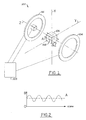
- ion transport apparatus 100 of the present invention includes coils 102 and 104 of a Helmholtz coil pair arranged to generate an applied magnetic field directed along a longitudinal axis identified by the letter Z.
- the number of turns N, the diameter of the coils, the separation of the coils, and the wire gauge are only critical insofar as conventional practice requires constraints on these and other design parameters to allow optimal performance characteristics in achieving predetermined flux densities as required in the preferred practice of the present invention.
- These predetermined flux densities may also be achieved by conventional devices other than Helmholtz coils, such as solenoids, electromagnets, and permanent magnets.
- Apparatus 100 generates a predictable, measurable and uniform magnetic flux density within active volume 106.
- This active volume will encompass the total volume of cells and/or tissue that are exposed to a composite flux density.
- a unipolar vector representing the composite magnetic flux density is illustrated by arrows A1 and A2 separated by a ".”that represents the average nonzero value of the vector.
- the opposed arrows represent the fact that the magnitude of the composite magnetic flux changes at a predetermined rate; however, as will be explained, the direction of the flux does not change.
- a single exemplary living cell 108 is shown within active volume 106.
- Cell 108 contains a specific complement of intrinsic ionic species and is surrounded by a liquid or tissue medium containing ionic species required for cell and tissue function.
- TABLE 1 lists a typical, but incomplete, group of such ionic species suitable for use with the invention and shows the charge-to-mass ratio (q/m) of each species, in units of Coulombs per kilogram, as well as a preferred repetition rate or frequency (f c ), in Hz, for each species, for the specific case in which the composite magnetic flux density is 5 x 10 ⁇ 5 Tesla.
- the preferred frequency is found using the Cyclotron Resonance Relationship.
- Coils 102 and 104 are energized by controller 105 to generate a magnetic flux density within active volume 106 that varies with time as shown in Figure 2 of the drawings.
- a nonzero average magnetic flux density, uniform throughout the active volume, results either from an offset sinusoidal signal or from a full-wave rectified signal applied to coils 102 and 104.
- the local constant magnetic flux density will in general be superposed on the applied magnetic flux density generated by coils 102 and 104 in active volume 106.
- the local flux density which will generally comprise the geomagnetic field, will have one component along the direction of the Z-axis.
- the effect of the Z-component of the local flux density will be to change the nonzero average magnetic flux density created by coils 102 and 104 within active volume 106 to a different net average value, the value of the resultant composite magnetic field i.e. the combined local and applied field along the Z-axis.
- Apparatus 100 further includes a magnetic field sensing device, shown here as magnetometer 110 which is positioned in coil 102 to measure the total or composite magnetic flux which passes through predetermined space 106 parallel to the predetermined Z-axis. It will be understood, then, that magnetometer 110 is provided to measure the composite magnetic field along the Z-axis. Magnetometer 110 then sends a signal to controller 105.
- the local field component either augments or decreases the applied magnetic flux unless the local field component is zero.
- the presence of the local field is an important consideration in the present invention.
- the relatively low applied flux densities and relatively precise predetermined relationships of combined flux density and frequency provided by the present invention must be maintained, notwithstanding the influence of the local magnetic field. This is achieved in essentially two preferred manners which will be explained more fully herein.
- magnetometer 110 is provided to determine the magnitude of the magnetic flux density of the local magnetic field.
- predetermined space 106 is occupied by living cell 108 and a preselected ion.
- Predetermined Z-axis which projects through predetermined space 106 and thus through living cell 108 is defined by the relative position of apparatus 100 with respect to cell 108.
- Predetermined Z-axis is the direction of the applied magnetic flux generated by field coils 102 and 104 through predetermined space 106.
- magnetometer 110 measures the total magnetic flux density parallel to the Z-axis which passes through cell 108. This total or composite magnetic flux density is the sum of the applied component and the local component.
- the local component may at times be in the same direction as the applied flux and at other times be in directions other than the applied flux. At times the local component may drop to zero.
- changes in the local component along the Z-axis may be produced by changes in the direction of apparatus 100.
- the applied flux generated by field coils 102 and 104 may be parallel to a north-south axis and since the direction of predetermined Z-axis is defined by the direction of the applied flux, in this position, predetermined Z-axis is therefore also in the north-south direction.
- apparatus 100 may be turned to the north causing a 90 degree rotation of field coils 102 and 104 such that the applied magnetic flux is then parallel to an east-west axis. Accordingly, predetermined Z-axis is then also in the east-west direction.
- the local component of interest will have a value which is a function of directions. Therefore, the composite flux measured by magnetometer 110 along the predetermined Z-axis will change in response to changes in the position of apparatus 110 with respect to the local magnetic field.
- the net average value of magnetic flux density is accordingly regulated to compensate for the change in composite flux.
- Transmembrane ion transport is achieved by creating a fluctuating combined or composite magnetic field having a magnetic flux density parallel to predetermined Z-axis, where the combined magnetic flux density along the Z-axis is maintained at a predetermined relationship to the frequency of the fluctuations.
- the combined magnetic flux density parallel to the Z-axis has a non-zero net average value.
- the composite magnetic field of the present invention can be thought of as a static field having reference level "A" on which a fluctuating magnetic field is superimposed. It comprises an ac component which varies in amplitude but not direction and a dc reference around which the ac component varies.
- Reference level A is the non-zero average value of the flux density.
- the non-zero average or net average value of the composite magnetic flux density along the Z-axis is utilized since the magnitude of the composite flux density changes at a predetermined rate due to oscillation or fluctuation of the applied magnetic flux.
- This reflects the fact that although the composite magnetic flux density along the axis is oscillating at a controlled rate, the composite field is regulated by the intensity of the applied field to ensure that the composite field is always unipolar; that is, the composite field is always in the same direction along the Z-axis.
- Microcontroller or microprocessor 200 is seen by which the composite magnetic field is maintained at a constant predetermined level despite changes in the ambient component as previously described.
- input 202 is provided by which a set point value of the predetermined composite magnetic flux density along a predetermined axis through the membrane is input into microprocessor 200.
- the composite field strength is compared to this set point value to generate an error equal to the difference in the set point value and the measured value of the composite magnetic flux density along the axis.
- a magnetic field sensor shown here as block 204, is provided by which the magnitude of the composite field which passes through cell 108 along the Z-axis is measured. It is preferred that magnetic field sensor 204 comprise a Hall-effect device which, as will be known by those skilled in the art, produces an analog signal. The magnetic field sensor 204 constantly monitors the composite magnetic field, sending a signal to microprocessor 200. It will be understood that the output of a Hall-effect magnetic sensor is relatively small; thus, magnetic field sensor amplifier 206 is provided by which the signal from magnetic field sensor 204 is amplified, for example, up to three thousand times its original value.
- analog-to-digital converter 207 is provided by which the amplified signal from magnetic field sensor 204 is converted to a digital signal which can be used by microprocessor 200. It is preferred that the analog-to-digital converter be provided on-board the microprocessor chip.
- the amplification of the magnetic field sensor signal may produce an unwanted noise level. Also, sudden changes in the magnetic field intensity may occur which make it difficult to determine the true average value of the composite magnetic flux density.
- the signal from analog-to-digital convertor 206 which is input into microprocessor 200 is filtered by software filter 208 to remove shot noise and sudden fluctuations in the composite field detected by magnetic field sensor 204.
- filter 208 comprise software in microprocessor 200, a discrete filter could be used.
- software filter 208 is a digital filter, preferably an integrator with a time constant of approximately 0.5 seconds.
- the changes in the magnitude of the composite magnetic field which are compensated for by increasing or decreasing the applied field are long-term changes of 0.5 seconds or more which result primarily from changes in the orientation of apparatus 100 with respect to the ambient field component.
- the time constant of filter 208 should be such that momentary fluctuations are filtered out.
- Microprocessor 200 includes logic which calculates the non-zero net average value of the composite magnetic flux density. This non-zero average value is then compared at comparator 210 in microprocessor 200 to the predetermined dc reference or offset value which is input into microprocessor 200 via input 202. It should be noted that this reference value is preferably established by dedicated circuitry in microprocessor 200, although variable input means could be included by which the set point value could be changed. An error statement is then generated defining the difference in the measured value of the composite magnetic flux density and the set point or reference value. Microprocessor 200 then determines the magnitude of the output necessary to drive magnetic field generating coils, shown here as block 212, to bring the composite magnetic flux density back to the set point W and produces a signal to increase or decrease the magnetic flux density.
- Software field modulator or oscillator 214 is provided by which an ac or fluctuating component is superimposed on the digital output signal which is input into digital-to-analog converter 216. From the previous discussion of the present invention, it will be understood that software field modulator 214 of microprocessor 200 in the preferred embodiment of the present invention is preset to a fixed, predetermined frequency to produce the desired predetermined, ion transport ratio of frequency-to-magnetic flux density value. In another embodiment, the feedback system of the present invention is such that changes in the composite magnetic flux density are measured, whereupon microprocessor 200 determines the necessary change in frequency to maintain the predetermined relationship. In that embodiment, software field modulator 214 produces the requisite ac frequency. It is again preferred that digital-to-analog converter 216 be provided on-board the microprocessor chip. Hence, software field modulator 214 provides the ac component at node 218.
- the signal from digital-to-analog converter 216 is fed to voltage-to-current amplifier 220, the output of which drives magnetic field generating coils 212 in the desired manner. Hence, the composite field is held substantially constant despite changes in the ambient component.
- power supply 222 be provided to power magnetic field sensor amplifier 206, microprocessor 200 and magnetic field sensor 204, the latter via bias circuitry 224.
- a separate power source 226 is preferred for voltage to current amplifier 220.
- the present invention provides a method of regulating the transmembrane movement of a preselected ion across a biochemical membrane such as the cell membrane of a living cell. This is achieved in one embodiment by generating a fluctuating, directionally-oriented magnetic field which projects through the target biochemical membrane. A number of magnetic field generating means are suitable for this purpose. The magnetic field so generated has a magnetic flux density of precisely controlled parameters which passes through the target membrane parallel to a predetermined axis projecting through the tissue.
- the local magnetic field to which the membrane is subjected will have a component which is parallel to the predetermined axis and which thus aids or opposes the applied or generated magnetic field along the axis. At times, the local component may be zero.
- the density of this combined magnetic flux and more specifically the average non-zero value of the combined magnetic flux density, is controlled to provide a precise relationship between the flux density along the axis and the frequency of the applied magnetic field which is oscillating at a predetermined value. Most preferably this is accomplished by automatically adjusting the intensity of the applied field to compensate for changes in the local field.
- the present invention provides a method of regulating transmembrane movement of a preselected ion by creating a magnetic field which penetrates the target membrane and which has a predetermined relationship between frequency of oscillation and average flux density.
- the composite magnetic field parallel to the predetermined axis is constantly monitored. As stated, this is preferably carried out with a Hall effect device or the like which produces an analog signal. This analog signal is periodically sampled by microprocessing means which then calculates the necessary frequency and/or magnitude of the applied magnetic field to maintain the preprogrammed, predetermined ratio previously described. Of course, it will now be understood that it is the combined magnetic flux which is sensed by the magnetic field sensor.
- the magnetic field generating means is used to adjust the magnitude of this composite field where appropriate.
- the method includes controlling the average value of the applied magnetic flux density along a predetermined axis to maintain a predetermined ratio of frequency-to-composite magnetic flux density.
- the frequency of the fluctuations is adjusted to maintain this relationship in which changes in the combined magnetic flux density due to changes in the local magnetic field are detected.
- a combination of these two methods may be used wherein both the frequency and the magnitude of the magnetic field flux density are adjusted to maintain the predetermined relationship of the present invention.
- the present invention provides a method for controlling transmembrane movement of a preselected ion across a biochemical membrane which includes the steps of creating a fluctuating magnetic field of predetermined frequency and flux density along an axis projecting through a predetermined volume and positioning a target biochemical membrane such as a living cell within this predetermined space such that it is exposed to the fluctuating magnetic field.
- the predetermined parameters of the fluctuating magnetic field are determined by measuring the net average value of the combined magnetic flux density parallel to the predetermined axis through the tissue, where the combined magnetic field is the sum of the local magnetic field along the predetermined axis and the applied magnetic field with a magnetic sensing means.
- the frequency and/or magnitude of the applied magnetic flux density is then automatically controlled by a microprocessor to produce a combined magnetic field along the axis having a predetermined ratio of frequency-to-flux density. This predetermined ratio causes transmembrane movement of the preselected ions.
Landscapes
- Health & Medical Sciences (AREA)
- Engineering & Computer Science (AREA)
- Life Sciences & Earth Sciences (AREA)
- Genetics & Genomics (AREA)
- Biomedical Technology (AREA)
- Organic Chemistry (AREA)
- Chemical & Material Sciences (AREA)
- General Health & Medical Sciences (AREA)
- Zoology (AREA)
- Wood Science & Technology (AREA)
- Bioinformatics & Cheminformatics (AREA)
- Animal Behavior & Ethology (AREA)
- General Engineering & Computer Science (AREA)
- Microbiology (AREA)
- Veterinary Medicine (AREA)
- Public Health (AREA)
- Radiology & Medical Imaging (AREA)
- Biochemistry (AREA)
- Biotechnology (AREA)
- Nuclear Medicine, Radiotherapy & Molecular Imaging (AREA)
- Magnetic Treatment Devices (AREA)
- Separation Using Semi-Permeable Membranes (AREA)
- Electrotherapy Devices (AREA)
- Control Of Electrical Variables (AREA)
- Thin Magnetic Films (AREA)
Applications Claiming Priority (3)
| Application Number | Priority Date | Filing Date | Title |
|---|---|---|---|
| US278688 | 1988-12-01 | ||
| US07/278,688 US5059298A (en) | 1986-10-27 | 1988-12-01 | Method and apparatus for regulating transmembrane ion movement |
| CA000615555A CA1308690C (fr) | 1988-03-17 | 1989-11-09 | Procede d'amelioration de la permeabilite d'une membrane aux ions |
Publications (2)
| Publication Number | Publication Date |
|---|---|
| EP0377284A2 true EP0377284A2 (fr) | 1990-07-11 |
| EP0377284A3 EP0377284A3 (fr) | 1990-11-22 |
Family
ID=25673223
Family Applications (1)
| Application Number | Title | Priority Date | Filing Date |
|---|---|---|---|
| EP19890312405 Withdrawn EP0377284A3 (fr) | 1988-12-01 | 1989-11-29 | Méthode et appareil de régulation du flux ionique transmembranaire |
Country Status (3)
| Country | Link |
|---|---|
| EP (1) | EP0377284A3 (fr) |
| JP (1) | JPH0321265A (fr) |
| CA (1) | CA2003577C (fr) |
Cited By (6)
| Publication number | Priority date | Publication date | Assignee | Title |
|---|---|---|---|---|
| WO1993000960A1 (fr) * | 1991-07-09 | 1993-01-21 | Dr. Fischer Ag | Dispositif pour le transport d'ions, en particulier de protons |
| WO1994011062A1 (fr) * | 1992-11-17 | 1994-05-26 | Dr. Fischer Aktiengesellschaft | Dispositif permettant d'influer sur des champs electriques et magnetiques de basse frequence |
| RU2145249C1 (ru) * | 1998-07-13 | 2000-02-10 | Кудрина Любовь Николаевна | Способ коррекции функционального состояния биологического объекта и устройство для его осуществления |
| EP2050481A1 (fr) | 2007-10-17 | 2009-04-22 | Wolf A. Prof. Dr. Kafka | Dispositif de thérapie de champ magnétique et signal de champ magnétique appliqué |
| DE202016008331U1 (de) | 2016-11-24 | 2017-09-04 | Bemer Int. AG | Vorrichtung zur Beeinflussung biologischer Abläufe in einem lebenden Gewebe |
| DE202016008332U1 (de) | 2016-11-24 | 2017-09-04 | Bemer Int. AG | Vorrichtung zur Beeinflussung biologischer Abläufe in einem lebenden Gewebe |
Family Cites Families (9)
| Publication number | Priority date | Publication date | Assignee | Title |
|---|---|---|---|---|
| FR2369850A1 (fr) * | 1976-11-03 | 1978-06-02 | Fragnet Jean | Appareil d'emission magnetique et electromagnetique a usage medical |
| CA1113156A (fr) * | 1979-09-24 | 1981-11-24 | Roland A. Drolet | Circuit therapeutique electro-magnetique |
| JPH0235531B2 (ja) * | 1981-09-04 | 1990-08-10 | Tokyo Shibaura Electric Co | Gasuzetsuenkaiheisochi |
| US4654574A (en) * | 1983-06-29 | 1987-03-31 | Sheldon Thaler | Apparatus for reactively applying electrical energy pulses to a living body |
| US4548208A (en) * | 1984-06-27 | 1985-10-22 | Medtronic, Inc. | Automatic adjusting induction coil treatment device |
| JPS6190676A (ja) * | 1984-10-09 | 1986-05-08 | 株式会社ポリトロニクス | 皮接具 |
| US4932951A (en) * | 1988-03-23 | 1990-06-12 | Life Resonances, Inc. | Method and apparatus for controlling tissue growth and an applied fluctuating magnetic field |
| US4818697A (en) * | 1986-10-27 | 1989-04-04 | Life Resonances, Inc. | Techniques for enhancing the permeability of ions through membranes |
| JPH0440030A (ja) * | 1990-06-05 | 1992-02-10 | Mitsubishi Electric Corp | 信号送受信装置 |
-
1989
- 1989-11-22 CA CA002003577A patent/CA2003577C/fr not_active Expired - Lifetime
- 1989-11-29 JP JP1310471A patent/JPH0321265A/ja active Pending
- 1989-11-29 EP EP19890312405 patent/EP0377284A3/fr not_active Withdrawn
Cited By (14)
| Publication number | Priority date | Publication date | Assignee | Title |
|---|---|---|---|---|
| WO1993000960A1 (fr) * | 1991-07-09 | 1993-01-21 | Dr. Fischer Ag | Dispositif pour le transport d'ions, en particulier de protons |
| US5480373A (en) * | 1991-07-09 | 1996-01-02 | Dr. Fischer Aktiengesellschaft | Device for transporting ions, in particular, protons |
| WO1994011062A1 (fr) * | 1992-11-17 | 1994-05-26 | Dr. Fischer Aktiengesellschaft | Dispositif permettant d'influer sur des champs electriques et magnetiques de basse frequence |
| US5725558A (en) * | 1992-11-17 | 1998-03-10 | Dr. Fischer Aktiengesellschaft | Device for influencing low-frequency electrical and magnetic fields |
| RU2145249C1 (ru) * | 1998-07-13 | 2000-02-10 | Кудрина Любовь Николаевна | Способ коррекции функционального состояния биологического объекта и устройство для его осуществления |
| EP2050481A1 (fr) | 2007-10-17 | 2009-04-22 | Wolf A. Prof. Dr. Kafka | Dispositif de thérapie de champ magnétique et signal de champ magnétique appliqué |
| DE202016008331U1 (de) | 2016-11-24 | 2017-09-04 | Bemer Int. AG | Vorrichtung zur Beeinflussung biologischer Abläufe in einem lebenden Gewebe |
| DE202016008332U1 (de) | 2016-11-24 | 2017-09-04 | Bemer Int. AG | Vorrichtung zur Beeinflussung biologischer Abläufe in einem lebenden Gewebe |
| DE102016122689A1 (de) | 2016-11-24 | 2018-05-24 | Bemer Int. AG | Vorrichtung zur Beeinflussung biologischer Abläufe in einem lebenden Gewebe |
| DE102016122691A1 (de) | 2016-11-24 | 2018-05-24 | Bemer Int. AG | Vorrichtung zur Beeinflussung biologischer Abläufe in einem lebenden Gewebe |
| WO2018095589A1 (fr) | 2016-11-24 | 2018-05-31 | Bemer Int. AG | Dispositif pour agir sur des processus biologiques dans un tissu vivant |
| WO2018095590A1 (fr) | 2016-11-24 | 2018-05-31 | Bemer Int. AG | Dispositif pour agir sur des processus biologiques dans un tissu vivant |
| US11090504B2 (en) | 2016-11-24 | 2021-08-17 | Bemer Int. AG | Device for influencing biological processes in living tissue |
| US11147981B2 (en) | 2016-11-24 | 2021-10-19 | Bemer Int. AG | Device for influencing biological processes in living tissue |
Also Published As
| Publication number | Publication date |
|---|---|
| JPH0321265A (ja) | 1991-01-30 |
| EP0377284A3 (fr) | 1990-11-22 |
| CA2003577A1 (fr) | 1990-06-01 |
| CA2003577C (fr) | 2001-04-17 |
Similar Documents
| Publication | Publication Date | Title |
|---|---|---|
| US5059298A (en) | Method and apparatus for regulating transmembrane ion movement | |
| US5215642A (en) | Improved method and apparatus for regulating transmembrane ion movement | |
| US5143588A (en) | Techniques for enhancing the permeability of ions through membranes | |
| US5100373A (en) | Techniques for controlling osteoporosis using non-invasive magnetic fields | |
| EP0338681B1 (fr) | Appareil pour appliquer un champ magnétique à un tissu | |
| CA1192261A (fr) | Dispositif biologique magnetique | |
| ATE154886T1 (de) | Verfahren und vorrichtung zur steuerung von ionenbewegung durch eine membran | |
| EP0377284A2 (fr) | Méthode et appareil de régulation du flux ionique transmembranaire | |
| US5215633A (en) | Techniques for enhancing the permeability of ions through membranes | |
| Halbach | Concepts for insertion devices that will produce high-quality synchrotron radiation | |
| Hettel | Review of synchrotron beam stability and stabilizing systems | |
| JPH10162772A (ja) | エネルギーフィルタ | |
| CA1308690C (fr) | Procede d'amelioration de la permeabilite d'une membrane aux ions | |
| SU710115A1 (ru) | Устройство настройки режима работы циклотрона | |
| Smolyakov | Planar microundulator with rectangular grooved poles | |
| JPS6017847A (ja) | イオン注入装置 | |
| Yao et al. | Compensation of Field Shaking due to the Magnet Vibration | |
| Frachon et al. | Results of magnetic measurements and field integral compensation for the elliptical multipole wiggler | |
| Bakker et al. | Orbit Control at BESSY II: Present Performance and Plans | |
| Burnham et al. | Application of precision magnetic measurements for control of the Duke storage ring | |
| Cheng | Compensation for field shaking due to magnet vibration | |
| JPS6446442A (en) | Inclined magnetic field generator of magnetic resonance imaging apparatus | |
| SU646475A1 (ru) | Способ повышени надежности мишени | |
| Cornacchia et al. | Modified octupoles for damping coherent instabilities | |
| JPH0748424B2 (ja) | 磁場発生装置 |
Legal Events
| Date | Code | Title | Description |
|---|---|---|---|
| PUAI | Public reference made under article 153(3) epc to a published international application that has entered the european phase |
Free format text: ORIGINAL CODE: 0009012 |
|
| AK | Designated contracting states |
Kind code of ref document: A2 Designated state(s): AT BE CH DE ES FR GB GR IT LI LU NL SE |
|
| PUAL | Search report despatched |
Free format text: ORIGINAL CODE: 0009013 |
|
| AK | Designated contracting states |
Kind code of ref document: A3 Designated state(s): AT BE CH DE ES FR GB GR IT LI LU NL SE |
|
| RHK1 | Main classification (correction) |
Ipc: A61N 1/42 |
|
| 17P | Request for examination filed |
Effective date: 19910218 |
|
| 17Q | First examination report despatched |
Effective date: 19940428 |
|
| STAA | Information on the status of an ep patent application or granted ep patent |
Free format text: STATUS: THE APPLICATION IS DEEMED TO BE WITHDRAWN |
|
| 18D | Application deemed to be withdrawn |
Effective date: 19950309 |