EP0382013B1 - Méthode pour revêtir un article et article ainsi fabriqué - Google Patents
Méthode pour revêtir un article et article ainsi fabriqué Download PDFInfo
- Publication number
- EP0382013B1 EP0382013B1 EP90101502A EP90101502A EP0382013B1 EP 0382013 B1 EP0382013 B1 EP 0382013B1 EP 90101502 A EP90101502 A EP 90101502A EP 90101502 A EP90101502 A EP 90101502A EP 0382013 B1 EP0382013 B1 EP 0382013B1
- Authority
- EP
- European Patent Office
- Prior art keywords
- thermally conductive
- conductive material
- skin
- painted
- exterior surface
- Prior art date
- Legal status (The legal status is an assumption and is not a legal conclusion. Google has not performed a legal analysis and makes no representation as to the accuracy of the status listed.)
- Expired - Lifetime
Links
- 238000000034 method Methods 0.000 title description 5
- 230000002787 reinforcement Effects 0.000 description 11
- 239000000853 adhesive Substances 0.000 description 10
- 230000001070 adhesive effect Effects 0.000 description 10
- 229920002430 Fibre-reinforced plastic Polymers 0.000 description 9
- 239000011151 fibre-reinforced plastic Substances 0.000 description 9
- 239000003973 paint Substances 0.000 description 6
- 239000000463 material Substances 0.000 description 5
- 229910052782 aluminium Inorganic materials 0.000 description 4
- XAGFODPZIPBFFR-UHFFFAOYSA-N aluminium Chemical group [Al] XAGFODPZIPBFFR-UHFFFAOYSA-N 0.000 description 4
- 239000011888 foil Substances 0.000 description 4
- 239000007769 metal material Substances 0.000 description 4
- 230000008901 benefit Effects 0.000 description 3
- 229910052751 metal Inorganic materials 0.000 description 3
- 239000002184 metal Substances 0.000 description 3
- 238000007591 painting process Methods 0.000 description 3
- 239000004033 plastic Substances 0.000 description 3
- 229920003023 plastic Polymers 0.000 description 3
- 239000003677 Sheet moulding compound Substances 0.000 description 2
- 239000011248 coating agent Substances 0.000 description 2
- 238000000576 coating method Methods 0.000 description 2
- 239000004020 conductor Substances 0.000 description 2
- 238000010438 heat treatment Methods 0.000 description 2
- 229910001369 Brass Inorganic materials 0.000 description 1
- RYGMFSIKBFXOCR-UHFFFAOYSA-N Copper Chemical compound [Cu] RYGMFSIKBFXOCR-UHFFFAOYSA-N 0.000 description 1
- 239000004593 Epoxy Substances 0.000 description 1
- 239000011324 bead Substances 0.000 description 1
- 239000010951 brass Substances 0.000 description 1
- 238000000748 compression moulding Methods 0.000 description 1
- 229910052802 copper Inorganic materials 0.000 description 1
- 239000010949 copper Substances 0.000 description 1
- 238000005260 corrosion Methods 0.000 description 1
- 230000007797 corrosion Effects 0.000 description 1
- 239000013528 metallic particle Substances 0.000 description 1
- 238000012986 modification Methods 0.000 description 1
- 230000004048 modification Effects 0.000 description 1
- 238000010422 painting Methods 0.000 description 1
- 238000005507 spraying Methods 0.000 description 1
- 239000002470 thermal conductor Substances 0.000 description 1
- 229920001187 thermosetting polymer Polymers 0.000 description 1
Images

Classifications
-
- B—PERFORMING OPERATIONS; TRANSPORTING
- B05—SPRAYING OR ATOMISING IN GENERAL; APPLYING FLUENT MATERIALS TO SURFACES, IN GENERAL
- B05D—PROCESSES FOR APPLYING FLUENT MATERIALS TO SURFACES, IN GENERAL
- B05D7/00—Processes, other than flocking, specially adapted for applying liquids or other fluent materials to particular surfaces or for applying particular liquids or other fluent materials
- B05D7/02—Processes, other than flocking, specially adapted for applying liquids or other fluent materials to particular surfaces or for applying particular liquids or other fluent materials to macromolecular substances, e.g. rubber
-
- B—PERFORMING OPERATIONS; TRANSPORTING
- B05—SPRAYING OR ATOMISING IN GENERAL; APPLYING FLUENT MATERIALS TO SURFACES, IN GENERAL
- B05D—PROCESSES FOR APPLYING FLUENT MATERIALS TO SURFACES, IN GENERAL
- B05D2350/00—Pretreatment of the substrate
- B05D2350/60—Adding a layer before coating
- B05D2350/65—Adding a layer before coating metal layer
-
- B—PERFORMING OPERATIONS; TRANSPORTING
- B05—SPRAYING OR ATOMISING IN GENERAL; APPLYING FLUENT MATERIALS TO SURFACES, IN GENERAL
- B05D—PROCESSES FOR APPLYING FLUENT MATERIALS TO SURFACES, IN GENERAL
- B05D3/00—Pretreatment of surfaces to which liquids or other fluent materials are to be applied; After-treatment of applied coatings, e.g. intermediate treating of an applied coating preparatory to subsequent applications of liquids or other fluent materials
- B05D3/002—Pretreatement
- B05D3/005—Pretreatment for allowing a non-conductive substrate to be electrostatically coated
-
- B—PERFORMING OPERATIONS; TRANSPORTING
- B05—SPRAYING OR ATOMISING IN GENERAL; APPLYING FLUENT MATERIALS TO SURFACES, IN GENERAL
- B05D—PROCESSES FOR APPLYING FLUENT MATERIALS TO SURFACES, IN GENERAL
- B05D3/00—Pretreatment of surfaces to which liquids or other fluent materials are to be applied; After-treatment of applied coatings, e.g. intermediate treating of an applied coating preparatory to subsequent applications of liquids or other fluent materials
- B05D3/02—Pretreatment of surfaces to which liquids or other fluent materials are to be applied; After-treatment of applied coatings, e.g. intermediate treating of an applied coating preparatory to subsequent applications of liquids or other fluent materials by baking
- B05D3/0254—After-treatment
Definitions
- This invention relates to painted parts and, more particularly, to painted plastic body panels for use in the automotive industry.
- FRP fiber reinforced plastic
- a thermally conductive material is applied in heat transfer relationship to the external surface of the part, yet it is spaced from the external surface so as to not degrade its smooth appearance.
- the thermally conductive material serves to evenly distribute heat throughout the exterior surface of the part during the painting processes to thereby provide a smooth, aesthetically pleasing surface quality for the part.
- the thin thermally conductive sheet is preferably of a metallic material that can additionally serve as a radio frequency (RFI) or electromagnetic interference (EMI) shield when the part is otherwise made of a nonmetallic material such as FRP.
- RFID radio frequency
- EMI electromagnetic interference
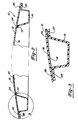
- the hood 10 includes a fiber reinforced plastic outer skin 12 and an inner reinforcement member 14 also made of FRP.
- the outer skin 12 is preferably made from sheet molding compound (SMC) using compression molding techniques under vacuum. Such techniques are disclosed in more detail in the following commonly assigned U.S. patents: U.S. Patent Nos. 4,488,862, issued December 18, 1984; 4,612,149, issued September 16, 1986; and 4,551,085, issued November 5, 1985. However, it should be understood that the skin 12 can be made from a variety of materials and processes.
- the present invention has applicability to parts made of a variety of materials, even metal, where problems are encountered due to temperature differentials at various locations on the part surface to be painted. These temperature differentials can be created by a variety of reasons. In this specific example, it has been discovered that temperature differentials are created between those areas of skin 12 that are supported and unsupported by the reinforcement member 14. Where the reinforcement member 14 is attached or in close proximity to the outer skin, there is created a localized area of increased mass relative to the unsupported thickness of the skin standing alone. It is believed that the supported areas act as heat sinks which cause them to be at different temperatures than the unsupported areas which consist simply of a single thickness of the skin 12.
- the reinforcement member 14 is also made of fiber reinforced plastic which can be made from similar materials and processes as the skin 12.
- Member 14 includes a plurality of hat-shaped cross sections distributed throughout its structure to provide reinforcement as necessary for the relatively thin outer skin 12.
- the shape and material of the reinforcement member can, of course, be varied depending upon the configuration of the final part.
- a thin, thermally conductive sheet 16 is applied in thermal transfer relationship to the exterior surface 18 of the outer skin 12 yet it is spaced therefrom so as to not degrade its smooth surface qualities.
- the thermally conductive sheet in the preferred embodiment is an aluminum foil approximately 1-3 mils (0,025 - 0,076 mm) thick. Aluminum foil is presently preferred because it is relatively inexpensive, lightweight and possesses good thermal conductivity.
- the sheet 16 should be made of a metallic material. If metallic materials are used, then the part will have the extra benefit of being an RFI/EMI shield. This is a very advantageous feature for plastic hoods or other engine covering panels where it is necessary to provide shielding from radio frequency noise created in the engine compartment.
- the sheet 16 can be replaced by a layer or coating of metallic material (such as copper, brass or aluminum) that has been painted or sprayed onto the interior surface 20 of the skin 12.
- metallic material such as copper, brass or aluminum
- the use of a continuous sheet or coating is preferable over a discontinuous or random layer.
- the aluminum foil sheet covers substantially the entire interior surface 20 of skin 12 except for the margins thereof.
- the sheet 16 is spaced from the edges of the skin by a sufficient distance (in this example, about 25 mm) to permit structural adhesive to mate directly between the outer marginal areas of the reinforcement member 14 and skin 12.
- One convenient way of positioning the sheet 16 is to spread it out and attach it to the inboard flanges 22 of reinforcement member 14 with a suitable adhesive.
- the adhesive shown in FIG. 1 and 2 is a series of spaced blobs 24 of nonstructural adhesive. Although a variety of adhesives can be used, commonly employed soft tacky adhesives known in the trade as dum-dum (such as SLUG CAULK) is presently preferred.
- Part 10 is assembled as shown in FIG. 2.
- a bead 26 of structural adhesive is laid about the outboard marginal flange 28 of the reinforcement member 14 and the outer skin brought into contact with the reinforcement member/sheet subassembly as illustrated in FIG. 2.
- the adhesive 26 is preferably a thermosetting adhesive such as an epoxy based adhesive. It is cured by localized heating in a conventional manner.
- the hood assembly 10 is now ready for painting in the traditional manner. This generally entails applying one or more primer coats, each coat being followed by a heating or baking step to dry the primer. Then, the top paint coats are applied.
- the top paint coats can be applied in a variety of well known manners such as spraying. It is a feature of this invention that the part can be painted with metallic paints which has heretofore created difficulties for FRP body panels.
- the metallic particles in these paints tend to be very susceptible to temperature differentials on the surface of the part to be painted.
- the present invention evenly distributes the temperature over the exterior surface 20 of skin 12 so that these problems are not created by hot spots which can otherwise be generated by the nonuniform cross sectional mass of the part 10.
- the temperature differential is maintained during initial application of the primer and top coat paint, as well as in subsequent baking thereof.
- the application of the top coat paint is generally followed by a baking step in a conventional gas-fired convection oven.
- Oven temperatures are generally in the range of 300-400 degrees Fahrenheit ( ⁇ 150 - ⁇ 200°C).
- the foil sheet 16 is a better thermal conductor than even the concentrated masses provided by the hat-shaped sections of reinforcement member 14. As a result, substantially even temperature distribution results.
- the present invention can be used in a wide variety of applications where it is desired to provide relatively large (in excess of one square foot) surfaces with extremely smooth, blemish-free painted surfaces without the aforementioned show through problem. It does, however, find particular utility for plastic exterior automotive body panels and, especially for cover panels for engine compartments where RFI/EMI shielding is required. Those skilled in the art will come to appreciate that other modifications can readily be made without departing from the scope of this invention after having the benefit of studying the foregoing specification, drawings and following claims.
Landscapes
- Life Sciences & Earth Sciences (AREA)
- Engineering & Computer Science (AREA)
- Wood Science & Technology (AREA)
- Body Structure For Vehicles (AREA)
- Superstructure Of Vehicle (AREA)
- Application Of Or Painting With Fluid Materials (AREA)
Claims (14)
- Procédé de fabrication d'une pièce peinte, consistant :
à produire une pièce relativement grande ayant une surface intérieure et une surface extérieure ;
à appliquer une matière thermiquement conductrice sur la pièce ;
à appliquer une peinture sur la surface extérieure ;
la matière thermiquement conductrice servant à distribuer de façon uniforme la chaleur sur toute la surface extérieure pour produire ainsi une surface peinte lisse, esthétiquement plaisante, pour la pièce. - Procédé selon la revendication 1, dans lequel ladite matière thermiquement conductrice se présente sous la forme d'une mince feuille métallique.
- Procédé selon la revendication 1, qui comprend en outre l'étape consistant : à chauffer la pièce pour faire sécher la peinture.
- Procédé selon la revendication 3, dans lequel la matière thermiquement conductrice est appliquée sur la surface intérieure.
- Procédé selon la revendication 4, dans lequel la pièce est essentiellement non métallique à l'exception de la matière thermiquement conductrice.
- Procédé de fabrication d'une pièce peinte armée, ledit procédé consistant :a) à produire une peau extérieure non métallique ayant des surfaces extérieure et intérieure ;b) à produire un élément non métallique d'armature ;c) à placer une feuille métallique sensiblement continue entre la peau et l'élément d'armature, ladite feuille étant sensiblement de même étendue que la surface intérieure de la peau à l'exception de bords marginaux de celle-ci qui sont laissés à découvert ;d) à lier l'élément d'armature à la peau extérieure à l'aide d'un adhésif dans la zone des bords marginaux à découvert ;e) à appliquer une peinture sur la surface extérieure de la peau ; etf) à chauffer la pièce pour faire sécher la peinture.
- Procédé selon la revendication 6, dans lequel la feuille est une mince feuille d'aluminium d'une épaisseur d'environ 1 à 3 mils (environ 0,025 à 0,076 mm).
- Procédé selon la revendication 7, dans lequel la pièce est un panneau de recouvrement pour un moteur de véhicule, ladite feuille métallique servant en outre de blindage RFI.
- Procédé selon la revendication 8, dans lequel ladite peau extérieure et ledit élément de renfort sont réalisés en une matière plastique armée de fibres.
- Pièce peinte fabriquée par le procédé qui consiste :
à réaliser une pièce relativement grande ayant une surface intérieure et une surface extérieure ;
à positionner une matière thermiquement conductrice en relation de transmission de chaleur avec la surface extérieure tout en en étant espacée ;
à appliquer une peinture sur la surface extérieure ;
la matière thermiquement conductrice servant à distribuer de façon égale la chaleur sur toute la surface pour produire ainsi une surface peinte lisse, esthétiquement présente, pour la pièce. - Pièce selon la revendication 10, sous la forme d'un panneau extérieur de carrosserie d'automobile ayant une peau extérieure en matière plastique armée de fibres et un élément intérieur d'armature.
- Pièce selon la revendication 11, dans laquelle ladite matière thermiquement conductrice se présente sous la forme d'une mince feuille métallique recouvrant sensiblement la surface intérieure de la peau.
- Pièce selon la revendication 12, sous la forme d'un panneau de recouvrement pour un compartiment moteur, la mince feuille servant en outre de blindage RFI.
- Pièce selon la revendication 13, dans laquelle la peinture contient des particules métalliques.
Applications Claiming Priority (2)
| Application Number | Priority Date | Filing Date | Title |
|---|---|---|---|
| US306990 | 1989-02-06 | ||
| US07/306,990 US5000997A (en) | 1989-02-06 | 1989-02-06 | Method for making a painted part and part made thereby |
Publications (2)
| Publication Number | Publication Date |
|---|---|
| EP0382013A1 EP0382013A1 (fr) | 1990-08-16 |
| EP0382013B1 true EP0382013B1 (fr) | 1992-12-16 |
Family
ID=23187772
Family Applications (1)
| Application Number | Title | Priority Date | Filing Date |
|---|---|---|---|
| EP90101502A Expired - Lifetime EP0382013B1 (fr) | 1989-02-06 | 1990-01-25 | Méthode pour revêtir un article et article ainsi fabriqué |
Country Status (4)
| Country | Link |
|---|---|
| US (1) | US5000997A (fr) |
| EP (1) | EP0382013B1 (fr) |
| CA (1) | CA2007966C (fr) |
| DE (1) | DE69000582T2 (fr) |
Families Citing this family (28)
| Publication number | Priority date | Publication date | Assignee | Title |
|---|---|---|---|---|
| JP2763984B2 (ja) * | 1992-03-18 | 1998-06-11 | 川崎重工業株式会社 | 構造体の構造 |
| US5329810A (en) * | 1993-08-23 | 1994-07-19 | General Motors Corporation | Non-destructive test strip and method for measuring paint film build |
| US5538094A (en) * | 1994-01-11 | 1996-07-23 | Aluminum Company Of America | Panel reinforcement structure |
| CA2136134C (fr) * | 1994-04-25 | 1999-07-27 | James E. Borchelt | Panneau de carrosserie en acier leger |
| US5433973A (en) * | 1994-05-26 | 1995-07-18 | Minnesota Mining And Manufacturing Company | Method of coating a magnetic recording media coating onto a substrate |
| US6079766A (en) * | 1998-05-06 | 2000-06-27 | National Rv, Inc. | Durable doors for a recreational vehicle |
| US6089382A (en) * | 1998-05-26 | 2000-07-18 | Ford Global Technologies, Inc. | Precision holding system for a vehicle hood |
| US7150496B2 (en) * | 2000-12-13 | 2006-12-19 | Kobe Steel, Ltd. | Panel structure for car body hood |
| DE10125065A1 (de) * | 2001-05-23 | 2002-11-28 | Bayerische Motoren Werke Ag | Verfahren zur Herstellung eines Strukturbauteils |
| US6793275B1 (en) | 2001-11-27 | 2004-09-21 | General Motors Corporation | Load-bearing body panel assembly for a motor vehicle |
| AU2002362067A1 (en) * | 2002-11-26 | 2004-06-18 | General Motors Corporation | Load-bearing body panel assembly for a motor vehicle |
| CA2425123C (fr) * | 2003-01-16 | 2010-09-21 | Decoma International Inc. | Hayon leger en composites |
| DE602004030974D1 (de) * | 2003-07-01 | 2011-02-24 | Toyota Motor Co Ltd | Fahrzeughaube und vorderer Karosserieaufbau |
| ATE473902T1 (de) | 2004-08-31 | 2010-07-15 | Toray Industries | Motorhaube für kraftfahrzeug |
| US7497507B2 (en) * | 2004-08-31 | 2009-03-03 | Toray Industries, Inc. | Bonnet for automobile |
| US8802183B2 (en) | 2005-04-28 | 2014-08-12 | Proteus Digital Health, Inc. | Communication system with enhanced partial power source and method of manufacturing same |
| JP4719039B2 (ja) * | 2006-03-15 | 2011-07-06 | 株式会社神戸製鋼所 | 自動車用フード |
| US8956287B2 (en) * | 2006-05-02 | 2015-02-17 | Proteus Digital Health, Inc. | Patient customized therapeutic regimens |
| CN100503340C (zh) * | 2006-07-07 | 2009-06-24 | 株式会社神户制钢所 | 机动车用发动机罩 |
| JP4664874B2 (ja) * | 2006-07-07 | 2011-04-06 | 株式会社神戸製鋼所 | 自動車用フード |
| SG175681A1 (en) * | 2006-10-25 | 2011-11-28 | Proteus Biomedical Inc | Controlled activation ingestible identifier |
| WO2008101107A1 (fr) * | 2007-02-14 | 2008-08-21 | Proteus Biomedical, Inc. | Source d'énergie intégrée au corps ayant une électrode de zone de surface supérieure |
| WO2008112577A1 (fr) * | 2007-03-09 | 2008-09-18 | Proteus Biomedical, Inc. | Dispositif dans le corps ayant un émetteur multidirectionnel |
| JP4575939B2 (ja) * | 2007-07-27 | 2010-11-04 | 本田技研工業株式会社 | トランクリッド骨格構造 |
| US8961412B2 (en) * | 2007-09-25 | 2015-02-24 | Proteus Digital Health, Inc. | In-body device with virtual dipole signal amplification |
| FR2937609B1 (fr) * | 2008-10-27 | 2012-12-21 | Plastic Omnium Cie | Doublure de capot de vehicule |
| JP2012514799A (ja) | 2009-01-06 | 2012-06-28 | プロテウス バイオメディカル インコーポレイテッド | 摂取に関連するバイオフィードバックおよび個別薬物療法の方法およびシステム |
| US20240166268A1 (en) * | 2021-06-04 | 2024-05-23 | Nippon Steel Corporation | Automotive exterior component |
Family Cites Families (10)
| Publication number | Priority date | Publication date | Assignee | Title |
|---|---|---|---|---|
| US1333214A (en) * | 1917-11-12 | 1920-03-09 | O'byrne Joseph Francis | Hood |
| DE2553482B2 (de) * | 1975-11-28 | 1977-10-06 | Dr.Ing.H.C. F. Porsche Ag, 7000 Stuttgart | Verfahren zur oberflaechenlackierung von aus kunststoff bestehenden aufbauteilen fuer kraftfahrzeuge |
| SE415550B (sv) * | 1977-02-04 | 1980-10-13 | Forbo Forshaga Ab | Forfarande for beleggning med plastmaterial av ett underlag som skall underga tillstandsforendring under uppvermning |
| IE51301B1 (en) * | 1980-06-24 | 1986-11-26 | Sonneborn & Rieck Ltd | Process for powder coating substrates |
| US4383060A (en) * | 1982-06-01 | 1983-05-10 | General Motors Corporation | Epoxy adhesive for structurally bonding molded SMC |
| US4612149A (en) * | 1983-04-25 | 1986-09-16 | The Budd Company | Compression molding a charge using vacuum |
| US4488862A (en) * | 1983-04-25 | 1984-12-18 | The Budd Company | Compression molding apparatus having vacuum chamber |
| US4551085A (en) * | 1983-04-25 | 1985-11-05 | The Budd Company | Compression molding apparatus having vacuum chamber |
| US4515543A (en) * | 1983-09-02 | 1985-05-07 | The Budd Co. | In-mold coating part ejection system |
| JPS61249877A (ja) * | 1985-04-26 | 1986-11-07 | Toyota Motor Corp | 合成樹脂製エンジンフ−ド |
-
1989
- 1989-02-06 US US07/306,990 patent/US5000997A/en not_active Expired - Fee Related
-
1990
- 1990-01-17 CA CA002007966A patent/CA2007966C/fr not_active Expired - Fee Related
- 1990-01-25 DE DE9090101502T patent/DE69000582T2/de not_active Expired - Fee Related
- 1990-01-25 EP EP90101502A patent/EP0382013B1/fr not_active Expired - Lifetime
Also Published As
| Publication number | Publication date |
|---|---|
| CA2007966C (fr) | 1998-10-20 |
| CA2007966A1 (fr) | 1990-08-06 |
| DE69000582D1 (de) | 1993-01-28 |
| EP0382013A1 (fr) | 1990-08-16 |
| US5000997A (en) | 1991-03-19 |
| DE69000582T2 (de) | 1993-04-22 |
Similar Documents
| Publication | Publication Date | Title |
|---|---|---|
| EP0382013B1 (fr) | Méthode pour revêtir un article et article ainsi fabriqué | |
| WO2000072983B1 (fr) | Procedes pour enduire un substrat metallique d'une composition de revetement electrodeposee et la secher | |
| CA2142237A1 (fr) | Procede de poudrage | |
| US2919218A (en) | Method of making a mask | |
| US6248408B1 (en) | Method for simultaneously curing powder underlayer coating and PVD deposition of thin film layer | |
| US20090061240A1 (en) | Moulding process and product | |
| JP2876654B2 (ja) | 樹脂外板の成形方法 | |
| JPH1044309A (ja) | 意匠性塗装金属板の製造方法 | |
| JPH028749Y2 (fr) | ||
| JPH0143299Y2 (fr) | ||
| JPS57194078A (en) | One-body painting method of metallic member and synthetic resin member | |
| JP2897322B2 (ja) | 導電性樹脂外板の成形方法 | |
| JPS63116782A (ja) | プラスチツク部品の塗装方法 | |
| JPH0655294B2 (ja) | メタリツク色シボ模様の塗装方法 | |
| JP2814265B2 (ja) | 樹脂外板の塗装方法 | |
| JPS62234578A (ja) | 車体塗装法 | |
| JPS6324478B2 (fr) | ||
| JPS6345011B2 (fr) | ||
| JPS6146312B2 (fr) | ||
| JPS6138936B2 (fr) | ||
| RU2080193C1 (ru) | Способ получения декоративного покрытия с рисунком "шагреневая кожа" | |
| JPS6048171A (ja) | 自動車車体の部分塗装方法 | |
| JP2727472B2 (ja) | 自動車車体の静電塗装法 | |
| JPS5858156B2 (ja) | 立体感のある装飾板の製造法 | |
| JPS5831097B2 (ja) | 金属光沢仕上方法 |
Legal Events
| Date | Code | Title | Description |
|---|---|---|---|
| PUAI | Public reference made under article 153(3) epc to a published international application that has entered the european phase |
Free format text: ORIGINAL CODE: 0009012 |
|
| AK | Designated contracting states |
Kind code of ref document: A1 Designated state(s): DE FR GB IT NL SE |
|
| 17P | Request for examination filed |
Effective date: 19901022 |
|
| 17Q | First examination report despatched |
Effective date: 19920408 |
|
| ITF | It: translation for a ep patent filed | ||
| GRAA | (expected) grant |
Free format text: ORIGINAL CODE: 0009210 |
|
| AK | Designated contracting states |
Kind code of ref document: B1 Designated state(s): DE FR GB IT NL SE |
|
| ET | Fr: translation filed | ||
| REF | Corresponds to: |
Ref document number: 69000582 Country of ref document: DE Date of ref document: 19930128 |
|
| PLBE | No opposition filed within time limit |
Free format text: ORIGINAL CODE: 0009261 |
|
| STAA | Information on the status of an ep patent application or granted ep patent |
Free format text: STATUS: NO OPPOSITION FILED WITHIN TIME LIMIT |
|
| 26N | No opposition filed | ||
| PGFP | Annual fee paid to national office [announced via postgrant information from national office to epo] |
Ref country code: SE Payment date: 19941215 Year of fee payment: 6 |
|
| PGFP | Annual fee paid to national office [announced via postgrant information from national office to epo] |
Ref country code: GB Payment date: 19941219 Year of fee payment: 6 |
|
| PGFP | Annual fee paid to national office [announced via postgrant information from national office to epo] |
Ref country code: FR Payment date: 19950113 Year of fee payment: 6 |
|
| PGFP | Annual fee paid to national office [announced via postgrant information from national office to epo] |
Ref country code: DE Payment date: 19950125 Year of fee payment: 6 |
|
| EAL | Se: european patent in force in sweden |
Ref document number: 90101502.4 |
|
| PGFP | Annual fee paid to national office [announced via postgrant information from national office to epo] |
Ref country code: NL Payment date: 19950131 Year of fee payment: 6 |
|
| PG25 | Lapsed in a contracting state [announced via postgrant information from national office to epo] |
Ref country code: GB Effective date: 19960125 |
|
| PG25 | Lapsed in a contracting state [announced via postgrant information from national office to epo] |
Ref country code: SE Effective date: 19960126 |
|
| PG25 | Lapsed in a contracting state [announced via postgrant information from national office to epo] |
Ref country code: NL Effective date: 19960801 |
|
| GBPC | Gb: european patent ceased through non-payment of renewal fee |
Effective date: 19960125 |
|
| PG25 | Lapsed in a contracting state [announced via postgrant information from national office to epo] |
Ref country code: FR Effective date: 19960930 |
|
| NLV4 | Nl: lapsed or anulled due to non-payment of the annual fee |
Effective date: 19960801 |
|
| PG25 | Lapsed in a contracting state [announced via postgrant information from national office to epo] |
Ref country code: DE Effective date: 19961001 |
|
| EUG | Se: european patent has lapsed |
Ref document number: 90101502.4 |
|
| REG | Reference to a national code |
Ref country code: FR Ref legal event code: ST |
|
| PG25 | Lapsed in a contracting state [announced via postgrant information from national office to epo] |
Ref country code: IT Free format text: LAPSE BECAUSE OF NON-PAYMENT OF DUE FEES Effective date: 20050125 |