EP0383724A2 - Polymerisation von Maleinsäureanhydrid - Google Patents
Polymerisation von Maleinsäureanhydrid Download PDFInfo
- Publication number
- EP0383724A2 EP0383724A2 EP90810081A EP90810081A EP0383724A2 EP 0383724 A2 EP0383724 A2 EP 0383724A2 EP 90810081 A EP90810081 A EP 90810081A EP 90810081 A EP90810081 A EP 90810081A EP 0383724 A2 EP0383724 A2 EP 0383724A2
- Authority
- EP
- European Patent Office
- Prior art keywords
- represent
- hydrogen atom
- anhydride
- methyl group
- compound
- Prior art date
- Legal status (The legal status is an assumption and is not a legal conclusion. Google has not performed a legal analysis and makes no representation as to the accuracy of the status listed.)
- Granted
Links
Classifications
-
- C—CHEMISTRY; METALLURGY
- C02—TREATMENT OF WATER, WASTE WATER, SEWAGE, OR SLUDGE
- C02F—TREATMENT OF WATER, WASTE WATER, SEWAGE, OR SLUDGE
- C02F5/00—Softening water; Preventing scale; Adding scale preventatives or scale removers to water, e.g. adding sequestering agents
- C02F5/08—Treatment of water with complexing chemicals or other solubilising agents for softening, scale prevention or scale removal, e.g. adding sequestering agents
- C02F5/10—Treatment of water with complexing chemicals or other solubilising agents for softening, scale prevention or scale removal, e.g. adding sequestering agents using organic substances
-
- C—CHEMISTRY; METALLURGY
- C07—ORGANIC CHEMISTRY
- C07C—ACYCLIC OR CARBOCYCLIC COMPOUNDS
- C07C57/00—Unsaturated compounds having carboxyl groups bound to acyclic carbon atoms
- C07C57/30—Unsaturated compounds having carboxyl groups bound to acyclic carbon atoms containing six-membered aromatic rings
- C07C57/38—Unsaturated compounds having carboxyl groups bound to acyclic carbon atoms containing six-membered aromatic rings polycyclic
-
- C—CHEMISTRY; METALLURGY
- C08—ORGANIC MACROMOLECULAR COMPOUNDS; THEIR PREPARATION OR CHEMICAL WORKING-UP; COMPOSITIONS BASED THEREON
- C08F—MACROMOLECULAR COMPOUNDS OBTAINED BY REACTIONS ONLY INVOLVING CARBON-TO-CARBON UNSATURATED BONDS
- C08F22/00—Homopolymers and copolymers of compounds having one or more unsaturated aliphatic radicals each having only one carbon-to-carbon double bond, and at least one being terminated by a carboxyl radical and containing at least one other carboxyl radical in the molecule; Salts, anhydrides, esters, amides, imides or nitriles thereof
- C08F22/04—Anhydrides, e.g. cyclic anhydrides
- C08F22/06—Maleic anhydride
Definitions
- the present invention relates to the polymerization of maleic anhydride and the products from this polymerization.
- maleic anhydride can be processed into polymers with varying molecular weights.
- Various polymerization processes have been described in the literature. The use of these polymers, as well as other polycarboxylic acids as scale inhibitors in aqueous systems, is well known.
- the present invention describes a polymaleic anhydride with an average molecular weight measured by gel permeation chromatography (GPC) between 450 to 800 and a polymolecularity index between 1.0 and 1.15.
- GPC gel permeation chromatography
- the polymolecularity index is the ratio M w / M n , where M w is the weight average molecular weight and M n is the number average molecular weight.
- the polymaleic anhydride according to the present invention can be produced by polymerizing maleic anhydride using a peroxide initiator in an amount of not more than 10% by weight, based on the anhydride, in a solvent which is predominantly an o-xylene of the formula I.
- R1, R2, R3 and R4, independently of one another, represent a hydrogen atom, a C1-C4 alkyl group or a carboxyl group
- R5 and R6, independently of one another, a hydrogen atom or a methyl group, or R5 and R6 together represent a methylene or ethylene group
- the weight ratio of maleic anhydride to solvent is not more than 1: 3 and particularly preferably not more than 1: 4.
- the amount of peroxide initiator can be from 1 to 10% by weight, preferably from 4 to 8% by weight, based on the maleic anhydride.
- the initiator can be selected from the known peroxide initiators. For example, it can be dibenzoyl peroxide, tert-butyl perbenzoate, dicumyl peroxide, tert-butyl hydroperoxide or, preferably, di-tert-butyl peroxide.
- the weight ratio of maleic anhydride to solvent can be from 1: 3 to 1: 9, preferably from 1: 3 to 1: 6 and in particular from 1: 4 to 1: 6. This weight ratio can also be higher at the start of the polymerization reaction, for example up to 1: 2, provided maleic anhydride is added during the reaction, so that the final ratio is not greater than 1: 3.
- the polymerization which can be carried out in stages or continuously, can take place at temperatures of 100 to 200 ° C., preferably at or near the reflux temperature of the solvent, which in practice is usually within the range from 120 to 160 ° C and for example at 120 to 146 ° C.
- the reaction time can vary depending on the reaction temperature and the initiator used. If the polymerization is carried out, for example, in the presence of di-tert-butyl peroxide in o-xylene at the reflux temperature, the reaction time is usually between 2 and 5 hours.
- the solvent preferably contains at least 90% by weight of one or more compounds of the formula I, particularly preferably more than 95% by weight and very particularly preferably 97% by weight of such compounds.
- the solvent can contain minor amounts of other xylene isomers and ethylbenzoyl.
- polymerization described above results in a polymaleic anhydride product containing new polycarboxylic anhydrides, usually with other polycarboxylic anhydrides.
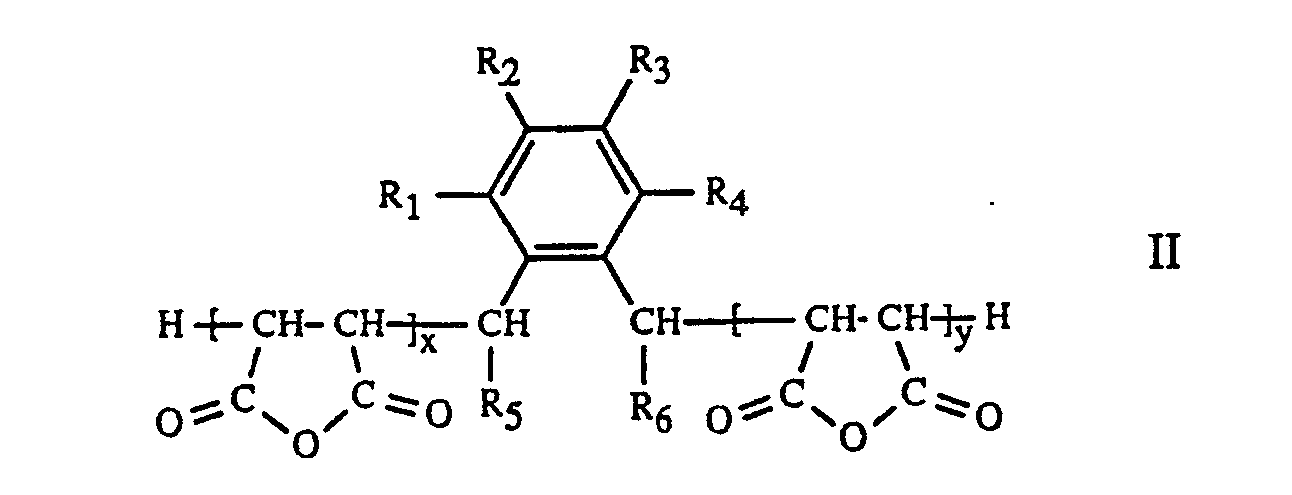
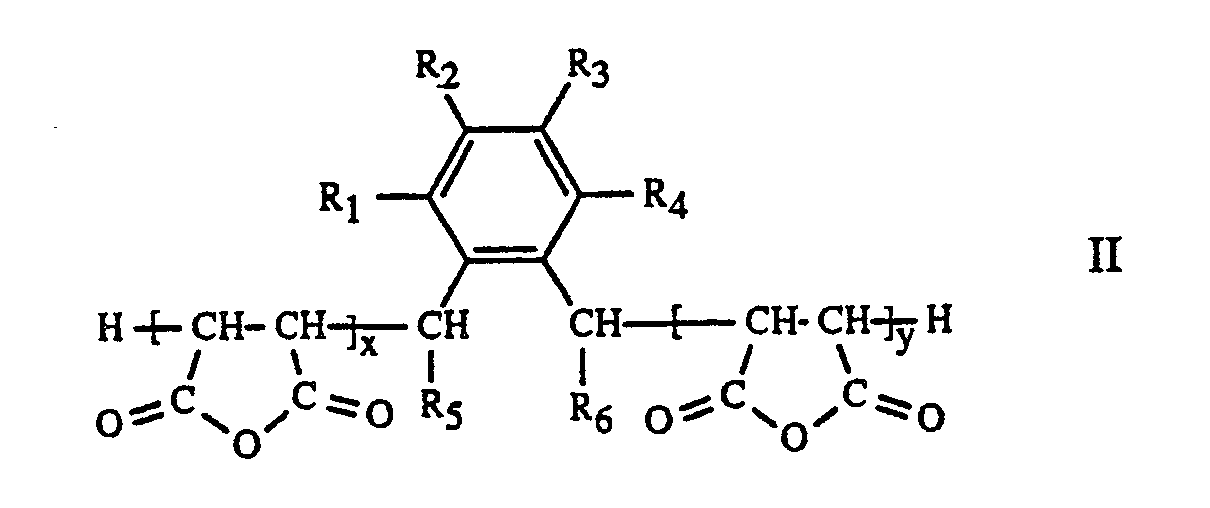
- the anhydrides of formula II are usually obtained as a result of a polymerization process in the form of new mixtures with polycarboxylic anhydrides of formula III: wherein R1, R2, R3, R4, R5 and R6 have the meaning given above, a and b represent 0 or 1 and the sum of a + b represents 1 or 2.
- the polymerization product can also contain minor amounts of unreacted compounds of the formula I.
- the mixture generally contains at least 50% of the anhydride of formula II. If the polymerization product is worked up using methods which remove the more soluble components, the percentage of anhydrides of formula II in the mixture is increased.
- R1, R2, R3 or R4 represents an alkyl group
- this can be methyl, ethyl, n-propyl, isopropyl, n-butyl, isobutyl, sec-butyl, or tert-butyl .
- Preferred compounds of formula I, II and III include those in which R1 to R6 represent a hydrogen atom, those in which R1 to R3, R5 and R6 represent a hydrogen atom and R4 represents a methyl group, those in which R1 represents a methyl group and R2 to R6 Are hydrogen, those in which R1, R4, R5 and R6 are hydrogen and R2 and R3 are methyl, those in which R1, R2, R4, R5 and R6 are hydrogen and R3 are methyl, those in which R1, R3, R4 , R5 and R6 represent a hydrogen atom and R2 represent a methyl group, those in which R1, R2, R4, R5 and R6 represent a hydrogen atom and R3 represent a tert-butyl group, those in which R1 and R3 to R6 represent a hydrogen atom and R2 represents a tert-butyl group mean those in which R1, R3, R5 and R6 represent a hydrogen atom and R2 and R4 represent a methyl group, those in
- x denotes 1 and y 2.
- the compound of formula III which is contained in the polymerization product consists mainly of compounds in which a is 1 and b is 1.
- the groups R1 to R6 in the formulas I, II and III represent a hydrogen atom and in formula II x 1 and y 2. This means in embodiments in which the compound of the formula I, for example the predominant compound im Polymerization solvent, o-xylene.
- the polymerization product separates out during the polymerization reaction. It can be isolated as the anhydride (usually a mixture of anhydrides as described above, as well as the individual compounds can be isolated, if desired, by purification) or it can be hydrolyzed to the corresponding free polycarboxylic acids by conventional methods per se Example using sodium hydroxide (followed by acidification) or water. The hydrolysis can finally be carried out in the reaction mixture or on the separated polymer.
- the products can also be isolated as water-soluble salts, for example as alkali metal salts, as alkaline alkaline earth metal salts or as ammonium salts.
- the purification of the polymerization product to isolate the individual compounds can be carried out by conventional methods, for example by conversion into a salt and multiple recrystallization of the salt and restoration of the free acid, if desired, by acidification of an aqueous solution of the salt, followed by extraction with an organic solvent.
- the products of the present invention are valuable for inhibiting scale formation from water or aqueous systems or for modifying the crystallization behavior and properties of precipitated materials.
- the products according to the invention are expediently added to the water or aqueous system in amounts of 0.1 to 100 ppm, preferably 0.5 to 20 ppm.
- the products according to the invention are used for the inhibition of scale deposits and for the precipitation of salts from aqueous solutions, the products are particularly effective for the inhibition of scale deposits of salts, derived from the calcium, magnesium, barium or strontium cations, and anions such as sulphates, carbonates, hydroxides, phosphates and silicates.
- aqueous systems that can be treated in accordance with the present invention are cooling water systems, steam generator systems, sea water evaporators, reverse osmosis equipment, bottle washers, paper pulp and paper making systems, sugar evaporation systems, soil irrigation systems, hydrostatic cookers , Gas scrubbing systems, exhaust gas desulfurization systems, closed heating systems, water-based cooling systems, oil production and drilling systems, oil refineries, sewage treatment plants, crystallizers, metal recovery systems and photo-development baths.
- the products according to the invention can be used alone or in combination with other materials known in the treatment of aqueous systems.
- further corrosion inhibitors can be used, such as water-soluble zinc salts, phosphates, polyphosphates, phosphonic acids and their salts, eg hydroxyethyldiphosphonic acid (HEDP); Nitrilotrismethylenephosphonic acid and methylaminodimethylenephosphonecarboxylic acid and their salts, for example those described in German Offenlegungsschrift 26 32 774; 2-hydroxyphosphonic acetic acid; 2-phosphonobutane-1,2,4-tricarboxylic acid and those described in GB 1 572 406; Nitrates, eg sodium nitrate; Nitrites, for example sodium nitrite; Molybdates, for example sodium molybdate; Tungstates, silicates, eg sodium silicates; Benzotriazoles; Bis-benzotriazoles or copper-
- HEDP hydroxyethyldiphosphonic acid
- the product according to the present invention can be used together with other dispersing and / or precipitation preventing agents (threshold agents), for example polymerized acrylic acid or its salts, phosphinopolycarboxylic acids (as described and claimed in GB 1 458 235), the cotelomeric ones Compounds described in EP 0 150 706, hydrolyzed polyacrylonitriles, polymerized methacrylic acids and their salts, polyacrylamides and copolymers thereof with acrylic and methacrylic acids, lignin sulfonic acids and their salts, tannin, naphthalenesulfonic acid / formaldehyde condensation products, starch and their derivatives, cellulose, acrylic acid / lower alkyl hydroxyacrylate Copolymers, for example those described in US Pat. No. 4,029,577, styrene / maleic anhydride copolymers and sulfonated styrene homopolymers,
- Specific anti-precipitation agents such as e.g. 2-phosphonobutane-1,2,4-tricarboxylic acid (PBSAM), hydroxyethyldiphosphonic acid (HEDP), alkylphosphonic acids, hydroxyphosphonic acetic acid, 1-aminoalkyl-1,1-diphosphonic acids and their salts and alkali metal polyphosphates can also be used.
- PBSAM 2-phosphonobutane-1,2,4-tricarboxylic acid
- HEDP hydroxyethyldiphosphonic acid
- alkylphosphonic acids hydroxyphosphonic acetic acid
- 1-aminoalkyl-1,1-diphosphonic acids and their salts and alkali metal polyphosphates can also be used.
- Particularly important additive compositions are those comprising the products according to the present invention with one or more polymaleic acids or copolymers thereof, in particular terpolymers with ethyl acrylate and vinyl acetate, polyacrylic acids or their copolymers or substituted copolymers, 2-hydroxyphosphonic acetic acid, HEDP, PBSAM, triazoles, such as tolutriazole , Molybdates and nitrites.
- Precipitating agents such as alkali metal orthophosphates, carbonates, oxygen scavengers, such as alkali metal sulfites and hydrazines, masking agents (sequestering agents), such as nitrilotriacetic acid and its salts, anti-foaming agents, such as silicones, for example polydimethylsiloxanes, distearylsebacinamide and ethylene amide products, and distearyl amide acid and amide / derivatives, Propylene oxide condensations, in addition to fatty alcohols, such as caprylic alcohols and their ethylene oxide condensates and biocides, for example amines, quaternary ammonium compounds, chlorophenols, sulfur-containing compounds such as sulphones, methylene bisthiocyanates and carbamates, isothiazolones, brominated propionic acid amides, triazines and phosphonium compounds releasing agents, bromine and bromine releasing agents,
- the invention is illustrated by the following examples, in which the percentages are based on the weight, unless otherwise stated, and in which the molecular weight values M w and M n are obtained by GPC.
- the mass spectrometer results (Fast atom bombardment mass spectrometry FAB-MS]) according to the examples are obtained for the polymaleic anhydride products after their conversion into the acid form by dissolving in hot water.
- the gas chromatography mass spectrometer results according to the examples are obtained from the trimethylsilyl ester of the polymaleic anhydride.
- Example 1 is repeated, with the exception that 369 g of o-xylene are used.
- the product yield is 42 g (84%).
- Example 1 is repeated, with the exception that 255 g of o-xylene are used.
- the product yield is 47.3 g (94.6%).
- Example 1 is repeated, with the exception that 220 g of o-xylene are used will.
- the product yield is 47 g (94%).
- the polycarboxylic acid product is obtained in a yield of 14 g (77%).
- Example 7 Under the conditions of Example 7, 20 g of maleic anhydride, 80 g of isodurol (1,2,3,5-tetramethylbenzene) and 1.2 g of di-tert-butyl peroxide are used instead of the mixture mentioned there.
- the product yield is 21.2 g (> 100% based on maleic anhydride).
- the associated mother ions M + H+ have the molecular weights 483.1 (formula II) and 367.2 (formula III).
- Example 1 The product of Example 1 is dissolved in water so that a solution of 20% by weight results. Add p-anisidine in aqueous acetone until the pH of the solution is 7. After drying, the residue is recrystallized twice from isopropanol. By dissolving the purified salt in sodium hydroxide solution and washing out the free amine with ether (six times), the free acid is again obtained. Treatment of the aqueous phase with hydrochloric acid to a pH of one and subsequent concentration to dryness results in the purified product, mixed with sodium chloride. The table salt is removed by treatment with acetone and filtration. After the solvent has been stripped off, the purified product is obtained as a yellow dye.
- the GPC analysis of the purified product shows only one peak, while the mixture obtained in Example 1 gives 4 peaks corresponding to the four products identified by mass spectrometry.
- the product obtained after cleaning corresponds to a compound of formula II, wherein R1 to R6 are hydrogen, x is one and y is two.
- the concentration of the cation remaining in the solution is measured, and the I% value (Precipitation Prevention Value) is calculated using the following formula: C end mean: concentration of the cation at the end of the test C beginn : concentration of the cation at the start of the test C o : concentration of the cation at the end of a test without threshold reagent Reagents with I% values above 50% are considered suitable deposit inhibitors.
- the test solution contains 125 mg / l Ca2+, 375 mg / l Mg2+, 182 mg / l CO32 ⁇ and 2 mg / l of the additive. Each test solution also contains 0.02 g calcium carbonate seeds. The test lasts 30 minutes at 85 ° C and the concentration of Ca2+ is then determined.
- the results, which clearly demonstrate the superiority of the product from Example 1, are: Additive % Inhibition Product of Example 1 69 Product of the comparative example 20th Commercially available polyacrylate (molecular weight 2000) 12
- This test uses seawater and a synthetic mixed water close to that found in geological formations to simulate the depth of a well.
- the test solution contains 136.3 mg / l Ba2+, 335.1 mg / l Sr2+, 1.666 g / l Ca2+ and 1.38 SO42 ⁇ and is buffered to pH 5.5.
- the test is carried out with shaking in a water bath at 70 ° C. for 3 hours.
- the concentration of Ba2+ becomes after Test end determined. With 20 mg / l of the product from Example 1, a precipitation prevention value of 94% is achieved.
Landscapes
- Chemical & Material Sciences (AREA)
- Organic Chemistry (AREA)
- Chemical Kinetics & Catalysis (AREA)
- Water Supply & Treatment (AREA)
- Medicinal Chemistry (AREA)
- Hydrology & Water Resources (AREA)
- Engineering & Computer Science (AREA)
- Environmental & Geological Engineering (AREA)
- General Chemical & Material Sciences (AREA)
- Health & Medical Sciences (AREA)
- Life Sciences & Earth Sciences (AREA)
- Polymers & Plastics (AREA)
- Addition Polymer Or Copolymer, Post-Treatments, Or Chemical Modifications (AREA)
- Furan Compounds (AREA)
- Polymerisation Methods In General (AREA)
- Polyethers (AREA)
- Solid-Sorbent Or Filter-Aiding Compositions (AREA)
- Treatment Of Liquids With Adsorbents In General (AREA)
- Polymerization Catalysts (AREA)
Abstract
Description
- Vorliegende Erfindung betrifft die Polymerisation von Maleinsäureanhydrid und die Produkte aus dieser Polymerisation.
- Es ist bekannt, dass Maleinsäureanhydrid zu Polymeren mit variierenden Molekulargewichten verarbeitet werden kann. Verschiedene Polymerisationsverfahren sind in der Literatur beschrieben worden. Die Anwendung dieser Polymere, wie auch anderer Polycarbonsäuren als Kesselstein verhütende Mittel in wässrigen Systemen ist wohlbekannt.
- Verfahren zur Polymerisation die sich des Toluols oder Xylols als Lösungsmittel bedienen sind bekannt, benötigen aber generell grosse Mengen an Initiator, z.B. 15-30 %, und konzentrierte Monomerlösungen in Lösungsmittel, um genügende Ausbeuten an Polymeren zu erzielen. Die GB 1 411 063 beschreibt die Anwendung von Xylol mit einem ortho-Isomerengehalt von weniger als 99 %. Die Molekulargewichtsverteilung der mit diesem Verfahren erhaltenen Produkte ist üblicherweise sehr gross.
- Es wurde nun überraschenderweise gefunden, dass wenn die Polymerisation mit verdünnten Maleinsäureanhydridlösungen in ortho-Xylol oder einem substituierten ortho-Xylol und mit niedrigen Initiatormengen ausgeführt wird, eine hohe Ausbeute des Produktes erhalten wird, wobei das Produkt eine niedrige Molekulargewichtsverteilung hat und eine verbesserte Aktivität als Kesselstein kontrollierendes Mittel gegenüber bekannten Polycarbonsäuren zur Kesselsteinbehandlung zeigt. Die Produkte enthalten neue Polycarbonsäureanhydride, die, falls gewünscht, isoliert werden können und die hydrolisiert werden können, um die entsprechende neue Polycarbonsäure oder deren wasserlöslichen Salze zu erhalten. Die neuen Materialien haben eine überraschend hohe Aktivität als Kesselstein kontrollierendes Mittel.
- Dementsprechend beschreibt vorliegende Erfindung ein Polymaleinsäureanhydrid mit einem mittleren Molekulargewicht gemessen mit Gelpermeations Chromatographie (GPC) zwischen 450 bis 800 und einem Polymolekularitätsindex zwischen 1,0 bis 1,15.
- Der Polymolekularitätsindex ist das Verhältnis Mw/Mn, wobei Mw das Gewichtsmittel der Molekulargewichte und Mn das Zahlenmittel des Molekulargewichtes ist.
- Das Polymaleinsäureanhydrid nach vorliegender Erfindung kann durch Polymerisation von Maleinsäureanhydrid hergestellt werden, unter Anwendung eines Peroxidinitiators in einer Menge von nicht grösser als 10 Gew.-%, bezogen auf das Anhydrid, in einem Lösungsmittel, das überwiegend ein o-Xylol der Formel I

- Die Menge an Peroxid-Initiator kann von 1 bis 10 % Gew.-%, vorzugsweise von 4 bis 8 Gew.-%, bezogen auf das Maleinsäureanhydrid, betragen. Der Initiator kann aus den bekannten Peroxid-Initiatoren ausgewählt werden. Zum Beispiel kann es Dibenzoylperoxid, tert-Butylperbenzoat, Dicumylperoxid, tert.-Butylhydroperoxid oder, vorzugsweise, Di-tert.-butylperoxid.
- Das Gewichtsverhältnis von Maleinsäureanhydrid zu Lösungsmittel kann von 1:3 zu 1:9, vorzugsweise von 1:3 bis 1:6 und insbesondere von 1:4 bis 1:6 sein. Dieses Gewichtsverhältnis kann zu Beginn der Polymerisationsreaktion auch höher sein, beispielsweise bis 1:2, vorausgesetzt Maleinsäureanhydrid wird während der Reaktion zuaddiert, so dass das endgültige Verhältnis nicht grösser als 1:3 ist.
- Die Polymerisation, die stufenweise oder kontinuierlich ausgeführt werden kann, kann bei Temperaturen von 100 bis 200°C, vorzugsweise bei oder nahe der Rückflusstemperatur des Lösungsmittels, welche in der Praxis üblicherweise innerhalb des Bereiches von 120 bis 160°C und zum Beispiel bei 120 bis 146°C liegt. Die Reaktionszeit kann entsprechend der Reaktionstemperatur und dem zur Anwendung gelangenden Initiator variieren. Wird die Polymerisation beispielsweise in Gegenwart von Di-tert.-butylperoxid in o-Xylol bei Rückflusstemperatur ausgeführt, beträgt die Reaktionszeit üblicherweise zwischen 2 bis 5 Stunden.
- Das Lösungsmittel enthält vorzugsweise mindestens 90 Gew.-% einer oder mehrerer Verbindungen der Formel I, besonders bevorzugt mehr als 95 Gew.-% und ganz besonders bevorzugt 97 Gew.-% solcher Verbindungen. Das Lösungsmittel kann kleinere Mengen anderer Xylol-Isomeren und Ethylbenzoyl enthalten.
- Die oben beschriebene Polymerisation führt zu einem Polymaleinsäureanhydrid-Produkt, enthaltend neue Polycarbonsäureanhydride, üblicherweise mit anderen Polycarbonsäureanhydriden. Entsprechend beschreibt vorliegende Erfindung auch Polycarbonsäureanhydride der Formel II:
- Die Anhydride der Formel II werden üblicherweise als Resultat eines Polymerisationsverfahrens in Form von neuen Mischungen mit Polycarbonsäureanhydriden der Formel III erhalten:

- Die Mischung enthält im allgemeinen mindestens 50 % des Anhydrides der Formel II. Wird das Polymerisationsprodukt mit Verfahren, welche die löslicheren Komponenten entfernen aufgearbeitet, wird der Prozentsatz von Anhydriden der Formel II in der Mischung erhöht.
- In den Formeln I, II und III, wenn R₁, R₂, R₃ oder R₄ eine Alkylgruppe bedeutet, kann dies Methyl, Ethyl, n-Propyl, Isopropyl, n-Butyl, Isobutyl, sec.-Butyl, oder tert.-Butyl sein. Bevorzugte Verbindungen der Formel I, II und III umfassen solche, worin R₁ bis R₆ ein Wasserstoffatom bedeuten, solche, worin R₁ bis R₃, R₅ und R₆ ein Wasserstoffatom bedeuten und R₄ eine Methylgruppe bedeutet, solche, worin R₁ eine Methylgruppe und R₂ bis R₆ ein Wasserstoffatom bedeuten, solche, worin R₁, R₄, R₅ und R₆ ein Wasserstoffatom und R₂ und R₃ eine Methylgruppe bedeuten, solche worin R₁, R₂, R₄, R₅ und R₆ ein Wasserstoffatom und R₃ eine Methylgruppe bedeuten, solche, worin R₁, R₃, R₄, R₅ und R₆ ein Wasserstoffatom und R₂ eine Methylgruppe bedeuten, solche, worin R₁, R₂, R₄, R₅ und R₆ ein Wasserstoffatom und R₃ eine tert-Butylgruppe bedeuten, solche, worin R₁ und R₃ bis R₆ ein Wasserstoffatom und R₂ eine tert-Butylgruppe bedeuten, solche, worin R₁, R₃, R₅ und R₆ ein Wasserstoffatom und R₂ und R₄ eine Methylgruppe bedeuten, solche, worin R₁ und R₃ eine Methylgruppe und R₂, R₄, R₅ und R₆ ein Wasserstoffatom bedeuten, und solche, worin R₁, R₄, R₅ und R₆ ein Wasserstoffatom und R₂ und R₃ eine Carboxylgruppe bedeuten.
- In bevorzugten Verbindungen der Formel II bedeutet x 1 und y 2. Die Verbindung der Formel III, die im Polymerisationsprodukt enthalten ist, besteht hauptsächlich aus Verbindungen, worin a 1 und b 1 ist.
- In besonders bevorzugten Ausführungsformen der vorliegenden Erfindung bedeuten die Gruppen R₁ bis R₆ in den Formeln I, II und III ein Wasserstoffatom und in Formel II bedeutet x 1 und y 2. Dies in solchen Ausführungsformen worin die Verbindung der Formel I, beispielsweise die vorwiegende Verbindung im Polymerisations-Lösungsmittel, o-Xylol ist.
- Gewöhnlich scheidet sich das Polymerisationsprodukt während der Polymerisationsreaktion ab. Es kann als das Anhydrid isoliert werden (üblicherweise eine Mischung von Anhydriden, wie vorbeschrieben, ebenso wie die einzelnen Verbindungen isoliert werden können, falls gewünscht, durch Reinigung) oder es kann zu den entsprechenden freien Polycarbonsäuren hydrolysiert werden, durch an sich übliche Methoden, zum Beispiel mittels Natriumhydroxid (gefolgt von einer Ansäuerung) oder Wasser. Die Hydrolyse kann am Schluss im Reaktionsgemisch oder am abgetrennten Polymer ausgeführt werden. Die Produkte können auch als wasserlösliche Salze, beispielsweise als Alkalimetallsalz, als alkalische Erdalkalimetallsalze oder als Ammoniumsalze isoliert werden.
- Die Reinigung des Polymerisationsproduktes, um die einzelnen Verbindungen zu isolieren, kann durch konventionelle Methoden erfolgen, beispielsweise durch Umsetzung in ein Salz und mehrfache Rekristallisation des Salzes und Wiederherstellung der freien Säure, falls gewünscht, durch Ansäuerung einer wässrigen Lösung des Salzes, gefolgt durch Extraktion mit einem organischen Lösungsmittel.
- Verbindungen der Formel II und Mischungen davon mit Verbindungen der Formel III können modiliziert werden, um andere Verbindungen der Formel II und Mischungen davon zu erhalten. Beispielsweise können Produkte, enthaltend eine Methylgruppe am aromatischen Ring durch an sich bekannte Verfahren oxidiert werden, um die Methylgruppe in eine Carboxylgruppe umzuwandeln.
- Die Produkte nach vorliegender Erfindung sind wertvoll zur Inhibierung von Ablagerungen von Kesselstein bildenden Verbindungen aus Wasser oder wässrigen Systemen oder zur Modifizierung des Kristallisierverhaltens und Eigenschaften von ausgefällten Materialien.
- Die erfindungsgemässen Produkte werden zweckmässig zum Wasser oder wässrigen System in Mengen von 0,1 bis 100 ppm, vorzugsweise von 0,5 zu 20 ppm, zugegeben.
- Werden die erfindungsgemässen Produkte für die Inhibierung von Kesselsteinablagerungen und zur Ausfällung von Salzen aus wässrigen Lösungen angewendet, so sind die Produkte besonders wirksam zur Inhibierung von Kesselstein bildenden Ablagerungen von Salzen, abgeleitet von den Calcium-, Magnesium-, Barium- oder Strontium-Kationen, und Anionen wie Sulphaten, Carbonaten, Hydroxiden, Phosphaten und Silikaten.
- Im Bezug auf die wässrigen Systeme, die in Uebereinstimmung mit vorliegender Erfindung behandelt werden können, sind von besonderem Interesse Kühlwassersysteme, Dampferzeugersysteme, Meerwasserverdampfer, Ausrüstungen für die umgekehrte Osmose, Flaschenreinigungsanlagen, Papierbrei- und Papierherstellungsanlagen, Zucker-Verdampfungsanlagen, Bewässerungssysteme für Böden, hydrostatische Kocher, Gaswaschsysteme, Abgasentschwefelungsanlagen, geschlossene Heizsysteme, auf Wasser basierende Kühlsysteme, Oelherstellungs- und Bohrsysteme, Oelraffinerien, Kläranlagen, Kristallisatoren, Metallrückgewinnungssysteme und Photoentwicklungsbäder.
- Die Produkte nach der Erfindung können allein angewendet werden oder in Verbindung mit anderen Materialien, die in der Behandlung von wässrigen Systemen bekannt sind.
- In der Behandlung von Systemen, wie Kühlwassersystemen, Klimaanlagen, Dampferzeuger-Systemen, Meerwasserverdampfungs-Systemen, hydrostatischen Kochern und Heiz- und Kühlsystemen mit geschlossenem Kreislauf, können weitere Korrosionsinhibitoren verwendet werden, wie z.B. wasserlösliche Zinksalze, Phosphate, Polyphosphate, Phosphonsäuren und deren Salze, z.B. Hydroxyethyldiphosphonsäure (HEDP); Nitrilotrismethylenphosphonsäure und Methylaminodimethylenphosphoncarbonsäure und deren Salze, z.B. solche beschrieben in der Deutschen Offenlegungsschrift 26 32 774; 2-Hydroxyphosphonessigsäure; 2-Phosphonobutan-1,2,4-tricarbonsäure und jene, die in GB 1 572 406 beschrieben sind; Nitrate, z.B. Natriumnitrat; Nitrite, z.B. Natriumnitrit; Molybdate, z.B. Natriummbolybdat; Wolframate, Silikate, z.B. Natriumsilikate; Benztriazole; Bis-benztriazole oder Kupfer-desaktivierende Benztriazol- oder Tolutriazol-Derivate oder deren Derivate der Mannich-Basen; Mercaptobenztriazole; N-Acylsarcosine; N-Acyliminodiessigsäuren; Ethanolamine; Amine der Fettsäuren und Polycarbonsäuren, z.B. Polymaleinsäure und Polyacrylsäure, sowie deren entsprechenden Alkalimetallsalze, Copolymere des Maleinsäureanhydrides, z.B. Copolymere des Maleinsäureanhydrides und des sulfonierten Styrols, Copolymere der Acrylsäure, z.B. Copolymere der Acrylsäure und hydroxyalkylierten Acrylsäure, und substituierte Derivate der Polymaleinsäure und Polyacrylsäure und deren Copolymere. Darüberhinaus, in derartigen Systemen, kann das Produkt nach vorliegender Erfindung zusammen mit weiteren Dispergier- und/oder Fällungsverhinderungsmitteln (threshold agents) verwendet werden, z.B. polymerisierte Acrylsäure oder deren Salze, Phosphinopolycarbonsäuren (wie beschrieben und beansprucht in GB 1 458 235), den cotelomerischen Verbindungen beschrieben in EP 0 150 706, hydrolysierten Polyacrylnitrilen, polymerisierten Methacrylsäuren und deren Salzen, Polyacrylamiden und Copolymere davon mit Acryl- und Methacrylsäuren, Ligninsulfonsäuren und deren Salze, Tannin, Naphthalinsulfonsäure/Formaldehyd-Kondensationsprodukten, Stärke und deren Derivate, Cellulose, Acrylsäure/Niederalkylhydroxyacrylat-Copolymere, z.B. solche beschrieben in US 4 029 577, Styrol/Maleinsäureanhydrid-Copolymere und sulfonierte Styrolhomopolymere, z.B. solche beschrieben in der US 4 374 733, und Kombinationen davon.
- Spezifische Fällungsverhinderungsmittel, wie z.B. 2-Phosphonbutan-1,2,4- tricarbonsäure (PBSAM), Hydroxyethyldiphosphonsäure (HEDP), Alkylphosphonsäuren, Hydroxyphosphonessigsäure, 1-Aminoalkyl-1,1-diphosphonsäuren und deren Salze und Alkalimetallpolyphosphate können ebenfalls angewendet werden.
- Besonders wichtige Additiv-Zusammenstellungen sind solche, enthaltend die Produkte gemäss vorliegender Erfindung mit einer oder mehreren Polymaleinsäuren oder Copolymere davon, insbesondere Terpolymere mit Ethylacrylat und Vinylacetat, Polyacrylsäuren oder deren Copolymere oder substituierten Copolymere, 2-Hydroxyphosphonessigsäure, HEDP, PBSAM, Triazole, wie Tolutriazol, Molybdate und Nitrite.
- Fällungsmittel, wie Alkalimetallorthophosphate, Carbonate, Sauerstoffänger (oxygen scavengers), wie Alkalimetallsulfite und Hydrazine, Maskierungsmittel (Sequestrierungsmittel), wie Nitrilotriessigsäure und deren Salze, Antischaummittel, wie Silikone, z.B. Polydimethylsiloxane, Distearylsebacinsäureamid, Distearyladipinsäureamid und verwandte Produkte, deriviert aus Ethylenoxid und/oder Propylenoxid-Kondensationen, in Addition zu Fettalkoholen, wie Caprylalkoholen und deren Ethylenoxid-Kondensate und Biocide, z.B. Amine, quaternäre Ammoniumverbindungen, Chlorophenole, Schwefelhaltige Verbindungen wie Sulphone, Methylenbisthiocyanate und -carbamate, Isothiazolone, bromierte Propionsäureamide, Triazine, Phosphoniumverbindungen, Chlor und Chlor-freisetzende Mittel, Brom und Brom-freisetzende Mittel, Ozon und organometallische Verbindungen, wie Tributylzinnoxide, können angewendet werden.
- Die Erfindung ist durch nachfolgende Beispiele illustriert, in welchen die Prozentzahlen auf das Gewicht bezogen sind, ausser es wären andere Angeben gemacht, und in welchen die Molekulargewichtswerte Mw und Mn durch GPC erhalten werden. Die Massenspektrometer-Resultate (Fast atom bombardment mass spectrometry FAB-MS]) gemäss den Beispielen werden für die Polymaleinsäureanhydrodprodukte nach deren Umwandlung in die Säureform durch Auflösung in heissem Wasser erhalten. Die Gaschromatographie-Massenspektrometerresultate gemäss den Beispielen werden von der Trimethylsilylestern des Polymaleinsäureanhydrides erhalten.
- 50 g Maleinsäureanhydrid und 290 g o-Xylol werden zum Rückfluss erhitzt, und 3 g Di-tert-butylperoxid werden innerhalb 15 Minuten zugetropft. Nach 3.5 Stunden Reaktionszeit lässt man das Polymer sich von der Lösung abscheiden. Nach Kühlung auf Raumtemperatur wird die flüssige Phase abdekantiert. Man erhält 44 g polymeres Produkt (entsprechend einer Ausbeute von 88 % bezogen auf Maleinsäureanhydrid). Es ist keine weitere Reinigung erforderlich. Das erhaltene Polymer besitzt die mittleren Molekulargewichte Mw = 550 und Mn = 520 woraus sich Mw/Mn = 1,058 ergibt. Die Gelpermeationschromatographie weist auf 4 Komponenten hin. Durch FAB-MS werden die beiden Hauptbestandteile als Verbindung der Formel II, worin R₁ bis R₆ Wasserstoff sind, x = 1 und y = 2 ist ([M + H⁺ = 455), sowie als Verbindung der Formel II, worin R₁ bis R₆ Wasserstoff sind, x = 1 und y = 3 ist ([M + H]⁺ = 571), identifiziert.
- Eine Gaschromatographie-Massenspektrometrie der Trimethylsilylester identifiziert die restlichen beiden Komponenten als Verbindungen der Formel III, wobei im einen Fall R₁ bis R₆ Wasserstoff sind, a = 0 und b = 1 ist (M⁺ = 366), und im anderen Fall R₁ bis R₆ Wasserstoff und a und b jeweils 1 sind (M⁺ = 626).
- Beispiel 1 wird wiederholt, mit der Ausnahme, dass 369 g o-Xylol eingesetzt werden. Die Produkteausbeute beträgt 42 g (84 %). Die mittleren Molekulargewichte des Produkts betragen Mw = 500 und Mn = 480. Das ergibt Mw/Mn = 1,04.
- Beispiel 1 wird wiederholt, mit der Ausnahme, dass 255 g o-Xylol eingesetzt werden. Die Produkteausbeute beträgt 47,3 g (94,6 %). Die mittleren Molekulargewichte des Produkts betragen Mw = 490 und Mn = 460. Das ergibt Mw/Mn = 1,07.
- Beispiel 1 wird wiederholt, mit der Ausnahme, dass 220 g o-Xylol eingesetzt werden. Die Produkteausbeute beträgt 47 g (94 %). Die mittleren Molekulargewichte des Produkts sind Mw = 480 und Mn = 440. Das ergibt Mw/Mn = 1,09.
- 149,6 g o-Xylol wird zum Rückfluss erhitzt, und 50,87 g Maleinsäureanhydrid werden innerhalb einer Stunde zugegeben. Im selben Zeitraum werden 3,6 g Di-tert-butylperoxid zugegeben. Nach 3,5 Stunden Kochen unter Rückfluss wird die entstandene Mischung auf 115°C abgekühlt. Nach Entfernung der flüssigen Phase erhält man 47,3 g des Polymerisationsprodukts, entsprechend einer Ausbeute von 93 % bezogen auf Maleinsäureanhydrid. Die mittleren Molekulargewichte des Produkts betragen Mw = 590 und Mn = 560, so dass Mw/Mn = 1,05 ist.
- 500 g o-Xylol werden zum Rückfluss erhitzt. Innerhalb eines Zeitraums von 2,5 Stunden werden 250 g Maleinsäureanhydrid und 30 g Di-tert-butylperoxid in separat Strömen zugegeben. Man lässt eine Stunde refluxieren und lässt die entstandene Mischung auf 115°-120°C abkühlen. Innerhalb der nächsten halben Stunde werden 440 ml Wasser zugetropft, und die Mischung noch weitere 15 Minuten bei 95°C gerührt. Durch Destillation wird das gesamte Xylol entfernt. Durch die Zugabe oder Entfernung von Wasser wird die Masse der Reaktionsmischung auf 880 g eingestellt. Unter Kühlung werden 382 g 46 %ige Natronlauge so zugegeben, dass die Reaktionstemperatur unter 60°C bleibt. Man erhält 1182 g einer 38,4 %igen Lösung des Natriumsalzes des Polymerisationsprodukts in Wasser. Nach Trocknung ergibt die Gelpermeationschromatographie des festen Produktes die Werte Mw = 670, Mn = 640 und folglich Mw/Mn = 1,05.
- 18,27 g Maleinsäureanhydrid und 50 g Durol (1 ,2,4,5-Tetramethylbenzol) werden auf 140°C erhitzt, und 1,1 g Di-tert-butylperoxid werden innerhalb von 5 Minuten zugegeben. Man belässt für weitere 3,5 Stunden bei 140°C, kühlt auf 100°C ab und dekantiert die flüssige Phase ab. Das verbleibende, feste Produkt wird in verdünnter Natronlauge gelöst, und die Lösung wird mit Toluol gewaschen, mit Salzsäure angesäuert und zur Trockene eingeengt. Das Polymerisationsprodukt (als Säure) wird vom entstandenen Kochsalz durch Behandlung mit Aceton und anschliessende Filtration abgetrennt. Nach Abziehen des Lösungsmittels erhält man das Polycarbonsäureprodukt in einer Ausbeute von 14 g (77 %). Die mittleren Molekulargewichte des Produktes betragen Mw= 660 und Mn = 620. Das ergibt Mw/Mn= 1,06.
- Die FAB-MS-Analyse zeigt peaks für eine Verbindung der Formel II, worin R₁, R₄, R₅ und R₆ Wasserstoff, R₂ und R₃ Methyl, x = 1 und y = 2 sind (M + H⁺ = 483,1), sowie für eine Verbindung der Formel III, worin R₁, R₄, R₅ und R₆ Wasserstoff sind, R₂ und R₃ Methyl, a= 1 und b = 1 sind (M + H⁺ = 367,1).
- 15,27 g Maleinsäureanhydrid und 100 g 1,2,3-Trimethylbenzol werden auf 140°C erhitzt. Innerhalb von 5 Minuten werden 0,92 g Di-tert-butylperoxid zugetropft. Die Reaktionsmischung wird drei Stunden lang bei 140°C belassen, auf 100°C abgekühlt und die flüssige Phase abdekantiert. Das Polymerisationsprodukt wird im Vakuum fünf Stunden lang bei 50°C getrocknet. Man erhält 8,98 g (59 % bezogen auf Maleinsäureanhydrid). Die mittleren Molekulargewichte Mw und Mn betragen 646 und 613. Das ergibt Mw/Mn = 1,05.
- Die FAB-MS zeigt peaks für Verbindungen der Formel II, worin R₁ Methyl ist, R₂ bis R₆ Wasserstoff, x = 1 und y = 3 sind (M + H⁺ = 585,1) und für die Verbindungen der Formel III, worin R₁ bis R₃ Wasserstoff, R₄ Methyl und R₅ und R₆ Wasserstoff a = 1 und b = 1 sind (M + H⁺ = 353,1).
- Unter den Bedingungen von Beispiel 8 wird statt 1,2,3-Trimethylbenzol 1,2,4-Trimethylbenzol eingesetzt. Die Produktionsausbeute beträgt 12,51 g (82 % bezogen auf Maleinsäureanhydrid). Die GPC Analyse ergibt die mittleren Molekulargewichte von Mw = 638, Mn = 616 und damit Mw/Mn = 1,036.
- FAB-MS zeigt peaks für Verbindungen der Formel II, worin R₁ und R₃ bis R₆ Wasserstoff sind und R₂ Methyl ist, bzw. sind R₁, R₂ und R₄ bis R₆ Wasserstoff und R₃ ist Methyl, in beiden Fällen ist x = 1 und y = 2 (M + H⁺ = 469,0).
- Unter den Bedingungen von Beispiel 7 werden statt der dort genannten Mischung 20 g Maleinsäureanhydrid, 80 g Isodurol (1,2,3,5-Tetramethylbenzol) und 1,2 g Di-tert-butylperoxid eingesetzt. Die Produkteausbeute beträgt 21,2 g (>100 % bezogen auf Maleinsäureanhydrid). Die mittleren Molekulargewichte des Produkts sind Mw = 689 und Mn = 657 und damit Mw/Mn = 1,048.
- Die FAB-MS ergibt peaks für eine Verbindung der Formel II, worin R₁ und R₃ Methyl, R₂ und R₄ bis R₆ Wasserstoff, x = 1 und y = 2 sind, sowie für eine Verbindung der Formel III, worin R₁, R₃, R₅ und R₆ Wasserstoff und a und b gleich eins sind. Die zugehörigen Mutterionen M + H⁺ haben die Molekulargewichte 483,1 (Formel II) und 367,2 (Formel III).
- Das Produkt des Beispiels 1 wird so in Wasser gelöst, dass sich eine Lösung von 20 Gew.% ergibt. Man fügt p-Anisidin in wässrigem Aceton hinzu, bis der pH der Lösung 7 beträgt. Nach Trocknung wird der Rückstand zweimal aus Isopropanol umkristallisiert. Durch Auflösen des gereinigten Salzes in Natronlauge und Auswaschen des freien Amins mit Ether (sechsmal) kommt man wieder zur freien Säure. Behandlung der wässrigen Phase mit Salzsäure bis zu einem pH von eins und anschliessendes Einengen zur Trockene ergibt das gereinigte Produkt, vermischt mit Kochsalz. Durch Behandlung mit Aceton und Filtrieren wird das Kochsalz entfernt. Nach Abziehen des Lösungsmittels erhält man das gereinigte Produkt als gelben Farbstoff. Die GPC-Analyse des gereinigten Produkts zeigt nur einen peak, während die Mischung, die man bei Beispiel 1 erhält, entsprechend den vier massenspektrometrisch identifizierten Produkten 4 peaks ergibt. Das nach der Reinigung erhaltene Produkt entspricht einer Verbindung der Formel II, worin R₁ bis R₆ Wasserstoff, x gleich eins und y gleich zwei sind.
- Unter den Bedingen von Beispiel 7 werden statt der dort genannten Mischung 3,7 g Maleinsäureanhydrid, 22 g 4-t-Butyl-o-xylol und 0,24 g Di-tert-butylperoxid eingesetzt. Die Produktionsausbeute beträgt 3,3 g (89 % bezogen auf Maleinsäureanhydrid). Die mittleren Molekulargewichte des Produkts sind Mw = 660, Mn = 620 und damit Mw/Mn = 1,07.
- 50 g Maleinsäureanhydrid werden in einem Gemisch von 99 % o-Xylol und 1 % m-Xylol gelöst und auf 130°C erhitzt. 14,89 g Di-tert-butylperoxid in 27,0 g desselben Lösungsmittelgemisches werden innerhalb von 15 Minuten zugetropft, und die Reaktions-Mischung wird 5 Stunden bei 130°C gehalten. Nach Kühlung auf 70°C und Entfernung der oberen Phase erhält man 60 g Produkt, was einer Ausbeute von 120 % entspräche. Die mittleren Molekulargewichte des Produkts sind Mw = 890 und Mn = 640. Damit ist Mw/Mn = 1,39.
- Die Fähigkeit der Produkte, Ablagerungen von Erdalkalimetallsalzen zu verhindern, wird folgendermassen gemessen:
Lösungen, welche die entsprechenden Kationen bzw. Anionen enthalten, werden zu einer Lösung vereinigt, aus der unter den im Folgenden genannten Testbedingungen ein Niederschlag ausfällt. Der das Erdalkalikation enthaltenden Lösung werden vor der Vermischung 2 ppm des jeweiligen Produkts zugefügt. Nach einer bestimmten Zeit wird die Konzentration des in der Lösung verbliebenen Kations gemessen, und der I %-Wert (Fällungsverhinderungswert) wird nach der folgenden Formel berechnet:
Canf : Konzentration des Kations bei Testbeginn
Co : Konzentration des Kations beim Ende eines Tests ohne Schwellenreagens
Reagentien mit I %-Werten über 50 % werden als geeignete Ablagerungsverhinderer angesehen. - Bedingungen: Ca²⁺: 150 mg/l, Mg²⁺: 45 mg/l, CO₃²⁻: 51 mg/l HCO₃⁻: 269 mg/l, 70°C, 30 Minuten, Additivdosis 2 mg/l.
- Die Ergebnisse sind in der folgenden Tabelle zusammengefasst:
Additiv % Inhibierung Produkt aus Beispiel 1 93 Produkt aus Beispiel 6 83 Produkt aus Beispiel 7 82 Produkt aus Beispiel 8 89 Produkt aus Beispiel 9 88 Produkt aus Beispiel 10 93 Produkt aus Beispiel 11 95 Produkt aus Beispiel 12 93 Produkt aus Vergleichsbeispiel 66 Im Handel erhältliches Polyacrylat (Molekulargewicht 2000) 67 - Diese Ergebnisse zeigen die signifikante Ueberlegenheit der Produkte aus den Beispielen der vorliegenden Erfindung im Vergleich zum kommerziell erhältlichen Polyacrylat und zum Produkt des Vergleichsbeispiels, wenn die Eignung als Schwellenreagentien gemessen wird.
- Mit diesem Test wird die Eignung von Additiven zur Verhinderung der Fällung von Calciumcarbonat unter Wachstumsbedingungen bei vorhandenen Keimen untersucht.
- Die Testlösung enthält 125 mg/l Ca²⁺, 375 mg/l Mg²⁺, 182 mg/l CO₃²⁻ und 2 mg/l des Additivs. Jede Testlösung enthält ferner 0,02 g Calciumcarbonatkeime. Der Test dauert 30 Minuten bei 85°C, und die Konzentration der Ca²⁺ wird sodann bestimmt. Die Ergebnisse, aus denen die Ueberlegenheit des Produkts aus Beispiel 1 klar hervorgeht, sind:
Additiv % Inhibierung Produkt von Beispiel 1 69 Produkt des Vergleichsbeispiels 20 Im Handel erhältliches Polyacrylat (Molekulargewicht 2000) 12 - In diesem Test untersucht man die Kesselsteinverhinderung bei sulfathartem Wasser. Die Testlösung enthält 2,94 g/l Ca²⁺, 7,2 g/l SO₄²⁻, 7,5 g/l NaCl bei einem pH von 8,0-8,5. Der Test wird über 24 Stunden geführt und zwar bei 70°C mit 5 mg/l des Additivs. Die erhaltenen Ergebnisse sind:
Additiv % Inhibierung 5 mg/l Produkt aus Beispiel 1 92 Im Handel erhältliches Polyacrylat, MG = 2000 31 Im Handel erhältliches Polymaleinsäureanhydrid MG = 2000 12 - Aus diesen Ergebnissen geht die wesentlich höhere Aktivität des Produktes aus Beispiel 1 klar hervor.
- Bei diesem Test werden Seewasser und ein synthetisch gemischtes Wasser, das dem in geologischen Formationen nahe kommt, verwendet, um die Bedingungen in der Tiefe eines Bohrlochs zu simulieren. Die Testlösung enthält 136,3 mg/l Ba²⁺, 335,1 mg/l Sr²⁺, 1,666 g/l Ca²⁺ and 1,38 SO₄²⁻ und wird bis pH 5,5 gepuffert. Man testet 3 Stunden lang unter Schütteln im Wasserbad bei 70°C. Die Konzentration des Ba²⁺ wird nach Testende bestimmt. Mit 20 mg/l des Produktes aus Beispiel 1 erzielt man so einen Fällungsverhinderungswert von 94 %.
- Bedingungen: 600 ppm Ca²⁺, 300 ppm Mg²⁺, 600 ppm HCO₃⁻, 40°C, 24 Stunden unter Rühren bei 150 U/min.
- Man erhält die folgenden Ergebnisse:
Additiv % Inhibierung 15 ppm Produkt aus Beispiel 6 80 15 ppm Produkt aus Beispiel 6 + 2,5 ppm Copolymer aus 6 mol Maleinsäureanhydrid 1 mol Ethylacetat 1 mol Vinylacetat 85.2
Claims (23)



Applications Claiming Priority (4)
| Application Number | Priority Date | Filing Date | Title |
|---|---|---|---|
| GB898903330A GB8903330D0 (en) | 1989-02-14 | 1989-02-14 | Polymerisation of maleic anhydride |
| GB8903330 | 1989-02-14 | ||
| GB8926586 | 1989-11-24 | ||
| GB898926586A GB8926586D0 (en) | 1989-11-24 | 1989-11-24 | Polymerisation of maleic anhydride |
Publications (4)
| Publication Number | Publication Date |
|---|---|
| EP0383724A2 true EP0383724A2 (de) | 1990-08-22 |
| EP0383724A3 EP0383724A3 (en) | 1990-12-19 |
| EP0383724B1 EP0383724B1 (de) | 1994-06-01 |
| EP0383724B2 EP0383724B2 (de) | 1999-03-17 |
Family
ID=26294954
Family Applications (1)
| Application Number | Title | Priority Date | Filing Date |
|---|---|---|---|
| EP90810081A Expired - Lifetime EP0383724B2 (de) | 1989-02-14 | 1990-02-06 | Polymerisation von Maleinsäureanhydrid |
Country Status (11)
| Country | Link |
|---|---|
| US (1) | US5077364A (de) |
| EP (1) | EP0383724B2 (de) |
| JP (1) | JP2964154B2 (de) |
| AU (1) | AU629898B2 (de) |
| BR (1) | BR9000641A (de) |
| CA (1) | CA2009850C (de) |
| DE (1) | DE59005850D1 (de) |
| ES (1) | ES2055395T3 (de) |
| IL (1) | IL93348A0 (de) |
| RU (1) | RU1836389C (de) |
| SA (1) | SA90100222B1 (de) |
Families Citing this family (5)
| Publication number | Priority date | Publication date | Assignee | Title |
|---|---|---|---|---|
| US7110959B2 (en) * | 1996-11-12 | 2006-09-19 | Hahn-Carlson Dean W | Processing and management of transaction timing characteristics |
| US6001940A (en) * | 1997-03-18 | 1999-12-14 | Rohm And Haas Company | Process for preparing anhydride polymers |
| JP5686581B2 (ja) * | 2010-11-18 | 2015-03-18 | 伯東株式会社 | 水処理剤及び水処理方法 |
| RU2486139C2 (ru) * | 2011-06-22 | 2013-06-27 | Государственное образовательное учреждение высшего профессионального образования Уральский государственный лесотехнический университет | Способ предотвращения солеотложений и коррозии в системах водоснабжения |
| CN106809963B (zh) * | 2017-03-06 | 2020-09-22 | 王仲贤 | 无磷无钠锅炉水处理药剂 |
Family Cites Families (8)
| Publication number | Priority date | Publication date | Assignee | Title |
|---|---|---|---|---|
| US3320216A (en) * | 1959-04-03 | 1967-05-16 | Peninsular Chem Res Inc | Saturated linear copolymers |
| DE1227889B (de) * | 1963-05-09 | 1966-11-03 | Hoechst Ag | Verfahren zur Herstellung von Telomeren des Maleinsaeureanhydrids |
| GB1193146A (en) * | 1966-08-22 | 1970-05-28 | Kao Corp | Method of producing Polymaleic Anhydride |
| GB1369429A (en) * | 1970-11-30 | 1974-10-09 | Ciba Geigy Ag | Treatment of water or aqueous systems |
| GB1411063A (en) * | 1973-02-14 | 1975-10-22 | Ciba Geigy Uk Ltd | Polymerisation process |
| US4374733A (en) * | 1981-04-01 | 1983-02-22 | Betz Laboratories, Inc. | Method for treating aqueous mediums |
| DE3631815A1 (de) * | 1986-09-19 | 1988-03-31 | Basf Ag | Verfahren zur herstellung von polymaleinsaeure |
| DE3634956A1 (de) * | 1986-10-14 | 1988-04-21 | Huels Chemische Werke Ag | Verfahren zur herstellung von polymaleinsaeureanhydridpulver |
-
1990
- 1990-01-31 AU AU48935/90A patent/AU629898B2/en not_active Ceased
- 1990-02-06 EP EP90810081A patent/EP0383724B2/de not_active Expired - Lifetime
- 1990-02-06 ES ES90810081T patent/ES2055395T3/es not_active Expired - Lifetime
- 1990-02-06 DE DE59005850T patent/DE59005850D1/de not_active Expired - Fee Related
- 1990-02-07 US US07/476,208 patent/US5077364A/en not_active Expired - Lifetime
- 1990-02-12 CA CA002009850A patent/CA2009850C/en not_active Expired - Fee Related
- 1990-02-12 IL IL93348A patent/IL93348A0/xx not_active IP Right Cessation
- 1990-02-13 BR BR909000641A patent/BR9000641A/pt unknown
- 1990-02-13 RU SU904743077A patent/RU1836389C/ru active
- 1990-02-14 JP JP2033588A patent/JP2964154B2/ja not_active Expired - Lifetime
- 1990-05-14 SA SA90100222A patent/SA90100222B1/ar unknown
Also Published As
| Publication number | Publication date |
|---|---|
| IL93348A0 (en) | 1990-11-29 |
| CA2009850C (en) | 2000-04-04 |
| EP0383724A3 (en) | 1990-12-19 |
| CA2009850A1 (en) | 1990-08-14 |
| US5077364A (en) | 1991-12-31 |
| AU629898B2 (en) | 1992-10-15 |
| AU4893590A (en) | 1990-08-23 |
| DE59005850D1 (de) | 1994-07-07 |
| EP0383724B1 (de) | 1994-06-01 |
| RU1836389C (ru) | 1993-08-23 |
| ES2055395T3 (es) | 1994-08-16 |
| EP0383724B2 (de) | 1999-03-17 |
| BR9000641A (pt) | 1991-01-15 |
| JPH02247206A (ja) | 1990-10-03 |
| SA90100222B1 (ar) | 2004-02-15 |
| JP2964154B2 (ja) | 1999-10-18 |
Similar Documents
| Publication | Publication Date | Title |
|---|---|---|
| DE2405192C2 (de) | Verfahren zur Behandlung von Wasser | |
| DE69219009T2 (de) | Telomere | |
| EP0276464B1 (de) | Verfahren zur Herstellung von wasserlöslichen Copolymerisaten der Maleinsäure und deren Verwendung als Wasserbehandlungsmittel | |
| DE2159172C3 (de) | Verfahren zur Verminderung der Kesselsteinabscheidung durch synthetische Polymere | |
| DE2812584C2 (de) | Mischpolymere und ihre Verwendung | |
| DE69104947T2 (de) | Verhütung von Kesselstein. | |
| EP0009080B1 (de) | Korrosionsinhibitoren; Gemische zum Schützen von eisenhaltigen Metallen und die geschützten Metalle | |
| DE68924632T2 (de) | Telomerische Verbindung. | |
| EP0261589B1 (de) | Verfahren zur Herstellung von Polymaleinsäure | |
| US4532048A (en) | Method for inhibiting scale deposition | |
| EP0383724B2 (de) | Polymerisation von Maleinsäureanhydrid | |
| DE2921374C2 (de) | ||
| EP0122229A1 (de) | Zusammensetzung zur Wasserbehandlung | |
| EP0264627A2 (de) | Geringfügig vernetzte, wasserlösliche Polymaleinsäure, Verfahren zu deren Herstellung und Verwendung | |
| DE2412926A1 (de) | Wasserbehandlung | |
| DE2518880A1 (de) | Verfahren und mittel zur verhinderung von alkalischem kesselstein | |
| DE2632773A1 (de) | Neuartige bei der behandlung waessriger systeme verwendbare stoffzusammensetzungen | |
| DD292659A5 (de) | Polymerisation von maleinsaeureanhydrid | |
| EP0934948A1 (de) | Phosphorhaltige Verbindungen auf Basis der 1-Hydroxypropan-1,3-diphosphonsäure | |
| US5156744A (en) | Process for inhibiting scale using maleic anhydride polymerized in reactive aromatic hydrocarbons | |
| DE2525859A1 (de) | Verfahren zur behandlung von waessrigen systemen | |
| DE2612504C2 (de) | Verfahren zur Herstellung von basischen, phosphathaltigen Aluminiumchloridlösungen und Verwendung dieser Lösungen | |
| EP2118156B1 (de) | Verfahren und polymer zur vermeidung von ba/sr-kesselstein mit eingebauter nachweisbarer phosphorfunktionalität | |
| DE2836306A1 (de) | Aminoalkylenphosphonsaeuren und ihre salze und ihre verwendung in waessrigen systemen | |
| WO2008077829A1 (de) | Verfahren und polymer zur vermeidung von ba/sr-kesselstein mit nachweisbarer phosphorfunktionalität |
Legal Events
| Date | Code | Title | Description |
|---|---|---|---|
| PUAI | Public reference made under article 153(3) epc to a published international application that has entered the european phase |
Free format text: ORIGINAL CODE: 0009012 |
|
| 17P | Request for examination filed |
Effective date: 19900209 |
|
| AK | Designated contracting states |
Kind code of ref document: A2 Designated state(s): BE CH DE ES FR GB GR IT LI NL |
|
| PUAL | Search report despatched |
Free format text: ORIGINAL CODE: 0009013 |
|
| AK | Designated contracting states |
Kind code of ref document: A3 Designated state(s): BE CH DE ES FR GB GR IT LI NL |
|
| 17Q | First examination report despatched |
Effective date: 19920901 |
|
| RAP1 | Party data changed (applicant data changed or rights of an application transferred) |
Owner name: FMC CORPORATION (UK) LIMITED |
|
| GRAA | (expected) grant |
Free format text: ORIGINAL CODE: 0009210 |
|
| AK | Designated contracting states |
Kind code of ref document: B1 Designated state(s): BE CH DE ES FR GB GR IT LI NL |
|
| REF | Corresponds to: |
Ref document number: 59005850 Country of ref document: DE Date of ref document: 19940707 |
|
| REG | Reference to a national code |
Ref country code: ES Ref legal event code: FG2A Ref document number: 2055395 Country of ref document: ES Kind code of ref document: T3 |
|
| ITF | It: translation for a ep patent filed | ||
| ET | Fr: translation filed | ||
| GBT | Gb: translation of ep patent filed (gb section 77(6)(a)/1977) |
Effective date: 19940906 |
|
| REG | Reference to a national code |
Ref country code: GR Ref legal event code: FG4A Free format text: 3013090 |
|
| PLBI | Opposition filed |
Free format text: ORIGINAL CODE: 0009260 |
|
| 26 | Opposition filed |
Opponent name: BASF AKTIENGESELLSCHAFT, LUDWIGSHAFEN Effective date: 19950301 |
|
| NLR1 | Nl: opposition has been filed with the epo |
Opponent name: BASF AG |
|
| PLBF | Reply of patent proprietor to notice(s) of opposition |
Free format text: ORIGINAL CODE: EPIDOS OBSO |
|
| PGFP | Annual fee paid to national office [announced via postgrant information from national office to epo] |
Ref country code: GR Payment date: 19980126 Year of fee payment: 9 |
|
| PLAW | Interlocutory decision in opposition |
Free format text: ORIGINAL CODE: EPIDOS IDOP |
|
| PLAW | Interlocutory decision in opposition |
Free format text: ORIGINAL CODE: EPIDOS IDOP |
|
| PUAH | Patent maintained in amended form |
Free format text: ORIGINAL CODE: 0009272 |
|
| STAA | Information on the status of an ep patent application or granted ep patent |
Free format text: STATUS: PATENT MAINTAINED AS AMENDED |
|
| PG25 | Lapsed in a contracting state [announced via postgrant information from national office to epo] |
Ref country code: GR Free format text: LAPSE BECAUSE OF NON-PAYMENT OF DUE FEES Effective date: 19990228 |
|
| 27A | Patent maintained in amended form |
Effective date: 19990317 |
|
| AK | Designated contracting states |
Kind code of ref document: B2 Designated state(s): BE CH DE ES FR GB GR IT LI NL |
|
| REG | Reference to a national code |
Ref country code: CH Ref legal event code: AEN Free format text: AUFRECHTERHALTUNG DES PATENTES IN GEAENDERTER FORM |
|
| NLR2 | Nl: decision of opposition | ||
| ET3 | Fr: translation filed ** decision concerning opposition | ||
| NLR3 | Nl: receipt of modified translations in the netherlands language after an opposition procedure | ||
| GBTA | Gb: translation of amended ep patent filed (gb section 77(6)(b)/1977) | ||
| PGFP | Annual fee paid to national office [announced via postgrant information from national office to epo] |
Ref country code: CH Payment date: 20000214 Year of fee payment: 11 |
|
| PGFP | Annual fee paid to national office [announced via postgrant information from national office to epo] |
Ref country code: ES Payment date: 20000222 Year of fee payment: 11 |
|
| PGFP | Annual fee paid to national office [announced via postgrant information from national office to epo] |
Ref country code: NL Payment date: 20000228 Year of fee payment: 11 |
|
| PGFP | Annual fee paid to national office [announced via postgrant information from national office to epo] |
Ref country code: BE Payment date: 20000412 Year of fee payment: 11 |
|
| PG25 | Lapsed in a contracting state [announced via postgrant information from national office to epo] |
Ref country code: ES Free format text: LAPSE BECAUSE OF NON-PAYMENT OF DUE FEES Effective date: 20010207 |
|
| PG25 | Lapsed in a contracting state [announced via postgrant information from national office to epo] |
Ref country code: BE Free format text: LAPSE BECAUSE OF NON-PAYMENT OF DUE FEES Effective date: 20010228 Ref country code: LI Free format text: LAPSE BECAUSE OF NON-PAYMENT OF DUE FEES Effective date: 20010228 Ref country code: CH Free format text: LAPSE BECAUSE OF NON-PAYMENT OF DUE FEES Effective date: 20010228 |
|
| REG | Reference to a national code |
Ref country code: GB Ref legal event code: 732E |
|
| REG | Reference to a national code |
Ref country code: FR Ref legal event code: TP |
|
| BERE | Be: lapsed |
Owner name: FMC CORP. (UK) LTD Effective date: 20010228 |
|
| PG25 | Lapsed in a contracting state [announced via postgrant information from national office to epo] |
Ref country code: NL Free format text: LAPSE BECAUSE OF NON-PAYMENT OF DUE FEES Effective date: 20010901 |
|
| REG | Reference to a national code |
Ref country code: CH Ref legal event code: PL |
|
| NLV4 | Nl: lapsed or anulled due to non-payment of the annual fee |
Effective date: 20010901 |
|
| REG | Reference to a national code |
Ref country code: GB Ref legal event code: IF02 |
|
| REG | Reference to a national code |
Ref country code: ES Ref legal event code: FD2A Effective date: 20020916 |
|
| PGFP | Annual fee paid to national office [announced via postgrant information from national office to epo] |
Ref country code: IT Payment date: 20080218 Year of fee payment: 19 Ref country code: DE Payment date: 20080227 Year of fee payment: 19 Ref country code: GB Payment date: 20080121 Year of fee payment: 19 |
|
| PGFP | Annual fee paid to national office [announced via postgrant information from national office to epo] |
Ref country code: FR Payment date: 20080211 Year of fee payment: 19 |
|
| REG | Reference to a national code |
Ref country code: GB Ref legal event code: 732E |
|
| REG | Reference to a national code |
Ref country code: FR Ref legal event code: TP |
|
| GBPC | Gb: european patent ceased through non-payment of renewal fee |
Effective date: 20090206 |
|
| REG | Reference to a national code |
Ref country code: FR Ref legal event code: ST Effective date: 20091030 |
|
| PG25 | Lapsed in a contracting state [announced via postgrant information from national office to epo] |
Ref country code: DE Free format text: LAPSE BECAUSE OF NON-PAYMENT OF DUE FEES Effective date: 20090901 |
|
| PG25 | Lapsed in a contracting state [announced via postgrant information from national office to epo] |
Ref country code: GB Free format text: LAPSE BECAUSE OF NON-PAYMENT OF DUE FEES Effective date: 20090206 Ref country code: FR Free format text: LAPSE BECAUSE OF NON-PAYMENT OF DUE FEES Effective date: 20090302 |
|
| PG25 | Lapsed in a contracting state [announced via postgrant information from national office to epo] |
Ref country code: IT Free format text: LAPSE BECAUSE OF NON-PAYMENT OF DUE FEES Effective date: 20090206 |