EP0384144A1 - Composition pharmaceutique contre les maladies provoquées par la vasoconstriction - Google Patents
Composition pharmaceutique contre les maladies provoquées par la vasoconstriction Download PDFInfo
- Publication number
- EP0384144A1 EP0384144A1 EP90101405A EP90101405A EP0384144A1 EP 0384144 A1 EP0384144 A1 EP 0384144A1 EP 90101405 A EP90101405 A EP 90101405A EP 90101405 A EP90101405 A EP 90101405A EP 0384144 A1 EP0384144 A1 EP 0384144A1
- Authority
- EP
- European Patent Office
- Prior art keywords
- endothelin
- antibody
- vasoconstriction
- protein
- pharmaceutical composition
- Prior art date
- Legal status (The legal status is an assumption and is not a legal conclusion. Google has not performed a legal analysis and makes no representation as to the accuracy of the status listed.)
- Granted
Links
Images

Classifications
-
- C—CHEMISTRY; METALLURGY
- C07—ORGANIC CHEMISTRY
- C07K—PEPTIDES
- C07K16/00—Immunoglobulins [IG], e.g. monoclonal or polyclonal antibodies
- C07K16/18—Immunoglobulins [IG], e.g. monoclonal or polyclonal antibodies against material from animals or humans
- C07K16/26—Immunoglobulins [IG], e.g. monoclonal or polyclonal antibodies against material from animals or humans against hormones ; against hormone releasing or inhibiting factors
-
- A—HUMAN NECESSITIES
- A61—MEDICAL OR VETERINARY SCIENCE; HYGIENE
- A61K—PREPARATIONS FOR MEDICAL, DENTAL OR TOILETRY PURPOSES
- A61K38/00—Medicinal preparations containing peptides
Definitions
- This invention relates to a novel pharmaceutical composition, and, more particularly, to a pharmaceutical composition comprising an anti-endothelin antibody as an effective component and useful for curing diseases caused by vasoconstriction.
- Hypertension coronary artery contracture, basiler artery contracture, asthma, and the like are diseases caused by vasoconstriction. Noradrenalin, adrenaline, serotonin, thrombin, thromboxane As, prostaglandin F 2 ⁇ , neuropeptide, oxyhemoglobin, and the like are known as substances which cause such diseases.
- vasoconstriction two types of vasoconstriction, i.e., vascular endothelium-dependent vasoconstriction and vascular endothelium-independent vasoconstriction, have been studied separately.
- Existence of vasoconstrictors other than the above-mentioned substances has been suggested for vascular endothelium-dependent vasoconstriction caused by anoxia [Vanhoutte et al., Circ. Res. 51 , 439-447 (1982)].
- the existence of a peptide-like vasoconstrictive compound was confirmed in a supernatant of bovine aorta endothelial culture cells [Highsmith et al., Am. J.
- the present inventors have undertaken extensive studies for the development of such a medicine and found that antibodies of endothelins were effective for curing diseases caused by vasoconstriction. This finding has led to the completion of the present invention.
- an object of the present invention is to provide a pharmaceutical composition comprising an anti-endothelin antibody as an effective component and useful for curing diseases caused by vasoconstriction.
- Anti-endothelin antibodies used as an effective component of the pharmaceutical composition of the present invention may be either monoclonal or polyclonal antibodies.
- Monoclonal antibodies include mouse monoclonal antibodies, human monoclonal antibodies, and monoclonal antibodies prepared by genetic engineering techniques.
- Polyclonal antibodies used in the present invention can be prepared by a conventional immunological process.
- a preferable example of such a process comprises combining an endothelin antigen with another protein, administering the combined protein to an animal, collecting serum from the immuned animal, and isolating an antibody having a specificity against endothelins.
- Endothelins which are the antigens used in the process can be prepared, for example, by culturing porcine endotherial cells under serum-free conditions followed by separation and purification of the target antigen from the supernatant [Yanagisawa et al., Nature, 332 , 411-415 (1988)].
- a peptide synthesis method can also be used for the preparation of such antigens [Yanagisawa et al., Proc. Natl. Acad. Sci., USA, 85 , 6964 (1988)].
- Thyroglobulin bovine serum albumin, mioglobin, or the like can be used as a protein to combine with an endothelin.
- An endothelin-protein conjugate can be prepared by condensing both by the formation of a peptide bond, or by combining an amino group of the endothelin and that of the protein through an alkylenedicarbonyl group, alkanediylidene group, phenylenedithiocarbamoyl group, or the like.
- a conventional peptide synthesis method can be used for the condensation of an endothelin and a protein by the formation of a peptide bond, e.g. by reacting the endothelin and protein in a solvent, preferably in a buffer solution, in the presence of a condensing agent.
- a condensing agent 1-(3-dimethylaminopropyl)-3-ethylcarbodiimide, dicyclohexylcarbodiimide, or the like can be used.
- a preferable group which bridges an amino group of an endothelin and that of a protein is an alkylenedicarbonyl group or an alkanediylidene group having 2-8 carbon atoms, phenylenedithiocarbamoyl, or the like.
- the carbon chain of the alkylenedicarbonyl or alkanediylidene may be either linear or branched, and may contain unsaturated bonds therein.
- Agents used for the bridging reaction are, for example, bis(sulfosuccinimidyl)suberate, disuccinimidylsuberate, or the like for the alkylenedicarbonyl group, glutalaldehyde or the like for the alkanediylidene group, and p-phenylenediisothiocyanate or the like for the phenylenedithiocarbamoyl group.
- Purification of the combined endothelin-protein conjugate thus prepared can be carried out according to a conventional method.
- One of the preferable methods is dialyzing the product against a phosphate buffer containing a physiological saline. It is possible to obtain the target immune source in a powdery form from the dialyzed solution. More preferably, however, the dialyzed solution is used in the following step as is.
- the above immune source is administered to an animal to immunize it. Any conventional method can be used. Animals which can be used for the immunization are, for example, mouse, rat, guinea pig, rabbit, goat, and the like.
- the immune source is emulsified in a complete Freund's adjuvant, incomplete Freund's adjuvant, alum adjuvant, or the like, and is subcutaneously, intradermally, or intraperitoneally administered. It is desirable to administer the immune source at an interval of 1-5 weeks for a period of 1-20 months to produce the antibody. Exsanguination according to a conventional method is performed when the antibody titer goes up, followed by separation of serum, thus obtaining anti-serum containing the antibody.
- the anti-serum is then purified by a known method. Salting-out using a neutral salt such as ammonium sulfate, sodium sulfate, or the like; alcohol precipitation, a precipitation method using polyethylene glycol, a heavy metal, or the like; electrophoresis, ion-exchange chromatography, gel filtration, affinity column chromatography, or the like is used independently or in combination for the purification. Since anti-endothelin antibodies of the present invention are those belonging to the IgG class, the use of a purification method capable of specifically separating such antibodies, e.g. gel filtration, affinity column chromatography using protein A, or the like, is preferable. In order to specifically eliminate an antibody against the protein which is combined with the endothelin, the use of affinity chromatography using a carrier to which the protein is combined is preferable.
- a neutral salt such as ammonium sulfate, sodium sulfate, or the like
- alcohol precipitation a precipitation
- Monoclonal antibodies of the present invention can also be prepared by a conventional method.
- a typical process comprises immunizing a mouse in the same way as in the preparation of polyclonal antibody using the same or similar immune source, collecting the antibody-producing cells, hybridizing them with mouse myeloma, selectively growing the hybridoma, detecting the antibody-producing hybridoma, cloning and culturing the hybridoma, and collecting the monoclonal antibody.
- Suitable human monoclonal antibodies which can be used are those prepared by a process using a human-human hybridoma, a process using a human-mouse hetero-hybridoma, a process using a human-mouse-human triple-hybridoma, or a process using established cells which are transformed using Epstein-Barr virus.
- the pharmaceutical composition of the present invention is very effective for curing diseases caused by vasoconstriction such as hypertension, coronary artery contracture, basilar artery contracture, and the like.
- Endothelin antibodies which are the active components of the pharmaceutical composition of the present invention exhibited an LD50 200 mg/kg or more value in acute toxicity tests, in which they are intravenously administered to rats, thus demonstrating that they can safely be administered to human.
- the dose to be administered varies depending on the subject and his symptom. In general, it is desirable to administer the composition in an amount of 0.01-3,000 mg per day at one time or divided in 2-4 times.
- a preferable manner of administration is injection, although to direct administration to the rectum is acceptable.
- Injection preparations are prepared by dissolving the antibody in a buffer and optionally adding a stabilizer, a solubilizing agent, and the like. The preparations are then filled in vials and intravenously, subcutaneously, or intramuscularly injected. The antibody filled in vials and lyophillized may be used after dissolution into water for injection or physiological saline.
- Wistar male rats weighing 200-300 g were decapitated and the thoratic aorta was isolated.
- the aorta was cut into rings of about 3 mm width.
- An organic bath filled with 3 ml of a Krebs-Henseleit solution was aerated with a mixed gas (95% 02, 5% CO2) and maintained at 37°C.
- the aorta segments were mounted between hooks, resting tension was adjusted to 2 g, and equibration for 1 hour was followed by the maximum response to potassium chloride (80 mM), until a steady response was obtained.
- Anti-endothelin-1-mono- or polyclonal rabbit IgG was dissolved in the Krebs-Henseleit solution, and added to the organic bath.
- a mixed gas 95% 02, 5% CO2
- Anti-endothelin-1-polyclonal rabbit IgG was dissolved in the Krebs-Henseleit solution and added to the organic bath to the final concentration of 100 or 300 ⁇ g/ml. After 10 minutes, endothelin-1 or -2 dissolved in a 10 mM phosphate buffer containing 0.1% bovine serum albumin was added to the final concentration of 10 or 30 ng/ml (for both endothelin-1 and endothelin-2), thus causing the arteries to constrict. Each constriction reaction was isometrically measured and recorded.
- Anti-endothelin-1-monoclonal antibody prepared in Example 2 hereinafter also effectively inhibited contraction of canine isolated basilar, coronary, and kidney arteries induced by endothelin-1 and endothelin-2.
- Blood pressure in anti-endothelin-1-polyclonal rabbit IgG untreated groups decreased temporarily, followed by a prolonged increase.
- anti-endothelin-1-polyclonal rabbit IgG treated groups on the other hand, significant suppression of the blood pressure rise was observed, although the blood pressure rose continuously after a temporary decrease.
- Cardiac output in both groups exhibited a decrease after a temporary rise, although the antibody administration demonstrated significant suppression of the rise.
- Total peripheral vascular resistance in antibody untreated groups was administered temporarily decreased and then continuously went up by administration of endothelin-1. The rise, however, was significantly suppressed in the antibody treated groups.
- Anti-endothelin-1-polyclonal rabbit IgG exhibited the same effects against endothelin-2.
- Anti-endothelin-1-monoclonal antibody prepared in Example 2 hereinafter also exhibited the same effects as anti-endothelin-1-polyclonal rabbit IgG.
- the solution was frozen and stored. The required amount of the frozen material was taken out and thawed for use from time to time.
- reaction mixture was dialyzed against a 0.1 M phosphate buffer (pH 7.42) containing 0.15 M sodium chloride at 4°C for 2 days to obtain 1 ml of a phosphate buffer which contained endothelin-1-bovine serum albumin conjugate cross-linked with a 1,5-pentanediylidene group (0.5 mg protein/ml).
- a phosphate buffer which contained endothelin-1-bovine serum albumin conjugate cross-linked with a 1,5-pentanediylidene group (0.5 mg protein/ml).
- reaction mixture was dialyzed against a 0.01 M phosphate buffer containing 0.15 M sodium chloride at 4°C for 5 days to obtain 1.4 ml of a phosphate buffer which contained endothelin-1-bovine serum albumin combination cross-linked with a 1,6-hexamethylenedicarbonyl group conjugate (0.36 mg protein/ml).
- the precipitate was washed three times with ether, dried, and dissolved into a mixed solution of 50 ⁇ l of N-methylmorpholine-trifluoroacetic acid and 50 ⁇ l of dimethylformamide. To this solution was added a solution of 500 ⁇ g (7.58 nM) of bovine serum albumin in 100 ⁇ l of N-methylmorpholine-trifluoroacetic acid. The mixture was stirred at room temperature overnight under a nitrogen atmosphere, and, after a further addition of 100 ⁇ l of dimethylformamide, was stirred for a further 6 hours at room temperature.
- the resultant reaction mixture was dialyzed against a 0.01 M phosphate buffer (pH 7.5) containing 0.15 M sodium chloride for 4 days to obtain 1.1 ml of a phosphate buffer which contained endothelin-1-bovine serum albumin conjugate cross-linked by p-phenylenedithiocarbamoyl group.
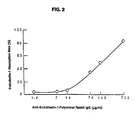
- This IgG at a 7 mg/ml concentration had an antibody titer of 1:89,200 by the ELISA method. It absorbed 80% of 10 ng/ml endothelin-1 at a concentration of 700 ⁇ g/ml as shown in Figure 2.
- phosphate buffer (pH 7.2) containing the endothelin-1-thyroglobulin conjugate prepared in Reference Example 1 was added the same amount of complete Freund's adjuvant to produce a homogeneous emulsion.
- the emulsion was subcutaneously injected into 3 BALB/c mice at a dose of 50 ⁇ g/mouse as protein to immunize the animals.
- the antigen was emulsified with incomplete Freund's adjuvant and injected to the mice at a dose of 50 ⁇ g/mouse as protein to immunize them.
- a phosphate buffer (pH 7.2) containing the antigen was intraperitoneally injected into the mice at a dose of 50 ⁇ g/mouse as protein.
- antibody titers were measured by the ELISA method.
- the spleen cells of the mouse which exhibited the highest titer (1:347,800) were isolated.
- the spleen cells and the mouse myeroma cells P3x63Ag 8U.1 were fused using ethylene glycol 1500.
- the titer for endothelin-1 of the hybridoma selected by HAT medium was measured and colonies having a higher antibody titer were cloned.
- a monoclonal antibody producing hybridoma BT-H51 having specificity to endothelin-1 was thus prepared.
- the hybridoma was a novel stock capable of producing the monoclonal antibody having specificity to endothelin-1 and was deposited with Fermentation Research Institute, Agency of Industrial Science and Technology (Deposition No. 2596, FERM BP-2596).
- the hybridoma was cultured and intraperitoneally inoculated in a BALB/c mouse which had received an intraperitoneal injection of pristan 3 weeks beforehand. After 10-12 days, abdominal dropsy of the mouse was collected. To a 10 ml aliquot of the abdominal dropsy the equivalent amount of saturated ammonium sulfate solution was added, and the mixture was left at 4°C for 2 hours and centrifuged at 7,500 rpm for 10 minutes. The precipitate was dissolved into 15 ml of PBS and dialyzed against PBS for 2 days. After dialysis, PBS was added to the dialyzate to adjust the total volume to 15 ml. This solution was subjected to protein G-celluofine affinity column chromatography (10 ml).
- the column was eluted with 0.1 M glycin-HCl buffer (pH 2.7) containing 0.2 M sodium chloride. After neutralizing with 1 M Tris buffer, the eluent was lyophillized to produce 80 mg of an anti-endothelin-1-monoclonal antibody as white powder.
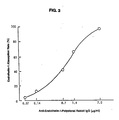
- This IgG at a 7 mg/ml concentration had an antibody titer by the ELISA method of 1:102,400. It absorbed 80% of 10 ng/ml endothelin-1 at a concentration of 2.2 ⁇ g/ml as shown in Figure 3.
- the anti-endothelin-1-monoclonal antibody thus prepared has the following characteristics, in which the molecular weight was measured by the SDS-polyacrylamide gel electrophoresis method.
- the isoelectric point was determined using Pharmacia-LKB electrophoresis equipment, and the immunoglobulin subclass was determined by the Ouchterlony immunodiffusion method.
Landscapes
- Chemical & Material Sciences (AREA)
- Health & Medical Sciences (AREA)
- Organic Chemistry (AREA)
- Medicinal Chemistry (AREA)
- Immunology (AREA)
- Biochemistry (AREA)
- Biophysics (AREA)
- General Health & Medical Sciences (AREA)
- Genetics & Genomics (AREA)
- Life Sciences & Earth Sciences (AREA)
- Molecular Biology (AREA)
- Proteomics, Peptides & Aminoacids (AREA)
- Endocrinology (AREA)
- Medicines Containing Antibodies Or Antigens For Use As Internal Diagnostic Agents (AREA)
- Preparation Of Compounds By Using Micro-Organisms (AREA)
- Peptides Or Proteins (AREA)
Applications Claiming Priority (4)
| Application Number | Priority Date | Filing Date | Title |
|---|---|---|---|
| JP17197/89 | 1989-01-26 | ||
| JP1719789 | 1989-01-26 | ||
| JP315979/89 | 1989-12-05 | ||
| JP31597989A JPH02291296A (ja) | 1989-01-26 | 1989-12-05 | 血管収縮を原因とする疾患の治療剤 |
Publications (2)
| Publication Number | Publication Date |
|---|---|
| EP0384144A1 true EP0384144A1 (fr) | 1990-08-29 |
| EP0384144B1 EP0384144B1 (fr) | 1996-04-03 |
Family
ID=26353679
Family Applications (1)
| Application Number | Title | Priority Date | Filing Date |
|---|---|---|---|
| EP90101405A Expired - Lifetime EP0384144B1 (fr) | 1989-01-26 | 1990-01-24 | Composition pharmaceutique contre les maladies provoquées par la vasoconstriction |
Country Status (3)
| Country | Link |
|---|---|
| EP (1) | EP0384144B1 (fr) |
| CA (1) | CA2008122A1 (fr) |
| DE (1) | DE69026295T2 (fr) |
Cited By (4)
| Publication number | Priority date | Publication date | Assignee | Title |
|---|---|---|---|---|
| EP0423333A4 (en) * | 1988-05-07 | 1991-07-03 | Yamasa Shoyu Kabushiki Kaisha | Anti-endoserine antibody |
| WO1992007254A3 (fr) * | 1990-10-10 | 1992-06-11 | Basf Ag | Utilisation de substances a ponts bisulfures |
| EP1466622A4 (fr) * | 2001-12-26 | 2006-02-01 | Oleg Iliich Epshtein | Agent pharmaceutique et methode de traitement de maladies s'accompagnant de troubles du tonus vasculaire |
| US9751932B2 (en) | 2012-02-22 | 2017-09-05 | Regeneron Pharmaceuticals, Inc. | Anti-big-endothelin-1 (big-ET-1) antibodies and uses thereof |
Citations (1)
| Publication number | Priority date | Publication date | Assignee | Title |
|---|---|---|---|---|
| EP0331100A1 (fr) * | 1988-03-02 | 1989-09-06 | Takeda Chemical Industries, Ltd. | Anticorps anti-endothéline et leur utilisation |
Family Cites Families (1)
| Publication number | Priority date | Publication date | Assignee | Title |
|---|---|---|---|---|
| AU634158B2 (en) * | 1988-05-07 | 1993-02-18 | Yamasa Shoyu Kabushiki Kaisha | Anti-endothelin antibody |
-
1990
- 1990-01-19 CA CA 2008122 patent/CA2008122A1/fr not_active Abandoned
- 1990-01-24 DE DE1990626295 patent/DE69026295T2/de not_active Expired - Fee Related
- 1990-01-24 EP EP90101405A patent/EP0384144B1/fr not_active Expired - Lifetime
Patent Citations (1)
| Publication number | Priority date | Publication date | Assignee | Title |
|---|---|---|---|---|
| EP0331100A1 (fr) * | 1988-03-02 | 1989-09-06 | Takeda Chemical Industries, Ltd. | Anticorps anti-endothéline et leur utilisation |
Non-Patent Citations (2)
| Title |
|---|
| Nature, Vol. 332, No. 6163, March 31, 1988, London M. YANAGISAWA et al. "A Novel Potent Vasoconstrictor Peptide Produced by Vascular Endothelial Cells" pages 411-415* Totality* * |
| Proceedings of the National Academy of Sciences of the United States of America, Vol. 86, No. 8, April 1989, Baltimore, USA A. INOUE et al. "The Human Entothelin Family: Three Structurally and Pharmacologically Distinct Isopeptides Predicted by three Separate Genes" pages 2863-2867* Totality* * |
Cited By (4)
| Publication number | Priority date | Publication date | Assignee | Title |
|---|---|---|---|---|
| EP0423333A4 (en) * | 1988-05-07 | 1991-07-03 | Yamasa Shoyu Kabushiki Kaisha | Anti-endoserine antibody |
| WO1992007254A3 (fr) * | 1990-10-10 | 1992-06-11 | Basf Ag | Utilisation de substances a ponts bisulfures |
| EP1466622A4 (fr) * | 2001-12-26 | 2006-02-01 | Oleg Iliich Epshtein | Agent pharmaceutique et methode de traitement de maladies s'accompagnant de troubles du tonus vasculaire |
| US9751932B2 (en) | 2012-02-22 | 2017-09-05 | Regeneron Pharmaceuticals, Inc. | Anti-big-endothelin-1 (big-ET-1) antibodies and uses thereof |
Also Published As
| Publication number | Publication date |
|---|---|
| DE69026295T2 (de) | 1996-10-02 |
| CA2008122A1 (fr) | 1990-07-26 |
| DE69026295D1 (de) | 1996-05-09 |
| EP0384144B1 (fr) | 1996-04-03 |
Similar Documents
| Publication | Publication Date | Title |
|---|---|---|
| CA2283746C (fr) | Anticorps permettant d'inhiber la coagulation sanguine et procedes d'utilisation de ces derniers | |
| JPH0655759B2 (ja) | ハイブリドインタ−フエロン及びその製造方法 | |
| US4772684A (en) | Peptides affecting blood pressure regulation | |
| JPS60231624A (ja) | ヒト‐レニンに対するモノクローナル抗体及びその使用 | |
| US5278286A (en) | Immune interferon | |
| CN1318069A (zh) | 因子VIIa抑制剂 | |
| JPH09501186A (ja) | コレステリルエステル運搬蛋白質阻害ペプチドおよびこれを含む動脈硬化症のための予防および治療剤 | |
| EP0384144B1 (fr) | Composition pharmaceutique contre les maladies provoquées par la vasoconstriction | |
| EP0210029B1 (fr) | Anticorps monoclonaux contre la prékallicréine de plasma humain et méthodes pour leur préparation et leur utilisation | |
| EP0709455A1 (fr) | Anticorps monoclonal dirigé contre la glicentine humaine, hybridome produisant l'anticorps cité et méthode d'essai pour glicentine humaine utilisant cet anticorps | |
| US20040229282A1 (en) | Antibodies for inhibiting blood coagulation and methods of use thereof | |
| EP0319315A2 (fr) | Domaine du facteur VIII liant le facteur de von Willebrand | |
| JPH11502508A (ja) | 医薬製剤の製造における活性化プロテインcの使用 | |
| EP0363712B1 (fr) | Anticorps monoclonaux hybrides, leur production et utilisation | |
| US5807828A (en) | Platelet aggregation inhibitors | |
| EP0419292A1 (fr) | Protéine humaine apparentée à la tryptase | |
| JP2592441B2 (ja) | 免疫インタフエロンおよびその精製方法 | |
| JP2938129B2 (ja) | 虚血性腎疾患の予防・治療剤 | |
| EP0379295A2 (fr) | Anticorps antitryptase et composition pour le traitement du sida utilisant cet anticorps | |
| JP2000128803A (ja) | ティッシュ・ファクター・パスウェイ・インヒビター−2抗体 | |
| EP0320840A2 (fr) | Peptides, leur procédé de préparation, anticorps contre ceux-ci, et utilisation de ces anticorps pour bloquer l'activité PAI-1 du sang humain | |
| US4994554A (en) | Probursin | |
| JP2938128B2 (ja) | 虚血性心疾患の予防・治療剤 | |
| JPH02291296A (ja) | 血管収縮を原因とする疾患の治療剤 | |
| JPH06100591A (ja) | ペプチド、それらから誘導される抗体並びにその抗体を含有する抗ニュ−カッスル病薬 |
Legal Events
| Date | Code | Title | Description |
|---|---|---|---|
| PUAI | Public reference made under article 153(3) epc to a published international application that has entered the european phase |
Free format text: ORIGINAL CODE: 0009012 |
|
| AK | Designated contracting states |
Kind code of ref document: A1 Designated state(s): DE FR GB IT NL SE |
|
| 17P | Request for examination filed |
Effective date: 19901123 |
|
| 17Q | First examination report despatched |
Effective date: 19930331 |
|
| GRAH | Despatch of communication of intention to grant a patent |
Free format text: ORIGINAL CODE: EPIDOS IGRA |
|
| GRAA | (expected) grant |
Free format text: ORIGINAL CODE: 0009210 |
|
| AK | Designated contracting states |
Kind code of ref document: B1 Designated state(s): DE FR GB IT NL SE |
|
| REF | Corresponds to: |
Ref document number: 69026295 Country of ref document: DE Date of ref document: 19960509 |
|
| ITF | It: translation for a ep patent filed | ||
| ET | Fr: translation filed | ||
| PGFP | Annual fee paid to national office [announced via postgrant information from national office to epo] |
Ref country code: DE Payment date: 19961220 Year of fee payment: 8 |
|
| PGFP | Annual fee paid to national office [announced via postgrant information from national office to epo] |
Ref country code: GB Payment date: 19970113 Year of fee payment: 8 |
|
| PGFP | Annual fee paid to national office [announced via postgrant information from national office to epo] |
Ref country code: SE Payment date: 19970117 Year of fee payment: 8 |
|
| PGFP | Annual fee paid to national office [announced via postgrant information from national office to epo] |
Ref country code: FR Payment date: 19970127 Year of fee payment: 8 |
|
| PGFP | Annual fee paid to national office [announced via postgrant information from national office to epo] |
Ref country code: NL Payment date: 19970131 Year of fee payment: 8 |
|
| PLBE | No opposition filed within time limit |
Free format text: ORIGINAL CODE: 0009261 |
|
| STAA | Information on the status of an ep patent application or granted ep patent |
Free format text: STATUS: NO OPPOSITION FILED WITHIN TIME LIMIT |
|
| 26N | No opposition filed | ||
| PG25 | Lapsed in a contracting state [announced via postgrant information from national office to epo] |
Ref country code: GB Free format text: LAPSE BECAUSE OF NON-PAYMENT OF DUE FEES Effective date: 19980124 |
|
| PG25 | Lapsed in a contracting state [announced via postgrant information from national office to epo] |
Ref country code: SE Free format text: LAPSE BECAUSE OF NON-PAYMENT OF DUE FEES Effective date: 19980125 |
|
| PG25 | Lapsed in a contracting state [announced via postgrant information from national office to epo] |
Ref country code: FR Free format text: THE PATENT HAS BEEN ANNULLED BY A DECISION OF A NATIONAL AUTHORITY Effective date: 19980131 |
|
| PG25 | Lapsed in a contracting state [announced via postgrant information from national office to epo] |
Ref country code: NL Free format text: LAPSE BECAUSE OF NON-PAYMENT OF DUE FEES Effective date: 19980801 |
|
| GBPC | Gb: european patent ceased through non-payment of renewal fee |
Effective date: 19980124 |
|
| NLV4 | Nl: lapsed or anulled due to non-payment of the annual fee |
Effective date: 19980801 |
|
| PG25 | Lapsed in a contracting state [announced via postgrant information from national office to epo] |
Ref country code: DE Free format text: LAPSE BECAUSE OF NON-PAYMENT OF DUE FEES Effective date: 19981001 |
|
| EUG | Se: european patent has lapsed |
Ref document number: 90101405.0 |
|
| REG | Reference to a national code |
Ref country code: FR Ref legal event code: ST |
|
| PG25 | Lapsed in a contracting state [announced via postgrant information from national office to epo] |
Ref country code: IT Free format text: LAPSE BECAUSE OF NON-PAYMENT OF DUE FEES;WARNING: LAPSES OF ITALIAN PATENTS WITH EFFECTIVE DATE BEFORE 2007 MAY HAVE OCCURRED AT ANY TIME BEFORE 2007. THE CORRECT EFFECTIVE DATE MAY BE DIFFERENT FROM THE ONE RECORDED. Effective date: 20050124 |