EP0392408B1 - Zusammensetzungen auf der Basis von aromatischen Polyetherketonen - Google Patents
Zusammensetzungen auf der Basis von aromatischen Polyetherketonen Download PDFInfo
- Publication number
- EP0392408B1 EP0392408B1 EP90106734A EP90106734A EP0392408B1 EP 0392408 B1 EP0392408 B1 EP 0392408B1 EP 90106734 A EP90106734 A EP 90106734A EP 90106734 A EP90106734 A EP 90106734A EP 0392408 B1 EP0392408 B1 EP 0392408B1
- Authority
- EP
- European Patent Office
- Prior art keywords
- carbon fibers
- resin
- aromatic
- fiber
- resins
- Prior art date
- Legal status (The legal status is an assumption and is not a legal conclusion. Google has not performed a legal analysis and makes no representation as to the accuracy of the status listed.)
- Expired - Lifetime
Links
- 0 CC(C)(*)Oc1ccc(*)cc1 Chemical compound CC(C)(*)Oc1ccc(*)cc1 0.000 description 1
- ODEHNJLJURLUJM-UHFFFAOYSA-N CC(C)(C)Oc(cc1)ccc1S(=O)=O Chemical compound CC(C)(C)Oc(cc1)ccc1S(=O)=O ODEHNJLJURLUJM-UHFFFAOYSA-N 0.000 description 1
Images


Classifications
-
- C—CHEMISTRY; METALLURGY
- C08—ORGANIC MACROMOLECULAR COMPOUNDS; THEIR PREPARATION OR CHEMICAL WORKING-UP; COMPOSITIONS BASED THEREON
- C08K—Use of inorganic or non-macromolecular organic substances as compounding ingredients
- C08K9/00—Use of pretreated ingredients
- C08K9/08—Ingredients agglomerated by treatment with a binding agent
-
- C—CHEMISTRY; METALLURGY
- C08—ORGANIC MACROMOLECULAR COMPOUNDS; THEIR PREPARATION OR CHEMICAL WORKING-UP; COMPOSITIONS BASED THEREON
- C08L—COMPOSITIONS OF MACROMOLECULAR COMPOUNDS
- C08L71/00—Compositions of polyethers obtained by reactions forming an ether link in the main chain; Compositions of derivatives of such polymers
-
- C—CHEMISTRY; METALLURGY
- C08—ORGANIC MACROMOLECULAR COMPOUNDS; THEIR PREPARATION OR CHEMICAL WORKING-UP; COMPOSITIONS BASED THEREON
- C08L—COMPOSITIONS OF MACROMOLECULAR COMPOUNDS
- C08L79/00—Compositions of macromolecular compounds obtained by reactions forming in the main chain of the macromolecule a linkage containing nitrogen with or without oxygen or carbon only, not provided for in groups C08L61/00 - C08L77/00
- C08L79/04—Polycondensates having nitrogen-containing heterocyclic rings in the main chain; Polyhydrazides; Polyamide acids or similar polyimide precursors
- C08L79/08—Polyimides; Polyester-imides; Polyamide-imides; Polyamide acids or similar polyimide precursors
Definitions
- the present invention relates to fiber-reinforced resin compositions obtained by adding carbon fibers to aromatic polyetherketone resin compositions having excellent heat resistance, and mechanical components made of the fiber-reinforced resin compositions and suitable for use in internal combustion engines or auxiliary equipment, especially impellers for centrifugal compressors, power transmitting gears, and the like.
- Aromatic polyetherketone resins are expected to find utility in electric and electronic equipment, machinery, automobiles and the like, because they are engineering plastics excellent in mechanical, chemical and thermal properties.
- Carbon fibers are widely employed to reinforce plastic materials whose matrix resins are epoxy resins.
- Epoxy resins are therefore used as binders for carbon fibers.
- Such epoxy resin binders are effective where thermosetting resins such as epoxy resins are used as matrix resins, but have poor adhesion to thermoplastic resins such as aromatic polyetherketone resins so that the epoxy resin binders cannot provide resin compositions having good mechanical strength.
- polyamide resins as binders for thermoplastic resins as disclosed in Japanese Patent Application Laid-Open No. 106752/1978.
- a high temperature of at least 370°C is however required to mold or otherwise form aromatic polyetherketone resins.
- the binder may undergo thermal decomposition during the molding, thereby causing problems such as the formation of voids and strength reduction at welded portions.
- Japanese Patent Application Laid-Open JP-A-56120730 discloses the use of carbon fibers bound with an aromatic polysulfone resin.
- the aromatic polysulfone resin is said to overcome the problems such as the formation of voids and strength reduction at welded portions.
- EP-A-163464 discloses carbon fibers bound with polyetherketone and polyetherimide.
- the mechanical strength of the aromatic polyetherketone resin can be improved by the incorporation of carbon fibers. This method is however accompanied by the drawback that its strength reduction in the temperature range above the glass transition temperature of the matrix cannot be improved.
- Exemplary conventional impellers made of a fiber-reinforced resin include those disclosed in Japanese Patent Publication No. 48684/1977 and Japanese Patent Application Laid-Open JP-A-57135132, JP-A-57119105, JP-A-59018296 and JP-A-61283797.
- the resin materials which make up these impellers feature the use of carbon fibers as a reinforcing material for the resins.
- Japanese Patent Application Laid-Open JP-A-57119105 discloses that carbon-fiber-reinforced resins comprising heat-resistant thermoplastic resins or thermo-setting resins as matrix resins can be used in impellers.
- the impeller of a centrifugal compressor is however used under such conditions that the temperature ranges from -50°C to 200°C (maximum temperature during ordinary application: 165°C) and the maximum revolution speed reaches as high as 13 x 10 4 rpm. Moreover, the stress which occurs when driven at the highest revolution speed reaches about 20 kg/mm 2 in the case of impellers currently used (material: aluminum alloy, outer diameter: about 60 mm). The stress reaches as great as about 10 kg/mm 2 even at the basal part of each blade. The maximum stress at the time of revolution can be reduced about one half or so by using a fiber-reinforced resin whose specific gravity is low.
- thermoplastic resins and thermosetting resins disclosed in Japanese Patent Application Laid-Open JP-A-57119105 can by no means be used as they are.
- compositions of heat resistant resins such as polyethersulfones (PES), polyetherimides (PEI), polyetheretherketones (PEEK), polyetherketones (PEK), polyetherketoneketones (PEKK), polyketonesulfides (PKS), polyaryletherketones (PAEK), aromatic polyamides (PA), polyamideimides (PAI), or polyimides (PI) - with carbon fibers, glass fibers, whiskers or the like appear to be promising.
- PES polyethersulfones
- PEEK polyetherketones
- PEK polyetherketoneketones
- PKK polyketonesulfides
- PAEK polyaryletherketones
- PA aromatic polyamides
- PAI polyamideimides
- PI polyimides
- the above-described resins however have a high melting point. It is therefore necessary to mold them by raising the resin-melting temperature to a relatively high temperature of from 350°C to 430°C.
- Resin-reinforcing carbon fibers presently available on the market primarily use, as a binder, a polyamide resin (decomposition temperature: 280°C) for thermoplastic resins or an epoxy resin (decomposition temperature: 300°C) for thermosetting resins.
- These binders however involve various problems. Namely, they are susceptible to decomposition at the above-described resin-melting temperature (350°C-430°C) upon molding. Due to insufficient wetting of carbon fibers with the matrix resins, the interfacial strength tends to decrease and also to become uneven.
- matrix resins which can exhibit maximum wetting property to carbon fibers when combined with the latter involve the problems that they have a low glass transition temperature and their stiffness is insufficient when used at the maximum temperature of 165°C which are encountered in the course of ordinary use.
- An object of the present invention is to provide a fiber reinforced aromatic polyetherketone resin composition significantly improved in mechanical strength at high temperatures while retaining the inherent excellent chemical properties of polyetherketones.
- Another object of the present invention is to improve the heat resistance of a matrix resin itself and hence to provide a carbon-fiber-incorporated aromatic polyetherketone resin composition having excellent mechanical strength at high temperatures.
- a further object of the present invention is to provide a mechanical component for an internal combustion engine or auxiliary equipment, which mechanical component is formed of a fiber-reinforced resin, has high heat resistance and undergoes only a small reduction at strength and stiffness even in a high temperature range.
- a mechanical component for an internal combustion engine or auxiliary equipment said mechanical component being formed of the fiber-reinforced resin composition.
- the aromatic polyetherketone useful in the practice of the present invention is a thermoplastic crystalline resin having recurring units represented by the following formula (1):
- the melt flow index of the polyetherketone as measured at 380°C under a load of 2.16 kg in accordance with ASTM D1238 is desirably in a range of 5-50 g/10 min, more desirably in a range of 10-25/10 min.
- Commercially-available examples include "Victrex Polyetherketone PEK 220P" (trade name; product of Imperial Chemical Industries Limited, England).
- the polyetherimide usable in the present invention has recurring units represented by the following formula:
- the melt flow index of the polyetherimide as measured at 320°C under a load of 2.16 kg in accordance with ASTM D1238 is desirably in a range of 0.3-5 g/10 min, more desirably in a range of 0.5-3 g/10 min.
- the aromatic polyetherketone in a proportion of 95-60 wt.%, and when used in a fiber-reinforced resin, in a proportion of 95-70 wt.%, desirably 90-70 wt.%; and the polyetherimide in an proportion of 5-40 wt.%, and when employed in the fiber-reinforced resin, in a proportion of 5-30 wt.%, desirably 10-30 wt.%.
- the proportion of the aromatic polyetherketone exceeds 95 wt.% and that of the polyetherimide is less than 5 wt.%, the intended effects for the improvement of the mechanical strength at high temperatures cannot be fully brought about for the resulting resin composition.
- the proportion of the aromatic polyetherketone is smaller than 60 wt.% and that of the polyetherimide is in excess of 40 wt.%, the resulting resin composition can no longer exhibit the excellent chemical properties which the aromatic polyetherketone has.
- the aromatic polyetherketone and polyetherimide are uniformly mixed in the resin composition according to the present invention. No particular limitation is imposed on the mixing method, and various methods can be used. For example, they can be separately charged into a melt extruder and can then be mixed there. They can be pre-blended beforehand in a mixer such as a Henschel mixer, ribbon blender or tumbler and can then be charged into a melt extruder.
- the resin composition of the present invention which comprises the aromatic polyetherketone, polyetherimide and carbon fibers described above, has been significantly improved in mechanical strength at high temperatures while retaining the inherent excellent chemical properties of the polyetherketone.
- the aromatic polysulfone resin employed as a binder to coat surfaces of carbon fibers in the present invention is a linear polymer having arylene bonds, ether bonds and sulfone bonds as bonding units.
- arylene bonds, ether bonds and sulfone bonds as bonding units.
- aromatic polysulfone resins can be produced, for example, by the process described in Japanese Patent Publication No. 10067/1965, 7799/1967 or 617/1966. At least one of the aromatic polysulfone resins is used. Two or more of the aromatic polysulfone resins can also be used as a mixture.
- "Victrex polyethersulfone” (trade name; product of Imperial Chemical Industries Limited, England) can be mentioned as a representative example of polysulfone resins represented by the formula (3)
- “Udel Polysulfone” (trade name; product of Amoco Chemicals Corporation, U.S.A.) can be mentioned as a typical example of polysulfone resins represented by the formula (4).
- Carbon fibers usable in the present invention include acrylic carbon fibers, rayon carbon fibers, lignin carbon fibers, pitch carbon fibers, etc. They are all usable in the present invention. Acrylic carbon fibers are preferred for use in the present invention because of their highest tenacity. Carbon fibers may be in any form, for example, in the form of chopped strands, rovings, textile or the like. It is more preferred to subject these carbon fibers to surface oxidation in advance. These carbon fibers are coated with the aromatic polysulfone resin in the following manner.
- Carbon fibers are dipped in a solution of the aromatic polysulfone resin in a solvent such as dichloromethane, chloroform, 1,2-dichloroethane, 1,1,2,2-tetrachloroethane, dimethyl sulfoxide, normal methylpetane, methyl ethyl ketone or 1,1,2-trichloroethane.
- a solvent such as dichloromethane, chloroform, 1,2-dichloroethane, 1,1,2,2-tetrachloroethane, dimethyl sulfoxide, normal methylpetane, methyl ethyl ketone or 1,1,2-trichloroethane.
- the preferred coat weight of the aromatic polysulfone resin to carbon fibers may be 0.1-10 parts by weight per 100 parts by weight of the carbon fibers. Coat weights smaller than 0.1 part by weight tend to be too small to bring about the effects of the invention. Coat weights greater than 10 parts by weight are feasible but meaningless, because no additional improvement can be expected to the mechanical strength.
- Heat treatment of the carbon fibers coated with the aromatic polysulfone resin as described above is conducted by exposing them to a temperature of 300-400°C, most preferably 340-380°C in air.
- the heating time is desirably 3-20 hours, with 5-15 hours being particularly preferred.
- the mixing can be achieved by chopping the carbon fibers, which have been coated and then heat-treated, 3-6 mm by 3-6 mm, feeding the thus-chopped carbon fibers and the resin composition of the aromatic polyetherketone and polyetherimide separately into a melt extruder and then mixing them together.
- they may be pre-blended beforehand in a mixer such as a Henschel mixer, super mixer or ribbon blender and then fed to a melt extruder.
- the mixing ratio of the carbon fibers, which have been coated with the resin composition of the aromatic polyetherketone and polyetherimide in the present invention 25-45 wt.% of the carbon fibers are mixed with 75-55 wt.% of the composition of the aromatic polyetherketone and polyetherimide. Amounts of carbon fibers smaller than 25 wt.% result in resin compositions having low mechanical strength and are hence not preferred.
- the resulting resin composition can hardly be melted and mixed into a uniform mixture and moreover has substantially reduced melt flowability. As a consequence, the resulting resin composition shows impaired moldability, for example, upon injection molding.
- the high-temperature heat resistance of the matrix resins has been improved. Owing to the synergy between their improved heat resistance and the reinforcing effect of the carbon fibers, the carbon-fiber-incorporated resin compositions exhibit excellent heat resistance over a wide range of temperatures.
- the fiber-reinforced resin compositions of the present invention may be added, if needed, with a filler such as talc, calcium carbonate, mica or glass beads, a fibrous reinforcing material such as glass fibers, potassium titanate fibers, aramid fibers or ceramic fibers, a stabilizer and a colorant to extent not impairing their quality and performance.
- a filler such as talc, calcium carbonate, mica or glass beads
- a fibrous reinforcing material such as glass fibers, potassium titanate fibers, aramid fibers or ceramic fibers, a stabilizer and a colorant to extent not impairing their quality and performance.
- the fiber-reinforced resin compositions of the present invention can be molded or otherwise formed into desired molded or formed articles by a known molding or forming method such as injection molding, extrusion, transfer molding, compression molding or the like.
- the fiber-reinforced polyetherketone resin compositions of the present invention are generally furnished for injection molding in the form of pellet-like molding materials which permit easy handling. These pellets can be obtained, for example, by a known single-screw or twin-screw extruder, namely, by mixing the polyetherketone, polyetherimide and carbon fibers and then extruding the resultant mass as pellets at a cylinder temperature of 360-420°C, preferably 370-390°C while controlling within a range of 2-3 the compression ratio by the screw(s) of the extruder.
- Injection molding can be conducted at a cylinder temperature of 360-420°C, preferably 380-400°C and a mold temperature of 150-230°C, preferably 180-200°C, whereby impellers having a complex shape, made of a carbon-fiber-reinforced resin and suited for use in centrifugal compressors, power transmitting gears, and the like can be obtained easily.
- the impeller designated generally at numeral 1 has a complex shape, and moreover requires high dimensional precision.
- the impeller 1 is interposed between a sleeve 2 and a washer 3 and is fixed on a shaft 5 by a nut 4.
- the impeller 1 of the present invention can be fabricated by a conventional method such as extrusion or injection molding, using one of the fiber-reinforced resin compositions described above.
- the impeller 1 can be molded, for example, by using the mold shown in FIG. 3. Namely, a pin 7 is attached to a bottom plate 10 which is combined with a sectional mold 6 defining the shape of the impeller. A top plate 8 is then firmly fixed to the mold 6. The molding material is injected or extruded in the direction A through a gate 9, so that the molding material is filled in the impeller-shaped cavity 11 to mold the impeller.
- the mechanical components of this invention which are suitable for use in internal combustion engines or auxiliary equipment, have been improved not only in strength but also in glass transition temperature because of the improved wetting characteristics between the carbon fibers and the matrix resin in the fiber-reinforced resin employed. They therefore have high heat resistance and their strength and stiffness are reduced only a little even at a high temperature range above 165°C. Accordingly, they can remain intact even when continuously driven at a high speed.
- mechanical components such as impellers also have the following advantages. Owing to the light weight of the impeller, the follow-up performance to variations in engine load has been improved. Further, the precision of the surfaces of the impeller has been significantly improved compared to the corresponding impeller made of an aluminum alloy. It is therefore possible to reduce the divergence of intake air from the blade surfaces during high-speed rotation, so that the efficiency of intake and compression is improved.
- a polyethersulfone solution was prepared, which consisted of 20 wt.% of "Victrex polyethersulfone PES 5003P" (trade name; product of Imperial Chemical Industries Limited), 40 wt.% of dichloromethane and 40 wt.% of 1,1,2-trichloroethane.
- Rovings of "HTA” (trade name for electrolytically surface-oxidized acrylic carbon fibers produced by TOHO RAYON CO. LTD.; the same carbon fibers were used in the subsequent examples and comparative examples unless otherwise specifically indicated) were continuously dipped at a travelling speed of 60 m/hr in the solution. After the rovings were dried to remove the solvents, they were chopped 3 mm by 3 mm into chopped strands.
- the chopped strands were then put in a stainless steel vat and placed in an electric furnace which was heated at 370°C. In an air atmosphere, heat treatment was conducted for 10 hours.
- the chopped carbon fiber strands obtained as described above were dry-blended with PEK and PEI, which were of the same type as their corresponding resins employed in Example 1, in the proportions shown in Table 2.
- the resultant blends were separately extruded at the extrusion temperature of 380°C through an extruder having a cylinder diameter of 65 mm while being melted and kneaded, so that pellet samples, each having a uniform composition, were obtained.
- the pellet samples were separately molded at a cylinder temperature of 380°C and a mold temperature of 180°C into ASTM No. 1 dumbbell specimens by means of an injection molding machine (mold locking force: 80 tons) manufactured by Nissei Plastic Industrial Co., Ltd. Their tensile tests and bending tests were conducted at room temperature (23°C) and a high temperature (165°C) in accordance with ASTM D-638 and D-790, respectively. The results are shown in Table 2.
- Specimens of a carbon-fiber-incorporated PEK were prepared in a similar manner to Example 5 except that the PEK was only used as a matrix resin. The tensile strength and flexural strength of the specimens were measured similarly. The results are shown in Table 2.
- Specimens of a carbon-fiber-incorporated PEI resin were prepared in a similar manner to Example 5 except that the PEI was only used as a matrix resin. The tensile strength and flexural strength of the specimens were measured similarly. The results are shown in Table 2.
- Specimens of a carbon-fiber-incorporated PEI resin were prepared in a similar manner to Example 5 except that the mixing ratio of the PEK to the PEI was changed to 60:40. The tensile strength and flexural strength of the specimens were measured similarly. The results are shown in Table 2.
- Specimens of a carbon-fiber-incorporated resin were prepared in a similar manner to Example 6 except that the proportion of carbon fibers was changed to 40 wt.%. The tensile strength and flexural strength of the specimens were measured similarly. The results are shown in Table 2.
- polyacrylonitrile carbon fibers which had been subjected to surface treatment by electrolytic oxidation were surface-coated with the same aromatic polysulfone resin. They were chopped 6 mm by 6 mm into chopped carbon fibers, followed by heat treatment at 370°C for 10 hours in a heat treatment furnace whose atmosphere was air.
- Table 3 shows blending ratios of polymer alloys as matrix resins, which consisted of "Victrex polyetherketone -PER 220P” and a polyetherimide resin (PEI produced by General Electric Company).
- the matrix resins of the respective blending ratios were separately mixed with the above-treated carbon fibers to give a carbon fiber content of 30 wt.%.
- the resultant mixtures were separately extruded as strands at a cylinder temperature of 380°C and a screw revolution speed of 45 rpm through a vented single-screw extruder having a L/D ratio of 23 and the compression ratio of 3, followed by chopping. Pellet-like molding materials were thus obtained.
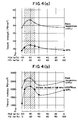
- the pellet-like molding materials were dried at 150°C for 5 hours in hot air, they were separately molded at a cylinder temperature of 380°C and a mold temperature of 180°C into ASTM No. 1 dumbbell specimens 3 mm thick by using the injection molding machine (mold locking force: 80 tons) manufactured by Nissei Plastic Industrial Co., Ltd. Those specimens were heat treated at 230°C for 3 hours, and their tensile tests (ASTM D-638) and bending tests (ASTM D-790) were conducted at room temperature and a high temperature (165°C). The results are tabulated along with their glass transition temperatures in Table 3 and are also plotted in FIGS. 4(a) and 4(b).
- the particularly preferred blending ratio of the polyetherketone resin to the sum of both matrix resins is 70-95 wt.%.
- pellet-like resin compositions were produced by mixing and kneading a polymer alloy resin and carbon fibers to give carbon fiber contents of 20 wt.%, 30 wt.%, 40 wt.% and 50 wt.%, respectively.
- the polymer alloy resin was an 80/20 blend of "Victrex polyetherketone PEK 220P” and the polyetherimide resin (PEI produced by General Electric Company).
- the carbon fibers had been treated in a similar manner to Production Example 1. After the resin compositions were dried at 180°C for 3 hours in hot air, they were separately molded at a cylinder temperature of 390°C and a mold temperature of 190°C into ASTM No.
- Pellet-like fiber-reinforced resin samples having the compositions given in Table 4 were produced in accordance with the procedure of Production Example 1. They were separately injected at a cylinder temperature of 390°C, a mold temperature of 180°C and a injection pressure of 2100 kg/cm 2 into a mold having a similar structure to that shown in FIG. 3, whereby impeller-like molded products were obtained. The thus-obtained molded products were heat treated at 230°C for 3 hours and were then subjected to machining such as deburring and balance checking. Each of the molded products was fixed on a shaft to make an assembly shown in FIG. 2.
- the assembly was then set on a high-speed rotary strength testing machine (revolution speed: 0 - 25 x 10 4 rpm) which was equipped with an air heater (temperature range: 0-600°C).
- the assembly was subjected to a continuous durability test while controlling the testing machine to maintain the temperature of the impeller-compressed air at 165°C at the outlet of the testing machine when the revolution speed was 13 x 10 4 rpm.
- the results are shown in Table 4.
- the impellers which successfully withstood the continuous 200-hr durability test are rated to be good (shown by letter A).
- Fiber-reinforced resin pellets having the composition (carbon fiber content: 40 wt.%) shown in Table 4 were produced in accordance with the procedure of Production Example 1. Using those pellets, impeller-like molded products were prepared and tested in a similar manner to Example 9. The results are shown in Table 4.
Landscapes
- Chemical & Material Sciences (AREA)
- Health & Medical Sciences (AREA)
- Chemical Kinetics & Catalysis (AREA)
- Medicinal Chemistry (AREA)
- Polymers & Plastics (AREA)
- Organic Chemistry (AREA)
- Compositions Of Macromolecular Compounds (AREA)
- Reinforced Plastic Materials (AREA)
- Paints Or Removers (AREA)
Claims (6)
- Faserverstärkte Zusammensetzung aus aromatischem Polyetherketonharz, umfassend:(a) 75-55 Gew% einer Harzzusammensetzung, umfassend:95-70 Gew.% eines aromatischen Polyetherketons, das sich wiederholende, durch die folgende Formel (I) dargestellte Einheiten aufweist:und
 5-30 Gew% eines Polyetherimids, das sich wiederholende, durch die folgende Formel (2) dargestellte Einheiten aufweist:und
 (b) 25-45 Gew% Kohlenstoffasern, die durch Beschichten der Oberflächen der Ausgangskohlenstoffasern mit einem aromatischen Polysulfonharz und Erhitzen der so beschichteten Kohlenstoffasern auf 300-400°C erhalten werden.
 - Zusammensetzung nach Anspruch 1, in welcher das aromatische Polyetherketon einen Schmelzindex in der Größenordnung von 5-50 g/10 min aufweist, gemessen bei 380°C mit einer Beladung von 2,16 kg.
- Zusammensetzung nach Anspruch 1, in welcher das Polyetherimid einen Schmelzindex in der Größenordnung von 0.3-5 g/10 min aufweist, gemessen bei 320°C unter einer Beladung von 2,16 kg.
- Zusammensetzung nach Anspruch 1, in welcher das aromatische Polysulfonharz ausgewählt ist aus der Gruppe bestehend aus aromatischen Polysulfonharzen, die jeweils die folgenden, sich wiederholenden Einheiten aufweisen:


 und
und

- Zusammensetzung nach Anspruch 1, in welcher die Kohlenstoffasern durch Beschichten der Ausgangskohlenstoffasern mit 0.1-10 Gewichtsteilen des aromatischen Polysulfonharzes pro 100 Gewichtsteilen der Ausgangskohlenstoffasern erhalten wurden.
- Mechanischer Bestandteil für einen Verbrennungsmotor oder eine Hilfseinrichtung, wobei der genannte mechanische Bestandteil aus einer faserverstärkten Harzzusammensetzung gebildet ist, die die Zusammensetzungen gemäß einem der Ansprüche 1 bis 5 enthält.
Applications Claiming Priority (6)
| Application Number | Priority Date | Filing Date | Title |
|---|---|---|---|
| JP1090830A JP2667247B2 (ja) | 1989-04-12 | 1989-04-12 | 内燃機関部品並びに補機部品 |
| JP90830/89 | 1989-04-12 | ||
| JP1090828A JP2667246B2 (ja) | 1989-04-12 | 1989-04-12 | 芳香族ポリエーテルケトン系樹脂組成物 |
| JP90829/89 | 1989-04-12 | ||
| JP1090829A JPH02269765A (ja) | 1989-04-12 | 1989-04-12 | 芳香族ポリエーテルケトン系樹脂組成物 |
| JP90828/89 | 1989-04-12 |
Publications (3)
| Publication Number | Publication Date |
|---|---|
| EP0392408A2 EP0392408A2 (de) | 1990-10-17 |
| EP0392408A3 EP0392408A3 (de) | 1992-01-22 |
| EP0392408B1 true EP0392408B1 (de) | 1998-05-13 |
Family
ID=27306551
Family Applications (1)
| Application Number | Title | Priority Date | Filing Date |
|---|---|---|---|
| EP90106734A Expired - Lifetime EP0392408B1 (de) | 1989-04-12 | 1990-04-08 | Zusammensetzungen auf der Basis von aromatischen Polyetherketonen |
Country Status (3)
| Country | Link |
|---|---|
| EP (1) | EP0392408B1 (de) |
| KR (1) | KR930010236B1 (de) |
| DE (1) | DE69032302T2 (de) |
Families Citing this family (6)
| Publication number | Priority date | Publication date | Assignee | Title |
|---|---|---|---|---|
| WO1989005373A1 (fr) * | 1987-11-30 | 1989-06-15 | Mitsui Toatsu Chemicals, Incorporated | Fibres de carbone enduites de resine, preparation a base de resine thermoresistante les utilisant, et pieces pour moteurs a combustion interne |
| EP0643105A1 (de) * | 1993-09-01 | 1995-03-15 | MITSUI TOATSU CHEMICALS, Inc. | Polyimidharzzusammensetzung |
| DE4414054A1 (de) * | 1994-04-21 | 1995-10-26 | Basf Ag | Formmassen auf der Basis von Polyarylenethern und Metallfasern |
| JP3355142B2 (ja) * | 1998-01-21 | 2002-12-09 | 三菱樹脂株式会社 | 耐熱性積層体用フィルムとこれを用いたプリント配線基板用素板および基板の製造方法 |
| GB0004347D0 (en) * | 2000-02-25 | 2000-04-12 | Victrex Mfg Ltd | Lightweight ablative materials |
| CN116217984B (zh) * | 2022-12-16 | 2025-01-14 | 中国科学院大连化学物理研究所 | 一种短切碳纤维增强共混改性酚酞聚芳醚腈酮树脂复合材料及其制备方法 |
Family Cites Families (6)
| Publication number | Priority date | Publication date | Assignee | Title |
|---|---|---|---|---|
| EP0163464A1 (de) * | 1984-05-18 | 1985-12-04 | RAYCHEM CORPORATION (a California corporation) | Mischungen von Poly(arylether)ketonen |
| US4965310A (en) * | 1985-03-27 | 1990-10-23 | Amoco Corporation | Wear resistant poly (aryl ether ketone) polyimide blends |
| GB8519060D0 (en) * | 1985-07-29 | 1985-09-04 | Ici Plc | Polymer compositions |
| EP0254488A3 (de) * | 1986-07-23 | 1989-11-15 | Imperial Chemical Industries Plc | Polymerzusammensetzung und ein beschichteter Leiter oder eine auf dieser basierte gefüllte Zusammensetzung |
| WO1989005373A1 (fr) * | 1987-11-30 | 1989-06-15 | Mitsui Toatsu Chemicals, Incorporated | Fibres de carbone enduites de resine, preparation a base de resine thermoresistante les utilisant, et pieces pour moteurs a combustion interne |
| JPH02129229A (ja) * | 1988-11-10 | 1990-05-17 | Toho Rayon Co Ltd | 炭素繊維チョップドストランド及びその製造法 |
-
1990
- 1990-04-08 DE DE69032302T patent/DE69032302T2/de not_active Expired - Lifetime
- 1990-04-08 EP EP90106734A patent/EP0392408B1/de not_active Expired - Lifetime
- 1990-04-12 KR KR1019900005064A patent/KR930010236B1/ko not_active Expired - Lifetime
Also Published As
| Publication number | Publication date |
|---|---|
| EP0392408A3 (de) | 1992-01-22 |
| DE69032302D1 (de) | 1998-06-18 |
| KR930010236B1 (ko) | 1993-10-15 |
| KR900016373A (ko) | 1990-11-13 |
| DE69032302T2 (de) | 1998-10-29 |
| EP0392408A2 (de) | 1990-10-17 |
Similar Documents
| Publication | Publication Date | Title |
|---|---|---|
| DE3850248T2 (de) | Mit harz beschichtete kohlenstofffasern, wärmebeständige harzzusammensetzung und teile für verbrennungsmotor. | |
| CN109651814B (zh) | 一种高增强增韧型聚苯硫醚复合材料及其制备方法 | |
| CA1177186A (en) | Coated carbon fiber reinforced poly(vinylidene fluoride) | |
| CN102311616B (zh) | 一种碳纤维增强聚酯复合材料及其制备方法 | |
| US5223556A (en) | Aromatic polyetherketone resin compositions containing polyetherimide, polysulfone-coated carbon fibers and mechanical component formed therefrom | |
| EP0392408B1 (de) | Zusammensetzungen auf der Basis von aromatischen Polyetherketonen | |
| CN112011156A (zh) | 聚对苯二甲酸乙二醇酯复合材料及其制备方法 | |
| AU600350B2 (en) | Polyarylene thioether composition for molding | |
| JP3915045B2 (ja) | マシニングセンタにおける構造部品成形材料、及びマシニングセンタにおける構造部品成形体 | |
| KR930010237B1 (ko) | 방향족 폴리에테르 케톤 수지 조성물 | |
| JP2667247B2 (ja) | 内燃機関部品並びに補機部品 | |
| US5559179A (en) | Molding compound | |
| JPH02175972A (ja) | 耐熱性樹脂組成物およびそれを用いた内燃機関用部品 | |
| JP2667544B2 (ja) | 内燃機関部品 | |
| Saalbrink et al. | Blends of poly (ethylene terephthalate) and epoxy as matrix material for continuous fibre reinforced composites | |
| CN115612242A (zh) | 一种玻纤增强聚甲醛复合材料及其制备方法 | |
| Guo et al. | Phase behaviour, mechanical properties and thermal stability of thermosetting polymer blends of unsaturated polyester resin and poly (ethylene oxide) | |
| JP2624554B2 (ja) | 内燃機関部品 | |
| CN111944308A (zh) | 低线性膨胀系数尼龙6复合材料及其制备方法 | |
| CN111978719A (zh) | 聚酰胺66复合材料及其制备方法 | |
| KR101664371B1 (ko) | 유동성 및 기계적 강도가 우수한 폴리아미드계 고분자 조성물 및 이를 포함하는 폴리아미드계 복합소재 | |
| JP2667246B2 (ja) | 芳香族ポリエーテルケトン系樹脂組成物 | |
| Chavan et al. | Mechanical characterization of hybrid thermoplastic composites of short carbon fiber | |
| JPH11166101A (ja) | ガラス繊維含有フェノール系樹脂成形材料の製造方法 | |
| EP0361364A2 (de) | Verbundmaterial von Verstärkungsfasern und luftgehärteter Polyarylensulfidmatrix und deren Herstellung |
Legal Events
| Date | Code | Title | Description |
|---|---|---|---|
| PUAI | Public reference made under article 153(3) epc to a published international application that has entered the european phase |
Free format text: ORIGINAL CODE: 0009012 |
|
| AK | Designated contracting states |
Kind code of ref document: A2 Designated state(s): DE FR GB IT NL SE |
|
| 17P | Request for examination filed |
Effective date: 19900910 |
|
| PUAL | Search report despatched |
Free format text: ORIGINAL CODE: 0009013 |
|
| AK | Designated contracting states |
Kind code of ref document: A3 Designated state(s): DE FR GB IT NL SE |
|
| 17Q | First examination report despatched |
Effective date: 19940804 |
|
| GRAG | Despatch of communication of intention to grant |
Free format text: ORIGINAL CODE: EPIDOS AGRA |
|
| GRAG | Despatch of communication of intention to grant |
Free format text: ORIGINAL CODE: EPIDOS AGRA |
|
| GRAH | Despatch of communication of intention to grant a patent |
Free format text: ORIGINAL CODE: EPIDOS IGRA |
|
| GRAH | Despatch of communication of intention to grant a patent |
Free format text: ORIGINAL CODE: EPIDOS IGRA |
|
| GRAA | (expected) grant |
Free format text: ORIGINAL CODE: 0009210 |
|
| AK | Designated contracting states |
Kind code of ref document: B1 Designated state(s): DE FR GB IT SE |
|
| ITF | It: translation for a ep patent filed | ||
| REF | Corresponds to: |
Ref document number: 69032302 Country of ref document: DE Date of ref document: 19980618 |
|
| RAP2 | Party data changed (patent owner data changed or rights of a patent transferred) |
Owner name: MITSUI CHEMICALS, INC. Owner name: NISSAN MOTOR CO., LTD. |
|
| ET | Fr: translation filed | ||
| PLBE | No opposition filed within time limit |
Free format text: ORIGINAL CODE: 0009261 |
|
| STAA | Information on the status of an ep patent application or granted ep patent |
Free format text: STATUS: NO OPPOSITION FILED WITHIN TIME LIMIT |
|
| 26N | No opposition filed | ||
| REG | Reference to a national code |
Ref country code: GB Ref legal event code: IF02 |
|
| PGFP | Annual fee paid to national office [announced via postgrant information from national office to epo] |
Ref country code: SE Payment date: 20090407 Year of fee payment: 20 Ref country code: IT Payment date: 20090424 Year of fee payment: 20 Ref country code: DE Payment date: 20090402 Year of fee payment: 20 Ref country code: FR Payment date: 20090417 Year of fee payment: 20 |
|
| PGFP | Annual fee paid to national office [announced via postgrant information from national office to epo] |
Ref country code: GB Payment date: 20090408 Year of fee payment: 20 |
|
| REG | Reference to a national code |
Ref country code: GB Ref legal event code: PE20 Expiry date: 20100407 |
|
| EUG | Se: european patent has lapsed | ||
| PG25 | Lapsed in a contracting state [announced via postgrant information from national office to epo] |
Ref country code: GB Free format text: LAPSE BECAUSE OF EXPIRATION OF PROTECTION Effective date: 20100407 |
|
| PG25 | Lapsed in a contracting state [announced via postgrant information from national office to epo] |
Ref country code: DE Free format text: LAPSE BECAUSE OF EXPIRATION OF PROTECTION Effective date: 20100408 |