EP0393523B1 - Farbentwickler und Bildherstellungsverfahren - Google Patents
Farbentwickler und Bildherstellungsverfahren Download PDFInfo
- Publication number
- EP0393523B1 EP0393523B1 EP90107078A EP90107078A EP0393523B1 EP 0393523 B1 EP0393523 B1 EP 0393523B1 EP 90107078 A EP90107078 A EP 90107078A EP 90107078 A EP90107078 A EP 90107078A EP 0393523 B1 EP0393523 B1 EP 0393523B1
- Authority
- EP
- European Patent Office
- Prior art keywords
- group
- color
- developing agent
- color developing
- alkyl group
- Prior art date
- Legal status (The legal status is an assumption and is not a legal conclusion. Google has not performed a legal analysis and makes no representation as to the accuracy of the status listed.)
- Expired - Lifetime
Links
- 238000000034 method Methods 0.000 title claims description 65
- 230000008569 process Effects 0.000 title claims description 33
- 239000003795 chemical substances by application Substances 0.000 claims description 176
- 239000000463 material Substances 0.000 claims description 145
- -1 silver halide Chemical class 0.000 claims description 132
- 229910052709 silver Inorganic materials 0.000 claims description 120
- 239000004332 silver Substances 0.000 claims description 120
- 239000002243 precursor Substances 0.000 claims description 83
- 150000001875 compounds Chemical class 0.000 claims description 71
- 239000000203 mixture Substances 0.000 claims description 65
- 125000000217 alkyl group Chemical group 0.000 claims description 46
- 125000003118 aryl group Chemical group 0.000 claims description 26
- 125000000623 heterocyclic group Chemical group 0.000 claims description 26
- 125000004435 hydrogen atom Chemical group [H]* 0.000 claims description 25
- 150000004989 p-phenylenediamines Chemical class 0.000 claims description 16
- GGCZERPQGJTIQP-UHFFFAOYSA-N sodium;9,10-dioxoanthracene-2-sulfonic acid Chemical compound [Na+].C1=CC=C2C(=O)C3=CC(S(=O)(=O)O)=CC=C3C(=O)C2=C1 GGCZERPQGJTIQP-UHFFFAOYSA-N 0.000 claims description 15
- 125000001424 substituent group Chemical group 0.000 claims description 14
- 239000007800 oxidant agent Substances 0.000 claims description 11
- 125000004442 acylamino group Chemical group 0.000 claims description 8
- 125000003545 alkoxy group Chemical group 0.000 claims description 6
- 125000003277 amino group Chemical group 0.000 claims description 6
- 125000005843 halogen group Chemical group 0.000 claims description 6
- 125000002887 hydroxy group Chemical group [H]O* 0.000 claims description 6
- 125000000472 sulfonyl group Chemical group *S(*)(=O)=O 0.000 claims description 6
- 125000004423 acyloxy group Chemical group 0.000 claims description 5
- 125000004453 alkoxycarbonyl group Chemical group 0.000 claims description 5
- 125000003178 carboxy group Chemical group [H]OC(*)=O 0.000 claims description 5
- 125000004093 cyano group Chemical group *C#N 0.000 claims description 5
- 125000000020 sulfo group Chemical group O=S(=O)([*])O[H] 0.000 claims description 5
- 229910006069 SO3H Inorganic materials 0.000 claims description 4
- 125000002252 acyl group Chemical group 0.000 claims description 4
- 125000004466 alkoxycarbonylamino group Chemical group 0.000 claims description 4
- 125000006598 aminocarbonylamino group Chemical group 0.000 claims description 4
- 125000004397 aminosulfonyl group Chemical group NS(=O)(=O)* 0.000 claims description 4
- 125000003917 carbamoyl group Chemical group [H]N([H])C(*)=O 0.000 claims description 4
- 125000000565 sulfonamide group Chemical group 0.000 claims description 4
- 239000010410 layer Substances 0.000 description 181
- 239000000839 emulsion Substances 0.000 description 146
- 239000000975 dye Substances 0.000 description 100
- 239000000243 solution Substances 0.000 description 64
- 235000013339 cereals Nutrition 0.000 description 54
- 238000012545 processing Methods 0.000 description 48
- 238000011161 development Methods 0.000 description 42
- 239000002904 solvent Substances 0.000 description 39
- 239000006185 dispersion Substances 0.000 description 38
- XLYOFNOQVPJJNP-UHFFFAOYSA-N water Chemical compound O XLYOFNOQVPJJNP-UHFFFAOYSA-N 0.000 description 31
- XEKOWRVHYACXOJ-UHFFFAOYSA-N Ethyl acetate Chemical compound CCOC(C)=O XEKOWRVHYACXOJ-UHFFFAOYSA-N 0.000 description 24
- 0 C*(*)c1c(C)c(O)c(C)c(*(**)N)c1* Chemical compound C*(*)c1c(C)c(O)c(C)c(*(**)N)c1* 0.000 description 22
- BQCADISMDOOEFD-UHFFFAOYSA-N Silver Chemical compound [Ag] BQCADISMDOOEFD-UHFFFAOYSA-N 0.000 description 22
- WVDDGKGOMKODPV-UHFFFAOYSA-N Benzyl alcohol Chemical compound OCC1=CC=CC=C1 WVDDGKGOMKODPV-UHFFFAOYSA-N 0.000 description 21
- 230000000052 comparative effect Effects 0.000 description 21
- 239000003381 stabilizer Substances 0.000 description 20
- 108010010803 Gelatin Proteins 0.000 description 19
- 239000008273 gelatin Substances 0.000 description 19
- 229920000159 gelatin Polymers 0.000 description 19
- 235000019322 gelatine Nutrition 0.000 description 19
- 235000011852 gelatine desserts Nutrition 0.000 description 19
- 239000007864 aqueous solution Substances 0.000 description 18
- 239000007844 bleaching agent Substances 0.000 description 17
- 239000000047 product Substances 0.000 description 16
- 238000010521 absorption reaction Methods 0.000 description 15
- 238000000576 coating method Methods 0.000 description 15
- 239000011229 interlayer Substances 0.000 description 15
- 239000011248 coating agent Substances 0.000 description 14
- 239000008199 coating composition Substances 0.000 description 14
- JOXIMZWYDAKGHI-UHFFFAOYSA-N toluene-4-sulfonic acid Chemical compound CC1=CC=C(S(O)(=O)=O)C=C1 JOXIMZWYDAKGHI-UHFFFAOYSA-N 0.000 description 14
- 239000011230 binding agent Substances 0.000 description 13
- 238000005859 coupling reaction Methods 0.000 description 13
- ZUNKMNLKJXRCDM-UHFFFAOYSA-N silver bromoiodide Chemical compound [Ag].IBr ZUNKMNLKJXRCDM-UHFFFAOYSA-N 0.000 description 13
- DOIRQSBPFJWKBE-UHFFFAOYSA-N dibutyl phthalate Chemical compound CCCCOC(=O)C1=CC=CC=C1C(=O)OCCCC DOIRQSBPFJWKBE-UHFFFAOYSA-N 0.000 description 12
- 238000002360 preparation method Methods 0.000 description 12
- 239000011241 protective layer Substances 0.000 description 12
- 230000006641 stabilisation Effects 0.000 description 12
- 238000011105 stabilization Methods 0.000 description 12
- SJOOOZPMQAWAOP-UHFFFAOYSA-N [Ag].BrCl Chemical compound [Ag].BrCl SJOOOZPMQAWAOP-UHFFFAOYSA-N 0.000 description 11
- 125000004432 carbon atom Chemical group C* 0.000 description 11
- 238000011160 research Methods 0.000 description 11
- 230000001235 sensitizing effect Effects 0.000 description 11
- 239000002253 acid Substances 0.000 description 10
- 239000012190 activator Substances 0.000 description 10
- ADZWSOLPGZMUMY-UHFFFAOYSA-M silver bromide Chemical compound [Ag]Br ADZWSOLPGZMUMY-UHFFFAOYSA-M 0.000 description 10
- 239000004094 surface-active agent Substances 0.000 description 10
- 239000000654 additive Substances 0.000 description 9
- 230000002829 reductive effect Effects 0.000 description 9
- 150000003839 salts Chemical class 0.000 description 9
- 238000004945 emulsification Methods 0.000 description 8
- 238000012546 transfer Methods 0.000 description 8
- LFQSCWFLJHTTHZ-UHFFFAOYSA-N Ethanol Chemical compound CCO LFQSCWFLJHTTHZ-UHFFFAOYSA-N 0.000 description 7
- 239000004698 Polyethylene Substances 0.000 description 7
- 229910021612 Silver iodide Inorganic materials 0.000 description 7
- 235000019445 benzyl alcohol Nutrition 0.000 description 7
- 230000008033 biological extinction Effects 0.000 description 7
- 239000000084 colloidal system Substances 0.000 description 7
- 229920000573 polyethylene Polymers 0.000 description 7
- 229910021607 Silver chloride Inorganic materials 0.000 description 6
- YSMRWXYRXBRSND-UHFFFAOYSA-N TOTP Chemical compound CC1=CC=CC=C1OP(=O)(OC=1C(=CC=CC=1)C)OC1=CC=CC=C1C YSMRWXYRXBRSND-UHFFFAOYSA-N 0.000 description 6
- 238000009835 boiling Methods 0.000 description 6
- 230000008878 coupling Effects 0.000 description 6
- 238000010168 coupling process Methods 0.000 description 6
- 239000013078 crystal Substances 0.000 description 6
- 239000003112 inhibitor Substances 0.000 description 6
- 239000004816 latex Substances 0.000 description 6
- 229920000126 latex Polymers 0.000 description 6
- 239000003960 organic solvent Substances 0.000 description 6
- 230000003647 oxidation Effects 0.000 description 6
- 238000007254 oxidation reaction Methods 0.000 description 6
- ISWSIDIOOBJBQZ-UHFFFAOYSA-N phenol group Chemical group C1(=CC=CC=C1)O ISWSIDIOOBJBQZ-UHFFFAOYSA-N 0.000 description 6
- 229920000642 polymer Polymers 0.000 description 6
- IOLCXVTUBQKXJR-UHFFFAOYSA-M potassium bromide Chemical compound [K+].[Br-] IOLCXVTUBQKXJR-UHFFFAOYSA-M 0.000 description 6
- 239000011541 reaction mixture Substances 0.000 description 6
- HKZLPVFGJNLROG-UHFFFAOYSA-M silver monochloride Chemical compound [Cl-].[Ag+] HKZLPVFGJNLROG-UHFFFAOYSA-M 0.000 description 6
- QTBSBXVTEAMEQO-UHFFFAOYSA-N Acetic acid Chemical compound CC(O)=O QTBSBXVTEAMEQO-UHFFFAOYSA-N 0.000 description 5
- VTLYFUHAOXGGBS-UHFFFAOYSA-N Fe3+ Chemical compound [Fe+3] VTLYFUHAOXGGBS-UHFFFAOYSA-N 0.000 description 5
- QAOWNCQODCNURD-UHFFFAOYSA-N Sulfuric acid Chemical compound OS(O)(=O)=O QAOWNCQODCNURD-UHFFFAOYSA-N 0.000 description 5
- GWEVSGVZZGPLCZ-UHFFFAOYSA-N Titan oxide Chemical compound O=[Ti]=O GWEVSGVZZGPLCZ-UHFFFAOYSA-N 0.000 description 5
- 229940121375 antifungal agent Drugs 0.000 description 5
- 230000002209 hydrophobic effect Effects 0.000 description 5
- 238000002156 mixing Methods 0.000 description 5
- 230000003595 spectral effect Effects 0.000 description 5
- 238000003756 stirring Methods 0.000 description 5
- 238000003860 storage Methods 0.000 description 5
- ZRHUHDUEXWHZMA-UHFFFAOYSA-N 1,4-dihydropyrazol-5-one Chemical class O=C1CC=NN1 ZRHUHDUEXWHZMA-UHFFFAOYSA-N 0.000 description 4
- JKFYKCYQEWQPTM-UHFFFAOYSA-N 2-azaniumyl-2-(4-fluorophenyl)acetate Chemical compound OC(=O)C(N)C1=CC=C(F)C=C1 JKFYKCYQEWQPTM-UHFFFAOYSA-N 0.000 description 4
- FFAJEKUNEVVYCW-UHFFFAOYSA-N 4-n-ethyl-4-n-(2-methoxyethyl)-2-methylbenzene-1,4-diamine Chemical compound COCCN(CC)C1=CC=C(N)C(C)=C1 FFAJEKUNEVVYCW-UHFFFAOYSA-N 0.000 description 4
- QGZKDVFQNNGYKY-UHFFFAOYSA-N Ammonia Chemical compound N QGZKDVFQNNGYKY-UHFFFAOYSA-N 0.000 description 4
- KCXVZYZYPLLWCC-UHFFFAOYSA-N EDTA Chemical compound OC(=O)CN(CC(O)=O)CCN(CC(O)=O)CC(O)=O KCXVZYZYPLLWCC-UHFFFAOYSA-N 0.000 description 4
- VEXZGXHMUGYJMC-UHFFFAOYSA-N Hydrochloric acid Chemical compound Cl VEXZGXHMUGYJMC-UHFFFAOYSA-N 0.000 description 4
- QIGBRXMKCJKVMJ-UHFFFAOYSA-N Hydroquinone Chemical compound OC1=CC=C(O)C=C1 QIGBRXMKCJKVMJ-UHFFFAOYSA-N 0.000 description 4
- 101100221809 Neurospora crassa (strain ATCC 24698 / 74-OR23-1A / CBS 708.71 / DSM 1257 / FGSC 987) cpd-7 gene Proteins 0.000 description 4
- QAOWNCQODCNURD-UHFFFAOYSA-L Sulfate Chemical compound [O-]S([O-])(=O)=O QAOWNCQODCNURD-UHFFFAOYSA-L 0.000 description 4
- 239000002250 absorbent Substances 0.000 description 4
- 230000002745 absorbent Effects 0.000 description 4
- 239000003242 anti bacterial agent Substances 0.000 description 4
- 230000000844 anti-bacterial effect Effects 0.000 description 4
- KRKNYBCHXYNGOX-UHFFFAOYSA-N citric acid Chemical compound OC(=O)CC(O)(C(O)=O)CC(O)=O KRKNYBCHXYNGOX-UHFFFAOYSA-N 0.000 description 4
- 238000009792 diffusion process Methods 0.000 description 4
- 238000009826 distribution Methods 0.000 description 4
- GVGUFUZHNYFZLC-UHFFFAOYSA-N dodecyl benzenesulfonate;sodium Chemical compound [Na].CCCCCCCCCCCCOS(=O)(=O)C1=CC=CC=C1 GVGUFUZHNYFZLC-UHFFFAOYSA-N 0.000 description 4
- 230000000694 effects Effects 0.000 description 4
- CMCWWLVWPDLCRM-UHFFFAOYSA-N phenidone Chemical compound N1C(=O)CCN1C1=CC=CC=C1 CMCWWLVWPDLCRM-UHFFFAOYSA-N 0.000 description 4
- 230000009467 reduction Effects 0.000 description 4
- 238000006722 reduction reaction Methods 0.000 description 4
- 229940045105 silver iodide Drugs 0.000 description 4
- SQGYOTSLMSWVJD-UHFFFAOYSA-N silver(1+) nitrate Chemical compound [Ag+].[O-]N(=O)=O SQGYOTSLMSWVJD-UHFFFAOYSA-N 0.000 description 4
- 229940080264 sodium dodecylbenzenesulfonate Drugs 0.000 description 4
- 230000000087 stabilizing effect Effects 0.000 description 4
- 238000001308 synthesis method Methods 0.000 description 4
- 238000005406 washing Methods 0.000 description 4
- CPELXLSAUQHCOX-UHFFFAOYSA-M Bromide Chemical compound [Br-] CPELXLSAUQHCOX-UHFFFAOYSA-M 0.000 description 3
- XDTMQSROBMDMFD-UHFFFAOYSA-N C1CCCCC1 Chemical compound C1CCCCC1 XDTMQSROBMDMFD-UHFFFAOYSA-N 0.000 description 3
- LYCAIKOWRPUZTN-UHFFFAOYSA-N Ethylene glycol Chemical compound OCCO LYCAIKOWRPUZTN-UHFFFAOYSA-N 0.000 description 3
- KFZMGEQAYNKOFK-UHFFFAOYSA-N Isopropanol Chemical compound CC(C)O KFZMGEQAYNKOFK-UHFFFAOYSA-N 0.000 description 3
- MUBZPKHOEPUJKR-UHFFFAOYSA-N Oxalic acid Chemical compound OC(=O)C(O)=O MUBZPKHOEPUJKR-UHFFFAOYSA-N 0.000 description 3
- 206010070834 Sensitisation Diseases 0.000 description 3
- HEMHJVSKTPXQMS-UHFFFAOYSA-M Sodium hydroxide Chemical compound [OH-].[Na+] HEMHJVSKTPXQMS-UHFFFAOYSA-M 0.000 description 3
- 230000000996 additive effect Effects 0.000 description 3
- 239000003513 alkali Substances 0.000 description 3
- 239000003429 antifungal agent Substances 0.000 description 3
- 230000015572 biosynthetic process Effects 0.000 description 3
- MTHSVFCYNBDYFN-UHFFFAOYSA-N diethylene glycol Chemical compound OCCOCCO MTHSVFCYNBDYFN-UHFFFAOYSA-N 0.000 description 3
- 230000006870 function Effects 0.000 description 3
- 238000004519 manufacturing process Methods 0.000 description 3
- 239000010446 mirabilite Substances 0.000 description 3
- 229910052757 nitrogen Inorganic materials 0.000 description 3
- 239000012071 phase Substances 0.000 description 3
- WVDDGKGOMKODPV-ZQBYOMGUSA-N phenyl(114C)methanol Chemical compound O[14CH2]C1=CC=CC=C1 WVDDGKGOMKODPV-ZQBYOMGUSA-N 0.000 description 3
- 229920000191 poly(N-vinyl pyrrolidone) Polymers 0.000 description 3
- 239000004800 polyvinyl chloride Substances 0.000 description 3
- 229920000915 polyvinyl chloride Polymers 0.000 description 3
- NLKNQRATVPKPDG-UHFFFAOYSA-M potassium iodide Chemical compound [K+].[I-] NLKNQRATVPKPDG-UHFFFAOYSA-M 0.000 description 3
- 239000003755 preservative agent Substances 0.000 description 3
- 230000002265 prevention Effects 0.000 description 3
- 150000003242 quaternary ammonium salts Chemical class 0.000 description 3
- 230000035945 sensitivity Effects 0.000 description 3
- 230000008313 sensitization Effects 0.000 description 3
- RSIJVJUOQBWMIM-UHFFFAOYSA-L sodium sulfate decahydrate Chemical compound O.O.O.O.O.O.O.O.O.O.[Na+].[Na+].[O-]S([O-])(=O)=O RSIJVJUOQBWMIM-UHFFFAOYSA-L 0.000 description 3
- 239000000126 substance Substances 0.000 description 3
- IMNIMPAHZVJRPE-UHFFFAOYSA-N triethylenediamine Chemical compound C1CN2CCN1CC2 IMNIMPAHZVJRPE-UHFFFAOYSA-N 0.000 description 3
- CFSGUMFOSQULCJ-UHFFFAOYSA-N 1,3-bis(ethenylsulfonyl)-2,2-bis(ethenylsulfonylmethyl)propane Chemical compound C=CS(=O)(=O)CC(CS(=O)(=O)C=C)(CS(=O)(=O)C=C)CS(=O)(=O)C=C CFSGUMFOSQULCJ-UHFFFAOYSA-N 0.000 description 2
- CBCKQZAAMUWICA-UHFFFAOYSA-N 1,4-phenylenediamine Chemical compound NC1=CC=C(N)C=C1 CBCKQZAAMUWICA-UHFFFAOYSA-N 0.000 description 2
- ALAVMPYROHSFFR-UHFFFAOYSA-N 1-methyl-3-[3-(5-sulfanylidene-2h-tetrazol-1-yl)phenyl]urea Chemical compound CNC(=O)NC1=CC=CC(N2C(=NN=N2)S)=C1 ALAVMPYROHSFFR-UHFFFAOYSA-N 0.000 description 2
- RNMCCPMYXUKHAZ-UHFFFAOYSA-N 2-[3,3-diamino-1,2,2-tris(carboxymethyl)cyclohexyl]acetic acid Chemical compound NC1(N)CCCC(CC(O)=O)(CC(O)=O)C1(CC(O)=O)CC(O)=O RNMCCPMYXUKHAZ-UHFFFAOYSA-N 0.000 description 2
- XLLIQLLCWZCATF-UHFFFAOYSA-N 2-methoxyethyl acetate Chemical compound COCCOC(C)=O XLLIQLLCWZCATF-UHFFFAOYSA-N 0.000 description 2
- CLENKVQTZCLNQS-UHFFFAOYSA-N 9-propylheptadecan-9-yl dihydrogen phosphate Chemical compound CCCCCCCCC(CCC)(OP(O)(O)=O)CCCCCCCC CLENKVQTZCLNQS-UHFFFAOYSA-N 0.000 description 2
- NLXLAEXVIDQMFP-UHFFFAOYSA-N Ammonia chloride Chemical compound [NH4+].[Cl-] NLXLAEXVIDQMFP-UHFFFAOYSA-N 0.000 description 2
- CIWBSHSKHKDKBQ-JLAZNSOCSA-N Ascorbic acid Chemical compound OC[C@H](O)[C@H]1OC(=O)C(O)=C1O CIWBSHSKHKDKBQ-JLAZNSOCSA-N 0.000 description 2
- VTYYLEPIZMXCLO-UHFFFAOYSA-L Calcium carbonate Chemical compound [Ca+2].[O-]C([O-])=O VTYYLEPIZMXCLO-UHFFFAOYSA-L 0.000 description 2
- 229920002284 Cellulose triacetate Polymers 0.000 description 2
- WSFSSNUMVMOOMR-UHFFFAOYSA-N Formaldehyde Chemical compound O=C WSFSSNUMVMOOMR-UHFFFAOYSA-N 0.000 description 2
- MHAJPDPJQMAIIY-UHFFFAOYSA-N Hydrogen peroxide Chemical compound OO MHAJPDPJQMAIIY-UHFFFAOYSA-N 0.000 description 2
- AVXURJPOCDRRFD-UHFFFAOYSA-N Hydroxylamine Chemical compound ON AVXURJPOCDRRFD-UHFFFAOYSA-N 0.000 description 2
- AFVFQIVMOAPDHO-UHFFFAOYSA-N Methanesulfonic acid Chemical compound CS(O)(=O)=O AFVFQIVMOAPDHO-UHFFFAOYSA-N 0.000 description 2
- QPCDCPDFJACHGM-UHFFFAOYSA-N N,N-bis{2-[bis(carboxymethyl)amino]ethyl}glycine Chemical compound OC(=O)CN(CC(O)=O)CCN(CC(=O)O)CCN(CC(O)=O)CC(O)=O QPCDCPDFJACHGM-UHFFFAOYSA-N 0.000 description 2
- 239000002202 Polyethylene glycol Substances 0.000 description 2
- 239000002262 Schiff base Substances 0.000 description 2
- 150000004753 Schiff bases Chemical class 0.000 description 2
- CDBYLPFSWZWCQE-UHFFFAOYSA-L Sodium Carbonate Chemical compound [Na+].[Na+].[O-]C([O-])=O CDBYLPFSWZWCQE-UHFFFAOYSA-L 0.000 description 2
- UIIMBOGNXHQVGW-UHFFFAOYSA-M Sodium bicarbonate Chemical compound [Na+].OC([O-])=O UIIMBOGNXHQVGW-UHFFFAOYSA-M 0.000 description 2
- NINIDFKCEFEMDL-UHFFFAOYSA-N Sulfur Chemical compound [S] NINIDFKCEFEMDL-UHFFFAOYSA-N 0.000 description 2
- WYURNTSHIVDZCO-UHFFFAOYSA-N Tetrahydrofuran Chemical compound C1CCOC1 WYURNTSHIVDZCO-UHFFFAOYSA-N 0.000 description 2
- 235000010724 Wisteria floribunda Nutrition 0.000 description 2
- XLOMVQKBTHCTTD-UHFFFAOYSA-N Zinc monoxide Chemical compound [Zn]=O XLOMVQKBTHCTTD-UHFFFAOYSA-N 0.000 description 2
- NNLVGZFZQQXQNW-ADJNRHBOSA-N [(2r,3r,4s,5r,6s)-4,5-diacetyloxy-3-[(2s,3r,4s,5r,6r)-3,4,5-triacetyloxy-6-(acetyloxymethyl)oxan-2-yl]oxy-6-[(2r,3r,4s,5r,6s)-4,5,6-triacetyloxy-2-(acetyloxymethyl)oxan-3-yl]oxyoxan-2-yl]methyl acetate Chemical compound O([C@@H]1O[C@@H]([C@H]([C@H](OC(C)=O)[C@H]1OC(C)=O)O[C@H]1[C@@H]([C@@H](OC(C)=O)[C@H](OC(C)=O)[C@@H](COC(C)=O)O1)OC(C)=O)COC(=O)C)[C@@H]1[C@@H](COC(C)=O)O[C@@H](OC(C)=O)[C@H](OC(C)=O)[C@H]1OC(C)=O NNLVGZFZQQXQNW-ADJNRHBOSA-N 0.000 description 2
- 229960000583 acetic acid Drugs 0.000 description 2
- 150000007513 acids Chemical class 0.000 description 2
- 229910021529 ammonia Inorganic materials 0.000 description 2
- 230000000843 anti-fungal effect Effects 0.000 description 2
- IRERQBUNZFJFGC-UHFFFAOYSA-L azure blue Chemical compound [Na+].[Na+].[Na+].[Na+].[Na+].[Na+].[Na+].[Na+].[Al+3].[Al+3].[Al+3].[Al+3].[Al+3].[Al+3].[S-]S[S-].[O-][Si]([O-])([O-])[O-].[O-][Si]([O-])([O-])[O-].[O-][Si]([O-])([O-])[O-].[O-][Si]([O-])([O-])[O-].[O-][Si]([O-])([O-])[O-].[O-][Si]([O-])([O-])[O-] IRERQBUNZFJFGC-UHFFFAOYSA-L 0.000 description 2
- OSGAYBCDTDRGGQ-UHFFFAOYSA-L calcium sulfate Chemical compound [Ca+2].[O-]S([O-])(=O)=O OSGAYBCDTDRGGQ-UHFFFAOYSA-L 0.000 description 2
- 239000003054 catalyst Substances 0.000 description 2
- 239000002738 chelating agent Substances 0.000 description 2
- 238000006243 chemical reaction Methods 0.000 description 2
- 239000003638 chemical reducing agent Substances 0.000 description 2
- JAWGVVJVYSANRY-UHFFFAOYSA-N cobalt(3+) Chemical compound [Co+3] JAWGVVJVYSANRY-UHFFFAOYSA-N 0.000 description 2
- 238000004040 coloring Methods 0.000 description 2
- 238000007796 conventional method Methods 0.000 description 2
- 230000001804 emulsifying effect Effects 0.000 description 2
- 125000001495 ethyl group Chemical group [H]C([H])([H])C([H])([H])* 0.000 description 2
- LXRRVDLNCROODH-UHFFFAOYSA-N ethyl n-(2-cyanoethyl)carbamate Chemical compound CCOC(=O)NCCC#N LXRRVDLNCROODH-UHFFFAOYSA-N 0.000 description 2
- FKRCODPIKNYEAC-UHFFFAOYSA-N ethyl propionate Chemical compound CCOC(=O)CC FKRCODPIKNYEAC-UHFFFAOYSA-N 0.000 description 2
- 239000000284 extract Substances 0.000 description 2
- 150000004694 iodide salts Chemical class 0.000 description 2
- ORUIBWPALBXDOA-UHFFFAOYSA-L magnesium fluoride Chemical compound [F-].[F-].[Mg+2] ORUIBWPALBXDOA-UHFFFAOYSA-L 0.000 description 2
- ACQVQJHUIZBTTB-UHFFFAOYSA-N methyl n-(3-aminophenyl)carbamate Chemical compound COC(=O)NC1=CC=CC(N)=C1 ACQVQJHUIZBTTB-UHFFFAOYSA-N 0.000 description 2
- ZMHNYWIJOJZOJY-UHFFFAOYSA-N methyl n-(3-nitrophenyl)carbamate Chemical compound COC(=O)NC1=CC=CC([N+]([O-])=O)=C1 ZMHNYWIJOJZOJY-UHFFFAOYSA-N 0.000 description 2
- BZQVOERPMMWIEQ-UHFFFAOYSA-N methyl n-[3-(diethylamino)phenyl]carbamate Chemical compound CCN(CC)C1=CC=CC(NC(=O)OC)=C1 BZQVOERPMMWIEQ-UHFFFAOYSA-N 0.000 description 2
- JZVJYYSDJYCACY-UHFFFAOYSA-N methyl n-[5-(diethylamino)-2-nitrosophenyl]carbamate Chemical compound CCN(CC)C1=CC=C(N=O)C(NC(=O)OC)=C1 JZVJYYSDJYCACY-UHFFFAOYSA-N 0.000 description 2
- 150000007522 mineralic acids Chemical class 0.000 description 2
- NPKFETRYYSUTEC-UHFFFAOYSA-N n-[2-(4-amino-n-ethyl-3-methylanilino)ethyl]methanesulfonamide Chemical compound CS(=O)(=O)NCCN(CC)C1=CC=C(N)C(C)=C1 NPKFETRYYSUTEC-UHFFFAOYSA-N 0.000 description 2
- XTEGVFVZDVNBPF-UHFFFAOYSA-L naphthalene-1,5-disulfonate(2-) Chemical compound C1=CC=C2C(S(=O)(=O)[O-])=CC=CC2=C1S([O-])(=O)=O XTEGVFVZDVNBPF-UHFFFAOYSA-L 0.000 description 2
- XTEGVFVZDVNBPF-UHFFFAOYSA-N naphthalene-1,5-disulfonic acid Chemical compound C1=CC=C2C(S(=O)(=O)O)=CC=CC2=C1S(O)(=O)=O XTEGVFVZDVNBPF-UHFFFAOYSA-N 0.000 description 2
- 125000004433 nitrogen atom Chemical group N* 0.000 description 2
- 150000007524 organic acids Chemical class 0.000 description 2
- 125000004430 oxygen atom Chemical group O* 0.000 description 2
- 229960003330 pentetic acid Drugs 0.000 description 2
- VLTRZXGMWDSKGL-UHFFFAOYSA-N perchloric acid Chemical compound OCl(=O)(=O)=O VLTRZXGMWDSKGL-UHFFFAOYSA-N 0.000 description 2
- JRKICGRDRMAZLK-UHFFFAOYSA-L persulfate group Chemical group S(=O)(=O)([O-])OOS(=O)(=O)[O-] JRKICGRDRMAZLK-UHFFFAOYSA-L 0.000 description 2
- ZJAOAACCNHFJAH-UHFFFAOYSA-N phosphonoformic acid Chemical compound OC(=O)P(O)(O)=O ZJAOAACCNHFJAH-UHFFFAOYSA-N 0.000 description 2
- 229920001223 polyethylene glycol Polymers 0.000 description 2
- 229920000139 polyethylene terephthalate Polymers 0.000 description 2
- 239000005020 polyethylene terephthalate Substances 0.000 description 2
- 230000002335 preservative effect Effects 0.000 description 2
- GZTPJDLYPMPRDF-UHFFFAOYSA-N pyrrolo[3,2-c]pyrazole Chemical class N1=NC2=CC=NC2=C1 GZTPJDLYPMPRDF-UHFFFAOYSA-N 0.000 description 2
- 238000006479 redox reaction Methods 0.000 description 2
- 239000011347 resin Substances 0.000 description 2
- 229920005989 resin Polymers 0.000 description 2
- 239000011369 resultant mixture Substances 0.000 description 2
- 229910001961 silver nitrate Inorganic materials 0.000 description 2
- LPXPTNMVRIOKMN-UHFFFAOYSA-M sodium nitrite Chemical compound [Na+].[O-]N=O LPXPTNMVRIOKMN-UHFFFAOYSA-M 0.000 description 2
- GEHJYWRUCIMESM-UHFFFAOYSA-L sodium sulfite Chemical compound [Na+].[Na+].[O-]S([O-])=O GEHJYWRUCIMESM-UHFFFAOYSA-L 0.000 description 2
- LSNNMFCWUKXFEE-UHFFFAOYSA-L sulfite Chemical class [O-]S([O-])=O LSNNMFCWUKXFEE-UHFFFAOYSA-L 0.000 description 2
- 125000006296 sulfonyl amino group Chemical group [H]N(*)S(*)(=O)=O 0.000 description 2
- 229910052717 sulfur Inorganic materials 0.000 description 2
- 239000011593 sulfur Substances 0.000 description 2
- 238000003786 synthesis reaction Methods 0.000 description 2
- XOAAWQZATWQOTB-UHFFFAOYSA-N taurine Chemical compound NCCS(O)(=O)=O XOAAWQZATWQOTB-UHFFFAOYSA-N 0.000 description 2
- 150000003512 tertiary amines Chemical class 0.000 description 2
- 125000003396 thiol group Chemical group [H]S* 0.000 description 2
- 150000003585 thioureas Chemical class 0.000 description 2
- SFENPMLASUEABX-UHFFFAOYSA-N trihexyl phosphate Chemical compound CCCCCCOP(=O)(OCCCCCC)OCCCCCC SFENPMLASUEABX-UHFFFAOYSA-N 0.000 description 2
- 235000013799 ultramarine blue Nutrition 0.000 description 2
- 239000012463 white pigment Substances 0.000 description 2
- BJEPYKJPYRNKOW-REOHCLBHSA-N (S)-malic acid Chemical compound OC(=O)[C@@H](O)CC(O)=O BJEPYKJPYRNKOW-REOHCLBHSA-N 0.000 description 1
- QNRATNLHPGXHMA-XZHTYLCXSA-N (r)-(6-ethoxyquinolin-4-yl)-[(2s,4s,5r)-5-ethyl-1-azabicyclo[2.2.2]octan-2-yl]methanol;hydrochloride Chemical compound Cl.C([C@H]([C@H](C1)CC)C2)CN1[C@@H]2[C@H](O)C1=CC=NC2=CC=C(OCC)C=C21 QNRATNLHPGXHMA-XZHTYLCXSA-N 0.000 description 1
- JLHMJWHSBYZWJJ-UHFFFAOYSA-N 1,2-thiazole 1-oxide Chemical class O=S1C=CC=N1 JLHMJWHSBYZWJJ-UHFFFAOYSA-N 0.000 description 1
- 150000005208 1,4-dihydroxybenzenes Chemical class 0.000 description 1
- MEKOFIRRDATTAG-UHFFFAOYSA-N 2,2,5,8-tetramethyl-3,4-dihydrochromen-6-ol Chemical compound C1CC(C)(C)OC2=C1C(C)=C(O)C=C2C MEKOFIRRDATTAG-UHFFFAOYSA-N 0.000 description 1
- VZYDKJOUEPFKMW-UHFFFAOYSA-N 2,3-dihydroxybenzenesulfonic acid Chemical class OC1=CC=CC(S(O)(=O)=O)=C1O VZYDKJOUEPFKMW-UHFFFAOYSA-N 0.000 description 1
- AXCGIKGRPLMUDF-UHFFFAOYSA-N 2,6-dichloro-1h-1,3,5-triazin-4-one;sodium Chemical compound [Na].OC1=NC(Cl)=NC(Cl)=N1 AXCGIKGRPLMUDF-UHFFFAOYSA-N 0.000 description 1
- QTLHLXYADXCVCF-UHFFFAOYSA-N 2-(4-amino-n-ethyl-3-methylanilino)ethanol Chemical compound OCCN(CC)C1=CC=C(N)C(C)=C1 QTLHLXYADXCVCF-UHFFFAOYSA-N 0.000 description 1
- UOMQUZPKALKDCA-UHFFFAOYSA-K 2-[2-[bis(carboxylatomethyl)amino]ethyl-(carboxymethyl)amino]acetate;iron(3+) Chemical compound [Fe+3].OC(=O)CN(CC([O-])=O)CCN(CC([O-])=O)CC([O-])=O UOMQUZPKALKDCA-UHFFFAOYSA-K 0.000 description 1
- DMQQXDPCRUGSQB-UHFFFAOYSA-N 2-[3-[bis(carboxymethyl)amino]propyl-(carboxymethyl)amino]acetic acid Chemical compound OC(=O)CN(CC(O)=O)CCCN(CC(O)=O)CC(O)=O DMQQXDPCRUGSQB-UHFFFAOYSA-N 0.000 description 1
- XWSGEVNYFYKXCP-UHFFFAOYSA-N 2-[carboxymethyl(methyl)amino]acetic acid Chemical compound OC(=O)CN(C)CC(O)=O XWSGEVNYFYKXCP-UHFFFAOYSA-N 0.000 description 1
- CDAWCLOXVUBKRW-UHFFFAOYSA-N 2-aminophenol Chemical class NC1=CC=CC=C1O CDAWCLOXVUBKRW-UHFFFAOYSA-N 0.000 description 1
- SVONRAPFKPVNKG-UHFFFAOYSA-N 2-ethoxyethyl acetate Chemical compound CCOCCOC(C)=O SVONRAPFKPVNKG-UHFFFAOYSA-N 0.000 description 1
- BSJQLOWJGYMBFP-UHFFFAOYSA-N 2-methyl-5-(2,4,4-trimethylpentan-2-yl)benzene-1,4-diol Chemical compound CC1=CC(O)=C(C(C)(C)CC(C)(C)C)C=C1O BSJQLOWJGYMBFP-UHFFFAOYSA-N 0.000 description 1
- URFHVMUPOBWMPP-UHFFFAOYSA-N 2h-benzotriazole-4-sulfonic acid;sodium Chemical compound [Na].OS(=O)(=O)C1=CC=CC2=NNN=C12 URFHVMUPOBWMPP-UHFFFAOYSA-N 0.000 description 1
- XJCVRTZCHMZPBD-UHFFFAOYSA-N 3-nitroaniline Chemical compound NC1=CC=CC([N+]([O-])=O)=C1 XJCVRTZCHMZPBD-UHFFFAOYSA-N 0.000 description 1
- XRZDIHADHZSFBB-UHFFFAOYSA-N 3-oxo-n,3-diphenylpropanamide Chemical class C=1C=CC=CC=1NC(=O)CC(=O)C1=CC=CC=C1 XRZDIHADHZSFBB-UHFFFAOYSA-N 0.000 description 1
- XVEPKNMOJLPFCN-UHFFFAOYSA-N 4,4-dimethyl-3-oxo-n-phenylpentanamide Chemical compound CC(C)(C)C(=O)CC(=O)NC1=CC=CC=C1 XVEPKNMOJLPFCN-UHFFFAOYSA-N 0.000 description 1
- YLNKRLLYLJYWEN-UHFFFAOYSA-N 4-(2,2-dibutoxyethoxy)-4-oxobutanoic acid Chemical compound CCCCOC(OCCCC)COC(=O)CCC(O)=O YLNKRLLYLJYWEN-UHFFFAOYSA-N 0.000 description 1
- ZFIQGRISGKSVAG-UHFFFAOYSA-N 4-methylaminophenol Chemical compound CNC1=CC=C(O)C=C1 ZFIQGRISGKSVAG-UHFFFAOYSA-N 0.000 description 1
- LRUDIIUSNGCQKF-UHFFFAOYSA-N 5-methyl-1H-benzotriazole Chemical compound C1=C(C)C=CC2=NNN=C21 LRUDIIUSNGCQKF-UHFFFAOYSA-N 0.000 description 1
- INVVMIXYILXINW-UHFFFAOYSA-N 5-methyl-1h-[1,2,4]triazolo[1,5-a]pyrimidin-7-one Chemical compound CC1=CC(=O)N2NC=NC2=N1 INVVMIXYILXINW-UHFFFAOYSA-N 0.000 description 1
- SRMJQDJYJMWSSZ-UHFFFAOYSA-N 5-methyl-2h-benzotriazole;silver Chemical compound [Ag].C1=C(C)C=CC2=NNN=C21 SRMJQDJYJMWSSZ-UHFFFAOYSA-N 0.000 description 1
- XZIIFPSPUDAGJM-UHFFFAOYSA-N 6-chloro-2-n,2-n-diethylpyrimidine-2,4-diamine Chemical compound CCN(CC)C1=NC(N)=CC(Cl)=N1 XZIIFPSPUDAGJM-UHFFFAOYSA-N 0.000 description 1
- QZCLKYGREBVARF-UHFFFAOYSA-N Acetyl tributyl citrate Chemical compound CCCCOC(=O)CC(C(=O)OCCCC)(OC(C)=O)CC(=O)OCCCC QZCLKYGREBVARF-UHFFFAOYSA-N 0.000 description 1
- 241000894006 Bacteria Species 0.000 description 1
- BTBUEUYNUDRHOZ-UHFFFAOYSA-N Borate Chemical compound [O-]B([O-])[O-] BTBUEUYNUDRHOZ-UHFFFAOYSA-N 0.000 description 1
- DKPFZGUDAPQIHT-UHFFFAOYSA-N Butyl acetate Natural products CCCCOC(C)=O DKPFZGUDAPQIHT-UHFFFAOYSA-N 0.000 description 1
- XIVLGTHWXXXKRG-UHFFFAOYSA-N CC(CC1=C)=CC(NC)=C1O Chemical compound CC(CC1=C)=CC(NC)=C1O XIVLGTHWXXXKRG-UHFFFAOYSA-N 0.000 description 1
- DPUKVOKMPGCNFF-UHFFFAOYSA-N CC1OC=CC(C)=C1 Chemical compound CC1OC=CC(C)=C1 DPUKVOKMPGCNFF-UHFFFAOYSA-N 0.000 description 1
- KLQUHOWHXKIFLR-UHFFFAOYSA-N CN(C(CCC1[IH2])CC1NC(OC)=O)C=C Chemical compound CN(C(CCC1[IH2])CC1NC(OC)=O)C=C KLQUHOWHXKIFLR-UHFFFAOYSA-N 0.000 description 1
- RFTORHYUCZJHDO-UHFFFAOYSA-N CN(CC(N1C)=O)C1=O Chemical compound CN(CC(N1C)=O)C1=O RFTORHYUCZJHDO-UHFFFAOYSA-N 0.000 description 1
- WZZAVCOFYBIZEV-UHFFFAOYSA-N C[IH]N/N=C(\NC1CCCCC1)/S Chemical compound C[IH]N/N=C(\NC1CCCCC1)/S WZZAVCOFYBIZEV-UHFFFAOYSA-N 0.000 description 1
- BHPQYMZQTOCNFJ-UHFFFAOYSA-N Calcium cation Chemical compound [Ca+2] BHPQYMZQTOCNFJ-UHFFFAOYSA-N 0.000 description 1
- 229920000623 Cellulose acetate phthalate Polymers 0.000 description 1
- JPVYNHNXODAKFH-UHFFFAOYSA-N Cu2+ Chemical compound [Cu+2] JPVYNHNXODAKFH-UHFFFAOYSA-N 0.000 description 1
- FEWJPZIEWOKRBE-JCYAYHJZSA-N Dextrotartaric acid Chemical compound OC(=O)[C@H](O)[C@@H](O)C(O)=O FEWJPZIEWOKRBE-JCYAYHJZSA-N 0.000 description 1
- MQIUGAXCHLFZKX-UHFFFAOYSA-N Di-n-octyl phthalate Natural products CCCCCCCCOC(=O)C1=CC=CC=C1C(=O)OCCCCCCCC MQIUGAXCHLFZKX-UHFFFAOYSA-N 0.000 description 1
- 229920001174 Diethylhydroxylamine Polymers 0.000 description 1
- DBVJJBKOTRCVKF-UHFFFAOYSA-N Etidronic acid Chemical compound OP(=O)(O)C(O)(C)P(O)(O)=O DBVJJBKOTRCVKF-UHFFFAOYSA-N 0.000 description 1
- UFHFLCQGNIYNRP-UHFFFAOYSA-N Hydrogen Chemical compound [H][H] UFHFLCQGNIYNRP-UHFFFAOYSA-N 0.000 description 1
- XEEYBQQBJWHFJM-UHFFFAOYSA-N Iron Chemical compound [Fe] XEEYBQQBJWHFJM-UHFFFAOYSA-N 0.000 description 1
- JLVVSXFLKOJNIY-UHFFFAOYSA-N Magnesium ion Chemical compound [Mg+2] JLVVSXFLKOJNIY-UHFFFAOYSA-N 0.000 description 1
- NTIZESTWPVYFNL-UHFFFAOYSA-N Methyl isobutyl ketone Chemical compound CC(C)CC(C)=O NTIZESTWPVYFNL-UHFFFAOYSA-N 0.000 description 1
- UIHCLUNTQKBZGK-UHFFFAOYSA-N Methyl isobutyl ketone Natural products CCC(C)C(C)=O UIHCLUNTQKBZGK-UHFFFAOYSA-N 0.000 description 1
- FXHOOIRPVKKKFG-UHFFFAOYSA-N N,N-Dimethylacetamide Chemical compound CN(C)C(C)=O FXHOOIRPVKKKFG-UHFFFAOYSA-N 0.000 description 1
- JYXGIOKAKDAARW-UHFFFAOYSA-N N-(2-hydroxyethyl)iminodiacetic acid Chemical compound OCCN(CC(O)=O)CC(O)=O JYXGIOKAKDAARW-UHFFFAOYSA-N 0.000 description 1
- BXUURYQQDJGIGA-UHFFFAOYSA-N N1C=NN2N=CC=C21 Chemical class N1C=NN2N=CC=C21 BXUURYQQDJGIGA-UHFFFAOYSA-N 0.000 description 1
- 239000000020 Nitrocellulose Substances 0.000 description 1
- 229910019142 PO4 Inorganic materials 0.000 description 1
- AVKHCKXGKPAGEI-UHFFFAOYSA-N Phenicarbazide Chemical class NC(=O)NNC1=CC=CC=C1 AVKHCKXGKPAGEI-UHFFFAOYSA-N 0.000 description 1
- YGYAWVDWMABLBF-UHFFFAOYSA-N Phosgene Chemical compound ClC(Cl)=O YGYAWVDWMABLBF-UHFFFAOYSA-N 0.000 description 1
- NBIIXXVUZAFLBC-UHFFFAOYSA-N Phosphoric acid Chemical group OP(O)(O)=O NBIIXXVUZAFLBC-UHFFFAOYSA-N 0.000 description 1
- 229920003171 Poly (ethylene oxide) Polymers 0.000 description 1
- 239000004372 Polyvinyl alcohol Substances 0.000 description 1
- UIIMBOGNXHQVGW-DEQYMQKBSA-M Sodium bicarbonate-14C Chemical compound [Na+].O[14C]([O-])=O UIIMBOGNXHQVGW-DEQYMQKBSA-M 0.000 description 1
- LSNNMFCWUKXFEE-UHFFFAOYSA-N Sulfurous acid Chemical class OS(O)=O LSNNMFCWUKXFEE-UHFFFAOYSA-N 0.000 description 1
- FEWJPZIEWOKRBE-UHFFFAOYSA-N Tartaric acid Natural products [H+].[H+].[O-]C(=O)C(O)C(O)C([O-])=O FEWJPZIEWOKRBE-UHFFFAOYSA-N 0.000 description 1
- GSEJCLTVZPLZKY-UHFFFAOYSA-N Triethanolamine Chemical compound OCCN(CCO)CCO GSEJCLTVZPLZKY-UHFFFAOYSA-N 0.000 description 1
- FJWGYAHXMCUOOM-QHOUIDNNSA-N [(2s,3r,4s,5r,6r)-2-[(2r,3r,4s,5r,6s)-4,5-dinitrooxy-2-(nitrooxymethyl)-6-[(2r,3r,4s,5r,6s)-4,5,6-trinitrooxy-2-(nitrooxymethyl)oxan-3-yl]oxyoxan-3-yl]oxy-3,5-dinitrooxy-6-(nitrooxymethyl)oxan-4-yl] nitrate Chemical compound O([C@@H]1O[C@@H]([C@H]([C@H](O[N+]([O-])=O)[C@H]1O[N+]([O-])=O)O[C@H]1[C@@H]([C@@H](O[N+]([O-])=O)[C@H](O[N+]([O-])=O)[C@@H](CO[N+]([O-])=O)O1)O[N+]([O-])=O)CO[N+](=O)[O-])[C@@H]1[C@@H](CO[N+]([O-])=O)O[C@@H](O[N+]([O-])=O)[C@H](O[N+]([O-])=O)[C@H]1O[N+]([O-])=O FJWGYAHXMCUOOM-QHOUIDNNSA-N 0.000 description 1
- XCFIVNQHHFZRNR-UHFFFAOYSA-N [Ag].Cl[IH]Br Chemical compound [Ag].Cl[IH]Br XCFIVNQHHFZRNR-UHFFFAOYSA-N 0.000 description 1
- VDEKZRMFBLPJOD-UHFFFAOYSA-N [dihydroxy(oxo)-$l^{6}-sulfanylidene]methanone Chemical compound OS(O)(=O)=C=O VDEKZRMFBLPJOD-UHFFFAOYSA-N 0.000 description 1
- 238000000862 absorption spectrum Methods 0.000 description 1
- 230000001133 acceleration Effects 0.000 description 1
- 238000009825 accumulation Methods 0.000 description 1
- 229910000288 alkali metal carbonate Inorganic materials 0.000 description 1
- 150000008041 alkali metal carbonates Chemical class 0.000 description 1
- 125000005194 alkoxycarbonyloxy group Chemical group 0.000 description 1
- BJEPYKJPYRNKOW-UHFFFAOYSA-N alpha-hydroxysuccinic acid Natural products OC(=O)C(O)CC(O)=O BJEPYKJPYRNKOW-UHFFFAOYSA-N 0.000 description 1
- PNEYBMLMFCGWSK-UHFFFAOYSA-N aluminium oxide Inorganic materials [O-2].[O-2].[O-2].[Al+3].[Al+3] PNEYBMLMFCGWSK-UHFFFAOYSA-N 0.000 description 1
- 125000003368 amide group Chemical group 0.000 description 1
- 150000001412 amines Chemical class 0.000 description 1
- 235000019270 ammonium chloride Nutrition 0.000 description 1
- XYXNTHIYBIDHGM-UHFFFAOYSA-N ammonium thiosulfate Chemical compound [NH4+].[NH4+].[O-]S([O-])(=O)=S XYXNTHIYBIDHGM-UHFFFAOYSA-N 0.000 description 1
- 150000001448 anilines Chemical class 0.000 description 1
- 125000000129 anionic group Chemical group 0.000 description 1
- 239000003963 antioxidant agent Substances 0.000 description 1
- 230000003078 antioxidant effect Effects 0.000 description 1
- 235000006708 antioxidants Nutrition 0.000 description 1
- 239000008346 aqueous phase Substances 0.000 description 1
- 125000001769 aryl amino group Chemical group 0.000 description 1
- 125000005110 aryl thio group Chemical group 0.000 description 1
- 235000010323 ascorbic acid Nutrition 0.000 description 1
- 229960005070 ascorbic acid Drugs 0.000 description 1
- 239000011668 ascorbic acid Substances 0.000 description 1
- 239000000987 azo dye Substances 0.000 description 1
- QVQLCTNNEUAWMS-UHFFFAOYSA-N barium oxide Chemical compound [Ba]=O QVQLCTNNEUAWMS-UHFFFAOYSA-N 0.000 description 1
- 229910001864 baryta Inorganic materials 0.000 description 1
- 239000002585 base Substances 0.000 description 1
- SRSXLGNVWSONIS-UHFFFAOYSA-N benzenesulfonic acid Chemical compound OS(=O)(=O)C1=CC=CC=C1 SRSXLGNVWSONIS-UHFFFAOYSA-N 0.000 description 1
- 229940092714 benzenesulfonic acid Drugs 0.000 description 1
- 125000003785 benzimidazolyl group Chemical class N1=C(NC2=C1C=CC=C2)* 0.000 description 1
- 150000001558 benzoic acid derivatives Chemical class 0.000 description 1
- IOJUPLGTWVMSFF-UHFFFAOYSA-N benzothiazole Chemical class C1=CC=C2SC=NC2=C1 IOJUPLGTWVMSFF-UHFFFAOYSA-N 0.000 description 1
- QRUDEWIWKLJBPS-UHFFFAOYSA-N benzotriazole Chemical compound C1=CC=C2N[N][N]C2=C1 QRUDEWIWKLJBPS-UHFFFAOYSA-N 0.000 description 1
- 239000012964 benzotriazole Substances 0.000 description 1
- BJQHLKABXJIVAM-UHFFFAOYSA-N bis(2-ethylhexyl) phthalate Chemical compound CCCCC(CC)COC(=O)C1=CC=CC=C1C(=O)OCC(CC)CCCC BJQHLKABXJIVAM-UHFFFAOYSA-N 0.000 description 1
- 238000004061 bleaching Methods 0.000 description 1
- MOOAHMCRPCTRLV-UHFFFAOYSA-N boron sodium Chemical compound [B].[Na] MOOAHMCRPCTRLV-UHFFFAOYSA-N 0.000 description 1
- SXDBWCPKPHAZSM-UHFFFAOYSA-M bromate Chemical class [O-]Br(=O)=O SXDBWCPKPHAZSM-UHFFFAOYSA-M 0.000 description 1
- 229940006460 bromide ion Drugs 0.000 description 1
- 150000001649 bromium compounds Chemical class 0.000 description 1
- 239000000872 buffer Substances 0.000 description 1
- BTANRVKWQNVYAZ-UHFFFAOYSA-N butan-2-ol Chemical compound CCC(C)O BTANRVKWQNVYAZ-UHFFFAOYSA-N 0.000 description 1
- 239000001273 butane Substances 0.000 description 1
- 229910000019 calcium carbonate Inorganic materials 0.000 description 1
- 229910001424 calcium ion Inorganic materials 0.000 description 1
- 125000002843 carboxylic acid group Chemical group 0.000 description 1
- 125000002091 cationic group Chemical group 0.000 description 1
- 230000008859 change Effects 0.000 description 1
- 239000007795 chemical reaction product Substances 0.000 description 1
- 150000001804 chlorine Chemical class 0.000 description 1
- JOPOVCBBYLSVDA-UHFFFAOYSA-N chromium(6+) Chemical compound [Cr+6] JOPOVCBBYLSVDA-UHFFFAOYSA-N 0.000 description 1
- 235000015165 citric acid Nutrition 0.000 description 1
- 229910017052 cobalt Inorganic materials 0.000 description 1
- 239000010941 cobalt Substances 0.000 description 1
- GUTLYIVDDKVIGB-UHFFFAOYSA-N cobalt atom Chemical compound [Co] GUTLYIVDDKVIGB-UHFFFAOYSA-N 0.000 description 1
- 239000002131 composite material Substances 0.000 description 1
- 229940125898 compound 5 Drugs 0.000 description 1
- 238000011109 contamination Methods 0.000 description 1
- 238000001816 cooling Methods 0.000 description 1
- 239000012043 crude product Substances 0.000 description 1
- 238000000586 desensitisation Methods 0.000 description 1
- 235000014113 dietary fatty acids Nutrition 0.000 description 1
- 125000004177 diethyl group Chemical group [H]C([H])([H])C([H])([H])* 0.000 description 1
- FVCOIAYSJZGECG-UHFFFAOYSA-N diethylhydroxylamine Chemical compound CCN(O)CC FVCOIAYSJZGECG-UHFFFAOYSA-N 0.000 description 1
- 150000005205 dihydroxybenzenes Chemical class 0.000 description 1
- 239000000539 dimer Substances 0.000 description 1
- ASMQGLCHMVWBQR-UHFFFAOYSA-M diphenyl phosphate Chemical compound C=1C=CC=CC=1OP(=O)([O-])OC1=CC=CC=C1 ASMQGLCHMVWBQR-UHFFFAOYSA-M 0.000 description 1
- 239000002270 dispersing agent Substances 0.000 description 1
- 239000004815 dispersion polymer Substances 0.000 description 1
- 239000012153 distilled water Substances 0.000 description 1
- PZZHMLOHNYWKIK-UHFFFAOYSA-N eddha Chemical compound C=1C=CC=C(O)C=1C(C(=O)O)NCCNC(C(O)=O)C1=CC=CC=C1O PZZHMLOHNYWKIK-UHFFFAOYSA-N 0.000 description 1
- 230000007613 environmental effect Effects 0.000 description 1
- VHBXLZJBCODOOU-UHFFFAOYSA-N ethyl n-(2-sulfonylethyl)carbamate Chemical compound CCOC(=O)NCC=S(=O)=O VHBXLZJBCODOOU-UHFFFAOYSA-N 0.000 description 1
- DEFVIWRASFVYLL-UHFFFAOYSA-N ethylene glycol bis(2-aminoethyl)tetraacetic acid Chemical compound OC(=O)CN(CC(O)=O)CCOCCOCCN(CC(O)=O)CC(O)=O DEFVIWRASFVYLL-UHFFFAOYSA-N 0.000 description 1
- 238000001704 evaporation Methods 0.000 description 1
- 230000008020 evaporation Effects 0.000 description 1
- 238000005562 fading Methods 0.000 description 1
- 239000000194 fatty acid Substances 0.000 description 1
- 229930195729 fatty acid Natural products 0.000 description 1
- 239000000706 filtrate Substances 0.000 description 1
- 238000001914 filtration Methods 0.000 description 1
- 125000001153 fluoro group Chemical class F* 0.000 description 1
- 229960005102 foscarnet Drugs 0.000 description 1
- 239000012458 free base Substances 0.000 description 1
- 239000012362 glacial acetic acid Substances 0.000 description 1
- 239000011521 glass Substances 0.000 description 1
- 230000009477 glass transition Effects 0.000 description 1
- 229910052736 halogen Inorganic materials 0.000 description 1
- 150000002367 halogens Chemical class 0.000 description 1
- FUZZWVXGSFPDMH-UHFFFAOYSA-N hexanoic acid Chemical compound CCCCCC(O)=O FUZZWVXGSFPDMH-UHFFFAOYSA-N 0.000 description 1
- 150000002429 hydrazines Chemical class 0.000 description 1
- 239000001257 hydrogen Substances 0.000 description 1
- 229910052739 hydrogen Inorganic materials 0.000 description 1
- XMBWDFGMSWQBCA-UHFFFAOYSA-N hydrogen iodide Chemical compound I XMBWDFGMSWQBCA-UHFFFAOYSA-N 0.000 description 1
- 150000002443 hydroxylamines Chemical class 0.000 description 1
- PTFYQSWHBLOXRZ-UHFFFAOYSA-N imidazo[4,5-e]indazole Chemical class C1=CC2=NC=NC2=C2C=NN=C21 PTFYQSWHBLOXRZ-UHFFFAOYSA-N 0.000 description 1
- 238000005470 impregnation Methods 0.000 description 1
- 238000010348 incorporation Methods 0.000 description 1
- LOCAIGRSOJUCTB-UHFFFAOYSA-N indazol-3-one Chemical compound C1=CC=C2C(=O)N=NC2=C1 LOCAIGRSOJUCTB-UHFFFAOYSA-N 0.000 description 1
- 230000002401 inhibitory effect Effects 0.000 description 1
- 230000005764 inhibitory process Effects 0.000 description 1
- HVTICUPFWKNHNG-UHFFFAOYSA-N iodoethane Chemical compound CCI HVTICUPFWKNHNG-UHFFFAOYSA-N 0.000 description 1
- 230000001788 irregular Effects 0.000 description 1
- 229910001425 magnesium ion Inorganic materials 0.000 description 1
- 239000001630 malic acid Substances 0.000 description 1
- 235000011090 malic acid Nutrition 0.000 description 1
- 229910052751 metal Inorganic materials 0.000 description 1
- 239000002184 metal Substances 0.000 description 1
- UKVIEHSSVKSQBA-UHFFFAOYSA-N methane;palladium Chemical compound C.[Pd] UKVIEHSSVKSQBA-UHFFFAOYSA-N 0.000 description 1
- 229940098779 methanesulfonic acid Drugs 0.000 description 1
- XMJHPCRAQCTCFT-UHFFFAOYSA-N methyl chloroformate Chemical compound COC(Cl)=O XMJHPCRAQCTCFT-UHFFFAOYSA-N 0.000 description 1
- JGXDUSIXAAJIQK-UHFFFAOYSA-N methyl n-[2-amino-5-(diethylamino)phenyl]carbamate Chemical compound CCN(CC)C1=CC=C(N)C(NC(=O)OC)=C1 JGXDUSIXAAJIQK-UHFFFAOYSA-N 0.000 description 1
- 125000000325 methylidene group Chemical group [H]C([H])=* 0.000 description 1
- 244000005700 microbiome Species 0.000 description 1
- 238000005065 mining Methods 0.000 description 1
- 238000012986 modification Methods 0.000 description 1
- 230000004048 modification Effects 0.000 description 1
- AJFDBNQQDYLMJN-UHFFFAOYSA-N n,n-diethylacetamide Chemical compound CCN(CC)C(C)=O AJFDBNQQDYLMJN-UHFFFAOYSA-N 0.000 description 1
- AJDUTMFFZHIJEM-UHFFFAOYSA-N n-(9,10-dioxoanthracen-1-yl)-4-[4-[[4-[4-[(9,10-dioxoanthracen-1-yl)carbamoyl]phenyl]phenyl]diazenyl]phenyl]benzamide Chemical compound O=C1C2=CC=CC=C2C(=O)C2=C1C=CC=C2NC(=O)C(C=C1)=CC=C1C(C=C1)=CC=C1N=NC(C=C1)=CC=C1C(C=C1)=CC=C1C(=O)NC1=CC=CC2=C1C(=O)C1=CC=CC=C1C2=O AJDUTMFFZHIJEM-UHFFFAOYSA-N 0.000 description 1
- IJDNQMDRQITEOD-UHFFFAOYSA-N n-butane Chemical compound CCCC IJDNQMDRQITEOD-UHFFFAOYSA-N 0.000 description 1
- OFBQJSOFQDEBGM-UHFFFAOYSA-N n-pentane Natural products CCCCC OFBQJSOFQDEBGM-UHFFFAOYSA-N 0.000 description 1
- MGFYIUFZLHCRTH-UHFFFAOYSA-N nitrilotriacetic acid Chemical compound OC(=O)CN(CC(O)=O)CC(O)=O MGFYIUFZLHCRTH-UHFFFAOYSA-N 0.000 description 1
- 150000002828 nitro derivatives Chemical class 0.000 description 1
- 150000005181 nitrobenzenes Chemical class 0.000 description 1
- 229920001220 nitrocellulos Polymers 0.000 description 1
- XNGIFLGASWRNHJ-UHFFFAOYSA-N o-dicarboxybenzene Natural products OC(=O)C1=CC=CC=C1C(O)=O XNGIFLGASWRNHJ-UHFFFAOYSA-N 0.000 description 1
- VECVSKFWRQYTAL-UHFFFAOYSA-N octyl benzoate Chemical compound CCCCCCCCOC(=O)C1=CC=CC=C1 VECVSKFWRQYTAL-UHFFFAOYSA-N 0.000 description 1
- 230000003287 optical effect Effects 0.000 description 1
- 235000006408 oxalic acid Nutrition 0.000 description 1
- 229940116315 oxalic acid Drugs 0.000 description 1
- KJIFKLIQANRMOU-UHFFFAOYSA-N oxidanium;4-methylbenzenesulfonate Chemical compound O.CC1=CC=C(S(O)(=O)=O)C=C1 KJIFKLIQANRMOU-UHFFFAOYSA-N 0.000 description 1
- 230000001590 oxidative effect Effects 0.000 description 1
- 239000006174 pH buffer Substances 0.000 description 1
- 150000002978 peroxides Chemical class 0.000 description 1
- 150000002989 phenols Chemical class 0.000 description 1
- NBIIXXVUZAFLBC-UHFFFAOYSA-K phosphate Chemical compound [O-]P([O-])([O-])=O NBIIXXVUZAFLBC-UHFFFAOYSA-K 0.000 description 1
- 239000010452 phosphate Substances 0.000 description 1
- 125000002270 phosphoric acid ester group Chemical group 0.000 description 1
- 150000003014 phosphoric acid esters Chemical class 0.000 description 1
- 239000002985 plastic film Substances 0.000 description 1
- 229920006255 plastic film Polymers 0.000 description 1
- 229920000768 polyamine Polymers 0.000 description 1
- 229920000728 polyester Polymers 0.000 description 1
- 229940068886 polyethylene glycol 300 Drugs 0.000 description 1
- 229920002451 polyvinyl alcohol Polymers 0.000 description 1
- JEXVQSWXXUJEMA-UHFFFAOYSA-N pyrazol-3-one Chemical compound O=C1C=CN=N1 JEXVQSWXXUJEMA-UHFFFAOYSA-N 0.000 description 1
- 150000003217 pyrazoles Chemical class 0.000 description 1
- NDGRWYRVNANFNB-UHFFFAOYSA-N pyrazolidin-3-one Chemical class O=C1CCNN1 NDGRWYRVNANFNB-UHFFFAOYSA-N 0.000 description 1
- MCSKRVKAXABJLX-UHFFFAOYSA-N pyrazolo[3,4-d]triazole Chemical class N1=NN=C2N=NC=C21 MCSKRVKAXABJLX-UHFFFAOYSA-N 0.000 description 1
- VNAUDIIOSMNXBA-UHFFFAOYSA-N pyrazolo[4,3-c]pyrazole Chemical class N1=NC=C2N=NC=C21 VNAUDIIOSMNXBA-UHFFFAOYSA-N 0.000 description 1
- 150000004053 quinones Chemical class 0.000 description 1
- 238000010992 reflux Methods 0.000 description 1
- 230000000452 restraining effect Effects 0.000 description 1
- 238000010898 silica gel chromatography Methods 0.000 description 1
- 150000003378 silver Chemical class 0.000 description 1
- 229910000030 sodium bicarbonate Inorganic materials 0.000 description 1
- 235000017557 sodium bicarbonate Nutrition 0.000 description 1
- 229910000029 sodium carbonate Inorganic materials 0.000 description 1
- 235000010288 sodium nitrite Nutrition 0.000 description 1
- 235000010265 sodium sulphite Nutrition 0.000 description 1
- QHFDHWJHIAVELW-UHFFFAOYSA-M sodium;4,6-dioxo-1h-1,3,5-triazin-2-olate Chemical class [Na+].[O-]C1=NC(=O)NC(=O)N1 QHFDHWJHIAVELW-UHFFFAOYSA-M 0.000 description 1
- 239000007787 solid Substances 0.000 description 1
- 229940035044 sorbitan monolaurate Drugs 0.000 description 1
- 150000003455 sulfinic acids Chemical class 0.000 description 1
- 125000000542 sulfonic acid group Chemical group 0.000 description 1
- 239000002344 surface layer Substances 0.000 description 1
- 239000011975 tartaric acid Substances 0.000 description 1
- 235000002906 tartaric acid Nutrition 0.000 description 1
- 229960003080 taurine Drugs 0.000 description 1
- KKEYFWRCBNTPAC-UHFFFAOYSA-L terephthalate(2-) Chemical compound [O-]C(=O)C1=CC=C(C([O-])=O)C=C1 KKEYFWRCBNTPAC-UHFFFAOYSA-L 0.000 description 1
- 238000012360 testing method Methods 0.000 description 1
- YLQBMQCUIZJEEH-UHFFFAOYSA-N tetrahydrofuran Natural products C=1C=COC=1 YLQBMQCUIZJEEH-UHFFFAOYSA-N 0.000 description 1
- 235000010296 thiabendazole Nutrition 0.000 description 1
- 150000003548 thiazolidines Chemical class 0.000 description 1
- 150000003567 thiocyanates Chemical class 0.000 description 1
- 150000003568 thioethers Chemical class 0.000 description 1
- DHCDFWKWKRSZHF-UHFFFAOYSA-L thiosulfate(2-) Chemical compound [O-]S([S-])(=O)=O DHCDFWKWKRSZHF-UHFFFAOYSA-L 0.000 description 1
- 150000004764 thiosulfuric acid derivatives Chemical class 0.000 description 1
- OGIDPMRJRNCKJF-UHFFFAOYSA-N titanium oxide Inorganic materials [Ti]=O OGIDPMRJRNCKJF-UHFFFAOYSA-N 0.000 description 1
- 150000003852 triazoles Chemical class 0.000 description 1
- NJPOTNJJCSJJPJ-UHFFFAOYSA-N tributyl benzene-1,3,5-tricarboxylate Chemical compound CCCCOC(=O)C1=CC(C(=O)OCCCC)=CC(C(=O)OCCCC)=C1 NJPOTNJJCSJJPJ-UHFFFAOYSA-N 0.000 description 1
- 150000003639 trimesic acids Chemical class 0.000 description 1
- XZZNDPSIHUTMOC-UHFFFAOYSA-N triphenyl phosphate Chemical compound C=1C=CC=CC=1OP(OC=1C=CC=CC=1)(=O)OC1=CC=CC=C1 XZZNDPSIHUTMOC-UHFFFAOYSA-N 0.000 description 1
- 239000006097 ultraviolet radiation absorber Substances 0.000 description 1
- 230000004304 visual acuity Effects 0.000 description 1
- 235000020985 whole grains Nutrition 0.000 description 1
- 239000001043 yellow dye Substances 0.000 description 1
- 239000011787 zinc oxide Substances 0.000 description 1
Classifications
-
- C—CHEMISTRY; METALLURGY
- C07—ORGANIC CHEMISTRY
- C07C—ACYCLIC OR CARBOCYCLIC COMPOUNDS
- C07C271/00—Derivatives of carbamic acids, i.e. compounds containing any of the groups, the nitrogen atom not being part of nitro or nitroso groups
- C07C271/06—Esters of carbamic acids
- C07C271/08—Esters of carbamic acids having oxygen atoms of carbamate groups bound to acyclic carbon atoms
- C07C271/26—Esters of carbamic acids having oxygen atoms of carbamate groups bound to acyclic carbon atoms with the nitrogen atom of at least one of the carbamate groups bound to a carbon atom of a six-membered aromatic ring
- C07C271/28—Esters of carbamic acids having oxygen atoms of carbamate groups bound to acyclic carbon atoms with the nitrogen atom of at least one of the carbamate groups bound to a carbon atom of a six-membered aromatic ring to a carbon atom of a non-condensed six-membered aromatic ring
-
- G—PHYSICS
- G03—PHOTOGRAPHY; CINEMATOGRAPHY; ANALOGOUS TECHNIQUES USING WAVES OTHER THAN OPTICAL WAVES; ELECTROGRAPHY; HOLOGRAPHY
- G03C—PHOTOSENSITIVE MATERIALS FOR PHOTOGRAPHIC PURPOSES; PHOTOGRAPHIC PROCESSES, e.g. CINE, X-RAY, COLOUR, STEREO-PHOTOGRAPHIC PROCESSES; AUXILIARY PROCESSES IN PHOTOGRAPHY
- G03C7/00—Multicolour photographic processes or agents therefor; Regeneration of such processing agents; Photosensitive materials for multicolour processes
- G03C7/30—Colour processes using colour-coupling substances; Materials therefor; Preparing or processing such materials
- G03C7/407—Development processes or agents therefor
- G03C7/413—Developers
- G03C7/4136—Developers p-Phenylenediamine or derivatives thereof
-
- Y—GENERAL TAGGING OF NEW TECHNOLOGICAL DEVELOPMENTS; GENERAL TAGGING OF CROSS-SECTIONAL TECHNOLOGIES SPANNING OVER SEVERAL SECTIONS OF THE IPC; TECHNICAL SUBJECTS COVERED BY FORMER USPC CROSS-REFERENCE ART COLLECTIONS [XRACs] AND DIGESTS
- Y10—TECHNICAL SUBJECTS COVERED BY FORMER USPC
- Y10S—TECHNICAL SUBJECTS COVERED BY FORMER USPC CROSS-REFERENCE ART COLLECTIONS [XRACs] AND DIGESTS
- Y10S430/00—Radiation imagery chemistry: process, composition, or product thereof
- Y10S430/156—Precursor compound
- Y10S430/16—Blocked developers
Definitions
- the present invention relates to a color developing agent for silver halide color photographic materials or a precursor for the color developing agent and to an image forming process using it. More particularly, the present invention relates to a p-phenylenediamine type color developing agent being used for forming color images together with couplers or a precursor for the color developing agent and to an image forming process using it.
- color photographic images are formed by processing a silver halide color photographic material as follows. First, the color photographic material is imagewise exposed and developed by a developing composition containing a color developing agent. In this case, the silver halide at the exposed portions is reduced to silver and at the same time, the color developing agent is oxidized. The oxidized color developing agent thus formed causes coupling with couplers contained in the color photographic material to imagewise form dyes corresponding to developed silver. It is known that a p-phenylenediamine derivative is used as the color developing agent for obtaining color images by utilizing the oxidative power of the exposed silver halide.
- a color developing composition being used for performing the aforesaid color development generally contains 1) a color developing agent, 2) a preservative for preventing the color developing agent from being deteriorated by air oxidation, such as sodium sulfite, hydroxylamine, etc., 3) a buffer for stabilizing the developing composition at high pH for obtaining a high developing activity, 4) an antifoggant, 5) benzyl alcohol for accelerating the coupling reaction, etc.
- the color developing composition contains a polyethylene glycol, a surface active agent, an auxiliary developing agent, etc.
- a color developing agent excluding benzyl alcohol which has hitherto been used for accelerating development has recently been particularly desired from the viewpoint of a pollution countermeasure.
- benzyl alcohol which has hitherto been used for accelerating development
- the density of images formed is extremely reduced. Accordingly, it has been keenly desired to find a color developing agent which can give dyes having sufficiently high density regardless of the presence or absence of benzyl alcohol.
- all the silver halide grains having latent images do not always relate to the formation of dyes at color development. So-called "dead grains" are wasted in a color photographic development. Accordingly, a new color developing agent capable of forming a dye at a larger ratio to the amount of exposed silver halide than that attained by a conventional color developing agent has been required. If silver halide grains are effectively converted to silver and then a dye is effectively formed, the amount of silver being used may be less and the thickness of the photographic emulsion layers of a color photographic light-sensitive material can be reduced, which gives various advantages, that is, a quick development process can be applied and color images having high resolving power are obtained.
- the color images of dyes formed using a conventional color developing agent are insufficient in color reproduction since the absorption of the dye is broad and a side absorption exists in the color images.
- the absorption of a cyan dye formed from a cyan formed by coupler (cyan coupler) and a color developing agent is broad and hence the discovery of a new color developing agent giving a cyan dye having a sharp absorption has been desired.
- a color developer is unstable and the composition of a color developer is liable to change during the storage thereof, whereby the management of a color developer is difficult. Accordingly, it has recently been proposed to incorporate a color developing agent in a silver halide color photographic material. By incorporating a color developing agent in a color photographic material, the composition of a color developer is simplified and the management of the color developer becomes easy. Also, in this case, the color photographic material can be developed by an alkaline bath only, which is very useful for the simplification and quickening of processing.
- JP-B-58-14671 sulfonylethylurethane type precursors are disclosed in JP-B-58-14671 (the term "JP-B ⁇ as used herein refers to an "examined Japanese patent publication")
- cyanoethylurethane type precursors are disclosed in JP-B-58-14672
- arylurethane type precursors are disclosed in JP-A-58-95344, JP-A-61-113059, and JP-A-61-114238
- arylurea type precursors are disclosed in JP-A-59-53931.
- the color developing agent precursors used in these conventional techniques are all the precursors for conventionally known color developing agents and these precursors have the problems of the conventionally known color developing agents as they are.
- problems that when the color photographic material contains such a precursor with an activator solution without containing benzyl alcohol, the density of color images formed is greatly reduced, the ratio of dyes formed to the exposed silver halide is yet low, the extinction coefficient of dyes formed is yet low, and the absorption of a dye formed is broad.
- JP-A-59-12431 JP-A-59-116642, JP-A-59-116643 and JP-A-59-116740.
- the heat developable light-sensitive material can be composed of 1) a color developing agent, 2) a light-sensitive silver halide, and 3) a dye providing material but, if desired, an organic silver salt can be used. In this case, a dye is formed or released from the dye providing material as a function of the reduction of the light-sensitive silver halide and/or the organic silver salt.
- a heat developable light-sensitive material in the system is composed of 1) an organic silver oxidizing agent stable to light, 2) a color developing agent, 3) a silver halide which becomes a catalyst for an oxidation reduction reaction of the organic silver oxidizing agent and the color developing agent at heat development when the silver halide is light exposed, 4) a material providing a dye by causing a reaction with the oxidation product of the color developing agent, 5) a binder, and 6) a support.
- the aforesaid heat developable light-sensitive material forms color images by the following manner.
- an oxidation reduction reaction occurs between the organic silver salt oxidizing agent and the color developing agent with the exposed light-sensitive silver halide as a catalyst to form silver images at the exposed portions.
- the color developing agent is simultaneously converted into the oxidation product thereof and the oxidation product causes a coupling reaction with the dye providing material to form color images as a function of the reduction of the organic silver salt oxidizing agent.
- color developing agents capable of being developed by a developer containing no benzyl alcohol from the viewpoint of avoiding the occurrence of pollution are disclosed in JP-A-52-134432, JP-A-52-76032, JP-A-51-95849, and JP-A-50-131526.
- a sufficient dye density is obtained by using these color developing agents.
- the ratio of the dye density formed at color developing latent images to the density of developed silver formed simultaneously is yet low.
- the extinction coefficient of the dye formed by coupling is low.
- these conventional color developing agents have a disadvantage that the absorption of dyes formed is broad.
- An object of the present invention is to provide a novel and excellent color developing agent.
- Another object of the present invention is to provide a novel color developing agent capable of giving a sufficiently high density without need of using benzyl alcohol in the case of using the color developing agent or the precursor thereof in a color developer or in the case of incorporating the color developing agent or the precursor in a color photographic light-sensitive material and subjecting the light-sensitive material to an activate processing (e.g., a processing using only an alkaline bath).
- an activate processing e.g., a processing using only an alkaline bath.
- Yet another object of the present invention is to provide a novel color developing agent and the precursor for the developing agent capable of giving a much larger ratio of a dye density obtained by color developing latent images, in the case of using the color developing agent or the precursor in the color developer or in the case of subjecting the color photographic light-sensitive material containing the color developing agent or the precursor to activate processing, to the density of developed silver simultaneously formed than the value obtained in the case of using a conventional color developing agent.
- a further object of the present invention is to provide a novel color developing agent and the precursor thereof giving a very large ratio of a dye formed by color development to an organic silver salt oxidizing agent or the exposed silver halide in the case of using the color developing agent or the precursor in a heat developable light-sensitive material than the value obtained in the case of using a conventionally known color developing agent.
- object of the present invention is to provide a novel color developing agent and the precursor thereof giving a dye having a large extinction coefficient by coupling with a coupler.
- a still other object of the present invention is to provide a novel color developing agent and the precursor thereof giving a dye having a sharp absorption by coupling with a coupler.
- a still further object of the present invention is to provide a silver halide color photographic material having greatly improved photographic characteristics (e.g., Dmax) and an image forming process using the color photographic material.
- R1 represents a hydrogen atom or an alkyl group and X represents -O-R7 or (wherein R7 represents an alkyl group, an aryl group, or a heterocyclic ring and R8 and R9, which may be the same or different, each represents a hydrogen atom, an alkyl group, an aryl group, or a heterocyclic ring, R8 and R9 may combine with each other to form a heterocyclic ring).
- a process for forming an image which comprises imagewise exposing a silver halide color photographic material and thereafter color developing the color photographic material in the presence of a p-phenylenediamine series color developing agent or a precursor thereof having the aforesaid substituent A at the ortho-position.
- the p-phenylenediamine derivative (p-phenylenediamine series color developing agent) having the aforesaid substituent A at the ortho-position thereof is preferably a compound represented by formula (I): wherein R1 represents a hydrogen atom or an alkyl group (preferably having from 1 to 12 carbon atoms); X represents -O-R7 or (wherein R7 represents an alkyl group, an aryl group, or a heterocyclic ring and R8 and R9, which may be the same or different, each represents a hydrogen atom, an alkyl group, an aryl group, or a heterocyclic ring, R8 and R9 may combine with each other to form a heterocyclic ring); R2, R3, and R4, which may be the same or different, each represents a hydrogen atom, an alkyl group, an amino group, a hydroxy group, an alkoxy group, an acylamino group, a sulfonamide group, an alkoxycarbonylamin
- R1 represents a hydrogen atom or an alkyl group and represents preferably a hydrogen atom.
- R7 is preferably an alkyl group having from 1 to 4 carbon atoms and the alkyl group may be unsubstituted or substituted.
- substituents for the alkyl group there are preferably a hydroxy group, an amino group, an alkoxy group, an aminocarbonyloxy group, an acylamino group, a sulfonylamino group, or a halogen atom.
- the alkyl group represented by R7 is preferably substituted.
- R8 and R9 each is preferably an alkyl group having from 1 to 4 carbon atoms and in the alkyl group represented by R8 or R9, the preferred alkyl group is the same as the alkyl group for R7. Also, R8 and R9 may combine with each other to form a heterocyclic ring.
- R2, R3 and R4 each is preferably a hydrogen atom or an alkyl group having 1 or 2 carbon atoms and is most preferably a hydrogen atom.
- R5 and R6 each represents an alkyl group having, preferably, from 1 to 6 carbon atoms.
- the alkyl group may be unsubstituted or substituted and as a substituent for the alkyl group, there are preferably a hydroxy group, an amino group, an alkoxy group, an aminocarbonyloxy group, an alkoxycarbonyl group, a sulfonylamino group, a halogen atom, a sulfo group, a carboxy group, an acyloxy group, an alkoxycarbonyloxy group, a cyano group, an acylamino group, and a sulfonyl group.
- substituents for the aryl group there are preferably a hydroxy group, an amino group, an alkoxy group, an aminocarbonylamino group, an alkyl group, an acylamino group, a sulfonamide group, an alkoxycarbonylamino group, a sulfonyl group, a carbamoyl group, a sulfamoyl group, a cyano group, a halogen atom, an alkoxycarbonyl group, an acyl group, an acyloxy group, a sulfo group, and a carboxy group. These substituents may be further substituted.
- Y2 represents (wherein Ar2 has the same meaning as Ar1 described above)].
- the p-phenylenediamine derivative of the present invention is used for color development of a color photographic material.
- the developing agent is preferably used as a free base or, as a case may be, a salt of an organic acid such as oxalic acid, methanesulfonic acid, benzenesulfonic acid, p-toluenesulfonic acid, and 1,5-naphthalenedisulfonic acid or an inorganic acid such as hydrochloric acid, sulfuric acid, and perchloric acid.
- an organic acid such as oxalic acid, methanesulfonic acid, benzenesulfonic acid, p-toluenesulfonic acid, and 1,5-naphthalenedisulfonic acid
- an inorganic acid such as hydrochloric acid, sulfuric acid, and perchloric acid.
- color developing agent of the present invention is not limited to these compounds.
- the following compounds are shown as the form of free bases.
- novel color developing agent of the present invention or the precursor thereof for the developing agent is used in a color photographic light-sensitive material, it is used as a free developing agent, a salt of an organic or inorganic acid, or a precursor.
- Schiff base precursors for a color developing agent as Compound (48) which is the precursor for Compound (1) can be synthesized from various kinds of arylaldehydes and aromatic primary amine developing agents according to the synthesis method described in JP-A-56-106241.
- Arylsulfonylethylurethane type precursors for color developing agent as Compound (54) which is the precursor for Compound (5) can be synthesized from various kinds of arylsulfinic acids and aromatic primary amine developing agents according to the synthesis method described in JP-B-58-14671.
- Cyanoethylurethane type precursors for color developing agent as Compound (59) which is the precursor for Compound (6) can be synthesized from various kinds of aromatic primary amine developing agents according to the synthesis method described in JP-B-58-14672.
- precursors for color developing agents of the types as Compounds (74) and (75) which are precursors for Compounds (1) and (6) can be synthesized from color developing agents, phosgene, and aniline derivatives according to the synthesis method described in JP-A-59-53831.
- the compound (p-phenylenediamine derivative) of the present invention can be used as a color developing agent or a precursor thereof in the case of carrying out color development in the presence of color couplers.
- the compound of the present invention when used in a color developer, the compound can be used as a main component for an alkaline aqueous solution.
- the content of the color developing agent in a color developer is preferably from 1 ⁇ 10 ⁇ 3 to 1 ⁇ 10 ⁇ 1 mol/liter, and more preferably from 5 ⁇ 10 ⁇ 3 to 5 ⁇ 10 ⁇ 2 mol/liter.
- a color developer generally contains an alkali metal carbonate, a pH buffer such as a borate and a phosphate, and a development inhibitor or an antifoggant such as bromides, iodides, benzimidazoles, benzothiazoles, and mercapto compounds in addition to a color developing agent.
- a pH buffer such as a borate and a phosphate
- a development inhibitor or an antifoggant such as bromides, iodides, benzimidazoles, benzothiazoles, and mercapto compounds in addition to a color developing agent.
- the color developer may further contain a preservative such as hydroxylamine, diethylhydroxylamine, sulfites, hydrazines, phenyl semicarbazides, triethanolamine, catecholsulfonic acids, triethylenediamine(1,4-diazabicyclo[2,2,2]octanes); an organic solvent such as ethylene glycol and diethylene glycol; a development accelerator such as benzyl alcohol, polyethylene glycol, quaternary ammonium salts, and amines; a dye forming coupler; a competing coupler; a fogging agent such as sodium boron hydride; an auxiliary developing agent such as 1-phenyl-3-pyrazolidone; a tackifier, a chelating agent such as aminopolycarboxylic acid, aminopolysulfonic acid, alkylphosphonic acid, and phosphonocarboxylic acid (e.g., ethylenediaminetetraacetic acid, n
- benzyl alcohol can be substantially omitted (e.g., less than 1 ml/liter) or preferably omitted from the color developer, which is preferred in the point of reducing a load for pollution.
- black-and-white developing agents such as dihydroxybenzenes (e.g., hydroquinone, 3-pyrazolidones (e.g., 1-phenyl-3-pyrazolidone), and aminophenols (e.g., N-methyl-p-aminophenol) can be used singly or as a combination thereof.
- the pH of the color developer and the black-and-white developer is generally from 9 to 12.
- the amount of replenishers for these developers are generally less than 3 liters per square meter of a color photographic material although the amount differs according to the kind of the color photographic material being processed, and also the amount can be reduced not more than 500 ml by reducing the bromide ion concentration in the replenisher.
- the amount of the replenisher is reduced, it is preferred to inhibit the occurrence of the evaporation of the developer and the air oxidation of the developer by reducing the contact area of the developer in the processing bath with air.
- the amount of the replenisher can be reduced by using a means of restraining the accumulation of bromide ions in the developers.
- the photographic emulsion layers are usually bleached.
- the bleach process may be carried out simultaneously with blix processing or separately from a fix process. Furthermore, for quickening processing, a processing process of carrying out a blix process after the bleach process may be employed. Furthermore, a system of processing with blix baths composed of two baths continuously connected, a system of fixing before a blix process, or a system of bleaching after a blix process can be optionally employed according to the purpose.
- the bleaching agent there are, for example, compounds of multivalent metal such as iron(III), cobalt(III), chromium(VI), copper(II), etc., peroxides, quinones and nitro compounds.
- bleaching agent examples include ferricyanides; bichromates; organic complex salts of iron(III) or cobalt(III); complex salts of aminopolycarboxylic acids (e.g., ethylenediaminetetraacetic acid, diethylenetriaminepentaacetic acid, cyclohexanediaminetetraacetic acid, methyliminodiacetic acid, 1,3-diaminopropanetetraacetic acid, and glycoletherdiaminetetraacetic acid) or citric acid, tartaric acid, malic acid, persulfates; bromates; permanganates; and nitrobenzenes.
- aminopolycarboxylic acid iron(III) complex salts such as ethylenediaminetetraacetic acid iron(III) complex salt, and persulfates are preferred from the viewpoints of quick processing and the prevention of environmental contamination.
- aminopolycarboxylic acid iron(III) complex salts are particularly useful in a bleach solution and a blix solution.
- the pH of the bleach solution or blix solution using the aminopolycarboxylic acid iron(III) complex salt is usually from 5.5 to 8 but for quickening the processing, a bleach solution or blix solution having a lower pH can be employed.
- a bleach accelerator can be, if desired, used.
- Practical examples of the bleach accelerator include compounds having a mercapto group or a disulfide bond described in U.S. Patent 3,893,858, West German Patent 1,290,812, JP-A-53-95630, Research Disclosure , No. 17129 (July, 1978), thiazolidine derivatives described in JP-A-50-140129; thiourea derivatives described in U.S. Patent 3,706,561; iodides described in JP-A-58-16235; polyoxyethylene compounds described in West German Patent 2,748,430; polyamine compounds described in JP-B-45-8836; and bromide ions.
- the compounds having a mercapto group or a disulfide bond are preferred from the viewpoint of giving a large acceleration effect and the compounds described in U.S. Patent 3,893,858, West German Patent 1,290,812 and JP-A-53-95630 are particularly preferred. Furthermore, the compounds described in U.S. Patent 4,552,834 are also preferred.
- bleach accelerators may be incorporated in color photographic light-sensitive materials.
- the use of these bleach accelerators is particularly effective when a color photographic light-sensitive material for photography is blixed.
- thiosulfates As a fixing agent, there are thiosulfates, thiocyanates, thioether series compounds, thioureas, and a large amount of an iodide.
- a thiosulfate is generally used and, in particular, ammonium thiosulfate is most widely used.
- preservatives for a blix solution there are sulfites, hydrogensulfites, sulfinic acids, and carbonylhydrogensulfite addition products.
- the silver halide color photographic material for use in the present invention is generally washed and/or stabilized after the desilvering process.
- the amount of water in the wash step can be widely selected according to the characteristics (e.g., materials such as couplers,) and the use of the color photographic material, the temperature of the wash water, the number (stage number) of wash tanks, the replenishing system such as countercurrent system and cocurrent system, and other various conditions.
- the relation between the number of wash tanks and the amount of water in the multistage countercurrent system can be obtained by the method described in Journal of the Society of Motion Picture and Television Engineers , Vol. 64, pp. 248 to 253 (May, 1955).
- the amount of wash water can be greatly reduced but the increase of the residence time causes a problem of growing bacteria and floats attaching to light-sensitive materials.
- the method of reducing calcium ions and magnesium ions as described in JP-A-62-288838 can be very effectively used for solving the aforesaid problem.
- chlorine series antibacterial agents such as isothiazolone compounds, thiabendazoles, chlorinated sodium isocyanurate, described in JP-A-57-8542, benzotriazole, and antibacterial agents described in Hiroshi Horiguchi, Bokin Bobai Zai no Kagaku (Chemistry of Antibacterial and Antifungal Agents) , Biseibutsu no Mekkin, Sakkin, Bobai Gijutsu (Antibacterial and Antifungal Techniques of Microorganisms) , edited by Eiseigijutsu Kai, and Bokin Bobai Zai Jiten (Antibacterial and Antifungal Agents Handbook) , edited by the Antibacterial and Antifungal Society of Japan can be used.
- the pH of wash water in the processing process for color photographic materials in the present invention is generally from 4 to 9 and preferably from 5 to 8.
- the temperature of the wash water and the washing time can be variously selected according to the characteristics and use of the color photographic material being processed but are generally selected in the range of from 15 to 45°C and from 20 seconds to 10 minutes and preferably from 25 to 45°C and from 30 seconds to 5 minutes.
- the color photographic material can be processed directly by a stabilization solution in place of the aforesaid wash process.
- a stabilization process known processes described in JP-A-57-8543, JP-A-58-14834 and JP-A-60-220345 can be used.
- the stabilization process is applied after the aforesaid wash process, and as an example thereof a stabilization bath containing formalin and a surface active agent is used as the final bath for processing color photographic materials for photography.
- the stabilization bath can contain a chelating agent and an antifungal agent.
- the overflow solution caused with the supply of the replenisher for the aforesaid wash water and/or stabilization solution can be reused for the desilvering step
- the silver halide color photographic material being processed by the process of the present invention can contain color developing agents for simplifying and quickening processing thereof.
- a precursor for a color developing agent is preferably used.
- the silver halide color photographic material being processed by the process of the present invention may further contain various kinds of 1-phenyl-3-pyrazolidones for accelerating the color development and typical examples of these compounds are described in JP-A-56-64339, JP-A-57-144547 and JP-A-58-115438.
- Various processing solutions in the present invention are used at a temperature of from 10°C to 50°C.
- a standard processing temperature is usually from 33°C to 38°C but a higher processing temperature may be employed for quickening processing to shorten the processing time or a lower processing temperature may be employed for improving the image quality or the stability of the processing solutions.
- a process using a cobalt intensification or a hydrogen peroxide intensification described in West German Patent 2,226,770 and U.S. Patent 3,674,499 may be applied.
- the color developer using the color developing agent of the present invention can be used for a processing step in any wet system.
- the color developer can be applied for processing color photographic papers, color reversal photographic papers, color positive photographic films, color negative photographic films, color reversal photographic films, color direct positive photographic materials.
- the application for color photographic papers, color negative photographic films, and color reversal photographic films are particularly preferred.
- halogen compositions such as silver iodobromide, silver bromide, silver chlorobromide, silver chloride, can be used.
- a silver chlorobromide emulsion containing at least 60 mol% silver chloride or a silver chloride emulsion is preferably used and further a silver halide emulsion containing from 80 to 100 mol% silver chloride is particularly preferred.
- a silver chlorobromide emulsion containing at least 50 mol% silver bromide or a silver bromide emulsion is preferred and the silver halide emulsion containing at least 70 mol% silver bromide is more preferred.
- the content of silver bromide is higher than 90 mol%, the application of quick processing becomes difficult but if a means for accelerating the development, such as a means of acting on a development accelerator such as a silver halide solvent, a fogging agent, a developing agent, at processing is used, the developing rate can be increased to some extent without being restrained by the content of silver bromide.
- a means for accelerating the development such as a means of acting on a development accelerator such as a silver halide solvent, a fogging agent, a developing agent, at processing is used, the developing rate can be increased to some extent without being restrained by the content of silver bromide.
- silver iodide is undesirable and is preferably not more than 3 mol%.
- These silver halide emulsions are preferably used for mainly light-sensitive materials for print, such as color photographic papers.
- a silver iodobromide emulsion or a silver chloroiodobromide emulsion is preferably used and in these emulsions, the content of silver iodide is preferably from 3 to 15 mol%.
- the silver halide grains for use in the present invention may have a different phase between the inside thereof and the surface layer (core/shell grains), may have a multiphase structure as the case of having a junction structure, or may have a uniform phase throughout the whole grains. These structures may exist as a mixture thereof.
- the mean grain size (the diameter of the grain when the grain is a sphere or near sphere, the mean value based on the projected area of the edge length as the grain sizes when the grain is a cubic grain, or the sphere converted value when the grain is a tabular grain) of the aforesaid silver halide grains is preferably from 0.1 »m to 2 »m, and particularly preferably from 0.15 »m to 1.5 »m.
- the grain size distribution may be narrow or broad but a so-called monodispersed silver halide emulsion having the value obtained by dividing the standard deviation value in the grain distribution curve of a silver halide emulsion by the mean grain size thereof (coefficient of variation) of less than 20%, and particularly preferably less than 15% is preferably used in the present invention.
- two or more kinds of monodispersed silver halide emulsions (monodispersed emulsions having the aforesaid coefficient of variation are preferred) each having different mean grain size can be used in the same emulsion layer as a mixture thereof or as separate emulsion layers in emulsion layer(s)) having substantially same color sensitivity.
- a combination of two or more kinds of polydispersed silver halide emulsions or a combination of a monodispersed emulsion and a polydispersed emulsion can be used as a mixture or for multilayers.
- the form of the aforesaid silver halide grains may be a regular crystal form such as cubic, octahedral, rhombic dodecahedral, tetradecahedral; a mixture thereof, an irregular crystal form such as spherical, or a composite form of these crystal forms.
- the silver halide grains may be tabular grains and in this case, a tabular grain silver halide emulsion wherein tabular silver halide grains having an aspect ratio of at least 5, and particularly at least 8, account for at least 50% of the total projected area of the silver halide grains can be used in the present invention.
- a mixture of these silver halide emulsions each containing silver halide grains having different crystal form may also be used.
- the silver halide emulsion may be of a surface latent image type for forming latent images mainly on the surface thereof or of an internal latent image type for forming latent images mainly in the inside of the grains.
- the silver halide photographic emulsions of color photographic materials which are developed by a color developer containing the color developing agent or a precursor thereof of the present invention can be prepared by the methods described in Research Disclosure (RD) , Vol. 176, Item No. 17643, Paragraphs I, II and III (December, 1978).
- the aforesaid silver halide emulsions are usually physically ripened, chemically ripened, and spectrally sensitized at use. Additives being used in such steps are described in Research Disclosure , Vol. 176, No. 17643 (December, 1978) and ibid. , Vol. 187, No. 18716 (November, 1979) and the portions thereof are shown in the following table.
- a color coupler is a compound capable of forming a dye by causing a coupling reaction with the oxidation product of an aromatic primary amine developing agent of the present invention.
- useful color couplers include naphtholic or phenolic compounds, pyrazolone or pyrazoloazole series compounds, and open chain or heterocyclic ketomethylene compounds.
- cyan, magenta, and yellow couplers which can be used in the present invention are described in the patents cited in Research Disclosure , No. 17643, VII-D (December, 1978) and ibid. , No. 18717 (November, 1979).
- the color couplers being incorporated in the color photographic materials for use in the present invention are nondiffusible by having a ballast group or by being polymerized.
- 2-Equivalent couplers where the releasing group is substituted are preferred as compared with 4-equivalent couplers wherein the coupling active site has a hydrogen atom, since the amount of silver coated can be reduced.
- couplers giving colored dyes having a proper diffusibility, colorless couplers, DIR couplers releasing a development inhibitor with a coupling reaction, or couplers releasing a development accelerator with a coupling can be used.
- Typical yellow couplers for use in the present invention are oil protected type acylacetamide series couplers and practical examples thereof are described in U.S. Patents 2,407,210, 2,875,057 and 3,265,506.
- 2-equivalent yellow couplers are preferably used and typical examples thereof are oxygen atom releasing type yellow couplers described in U.S. Patents 3,408,194, 3,447,928, 3,933,501 and 4,022,620 and nitrogen atom releasing type yellow couplers described in JP-B-55-10739, U.S. Patents 4,401,752 and 4,326,024, Research Disclosure , No. 18052 (April, 1979), British Patent 1,425,020, and West German Patent Applications (OLS) 2,219,917, 2,261,361, 2,329,587 and 2,433,812.
- OLS West German Patent Applications
- the ⁇ -pivaloylacetanilide type couplers are excellent in the fastness of the colored dyes formed, in particular, in the light fastness thereof, and the ⁇ -benzoylacetanilide series couplers form dyes of high color density.
- magenta couplers being used in the present invention, there are oil protected type indazolone or cyanoacetyl series couplers, preferably 5-pyrazolone series couplers and pyrazoloazole series couplers such as pyrazolotriazoles.
- the 5-pyrazolone series couplers having an arylamino group or an acylamino group at the 3-position thereof are preferred from the viewpoint of the hue of the colored dyes and the coloring density and typical examples thereof are described in U.S. Patents 2,311,082, 2,343,703, 2,600,788, 2,908,573, 3,062,653, 3,152,896, and 3,936,015.
- Preferred releasing groups for the 2-equivalent 5-pyrazolone series magenta couplers include nitrogen atom releasing groups described in U.S. Patent 4,310,619 and arylthio groups described in U.S. Patent 4,351,897.
- 5-pyrazolone series magenta couplers having a ballast group described in European Patent 73,636 give high coloring density.
- Pyrazoloazole series magenta couplers include pyrazolobenzimidazoles described in U.S. Patent 3,369,879, preferably pyrazolo(5,1-c][1,2,4]triazoles described in U.S. Patent 3,725,067, pyrazolotetrazoles described in Research Disclosure , No. 24220 (June, 1984), and pyrazolopyrazoles described in ibid. , No. 24230 (June, 1984).
- imidazo[1,2,-b]pyrazoles described in European Patent 119,741 are preferred and pyrazolo[1,5-b][1,2,4]triazoles described in European Patent 119,860 are particularly preferred.
- Cyan couplers for use in the present invention include oil protected type naphtholic and phenolic couplers.
- Typical examples of the naphtholic cyan couplers are the naphtholic cyan couplers described in U.S. Patent 2,474,293, and preferably oxygen atom releasing type 2-equivalent naphtholic cyan couplers described in U.S. Patents 4,052,212, 4,146,396, 4,228,233 and 4,296,200. Also, typical examples of phenolic cyan couplers are described in U.S. Patents 2,369,929, 2,801,171, 2,772,162 and 2,895,826.
- Cyan couplers having high fastness to humidity and temperature are preferably used in the present invention and typical examples thereof are phenolic cyan couplers having an alkyl group having 2 or more carbon atoms at the meta-position of the phenol nucleus described in U.S. Patent 3,772,002, 2,5-diacylamino-substituted phenolic cyan couplers described in U.S.
- the graininess of color images formed can be improved by using a coupler giving a colored dye having a proper diffusibility together with the aforesaid coupler(s).
- couplers giving diffusible dyes specific examples of the magenta couplers are described in U.S. Patent 4,366,237 and British Patent 2,125,570, and specific examples of the yellow, magenta, and cyan couplers are described in European Patent 96,570 and West German Patent Application (OLS) 3,234,533.
- the dye forming couplers and the specific couplers described above may form a dimer or a higher polymer.
- Typical examples of the polymerized dye forming couplers are described in U.S. Patents 3,451,820 and 4,080,211.
- specific examples of the polymerized magenta couplers are described in British Patent 2,102,173 and U.S. Patent 4,367,282.
- the various couplers for use in the present invention can be used for one light-sensitive emulsion layer as a mixture of two or more such couplers for meeting the properties required for the color photographic material or the same kind of coupler may be incorporated in two or ore photographic emulsion layers.
- the couplers for use in the present invention can be introduced into silver halide emulsions by various dispersion methods such as the oil-drop-in-water dispersion method.
- various dispersion methods such as the oil-drop-in-water dispersion method.
- a high boiling point organic solvent which is used for the oil-drop-in-water dispersion method are described in U.S. Patent 2,322,027.
- Examples of the high boiling point organic solvent being used for the aforesaid oil-drop-in-water dispersion method are phthalic acid alkyl esters (dibutyl phthalate, dioctyl phthalate), phosphoric acid esters (e.g., diphenyl phosphate, triphenyl phosphate, tricresyl phosphate, and dioctylbutyl phosphate), citric acid esters (e.g., tributyl acetylcitrate), benzoic acid esters (e.g., octyl benzoate), alkylamides (e.g., diethyllaurylamide), fatty acid esters (e.g., dibutoxyethyl succinate and diethyl azerate), and trimesic acid esters (e.g., tributyl trimesate).
- phthalic acid alkyl esters dibutyl phthalate, dioct
- the high boiling point organic solvent may be used together with a low boiling point organic solvent having a boiling point of from 30°C to 150°C, such as a lower alkyl acetate (e.g., ethyl acetate, butyl acetate), ethyl propionate, secondary butyl alcohol, methyl isobutyl ketone, ⁇ -ethoxyethyl acetate, methyl cellosolve acetate.
- a lower alkyl acetate e.g., ethyl acetate, butyl acetate
- ethyl propionate e.g., ethyl acetate, butyl acetate
- secondary butyl alcohol methyl isobutyl ketone
- ⁇ -ethoxyethyl acetate methyl cellosolve acetate.
- a standard amount of the color coupler is in the range of from 0.001 mol to 1 mol per mol of the light-sensitive silver halide, with from 0.01 mol to 0.5 mol of a yellow coupler, from 0.003 mol to 0.3 mol of a magenta coupler, and from 0.002 mol to 0.3 mol of a cyan coupler, per mol of the light-sensitive silver halide being preferred.
- the silver halide photographic emulsions for use in the present invention are coated on a flexible support, which is usually used for photographic light-sensitive materials, such as plastic films (e.g., films of cellulose nitrate, cellulose acetate, and polyethylene terephthalate) and papers or a rigid support such as glass,
- plastic films e.g., films of cellulose nitrate, cellulose acetate, and polyethylene terephthalate
- papers or a rigid support such as glass
- a reflective support is preferably used.
- the "reflective support” is a support having increased reflection for making clear dye images formed in the silver halide emulsion layers.
- the reflective support includes a support coated with a hydrophobic resin layer having dispersed therein a light-reflective material such as titanium oxide, zinc oxide, calcium carbonate, calcium sulfate, and a support composed of a hydrophobic resin having dispersed therein the aforesaid light-reflective material.
- the color developing agent or the precursor thereof of the present invention can be applied for a system of being incorporated in a color photographic light-sensitive material and obtaining color images through a color development step by processing with an alkali solution.
- the color developing agent or the precursor thereof of the present invention can exist in an optical layer containing a hydrophilic colloid of a color photographic material.
- a layer there are a surface protective layer, a light-sensitive layer (silver halide emulsion layer), an interlayer between a surface protective layer and a light-sensitive layer, another interlayer, and an image receiving layer (containing an oxidizing agent) for a color diffusion transfer process, but it is preferred that the compound of the present invention is incorporated in two hydrophilic colloid layers having a light-sensitive layer sandwiched between them.
- the color developing agent or the precursor thereof of the present invention is incorporated in an aqueous solution of a hydrophilic colloid as follows.
- an aqueous solution of the color developing agent or the precursor thereof can be added to an aqueous solution of a hydrophilic colloid.
- a latex dispersion method or an oil-drop-in-water type emulsification dispersion method is effective. These dispersion methods are well known. For example, a latex dispersion method is described in JP-A-49-74538 and JP-A-51-59943.
- An oil-drop-in-water type emulsification dispersion method is a conventional method which has hitherto been used for dispersing a hydrophobic additive such as a coupler. Accordingly, in the case of applying the emulsification dispersion method, as an oil for dissolving the compound of the present invention, a coupler solvent shown below can be used.
- a surface active agent For dispersing an oil phase having dissolved therein the compound of the present invention in an aqueous phase, a surface active agent is usually used.
- the surface active agent are anionic surface active agents having an acid group such as a carboxylic acid group, a sulfonic acid group, a phosphoric acid group, a sulfuric acid ester group, a phosphoric acid ester group, and nonionic, cationic, and amphoteric surface active agents. Practical examples thereof are well known in the field of art.
- hydrophilic colloid which is used for the color photographic materials
- gelatin as well as other polymers which are known as photographic binders can be used and a latex, may be added thereto. Examples thereof are described in U.S. Patent 3,518,088 and Research Disclosure , No. 148148, 50 (August, 1976).
- the coating composition containing the color developing agent or the precursor thereof of the present invention can contain a photographic antioxidant or a stabilizer, such as reductants (e.g., hydroquinone derivatives and ascorbic acid), hydroxylamines, sulfonyl compounds, active methylene compounds.
- a photographic antioxidant or a stabilizer such as reductants (e.g., hydroquinone derivatives and ascorbic acid), hydroxylamines, sulfonyl compounds, active methylene compounds.
- the coating amount of the color developing agent or the precursor thereof of the present invention which is contained in the color photographic material is from 0.1 to 10 mol times, and preferably from 0.25 to 5 mol times the whole silver amount of the color photographic material per unit area.
- the developing process for processing the color photographic material using the color developing agent or the precursor thereof of the present invention differs from a conventional color developing process in only the point that an alkali activator bath can be used in place of a color development bath.
- the color photographic material can be processed by conventional processing steps as they are.
- the steps after the color development step are fundamentally a desilvering step composed of a bleach step and a fix step, these steps may be carried out separately or simultaneously.
- auxiliary step(s) for keeping a good photographic and physical quality of images or improving the storage stability of images are employed in addition to the aforesaid fundamental steps of color development and desilvering.
- steps using a hardening bath for preventing the photographic layers of the color photographic material from being extremely softened during processing a stopping bath for effectively stopping the development reaction, an image stabilizing bath for stabilizing images, and a bath for removing a backing layer from a support.
- the activator bath which is used for processing the color photographic material containing the color developing agent or the precursor thereof of the present invention corresponds fundamentally to a conventional color developer from which a color developing agent is omitted. Accordingly, material known as an additive for a conventional color developer can be used for the activator bath in the present invention. Practical examples of them are described in JP-A-52-27638 and JP-A-50-145125. In a color diffusion transfer process, it is preferred to add a black-and-white developing agent such as phenidone, to the activator bath.
- a black-and-white developing agent such as phenidone
- the pH of the activator bath is relatively higher than that of a conventional color developer to quickly decompose the precursor by an alkali.
- the pH is preferably in the range of from about 10 to 14.
- the activator bath can be used in the range of from 20°C to 70°C, and preferably from 30°C to 60°C.
- DIR couplers i. e., couplers releasing a development inhibitor at the coupling reaction and compounds releasing a development inhibitor at coupling reaction can also be used for the color photographic materials.
- the aforesaid couplers can be used for the same emulsion layer as a mixture of two or more kinds or the same coupler or compound can be used for two or more different emulsion layers for meeting the characteristics required for the color photographic materials.
- the couplers can be dispersed in an aqueous solution of a hydrophilic colloid by a latex dispersing method or an oil-drop-in-water type emulsification dispersing method.
- the couplers are soluble in a coupler solvent (preferably, an oil having a proper polarity) and insoluble in water.
- a coupler solvent preferably, an oil having a proper polarity
- the useful solvent include tri-o-cresyl phosphate, trihexyl phosphate, dioctylbutyl phosphate, dibutyl phthalate, diethyllaurylamide, 2,4-diallylphenol, and the compounds described in Product Licensing Index , Vol. 83, pp. 26 to 29 (March, 1971) as the name of "Color Image Stabilizing Solvents for Improved Type Photography".
- the silver halide emulsions which are used for the color photographic materials using the color developing agents or the color developing agent precursors of the present invention can be produced by conventionally known methods. That is, there is no particular restriction on the materials such as silver halide and binder, which are used at the production of the silver halide emulsions, photographic additives such as chemical sensitizers, spectral sensitizers, and the methods and supports for coating the silver halide emulsions, and conventional ones can be used as they are. Practical examples thereof are described in JP-A-52-27638 and JP-A-50-145125.
- the silver halide emulsions for use in the present invention may be of a surface latent image type or an internal latent image type.
- the silver halide emulsion for use in the present invention is a direct positive silver halide emulsion
- the emulsion may be of the type being previously fogged before image exposure or of the type being fogged after image exposure.
- the color photographic materials for use in the present invention may be, for example, color photographic negative films, color photographic positive films, color photographic papers, color diffusion transfer photographic film units, etc.
- the color developing agent or the precursor for color developing agent of the present invention can be applied to a system of incorporating the compound in a color photographic material and obtaining color images through a heat development step.
- the compounds (the color developing agents or the color developing agent precursors) of the present invention which are used for a heat developable color photographic material can be used singly or as a combination of two or more. Also, the amount thereof depends upon the kind of a silver salt oxidizing agent (organic silver salt) being used, the kind of light-sensitive silver halide, and the kind of other additives being used, if desired, but is usually in the range of from 0.05 mol to 10 mols, and preferably from 0.1 mol to 3 mols, per mol of the silver salt oxidizing agent in the heat developable color photographic material.
- a silver salt oxidizing agent organic silver salt
- the addition method of the compound of the present invention is optional.
- the compound of the present invention may be added to an aqueous solution of the hydrophilic colloid as a solution in a hydrophilic solvent or may be dispersed therein as a solution in a solvent immiscible with water by a method known in the field of art.
- the compound in the case of using a hydrophobic binder, can be added to a solution of the binder in a nonaqueous solvent as a solution thereof in a solvent which has a miscibility with the binder solvent and does not deposit the binder in the binder solution or if the compound is soluble in only a solvent immiscible with the solvent of the binder solution, the compound may be dispersed in the binder solution as a solution thereof in the solvent.
- dye providing materials which are used in the case of applying the color developing agent or the color developing agent precursor of the present invention for a heat developable color photographic material, there are those described in JP-A-62-44737, couplers forming nondiffusible dyes described in JP-A-62-129852 and JP-A-62-169158, leuco dyes described in U.S. Patent 475,441, and azo dyes for a heat developable dye bleach process described in U.S. Patent 4,235,957 but diffusible dye providing materials forming or releasing a diffusible dye are preferably used and compounds forming a diffusible dye by a coupling reaction are particularly preferred.
- the diffusible dye providing materials, negative type dye providing materials and the using methods thereof are described in JP-A-62-44737.
- JP-A-63-301037 light-sensitive silver halide emulsions which are used for the heat developable color photographic materials and the chemical sensitizing methods and spectral sensitizing methods of the silver halide emulsions are described in JP-A-63-301037. Also, organic silver salts which are used, if desired, for improving the sensitivity of the silver halide emulsions and the amounts thereof are described in said JP-A-63-301037.
- a color developing agent which is usually used in the field of a heat developable light-sensitive material can be used together with the color developing agent or the color developing agent precursor of the present invention. Practical examples of such developing agent are described in JP-A-63-301037.
- binders and supports which are used for the heat developable color photographic materials in the present invention are practically described in the aforesaid JP-A-63-301037.
- heat solvent is a compound capable of accelerating the heat development and/or the heat transfer.
- an image receiving member When the present invention is applied to a heat developable color photographic material of a transfer system, an image receiving member is formed as described above.
- the image receiving layer of the image receiving member which is effectively used in this case may have a function capable of receiving dyes of the heat developable light-sensitive emulsion layers released or formed by heat development.
- a polymer containing a tertiary amine or a quaternary ammonium salt described in U.S. Patent 3,709,690 is preferably used.
- a typical image receiving layer for diffusion transfer is formed by coating a mixture of the polymer containing a quaternary ammonium salt or a tertiary amine and gelatin or other binder such as polyvinyl alcohol on a support.
- a heat resisting organic high molecular compound having a glass transition temperature of from 40°C to 250°C described in JP-A-57-207250.
- the aforesaid polymer or high molecular compound may be carried on a support as an image receiving layer or may be used as the support by itself.
- the heat developable color photographic material containing the compound of the present invention may be a so-called monotone type heat developable light-sensitive material having a light-sensitive layer and an image receiving layer on the same support as described in Research Disclosure , No. 15108 and JP-A-57-198458, JP-A-57-207250, and JP-A-61-80148.
- a protective layer is formed on the heat developable color photographic material in the present invention.
- the coating compositions for the layers were prepared as follows.
- a silver chlorobromide emulsion (a mixture of a silver chlorobromide having silver bromide content of 80.0 mol%, cubic form, a mean grain size of 0.85 »m, and a variation coefficient of 0.08 and a silver chlorobromide having a silver bromide content of 80.0 mol%, a cubic form, a mean grain size of 0.62 »m, and a variation coefficient of 0.07 at a ratio of 1/3 by mol ratio of silver) was sulfur sensitized and added with a blue-sensitive sensitizing dye shown below at 5.0 ⁇ 10 ⁇ 1 mol per mol of silver.
- the aforesaid emulsified dispersion was mixed with the silver halide emulsion and the composition of the mixture was adjusted as shown below to provide the coating composition for the First Layer.
- the solvents, coupler, and color image stabilizers used are shown below.
- the coating composition for the Second Layer to the Seventh Layer were also prepared by the same manner as in the case of the coating composition for the First Layer. For each layer was used 1-oxy-3,5-dichloro-s-triazine sodium salt as a gelatin hardening agent.
- red-sensitive emulsion layer was added the following compound in an amount of 2.6 ⁇ 10 ⁇ 3 mol per mol of silver halide.
- the blue-sensitive emulsion layer the green-sensitive emulsion layer, and the red-sensitive emulsion layer was added 1-(5-methylureidophenyl)-5-mercaptotetrazole in an amount of 4.0 ⁇ 10 ⁇ 6 mol, 3.0 ⁇ 10 ⁇ 5 mol, and 1.0 ⁇ 10 ⁇ 5 mol, respectively, per mol of silver halide and 2-methyl-5-t-octylhydroquinone in an amount of 8 ⁇ 10 ⁇ 3 mol, 2 ⁇ 10 ⁇ 2, and 2 ⁇ 10 ⁇ 2 mol, respectively, per mol of silver halide.
- each layer is shown below, wherein the numeral shows a coating amount (g/m2) but the coating amount of silver halide emulsion is shown as the calculated silver amount.
- a polyethylene-coated paper (containing a white pigment (TiO2) and a bluish dye (ultramarine blue) in the polyethylene layer at the emulsion layer-carrying side)
- Second Layer Color Mixing Inhibiting Layer
- the compounds used for the aforesaid color photographic paper were as follows.
- the sample prepared as described above was imagewise exposed.
- Five such imagewise exposed samples were prepared, each sample was processed by each of five developers, i.e., Developers (A) to (C) shown below using the color developing agents of the present invention and Comparative Developers (D) and (E) using two kinds of comparative developing agents, and thereafter they were blixed and washed to provide five kinds of samples each having color images.
- the processing was carried out using Fuji Color Paper Processor FPRP115 (trade name, manufactured, by Fuji Photo Film Co., Ltd.). Thus, a continuous processing (running test) was carried out in the following processing steps until the amount of the replenisher replenished became twice the tank volume of the color developer.
- composition of each processing solution was as follows.
- the densities of yellow, magenta, and cyan were measured on each sample thus processed and also dyes formed were extracted from each sample, the absorption spectrum of each dye was measured, and a half value width was obtained from the result.
- a multilayer color photographic paper having the following layers on a paper support both surfaces of which were coated with polyethylene was prepared.
- the coating compositions for the layers were prepared as follows.
- a silver chlorobromide emulsion (a mixture of silver chlorobromide having a cubic form and a mean grain size of 0.88 »m and silver chlorobromide having a cubic form and a mean grain size of 0.70 »m at 3/7 by mol ratio of silver, the silver halides having a variation coefficient of grain size distribution of 0.08 and 0.10, respectively, and each silver halide containing 0.2 mol% of silver bromide localized at the surface of the grains) was added with the blue-sensitive sensitizing dye shown below in an amount of 2.0 ⁇ 10 ⁇ 4 mol for the large grain size emulsion and 2.5 ⁇ 10 ⁇ 4 mol for the small grain size emulsion per mol of silver and then subjected to a sulfur sensitization.
- the aforesaid emulsified dispersion was mixed with the silver halide emulsion and the composition of the resultant mixture was adjusted as shown below to provide a coating composition for the First Layer.
- the coating compositions for the Second to Seventh Layers were also prepared by similar manner to the above. Also, 1-oxy-3,5-dichloro-s-triazine sodium salt was used for each layer as a gelatin hardening agent.
- the following dyes were used for the emulsion layers as spectral sensitizing dyes.
- Green-Sensitive Emulsion Layer
- the following composition was added to the red-sensitive emulsion layer at 2.6 ⁇ 10 ⁇ 3 mol per mol of silver halide.
- the blue-sensitive emulsion layer was added 1-(5-methylureidophenyl)-5-mercaptotetrazole in an amount of 8.5 ⁇ 10 ⁇ 5 mol, 7.7 ⁇ 10 ⁇ 4 mol, and 2.5 ⁇ 10 ⁇ 4 mol, respectively, per mol of silver halide.
- each layer is shown below, wherein the numeral shows a coating amount (g/m2) but the coating amount of silver halide emulsion is shown as the calculated silver amount.
- a polyethylene coated paper (containing a white pigment (TiO2) and a bluish dye (ultramarine blue) in the polyethylene layer at the emulsion layer-carrying side)
- Second Layer Color Mixing Inhibition Layer
- the compounds used for the aforesaid color photographic paper were as follows.
- the color photographic paper thus prepared was imagewise exposed.
- compositions of the processing solutions were as follows.
- the color photographic papers prepared as in Example 3 were imagewise exposed by an ordinary manner. Each of the imagewise exposed samples was developed by each of the five kinds of the color developers as used in Example 3, and processed by a blix solution having a low pH for quickening the desilvering rate and then by a stabilization solution to provide five kinds of samples having color images.
- composition of the processing solutions were as follows.
- the pH was adjusted by adding glacial acetic acid.
- a multilayer color photographic material having the following layers was prepared on a cellulose triacetate film support having a subbing layer.
- the coating amounts of a silver halide emulsion and colloidal silver are shown by a g/m2 unit of silver, the coating amounts of couplers, additives, and gelatin are shown by a g/m2 unit, and the coating amounts of sensitizing dyes are shown by mol number per mol of the silver halide in the same layer.
- the marks showing additives are as follows.
- Second Layer Low Speed Red-Sensitive Emulsion Layer
- Twelfth Layer Low Speed Blue-Sensitive Emulsion Layer
- Second Protective Layer Sixteenth Layer: Second Protective Layer
- a stabilizer, Cpd-3 (0.07 g/m2) for the emulsion layers and a surface active agent, Cpd-4 (0.03 g/m2) as a coating aid were added to the coating compositions for the aforesaid layers.
- the color photographic film thus prepared was imagewise exposed by an ordinary manner.
- compositions of the processing solutions are shown below.
- a sample was prepared by forming the following layers on a cellulose triacetate film support having a subbing layer.
- Second Layer First Interlayer
- Emulsions EM-1, EM-4 and EM-7 described above are shown below.
- the compounds used for the aforesaid color photographic film were as follows.
- the silver halide color photographic films thus prepared were imagewise exposed and processed by the following steps.
- each of the samples was processed by each of Developers (O) and (P) containing the color developing agent precursors of the present invention and Developers (Q) and (,R) containing the following comparative color developing agent precursors.
- compositions of the processing solutions used for the aforesaid processing steps were as follows.
- a color photographic paper was prepared by coating a silver bromide emulsion layer containing a yellow coupler emulsified dispersion, a silver chlorobromide emulsion layer (silver chloride content: 70 mol%) containing a magenta coupler emulsified dispersion, a silver chlorobromide emulsion layer (silver chloride content: 70 mol%) containing a cyan coupler emulsified dispersion, a precursor-containing layer, and a gelatin layer containing an ultraviolet absorbent in this order on a paper support coated with polyethylene.
- Each coupler emulsion used for the color photographic paper was prepared by dissolving each coupler in a mixture of dibutyl phthalate and tricresyl phosphate and dispersing by emulsification the solution in an aqueous gelatin solution using sorbitan monolaurate and sodium dodecylbenzenesulfonate as emulsifying dispersants according to an ordinary an oil-in-water type emulsifying dispersion method.
- cyan coupler 2-[ ⁇ -(2,4-di-t-amylphenoxy)butanamido]-4,6-dichloro-5-methylphenol was used, as the magenta coupler, 1-(2,4,6-trichlorophenyl)-3-(2-chloro-5-tetradecanamido)anilino-2-pyrazolin-5-one, and as the yellow coupler, ⁇ -pivaloyl- ⁇ -(2,4-dioxo-5,5-dimethyloxazolidin-3-yl)-2-chloro-5-[ ⁇ -(2,4-di-t-amyl phenoxy)butane]amido. Further, the color developing agent precursors shown below were used.
- Compound 5 (0.5 g/m2 ) described in JP-B-45-9586 was used. Furthermore, 2,4-dichloro-6-hydroxy-1,3,5-triazine sodium salt was used for each layer as a hardening agent at 0.4 g per 1,000 g of gelatin.
- the coating amounts of the coupler and the silver salt in each emulsion layer of the color photographic paper were as follows.
- the color developing agent precursors used for the samples were as follows.
- the layer containing each color developing agent precursor is formed by coating the emulsified dispersion such that the amount of each precursor became an equimolar amount to the total silver amount on the same area.
- the emulsified dispersion was prepared as follows.
- the color photographic papers were exposed by a sensitometer (1 second, 500 CMS) and processed as follows.
- composition of the processing solutions were as follows.
- a core/shell type silver iodobromide emulsion, an organic silver salt dispersion, a dye providing material dispersion, and a reducing agent dispersion were prepared and heat developable light-sensitive materials (Sample No.(U) and Sample No. (V)) were prepared by using these compositions.
- the present invention was also applied for a transfer type heat developable light-sensitive material and thus an image receiving member for such a light-sensitive material was formed as explained below.
- a core/shell type Emulsion Em-1 having a silver iodobromide content of 1 mol% and a mean grain size of 0.3 am was prepared by the following method.
- Aqueous Solution (A) having dissolved therein 20 g of ossein gelatin, 0.2 mol of ammonia, and 0.0385 mol of a silver iodobromide seed emulsion (mean grain size: 0.1 »m, silver iodide content: 2 mol%) were simultaneously added Aqueous Solution (B-1) containing 0.04 mol/liter of potassium iodide and 1.94 mol/liter of potassium bromide and 500 ml of Aqueous Solution (C) containing 1 mol of silver nitrate and 2 mols of ammonia at the allowable maximum speeds of not forming small grains during the addition while keeping a constant pAg using a mixing stirrer described in JP-A-57-92523 and JP-A-57-92524 to prepare core portions.
- a core/shell type Silver Halide Emulsion Em-1 having a grain of regular octahedron, a mean grain size of 0.3 »m, a grain size distribution of 13%, a silver iodide content of 2 mol% in the core portion, 0 mol% in the shell portion, and 1 mol% in the total average, and a shell thickness of 0.031 »m was prepared.
- Emulsion Em-1 was washed and desalted, and after adding thereto an aqueous solution of ossein gelatin (30 g of gelatin) and dispersing the emulsion in the solution, the volume of the mixture was adjusted to 800 ml with distilled water.
- each of red-sensitive, green-sensitive and blue-sensitive silver halide emulsion dispersions was prepared.
- the aforesaid Silver Halide Emulsion Em-1 (200 ml) was mixed with the following components:
- the aforesaid Silver Halide Emulsion Em-1 (200 ml) was mixed with the following components:
- the aforesaid Silver Halide Emulsion Em-1 (200 ml) was mixed with the following components:
- Samples of heat developable light-sensitive material were prepared as follows.
- Each of the aforesaid heat developable light-sensitive materials was exposed to blue light through a step wedge, the aforesaid image receiving member was superposed on the light-sensitive material, and after applying thereto a heat development for 1 minute at 150°C by a heat developing machine (Developer Module 277, trade name, made by Minnesota Mining & Manufacturing Company), the heat developable light-sensitive material was quickly separated from the image receiving member, whereby yellow negative images of the step wedge were obtained on the polyvinyl chloride surface of the image receiving member.
- a heat developing machine Developer Module 277, trade name, made by Minnesota Mining & Manufacturing Company
- a transparent polyester terephthalate film of 180 »m in thickness having a subbing layer was coated with a coating composition for light-sensitive layer having the same composition as that of Sample (U) or (V) in Example 8 except that the following Dye Providing Material Dispersion (b) was used in place of the dye providing material dispersion in Example 8 and also the red-sensitive silver iodobromide emulsion described in Example 8 was used as the silver halide emulsion at a wet thickness of 70 »m and dried to form a first light-sensitive layer.
- the dye providing material dispersion was prepared by the same manner as in Example 8 except that the following Dye Providing Material (3) (amount: 90 g) was used in place of the dye providing material in Example 8.
- a first interlayer having the following composition was formed on the first light-sensitive layer.
- x 60 wt%
- y 40 wt%
- the dye providing material dispersion was the same as the aforesaid Dye Providing Material Dispersion-1 except that 35.5 g of the following Dye Providing Material (2) was used.
- composition for the first interlayer was further added the following yellow filter dye (0.2 g/m2), and the resulting composition was coated on the second light-sensitive layer to form a second interlayer.
- the same coating composition for the light-sensitive layer as the composition for Sample (U) or (V) in Example 8 was coated on the second interlayer at a wet thickness of 80 »m to form a third light-sensitive layer.
- a protective layer having the following composition was formed on the third light-sensitive layer to provide a multilayer light-sensitive material (Sample (W) or (X)).
Landscapes
- Chemical & Material Sciences (AREA)
- Organic Chemistry (AREA)
- Physics & Mathematics (AREA)
- General Physics & Mathematics (AREA)
- Silver Salt Photography Or Processing Solution Therefor (AREA)
Claims (7)
- Farbentwicklungsmittel der p-Phenylendiaminreihe oder ein Vorläufer davon mit einem Substituenten A in orthoStellung;
Substituent A:

- Farbentwicklungsmittel der p-Phenylendiaminreihe oder ein Vorläufer davon nach Anspruch 1, worin das Entwicklungsmittel eine Verbindung ist, die durch Formel (I) dargestellt ist:
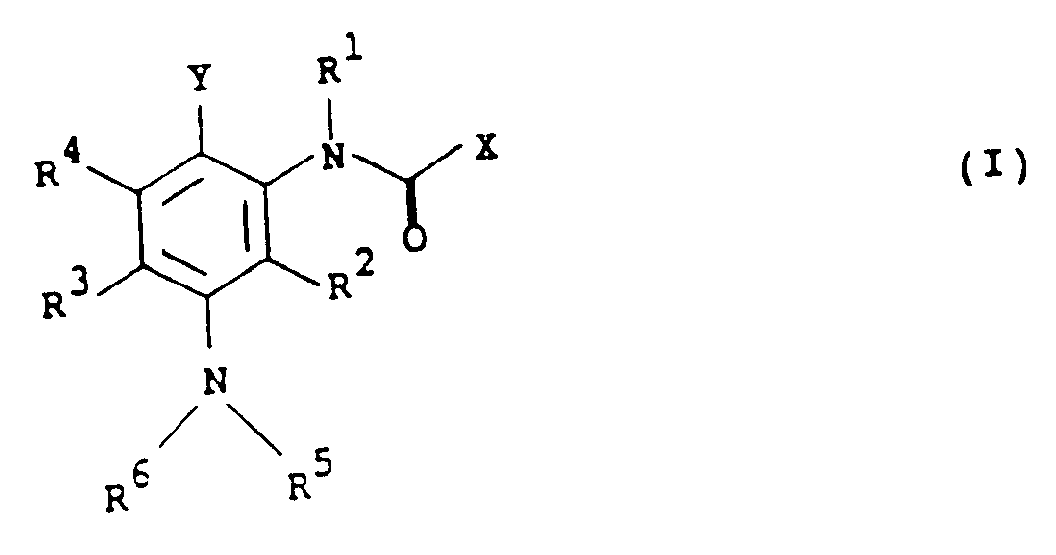


- Farbentwicklungsmittel der p-Phenylendiaminreihe oder ein Vorläufer davon nach Anspruch 1, worin das in einem Farbentwickler enthaltene Farbentwicklungsmittel oder ein Vorläufer davon im Bereich von 1 x 10⁻³ bis 1 x 10⁻¹ Mol/Liter vorhanden ist.
- Farbentwicklungsmittel der p-Phenylendiaminreihe oder ein Vorläufer davon nach Anspruch 1, worin das in einem farbphotographischen Material enthaltene Farbentwicklungsmittel oder ein Vorläufer davon im Bereich von 0,05 Mol bis 10 Mol pro Mol des Silbersalzoxidationsmittels vorhanden ist.
- Verfahren zum Erzeugen eines Bildes, welches das bildmäßige Belichten eines farbphotographischen Silberhalogenidmaterials und danach das Farbentwickeln des farbphotographischen Materials in Gegenwart eines Farbentwicklungsmittels der p-Phenylendiaminreihe oder eines Vorläufers davon mit einem Substituenten A in ortho-Stellung umfaßt:
Substituent A:

- Verfahren zum Erzeugen eines Bildes nach Anspruch 5, worin das Entwicklungsmittel eine Verbindung ist, die durch Formel (I) dargestellt ist:
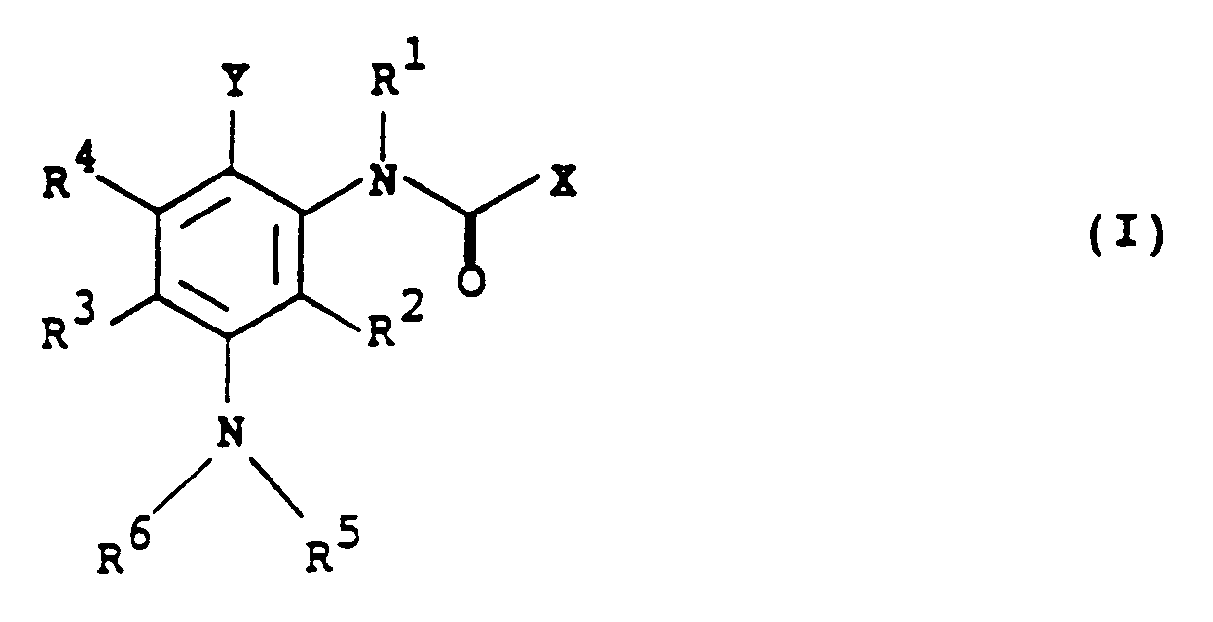


- Entwicklungszusammensetzung zum Entwickeln eines belichteten farbphotographischen Silberhalogenidmaterials, umfassend ein Farbentwicklungsmittel der p-Phenylendiaminreihe oder einen Vorläufer davon mit einem Substituenten A in ortho-Stellung;
Substituent A:

Applications Claiming Priority (2)
| Application Number | Priority Date | Filing Date | Title |
|---|---|---|---|
| JP1096619A JP2631552B2 (ja) | 1989-04-17 | 1989-04-17 | カラー現像主薬及び画像形成方法 |
| JP96619/89 | 1989-04-17 |
Publications (3)
| Publication Number | Publication Date |
|---|---|
| EP0393523A2 EP0393523A2 (de) | 1990-10-24 |
| EP0393523A3 EP0393523A3 (de) | 1991-10-16 |
| EP0393523B1 true EP0393523B1 (de) | 1995-12-13 |
Family
ID=14169864
Family Applications (1)
| Application Number | Title | Priority Date | Filing Date |
|---|---|---|---|
| EP90107078A Expired - Lifetime EP0393523B1 (de) | 1989-04-17 | 1990-04-12 | Farbentwickler und Bildherstellungsverfahren |
Country Status (4)
| Country | Link |
|---|---|
| US (1) | US5310634A (de) |
| EP (1) | EP0393523B1 (de) |
| JP (1) | JP2631552B2 (de) |
| DE (1) | DE69024087T2 (de) |
Families Citing this family (12)
| Publication number | Priority date | Publication date | Assignee | Title |
|---|---|---|---|---|
| US5223380A (en) * | 1990-05-14 | 1993-06-29 | Fuji Photo Film Co., Ltd. | Color developing agent and process for forming image |
| JP2759373B2 (ja) * | 1990-05-14 | 1998-05-28 | 富士写真フイルム株式会社 | カラー現像主薬及び画像形成方法 |
| EP0662632B1 (de) * | 1994-01-11 | 2004-04-07 | Fuji Photo Film Co., Ltd. | Lichtempfindliche Silberhalogenidemulsion und lichtempfindliches Silberhalogenidmaterial |
| JPH08248601A (ja) * | 1995-03-15 | 1996-09-27 | Fuji Photo Film Co Ltd | 発色現像主薬、処理組成物及びカラー画像形成方法 |
| US6506546B1 (en) * | 1999-12-30 | 2003-01-14 | Eastman Kodak Company | Imaging element containing a blocked photographically useful compound |
| US6312879B1 (en) * | 1999-12-30 | 2001-11-06 | Eastman Kodak Company | Photographic or photothermographic element containing a blocked photographically useful compound |
| US6319640B1 (en) | 2000-05-26 | 2001-11-20 | Eastman Kodak Company | Imaging element containing a blocked photographically useful compound |
| US6440618B1 (en) * | 2000-05-26 | 2002-08-27 | Eastman Kodak Company | Imaging element containing a blocked photographically useful compound |
| US6413708B1 (en) * | 2000-05-26 | 2002-07-02 | Eastman Kodak Company | Imaging element containing a blocked photographically useful compound |
| US6506528B1 (en) * | 2000-06-13 | 2003-01-14 | Eastman Kodak Company | Photothermographic element containing a mixture of blocked developers |
| US6472111B1 (en) * | 2000-06-13 | 2002-10-29 | Eastmank Kodak Company | Color photothermographic element containing a mixture of blocked developers for balancing imaging layers |
| US6610450B2 (en) * | 2000-06-13 | 2003-08-26 | Eastman Kodak Company | Thermally developable imaging system comprising a blocked color-forming agent in association with a hydroxy-substituted aromatic compound for promoting image formation |
Family Cites Families (10)
| Publication number | Priority date | Publication date | Assignee | Title |
|---|---|---|---|---|
| US3763141A (en) * | 1968-05-13 | 1973-10-02 | Eastman Kodak Co | Substituted azobenzene compounds |
| BE757902A (nl) * | 1969-10-27 | 1971-04-23 | Agfa Gevaert Nv | Methode van fotografische ontwikkeling |
| US4113491A (en) * | 1975-02-10 | 1978-09-12 | Konishiroku Photo Industry Co., Ltd. | Color photographic developing composition |
| DE2855883A1 (de) * | 1978-12-23 | 1980-07-10 | Hoechst Ag | Verfahren zur herstellung von aminobenzimidazolonen-(2) |
| JPS5616133A (en) * | 1979-07-18 | 1981-02-16 | Konishiroku Photo Ind Co Ltd | Photographic material |
| JPS5950043A (ja) * | 1982-09-17 | 1984-03-22 | Sumitomo Electric Ind Ltd | 定偏波フアイバの製造方法 |
| JPS601607A (ja) * | 1983-06-17 | 1985-01-07 | Matsushita Electric Ind Co Ltd | 磁気記録再生装置 |
| JPS6152643A (ja) * | 1984-08-21 | 1986-03-15 | Konishiroku Photo Ind Co Ltd | 熱現像カラ−感光材料 |
| EP0255734B1 (de) * | 1986-08-08 | 1993-01-13 | Fuji Photo Film Co., Ltd. | Verfahren zur Behandlung eines farbphotographischen Silberhalogenidmaterials und eine Farbentwicklungszusammensetzung |
| JPH02267547A (ja) * | 1989-04-10 | 1990-11-01 | Fuji Photo Film Co Ltd | カラー画像形成方法 |
-
1989
- 1989-04-17 JP JP1096619A patent/JP2631552B2/ja not_active Expired - Fee Related
-
1990
- 1990-04-12 EP EP90107078A patent/EP0393523B1/de not_active Expired - Lifetime
- 1990-04-12 DE DE69024087T patent/DE69024087T2/de not_active Expired - Fee Related
-
1991
- 1991-10-30 US US07/790,094 patent/US5310634A/en not_active Expired - Lifetime
Non-Patent Citations (1)
| Title |
|---|
| CHEMICAL ABSTRACTS, vol. 95, no. 1, July 6, 1981, Columbus, Ohio, US; HITACHI CHEM.: "Heat-resistant polymers", p. 40, column 1, abstract-no. 8 258x; & JP-A-80 147 527 * |
Also Published As
| Publication number | Publication date |
|---|---|
| DE69024087D1 (de) | 1996-01-25 |
| JP2631552B2 (ja) | 1997-07-16 |
| EP0393523A2 (de) | 1990-10-24 |
| EP0393523A3 (de) | 1991-10-16 |
| DE69024087T2 (de) | 1996-06-13 |
| JPH02275446A (ja) | 1990-11-09 |
| US5310634A (en) | 1994-05-10 |
Similar Documents
| Publication | Publication Date | Title |
|---|---|---|
| US5122444A (en) | Silver halide color photographic material containing a magenta couplers and color fading preventing agent | |
| EP0254280A2 (de) | Verfahren zur Behandlung eines farbphotographischen Silberhalogenidmaterials | |
| US5278034A (en) | Process for forming color image | |
| US4833068A (en) | Color photographic developing solution composition and method for processing a silver halide color photographic material | |
| EP0393523B1 (de) | Farbentwickler und Bildherstellungsverfahren | |
| JPH03206450A (ja) | 新規な色素形成カプラー及びそれを用いたハロゲン化銀カラー写真感光材料及びその処理方法 | |
| JP2726950B2 (ja) | カラー画像形成方法 | |
| JP2876075B2 (ja) | ハロゲン化銀カラー写真感光材料 | |
| JPH0234842A (ja) | ハロゲン化銀カラー写真感光材料 | |
| US5002862A (en) | Method for processing a silver halide color photographic material with a color developer comprising an aromatic primary amine precursor | |
| JP2592677B2 (ja) | ハロゲン化銀カラー写真感光材料 | |
| JP2964007B2 (ja) | カラー画像形成方法およびハロゲン化銀写真感光材料 | |
| JPH04191736A (ja) | ハロゲン化銀カラー写真感光材料 | |
| JPH0766170B2 (ja) | ハロゲン化銀カラー写真感光材料 | |
| JPH04190347A (ja) | 新規な色素形成カプラーおよび該カプラーを含有するハロゲン化銀カラー写真感光材料 | |
| JP2524819B2 (ja) | ピラゾロトリアゾ―ル系カプラ―を含有するハロゲン化銀カラ―写真感光材料および該カプラ―による画像形成方法 | |
| JP2631147B2 (ja) | 写真用現像主薬、該主薬を含む処理組成物およびそれを用いたカラー画像形成方法 | |
| JP2720232B2 (ja) | 発色現像主薬、処理液組成物およびカラー画像形成方法 | |
| JP2717478B2 (ja) | ハロゲン化銀カラー写真感光材料 | |
| JP2893097B2 (ja) | ハロゲン化銀カラー写真感光材料 | |
| JPH04285955A (ja) | ハロゲン化銀写真感光材料 | |
| JPH0262537A (ja) | ハロゲン化銀カラー写真感光材料 | |
| JPS6327841A (ja) | カラ−写真現像液組成物およびそれを用いる処理方法 | |
| JP2860411B2 (ja) | ハロゲン化銀カラー写真感光材料 | |
| EP0459210A1 (de) | Farbentwickler und Bildherstellungsverfahren |
Legal Events
| Date | Code | Title | Description |
|---|---|---|---|
| PUAI | Public reference made under article 153(3) epc to a published international application that has entered the european phase |
Free format text: ORIGINAL CODE: 0009012 |
|
| AK | Designated contracting states |
Kind code of ref document: A2 Designated state(s): BE DE FR GB IT NL |
|
| PUAL | Search report despatched |
Free format text: ORIGINAL CODE: 0009013 |
|
| AK | Designated contracting states |
Kind code of ref document: A3 Designated state(s): BE DE FR GB IT NL |
|
| 17P | Request for examination filed |
Effective date: 19920116 |
|
| 17Q | First examination report despatched |
Effective date: 19950202 |
|
| GRAA | (expected) grant |
Free format text: ORIGINAL CODE: 0009210 |
|
| AK | Designated contracting states |
Kind code of ref document: B1 Designated state(s): BE DE FR GB IT NL |
|
| PG25 | Lapsed in a contracting state [announced via postgrant information from national office to epo] |
Ref country code: IT Free format text: LAPSE BECAUSE OF FAILURE TO SUBMIT A TRANSLATION OF THE DESCRIPTION OR TO PAY THE FEE WITHIN THE PRE;WARNING: LAPSES OF ITALIAN PATENTS WITH EFFECTIVE DATE BEFORE 2007 MAY HAVE OCCURRED AT ANY TIME BEFORE 2007. THE CORRECT EFFECTIVE DATE MAY BE DIFFERENT FROM THE ONE RECORDED.SCRIBED TIME-LIMIT Effective date: 19951213 Ref country code: NL Free format text: LAPSE BECAUSE OF FAILURE TO SUBMIT A TRANSLATION OF THE DESCRIPTION OR TO PAY THE FEE WITHIN THE PRESCRIBED TIME-LIMIT Effective date: 19951213 Ref country code: FR Effective date: 19951213 Ref country code: BE Effective date: 19951213 |
|
| REF | Corresponds to: |
Ref document number: 69024087 Country of ref document: DE Date of ref document: 19960125 |
|
| EN | Fr: translation not filed | ||
| NLV1 | Nl: lapsed or annulled due to failure to fulfill the requirements of art. 29p and 29m of the patents act | ||
| PLBE | No opposition filed within time limit |
Free format text: ORIGINAL CODE: 0009261 |
|
| STAA | Information on the status of an ep patent application or granted ep patent |
Free format text: STATUS: NO OPPOSITION FILED WITHIN TIME LIMIT |
|
| 26N | No opposition filed | ||
| REG | Reference to a national code |
Ref country code: GB Ref legal event code: IF02 |
|
| REG | Reference to a national code |
Ref country code: GB Ref legal event code: 732E |
|
| PGFP | Annual fee paid to national office [announced via postgrant information from national office to epo] |
Ref country code: DE Payment date: 20080417 Year of fee payment: 19 |
|
| PGFP | Annual fee paid to national office [announced via postgrant information from national office to epo] |
Ref country code: GB Payment date: 20080416 Year of fee payment: 19 |
|
| GBPC | Gb: european patent ceased through non-payment of renewal fee |
Effective date: 20090412 |
|
| PG25 | Lapsed in a contracting state [announced via postgrant information from national office to epo] |
Ref country code: DE Free format text: LAPSE BECAUSE OF NON-PAYMENT OF DUE FEES Effective date: 20091103 |
|
| PG25 | Lapsed in a contracting state [announced via postgrant information from national office to epo] |
Ref country code: GB Free format text: LAPSE BECAUSE OF NON-PAYMENT OF DUE FEES Effective date: 20090412 |