EP0394663A1 - Ferrocen Derivate, oberflächenaktive Mittel, die sie enthalten, und Verfahren zur Herstellung von organischen Dünnfilmen - Google Patents
Ferrocen Derivate, oberflächenaktive Mittel, die sie enthalten, und Verfahren zur Herstellung von organischen Dünnfilmen Download PDFInfo
- Publication number
- EP0394663A1 EP0394663A1 EP90105058A EP90105058A EP0394663A1 EP 0394663 A1 EP0394663 A1 EP 0394663A1 EP 90105058 A EP90105058 A EP 90105058A EP 90105058 A EP90105058 A EP 90105058A EP 0394663 A1 EP0394663 A1 EP 0394663A1
- Authority
- EP
- European Patent Office
- Prior art keywords
- ferrocene derivatives
- represented
- general formula
- novel ferrocene
- novel
- Prior art date
- Legal status (The legal status is an assumption and is not a legal conclusion. Google has not performed a legal analysis and makes no representation as to the accuracy of the status listed.)
- Withdrawn
Links
- 0 *c1ccccc1 Chemical compound *c1ccccc1 0.000 description 2
- ZLCSFXXPPANWQY-UHFFFAOYSA-N CCc1cc(C)ccc1 Chemical compound CCc1cc(C)ccc1 ZLCSFXXPPANWQY-UHFFFAOYSA-N 0.000 description 1
Images


Classifications
-
- C—CHEMISTRY; METALLURGY
- C07—ORGANIC CHEMISTRY
- C07F—ACYCLIC, CARBOCYCLIC OR HETEROCYCLIC COMPOUNDS CONTAINING ELEMENTS OTHER THAN CARBON, HYDROGEN, HALOGEN, OXYGEN, NITROGEN, SULFUR, SELENIUM OR TELLURIUM
- C07F17/00—Metallocenes
- C07F17/02—Metallocenes of metals of Groups 8, 9 or 10 of the Periodic Table
-
- C—CHEMISTRY; METALLURGY
- C09—DYES; PAINTS; POLISHES; NATURAL RESINS; ADHESIVES; COMPOSITIONS NOT OTHERWISE PROVIDED FOR; APPLICATIONS OF MATERIALS NOT OTHERWISE PROVIDED FOR
- C09K—MATERIALS FOR MISCELLANEOUS APPLICATIONS, NOT PROVIDED FOR ELSEWHERE
- C09K23/00—Use of substances as emulsifying, wetting, dispersing, or foam-producing agents
-
- C—CHEMISTRY; METALLURGY
- C25—ELECTROLYTIC OR ELECTROPHORETIC PROCESSES; APPARATUS THEREFOR
- C25D—PROCESSES FOR THE ELECTROLYTIC OR ELECTROPHORETIC PRODUCTION OF COATINGS; ELECTROFORMING; APPARATUS THEREFOR
- C25D9/00—Electrolytic coating other than with metals
- C25D9/02—Electrolytic coating other than with metals with organic materials
Definitions
- the present invention relates to novel ferrocene derivatives, surfactants containing them and a process for producing organic thin films, more particularly to novel ferrocene derivatives having a structure in which an anion group including alkali metals is contained in the side chain bonded to a ferrocene skeleton; surfactants containing said ferrocene derivatives, and capable of making hydrophobic organic substances including phthalocyanine soluble, and a process for making hydrophobic organic substances soluble using said surfactants and a process of producing thin films thereof.
- coloring matters such as phthalocyanine or its derivatives are insoluble in water, and although they are soluble in organic solvents such as chloronaphthalene, dimethylformamide (DMF), tetrahydrofuran (THF) and the like and concentrated sulfuric acid, their soluble amounts are small and the solubility is as small as several milligrams.
- organic solvents such as chloronaphthalene, dimethylformamide (DMF), tetrahydrofuran (THF) and the like and concentrated sulfuric acid
- the present inventors' group has previously developed ferrocene derivatives having polyoxyethylene chain as surfactants to make coloring matters such as phthalocyanine or its derivatives, or water-insoluble polymers and the like soluble, and at the same time have developed a process for forming organic thin films by applying so-called Micellar Disruption Method by use of said ferrocene derivatives (PCT International Publication W089/01939).
- the present inventors have made extensive investigations to develop a process for improving the abovementioned surfactants, making the oxidation-reduction reaction of ferrocene derivatives in Micellar Disruption Method proceed smoothly, and improving the productivity of organic thin films much more.
- An object of the present invention is to provide novel ferrocene derivatives.
- Another object of the present invention is to provide surfactants containing the above mentioned novel ferrocene derivatives.
- a further object of the present invention is to provide a process for making hydrophobic organic substances soluble using surfactants containing ferrocene derivatives.
- a still further object of the present invention is to provide a process for efficiently producing organic thin films.
- the present invention provides novel ferrocene derivatives represented by the general formula; wherein R' and R 2 are each a hydrogen, a methyl group, a methoxyl group, an amino group, a dimethylamino group, a hydroxyl group or halogen, X is -CH 2 -, -O-, M is alkali metal, a is an integer of 1 to 4, b is an integer of 1 to 5, k is an integer of 1 to 18 and m is an integer of 0 to 4, and surfactants containing said novel ferrocene derivatives and provides a process for making hydrophobic organic substances soluble, characterized by doing so in aqueous medium using surfactants containing the beforementioned novel ferrocene derivatives, and also a process for producing organic thin films, characterized by forming thin films of the beforementioned hydrophobic organic substances on the electrode by electrolyzing micelle solution obtained by the above process.
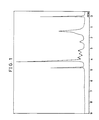
- Figs. 1 to 4 show the H-NMR spectrums of the ferrocene derivatives obtained in Examples 1 to 4, respectively.
- Ferrocene derivatives of the present invention are represented by the general formula [I], therein each symbol is as defined as before.
- R' and R 2 are independently a hydrogen (H), a methyl group (CH 3 ), a methoxyl group (CH 3 0), an amino group (NH z ), a dimethylamino group (N(CH 3 ) 2 ), a hydroxyl group (OH) or a halogen (chlorine, bromine, fluorine and the like).
- R 1 and R 2 may be identical or different.
- a is an integer of 1 to 4
- b is an integer of 1 to 5.
- R 1 and R 2 when plural substituents are present, they may be identical or different.
- X which is present in the carbon chain of side chain of ferrocene ring, is -CH 2 -, -0-, or -NH- and as for the number of carbon chains which are present at both terminals thereof, that is k and m, k is 1 to 18, preferably 5 to 13, and m is 0 to 4, preferably 0 to 2.
- Ferrocene derivatives of the present invention have an anion represented by Y at the terminal of side chain bonded to ferrocene ring.
- Said Y is wherein M is alkali metal, that is, lithium, sodium, potassium and the like.
- novel ferrocene derivatives represented by the general formula [I] can be produced by various methods. Specifically, when X is an oxygen -0-, Y is a group represented by in solvents such as methylene chloride, carbon disulfide, carbon tetrachloride, nitrobenzene and so on, the ferrocene having a substituent represented by the general formula: (wherein R 1 , R 2 , a and b are the same as defined before) is reacted with halogenated acyl having an ester group represented by the general formula; C l (CH 2 ) k-2 OR 3 [ III ] (wherein k is the same as defined before, R 3 is a methyl group or an ethyl group, k satisfies the following expression: k - 2 ⁇ 0), in the presence of Friedel-Crafts catalysts (e.g.
- the compound of the general formula [IV] is subjected to reduction in aprotic polar solvents such as diethylether, 1,2-dimethoxyethane, tetrahydrofuran, dioxane and so on, in the presence of aluminum chloride and sodium borohydride or lithium aluminum hydride, at 30 to 100°C for 0.5 to 10 hours, while refluxing, to obtain the compound represented by the general formula; (wherein R', R 2 , a, b and k are the same as defined before).
- aprotic polar solvents such as diethylether, 1,2-dimethoxyethane, tetrahydrofuran, dioxane and so on
- the compound represented by the general formula [V]. wherein k is 1, is obtained by reducing the ferrocene compounds represented by the general formula: (wherein R', R 2 , a and b are the same as defined before) in aprotic polar solvents such as 1,2-dimethoxyethane. diethylether, tetrahydrofuran, dioxane and so on, in the presence of lithium aluminum hydride and sodium borohydride.
- aprotic polar solvents such as 1,2-dimethoxyethane. diethylether, tetrahydrofuran, dioxane and so on
- the compound of the general formula [V] is reacted with the compound represented by the general formula: Br(CH 2 ) m S0 3 M [VI] (wherein M is alkali metal and m is an integer of 1 to 4), in the solvents such as N,N -dimethylformamide; N,N'-dimethylacetoamide; hexamethyl phosphoric triamide (HMPA) and so on, or without solvents, in the presence of alkali metal (e.g., lithium, potassium, sodium and the like) or sodium hydride, at 50 °C to 200 C for 5 to 30 hours, to obtain the compound of the present invention represented by the general formula; wherein R 1 , R 2 , M, m, a, b and k are the same as defined before.
- alkali metal e.g., lithium, potassium, sodium and the like
- the compound represented by the general formula [V] is reacted with phosphorus oxychloride (POCl 3 ) in the presence of catalyst of tertiary amine such as triethylamine, pyridine and so on or without using a catalyst, in aprotic solvent or without solvent, at 0°C to 50°C for 0.5 to 8 hours, to obtain the compound represented by the general formula; wherein R 1 , R 2 , a, b and k are the same as defined above.
- POCl 3 phosphorus oxychloride
- the compound of the general formula [VII] is treated in water or in a mixed solvent of water and aprotic solvent (diethylether, 1,2-dimethoxyethane, chloroform and so on) at 0°C to reflux temperature, to obtain the compound represented by the general formula; wherein R 1 , R 2 , a, b and k are the same as defined above.
- aprotic solvent diethylether, 1,2-dimethoxyethane, chloroform and so on
- the compound was neutralized using an alkali aqueous solution such as sodium hydroxide, potassium hydroxide, lithium hydroxide and so on or using a weak basic aqueous solution such as sodium carbonate, potassium carbonate, lithium carbonate and so on, to obtain the compound of the present invention represented by the general formula; wherein R 1 , R 2 , M, a, b and k are the same as defined before.
- alkali aqueous solution such as sodium hydroxide, potassium hydroxide, lithium hydroxide and so on
- a weak basic aqueous solution such as sodium carbonate, potassium carbonate, lithium carbonate and so on
- Y is a group represented by - -OM
- the following method can be employed. That is, the compound of the above general formula [IV] is reacted with alkali hydroxide such as sodium hydroxide, potassium hydroxide and lithium hydroxide in solvents such as ethyl alcohol, methyl alcohol, water and so on, while refluxing at 10 to 100° C for 0.5 to 10 hours, and then acidified by treatment with hydrochloric acid, to obtain the compound represented by the general formula; wherein R 1 , R 2 , k, a and b are the same as defined before.
- alkali hydroxide such as sodium hydroxide, potassium hydroxide and lithium hydroxide
- solvents such as ethyl alcohol, methyl alcohol, water and so on
- the compound of the general formula [IX] is subjected to Clemmensen reduction with zinc or zinc amalgam (Zn-HgCl 2 , Zn-HgBr 2 and so on) and concentrated hydrochloric acid in a solvents such as 1,2-dimethoxyethane, toluene and acetic acid and so on at 10 to 120 C for 1 to 20 hours, to obtain the compound represented by the general formula; (wherein R', R 2 , k, a and b are the same as defined before).
- the compound is neutralized with alkaline aqueous solutions such as sodium hydroxide, potassium hydroxide, lithium hydroxide so on, to obtain the compound of the present invention represented by the general formula; wherein R', R 2 , M, k, a and b are the same as defined before.
- novel ferrocene derivatives of the present invention are useful as surfactants, and can be used particularly as surfactants (micelle forming agents) for making hydrophobic organic substances soluble to aqueous medium.
- surfactants micelle forming agents
- the ferrocene derivatives of the present invention can be used solely or as a mixture of plural ferrocene derivatives.
- the surfactant of the present invention contains the ferrocene derivatives represented by the above general formula [I] (containing the above mentioned general formulae [I'] to [I''']), as a main component, and various additives can be added thereto appropriately.
- the surfactant of the present invention is capable of making various hydrophobic substances soluble to aqueous medium.
- These hydrophobic organic substances are in variety. Specific examples of them are, coloring matters for optical memory and organic coloring matters such as phthalocyanine, metal complexes thereof, and derivatives thereof, naphthalocyanine, metal complexes thereof and derivatives thereof, porphyrin and metal complexes thereof, and derivatives thereof; electrochromic materials such as 1,1-diheptyl-4,4 -bipyridinium dibromide, 1,1 -didodecyl-4,4 -bipyridinium dibromide and the like; lightsensitive materials (photochromic materials) and light sensor materials such as 6-nitro-1,3,3-trimethylspiro-(2'H-1'-benzopyran-2,2'-indotine) (commonly called spiropyran) and the like; liquid crystal display coloring matters such as p-azoxyanisole and the like.
- electrically conductive organic materials and gas sensor materials such as the 1:1 complex of 7,7,8,8-tetracyanoquinonedimethane (TCNQ) and tetrathiafulvalene (TTF), light curing paints such as pentaerythritol diacrylate and the like, insulating materials such as stearic acid and the like, diazo-type light-sensitive materials and paints such as 1-phenylazo-2-naphthol and the like.
- water-insoluble polymers for example, general purpose polymers such as polycarbonate, polystyrene, polyethylene, polypropylene, polyamide, polyphenylene sulfide (PPS), polyphenylene oxide (PPO), polyacrylonitrile (PAN) and the like, polyphenylene, polypyrrole, polyaniline, polythiophene, acetyl cellulose, polyvinyl acetate, polyvinyl butyral, and various polymers (polyvinyl pyridine and the like) or copolymers (a copolymer of methyl methacrylate and methacrylic acid).
- general purpose polymers such as polycarbonate, polystyrene, polyethylene, polypropylene, polyamide, polyphenylene sulfide (PPS), polyphenylene oxide (PPO), polyacrylonitrile (PAN) and the like, polyphenylene, polypyrrole, polyaniline, polythiophene, acetyl cellulose, polyviny
- ferrocene derivatives of the present invention are various embodiments. Particularly in a process for making hydrophobic organic materials soluble and in production of the organic thin films of the present invention, they are effectively used as micelle forming agents.
- a surfactant composed of novel ferrocene derivatives represented by the above general formula [I] (micelle forming agent, concentration: not lower than the limit micelle concentration), a supporting salt if necessary, and a hydrophobic organic substances (concentration: not lower than the saturation) are placed in a vessel and thoroughly dispersed by the use of supersonic waves, a homogenizer, or a stirrer, to form a micelle.
- an excessive hydrophobic organic substance is removed and after that, the soluble solution (micelle solution) of the hydrophobic organic substances thus obtained is subjected to electrolytic treatment using the electrode while allowing it to stand or be stirred somewhat.
- hydrophobic organic substances may be supplimentarily added to the micelle solution; or there may be provided a recycle circuit in which the micelle solution in the vicinity of the anode is withdrawn out of the system, the hydrophobic organic substance is added to the withdrawn micelle solution and thoroughly stirred, and then the resulting solution is returned to the vicinity of the cathode.
- Electrolytic conditions are determined appropriately depending on various circumstances.
- the liquid temperature is 0 to 70 C and preferably 20 to 30 C
- the voltage is 0.03 to 1.5 V and preferably 0.1 to 0.5 V
- the current density is not more than 10 mA/cm 2 , preferably 50 to 300 uA/cm2.
- the oxidation-reduction reaction in the ferrocene derivatives proceeds.
- Fe 2+ is converted into Fe 3+ on an anode, leading to the breakdown of the micelle, and particles (about 600 to 900 A) of a hydrophobic organic substance are deposited on the anode.
- Fe 3+ oxidized on the anode is reduced to Fe 2+ , recovering the original micelle and, therefore, a film forming operation can be carried out repeatedly using the same solution.
- novel ferrocene derivatives to be used in a process of the present invention contain an anion group in the side chain bonded to the ferrocene skeleton, the solubility of hydrophobic organic substances can be improved and further, the above oxidation-reduction reaction proceeds very efficiently, and accordingly thin films can be formed in a short time.
- Electrolytic treatment as described above forms a thin film comprised of about 600 to 900 A particles of the desired hydrophobic organic substance on the anode.
- the supporting salt (supporting electrolyte) to be used in the process of the present invention as described above is added, if necessary, in order to control the electrical conductance of the aqueous medium.
- the amount of the supporting salt added is usually about 0 to 300 times, preferably 10 to 200 times that of the above surfactant (micelle forming agent).
- Electrolysis may be carried out without using this supporting salt, and in this case, a high purity thin film containing no supporting salt can be prepared.
- the kinds of the supporting salt are not particularly limited so long as it can control the electrical conductance of the aqueous medium without preventing formation of the micelle or deposition of the above hydrophobic organic substances on the electrode.
- sulfuric acid salts salts of lithium, potassium, sodium, rubidium, aluminum and so on
- acetic acid salts salts of lithium, potassium, sodium, rubidium, beryllium, magnesium, calcium, strontium, barium or aluminum and so on
- salts of halides salts of lithium, potassium, sodium, rubidium, calcium, magnesium, aluminum and so on
- salts of water-soluble oxides salts of lithium, potassium, sodium, rubidium, calcium, magnesium, aluminum and so on
- the material of the electrode to be used in the process of the present invention is sufficient if it is a metal more noble than the oxidation-reduction potential (against +0.15 V to +0. 30 V saturated calomel electrode) of the ferrocene derivatives or an electrically conductive substance. More specifically, ITO (mixed oxide of indium oxide and tin oxide), platinum, gold, silver, glassy carbon, electrically conductive metal oxides, electrically conductive polymers and the like may be named.
- the ferrocene derivatives of the present invention are novel compounds and can be used in various applications, for example, as surfactants (micelle forming agents), catalysts, auxiliary fuels, flotation agents, lubricating aides, dispersants, liquid crystal and the like.
- the novel ferrocene derivatives when used as surfactans (micelle forming agents), form micelles in an aqueous solution system and, therefore, can make various hydrophobic organic substances soluble such as coloring matters including phthalocyanine, having a wide variety of applications and various hydrophobic polymers, and the solubility is high.
- an organic thin film of extraordinary small thickness can be formed.
- the film is formed at a very high productivity rate, since the oxidation-reduction efficiency of the said surfactant is excellent.
- the organic thin film formed according to the process of the present invention can be effectively utilized in various fields including photoconductor materials, light-sensitive materials and solar batteries.
- the reaction solution was extracted with a mixture of equal amounts of water and ethyl acetate, and the residue obtained by concentrating the aqueous layer was recrystallized with a mixed solvent of ethanol and water to obtain 3.5 g of the purified product (yield: 51 %).
- ferrocene derivative obtained in Example 1 was added to 100 cc of water.
- surfactant micelle forming agent
- To 20 cc of the resulting solution 0.1 g of phthalocyanine' was added and stirred to disperse and dissolve by ultrasonic wave for 10 minutes, followed by stirring for 2 days and nights with a stirrer. Then, the obtained micelle solution (dispersed solution) was subjected to centrifugal separation for 30 minutes at 2000 rpm.
- lithium bromide was added so that the concentration became 0.1 M, and was stirred for 10 minutes with a stirrer.
- a micelle forming agent composed of ferrocene derivative obtained in Example 2 was added to 100 cc of water.
- a micelle forming agent composed of ferrocene derivative obtained in Example 2 to make 2 mM solution.
- 0.1 g of phthalocyanine produced by Tokyo Kasei Co., Ltd. was added and stirred to disperse and dissolve by ultrasonic wave for 10 minutes, followed by stirring for 2 days and nights with a stirrer. Then, the obtained dispersed and soluble micelle solution was subjected to centrifugal separation for 30 minutes at 2000 rpm.
- lithium bromide was added so that the concentration became 0.1 M, and was stirred with a stirrer for 10 minutes.
- this solution as an electrolyte, as well as by using the ITO transparent glass electrode as the anode, a platinum as the cathode and a saturated calomel electrode as the reference electrode, controlled potential electrolysis was carried out at 25 C, at an applied voltage of 0.5 V and an electric current density of 12.3 aA/cM2, for 30 minutes. The amount of electric current was 0.02 C.
- a micelle forming agent composed of ferrocene derivative obtained in Example 3 was added to 100 cc of water and a micelle forming agent composed of ferrocene derivative obtained in Example 3 to make 2 mM solution.
- 0.1 g of phthalocyanine produced by Tokyo Kasei Co., Ltd. was added and stirred to disperse and dissolve by ultrasonic wave for 10 minutes, followed by stirring for 2 days and nights with a stirrer. Then, the obtained dispersed and soluble micelle solution was subjected to centrifugal separation for 30 minutes at 2000 rpm.
- lithium bromide was added so that the concentration became 0.1 M, and was stirred with a stirrer for 10 minutes.
- this solution as an electrolyte, as well as by using the ITO transparent glass electrode as the anode, a platinum as the cathode and a saturated calomel electrode as the reference electrode, controlled potential electrolysis was carried out at 25 C, at an applied voltage of 0.5 V and an electric current density of 8.9 a A/cm 2 , for 30 minutes. The amount of electric current was 0.15 C.
- a micelle forming agent composed of ferrocene derivative obtained in Example 4 was added to 100 cc of water.
- a micelle forming agent composed of ferrocene derivative obtained in Example 4 to make 2 mM solution.
- 0.1 g of phthalocyanine produced by Tokyo Kasei Co., Ltd. was added and stirred to disperse and dissolve by ultrasonic wave for 10 minutes, followed by stirring for 2 days and nights with a stirrer. Then, the obtained dispersed and soluble micelle solution was subjected to centrifugal separation for 30 minutes at 2000 rpm.
- lithium bromide was added so that the concentration became 0.1 M, and was stirred with a stirrer for 10 minutes.
- this solution as an electrolyte, as well as by using the ITO transparent glass electrode as the anode, a platinum as the cathode and a saturated calomel electrode as the reference electrode, controlled potential electrolysis was carried out at 25 C, at the applied voltage of 0.5 V and an electric current density of 4.1 ⁇ A/cm 2 , for 30 minutes. The amount of electric current was 0.61 C.
- a micelle forming agent composed of ferrocene derivative obtained in the structural formula 1 to make 2 mM solution.
- a micelle forming agent composed of ferrocene derivative obtained in the structural formula 1 to make 2 mM solution.
- 0.1 g of phthalocyanine produced by Tokyo Kasei Co., Ltd. was added and stirred to disperse and dissolve by ultrasonic wave for 10 minutes, followed by stirring for 2 days and nights with a stirrer. Then, the resulting dispersed and soluble micelle solution was subjected to centrifugal separation for 30 minutes at 2000 rpm.
- lithium bromide was added so that the concentration became 0.1 M, and was stirred with a stirrer for 10 minutes.
- this solution as an electrolyte, as well as by using the ITO transparent glass electrode as the anode, a platinum as the cathode and a saturated calomel electrode as the reference electrode, controlled potential electrolysis was carried out at 25 C, at an applied voltage of 0.5 V and an electric current density of 16.7 ⁇ A/cm 2 , for 30 minutes. The amount of electric current was 0.03 C.
Landscapes
- Chemical & Material Sciences (AREA)
- Organic Chemistry (AREA)
- Engineering & Computer Science (AREA)
- Materials Engineering (AREA)
- Chemical Kinetics & Catalysis (AREA)
- Electrochemistry (AREA)
- Metallurgy (AREA)
- Emulsifying, Dispersing, Foam-Producing Or Wetting Agents (AREA)
- Colloid Chemistry (AREA)
- Physical Or Chemical Processes And Apparatus (AREA)
Applications Claiming Priority (2)
| Application Number | Priority Date | Filing Date | Title |
|---|---|---|---|
| JP70680/89 | 1989-03-24 | ||
| JP1070680A JPH02250892A (ja) | 1989-03-24 | 1989-03-24 | 新規フェロセン誘導体,それを含有する界面活性剤及び有機薄膜の製造方法 |
Publications (1)
| Publication Number | Publication Date |
|---|---|
| EP0394663A1 true EP0394663A1 (de) | 1990-10-31 |
Family
ID=13438603
Family Applications (1)
| Application Number | Title | Priority Date | Filing Date |
|---|---|---|---|
| EP90105058A Withdrawn EP0394663A1 (de) | 1989-03-24 | 1990-03-17 | Ferrocen Derivate, oberflächenaktive Mittel, die sie enthalten, und Verfahren zur Herstellung von organischen Dünnfilmen |
Country Status (5)
| Country | Link |
|---|---|
| US (1) | US5041582A (de) |
| EP (1) | EP0394663A1 (de) |
| JP (1) | JPH02250892A (de) |
| KR (1) | KR900014417A (de) |
| CA (1) | CA2012638A1 (de) |
Cited By (1)
| Publication number | Priority date | Publication date | Assignee | Title |
|---|---|---|---|---|
| EP1263752A4 (de) * | 2000-03-17 | 2003-07-30 | Univ Tennessee Res Corp | Agonisten und antagonisten für den lpa-rezeptor und anwendungsmethoden |
Families Citing this family (15)
| Publication number | Priority date | Publication date | Assignee | Title |
|---|---|---|---|---|
| US5185074A (en) * | 1988-08-15 | 1993-02-09 | Idemitsu Kosan Co., Ltd. | Process for producing color filter |
| US5135619A (en) * | 1988-10-01 | 1992-08-04 | Idemitsu Kosan Co., Inc. | Process for producing organic thin films |
| US5203974A (en) * | 1988-12-17 | 1993-04-20 | Idemitsu Kosan Co., Ltd. | Process for producing thin films |
| US5122247A (en) * | 1988-12-17 | 1992-06-16 | Idemitsu Kosan Co., Ltd. | Process for producing thin films |
| EP0424547B1 (de) * | 1989-05-12 | 1998-08-19 | Idemitsu Kosan Company Limited | Verfahren zur herstellung von ferrocenoylderivaten |
| JP2774351B2 (ja) * | 1990-03-26 | 1998-07-09 | 出光興産株式会社 | 有機薄膜エレクトロルミネッセンス素子及びその製造方法 |
| US5270473A (en) * | 1991-05-16 | 1993-12-14 | American Cyanamid Company | N-[(pentaalkyl-cyclopentadienyl)methyl]-glycines, process for the preparation of the compounds and the use thereof in the manufacture of N-phosphonomethylglycine |
| US5210277A (en) * | 1991-05-16 | 1993-05-11 | American Cyanamid Company | N-[pentaalkyl-cyclopentadienyl)methyl]-glycines |
| US5327373A (en) * | 1992-08-21 | 1994-07-05 | Board Of Regents, The University Of Texas System | Optoelectronic memories with photoconductive thin films |
| US6620954B1 (en) * | 2002-03-25 | 2003-09-16 | Eastman Chemical Company | Phosphinometallocenylamides as novel ligands for asymmetric catalysis |
| TWI274082B (en) * | 2002-10-31 | 2007-02-21 | Praxair Technology Inc | Methods for making metallocene compounds |
| US20090203928A1 (en) * | 2008-01-24 | 2009-08-13 | Thompson David M | Organometallic compounds, processes for the preparation thereof and methods of use thereof |
| US20090205538A1 (en) * | 2008-01-24 | 2009-08-20 | Thompson David M | Organometallic compounds, processes for the preparation thereof and methods of use thereof |
| US20090208670A1 (en) * | 2008-01-24 | 2009-08-20 | Thompson David M | Organometallic compounds, processes for the preparation thereof and methods of use thereof |
| US20090200524A1 (en) * | 2008-01-24 | 2009-08-13 | Thompson David M | Organometallic compounds, processes for the preparation thereof and methods of use thereof |
Citations (3)
| Publication number | Priority date | Publication date | Assignee | Title |
|---|---|---|---|---|
| DE1618229A1 (de) * | 1966-05-12 | 1970-12-10 | Colgate Palmolive Co | Verfahren zur Herstellung von carbocyclischen Ferrocenen |
| US3996377A (en) * | 1973-12-10 | 1976-12-07 | Nesmeyanov Alexander Nikolaevi | Medicinal preparation for treating parodontosis and method of treating parodontosis |
| WO1989001939A1 (fr) * | 1987-08-28 | 1989-03-09 | Idemitsu Kosan Company Limited | Derives de ferrocene, agents tensio-actifs contenant de tels derives et procede de production d'un mince film organique |
Family Cites Families (5)
| Publication number | Priority date | Publication date | Assignee | Title |
|---|---|---|---|---|
| JPS5714332B2 (de) * | 1972-07-31 | 1982-03-24 | ||
| IL46027A (en) * | 1973-11-21 | 1977-06-30 | Fisons Ltd | Organo-metallic compounds their preparation and pharmaceutical compositions containing them |
| IL48713A0 (en) * | 1975-01-15 | 1976-02-29 | Fisons Ltd | Novel ferrocene derivatives,their production and pharmaceutical compositions containing them |
| DD234274A1 (de) * | 1984-12-27 | 1986-03-26 | Adw Ddr | Verfahren zur herstellung nichtionischer und anionischer grenzflaechenaktiver ferrocenderivate |
| JPH0296585A (ja) * | 1988-10-01 | 1990-04-09 | Idemitsu Kosan Co Ltd | 新規フェロセン誘導体,界面活性剤及び有機薄膜の製造方法 |
-
1989
- 1989-03-24 JP JP1070680A patent/JPH02250892A/ja active Pending
-
1990
- 1990-03-12 US US07/491,510 patent/US5041582A/en not_active Expired - Fee Related
- 1990-03-17 EP EP90105058A patent/EP0394663A1/de not_active Withdrawn
- 1990-03-20 CA CA002012638A patent/CA2012638A1/en not_active Abandoned
- 1990-03-22 KR KR1019900003964A patent/KR900014417A/ko not_active Ceased
Patent Citations (3)
| Publication number | Priority date | Publication date | Assignee | Title |
|---|---|---|---|---|
| DE1618229A1 (de) * | 1966-05-12 | 1970-12-10 | Colgate Palmolive Co | Verfahren zur Herstellung von carbocyclischen Ferrocenen |
| US3996377A (en) * | 1973-12-10 | 1976-12-07 | Nesmeyanov Alexander Nikolaevi | Medicinal preparation for treating parodontosis and method of treating parodontosis |
| WO1989001939A1 (fr) * | 1987-08-28 | 1989-03-09 | Idemitsu Kosan Company Limited | Derives de ferrocene, agents tensio-actifs contenant de tels derives et procede de production d'un mince film organique |
Non-Patent Citations (1)
| Title |
|---|
| CHEMICAL ABSTRACTS * |
Cited By (3)
| Publication number | Priority date | Publication date | Assignee | Title |
|---|---|---|---|---|
| EP1263752A4 (de) * | 2000-03-17 | 2003-07-30 | Univ Tennessee Res Corp | Agonisten und antagonisten für den lpa-rezeptor und anwendungsmethoden |
| US6875757B2 (en) | 2000-03-17 | 2005-04-05 | University Of Tennessee Research Foundation | LPA receptor agonists and antagonists and methods of use |
| EP1918287A3 (de) * | 2000-03-17 | 2008-08-20 | The University Of Tennessee Research Corporation | LPA-Rezeptor-Agonist und -Antagonist sowie Verwendungsverfahren dafür |
Also Published As
| Publication number | Publication date |
|---|---|
| JPH02250892A (ja) | 1990-10-08 |
| CA2012638A1 (en) | 1990-09-24 |
| US5041582A (en) | 1991-08-20 |
| KR900014417A (ko) | 1990-10-23 |
Similar Documents
| Publication | Publication Date | Title |
|---|---|---|
| US5041582A (en) | Novel ferrocene derivatives, surfactants containing same and process for producing organic thin films | |
| JP3525403B2 (ja) | 電極材料及び二次電池 | |
| DE69015906T2 (de) | Fluorierte Thiophene, von diesen Thiophenen abgeleitete leitfähige Polymere, Verfahren zu deren Herstellung und diese Polymere enthaltende Vorrichtungen. | |
| US5135637A (en) | Eerrocene derivatives, surfactants containing same and process for producing organic thin films | |
| US5082539A (en) | Ferrocene compounds and uses thereof | |
| EP0362672A2 (de) | Ferrocenderivate, diese enthaltende oberflächenaktive Mittel und ein Verfahren zur Herstellung dünner organischer Filme | |
| EP0331745B1 (de) | Ferrocenderivate, oberflächenaktive mittel, die diese enthalten und verfahren zur herstellung dünner organischer filme | |
| WO1991008507A1 (en) | Charge transfer salts and uses thereof | |
| US4816536A (en) | Polymers of 3,4-substituted pyrrole compounds and their preparation method | |
| JPH0296585A (ja) | 新規フェロセン誘導体,界面活性剤及び有機薄膜の製造方法 | |
| US5135619A (en) | Process for producing organic thin films | |
| JPS61293962A (ja) | ラジカルイオン塩 | |
| JPH02256693A (ja) | 新規フェロセン誘導体,それを含有する界面活性剤及び有機薄膜の製造方法 | |
| JPH02256692A (ja) | 新規フェロセン誘導体,それを含有する界面活性剤及び有機薄膜の製造方法 | |
| CA1329622C (en) | Ferrocene derivatives, surfactants containing them and process for producing organic thin film | |
| JPH0794718B2 (ja) | 有機薄膜の製造方法 | |
| JPH02250893A (ja) | 新規フェロセン誘導体,それを含有する界面活性剤及び有機薄膜の製造方法 | |
| JPH02173295A (ja) | 薄膜の製造法 | |
| JPH0751594B2 (ja) | 新規フェロセン誘導体,その製造方法及び薄膜の製造方法 | |
| JPH0725782B2 (ja) | 新規フェロセン誘導体,界面活性剤及び有機薄膜の製造方法 | |
| US5331072A (en) | Polyazopyrroles and electric cells based thereon | |
| JPH0633298B2 (ja) | フェロセン誘導体及びそれを含有する界面活性剤 | |
| CA1339135C (en) | Ferrocene derivatives and process for producing organic thim films | |
| JPH0662655B2 (ja) | 新規フェロセン誘導体,それを含有する界面活性剤及び有機薄膜の製造方法 | |
| JPWO1989001939A1 (ja) | フェロセン誘導体及びそれを含有する界面活性剤 |
Legal Events
| Date | Code | Title | Description |
|---|---|---|---|
| PUAI | Public reference made under article 153(3) epc to a published international application that has entered the european phase |
Free format text: ORIGINAL CODE: 0009012 |
|
| AK | Designated contracting states |
Kind code of ref document: A1 Designated state(s): BE CH DE FR GB IT LI NL SE |
|
| 17P | Request for examination filed |
Effective date: 19901215 |
|
| 17Q | First examination report despatched |
Effective date: 19930527 |
|
| STAA | Information on the status of an ep patent application or granted ep patent |
Free format text: STATUS: THE APPLICATION IS DEEMED TO BE WITHDRAWN |
|
| 18D | Application deemed to be withdrawn |
Effective date: 19940309 |