EP0396790A1 - Verfahren zur Entfernung von Nitrat und organischen Verunreinigungen aus Abwässern - Google Patents
Verfahren zur Entfernung von Nitrat und organischen Verunreinigungen aus Abwässern Download PDFInfo
- Publication number
- EP0396790A1 EP0396790A1 EP89108278A EP89108278A EP0396790A1 EP 0396790 A1 EP0396790 A1 EP 0396790A1 EP 89108278 A EP89108278 A EP 89108278A EP 89108278 A EP89108278 A EP 89108278A EP 0396790 A1 EP0396790 A1 EP 0396790A1
- Authority
- EP
- European Patent Office
- Prior art keywords
- nitrate
- process according
- effluent
- organic
- amine
- Prior art date
- Legal status (The legal status is an assumption and is not a legal conclusion. Google has not performed a legal analysis and makes no representation as to the accuracy of the status listed.)
- Granted
Links
- 229910002651 NO3 Inorganic materials 0.000 title claims abstract description 55
- 238000000034 method Methods 0.000 title claims abstract description 54
- 230000008569 process Effects 0.000 title claims abstract description 50
- NHNBFGGVMKEFGY-UHFFFAOYSA-N Nitrate Chemical compound [O-][N+]([O-])=O NHNBFGGVMKEFGY-UHFFFAOYSA-N 0.000 title claims abstract description 46
- 239000002957 persistent organic pollutant Substances 0.000 title description 6
- 239000012074 organic phase Substances 0.000 claims abstract description 18
- 239000003960 organic solvent Substances 0.000 claims abstract description 15
- 150000003839 salts Chemical group 0.000 claims abstract description 13
- 239000007788 liquid Substances 0.000 claims abstract description 7
- 238000005342 ion exchange Methods 0.000 claims abstract description 6
- 150000003973 alkyl amines Chemical class 0.000 claims abstract description 4
- 238000010924 continuous production Methods 0.000 claims abstract description 4
- QAOWNCQODCNURD-UHFFFAOYSA-N Sulfuric acid Chemical compound OS(O)(=O)=O QAOWNCQODCNURD-UHFFFAOYSA-N 0.000 claims description 41
- 150000001412 amines Chemical class 0.000 claims description 36
- 229910052921 ammonium sulfate Inorganic materials 0.000 claims description 30
- 239000000356 contaminant Substances 0.000 claims description 29
- BFNBIHQBYMNNAN-UHFFFAOYSA-N ammonium sulfate Chemical compound N.N.OS(O)(=O)=O BFNBIHQBYMNNAN-UHFFFAOYSA-N 0.000 claims description 28
- 235000011130 ammonium sulphate Nutrition 0.000 claims description 28
- JBKVHLHDHHXQEQ-UHFFFAOYSA-N epsilon-caprolactam Chemical compound O=C1CCCCCN1 JBKVHLHDHHXQEQ-UHFFFAOYSA-N 0.000 claims description 24
- HEMHJVSKTPXQMS-UHFFFAOYSA-M Sodium hydroxide Chemical group [OH-].[Na+] HEMHJVSKTPXQMS-UHFFFAOYSA-M 0.000 claims description 23
- -1 nitrate ions Chemical class 0.000 claims description 20
- QGZKDVFQNNGYKY-UHFFFAOYSA-N Ammonia Chemical compound N QGZKDVFQNNGYKY-UHFFFAOYSA-N 0.000 claims description 16
- 238000004519 manufacturing process Methods 0.000 claims description 16
- 238000002425 crystallisation Methods 0.000 claims description 13
- 239000007864 aqueous solution Substances 0.000 claims description 12
- 239000002904 solvent Substances 0.000 claims description 12
- 239000002699 waste material Substances 0.000 claims description 11
- 230000008025 crystallization Effects 0.000 claims description 9
- 229910021529 ammonia Inorganic materials 0.000 claims description 8
- 239000003085 diluting agent Substances 0.000 claims description 8
- XTAZYLNFDRKIHJ-UHFFFAOYSA-N n,n-dioctyloctan-1-amine Chemical compound CCCCCCCCN(CCCCCCCC)CCCCCCCC XTAZYLNFDRKIHJ-UHFFFAOYSA-N 0.000 claims description 8
- 150000003467 sulfuric acid derivatives Chemical class 0.000 claims description 8
- 238000005201 scrubbing Methods 0.000 claims description 7
- XLYOFNOQVPJJNP-UHFFFAOYSA-N water Substances O XLYOFNOQVPJJNP-UHFFFAOYSA-N 0.000 claims description 7
- 238000005406 washing Methods 0.000 claims description 6
- 125000004432 carbon atom Chemical group C* 0.000 claims description 3
- 230000008929 regeneration Effects 0.000 claims description 3
- 238000011069 regeneration method Methods 0.000 claims description 3
- 125000003118 aryl group Chemical group 0.000 claims description 2
- YKGBNAGNNUEZQC-UHFFFAOYSA-N 6-methyl-n,n-bis(6-methylheptyl)heptan-1-amine Chemical compound CC(C)CCCCCN(CCCCCC(C)C)CCCCCC(C)C YKGBNAGNNUEZQC-UHFFFAOYSA-N 0.000 claims 1
- 150000001338 aliphatic hydrocarbons Chemical class 0.000 claims 1
- 150000004945 aromatic hydrocarbons Chemical class 0.000 claims 1
- 238000000605 extraction Methods 0.000 description 32
- 239000000243 solution Substances 0.000 description 20
- QAOWNCQODCNURD-UHFFFAOYSA-L Sulfate Chemical compound [O-]S([O-])(=O)=O QAOWNCQODCNURD-UHFFFAOYSA-L 0.000 description 19
- 239000012071 phase Substances 0.000 description 9
- VWDWKYIASSYTQR-UHFFFAOYSA-N sodium nitrate Chemical compound [Na+].[O-][N+]([O-])=O VWDWKYIASSYTQR-UHFFFAOYSA-N 0.000 description 8
- PAWQVTBBRAZDMG-UHFFFAOYSA-N 2-(3-bromo-2-fluorophenyl)acetic acid Chemical compound OC(=O)CC1=CC=CC(Br)=C1F PAWQVTBBRAZDMG-UHFFFAOYSA-N 0.000 description 7
- 239000002253 acid Substances 0.000 description 7
- 238000000622 liquid--liquid extraction Methods 0.000 description 6
- 238000000638 solvent extraction Methods 0.000 description 6
- 239000002585 base Substances 0.000 description 5
- 230000008901 benefit Effects 0.000 description 5
- 239000000203 mixture Substances 0.000 description 5
- GRYLNZFGIOXLOG-UHFFFAOYSA-N Nitric acid Chemical compound O[N+]([O-])=O GRYLNZFGIOXLOG-UHFFFAOYSA-N 0.000 description 4
- 230000015572 biosynthetic process Effects 0.000 description 4
- 239000006227 byproduct Substances 0.000 description 4
- 229910017604 nitric acid Inorganic materials 0.000 description 4
- 238000004064 recycling Methods 0.000 description 4
- 150000003335 secondary amines Chemical class 0.000 description 4
- 235000010344 sodium nitrate Nutrition 0.000 description 4
- 239000004317 sodium nitrate Substances 0.000 description 4
- 239000008346 aqueous phase Substances 0.000 description 3
- 239000003795 chemical substances by application Substances 0.000 description 3
- 238000000658 coextraction Methods 0.000 description 3
- 239000003337 fertilizer Substances 0.000 description 3
- 239000000463 material Substances 0.000 description 3
- 230000007935 neutral effect Effects 0.000 description 3
- 229920006395 saturated elastomer Polymers 0.000 description 3
- 239000002351 wastewater Substances 0.000 description 3
- IJGRMHOSHXDMSA-UHFFFAOYSA-N Atomic nitrogen Chemical compound N#N IJGRMHOSHXDMSA-UHFFFAOYSA-N 0.000 description 2
- VEXZGXHMUGYJMC-UHFFFAOYSA-M Chloride anion Chemical compound [Cl-] VEXZGXHMUGYJMC-UHFFFAOYSA-M 0.000 description 2
- WCUXLLCKKVVCTQ-UHFFFAOYSA-M Potassium chloride Chemical compound [Cl-].[K+] WCUXLLCKKVVCTQ-UHFFFAOYSA-M 0.000 description 2
- 238000006243 chemical reaction Methods 0.000 description 2
- 239000003153 chemical reaction reagent Substances 0.000 description 2
- 238000011109 contamination Methods 0.000 description 2
- JHIVVAPYMSGYDF-UHFFFAOYSA-N cyclohexanone Chemical compound O=C1CCCCC1 JHIVVAPYMSGYDF-UHFFFAOYSA-N 0.000 description 2
- VEZUQRBDRNJBJY-UHFFFAOYSA-N cyclohexanone oxime Chemical compound ON=C1CCCCC1 VEZUQRBDRNJBJY-UHFFFAOYSA-N 0.000 description 2
- SNRUBQQJIBEYMU-UHFFFAOYSA-N dodecane Chemical compound CCCCCCCCCCCC SNRUBQQJIBEYMU-UHFFFAOYSA-N 0.000 description 2
- 230000000694 effects Effects 0.000 description 2
- 238000011067 equilibration Methods 0.000 description 2
- 239000003350 kerosene Substances 0.000 description 2
- 239000007791 liquid phase Substances 0.000 description 2
- 150000002823 nitrates Chemical class 0.000 description 2
- FGIUAXJPYTZDNR-UHFFFAOYSA-N potassium nitrate Chemical compound [K+].[O-][N+]([O-])=O FGIUAXJPYTZDNR-UHFFFAOYSA-N 0.000 description 2
- 230000009467 reduction Effects 0.000 description 2
- 238000000926 separation method Methods 0.000 description 2
- 239000000126 substance Substances 0.000 description 2
- 150000003512 tertiary amines Chemical class 0.000 description 2
- 238000005979 thermal decomposition reaction Methods 0.000 description 2
- 238000009279 wet oxidation reaction Methods 0.000 description 2
- ZNBNBTIDJSKEAM-UHFFFAOYSA-N 4-[7-hydroxy-2-[5-[5-[6-hydroxy-6-(hydroxymethyl)-3,5-dimethyloxan-2-yl]-3-methyloxolan-2-yl]-5-methyloxolan-2-yl]-2,8-dimethyl-1,10-dioxaspiro[4.5]decan-9-yl]-2-methyl-3-propanoyloxypentanoic acid Chemical compound C1C(O)C(C)C(C(C)C(OC(=O)CC)C(C)C(O)=O)OC11OC(C)(C2OC(C)(CC2)C2C(CC(O2)C2C(CC(C)C(O)(CO)O2)C)C)CC1 ZNBNBTIDJSKEAM-UHFFFAOYSA-N 0.000 description 1
- GAHCNYHAKKGGHF-UHFFFAOYSA-N 5,5-dimethylhexan-1-amine Chemical compound CC(C)(C)CCCCN GAHCNYHAKKGGHF-UHFFFAOYSA-N 0.000 description 1
- LPULCTXGGDJCTO-UHFFFAOYSA-N 6-methylheptan-1-amine Chemical compound CC(C)CCCCCN LPULCTXGGDJCTO-UHFFFAOYSA-N 0.000 description 1
- NLHHRLWOUZZQLW-UHFFFAOYSA-N Acrylonitrile Chemical compound C=CC#N NLHHRLWOUZZQLW-UHFFFAOYSA-N 0.000 description 1
- 239000002028 Biomass Substances 0.000 description 1
- 235000008733 Citrus aurantifolia Nutrition 0.000 description 1
- VEXZGXHMUGYJMC-UHFFFAOYSA-N Hydrochloric acid Chemical group Cl VEXZGXHMUGYJMC-UHFFFAOYSA-N 0.000 description 1
- 239000000020 Nitrocellulose Substances 0.000 description 1
- PMZURENOXWZQFD-UHFFFAOYSA-L Sodium Sulfate Chemical compound [Na+].[Na+].[O-]S([O-])(=O)=O PMZURENOXWZQFD-UHFFFAOYSA-L 0.000 description 1
- 235000011941 Tilia x europaea Nutrition 0.000 description 1
- 229910052770 Uranium Inorganic materials 0.000 description 1
- FJWGYAHXMCUOOM-QHOUIDNNSA-N [(2s,3r,4s,5r,6r)-2-[(2r,3r,4s,5r,6s)-4,5-dinitrooxy-2-(nitrooxymethyl)-6-[(2r,3r,4s,5r,6s)-4,5,6-trinitrooxy-2-(nitrooxymethyl)oxan-3-yl]oxyoxan-3-yl]oxy-3,5-dinitrooxy-6-(nitrooxymethyl)oxan-4-yl] nitrate Chemical compound O([C@@H]1O[C@@H]([C@H]([C@H](O[N+]([O-])=O)[C@H]1O[N+]([O-])=O)O[C@H]1[C@@H]([C@@H](O[N+]([O-])=O)[C@H](O[N+]([O-])=O)[C@@H](CO[N+]([O-])=O)O1)O[N+]([O-])=O)CO[N+](=O)[O-])[C@@H]1[C@@H](CO[N+]([O-])=O)O[C@@H](O[N+]([O-])=O)[C@H](O[N+]([O-])=O)[C@H]1O[N+]([O-])=O FJWGYAHXMCUOOM-QHOUIDNNSA-N 0.000 description 1
- 125000003277 amino group Chemical group 0.000 description 1
- 239000003957 anion exchange resin Substances 0.000 description 1
- QVGXLLKOCUKJST-UHFFFAOYSA-N atomic oxygen Chemical compound [O] QVGXLLKOCUKJST-UHFFFAOYSA-N 0.000 description 1
- 230000009286 beneficial effect Effects 0.000 description 1
- OSGAYBCDTDRGGQ-UHFFFAOYSA-L calcium sulfate Chemical class [Ca+2].[O-]S([O-])(=O)=O OSGAYBCDTDRGGQ-UHFFFAOYSA-L 0.000 description 1
- 229910052799 carbon Inorganic materials 0.000 description 1
- 230000015556 catabolic process Effects 0.000 description 1
- 239000003054 catalyst Substances 0.000 description 1
- 239000000470 constituent Substances 0.000 description 1
- 238000001816 cooling Methods 0.000 description 1
- 239000013078 crystal Substances 0.000 description 1
- 238000000354 decomposition reaction Methods 0.000 description 1
- 238000006731 degradation reaction Methods 0.000 description 1
- 230000000368 destabilizing effect Effects 0.000 description 1
- 239000006185 dispersion Substances 0.000 description 1
- 150000002148 esters Chemical class 0.000 description 1
- 238000001704 evaporation Methods 0.000 description 1
- 230000008020 evaporation Effects 0.000 description 1
- 238000001125 extrusion Methods 0.000 description 1
- 239000012458 free base Substances 0.000 description 1
- 238000010438 heat treatment Methods 0.000 description 1
- 229910000378 hydroxylammonium sulfate Inorganic materials 0.000 description 1
- 230000006872 improvement Effects 0.000 description 1
- 239000003295 industrial effluent Substances 0.000 description 1
- 229910001410 inorganic ion Inorganic materials 0.000 description 1
- 229910017053 inorganic salt Inorganic materials 0.000 description 1
- 229910052920 inorganic sulfate Inorganic materials 0.000 description 1
- 239000004571 lime Substances 0.000 description 1
- 230000007774 longterm Effects 0.000 description 1
- 229910052751 metal Inorganic materials 0.000 description 1
- 239000002184 metal Substances 0.000 description 1
- 239000003607 modifier Substances 0.000 description 1
- 229920001220 nitrocellulos Polymers 0.000 description 1
- 229910052757 nitrogen Inorganic materials 0.000 description 1
- 150000002894 organic compounds Chemical class 0.000 description 1
- 150000002923 oximes Chemical class 0.000 description 1
- 229910052760 oxygen Inorganic materials 0.000 description 1
- 239000001301 oxygen Substances 0.000 description 1
- 239000001103 potassium chloride Substances 0.000 description 1
- 235000011164 potassium chloride Nutrition 0.000 description 1
- 235000010333 potassium nitrate Nutrition 0.000 description 1
- 239000004323 potassium nitrate Substances 0.000 description 1
- 239000010970 precious metal Substances 0.000 description 1
- 239000002244 precipitate Substances 0.000 description 1
- 238000002203 pretreatment Methods 0.000 description 1
- 150000003141 primary amines Chemical class 0.000 description 1
- 238000000746 purification Methods 0.000 description 1
- 230000008707 rearrangement Effects 0.000 description 1
- 238000009877 rendering Methods 0.000 description 1
- 230000003252 repetitive effect Effects 0.000 description 1
- 239000012266 salt solution Substances 0.000 description 1
- 229910052938 sodium sulfate Inorganic materials 0.000 description 1
- 235000011152 sodium sulphate Nutrition 0.000 description 1
- 239000002910 solid waste Substances 0.000 description 1
- 230000002195 synergetic effect Effects 0.000 description 1
- JFALSRSLKYAFGM-UHFFFAOYSA-N uranium(0) Chemical compound [U] JFALSRSLKYAFGM-UHFFFAOYSA-N 0.000 description 1
- 238000004073 vulcanization Methods 0.000 description 1
- 238000010626 work up procedure Methods 0.000 description 1
Images

Classifications
-
- C—CHEMISTRY; METALLURGY
- C02—TREATMENT OF WATER, WASTE WATER, SEWAGE, OR SLUDGE
- C02F—TREATMENT OF WATER, WASTE WATER, SEWAGE, OR SLUDGE
- C02F1/00—Treatment of water, waste water, or sewage
- C02F1/26—Treatment of water, waste water, or sewage by extraction
-
- C—CHEMISTRY; METALLURGY
- C07—ORGANIC CHEMISTRY
- C07C—ACYCLIC OR CARBOCYCLIC COMPOUNDS
- C07C37/00—Preparation of compounds having hydroxy or O-metal groups bound to a carbon atom of a six-membered aromatic ring
- C07C37/68—Purification; separation; Use of additives, e.g. for stabilisation
- C07C37/70—Purification; separation; Use of additives, e.g. for stabilisation by physical treatment
- C07C37/72—Purification; separation; Use of additives, e.g. for stabilisation by physical treatment by liquid-liquid treatment
-
- C—CHEMISTRY; METALLURGY
- C02—TREATMENT OF WATER, WASTE WATER, SEWAGE, OR SLUDGE
- C02F—TREATMENT OF WATER, WASTE WATER, SEWAGE, OR SLUDGE
- C02F1/00—Treatment of water, waste water, or sewage
- C02F1/42—Treatment of water, waste water, or sewage by ion-exchange
- C02F2001/422—Treatment of water, waste water, or sewage by ion-exchange using anionic exchangers
-
- C—CHEMISTRY; METALLURGY
- C02—TREATMENT OF WATER, WASTE WATER, SEWAGE, OR SLUDGE
- C02F—TREATMENT OF WATER, WASTE WATER, SEWAGE, OR SLUDGE
- C02F2101/00—Nature of the contaminant
- C02F2101/10—Inorganic compounds
- C02F2101/16—Nitrogen compounds, e.g. ammonia
- C02F2101/163—Nitrates
-
- C—CHEMISTRY; METALLURGY
- C02—TREATMENT OF WATER, WASTE WATER, SEWAGE, OR SLUDGE
- C02F—TREATMENT OF WATER, WASTE WATER, SEWAGE, OR SLUDGE
- C02F2101/00—Nature of the contaminant
- C02F2101/30—Organic compounds
Definitions
- the present invention relates to a continuous process for the removal of nitrate and/or organic contaminants from aqueous effluents.
- Effluents containing organic and/or inorganic contaminants have to be purified for ecological and economic reasons. Such effluents are present for instance in the processes for the production of acrylonitrile and caprolactam.
- Caprolactam can be produced by the well-known Beckman rearrangement of cyclohexanone oxime in the presence of oleum, the oxime being prepared from cyclohexanone and hydroxylamine sulfate according to the Raschig process.
- the ammonium sulfate is crystallized, leaving a saturated waste solution of ammonium sulfate which has a greater content of the nitrate and organic contaminants due to the concentrating effect of the crystallization.
- This effluent can be treated with a strong base, in particular sodium hydroxide, to strip off the ammonia.
- a strong base in particular sodium hydroxide
- the remaining sodium nitrate and organic components can then be removed by biological treatment.
- Another alternative is to treat the effluent by continuous wet oxidation with oxygen, followed by alkaline stripping of the effluent which is virtually free of organic contaminants.
- the ammonium nitrate remains unchanged and it is therefore still not possible to recycle the ammonium sulfate waste effluent.
- the above combination has the advantage of avoiding a conventional bio-treatment of the organic pollu tants; however, its operation still requires enormous expense on alkaline stripping.
- Another approach is based upon thermal decomposition of the ammonium nitrate content (together with part of the organic fraction) by heating thin layers of the solution to 200 C, as described in Swiss patents CH-A-493,427 and CH-A-544,035.
- EP-A 196,597 a similar process is disclosed using wet thermal decomposition, for the treatment of ammonium nitrate-containing waste water obtained in particular during uranium ore processing. Precious metal catalyst are however required in this process.
- nitrate ions can be removed from aqueous solutions by extraction with amine-group-containing material.
- This material consists of primary, secondary or tertiary amines, suitably in liquid form, and in particular normal or branched long-chain alkylamines which have from 18 to 36 carbon atoms and which are substantially water-insoluble.
- a combined extraction agent comprising a neutral phosphoric ester and a tertiary octylamine, which was found to have a synergistic effect on nitric acid extraction.
- the process was designed for the treatment of dilute nitric effluents from nitric acid production plants.
- the present invention relates to a continuous process for the removal of both nitrate and/or organic contaminants from aqueous effluents, which process comprises extractive liquid ion-exchange with a long-chain alkylamine dissolved in an organic solvent and present in the form of a salt, and reextraction of the loaded organic phase with a base, after which the treated effluent can be recycled for reuse.
- the amine is primary, secondary or tertiary, having from 18 to 36 carbon atoms and being substantially water-insoluble.
- tertiary amines such as tri-.iso-octyl-amine (TIOA), which is commercially available under the name Alamine-308 (General Mills Co., now Henkel Corp.) or Hostarex-324 (Hoechst AG).
- TIOA tri-.iso-octyl-amine
- the above extraction agent is diluted to a specific concentration with a suitable organic solvent which should have negligible water solubility, low density, low volatility and low viscosity, common examples being kerosene and dodecane.
- the effluent in addition contains high concentrations of several salts in particular ammonium sulfate.
- an aromatic diluent such as Shellsol AB (Shell Chemical Co.) is preferably used to avoid formation of a third phase in the organic extracting layer, thus making the further addition of modifiers unnecessary.
- the concentration by weight of the amine used in the present process preferably ranges for example from 20% to 60%. However, in principle, the amine concentration may be between 1% and 100%, provided that appropriate flow properties are still conferred on the resulting solvent.
- the above liquid ion-exchange process exhibits the particular feature that when the organic amine is transformed into its sulfate salt form and subsequently brought into contact with a nitrate and/or organic compounds containing solution, the nitrate ions and/or organics are extracted into the organic phase. interchanging with the counter-anions of the original amine salt.
- the organic extractant phase can be regenerated by contacting it with a second aqueous solution containing a specific stripping reagent in a suitable concentration.
- a second aqueous solution containing a specific stripping reagent for this purpose an inorganic salt, acid or base can be used.
- the amine extractant can be recycled, either already in a suitable salt form or as the free base.
- the aqueous solution of reduced volume obtained after stripping contains all of the original nitrate and can be further treated for disposal or conveniently processed into useful by-products, such as nitric acid or chemical fertilizers.
- the amine extractant should be available in the suitable form, as is also required for the removal of nitrate.
- the sulfate salt is preferred over the chloride form, for several reasons:
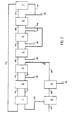
- the process of the present invention comprises the following steps (Fig. 1):
- Each of the above steps may be carried out over a wide temperature range, for instance at ambient tempera ture, in one or several stages, preferably using countercurrent circulation, the different throughputs of entering streams being carefully matched to a particular flow scheme which has been optimized for the present process.
- the inventive process can even successfully been applied to solutions containing high amounts of contaminants.
- the nitrate concentration can be between 5 and 15 % by weight, calculated as NH 4 N0 3 .
- the organic contaminants can even be removed from solutions having concentrations from 1 to 10% by weight, preferably 1 to 3% by weight.
- the (NH 4 ) 2 S0 4 concentration is preferably between 20 and 40% by weight.
- the amine extractant can be converted to its sulfate form in different ways, by
- an additional acid recuperation section has been incorporated to extract residual sulfuric acid from the raffinate by contacting said raffinate with the recycled solvent, thus saving on sulfuric acid costs.
- any free acidity of the feed may, at least in part, be conveniently used to regenerate the amine sulfate extractant.
- the organic solvent leaving the extraction step (i) is first scrubbed with water and/or nitrate ions before entering the actual stripping section.
- the scrubbing may be regarded as a selective partial stripping of the amine extractant, whereby at least part of the co-extracted organic pollutants are removed into an aqueous side-stream.
- an aqueous solution of nitrates may be used, which is derived from a subsequent solvent washing section.
- the original nitrate and organic contaminants can be concentrated and at least partly separated into two secondary aqueous effluents of much reduced volume, which may then be further processed in a different manner.
- the effluent to be treated is discharged from the existing crystallization unit "6", and is passed to the extraction section "2" through conduit "62".
- the nitrate and organic contaminants, together with or without a minor amount of sulfate, are removed in multiple stages by contacting with the organic extractant in countercurrent flow.
- concentrated sulfuric acid is introduced into the amine salt formation section "1", which forms an integral part of the total extraction section, to regenerate the amine sulfate extractant, the amine entering unit "1" through conduit "41 ".
- the recycled organic extracting phase then proceeds to the above unit "2" through conduit "12".
- the aqueous raffinate, leaving unit "1" through conduit "15" constitutes a purified ammonium sulfate effluent, containing no nitrate and a drastically reduced COD-value.
- This stream with an increased sulfate concentration, is mixed in vessel "5" with the main effluent from caprolactam production delivered in much higher throughput via conduit "05”, and is recycled through conduit "56" to the AS-crystallization unit "6".
- a base such as ammonia or sodium hydroxide
- the original nitrate and organic contaminants are concentrated in a secondary aqueous effluent which is withdrawn through conduit "30" to await further treatment.
- the stripped solvent leaves the above stripping section “3” through conduit "34” and passes through an efficient coalescer "4" for the separation of the entrained aqueous phase, which is reintroduced via conduit "43” with the alkaline stripping solution.
- An additional coalescer may optionally be inserted in conduit "23", whereby the entrained aqueous phase is passed back to the extraction section "2".
- the free amine extractant, leaving unit "4" through conduit "41 ", is conveniently recycled to the amine salt formation section "1". Its effective concentration in the organic diluent and its relative throughput with respect to the incoming effluent flow should be continuously monitored.
- the process based on liquid-liquid extraction according to the present invention provides a method of great benefit both from an economic and an ecological point of view, which enables removal of both the nitrate and/ or the organic pollutants from waste effluents in one and the same operation, leaving a purified stream of ammonium sulfate which can, for example, be profitably recycled to the industrial AS-crystallization unit.
- the advantages of the recycling offered by the present invention are clear in view of the substantial reduction in stripping expenditure, the considerable improvement in the AS-production yields. and the simultaneous drastic reduction in the release of sulfate into to the environment.
- the controlled removal of polar organic contaminants from AS-mother liquors and/or effluents means that the quality of the resulting ammonium sulfate crystals can be improved.
- the process according to the present invention can also be employed for the separate ammonium sulfate streams derived from the above-mentioned production of caprolactam according to Raschig and/or other processes as well as for other industrial effluents, in particular those containing a high level of ammonium sulfate.
- the process is for example suitable for treating effluent derived from the production of caprolactam, in particular according to the well-known Raschig process, such effluent being saturated with ammonium sulfate and contaminated to a high level by ammonium nitrate and organic by products, as well as in particular the waste effluent resulting from the repetitive large-scale crystallization to recuperate the ammonium sulfate for the chemical fertilizer market.
- the present process provides the opportunity of recycling the above waste effluent back to the existing production facility.
- ammonium sulfate effluent derived from caprolactam production having the composition given in Table 1, is contacted at room temperature with an organic extractant phase consisting of 30% of Alamine-336 (tri-n-octylamine) in a Shellsol AB diluent.
- the amine extractant has previously been converted into its sulfate salt (case A) by equilibration with a solution of dilute sulfuric acid (25%), the relative molar uptake being about 90%.
- case B the above extractant is used as the free amine.
- the molar ratio of nitrate to amine changes from 3:1 to 1:2.
- Table 2 The experimental results are shown below in Table 2, demonstrating that an adequate extraction of both the nitrate and organic COD-contaminants is only achieved in case A.
- a flow of 1 I/h of an ammonium sulfate effluent derived from caprolactam production is contacted counter-currently with 4.1 I/h of an organic phase comprising 30% of Alamine-308 in a Shellsol AB diluent.
- the amine extractant has been converted into its sulfate salt by the continuous addition of 0.1 lih of concentrated sulfuric acid directly into the extraction unit into which the recycled organic amine is re-introduced.
- the effluent to be treated has the composition given below in Table 3.
- the raffinate withdrawn from the present process contains no residual nitrate and at the same time displays a substantially reduced COD-value, with an at least 80% removal of the organic contaminants. It can therefore readily be reused.
- the treated effluent also exhibits an increased sulfate concentration (Table 3).
- the loaded organic solvent leaving the extraction section is then continuously stripped in 3 mixer-settler stages using countercurrent circulation of 0.29 1/h of an aqueous solution containing 35% of sodium hydroxide.
- a secondary effluent of neutral to alkaline pH which contains 20.5% of sodium nitrate.
- the nitrate is present in approximately twice its original concentration. It also contains the major part of the above-mentioned organic contaminants, as is clear from the high COD- and TOC-values (140,000 mg 0 2 /1) and 45,300 mg C/I, respectively).
- a minor fraction of about 10% of the total sulfate input is discarded with the sodium nitrate effluent.
- 1 I/h of Effluent B (see Table 1) is contacted countercurrently with 3.8 I/h of an organic phase comprising 30% of Alamine-308 in a Shellsol AB diluent, the amine extractant having been sulfated by introducing 0.086 I/h of concentrated sulfuric acid.
- the aqueous raffinate of 0.92 I/h is substantially purified, as can be seen from Table 4, the COD-value being greatly reduced and no residual nitrate being present.
- the organic solvent thereafter proceeds to the actual stripping section, comprising 2 mixer-settler stages, in which 0.129 I/h of an aqueous solution containing 25% of ammonia is used to re-extract part of the nitrate.
- 0.17 I/h of a concentrated solution of ammonium nitrate is provided, which has a substantial concentration of nitrate in relation to the sulfate and organic contaminants (Table 4).
- This "Strip Out" solution contains more than 75% of the nitrate input and has a considerably reduced volume compared to the original effluent.
- relative enrichment factors are given to illustrate the separating effect of the previous scrubbing section.
- the organic solvent is washed in a single mixer-settler stage by about 0.1 I/h of a 30%-NaOH solution, which directly provides the nitrate ions needed for scrubbing.
- the organic extractant is now available as the free amine and, after passing a supplementary coalescer, the solvent phase is recycled to the extraction section.
- ammonium sulfate-containing effluents derived from both reaction steps in the production of caprolactam according to the Raschig process have the typical and differing composition shown in Table 6. In this particular case, they are separately concentrated approximately 5-10 times by evaporative crystallization of the ammonium sulfate.
- the resulting waste effluent either exhibits a high nitrate concentration with only minor organic contamination (Effluent C from Table 7) or is otherwise highly contaminated by organic constituents without substantial amounts of nitrate (Effluent D from Table 7).
- a synthetic aqueous solution containing 28% of ammonium sulfate and 12% of ammonium nitrate without any organic contamination is extracted by the same organic phase and under the same conditions as used in Example IV.
- the molar ratio of amine to nitrate ranges from 1:3 to 2:1
- the experimental results are presented in Table 8. They demonstrate a complete extraction of the nitrate contaminants from this particular effluent of high salt concentration.
- a stream of 2.5 l,h of an aqueous effluent derived from the production of vulcanization accelerators and loaded with organic COD-contaminants is contacted countercurrently at room temperature with 0.5 I/h of an organic phase comprising 10% of Alamine-308 in a Shellsol AB diluent.
- the amine extractant has already been converted into its sulfate salt by previous continuous contact with 0.115 I/h of dilute sulfuric acid (10%) in a separate mixer-settler unit into which fresh organic extractant is introduced and from which the exchanged sulfuric acid solution is withdrawn.
- the aqueous effluent to be treated has the composition shown in Table 9.
- the raffinate withdrawn from the extraction section exhibits a substantially reduced COD-and TOC value (Table 9), without co-extraction of the inorganic ions present in high concentration.
- Table 9 COD-and TOC value
- the loaded organic solvent leaving the extraction section is continuously stripped in 2 mixer-settler stages using countercurrent contact with 0.095 I/h of an aqueous solution containing 5% of sodium hydroxide.
- a conveniently concentrated solution of alkaline pH is provided which contains the major part of the above-mentioned organic contaminants, as is clear from the high COD-value (>20,000 mg 02/1).
Landscapes
- Chemical & Material Sciences (AREA)
- Organic Chemistry (AREA)
- Life Sciences & Earth Sciences (AREA)
- Hydrology & Water Resources (AREA)
- Engineering & Computer Science (AREA)
- Environmental & Geological Engineering (AREA)
- Water Supply & Treatment (AREA)
- Physical Water Treatments (AREA)
- Extraction Or Liquid Replacement (AREA)
- Removal Of Specific Substances (AREA)
Priority Applications (9)
| Application Number | Priority Date | Filing Date | Title |
|---|---|---|---|
| EP89108278A EP0396790B1 (de) | 1989-05-09 | 1989-05-09 | Verfahren zur Entfernung von Nitrat und organischen Verunreinigungen aus Abwässern |
| ES198989108278T ES2037904T3 (es) | 1989-05-09 | 1989-05-09 | Procedimiento para la extraccion de nitrato y contaminantes organicos de efluentes. |
| DE8989108278T DE68904070T2 (de) | 1989-05-09 | 1989-05-09 | Verfahren zur entfernung von nitrat und organischen verunreinigungen aus abwaessern. |
| US07/513,346 US5015456A (en) | 1989-05-09 | 1990-04-20 | Removal of nitrate and/or organic pollutants from effluents |
| JP2111880A JP2882538B2 (ja) | 1989-05-09 | 1990-05-01 | 排出液から硝酸塩及び/又は有機汚染物質の除去法 |
| CA002016161A CA2016161A1 (en) | 1989-05-09 | 1990-05-07 | Removal of nitrate and/or organic pollutants from effluents |
| DD90340442A DD297950A5 (de) | 1989-05-09 | 1990-05-07 | Verfahren zur entfernung von nitrat und/oder organischen verunreinigungen aus abwaessern |
| KR90006443A KR0135417B1 (en) | 1989-05-09 | 1990-05-08 | Process for the removal of nitrate and/or organic pollutants |
| BR909002142A BR9002142A (pt) | 1989-05-09 | 1990-05-08 | Processo continuo para a remocao de nitrato e/ou de impurezas organicas de aguas servidas |
Applications Claiming Priority (1)
| Application Number | Priority Date | Filing Date | Title |
|---|---|---|---|
| EP89108278A EP0396790B1 (de) | 1989-05-09 | 1989-05-09 | Verfahren zur Entfernung von Nitrat und organischen Verunreinigungen aus Abwässern |
Publications (2)
| Publication Number | Publication Date |
|---|---|
| EP0396790A1 true EP0396790A1 (de) | 1990-11-14 |
| EP0396790B1 EP0396790B1 (de) | 1992-12-23 |
Family
ID=8201331
Family Applications (1)
| Application Number | Title | Priority Date | Filing Date |
|---|---|---|---|
| EP89108278A Expired EP0396790B1 (de) | 1989-05-09 | 1989-05-09 | Verfahren zur Entfernung von Nitrat und organischen Verunreinigungen aus Abwässern |
Country Status (9)
| Country | Link |
|---|---|
| US (1) | US5015456A (de) |
| EP (1) | EP0396790B1 (de) |
| JP (1) | JP2882538B2 (de) |
| KR (1) | KR0135417B1 (de) |
| BR (1) | BR9002142A (de) |
| CA (1) | CA2016161A1 (de) |
| DD (1) | DD297950A5 (de) |
| DE (1) | DE68904070T2 (de) |
| ES (1) | ES2037904T3 (de) |
Cited By (6)
| Publication number | Priority date | Publication date | Assignee | Title |
|---|---|---|---|---|
| EP0547487A1 (de) * | 1991-12-18 | 1993-06-23 | Hoechst Aktiengesellschaft | Verfahren zur Aufarbeitung organische Phosphorverbindungen, insbesondere sulfonierte Arylphosphine enthaltender Abwässer |
| WO1998022395A1 (en) * | 1996-11-19 | 1998-05-28 | Merichem Company | Removal of acidic organic contaminants from refinery waste water |
| US6045696A (en) * | 1997-07-25 | 2000-04-04 | Bayer Ag | Process for the purification of waste waters containing organic and inorganic sulphur compounds |
| CN102642946A (zh) * | 2012-04-13 | 2012-08-22 | 天津市富特斯科技发展有限公司 | 甲苯法生产己内酰胺工艺废水的处理方法 |
| WO2014071069A1 (en) * | 2012-10-31 | 2014-05-08 | Battelle Memorial Institute | Process water treatment using liquid-liquid extraction technology |
| CN105366862A (zh) * | 2015-11-18 | 2016-03-02 | 浙江闰土研究院有限公司 | 一种含硫酸染料废水的处理方法 |
Families Citing this family (12)
| Publication number | Priority date | Publication date | Assignee | Title |
|---|---|---|---|---|
| US5665237A (en) * | 1994-08-08 | 1997-09-09 | Henkel Corporation | Method for separating materials |
| US5575918A (en) * | 1995-02-28 | 1996-11-19 | Henkel Corporation | Method for recovery of polymers |
| WO1996004981A1 (en) * | 1994-08-08 | 1996-02-22 | Henkel Corporation | Method for separating materials |
| US5501796A (en) * | 1994-08-08 | 1996-03-26 | Henkel Corporation | Method for separating materials |
| DE10113113A1 (de) * | 2001-03-16 | 2002-09-19 | Bayer Ag | Nitratreduktion durch SO¶2¶ |
| DE10207442A1 (de) * | 2002-02-22 | 2003-09-11 | Bayer Ag | Aufbereitung von Kochsalz enthaltenden Abwässern zum Einsatz in der Chlor-Alkali-Elektrolyse |
| RU2431606C2 (ru) * | 2009-07-13 | 2011-10-20 | Федеральное государственное образовательное учреждение высшего профессионального образования "Чувашский государственный университет им. И.Н. Ульянова" | Экстракционный способ очистки сточных вод от ароматических аминов |
| CN102344220B (zh) * | 2011-07-19 | 2013-03-27 | 湖北省宏源药业有限公司 | 一种甲硝唑废水的处理方法 |
| JP2014138914A (ja) * | 2013-01-21 | 2014-07-31 | Kyoto Univ | 被処理水中の窒素化合物の除去方法。 |
| US9902626B2 (en) | 2013-07-26 | 2018-02-27 | General Electric Company | Method and filter for removing nitrate ions |
| KR101994997B1 (ko) | 2017-06-19 | 2019-07-04 | 삼성중공업 주식회사 | 오염수 처리 시스템 |
| CN112811728B (zh) * | 2020-12-30 | 2022-08-12 | 广东先导稀材股份有限公司 | 一种达标处理超细球形银粉生产母液并回收有价组分的方法 |
Citations (4)
| Publication number | Priority date | Publication date | Assignee | Title |
|---|---|---|---|---|
| DE2350962A1 (de) * | 1972-10-16 | 1974-04-25 | Kemira Oy | Kontinuierliches verfahren zur entfernung von nitraten aus abwassern durch fluessigkeitsextraktion mit moeglichst geringen loesungsmittelverlusten |
| EP0178494A1 (de) * | 1984-10-04 | 1986-04-23 | Hoechst Aktiengesellschaft | Verfahren zur Extraktion von Phenolen aus wässrigen Lösungen |
| EP0256504A1 (de) * | 1986-08-14 | 1988-02-24 | Hoechst Aktiengesellschaft | Verfahren zur Extraktion von Nitro-hydroxy-aromaten aus wässrigen Lösungen |
| EP0293849A1 (de) * | 1987-06-04 | 1988-12-07 | Hoechst Aktiengesellschaft | Verfahren zur Abtrennung von halogenierten Hydroxy-aromaten aus wässrigen Lösungen |
Family Cites Families (6)
| Publication number | Priority date | Publication date | Assignee | Title |
|---|---|---|---|---|
| FI53661C (fi) * | 1973-11-22 | 1978-07-10 | Kemira Oy | Kontinuerligt foerfarande foer extrahering av nitrater fraon nitrathaltiga loesningar |
| US3966594A (en) * | 1973-11-26 | 1976-06-29 | Sumitomo Chemical Company, Limited | Treatment of aqueous waste solution |
| FR2391953A1 (fr) * | 1976-11-02 | 1978-12-22 | Ugine Kuhlmann | Procede de traitement d'effluents nitriques |
| US4661257A (en) * | 1985-03-13 | 1987-04-28 | Regents Of The University Of Minnesota | Liquid membrane system for the removal of nitrate from water |
| GB8607034D0 (en) * | 1986-03-21 | 1986-04-30 | Rohm & Haas | Removal of no3 from salt solutions |
| US4872989A (en) * | 1987-03-16 | 1989-10-10 | Rohm And Haas Company | Selective removal of nitrate ions from salt solutions |
-
1989
- 1989-05-09 EP EP89108278A patent/EP0396790B1/de not_active Expired
- 1989-05-09 ES ES198989108278T patent/ES2037904T3/es not_active Expired - Lifetime
- 1989-05-09 DE DE8989108278T patent/DE68904070T2/de not_active Expired - Fee Related
-
1990
- 1990-04-20 US US07/513,346 patent/US5015456A/en not_active Expired - Fee Related
- 1990-05-01 JP JP2111880A patent/JP2882538B2/ja not_active Expired - Lifetime
- 1990-05-07 CA CA002016161A patent/CA2016161A1/en not_active Abandoned
- 1990-05-07 DD DD90340442A patent/DD297950A5/de not_active IP Right Cessation
- 1990-05-08 BR BR909002142A patent/BR9002142A/pt not_active IP Right Cessation
- 1990-05-08 KR KR90006443A patent/KR0135417B1/ko not_active Expired - Fee Related
Patent Citations (4)
| Publication number | Priority date | Publication date | Assignee | Title |
|---|---|---|---|---|
| DE2350962A1 (de) * | 1972-10-16 | 1974-04-25 | Kemira Oy | Kontinuierliches verfahren zur entfernung von nitraten aus abwassern durch fluessigkeitsextraktion mit moeglichst geringen loesungsmittelverlusten |
| EP0178494A1 (de) * | 1984-10-04 | 1986-04-23 | Hoechst Aktiengesellschaft | Verfahren zur Extraktion von Phenolen aus wässrigen Lösungen |
| EP0256504A1 (de) * | 1986-08-14 | 1988-02-24 | Hoechst Aktiengesellschaft | Verfahren zur Extraktion von Nitro-hydroxy-aromaten aus wässrigen Lösungen |
| EP0293849A1 (de) * | 1987-06-04 | 1988-12-07 | Hoechst Aktiengesellschaft | Verfahren zur Abtrennung von halogenierten Hydroxy-aromaten aus wässrigen Lösungen |
Cited By (6)
| Publication number | Priority date | Publication date | Assignee | Title |
|---|---|---|---|---|
| EP0547487A1 (de) * | 1991-12-18 | 1993-06-23 | Hoechst Aktiengesellschaft | Verfahren zur Aufarbeitung organische Phosphorverbindungen, insbesondere sulfonierte Arylphosphine enthaltender Abwässer |
| WO1998022395A1 (en) * | 1996-11-19 | 1998-05-28 | Merichem Company | Removal of acidic organic contaminants from refinery waste water |
| US6045696A (en) * | 1997-07-25 | 2000-04-04 | Bayer Ag | Process for the purification of waste waters containing organic and inorganic sulphur compounds |
| CN102642946A (zh) * | 2012-04-13 | 2012-08-22 | 天津市富特斯科技发展有限公司 | 甲苯法生产己内酰胺工艺废水的处理方法 |
| WO2014071069A1 (en) * | 2012-10-31 | 2014-05-08 | Battelle Memorial Institute | Process water treatment using liquid-liquid extraction technology |
| CN105366862A (zh) * | 2015-11-18 | 2016-03-02 | 浙江闰土研究院有限公司 | 一种含硫酸染料废水的处理方法 |
Also Published As
| Publication number | Publication date |
|---|---|
| BR9002142A (pt) | 1991-08-13 |
| ES2037904T3 (es) | 1993-07-01 |
| KR0135417B1 (en) | 1998-04-23 |
| DD297950A5 (de) | 1992-01-30 |
| DE68904070T2 (de) | 1993-04-29 |
| JPH02303591A (ja) | 1990-12-17 |
| US5015456A (en) | 1991-05-14 |
| EP0396790B1 (de) | 1992-12-23 |
| CA2016161A1 (en) | 1990-11-09 |
| KR900017927A (ko) | 1990-12-20 |
| JP2882538B2 (ja) | 1999-04-12 |
| DE68904070D1 (de) | 1993-02-04 |
Similar Documents
| Publication | Publication Date | Title |
|---|---|---|
| US5015456A (en) | Removal of nitrate and/or organic pollutants from effluents | |
| KR101093862B1 (ko) | 디니트로톨루엔의 제조 과정에서 수득된 폐수의 처리 방법 | |
| DE69414523T2 (de) | Verfahren und Vorrichtung zur Rückgewinnung der Carbonsäuren aus verdünnten Lösungen | |
| KR101093972B1 (ko) | 디니트로톨루엔의 제조에 있어서 2차 성분의 처리 방법 | |
| CH678619A5 (de) | ||
| JPH04228084A (ja) | クエン酸の回収方法 | |
| US4481112A (en) | Process of treating gas condensate | |
| JPS6057919B2 (ja) | 硝酸含有廃液の処理方法 | |
| GB2324791A (en) | Solvent extraction of nickel sulfate | |
| JP3902069B2 (ja) | N,n−ジメチルホルムアミド含有廃水の処理方法 | |
| SU858572A3 (ru) | Способ извлечени урана | |
| DE3634180A1 (de) | Verfahren zur wiedergewinnung von in atomkraftwerken erneut verwendbaren borsaeureloesungen aus in atomkraftwerken anfallenden radioaktiven abfaellen und loesungen | |
| KR100367356B1 (ko) | 추출에 의한 액체 매질 정제방법 | |
| SU1438607A3 (ru) | Способ очистки фосфорной кислоты | |
| US3433592A (en) | Method of purifying phosphoric acid | |
| EP0758636B1 (de) | Verfahren zur Reinigung des Prozessabwassers des Bisphenol-A-Verfahrens | |
| JPH0375617B2 (de) | ||
| US4814518A (en) | Process for extracting nitrohydroxyaromatics from aqueous solutions | |
| JPS6037059B2 (ja) | 第四アンモニウム塩による液−液抽出によつてガリウム溶液を精製する方法 | |
| US3393046A (en) | Method for purification of zinc sulphate solutions | |
| GB1571172A (en) | Prcess for selective extraction of metal ions from aqueous solutions and extracting agents suitable for that purpose | |
| SU1011202A1 (ru) | Способ очистки газа от сероводорода | |
| JPH10310435A (ja) | 高純度硫酸ニッケルの精製方法 | |
| US4864065A (en) | Process for removing halogenated hydroxyaromatics from aqueous solutions | |
| DE69406187T2 (de) | Verfahren zur Reinigung von Wasserstoffperoxyd |
Legal Events
| Date | Code | Title | Description |
|---|---|---|---|
| PUAI | Public reference made under article 153(3) epc to a published international application that has entered the european phase |
Free format text: ORIGINAL CODE: 0009012 |
|
| 17P | Request for examination filed |
Effective date: 19890509 |
|
| AK | Designated contracting states |
Kind code of ref document: A1 Designated state(s): BE DE ES FR GB IT NL |
|
| 17Q | First examination report despatched |
Effective date: 19910606 |
|
| GRAA | (expected) grant |
Free format text: ORIGINAL CODE: 0009210 |
|
| AK | Designated contracting states |
Kind code of ref document: B1 Designated state(s): BE DE ES FR GB IT NL |
|
| REF | Corresponds to: |
Ref document number: 68904070 Country of ref document: DE Date of ref document: 19930204 |
|
| ITF | It: translation for a ep patent filed | ||
| ET | Fr: translation filed | ||
| REG | Reference to a national code |
Ref country code: ES Ref legal event code: FG2A Ref document number: 2037904 Country of ref document: ES Kind code of ref document: T3 |
|
| PLBE | No opposition filed within time limit |
Free format text: ORIGINAL CODE: 0009261 |
|
| STAA | Information on the status of an ep patent application or granted ep patent |
Free format text: STATUS: NO OPPOSITION FILED WITHIN TIME LIMIT |
|
| 26N | No opposition filed | ||
| PGFP | Annual fee paid to national office [announced via postgrant information from national office to epo] |
Ref country code: DE Payment date: 19990421 Year of fee payment: 11 |
|
| PGFP | Annual fee paid to national office [announced via postgrant information from national office to epo] |
Ref country code: ES Payment date: 19990506 Year of fee payment: 11 |
|
| PGFP | Annual fee paid to national office [announced via postgrant information from national office to epo] |
Ref country code: GB Payment date: 19990512 Year of fee payment: 11 |
|
| PGFP | Annual fee paid to national office [announced via postgrant information from national office to epo] |
Ref country code: BE Payment date: 19990519 Year of fee payment: 11 |
|
| PGFP | Annual fee paid to national office [announced via postgrant information from national office to epo] |
Ref country code: FR Payment date: 19990525 Year of fee payment: 11 |
|
| PGFP | Annual fee paid to national office [announced via postgrant information from national office to epo] |
Ref country code: NL Payment date: 19990531 Year of fee payment: 11 |
|
| PG25 | Lapsed in a contracting state [announced via postgrant information from national office to epo] |
Ref country code: GB Free format text: LAPSE BECAUSE OF NON-PAYMENT OF DUE FEES Effective date: 20000509 |
|
| PG25 | Lapsed in a contracting state [announced via postgrant information from national office to epo] |
Ref country code: ES Free format text: THE PATENT HAS BEEN ANNULLED BY A DECISION OF A NATIONAL AUTHORITY Effective date: 20000510 |
|
| PG25 | Lapsed in a contracting state [announced via postgrant information from national office to epo] |
Ref country code: BE Free format text: LAPSE BECAUSE OF NON-PAYMENT OF DUE FEES Effective date: 20000531 |
|
| BERE | Be: lapsed |
Owner name: BAYER ANTWERPEN N.V. Effective date: 20000531 |
|
| PG25 | Lapsed in a contracting state [announced via postgrant information from national office to epo] |
Ref country code: NL Free format text: LAPSE BECAUSE OF NON-PAYMENT OF DUE FEES Effective date: 20001201 |
|
| GBPC | Gb: european patent ceased through non-payment of renewal fee |
Effective date: 20000509 |
|
| PG25 | Lapsed in a contracting state [announced via postgrant information from national office to epo] |
Ref country code: FR Free format text: LAPSE BECAUSE OF NON-PAYMENT OF DUE FEES Effective date: 20010131 |
|
| NLV4 | Nl: lapsed or anulled due to non-payment of the annual fee |
Effective date: 20001201 |
|
| PG25 | Lapsed in a contracting state [announced via postgrant information from national office to epo] |
Ref country code: DE Free format text: LAPSE BECAUSE OF NON-PAYMENT OF DUE FEES Effective date: 20010301 |
|
| REG | Reference to a national code |
Ref country code: FR Ref legal event code: ST |
|
| REG | Reference to a national code |
Ref country code: ES Ref legal event code: FD2A Effective date: 20020204 |
|
| PG25 | Lapsed in a contracting state [announced via postgrant information from national office to epo] |
Ref country code: IT Free format text: LAPSE BECAUSE OF NON-PAYMENT OF DUE FEES;WARNING: LAPSES OF ITALIAN PATENTS WITH EFFECTIVE DATE BEFORE 2007 MAY HAVE OCCURRED AT ANY TIME BEFORE 2007. THE CORRECT EFFECTIVE DATE MAY BE DIFFERENT FROM THE ONE RECORDED. Effective date: 20050509 |