EP0400569B1 - Verfahren zur Herstellung eines Antikaries-Impfstoffes aus Streptococcus mutans und Impfzusammensetzung gegen Karies in Form von Nasentropfen - Google Patents
Verfahren zur Herstellung eines Antikaries-Impfstoffes aus Streptococcus mutans und Impfzusammensetzung gegen Karies in Form von Nasentropfen Download PDFInfo
- Publication number
- EP0400569B1 EP0400569B1 EP90110144A EP90110144A EP0400569B1 EP 0400569 B1 EP0400569 B1 EP 0400569B1 EP 90110144 A EP90110144 A EP 90110144A EP 90110144 A EP90110144 A EP 90110144A EP 0400569 B1 EP0400569 B1 EP 0400569B1
- Authority
- EP
- European Patent Office
- Prior art keywords
- pac
- streptococcus mutans
- protein antigen
- vaccine
- strain
- Prior art date
- Legal status (The legal status is an assumption and is not a legal conclusion. Google has not performed a legal analysis and makes no representation as to the accuracy of the status listed.)
- Expired - Lifetime
Links
Images

Classifications
-
- A—HUMAN NECESSITIES
- A61—MEDICAL OR VETERINARY SCIENCE; HYGIENE
- A61K—PREPARATIONS FOR MEDICAL, DENTAL OR TOILETRY PURPOSES
- A61K9/00—Medicinal preparations characterised by special physical form
- A61K9/0012—Galenical forms characterised by the site of application
- A61K9/0043—Nose
-
- C—CHEMISTRY; METALLURGY
- C07—ORGANIC CHEMISTRY
- C07K—PEPTIDES
- C07K14/00—Peptides having more than 20 amino acids; Gastrins; Somatostatins; Melanotropins; Derivatives thereof
- C07K14/195—Peptides having more than 20 amino acids; Gastrins; Somatostatins; Melanotropins; Derivatives thereof from bacteria
- C07K14/315—Peptides having more than 20 amino acids; Gastrins; Somatostatins; Melanotropins; Derivatives thereof from bacteria from Streptococcus (G), e.g. Enterococci
-
- A—HUMAN NECESSITIES
- A61—MEDICAL OR VETERINARY SCIENCE; HYGIENE
- A61K—PREPARATIONS FOR MEDICAL, DENTAL OR TOILETRY PURPOSES
- A61K39/00—Medicinal preparations containing antigens or antibodies
Definitions
- the present invention relates to a method for preparing a vaccine for dental caries, a novel variant of Streptococcus mutans GS-5 as well as a vaccine composition for dental caries which is used as nasal drops.
- the Streptococcus mutans group is the most crucial pathogenic factor in dental caries in human beings and animals.
- the S. mutans group is divided into 7 species depending on the characteristics of their DNA's and S. mutans of serotype, c, which is most closely related to human dental caries, posesses, on its surface, substances having various antigenicities such as serotype-specific polysaccharide antigens, lipoteichoic acid and protein antigens.
- a protein antigen having a molecular weight of about 190,000 determined by SDS polyacrylamide gel electrophoresis is a fine fibrous structure called fimbriae.
- This protein antigen is known variously as 1/11, B, P1 and IF and it does not yet have a uniform name.
- this protein antigen is herein called PAc (protein antigen serotype c).
- PAc protein antigen serotype c
- the cloning of the PAc gene of Streptococcus mutans MT 8148 (serotype c) and its expression is disclosed in Mol. Microbiol. 3(2) (1989), 221-228 and in Mol. Microbiol. 3(5) (1989), 673-678, respectively.
- JP-A-56-501364 proposes the use of the antigen 1/11 possessing specific properties as a vaccine for dental caries and JP-A-58-164518 discloses a vaccine for preventing the decay of teeth.
- the vaccine comprises, as an antigen, the component of bacterial cells of microorganisms belonging to genus Streptococcus or an extract thereof.
- rPAc PAc-expressing gene of S. mutans
- E. coli Esscherichia coli
- S. milleri a species of Streptococcus
- the inventors linked the pac gene to a plasmid-shuttle vector which can proliferate in both E. coli and Streptococcus host cells and inserted it into a S. mutans GS-5 strain which cannot express PAc.
- the results are reported in Review of Nippon Dentistry Society, 1989, No. 555.
- this method suffers from various problems. For instance, after insertion of the pac gene into the cells of the GS-5 strain, it is sometimes observed that the plasmid carrying the gene is left out of the resulting recombinant bacterial cells and thus the variant stops the production of PAc and the products are insufficient in their uniformity.
- An object of the present invention is to provide a method for preparing a vaccine for dental caries which makes it possible to enhance the yield of PAc and to simplify processes for purifying PAc as well as a variant of S. mutans GS-5 in which a pac gene is integrated into its chromosome.
- Another object of the present invention is to provide a vaccine composition whose component, the protein antigen PAc, is internally easily absorbed, in high efficiency, by a subject for immunization.
- a further object of the present invention is to provide a vaccine composition capable of effectively increasing the antibody titer in a subject for immunization after the administration thereof and capable of sufficiently showing its vaccination effect.
- the method for preparing a vaccine for dental caries comprises the step of culturing a variant of an S. mutans GS-5 strain in which a protein antigen (PAc)-expressing gene which is obtained by integrating a protein antigen (PAc)-expressing gene of Streptococcus mutans into the chromosome of a Streptococcus mutans GS-5 strain to obtain the protein antigen, the protein antigen being produced on the surface of cells of Streptococcus mutans or it being secreted by the microorganism and having a molecular weight ranging from about 170,000 to 220,000. In a preferred embodiment, the molecular weight is about 190,000.
- the novel strain (Streptococcus mutans GS-5 (K-3) FERM BP-2437) of the present invention was established through genetic engineering. More specifically, it was established by integrating the pac gene into the chromosome of oral Streptococcus, i.e. Streptococcus mutans host cells, to transform the host cells to thus substantially improve their productivity of PAc.
- the preventive vaccine for dental caries of the present invention comprises the protein antigen (PAc) which is produced on the surface of the cells of oral Streptococcus mutans or extracellularly produced, i.e. secreted by the microorganism.
- PAc protein antigen
- the composition is used in the form of nasal drops, i.e. it is adapted for intranasal administration.
- the preventive vaccine for dental caries in the form of nasal drops may further comprise a surfactant, cholera toxin B subunit or a bile acid or a derivative thereof.
- the S. mutans GS-5 strain is employed as host bacteria, while any donor bacteria may be used so far as they are strains belonging to species S. mutans capable of producing PAc and preferred are, for instance, strains of c serotype, e serotype and f serotype.
- any donor bacteria may be used so far as they are strains belonging to species S. mutans capable of producing PAc and preferred are, for instance, strains of c serotype, e serotype and f serotype.
- the S. mutans GS-5 strain is a known strain of S. mutans which is incapable of producing PAc and is preserved at various research institutes such as universities.
- the applicant of this invention deposited it with the Fermentation Research Institute (FRI) under an accession number of FERM BP-2436 under a designation of Streptococcus mutans GS-5 strain so that a third party can easily obtain it.
- FI Fermentation Research Institute
- Examples of the donor bacteria used in the present invention include Streptcoccus mutans NCTC 10449, Streptococcus mutans MT8148, Streptococcus mutans Ingbritt, Streptococcus mutans MT6, Streptococcus mutans JC2, Streptococcus mutans MT118, Streptococcus mutans C67-1, Streptococcus mutans OMZ70, Streptococcus mutans MT6801, Streptococcus mutans JC 1-5, Streptococcus mutans ATCC 33477, Streptococcus mutans SE11, Streptococcus mutans OMZ175, Streptococcus mutans MT557, Streptococcus mutans P2 and Streptococcus mutans PK-1.
- the vector plasmid for transferring PAc
- the vector there may be used, for instance, shuttle vectors pSA3 and pVA981 and as restriction enzymes for cleavage, there may be used, for instance, Barn HI, Sph I, Bgl II, Eco RI, Eco T141, Hind III, Pst I and Sac I.
- examples of the genes which encode the protein antigen (PAc) having a molecular weight ranging from about 170,000 to 220,000 preferably 180,000 to 210,000 include base sequences which encode the fragment substantially comprising 1,565 amino acid residues from the initiation codon (ATG) to the termination codon (TGA) of the following base sequence and fragments thereof.
- ATG initiation codon
- TGA termination codon
- the strain GS-5 (K-3) of the present invention is obtained by integrating the pac gene into the chromosomal DNA of the strain GS-5, the leaving out of the pac gene from the strain is hardly caused and the strain extracellularly produces rPAc in high yield.
- rPAc can be obtained in high efficiency by isolating such a strain and culturing the same. Moreover, the processes for purifying rPAc can be substantially simplified since the content of rPAc in the culture supernatant is very high. The resulting rPAc can be used as a vaccine for dental caries in a variety of forms.
- the strain GS-5 (K-3) of the present invention can be cultured, for instance, in the following manner.
- 37 g of a brain heart infusion medium is dissolved in 1 1 of distilled water, then the resulting solution is sterilized at 121 ° C for 20 minutes and 1 ml of a 5 mg/ml erythromycin solution which has been filtered and sterilized in advance is added to and mixed with the foregoing solution to give a culture medium.
- the culture medium is dispensed in 10 ml portions into 24 ml sterilized test tubes, the strain GS-5 (K-3) is inoculated into each test tube and cultured at 37° C for 18 hours to thus give a seed cultue liquid.
- 100 ml of the seed culture liquid is added to a 2 1 volume flask in which 1 1 of a culture medium having the same composition has been added and cultured at 37 C for 18 hours to thus give a culture medium containing microorganisms.
- the medium is centrifuged at 10,000 X g for 15 minutes to obtain a culture supernatant.
- the purification of rPAc from the culture supernatant can be performed by various means. For instance, there can be used gel filtration methods such as those in which dextrans or agaroses are employed as a stationary phase; ion-exchange techniques such as those in which AE, DEAE, QAE, CM, SP, Phospho or the like is used as an ion-exchange resin; hydrophobic chromatography techniques such as those in which Octyl Sepharose, Phenyl Sepharose or the like is employed as a stationary phase; and affinity chromatography techniques.
- gel filtration methods such as those in which dextrans or agaroses are employed as a stationary phase
- ion-exchange techniques such as those in which AE, DEAE, QAE, CM, SP, Phospho or the like is used as an ion-exchange resin
- hydrophobic chromatography techniques such as those in which Octyl Sepharose, Phenyl Sepharose or the like is employed as a stationary phase
- the resultant vaccines for dental caries are administered, for instance, orally or via subcutaneous injection.
- the dose thereof desirably ranges from about 10 ug to about 50 mg and preferably 10 ug to 10 mg and the optimum dose thereof is 1 mg.
- the bacteriological properties of the Streptococcus mutans GS-5 (K-3) (FERM BP-2437) are as follows. The determination of these bacteriological properties and the classification are performed according to the methods disclosed in Bergey's Manual of Systematic Bacteriology, 1986, 2.
- the strain grows at pH ranging from 7.0 to 7.4 and forms circular, flat, entire colonies.
- the surface of these colonies is smooth and glossy and the color thereof is yellowish white or pale brown.
- the culture medium is not liquefied at all.
- the strain is a gram positive Streptococcus which produces acids from inulin, D-raffinose, D-melibiose and D-sorbit, which does not hydrolyze arginine and which is resistant to bacitracin.
- the microorganism is a strain belonging to species Streptococcus mutans.
- the vaccine of the present invention it is also possible to use the cortex of the cells of the foregoing S. mutans or those which are extracellularly produced by the strain in addition to the protein antigen (PAc) obtained by the method described above. More specifically, PAc is a protein present on the cortex of the cell bodies, but the strain secretes PAc extracellularly. Therefore, the easiest way for the preparation of the vaccine is to use the culture medium obtained after the cultivation of S. mutans. For instance, S.
- mutans strain ATCC 25175 is cultured in an outer solution obtained by dialyzing a brain-heart infusion culture medium (available from BBL Company, Difco Company etc.), the resulting culture supernatant is subjected to a salting out process carried out at a saturated ammonium sulfate concentrtion (60%), the product salted out is dissolved in a 50 mM Tris-hydrochloric acid buffer and then dialyzed against the same buffer.
- a brain-heart infusion culture medium available from BBL Company, Difco Company etc.
- the preparation thus obtained is added to a column packed with DEAE Sephacel@ (available from Pharmacia Co., Ltd.) which has been equilibrated with the same buffer and elution is performed by a linear concentration gradient of NaCl ranging from 0 to 0.5 M whereby PAc is eluted at an NaCl concentration of about 0.2 M.
- the resulting PAc-containing fractions are pooled, concentrated and subjected to gel filtration using Sepharose CL-6B@ to obtain purified PAc-containing fractions which are used as the purified PAc.
- proteins equivalent to PAc and rPAc obtained from strains belonging to species Streptococcus mutans other than the S. mutans serotype c, which produce protein antigens common to PAc are also included in the scope of this invention and hence may be used in the vaccine composition of the present invention.
- the purified PAc there may optionaly be added carriers, diluents, or other additives such as preservatives, humectants, binders, adjuvants and agents for accelerating absorption to obtain pharmaceutical preparations used as nasal drops.
- carriers diluents, or other additives such as preservatives, humectants, binders, adjuvants and agents for accelerating absorption to obtain pharmaceutical preparations used as nasal drops.
- the amount of PAc to be added to the vaccine composition suitably ranges from 0.05 to 50 mg/0.2mî and preferably 0.5 to 20 mg/0.2 mL
- the vaccine composition of the present invention is preferably administered in an amount ranging from 0.05 to 0.6 m R/dose. Moreover, the vaccine composition of the present invention is suitably administered 2 or more times and preferably 2 to 6 times to achieve the desired immunization effect.
- the vaccine composition of the present invention makes it possible to intranasally immunize a subject. Therefore, it may be easily administered even to many persons and the administration thereof is not accompanied by pain. Since at least two administrations are in general required for achieving the desired immunization effect, simplicity and the possibility of administration without pain are very important for the immunization procedures.
- the antibody titer of the vaccine composition of the present invention can effectively be increased by the addition of cholera toxin B, a surfactant or a bile acid or a derivative thereof to the composition for nasal drops.
- the amount of the cholera toxin B to be added to the composition suitably ranges from 10 ⁇ g to 20 mg/0.2 mt and preferably 50 ⁇ g to 10 mg/0.2 mt of the vaccine composition.
- the surfactants may be anionic surfactants, cationic surfactants, nonionic surfactants and/or amphoteric surfactants, in particular cationic surfactants are preferred. These surfactants may be used alone or in any combination.
- the amount of the surfactants to be incorporated into the vaccine composition suitably ranges from 0.01 to 10% by weight, preferably 0.1 to 5% by weight on the basis of the total eight of the composition for anionic and nonionic surfactants and suitably ranges from 0.001 to 1.0% by weight and preferably 0.01 to 0.5% by weight on the basis of the total weight of the composition for cationic surfactants.
- anionic surfactants are carboxylic acid salts such as higher fatty acid salts (soaps) and N-acylamino acid salts of, for instance, lauroyl sarcosinate; sulfuric acid ester salts such as alkyl sulfates (for instance, lauryl sulfate), alkyl ether sulfates (for instance, polyoxyethylene alkyl ether sulfates) and fatty acid monoglyceride sulfates; alkane sulfonate; sulfosuccinates such as sodium dioctyl sulfosuccinate; N-acylsulfonates, fatty acid monoglyceride sulfonates and a-sulfofatty acid ester salts; alkyl phosphoric acid salts; and alkyl ether phosphoric acid salts.
- carboxylic acid salts such as higher fatty acid salts (soaps) and N-acylamin
- cationic surfactants examples include quaternary ammonium salts such as benzethonium chloride, benzalkonium chloride, cetyl pyridinium chloride, chlorohexyzine. gluconate and chlorohexyzine. hydrochloride.
- nonionic surfactants are polyoxyethylene alkyl ethers, polyoxyethylene alkyl phenyl ethers (such as Triton X-100), polyoxyethylene fatty acid esters, polyoxyethylene sorbitan fatty acid esters (such as Tween 20@ and Tween 80@), polyoxyethylene (hardened) castor oil, polyoxyethylene glycerin fatty acid esters and polyoxyethylene-polyoxypropylene copolymers.
- nonionic surfactants such as polyoxyethylene octyl ether, polyoxyethylene nonyl ether, polyoxyethylene lauryl ether, polyoxyethylene stearyl ether, polyoxyethylene cetyl ether, polyoxyethylene octylphenyl ether and Triton X100@, whose average molar number of added ethylene oxide ranges from 5 to 30; cationic surfactants such as benzethonium chloride and benzalkonium chloride; and anionic surfactants such as sodium lauryl sulfate and potassium lauryl sulfate.
- nonionic surfactants such as polyoxyethylene octyl ether, polyoxyethylene nonyl ether, polyoxyethylene lauryl ether, polyoxyethylene stearyl ether, polyoxyethylene cetyl ether, polyoxyethylene octylphenyl ether and Triton X100@, whose average molar number of added ethylene oxide ranges from 5 to 30;
- bile acids usable in the present invention include etiobilianic acid, etioallobilianic acid, etianic acid, 3-hydroxy-nor-5a-cholanic acid, dehydrocholic acid, cilianic acid, 12-ketocholanic acid, lithocholic acid, deoxycholic acid, chenodeoxycholic acid, cholic acid and cholanic acid.
- derivatives and salts such as sodium and potassium salts thereof and sodium and potassium salts of the derivatives.
- preferred are amide compounds of bile acids with amino acids or aminosulfonic acids and their sodium and potassium salts are also suitably employed in the present invention.
- amino acids and aminosulfonic acids are glycine, serine, asparagine, aspartic acid and taurine.
- particularly preferred are sodium taurocholate, sodium glycocholate, sodium cholate and sodium deoxycholate.
- the amount of these bile acids or the derivatives thereof to be incorporated into the vaccine composition of the present invention desirably ranges from 0.05 to 50 mg/0.2 mî and preferably 0.5 to 20 mg/0.2mt.
- the protective vaccine composition for dental caries of the present invention may further comprise an adjuvant such as alum, aluminum hydroxide, aluminum phosphate, aluminum sulfate and muramyl dipeptide; adjuvant fat-soluble components (agents for accelerating absorption) such as oleic acid, stearic acid and palmitic acid; humectants such as glycerin, sorbite, xylite, mannite, lactite, maltite and polyethylene glycols (such as PEG 400 and PEG 4,000); preservatives such as sorbic acid, chlorobutanol, benzoic acid, o-oxybenzoic acid ester, boric acid, dehydroacetic acid and thymol; and binders such as sodium polyacrylate, polyvinyl alcohol, polyvinyl pyrrolidone, sodium carboxy methyl cellulose, methyl cellulose, hydroxyethyl cellulose, carrageenan, sodium alginate, gum arabic,
- mammalian or birds are immunized with the protein antigen PAc of the present invention per se or a combination thereof with a surfactant and/or CTB to obtain antibodies and the resulting antibodies may be used in the protective vaccine composition for dental caries of the present invention as effective components.
- the antibody titer can effectively and simply be increased without pain by intranasally administering the protein antigen PAc.
- the antibody titer of the vaccine composition of the present invention can more efficiently be increased if the protein antigen PAc is administered together with a surfactant, cholera toxin B or a bile acid or a derivative thereof.
- the present invention further includes two aspects, the one being a method for intranasally administering a vaccine composition for dental carries which comprises a protein antigen PAc and a carrier or a diluent and optionally a surfactant, cholera toxin B or a bile acid or a derivative thereof and the other being use of protein antigen PAc for the preparation of the vaccine composition for dental carries as nasal drops.
- a vaccine composition for dental carries which comprises a protein antigen PAc and a carrier or a diluent and optionally a surfactant, cholera toxin B or a bile acid or a derivative thereof
- the other being use of protein antigen PAc for the preparation of the vaccine composition for dental carries as nasal drops.
- the plasmid pPC77 carrying the pac gene of Streptcoccus mutans NCTC 10449 and a shuttle vector pSA3 were cleaved with restriction enzymes Barn HI and Sph I respectively.
- the cleaved pPC77 and pSA3 were linked with a T4 DNA ligase, the resultant plasmid was inserted into host cells, E. coli strain HB 101 (deposited with National Institute for Genetics under the accession number of ME 8568) by a transformation technique and a clone which was resistant to chloramphenicol and sensitive to ampicillin and tetracycline was selected.
- Recombinant plasmids were extracted from clones whose capacity of producing PAc had been confirmed by a colony immune blot technique or Western blot technique, the size thereof was determined by agarose electrophoresis and it was thus found that all the clones had the recombinant plasmid of 16.4 kb.
- One of these plasmids was named K and the plasmid K was inserted into a strain, S. mutans GS-5, incapable of producing PAc by an electroporation technique to transform the strain.
- the resulting PAc-producing strain was named GS-5 (K-X).
- the strains GS-5 and GS-5 (K-3) were lysed with lysozyme and the plasmids were separated from the chromosomal DNA's.
- the resulting fractions containing plasmid were analyzed by agarose electrophoresis and it was found that any plasmids were not present in the fractions thus obtained from the strains GS-5 and GS-5 (K-3) as shown in Fig. 1.
- the same procedures were repeated using the strain GS-5 (K-9) and it was found that the intended plasmid was present in the fraction thus obtained from the strain GS-5 (K-9).
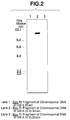
- the chromosomal DNA was cleaved with Eco RI and then the resultant products were analyzed by the conventional Southern blot technique.
- the chromosomal DNA's of the strains GS-5 and GS-5 (K-9) did not show any reactivity, while the fragment of about 16 kb of the chromosomal DNA of the strains GS-5 (K-3) exhibited reactivity therewith.
- the S. mutans strain GS-5 (K-3) was cultured in an external solution obtained by dialyzing TTY broth or BHI broth, the resulting culture supernatant was salted out at a saturated concentration of ammonium sulfate (60%), the products salted out were dissolved in 50 mM Tris-HCR buffer, dialyzed against the same buffer and the resulting dialyzate (preparation) was passed through a DEAE-cellulose column which had been equilibrated with the same buffer in advance. After passing the bed volume of the same buffer through the column two times, elution was performed at a linear concentration gradient of NaC I ranging from 0 to 0.5 mole.
- PAc was eluted at an NaCt concentration of about 0.2 mole.
- This eluted fraction as such can be used as a purified preparation of rPAc.
- the strain GS-5 (K-3) is used, the purification processes can be substantially simplified as described above since the content of rPAc in the culture supernatant is very high.
- the rPAc thus prepared can be used as vaccines for dental caries in various forms.
- compositions listed in the following Table II were dissolved in phosphate-buffered saline (PBS) and 0.1 mî each of the resulting solution was intraperitoneally injected twice in groups of mice (5 mice per group) at 10-days intervals to thus immunize the mice. 7 days after the second immunization, blood was sampled from the mice and the antibody titer against rPAc in blood was determined by the enzyme-linked immuno sorbent assay (ELISA method). The results obtained are summarized in Table II. In Table II, the antibody titer is expressed in the reciprocal of the highest rate of dilution at which the resulting serum showed reactivity in the ELISA method. In this respect, the serum was first diluted 10 times and thereafter it was diluted two times in order to determine the highest rate of dilution.
- PBS phosphate-buffered saline
- mice Groups of 5-week-old BALB/c mice (each comprising 5 animals) were immunized by intranasally administering 10 ⁇ l each of a solution containing PAc alone or a mixed solution containing PAc as well as a surfactant, cholera toxin B or a bile acid (salt) (the composition thereof is given below), three times at one- week intervals and further 4 weeks after the third immunization a fourth immunization was likewise performed. Then blood was sampled from each mouse and the antibody titer in blood was determined by the ELISA method. The results obtained are listed in the following Table III. In Table III, the antibody titer is expressed in the titer of the serum diluted 100 times, which was obtained 7 weeks after the final intranasal immunization.
Landscapes
- Health & Medical Sciences (AREA)
- Chemical & Material Sciences (AREA)
- Life Sciences & Earth Sciences (AREA)
- Organic Chemistry (AREA)
- Medicinal Chemistry (AREA)
- General Health & Medical Sciences (AREA)
- Veterinary Medicine (AREA)
- Biophysics (AREA)
- Epidemiology (AREA)
- Public Health (AREA)
- Pharmacology & Pharmacy (AREA)
- Gastroenterology & Hepatology (AREA)
- Biochemistry (AREA)
- Animal Behavior & Ethology (AREA)
- Genetics & Genomics (AREA)
- Molecular Biology (AREA)
- Proteomics, Peptides & Aminoacids (AREA)
- Otolaryngology (AREA)
- Medicines Containing Antibodies Or Antigens For Use As Internal Diagnostic Agents (AREA)
- Preparation Of Compounds By Using Micro-Organisms (AREA)
Claims (12)
Applications Claiming Priority (4)
| Application Number | Priority Date | Filing Date | Title |
|---|---|---|---|
| JP137025/89 | 1989-05-29 | ||
| JP13702589 | 1989-05-29 | ||
| JP20770089A JP2707333B2 (ja) | 1989-08-09 | 1989-08-09 | 点鼻用う蝕予防ワクチン組成物 |
| JP207700/89 | 1989-08-09 |
Publications (3)
| Publication Number | Publication Date |
|---|---|
| EP0400569A2 EP0400569A2 (de) | 1990-12-05 |
| EP0400569A3 EP0400569A3 (de) | 1991-06-05 |
| EP0400569B1 true EP0400569B1 (de) | 1995-04-19 |
Family
ID=26470457
Family Applications (1)
| Application Number | Title | Priority Date | Filing Date |
|---|---|---|---|
| EP90110144A Expired - Lifetime EP0400569B1 (de) | 1989-05-29 | 1990-05-29 | Verfahren zur Herstellung eines Antikaries-Impfstoffes aus Streptococcus mutans und Impfzusammensetzung gegen Karies in Form von Nasentropfen |
Country Status (6)
| Country | Link |
|---|---|
| US (1) | US5352450A (de) |
| EP (1) | EP0400569B1 (de) |
| AT (1) | ATE121298T1 (de) |
| AU (1) | AU626049B2 (de) |
| DE (1) | DE69018702T2 (de) |
| NO (1) | NO902352L (de) |
Families Citing this family (10)
| Publication number | Priority date | Publication date | Assignee | Title |
|---|---|---|---|---|
| SE9602280D0 (sv) * | 1996-06-10 | 1996-06-10 | Pharmatrix Ab | Immunstimulerande lipidformulering |
| US5932469A (en) * | 1997-06-10 | 1999-08-03 | University Of Florida | Antimicrobial polypeptide, nucleic acid, and methods of use |
| US20060198793A1 (en) * | 1997-06-10 | 2006-09-07 | University Of Florida Research Foundation | Antimicrobial polypeptide, nucleic acid, and methods of use |
| US6475771B1 (en) | 1997-06-10 | 2002-11-05 | University Of Florida Research Foundation | Antimicrobial polypeptides and methods of use |
| US6964760B2 (en) * | 1997-06-10 | 2005-11-15 | University Of Florida Research Foundation | Antimicrobial polypeptide, nucleic acid, and methods of use |
| US6231857B1 (en) | 1998-09-28 | 2001-05-15 | The Regents Of The University Of California | Antibodies to S. mutans and uses thereof |
| MY134424A (en) * | 2001-05-30 | 2007-12-31 | Saechsisches Serumwerk | Stable influenza virus preparations with low or no amount of thiomersal |
| JP4056837B2 (ja) * | 2002-09-19 | 2008-03-05 | 株式会社ジーシー | う蝕リスク検査方法 |
| US7875598B2 (en) * | 2004-03-04 | 2011-01-25 | The Regents Of The University Of California | Compositions useful for the treatment of microbial infections |
| CA2661634C (en) | 2006-09-06 | 2017-03-28 | The Regents Of The University Of California | Selectively targeted antimicrobial peptides and the use thereof |
Family Cites Families (13)
| Publication number | Priority date | Publication date | Assignee | Title |
|---|---|---|---|---|
| JPS4962624A (de) * | 1972-10-17 | 1974-06-18 | ||
| ZA794413B (en) * | 1978-09-01 | 1980-08-27 | Us Government | Protection against dental caries |
| GB2060647B (en) * | 1979-10-18 | 1983-04-13 | Russell M W | Antigens ex streptococcus mutans |
| WO1981001101A1 (en) * | 1979-10-18 | 1981-04-30 | T Lehner | Improvements in or relating to vaccines |
| JPS57114526A (en) * | 1981-01-07 | 1982-07-16 | Dainippon Pharmaceut Co Ltd | Antigen derived from tooth cariogenic bacterium |
| DE3263103D1 (en) * | 1981-06-19 | 1985-05-23 | Secr Social Service Brit | Protection against dental caries |
| JPS58164518A (ja) * | 1982-03-25 | 1983-09-29 | Kitasato Inst:The | 虫歯予防用ワクチン |
| JPS6064930A (ja) * | 1983-09-20 | 1985-04-13 | Kitasato Inst:The | 虫歯用ワクチン |
| US4693888A (en) * | 1983-08-11 | 1987-09-15 | Lion Corporation | Caries-preventive composition |
| JPS6038329A (ja) * | 1983-08-11 | 1985-02-27 | Lion Corp | う蝕予防剤 |
| JPH0641424B2 (ja) * | 1984-11-06 | 1994-06-01 | ライオン株式会社 | う蝕予防剤 |
| JPH0753669B2 (ja) * | 1985-11-25 | 1995-06-07 | 株式会社ゲン・コーポレーション | 鶏卵からの特異的抗体含有材料およびその製造方法と用途 |
| GB8704647D0 (en) * | 1987-02-27 | 1987-04-01 | Guy S & St Thomas S Hospitals | Vaccine |
-
1990
- 1990-05-28 NO NO90902352A patent/NO902352L/no unknown
- 1990-05-28 AU AU55979/90A patent/AU626049B2/en not_active Ceased
- 1990-05-29 EP EP90110144A patent/EP0400569B1/de not_active Expired - Lifetime
- 1990-05-29 AT AT90110144T patent/ATE121298T1/de not_active IP Right Cessation
- 1990-05-29 DE DE69018702T patent/DE69018702T2/de not_active Expired - Fee Related
- 1990-05-29 US US07/529,602 patent/US5352450A/en not_active Expired - Fee Related
Also Published As
| Publication number | Publication date |
|---|---|
| DE69018702D1 (de) | 1995-05-24 |
| NO902352D0 (no) | 1990-05-28 |
| DE69018702T2 (de) | 1995-10-19 |
| NO902352L (no) | 1990-11-30 |
| US5352450A (en) | 1994-10-04 |
| ATE121298T1 (de) | 1995-05-15 |
| AU5597990A (en) | 1990-11-29 |
| EP0400569A3 (de) | 1991-06-05 |
| AU626049B2 (en) | 1992-07-23 |
| EP0400569A2 (de) | 1990-12-05 |
Similar Documents
| Publication | Publication Date | Title |
|---|---|---|
| JP5566684B2 (ja) | Clostridiumdifficileに対する、組換え毒素A/毒素Bワクチン | |
| AU748973B2 (en) | Immunogenic conjugates comprising a group B meningococcal porin and an H. influenzae polysaccharide | |
| PT778781E (pt) | Vacinas de conjugados de polissacarido pneumococico-pneumolisina recombinante para imunizacao contra infeccoes pneumococcicas | |
| BG51358A3 (bg) | Метод за получаване на рекомбинантен пнеумолизин и приложението му | |
| PT832093E (pt) | Expressão de lipoproteínas | |
| US6733760B1 (en) | Recombinant toxin A/toxin B vaccine against Clostridium difficile | |
| SU1720493A3 (ru) | Способ получени штамма SтRертососсUS SaNGUIS, способного секретировать @ -1,3-глюкан-3-глюканогидролазу | |
| US5352450A (en) | Method for preparing vaccine for dental caries and vaccinal compositions for dental caries used as nasal drop | |
| JP2002505083A (ja) | 組換え脂質化PsaAタンパク質、調製法および使用 | |
| JP3236610B2 (ja) | 豚胸膜肺炎用ワクチン | |
| US5290916A (en) | Purified glucanase enzymes | |
| US5618540A (en) | Subunit vaccine against Neisseria meningitidis infections and corresponding subunits in the purified state | |
| JPH09500537A (ja) | B型インフルエンザウイルス由来のタンパク質p2の発現および精製方法 | |
| US6994854B1 (en) | Protective epitopes of adenyl cyclase-haemolysin (AC-Hly), their application to the treatment or to the prevention of bordetella infections | |
| US6214356B1 (en) | Use of adenylate cyclase or bacteria producing it as vaccines against bordetella | |
| Chen et al. | A nontoxic Pseudomonas exotoxin A induces active immunity and passive protective antibody against Pseudomonas exotoxin A intoxication | |
| CZ285307B6 (cs) | Vakcina proti Bordetella bronchiseptica na bázi rekombinantního proteinu fimbrií těchto bakterií | |
| CN1130225C (zh) | 博代氏杆菌所产皮肤坏死毒素和类毒素的纯化方法 | |
| KR100465347B1 (ko) | 효모에서 악티노바실러스 플루로뉴모니애의 재조합ApxⅡA 독소 단백질을 제조하는 방법 및사료첨가제로서의 이의 용도 | |
| AU2790400A (en) | Multi-component vaccine comprising at least three antigens to protect against disease caused by (haemophilus influenzae) | |
| JP3089287B2 (ja) | う蝕ワクチンの製造法 | |
| JP3140776B2 (ja) | 無細胞ワクチン | |
| EP0419997A1 (de) | Klonierung des für die pilinische Untereinheit fim3 kodierenden Gens von Bordetella pertussis | |
| CA2081950A1 (en) | Vaccine for the prevention of infections caused by pasteurella haemolytica | |
| AU783851B2 (en) | Method for preparing a polypeptide soluble in an aqueous solvent in the absence of detergent |
Legal Events
| Date | Code | Title | Description |
|---|---|---|---|
| PUAI | Public reference made under article 153(3) epc to a published international application that has entered the european phase |
Free format text: ORIGINAL CODE: 0009012 |
|
| AK | Designated contracting states |
Kind code of ref document: A2 Designated state(s): AT BE CH DE DK ES FR GB GR IT LI LU NL SE |
|
| PUAL | Search report despatched |
Free format text: ORIGINAL CODE: 0009013 |
|
| AK | Designated contracting states |
Kind code of ref document: A3 Designated state(s): AT BE CH DE DK ES FR GB GR IT LI LU NL SE |
|
| 17P | Request for examination filed |
Effective date: 19910809 |
|
| 17Q | First examination report despatched |
Effective date: 19931018 |
|
| RAP1 | Party data changed (applicant data changed or rights of an application transferred) |
Owner name: THE NATIONAL INSTITUTE OF HEALTH Owner name: LION CORPORATION |
|
| GRAA | (expected) grant |
Free format text: ORIGINAL CODE: 0009210 |
|
| ITF | It: translation for a ep patent filed | ||
| AK | Designated contracting states |
Kind code of ref document: B1 Designated state(s): AT BE CH DE DK ES FR GB GR IT LI LU NL SE |
|
| PG25 | Lapsed in a contracting state [announced via postgrant information from national office to epo] |
Ref country code: NL Free format text: LAPSE BECAUSE OF NON-PAYMENT OF DUE FEES Effective date: 19950419 Ref country code: LI Effective date: 19950419 Ref country code: GR Free format text: LAPSE BECAUSE OF FAILURE TO SUBMIT A TRANSLATION OF THE DESCRIPTION OR TO PAY THE FEE WITHIN THE PRESCRIBED TIME-LIMIT Effective date: 19950419 Ref country code: ES Free format text: THE PATENT HAS BEEN ANNULLED BY A DECISION OF A NATIONAL AUTHORITY Effective date: 19950419 Ref country code: DK Effective date: 19950419 Ref country code: CH Effective date: 19950419 Ref country code: BE Effective date: 19950419 Ref country code: AT Effective date: 19950419 |
|
| REF | Corresponds to: |
Ref document number: 121298 Country of ref document: AT Date of ref document: 19950515 Kind code of ref document: T |
|
| REF | Corresponds to: |
Ref document number: 69018702 Country of ref document: DE Date of ref document: 19950524 |
|
| PG25 | Lapsed in a contracting state [announced via postgrant information from national office to epo] |
Ref country code: LU Free format text: LAPSE BECAUSE OF NON-PAYMENT OF DUE FEES Effective date: 19950531 |
|
| ET | Fr: translation filed | ||
| REG | Reference to a national code |
Ref country code: CH Ref legal event code: PL |
|
| NLV1 | Nl: lapsed or annulled due to failure to fulfill the requirements of art. 29p and 29m of the patents act | ||
| PLBE | No opposition filed within time limit |
Free format text: ORIGINAL CODE: 0009261 |
|
| STAA | Information on the status of an ep patent application or granted ep patent |
Free format text: STATUS: NO OPPOSITION FILED WITHIN TIME LIMIT |
|
| 26N | No opposition filed | ||
| PGFP | Annual fee paid to national office [announced via postgrant information from national office to epo] |
Ref country code: GB Payment date: 19970422 Year of fee payment: 8 |
|
| PGFP | Annual fee paid to national office [announced via postgrant information from national office to epo] |
Ref country code: FR Payment date: 19970423 Year of fee payment: 8 |
|
| PG25 | Lapsed in a contracting state [announced via postgrant information from national office to epo] |
Ref country code: GB Free format text: LAPSE BECAUSE OF NON-PAYMENT OF DUE FEES Effective date: 19980529 |
|
| PG25 | Lapsed in a contracting state [announced via postgrant information from national office to epo] |
Ref country code: FR Free format text: LAPSE BECAUSE OF NON-PAYMENT OF DUE FEES Effective date: 19980531 |
|
| GBPC | Gb: european patent ceased through non-payment of renewal fee |
Effective date: 19980529 |
|
| REG | Reference to a national code |
Ref country code: FR Ref legal event code: ST |
|
| PGFP | Annual fee paid to national office [announced via postgrant information from national office to epo] |
Ref country code: SE Payment date: 20010417 Year of fee payment: 12 |
|
| PGFP | Annual fee paid to national office [announced via postgrant information from national office to epo] |
Ref country code: DE Payment date: 20010522 Year of fee payment: 12 |
|
| PG25 | Lapsed in a contracting state [announced via postgrant information from national office to epo] |
Ref country code: SE Free format text: LAPSE BECAUSE OF NON-PAYMENT OF DUE FEES Effective date: 20020530 |
|
| PG25 | Lapsed in a contracting state [announced via postgrant information from national office to epo] |
Ref country code: DE Free format text: LAPSE BECAUSE OF NON-PAYMENT OF DUE FEES Effective date: 20021203 |
|
| EUG | Se: european patent has lapsed | ||
| PG25 | Lapsed in a contracting state [announced via postgrant information from national office to epo] |
Ref country code: IT Free format text: LAPSE BECAUSE OF NON-PAYMENT OF DUE FEES Effective date: 20050529 |