EP0400850A2 - Koeffizientengenerator für digitale Filter - Google Patents
Koeffizientengenerator für digitale Filter Download PDFInfo
- Publication number
- EP0400850A2 EP0400850A2 EP90305400A EP90305400A EP0400850A2 EP 0400850 A2 EP0400850 A2 EP 0400850A2 EP 90305400 A EP90305400 A EP 90305400A EP 90305400 A EP90305400 A EP 90305400A EP 0400850 A2 EP0400850 A2 EP 0400850A2
- Authority
- EP
- European Patent Office
- Prior art keywords
- coefficients
- generating
- filter
- stochastic
- coefficient
- Prior art date
- Legal status (The legal status is an assumption and is not a legal conclusion. Google has not performed a legal analysis and makes no representation as to the accuracy of the status listed.)
- Granted
Links
Images


Classifications
-
- H—ELECTRICITY
- H03—ELECTRONIC CIRCUITRY
- H03H—IMPEDANCE NETWORKS, e.g. RESONANT CIRCUITS; RESONATORS
- H03H21/00—Adaptive networks
- H03H21/0012—Digital adaptive filters
-
- H—ELECTRICITY
- H03—ELECTRONIC CIRCUITRY
- H03H—IMPEDANCE NETWORKS, e.g. RESONANT CIRCUITS; RESONATORS
- H03H21/00—Adaptive networks
- H03H21/0012—Digital adaptive filters
- H03H2021/007—Computation saving measures; Accelerating measures
- H03H2021/0076—Measures relating to the convergence time
- H03H2021/0078—Measures relating to the convergence time varying the step size
Definitions
- the present invention relates in general to a system and method for generating coefficients for digital filters.
- the present invention more particularly relates to such a system and method wherein an iterative adaptive process is utilized which employs a least mean square processor with the step size of the filter coefficients in process being related to the stochastic average of the gradients generated during the iterative process.
- Digital filters find application in digital circuits, including those implemented in integrated circuit form. Such filters exhibit many advantages such as, for example, high reliability, no drift with time, no drift with temperature, unit-to-unit repeatability, and superior transmission performance.
- Digital filters can include one or more sections, the number of sections depending mainly upon the desired accuracy in realizing the nominal characteristics of the filter. In other words, an increase in the number of sections a digital filter provides a corresponding increase in the accuracy to which the desired filter characteristics can be obtained.
- SLAG devices are utilized in telephone systems to perform CODEC and filter functions associated with the two-wire section of the subscriber line circuiting in a digital switch.
- these circuits provide conversion of analog voice signals to digital pulse code modulated (PCM) samples for place-ent of the PCM signals onto a PCM highway, and conversion of digital PCM signals received from the PCM highway into analog voice signals.
- PCM digital pulse code modulated
- digital filters are used to band-limit the voice signals, set gain, perform trans-hybrid balancing, provide adjustment of termination impedance, and provide frequency attenuation adjustment (equalization) of the receive and transmit paths.
- a filter coefficient for each section or tap of the filter is necessary to provide a filter coefficient for each section or tap of the filter. This is generally accomplished by storing the filter coefficient in a memory of the device employing the filter.
- the filter coefficient for each filter section is transformed from a single number into a plurality of coefficients known as Canonic Signed Digit (CSD) coefficients before storage into memory.
- CSD coefficients and the manner in which they may be derived from a single coefficient are well known in the art.
- the coefficients for the digital filter section were generated by an adaptive iterative least mean square process.
- the coefficients of the filter section have been, during each iteration, updated from the last iteration by the instantaneous gradient value.
- the instantaneous gradient based upon a single sample, is the product of the instantaneous value of a time-varying input signal and the simultaneous instantaneous value of an error signal.
- the error signal is generated by applying the input signal to both a desired filter characteristic and the filter coefficients in process to generate first and second outputs, and then generating the difference between these output.
- the process is stopped and the last set of coefficients used in the process are the final coefficients to be used in the filter after conversion to the CSD format.
- the foregoing process is sensitive to noise in generating the gradient because the gradient is based upon a single time sample.
- the prior art iterative process has required considerable time for completion to arrive at an accurate determination of digital filter coefficients given the fact that it is sensitive to noise and the variable optimum step-size is difficult to determine.
- step-size is related to the stochastic average of the gradients generated during the adaptive process.
- the system includes means for providing data indicative of a desired filter characteristic and iterative processing means for generating at least one filter coefficient and a gradient for each iteration.
- the iterative processing means includes means for varying the at least one coefficient during each iteration by an amount related to the stochastic average of the gradients.
- the system further includes comparing means for comparing the generated at least one coefficient to the desired filter characteristic and means for terminating the iterative processing means when the at least one coefficient is within a given range of the desired filter characteristic.
- the system includes input means for receiving an applied time-varying signal and filter standard means for providing a desired filter characteristic.
- the filter standard means has an input coupled to the input means for acting upon the time-varying signal and an output for providing a standard filtered signal.
- the system further includes iterative processing means having an input coupled to the input means for acting upon the time-varying signal, wherein the iterative processing means includes filter coefficient generating means for generating, during each iteration, a set of filter coefficients equal in number to the number of sections of the digital filter and iterative processing means having an output for providing an intermediate filtered signal during each iteration.
- the system further includes combining means for combining the standard filtered signal with the intermediate filtered signal for providing an error signal for each iteration.
- the iterative processing means also includes gradient generating means for generating a gradient for each iteration and coefficient varying means for varying the set of coefficients after each iteration by an amount related to the stochastic average of the gradients.
- the system further includes means for terminating the iterative processing means when the error signal is below the predetermined standard so that, when the iterative processing means is terminated, the current set of coefficients represent the final set of coefficients for the digital filter.
- the method includes the steps of providing a desired filter characteristic, iteratively generating at least one filter coefficient and a gradient for each iteration by varying the at least one coefficient during each iteration by an amount related to the stochastic average of the gradients, comparing the generated coefficients to the desired filter characteristic, and terminating the iterative generation of the at least one coefficient when the at least one coefficient is within a given range of the desired filter characteristic.
- the method includes the steps of providing a desired filter characteristic, iteratively generating a set of filter coefficients equal in number to the number of sections of the digital filter and applying the desired filter characteristic to a time-varying signal to generate a first output.
- the method further includes the steps of applying the iteratively generated set of filter coefficients to the time-varying signal to generate a second output, combining the first and second outputs to generate an error signal during each iteration, generating a gradient for each iteration responsive to the error signal, varying the iteratively generated filter coefficients during each iteration by an amount related to the stochastic average of the generated gradients, and terminating the iterative generation of the set of filter coefficients when the error signal is below a predetermined standard.
- FIG. 1 it illustrates, in block diagram form, the signal processing circuitry of a subscriber line audio-processing circuit in which the present invention may be utilized to an advantage.
- the subscriber line audio-processing circuit (SLAG) performs the CODEC and filter functions associated with the two-wire section of the subscriber line circuitry in a digital switch. In general, these functions involve converting an analog voice signal into digital pulse code modulated (PCM) samples for placing the PCM samples onto a PCM highway and converting digital PCM samples received from the PCM highway into an analog signal.
- PCM digital pulse code modulated
- the circuit 10 of Figure 1 generally includes a first input 12 for receiving analog voice signals, a first output 14 for transferring the PCM samples to a time slot assigning circuit for placement of the PCM samples onto the PCM highway, a second input 16 adapted to be coupled to the time slot assigning circuit for receiving PCM samples from the PCM highway, and a second output 18 for providing analog signals representative of the PCM samples received from the PCM highway.
- the signal processing circuitry extending between the first input 12 and the first output 14 represents the transmit signal processing path of the circuit and the signal processing circuitry from the second input 16 to the second output 18 represents the receive signal processing path of the circuit.
- the transmit signal processing path includes an amplifier 20, an analog-to-digital converter 22, a first decimator 24, a second decimator 26, an attenuator 28, a first programmable digital filter (X) 30, a high-pass filter 32, and a data compressor 34.
- the amplifier 20 is an analog amplifier and provides analog signal gain into the analog-to-digital converter 22.
- the analog-to-digital converter 22 converts the analog voice signals to PCM data samples.
- the decimators 24 and 26 reduce the high input sampling rate to 16 khz.
- the attenuator 28 provides signal level correction into the filter 30.
- the filter 30 is, for example, a six-tapp finite input response filter which provides frequency response correction.
- the high-pass filter 32 rejects low frequencies such as frequencies in the range of 50 hz or 60 hz for the purpose of filtering, for example, AC line noise.
- the compressor 34 compresses the digital PCM samples in a known manner.
- the receive signal processing circuitry includes an expander 40, a low-pass filter 42, a second programmable digital filter (R) 44, an attenuator 46, interpolators 48 and 50, a digital--to-analog converter 52, and an amplifier 54.
- the expander 40 expands the compressed digital PCM samples received from the PCM highway and the low-pass filter 42 filters the expanded digital PCM samples.
- the second programmable filter 44 is preferably a 6-tap finite input response filter which operates at a 16 khz sampling rate and provides frequency response correction.
- the attenuator 46 provides signal amplitude scaling into the interpolators 48 and 50.
- the interpolators 48 and 50 increase the sampling rate for the digital-to-analog conversion performed by the digital-to-analog converter 52.
- Amplifier 54 provides an analog loss to provide amplitude correction into the output terminal 18.
- a third programmable filter (Z) 56 Coupled across the transmit and receive processing paths is a third programmable filter (Z) 56.
- Filter 56 provides feedback from the transmit signal path to the receive signal path to modify the effective input impedance into the system. Hence, filter 56 provides impedance matching to assure efficient signal transfer.
- B also coupled across the receive and transmit signal processing path is a fourth programmable filter (B) 58.
- Filter 58 includes a single-pole infinite impulse response filter section 58a and 8-tap finite input response filter section 58b. Filter 58 provides trans-hybrid balance between the receive and transmit signal processing circuits to eliminate echo within the system.
- the programmable filters 30, 44, 56, and 58 may have their coefficients for each of their sections determined by the system and method of the present invention and stored in memory. As previously mentioned, the coefficients of these filters are stored after being converted to the Canonic Signed Digit (CSD) format. Such coefficient conversion is well known in the art and need not be described herein.
- CSD Canonic Signed Digit
- FIG 2 it illustrates a system embodying the present invention for generating the coefficients of digital filters, such as filters 30, 44, 56 and 58 illustrated in Figure 1 and then converting the filter coefficients to the CSD format then storing the coefficients in memory.
- the system 60 generally includes a desired filter characteristic processor 62 and an adaptive coefficient processor 64.
- the adaptive coefficient processor is arranged to provide the final filter coefficients to a CSD converter 66 for converting the filter coefficients into the CSD format.
- the CSD converter 66 is coupled to a filter memory 68 for storing the CSD formatted filter coefficients into the memory of the subscriber line audio-processing circuit.
- the desired filter characteristic processor preferably takes the form of an IBM compatible computer operating under a commercially available software program referred to as AmSLAC-II available from Advanced Micro Devices, Inc. of Sunnyvale, California, and is disclosed in the AMSLAC-II Technical Manual (Order No. 10249 A).
- the desired filter characteristic processor having this configuration provides a desired filter characteristic in response to inputted input information such as line impedance, desired terminating impedance, the actual terminating impedance at the exchange, the attenuation of attenuator 46 of Figure 1, the desired gain of attenuator 28, the receive buffer transfer function, the transmit buffer transfer function, fuse resistances, and the two-wire return loss.
- the desired filter characteristic processor models the subscriber line audio-processing circuit to provide the desired filter characteristic for each of the programmable filters.
- the aforementioned input information is inputted into the desired filter character processor at inputs 70, 72, 74, and 76, for example.
- the desired filter characteristic processor 62 includes a further input 78 for receiving a time-varying input signal X(j). After applying the desired filter characteristic to the input signal, the processor 62 provides the resulting output at an output 80. The resulting output of applying the desired filter characteristic to the input signal is identified as d(j).
- the adaptive coefficient processor 64 performs an iterative least means square process for generating the digital filter coefficients. Unlike the prior art least means square process however, wherein the coefficient step-size was determined by the instantaneous value of the iterative gradient, the adaptive coefficient processor of the present invention generates the adaptive coefficient step-size in accordance with the stochastic average of the iterative gradients. Because the step-sizes are the result of the stochastic average of the gradients, the step-sizes are not dependant upon the instantaneous value of the gradients so that the iterative process which results is insensitive to noise in the gradient estimate and fast in convergence without having to use an optimal step-size. Thus, while the least mean square process estimates its gradient on a sample-by-sample basis, the least means square process of the instant invention which utilizes stochastic averaging in estimating its gradient provides an estimate of the correlation between the adaptive error and the input signal.
- G(j) is given by the expression below.
- G(j) ⁇ (j) ⁇ (j)G(j-1) + ⁇ (j)e(j)X(j)
- the ⁇ (j) and ⁇ (j), are respectively, an adaptive gain factor and an adaptive forgetting factor.
- the adaptive error is initially large and highly non-stationary and the cross-correlation between the adaptive error and system input signals yields a large gradient estimate and hence provides fast convergence.
- the adaptive error is small, almost random and stationary, and the cross-correlation yields a small gradient estimate and hence a small misadjustment error with fine tracking. Therefore, since the iterative process of the present invention automatically adjusts the time-varying gradient estimate according to the gradient of the adaptive error surface it ensures that convergence is always in the optimal way.
- an iterative processing circuit which includes an adaptive 1-pole correlator which provides an output signal which is the time-varying gradient estimate given below.
- the adaptive forgetting factor ⁇ (j) is 1- the estimate of the normalized autocorrelation of the gradient estimate, and is given below.
- ⁇ (j) 1-R g (j)
- the 1-pole correlator referred to previously for implementing the present invention has the following transfer function.
- H(z) ⁇ (j)/(1- ⁇ (j) ⁇ (j)z ⁇ 1)
- the forgetting factor, ⁇ (j) is obtained from the expression above of 1- the estimate of the normalized autocorrelation of the gradient estimate, and the adaptive gain ⁇ (j) is obtained so as to keep the dc gain less than 1.0 for stability. In other words, the following expression must be adhered to.
- the adaptive coefficient processor generates two filter coefficients related to the stochastic average of the gradients generated by the system.
- the adaptive coefficient processor is coupled to the input signal X(j).
- the input signal is applied to the coefficients in the adaptive coefficient processor to provide a second output signal resulting from the application of the set of filter coefficients to the input signal.
- a combining circuit within the adaptive coefficient processor then combines the output d(j) of the desired filter characteristic processor with the second output signal generated by the adaptive coefficient processor to develop the error signal e(j).
- the error signal is then multiplied by the input signal from which it resulted to derive a new gradient which is then utilized for generating a new stochastic average of the gradients which in turn is used for generating a new set of filter coefficients.
- the error signal is compared to a predetermined standard. If the error signal is less than a predetermined standard, the iterative process is stopped and the set of coefficients used in the last iteration are the final coefficients for the digital filter.
- the final set of generated filter coefficients is transferred to the CSD converter which converts the coefficients to the Canonic Signed Digit format. After being so converted, the coefficients in the CSD format are transferred to the filter memory of the subscriber line audio-processing circuit.
- Such memory may be in the form of a random access memory (RAM) .
- Figure 3 illustrates in hardware circuit diagram form an adaptive coefficient processor 64a structured in accordance with a first embodiment of the present invention in conjunction with the desired filter characteristic processor 62 as previously described.
- the adaptive coefficient processor generally includes a plurality of filter coefficient generating circuit 82a, 82b through 82n.
- filter coefficient generating circuit 82a, 82b through 82n In practice, one such filter coefficient circuit is provided for each section of the digital filter for each the coefficients are to be generated. In other words, if the digital filter includes six sections, then there would be six filter coefficient generating circuits provided.
- the adaptive coefficient processor also includes circuits for generating the pair of stochastic averaging coefficients, namely ⁇ , the adaptive forgetting factor, and ⁇ , the adaptive gain. That circuit is identified by reference character 84.
- the adaptive coefficient processor 64a further includes a combining circuit 86, a compare circuit 88, and a multiplication circuit 90.
- the adaptive coefficient processor includes an input 92 which is coupled to the input means 94 of the system for receiving the time-varying input signal.
- the filter coefficient generating circuit 82a includes a 1-pole correlator 96 comprising a summing circuit 98, an amplifier 100 having a gain equal to the adaptive gain, a delay network 102, and another amplifier 104 having a gain equal to the forgetting factor.
- the filter coefficient generating circuit 82a further includes a multiplying circuit 106 which multiplies the results of the 1-pole correlator with a stability factor ⁇ which is a step-size.
- the filter coefficient generating circuit 82a further includes a summing circuit 108 and a delay network 110.
- Each of the delay networks illustrated in Figure 3 is a delay network which delays signals applied at its input by one time period.
- Each of the coefficient generating circuits 82b through 82n are identical to circuit 82a and therefore, only circuit 82a has been shown in detail herein.
- the 1-pole correlator circuit 96 implements the generation of the amount by which the coefficients are to be varied in accordance with the stochastic average of the previously generated gradients and the summing circuit 108 adds that amount to the previous coefficient for generating the new coefficient during the next iteration.
- the gain values for the amplifiers 100 and 104 are obtained from the circuit 84 which generates the pair of stochastic averaging coefficients ⁇ and ⁇ .
- the circuit 84 includes delay networks 120, 122, 124, and 126, multipliers 128, 130, and 132, amplifiers 134, 136, 138, and 140, and a square-root circuit 142.
- the circuit 84 further includes summing circuits 144 and 146.
- the delay network 120, multiplier 128, amplifier 134, summing circuit 144, amplifier 140, and delay network 122 provide or generate the numerator for the expression given above for R g (j).
- the components including multiplier 130, amplifier 136, summer 146, and amplifier 138, delay networks 124 and 126, multiplier 132 and the square-root circuit 142 provide the denominator for the value of R g (j).
- a dividing circuit 148 divides the numerator by the denominator to provide the value of R g (j).
- a subtractor circuit 150 subtracts the value of R g (j) from one to provide the value of ⁇ which is used to set the gain of amplifier 104.
- a circuit 152 provides the value of ⁇ as illustrated which is used to set the gain of amplifier 100. This process is performed during each iteration for the purpose of updating the stochastic average of the previously generated gradients. Also, the same values for ⁇ and ⁇ are used in connection with each of the other filter coefficient generating circuits 82b through 82n.
- a delay network 154 is coupled between the input 92 and a multiplier 156, and this kind of structure is completed for each coefficient generating circuit. This permits each coefficient to act upon the input signal and the individual results of the each of the coefficients is summed by a summing circuit 160 to provide the resulting output y(j) which results from the filter coefficients process acting upon the signal.
- the signal y(j) is coupled to the negative input of the summer 86 and the output of the desired filter characteristic processor 62, d(j), is coupled to a positive input of the summer 86. As a result, these two signals are combined to produce the error signal e(j).
- the error signal is applied to an input of the compare circuit 88 and is compared to a threshold or a predetermined standard 162 applied to the other input of the compare circuit 88. If the error signal is greater than the predetermined standard, the error signal is conveyed through the compare circuit 88 to the multiplier 90 for purposes of generating the new gradient for the next iteration. If the error signal is less than the predetermined standard, the error signal is not conveyed by the compare circuit to stop the iterative process. When the iterative process is completed, the filter coefficients currently at the inputs to the multipliers 156 are the final filter coefficients for the digital filter.
- the adaptive coefficient processor 64a through the circuits 82a through 82n generate a new set of filter coefficients which are updated from the last value of the filter coefficients by an amount dependant upon the stochastic average of the previously generated gradients.
- the coefficients generated in each set of coefficients is equal to the number of filter sections of the digital filter.
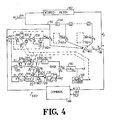
- FIG 4 it shows another adaptive coefficient processor structured in accordance with a second embodiment of the present invention.
- the processor 64b is similar to the processor 64a of Figure 3 and incorporates many of the same components which have been denoted by identical reference characters. However, the difference between the processor 64b and processor 64a is that the stochastic averaging coefficients ⁇ and ⁇ used in the processor 64b are the stochastic average of the coefficients ⁇ and ⁇ .
- the circuit 84b includes a first single-pole correlator 170 and a second single-pole correlator 172.
- Correlator 170 includes an amplifier 174 and an amplifier 176 with the gain of amplifier 174 equal to the ⁇ of the last time period and the gain of amplifier 176 being equal to the ⁇ of the last time period.
- the correlator 172 includes amplifiers 178 and 180, wherein the gain of amplifier 178 is the ⁇ of the last time period and the gain of amplifier 180 is the ⁇ of the last time period.
- resulting values of ⁇ and ⁇ generated by the circuit 84b represent the stochastic average of the generated and stochastic averaging coefficients.
- processor 64b since values of ⁇ and ⁇ are now the stochastic averages of those coefficients, the iterative process will converge at a faster rate than the iterative process of processor 64a of Figure 3. The reason for this is that values of ⁇ and ⁇ are now time-dependant and signal-dependent. In all other respects, the processor 64b operates in the same manner of processor 64a of Figure 3.
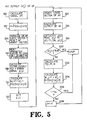
- FIG. 5 provides a flow chart for implementing the present invention into microprocessor form.
- microprocessors include internal memory which will be referred to in the description of a flow chart of Figure 5.
- step 180 wherein the input signal power (p) is determined and the response (d j ) of the desired filter (DF) to the input signal is calculated. This value (d j ) is the output of the desired filter characteristic.
- step 182 the value of ⁇ is determined and is equal to 1 divided by N+1 times the signal power determined in 180 and wherein N is equal to the number of sections of the adaptive digital filter.
- step 184 the value of the output (d j ) of the desired filter (DF) and the initial adaptive filter state vector are stored in memory and the initial adaptive filter coefficient vector is set to zero.
- step 186 parameter buffer, or memory, is set to zero so that all of the variables such as the gradients are set to zero and the desired number of iterations is stored in memory.
- step 188 the output of the adaptive filter y(j) and the error signal are determined.
- step 190 the first adaptive filter coefficient update is performed utilizing the expression indicated.
- step 192 the iteration number is set to one.
- step 194 the adaptive filter state vector is updated and in step 196, the output of the adaptive filter is calculated.
- step 198 the error signal e(j) is calculated and the gradient for the first iteration is calculated and stored in memory as the gradient of the last iteration. The gradient for the current iteration is then calculated.
- step 200 the error signal is compared to the predetermined standard. If the error signal is less than the predetermined standard, then the iterative process is stopped. If the error signal is not less than the predetermined standard then the process continues to step 202 wherein the values of R g (j), ⁇ and ⁇ are calculated using the expressions previously described.
- step 204 the new adaptive filter coefficient is determined by utilizing the stochastic average of the gradients generated.
- step 206 it is determined if the number of iterations now exceed the maximum number of iterations. If the answer is "Yes”, then the iteration process is stopped. If the answer is "No", then the iterative number is update by one in step 208, and the process returns to update the memory which contains the new filter coefficient. As a result, the new filter coefficient is available for the subsequent iterative process.
- the present invention provides a new and improved system and method for generating coefficients for use in a digital filter.
- the system and method of the present invention utilizes an iterative adaptive process which includes a least mean square process and wherein the updated values for the filter coefficients are based upon the stochastic average of the gradients generated during previous iterations.
- the foregoing results in a system and method for generating coefficients for use in a digital filter which is insensitive to noise in the gradient estimate and which has a fast convergence without having to use an optimal step-size.
- the system utilizes a 1-pole correlator to estimate the correlation between the adaptive error and the signal. The correlator is used for fast, efficient gradient estimation rather than to control the step-size as in prior art processes.
Landscapes
- Filters That Use Time-Delay Elements (AREA)
- Developing Agents For Electrophotography (AREA)
- Compositions Of Oxide Ceramics (AREA)
- Signal Processing For Digital Recording And Reproducing (AREA)
Applications Claiming Priority (2)
| Application Number | Priority Date | Filing Date | Title |
|---|---|---|---|
| US359022 | 1989-05-30 | ||
| US07/359,022 US5058047A (en) | 1989-05-30 | 1989-05-30 | System and method for providing digital filter coefficients |
Publications (3)
| Publication Number | Publication Date |
|---|---|
| EP0400850A2 true EP0400850A2 (de) | 1990-12-05 |
| EP0400850A3 EP0400850A3 (de) | 1991-11-27 |
| EP0400850B1 EP0400850B1 (de) | 1995-11-22 |
Family
ID=23411995
Family Applications (1)
| Application Number | Title | Priority Date | Filing Date |
|---|---|---|---|
| EP90305400A Expired - Lifetime EP0400850B1 (de) | 1989-05-30 | 1990-05-18 | Koeffizientengenerator für digitale Filter |
Country Status (5)
| Country | Link |
|---|---|
| US (1) | US5058047A (de) |
| EP (1) | EP0400850B1 (de) |
| JP (1) | JP3250801B2 (de) |
| AT (1) | ATE130708T1 (de) |
| DE (1) | DE69023697T2 (de) |
Cited By (5)
| Publication number | Priority date | Publication date | Assignee | Title |
|---|---|---|---|---|
| FR2670600A1 (fr) * | 1990-12-14 | 1992-06-19 | Thomson Csf | Procede et dispositif de detection des changements de caracteristiques du signal de parole appliques a des vocodeurs a bas debit. |
| WO1998059418A3 (en) * | 1997-06-23 | 1999-03-18 | Koninkl Philips Electronics Nv | A blind equalization having reduced complexity |
| EP1976122A1 (de) * | 2007-03-31 | 2008-10-01 | Sony Deutschland Gmbh | Adaptive Filtervorrichtung |
| GB2449167A (en) * | 2007-05-11 | 2008-11-12 | I P Access Ltd | Wireless communication unit and method for filtering using an adaptive root raised cosine filter |
| EP3301810A1 (de) * | 2016-09-29 | 2018-04-04 | Intel IP Corporation | Adaptive filterschaltungen und verfahren |
Families Citing this family (39)
| Publication number | Priority date | Publication date | Assignee | Title |
|---|---|---|---|---|
| JP3038790B2 (ja) * | 1990-04-27 | 2000-05-08 | 日本電気株式会社 | 等化器 |
| US5272656A (en) * | 1990-09-21 | 1993-12-21 | Cambridge Signal Technologies, Inc. | System and method of producing adaptive FIR digital filter with non-linear frequency resolution |
| WO1992005501A1 (en) * | 1990-09-21 | 1992-04-02 | Cambridge Signal Technologies, Inc. | System and method of producing adaptive fir digital filter with non-linear frequency resolution |
| JP2842026B2 (ja) * | 1991-02-20 | 1998-12-24 | 日本電気株式会社 | 適応フィルタの係数制御方法及び装置 |
| US5136531A (en) * | 1991-08-05 | 1992-08-04 | Motorola, Inc. | Method and apparatus for detecting a wideband tone |
| US5282154A (en) * | 1992-06-01 | 1994-01-25 | Thomson Consumer Electronics, Inc. | System for determining and repairing instability in an IIR filter suitable for use in deghosting apparatus |
| US5828700A (en) * | 1993-08-05 | 1998-10-27 | Micro Linear Corporation | Adaptive equalizer circuit |
| KR100248266B1 (ko) * | 1994-03-07 | 2000-03-15 | 김영환 | 유한충격응답적응디지탈필터의 탭계수갱신장치 |
| JPH07248778A (ja) * | 1994-03-09 | 1995-09-26 | Fujitsu Ltd | 適応フィルタの係数更新方法 |
| US5532950A (en) * | 1994-04-25 | 1996-07-02 | Wadia Digital Corporation | Dynamic digital filter using neural networks |
| US5426597A (en) * | 1994-04-26 | 1995-06-20 | The United States Of America As Represented By The Secretary Of The Navy | Adaptive infinite impulse response (IIR) filter system |
| US5627896A (en) * | 1994-06-18 | 1997-05-06 | Lord Corporation | Active control of noise and vibration |
| US5682341A (en) * | 1995-04-19 | 1997-10-28 | Korea Advanced Institute Of Science And Technology | Adaptive signal processor using Newton/LMS algorithm |
| US5844941A (en) * | 1995-07-20 | 1998-12-01 | Micro Linear Corporation | Parallel adaptive equalizer circuit |
| KR100248021B1 (ko) * | 1995-09-30 | 2000-03-15 | 윤종용 | Csd 필터의 신호처리방법과 그 회로 |
| JPH09270672A (ja) * | 1996-03-29 | 1997-10-14 | Sharp Corp | 適応型ディジタルフィルタ装置 |
| US6757326B1 (en) * | 1998-12-28 | 2004-06-29 | Motorola, Inc. | Method and apparatus for implementing wavelet filters in a digital system |
| WO2001001570A1 (de) * | 1999-06-25 | 2001-01-04 | Infineon Technologies Ag | Programmierbares digitales bandpass-filter für eine kodec-schaltung |
| KR100330237B1 (ko) * | 1999-07-19 | 2002-03-25 | 윤종용 | 반향 지연 추정 장치 및 방법 |
| US7072392B2 (en) * | 2000-11-13 | 2006-07-04 | Micronas Semiconductors, Inc. | Equalizer for time domain signal processing |
| US6829297B2 (en) * | 2001-06-06 | 2004-12-07 | Micronas Semiconductors, Inc. | Adaptive equalizer having a variable step size influenced by output from a trellis decoder |
| US7190744B2 (en) * | 2001-06-07 | 2007-03-13 | Micronas Semiconductors, Inc. | Error generation for adaptive equalizer |
| US7418034B2 (en) * | 2001-06-19 | 2008-08-26 | Micronas Semiconductors. Inc. | Combined trellis decoder and decision feedback equalizer |
| KR100422449B1 (ko) * | 2001-11-12 | 2004-03-11 | 삼성전자주식회사 | 수직 공통패턴을 사용한 저전력 csd 선형위상 디지털필터 구조 및 그에 따른 필터구현방법 |
| US7272203B2 (en) * | 2002-04-05 | 2007-09-18 | Micronas Semiconductors, Inc. | Data-directed frequency-and-phase lock loop for decoding an offset-QAM modulated signal having a pilot |
| US7321642B2 (en) * | 2002-04-05 | 2008-01-22 | Micronas Semiconductors, Inc. | Synchronization symbol re-insertion for a decision feedback equalizer combined with a trellis decoder |
| US6995617B2 (en) * | 2002-04-05 | 2006-02-07 | Micronas Semiconductors, Inc. | Data-directed frequency-and-phase lock loop |
| US7376181B2 (en) * | 2002-04-05 | 2008-05-20 | Micronas Semiconductors, Inc. | Transposed structure for a decision feedback equalizer combined with a trellis decoder |
| US7200552B2 (en) * | 2002-04-29 | 2007-04-03 | Ntt Docomo, Inc. | Gradient descent optimization of linear prediction coefficients for speech coders |
| US6774822B1 (en) * | 2003-01-09 | 2004-08-10 | Process Control Corporation | Method and systems for filtering unwanted noise in a material metering machine |
| US7904496B2 (en) * | 2006-01-24 | 2011-03-08 | Texas Instruments Incorporated | Method and system for selecting effective tap values for a digital filter |
| US7917563B1 (en) * | 2006-02-07 | 2011-03-29 | Link—A—Media Devices Corporation | Read channel processor |
| US8284870B1 (en) | 2006-02-07 | 2012-10-09 | Link—A—Media Devices Corporation | Timing loop |
| US7746924B2 (en) * | 2006-05-09 | 2010-06-29 | Hewlett-Packard Development Company, L.P. | Determination of filter weights |
| DE102008026518B4 (de) | 2008-04-28 | 2017-11-23 | Rohde & Schwarz Gmbh & Co. Kg | Automatisierte Filterkoeffizientenberechnung |
| KR101677294B1 (ko) * | 2010-04-19 | 2016-11-18 | 삼성전자주식회사 | 피크 윈도윙을 위한 스무딩 장치 |
| GB2488599B (en) * | 2011-03-04 | 2017-11-29 | Snell Advanced Media Ltd | Adaptive signal processing |
| US9414372B2 (en) * | 2012-03-16 | 2016-08-09 | Qualcomm Incorporated | Digital filter control for filter tracking speedup |
| CN107659290B (zh) * | 2017-08-09 | 2021-02-09 | 湖南艾科诺维科技有限公司 | 带宽扩展滤波器及其设计方法 |
Family Cites Families (3)
| Publication number | Priority date | Publication date | Assignee | Title |
|---|---|---|---|---|
| NL7905577A (nl) * | 1979-07-18 | 1981-01-20 | Philips Nv | Inrichting met een niet-recursieffilter. |
| US4791390A (en) * | 1982-07-01 | 1988-12-13 | Sperry Corporation | MSE variable step adaptive filter |
| FR2556530B1 (fr) * | 1983-10-28 | 1986-04-04 | Telediffusion Fse | Dispositif de correction d'echos, notamment pour systeme de diffusion de donnees |
-
1989
- 1989-05-30 US US07/359,022 patent/US5058047A/en not_active Expired - Lifetime
-
1990
- 1990-05-18 DE DE69023697T patent/DE69023697T2/de not_active Expired - Fee Related
- 1990-05-18 AT AT90305400T patent/ATE130708T1/de not_active IP Right Cessation
- 1990-05-18 EP EP90305400A patent/EP0400850B1/de not_active Expired - Lifetime
- 1990-05-30 JP JP14324590A patent/JP3250801B2/ja not_active Expired - Lifetime
Non-Patent Citations (2)
| Title |
|---|
| 1989 IEEE INTERNATIONAL SYMPOSIUM ON CIRCUITS AND SYSTEMS ; PORTLAND 8-11 MAY 1989 G.K.BORAY et al "CONJUGATE GRADIENT TECHNIQUES FOR ADAPTIVE FILTERING" p 1752-1757 * |
| IEEE ACOUSTICS, SPEECH, AND SIGNAL PROCESSING MAGAZINE. vol. 37, no. 2, February 1989, NEW YORK US pages 254 - 264; YUNG-FU CHENG ET AL: 'ANALYSIS OF AN ADAPTIVE TECHNIQUE FOR MODELING SPARSE SYSTEMS ' * |
Cited By (9)
| Publication number | Priority date | Publication date | Assignee | Title |
|---|---|---|---|---|
| FR2670600A1 (fr) * | 1990-12-14 | 1992-06-19 | Thomson Csf | Procede et dispositif de detection des changements de caracteristiques du signal de parole appliques a des vocodeurs a bas debit. |
| EP0490758A3 (en) * | 1990-12-14 | 1992-12-23 | Thomson-Csf | Method and apparatus for detecting change of speech signal characteristics for low bitrate vocoders |
| WO1998059418A3 (en) * | 1997-06-23 | 1999-03-18 | Koninkl Philips Electronics Nv | A blind equalization having reduced complexity |
| US6011813A (en) * | 1997-06-23 | 2000-01-04 | Philips Electronics North America Corporation | Blind equalization method and apparatus having reduced complexity |
| EP1976122A1 (de) * | 2007-03-31 | 2008-10-01 | Sony Deutschland Gmbh | Adaptive Filtervorrichtung |
| US8402074B2 (en) | 2007-03-31 | 2013-03-19 | Sony Deutschland Gmbh | Adaptive filter device and method for determining filter coefficients |
| GB2449167A (en) * | 2007-05-11 | 2008-11-12 | I P Access Ltd | Wireless communication unit and method for filtering using an adaptive root raised cosine filter |
| GB2449167B (en) * | 2007-05-11 | 2009-04-08 | I P Access Ltd | Wireless communication unit and method for filtering using an adaptive root raised cosine filter |
| EP3301810A1 (de) * | 2016-09-29 | 2018-04-04 | Intel IP Corporation | Adaptive filterschaltungen und verfahren |
Also Published As
| Publication number | Publication date |
|---|---|
| JPH0322704A (ja) | 1991-01-31 |
| DE69023697D1 (de) | 1996-01-04 |
| EP0400850B1 (de) | 1995-11-22 |
| ATE130708T1 (de) | 1995-12-15 |
| JP3250801B2 (ja) | 2002-01-28 |
| EP0400850A3 (de) | 1991-11-27 |
| DE69023697T2 (de) | 1996-07-25 |
| US5058047A (en) | 1991-10-15 |
Similar Documents
| Publication | Publication Date | Title |
|---|---|---|
| EP0400850B1 (de) | Koeffizientengenerator für digitale Filter | |
| US5343522A (en) | Adaptive sparse echo canceller using a sub-rate filter for active tap selection | |
| EP0342782B1 (de) | Elektronisches Filter für ein Hörgerät | |
| KR100338656B1 (ko) | 반향 경로 지연 추정 방법 및 장치 | |
| US5475759A (en) | Electronic filters, hearing aids and methods | |
| JP3216704B2 (ja) | 適応アレイ装置 | |
| US6097823A (en) | Digital hearing aid and method for feedback path modeling | |
| EP0561133B1 (de) | Mehrkanalsechokompensation mit adaptiven Filtern welche auswählbare Koeffizientvektoren haben | |
| US4882668A (en) | Adaptive matched filter | |
| US4764955A (en) | Process for determining an echo path flat delay and echo canceler using said process | |
| US4879745A (en) | Half-duplex speakerphone | |
| US5570423A (en) | Method of providing adaptive echo cancellation | |
| JP3280496B2 (ja) | 全二重スピーカホン等のノイズ低減装置および方法 | |
| US6928160B2 (en) | Estimating bulk delay in a telephone system | |
| JP3159176B2 (ja) | 帯域分割適応フィルタによる未知システム同定方法及び装置 | |
| JP2625613B2 (ja) | 適合型エコー・キャンセルの方法 | |
| RU2180984C2 (ru) | Измерение сходимости адаптивных фильтров | |
| CA2171778A1 (en) | Method and apparatus for adaptive filtering | |
| GB2135558A (en) | Improvements in or relating to delay estimation | |
| US4811261A (en) | Adaptive digital filter for determining a transfer equation of an unknown system | |
| JPH07176991A (ja) | 適応フィルタ装置及びその制御方法 | |
| EP0114855B1 (de) | Normalisierung der anpassung eines adaptiven filters | |
| US4752903A (en) | Adaptive digital filter for eliminating howling | |
| US6950842B2 (en) | Echo canceller having an adaptive filter with a dynamically adjustable step size | |
| JP2785858B2 (ja) | 高速制御適応フィルタを用いた受信方式 |
Legal Events
| Date | Code | Title | Description |
|---|---|---|---|
| PUAI | Public reference made under article 153(3) epc to a published international application that has entered the european phase |
Free format text: ORIGINAL CODE: 0009012 |
|
| AK | Designated contracting states |
Kind code of ref document: A2 Designated state(s): AT BE CH DE DK ES FR GB GR IT LI LU NL SE |
|
| PUAL | Search report despatched |
Free format text: ORIGINAL CODE: 0009013 |
|
| AK | Designated contracting states |
Kind code of ref document: A3 Designated state(s): AT BE CH DE DK ES FR GB GR IT LI LU NL SE |
|
| 17P | Request for examination filed |
Effective date: 19920507 |
|
| 17Q | First examination report despatched |
Effective date: 19940803 |
|
| GRAA | (expected) grant |
Free format text: ORIGINAL CODE: 0009210 |
|
| AK | Designated contracting states |
Kind code of ref document: B1 Designated state(s): AT BE CH DE DK ES FR GB GR IT LI LU NL SE |
|
| PG25 | Lapsed in a contracting state [announced via postgrant information from national office to epo] |
Ref country code: IT Free format text: LAPSE BECAUSE OF FAILURE TO SUBMIT A TRANSLATION OF THE DESCRIPTION OR TO PAY THE FEE WITHIN THE PRESCRIBED TIME-LIMIT;WARNING: LAPSES OF ITALIAN PATENTS WITH EFFECTIVE DATE BEFORE 2007 MAY HAVE OCCURRED AT ANY TIME BEFORE 2007. THE CORRECT EFFECTIVE DATE MAY BE DIFFERENT FROM THE ONE RECORDED. Effective date: 19951122 Ref country code: GR Free format text: LAPSE BECAUSE OF FAILURE TO SUBMIT A TRANSLATION OF THE DESCRIPTION OR TO PAY THE FEE WITHIN THE PRESCRIBED TIME-LIMIT Effective date: 19951122 Ref country code: ES Free format text: THE PATENT HAS BEEN ANNULLED BY A DECISION OF A NATIONAL AUTHORITY Effective date: 19951122 Ref country code: DK Effective date: 19951122 Ref country code: BE Effective date: 19951122 Ref country code: CH Effective date: 19951122 Ref country code: NL Free format text: LAPSE BECAUSE OF FAILURE TO SUBMIT A TRANSLATION OF THE DESCRIPTION OR TO PAY THE FEE WITHIN THE PRESCRIBED TIME-LIMIT Effective date: 19951122 Ref country code: AT Effective date: 19951122 Ref country code: LI Effective date: 19951122 |
|
| REF | Corresponds to: |
Ref document number: 130708 Country of ref document: AT Date of ref document: 19951215 Kind code of ref document: T |
|
| REF | Corresponds to: |
Ref document number: 69023697 Country of ref document: DE Date of ref document: 19960104 |
|
| PG25 | Lapsed in a contracting state [announced via postgrant information from national office to epo] |
Ref country code: SE Effective date: 19960222 |
|
| ET | Fr: translation filed | ||
| NLV1 | Nl: lapsed or annulled due to failure to fulfill the requirements of art. 29p and 29m of the patents act | ||
| PG25 | Lapsed in a contracting state [announced via postgrant information from national office to epo] |
Ref country code: LU Free format text: LAPSE BECAUSE OF NON-PAYMENT OF DUE FEES Effective date: 19960531 |
|
| REG | Reference to a national code |
Ref country code: CH Ref legal event code: PL |
|
| PLBE | No opposition filed within time limit |
Free format text: ORIGINAL CODE: 0009261 |
|
| STAA | Information on the status of an ep patent application or granted ep patent |
Free format text: STATUS: NO OPPOSITION FILED WITHIN TIME LIMIT |
|
| 26N | No opposition filed | ||
| PGFP | Annual fee paid to national office [announced via postgrant information from national office to epo] |
Ref country code: FR Payment date: 20010503 Year of fee payment: 12 |
|
| REG | Reference to a national code |
Ref country code: GB Ref legal event code: IF02 |
|
| PGFP | Annual fee paid to national office [announced via postgrant information from national office to epo] |
Ref country code: DE Payment date: 20020531 Year of fee payment: 13 |
|
| PG25 | Lapsed in a contracting state [announced via postgrant information from national office to epo] |
Ref country code: FR Free format text: LAPSE BECAUSE OF NON-PAYMENT OF DUE FEES Effective date: 20030131 |
|
| REG | Reference to a national code |
Ref country code: FR Ref legal event code: ST |
|
| PG25 | Lapsed in a contracting state [announced via postgrant information from national office to epo] |
Ref country code: DE Free format text: LAPSE BECAUSE OF NON-PAYMENT OF DUE FEES Effective date: 20031202 |
|
| PGFP | Annual fee paid to national office [announced via postgrant information from national office to epo] |
Ref country code: GB Payment date: 20070410 Year of fee payment: 18 |
|
| GBPC | Gb: european patent ceased through non-payment of renewal fee |
Effective date: 20080518 |
|
| PG25 | Lapsed in a contracting state [announced via postgrant information from national office to epo] |
Ref country code: GB Free format text: LAPSE BECAUSE OF NON-PAYMENT OF DUE FEES Effective date: 20080518 |