EP0401004A2 - Composition utilisée dans le traitement d'une matière à base de poisson pendant la préparation d'un produit de poisson préparé, méthode pour la préparation d'un tel produit de poisson et produit à base de poisson - Google Patents
Composition utilisée dans le traitement d'une matière à base de poisson pendant la préparation d'un produit de poisson préparé, méthode pour la préparation d'un tel produit de poisson et produit à base de poisson Download PDFInfo
- Publication number
- EP0401004A2 EP0401004A2 EP90305897A EP90305897A EP0401004A2 EP 0401004 A2 EP0401004 A2 EP 0401004A2 EP 90305897 A EP90305897 A EP 90305897A EP 90305897 A EP90305897 A EP 90305897A EP 0401004 A2 EP0401004 A2 EP 0401004A2
- Authority
- EP
- European Patent Office
- Prior art keywords
- fish
- macroglobulin
- alpha
- surimi
- product
- Prior art date
- Legal status (The legal status is an assumption and is not a legal conclusion. Google has not performed a legal analysis and makes no representation as to the accuracy of the status listed.)
- Pending
Links
Images


Classifications
-
- A—HUMAN NECESSITIES
- A23—FOODS OR FOODSTUFFS; TREATMENT THEREOF, NOT COVERED BY OTHER CLASSES
- A23B—PRESERVATION OF FOODS, FOODSTUFFS OR NON-ALCOHOLIC BEVERAGES; CHEMICAL RIPENING OF FRUIT OR VEGETABLES
- A23B4/00—Preservation of meat, sausages, fish or fish products
- A23B4/14—Preserving with chemicals not covered by groups A23B4/02 or A23B4/12
- A23B4/18—Preserving with chemicals not covered by groups A23B4/02 or A23B4/12 in the form of liquids or solids
- A23B4/20—Organic compounds; Microorganisms; Enzymes
-
- A—HUMAN NECESSITIES
- A23—FOODS OR FOODSTUFFS; TREATMENT THEREOF, NOT COVERED BY OTHER CLASSES
- A23L—FOODS, FOODSTUFFS OR NON-ALCOHOLIC BEVERAGES, NOT OTHERWISE PROVIDED FOR; PREPARATION OR TREATMENT THEREOF
- A23L17/00—Food-from-the-sea products; Fish products; Fish meal; Fish-egg substitutes; Preparation or treatment thereof
- A23L17/70—Comminuted, e.g. emulsified, fish products; Processed products therefrom such as pastes, reformed or compressed products
-
- C—CHEMISTRY; METALLURGY
- C07—ORGANIC CHEMISTRY
- C07K—PEPTIDES
- C07K14/00—Peptides having more than 20 amino acids; Gastrins; Somatostatins; Melanotropins; Derivatives thereof
- C07K14/81—Protease inhibitors
- C07K14/8107—Endopeptidase (E.C. 3.4.21-99) inhibitors
Definitions
- the present invention relates to the treatment of fish material with alpha-2-macroglobulin during the preparation of a processed fish product.
- Surimi is one such product.
- Surimi is a paste of minced, washed fish muscle. The washing removes water soluble components as well as removing other contaminants.
- High quality surimi consists of a paste of such muscle. This is dissolved in a dilute solution of sodium chloride which gels on heating.
- the surimi can be shaped when in a paste form or shaped and extruded after cooking.
- the surimi paste is usually provided in frozen form. Substances known as cryoprotectants are added to the surimi mix prior to freezing to increase its storage stability.
- a number of species of fish contain heat stable proteases which break down muscle texture during processing, and thus inhibit the gel forming ability of surimi. Since gel formation is a critical processing requirement, species with heat stable proteases are unsuitable raw materials for the production of acceptable quality fish products such as surimi.
- protease inhibitors would be an indispensable tool in fish processing technology.
- the invention is directed to a composition for treating fish material during the preparation of a processed fish product comprising alpha-2-macroglobulin in amount sufficient to neutralize or inhibit protease contained in the fish material.
- the invention provides a suitable protease inhibitor to treat a number of fish species which were previously unsuitable for preparing processed fish products such as surimi.
- the present invention also relates to a method of preparing a processed fish product comprising contacting the fish material with alpha-2-macroglobulin in an amount sufficient to neutralize or inhibit the protease contained in the fish material.
- the present invention is directed to a fish product prepared using the composition of this invention and to a fish product prepared according to the method of this invention.
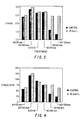
- Figures 1-5 show the effect of protease inhibition with alpha-2-macroglobulin on surimi gel strength (stress and strain).
- the present invention provides a composition for the treatment of fish material during the preparation of a processed fish product comprising alpha-2-macroglobulin in an amount sufficient to neutralize proteases contained in the fish material.
- the amount of alpha-2-macroglobulin needed to inactivate the heat stable protease of a particular fish material will vary depending on the amount of protease present in the fish material.
- the amount of alpha-2-macroglobulin sufficient to neutralize or inhibit the protease present in fish material is an amount necessary to prevent muscle texture breakdown during processing of the fish material.
- This amount of alpha-2-macroglobulin is typically in the range of 0.1 to 20.0 mls of a 10% (w/v) protein solution (approximately 50% alpha-2-macroglobulin) per kg of fish material.
- the amount of protein solution added is 3.3 to 13.3 mls/kg.
- a partially purified alpha-2-macroglobulin is used to treat fish material.
- the alpha-2-macroglobulin of the present invention may be obtained from any mammal.
- the alpha-2-macroglobulin is a bovine alpha-2-macroglobulin.
- the bovine alpha-2-macroglobulin is extracted from bovine plasma.
- Other mammalian plasma sources for obtaining the alpha-2-macroglobulin of the present invention include but are not limited to ovine, porcine, and equine.
- the alpha-2-macroglobulin of the present invention may be obtained by recombinant DNA technology well known to those of skill in the art.
- the alpha-2-macroglobulin of the present invention may be in lyophilized form to be reconstituted for use by the addition of a suitable diluent, or alternatively, it may be in the form of an aqueous solution.
- a sterile diluent which may contain materials generally recognized for approximating physiological conditions or conditions suitable to optimize the protease inhibition activity of the alpha-2-macroglobulin of the present invention.
- the alpha-2-macroglobulin composition of the present invention When used as an aqueous solution, the alpha-2-macroglobulin composition of the present invention, for the most part, will contain many of the same substances described above for the reconstitution of a lyophilized product.
- the invention provides a method of preparing a processed fish product comprising treating the fish material with alpha-2-macroglobulin in a manner and in a sufficient amount to neutralize or inhibit the protease contained in the fish material.
- the alpha-2-macroglobulin needs to be added at a time when it is effective to inhibit the proteases.
- the effect of the proteases is most noticeable on heating.
- the inhibitor must be present before heating commences. Desirably it is added prior to freezing.
- the invention relates to fish products prepared according to the method of the present invention and a fish product prepared using the composition of this invention.
- Fish as used in the present invention may be any type of cold-blooded aquatic vertebrate, including, but not limited to the class Osteichthyes, the class Chondrichthyes, the class Agnatha and various unrelated aquatic animals.
- the fish material may be derived from the whole fish or parts thereof and may be a mixture of several types, classes or species of fish.
- the fish may be minced, filleted or otherwise prepared to facilitate contacting the fish material with the alpha-2-macroglobulin.
- the prepared material is soaked in a aqueous solution of alpha-2-macroglobulin for a predetermined time and temperature in order to effect neutralization of the protease before the fish is further processed.
- the time may range from 20 minutes to 20 hours.
- a typical time will be 20 to 120 minutes with the incubation temperature ranging between 25 to 90°C.
- alpha-2-macroglobulin of the present invention may also be added to the processed fish product after processing.
- the addition of alpha-2-macroglobulin after processing may or may not follow a previous protease neutralization step with alpha-2-macroglobulin.
- composition of the present invention it is possible to prepare completely acceptable fish products from fish material that had previously been considered unsuitable for processing.
- Criteria for determining acceptability of processed fish products such as surimi are well known to those of skill in the art. In particular, these standards are based on surimi gel strength as analyzed by stress and strain.
- a particular advantage of the preferred embodiment of the invention is that the mammalian alpha-2-macroglobulin is an extract from a food product and thus is a much more acceptable additive from the point of view of public health authorities. This is in stark contrast to other artificial additives. Furthermore, the presence of the alpha-2-macroglobulin during storage (after processing) of the prepared fish product may act to prevent residual protease activity from destroying the gel texture. Thus, the alpha-2-macroglobulin of the present invention may be incorporated into the surimi along with the other stabilizers and cryoprotectants, after the washing and dehydration step and before the freezing stage.
- a composition of the invention containing alpha-2-macroglobulin as the active protease inhibitor, may be prepared in crude form from mammalian plasma and then used to neutralize or inhibit the heat stable alkaline protease and other proteases present in some fish tissue.
- the alpha-2-macroglobulin of the present invention may be obtained from plasma by using well known protein purification techniques.
- the plasma is separated from blood by centrifugation.
- the alpha-2-macroglobulin may be purified by one or a combination of techniques including salt fractionation, ion-exchange chromatography, molecular-sieve chromatography and affinity chromatography.
- the protease inhibitor, bovine alpha-2-macroglobulin can, for example, be prepared from bovine plasma by a salt fractionation technique.
- the technique uses different concentrations of ammonium sulphate to precipitate unwanted gamma-globulin fractions, leaving the desired alpha-2-macroglobulin in the supernatant.
- a higher concentration of ammonium sulphate may be added to precipitate the active alpha-2-macroglobulin from the supernatant, which is collected and further processed to remove unwanted residual salts.
- a solution of the prepared alpha-2-macroglobulin may then be used to treat prepared fish material.
- Alpha-2-macroglobulin obtained by the salt fractionation technique may be further purified by other purification techniques well known to those of skill in art including ion exchange, gel filtration chromatography, dye-ligand affinity chromatography or zinc chelate chromatography.
- the alpha-2-macroglobulin obtained by salt fractionation is suitable for use in the present invention.
- a crude alpha-2-macroglobulin rich solution was prepared by ammonium sulphate precipitation technique.
- Bovine serum was diluted with an equal volume of 0.9% (w/v) NaCl in water.
- Solid ammonium sulphate was then added to the diluted serum to a concentration of 38% (w/v) of the total volume and the solution then stirred for 3 hours.
- the precipitated contaminating gammaglobulin fraction was then removed by centrifugation and discarded and the alpha-2-macroglobulin rich supernatant collected.
- Alpha-2-macroglobulin obtained by ammonium sulfate precipitation may be further purified by ion exchange, gel filtration chromatography, dye-ligand affinity chromatography or zinc chelate chromatography.
- the alpha-2-macroglobulin purified by the salt precipitation technique (approximately 50% alpha2-macroglobulin) is suitable for use at a total protein concentration of 1g per kilogram of surimi.
- the amount of alpha-2-macroglobulin needed to inactivate the heat stable protease of a particular fish material will vary depending on the amount of protease present in the fish meat.
- Bovine alpha-2-macroglobulin has a molecular weight of approximately 725,000 Daltons.
- Bacterial proteases readily inactivate alpha-2-macroglobulin.
- the alpha-2-macroglobulin can be stored as a solution at 4°C or stored as a frozen solution at -18°C or as a freeze-dried powder and reconstituted before use.
- the alpha-2-macroglobulin is easily denatured and inactivated, especially by bacterial proteases, and therefore should not be stored for long periods of time in solution.
- the alpha-2-macroglobulin can be incorporated into the surimi along with the other stabilizers and cryoprotectants, after the washing and dehydration step and before the freezing stage.
- the alpha-2-macroglobulin produced in Example 1 is added during chopping in the bowl chopper.
- the surimi is then incubated at various temperatures for various times as referred to in the attached figure.
- Gel strength is usually comprised of a firmness component and an elasticity component.
- the firmness is indicated by measuring the stress of the product, while the elasticity is measured by the strain.
- These properties in accordance with this invention were measured on a modified Brookfield viscometer which briefly employs a probe penetrating into the cooked surimi and the probe is subjected to a force to move it sideways through the surimi. People skilled in the art will know the steps necessary to obtain a measure of the stress and strain characteristics of a gel using this apparatus.
- the modified Brookfield viscometer Is essentially a torsion test.
- Controls referred to in Figures 1 to 5 have no alpha-2-macroglobulin added.
- alpha-2-macroglobulin may then be used to prepare surimi from a number of species which contain protease activity.
- a total protein concentration of 1g of the 10% (w/v) protein solution containing alpha-2-macroglobulin per kilogram of fish material can effectively neutralize protease activity.
- the 60°C incubation (60 and 120 minutes) showed the most drastic increase in gel strength over the control. This may result from the fact that the optimum temperature for alkaline protease activity is near 60°C whereas the 90°C incubation may tend to inactivate the protease to some extent. Indeed, alkaline protease isolated from atlantic menhaden (Brevoortia tyrannus) was demonstrated to degrade surimi gels optimally at 60°C at a pH of 7.5 to 8.0 (Boye et al ., J. Food Sci. , 53(5) :1340-1342 (1988)). Although the 90°C treatment may be used to increase gel strength in this case, it may not be effective for all heat stable proteases.
- alpha-2-macroglobulin treatment makes alpha-2-macroglobulin treatment a more attractive alternative.
- thermal processing of surimi is usually preformed at temperatures of 50-70°C and thus according to the results, alpha-2-macroglobulin addition before thermal processing would be effective in making acceptable quality surimi.
- Figure 5 demonstrates a comparison of surimi gel strength (stress and strain) of Hoki fish material with and without treatment with the alpha-2-macroglobulin protease inhibitor.
- Three different temperature/time incubation steps were performed to generate the comparison with and without treatment. Specifically, a 90°C/20 minute incubation, a 60°C/60 minute incubation, and a 60°C/120 minute incubation was performed. Gel strength was analyzed by torsion shear strain and by torsion shear stress. For each incubation, 10 mls of the alpha-2-macroglobulin solution obtained in example 1 were added per kg of fish material.
- Surimi is a paste formed from fish muscle protein with the substantial absence of bone, cartilage and skin.
Landscapes
- Chemical & Material Sciences (AREA)
- Life Sciences & Earth Sciences (AREA)
- Health & Medical Sciences (AREA)
- Engineering & Computer Science (AREA)
- Food Science & Technology (AREA)
- Organic Chemistry (AREA)
- Polymers & Plastics (AREA)
- Zoology (AREA)
- Nutrition Science (AREA)
- Biophysics (AREA)
- Marine Sciences & Fisheries (AREA)
- General Chemical & Material Sciences (AREA)
- Chemical Kinetics & Catalysis (AREA)
- Gastroenterology & Hepatology (AREA)
- Biochemistry (AREA)
- Wood Science & Technology (AREA)
- General Health & Medical Sciences (AREA)
- Genetics & Genomics (AREA)
- Medicinal Chemistry (AREA)
- Molecular Biology (AREA)
- Proteomics, Peptides & Aminoacids (AREA)
- Microbiology (AREA)
- Fish Paste Products (AREA)
- Processing Of Meat And Fish (AREA)
Applications Claiming Priority (2)
| Application Number | Priority Date | Filing Date | Title |
|---|---|---|---|
| NZ229385A NZ229385A (en) | 1989-06-01 | 1989-06-01 | Treatment of processed fish product (surimi) with alpha-2-macroglobulin to neutralise alkaline proteases in the fish |
| NZ229385 | 1989-06-01 |
Publications (2)
| Publication Number | Publication Date |
|---|---|
| EP0401004A2 true EP0401004A2 (fr) | 1990-12-05 |
| EP0401004A3 EP0401004A3 (fr) | 1991-03-20 |
Family
ID=19922885
Family Applications (1)
| Application Number | Title | Priority Date | Filing Date |
|---|---|---|---|
| EP19900305897 Pending EP0401004A3 (fr) | 1989-06-01 | 1990-05-31 | Composition utilisée dans le traitement d'une matière à base de poisson pendant la préparation d'un produit de poisson préparé, méthode pour la préparation d'un tel produit de poisson et produit à base de poisson |
Country Status (6)
| Country | Link |
|---|---|
| US (1) | US5013568A (fr) |
| EP (1) | EP0401004A3 (fr) |
| JP (1) | JPH03103138A (fr) |
| AU (1) | AU5609390A (fr) |
| CA (1) | CA2017955A1 (fr) |
| NZ (1) | NZ229385A (fr) |
Families Citing this family (5)
| Publication number | Priority date | Publication date | Assignee | Title |
|---|---|---|---|---|
| JPH1067680A (ja) * | 1996-08-27 | 1998-03-10 | Kaki Kenkyusho | 魚介類の幼生用細菌感染予防剤及び魚介類の幼生の飼育方法 |
| US9062221B2 (en) | 2012-03-22 | 2015-06-23 | Ricoh Company, Ltd. | Polymer, ink and organic film |
| MY169384A (en) * | 2012-09-11 | 2019-03-26 | Shinyo Suisan Co Ltd | Minced-fish product using dark flesh, paste product using dark flesh, method for manufacturing minced-fish product using dark flesh, and method for manufacturing paste product using dark flesh |
| AU2018203879B2 (en) * | 2018-06-01 | 2024-03-07 | I Cook Catering Services Pty Ltd | A texture modified food product |
| AU2019201778A1 (en) | 2019-03-14 | 2020-10-01 | I Cook Catering Services Pty Ltd | A texture modified food product |
Family Cites Families (3)
| Publication number | Priority date | Publication date | Assignee | Title |
|---|---|---|---|---|
| FR2460137A1 (fr) * | 1979-06-29 | 1981-01-23 | Merieux Inst | Nouveau medicament a base d'alpha2-macroglobuline, sa preparation et son application |
| AT369990B (de) * | 1981-07-28 | 1983-02-25 | Immuno Ag | Verfahren zur herstellung eines gewebeklebstoffes |
| JPS58111661A (ja) * | 1981-12-24 | 1983-07-02 | Nippon Kayaku Co Ltd | 畜肉・魚肉加工品の製造法 |
-
1989
- 1989-06-01 NZ NZ229385A patent/NZ229385A/xx unknown
-
1990
- 1990-05-30 US US07/530,592 patent/US5013568A/en not_active Expired - Fee Related
- 1990-05-31 EP EP19900305897 patent/EP0401004A3/fr active Pending
- 1990-05-31 CA CA002017955A patent/CA2017955A1/fr not_active Abandoned
- 1990-05-31 JP JP2143234A patent/JPH03103138A/ja active Pending
- 1990-05-31 AU AU56093/90A patent/AU5609390A/en not_active Abandoned
Non-Patent Citations (5)
| Title |
|---|
| BOYE ET AL., J. FOOD SCI., vol. 53, no. 5, 1988, pages 1340 - 1342 |
| GANROT, P.O., CLTN CHIM ACTA, vol. 13, 1966, pages 597 - 601 |
| MED., vol. 132, 1970, pages 329 - 352 |
| MENHL, J.W. ET AL., SOC. EXP. BIOL. MED., vol. 122, 1966, pages 203 - 210 |
| STEINBUCH, M. ET AL., NATURE, vol. 205, 1965, pages 1227 - 1228 |
Also Published As
| Publication number | Publication date |
|---|---|
| US5013568A (en) | 1991-05-07 |
| CA2017955A1 (fr) | 1990-12-01 |
| NZ229385A (en) | 1992-02-25 |
| JPH03103138A (ja) | 1991-04-30 |
| EP0401004A3 (fr) | 1991-03-20 |
| AU5609390A (en) | 1990-12-06 |
Similar Documents
| Publication | Publication Date | Title |
|---|---|---|
| Hultmann et al. | Textural changes during iced storage of salmon (Salmo salar) and cod (Gadus morhua) | |
| Beltrán et al. | Effect of stress-induced high post-mortem pH on protease activity and tenderness of beef | |
| Thompson et al. | Ginger rhizome: A new source of proteolytic enzyme | |
| Yu et al. | Effects of postmortem pH and temperature muscle structure and meat tenderness | |
| US4741906A (en) | Composite meat product and method for the manufacture thereof | |
| Locker | Cold-induced toughness of meat | |
| Ertbjerg et al. | Relationship between proteolytic changes and tenderness in prerigor lactic acid marinated beef | |
| JPH10506010A (ja) | 凝固を引き起こさずにその中の微生物を殺すための水性タンパク質溶液の処理方法 | |
| Young et al. | Effect of calcium marination on biochemical and textural properties of peri-rigor chicken breast meat | |
| EP0648079B1 (fr) | Procede de production d'un hydrolysat carne, et application de celui-ci | |
| Hunt et al. | Effect of various types of egg white on characteristics and gelation of fish myofibrillar proteins | |
| JPH0571218B2 (fr) | ||
| US5013568A (en) | Method for treating fish with alpha-2-macroglobulin | |
| McKee et al. | Physical and biochemical effects of broiler breast tenderization by aging after pre‐rigor deboning | |
| CN101569419A (zh) | 一种加速淘汰蛋鸡肉成熟、嫩化的方法 | |
| DE69420894T2 (de) | Enzym-Zubereitung zur Verbesserung der Zartheit von Fleisch | |
| Morrissey et al. | Tenderisation of meat: a review | |
| JP3072357B2 (ja) | 畜肉食品の製造方法 | |
| CA1232200A (fr) | Methode de transformation du sang d'animaux et de ses fractions | |
| JP2007014286A (ja) | タンパク質分解酵素及びこれを含む食肉改質剤 | |
| Mane et al. | Tenderization of meat and meat products: A detailed review | |
| JPH02245162A (ja) | ピックル剤組成物 | |
| JP3022409B2 (ja) | 食肉用軟化剤及び食肉の処理方法 | |
| JP3217167B2 (ja) | 食肉軟化剤 | |
| Al-Waeli et al. | Effect of Tenderization with Citric Acid on some Physical Traits of Spent Hen Meat |
Legal Events
| Date | Code | Title | Description |
|---|---|---|---|
| PUAI | Public reference made under article 153(3) epc to a published international application that has entered the european phase |
Free format text: ORIGINAL CODE: 0009012 |
|
| AK | Designated contracting states |
Kind code of ref document: A2 Designated state(s): AT BE CH DE DK ES FR GB GR IT LI LU NL SE |
|
| PUAL | Search report despatched |
Free format text: ORIGINAL CODE: 0009013 |
|
| AK | Designated contracting states |
Kind code of ref document: A3 Designated state(s): AT BE CH DE DK ES FR GB GR IT LI LU NL SE |
|
| STAA | Information on the status of an ep patent application or granted ep patent |
Free format text: STATUS: REQUEST FOR EXAMINATION WAS MADE |
|
| 17P | Request for examination filed |
Effective date: 19910913 |