EP0401843A1 - Appareil d'enregistrement - Google Patents
Appareil d'enregistrement Download PDFInfo
- Publication number
- EP0401843A1 EP0401843A1 EP90110842A EP90110842A EP0401843A1 EP 0401843 A1 EP0401843 A1 EP 0401843A1 EP 90110842 A EP90110842 A EP 90110842A EP 90110842 A EP90110842 A EP 90110842A EP 0401843 A1 EP0401843 A1 EP 0401843A1
- Authority
- EP
- European Patent Office
- Prior art keywords
- carriage
- over
- control
- motor
- switch
- Prior art date
- Legal status (The legal status is an assumption and is not a legal conclusion. Google has not performed a legal analysis and makes no representation as to the accuracy of the status listed.)
- Ceased
Links
Images


Classifications
-
- H—ELECTRICITY
- H04—ELECTRIC COMMUNICATION TECHNIQUE
- H04N—PICTORIAL COMMUNICATION, e.g. TELEVISION
- H04N1/00—Scanning, transmission or reproduction of documents or the like, e.g. facsimile transmission; Details thereof
- H04N1/04—Scanning arrangements, i.e. arrangements for the displacement of active reading or reproducing elements relative to the original or reproducing medium, or vice versa
- H04N1/047—Detection, control or error compensation of scanning velocity or position
- H04N1/053—Detection, control or error compensation of scanning velocity or position in main scanning direction, e.g. synchronisation of line start or picture elements in a line
-
- B—PERFORMING OPERATIONS; TRANSPORTING
- B41—PRINTING; LINING MACHINES; TYPEWRITERS; STAMPS
- B41J—TYPEWRITERS; SELECTIVE PRINTING MECHANISMS, i.e. MECHANISMS PRINTING OTHERWISE THAN FROM A FORME; CORRECTION OF TYPOGRAPHICAL ERRORS
- B41J19/00—Character- or line-spacing mechanisms
- B41J19/18—Character-spacing or back-spacing mechanisms; Carriage return or release devices therefor
- B41J19/20—Positive-feed character-spacing mechanisms
- B41J19/202—Drive control means for carriage movement
-
- H—ELECTRICITY
- H02—GENERATION; CONVERSION OR DISTRIBUTION OF ELECTRIC POWER
- H02P—CONTROL OR REGULATION OF ELECTRIC MOTORS, ELECTRIC GENERATORS OR DYNAMO-ELECTRIC CONVERTERS; CONTROLLING TRANSFORMERS, REACTORS OR CHOKE COILS
- H02P8/00—Arrangements for controlling dynamo-electric motors rotating step by step
- H02P8/14—Arrangements for controlling speed or speed and torque
-
- H—ELECTRICITY
- H04—ELECTRIC COMMUNICATION TECHNIQUE
- H04N—PICTORIAL COMMUNICATION, e.g. TELEVISION
- H04N1/00—Scanning, transmission or reproduction of documents or the like, e.g. facsimile transmission; Details thereof
- H04N1/04—Scanning arrangements, i.e. arrangements for the displacement of active reading or reproducing elements relative to the original or reproducing medium, or vice versa
- H04N1/12—Scanning arrangements, i.e. arrangements for the displacement of active reading or reproducing elements relative to the original or reproducing medium, or vice versa using the sheet-feed movement or the medium-advance or the drum-rotation movement as the slow scanning component, e.g. arrangements for the main-scanning
-
- H—ELECTRICITY
- H04—ELECTRIC COMMUNICATION TECHNIQUE
- H04N—PICTORIAL COMMUNICATION, e.g. TELEVISION
- H04N1/00—Scanning, transmission or reproduction of documents or the like, e.g. facsimile transmission; Details thereof
- H04N1/04—Scanning arrangements, i.e. arrangements for the displacement of active reading or reproducing elements relative to the original or reproducing medium, or vice versa
- H04N1/19—Scanning arrangements, i.e. arrangements for the displacement of active reading or reproducing elements relative to the original or reproducing medium, or vice versa using multi-element arrays
- H04N1/191—Scanning arrangements, i.e. arrangements for the displacement of active reading or reproducing elements relative to the original or reproducing medium, or vice versa using multi-element arrays the array comprising a one-dimensional [1D] array
- H04N1/1911—Simultaneously or substantially simultaneously scanning picture elements on more than one main scanning line, e.g. scanning in swaths
-
- H—ELECTRICITY
- H04—ELECTRIC COMMUNICATION TECHNIQUE
- H04N—PICTORIAL COMMUNICATION, e.g. TELEVISION
- H04N2201/00—Indexing scheme relating to scanning, transmission or reproduction of documents or the like, and to details thereof
- H04N2201/024—Indexing scheme relating to scanning, transmission or reproduction of documents or the like, and to details thereof deleted
- H04N2201/02406—Arrangements for positioning elements within a head
- H04N2201/02439—Positioning method
- H04N2201/02443—Positioning method using adhesive
-
- H—ELECTRICITY
- H04—ELECTRIC COMMUNICATION TECHNIQUE
- H04N—PICTORIAL COMMUNICATION, e.g. TELEVISION
- H04N2201/00—Indexing scheme relating to scanning, transmission or reproduction of documents or the like, and to details thereof
- H04N2201/04—Scanning arrangements
- H04N2201/047—Detection, control or error compensation of scanning velocity or position
- H04N2201/04701—Detection of scanning velocity or position
- H04N2201/0471—Detection of scanning velocity or position using dedicated detectors
-
- H—ELECTRICITY
- H04—ELECTRIC COMMUNICATION TECHNIQUE
- H04N—PICTORIAL COMMUNICATION, e.g. TELEVISION
- H04N2201/00—Indexing scheme relating to scanning, transmission or reproduction of documents or the like, and to details thereof
- H04N2201/04—Scanning arrangements
- H04N2201/047—Detection, control or error compensation of scanning velocity or position
- H04N2201/04701—Detection of scanning velocity or position
- H04N2201/04715—Detection of scanning velocity or position by detecting marks or the like, e.g. slits
- H04N2201/04724—Detection of scanning velocity or position by detecting marks or the like, e.g. slits on a separate encoder wheel
-
- H—ELECTRICITY
- H04—ELECTRIC COMMUNICATION TECHNIQUE
- H04N—PICTORIAL COMMUNICATION, e.g. TELEVISION
- H04N2201/00—Indexing scheme relating to scanning, transmission or reproduction of documents or the like, and to details thereof
- H04N2201/04—Scanning arrangements
- H04N2201/047—Detection, control or error compensation of scanning velocity or position
- H04N2201/04701—Detection of scanning velocity or position
- H04N2201/04715—Detection of scanning velocity or position by detecting marks or the like, e.g. slits
- H04N2201/04727—Detection of scanning velocity or position by detecting marks or the like, e.g. slits on a linear encoder
-
- H—ELECTRICITY
- H04—ELECTRIC COMMUNICATION TECHNIQUE
- H04N—PICTORIAL COMMUNICATION, e.g. TELEVISION
- H04N2201/00—Indexing scheme relating to scanning, transmission or reproduction of documents or the like, and to details thereof
- H04N2201/04—Scanning arrangements
- H04N2201/047—Detection, control or error compensation of scanning velocity or position
- H04N2201/04701—Detection of scanning velocity or position
- H04N2201/04734—Detecting at frequent intervals, e.g. once per line for sub-scan control
-
- H—ELECTRICITY
- H04—ELECTRIC COMMUNICATION TECHNIQUE
- H04N—PICTORIAL COMMUNICATION, e.g. TELEVISION
- H04N2201/00—Indexing scheme relating to scanning, transmission or reproduction of documents or the like, and to details thereof
- H04N2201/04—Scanning arrangements
- H04N2201/047—Detection, control or error compensation of scanning velocity or position
- H04N2201/04753—Control or error compensation of scanning position or velocity
- H04N2201/04755—Control or error compensation of scanning position or velocity by controlling the position or movement of a scanning element or carriage, e.g. of a polygonal mirror, of a drive motor
-
- H—ELECTRICITY
- H04—ELECTRIC COMMUNICATION TECHNIQUE
- H04N—PICTORIAL COMMUNICATION, e.g. TELEVISION
- H04N2201/00—Indexing scheme relating to scanning, transmission or reproduction of documents or the like, and to details thereof
- H04N2201/04—Scanning arrangements
- H04N2201/047—Detection, control or error compensation of scanning velocity or position
- H04N2201/04753—Control or error compensation of scanning position or velocity
- H04N2201/04794—Varying the control or compensation during the scan, e.g. using continuous feedback or from line to line
- H04N2201/04798—Varying the main-scan control during the main-scan, e.g. facet tracking
-
- Y—GENERAL TAGGING OF NEW TECHNOLOGICAL DEVELOPMENTS; GENERAL TAGGING OF CROSS-SECTIONAL TECHNOLOGIES SPANNING OVER SEVERAL SECTIONS OF THE IPC; TECHNICAL SUBJECTS COVERED BY FORMER USPC CROSS-REFERENCE ART COLLECTIONS [XRACs] AND DIGESTS
- Y10—TECHNICAL SUBJECTS COVERED BY FORMER USPC
- Y10S—TECHNICAL SUBJECTS COVERED BY FORMER USPC CROSS-REFERENCE ART COLLECTIONS [XRACs] AND DIGESTS
- Y10S400/00—Typewriting machines
- Y10S400/903—Stepping-motor drive for carriage feed
Definitions
- This invention relates to a recording apparatus, and in particular to a serial type recording apparatus which uses a step motor as a drive source to effect the movement of at least a recording head for recording scanning.
- a hybrid type or PM (permanent magnet) type step motor or a brushless motor is often used as a carriage driving motor for conveying a recording head for recording scanning.
- a Hall element for instance, is usually used for the detection of the positions of the magnetic poles of a rotor for effecting the control of electrical energization and an optical type or magnetic type encoder is used for the detection of the speed of the rotor.
- Japanese Patent Application Laid-Open No. 62-193548 and Japanese Patent Application Laid-Open No. 62-193549 propose a stepping motor in which energization control is effected by the use of the output of an encoder, but what is disclosed therein is only the structure itself of a motor in which an encoder is provided at a predetermined location, and no disclosure is made of the circuit, method, etc. for the drive control of the motor.
- the drive control of a step motor has been effected by simply open-loop-controlling the frequency of the same pulse as the driving pulse number of the motor.
- a step motor is used as a carriage driving motor and is driven under open loop control
- when the carriage is driven for movement particularly in the case of the hybrid type, there is produced a keen, harsh noise attributable to the vibration of the rotor of the step motor.
- the carriage is started, stopped and reversed, that is, when the step motor is started, stopped and reversed, there is produced a great noise "bang" because the step motor is started or stopped while vibrating.
- the aforementioned brushless motor takes a long rising time during starting and is not suitable as a carriage driving motor which repeats starting, stoppage and reverse starting substantially for each line, and the use of the brushless motor cannot accomplish high-speed recording.
- step motor is thus controlled by closed loop.
- closed loop control chiefly by the closed loop control, the harsh noise attributable to the vibration of the rotor of the step motor during the driving for movement of the carriage when the step motor is driven and the great vibration sound produced when the carriage is started or stopped and reversed are prevented from occurring.
- multicolor has recently be adopted in recording apparatuses, and where multicolor is adopted, it is necessary that the control of the printing position be effected highly accurately, and where an encoder is mounted within the motor, there has been a limit in the detection of the printing position.
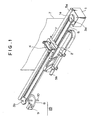
- the reference numeral 2 designates a carriage reciprocally movable in predetermined directions to recording-scan a recording head 4.
- the carriage 2 carries the recording head 4 thereon and is supported on guide shafts 5 for sliding movement in the axial direction thereof.
- a timing belt 6 is coupled to the carriage 2, and this timing belt 6 is extended between a pair of pulleys 3a and 3b, one of which, 3a, is coupled to the output rotary shaft (hereinafter referred to as the rotor shaft) 1a of a carriage driving motor (step motor) 1.
- the carriage driving motor 1 By the rotation of the carriage driving motor 1, the carriage 2 slides on the guide shafts 5 in the direction of arrow F or R in Figure 1 along recording paper 7 through a transmission mechanism provided by the pulleys 3a, 3b and the timing belt 6. While the carriage 2 moves once in the direction F or R, the recording head 4 is driven in response to an input signal, whereby visual information such as characters and images is recorded on the recording paper 7.
- the recording head 4 may be of any one of various recording types such as the liquid injection type, the heat transfer type and the wire dot type.
- the reference numeral 25 denotes an encoder for detecting the amount of rotation of the carriage driving motor 1.
- the encoder 25 is constituted by a disk-shaped encoder slit 8 coupled to the rotary support shaft 10 of the pulley 3b forming a pair with the pulley 3a coupled to the rotor shaft 1a of the motor, and a photointerrupter 9.
- the photointerrupter 9 detects the number of slits which pass it.
- the encoder slit 8 is coupled to the rotor shaft 1a of the carriage driving motor 1 through the pulley 3b, the belt 6 and the pulley 3a and can therefore detect the amount of rotation of the motor 1 and the rotational angular position of the motor by the output signal of the photointerrupter 9 of the encoder 25.
- the reduction ratio between the pulley 3a and the pulley 3b is 1, i.e., equal speed, and therefore, the amount of rotation of the motor 1 can be directly detected by the encoder 25.
- the encoder slits 8 are fixed to the rotary support shaft 10 of the pulley 3b which extends toward the lower portion of the printer.
- the volume the carriage driving motor 1 occupies in the printer is large, and is a factor which particularly determines the height of the printer. Accordingly, by the encoder 25 which has heretofore increased the length (height) of the motor 1 being disposed below the pulley 3b spaced apart from the motor 1 leaving a free space as in the present embodiment, the height of the printer can be made small.
- an optical type encoder in which the presence of the slits formed in the encoder slit 8 is detected by the photointerrupter 9 is shown as the encoder 25, whereas in the present invention, this is not restrictive, but the encoder 25 may be a magnetic type encoder using, for example, an MR element, or a voltage inducing type encoder.
- the above-described encoder slit 8 if fixedly coupled to the rotary support shaft 10 of the pulley 3b, may of course be disposed not below, but above the pulley 3b if there is a sufficient space for mounting the encoder.
- Figure 2 shows the circuit construction of a motor driving control system for effecting the closed loop control of the carriage driving motor 1 of Figure 1.
- the reference numeral 20 designates an MPU (microprocessor unit) for effecting the control of the entire printer.
- the MPU 20 uses an RAM (random access memory) 22 for data processing to effect the drive control of a drive source for other various mechanisms, not shown, of the printer and also effect the drive control of the carriage driving motor 1 which drives the above-described carriage 2.
- the MPU 20 uses a counter by hardware or software, not shown, to count the output pulses of the above-described encoder 25 to thereby detect the position of the carriage 2.
- the MPU 20 controls the rotational speed of the carriage driving motor 1 to a high speed mode or a low speed mode through a motor speed control circuit 23 and effects the switching of the energization current of the carriage driving motor, and further controls the starting, the stoppage and the direction of rotation of the motor 1, i.e., the starting, the stoppage and the direction of movement of the carriage, through a current switch-over circuit 24 for driving the carriage driving motor 1.
- the motor speed control circuit 23 closed-loop-controls the rotational speed of the carriage driving motor 1 in conformity with the detection output of the encoder 25, and specifically, it compares the interval time of the output pulses of the encoder 25 with a reference time, and adjusts the magnitude of the energization current of the motor 1 or the magnitude of the voltage so as to reduce or eliminate the time difference therebetween in conformity with the result of the comparison.
- the circuit which performs such a function is already known and therefore need not be described in detail herein.
- the MPU 20 indicates the rotational speed of the carriage driving motor 1 to such motor speed control circuit 23, and in response thereto, the reference time for comparison corresponding to the speed indicated in the motor speed control circuit 23 is selected, and by the use of it, comparison with the pulse interval is effected and the rotational speed of the motor 1 is controlled, for example, to a predetermined high speed mode or a predetermined low speed mode.
- the current switch-over circuit 24 starts the switch-over of the above-described energization current in response to a starting signal input from the MPU 20 and energizes the carriage driving motor 1, and stops the carriage driving motor 1 in response to a stop signal input from the MPU 20.
- the current switch-over circuit 24 not only effects the driving and stoppage of the carriage driving motor 1 as described above, but also as a point concerned with the present invention, closed-loop-controls the switch-over timing of the energization current for the coil of the carriage driving motor 1 in conformity with the detection output of the encoder 25.
- the current switch-over circuit 24 has a counter, not shown, counts the output pulses of the encoder 25 by that counter, and effects the switch-over of the energization current at a point of time whereat the count value thereof coincides with a predetermined value.
- the frequency of the current switch-over of the carriage driving motor 1 is e.g. 48 times per one full rotation of the rotor in terms of the single-phase-on drive system, and the number of the output pulses of the encoder 25 is 288 pulses per one full rotation.
- the rotor 14 rotates by an equal angle each time one pulse is output and therefore, assuming that the switch-over of the energization current is effected each time 6 (288 ⁇ 48) pulses are counted, it follows that the switch-over of the energization current is effected at such a timing that the relative position of the magnetic poles of the rotor and the magnetic poles of the stator assumes the same predetermined relation at a predetermined timing whereat the rotor has rotated always by an equal angle each. So, in the case of the present embodiment, the switch-over of the energization current is effected each time 6 pulses are counted.
- initialization for rendering the value of the counter into 0 and adjusting the position of the rotor to a position preferable as the position for effecting the switch-over of the energization current is effected under the control of the MPU 20 so that each switch-over of the energization current may be effected at a timing in the positional relation between the magnetic poles of the rotor and stator which is suitable and preferable in driving the carriage driving motor 1 smoothly and well.
- the MPU 20 When the power source switch of the printer is closed, at the step S1 of Figure 3, the MPU 20 performs the initializing operation for providing right correspondence between the above-described position of the rotor and the count value of the counter in the current switch-over circuit 24.
- step S2 whether the carriage 2 is in the home-position which is the left end as viewed in Figure 1 is judged, and if the carriage 2 is not in the home-position, at a step S3, the carriage driving motor 1 is driven to move the carriage 2 to the home-position.
- the detection of whether the carriage 2 is in the home-position is effected by an optical sensor or the like comprising, for example, a light-emitting diode and a phototransistor, although not shown.
- step S4 the rotational speed and the direction of rotation of the motor 1 are determined in conformity with the recording mode indicated by a host system, not shown, and the number of the driving pulses of the carriage driving motor 1 is determined from the number of prints in one line.
- a signal for indicating the rotational speed of the motor to the motor speed control circuit 23 is output and also, at a step S5, the carriage driving motor 1 is energized by the driving of the current switch-over circuit 24. That is, the carriage 2 is started. Also, simultaneously with the energization of the carriage driving motor 1, the MPU 20 starts counting the output pulses of the encoder 25.
- step S6 whether the carriage 2 has arrived at the print-start position is examined by the value of the count of the output pulses of the encoder 25, and when the carriage 2 has arrived at the print-start position, at a step S7, the recording head 4 is driven to start printing.
- a step S8 whether the carriage 2 has arrived at the print-end position for one line is examined by the value of the count of the output pulses of the encoder 25, and when the carriage 2 has arrived at that position, at a step S9, the printing operation of the recording head 4 is stopped to end one line printing. Then at a step S10, a stop signal is output to the current switch-over circuit 24, which short-circuits the both ends of the coil of the carriage driving motor 1 in response to this signal, thereby stopping the motor 1.
- the MPU 20 judges from the presence or absence of the remaining amount of print data whether all printing has been finished.
- step S13 where the carriage driving motor 1 is driven to move the carriage 2 to the home-position, and thus the process is terminated.
- step S11 If at the step S11, it is judged that all printing has not been finished and there is print data for the next line, shift is made to a step S12, where the carriage driving motor 1 is driven to thereby move the carriage 2 to the print-start position of the next line, and return is made to the step S7, and the subsequent processing is repeated.
- the above-mentioned print-start position of the next line is the rightmost position of the print width of the next line. Also, when the carriage driving motor 1 is to be reversely rotated to move the carriage 2 in the reverse direction (the direction R in Figure 1), of course the output pulses of the encoder 25 are subtracted and counted to thereby detect the position of the carriage 2.
- the switch-over timing of the energization current of the carriage driving motor 1 and the rotational speed of the same motor are closed-loop-controlled in conformity with the output of the encoder 25, whereby the switch-over of the energization current can always be effected at an optimum timing and also, acceleration can be sequentially effected smoothly and thus, the carriage driving motor 1 can be driven smoothly and well. Accordingly, the vibration of the carriage driving motor 1 is little and the noise during the driving thereof can be minimized. Also, when the carriage driving motor 1, is to be stopped, the motor 1 can be stopped smoothly and quickly by the above-described stopping method and the then noise can also be minimized.
- Figure 4 shows the construction of a second embodiment of the present invention.
- the encoder 25 in the present embodiment is comprised of a straight strip-like linear encoder slit 11 and a photointerrupter 12 made integral with the carriage 2.
- the linear encoder slit 11 is installed parallel to the guide shaft 5b over the movement range of the carriage 2, and with the movement of the carriage 2, a slit detection signal is output from the photointerrupter 12 integrally fixed to the interior of the carriage 2.
- the amount of movement of the carriage 2 and the amount of rotation of the rotor of the carriage driving motor 1 correspond to each other and therefore, by suitably selecting the slit density (resolving power) of the linear encoder slit 11, the closed loop control of the carriage driving motor 1 becomes possible.
- the linear encoder slit 11 is installed straight in the space defined between the guide shaft 5b and the belt 6 as shown, for example, in Figure 4, and the photointerrupter 12 made integral with the carriage 2 is so disposed as to be astride the linear encoder slit 11.
- the encoder 25 is not limited to the optical type, but may be a magnetic type linear encoder on which magnetic poles are magnetized. Also, the location at which the encoder slit 11 is disposed may be between the guide shaft 5a on the opposite side and the belt 6.
- the linear scale indicating the absolute position of printing is requisite to prevent the color misregistration between printed dots.
- such a linear scale is used as the encoder 25 of Figure 4 and can be used as the energization switch-over signal source of the step motor 1, and this provides a great advantage in reducing the manufacturing cost and simplifying the structure.
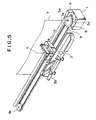
- Figure 5 shows the construction of a third embodiment of the present invention.
- the encoder 25 in the present embodiment is comprised of a disk-shaped encoder slit 8 mounted on the output shaft (rotor shaft) of the carriage driving motor 1, and a slit detecting photointerrupter 9.
- the present embodiment in its construction, is apparently similar to a step motor with an encoder, but differs from the latter in that the encoder 8 is disposed in the free space above the carriage driving motor 1 to thereby prevent an increase in the length of the motor. Also, the fact that the motor 1 and the encoder 25 are separated from each other leads to the advantage that a step motor generally used by an open loop can be used as the carriage driving motor 1.
- the amount of rotation of the rotor of the carriage driving motor is detected by the detecting means (encoder) mounted externally of the motor and the motor is closed-loop-controlled by the detection signal of the detecting means and therefore, there can be provided a recording apparatus of high reliability which is compact and thin as well as quiet.
- the energization current switch-over of the motor and the detection of the position of the carriage are effected by a linear encoder and therefore, highly accurate printing position control can be accomplished, and multicolor can be made suitable for the recording apparatus.
- a recording apparatus in which the movement of a recording head for recording scanning is effected includes a carriage carrying the recording head thereon, a step motor for moving the carriage, a linear encoder for detecting the amount of movement of the carriage, the linear encoder being installed over the movement range of the carriage and generating pulse signals in conformity with the amount of movement of the carriage, control means for counting the pulse signals from the linear encoder and outputting a control signal for the starting and stoppage of the carriage in conformity with the count value, and current switch-over means for switching over and controlling an energization current supplied to the coil of the step motor in conformity with the pulse signals from the linear encoder, the current switch-over means starting the switch-over control of the energization current by an energization control signal from the control means, and stopping the switch-over control of the energization current by a stop control signal.
Landscapes
- Engineering & Computer Science (AREA)
- Multimedia (AREA)
- Signal Processing (AREA)
- Power Engineering (AREA)
- Character Spaces And Line Spaces In Printers (AREA)
Applications Claiming Priority (2)
| Application Number | Priority Date | Filing Date | Title |
|---|---|---|---|
| JP1147126A JPH0798413B2 (ja) | 1989-06-09 | 1989-06-09 | 記録装置 |
| JP147126/89 | 1989-06-09 |
Publications (1)
| Publication Number | Publication Date |
|---|---|
| EP0401843A1 true EP0401843A1 (fr) | 1990-12-12 |
Family
ID=15423138
Family Applications (1)
| Application Number | Title | Priority Date | Filing Date |
|---|---|---|---|
| EP90110842A Ceased EP0401843A1 (fr) | 1989-06-09 | 1990-06-07 | Appareil d'enregistrement |
Country Status (3)
| Country | Link |
|---|---|
| US (1) | US5075609A (fr) |
| EP (1) | EP0401843A1 (fr) |
| JP (1) | JPH0798413B2 (fr) |
Cited By (3)
| Publication number | Priority date | Publication date | Assignee | Title |
|---|---|---|---|---|
| EP0509681A3 (en) * | 1991-04-16 | 1993-04-21 | Hewlett-Packard Company | Method and apparatus for controlling a stepper motor |
| EP0585881A3 (fr) * | 1992-08-31 | 1994-12-07 | Canon Kk | Imprimante en série. |
| US5663624A (en) * | 1992-03-05 | 1997-09-02 | Hewlett-Packard Company | Closed-loop method and apparatus for controlling acceleration and velocity of a stepper motor |
Families Citing this family (23)
| Publication number | Priority date | Publication date | Assignee | Title |
|---|---|---|---|---|
| US5278481A (en) * | 1990-02-22 | 1994-01-11 | British Technological Group Ltd. | Control of stepping motors |
| US5297881A (en) * | 1991-05-16 | 1994-03-29 | Mitsubishi Steel Mfg. Co., Ltd. | Printing machine carriage having a magnetic encoder |
| US5434602A (en) * | 1992-04-23 | 1995-07-18 | Canon Kabushiki Kaisha | Recording apparatus with magnetic linear encoder |
| JP3061994B2 (ja) * | 1994-01-19 | 2000-07-10 | キヤノン株式会社 | インクジェット装置 |
| JP3790571B2 (ja) * | 1995-11-06 | 2006-06-28 | 株式会社きもと | 光拡散性シートおよびそれを用いた液晶ディスプレイ用バックライトユニット |
| JPH09189574A (ja) * | 1996-01-10 | 1997-07-22 | Canon Inc | 光学式リニアエンコーダ、及びこれを用いた電子装置、記録装置 |
| JP3727094B2 (ja) * | 1996-01-12 | 2005-12-14 | 株式会社きもと | 液晶ディスプレイ用バックライト |
| JP3373106B2 (ja) * | 1996-03-27 | 2003-02-04 | 株式会社きもと | 光学フィルム |
| US6367906B1 (en) * | 1997-11-14 | 2002-04-09 | Canon Kabushiki Kaisha | Ink jet recording apparatus |
| DE19811637A1 (de) * | 1998-03-18 | 1999-09-23 | Heidelberger Druckmasch Ag | Ermittlung der Nullposition eines Gravierorgans |
| US6323617B1 (en) * | 1998-10-26 | 2001-11-27 | Canon Kabushiki Kaisha | Stepping motor drive control circuit |
| US6447094B1 (en) * | 2000-11-24 | 2002-09-10 | Xerox Corporation | Firmware sensoring systems and methods for a maintenance mechanism of an ink jet printer |
| JP2002199692A (ja) * | 2000-12-27 | 2002-07-12 | Minebea Co Ltd | ステッピングモータ及び、ステッピングモータ装置とその駆動方法 |
| US6779868B2 (en) * | 2001-07-06 | 2004-08-24 | Benq Corporation | Printer with a calibration position positioned within a printing range |
| AU2002242969A1 (en) | 2001-12-13 | 2003-06-23 | Sony Corporation | Screen and method for manufacturing the same and image display system |
| JP2004092431A (ja) * | 2002-08-29 | 2004-03-25 | Toyota Motor Corp | 排気ガス浄化装置 |
| JP3809421B2 (ja) * | 2003-01-31 | 2006-08-16 | キヤノン株式会社 | 記録装置 |
| US6953294B2 (en) * | 2004-02-19 | 2005-10-11 | Hi-Touch Imaging Technologies Co., Ltd. | Positioning apparatus installed inside a printer |
| JP4551499B2 (ja) * | 2005-01-05 | 2010-09-29 | 株式会社リコー | 画像形成装置 |
| US20060163352A1 (en) * | 2005-01-24 | 2006-07-27 | Kurt Thiessen | Conveyer |
| US7360862B2 (en) * | 2005-03-14 | 2008-04-22 | Ncr Corporation | Inkjet apparatus and a method of controlling an inkjet mechanism |
| JP2007076027A (ja) * | 2005-09-12 | 2007-03-29 | Seiko Epson Corp | 位置検出装置およびこの位置検出装置を備える液体吐出装置 |
| JP5610838B2 (ja) * | 2010-05-11 | 2014-10-22 | キヤノン株式会社 | モータを備えた機器 |
Citations (3)
| Publication number | Priority date | Publication date | Assignee | Title |
|---|---|---|---|---|
| US4143980A (en) * | 1976-03-03 | 1979-03-13 | Siemens Aktiengesellschaft | Shifting arrangement for exact space positioning of a writing carriage in typewriters |
| US4602882A (en) * | 1982-08-05 | 1986-07-29 | Seiko Epson Corporation | Control system of serial printer |
| US4838717A (en) * | 1987-01-28 | 1989-06-13 | Chinon Kabushiki Kaisha | Serial dot matrix printer |
Family Cites Families (10)
| Publication number | Priority date | Publication date | Assignee | Title |
|---|---|---|---|---|
| JPS51104920A (ja) * | 1975-03-10 | 1976-09-17 | Omron Tateisi Electronics Co | Dotsutopurinta |
| JPS5642027A (en) * | 1979-09-11 | 1981-04-20 | Hitachi Heating Appliance Co Ltd | Gas range for kitchen |
| JPS56117664A (en) * | 1980-02-22 | 1981-09-16 | Canon Inc | Dot matrix printer |
| JPS617299U (ja) * | 1984-06-18 | 1986-01-17 | 株式会社東芝 | パルスモ−タ駆動装置 |
| US4628239A (en) * | 1985-06-06 | 1986-12-09 | The United States Of America As Represented By The Secretary Of The Army | Dual optical mechanical position tracker |
| US4926196A (en) * | 1986-12-25 | 1990-05-15 | Canon Kabushiki Kaisha | Ink jet printer |
| JPS63291269A (ja) * | 1987-05-22 | 1988-11-29 | Canon Electronics Inc | ヘツド移送装置 |
| DE3874280T2 (de) * | 1987-10-21 | 1993-01-21 | Canon Kk | Motorregelvorrichtung. |
| FR2627312B1 (fr) * | 1988-01-29 | 1994-02-18 | Canon Kk | Enregistreur de donnees |
| US5029264A (en) * | 1988-09-27 | 1991-07-02 | Canon Kabushiki Kaisha | Recording apparatus |
-
1989
- 1989-06-09 JP JP1147126A patent/JPH0798413B2/ja not_active Expired - Fee Related
-
1990
- 1990-05-31 US US07/531,444 patent/US5075609A/en not_active Expired - Lifetime
- 1990-06-07 EP EP90110842A patent/EP0401843A1/fr not_active Ceased
Patent Citations (3)
| Publication number | Priority date | Publication date | Assignee | Title |
|---|---|---|---|---|
| US4143980A (en) * | 1976-03-03 | 1979-03-13 | Siemens Aktiengesellschaft | Shifting arrangement for exact space positioning of a writing carriage in typewriters |
| US4602882A (en) * | 1982-08-05 | 1986-07-29 | Seiko Epson Corporation | Control system of serial printer |
| US4838717A (en) * | 1987-01-28 | 1989-06-13 | Chinon Kabushiki Kaisha | Serial dot matrix printer |
Non-Patent Citations (1)
| Title |
|---|
| PATENT ABSTRACTS OF JAPAN vol. 13, no. 116 () 22 March 1989, & JP-A-63 291269 (CANON ELECTRONICS) 29 November 1988, * |
Cited By (4)
| Publication number | Priority date | Publication date | Assignee | Title |
|---|---|---|---|---|
| EP0509681A3 (en) * | 1991-04-16 | 1993-04-21 | Hewlett-Packard Company | Method and apparatus for controlling a stepper motor |
| US5663624A (en) * | 1992-03-05 | 1997-09-02 | Hewlett-Packard Company | Closed-loop method and apparatus for controlling acceleration and velocity of a stepper motor |
| EP0585881A3 (fr) * | 1992-08-31 | 1994-12-07 | Canon Kk | Imprimante en série. |
| US5427461A (en) * | 1992-08-31 | 1995-06-27 | Canon Kabushiki Kaisha | Serial printer with carriage position control |
Also Published As
| Publication number | Publication date |
|---|---|
| JPH0798413B2 (ja) | 1995-10-25 |
| JPH0310871A (ja) | 1991-01-18 |
| US5075609A (en) | 1991-12-24 |
Similar Documents
| Publication | Publication Date | Title |
|---|---|---|
| US5075609A (en) | Recording apparatus | |
| US4928050A (en) | Recorder | |
| JP2563790B2 (ja) | プリンタのキヤリツジ制御方法 | |
| EP0409175B1 (fr) | Appareil d'enregistrement | |
| GB2127193A (en) | Control system for a serial printer | |
| EP0834405B1 (fr) | Appareil d'enregistrement | |
| US5029264A (en) | Recording apparatus | |
| US5264769A (en) | Recording device with a controllable carriage driving motor | |
| US5074690A (en) | Print head carriage homing system | |
| EP0488805B1 (fr) | Dispositif à moteur linéaire comportant un élément réducteur de vibrations | |
| EP0856938B1 (fr) | Moteur à courant continu pour asservissement en boucle fermée, asservissement en boucle fermée et imprimante incluant un tel moteur ainsi que procédés de controle de la position de ce moteur | |
| EP0910156B1 (fr) | Moteur à courant continu pour une régulation en boucle fermée | |
| JP3047549B2 (ja) | シルアルプリンタおよびそのホーム位置設定方法 | |
| GB2138226A (en) | Printer | |
| JP2726071B2 (ja) | 記録装置 | |
| JPH0295200A (ja) | 記録装置 | |
| JP3415258B2 (ja) | ドットプリンタのシャトル制御装置 | |
| JP3813790B2 (ja) | 印刷ヘッドの初期位置制御方法および印刷装置 | |
| JP3454399B2 (ja) | ドットラインプリンタのシャトル制御方式 | |
| JP3620627B2 (ja) | 印刷装置のシャトル制御方法 | |
| JPH0798412B2 (ja) | 記録装置 | |
| EP0531049A1 (fr) | Imprimante | |
| JP2000238359A (ja) | 記録装置 | |
| JPH0514628A (ja) | 画像読取装置の駆動方式 | |
| JPH03218299A (ja) | 記録装置 |
Legal Events
| Date | Code | Title | Description |
|---|---|---|---|
| PUAI | Public reference made under article 153(3) epc to a published international application that has entered the european phase |
Free format text: ORIGINAL CODE: 0009012 |
|
| AK | Designated contracting states |
Kind code of ref document: A1 Designated state(s): DE FR GB IT |
|
| 17P | Request for examination filed |
Effective date: 19901221 |
|
| 17Q | First examination report despatched |
Effective date: 19931028 |
|
| STAA | Information on the status of an ep patent application or granted ep patent |
Free format text: STATUS: THE APPLICATION HAS BEEN REFUSED |
|
| 18R | Application refused |
Effective date: 19950717 |