EP0401880A2 - Système de contrôle du ralenti pour un moteur à combustion interne - Google Patents
Système de contrôle du ralenti pour un moteur à combustion interne Download PDFInfo
- Publication number
- EP0401880A2 EP0401880A2 EP90115147A EP90115147A EP0401880A2 EP 0401880 A2 EP0401880 A2 EP 0401880A2 EP 90115147 A EP90115147 A EP 90115147A EP 90115147 A EP90115147 A EP 90115147A EP 0401880 A2 EP0401880 A2 EP 0401880A2
- Authority
- EP
- European Patent Office
- Prior art keywords
- speed
- supplied
- signal
- predetermined
- idle
- Prior art date
- Legal status (The legal status is an assumption and is not a legal conclusion. Google has not performed a legal analysis and makes no representation as to the accuracy of the status listed.)
- Withdrawn
Links
Images

Classifications
-
- F—MECHANICAL ENGINEERING; LIGHTING; HEATING; WEAPONS; BLASTING
- F02—COMBUSTION ENGINES; HOT-GAS OR COMBUSTION-PRODUCT ENGINE PLANTS
- F02D—CONTROLLING COMBUSTION ENGINES
- F02D31/00—Use of speed-sensing governors to control combustion engines, not otherwise provided for
- F02D31/001—Electric control of rotation speed
- F02D31/002—Electric control of rotation speed controlling air supply
- F02D31/003—Electric control of rotation speed controlling air supply for idle speed control
- F02D31/005—Electric control of rotation speed controlling air supply for idle speed control by controlling a throttle by-pass
Definitions
- the invention relates to a system for controlling the idle speed of an internal combustion engine, an actuating variable being supplied to an actuator, which is determined by comparing the actual speed value, which is supplied as a speed signal, with a speed setpoint.
- the actuator In the event of a transition from idle mode to driving mode in systems for regulating the idle speed, the actuator would be closed as far as possible without further measures due to the associated increase in the actual speed value. As a result, when the accelerator pedal reaches the idle position again, the internal combustion engine can only reach the intended idle speed again after a delay - possibly even stop. In known idle speed controllers, the operating point of the controller is therefore stored during the transition from idle mode to driving mode. Among other things, there is a so-called idle contact on the accelerator pedal provided with which an idle signal is emitted when the accelerator pedal is in the idle position.
- the idle signal fails to appear, this can result in an excessive engine speed that is outside the idle range and can therefore also lead to dangerous driving situations. This is caused by the regulator opening required to start the engine. However, the controller cannot perform a necessary curtailment if - as mentioned above - the idle signal is missing.
- the system according to the invention is characterized in that a signal (idle signal) is also supplied which is dependent on whether the accelerator pedal is in the idle position, that in the absence of the idle signal the actual speed value is not used to determine the manipulated variable, and that the actuator a predetermined manipulated variable is supplied if the idle signal is not present and the speed setpoint is greater than the actual speed value for a predetermined time.
- a signal is also supplied which is dependent on whether the accelerator pedal is in the idle position, that in the absence of the idle signal the actual speed value is not used to determine the manipulated variable, and that the actuator a predetermined manipulated variable is supplied if the idle signal is not present and the speed setpoint is greater than the actual speed value for a predetermined time.
- a further development of the invention consists in the fact that the predetermined manipulated variable is only supplied to the actuator if, after the predetermined time has elapsed, the actual speed value is not less than the predetermined speed value when the internal combustion engine is started.
- the actuator which is arranged in a so-called bypass on the throttle valve, is opened wide when the internal combustion engine is cold, so that a sufficiently high idle speed is achieved. In the same opening of the actuator results in a warm engine, however, a speed which is outside the idle speed range permitted for safety reasons. If the speed signal fails - for example due to an open circuit or short-circuit of the encoder - a speed that is too low is simulated, whereupon the controller opens the actuator wide, which results in an idling speed that is too high when the engine is warm.
- This disadvantage is remedied in another development of the system according to the invention in that if the speed signal fails, the actuator is supplied with a predetermined manipulated variable. The specified manipulated variable can be selected so that emergency operation is possible.
- the predetermined manipulated variable is dependent on the temperature of the internal combustion engine.
- speed signal is formed by speed pulses, the repetition frequency of which is proportional to the speed of the internal combustion engine, that a counter to which counts of higher frequency are supplied is reset by each of the speed pulses and that the actuator is overwritten when the counter overflows predetermined manipulated variable is supplied.
- Another development of the invention reduces the effects of the absence of a supplied signal, which represents the engine temperature, by assuming a predetermined temperature if the supplied signal is outside a predetermined range.
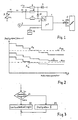
- the system shown in FIG. 1 comprises a controller which essentially consists of an integrated circuit which contains a microcomputer 1 and an analog / digital converter 2.
- a speed signal is fed to the controller from a speed sensor 3 - for example, a predetermined number of pulses per revolution of the internal combustion engine.
- An actuator 4, which adjusts the cross section of a so-called bypass 5, is controlled by comparison with a stored target value.
- the bypass 5 represents the bypass of a schematically indicated throttle valve.
- the adjustment range of the actuator 4 is narrowed according to the engine temperature, which is shown schematically in FIG. 2.
- Corresponding values are stored in a memory assigned to the microcomputer for each subrange of the temperature.
- the actuator 4 is supplied with a predetermined manipulated variable which, according to a development of the invention, is dependent on the engine temperature.
- the corresponding curve is designated S in FIG. 2.
- a simple possibility for checking the presence of speed pulses is explained on the basis of a flow chart which is shown in FIG. 3.
- a speed measurement is performed within a part of the program (not shown) by counting pulses of a higher frequency between two successive speed pulses. This counter is reset with every speed pulse after its counter status has been transferred to a register. If the speed pulses do not occur, an overflow results when the counter is appropriately dimensioned, and a flag is set on it.
- a query is made at 31 as to whether the flag is set or not. If the flag is set, the specified value for the manipulated variable is called at 32. If the flag is not set, speed control takes place at 33 in a manner known per se by comparing the speed setpoints and actual values.
- an idle switch 16 (FIG. 1) is provided, the signal of which, in the following idle signal, is processed in the microcomputer 1 as follows using the program shown in FIG. 4 becomes.
- the idle speed control is carried out as usual at 42. However, if there is no idle signal, it is checked whether the speed setpoint is greater than the speed actual value. If this is the case, the parts 42 of the program which effect speed control are bypassed. This ensures that the speed values increasing due to the accelerator no longer influence the manipulated variable supplied to the actuator. However, it is still possible to influence the temperature.
- the idle switch 16 (FIG. 1) is closed again, so that the idle signal is present again and the speed-regulating program part 42 is addressed again.
- the speed setpoint is less than the actual value, but this can also occur briefly in normal operation.
- the program steps described below are therefore used to check whether, in the event of no idle signal and a speed setpoint that is less than the actual speed value, the question is asked at 44 whether a flag is set. If this is not the case, a time specification is started at 45 and the flag is then set at 46. A decision is then made at 47 as to whether the time limit has expired. Is this if not, it means that the query is bypassed at 48. If, however, the time specification no longer runs, a check is made at 48 as to whether the start value is greater than the control value.
- the start value A o (FIG. 2) and the control value correspond to any value between A u and A o . If applicable, the program is continued normally, while otherwise a predetermined manipulated variable is called up at 49 and fed to the actuator.
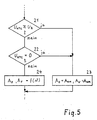
- FIGS. 1 and 5 A further development of the invention is explained below with reference to FIGS. 1 and 5, with which a malfunction due to a defect in the area of a temperature sensor and its supply line is prevented.
- the regulator 1 is fed by an operating voltage (+), which is obtained from the battery voltage + U B with the aid of a resistor 6 and a Zener diode 7.
- the motor temperature is now measured in such a way that the stabilized voltage is fed to an NTC resistor 9 via a second resistor 8.
- the NTC resistor 9 is located at a suitable point on the motor, while the controller, including the few discrete components shown in FIG. 1, are located in a corresponding housing.
- a connection between the NTC resistor 9 and the regulator circuit is established by a line 10 which is provided with plug devices 11, 12 at both ends.
- the circuit point 13 represents the input for the temperature signal and is connected via a resistor 14 to the input of the analog / digital converter 2.
- the level of the voltage supplied to the analog / digital converter is accordingly based on the value of the NTC resistor 9 and thus on the motor temperature.
- the voltage at the input 13 assumes ground potential, which is determined in the microcomputer, whereupon the modulation limits A on and A un shown in dashed lines in FIG. 2 are specified. If the signal line 10 is interrupted, the voltage at the input 13 becomes equal to the positive operating voltage (+) of the microcomputer, which also leads to the application of the specified modulation limits. The same applies to an end of the signal line with a line which carries a higher voltage, for example the operating voltage + U B. In this case, a resistor 14 and a diode 15 are provided. The latter then becomes conductive and thus prevents the input voltage of the analog / digital converter from rising significantly above the operating voltage of the microcomputer or the analog / digital converter.
- FIG. 5 shows parts of a program as a flow chart, which are used to check the input signal U NTC of the analog / digital converter 2 and to switch to so-called emergency operation.
Landscapes
- Engineering & Computer Science (AREA)
- Chemical & Material Sciences (AREA)
- Combustion & Propulsion (AREA)
- Mechanical Engineering (AREA)
- General Engineering & Computer Science (AREA)
- Electrical Control Of Air Or Fuel Supplied To Internal-Combustion Engine (AREA)
Applications Claiming Priority (2)
| Application Number | Priority Date | Filing Date | Title |
|---|---|---|---|
| DE3708999 | 1987-03-19 | ||
| DE19873708999 DE3708999A1 (de) | 1987-03-19 | 1987-03-19 | System zur regelung der leerlaufdrehzahl eines verbrennungsmotors |
Related Parent Applications (2)
| Application Number | Title | Priority Date | Filing Date |
|---|---|---|---|
| EP87115560A Division EP0283562B1 (fr) | 1987-03-19 | 1987-10-23 | Système de contrôle du ralenti pour un moteur à explosion |
| EP87115560.2 Division | 1987-10-23 |
Publications (2)
| Publication Number | Publication Date |
|---|---|
| EP0401880A2 true EP0401880A2 (fr) | 1990-12-12 |
| EP0401880A3 EP0401880A3 (fr) | 1991-01-02 |
Family
ID=6323497
Family Applications (2)
| Application Number | Title | Priority Date | Filing Date |
|---|---|---|---|
| EP87115560A Expired - Lifetime EP0283562B1 (fr) | 1987-03-19 | 1987-10-23 | Système de contrôle du ralenti pour un moteur à explosion |
| EP19900115147 Withdrawn EP0401880A3 (fr) | 1987-03-19 | 1987-10-23 | Système de contrôle du ralenti pour un moteur à combustion interne |
Family Applications Before (1)
| Application Number | Title | Priority Date | Filing Date |
|---|---|---|---|
| EP87115560A Expired - Lifetime EP0283562B1 (fr) | 1987-03-19 | 1987-10-23 | Système de contrôle du ralenti pour un moteur à explosion |
Country Status (4)
| Country | Link |
|---|---|
| US (1) | US4887570A (fr) |
| EP (2) | EP0283562B1 (fr) |
| JP (1) | JPS63253150A (fr) |
| DE (2) | DE3708999A1 (fr) |
Families Citing this family (11)
| Publication number | Priority date | Publication date | Assignee | Title |
|---|---|---|---|---|
| GB8630674D0 (en) * | 1986-12-23 | 1987-02-04 | Qualter Hall & Co Ltd | Microprocessor-based controllers |
| JPH0281939A (ja) * | 1988-09-16 | 1990-03-22 | Mazda Motor Corp | 自動変速機付車両におけるエンジンの吸入空気量制御装置 |
| KR950013548B1 (ko) * | 1989-05-02 | 1995-11-08 | 미쓰비시 덴키 가부시키가이샤 | 내연기관의 제어장치 |
| US5056483A (en) * | 1989-07-27 | 1991-10-15 | Mitsubishi Denki Kabushiki Kaisha | Engine speed control apparatus |
| JPH03156140A (ja) * | 1989-08-20 | 1991-07-04 | Nippondenso Co Ltd | エンジンのアイドリング制御弁 |
| JP2666519B2 (ja) * | 1990-04-26 | 1997-10-22 | 三菱電機株式会社 | エンジンの吸入空気量制御装置 |
| US5163399A (en) * | 1991-01-07 | 1992-11-17 | Saturn Corporation | Method for adjusting engine output power to compensate for loading due to a variable capacity air conditioning compressor |
| JPH09203340A (ja) * | 1996-01-26 | 1997-08-05 | Denso Corp | 内燃機関の制御装置 |
| TWI224651B (en) * | 2001-11-30 | 2004-12-01 | Yamaha Motor Co Ltd | Engine controller |
| DE10229575B4 (de) * | 2002-07-02 | 2006-05-04 | Robert Bosch Gmbh | Verfahren zum Betrieb mehrerer Luftklappensteller |
| CN108779868B (zh) * | 2016-03-09 | 2020-03-06 | 三菱电机株式会社 | 阀装置 |
Family Cites Families (13)
| Publication number | Priority date | Publication date | Assignee | Title |
|---|---|---|---|---|
| US4328547A (en) * | 1978-02-27 | 1982-05-04 | The Bendix Corporation | Failure system for internal combustion engine |
| JPS5644431A (en) * | 1979-09-14 | 1981-04-23 | Nippon Denso Co Ltd | Method of controlling revolution speed of engine |
| JPS6038544B2 (ja) * | 1979-10-17 | 1985-09-02 | 株式会社デンソー | エンジンの回転速度制御方法 |
| JPS57181939A (en) * | 1981-05-06 | 1982-11-09 | Hitachi Ltd | Fuel feed method for automobile engine |
| US4491922A (en) * | 1981-08-14 | 1985-01-01 | Toyota Jidosha Kogyo Kabushiki Kaisha | Method and apparatus for controlling stepping motor in idling rotational speed control |
| JPS5952306A (ja) * | 1982-09-18 | 1984-03-26 | Honda Motor Co Ltd | 電子制御装置の異常判別方法 |
| JPS59206645A (ja) * | 1983-05-10 | 1984-11-22 | Toyota Motor Corp | 電子制御エンジンのアイドル回転速度制御方法 |
| JPS603447A (ja) * | 1983-06-22 | 1985-01-09 | Honda Motor Co Ltd | 内燃エンジンの回転角度位置計測系異常時のアイドル回転数制御方法 |
| JPH0733807B2 (ja) * | 1984-06-01 | 1995-04-12 | 日産自動車株式会社 | フエイルセ−フ制御装置 |
| JPS6181546A (ja) * | 1984-09-28 | 1986-04-25 | Honda Motor Co Ltd | 内燃エンジンのアイドル回転数フイ−ドバツク制御方法 |
| JPH0612088B2 (ja) * | 1985-05-31 | 1994-02-16 | 本田技研工業株式会社 | 内燃エンジンのアイドル時の燃料供給制御方法 |
| US4760823A (en) * | 1985-06-24 | 1988-08-02 | Honda Giken Kogyo Kabushiki Kaisha | Method for control of idle rotations of internal combustion engine |
| JP2679970B2 (ja) * | 1985-10-21 | 1997-11-19 | 株式会社日立製作所 | アイドル回転速度制御装置 |
-
1987
- 1987-03-19 DE DE19873708999 patent/DE3708999A1/de not_active Withdrawn
- 1987-10-23 DE DE8787115560T patent/DE3769469D1/de not_active Expired - Lifetime
- 1987-10-23 EP EP87115560A patent/EP0283562B1/fr not_active Expired - Lifetime
- 1987-10-23 EP EP19900115147 patent/EP0401880A3/fr not_active Withdrawn
-
1988
- 1988-03-02 US US07/163,051 patent/US4887570A/en not_active Expired - Fee Related
- 1988-03-17 JP JP63062082A patent/JPS63253150A/ja active Pending
Also Published As
| Publication number | Publication date |
|---|---|
| JPS63253150A (ja) | 1988-10-20 |
| US4887570A (en) | 1989-12-19 |
| EP0283562B1 (fr) | 1991-04-17 |
| EP0283562A2 (fr) | 1988-09-28 |
| DE3708999A1 (de) | 1988-10-06 |
| EP0401880A3 (fr) | 1991-01-02 |
| EP0283562A3 (en) | 1988-12-28 |
| DE3769469D1 (de) | 1991-05-23 |
Similar Documents
| Publication | Publication Date | Title |
|---|---|---|
| EP0350082B1 (fr) | Méthode et dispositif de sécurité et assistance pour un moteur à auto-allumage | |
| DE3510173A1 (de) | Ueberwachungseinrichtung fuer eine elektronisch gesteuerte drosselklappe in einem kraftfahrzeug | |
| DE3828850C2 (fr) | ||
| DE4015415B4 (de) | Vorrichtung zur Erfassung eines veränderlichen Betriebsparameters | |
| EP0283562B1 (fr) | Système de contrôle du ralenti pour un moteur à explosion | |
| DE3941995A1 (de) | Verfahren und vorrichtung zur ueberwachung der funktionsfaehigkeit einer sonden-heizeinrichtung | |
| DE3733623A1 (de) | Einrichtung zur einstellung einer betriebskenngroesse einer brennkraftmaschine | |
| DE4029537A1 (de) | Verfahren und vorrichtung zur steuerung und/oder regelung einer betriebsgroesse einer brennkraftmaschine | |
| DE4237878C2 (de) | Verfahren zur Regelung des Schaltkomforts bei Fahrzeugen mit automatischem Getriebe | |
| DE4302483C2 (de) | Verfahren und Vorrichtung zur Steuerung einer Brennkraftmaschine | |
| EP0347446B1 (fr) | Procede et agencement de regulation du dosage d'air dans des moteurs a combustion interne, notamment au ralenti et en deceleration | |
| EP0375710B1 (fr) | Systeme de reglage (commande et/ou ajustement) pour vehicules a moteur | |
| DE19719518B4 (de) | Verfahren und Vorrichtung zur Steuerung einer Antriebseinheit eines Kraftfahrzeugs | |
| DE3342848A1 (de) | Sicherheitseinrichtung fuer eine elektronisch gesteuerte oder geregelte brennkraftmaschine mit mikrocomputer | |
| DE69206746T2 (de) | Elektronische Kraftstoffeinspritzvorrichtung mit Schreib-/Lesespeicher zur Speicherung von Stellgliedkorrekturwerten | |
| EP0371151B1 (fr) | Circuit de sécurité pour système électronique de commande ou de régulation de la vitesse de véhicules à moteur | |
| DE4113774C2 (fr) | ||
| DE19805299A1 (de) | Elektronische Regeleinrichtung | |
| EP0257181A2 (fr) | Dispositif pour la commande d'un actuateur | |
| EP0298187A2 (fr) | Pédale de gaz électrique | |
| DE3919108C2 (de) | Verfahren zur Steuerung eines Betriebsparameters eines Kraftfahrzeugs bei dynamischen Betriebszuständen | |
| DE4303560B4 (de) | Verfahren und Vorrichtung zur Steuerung einer Verstelleinrichtung | |
| DE4040219A1 (de) | System zur messwerterfassung im bereich eines kraftfahrzeugs | |
| DE4111918C1 (en) | Electronic controller for vehicle IC engine - uses interrupt routine in microprocessor to monitor faults in equipment and initiate emergency processes | |
| EP0260372B1 (fr) | Dispositif de limitation de la vitesse d'un véhicule automobile |
Legal Events
| Date | Code | Title | Description |
|---|---|---|---|
| PUAI | Public reference made under article 153(3) epc to a published international application that has entered the european phase |
Free format text: ORIGINAL CODE: 0009012 |
|
| PUAL | Search report despatched |
Free format text: ORIGINAL CODE: 0009013 |
|
| AC | Divisional application: reference to earlier application |
Ref document number: 283562 Country of ref document: EP |
|
| AK | Designated contracting states |
Kind code of ref document: A2 Designated state(s): DE FR GB SE |
|
| AK | Designated contracting states |
Kind code of ref document: A3 Designated state(s): DE FR GB SE |
|
| 17P | Request for examination filed |
Effective date: 19901120 |
|
| STAA | Information on the status of an ep patent application or granted ep patent |
Free format text: STATUS: THE APPLICATION HAS BEEN WITHDRAWN |
|
| 18W | Application withdrawn |
Withdrawal date: 19911017 |