EP0404632A1 - Matériau composite à matrice vitrocéramique renforcée et son procédé de préparation - Google Patents
Matériau composite à matrice vitrocéramique renforcée et son procédé de préparation Download PDFInfo
- Publication number
- EP0404632A1 EP0404632A1 EP90401609A EP90401609A EP0404632A1 EP 0404632 A1 EP0404632 A1 EP 0404632A1 EP 90401609 A EP90401609 A EP 90401609A EP 90401609 A EP90401609 A EP 90401609A EP 0404632 A1 EP0404632 A1 EP 0404632A1
- Authority
- EP
- European Patent Office
- Prior art keywords
- material according
- matrix
- reinforcing agent
- alumina
- rare earth
- Prior art date
- Legal status (The legal status is an assumption and is not a legal conclusion. Google has not performed a legal analysis and makes no representation as to the accuracy of the status listed.)
- Granted
Links
- 239000011159 matrix material Substances 0.000 title claims abstract description 27
- 239000002131 composite material Substances 0.000 title claims abstract description 22
- 238000000034 method Methods 0.000 title claims abstract description 12
- 239000002241 glass-ceramic Substances 0.000 title claims description 10
- 238000002360 preparation method Methods 0.000 title abstract description 6
- VYPSYNLAJGMNEJ-UHFFFAOYSA-N Silicium dioxide Chemical compound O=[Si]=O VYPSYNLAJGMNEJ-UHFFFAOYSA-N 0.000 claims abstract description 30
- PNEYBMLMFCGWSK-UHFFFAOYSA-N aluminium oxide Inorganic materials [O-2].[O-2].[O-2].[Al+3].[Al+3] PNEYBMLMFCGWSK-UHFFFAOYSA-N 0.000 claims abstract description 20
- 239000000377 silicon dioxide Substances 0.000 claims abstract description 15
- 229910052593 corundum Inorganic materials 0.000 claims abstract description 11
- 235000012239 silicon dioxide Nutrition 0.000 claims abstract description 11
- 229910001845 yogo sapphire Inorganic materials 0.000 claims abstract description 11
- 229910052681 coesite Inorganic materials 0.000 claims abstract description 10
- 229910052906 cristobalite Inorganic materials 0.000 claims abstract description 10
- 229910001404 rare earth metal oxide Inorganic materials 0.000 claims abstract description 10
- 229910052682 stishovite Inorganic materials 0.000 claims abstract description 10
- 229910052905 tridymite Inorganic materials 0.000 claims abstract description 10
- 229910000287 alkaline earth metal oxide Inorganic materials 0.000 claims abstract description 4
- 239000000835 fiber Substances 0.000 claims description 19
- 239000012744 reinforcing agent Substances 0.000 claims description 19
- 239000000463 material Substances 0.000 claims description 18
- 239000000203 mixture Substances 0.000 claims description 11
- 239000000919 ceramic Substances 0.000 claims description 9
- 238000010438 heat treatment Methods 0.000 claims description 8
- 238000004519 manufacturing process Methods 0.000 claims description 7
- 229910052761 rare earth metal Inorganic materials 0.000 claims description 5
- XUIMIQQOPSSXEZ-UHFFFAOYSA-N Silicon Chemical compound [Si] XUIMIQQOPSSXEZ-UHFFFAOYSA-N 0.000 claims description 4
- 229910052796 boron Inorganic materials 0.000 claims description 4
- 239000000470 constituent Substances 0.000 claims description 4
- 150000002910 rare earth metals Chemical class 0.000 claims description 4
- 229910052710 silicon Inorganic materials 0.000 claims description 4
- 239000010703 silicon Substances 0.000 claims description 4
- HBMJWWWQQXIZIP-UHFFFAOYSA-N silicon carbide Chemical compound [Si+]#[C-] HBMJWWWQQXIZIP-UHFFFAOYSA-N 0.000 claims description 4
- 229910010271 silicon carbide Inorganic materials 0.000 claims description 4
- 229910052684 Cerium Inorganic materials 0.000 claims description 3
- GWXLDORMOJMVQZ-UHFFFAOYSA-N cerium Chemical compound [Ce] GWXLDORMOJMVQZ-UHFFFAOYSA-N 0.000 claims description 3
- 229910052749 magnesium Inorganic materials 0.000 claims description 3
- 239000011777 magnesium Substances 0.000 claims description 3
- 229910052727 yttrium Inorganic materials 0.000 claims description 3
- VWQVUPCCIRVNHF-UHFFFAOYSA-N yttrium atom Chemical compound [Y] VWQVUPCCIRVNHF-UHFFFAOYSA-N 0.000 claims description 3
- 229910052582 BN Inorganic materials 0.000 claims description 2
- ZOXJGFHDIHLPTG-UHFFFAOYSA-N Boron Chemical compound [B] ZOXJGFHDIHLPTG-UHFFFAOYSA-N 0.000 claims description 2
- PZNSFCLAULLKQX-UHFFFAOYSA-N Boron nitride Chemical compound N#B PZNSFCLAULLKQX-UHFFFAOYSA-N 0.000 claims description 2
- OKTJSMMVPCPJKN-UHFFFAOYSA-N Carbon Chemical compound [C] OKTJSMMVPCPJKN-UHFFFAOYSA-N 0.000 claims description 2
- FYYHWMGAXLPEAU-UHFFFAOYSA-N Magnesium Chemical group [Mg] FYYHWMGAXLPEAU-UHFFFAOYSA-N 0.000 claims description 2
- 229910052799 carbon Inorganic materials 0.000 claims description 2
- 229910052746 lanthanum Inorganic materials 0.000 claims description 2
- FZLIPJUXYLNCLC-UHFFFAOYSA-N lanthanum atom Chemical compound [La] FZLIPJUXYLNCLC-UHFFFAOYSA-N 0.000 claims description 2
- 229910052581 Si3N4 Inorganic materials 0.000 claims 1
- HQVNEWCFYHHQES-UHFFFAOYSA-N silicon nitride Chemical compound N12[Si]34N5[Si]62N3[Si]51N64 HQVNEWCFYHHQES-UHFFFAOYSA-N 0.000 claims 1
- 150000001342 alkaline earth metals Chemical class 0.000 abstract 2
- 229910052784 alkaline earth metal Inorganic materials 0.000 abstract 1
- 230000002787 reinforcement Effects 0.000 description 8
- 239000011521 glass Substances 0.000 description 5
- VTYYLEPIZMXCLO-UHFFFAOYSA-L Calcium carbonate Chemical compound [Ca+2].[O-]C([O-])=O VTYYLEPIZMXCLO-UHFFFAOYSA-L 0.000 description 4
- 238000000280 densification Methods 0.000 description 4
- 238000005245 sintering Methods 0.000 description 4
- OYPRJOBELJOOCE-UHFFFAOYSA-N Calcium Chemical compound [Ca] OYPRJOBELJOOCE-UHFFFAOYSA-N 0.000 description 3
- 238000001035 drying Methods 0.000 description 3
- 238000005470 impregnation Methods 0.000 description 3
- ZLNQQNXFFQJAID-UHFFFAOYSA-L magnesium carbonate Chemical compound [Mg+2].[O-]C([O-])=O ZLNQQNXFFQJAID-UHFFFAOYSA-L 0.000 description 3
- 239000001095 magnesium carbonate Substances 0.000 description 3
- 229910000021 magnesium carbonate Inorganic materials 0.000 description 3
- 235000014380 magnesium carbonate Nutrition 0.000 description 3
- 230000007935 neutral effect Effects 0.000 description 3
- 239000000843 powder Substances 0.000 description 3
- 238000001953 recrystallisation Methods 0.000 description 3
- 230000000930 thermomechanical effect Effects 0.000 description 3
- GOLCXWYRSKYTSP-UHFFFAOYSA-N Arsenious Acid Chemical compound O1[As]2O[As]1O2 GOLCXWYRSKYTSP-UHFFFAOYSA-N 0.000 description 2
- WHXSMMKQMYFTQS-UHFFFAOYSA-N Lithium Chemical compound [Li] WHXSMMKQMYFTQS-UHFFFAOYSA-N 0.000 description 2
- MCMNRKCIXSYSNV-UHFFFAOYSA-N Zirconium dioxide Chemical compound O=[Zr]=O MCMNRKCIXSYSNV-UHFFFAOYSA-N 0.000 description 2
- 239000011230 binding agent Substances 0.000 description 2
- 229910052791 calcium Inorganic materials 0.000 description 2
- 239000011575 calcium Substances 0.000 description 2
- 229910000019 calcium carbonate Inorganic materials 0.000 description 2
- 239000003795 chemical substances by application Substances 0.000 description 2
- 238000005260 corrosion Methods 0.000 description 2
- 230000007797 corrosion Effects 0.000 description 2
- 239000004744 fabric Substances 0.000 description 2
- 238000007731 hot pressing Methods 0.000 description 2
- 229910052744 lithium Inorganic materials 0.000 description 2
- HCWCAKKEBCNQJP-UHFFFAOYSA-N magnesium orthosilicate Chemical compound [Mg+2].[Mg+2].[O-][Si]([O-])([O-])[O-] HCWCAKKEBCNQJP-UHFFFAOYSA-N 0.000 description 2
- 239000000155 melt Substances 0.000 description 2
- 238000002844 melting Methods 0.000 description 2
- 230000008018 melting Effects 0.000 description 2
- ZKATWMILCYLAPD-UHFFFAOYSA-N niobium pentoxide Chemical compound O=[Nb](=O)O[Nb](=O)=O ZKATWMILCYLAPD-UHFFFAOYSA-N 0.000 description 2
- 238000003825 pressing Methods 0.000 description 2
- 239000002904 solvent Substances 0.000 description 2
- 229910018404 Al2 O3 Inorganic materials 0.000 description 1
- 239000005995 Aluminium silicate Substances 0.000 description 1
- 229910021532 Calcite Inorganic materials 0.000 description 1
- MQIUGAXCHLFZKX-UHFFFAOYSA-N Di-n-octyl phthalate Natural products CCCCCCCCOC(=O)C1=CC=CC=C1C(=O)OCCCCCCCC MQIUGAXCHLFZKX-UHFFFAOYSA-N 0.000 description 1
- FUJCRWPEOMXPAD-UHFFFAOYSA-N Li2O Inorganic materials [Li+].[Li+].[O-2] FUJCRWPEOMXPAD-UHFFFAOYSA-N 0.000 description 1
- 229910052779 Neodymium Inorganic materials 0.000 description 1
- BPQQTUXANYXVAA-UHFFFAOYSA-N Orthosilicate Chemical compound [O-][Si]([O-])([O-])[O-] BPQQTUXANYXVAA-UHFFFAOYSA-N 0.000 description 1
- 239000004793 Polystyrene Substances 0.000 description 1
- 229910052777 Praseodymium Inorganic materials 0.000 description 1
- 229910052772 Samarium Inorganic materials 0.000 description 1
- 229910000272 alkali metal oxide Inorganic materials 0.000 description 1
- 229910052782 aluminium Inorganic materials 0.000 description 1
- XAGFODPZIPBFFR-UHFFFAOYSA-N aluminium Chemical compound [Al] XAGFODPZIPBFFR-UHFFFAOYSA-N 0.000 description 1
- 235000012211 aluminium silicate Nutrition 0.000 description 1
- 229910052661 anorthite Inorganic materials 0.000 description 1
- 229910052788 barium Inorganic materials 0.000 description 1
- DSAJWYNOEDNPEQ-UHFFFAOYSA-N barium atom Chemical compound [Ba] DSAJWYNOEDNPEQ-UHFFFAOYSA-N 0.000 description 1
- 239000011324 bead Substances 0.000 description 1
- 238000005452 bending Methods 0.000 description 1
- 230000002457 bidirectional effect Effects 0.000 description 1
- 229910001593 boehmite Inorganic materials 0.000 description 1
- 229910052599 brucite Inorganic materials 0.000 description 1
- 239000000378 calcium silicate Substances 0.000 description 1
- 229910052918 calcium silicate Inorganic materials 0.000 description 1
- OYACROKNLOSFPA-UHFFFAOYSA-N calcium;dioxido(oxo)silane Chemical compound [Ca+2].[O-][Si]([O-])=O OYACROKNLOSFPA-UHFFFAOYSA-N 0.000 description 1
- NWXHSRDXUJENGJ-UHFFFAOYSA-N calcium;magnesium;dioxido(oxo)silane Chemical compound [Mg+2].[Ca+2].[O-][Si]([O-])=O.[O-][Si]([O-])=O NWXHSRDXUJENGJ-UHFFFAOYSA-N 0.000 description 1
- 239000004927 clay Substances 0.000 description 1
- 230000006835 compression Effects 0.000 description 1
- 238000007906 compression Methods 0.000 description 1
- 229910052878 cordierite Inorganic materials 0.000 description 1
- 239000013078 crystal Substances 0.000 description 1
- GWWPLLOVYSCJIO-UHFFFAOYSA-N dialuminum;calcium;disilicate Chemical compound [Al+3].[Al+3].[Ca+2].[O-][Si]([O-])([O-])[O-].[O-][Si]([O-])([O-])[O-] GWWPLLOVYSCJIO-UHFFFAOYSA-N 0.000 description 1
- XUCJHNOBJLKZNU-UHFFFAOYSA-M dilithium;hydroxide Chemical compound [Li+].[Li+].[OH-] XUCJHNOBJLKZNU-UHFFFAOYSA-M 0.000 description 1
- JSKIRARMQDRGJZ-UHFFFAOYSA-N dimagnesium dioxido-bis[(1-oxido-3-oxo-2,4,6,8,9-pentaoxa-1,3-disila-5,7-dialuminabicyclo[3.3.1]nonan-7-yl)oxy]silane Chemical compound [Mg++].[Mg++].[O-][Si]([O-])(O[Al]1O[Al]2O[Si](=O)O[Si]([O-])(O1)O2)O[Al]1O[Al]2O[Si](=O)O[Si]([O-])(O1)O2 JSKIRARMQDRGJZ-UHFFFAOYSA-N 0.000 description 1
- 229910052637 diopside Inorganic materials 0.000 description 1
- 239000010459 dolomite Substances 0.000 description 1
- 229910000514 dolomite Inorganic materials 0.000 description 1
- 230000000694 effects Effects 0.000 description 1
- 239000010433 feldspar Substances 0.000 description 1
- 239000000945 filler Substances 0.000 description 1
- 229910052839 forsterite Inorganic materials 0.000 description 1
- 229910001679 gibbsite Inorganic materials 0.000 description 1
- 238000001033 granulometry Methods 0.000 description 1
- 239000005337 ground glass Substances 0.000 description 1
- FAHBNUUHRFUEAI-UHFFFAOYSA-M hydroxidooxidoaluminium Chemical compound O[Al]=O FAHBNUUHRFUEAI-UHFFFAOYSA-M 0.000 description 1
- NLYAJNPCOHFWQQ-UHFFFAOYSA-N kaolin Chemical compound O.O.O=[Al]O[Si](=O)O[Si](=O)O[Al]=O NLYAJNPCOHFWQQ-UHFFFAOYSA-N 0.000 description 1
- 229910052747 lanthanoid Inorganic materials 0.000 description 1
- 150000002602 lanthanoids Chemical class 0.000 description 1
- -1 magnesium aluminate Chemical class 0.000 description 1
- VTHJTEIRLNZDEV-UHFFFAOYSA-L magnesium dihydroxide Chemical compound [OH-].[OH-].[Mg+2] VTHJTEIRLNZDEV-UHFFFAOYSA-L 0.000 description 1
- CPLXHLVBOLITMK-UHFFFAOYSA-N magnesium oxide Inorganic materials [Mg]=O CPLXHLVBOLITMK-UHFFFAOYSA-N 0.000 description 1
- 239000000391 magnesium silicate Substances 0.000 description 1
- 229910052919 magnesium silicate Inorganic materials 0.000 description 1
- 235000019792 magnesium silicate Nutrition 0.000 description 1
- 238000002156 mixing Methods 0.000 description 1
- QEFYFXOXNSNQGX-UHFFFAOYSA-N neodymium atom Chemical compound [Nd] QEFYFXOXNSNQGX-UHFFFAOYSA-N 0.000 description 1
- 150000004767 nitrides Chemical class 0.000 description 1
- 239000012188 paraffin wax Substances 0.000 description 1
- 229920002223 polystyrene Polymers 0.000 description 1
- PUDIUYLPXJFUGB-UHFFFAOYSA-N praseodymium atom Chemical compound [Pr] PUDIUYLPXJFUGB-UHFFFAOYSA-N 0.000 description 1
- 239000002243 precursor Substances 0.000 description 1
- 239000010453 quartz Substances 0.000 description 1
- 239000002994 raw material Substances 0.000 description 1
- 238000000518 rheometry Methods 0.000 description 1
- KZUNJOHGWZRPMI-UHFFFAOYSA-N samarium atom Chemical compound [Sm] KZUNJOHGWZRPMI-UHFFFAOYSA-N 0.000 description 1
- 238000005201 scrubbing Methods 0.000 description 1
- 229910052851 sillimanite Inorganic materials 0.000 description 1
- 229910052596 spinel Inorganic materials 0.000 description 1
- 239000011029 spinel Substances 0.000 description 1
- 229910052712 strontium Inorganic materials 0.000 description 1
- CIOAGBVUUVVLOB-UHFFFAOYSA-N strontium atom Chemical compound [Sr] CIOAGBVUUVVLOB-UHFFFAOYSA-N 0.000 description 1
- 239000010456 wollastonite Substances 0.000 description 1
- 229910052882 wollastonite Inorganic materials 0.000 description 1
Classifications
-
- C—CHEMISTRY; METALLURGY
- C03—GLASS; MINERAL OR SLAG WOOL
- C03C—CHEMICAL COMPOSITION OF GLASSES, GLAZES OR VITREOUS ENAMELS; SURFACE TREATMENT OF GLASS; SURFACE TREATMENT OF FIBRES OR FILAMENTS MADE FROM GLASS, MINERALS OR SLAGS; JOINING GLASS TO GLASS OR OTHER MATERIALS
- C03C10/00—Devitrified glass ceramics, i.e. glass ceramics having a crystalline phase dispersed in a glassy phase and constituting at least 50% by weight of the total composition
- C03C10/0036—Devitrified glass ceramics, i.e. glass ceramics having a crystalline phase dispersed in a glassy phase and constituting at least 50% by weight of the total composition containing SiO2, Al2O3 and a divalent metal oxide as main constituents
-
- C—CHEMISTRY; METALLURGY
- C03—GLASS; MINERAL OR SLAG WOOL
- C03C—CHEMICAL COMPOSITION OF GLASSES, GLAZES OR VITREOUS ENAMELS; SURFACE TREATMENT OF GLASS; SURFACE TREATMENT OF FIBRES OR FILAMENTS MADE FROM GLASS, MINERALS OR SLAGS; JOINING GLASS TO GLASS OR OTHER MATERIALS
- C03C14/00—Glass compositions containing a non-glass component, e.g. compositions containing fibres, filaments, whiskers, platelets, or the like, dispersed in a glass matrix
- C03C14/002—Glass compositions containing a non-glass component, e.g. compositions containing fibres, filaments, whiskers, platelets, or the like, dispersed in a glass matrix the non-glass component being in the form of fibres, filaments, yarns, felts or woven material
-
- C—CHEMISTRY; METALLURGY
- C03—GLASS; MINERAL OR SLAG WOOL
- C03C—CHEMICAL COMPOSITION OF GLASSES, GLAZES OR VITREOUS ENAMELS; SURFACE TREATMENT OF GLASS; SURFACE TREATMENT OF FIBRES OR FILAMENTS MADE FROM GLASS, MINERALS OR SLAGS; JOINING GLASS TO GLASS OR OTHER MATERIALS
- C03C2214/00—Nature of the non-vitreous component
- C03C2214/02—Fibres; Filaments; Yarns; Felts; Woven material
-
- C—CHEMISTRY; METALLURGY
- C03—GLASS; MINERAL OR SLAG WOOL
- C03C—CHEMICAL COMPOSITION OF GLASSES, GLAZES OR VITREOUS ENAMELS; SURFACE TREATMENT OF GLASS; SURFACE TREATMENT OF FIBRES OR FILAMENTS MADE FROM GLASS, MINERALS OR SLAGS; JOINING GLASS TO GLASS OR OTHER MATERIALS
- C03C2214/00—Nature of the non-vitreous component
- C03C2214/20—Glass-ceramics matrix
Definitions
- the present invention relates to a composite material with a reinforced vitroceramic matrix, as well as its preparation process.
- Composite materials with a glass-ceramic matrix and in particular fibrous reinforcements are of great technical interest today given their good thermomechanical properties and, for this reason, they can be advantageously used in the aeronautical and space fields for applications requiring in particular good resistance to medium temperatures, that is to say of the order of 600 to 1000 ° C.
- the most widespread technique for manufacturing these materials consists in impregnating a fibrous preform (reinforcing agent) by means of a slip containing, in the most diverse forms, all the elements necessary for obtaining the desired vitreous composition. , then the preform thus impregnated is dried.
- the impregnation-drying stages are optionally repeated until a prepreg having the desired volume fraction of fibers is obtained and / or the dried prepregs are stacked and then joined together by moderate heating in order to obtain composites with mono or bi-directional reinforcement of large sizes.
- this preform is densified by means of a hot compression step. This last step, having in particular the aim of causing the glass to flow through the strands of the preform, requires that the viscosity of the glass be relatively low (less than 107 poises) and therefore that the pressing temperature is high.
- lithium-based glasses must be pressed at least around 1300-1400 ° C. High pressing temperatures obviously run the risk of damaging the fibers that make up the reinforcement structure.
- the present invention overcomes the drawbacks stated above.
- the main object of the invention is to provide composite materials with a reinforced vitroceramic matrix and at a lower hot pressing production temperature than the temperatures indicated above.
- Another object of the present invention is to provide composite materials with improved corrosion resistance.
- the composite material according to the invention is of the type comprising a glass ceramic matrix and a reinforcing agent and it is characterized in that the glass ceramic matrix is based on silica, alumina, alkali metal oxides earthy and rare earth in the following weight proportions relative to the total mass of said matrix: 5% ⁇ MO ⁇ 40% 25% ⁇ SiO2 ⁇ 70% 15% ⁇ Al2O3 ⁇ 70% 5% ⁇ Rare earth oxide ⁇ 70% formula in which M denotes an alkaline earth.
- the material of the invention is particularly advantageous in view of the fact that it has a processing temperature of less than 1200 ° C.
- the glass ceramic matrix of the material of the invention is based on silica (SiO2), alumina (Al2 O3), alkaline earth oxides and rare earths.
- the oxides of calcium, barium, strontium and magnesium are generally used, the latter being preferred because it allows the recrystallization of a phase with a low coefficient of expansion of close dilatometric characteristic. that of the reinforcing agent.
- rare earth elements for rare earths, here and for the rest of the description are understood the rare earth elements called lanthanides having atomic numbers from 57 to 71 inclusive and yttrium.
- cerium, lanthanum, neodymium, praseodymium and samarium are used more particularly, the first two cited being preferred with yttrium.
- the rare earth oxide contents given above and in the rest of the description are calculated for the most common oxide of the rare earth (Tr) concerned, that is to say generally Tr2O3 or TrO2 in particular for cerium .
- the elements constituting the matrix of the invention are present in the proportions indicated above, that is to say: 5% ⁇ MB ⁇ 40% 25% ⁇ SiO2 ⁇ 70% 15% ⁇ Al2O3 ⁇ 70% 5% ⁇ Rare earth oxide ⁇ 70%
- the respective proportions of these elements will be as follows: 6.5% ⁇ MO ⁇ 18% 25% ⁇ SiO2 ⁇ 50% 17.5% ⁇ Al2O3 ⁇ 62.5% 5% ⁇ Rare earth oxide ⁇ 50%
- the proportions can be: 7% ⁇ MO ⁇ 11% 28% ⁇ SiO2 ⁇ 40% 20% ⁇ Al2O3 ⁇ 45% 10% ⁇ Rare earth oxide ⁇ 40%
- the material of the invention comprises a reinforcing agent of the fibrous type.
- They are generally ceramic reinforcements constituted by an assembly, organized or random, of long and continuous ceramic fibers.
- the fibers used can be present in the matrix in a unidirectional configuration, or in the form of fabrics, or non-woven mats, or even in a multidirectional configuration.
- the reinforcing agent could be in the form of short fibers and / or whiskers, randomly oriented in the matrix.
- Long fibers can also be used as reinforcing agents in combination with whiskers and / or short fibers dispersed in the matrix.
- the preferred composite materials according to the invention are those with unidirectional fibrous reinforcement, that is to say made up of fibers substantially all parallel to one another and oriented in one and the same direction (composite 1D), or with bidirectional fiber reinforcement, that is to say made up of fibers substantially all parallel to one another but in a crossed direction in two successive horizontal planes, the crossing angle being advantageously chosen equal to 90 ° to obtain the best mechanical properties (2D composite).
- Ceramic fibers which may be suitable for constituting the reinforcing agent, of carbon, boron, alumina, alumina-silica, alumina-silica-boron, silicon carbide, nitride silicon, boron nitride and silicon carbonitride.
- mixtures between fibers of different ceramic nature can be used to produce the reinforcement.
- the silicon carbide ceramic fibers are particularly suitable for the production of composites with high thermomechanical strength.
- the volume fraction of the reinforcing agent in the composite material can be between 20% and 70%, preferably between 30 and 50%.
- This process includes several steps.
- the first consists of impregnating the reinforcing agent (unidirectional fibers, fabrics, non-woven mats, multidirectional preforms, etc.) by means of a slip containing the constituent elements of the glass-ceramic matrix.
- the reinforcing agent unidirectional fibers, fabrics, non-woven mats, multidirectional preforms, etc.
- the impregnation slip therefore contains, in a finely dispersed form, the elements silicon, aluminum, alkaline earth and rare earths in respective weight proportions expressed as oxides in the quantities defined above, all of these elements present in the slip being found in effect, after hot pressing, in the ceramic matrix of the composite.
- These elements are present in the form of a melt previously obtained by mixing and melting either the oxides of the elements considered, or the precursors of these elements in the form of natural materials.
- CaO can be provided by calcium silicate (Wollastonite), by calcium carbonate (Aragonite, Calcite), by calcium Feldspar (Anorthite).
- MgO can be introduced via magnesium silicate (Steatite, Forsterite, Saphirine) by magnesium aluminate (Spinel), by magnesium hydrate (Brucite) or magnesium carbonate (Magnesite).
- SiO2 and Al2O3 can be brought together by kaolin, cyanite, sillimanite, clay, or separately by quartz or an alumina hydrate (hydrargillite, boehmite).
- the granulometry of the powders constituting the ceramic filler of the slip is advantageously chosen to be less than 50 ⁇ , even more preferably less than 10 ⁇ .
- the rheology and wettability properties of the slip are conventionally adjusted by the addition of binders and solvents of appropriate nature and proportions. Solvents are removed during the drying step.
- the impregnated reinforcing agent from the previous step is dried.
- the impregnation and drying steps can be repeated until a prepreg having the desired volume fraction of reinforcing agent is obtained.
- the third stage of the process is that of densification or sintering.
- Densification or sintering by heating is usually carried out at a temperature of at least 850 ° C, for example between 850 ° C and 1200 ° C and more particularly between 900 ° C and 1100 ° C.
- the pressure is generally at least 3 MPa and for example it can be between 3 or 5 MPa and 25 MPa.
- the duration of the densification treatment is preferably at least 15 minutes and can go up to 3 hours for example.
- the last step of the process is a heat treatment or recrystallization. This stage makes it possible to develop the crystal structure in the amorphous matrix obtained at the end of the preceding stages.
- This treatment is carried out at a temperature of at least 1000 ° C., preferably between 1000 and 1200 ° C.
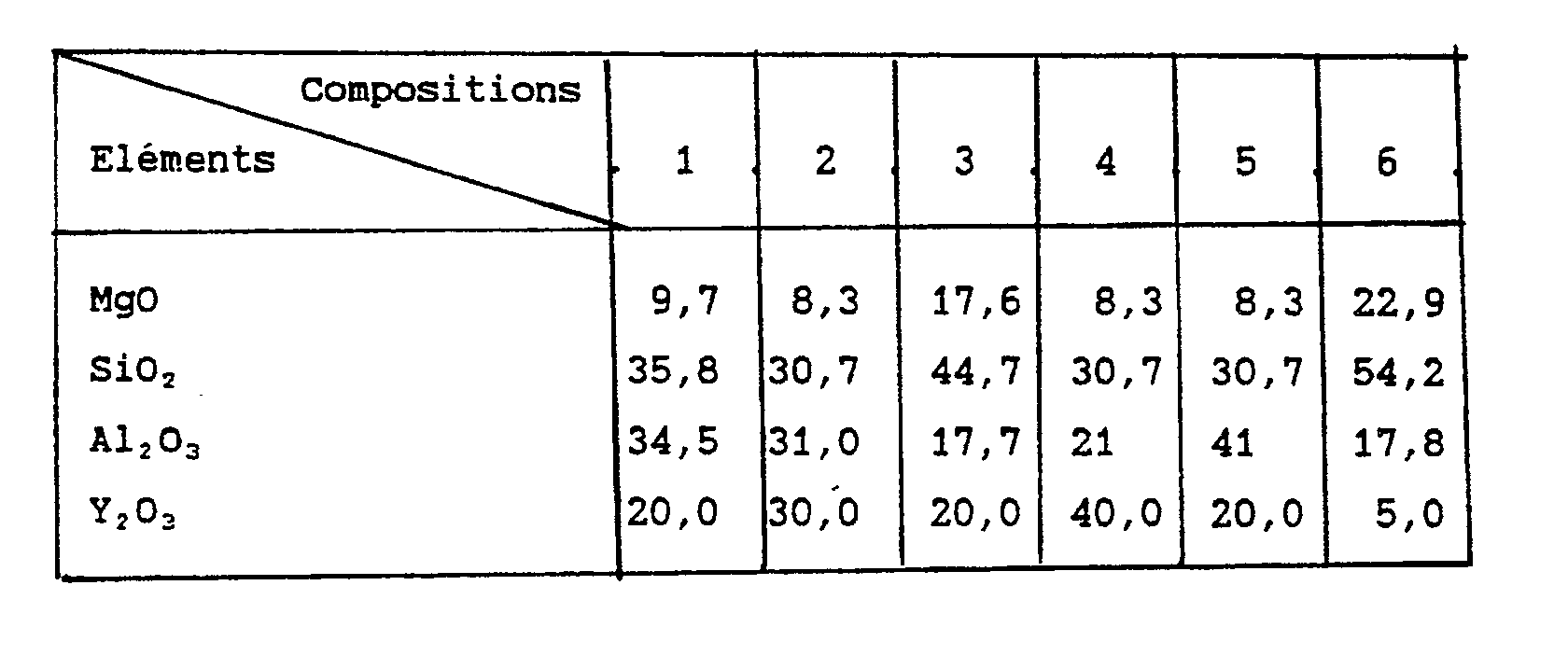
- the constituent elements are given in% by weight.
- compositions once melted can be used in slip and lead to the dies according to the invention.
- contents of the various elements of these compositions are given below in oxides:
- composition 1 a material according to the invention.
- composition 1 a material according to the invention.
- composition 1 a material according to the invention.
- composition 1 a material according to the invention.
- composition 1 a material according to the invention.
- composition 1 a material according to the invention.
- composition 1 a material according to the invention.
- composition 1 a material according to the invention.
- composition 1 a material according to the invention.
- composition 1 a grain powder with a diameter of less than 10 ⁇ m.
- Composition 1 10.3 kg - Polystyrene 0.87 kg - Paraffin 0.21 kg - Dioctylphthalate 0.36 kg - Cyclohexane 10.6 liters
- the slip is introduced into a 50-liter alumina mill with 50 kg of alumina beads. We grind for 15 hours.
- SiC fibers are then impregnated with this slip.
- the plates are wound on a polygonal mandrel.
- the sheets are cut and a stack is made at 0 °.
- the characteristics of the composite material P1 according to the invention thus obtained are indicated in the table below which also includes those of a material P2 of the prior art of the following composition: If 69.6% Li2O 3.0% Al2O3 17.7% ZrO2 2.0% MgO 2.7% Nb2O5 3.0% BaO 1.0% As2O3 1.0% P1 P2 Hot processing temperature 900 ° C 1400 ° C Density 2.61 2.5 Fiber volume fraction 40 50 Bending 3 hot points MPa 20 ° C 470 600 1200 ° C 400 300
Landscapes
- Chemical & Material Sciences (AREA)
- Engineering & Computer Science (AREA)
- Materials Engineering (AREA)
- Dispersion Chemistry (AREA)
- Life Sciences & Earth Sciences (AREA)
- Chemical Kinetics & Catalysis (AREA)
- General Chemical & Material Sciences (AREA)
- Geochemistry & Mineralogy (AREA)
- Ceramic Engineering (AREA)
- Organic Chemistry (AREA)
- Crystallography & Structural Chemistry (AREA)
- Compositions Of Oxide Ceramics (AREA)
- Glass Compositions (AREA)
- Catalysts (AREA)
Abstract
5% ≦ MO ≦ 40%
25% ≦ SiO₂ ≦ 70%
15% ≦ Al₂O₃ ≦ 70%
5% ≦ oxyde de terre rare ≦ 70 %
où M désigne un alcalino-terreux.
Description
- La présente invention concerne un matériau composite à matrice vitrocéramique renforcée, ainsi que son procédé de préparation.
- Les matériaux composites à matrice vitrocéramique et à renforts notamment fibreux présentent aujourd'hui un grand intérêt technique compte tenu de leurs bonnes propriétés thermomécaniques et, pour cette raison, ils peuvent être avantageusement utilisés dans les domaines aéronautiques et spatiaux pour des applications nécessitant notamment une bonne tenue aux moyennes températures, c'est-à-dire de l'ordre de 600 à 1000°C.
- Cependant, la plupart des matériaux de ce type développés à ce jour ne donnent pas entièrement satisfaction, tant au point de vue de leurs propriétés finales qu'au point de vue de leur mode d'élaboration.
- Parmi les matériaux composites à matrice vitrocéramique les plus répandus et les plus performants, on connaît ceux pour lesquels la matrice est à base de lithium. Or les matrices de ce type ont une résistance à la corrosion qui n'est pas toujours suffisante.
- Par ailleurs la technique la plus répandue pour fabriquer ces matériaux consiste à imprégner une préforme fibreuse (agent de renforcement) au moyen d'une barbotine contenant, sous des formes les plus diverses, tous les éléments nécessaires à l'obtention de la composition vitreuse désirée, puis on séche la préforme ainsi imprégnée.
- On répète éventuellement les étapes d'imprégnation-séchage jusqu'à l'obtention d'un préimprégné ayant la fraction volumique de fibres recherchée et/ou on empile puis solidarise entre eux par chauffage modéré des préimprégnés séchés dans le but d'obtenir des composites à renfort mono ou bi-directionnels de grandes tailles. Enfin on densifie cette préforme au moyen d'une étape de compression à chaud. Cette dernière étape, ayant en particulier pour but de faire fluer le verre à travers les torons de la préforme, nécessite que la viscosité du verre soit relativement faible (inférieure à 10⁷ poises) et donc que la température de pressage soit élevée.
- Ainsi pour obtenir des résultats convenables en densité et en propriétés thermomécaniques, il est connu que les verres à base de lithium doivent être pressés au minimum aux environs de 1300-1400°C. Des températures de pressage élevées font à l'évidence courir le risque d'endommager les fibres qui constituent la structure de renforcement.
- La présente invention permet d'obvier aux inconvénients énoncés ci-dessus.
- L'objet principal de l'invention est de proposer des matériaux composites à matrice vitrocéramique renforcée et à température d'élaboration par pressage à chaud moins élevée que les températures indiquées plus haut.
- Un autre objet de la présente invention est de fournir des matériaux composites à résistance à la corrosion améliorée.
- Dans ce but, le matériau composite selon l'invention est du type comprenant une matrice vitrocéramique et un agent de renforcement et il est caractérisé en ce que la matrice vitrocéramique est à base de silice, d'alumine, d'oxydes d'alcalino-terreux et de terres rares dans les proportions pondérales suivantes rapportées a la masse totale de ladite matrice :
5% ≦ MO ≦ 40%
25% ≦ SiO₂ ≦ 70%
15% ≦ Al₂O₃ ≦ 70%
5% ≦ Oxyde de terres rares ≦ 70%
formule dans laquelle M désigne un alcalino-terreux. - Par ailleurs, le procédé de fabrication du matériau selon l'invention est caractérisé en ce qu'il comporte les étapes suivantes :
- a) on imprègne l'agent de renforcement au moyen d'une barbotine contenant les éléments constitutifs de la matrice vitrocéramique.
- b) on sèche l'agent de renforcement ainsi imprégné ce par quoi on obtient un préimprégné.
- c) on densifie le préimprégné obtenu.
- d) on soumet le produit issu de l'étape c) à un traitement thermique.
- Le matériau de l'invention est particulièrement intéressant compte tenu du fait qu'il présente une température d'élaboration inférieure à 1200°C.
- Il présente aussi une bonne tenue à chaud de ses propriétés mécaniques.
- D'autres caractéristiques et avantages de l'invention apparaîtront mieux à la lecture de la description et des exemples concrets mais non limitatifs qui vont suivre.
- Comme on l'a vu plus haut la matrice vitrocéramique du matériau de l'invention est à base de silice (SiO₂), d'alumine (Al₂ O₃), d'oxydes d'alcalino-terreux et de terres rares.
- En ce qui concerne les oxydes d'alcalino-terreux, on utilise généralement les oxydes de calcium, de baryum, strontium et de magnésium, ce dernier étant préféré car il permet la recristallisation d'une phase à bas coefficient de dilatation de caractéristique dilatométrique proche de celle de l'agent de renforcement.
- Pour les terres rares, on entend ici et pour le reste de la description les éléments de terres rares appelés lanthanides ayant des numéros atomiques de 57 à 71 inclus et l'yttrium.
- Parmi ces éléments, on utilise plus particulièrement le cerium, le lanthane, le néodyme, le praséodyme et le samarium, les deux premiers cités étant préférés avec l'yttrium.
- Les teneurs en oxyde de terre rare données ci-dessus et dans le reste de la description sont calculées pour l'oxyde le plus courant de la terre rare (Tr) concernée c'est-à-dire généralement Tr₂O₃ ou TrO₂ notamment pour le cerium.
- On notera que tant pour les alcalino-terreux que pour les terres rares, on peut utiliser chacun de ces éléments seul ou en combinaison avec un autre élément du même groupe. Cette remarque s'applique pour l'ensemble de la description étant entendu que ce qui sera décrit en référence à un alcalino-terreux ou une terre rare s'appliquera aussi à une combinaison de plusieurs alcalino-terreux ou terres rares.
- Les éléments constituant la matrice de l'invention sont présents dans les proportions indiquées plus haut c'est-à-dire :
5% ≦ Mo ≦ 40%
25% ≦ SiO₂ ≦ 70%
15% ≦ Al₂O₃ ≦ 70%
5% ≦ Oxyde de terre rare ≦ 70% - Selon un mode de réalisation plus particulier les proportions respectives de ces éléments seront les suivantes :
6,5% ≦ MO ≦ 18%
25% ≦ SiO₂ ≦ 50%
17,5% ≦ Al₂O₃ ≦ 62,5%
5% ≦ Oxyde de terre rare ≦ 50% - Selon un troisième mode encore plus particulier, les proportions peuvent être :
7% ≦ MO ≦ 11%
28% ≦ SiO₂ ≦ 40%
20% ≦ Al₂O₃ ≦ 45%
10% ≦ Oxyde de terre rare ≦ 40% - Par ailleurs, le matériau de l'invention comprend un agent de renforcement de type fibreux.
- Il s'agit généralement de renforts céramiques constitués par un assemblage, organisé ou aléatoire, de fibres longues et continues en céramique. Ainsi, les fibres utilisées peuvent se présenter dans la matrice selon une configuration unidirectionnelle, ou sous la forme de tissus, ou de mats non tissés, ou bien encore selon une configuration multidirectionnelle.
- Eventuellement, l'agent de renforcement pourrait se présenter sous la forme de fibres courtes et/ou de whiskers, orientés de façon aléatoire dans la matrice.
- On peut utiliser aussi comme agents de renforcement des fibres longues en combinaison avec des whiskers et/ou des fibres courtes dispersés dans la matrice.
- D'un point de vue résistance mécanique, les matériaux composites préférés selon l'invention sont ceux soit à renfort fibreux unidirectionnel, c'est-à-dire constitué de fibres substantiellement toutes parallèles entre elles et orientées dans une seule et même direction (composite 1D), soit à renfort fibreux bidirectionnel, c'est-à-dire constitué de fibres substantiellement toutes parallèles entre elles mais de direction croisée dans deux plans horizontaux successifs, l'angle de croisure étant avantageusement choisi égal à 90° pour obtenir les meilleures propriétés mécaniques (composite 2D).
- A titre de fibres céramiques pouvant convenir pour la constitution de l'agent de renforcement, on peut citer notamment celles en carbone, en bore, en alumine, en alumine-silice, en alumine-silice-bore, en carbure de silicium, en nitrure de silicium, en nitrure de bore et en carbonitrure de silicium. Bien entendu, des mélanges entre des fibres de nature céramique différente peuvent être utilisés à la réalisation du renfort.
- Les fibres céramiques en carbure de silicium conviennent particulièrement bien pour la réalisation de composites à haute tenue thermomécanique.
- La fraction volumique de l'agent de renforcement dans le matériau composite peut être comprise entre 20 % et 70 %, de préférence entre 30 et 50 %.
- Le procédé de préparation du matériau composite selon l'invention va maintenant être décrit plus particulièrement.
- Ce procédé comprend plusieurs étapes.
- La première consiste à imprégner l'agent de renforcement (fibres unidirectionnelles, tissus, mats non tissés, préformés multidirectionnels, etc ...) au moyen d'une barbotine contenant les éléments constitutifs de la matrice vitrocéramique.
- La barbotine d'imprégnation contient donc, sous une forme finement dispersée, les éléments silicium, aluminium, alcalinoterreux et terres rares dans des proportions pondérales respectives exprimées en oxydes dans les quantités définies ci-dessus, tous ces éléments présents dans la barbotine se retrouvant en effet, après pressage à chaud, dans la matrice céramique du composite.
- Ces éléments sont présents sous la forme d'une masse fondue préalablement obtenue par mélange et fusion soit des oxydes des éléments considérés, soit de précurseurs de ces éléments sous formes de matières naturelles.
- C'est ainsi que CaO peut être apporté par du silicate de calcium (Wollastonite), par du carbonate de calcium (Aragonite, Calcite), par du Feldspath calcique (Anorthite).
- MgO peut être introduit par l'intermédiaire du silicate de magnésium (Steatite, Forsterite, Saphirine) par de l'aluminate de magnésium (Spinelle), par un hydrate de magnésium (Brucite) ou du carbonate de magnésium (Magnésite).
- On peut aussi introduire ensemble CaO et MgO avec un carbonate double de calcium et de magnésium (Dolomite) ou un silicate double de ces éléments (Diopside).
- SiO₂ et Al₂O₃ peuvent être apportés ensemble par du kaolin, de la cyanite, de la sillimanite, de l'argile, ou séparément par du quartz ou un hydrate d'alumine (hydrargillite, boehmite).
- Enfin, on peut apporter conjointement SiO₂, Al₂O₃ et MgO par de la cordiérite.
- La granulométrie des poudres constituant la charge céramique de la barbotine est avantageusement choisie inférieure à 50 µ, encore plus préférentiellement inférieure à 10 µ.
- Les propriétés de rhéologie et de mouillabilité de la barbotine sont ajustées classiquement par addition de liants et de solvants de nature et de proportions appropriées. Les solvants sont éliminés lors de l'étape du séchage.
- Dans une deuxième étape on sèche l'agent de renforcement imprégné issu de l'étape précédente.
- Eventuellement, on peut répétér les étapes d'imprégnation et de séchage jusqu'à l'obtention d'un préimprégné ayant la fraction volumique recherchée d'agent de renforcement.
- Selon une variante du procédé, convenant plus particulièrement pour la préparatipn de composites 1D ou 2D tels que définis ci-dessus, on peut également procéder à l'empilement puis au collage de préimprégnés identiques se présentant sous la forme de feuilles composites à renfort fibreux unidirectionnel, l'empilage se faisant soit en gardant parallèle (composite 1D) soit en croisant (composite 2D) les directions des fibres des feuilles superposées.
- La troisième étape du procédé est celle de densification ou de frittage.
- On notera toutefois qu'avant de procéder au frittage sous charge de la préforme imprégnée et séchée, il est préférable d'éliminer, partiellement ou totalement, les divers liants qui ont été utilisés à la préparation de la barbotine ; cette opération, dite de décrassage, est classiquement réalisée par traitement thermique modéré, sous air ou sous atmosphère neutre, de la préforme.
- La densification ou frittage par chauffage se fait habituellement à une température d'au moins 850°C par exemple entre 850°C et 1200°C et plus particulièrement entre 900°C et 1100°C.
- Selon un mode préférentiel, on procède sous pression.
- La pression est généralement d'au moins 3 MPa et par exemple elle peut être comprise entre 3 ou 5 MPa et 25 MPa.
- D'une manière connue en soi il est préférable de réaliser le traitement de densification ou frittage dans une atmosphère neutre.
- La durée du traitement de densification est de préférence d'au moins 15 minutes et peut aller jusqu'à 3 heures par exemple.
- La dernière étape du procédé est un traitement thermique ou de recristallisation. Cette étape permet de développer la structure cristalline dans la matrice amorphe obtenue à l'issue des étapes précédentes.
- Ce traitement se fait à une température d'au moins 1000°C préférentiellement entre 1000 et 1200°C.
- Il se fait généralement sans pression. Sa durée est de quelques heures, par exemple entre 0,5 et 6 heures.
- Des exemples vont maintenant être donnés :
- Dans cet exemple on donne différentes compositions de départ à base de matières premières naturelles.
- Les éléments constitutifs sont donnés en % pondéral.
- Ces compositions une fois fondues peuvent être utilisées en barbotine et conduire aux matrices selon l'invention.

- Cet exemple décrit une fabrication d'un matériau selon l'invention. On synthétise le verre par fusion à l'air à 1550°C de la composition 1. La masse fondue ainsi obtenue est broyée jusqu'à l'obtention d'une poudre de grains de diamètre inférieur à 10 µm. On prépare une barbotine d'imprégnation à partir de cette poudre et de composition suivante :
- Verre prébroyé (composition 1) 10,3 kg - Polystyrène 0,87 kg - Paraffine 0,21 kg - Dioctylphtalate 0,36 kg - Cyclohexane 10,6 litres - La barbotine est introduite dans un broyeur en alumine de 50 litres avec 50 kg de billes d'alumine. On broie pendant 15 heures.
- On imprègne ensuite des fibres SiC par cette barbotine. On effectue un bobinage des plaques sur un mandrin polygonal. On découpe les nappes et on réalise un empilement à 0°.
- On décrasse puis on fritte sous charge en atmosphère neutre à 900°C sous 5 MPa de pression, pendant 2 heures.
- On réalise enfin un traitement de recristallisation à 1100°C durant 5 heures sans pression.
- Les caractéristiques du matériau composite P₁ selon l'invention ainsi obtenus sont indiquées dans le tableau ci-dessous où figurent aussi celles d'un matériau P₂ de l'art antérieur de composition suivante :
SiO₂ 69,6% Li₂O 3,0% Al₂O₃ 17,7% ZrO₂ 2,0% MgO 2,7% Nb₂O₅ 3,0% BaO 1,0% As₂O₃ 1,0% P₁ P₂ Température d'élaboration à chaud 900°C 1400°C Densité 2,61 2,5 Fraction volumique de fibre 40 50 Flexion 3 Points à chaud MPa 20°C 470 600 1200°C 400 300
Claims (11)
5% ≦ MO ≦ 40%
25% ≦ SiO₂ ≦ 70%
15 % ≦ Al₂O₃ ≦ 70%
5% ≦ oxyde de terre rare ≦ 70%
où M désigne un alcalino-terreux.
6,5% ≦ MO ≦ 18%
25% ≦ SiO₂ ≦ 50%
17,5% ≦ Al₂O₃ ≦ 62,5%
5% ≦ oxyde de terre rare ≦ 50 %
7% ≦ MO ≦ 11%
28 % ≦ SiO₂ ≦ 40%
20% Al₂O₃ ≦ 45%
10 % ≦ Oxyde de terre rare ≦ 40 %
Applications Claiming Priority (2)
| Application Number | Priority Date | Filing Date | Title |
|---|---|---|---|
| FR8908260A FR2648806B1 (fr) | 1989-06-21 | 1989-06-21 | Materiau composite a matrice vitroceramique renforcee et son procede de preparation |
| FR8908260 | 1989-06-21 |
Publications (2)
| Publication Number | Publication Date |
|---|---|
| EP0404632A1 true EP0404632A1 (fr) | 1990-12-27 |
| EP0404632B1 EP0404632B1 (fr) | 1995-03-15 |
Family
ID=9382983
Family Applications (1)
| Application Number | Title | Priority Date | Filing Date |
|---|---|---|---|
| EP90401609A Expired - Lifetime EP0404632B1 (fr) | 1989-06-21 | 1990-06-12 | Matériau composite à matrice vitrocéramique renforcée et son procédé de préparation |
Country Status (6)
| Country | Link |
|---|---|
| US (1) | US5104830A (fr) |
| EP (1) | EP0404632B1 (fr) |
| JP (1) | JPH0777984B2 (fr) |
| AT (1) | ATE119861T1 (fr) |
| DE (1) | DE69017766T2 (fr) |
| FR (1) | FR2648806B1 (fr) |
Cited By (5)
| Publication number | Priority date | Publication date | Assignee | Title |
|---|---|---|---|---|
| FR2684040A1 (fr) * | 1991-11-26 | 1993-05-28 | Aerospatiale | Materiau composite thermostructural isolant de faible densite et procede de realisation d'un tel materiau sandwich-verre. |
| FR2684659A1 (fr) * | 1991-12-06 | 1993-06-11 | Rhone Poulenc Chimie | Precurseur de verres ou de vitroceramiques et son procede de preparation. |
| FR2693453A1 (fr) * | 1992-07-09 | 1994-01-14 | Aerospatiale | Matériau composite à renfort fibreux et à matrice vitrocéramique Mg-Al-Si-Y totalement céramisée, issue d'une poudre obtenue par la voie sol-sel, sa fabrication et ses applications. |
| WO2011128521A1 (fr) | 2010-04-14 | 2011-10-20 | Pyromeral Systems S.A. | Matrice à base de cristobalite nano-cristalline pour matériau composite fibreux thermostructural. |
| CN102992590A (zh) * | 2012-11-29 | 2013-03-27 | 江苏宜达光电科技有限公司 | 微晶玻璃碎粒压延制备方法 |
Families Citing this family (18)
| Publication number | Priority date | Publication date | Assignee | Title |
|---|---|---|---|---|
| US5472720A (en) * | 1992-06-17 | 1995-12-05 | Mitec Scientific Corporation | Treatment of materials with infrared radiation |
| US5350927A (en) * | 1992-06-17 | 1994-09-27 | Mitech Scientific Corp. | Radiation emitting ceramic materials and devices containing same |
| JPH07169127A (ja) * | 1993-10-01 | 1995-07-04 | Minnesota Mining & Mfg Co <3M> | 非晶質希土類酸化物 |
| WO2003012000A2 (fr) * | 2001-08-02 | 2003-02-13 | 3M Innovative Properties Company | Particules abrasives, et leurs procedes de production et d'utilisation |
| US7501001B2 (en) * | 2001-08-02 | 2009-03-10 | 3M Innovative Properties Company | Abrasive particles, and methods of making and using the same |
| US7625509B2 (en) * | 2001-08-02 | 2009-12-01 | 3M Innovative Properties Company | Method of making ceramic articles |
| US7563293B2 (en) * | 2001-08-02 | 2009-07-21 | 3M Innovative Properties Company | Al2O3-rare earth oxide-ZrO2/HfO2 materials, and methods of making and using the same |
| KR100885328B1 (ko) * | 2001-08-02 | 2009-02-26 | 쓰리엠 이노베이티브 프로퍼티즈 컴파니 | 알루미나-산화 이트륨-산화 지르코늄/산화 하프늄 물질,및 그의 제조 및 사용 방법 |
| ATE378293T1 (de) | 2001-08-02 | 2007-11-15 | 3M Innovative Properties Co | Verfahren zur herstellung von gegenständen aus glas sowie so hergestellte glaskeramikgegenstände |
| JP4748904B2 (ja) * | 2001-09-26 | 2011-08-17 | 京セラ株式会社 | ガラスセラミック焼結体およびそれを用いた配線基板 |
| US8056370B2 (en) * | 2002-08-02 | 2011-11-15 | 3M Innovative Properties Company | Method of making amorphous and ceramics via melt spinning |
| US6984261B2 (en) * | 2003-02-05 | 2006-01-10 | 3M Innovative Properties Company | Use of ceramics in dental and orthodontic applications |
| US20040148868A1 (en) * | 2003-02-05 | 2004-08-05 | 3M Innovative Properties Company | Methods of making ceramics |
| US7297171B2 (en) * | 2003-09-18 | 2007-11-20 | 3M Innovative Properties Company | Methods of making ceramics comprising Al2O3, REO, ZrO2 and/or HfO2 and Nb205 and/or Ta2O5 |
| US7497093B2 (en) | 2004-07-29 | 2009-03-03 | 3M Innovative Properties Company | Method of making ceramic articles |
| US7332453B2 (en) * | 2004-07-29 | 2008-02-19 | 3M Innovative Properties Company | Ceramics, and methods of making and using the same |
| DE102005038457B3 (de) | 2005-08-13 | 2007-04-05 | Schott Ag | Verwendung einer Glaskeramik als Panzermaterial |
| US8925350B2 (en) * | 2010-07-23 | 2015-01-06 | King Abdulaziz City For Science And Technology | Preparation of sintered cordierite glass-ceramic bodies |
Citations (3)
| Publication number | Priority date | Publication date | Assignee | Title |
|---|---|---|---|---|
| FR2538370A1 (fr) * | 1982-12-28 | 1984-06-29 | Ceraver | Materiaux ceramiques vitreux, procede de fabrication de tels materiaux et application de ces derniers au collage de pieces ceramiques |
| EP0288199A1 (fr) * | 1987-04-23 | 1988-10-26 | Corning Glass Works | Composites extrudés à matrice céramique et à renforcement par whiskers et méthode de fabrication |
| US4794094A (en) * | 1986-08-11 | 1988-12-27 | National Institute For Research In Inorganic Materials | Process for producing and product of a machinable crystallized glass having needle-like crystals precipitated therein |
Family Cites Families (6)
| Publication number | Priority date | Publication date | Assignee | Title |
|---|---|---|---|---|
| US4097295A (en) * | 1976-10-26 | 1978-06-27 | Corning Glass Works | Silica-alumina-nitrogen containing glasses for production of glass-ceramics |
| US4485179A (en) * | 1982-05-20 | 1984-11-27 | United Technologies Corporation | Reaction inhibited-silicon carbide fiber reinforced high temperature glass-ceramic composites |
| US4412854A (en) * | 1982-05-25 | 1983-11-01 | United Technologies Corporation | Method of producing fiber reinforced glass matrix composite articles of complex shape |
| US4615987A (en) * | 1985-04-15 | 1986-10-07 | Corning Glass Works | Reinforcement of alkaline earth aluminosilicate glass-ceramics |
| US5132178A (en) * | 1987-05-08 | 1992-07-21 | Corning Incorporated | Ceramic matrix composites exhibiting high interlaminar shear strength |
| US4857485A (en) * | 1987-10-14 | 1989-08-15 | United Technologies Corporation | Oxidation resistant fiber reinforced composite article |
-
1989
- 1989-06-21 FR FR8908260A patent/FR2648806B1/fr not_active Expired - Lifetime
-
1990
- 1990-06-12 DE DE69017766T patent/DE69017766T2/de not_active Expired - Fee Related
- 1990-06-12 AT AT90401609T patent/ATE119861T1/de not_active IP Right Cessation
- 1990-06-12 EP EP90401609A patent/EP0404632B1/fr not_active Expired - Lifetime
- 1990-06-19 US US07/540,167 patent/US5104830A/en not_active Expired - Fee Related
- 1990-06-20 JP JP2160044A patent/JPH0777984B2/ja not_active Expired - Lifetime
Patent Citations (3)
| Publication number | Priority date | Publication date | Assignee | Title |
|---|---|---|---|---|
| FR2538370A1 (fr) * | 1982-12-28 | 1984-06-29 | Ceraver | Materiaux ceramiques vitreux, procede de fabrication de tels materiaux et application de ces derniers au collage de pieces ceramiques |
| US4794094A (en) * | 1986-08-11 | 1988-12-27 | National Institute For Research In Inorganic Materials | Process for producing and product of a machinable crystallized glass having needle-like crystals precipitated therein |
| EP0288199A1 (fr) * | 1987-04-23 | 1988-10-26 | Corning Glass Works | Composites extrudés à matrice céramique et à renforcement par whiskers et méthode de fabrication |
Cited By (7)
| Publication number | Priority date | Publication date | Assignee | Title |
|---|---|---|---|---|
| FR2684040A1 (fr) * | 1991-11-26 | 1993-05-28 | Aerospatiale | Materiau composite thermostructural isolant de faible densite et procede de realisation d'un tel materiau sandwich-verre. |
| EP0544553A1 (fr) * | 1991-11-26 | 1993-06-02 | AEROSPATIALE Société Nationale Industrielle | Matériau composite thermostructural isolant de faible densité et procédé de réalisation d'un tel matériau sandwich-verre |
| US5514198A (en) * | 1991-11-26 | 1996-05-07 | Aerospatiale-Societe Nationale Industrielle | Method of forming a low-density insulating thermostructural composite material |
| FR2684659A1 (fr) * | 1991-12-06 | 1993-06-11 | Rhone Poulenc Chimie | Precurseur de verres ou de vitroceramiques et son procede de preparation. |
| FR2693453A1 (fr) * | 1992-07-09 | 1994-01-14 | Aerospatiale | Matériau composite à renfort fibreux et à matrice vitrocéramique Mg-Al-Si-Y totalement céramisée, issue d'une poudre obtenue par la voie sol-sel, sa fabrication et ses applications. |
| WO2011128521A1 (fr) | 2010-04-14 | 2011-10-20 | Pyromeral Systems S.A. | Matrice à base de cristobalite nano-cristalline pour matériau composite fibreux thermostructural. |
| CN102992590A (zh) * | 2012-11-29 | 2013-03-27 | 江苏宜达光电科技有限公司 | 微晶玻璃碎粒压延制备方法 |
Also Published As
| Publication number | Publication date |
|---|---|
| US5104830A (en) | 1992-04-14 |
| ATE119861T1 (de) | 1995-04-15 |
| EP0404632B1 (fr) | 1995-03-15 |
| JPH03215351A (ja) | 1991-09-20 |
| JPH0777984B2 (ja) | 1995-08-23 |
| FR2648806A1 (fr) | 1990-12-28 |
| DE69017766T2 (de) | 1995-11-23 |
| FR2648806B1 (fr) | 1993-02-12 |
| DE69017766D1 (de) | 1995-04-20 |
Similar Documents
| Publication | Publication Date | Title |
|---|---|---|
| EP0404632B1 (fr) | Matériau composite à matrice vitrocéramique renforcée et son procédé de préparation | |
| US3681187A (en) | Carbon fibres embedded in glass matrix | |
| US4919991A (en) | Hybrid ceramic matrix composite articles comprising particulate additives and method | |
| JPS6235996B2 (fr) | ||
| KR930006322B1 (ko) | 섬유보강 복합재료 | |
| JPS61242930A (ja) | 強化アルカリ土類アルミノ珪酸ガラス複合体およびその製造方法 | |
| JPS61242931A (ja) | 強化アルカリ土類アルミノ珪酸ガラスセラミツクマトリツクス複合体およびその製造方法 | |
| JPS6341862B2 (fr) | ||
| US4788162A (en) | Composite by compression | |
| JPH0365527A (ja) | オキシ炭化ケイ素ガラスおよび物品 | |
| JPS58217435A (ja) | 繊維強化ガラスマトリツクス複合材料物品の製造方法 | |
| US4666645A (en) | Method for forming fiber reinforced composite articles | |
| EP0404631B1 (fr) | Matériaux composites à matrice vitreuse renforcée et leur procédé de préparation | |
| US5399440A (en) | Composite material with a glass-ceramic or ceramic matrix obtained by the sol-gel process and reinforced by fibers based on silicon carbide, its manufacture and its applications | |
| US5312787A (en) | Ceramics composite material and method of producing the same | |
| US5464583A (en) | Method for manufacturing whisker preforms and composites | |
| EP0424220B1 (fr) | Compositions verrières oxyazotées, leurs précurseurs et leur application à la préparation de compositions vitrocéramiques et de matériaux composites | |
| Leutbecher et al. | Oxide fiber reinforced glass: a challenge to new composites | |
| US5034356A (en) | Ceramic matrix composite | |
| US5652188A (en) | Fiber-reinforced composite with sheet silicate interlayer | |
| JP3195266B2 (ja) | 複層断熱材及びその製造法 | |
| US4846866A (en) | Providing reinforced alkaline earth aluminosilicate glasses | |
| US5190895A (en) | Ceramics composite material | |
| EP0227019A2 (fr) | Matériau composite par compression | |
| FR2624851A1 (fr) | Composition refractaire de grains d'alumine-zirconium-silice pour la fabrication d'articles refractaires, notamment carrelage, revetement refractaire de fours ou analogues |
Legal Events
| Date | Code | Title | Description |
|---|---|---|---|
| PUAI | Public reference made under article 153(3) epc to a published international application that has entered the european phase |
Free format text: ORIGINAL CODE: 0009012 |
|
| AK | Designated contracting states |
Kind code of ref document: A1 Designated state(s): AT BE CH DE DK ES FR GB GR IT LI LU NL SE |
|
| 17P | Request for examination filed |
Effective date: 19910321 |
|
| 17Q | First examination report despatched |
Effective date: 19930707 |
|
| RAP1 | Party data changed (applicant data changed or rights of an application transferred) |
Owner name: AEROSPATIALE SOCIETE NATIONALE INDUSTRIELLE |
|
| GRAA | (expected) grant |
Free format text: ORIGINAL CODE: 0009210 |
|
| AK | Designated contracting states |
Kind code of ref document: B1 Designated state(s): AT BE CH DE DK ES FR GB GR IT LI LU NL SE |
|
| PG25 | Lapsed in a contracting state [announced via postgrant information from national office to epo] |
Ref country code: IT Free format text: LAPSE BECAUSE OF FAILURE TO SUBMIT A TRANSLATION OF THE DESCRIPTION OR TO PAY THE FEE WITHIN THE PRE;WARNING: LAPSES OF ITALIAN PATENTS WITH EFFECTIVE DATE BEFORE 2007 MAY HAVE OCCURRED AT ANY TIME BEFORE 2007. THE CORRECT EFFECTIVE DATE MAY BE DIFFERENT FROM THE ONE RECORDED.SCRIBED TIME-LIMIT Effective date: 19950315 Ref country code: ES Free format text: THE PATENT HAS BEEN ANNULLED BY A DECISION OF A NATIONAL AUTHORITY Effective date: 19950315 Ref country code: GR Free format text: LAPSE BECAUSE OF FAILURE TO SUBMIT A TRANSLATION OF THE DESCRIPTION OR TO PAY THE FEE WITHIN THE PRESCRIBED TIME-LIMIT Effective date: 19950315 Ref country code: NL Free format text: LAPSE BECAUSE OF NON-PAYMENT OF DUE FEES Effective date: 19950315 Ref country code: AT Effective date: 19950315 Ref country code: DK Effective date: 19950315 |
|
| REF | Corresponds to: |
Ref document number: 119861 Country of ref document: AT Date of ref document: 19950415 Kind code of ref document: T |
|
| REF | Corresponds to: |
Ref document number: 69017766 Country of ref document: DE Date of ref document: 19950420 |
|
| PG25 | Lapsed in a contracting state [announced via postgrant information from national office to epo] |
Ref country code: SE Effective date: 19950615 |
|
| GBT | Gb: translation of ep patent filed (gb section 77(6)(a)/1977) |
Effective date: 19950530 |
|
| PG25 | Lapsed in a contracting state [announced via postgrant information from national office to epo] |
Ref country code: LI Effective date: 19950630 Ref country code: LU Free format text: LAPSE BECAUSE OF NON-PAYMENT OF DUE FEES Effective date: 19950630 Ref country code: CH Effective date: 19950630 Ref country code: BE Effective date: 19950630 |
|
| NLV1 | Nl: lapsed or annulled due to failure to fulfill the requirements of art. 29p and 29m of the patents act | ||
| BERE | Be: lapsed |
Owner name: AEROSPATIALE SOC. NATIONALE INDUSTRIELLE Effective date: 19950630 |
|
| PLBE | No opposition filed within time limit |
Free format text: ORIGINAL CODE: 0009261 |
|
| STAA | Information on the status of an ep patent application or granted ep patent |
Free format text: STATUS: NO OPPOSITION FILED WITHIN TIME LIMIT |
|
| REG | Reference to a national code |
Ref country code: CH Ref legal event code: PL |
|
| 26N | No opposition filed | ||
| PGFP | Annual fee paid to national office [announced via postgrant information from national office to epo] |
Ref country code: DE Payment date: 20000720 Year of fee payment: 11 |
|
| PGFP | Annual fee paid to national office [announced via postgrant information from national office to epo] |
Ref country code: GB Payment date: 20010606 Year of fee payment: 12 |
|
| REG | Reference to a national code |
Ref country code: FR Ref legal event code: CD Ref country code: FR Ref legal event code: TP |
|
| REG | Reference to a national code |
Ref country code: GB Ref legal event code: IF02 |
|
| PG25 | Lapsed in a contracting state [announced via postgrant information from national office to epo] |
Ref country code: DE Free format text: LAPSE BECAUSE OF NON-PAYMENT OF DUE FEES Effective date: 20020403 |
|
| PG25 | Lapsed in a contracting state [announced via postgrant information from national office to epo] |
Ref country code: GB Free format text: LAPSE BECAUSE OF NON-PAYMENT OF DUE FEES Effective date: 20020612 |
|
| GBPC | Gb: european patent ceased through non-payment of renewal fee |
Effective date: 20020612 |
|
| PGFP | Annual fee paid to national office [announced via postgrant information from national office to epo] |
Ref country code: FR Payment date: 20090615 Year of fee payment: 20 |