EP0410123A2 - Verfahren und daraus resultierende Vorrichtung zur Kompensation von Prozessparametern in einer CMOS-Treiberschaltung - Google Patents
Verfahren und daraus resultierende Vorrichtung zur Kompensation von Prozessparametern in einer CMOS-Treiberschaltung Download PDFInfo
- Publication number
- EP0410123A2 EP0410123A2 EP90110958A EP90110958A EP0410123A2 EP 0410123 A2 EP0410123 A2 EP 0410123A2 EP 90110958 A EP90110958 A EP 90110958A EP 90110958 A EP90110958 A EP 90110958A EP 0410123 A2 EP0410123 A2 EP 0410123A2
- Authority
- EP
- European Patent Office
- Prior art keywords
- fet
- fet device
- transistors
- output signal
- circuit
- Prior art date
- Legal status (The legal status is an assumption and is not a legal conclusion. Google has not performed a legal analysis and makes no representation as to the accuracy of the status listed.)
- Withdrawn
Links
Images
Classifications
-
- H—ELECTRICITY
- H03—ELECTRONIC CIRCUITRY
- H03K—PULSE TECHNIQUE
- H03K17/00—Electronic switching or gating, i.e. not by contact-making and –breaking
- H03K17/51—Electronic switching or gating, i.e. not by contact-making and –breaking characterised by the components used
- H03K17/56—Electronic switching or gating, i.e. not by contact-making and –breaking characterised by the components used by the use, as active elements, of semiconductor devices
- H03K17/687—Electronic switching or gating, i.e. not by contact-making and –breaking characterised by the components used by the use, as active elements, of semiconductor devices the devices being field-effect transistors
- H03K17/6871—Electronic switching or gating, i.e. not by contact-making and –breaking characterised by the components used by the use, as active elements, of semiconductor devices the devices being field-effect transistors the output circuit comprising more than one controlled field-effect transistor
- H03K17/6872—Electronic switching or gating, i.e. not by contact-making and –breaking characterised by the components used by the use, as active elements, of semiconductor devices the devices being field-effect transistors the output circuit comprising more than one controlled field-effect transistor using complementary field-effect transistors
-
- H—ELECTRICITY
- H03—ELECTRONIC CIRCUITRY
- H03K—PULSE TECHNIQUE
- H03K17/00—Electronic switching or gating, i.e. not by contact-making and –breaking
- H03K17/14—Modifications for compensating variations of physical values, e.g. of temperature
- H03K17/145—Modifications for compensating variations of physical values, e.g. of temperature in field-effect transistor switches
-
- H—ELECTRICITY
- H03—ELECTRONIC CIRCUITRY
- H03K—PULSE TECHNIQUE
- H03K19/00—Logic circuits, i.e. having at least two inputs acting on one output; Inverting circuits
- H03K19/003—Modifications for increasing the reliability for protection
- H03K19/00369—Modifications for compensating variations of temperature, supply voltage or other physical parameters
- H03K19/00384—Modifications for compensating variations of temperature, supply voltage or other physical parameters in field effect transistor circuits
Definitions
- This invention relates generally to a technique and resulting structure which compensates for performance differences of devices due to process variations in the process of manufacturing integrated circuit devices and in particular, circuits utilizing CMOS technology.
- this invention relates to a technique and resulting structure which compensates for process variables, and variables in supply voltage, and operating temperature in the manufacture and operation of device drivers for integrated circuits on chips utilizing CMOS technology.
- process variables or variations can significantly affect the performance of many of the devices particularly device drivers which are formed on the chip.
- performance variables include delay, rise and fall time, impedance, etc., and indeed in uncompensated CMOS circuits the 3-sigma statistical combination of these independent variations on driver devices can be as much as ⁇ 60%.
- process variables which affect the performance include variation of channel length (which typically can vary up to ⁇ 35%); threshold voltage ( ⁇ 20%) the thickness of the dielectric in the gate electrode channel ( ⁇ 20%); diffusion channel width ( ⁇ 2%); and supply voltage ( ⁇ 10%).
- an improved integrated circuit which is preferably a CMOS circuit and an improved method of forming the circuit
- circuit has at least a first FET device and a second FET device and wherein at least one performance characteristic of said first and second FET devices varies in the same manner with the variation of at least one performance related process variable condition.
- Each of said FET devices has an output signal at least one characteristic of which is changed by a change in the performance related variable condition.
- the first and second FET devices are connected such that said one output characteristic of said second FET device acts in opposition to said one output characteristic of the first FET device to provide a merged output signal representative of the combined effect of said FET devices.
- the second FET device is constructed so as to be more responsive to the variations in said performance related variable condition than the first FET device and to have a weaker output signal than the first FET device, whereby the merged output signal of said FET devices is maintained relatively constant irrespective of variations in the performance related variable condition.
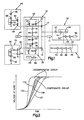
- the circuit includes a conventional driver circuit 10 which drives a group of off-chip load devices such as capacitors indicated collectively as 11.
- the driver circuit 10 is also connected to a receiver circuit 12.
- the driver circuit includes a P/FET transistor 14 and an N/FET transistor 16 coupled to drive the load 11. These transistors 14 and 16 are pull-up and pull-down transistors, respectively, connected in a conventional way to drive the load 11.
- the transistor 14 is turned on by N/FET transistors 18 and 20 connected in series.
- P/FET transistors 22 and 24 are also connected to transistor 14 for the purpose of turning off said P/FET transistor 14.
- the transistors 18, 20, 22 and 24 constitute a conventional NAND gate shown in broken outline and designated as 26.
- transistor 16 is turned on by P/FET transistors 30 and 32 connected in series. Transistor 16 is also connected to N/FET transistors 34 and 36 for the purpose of turning off said N/FET transistor 16.
- the transistors 30, 32, 34 and 36 constitute a conventional NOR gate shown in broken outline and designated by the reference character 38.
- the signal to operate the transistors 18 and 24 and transistors 32 and 34 is provided from an input source 40.
- the speed or rate at which either transistor 18 or 32 is turned on can vary widely, depending on many process variables. These process variables include the channel length of the transistors, the threshold voltage, the thickness of the dielectric between the gate electrode and the channel, the base mobility dictated by the background doping level, variations in channel width (this is a small effect but not completely negligible); and supply voltage. Other external variables can also affect the performance of the circuit such as temperature, etc. Therefore, if the driver circuit 10 were not compensated in some manner then, depending upon these process variables, the speed at which the transistors 14 or 16 would be turned “on” would vary widely depending upon how sensitive the transistors 18 and 20 and 30 and 32 are and thus how hard they turn “on” the transistors 14 and 16.
- the transistors 14 and 16 are turned on too fast or too hard, the speed of operation of the output from the driver circuit is significantly increased and if it is too fast, excessive noise or resonance results which makes it difficult to read the signal and thus the circuit cannot operate properly.
- the transistors 18 and 20 and 30 and 32 turn on the transistors 14 and 16 too slowly due to process variables, the speed of the driver circuit 10 is significantly reduced thus causing a loss of performance.
- a compensator for the P channel is designated by the reference character 60 which includes P/FET transistors 62 and 64 connected in series and P/FET transistors 66, 68 and 70 connected in series as shown in Figure 1, with the gate of transistor 62 being connected between transistors 68 and 70, this connection acting as a voltage divider.
- transistors 62 and 64 is merged with the output of the N/FET transistors 18 and 20 as shown in Figure 1 such that the outputs are in opposition to each other, i.e. the path from the transistors 18 and 20 to transistor 14 which is a pull-up transistor tends to turn the transistor 14 "on” when the transistors 18 and 20 are turned on, whereas the output of the transistors 62 and 64 tends to turn the transistor 14 "off” when they are turned “on” thus acting in opposition to the action of the transistors 18 and 20.
- the transistors 62 and 64 are designed so that they are less powerful than the transistors 18 and 20 such that their action does not overcome the action of the transistors 18 and 20 but merely compensates for it by acting in opposition to the signal from the transistors 18 and 20.
- the N channel compensator circuit 72 is provided which has N/FET transistors 74, 76, 78, 80 and 82 connected in manner similar to the transistors of the compensating circuit 62 and act in a similar manner in conjunction with transistors 30 and 32 to turn transistor 16 "on".
- the gates of transistors 34 and 24 are connected to input 40.
- the output from the receiver 12 at node 53 is delivered to a delay circuit 54 which is comprised of a series of inverters 86, 88, 90 and 92 which provide a feedback signal to node 94 which is connected to the gates of transistors 64 and 76 and turns "off" compensation after transition at load 11 is complete as determined by transistor 14 thereby eliminating unnecessary power dissipation.
- the operation of gates of transistors 66 and 82 is for test purposes only to shut off DC current in transistors 68 and 70, and 78 and 80 respectively.
- the transistors 66 and 82 are not used during operation of the circuit.
- Transistors 20 and 22 are connected to enable signal shown schematically at 96 and transistors 30 and 36 are connected to the inverted or nonenable signal shown schematically at 98 which allows circuit 10 to be placed in the high impedance state as is well known in the art.
- the purpose of the NAND and NOR gate configuration in conjunction with a pull-up and pull-down transistors 14 and 16 is to provide a tri-strate condition for the transistors 14 and 16 so that both of them can be completely shut off and that they are in neither a high nor a low condition which circuit is well-known in the art.
- transistors 62 and 64 as compared to transistors 18 and 20 and of transistors 74 and 76 as compared to transistors 30 and 32 can be explained as follows with respect to several different process parameters. For example, it is well-known that as the channel length decreases the speed of the transistor increases. Therefore if the channel lengths of the transistors 18, 20 and 14 are decreased because of process variations, this will tend to increase the speed at which the transistor 14 is turned “on” and speed with which transistor 14 drives load 11. However, these same process variations will decrease the channel lengths of the transistors 62 and 64.
- any increase due to process variations in channel lengths of the transistors 18 and 20 will be percentage wise less then the corresponding increasing channel lengths in the transistors 62 and 64 and thus the absolute variations in the process variables will have a much larger effect on channels 62 and 64 thus making them more sensitive to process variations with respect to channel length than the transistors 18 and 20. It is this greater sensitivity coupled with the lesser strength of the transistors 62 and 64 which will overcome the sensitivity of transistors 18, 20 and 14 to channel length.
- transistors 62 and 64 can be designed to have a lower nominal gate to source voltage than the transistors 18 and 20 which again will cause the transistors 62 and 64 to have a greater percentage change in the characteristics with respect to the output characteristics transistors 18 and 20 to any variations in supply voltage. Similar nominal design criteria can be used with respect to transistors 62 and 64 and transistors 18 and 20 which are affected by other process variables including base mobility, channel width, threshold voltage, temperature, etc. all of which will be understood by a person skilled in the art and need not be described in detail.
- Figure 2 is a graph plotting the voltage of load 11 against time for a typical uncompensated circuit as compared to a circuit according to this invention showing how the output characteristic of circuit 10 at load 11 varies with different changes in process, and how it is effected with transistors made according to the present invention.
- the rise time of load 11 may vary by 35% in uncompensated circuit, whereas with the addition of compensation contained in this invention, the variation of rise time at load 11 is reduced to 5%.
- the other variables will have the effects noted above.
- the graphs represent the response speed of the output of circuit 10 from a cumulative 3 sigma worst case variation of each process parameter to the cumulative 3 sigma best case.
- the combined effect of process parameters on an uncompensated driver can be as high as ⁇ 60%, whereas, the compensation technique described in this invention will reduce the variations to ⁇ 20%.
- Figure 2 wherein the lines 100 and 102 represent the boundary condition of best case and worst case of a typical uncompensated circuit, and the lines 104 and 106 represent the boundary conditions of best case and worst case of a typical circuit compensated according to this invention, the area between the lines 104 and 106 being shaded.
Landscapes
- Physics & Mathematics (AREA)
- Engineering & Computer Science (AREA)
- Computer Hardware Design (AREA)
- Computing Systems (AREA)
- General Engineering & Computer Science (AREA)
- Mathematical Physics (AREA)
- Logic Circuits (AREA)
- Metal-Oxide And Bipolar Metal-Oxide Semiconductor Integrated Circuits (AREA)
Applications Claiming Priority (2)
| Application Number | Priority Date | Filing Date | Title |
|---|---|---|---|
| US07/385,629 US4975599A (en) | 1989-07-26 | 1989-07-26 | Method and resulting devices for compensating for process variables in a CMOS device driver circuit |
| US385629 | 1989-07-26 |
Publications (2)
| Publication Number | Publication Date |
|---|---|
| EP0410123A2 true EP0410123A2 (de) | 1991-01-30 |
| EP0410123A3 EP0410123A3 (en) | 1992-09-23 |
Family
ID=23522218
Family Applications (1)
| Application Number | Title | Priority Date | Filing Date |
|---|---|---|---|
| EP19900110958 Withdrawn EP0410123A3 (en) | 1989-07-26 | 1990-06-09 | Method and resulting devices for compensating for process variables in a cmos device driver circuit |
Country Status (3)
| Country | Link |
|---|---|
| US (1) | US4975599A (de) |
| EP (1) | EP0410123A3 (de) |
| JP (1) | JPH0736521B2 (de) |
Cited By (1)
| Publication number | Priority date | Publication date | Assignee | Title |
|---|---|---|---|---|
| EP1006579A1 (de) * | 1998-12-03 | 2000-06-07 | CSELT Centro Studi e Laboratori Telecomunicazioni S.p.A. | Einrichtung zur Kompensation von Prozess- und Betriebsparametervariation in integrierten Schaltungen CMOS |
Families Citing this family (26)
| Publication number | Priority date | Publication date | Assignee | Title |
|---|---|---|---|---|
| US4975599A (en) | 1989-07-26 | 1990-12-04 | International Business Machines Corporation | Method and resulting devices for compensating for process variables in a CMOS device driver circuit |
| JPH03185921A (ja) * | 1989-12-14 | 1991-08-13 | Toshiba Corp | 半導体集積回路 |
| US5212801A (en) * | 1990-08-31 | 1993-05-18 | Advanced Micro Devices, Inc. | Apparatus for responding to completion of each transition of a driver output signal for damping noise by increasing driver output impedance |
| US5111081A (en) * | 1990-12-20 | 1992-05-05 | International Business Machines Corporation | Process compensated input switching threshold of a CMOS receiver |
| US5263173A (en) * | 1991-07-10 | 1993-11-16 | Hewlett-Packard Company | High speed clocked output driver for switching logic levels of an output pad at integer and integer and a half clock cycles |
| US5168178A (en) * | 1991-08-30 | 1992-12-01 | Intel Corporation | High speed NOR'ing inverting, MUX'ing and latching circuit with temperature compensated output noise control |
| US5248906A (en) * | 1992-06-12 | 1993-09-28 | Advanced Micro Devices, Inc. | High speed CMOS output buffer circuit minimizes output signal oscillation and steady state current |
| US5214320A (en) * | 1992-06-12 | 1993-05-25 | Smos Systems, Inc. | System and method for reducing ground bounce in integrated circuit output buffers |
| US5842033A (en) * | 1992-06-30 | 1998-11-24 | Discovision Associates | Padding apparatus for passing an arbitrary number of bits through a buffer in a pipeline system |
| US5430387A (en) * | 1992-09-16 | 1995-07-04 | International Business Machines Corporation | Transition-controlled off-chip driver |
| JP2896305B2 (ja) * | 1993-05-15 | 1999-05-31 | 株式会社東芝 | 半導体集積回路装置 |
| US5367206A (en) * | 1993-06-17 | 1994-11-22 | Advanced Micro Devices, Inc. | Output buffer circuit for a low voltage EPROM |
| JP3123337B2 (ja) * | 1994-03-31 | 2001-01-09 | 富士電機株式会社 | 電圧駆動型半導体素子用のゲート駆動用回路装置 |
| US5534790A (en) * | 1994-04-13 | 1996-07-09 | International Business Machines Corporation | Current transition rate control circuit |
| US5424659A (en) * | 1994-06-20 | 1995-06-13 | International Business Machines Corp. | Mixed voltage output buffer circuit |
| US5498977A (en) * | 1995-03-03 | 1996-03-12 | Hewlett-Packard Company | Output driver having process, voltage and temperature compensation for delay and risetime |
| US5548237A (en) | 1995-03-10 | 1996-08-20 | International Business Machines Corporation | Process tolerant delay circuit |
| KR0142960B1 (ko) * | 1995-05-25 | 1998-08-17 | 김광호 | 전원 변동에 안정된 반도체 메모리 장치 |
| US5793223A (en) * | 1996-08-26 | 1998-08-11 | International Business Machines Corporation | Reference signal generation in a switched current source transmission line driver/receiver system |
| US5815107A (en) * | 1996-12-19 | 1998-09-29 | International Business Machines Corporation | Current source referenced high speed analog to digitial converter |
| US5923276A (en) * | 1996-12-19 | 1999-07-13 | International Business Machines Corporation | Current source based multilevel bus driver and converter |
| US5892409A (en) * | 1997-07-28 | 1999-04-06 | International Business Machines Corporation | CMOS process compensation circuit |
| US6184704B1 (en) | 1999-02-08 | 2001-02-06 | Tritech Microelectronics | Design method for compensation of process variation in CMOS digital input circuits |
| DE10136551A1 (de) * | 2001-07-27 | 2003-02-13 | Richter System Gmbh & Co Kg | Zugstrebe für Gebäude |
| TW548895B (en) * | 2002-02-22 | 2003-08-21 | Winbond Electronics Corp | Differential output driving apparatus |
| JP4847995B2 (ja) * | 2008-10-17 | 2011-12-28 | 株式会社沖データ | 駆動回路、光プリントヘッド及び画像形成装置 |
Family Cites Families (18)
| Publication number | Priority date | Publication date | Assignee | Title |
|---|---|---|---|---|
| US3970875A (en) * | 1974-11-21 | 1976-07-20 | International Business Machines Corporation | LSI chip compensator for process parameter variations |
| US4242604A (en) * | 1978-08-10 | 1980-12-30 | National Semiconductor Corporation | MOS Input circuit with selectable stabilized trip voltage |
| JPS5772429A (en) * | 1980-10-22 | 1982-05-06 | Toshiba Corp | Semiconductor integrated circuit device |
| US4614882A (en) * | 1983-11-22 | 1986-09-30 | Digital Equipment Corporation | Bus transceiver including compensation circuit for variations in electrical characteristics of components |
| US4613772A (en) * | 1984-04-11 | 1986-09-23 | Harris Corporation | Current compensation for logic gates |
| US4584492A (en) * | 1984-08-06 | 1986-04-22 | Intel Corporation | Temperature and process stable MOS input buffer |
| US4742247A (en) * | 1985-04-26 | 1988-05-03 | Advanced Micro Devices, Inc. | CMOS address transition detector with temperature compensation |
| JPH0763141B2 (ja) * | 1986-03-13 | 1995-07-05 | 日本電信電話株式会社 | 増幅回路 |
| US4760288A (en) * | 1986-07-21 | 1988-07-26 | Honeywell Inc. | Temperature compensation for semiconductor logic gates |
| US4791326A (en) * | 1987-01-22 | 1988-12-13 | Intel Corporation | Current controlled solid state switch |
| US4763021A (en) * | 1987-07-06 | 1988-08-09 | Unisys Corporation | CMOS input buffer receiver circuit with ultra stable switchpoint |
| US4818901A (en) * | 1987-07-20 | 1989-04-04 | Harris Corporation | Controlled switching CMOS output buffer |
| JPH01161916A (ja) * | 1987-12-18 | 1989-06-26 | Toshiba Corp | 半導体集積回路 |
| JPH01183217A (ja) * | 1988-01-14 | 1989-07-21 | Nec Corp | 入力バッファ回路 |
| US4845388A (en) * | 1988-01-20 | 1989-07-04 | Martin Marietta Corporation | TTL-CMOS input buffer |
| US4820942A (en) * | 1988-01-27 | 1989-04-11 | Advanced Micro Devices, Inc. | High-speed, high-drive output buffer circuits with reduced ground bounce |
| US4857770A (en) * | 1988-02-29 | 1989-08-15 | Advanced Micro Devices, Inc. | Output buffer arrangement for reducing chip noise without speed penalty |
| US4975599A (en) | 1989-07-26 | 1990-12-04 | International Business Machines Corporation | Method and resulting devices for compensating for process variables in a CMOS device driver circuit |
-
1989
- 1989-07-26 US US07/385,629 patent/US4975599A/en not_active Expired - Fee Related
-
1990
- 1990-06-09 EP EP19900110958 patent/EP0410123A3/en not_active Withdrawn
- 1990-07-25 JP JP2195100A patent/JPH0736521B2/ja not_active Expired - Lifetime
Cited By (1)
| Publication number | Priority date | Publication date | Assignee | Title |
|---|---|---|---|---|
| EP1006579A1 (de) * | 1998-12-03 | 2000-06-07 | CSELT Centro Studi e Laboratori Telecomunicazioni S.p.A. | Einrichtung zur Kompensation von Prozess- und Betriebsparametervariation in integrierten Schaltungen CMOS |
Also Published As
| Publication number | Publication date |
|---|---|
| JPH0736521B2 (ja) | 1995-04-19 |
| US4975599A (en) | 1990-12-04 |
| EP0410123A3 (en) | 1992-09-23 |
| JPH0365817A (ja) | 1991-03-20 |
Similar Documents
| Publication | Publication Date | Title |
|---|---|---|
| US4975599A (en) | Method and resulting devices for compensating for process variables in a CMOS device driver circuit | |
| EP0717334B1 (de) | Schaltungsanordnung zum Liefern einer kompensierten Polarisationsspannung | |
| US5021684A (en) | Process, supply, temperature compensating CMOS output buffer | |
| US5528166A (en) | Pulse controlled impedance compensated output buffer | |
| US5506534A (en) | Digitally adjustable picosecond delay circuit | |
| EP0212584B1 (de) | Ausgangsschaltung mit Pegelstabilisierung | |
| EP0329285B1 (de) | Ausgangspuffer | |
| US5118971A (en) | Adjustable low noise output circuit responsive to environmental conditions | |
| EP0575676B1 (de) | Logikausgangstreiber | |
| EP0143699B1 (de) | Bus-Sender/Empfänger | |
| US20020097071A1 (en) | Output buffer with constant switching current | |
| US5315187A (en) | Self-controlled output stage with low power bouncing | |
| US20020149392A1 (en) | Level adjustment circuit and data output circuit thereof | |
| JPH07502135A (ja) | 負荷に応じてプログラム可能な出力バッファ構造 | |
| US5055713A (en) | Output circuit of semiconductor integrated circuit | |
| US6559676B1 (en) | Output buffer circuit | |
| US5856753A (en) | Output circuit for 3V/5V clock chip duty cycle adjustments | |
| US4924120A (en) | Low noise output circuit | |
| EP1341307B1 (de) | Gegen Temperatur-, Spannungs- und Herstellungsschwankungen kompensierte Logikschaltung | |
| KR20000017305A (ko) | 스위칭 잡음을 감소시키는 회로 | |
| US6177817B1 (en) | Compensated-current mirror off-chip driver | |
| JP2002009605A (ja) | 出力バッファ回路 | |
| US6359484B1 (en) | Slew-rate-control structure for high-frequency operation | |
| US6856179B2 (en) | CMOS buffer with reduced ground bounce | |
| US5254890A (en) | Ground bouncing reducing circuit and method |
Legal Events
| Date | Code | Title | Description |
|---|---|---|---|
| PUAI | Public reference made under article 153(3) epc to a published international application that has entered the european phase |
Free format text: ORIGINAL CODE: 0009012 |
|
| AK | Designated contracting states |
Kind code of ref document: A2 Designated state(s): DE FR GB |
|
| 17P | Request for examination filed |
Effective date: 19901213 |
|
| PUAL | Search report despatched |
Free format text: ORIGINAL CODE: 0009013 |
|
| AK | Designated contracting states |
Kind code of ref document: A3 Designated state(s): DE FR GB |
|
| 17Q | First examination report despatched |
Effective date: 19950213 |
|
| GRAH | Despatch of communication of intention to grant a patent |
Free format text: ORIGINAL CODE: EPIDOS IGRA |
|
| GRAH | Despatch of communication of intention to grant a patent |
Free format text: ORIGINAL CODE: EPIDOS IGRA |
|
| STAA | Information on the status of an ep patent application or granted ep patent |
Free format text: STATUS: THE APPLICATION HAS BEEN WITHDRAWN |
|
| 18W | Application withdrawn |
Withdrawal date: 19960716 |