EP0410285A1 - Matériau photosensible organique, laminé - Google Patents
Matériau photosensible organique, laminé Download PDFInfo
- Publication number
- EP0410285A1 EP0410285A1 EP90113743A EP90113743A EP0410285A1 EP 0410285 A1 EP0410285 A1 EP 0410285A1 EP 90113743 A EP90113743 A EP 90113743A EP 90113743 A EP90113743 A EP 90113743A EP 0410285 A1 EP0410285 A1 EP 0410285A1
- Authority
- EP
- European Patent Office
- Prior art keywords
- phenyl
- photosensitive material
- organic photosensitive
- arylaldehydehydrazone
- derivative
- Prior art date
- Legal status (The legal status is an assumption and is not a legal conclusion. Google has not performed a legal analysis and makes no representation as to the accuracy of the status listed.)
- Withdrawn
Links
- WNJUBTDCWVONCO-UHFFFAOYSA-N C=C=NN(c1ccccc1)c1ccccc1 Chemical compound C=C=NN(c1ccccc1)c1ccccc1 WNJUBTDCWVONCO-UHFFFAOYSA-N 0.000 description 1
- LVBXEBUUTKBWMI-UHFFFAOYSA-N Cc(cc1)ccc1N(c(cc1)ccc1N(c1ccccc1)c1cccc(C)c1)c1cccc(C)c1 Chemical compound Cc(cc1)ccc1N(c(cc1)ccc1N(c1ccccc1)c1cccc(C)c1)c1cccc(C)c1 LVBXEBUUTKBWMI-UHFFFAOYSA-N 0.000 description 1
Images







Classifications
-
- G—PHYSICS
- G03—PHOTOGRAPHY; CINEMATOGRAPHY; ANALOGOUS TECHNIQUES USING WAVES OTHER THAN OPTICAL WAVES; ELECTROGRAPHY; HOLOGRAPHY
- G03G—ELECTROGRAPHY; ELECTROPHOTOGRAPHY; MAGNETOGRAPHY
- G03G5/00—Recording-members for original recording by exposure, e.g. to light, to heat or to electrons; Manufacture thereof; Selection of materials therefor
- G03G5/02—Charge-receiving layers
- G03G5/04—Photoconductive layers; Charge-generation layers or charge-transporting layers; Additives therefor; Binders therefor
- G03G5/06—Photoconductive layers; Charge-generation layers or charge-transporting layers; Additives therefor; Binders therefor characterised by the photoconductive material being organic
- G03G5/0601—Acyclic or carbocyclic compounds
- G03G5/0612—Acyclic or carbocyclic compounds containing nitrogen
- G03G5/0616—Hydrazines; Hydrazones
-
- G—PHYSICS
- G03—PHOTOGRAPHY; CINEMATOGRAPHY; ANALOGOUS TECHNIQUES USING WAVES OTHER THAN OPTICAL WAVES; ELECTROGRAPHY; HOLOGRAPHY
- G03G—ELECTROGRAPHY; ELECTROPHOTOGRAPHY; MAGNETOGRAPHY
- G03G5/00—Recording-members for original recording by exposure, e.g. to light, to heat or to electrons; Manufacture thereof; Selection of materials therefor
- G03G5/02—Charge-receiving layers
- G03G5/04—Photoconductive layers; Charge-generation layers or charge-transporting layers; Additives therefor; Binders therefor
- G03G5/06—Photoconductive layers; Charge-generation layers or charge-transporting layers; Additives therefor; Binders therefor characterised by the photoconductive material being organic
- G03G5/0601—Acyclic or carbocyclic compounds
- G03G5/0612—Acyclic or carbocyclic compounds containing nitrogen
Definitions
- This invention relates to a laminated organic photosentive material which has a charge producing layer and a charge transporting layer formed on an eletroconductive support and which is not only readily electrified, but also has a small residual potential. More particularly, the invention relates to a laminated organic photosensitive material which has a high sensitivity to a semiconductor laser region wavelength so as to be suitable for use as a photosentive material for a laser beam printer.
- a composite or laminated type organic photosensitive material has been developed and put to practical use in recent years.
- This type of organic photosensitive material is disclosed in, for example, Japanese Patent Publications Nos. 42380/1980 and 34099/1985. It comprises an electroconductive support, a charge producing layer formed on the support and a charge transporting layer formed on the charge producing layer.
- a composite photosensitive material has an electroconductive support of aluminum layer, a charge producing layer formed on the aluminum layer, and a charge transporting layer formed on the charge producing layer.
- the charge transporting layer is formed by, for example, preparing a dispersion of a charge transporting substance together with an organic solvent, a binder resin and, if necessary a plasticizer, applying the dispersion onto the support, and drying to a thin film.
- the charge producing layer is formed by, for example, dissolving a charge producing substance in an organic solvent together with a biner resin and, if required, a plasticizer, applying the solution onto the charge transporting layer, and drying to a thin film.
- the hydrazone compound includes p-N,N-dialkylaminobenzaldehyde-N′,N′-diphenylhydrazones, and in particular, p-N,N-diethylaminobenzaldehyde-N′, N′-diphenylhydrazone is preferred.
- p-N,N-diphenylaminobenzaldehyde-N′-methyl-N′-phenylhydrazone and p-N-ethyl-N-phenylaminobenZaldehyde-N′-methyl-N′-phenylhydrazone are also preferred.
- the charge transporting substance has a decisive bearing on the performance or quality of the photosentive material.
- the manufacture of a photosensitive material of high sensitivity requires the provision of the charge transporting layer with the charge transporting substance in a relatively high copncentration, and therefore the use of a charge transporting substance which is highly compatible with the binder resin.
- the substance must also be one from which a thin film can be formed easily.
- the charge transporting substance is required to have an appropriately low oxidation potential and a high charge transfer rate so that the charge produced in the charge producing layer may be effectively injected into the charge transporting layer.
- an organic compound which has a low oxidation potential is generally sensitive to oxidation and hence is unstable.
- the present inventors have made an extensive secualgation to solve the problems as above set forth involved in the known laminated organic photosensitive material, in particular to obtain a laminated organic photosensitive material having a high sensitivity to the long wavelength region.
- the inventors have found that the co-use of the X-type nonmetal phthalocyanine as a charge producing substance and a novel arylaldehydehydrazone compound as a charge transporting substance which is highly compatible with an organic binder and has an appropriately low oxidation potential and a high transfer rate as well as a high stability, provides a laminated organic photosensitive material very sensitive to the long wavelength region of 750-850 nm.
- a laminated organic photosensitive material which comprises an electroconductive support, a charge producing layer and a charge transporting layer formed thereon wherein the charge producing layer contains X- type nonmetal phthalocyanine as a charge producing substance and the charge transporting layer contains an arylaldehydehydrazone derivative of the general formula: wherein R1, R2, R3 and R4 are each an alkyl or an aryl group, as a charge transporting substance.
- the laminated organic photosensitive material of the invention contains X- type nonmetal phthalocyanine as a charge producing substance. It is represented by the formula:
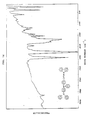
- Fig. 1 is an X-ray diffraction diagram (CuK ⁇ , powder method) of the X-type nonmetal phthalocyanine used as a charge transporting substance used in the invention.
- the binder resin for the charge producing layer is not specifically limited, and it may be either a thermoplastic or thermosetting resin.
- the binder resin may be exemplified by, for example, polystyrene, styrene-acrylonitrile copolymer, styrene-butadiene copolymer, styrene-maleic anhydride copolymer, polyester resin, polyvinyl chloride, ethylene-vinyl chloride copolymer, vinyl chloride-vinyl acetate copolymer, ethylene-vinyl acetate-vinyl chloride copolymer, polyvinyl acetate, polyvinylidene chloride, polyallylate resin, phenoxy resin, polycarbonate, cellulose acetate resin, ethyl cellulose resin, polyvinyl butyral resin, polyvinyl formal resin, polyvinyl toluene, poly(N-vinyl carbazole) resin, acrylic resin, silicone resin,
- the charge producing layer has a thickness usually of about 0.05-1 microns.
- the organic solvent used in the preparation of the charge producing layer is such that it dissolves the binder resin.
- the organic solvent used includes, for example, benzene, toluene, xylene, methylene chloride, chloroform, 1,2-dichloroethane, 1,1,2,2-tetrachloroethane, chlorobenzene, dichlorobenzene, ethyl acetate, butyl acetate, methyl ethyl ketone, dioxane, tetrahydrofuran, cyclohexanone, methyl cellosolve or ethyl cellosolve.
- the laminated organic photosensitive material of the invention has a charge transporting layer on the charge producing layer.
- the charge transporting layer contains the novel arylaldehydehydrazone derivative as hereinbefore mentioned.
- the aryl group may have substituents.
- the alkyl group may, for example, a methyl, ethyl, propyl, butyl, pentyl, hexyl, octyl, nonyl or dodecyl group. It may be in the form of a straight or branched chain.
- the aryl group may, for example, be an unsubstituted or a substituted phenyl, naphthyl, anthryl, pyrenyl, acenaphthenyl or fluorenyl group.
- the substituent may, for example, be an alkyl group such as methyl, ethyl, propyl, butyl, pentyl, hexyl, octyl, nonyl or dodecyl, an alkoxy group such as methoxy, ethoxy, propoxy or butoxy, a halogen such as chlorine, bromine or fluorine, an aryloxy group such as phenoxy or tolyloxy, or a dialkylamino group such as dimethylamino, diethylamino or dipropylamino.
- an alkyl group such as methyl, ethyl, propyl, butyl, pentyl, hexyl, octyl, nonyl or dodecyl
- an alkoxy group such as methoxy, ethoxy, propoxy or butoxy
- a halogen such as chlorine, bromine or fluorine
- an aryloxy group such as phenoxy or
- R1, R2, R3 and R4 are each methyl, ethyl, propyl, butyl, phenyl, tolyl or chlorophenyl.
- arylaldehydehydrazone derivatives can be produced by reacting the corresponding arylaldehyde with hydrazine appropriately in accordance with any conventional method which is employed for the production of aldehydehydrazones.
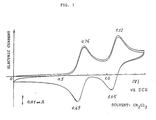
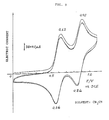
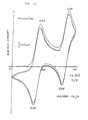
- arylaldehydehydrazone derivatives are highly compatible with a binder resin and they also has an appropriately low oxidation potential, but also they show complete reversibility in an oxidation-reduction reaction and is hence very stable.
- the binder resin for the charge transporting layer is of the type which is soluble in an organic solvent and is highly compatible with the charge transporting substance so that a stable solution thereof may be prepared easily. Moreover, it is preferable to use a resin which is inexpensive and can form a film of high mechanical strength, transparency and electrical insulation.
- binder resin may be exemplified by, for example, polystyrene, styrene-acrylonitrile copolymer, styrene-butadiene copolymer, styrene-maleic anhydride copolymer, polyester resin, polyvinyl chloride, ethylene-vinyl chloride copolymer, vinyl chloride-vinyl acetate copolymer, ethylene-vinyl acetate-vinyl chloride copolymer, polyvinyl acetate, polyvinylidene chloride, polyallylate resin, phenoxy resin, polycarbonate, cellulose acetate resin, ethyl cellulose resin, polyvinyl butyral resin, polyvinyl formal resin, polyvinyl toluene, poly(N-vinyl carbazole) resin, acrylic resin, silicone resin, epoxy resin, melamine resin, urethane resin, phenol resin or alkyd resin.
- polyester resin polyvinyl
- the organic solvent used for the preparation of the charge transporting layer may include, for example, tetrahydrofuran, dioxane, toluene, chlorobenzene, methylene chloride, chloroform, 1,2-dichloroethane or 1,1,2,2-tetrachloroethane.
- the content of the charge transporting substance in the charge transporting layer is usually in the range of about 10-60 % by weight based on the layer, and the thickness of the layer is usually in the range of about 5-10 microns.
- the laminated organic photosensitive material is manufactured by applying a mixture of X-type nonmetal phthalocyanine as a charge producing substance, a binder resin, an organic solvent and, if necessary, a plasticizer onto an electroconductive support, drying the coated layer to form a charge producing layer, and then applying a solution of the charge transporting substance, a binder resin and, if necessary a plasticizer, in an organic solvent, and then drying the coated layer to form a charge transporting layer.
- the laminated organic photosensitive material of the invention may have a charge transporting layer on an electrocondinctive support, and a charge producing layer on the charge transporting layer.
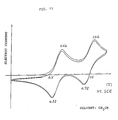
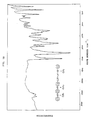
- the infrared absoprption spectrum of the compound is shown in Fig. 2, and the cyclic voltamogram in Fig. 2. It showed complete reversibility in an oxidation-reduction reaction.
- a compatibilized composition was prepared by dissolving the compound in polycarbonate in equal proportions by weight and its charge transfer rate is shown in Table 1.
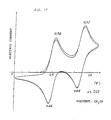
- the infrared absoprption spectrum of the compound is shown in Fig. 8 and the cyclic voltamogram in Fig. 9. It showed complete reversibility in an oxidation-reduction reaction.
- a compatibilized composition was prepared by dissolving the compound in polycarbonate in equal proportions by weight and its charge transfer rate is shown in Table 1.
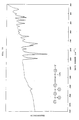
- the infrared absoprption spectrum of the compound is shown in Fig. 10, and the cyclic voltamogram in Fig. 11. It showed complete reversibility in an oxidation-reduction reaction.
- a compatibilized composition was prepared by dissolving the compound in polycarbonate in equal proportions by weight and its charge transfer rate is shown in Table 1.
- the infrared absoprption spectrum of the compound is shown in Fig. 12, and the cyclic voltamogram in Fig. 13. It showed complete reversibility in an oxidation-reduction reaction.
- a compatibilized composition was prepared by dissolving the compound in polycarbonate in equal proprtions by weight and its charge transfer rate is shown in Table 1.
- a compatibilized composition was prepared by dissolving the compound in polycarbonate in equal proprtions by weight and its charge transfer rateis shown in Table 1.
- X-type nonmetal phthalocyanine 8120B from Dainippon Ink Kagaku Kogyo K.K.
- the dispersion was applied by a doctor blade onto an aluminum film deposited on a polyethylene terephthalate film, allowed to dry at room temperature and then dried by heating at 100°C for 60 minutes, to form a charge producing layer having a thickness of 0.6 microns.
- Laminated photosensitive materials were prepared in the same manner as in the Example 1 using hydrazone compounds shown in Table 2 as a charge transporting substance.
- a laminated photosensitive material was prepared in the same manner as in the Example 1 using a hydrazone compound (a) as a charge transporting substance as represented by the formula:
- a laminated photosensitive material was prepared in the same manner as in the Example 1 using a hydrazone compound (b) as a charge transporting substance as represented by the formula:
- a laminated photosensitive material was prepared in the same manner as in the Example 1 using a hydrazone compound (c) as a charge transporting substance as representedby the formula:
- a laminated photosensitive material was prepared in the same manner as in the Example 1 using a hydrazone compound (d) as a charge transporting substance as represented by the formula:
- a mixture of 0.17 parts by weight of polycarbonate (Yupiron E-2000 from Mitsubishi Gas Kagaku Kogyo K.K.), 0.33 parts by weight of titanyl phthalocyanine as a charge producing substance and 99.5 parts by weight of chloroform was milled in a ball mill for 20 hours to prepare a dispersion.
- the dispersion was applied by a doctor blade having a clearance of 50 microns onto an aluminum film deposited on a polyethylene terephthalate film, allowed to dry at room temperature and then dried by heating at 80°C for 60 minutes, to form a charge producing layer having a thickness of 0.3 microns.
- a charge transporting layer was then formed on the charge producing layer in the same manner as in the Example 1, whereby a laminated photosensitive material was obtained.
- a laminated photosensitive material was prepared using p-[(p-(phenyl-p-tolylamino)phenyl)-p-tolyl]aminobenzaldehydemethylphenylhydrazone [Compound (2)] as a charge transporting substance in the same manner as in the Comparative Example 5.
- a laminated photosensitive material was prepared using p-[(p-(phenyl-p-chlorophenyl)phenyl)-p-chlorophenyl]aminobenzaldehydediphenylhydrazone [Compound (3)] as a charge transporting substance in the same manner as in the Comparative Example 5.
- a laminated photosensitive material was prepared using p-[(p-(phenyl-p-chlorophenyl)phenyl)-p-chlorophenyl]aminobenzaldehydemethylphenylhydrazone [Compound (4)] as a charge transporting substance in the same manner as in the Comparative Example 5.
- a laminated photosensitive material was prepared using p-[(p-diphenylaminophenyl)phenyl]aminobenzaldehydemethyl-p-chlorophenylhydrazone [Compound (5)] as a charge transporting substance in the same manner as in the Comparative Example 5.
- a laminated photosensitive material was prepared using p-[(p-methylphenylamino)phenyl)methyl]aminobenzaldehydediphenylhydrazone [Compound (6)] as a charge transporting substance in the same manner as in the Comparative Example 5.
- the laminated photosensitive materials prepared as above set forth were each evaluated for electrostatic charging characteristics by use of an electrostatic charging testing device (Model EPA 8100 from Kawaguchi Denki Seisakusho).
- the surface of photosensitive material was negatively charged with a charge corona of -6 KV, and the surface potential was measured as an initial potential. Then, after the photosensitive material was left standing in the dark over a period of five seconds, the surface was irradiated with monochromatic light having a wavelength of 750 nm and a luminous intensity of 0.5 ⁇ W/cm2. The length of time was measured until the point at which the surface potential dropped to a half of its initial value, and the half-time exposure E 1/2 ( ⁇ J/cm2) of the photosensitive material to that point of time was determined as its photosensitivity.
Landscapes
- Physics & Mathematics (AREA)
- General Physics & Mathematics (AREA)
- Photoreceptors In Electrophotography (AREA)
- Organic Low-Molecular-Weight Compounds And Preparation Thereof (AREA)
Applications Claiming Priority (2)
| Application Number | Priority Date | Filing Date | Title |
|---|---|---|---|
| JP187650/89 | 1989-07-19 | ||
| JP1187650A JPH0351855A (ja) | 1989-07-19 | 1989-07-19 | 積層型有機感光体 |
Publications (1)
| Publication Number | Publication Date |
|---|---|
| EP0410285A1 true EP0410285A1 (fr) | 1991-01-30 |
Family
ID=16209817
Family Applications (1)
| Application Number | Title | Priority Date | Filing Date |
|---|---|---|---|
| EP90113743A Withdrawn EP0410285A1 (fr) | 1989-07-19 | 1990-07-18 | Matériau photosensible organique, laminé |
Country Status (4)
| Country | Link |
|---|---|
| US (1) | US5223362A (fr) |
| EP (1) | EP0410285A1 (fr) |
| JP (1) | JPH0351855A (fr) |
| CA (1) | CA2021350A1 (fr) |
Cited By (1)
| Publication number | Priority date | Publication date | Assignee | Title |
|---|---|---|---|---|
| EP0511664A1 (fr) * | 1991-04-30 | 1992-11-04 | Mitsubishi Chemical Corporation | Photorécepteur électrophotographique |
Families Citing this family (1)
| Publication number | Priority date | Publication date | Assignee | Title |
|---|---|---|---|---|
| US8825502B2 (en) * | 2003-09-30 | 2014-09-02 | Epic Systems Corporation | System and method for providing patient record synchronization in a healthcare setting |
Citations (3)
| Publication number | Priority date | Publication date | Assignee | Title |
|---|---|---|---|---|
| EP0084147A2 (fr) * | 1982-01-16 | 1983-07-27 | BASF Aktiengesellschaft | Phénylhydrazones et leur utilisation |
| US4814245A (en) * | 1986-08-18 | 1989-03-21 | Fuji Photo Film Co., Ltd. | Electrophotographic photoreceptor containing a phthalocyanine pigment and a bishydrazone compound |
| EP0319992A2 (fr) * | 1987-12-10 | 1989-06-14 | Bando Chemical Industries, Limited | Matériau photosensible électrophotographique |
Family Cites Families (3)
| Publication number | Priority date | Publication date | Assignee | Title |
|---|---|---|---|---|
| DE3813459A1 (de) * | 1987-04-24 | 1988-11-10 | Minolta Camera Kk | Funktionsmaessig geteiltes photoempfindliches element |
| US4886719A (en) * | 1987-05-07 | 1989-12-12 | Matsushita Electric Industrial Co., Ltd. | Electrophotography photosensitive member and a method for fabricating same |
| CA1296216C (fr) * | 1987-12-10 | 1992-02-25 | Tomokazu Kobata | Materiau electrophotographique photosensible |
-
1989
- 1989-07-19 JP JP1187650A patent/JPH0351855A/ja active Pending
-
1990
- 1990-07-17 CA CA002021350A patent/CA2021350A1/fr not_active Abandoned
- 1990-07-18 EP EP90113743A patent/EP0410285A1/fr not_active Withdrawn
- 1990-07-19 US US07/553,814 patent/US5223362A/en not_active Expired - Fee Related
Patent Citations (3)
| Publication number | Priority date | Publication date | Assignee | Title |
|---|---|---|---|---|
| EP0084147A2 (fr) * | 1982-01-16 | 1983-07-27 | BASF Aktiengesellschaft | Phénylhydrazones et leur utilisation |
| US4814245A (en) * | 1986-08-18 | 1989-03-21 | Fuji Photo Film Co., Ltd. | Electrophotographic photoreceptor containing a phthalocyanine pigment and a bishydrazone compound |
| EP0319992A2 (fr) * | 1987-12-10 | 1989-06-14 | Bando Chemical Industries, Limited | Matériau photosensible électrophotographique |
Non-Patent Citations (1)
| Title |
|---|
| PATENT ABSTRACTS OF JAPAN vol. 12, no. 497 (P-806)(3344) 26 December 1988, & JP-A-63 206758 (MITSUI TOATSU CHEMICALS INC.) 26 August 1988, * |
Cited By (2)
| Publication number | Priority date | Publication date | Assignee | Title |
|---|---|---|---|---|
| EP0511664A1 (fr) * | 1991-04-30 | 1992-11-04 | Mitsubishi Chemical Corporation | Photorécepteur électrophotographique |
| US5284728A (en) * | 1991-04-30 | 1994-02-08 | Mitsubishi Kasei Corporation | Electrophotographic photoreceptor containing hydrazone compounds |
Also Published As
| Publication number | Publication date |
|---|---|
| JPH0351855A (ja) | 1991-03-06 |
| CA2021350A1 (fr) | 1991-01-20 |
| US5223362A (en) | 1993-06-29 |
Similar Documents
| Publication | Publication Date | Title |
|---|---|---|
| JPS61295558A (ja) | アルコキシアミン電荷移送分子を含有する光導電性像形成部材 | |
| JPH01206349A (ja) | 電子写真感光体用電荷輸送剤及び電子写真感光体 | |
| US4365017A (en) | Telluropyrylium electron accepting dye sensitizers for electron donating photoconductive compositions | |
| EP0511664B1 (fr) | Photorécepteur électrophotographique | |
| JPH04290851A (ja) | 新規スチリル化合物、このスチリル化合物を用いた感光体およびエレクトロルミネセンス素子 | |
| DE2829751C2 (fr) | ||
| JPS61225151A (ja) | アントラキノジメタン誘導体およびアントロン誘導体の製造方法 | |
| US5223362A (en) | Laminated organic photosensitive material | |
| JPH04356052A (ja) | 電子写真用感光体 | |
| US4634553A (en) | Novel 4H-tellurin tellurane electron-accepting sensitizers for electron-donating photoconductive compositions | |
| US3647431A (en) | Substituted bis(p-diakylaminophenyl) methane photoconductors | |
| US4889785A (en) | Electrophotographic light-sensitive material | |
| EP0319992B1 (fr) | Matériau photosensible électrophotographique | |
| US4869983A (en) | Sulfonyl-containing styrene derivatives and their use in electrophotographic processes | |
| JP3780544B2 (ja) | 新規フタロシアニン化合物及びそれを用いた電子写真感光体 | |
| JPH0272372A (ja) | 電子写真感光体 | |
| JPH05100456A (ja) | 電子写真用感光体 | |
| US4820846A (en) | Triarylmethane compounds, their preparation and use as photoconductive systems | |
| EP0514871A1 (fr) | Photorécepteur électrophotographique | |
| JPH0594030A (ja) | 電子写真用感光体 | |
| KR940010124B1 (ko) | 전자사진 광수용체 | |
| JP2005121887A (ja) | フルオレノン誘導体、および該化合物を用いた電子写真感光体、電子写真装置 | |
| US3755310A (en) | Substituted bis(p-dialkylaminophenyl)methane photoconductors | |
| JP2006089655A (ja) | 特定のクラウンエーテル誘導体を構成単位に含む高分子化合物、電荷輸送材料、及び電子写真感光体 | |
| JP2847195B2 (ja) | ビスアゾ化合物およびその製造方法 |
Legal Events
| Date | Code | Title | Description |
|---|---|---|---|
| PUAI | Public reference made under article 153(3) epc to a published international application that has entered the european phase |
Free format text: ORIGINAL CODE: 0009012 |
|
| AK | Designated contracting states |
Kind code of ref document: A1 Designated state(s): BE CH DE FR GB IT LI NL |
|
| 17P | Request for examination filed |
Effective date: 19910614 |
|
| 17Q | First examination report despatched |
Effective date: 19940124 |
|
| STAA | Information on the status of an ep patent application or granted ep patent |
Free format text: STATUS: THE APPLICATION IS DEEMED TO BE WITHDRAWN |
|
| 18D | Application deemed to be withdrawn |
Effective date: 19940804 |