EP0422725A2 - Article optique à susceptibilité de second ordre élevée - Google Patents
Article optique à susceptibilité de second ordre élevée Download PDFInfo
- Publication number
- EP0422725A2 EP0422725A2 EP19900202633 EP90202633A EP0422725A2 EP 0422725 A2 EP0422725 A2 EP 0422725A2 EP 19900202633 EP19900202633 EP 19900202633 EP 90202633 A EP90202633 A EP 90202633A EP 0422725 A2 EP0422725 A2 EP 0422725A2
- Authority
- EP
- European Patent Office
- Prior art keywords
- novm
- layer
- optical article
- further characterized
- article according
- Prior art date
- Legal status (The legal status is an assumption and is not a legal conclusion. Google has not performed a legal analysis and makes no representation as to the accuracy of the status listed.)
- Withdrawn
Links
Images

Classifications
-
- G—PHYSICS
- G02—OPTICS
- G02F—OPTICAL DEVICES OR ARRANGEMENTS FOR THE CONTROL OF LIGHT BY MODIFICATION OF THE OPTICAL PROPERTIES OF THE MEDIA OF THE ELEMENTS INVOLVED THEREIN; NON-LINEAR OPTICS; FREQUENCY-CHANGING OF LIGHT; OPTICAL LOGIC ELEMENTS; OPTICAL ANALOGUE/DIGITAL CONVERTERS
- G02F1/00—Devices or arrangements for the control of the intensity, colour, phase, polarisation or direction of light arriving from an independent light source, e.g. switching, gating or modulating; Non-linear optics
- G02F1/01—Devices or arrangements for the control of the intensity, colour, phase, polarisation or direction of light arriving from an independent light source, e.g. switching, gating or modulating; Non-linear optics for the control of the intensity, phase, polarisation or colour
- G02F1/011—Devices or arrangements for the control of the intensity, colour, phase, polarisation or direction of light arriving from an independent light source, e.g. switching, gating or modulating; Non-linear optics for the control of the intensity, phase, polarisation or colour in optical waveguides, not otherwise provided for in this subclass
- G02F1/0115—Devices or arrangements for the control of the intensity, colour, phase, polarisation or direction of light arriving from an independent light source, e.g. switching, gating or modulating; Non-linear optics for the control of the intensity, phase, polarisation or colour in optical waveguides, not otherwise provided for in this subclass in optical fibres
- G02F1/0118—Devices or arrangements for the control of the intensity, colour, phase, polarisation or direction of light arriving from an independent light source, e.g. switching, gating or modulating; Non-linear optics for the control of the intensity, phase, polarisation or colour in optical waveguides, not otherwise provided for in this subclass in optical fibres by controlling the evanescent coupling of light from a fibre into an active, e.g. electro-optic, overlay
-
- G—PHYSICS
- G02—OPTICS
- G02F—OPTICAL DEVICES OR ARRANGEMENTS FOR THE CONTROL OF LIGHT BY MODIFICATION OF THE OPTICAL PROPERTIES OF THE MEDIA OF THE ELEMENTS INVOLVED THEREIN; NON-LINEAR OPTICS; FREQUENCY-CHANGING OF LIGHT; OPTICAL LOGIC ELEMENTS; OPTICAL ANALOGUE/DIGITAL CONVERTERS
- G02F1/00—Devices or arrangements for the control of the intensity, colour, phase, polarisation or direction of light arriving from an independent light source, e.g. switching, gating or modulating; Non-linear optics
- G02F1/01—Devices or arrangements for the control of the intensity, colour, phase, polarisation or direction of light arriving from an independent light source, e.g. switching, gating or modulating; Non-linear optics for the control of the intensity, phase, polarisation or colour
- G02F1/011—Devices or arrangements for the control of the intensity, colour, phase, polarisation or direction of light arriving from an independent light source, e.g. switching, gating or modulating; Non-linear optics for the control of the intensity, phase, polarisation or colour in optical waveguides, not otherwise provided for in this subclass
-
- G—PHYSICS
- G02—OPTICS
- G02F—OPTICAL DEVICES OR ARRANGEMENTS FOR THE CONTROL OF LIGHT BY MODIFICATION OF THE OPTICAL PROPERTIES OF THE MEDIA OF THE ELEMENTS INVOLVED THEREIN; NON-LINEAR OPTICS; FREQUENCY-CHANGING OF LIGHT; OPTICAL LOGIC ELEMENTS; OPTICAL ANALOGUE/DIGITAL CONVERTERS
- G02F1/00—Devices or arrangements for the control of the intensity, colour, phase, polarisation or direction of light arriving from an independent light source, e.g. switching, gating or modulating; Non-linear optics
- G02F1/01—Devices or arrangements for the control of the intensity, colour, phase, polarisation or direction of light arriving from an independent light source, e.g. switching, gating or modulating; Non-linear optics for the control of the intensity, phase, polarisation or colour
- G02F1/19—Devices or arrangements for the control of the intensity, colour, phase, polarisation or direction of light arriving from an independent light source, e.g. switching, gating or modulating; Non-linear optics for the control of the intensity, phase, polarisation or colour based on variable-reflection or variable-refraction elements not provided for in groups G02F1/015 - G02F1/169
- G02F1/195—Devices or arrangements for the control of the intensity, colour, phase, polarisation or direction of light arriving from an independent light source, e.g. switching, gating or modulating; Non-linear optics for the control of the intensity, phase, polarisation or colour based on variable-reflection or variable-refraction elements not provided for in groups G02F1/015 - G02F1/169 by using frustrated reflection
-
- Y—GENERAL TAGGING OF NEW TECHNOLOGICAL DEVELOPMENTS; GENERAL TAGGING OF CROSS-SECTIONAL TECHNOLOGIES SPANNING OVER SEVERAL SECTIONS OF THE IPC; TECHNICAL SUBJECTS COVERED BY FORMER USPC CROSS-REFERENCE ART COLLECTIONS [XRACs] AND DIGESTS
- Y10—TECHNICAL SUBJECTS COVERED BY FORMER USPC
- Y10T—TECHNICAL SUBJECTS COVERED BY FORMER US CLASSIFICATION
- Y10T428/00—Stock material or miscellaneous articles
- Y10T428/31504—Composite [nonstructural laminate]
Definitions
- the invention relates to optical articles for the nonlinear propagation of electromagnetic radiation.
- Nonlinear optics is concerned with the interactions of electromagnetic fields in various media to produce new fields altered in phase, frequency, amplitude, or other propagation characteristics from the incident fields.
- P the total induced polarization
- E the local electric field created by electromagnetic radiation
- ⁇ , ⁇ , and ⁇ are the first, second, and third order polarizabilities, each of which is a function of molecular properties.
- the molecular level terms of Equation 1 are first order or linear polarization ⁇ E, second order or first nonlinear polarization ⁇ E2, and third order or second nonlinear polarization ⁇ E3.
- P the total induced polarization
- E the local electric field created by electromagnetic radiation
- ⁇ (1) , ⁇ (2) , and ⁇ (3) are the first, second, and third order polarization susceptibilities of the electromagnetic wave transmission medium.
- the macromolecular level terms of Equation 2 are first order ⁇ (1) E, second order polarization ⁇ (2) E2, and third order polarization ⁇ 3E3.
- ⁇ (2) For ⁇ (2) to exhibit a usefully large value it is not only necessary that ⁇ be large, but, in addition, the molecular dipoles must be aligned so as to lack inversion symmetry.
- the largest values of ⁇ (2) are realized when the molecular dipoles are arranged in polar alignment-e.g., the alignment obtained when molecular dipoles are placed in an electric field.
- the materials employed for achieving second order polarization effects were non-centrosymmetric inorganic crystals, such as potassium dihydrogen phosphate and lithium niobate. Williams postulates mathematically and experimentally corroborates second order polarization susceptibilities in organic molecular dipoles equalling and exceeding those of conventional inorganic dipoles.
- a technique that has been found useful in obtaining high ⁇ (2) organic molecular dipole layers for the nonlinear propagation of electromagnetic radiation is to incorporate the organic dipoles in a polymeric medium having a glass transition well above ambient temperatures.
- the organic molecular dipoles can form a part of the polymer molecule or simply blended with the polymer. While the polymeric medium is heated above its glass transition temperature, an electric field gradient is placed across the medium. The organic molecular dipoles align themselves with the electric field gradient. With the electric field applied the polymeric medium is cooled to below its glass transition temperature, thereby locking the organic dipoles in a polar aligned, non-centrosymmetric arrangement essential to achieving high ⁇ (2) values.
- ATR's Attenuated total reflection devices
- the present invention stems from attempting to employ for (c) a poled polymeric layer exhibiting a glass transition temperature of at least 50°C and a second order polarization susceptibility greater than 10 ⁇ 9 esu.
- a poled polymeric layer exhibiting a glass transition temperature of at least 50°C and a second order polarization susceptibility greater than 10 ⁇ 9 esu.
- spin cast or otherwise coat the polymeric layer containing the organic molecular dipoles on a metal surface While many metals are available which are stable when brought into contact with the polymeric layer at ambient temperatures, a problem has arisen of unwanted interactions between the poled polymer layer and the metal surface before and during poling. Solvents used in spin coating can interact deleteriously with the metal surfaces. Heating to temperatures well above above ambient, essential to achieving stable poled layers, makes the metal surfaces particularly susceptible to chemical attack.
- the present invention is directed to an ATR construction that allows a high ⁇ (2) poled polymeric layer to be employed that requires elevated poling temperatures while protecting the reflective metal layer from degradation.
- this invention is directed to an optical article capable of modulating the reflection of electromagnetic radiation
- a reflective metal layer having a thickness in the range of from 100 to 1000 ⁇ comprised of at least one metal having a work function in the range of from 2.5 to 4.5 eV, means for directing polarized electromagnetic radiation to and acting as a support for said reflective metal layer, a dielectric medium capable of exhibiting a change in its refractive index as a function of an applied electrical potential gradient overlying said reflective metal layer, and means for variably applying an electrical potential to a surface of said dielectric medium remote from said reflective metal layer.
- the invention is characterized in that the dielectric medium is comprised of a poled polymeric layer exhibiting a glass transition temperature of at least 50°C and a second order polarization susceptibility greater than 10 ⁇ 9 electrostatic units and a protective layer having a thickness of less than 0.1 ⁇ m consisting essentially of at least one of a metal oxide and a metal fluoride is interposed between the reflective metal layer and the poled polymeric layer.
- a layer having a thickness of less than 0.1 ⁇ m can afford protection of the reflective metal layer, since layers in the 100 Angstrom thickness ranges are known to provide less than pin-hole free coverages. It is even more surprising that a layer can be interposed between the interface of the poled polymeric layer and the reflective metal layer while retaining the capability of modulating reflection. It is generally accepted that the propagation of an evanescent portion of the electromagnetic radiation received for reflection along the interface of the variable refractive index dielectric medium and the reflective metal layer is relied upon for attenuation. Separating the variable refractive index dielectric medium and the reflective metal layer would appear on its face to be incompatible with this capability.
- the invention is applicable to the propagation of electromagnetic radiation in the wavelength ranges commonly encountered by nonlinear optical articles-e.g., wavelengths ranging from the near ultraviolet, typically 300 to 400 nm, through the visible of 400 to 700 nm and well into the infrared up to wavelengths of 2.0 ⁇ m or more.
- the optical articles of the invention are particularly useful with solid state lasers providing input wavelengths in the range from about 550 to 1500 nm. Second harmonic wavelengths internally generated are, of course, half the input radiation wavelengths.
- FIG. 1 an attenuated total reflection optical article 100 capable of modulating reflection by controlled attentuation of received electromagnetic radiation is illustrated. Electromagnetic radiation is shown at A to be optically coupled into the article through prism 101 at an angle of incidence ⁇ measured from the axis 111, which is perpendicular to the base of the prism. In one operating condition of the optical article substantially all of the electromagnetic radiation received is reflected, as indicated at B. In varied operating conditions the optical article is capable of attenuating the electromagnetic radiation.
- the optical article 100 can be employed as a switch or modulator for reflected electromagnetic radiation.
- a reflective metal layer 103 On the base of the prism is coated a reflective metal layer 103.
- a protective layer 105 overlies the reflective metal layer, and a poled polymeric layer 107 capable of exhibiting a change in its refractive index as a function of an applied electrical potential gradient overlies the protective layer.
- the device is completed by an electrode 109 or similar suitable means for applying an electrical potential gradient across the poled polymeric layer.
- the metal layer is sufficiently thick to be reflective, at least 100 ⁇ (preferably at least 150 ⁇ ), yet is sufficiently thin to be penetrable by the electromagnetic radiation, no thicker than about 1000 ⁇ (preferably no thicker than about 700 ⁇ ).
- the reflective metal layer can be formed of one or a combination of moderate work function metals-that is, any metal having a work function in the range of from about 2.5 to 4.5 electron volts (eV), preferably in the range of from 3.5 to 4.5 eV. These metals are sufficiently stable for use under commonly encountered ambient conditions, but are susceptible to oxidation under the more stringent conditions encountered during poling. At the lower end of the work function range (2.5 to 3.5 eV) are metals such as the rare earth elements and alkaline earth elements, such as calcium and barium. Metals in the preferred upper portion of the work function range (3.5 to 4.5 eV) include a wide variety of non-noble metals commonly employed for electrode fabrication in electronic and optical devices.
- moderate work function metals that is, any metal having a work function in the range of from about 2.5 to 4.5 electron volts (eV), preferably in the range of from 3.5 to 4.5 eV.
- eV electron volts
- These metals are sufficiently stable for use under
- Typical useful metals in the upper portion of the work function range include magnesium, indium, titanium, aluminum, nickel, copper, zinc, silver, tin, antimony, and bismuth. Alloys of the various metals are, of course, contemplated.
- a metal fluoride or oxide coated over the moderate work function reflective metal layer can protect this layer from degradation at the elevated temperatures of poling, yet does not interfere with propagation of electromagnetic radiation.
- adequate protection of the poling electrode is achieved even when the metal fluoride or oxide is deposited in such limited amounts that an entirely continuous, pin hole free coating is not realized.
- Measurable levels of protection have been observed at layer thicknesses as low as 10 ⁇ . Layer thicknesses of at least 50 ⁇ are preferred.
- the maximum protective layer thickness contemplated is less than 0.1 ⁇ m (i.e., less than 1000 ⁇ ), preferably less than 700 ⁇ . It is essential to limit the thickness of the protective layer to permit the necessary optical coupling of the reflective metal layer and the overlying poled polymeric layer required for attenuation of electromagnetic radiation. Specifically, in the absence of the protective layer, attenuation is achieved by propagating an evanescent portion of the electromagnetic radiation incident upon the reflective metal layer along the interface between the poled polmeric layer and the reflective metal layer. By limiting the thickness of the protective layer to less than 0.1 ⁇ m sufficient optical coupling between the reflective metal layer and the polymeric layer remains to retain this interface propagation capability.
- the protective layer can be formed from a broad selection of metal fluorides and oxides.
- Alkaline earth oxides (particularly magnesia), rare earth oxides, alumina, and silica constitute preferred metal oxides for use in the practice of this invention.
- any stable metal oxide that can be readily deposited in an amorphous form can be employed.
- Alkali metal fluorides (e.g., lithium fluoride) and alkaline earth metal fluorides (e.g., calcium or magnesium fluoride) constitute preferred metal fluorides.
- Rare earth fluorides are also contemplated.
- Mixed metal oxides, mixed metal fluorides, and mixtures of metal fluorides and oxides are all contemplated. Mixtures offer the advantage of increasing steric disorder, thereby suppressing crystallization and preserving the desired amorphous nature of the coating.
- any conventional technique for depositing the metal fluoride or oxide layer compatible with the metal surface onto which deposition is intended can be undertaken.
- Vacuum vapor deposition, sputtering, chemical vapor deposition, molecular beam epitaxy, liquid phase epitaxy, electrolytic oxidative coating, and similar conventional coating processes can be employed. While these deposition techniques lend themselves to forming protective layers of less than 0.1 ⁇ m in thickness, they do not lend themselves to forming thicker layers.
- metal fluoride coatings by the thermal decomposition of a metal carboxylate (e.g., a metal acetate or 2-ethylhexanoate) in the presence of fluorinating agent (e.g., heptafluorobutyric acid).
- a metal carboxylate e.g., a metal acetate or 2-ethylhexanoate
- fluorinating agent e.g., heptafluorobutyric acid
- the polymeric layer 107 overlies the protective layer.
- the polymeric layer contains organic molecular dipoles.
- the organic molecular dipoles can themselves form a portion of a polymer as pendant or backbone repeating units. Alternatively, the organic molecular dipoles can be mixed with a separate polymer to form the polymeric layer.
- the organic molecular dipoles are more or less randomly aligned as originally deposited. In other words, the polymeric layer lacks the degree of non-centrosymmetric alignment of organic molecular dipoles essential to achieve high ⁇ (2) values.
- the article 100 as shown is provided with electrode 109, which can be employed for poling.
- electrode 109 By applying an electrical potential gradient between the electrode and the reflective metal layer with the polymeric layer heated to a temperature above its glass transition temperature (T g ) the organic molecular dipoles have freedom of mobility to align themselves in the applied electrical field.
- T g glass transition temperature
- the organic molecular dipoles By cooling the polymeric layer below its glass transition temperature while maintaining the applied electrical field, the organic molecular dipoles are immobilized in their non-centrosymmetrically arranged field aligned position, thereby imparting to the polymeric layer the desired high ⁇ (2) (second order polarization susceptibility of greater than 10 ⁇ 9 esu).
- the polymeric layer To avoid having the field imparted poling lost as soon as the applied potential gradient is relaxed, it is necessary to select the polymeric layer to have a T g well above ambient temperatures. Generally, the polymeric layer should have a T g of at least 50°C, with a T g of 80°C or more being preferred.
- the device By corona charging the bare surface of the polymeric layer. This entails establishing an electrical potential between the reflective metal layer 103 and a corona charging electrode (not shown) located above and spaced from the surface of the polymeric layer. The corona induces a charge on the surface of the polymeric layer that acts a counter electrode for the reflective metal layer. Apart from the difference in the counter electrode construction, the poling procedure is otherwise similar to that described above.
- the protective layer 105 constitutes a resistance in series with the polymeric layer. Since the resistivity of metal fluorides and oxides is much higher than that of the polymeric media, limiting the thickness of the protective layer to less than 0.1 ⁇ m serves an important function in reducing the series resistance of this layer. This allows a greater proportion of the field gradient applied during poling to occur within the polymeric layer, where it is available for orienting the organic dipoles.
- the protective layer is interposed between the layers 103 and 107, by limiting its thickness to less than 0.1 ⁇ m it does not interfere with optical coupling of the moderate work function metal and the poled polymeric layer.
- the electrical potential of the reflective metal layer relative to that of the electrode 109 is varied. Any change in the potential difference between the metal layer and the electrode 109 changes the refractive index of the poled polymeric layer. This in turn changes the ability of the device to propagate a portion of the incident electromagnetic radiation along the internal propagation interface.
- the angle of incidence of electromagnetic radiation can be chosen to favor maximum attenuation along the internal propagation interface with no electrical potential difference applied between the metal layer and the electrode. By applying a potential difference, the amplitude of the reflected electromagnetic radiation is increased.
- the angle of incidence of the electromagnetic radiation can be chosen so that at a selected potential difference between the reflective metal layer and the electrode maximum propagation along the internal propagation interface occurs, with reflection being increased upon either decreasing (including eliminating) or increasing the potential difference between the metal layer and the electrode.
- the optical article is relying on surface plasmon generation for modulation. It is also possible to operate the device as a guided mode device. By reducing the angle ⁇ attenuation can be shifted into the polymeric layer. A choice of angles are available for achieving guided mode operation. Generally best results are achieved at the first (zero order) guided mode angle ⁇ encountered below the value of ⁇ that produces a surface plasmon.
- the degree of attenuation of the electromagnetic radiation that can be realized can be increased by modifying optical article 100 by locating a dielectric layer having a thickness in the range of from 0.1 to 10 times the wavelength of the electromagnetic radiation between the metal layer 103 and the prism (or other coupling element).
- This interposed dielectric layer is chosen to have a refractive index that matches that of the poled polymeric layer under at least one condition of use.
- optical article 100 is shown to be formed on the base of a prism, it is appreciated that the optical articles of this invention can be formed on any conventional optical coupling substrate, such as an optical grating or a waveguide (e.g., an optical fiber).
- any conventional optical coupling substrate such as an optical grating or a waveguide (e.g., an optical fiber).
- an optical article 200 is shown differing from optical article 100 solely by the substitution of an alternative optical coupling support arrangement for the prism.
- An optical fiber 201 comprised of a core 203 of a material, such as glass or an organic polymer, which is transparent to electromagnetic radiation at the wavelength being propagated.
- Concentrically surrounding the core is a cladding layer 205 which is similar, but differs in that it exhibits a refractive index which is lower than that of the core.
- the electromagnetic radiation being propagated is directed back into the core upon impinging the cladding layer.
- the optical fiber in its curved configuration shown is cast in a mounting block 207.
- an optically smooth surface 209 is formed. Lapping removes a portion of cladding layer from the optical fiber, so that its core lies adjacent the optical surface.
- Layer 103 is then deposited on the optical surface, and the remaining layers of the device are formed as previously described.
- Operation of the device 200 can be generally similar to that described above for device 100. Since the optical fiber is locked in position, the optimum angle for directing electromagnetic radition to the reflective metal layer must be determined prior to locating the optical fiber in the casting block. In addition to modulating and switching electromagnetic radiation as described above, it is possible to use the device 200 to remove p- components from the polarized electromagnetic radiation being transmitted in the optical fiber.
- any conventional high ⁇ (2) poled polymeric layer can be utilized which provides an immobilizing matrix for the organic molecular dipoles at ambient or near ambient temperatures, but requires heating to at least 50°C (preferably 80°C) to effect poling, as noted above.
- the poled polymeric media of Ulman et al and Robello et al, cited above, are specifically contemplated as well as Robello European Patent Application 0,313,477, published Apr. 26, 1986, and Scozzafava et al U.S. Patent 4,886,339.
- Specifically preferred organic nonlinear optical layers are those which can be formed by poling linear condensation and vinyl polymers including non-centrosymmetric molecular dipoles as pendant or backbone groups.
- the molecular dipoles include an electron donor moiety, such as an amino, oxy, or thio group, linked through a conjugated ⁇ bonding system to an electron acceptor moiety, such as a sulfonyl, cyano, or nitro group, to permit oscillation of the molecular dipole between a lower polarity ground state and a higher polarity excited state.
- a preferred conjugated ⁇ bonding system is provided by a 4,4′-stilbene or 4,4′-diazobenzene linkage between the electron acceptor or electron donor moiety.
- the molecular dipole can be linked to the polymer backbone through the electron donor or acceptor moiety or incorporated in the polymer backbone by linkages through both the electron acceptor and donor moieties.
- the following are illustrative of typical vinyl addition monomers that can be copolymerized with the vinyl molecular dipole monomers of Table II, if desired.
- the vinyl molecular dipole monomers can form 50 to 100 percent of the repeating units of the polymer, with vinyl addition monomers, such as those of Table III, below, forming the balance of the repeating units of the polymer.
- a glass plate presenting a deposition surface of approximately 20 cm2 was cleaned in successive stages using detergent, deionized water, iso -propyl alcohol, and a high purity toluene vapor reflux. This same cleaning procedure was employed with each of the glass plate and prism substrates of the examples.
- a thickness of 800 ⁇ of silver was vacuum deposited onto the deposition surface at a rate of 10 ⁇ per second. The vacuum chamber during silver deposition was maintained at 1 X 10 ⁇ 6 Torr.
- a copolymer of NOVM-4 and VCOM-13 (T g 127°C, refractive index 1.549) in the amount of 1.5 g was dissolved in 10 mL of 1,2,3-trichloropropane.
- the sample was removed from the nitrogen atmosphere and divided into two samples, a larger sample and a smaller sample, each having a portion of the silver layer coated with magnesium fluoride and a remaining portion left unprotected. The smaller sample was used as a control for comparison.
- the larger sample was placed on the spinning stage of a spin coating machine, and the polymer dispersed in trichloropropane was poured onto its surface through a 0.2 ⁇ m pore filter.
- the larger sample was spun for 10 seconds at 500 r.p.m. and then accelerated to 2000 r.p.m. for an additional 50 seconds.
- the polymer layer produced was about 1.5 ⁇ m thick.
- the spin coated larger sample was then placed in a vacuum oven which was evacuted to a pressure of 1 X 10 ⁇ 3 Torr. and heated to a temperature of 135°C over a period of 18 hours, which included 2 hours to reach the baking temperature from ambient and 2 hours to cool down after baking.
- the temperature of 135°C was selected to correspond to an appropriate poling temperature of the polymer layer in view of its glass transition temperature.
- a protective layer was next formed on the reflective silver layer.
- a 53 ⁇ layer of MgF2 was evaporated at a pressure of less than 1 X 10 ⁇ 5 Torr. at a rate of 2 ⁇ /sec.
- the sample was immediately placed in a vacuum oven and baked to evaporate the solvent. The temperature was increased over a period of 2 hours to 95°C at a reduced pressure of 1 X 10 ⁇ 3 Torr. After 16 hours heating was discontinued and the sample was allowed to cool over a period of 3 hours before it was removed from the oven. The thickness of the polymeric layer was observed to be 1.8 ⁇ m.
- a gold electrode was next formed over the polymeric layer.
- Gold in the amount 400 ⁇ was deposited at 5 ⁇ /sec. to form an electrode on the surface of the device.
- a small area of the second dielectric layer which did not receive gold was removed by swabbing with dichloromethane to expose the underlying silver layer.
- Phosphor bronze contacts were attached to the exposed reflective silver layer and to the gold electrode using a conductive silver paste.
- the polymeric layer was poled at 150 volts and 120°C for 75 minutes before being allowed to cool to room temperature over a period of 2 hours. The applied voltage was then removed.
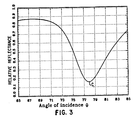
- Figure 3 which is a plot of reflectance the angle of incidence ⁇ over the range of from 65° to 85° shows a reduction of reflectance at C, which corresponds to the surface plasmon mode of operation.
- a sinusoidally oscillating voltage with an amplitude of Vo and a frequency of 1 KHz was applied across the second dielectric layer through the reflective silver layer and the gold electrode, causing a time varying change in the refractive index of the of the high ⁇ (2) polymeric layer.
- a small positive change in the refractive index of the polymeric layer caused the curve shown in Figure 3 to shift in the direction of higher values of ⁇ , changing the reflectance of the device at any selected value of ⁇ .
- the modulation of the reflected laser beam, M defined as the amplitude of the reflectance change divided by the average reflectance, was measured with the following results: Vo M 120 0.09
Landscapes
- Physics & Mathematics (AREA)
- Nonlinear Science (AREA)
- General Physics & Mathematics (AREA)
- Optics & Photonics (AREA)
- Addition Polymer Or Copolymer, Post-Treatments, Or Chemical Modifications (AREA)
- Optical Modulation, Optical Deflection, Nonlinear Optics, Optical Demodulation, Optical Logic Elements (AREA)
- Physical Vapour Deposition (AREA)
- Electrochromic Elements, Electrophoresis, Or Variable Reflection Or Absorption Elements (AREA)
Applications Claiming Priority (2)
| Application Number | Priority Date | Filing Date | Title |
|---|---|---|---|
| US07/419,984 US4948225A (en) | 1989-10-11 | 1989-10-11 | Nonlinear optical article for modulating polarized light |
| US419984 | 1989-10-11 |
Publications (2)
| Publication Number | Publication Date |
|---|---|
| EP0422725A2 true EP0422725A2 (fr) | 1991-04-17 |
| EP0422725A3 EP0422725A3 (en) | 1992-03-25 |
Family
ID=23664583
Family Applications (1)
| Application Number | Title | Priority Date | Filing Date |
|---|---|---|---|
| EP19900202633 Withdrawn EP0422725A3 (en) | 1989-10-11 | 1990-10-04 | High x(2) optical article |
Country Status (4)
| Country | Link |
|---|---|
| US (1) | US4948225A (fr) |
| EP (1) | EP0422725A3 (fr) |
| JP (1) | JPH03202814A (fr) |
| CA (1) | CA2025879C (fr) |
Cited By (1)
| Publication number | Priority date | Publication date | Assignee | Title |
|---|---|---|---|---|
| WO1999049353A1 (fr) * | 1998-03-26 | 1999-09-30 | Verifiber Technologies, Inc. | Structures optiques a ondes de plasmon |
Families Citing this family (29)
| Publication number | Priority date | Publication date | Assignee | Title |
|---|---|---|---|---|
| JP2698394B2 (ja) * | 1988-09-30 | 1998-01-19 | キヤノン株式会社 | 非線形光学素子 |
| GB8916764D0 (en) * | 1989-07-21 | 1989-09-06 | Sambles John R | Surface plasmon optical sensor |
| US5080764A (en) * | 1989-11-27 | 1992-01-14 | The Dow Chemical Company | Novel polymeric nonlinear optical materials from anisotropic dipolar monomers |
| US5086239A (en) * | 1990-02-22 | 1992-02-04 | E. I. Du Pont De Nemours And Company | Nonlinear optical elements containing j-aggregates of aromatic dyes |
| US5026147A (en) * | 1990-03-23 | 1991-06-25 | Regents Of The University Of California | Non-linear optical polymeric article and method |
| US5401587A (en) * | 1990-03-27 | 1995-03-28 | Kabushiki Kaisha Toyota Chuo Kenkyusho | Anisotropic nanophase composite material and method of producing same |
| JP2854669B2 (ja) * | 1990-04-27 | 1999-02-03 | 株式会社 日立製作所 | 光伝送体とそれを用いた光伝送システムおよびエンジンの制御システム |
| GB9012099D0 (en) * | 1990-05-31 | 1990-07-18 | Kodak Ltd | Optical article for multicolour imaging |
| GB9012162D0 (en) * | 1990-05-31 | 1990-07-18 | Kodak Ltd | Optical article for reflection modulation |
| US5052771A (en) * | 1990-12-21 | 1991-10-01 | Eastman Kodak Company | Integrated electro-optical scanner |
| US5093874A (en) * | 1991-04-01 | 1992-03-03 | Eastman Kodak Company | Integrated electro-optical scanner with photoconductive substrate |
| US5155617A (en) * | 1991-06-13 | 1992-10-13 | The Board Of Trustees Of The Leland Stanford Junior University | Electro-optic attenuated total internal reflection modulator and method |
| US5390157A (en) * | 1992-07-15 | 1995-02-14 | Eastman Kodak Company | Waveguide optical pick-up head using mach-zehnder interferometer wavefront sensor apparatus and method |
| US5291567A (en) * | 1992-07-21 | 1994-03-01 | Eastman Kodak Company | Electro-optic waveguide deflector using a nonlinear optic film or liquid-crystal overlay cell for use in an optical pickup head |
| US5276745A (en) * | 1992-10-15 | 1994-01-04 | Eastman Kodak Company | Integrated optic read/write head for optical data storage incorporating second harmonic generator, electro-optic tracking error actuator, and electro-optic modulator |
| US5327512A (en) * | 1993-03-01 | 1994-07-05 | Eastman Kodak Company | Langmuir-Blodgett film in an integrated electro-optical scanner |
| US5276743A (en) * | 1993-03-01 | 1994-01-04 | Eastman Kodak Company | Langmuir-Blodgett films in a waveguide optical pick-up head using Mach-Zehnder interferometers |
| US5955153A (en) * | 1993-10-01 | 1999-09-21 | Johnson & Johnson Clinical Diagnostics, Inc. | Production of carriers for surface plasmon resonance |
| US5729641A (en) * | 1996-05-30 | 1998-03-17 | Sdl, Inc. | Optical device employing edge-coupled waveguide geometry |
| US6017579A (en) * | 1997-04-14 | 2000-01-25 | Symetrix Corporation | Method of forming magnesium oxide films on glass substrate for use in plasma display panels |
| US6282005B1 (en) * | 1998-05-19 | 2001-08-28 | Leo J. Thompson | Optical surface plasmon-wave communications systems |
| CA2314723A1 (fr) | 1999-12-23 | 2001-06-23 | Pierre Simon Joseph Berini | Structures de guides d'ondes optiques |
| US7043134B2 (en) | 1999-12-23 | 2006-05-09 | Spectalis Corp. | Thermo-optic plasmon-polariton devices |
| US6614960B2 (en) | 1999-12-23 | 2003-09-02 | Speotalis Corp. | Optical waveguide structures |
| AU2003233704A1 (en) * | 2002-05-31 | 2003-12-19 | Spectalis Corp. | Electro-optic modulators |
| US20040120649A1 (en) * | 2002-12-20 | 2004-06-24 | Motorola, Inc. | Optical coupling interface for optical waveguide and optical fiber |
| US7652995B2 (en) * | 2003-12-19 | 2010-01-26 | International Business Machines Corporation | Autonomic reassociation of clients in a wireless local area network |
| US7110154B2 (en) * | 2004-06-10 | 2006-09-19 | Clemson University | Plasmon-photon coupled optical devices |
| CA2873573C (fr) | 2013-12-10 | 2022-06-07 | University Of Ottawa | Dispositifs a semi-conducteurs isolants metalliques bases sur des plasmons et polaritons de surface |
Family Cites Families (17)
| Publication number | Priority date | Publication date | Assignee | Title |
|---|---|---|---|---|
| US2441668A (en) * | 1946-07-26 | 1948-05-18 | Frank C Mathers | Process for the purification of magnesium fluoride for use as lens coating |
| US3176575A (en) * | 1960-12-19 | 1965-04-06 | Bell & Howell Co | Low reflectance optical member coatings with barrier layer |
| US3650601A (en) * | 1970-11-19 | 1972-03-21 | Du Pont | Magneto-optic device having alternate layer film structure |
| US3883214A (en) * | 1972-06-14 | 1975-05-13 | Westinghouse Electric Corp | Protective anti-reflective coatings for alkali-metal halide optical components |
| DE2443511A1 (de) * | 1974-09-11 | 1976-03-25 | Siemens Ag | Schmalbandiger reflexionspolarisator |
| US4249796A (en) * | 1979-06-21 | 1981-02-10 | International Business Machines Corporation | Projection display device |
| US4451123A (en) * | 1982-12-20 | 1984-05-29 | Gte Laboratories Incorporated | High frequency light modulation device |
| US4729622A (en) * | 1983-12-05 | 1988-03-08 | Litton Systems, Inc. | Fiber optic polarizer with error signal feedback |
| US4666235A (en) * | 1984-03-16 | 1987-05-19 | Litton Systems, Inc. | Stable fiber optic polarizer |
| GB2170016B (en) * | 1984-12-19 | 1989-04-05 | Plessey Co Plc | Improvements in or relating to modulators |
| US4695123A (en) * | 1985-08-20 | 1987-09-22 | Litton Systems, Inc. | Cutoff polarizer and method |
| US4725113A (en) * | 1985-08-22 | 1988-02-16 | Litton Systems, Inc. | Form birefringent cutoff polarizer and method |
| US4721352A (en) * | 1986-02-26 | 1988-01-26 | The Board Of Trustees Of The Leland Stanford Junior University | Polarizing apparatus and method utilizing an optical fiber |
| US4786128A (en) * | 1986-12-02 | 1988-11-22 | Quantum Diagnostics, Ltd. | Device for modulating and reflecting electromagnetic radiation employing electro-optic layer having a variable index of refraction |
| US4796971A (en) * | 1987-09-28 | 1989-01-10 | Eastman Kodak Company | Optical article containing a polymeric matrix exhibiting a high level of second order polarization susceptibility |
| US4792208A (en) * | 1987-09-28 | 1988-12-20 | Eastman Kodak Company | Optical article exhibiting a high level of second order polarization susceptibility |
| US4895422A (en) * | 1988-12-13 | 1990-01-23 | The United States Of America As Represented By The Secretary Of The Air Force | Phase-matchable, single-mode fiber-optic device |
-
1989
- 1989-10-11 US US07/419,984 patent/US4948225A/en not_active Expired - Fee Related
-
1990
- 1990-09-20 CA CA 2025879 patent/CA2025879C/fr not_active Expired - Fee Related
- 1990-10-04 EP EP19900202633 patent/EP0422725A3/en not_active Withdrawn
- 1990-10-09 JP JP2269741A patent/JPH03202814A/ja active Pending
Non-Patent Citations (4)
| Title |
|---|
| APPLIED OPTICS. vol. 13, no. 2, February 1974, NEW YORK US pages 396 - 405; I.P.KAMINOW: 'METAL-CLAD OPTICAL WAVEGUIDES....' * |
| APPLIED OPTICS. vol. 27, no. 21, November 1988, NEW YORK US pages 4587 - 4590; JAY S .SCHILDKRAUT: 'LONG-RANGE SURFACE PLASMON...' * |
| GEC JOURNAL OF RESEARCH ( INCORPORATING MARCONI. REVIEUW.), vol.6, no.3, 1988,GREAT BADDOW CHEMSFORD GB, pages 170-175 ; S. MANN : " INFRA-RED OPTICAL CHANNEL WAVEGUIDE..." * the whole document * * |
| OPTICAL AND QUANTUM ELECTRONICS. vol. 8, no. 9, 1976, LONDON GB pages 49 - 60; S.C.RASHLEIGH: 'FOUR-LAYER METAL-CLAD THIN FILM OPTICAL WAVEGUIDE' * |
Cited By (1)
| Publication number | Priority date | Publication date | Assignee | Title |
|---|---|---|---|---|
| WO1999049353A1 (fr) * | 1998-03-26 | 1999-09-30 | Verifiber Technologies, Inc. | Structures optiques a ondes de plasmon |
Also Published As
| Publication number | Publication date |
|---|---|
| JPH03202814A (ja) | 1991-09-04 |
| US4948225A (en) | 1990-08-14 |
| EP0422725A3 (en) | 1992-03-25 |
| CA2025879A1 (fr) | 1991-04-12 |
| CA2025879C (fr) | 1993-10-12 |
Similar Documents
| Publication | Publication Date | Title |
|---|---|---|
| US4948225A (en) | Nonlinear optical article for modulating polarized light | |
| EP0422723B1 (fr) | Article optique pour la modulation de la reflexion | |
| US4955977A (en) | Nonlinear optical article with improved buffer layer | |
| US5157541A (en) | Optical article for reflection modulation | |
| US6895162B2 (en) | Multi-layer electro-optic polymer modulators with reduced optical coupling loss | |
| US6373620B1 (en) | Thin film electro-optic beam steering device | |
| US4946235A (en) | Nonlinear optical waveguide device | |
| EP0218938B1 (fr) | Matériaux et dispositifs optiquement non linéaires | |
| EP0576685B1 (fr) | Coupleur directionnel de lumiere du type guide d'onde | |
| US20030128930A1 (en) | Buffer layer structures for stabilization of a lithium niobate device | |
| EP1563339A1 (fr) | Guides d'ondes polymeres electro-optiques et procede de fabrication correspondant | |
| NL9301058A (nl) | Optische enkelvoudige-mode golfgeleider. | |
| US5547763A (en) | Organic nonlinear optical article with improved transmission enhancement layer | |
| GB2205767A (en) | Coated optical waveguides | |
| US5192579A (en) | Method of forming thin film on fiber end surface by breaking it in a vacuum | |
| US6925211B2 (en) | Buffer layer structures for stabilization of a lithium niobate device | |
| EP0522637A2 (fr) | Elément optique plan | |
| Haruna et al. | Epitaxial growth of LiNbO3 optical-waveguide films by excimer laser ablation | |
| JPH0588226A (ja) | 非線形光学素子およびその製造方法 | |
| JP2809112B2 (ja) | 光制御デバイスとその製造方法 | |
| Tang | Domain-Inverted Electrooptic Polymers for High-Speed Polarization-Insensitive 2X2 Cross Bar Switches | |
| JPH11160560A (ja) | 光導波路素子の製造方法 | |
| JPH0922033A (ja) | 非線形光デバイス | |
| JPH02176730A (ja) | 非線形光学素子 |
Legal Events
| Date | Code | Title | Description |
|---|---|---|---|
| PUAI | Public reference made under article 153(3) epc to a published international application that has entered the european phase |
Free format text: ORIGINAL CODE: 0009012 |
|
| AK | Designated contracting states |
Kind code of ref document: A2 Designated state(s): AT BE CH DE DK ES FR GB GR IT LI LU NL SE |
|
| PUAL | Search report despatched |
Free format text: ORIGINAL CODE: 0009013 |
|
| AK | Designated contracting states |
Kind code of ref document: A3 Designated state(s): AT BE CH DE DK ES FR GB GR IT LI LU NL SE |
|
| 17P | Request for examination filed |
Effective date: 19920911 |
|
| STAA | Information on the status of an ep patent application or granted ep patent |
Free format text: STATUS: THE APPLICATION HAS BEEN WITHDRAWN |
|
| 17Q | First examination report despatched |
Effective date: 19940722 |
|
| 18W | Application withdrawn |
Withdrawal date: 19940831 |