EP0423598A2 - Maissnacks und Herstellungsverfahren - Google Patents
Maissnacks und Herstellungsverfahren Download PDFInfo
- Publication number
- EP0423598A2 EP0423598A2 EP90119343A EP90119343A EP0423598A2 EP 0423598 A2 EP0423598 A2 EP 0423598A2 EP 90119343 A EP90119343 A EP 90119343A EP 90119343 A EP90119343 A EP 90119343A EP 0423598 A2 EP0423598 A2 EP 0423598A2
- Authority
- EP
- European Patent Office
- Prior art keywords
- corn
- screen
- recited
- dough
- comminuted
- Prior art date
- Legal status (The legal status is an assumption and is not a legal conclusion. Google has not performed a legal analysis and makes no representation as to the accuracy of the status listed.)
- Granted
Links
- 235000002017 Zea mays subsp mays Nutrition 0.000 title claims abstract description 144
- 240000008042 Zea mays Species 0.000 title claims abstract description 142
- 235000005824 Zea mays ssp. parviglumis Nutrition 0.000 title claims abstract description 141
- 235000005822 corn Nutrition 0.000 title claims abstract description 141
- 238000000034 method Methods 0.000 title claims abstract description 42
- 235000011888 snacks Nutrition 0.000 title claims abstract description 21
- 238000004519 manufacturing process Methods 0.000 title claims description 6
- 239000002245 particle Substances 0.000 claims abstract description 28
- 238000009826 distribution Methods 0.000 claims abstract description 15
- 239000000463 material Substances 0.000 claims abstract description 14
- 229920002472 Starch Polymers 0.000 claims description 20
- 235000019698 starch Nutrition 0.000 claims description 19
- 239000008107 starch Substances 0.000 claims description 17
- 239000004615 ingredient Substances 0.000 claims description 13
- XLYOFNOQVPJJNP-UHFFFAOYSA-N water Substances O XLYOFNOQVPJJNP-UHFFFAOYSA-N 0.000 claims description 10
- 230000001939 inductive effect Effects 0.000 claims description 9
- 235000013305 food Nutrition 0.000 claims description 8
- 235000008733 Citrus aurantifolia Nutrition 0.000 claims description 5
- 235000011941 Tilia x europaea Nutrition 0.000 claims description 5
- 239000004571 lime Substances 0.000 claims description 5
- 238000010411 cooking Methods 0.000 claims description 3
- 238000001125 extrusion Methods 0.000 claims description 3
- 239000000243 solution Substances 0.000 claims 2
- 239000007864 aqueous solution Substances 0.000 claims 1
- 230000000063 preceeding effect Effects 0.000 claims 1
- 238000005406 washing Methods 0.000 claims 1
- 238000005520 cutting process Methods 0.000 abstract description 20
- 230000000717 retained effect Effects 0.000 abstract description 5
- 239000000047 product Substances 0.000 description 49
- 239000004575 stone Substances 0.000 description 19
- 241000718541 Tetragastris balsamifera Species 0.000 description 15
- 239000000203 mixture Substances 0.000 description 8
- 238000000227 grinding Methods 0.000 description 6
- 239000007787 solid Substances 0.000 description 6
- 239000000796 flavoring agent Substances 0.000 description 4
- 235000019634 flavors Nutrition 0.000 description 4
- 230000001965 increasing effect Effects 0.000 description 4
- 238000003921 particle size analysis Methods 0.000 description 4
- 235000013339 cereals Nutrition 0.000 description 3
- 230000000694 effects Effects 0.000 description 3
- 235000013312 flour Nutrition 0.000 description 3
- 238000012360 testing method Methods 0.000 description 3
- 229920000881 Modified starch Polymers 0.000 description 2
- 241000482268 Zea mays subsp. mays Species 0.000 description 2
- 238000004458 analytical method Methods 0.000 description 2
- 230000015556 catabolic process Effects 0.000 description 2
- 238000013461 design Methods 0.000 description 2
- 239000003995 emulsifying agent Substances 0.000 description 2
- 239000012467 final product Substances 0.000 description 2
- 238000007542 hardness measurement Methods 0.000 description 2
- 150000003839 salts Chemical class 0.000 description 2
- 239000000523 sample Substances 0.000 description 2
- 238000003756 stirring Methods 0.000 description 2
- 229920002261 Corn starch Polymers 0.000 description 1
- 239000004278 EU approved seasoning Substances 0.000 description 1
- 241001125831 Istiophoridae Species 0.000 description 1
- 235000019759 Maize starch Nutrition 0.000 description 1
- 235000002595 Solanum tuberosum Nutrition 0.000 description 1
- 244000061456 Solanum tuberosum Species 0.000 description 1
- 101150095510 TMEM35A gene Proteins 0.000 description 1
- 235000016383 Zea mays subsp huehuetenangensis Nutrition 0.000 description 1
- 238000010521 absorption reaction Methods 0.000 description 1
- 238000005054 agglomeration Methods 0.000 description 1
- 230000002776 aggregation Effects 0.000 description 1
- 235000021168 barbecue Nutrition 0.000 description 1
- 238000009835 boiling Methods 0.000 description 1
- 239000000470 constituent Substances 0.000 description 1
- 230000002844 continuous effect Effects 0.000 description 1
- 239000013068 control sample Substances 0.000 description 1
- 230000003247 decreasing effect Effects 0.000 description 1
- 230000008034 disappearance Effects 0.000 description 1
- 238000005516 engineering process Methods 0.000 description 1
- 235000014089 extruded snacks Nutrition 0.000 description 1
- 235000011194 food seasoning agent Nutrition 0.000 description 1
- 239000013505 freshwater Substances 0.000 description 1
- 239000007788 liquid Substances 0.000 description 1
- 235000009973 maize Nutrition 0.000 description 1
- 238000005259 measurement Methods 0.000 description 1
- 238000002156 mixing Methods 0.000 description 1
- 235000012015 potatoes Nutrition 0.000 description 1
- 238000002360 preparation method Methods 0.000 description 1
- 239000002994 raw material Substances 0.000 description 1
- 238000011160 research Methods 0.000 description 1
- 238000005070 sampling Methods 0.000 description 1
- 230000009747 swallowing Effects 0.000 description 1
- 238000012876 topography Methods 0.000 description 1
- 235000008371 tortilla/corn chips Nutrition 0.000 description 1
Images

Classifications
-
- A—HUMAN NECESSITIES
- A23—FOODS OR FOODSTUFFS; TREATMENT THEREOF, NOT COVERED BY OTHER CLASSES
- A23L—FOODS, FOODSTUFFS OR NON-ALCOHOLIC BEVERAGES, NOT OTHERWISE PROVIDED FOR; PREPARATION OR TREATMENT THEREOF
- A23L7/00—Cereal-derived products; Malt products; Preparation or treatment thereof
- A23L7/10—Cereal-derived products
- A23L7/117—Flakes or other shapes of ready-to-eat type; Semi-finished or partly-finished products therefor
- A23L7/13—Snacks or the like obtained by oil frying of a formed cereal dough
Definitions
- Snack foods have traditionally been manufactured from raw materials having a base either of potatoes (fresh, sliced or dehydrated) or corn.
- Corn snacks are either sheeted or extruded into a flat planar configuration (tortilla chips) or into various shapes depending upon extruder die design.
- Corn is typically prepared for inclusion in snack foods by either preparing a limed masa for a traditional Mexican flavor, or by simply cooking the corn without lime to avoid the Mexican flavor.
- the most common method of preparing corn masa is to grind the cooked corn kernels in a stone grinder.
- stone grinders consist of a pair of cylindrical stones having radially fluted faces, with one stone stationary and the other rotating. Cooked corn is fed through an opening in the center of the stationary stone by an auger, and is ground as it is forced radially outwardly along the radial flute.
- Manufacturers of corn masa have recognized for many years that the production of acceptable masa is an art, not a science.
- an operator of a stone grinder having many years experience simply "feels" the ground corn exiting the stone grinder to determine whether or not it is acceptable. No empirical tests are used in the industry to determine whether or not an acceptable grind is occurring. Rather, if the ground corn exiting the stone grinders is too coarse to the feel, the operator simply reduces the gap between the stones; conversely, if the corn exiting the grinders is too fine, the operator increases the gap between the stones.
- fines means corn particles capable of passing through a U.S. #80 mesh screen (having an aperture diameter of 0.177 mm). As noted above, fines tend to produce a hard, dense, brittle product.
- U.S. Patent No. 4,803,091, issued February 7, 1989 a process is disclosed for the manufacture of fried corn snacks wherein limed corn is produced by a combination of stone grinding followed by grating/cutting in a cutting mill, such as an Urschel Comitrol ⁇ mill. The ground corn is incorporated into a dough, which is extruded in a spiral ribbon, subsequently cut into individual pieces and fried.
- masa-based fried corn snack having an expanded, less dense texture resulting from the inclusion of fewer fines in the dough. Additionally, ingredients added to the dough to induce additional expansion of the dough during frying are contemplated. Finally, it is an object of the present invention to provide a process whereby corn masa having a reasonably consistent particle size distribution can be produced, so that products having known attributes can be designed.
- the present invention comprises a fried corn-based snack food product having a texture substantially more expanded than those previously manufactured from corn masa.
- the expanded texture of the inventive products results from a novel masa preparation technique, as well as the addition of expansion-inducing constituents to the masa dough.
- cooked corn is not ground by a stone grinder. Rather, the cooked corn of the present invention is subjected to successive cutting steps wherein the corn is cut to a preferred particle size distribution.
- the corn is cut by impelling the corn against a blade and then through a screen sized to produce the desired particle size distribution.
- the once-comminuted corn is comminuted a second time by a similar process having either the same or smaller openings in the screen against which the corn is impelled.
- from about 30% to about 50% of the corn comminuted a second time passes through a U.S. #40 mesh screen (having an aperture diameter of 0.42 mm), and less than about 30% passes through a U.S. #80 mesh screen.
- an expansion-inducing starch or starch-containing ingredient is added to the corn masa to produce a dough which, when extruded and fried, exhibits substantially greater expansion in the fried product than would have been the case without the starch ingredient having been added.
- an expansion-inducing starch or starch-containing ingredient is added to the corn masa to produce a dough which, when extruded and fried, exhibits substantially greater expansion in the fried product than would have been the case without the starch ingredient having been added.
- 4,623,5408 discloses a process for increasing the expansion of cereal-based extruded snacks by adding (1) a high water-absorbing component (HIWAC) comprising one or more pregelatinized cereal starches or flours comprising from about 3% to about 40% by weight, of the total dry solids; and (2) a starch component comprising one or more ungelatinized starches comprising from about 10% to about 45% by weight, of the total dry solids.
- HIWAC has a substantially greater ability to hold water throughout frying, until the gelatinization temperature of the residual raw starch contained in the dough is reached. This retains the water in the dough piece long enough to hydrate the residual raw starch in the dough to cause the starch to gelatinize and form an expanded, fried snack structure.
- the preferred shape of the product of this invention is a fluted ring.
- the dough is extruded through a conventional extrusion apparatus in the shape of a ring having a smooth inner surface and an undulating, or fluted, outer surface.
- the size of the screen in the cutting mill through which the corn is directed must be sufficiently small to insure that particles exiting the cutting mill are smaller than the minimum dimension in the fluted die through which the dough is to be extruded.
- the preferred dimensions of the fluted die are a minimum opening (between the center die post and the trough of the flutes) of about 0.85 mm, while the maximum diameter (between the center die post and the top, or radially outermost portion of the flute) of about 2.00 mm.
- the process of the present invention utilizes a mixture of yellow dent and white dent corn cooked with lime in the conventional manner.
- the corn raw ingredients of this process are conventional in all respects.
- Extrusion is preferably through a conventional batch piston extruder, such as those manufactured by Heat and Control, Inc., or a continuous extruder such as the Model 750 manufactured by Marlin Research Corp.
- the snack food product is a corn ring having dimensions of about 12 mm in length, 20 mm in width and about 2.35 mm in thickness.
- the inner surface of the ring is smooth, while the outer surface is provided with an undulating, or fluted, topography.
- the product after frying resembles other fried corn snacks currently on the market, such as Fritos ⁇ , or Spirals ⁇ .
- the product may be seasoned with salt or other seasonings, such as nacho or barbecue.
- the products of this invention are produced by conventionally cooking whole corn kernels, comminuting the corn in successive cutting steps, forming an extruding the corn dough, and frying individual corn pieces.
- the process of the present invention is inventive in three respects: (a) the novel cutting procedure to produce a particle size distribution resulting in fried snacks having optimal organoleptic properties, (b) the addition of expansion-inducing ingredients to the corn dough, and (c) the use of a novel die shape to produce the fried products of this invention.
- the process of the present invention contemplates cutting the cooked corn kernels, but not grinding the kernels as is conventionally practiced with a stone grinder.
- a number of different rotary cutting techniques can be used for cutting the corn in the process of the present invention, such as the Fitzmill manufactured by the Fitzpatric Company, Applicants have found that cutting the cooked corn with a Urschel Comitrol mill provides exemplary results. Applicants have found that it is possible to design a particle size distribution in a batch of ground corn depending upon the particular cutting head chosen for the Comitrol mill.
- the cutting heads are provided in various configurations depending upon the relative ratio of the open area in the screen through which the cut corn is discharged.
- the screen material may be provided in various widths comprising from 33% of the total area of the screen (or, stated differently, a 2:1 ratio of screen material:open area) to about 80% open area (or a 1:4 ratio of screen material:open area).
- screen or "screen material” is actually the cutting head of a Comitrol mill. Product is introduced into the radially innermost portion of the cutting head and impellers sweep the corn kernels against cutting blades and the "screen material", thereby reducing the corn kernels in size until they are small enough to pass through the open area in the cutting head or screen material.
- the 2B 030030 head (hereinafter "the 30/30 head") identifies an Urschel cutting head wherein the "2B" identifies the size and style of head, the initial three digits (030) identify the thickness of the bar separating adjacent open spaces and the final three digits (030) identify the width of the opening between adjacent bars.
- the bars and openings constitute what is defined herein as the "screen”, and the bars correspond to the "screen material”.
- the dry ingredients comprised 400 gm of a pregelatinized lightly modified waxy maize starch manufactured by National Starch Co., 60 gm of salt and 25 gm of a mono- and diglyceride emulsifier manufactured by Durkee Industrial Foods.
- the corn and dry ingredients were mixed on a medium speed for approximately 40 seconds, after which 90 gm of water was added over a period of 10 seconds, with mixing continuing for 40 seconds.
- the dough was compressed to remove entrained air and placed in a piston extruder having dimensions of 2 inches (diameter) by 11.5 inches (length).
- the dough was extruded by a hydraulic piston at approximately 240 psi (dough pressure) through an annular fluted die.
- the die post had a smooth exterior surface, producing a smooth interior on the extruded dough.
- the fluted extrudate had a minimum thickness of about 0.87 mm and a maximum thickness of about 2.02 mm.
- the extruded dough tube was cut to appropriate lengths (about 12 mm) with a reciprocating wire, with individual dough pieces dropping directly into a fryer, where they were fried for approximately 105 seconds at 390°F to a moisture content of less than 2%.
- Example 1 A corn dough was prepared as in Example 1, with the exception that no dry ingredients or emulsifier were added to the dough. One hundred percent corn dough was extruded and fried as set forth in Example 1.
- Products were produced with a 95% corn dough and a 100% corn dough as set forth in Examples l and 2 in the shape of a ring having a smooth, non-fluted exterior and a relatively flat rectangular chip.
- the smooth ring was extruded with an 18.1 mm outside diameter and an inner diameter of 1.2 mm.
- the rectangular chip was extruded as a ribbon, or strip 18.1 mm wide and 1.3 mm thick.
- Example 5 Each of the samples comminuted in Example 5 were tested to determine the particle size distribution after both the first and second comminution.
- a 100 gm sample comminuted corn was placed in a beaker of warm water and stirred gently to break up agglomerations. This mixture was poured onto tared screens and the mixture sprayed with warm water until all of the particles capable of passing through the screen had done so. The top screen was removed and the process repeated until only the U.S. #80 mesh screen remained. The screens were dried on the bottom and sides with a towel, drained 4-5 minutes and reweighed to determine the amount of product retained on each screen. In a number of instances, the measured amount of corn particles was greater than the amount initially utilized, because of water absorption. In such cases, the measured amounts were calculated to a 100% basis.
- Example 3 A large quantity of corn ring product was produced by the process of Example 1 for consumer testing.
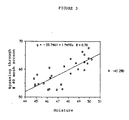
- the comminuted corn samples were analyzed for particle size and moisture content.
- the particle size analysis was substantially similar to that reported in Example 1, and the relationship of the particle size to moisture is reported in Figure 3.
- the expansion during frying is believed to be a measure of significance in determining consumer appeal -- a somewhat expanded product is desirable over a nonexpanded product, while a highly expanded product may be less desirable than a moderately expanded product.
- a plurality of product samples were randomly withdrawn from a product batch, and the thickness measured.
- the expansion for smooth rings and flat chip-type products was defined as the maximum thickness of the product divided by the width of the die opening.
- For fluted ring products the expansion of only the base portion was determined, the base being the minimum thickness of the fluted product. It was visually determined that substantially all the expansion in a fluted product occurred in the base portion with very little expansion taking place in the undulating outer ribbed portion.
- the expansion was determined by subtracting the height of the die peak from the thickness measured in the product and dividing this measurement by the minimum die opening. Selected samples were subjected to hardness measurements by the Food Technology Corporation of Rockville, Maryland, using an FTC Model T-2100-CI Integrating Texture Test System. Finally, a texture profile was determined by blind sampling by trained testers using a 60-point scale, wherein higher numbers indicate more of the measured criteria.
- the fluted ring made with the expansion-inducing starch of Example 1 had greater expansion and substantially lower hardness than the 100% corn fluted ring of Example 2. Additionally, the organoleptic analysis of texture indicates that the greater expansion results in perceptively lower hardness, less density and quicker "breakdown" (or disappearance within the mouth). The greater expansion of smooth rings and flat strips made with the 95% corn/5% starch formula of Example 3 is also apparent in Table I, consistent with the results of Examples 1 and 2. While the difference in the hardness measurement is not as dramatic, the texture analysis is consistent: products made from 95% corn and 5% of the expansion-inducing starch produce a product preferable to the 100% corn product.
- FIG. 1 The expansion of the products of Examples 1 and 2 are illustrated schematically in Figures 1 and 2.
- the product of Example 1 is illustrated in Figure 1 wherein a portion of the fluted ring 10 is illustrated with a number of large separated areas 12 and a larger number of smaller voids 14. Most of the flutes 16 exhibit a dense, unexpanded area 18 at the apex of the ribbed or fluted portion.
- the relatively unexpanded fluted rings 20 of Example 2 are illustrated in Figure 2 having predominantly the dense unexpanded regions 22, with relatively few large voids 24 and even fewer small voids 26.
- the relatively light, airy texture of the products of Example 1 result in the superior texture profile illustrated in Table I.
- the expanded nature of the corn ring of Figure 1 is representative of products produced with the expansion-inducing starch in Example 3.
- Example 4 illustrates that there are a number of ingredients capable of serving the expansion-inducing role contemplated herein.
- the preferred starch is a pregelatinized starch at a level of about 5% on a dry solids basis; higher levels result in a loss of corn flavor.
- Example 5 The results of Example 5 are illustrated in Table II below. Applicants believe that the percentage of the final product (“Pass 2") passing through a U.S. #40 mesh screen (-40), and the percentage passing through a U.S. #80 mesh screen (-80) are of particular relevance to the production of products according to the present invention. "Fines" are those particles passing through the #80 mesh screen and are believed to play an important role in the expansion, hardness and texture profile of such products. A relatively high percentage of fines (anything over about 10%) produces a relatively dense, hard product when fried, which does not exhibit the expansion illustrated in Figure 1 which is desired.
- Example 5A As indicated in Table II, the product of Example 5A made according to the two-step process of the '091 patent produces a product having 62% of the corn particles passing through a #40 mesh screen and 40% passing through a #80 mesh screen.
- Examples 5B-F illustrate the effects of different screen sizes on the final particle size analysis.
- the parameters of the screen are indicated with two numbers: viz., 10/30 indicates a bar having a width of 0.010 inches and an opening between adjacent bars of .030 inches. Therefore, a 10/30 screen would have a ratio of screen material:open area of 1:3.
- the size of the screen material has little effect on the ultimate particle size analysis.
- the relative size of the open area is critically important in producing products having an appropriate particle size distribution.
- Examples 5C and 5E wherein the second pass is made through a screen having a .020-inch opening, the particles passing through the #40 mesh screen exceed 80% and those passing through the #80 mesh screen exceed 60%.
- the products of Examples 5B, 5D and 5F wherein the cooked corn is subjected only to an opening having a diameter of .030 inches, about 40% of the cut corn passes a #40 mesh screen and almost nothing passes a #80 mesh screen.
- the preferred process of Examples 5B, 5D and 5F produce a relatively narrow particle size distribution: most of the corn is retained on either a #40 or #60 mesh screen.
- Examples 5B, 5D and 5F illustrate the process of the preferred embodiment, and illustrate ratios of screen material:open area of from 1:3 to 1:1.
- screens having such ratios of from 1:4 (a 10/40 head) to 2:1 (a 40/20 head) would be operative in the process of this invention.
- heads having ratios of from 1:4 to 2:1 would be operative in the process of the present invention, the preferred range appears to be a ratio of from 1:1 to 1:3.
- a consumer-preferred shape of the corn products of the present invention is a fluted ring.
- Applicants have extruded the corn dough of the present invention through numerous dies having various maximum and minimum die openings.
- the preferred die openings appear to range from a minimum of about 0.85 mm to a maximum of about 2.00 mm with approximately 18 rounded flutes about the circumference.
- Applicants have demonstrated minimum die openings in the range of about 0.5-1.2 mm, and maximum die openings in the range of about 1.45-2.25 mm.
- Example 5A (stone grind + 10/30)
- Example 5B (30/30 + 10/30)
- Example 5C (10/20 + 10/20)
- Example 5D (10/30 + 10/30)
- Example 5E (15/30 + 10/20)
- Example 5F (30/30 + 30/30) Pass 1 Pass 2 Pass 1 Pass 2 Pass 1 Pass 2 Pass 1 Pass 2 Pass 1 Pass 2 +10 mesh 6.8 0 0 0 0 0 0 0 0 0 0 0 +20 mesh 32.6 5.9 22.4 7.1 4.9 0 36.5 6.8 5.8 0 28.3 6.4 +40 mesh 27.8 31.9 54.8 55.2 36.9 18.4 42.3 50.2 38.3 15.1 45.5 53.9 -40 mesh 32.8 62.2 22.8 37.7 58.2 81.6 21.2 43.0 55.9 8
Landscapes
- Health & Medical Sciences (AREA)
- Nutrition Science (AREA)
- Life Sciences & Earth Sciences (AREA)
- Chemical & Material Sciences (AREA)
- Engineering & Computer Science (AREA)
- Food Science & Technology (AREA)
- Polymers & Plastics (AREA)
- Cereal-Derived Products (AREA)
- Grain Derivatives (AREA)
- Bakery Products And Manufacturing Methods Therefor (AREA)
- Confectionery (AREA)
Applications Claiming Priority (2)
| Application Number | Priority Date | Filing Date | Title |
|---|---|---|---|
| US42406189A | 1989-10-19 | 1989-10-19 | |
| US424061 | 1989-10-19 |
Publications (3)
| Publication Number | Publication Date |
|---|---|
| EP0423598A2 true EP0423598A2 (de) | 1991-04-24 |
| EP0423598A3 EP0423598A3 (en) | 1992-01-08 |
| EP0423598B1 EP0423598B1 (de) | 1995-01-11 |
Family
ID=23681299
Family Applications (1)
| Application Number | Title | Priority Date | Filing Date |
|---|---|---|---|
| EP90119343A Expired - Lifetime EP0423598B1 (de) | 1989-10-19 | 1990-10-09 | Maissnacks und Herstellungsverfahren |
Country Status (7)
| Country | Link |
|---|---|
| EP (1) | EP0423598B1 (de) |
| JP (1) | JPH03133349A (de) |
| AT (1) | ATE116812T1 (de) |
| AU (1) | AU633583B2 (de) |
| CA (1) | CA2019142A1 (de) |
| DE (1) | DE69015955T2 (de) |
| IE (1) | IE903016A1 (de) |
Cited By (1)
| Publication number | Priority date | Publication date | Assignee | Title |
|---|---|---|---|---|
| EP2756758A1 (de) * | 2013-01-18 | 2014-07-23 | Intersnack Group GmbH & Co. KG | Verbessertes Snackprodukt und Verfahren zu dessen Herstellung |
Families Citing this family (1)
| Publication number | Priority date | Publication date | Assignee | Title |
|---|---|---|---|---|
| JP2767330B2 (ja) * | 1991-08-13 | 1998-06-18 | 富士写真フイルム株式会社 | ハロゲン化銀写真感光材料 |
Family Cites Families (6)
| Publication number | Priority date | Publication date | Assignee | Title |
|---|---|---|---|---|
| US3278311A (en) * | 1965-05-10 | 1966-10-11 | Morton Foods Inc | Method of manufacturing corn dough and corn chips |
| US4640843A (en) * | 1984-12-11 | 1987-02-03 | Borden, Inc. | Low fat content food chips and method of preparation |
| US4645679A (en) * | 1984-12-24 | 1987-02-24 | The Procter & Gamble Co. | Process for making a corn chip with potato chip texture |
| US4680191A (en) * | 1985-02-05 | 1987-07-14 | Frito-Lay, Inc. | Cross-cut extrusion method |
| US4623548A (en) * | 1985-05-09 | 1986-11-18 | Willard Miles J | Method for preparing extruded fried snack products from corn and other cereal flours |
| US4803091A (en) * | 1986-01-31 | 1989-02-07 | Borden, Inc. | Corn spirals and method of manufacture |
-
1990
- 1990-06-08 AU AU57038/90A patent/AU633583B2/en not_active Ceased
- 1990-06-15 CA CA002019142A patent/CA2019142A1/en not_active Abandoned
- 1990-08-03 JP JP2206656A patent/JPH03133349A/ja active Pending
- 1990-08-21 IE IE301690A patent/IE903016A1/en unknown
- 1990-10-09 EP EP90119343A patent/EP0423598B1/de not_active Expired - Lifetime
- 1990-10-09 DE DE69015955T patent/DE69015955T2/de not_active Expired - Fee Related
- 1990-10-09 AT AT90119343T patent/ATE116812T1/de not_active IP Right Cessation
Cited By (1)
| Publication number | Priority date | Publication date | Assignee | Title |
|---|---|---|---|---|
| EP2756758A1 (de) * | 2013-01-18 | 2014-07-23 | Intersnack Group GmbH & Co. KG | Verbessertes Snackprodukt und Verfahren zu dessen Herstellung |
Also Published As
| Publication number | Publication date |
|---|---|
| JPH03133349A (ja) | 1991-06-06 |
| IE903016A1 (en) | 1991-04-24 |
| AU5703890A (en) | 1991-04-26 |
| AU633583B2 (en) | 1993-02-04 |
| ATE116812T1 (de) | 1995-01-15 |
| EP0423598A3 (en) | 1992-01-08 |
| DE69015955D1 (de) | 1995-02-23 |
| CA2019142A1 (en) | 1991-04-19 |
| EP0423598B1 (de) | 1995-01-11 |
| DE69015955T2 (de) | 1995-05-11 |
Similar Documents
| Publication | Publication Date | Title |
|---|---|---|
| US4770891A (en) | Method for preparing sheeted fried snack products | |
| US4623550A (en) | Method for preparing sheeted fried snack products from corn and other cereal flours | |
| CA1270144A (en) | Process for making a corn chip with potato chip texture | |
| US6291008B1 (en) | R-T-E cereal and method of preparation | |
| US3404986A (en) | Process for manufacturing corn flour | |
| US3997684A (en) | Method for making expanded potato based snack products | |
| US4446163A (en) | Process of manufacturing a starch-based food product | |
| EP0348546B1 (de) | Snack-Bestandteil und Verfahren zu seiner Herstellung | |
| US4803091A (en) | Corn spirals and method of manufacture | |
| JPS63129957A (ja) | 膨張フライド穀物ベ−スのスナツク製品の製造方法 | |
| JP4505458B2 (ja) | 米粉組成物 | |
| IE43588B1 (en) | Manufacture of food products | |
| US4876101A (en) | Snack food ingredient and method for making same | |
| US5128166A (en) | Fried pasta snack food | |
| US5100686A (en) | Corn rings and method of manufacture | |
| US5192574A (en) | Corn rings and method of manufacture | |
| EP0064224B1 (de) | Verhindern von Puffen während des Backens von expandierten Imbissprodukten | |
| EP0423598B1 (de) | Maissnacks und Herstellungsverfahren | |
| US3580727A (en) | Process for making expanded snack product | |
| EP1249178B1 (de) | Verfahren zur Herstellung eines neuen Snackproduktes und erhältliches Snackprodukt | |
| GB2105565A (en) | Edible products | |
| CA1052623A (en) | Method of making potato snack product | |
| EP0267322A1 (de) | Verfahren zur Zubereitung von frittierten Snack-Produkten aus Mais- und anderen Getreidemehlen | |
| CA1282993C (en) | Corn spirals and method of manufacture | |
| KR100447400B1 (ko) | 새로운 애피타이저의 제조 방법 및 이로부터 수득된 제품 |
Legal Events
| Date | Code | Title | Description |
|---|---|---|---|
| PUAI | Public reference made under article 153(3) epc to a published international application that has entered the european phase |
Free format text: ORIGINAL CODE: 0009012 |
|
| AK | Designated contracting states |
Kind code of ref document: A2 Designated state(s): AT BE CH DE ES FR GB IT LI NL SE |
|
| PUAL | Search report despatched |
Free format text: ORIGINAL CODE: 0009013 |
|
| AK | Designated contracting states |
Kind code of ref document: A3 Designated state(s): AT BE CH DE ES FR GB IT LI NL SE |
|
| RAP1 | Party data changed (applicant data changed or rights of an application transferred) |
Owner name: DAYLEY, KYLE E. Owner name: WILLARD, MILES JAMISON Owner name: HUNT, DEWEY RINNEL Owner name: HIX, VELDON MAX |
|
| 17P | Request for examination filed |
Effective date: 19920630 |
|
| 17Q | First examination report despatched |
Effective date: 19930709 |
|
| GRAA | (expected) grant |
Free format text: ORIGINAL CODE: 0009210 |
|
| AK | Designated contracting states |
Kind code of ref document: B1 Designated state(s): AT BE CH DE ES FR GB IT LI NL SE |
|
| PG25 | Lapsed in a contracting state [announced via postgrant information from national office to epo] |
Ref country code: IT Free format text: LAPSE BECAUSE OF FAILURE TO SUBMIT A TRANSLATION OF THE DESCRIPTION OR TO PAY THE FEE WITHIN THE PRE;WARNING: LAPSES OF ITALIAN PATENTS WITH EFFECTIVE DATE BEFORE 2007 MAY HAVE OCCURRED AT ANY TIME BEFORE 2007. THE CORRECT EFFECTIVE DATE MAY BE DIFFERENT FROM THE ONE RECORDED.SCRIBED TIME-LIMIT Effective date: 19950111 Ref country code: BE Effective date: 19950111 Ref country code: FR Effective date: 19950111 Ref country code: AT Effective date: 19950111 Ref country code: NL Effective date: 19950111 Ref country code: LI Effective date: 19950111 Ref country code: ES Free format text: THE PATENT HAS BEEN ANNULLED BY A DECISION OF A NATIONAL AUTHORITY Effective date: 19950111 Ref country code: CH Effective date: 19950111 |
|
| REF | Corresponds to: |
Ref document number: 116812 Country of ref document: AT Date of ref document: 19950115 Kind code of ref document: T |
|
| REF | Corresponds to: |
Ref document number: 69015955 Country of ref document: DE Date of ref document: 19950223 |
|
| PG25 | Lapsed in a contracting state [announced via postgrant information from national office to epo] |
Ref country code: SE Effective date: 19950411 |
|
| REG | Reference to a national code |
Ref country code: CH Ref legal event code: PL |
|
| EN | Fr: translation not filed | ||
| NLV1 | Nl: lapsed or annulled due to failure to fulfill the requirements of art. 29p and 29m of the patents act | ||
| PLBE | No opposition filed within time limit |
Free format text: ORIGINAL CODE: 0009261 |
|
| STAA | Information on the status of an ep patent application or granted ep patent |
Free format text: STATUS: NO OPPOSITION FILED WITHIN TIME LIMIT |
|
| 26N | No opposition filed | ||
| PGFP | Annual fee paid to national office [announced via postgrant information from national office to epo] |
Ref country code: GB Payment date: 19960930 Year of fee payment: 7 |
|
| PGFP | Annual fee paid to national office [announced via postgrant information from national office to epo] |
Ref country code: DE Payment date: 19961223 Year of fee payment: 7 |
|
| PG25 | Lapsed in a contracting state [announced via postgrant information from national office to epo] |
Ref country code: GB Free format text: LAPSE BECAUSE OF NON-PAYMENT OF DUE FEES Effective date: 19971009 |
|
| GBPC | Gb: european patent ceased through non-payment of renewal fee |
Effective date: 19971009 |
|
| PG25 | Lapsed in a contracting state [announced via postgrant information from national office to epo] |
Ref country code: DE Free format text: LAPSE BECAUSE OF NON-PAYMENT OF DUE FEES Effective date: 19980701 |