EP0426829B1 - Monoparticules fluorescentes de grande sensibilite et appareil et procede de detection de molecules individuelles - Google Patents
Monoparticules fluorescentes de grande sensibilite et appareil et procede de detection de molecules individuelles Download PDFInfo
- Publication number
- EP0426829B1 EP0426829B1 EP90908805A EP90908805A EP0426829B1 EP 0426829 B1 EP0426829 B1 EP 0426829B1 EP 90908805 A EP90908805 A EP 90908805A EP 90908805 A EP90908805 A EP 90908805A EP 0426829 B1 EP0426829 B1 EP 0426829B1
- Authority
- EP
- European Patent Office
- Prior art keywords
- particles
- molecules
- output
- volume
- energy
- Prior art date
- Legal status (The legal status is an assumption and is not a legal conclusion. Google has not performed a legal analysis and makes no representation as to the accuracy of the status listed.)
- Expired - Lifetime
Links
- 239000002245 particle Substances 0.000 title claims abstract description 73
- 238000000034 method Methods 0.000 title claims description 19
- 230000035945 sensitivity Effects 0.000 title description 5
- 238000004557 single molecule detection Methods 0.000 title 1
- 239000012530 fluid Substances 0.000 claims abstract description 16
- 238000001514 detection method Methods 0.000 claims abstract description 14
- 238000012545 processing Methods 0.000 claims description 5
- 230000001419 dependent effect Effects 0.000 claims 1
- 238000005286 illumination Methods 0.000 claims 1
- 239000000758 substrate Substances 0.000 abstract description 15
- 239000000523 sample Substances 0.000 description 13
- 238000010586 diagram Methods 0.000 description 6
- 230000005284 excitation Effects 0.000 description 6
- 238000002474 experimental method Methods 0.000 description 6
- 230000003595 spectral effect Effects 0.000 description 6
- 238000001069 Raman spectroscopy Methods 0.000 description 4
- 238000010521 absorption reaction Methods 0.000 description 4
- 238000011160 research Methods 0.000 description 4
- 239000000539 dimer Substances 0.000 description 3
- 239000000178 monomer Substances 0.000 description 3
- XKRFYHLGVUSROY-UHFFFAOYSA-N Argon Chemical compound [Ar] XKRFYHLGVUSROY-UHFFFAOYSA-N 0.000 description 2
- 239000007788 liquid Substances 0.000 description 2
- OALHHIHQOFIMEF-UHFFFAOYSA-N 3',6'-dihydroxy-2',4',5',7'-tetraiodo-3h-spiro[2-benzofuran-1,9'-xanthene]-3-one Chemical compound O1C(=O)C2=CC=CC=C2C21C1=CC(I)=C(O)C(I)=C1OC1=C(I)C(O)=C(I)C=C21 OALHHIHQOFIMEF-UHFFFAOYSA-N 0.000 description 1
- 241000894006 Bacteria Species 0.000 description 1
- 241000700605 Viruses Species 0.000 description 1
- 229910052786 argon Inorganic materials 0.000 description 1
- 230000008033 biological extinction Effects 0.000 description 1
- VYXSBFYARXAAKO-WTKGSRSZSA-N chembl402140 Chemical compound Cl.C1=2C=C(C)C(NCC)=CC=2OC2=C\C(=N/CC)C(C)=CC2=C1C1=CC=CC=C1C(=O)OCC VYXSBFYARXAAKO-WTKGSRSZSA-N 0.000 description 1
- 238000005315 distribution function Methods 0.000 description 1
- 230000000694 effects Effects 0.000 description 1
- 230000007613 environmental effect Effects 0.000 description 1
- 230000005281 excited state Effects 0.000 description 1
- 239000012634 fragment Substances 0.000 description 1
- 239000011521 glass Substances 0.000 description 1
- 230000010354 integration Effects 0.000 description 1
- 238000001499 laser induced fluorescence spectroscopy Methods 0.000 description 1
- 239000000463 material Substances 0.000 description 1
- 238000012986 modification Methods 0.000 description 1
- 230000004048 modification Effects 0.000 description 1
- 230000003287 optical effect Effects 0.000 description 1
- 238000005457 optimization Methods 0.000 description 1
- 230000010287 polarization Effects 0.000 description 1
- 238000006862 quantum yield reaction Methods 0.000 description 1
- 239000012488 sample solution Substances 0.000 description 1
- 238000005070 sampling Methods 0.000 description 1
- 239000002904 solvent Substances 0.000 description 1
- 238000012360 testing method Methods 0.000 description 1
- 238000013519 translation Methods 0.000 description 1
Images




Classifications
-
- G—PHYSICS
- G01—MEASURING; TESTING
- G01N—INVESTIGATING OR ANALYSING MATERIALS BY DETERMINING THEIR CHEMICAL OR PHYSICAL PROPERTIES
- G01N21/00—Investigating or analysing materials by the use of optical means, i.e. using sub-millimetre waves, infrared, visible or ultraviolet light
- G01N21/62—Systems in which the material investigated is excited whereby it emits light or causes a change in wavelength of the incident light
- G01N21/63—Systems in which the material investigated is excited whereby it emits light or causes a change in wavelength of the incident light optically excited
- G01N21/64—Fluorescence; Phosphorescence
- G01N21/645—Specially adapted constructive features of fluorimeters
-
- G—PHYSICS
- G01—MEASURING; TESTING
- G01N—INVESTIGATING OR ANALYSING MATERIALS BY DETERMINING THEIR CHEMICAL OR PHYSICAL PROPERTIES
- G01N15/00—Investigating characteristics of particles; Investigating permeability, pore-volume or surface-area of porous materials
- G01N15/10—Investigating individual particles
- G01N15/14—Optical investigation techniques, e.g. flow cytometry
- G01N15/1468—Optical investigation techniques, e.g. flow cytometry with spatial resolution of the texture or inner structure of the particle
- G01N15/147—Optical investigation techniques, e.g. flow cytometry with spatial resolution of the texture or inner structure of the particle the analysis being performed on a sample stream
-
- G—PHYSICS
- G01—MEASURING; TESTING
- G01N—INVESTIGATING OR ANALYSING MATERIALS BY DETERMINING THEIR CHEMICAL OR PHYSICAL PROPERTIES
- G01N15/00—Investigating characteristics of particles; Investigating permeability, pore-volume or surface-area of porous materials
- G01N15/10—Investigating individual particles
- G01N15/14—Optical investigation techniques, e.g. flow cytometry
- G01N15/1429—Signal processing
-
- G—PHYSICS
- G01—MEASURING; TESTING
- G01N—INVESTIGATING OR ANALYSING MATERIALS BY DETERMINING THEIR CHEMICAL OR PHYSICAL PROPERTIES
- G01N15/00—Investigating characteristics of particles; Investigating permeability, pore-volume or surface-area of porous materials
- G01N15/10—Investigating individual particles
- G01N15/14—Optical investigation techniques, e.g. flow cytometry
- G01N15/1429—Signal processing
- G01N15/1433—Signal processing using image recognition
-
- G—PHYSICS
- G01—MEASURING; TESTING
- G01N—INVESTIGATING OR ANALYSING MATERIALS BY DETERMINING THEIR CHEMICAL OR PHYSICAL PROPERTIES
- G01N15/00—Investigating characteristics of particles; Investigating permeability, pore-volume or surface-area of porous materials
- G01N15/02—Investigating particle size or size distribution
- G01N15/0205—Investigating particle size or size distribution by optical means
- G01N15/0211—Investigating a scatter or diffraction pattern
- G01N2015/0222—Investigating a scatter or diffraction pattern from dynamic light scattering, e.g. photon correlation spectroscopy
-
- G—PHYSICS
- G01—MEASURING; TESTING
- G01N—INVESTIGATING OR ANALYSING MATERIALS BY DETERMINING THEIR CHEMICAL OR PHYSICAL PROPERTIES
- G01N21/00—Investigating or analysing materials by the use of optical means, i.e. using sub-millimetre waves, infrared, visible or ultraviolet light
- G01N21/62—Systems in which the material investigated is excited whereby it emits light or causes a change in wavelength of the incident light
- G01N21/63—Systems in which the material investigated is excited whereby it emits light or causes a change in wavelength of the incident light optically excited
- G01N21/64—Fluorescence; Phosphorescence
- G01N21/645—Specially adapted constructive features of fluorimeters
- G01N21/6456—Spatial resolved fluorescence measurements; Imaging
Definitions
- This invention relates generally to an apparatus and method for the detection of individual fluorescent particles down to the single molecule limit, and more particularly, to an apparatus and method for measuring the concentration of fluorescent particles or molecules in a fluid solution, or for locating and/or counting fluorescent particles or molecules on surfaces or in films.
- U.S. Patent 4,778,593 teaches discrimination of minute particles, such as biological particles or organic polymers.
- the particles are suspended in a liquid with individual particles substantially separated from each other as they flow in a liquid stream.
- the particle stream is irradiated with a high-intensity light beam, and the stream is then formed into droplets, each of which contains a particle.
- the particles are discriminated in accordance with the change in light energy emitted by the particles over a period of time; that is, each particle emits light for a given time, depending on its size and characteristics.
- the particles are sorted by deflecting the droplets in accordance with the change in emitted energy.
- U.S. Patent 4,021,117 teaches a method of counting and analyzing pulses representative of characteristics of particles passing through a detection device. The amplitude of each pulse is detected, the area under each pulse above a reference level is determined and a ratio of amplitude-to-measured-area is obtained. The apparatus is used to discriminate against the passage of multiple particles through the sensing zone of the device.
- the prior art does not provide a method and apparatus which can provide rapid ultrasensitive detection and counting of fluorescent particles down to the single molecule limit, nor does the prior art provide a method for determining the optimal conditions to obtain this high detection sensitivity.
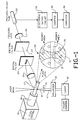
- FIGURE 1 is a schematic diagram of the preferred embodiment of the present apparatus in which the particles are presented in a fluid stream.
- FIGURE 2 is a block diagram of the electronic gating circuit of FIGURE 1 showing the signal input and output at various points in the circuit.
- FIGURE 3 is another embodiment of the gating circuit of FIGURE 1.
- FIGURE 4 shows still another embodiment of the gating circuit of FIGURE 1.
- FIGURE 5 shows a digital circuit embodiment of the gating circuit.
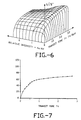
- FIGURE 6 shows the laser intensity and particle transit time for optimum signal-to-noise conditions.
- FIGURE 7 is a plot of optimal signal-to-noise ratio at optimal laser intensities as a function of transit time.
- FIGURE 8 is a plot showing the results of operation of the apparatus of FIGURE 1.
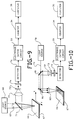
- FIGURE 9 is a schematic block diagram of another embodiment of this invention for counting and locating fluorescent particles or molecules on a substrate.
- FIGURE 10 is a schematic diagram of still another embodiment of this invention for counting and locating fluorescent particles or molecules on a substrate.
- FIGURE 11 is a schematic diagram of a further embodiment of this invention for counting and locating fluorescent particles or molecules on a substrate.
- a laser beam 11 is projected by a laser 12 through a polarizer 13 and focused by a lens 14 onto to the fluid stream as shown by the focused beam 16.
- the beam is focused onto flowing sample fluid stream 17 flowing in a capillary tube 18.
- Schematically shown is a flow control means 19 which serves to control the flow velocity of the stream 17.
- the laser polarization is oriented in the scattering plane by the polarizer 13 to minimize background scattering.
- the laser beam illuminates the area 21 shown in the enlarged view 22.
- An image of the illuminated volume is imaged onto a spatial filter 23 by the objective lens 24.
- the spatial filter 23 reduces the illuminated area and volume which is probed to the volume shown by reference number 26.
- the spatial filter defines the height and width of the probe volume.
- a spectral filter 28 rejects scattered Rayleigh and Raman emission from the illuminated volume.
- the energy passing spatial and spectral filters is focused by a focusing lens 28 onto a phototransducer 29 which may be a photomultiplier tube or any other type of phototransducer having the requisite sensitivity.
- a burst of photons are generated.
- This burst of photons, together with the background emission, is detected by the photomultiplier tube which provides an output signal.
- This output signal is applied to an electronic gating circuit 33 which is designed to look for bursts of particular amplitude and duration.
- the bursts of interest have a duration equal to the transit time through the volume and at least a minimum amplitude.
- the resulting signal is applied to counter 34 and to a computer 36, which can process and store the processed counts over predetermined times to provide an indication of concentration or other relevant information.
- the output from the photomultiplier tube is shown in FIGURE 2A and is comprised of a plurality of photon bursts including both low frequency background emission 38 representing Rayleigh and Raman scattering, and high frequency bursts 39 representing a particle traveling through the probe volume, and electronic noise 40.
- the signal from the photomultiplier tube is supplied to a pulse height discriminator 41 which passes pulses with predetermined amplitudes and then to a frequency to voltage converter 42 which converts the frequency of pulses to a voltage 43. Thereafter, the voltage 43 is applied to a pulse height discriminator 44 which provides a pair of output pulses 46, 47 and discriminates against low frequency background emissions.
- a pulse-width-to-voltage converter 48 receives the pulses and provides the output shown at 51, 52, FIGURE 2E.
- a pulse height discriminator 53 detects the pulses 51 and 52 and provides an output pulse 54 when the pulse 52 exceeds a predetermined amplitude or lies within a predetermined range indicated by the two doted lines in Figure 2E.
- a window discriminator may be employed to reject very long pulses that are not physical. The amplitude is indicative of the presence of a particle.
- the circuit discriminates against high frequency short duration sharp electronic spikes 40 as represented by the pulse 51 as well as low frequency background emissions 38.
- FIGURE 3 An alternate method of detection is shown in FIGURE 3, wherein the signal from the photomultiplier tube 29 is applied to a current-to-voltage converter 52 which will generate a signal corresponding generally to that shown in FIGURE 2C. The signal can then be applied to pulse height discriminator 44 and pulse width discriminators 48 to provide an output indicative of the presence of particles.
- FIGURE 4 is a generalized block diagram of the processing circuitry which comprises the pulse height discrimination and pulse width discrimination 48 described above.
- FIGURE 5 there is shown a digital circuit for performing the pulse height and pulse width discrimination to detect valid bursts of photons from fluorescent particles.
- the output from the photomultiplier tube is amplified 56 and applied to the pulse height discriminator 57 to give a signal of the type shown in FIGURE 2B.
- the output of the pulse height discriminator is applied to a counter which is started by the first incoming pulse.
- the pulse also closes a gate 58 and starts a variable delay circuit 59 which is set to match the transit time of the molecule through the laser beam.
- the counter keeps counting until the variable delay circuit triggers the counter 61 to stop, reset the and counter, and opens the gate to allow a new delay cycle to start.
- a magnitude comparator 62 compares the number of counts which the counter generates over the delay period with a predetermined background value since the fluorescent bursts from particles have higher count rate than the background emission. If the number exceeds the predetermined background value, it is an indication of a molecule passed through the beam and one count is generated.
- the laser needs to be tightly focused and the spatial filter needs to define a probe volume that is small enough to have the probability of multiple molecules or particles occupying the volume negligible.
- the laser power needs to be chosen to provide the brightest fluorescence without generating excessive background emission.
- Equation (4) gives the fluorescence-per-molecule divided by the square root of the mean background-signal-per-transit time. This is a signal-to-noise ratio because we are interested in optimizing the signal (fluorescence-per-molecule) relative to the fluctuations in the background.
- the equation is: S/ ⁇ B (k ⁇ ) -1 ⁇ 2 [1 - exp[-k ⁇ /(k + 1) ⁇ ]
- the variable k is defined as k a /k f and ⁇ is defined as ⁇ t / ⁇ pd .
- the optimization of the experiment depends on the ratio of the excitation rate to the emission rate (k a /k f ) and on the ratio of the transit time to the photodestruction time ( ⁇ t / ⁇ pd ).
- a two-dimensional plot of S/ ⁇ B as a function of k and ⁇ is presented in FIGURE 6. This is a fundamental function which applies to all fluorophores.
- FIGURE 6 To optimize the conditions for a particular fluorophore it is only necessary to know the characteristic photodestruction time and the observed fluorescence lifetime.
- the dots on FIGURE 6 indicate the optimum S/ ⁇ B values at the optimum light intensities for transit times ⁇ from 0 to three.
- FIGURE 7 presents a plot of the optimal S/ ⁇ B as a function of the transit time. To perform an experiment, one simply selects the longest transit time that is practical for the experiment at hand and then selects the excitation intensity that gives maximum S/ ⁇ B at that transit time.
- FIGURES 1 and 2 The apparatus of FIGURES 1 and 2 was used to detect single-molecule fluorescence in a subpicomolar solution of monomers and dimers of B-phycoerythrin (PE).
- Argon laser 12 provided an excitation beam which was focused to a few ⁇ m spot size at the center of a flowing sample stream 17 contained in capillary tube 18.
- the flow velocity was chosen to give a transit time approximately equal to the photodestruction time for PE and the laser intensity was selected to give the optimal s/ ⁇ B as indicated in FIGURES 6 and 7.
- Fluorescence emission was collected by a microscope objective 24 and imaged onto a spatial filter 23.
- the spatial filter defined the probe volume and rejected scattering and fluorescence from the capillary walls.
- a fluorescence interference filter 27 was used to reject Rayleigh and Raman scattering.
- the fluorescence was detected with a photomultiplier tube and amplifier/discriminator.
- the fluorescence burst detector in FIGURE 2 was then used to record the number of
- FIGURE 8 presents the log of the number of single molecule events versus the log of the concentration of PE monomers and dimers.
- the regression lines of these two plots have a slope fairly close to one, 1.05 for the monomer data and 1.15 for the dimer data.
- the linear concentration dependence proves we are seeing single -molecule events.
- the dynamic range is limited by sampling time at low concentrations and by multiple occupancy at high concentrations. Higher than 10 -12 M, the mean will shift up due to the fluorescence around the probe volume.
- FIGURE 1 the fluid solution flows through the illuminated area whereby particles emit a burst of photons as they are in the volume. It is apparent that the illuminated areas may be moved over a surface or film on a substrate to locate and detect particles. The end effect is the same since the particles emit only for the transit time ⁇ during which they are illuminated. By moving the light beam relative to the surface or by moving the substrate such as on a slide or the like relative to the light beam, it is possible to scan the total area contained on the substrate or slide to locate or count particles.
- the solution can be carried on a substrate or a slide 67 as a think film 66, in filter paper or in a gel which can be moved by suitable X-Y drive means such as rack and pinions, stepper motors or the like.
- a light source 68 which may be a laser or the like, is focused onto the slide by a lens 69.
- the light passes through a beam-splitter 71 and impinges upon the sample solution.
- the photons emitted by the solution are reflected by the dichroic beam-splitter to the collection optics 72, spatial filter 73, spectral filter 74 and detector 76.
- the spatial filter defines the area which is being viewed and the spectral filter rejects scattered Rayleigh and Raman emissions.
- the signal is then processed by gating circuit 33, counted by counter 34 and applied to the computer at 36 as previously described.
- gating circuit 33 By controlling the X-Y drive the total film may be analyzed.
- the transit time ⁇ of the particles in the illuminated volume is controlled by the speed of movement of the stages.
- the area can be scanned as desired. Any of the signal processing electronic circuits described above can be employed to process the output of the detector and provides a particle identification output.
- FIGURE 10 shows another apparatus for scanning film 66 on a substrate 67. Rather than translating and moving the substrate, the substrate is stationary and the projected beam is scanned by a scanning mirror or assembly.
- a light source 78 projects a light beam 79 which passes through the dichroic beam-splitter 81 and is deflected by scanning mirror assembly 82 and focused by scan lens 83 onto the film 66.
- the emitted photon energy is collected by the scan lens deflected by the scanning mirror assembly to a beam-splitter 81 where it impinges upon the focusing and collecting optics 72, passes through the spatial filter 73, spectral filter 74 and is collected by a detector 76.
- the scanning mirror may comprise two scanning galvanometer mirrors which are deflected with signals applied to the galvanometer motors to deflect the mirrors.
- One mirror is moved rapidly in a first direction to scan across the sample and a second mirror with slower rate to advance the scan provides a raster scan of the type illustrated by the lines 84.
- the beam can be scanned slowly in the x-direction by a stepper motor or the like. Again the electronic currents associated with the detector provide the necessary signal discrimination to identify and detect single particles.
- FIGURE 11 the substrate 67 and film 66 are placed on a translation stage of the type described with reference to FIGURE 9.
- a light source 86 which provides energy to a dichroic beam-splitter 87, and the energy is focused by the lens 88 onto the film 66.
- the emitted energy is picked up by the lens 88, passed through the dichroic beam-splitter 87 through a spectral filter 89, focusing lens 91 and spatial filter 92 to the detector 93.
- the output signal from the detector is processed by the electronic circuit comprising electronic gating device 33, counter 34, and computer 36.
- the electronic and gating is based upon the fact that when a fluorescent molecule or particle is transiting through the illuminated volume either by motion of the particle or motion of the illuminated area, it is illuminated for a predetermined period of time and emits a burst of photons.
- This burst of photons can be distinguished from background emission by using the single particle burst detector of the present invention which responds to only when the photon bursts have the proper magnitude and duration or width.
Landscapes
- Health & Medical Sciences (AREA)
- Chemical & Material Sciences (AREA)
- Biochemistry (AREA)
- Physics & Mathematics (AREA)
- Life Sciences & Earth Sciences (AREA)
- Analytical Chemistry (AREA)
- General Health & Medical Sciences (AREA)
- General Physics & Mathematics (AREA)
- Immunology (AREA)
- Pathology (AREA)
- Dispersion Chemistry (AREA)
- Nuclear Medicine, Radiotherapy & Molecular Imaging (AREA)
- Investigating, Analyzing Materials By Fluorescence Or Luminescence (AREA)
- Investigating Or Analyzing Non-Biological Materials By The Use Of Chemical Means (AREA)
- Investigating Or Analysing Materials By The Use Of Chemical Reactions (AREA)
Claims (8)
- Appareil pour détecter des particules et/ou des molécules fluorescentes individuelles dans un fluide, qui comporte:des moyens pour éclairer un volume prédéterminé du fluide;des moyens pour faire en sorte que des particules et/ou des molécules passent dans ledit volume éclairé de façon que des bouffées d'énergie fluorescente soient émises par lesdites particules et/ou molécules en réponse à l'éclairement lorsqu'elles passent dans ledit volume; etdes moyens pour détecter lesdites bouffées d'énergie fluorescente et fournir un signal de sortie, caractérisé en ce que:des moyens de traitement destinés à recevoir ledit signal de sortie sont prévus, lesdits moyens de traitement comportant des moyens pour détecter l'amplitude et la durée desdites bouffées et pour distinguer lesdites bouffées d'énergie fluorescente provenant desdites particules et/ou molécules du fond d'énergie ou du bruit électronique, lesdits moyens de traitement fournissant une indication de la détection d'une particule et/ou d'une molécule passant dans ledit volume.
- Appareil selon la revendication 1, dans lequel lesdits moyens de détection de l'amplitude et de la durée desdites bouffées comprennent un convertisseur fréquence-tension, un signal analogique, un discriminateur de hauteur d'impulsion pour recevoir ledit signal et fournir des impulsions de sortie ayant une largeur d'impulsion égale au temps pendant lequel le signal dépasse une valeur prédéterminée, et un discriminateur de largeur d'impulsion fournissant une sortie lorsque la largeur de l'impulsion de sortie dépasse une valeur prédéterminée représentative du temps de transit d'une particule.
- Appareil selon la revendication 2, dans lequel ledit discriminateur de largeur d'impulsion comporte un convertisseur largeur d'impulsion - tension, destiné à recevoir lesdites impulsions de sortie et à fournir une tension de sortie ayant une amplitude qui dépend de la largeur d'impulsion et un discriminateur de hauteur d'impulsion destiné à détecter l'instant où la tension de sortie dépasse une amplitude prédéterminée ou se situe à l'intérieur d'une fenêtre prédéterminée.
- Appareil selon la revendication 1, dans lequel lesdits moyens de détection de l'amplitude et de la durée desdites bouffées comprennent un convertisseur courant-tension destiné à recevoir la sortie desdits moyens de détection et à fournir un signal de sortie analogique, un discriminateur de hauteur d'impulsion destiné à recevoir ledit signal analogique et à fournir des impulsions de sortie ayant une largeur d'impulsion égale au temps pendant lequel ledit signal dépasse un volume prédéterminé, et un discriminateur de largeur d'impulsion fournissant un signal de sortie lorsque la largeur de l'impulsion de sortie dépasse une valeur prédéterminée ou se situe dans une fenêtre ou une gamme prédéterminée représentative du temps de transit d'une particule dans ledit volume.
- Appareil selon la revendication 1, dans lequel ledit moyen de détection de l'amplitude et de la durée desdites bouffées comprend des moyens destinés à compter des photons qui sont émis au cours de périodes prédéterminées et à fournir un signal de sortie représentatif d'une particule et/ou d'une molécule lorsque le compte dépasse un compte prédéterminé.
- Procédé de détection de particules et/ou de molécules fluorescentes individuelles dans un fluide, comprenant les étapes qui consistent:à éclairer un volume prédéterminé du fluide;à faire passer des particules et/ou des molécules dans ledit volume éclairé de façon à provoquer l'émission de bouffées d'énergie fluorescente; età détecter ladite énergie et à fournir un signal de sortie à partir des particules et/ou des molécules passant dans le volume, caractérisé en ce que:ledit signal étant traité par les étapes qui consistent:à rejeter des signaux électriques représentatifs d'un fond d'énergie, età générer une sortie lorsque des signaux électriques ont une amplitude et une durée qui correspondent au temps de transit de particules et/ou de molécules dans ledit volume afin de fournir une indication du passage de particules et/ou de molécules dans ledit volume.
- Procédé selon la revendication 6, comprenant l'étape qui consiste:
à choisir l'énergie d'éclairement et le temps de transit des particules et/ou des molécules dans le volume prédéterminé de façon à produire le rapport optimal entre l'énergie émise par des particules et/ou des molécules et le fond d'énergie ou la fluctuation d'énergie. - Procédé selon la revendication 7, dans lequel lesdites étapes comprennent l'utilisation de la durée de vie d'émission par fluorescence et du temps de photodestruction par fluorescence des fluorophores, comme facteurs déterminants.
Applications Claiming Priority (3)
| Application Number | Priority Date | Filing Date | Title |
|---|---|---|---|
| US358782 | 1989-05-26 | ||
| US07/358,782 US4979824A (en) | 1989-05-26 | 1989-05-26 | High sensitivity fluorescent single particle and single molecule detection apparatus and method |
| PCT/US1990/002702 WO1990014589A1 (fr) | 1989-05-26 | 1990-05-21 | Monoparticules fluorescentes de grande sensibilite et appareil et procede de detection de molecules individuelles |
Publications (3)
| Publication Number | Publication Date |
|---|---|
| EP0426829A1 EP0426829A1 (fr) | 1991-05-15 |
| EP0426829A4 EP0426829A4 (en) | 1992-05-06 |
| EP0426829B1 true EP0426829B1 (fr) | 1996-09-04 |
Family
ID=23411024
Family Applications (1)
| Application Number | Title | Priority Date | Filing Date |
|---|---|---|---|
| EP90908805A Expired - Lifetime EP0426829B1 (fr) | 1989-05-26 | 1990-05-21 | Monoparticules fluorescentes de grande sensibilite et appareil et procede de detection de molecules individuelles |
Country Status (7)
| Country | Link |
|---|---|
| US (1) | US4979824A (fr) |
| EP (1) | EP0426829B1 (fr) |
| JP (1) | JPH04500274A (fr) |
| AT (1) | ATE142334T1 (fr) |
| AU (1) | AU624047B2 (fr) |
| DE (1) | DE69028370T2 (fr) |
| WO (1) | WO1990014589A1 (fr) |
Families Citing this family (100)
| Publication number | Priority date | Publication date | Assignee | Title |
|---|---|---|---|---|
| US5541061A (en) * | 1992-04-29 | 1996-07-30 | Affymax Technologies N.V. | Methods for screening factorial chemical libraries |
| JP2575270B2 (ja) * | 1992-11-10 | 1997-01-22 | 浜松ホトニクス株式会社 | 核酸の塩基配列決定方法、単一分子検出方法、その装置及び試料の作成方法 |
| FI96638C (fi) * | 1992-11-17 | 1996-07-25 | Biohit Oy | "Inner-filter"-korjaus fluorometripohjaisella monitoimintoisella laitteella |
| AU673245B2 (en) * | 1993-02-01 | 1996-10-31 | Seq, Ltd. | Methods and apparatus for DNA sequencing |
| US5547849A (en) * | 1993-02-17 | 1996-08-20 | Biometric Imaging, Inc. | Apparatus and method for volumetric capillary cytometry |
| US6864048B2 (en) * | 1993-04-28 | 2005-03-08 | Affymetrix, Inc. | Factorial chemical libraries |
| US5439578A (en) * | 1993-06-03 | 1995-08-08 | The Governors Of The University Of Alberta | Multiple capillary biochemical analyzer |
| DE69530323T2 (de) * | 1994-09-02 | 2004-02-12 | BD Biosciences, Systems and Reagents, Inc., San Jose | Verfahren und vorrichtung zur eichung eines optischen abtasters |
| DE19649048C1 (de) * | 1996-11-27 | 1998-04-09 | Evotec Biosystems Gmbh | Verfahren zur Unterscheidung oder Erfassung von Partikeln in einer Probe durch Identifizierung von Signalabschnitten zeitaufgelöster, optischer Rohsignale aus der Probe auf Basis von Einzelphotonendetektion |
| CN1251609A (zh) | 1997-02-12 | 2000-04-26 | 尤金·Y·查恩 | 分析聚合物的方法和产品 |
| US6710871B1 (en) | 1997-06-09 | 2004-03-23 | Guava Technologies, Inc. | Method and apparatus for detecting microparticles in fluid samples |
| WO1998057152A1 (fr) * | 1997-06-09 | 1998-12-17 | Guava Technologies, Inc. | Procede et dispositif pour deceler des microparticules dans des echantillons de fluides |
| US6049380A (en) * | 1997-11-12 | 2000-04-11 | Regents Of The University Of California | Single molecule identification using selected fluorescence characteristics |
| SE9800360D0 (sv) * | 1998-02-06 | 1998-02-06 | Goeteborg University Science I | Method, apparatus and flow cell for high sensitivity detection of fluorescent molecules |
| US7875440B2 (en) | 1998-05-01 | 2011-01-25 | Arizona Board Of Regents | Method of determining the nucleotide sequence of oligonucleotides and DNA molecules |
| US6780591B2 (en) | 1998-05-01 | 2004-08-24 | Arizona Board Of Regents | Method of determining the nucleotide sequence of oligonucleotides and DNA molecules |
| US20040106110A1 (en) * | 1998-07-30 | 2004-06-03 | Solexa, Ltd. | Preparation of polynucleotide arrays |
| WO2000006770A1 (fr) * | 1998-07-30 | 2000-02-10 | Solexa Ltd. | Biomolecules en rangees et leur utilisation dans une procedure de sequençage |
| US20100130368A1 (en) * | 1998-07-30 | 2010-05-27 | Shankar Balasubramanian | Method and system for sequencing polynucleotides |
| US6263286B1 (en) * | 1998-08-13 | 2001-07-17 | U.S. Genomics, Inc. | Methods of analyzing polymers using a spatial network of fluorophores and fluorescence resonance energy transfer |
| DE19844931C1 (de) | 1998-09-30 | 2000-06-15 | Stefan Seeger | Verfahren zur DNS- oder RNS-Sequenzierung |
| WO2000036151A1 (fr) | 1998-12-14 | 2000-06-22 | Li-Cor, Inc. | Essai heterogene pour detection des pyrophosphates |
| US6818395B1 (en) | 1999-06-28 | 2004-11-16 | California Institute Of Technology | Methods and apparatus for analyzing polynucleotide sequences |
| US6927065B2 (en) * | 1999-08-13 | 2005-08-09 | U.S. Genomics, Inc. | Methods and apparatus for characterization of single polymers |
| US6696022B1 (en) | 1999-08-13 | 2004-02-24 | U.S. Genomics, Inc. | Methods and apparatuses for stretching polymers |
| US6569685B1 (en) | 1999-10-05 | 2003-05-27 | The Molecular Sciences Institute, Inc. | Protein fingerprint system and related methods |
| CA2397817C (fr) * | 2000-01-27 | 2008-08-12 | Applied Precision Holdings, Llc | Procedes d'etalonnage a champ plan, d'aplatissement de vignette et de liaison de vignettes d'image |
| US6936702B2 (en) * | 2000-06-07 | 2005-08-30 | Li-Cor, Inc. | Charge-switch nucleotides |
| JP2004516810A (ja) | 2000-06-07 | 2004-06-10 | リ−コール インコーポレーティッド | 電荷スイッチヌクレオチド |
| US6447995B1 (en) | 2000-10-04 | 2002-09-10 | Genvec, Inc. | Utilizing intrinsic fluorescence to detect adenovirus |
| US7211414B2 (en) | 2000-12-01 | 2007-05-01 | Visigen Biotechnologies, Inc. | Enzymatic nucleic acid synthesis: compositions and methods for altering monomer incorporation fidelity |
| WO2002061391A2 (fr) * | 2001-01-31 | 2002-08-08 | The University Of Tennessee Research Corporation | Procedes de detection d'interaction de molecules avec des reactifs fixes sur une surface |
| EP1368497A4 (fr) | 2001-03-12 | 2007-08-15 | California Inst Of Techn | Procedes et appareil d'analyse de sequences de polynucleotide par extension de base asynchrone |
| AU2002258997A1 (en) * | 2001-04-24 | 2002-11-05 | Li-Cor, Inc. | Polymerases with charge-switch activity and methods of generating such polymerases |
| US7118907B2 (en) * | 2001-06-06 | 2006-10-10 | Li-Cor, Inc. | Single molecule detection systems and methods |
| US7076092B2 (en) * | 2001-06-14 | 2006-07-11 | The United States Of America As Represented By The United States Department Of Energy | High-throughput, dual probe biological assays based on single molecule detection |
| US7695926B2 (en) | 2001-07-10 | 2010-04-13 | The Board Of Trustees Of The Leland Stanford Junior University | Methods and compositions for detecting receptor-ligand interactions in single cells |
| AU2002365421A1 (en) | 2001-07-10 | 2003-09-02 | The Board Of Trustees Of The Leland Stanford Junior University | Methods and compositions for detecting the activation state of the multiple proteins in single cells |
| US7393656B2 (en) * | 2001-07-10 | 2008-07-01 | The Board Of Trustees Of The Leland Stanford Junior University | Methods and compositions for risk stratification |
| US7381535B2 (en) * | 2002-07-10 | 2008-06-03 | The Board Of Trustees Of The Leland Stanford Junior | Methods and compositions for detecting receptor-ligand interactions in single cells |
| US20030110840A1 (en) * | 2001-07-24 | 2003-06-19 | Arriaga Edgar A. | Systems and methods for detecting a particle |
| US7016087B2 (en) * | 2001-08-08 | 2006-03-21 | Becton Dickinson And Company | Photon efficient scanner |
| US6750457B2 (en) * | 2001-08-29 | 2004-06-15 | Becton Dickinson And Company | System for high throughput analysis |
| WO2003100101A1 (fr) * | 2002-05-28 | 2003-12-04 | U.S. Genomics, Inc. | Procedes et appareils d'analyse de polymeres simples |
| KR100473360B1 (ko) * | 2002-07-31 | 2005-03-08 | 주식회사 디지탈바이오테크놀러지 | 레이저 반사를 이용한 미세 채널 위치 및 치수의 자동측정방법, 그 측정방법을 이용한 측정장치 및 그측정방법을 이용한 미세 채널 검사장치 |
| WO2005005666A1 (fr) * | 2002-11-19 | 2005-01-20 | Singulex, Inc. | Detection de molecules cibles par interaction de ces molecules avec des sondes |
| US7745116B2 (en) * | 2003-04-08 | 2010-06-29 | Pacific Biosciences Of California, Inc. | Composition and method for nucleic acid sequencing |
| WO2005019419A2 (fr) * | 2003-07-31 | 2005-03-03 | Singulex, Inc. | Co-detection de molecules individuelles de polypeptides et de polynucleotides |
| US7317521B2 (en) * | 2003-09-18 | 2008-01-08 | Micron Technology, Inc. | Particle detection method |
| US20080021674A1 (en) * | 2003-09-30 | 2008-01-24 | Robert Puskas | Methods for Enhancing the Analysis of Particle Detection |
| US7169560B2 (en) | 2003-11-12 | 2007-01-30 | Helicos Biosciences Corporation | Short cycle methods for sequencing polynucleotides |
| WO2005080605A2 (fr) | 2004-02-19 | 2005-09-01 | Helicos Biosciences Corporation | Procedes et kits pour analyser des sequences de polynucleotides |
| US7476734B2 (en) | 2005-12-06 | 2009-01-13 | Helicos Biosciences Corporation | Nucleotide analogs |
| DE602005027700D1 (de) | 2004-05-25 | 2011-06-09 | Helicos Biosciences Corp | Verfahren zur nukleinsäureimmobilisierung |
| US7340957B2 (en) | 2004-07-29 | 2008-03-11 | Los Alamos National Security, Llc | Ultrasonic analyte concentration and application in flow cytometry |
| US8685711B2 (en) | 2004-09-28 | 2014-04-01 | Singulex, Inc. | Methods and compositions for highly sensitive detection of molecules |
| US7572640B2 (en) * | 2004-09-28 | 2009-08-11 | Singulex, Inc. | Method for highly sensitive detection of single protein molecules labeled with fluorescent moieties |
| US9040305B2 (en) * | 2004-09-28 | 2015-05-26 | Singulex, Inc. | Method of analysis for determining a specific protein in blood samples using fluorescence spectrometry |
| AU2005290314A1 (en) * | 2004-09-28 | 2006-04-06 | Singulex, Inc. | System and method for spectroscopic analysis of single particles |
| US7220549B2 (en) | 2004-12-30 | 2007-05-22 | Helicos Biosciences Corporation | Stabilizing a nucleic acid for nucleic acid sequencing |
| JP2008528975A (ja) * | 2005-01-24 | 2008-07-31 | ザ・ボード・オブ・トラスティーズ・オブ・ザ・レランド・スタンフォード・ジュニア・ユニバーシティ | 細胞シグナル伝達系のモデリングのためのベイジアンネットワークの使用 |
| US7482120B2 (en) | 2005-01-28 | 2009-01-27 | Helicos Biosciences Corporation | Methods and compositions for improving fidelity in a nucleic acid synthesis reaction |
| CA2543521C (fr) * | 2005-04-13 | 2014-05-27 | Frederick David King | Systeme d'imagerie particulaire a debit variableable |
| US7666593B2 (en) | 2005-08-26 | 2010-02-23 | Helicos Biosciences Corporation | Single molecule sequencing of captured nucleic acids |
| US7998717B2 (en) | 2005-12-02 | 2011-08-16 | Pacific Biosciences Of California, Inc. | Mitigation of photodamage in analytical reactions |
| US7838250B1 (en) | 2006-04-04 | 2010-11-23 | Singulex, Inc. | Highly sensitive system and methods for analysis of troponin |
| CA2648385C (fr) | 2006-04-04 | 2020-09-01 | Singulex, Inc. | Systeme et procedes hautement sensibles destines a une analyse de la troponine |
| EP3156799B1 (fr) | 2006-04-04 | 2024-01-24 | Novilux, LLC | Analyseur et procédé hautement sensible de détection d'analytes |
| US8124943B1 (en) * | 2006-04-06 | 2012-02-28 | Lugade Ananda G | Methods and systems for altering fluorescent intensities of a plurality of particles |
| US20100032584A1 (en) * | 2006-08-18 | 2010-02-11 | Macquarie University | Tiime gated fluorescent flow cytometer |
| US7835000B2 (en) | 2006-11-03 | 2010-11-16 | Los Alamos National Security, Llc | System and method for measuring particles in a sample stream of a flow cytometer or the like |
| US7804594B2 (en) | 2006-12-29 | 2010-09-28 | Abbott Laboratories, Inc. | Method and apparatus for rapidly counting and identifying biological particles in a flow stream |
| ATE538377T1 (de) | 2007-04-02 | 2012-01-15 | Acoustic Cytometry Systems Inc | Verfahren zur verbesserten analyse von in einem akustischen feld fokussierten zellen und partikeln |
| US8083068B2 (en) | 2007-04-09 | 2011-12-27 | Los Alamos National Security, Llc | Apparatus for separating particles utilizing engineered acoustic contrast capture particles |
| US7837040B2 (en) | 2007-04-09 | 2010-11-23 | Los Alamos National Security, Llc | Acoustic concentration of particles in fluid flow |
| FR2917842A1 (fr) * | 2007-06-19 | 2008-12-26 | Commissariat Energie Atomique | Dispositif et methode de comptage de particules elementaires emises par un fluide dans un conduit. |
| US20090087860A1 (en) * | 2007-08-24 | 2009-04-02 | Todd John A | Highly sensitive system and methods for analysis of prostate specific antigen (psa) |
| US8528406B2 (en) | 2007-10-24 | 2013-09-10 | Los Alamos National Security, LLP | Method for non-contact particle manipulation and control of particle spacing along an axis |
| US8263407B2 (en) | 2007-10-24 | 2012-09-11 | Los Alamos National Security, Llc | Method for non-contact particle manipulation and control of particle spacing along an axis |
| US8159670B2 (en) | 2007-11-05 | 2012-04-17 | Abbott Laboratories | Method and apparatus for rapidly counting and identifying biological particles in a flow stream |
| US8266950B2 (en) | 2007-12-19 | 2012-09-18 | Los Alamos National Security, LLP | Particle analysis in an acoustic cytometer |
| CA2709217C (fr) | 2007-12-19 | 2021-01-05 | Singulex, Inc. | Analyseur a balayage permettant la detection de molecule unique et procedes d'utilisation |
| US8714014B2 (en) | 2008-01-16 | 2014-05-06 | Life Technologies Corporation | System and method for acoustic focusing hardware and implementations |
| WO2009126380A2 (fr) * | 2008-03-05 | 2009-10-15 | Singulex, Inc. | Procédés et compositions pour une détection hautement sensible de molécules |
| US20090291458A1 (en) * | 2008-05-22 | 2009-11-26 | Nodality, Inc. | Method for Determining the Status of an Individual |
| US8399206B2 (en) | 2008-07-10 | 2013-03-19 | Nodality, Inc. | Methods for diagnosis, prognosis and methods of treatment |
| EP2304436A1 (fr) | 2008-07-10 | 2011-04-06 | Nodality, Inc. | Procédés de diagnostic, pronostic et traitement |
| GB2464183A (en) * | 2008-09-19 | 2010-04-14 | Singulex Inc | Sandwich assay |
| JP5678045B2 (ja) * | 2009-06-08 | 2015-02-25 | シンギュレックス・インコーポレイテッド | 高感度バイオマーカーパネル |
| CN102869982B (zh) * | 2010-03-01 | 2014-04-30 | 奥林巴斯株式会社 | 光学分析装置、光学分析方法 |
| EP2566971B1 (fr) | 2010-05-06 | 2019-03-27 | Singulex, Inc. | Méthodes de diagnostic, de classification et de prédiction du risque de développement d'une polyarthrite rhumatoïde et identification des sujets répondant à un traitement |
| WO2012021733A2 (fr) | 2010-08-12 | 2012-02-16 | Pacific Biosciences Of California, Inc. | Systèmes et composés pour atténuer une photodégradation |
| EP2667183A4 (fr) | 2011-01-20 | 2017-05-10 | Olympus Corporation | Procédé de photoanalyse et dispositif associé faisant appel à la détection de la lumière émise par une particule luminescente individuelle |
| JP5391336B2 (ja) * | 2011-06-29 | 2014-01-15 | パナソニック株式会社 | 発光素子の製造方法、及び、発光素子の製造装置 |
| JP6013338B2 (ja) | 2011-08-26 | 2016-10-25 | オリンパス株式会社 | 単一発光粒子検出を用いた光分析装置、光分析方法及び光分析用コンピュータプログラム |
| CN103765194B (zh) | 2011-08-30 | 2016-02-17 | 奥林巴斯株式会社 | 目标粒子的检测方法 |
| EP2790008B1 (fr) | 2011-12-05 | 2017-11-15 | Rion Co., Ltd. | Compteur de particules biologiques, procédé de comptage de particules biologiques, système de surveillance de dialysat, et système de surveillance de purification de l'eau |
| US9028776B2 (en) | 2012-04-18 | 2015-05-12 | Toxic Report Llc | Device for stretching a polymer in a fluid sample |
| WO2015015951A1 (fr) | 2013-07-31 | 2015-02-05 | オリンパス株式会社 | Dispositif de microscope optique, procédé de microscopie et programme informatique pour microscopie faisant appel à la technologie de détection de particule électroluminescente unique |
| WO2017098597A1 (fr) | 2015-12-09 | 2017-06-15 | オリンパス株式会社 | Procédé d'analyse optique et dispositif d'analyse optique utilisant une détection de particule électroluminescente unique |
Family Cites Families (8)
| Publication number | Priority date | Publication date | Assignee | Title |
|---|---|---|---|---|
| GB696675A (en) * | 1950-02-17 | 1953-09-09 | Ici Ltd | Improvements in and relating to methods of, and apparatus for, determining the concentration of particulate matter contained in liquid suspensions or colloidal solutionsor of solutes in true solutions |
| US3536898A (en) * | 1967-12-04 | 1970-10-27 | Us Navy | Detection device |
| US4021117A (en) * | 1975-08-07 | 1977-05-03 | Hildegard Gohde | Process for automatic counting and measurement of particles |
| US4573798A (en) * | 1981-09-16 | 1986-03-04 | Toshiba Kikai Kabushiki Kaisha | Method and apparatus for measuring pattern area percentage for engraving films |
| JPS59174742A (ja) * | 1983-03-25 | 1984-10-03 | Agency Of Ind Science & Technol | 微小粒子を区分又は選別する方法及びその装置 |
| US4573796A (en) * | 1984-01-06 | 1986-03-04 | The United States Of America As Represented By The United States Department Of Energy | Apparatus for eliminating background interference in fluorescence measurements |
| US4793705A (en) * | 1987-10-07 | 1988-12-27 | The United States Of America As Represented By The United States Department Of Energy | Single molecule tracking |
| FR2628530B1 (fr) * | 1988-03-08 | 1994-01-28 | Chemunex Sa | Appareil et procede de detection et de numeration de particules fluorescentes, portees par un support solide |
-
1989
- 1989-05-26 US US07/358,782 patent/US4979824A/en not_active Expired - Lifetime
-
1990
- 1990-05-21 AU AU56776/90A patent/AU624047B2/en not_active Expired
- 1990-05-21 AT AT90908805T patent/ATE142334T1/de not_active IP Right Cessation
- 1990-05-21 DE DE69028370T patent/DE69028370T2/de not_active Expired - Lifetime
- 1990-05-21 JP JP2508232A patent/JPH04500274A/ja active Pending
- 1990-05-21 EP EP90908805A patent/EP0426829B1/fr not_active Expired - Lifetime
- 1990-05-21 WO PCT/US1990/002702 patent/WO1990014589A1/fr not_active Ceased
Also Published As
| Publication number | Publication date |
|---|---|
| AU5677690A (en) | 1990-12-18 |
| WO1990014589A1 (fr) | 1990-11-29 |
| ATE142334T1 (de) | 1996-09-15 |
| JPH04500274A (ja) | 1992-01-16 |
| DE69028370D1 (de) | 1996-10-10 |
| EP0426829A1 (fr) | 1991-05-15 |
| AU624047B2 (en) | 1992-05-28 |
| US4979824A (en) | 1990-12-25 |
| DE69028370T2 (de) | 1997-03-13 |
| EP0426829A4 (en) | 1992-05-06 |
Similar Documents
| Publication | Publication Date | Title |
|---|---|---|
| EP0426829B1 (fr) | Monoparticules fluorescentes de grande sensibilite et appareil et procede de detection de molecules individuelles | |
| US5633503A (en) | Particle analyzer | |
| US8524489B2 (en) | Particle or cell analyzer and method | |
| EP0713087B1 (fr) | Appareil et procédé de détection et de numération rapides et ultrasensibles de micro-organismes par fluorescence | |
| US6177277B1 (en) | Flow fluorometric method | |
| CN102869982B (zh) | 光学分析装置、光学分析方法 | |
| US5028545A (en) | Biospecific multianalyte assay method | |
| US5026159A (en) | Area-modulated luminescence (AML) | |
| EP0713086B1 (fr) | Appareil et procédé de détection et de numération de cellules mammifères, en particulier de cellules à occurrence rare | |
| JP2002535614A (ja) | 改良したフローサイトメトリの装置および方法 | |
| JP2648376B2 (ja) | 微生物の検出計数装置および方法 | |
| JP2001509255A (ja) | 試料媒体にある標的粒子の所定の特性を決定するための方法および装置 | |
| EP0160568B1 (fr) | Procédé et appareil l'analyse de particules ou cellules | |
| EP1936359A2 (fr) | Système et procédé pour supprimer l'auto-fluorescence via l'utilisation de plusieurs canaux de détection | |
| Mathies et al. | High sensitivity fluorescent single particle and single molecule detection apparatus and method | |
| Belen kii et al. | Analytical monitoring devices based on combined capillary electrophoresis and fluorescence | |
| JPH02145941A (ja) | 細胞分析装置 |
Legal Events
| Date | Code | Title | Description |
|---|---|---|---|
| PUAI | Public reference made under article 153(3) epc to a published international application that has entered the european phase |
Free format text: ORIGINAL CODE: 0009012 |
|
| 17P | Request for examination filed |
Effective date: 19910212 |
|
| AK | Designated contracting states |
Kind code of ref document: A1 Designated state(s): AT BE CH DE DK ES FR GB IT LI LU NL SE |
|
| A4 | Supplementary search report drawn up and despatched |
Effective date: 19920316 |
|
| AK | Designated contracting states |
Kind code of ref document: A4 Designated state(s): AT BE CH DE DK ES FR GB IT LI LU NL SE |
|
| 17Q | First examination report despatched |
Effective date: 19941222 |
|
| GRAH | Despatch of communication of intention to grant a patent |
Free format text: ORIGINAL CODE: EPIDOS IGRA |
|
| GRAH | Despatch of communication of intention to grant a patent |
Free format text: ORIGINAL CODE: EPIDOS IGRA |
|
| GRAA | (expected) grant |
Free format text: ORIGINAL CODE: 0009210 |
|
| ITF | It: translation for a ep patent filed | ||
| AK | Designated contracting states |
Kind code of ref document: B1 Designated state(s): AT BE CH DE DK ES FR GB IT LI LU NL SE |
|
| PG25 | Lapsed in a contracting state [announced via postgrant information from national office to epo] |
Ref country code: NL Free format text: LAPSE BECAUSE OF FAILURE TO SUBMIT A TRANSLATION OF THE DESCRIPTION OR TO PAY THE FEE WITHIN THE PRESCRIBED TIME-LIMIT Effective date: 19960904 Ref country code: LI Effective date: 19960904 Ref country code: BE Effective date: 19960904 Ref country code: AT Effective date: 19960904 Ref country code: CH Effective date: 19960904 Ref country code: DK Effective date: 19960904 Ref country code: ES Free format text: THE PATENT HAS BEEN ANNULLED BY A DECISION OF A NATIONAL AUTHORITY Effective date: 19960904 |
|
| REF | Corresponds to: |
Ref document number: 142334 Country of ref document: AT Date of ref document: 19960915 Kind code of ref document: T |
|
| REF | Corresponds to: |
Ref document number: 69028370 Country of ref document: DE Date of ref document: 19961010 |
|
| ET | Fr: translation filed | ||
| PG25 | Lapsed in a contracting state [announced via postgrant information from national office to epo] |
Ref country code: SE Effective date: 19961204 |
|
| NLV1 | Nl: lapsed or annulled due to failure to fulfill the requirements of art. 29p and 29m of the patents act | ||
| REG | Reference to a national code |
Ref country code: CH Ref legal event code: PL |
|
| PG25 | Lapsed in a contracting state [announced via postgrant information from national office to epo] |
Ref country code: LU Free format text: LAPSE BECAUSE OF NON-PAYMENT OF DUE FEES Effective date: 19970531 |
|
| PLBE | No opposition filed within time limit |
Free format text: ORIGINAL CODE: 0009261 |
|
| STAA | Information on the status of an ep patent application or granted ep patent |
Free format text: STATUS: NO OPPOSITION FILED WITHIN TIME LIMIT |
|
| 26N | No opposition filed | ||
| REG | Reference to a national code |
Ref country code: GB Ref legal event code: IF02 |
|
| PGFP | Annual fee paid to national office [announced via postgrant information from national office to epo] |
Ref country code: IT Payment date: 20090528 Year of fee payment: 20 Ref country code: FR Payment date: 20090528 Year of fee payment: 20 |
|
| PGFP | Annual fee paid to national office [announced via postgrant information from national office to epo] |
Ref country code: DE Payment date: 20090715 Year of fee payment: 20 Ref country code: GB Payment date: 20090526 Year of fee payment: 20 |
|
| PG25 | Lapsed in a contracting state [announced via postgrant information from national office to epo] |
Ref country code: GB Free format text: LAPSE BECAUSE OF EXPIRATION OF PROTECTION Effective date: 20100520 |
|
| PG25 | Lapsed in a contracting state [announced via postgrant information from national office to epo] |
Ref country code: DE Free format text: LAPSE BECAUSE OF EXPIRATION OF PROTECTION Effective date: 20100521 |