EP0427162B1 - Nouveaux dérivés de l'insuline, leur préparation, leur usage et une composition pharmaceutique les contenant - Google Patents
Nouveaux dérivés de l'insuline, leur préparation, leur usage et une composition pharmaceutique les contenant Download PDFInfo
- Publication number
- EP0427162B1 EP0427162B1 EP90121101A EP90121101A EP0427162B1 EP 0427162 B1 EP0427162 B1 EP 0427162B1 EP 90121101 A EP90121101 A EP 90121101A EP 90121101 A EP90121101 A EP 90121101A EP 0427162 B1 EP0427162 B1 EP 0427162B1
- Authority
- EP
- European Patent Office
- Prior art keywords
- insulin
- thr
- arg
- formula iii
- amino acid
- Prior art date
- Legal status (The legal status is an assumption and is not a legal conclusion. Google has not performed a legal analysis and makes no representation as to the accuracy of the status listed.)
- Expired - Lifetime
Links
- NOESYZHRGYRDHS-UHFFFAOYSA-N insulin Chemical class N1C(=O)C(NC(=O)C(CCC(N)=O)NC(=O)C(CCC(O)=O)NC(=O)C(C(C)C)NC(=O)C(NC(=O)CN)C(C)CC)CSSCC(C(NC(CO)C(=O)NC(CC(C)C)C(=O)NC(CC=2C=CC(O)=CC=2)C(=O)NC(CCC(N)=O)C(=O)NC(CC(C)C)C(=O)NC(CCC(O)=O)C(=O)NC(CC(N)=O)C(=O)NC(CC=2C=CC(O)=CC=2)C(=O)NC(CSSCC(NC(=O)C(C(C)C)NC(=O)C(CC(C)C)NC(=O)C(CC=2C=CC(O)=CC=2)NC(=O)C(CC(C)C)NC(=O)C(C)NC(=O)C(CCC(O)=O)NC(=O)C(C(C)C)NC(=O)C(CC(C)C)NC(=O)C(CC=2NC=NC=2)NC(=O)C(CO)NC(=O)CNC2=O)C(=O)NCC(=O)NC(CCC(O)=O)C(=O)NC(CCCNC(N)=N)C(=O)NCC(=O)NC(CC=3C=CC=CC=3)C(=O)NC(CC=3C=CC=CC=3)C(=O)NC(CC=3C=CC(O)=CC=3)C(=O)NC(C(C)O)C(=O)N3C(CCC3)C(=O)NC(CCCCN)C(=O)NC(C)C(O)=O)C(=O)NC(CC(N)=O)C(O)=O)=O)NC(=O)C(C(C)CC)NC(=O)C(CO)NC(=O)C(C(C)O)NC(=O)C1CSSCC2NC(=O)C(CC(C)C)NC(=O)C(NC(=O)C(CCC(N)=O)NC(=O)C(CC(N)=O)NC(=O)C(NC(=O)C(N)CC=1C=CC=CC=1)C(C)C)CC1=CN=CN1 NOESYZHRGYRDHS-UHFFFAOYSA-N 0.000 title claims abstract description 96
- 238000002360 preparation method Methods 0.000 title description 6
- 239000008194 pharmaceutical composition Substances 0.000 title 1
- 150000003839 salts Chemical class 0.000 claims abstract description 16
- 101001011741 Bos taurus Insulin Proteins 0.000 claims abstract description 15
- IXIBAKNTJSCKJM-BUBXBXGNSA-N bovine insulin Chemical compound C([C@@H](C(=O)N[C@@H](CC(C)C)C(=O)N[C@H]1CSSC[C@H]2C(=O)N[C@@H](C)C(=O)N[C@@H](CO)C(=O)N[C@H](C(=O)N[C@H](C(N[C@@H](CO)C(=O)N[C@@H](CC(C)C)C(=O)N[C@@H](CC=3C=CC(O)=CC=3)C(=O)N[C@@H](CCC(N)=O)C(=O)N[C@@H](CC(C)C)C(=O)N[C@@H](CCC(O)=O)C(=O)N[C@@H](CC(N)=O)C(=O)N[C@@H](CC=3C=CC(O)=CC=3)C(=O)N[C@@H](CSSC[C@H](NC(=O)[C@H](C(C)C)NC(=O)[C@H](CC(C)C)NC(=O)[C@H](CC=3C=CC(O)=CC=3)NC(=O)[C@H](CC(C)C)NC(=O)[C@H](C)NC(=O)[C@H](CCC(O)=O)NC(=O)[C@H](C(C)C)NC(=O)[C@H](CC(C)C)NC(=O)[C@H](CC=3NC=NC=3)NC(=O)[C@H](CO)NC(=O)CNC1=O)C(=O)NCC(=O)N[C@@H](CCC(O)=O)C(=O)N[C@@H](CCCNC(N)=N)C(=O)NCC(=O)N[C@@H](CC=1C=CC=CC=1)C(=O)N[C@@H](CC=1C=CC=CC=1)C(=O)N[C@@H](CC=1C=CC(O)=CC=1)C(=O)N[C@@H]([C@@H](C)O)C(=O)N1[C@@H](CCC1)C(=O)N[C@@H](CCCCN)C(=O)N[C@@H](C)C(O)=O)C(=O)N[C@@H](CC(N)=O)C(O)=O)=O)CSSC[C@@H](C(N2)=O)NC(=O)[C@H](CCC(N)=O)NC(=O)[C@H](CCC(O)=O)NC(=O)[C@H](C(C)C)NC(=O)[C@@H](NC(=O)CN)[C@@H](C)CC)C(C)C)NC(=O)[C@H](CCC(N)=O)NC(=O)[C@H](CC(N)=O)NC(=O)[C@@H](NC(=O)[C@@H](N)CC=1C=CC=CC=1)C(C)C)C1=CN=CN1 IXIBAKNTJSCKJM-BUBXBXGNSA-N 0.000 claims abstract description 15
- 150000008575 L-amino acids Chemical class 0.000 claims abstract description 13
- 125000004432 carbon atom Chemical group C* 0.000 claims abstract description 13
- 150000001875 compounds Chemical class 0.000 claims abstract description 12
- 230000007935 neutral effect Effects 0.000 claims abstract description 12
- 150000001371 alpha-amino acids Chemical class 0.000 claims abstract description 6
- 235000008206 alpha-amino acids Nutrition 0.000 claims abstract description 6
- 206010012601 diabetes mellitus Diseases 0.000 claims abstract description 4
- PBGKTOXHQIOBKM-FHFVDXKLSA-N insulin (human) Chemical compound C([C@@H](C(=O)N[C@@H](CC(C)C)C(=O)N[C@H]1CSSC[C@H]2C(=O)N[C@H](C(=O)N[C@@H](CO)C(=O)N[C@H](C(=O)N[C@H](C(N[C@@H](CO)C(=O)N[C@@H](CC(C)C)C(=O)N[C@@H](CC=3C=CC(O)=CC=3)C(=O)N[C@@H](CCC(N)=O)C(=O)N[C@@H](CC(C)C)C(=O)N[C@@H](CCC(O)=O)C(=O)N[C@@H](CC(N)=O)C(=O)N[C@@H](CC=3C=CC(O)=CC=3)C(=O)N[C@@H](CSSC[C@H](NC(=O)[C@H](C(C)C)NC(=O)[C@H](CC(C)C)NC(=O)[C@H](CC=3C=CC(O)=CC=3)NC(=O)[C@H](CC(C)C)NC(=O)[C@H](C)NC(=O)[C@H](CCC(O)=O)NC(=O)[C@H](C(C)C)NC(=O)[C@H](CC(C)C)NC(=O)[C@H](CC=3NC=NC=3)NC(=O)[C@H](CO)NC(=O)CNC1=O)C(=O)NCC(=O)N[C@@H](CCC(O)=O)C(=O)N[C@@H](CCCNC(N)=N)C(=O)NCC(=O)N[C@@H](CC=1C=CC=CC=1)C(=O)N[C@@H](CC=1C=CC=CC=1)C(=O)N[C@@H](CC=1C=CC(O)=CC=1)C(=O)N[C@@H]([C@@H](C)O)C(=O)N1[C@@H](CCC1)C(=O)N[C@@H](CCCCN)C(=O)N[C@@H]([C@@H](C)O)C(O)=O)C(=O)N[C@@H](CC(N)=O)C(O)=O)=O)CSSC[C@@H](C(N2)=O)NC(=O)[C@H](CCC(N)=O)NC(=O)[C@H](CCC(O)=O)NC(=O)[C@H](C(C)C)NC(=O)[C@@H](NC(=O)CN)[C@@H](C)CC)[C@@H](C)CC)[C@@H](C)O)NC(=O)[C@H](CCC(N)=O)NC(=O)[C@H](CC(N)=O)NC(=O)[C@@H](NC(=O)[C@@H](N)CC=1C=CC=CC=1)C(C)C)C1=CN=CN1 PBGKTOXHQIOBKM-FHFVDXKLSA-N 0.000 claims description 24
- 239000004026 insulin derivative Substances 0.000 claims description 23
- 102000004877 Insulin Human genes 0.000 claims description 22
- 108090001061 Insulin Proteins 0.000 claims description 22
- 150000001413 amino acids Chemical class 0.000 claims description 19
- 235000001014 amino acid Nutrition 0.000 claims description 18
- 238000000034 method Methods 0.000 claims description 17
- 230000008569 process Effects 0.000 claims description 17
- 229940125396 insulin Drugs 0.000 claims description 16
- 101000976075 Homo sapiens Insulin Proteins 0.000 claims description 15
- HHMSPIAOYISBOU-IYQBICMXSA-N insulin rabbit Chemical compound C([C@@H](C(=O)N[C@@H](CC(C)C)C(=O)N[C@H]1CSSC[C@H]2C(=O)N[C@H](C(=O)N[C@@H](CO)C(=O)N[C@H](C(=O)N[C@H](C(N[C@@H](CO)C(=O)N[C@@H](CC(C)C)C(=O)N[C@@H](CC=3C=CC(O)=CC=3)C(=O)N[C@@H](CCC(N)=O)C(=O)N[C@@H](CC(C)C)C(=O)N[C@@H](CCC(O)=O)C(=O)N[C@@H](CC(N)=O)C(=O)N[C@@H](CC=3C=CC(O)=CC=3)C(=O)N[C@@H](CSSC[C@H](NC(=O)[C@H](C(C)C)NC(=O)[C@H](CC(C)C)NC(=O)[C@H](CC=3C=CC(O)=CC=3)NC(=O)[C@H](CC(C)C)NC(=O)[C@H](C)NC(=O)[C@H](CCC(O)=O)NC(=O)[C@H](C(C)C)NC(=O)[C@H](CC(C)C)NC(=O)[C@H](CC=3NC=NC=3)NC(=O)[C@H](CO)NC(=O)CNC1=O)C(=O)NCC(=O)N[C@@H](CCC(O)=O)C(=O)N[C@@H](CCCNC(N)=N)C(=O)NCC(=O)N[C@@H](CC=1C=CC=CC=1)C(=O)N[C@@H](CC=1C=CC=CC=1)C(=O)N[C@@H](CC=1C=CC(O)=CC=1)C(=O)N[C@@H]([C@@H](C)O)C(=O)N1[C@@H](CCC1)C(=O)N[C@@H](CCCCN)C(=O)N[C@@H](CO)C(O)=O)C(=O)N[C@@H](CC(N)=O)C(O)=O)=O)CSSC[C@@H](C(N2)=O)NC(=O)[C@H](CCC(N)=O)NC(=O)[C@H](CCC(O)=O)NC(=O)[C@H](C(C)C)NC(=O)[C@@H](NC(=O)CN)[C@@H](C)CC)[C@@H](C)CC)[C@@H](C)O)NC(=O)[C@H](CCC(N)=O)NC(=O)[C@H](CC(N)=O)NC(=O)[C@@H](NC(=O)[C@@H](N)CC=1C=CC=CC=1)C(C)C)C1=CN=CN1 HHMSPIAOYISBOU-IYQBICMXSA-N 0.000 claims description 13
- 241000282414 Homo sapiens Species 0.000 claims description 10
- 239000000047 product Substances 0.000 claims description 9
- 239000000825 pharmaceutical preparation Substances 0.000 claims description 8
- 108010053229 Lysyl endopeptidase Proteins 0.000 claims description 6
- 108090000765 processed proteins & peptides Proteins 0.000 claims description 6
- 108090000631 Trypsin Proteins 0.000 claims description 5
- 102000004142 Trypsin Human genes 0.000 claims description 5
- 125000003118 aryl group Chemical group 0.000 claims description 5
- 239000012588 trypsin Substances 0.000 claims description 5
- 239000004475 Arginine Substances 0.000 claims description 4
- 108010059378 Endopeptidases Proteins 0.000 claims description 4
- 102000005593 Endopeptidases Human genes 0.000 claims description 4
- 239000007795 chemical reaction product Substances 0.000 claims description 4
- 238000004519 manufacturing process Methods 0.000 claims description 4
- 125000006239 protecting group Chemical group 0.000 claims description 4
- 239000000243 solution Substances 0.000 claims description 4
- ODKSFYDXXFIFQN-UHFFFAOYSA-N arginine Natural products OC(=O)C(N)CCCNC(N)=N ODKSFYDXXFIFQN-UHFFFAOYSA-N 0.000 claims description 3
- 125000000547 substituted alkyl group Chemical group 0.000 claims description 3
- 239000000725 suspension Substances 0.000 claims description 3
- 230000001810 trypsinlike Effects 0.000 claims description 3
- 108010005991 Pork Regular Insulin Proteins 0.000 claims description 2
- 239000002253 acid Substances 0.000 claims description 2
- 239000000654 additive Substances 0.000 claims description 2
- 210000004899 c-terminal region Anatomy 0.000 claims description 2
- 239000007924 injection Substances 0.000 claims description 2
- 238000002347 injection Methods 0.000 claims description 2
- 239000000546 pharmaceutical excipient Substances 0.000 claims 1
- 125000003178 carboxy group Chemical group [H]OC(*)=O 0.000 abstract description 5
- 125000000962 organic group Chemical group 0.000 abstract description 5
- 230000003111 delayed effect Effects 0.000 abstract description 4
- CBOIHMRHGLHBPB-UHFFFAOYSA-N hydroxymethyl Chemical compound O[CH2] CBOIHMRHGLHBPB-UHFFFAOYSA-N 0.000 abstract description 4
- 230000009471 action Effects 0.000 abstract description 3
- 150000001408 amides Chemical class 0.000 abstract description 3
- 150000002148 esters Chemical class 0.000 abstract description 3
- 150000002596 lactones Chemical class 0.000 abstract description 3
- 230000000694 effects Effects 0.000 description 8
- 241000282898 Sus scrofa Species 0.000 description 7
- -1 alkaryl radicals Chemical class 0.000 description 6
- 230000004048 modification Effects 0.000 description 6
- 238000012986 modification Methods 0.000 description 6
- 239000008280 blood Substances 0.000 description 5
- 210000004369 blood Anatomy 0.000 description 5
- 150000003254 radicals Chemical group 0.000 description 5
- DTQVDTLACAAQTR-UHFFFAOYSA-N Trifluoroacetic acid Chemical compound OC(=O)C(F)(F)F DTQVDTLACAAQTR-UHFFFAOYSA-N 0.000 description 4
- 239000000126 substance Substances 0.000 description 4
- WEVYAHXRMPXWCK-UHFFFAOYSA-N Acetonitrile Chemical compound CC#N WEVYAHXRMPXWCK-UHFFFAOYSA-N 0.000 description 3
- WVDDGKGOMKODPV-UHFFFAOYSA-N Benzyl alcohol Chemical compound OCC1=CC=CC=C1 WVDDGKGOMKODPV-UHFFFAOYSA-N 0.000 description 3
- FAPWRFPIFSIZLT-UHFFFAOYSA-M Sodium chloride Chemical compound [Na+].[Cl-] FAPWRFPIFSIZLT-UHFFFAOYSA-M 0.000 description 3
- HEMHJVSKTPXQMS-UHFFFAOYSA-M Sodium hydroxide Chemical compound [OH-].[Na+] HEMHJVSKTPXQMS-UHFFFAOYSA-M 0.000 description 3
- 239000004480 active ingredient Substances 0.000 description 3
- 238000010276 construction Methods 0.000 description 3
- 241000283690 Bos taurus Species 0.000 description 2
- WQZGKKKJIJFFOK-GASJEMHNSA-N Glucose Natural products OC[C@H]1OC(O)[C@H](O)[C@@H](O)[C@@H]1O WQZGKKKJIJFFOK-GASJEMHNSA-N 0.000 description 2
- PEDCQBHIVMGVHV-UHFFFAOYSA-N Glycerine Chemical compound OCC(O)CO PEDCQBHIVMGVHV-UHFFFAOYSA-N 0.000 description 2
- TWRXJAOTZQYOKJ-UHFFFAOYSA-L Magnesium chloride Chemical compound [Mg+2].[Cl-].[Cl-] TWRXJAOTZQYOKJ-UHFFFAOYSA-L 0.000 description 2
- 241000283973 Oryctolagus cuniculus Species 0.000 description 2
- ISWSIDIOOBJBQZ-UHFFFAOYSA-N Phenol Chemical compound OC1=CC=CC=C1 ISWSIDIOOBJBQZ-UHFFFAOYSA-N 0.000 description 2
- 108010076181 Proinsulin Proteins 0.000 description 2
- HCHKCACWOHOZIP-UHFFFAOYSA-N Zinc Chemical compound [Zn] HCHKCACWOHOZIP-UHFFFAOYSA-N 0.000 description 2
- 125000000217 alkyl group Chemical group 0.000 description 2
- 230000004071 biological effect Effects 0.000 description 2
- 239000000872 buffer Substances 0.000 description 2
- 238000003776 cleavage reaction Methods 0.000 description 2
- 230000002255 enzymatic effect Effects 0.000 description 2
- 239000008103 glucose Substances 0.000 description 2
- 238000001155 isoelectric focusing Methods 0.000 description 2
- 239000007951 isotonicity adjuster Substances 0.000 description 2
- RLSSMJSEOOYNOY-UHFFFAOYSA-N m-cresol Chemical compound CC1=CC=CC(O)=C1 RLSSMJSEOOYNOY-UHFFFAOYSA-N 0.000 description 2
- 239000002243 precursor Substances 0.000 description 2
- 239000003755 preservative agent Substances 0.000 description 2
- 230000007017 scission Effects 0.000 description 2
- 239000012086 standard solution Substances 0.000 description 2
- 239000011701 zinc Substances 0.000 description 2
- 229910052725 zinc Inorganic materials 0.000 description 2
- 229940090248 4-hydroxybenzoic acid Drugs 0.000 description 1
- IASNWHAGGYTEKX-IUCAKERBSA-N Arg-Arg-Gly Chemical compound NC(N)=NCCC[C@H](N)C(=O)N[C@@H](CCCN=C(N)N)C(=O)NCC(O)=O IASNWHAGGYTEKX-IUCAKERBSA-N 0.000 description 1
- XUUXCWCKKCZEAW-YFKPBYRVSA-N Arg-Gly Chemical compound OC(=O)CNC(=O)[C@@H](N)CCCN=C(N)N XUUXCWCKKCZEAW-YFKPBYRVSA-N 0.000 description 1
- OYPRJOBELJOOCE-UHFFFAOYSA-N Calcium Chemical compound [Ca] OYPRJOBELJOOCE-UHFFFAOYSA-N 0.000 description 1
- UXVMQQNJUSDDNG-UHFFFAOYSA-L Calcium chloride Chemical compound [Cl-].[Cl-].[Ca+2] UXVMQQNJUSDDNG-UHFFFAOYSA-L 0.000 description 1
- 102000003670 Carboxypeptidase B Human genes 0.000 description 1
- 108090000087 Carboxypeptidase B Proteins 0.000 description 1
- 102000005367 Carboxypeptidases Human genes 0.000 description 1
- 108010006303 Carboxypeptidases Proteins 0.000 description 1
- FBPFZTCFMRRESA-KVTDHHQDSA-N D-Mannitol Chemical compound OC[C@@H](O)[C@@H](O)[C@H](O)[C@H](O)CO FBPFZTCFMRRESA-KVTDHHQDSA-N 0.000 description 1
- 150000008574 D-amino acids Chemical class 0.000 description 1
- 102000004190 Enzymes Human genes 0.000 description 1
- 108090000790 Enzymes Proteins 0.000 description 1
- 108090000371 Esterases Proteins 0.000 description 1
- 206010016173 Fall Diseases 0.000 description 1
- GAOJCVKPIGHTGO-UWVGGRQHSA-N Lys-Arg-Gly Chemical compound [H]N[C@@H](CCCCN)C(=O)N[C@@H](CCCNC(N)=N)C(=O)NCC(O)=O GAOJCVKPIGHTGO-UWVGGRQHSA-N 0.000 description 1
- 229930195725 Mannitol Natural products 0.000 description 1
- 241001465754 Metazoa Species 0.000 description 1
- 102000007327 Protamines Human genes 0.000 description 1
- 108010007568 Protamines Proteins 0.000 description 1
- 102000007056 Recombinant Fusion Proteins Human genes 0.000 description 1
- 108010008281 Recombinant Fusion Proteins Proteins 0.000 description 1
- VMHLLURERBWHNL-UHFFFAOYSA-M Sodium acetate Chemical compound [Na+].CC([O-])=O VMHLLURERBWHNL-UHFFFAOYSA-M 0.000 description 1
- PTFCDOFLOPIGGS-UHFFFAOYSA-N Zinc dication Chemical compound [Zn+2] PTFCDOFLOPIGGS-UHFFFAOYSA-N 0.000 description 1
- 150000007513 acids Chemical class 0.000 description 1
- 239000003513 alkali Substances 0.000 description 1
- 150000001447 alkali salts Chemical class 0.000 description 1
- 150000003863 ammonium salts Chemical class 0.000 description 1
- 239000007864 aqueous solution Substances 0.000 description 1
- 239000007900 aqueous suspension Substances 0.000 description 1
- 235000019445 benzyl alcohol Nutrition 0.000 description 1
- WQZGKKKJIJFFOK-VFUOTHLCSA-N beta-D-glucose Chemical compound OC[C@H]1O[C@@H](O)[C@H](O)[C@@H](O)[C@@H]1O WQZGKKKJIJFFOK-VFUOTHLCSA-N 0.000 description 1
- 239000011575 calcium Substances 0.000 description 1
- 229910052791 calcium Inorganic materials 0.000 description 1
- 239000001110 calcium chloride Substances 0.000 description 1
- 229910001628 calcium chloride Inorganic materials 0.000 description 1
- 235000011148 calcium chloride Nutrition 0.000 description 1
- 229940043430 calcium compound Drugs 0.000 description 1
- 238000006243 chemical reaction Methods 0.000 description 1
- 239000013078 crystal Substances 0.000 description 1
- 201000010099 disease Diseases 0.000 description 1
- 208000037265 diseases, disorders, signs and symptoms Diseases 0.000 description 1
- 239000002552 dosage form Substances 0.000 description 1
- 238000010353 genetic engineering Methods 0.000 description 1
- 235000011187 glycerol Nutrition 0.000 description 1
- 238000001727 in vivo Methods 0.000 description 1
- 125000003588 lysine group Chemical group [H]N([H])C([H])([H])C([H])([H])C([H])([H])C([H])([H])C([H])(N([H])[H])C(*)=O 0.000 description 1
- 229910001629 magnesium chloride Inorganic materials 0.000 description 1
- 150000002681 magnesium compounds Chemical class 0.000 description 1
- 239000000594 mannitol Substances 0.000 description 1
- 235000010355 mannitol Nutrition 0.000 description 1
- 238000005259 measurement Methods 0.000 description 1
- 239000002207 metabolite Substances 0.000 description 1
- FJKROLUGYXJWQN-UHFFFAOYSA-N papa-hydroxy-benzoic acid Natural products OC(=O)C1=CC=C(O)C=C1 FJKROLUGYXJWQN-UHFFFAOYSA-N 0.000 description 1
- 239000008363 phosphate buffer Substances 0.000 description 1
- 230000004962 physiological condition Effects 0.000 description 1
- 239000002504 physiological saline solution Substances 0.000 description 1
- 230000002335 preservative effect Effects 0.000 description 1
- 125000002924 primary amino group Chemical group [H]N([H])* 0.000 description 1
- 229950008679 protamine sulfate Drugs 0.000 description 1
- 230000035484 reaction time Effects 0.000 description 1
- 230000002441 reversible effect Effects 0.000 description 1
- 239000012488 sample solution Substances 0.000 description 1
- 239000011734 sodium Substances 0.000 description 1
- 239000001632 sodium acetate Substances 0.000 description 1
- 235000017281 sodium acetate Nutrition 0.000 description 1
- 239000011780 sodium chloride Substances 0.000 description 1
- 239000001509 sodium citrate Substances 0.000 description 1
- NLJMYIDDQXHKNR-UHFFFAOYSA-K sodium citrate Chemical compound O.O.[Na+].[Na+].[Na+].[O-]C(=O)CC(O)(CC([O-])=O)C([O-])=O NLJMYIDDQXHKNR-UHFFFAOYSA-K 0.000 description 1
- 239000001488 sodium phosphate Substances 0.000 description 1
- 229910000162 sodium phosphate Inorganic materials 0.000 description 1
- 125000001424 substituent group Chemical group 0.000 description 1
- 239000000758 substrate Substances 0.000 description 1
- RYFMWSXOAZQYPI-UHFFFAOYSA-K trisodium phosphate Chemical compound [Na+].[Na+].[Na+].[O-]P([O-])([O-])=O RYFMWSXOAZQYPI-UHFFFAOYSA-K 0.000 description 1
Classifications
-
- C—CHEMISTRY; METALLURGY
- C12—BIOCHEMISTRY; BEER; SPIRITS; WINE; VINEGAR; MICROBIOLOGY; ENZYMOLOGY; MUTATION OR GENETIC ENGINEERING
- C12N—MICROORGANISMS OR ENZYMES; COMPOSITIONS THEREOF; PROPAGATING, PRESERVING, OR MAINTAINING MICROORGANISMS; MUTATION OR GENETIC ENGINEERING; CULTURE MEDIA
- C12N15/00—Mutation or genetic engineering; DNA or RNA concerning genetic engineering, vectors, e.g. plasmids, or their isolation, preparation or purification; Use of hosts therefor
- C12N15/09—Recombinant DNA-technology
- C12N15/11—DNA or RNA fragments; Modified forms thereof; Non-coding nucleic acids having a biological activity
-
- C—CHEMISTRY; METALLURGY
- C07—ORGANIC CHEMISTRY
- C07K—PEPTIDES
- C07K14/00—Peptides having more than 20 amino acids; Gastrins; Somatostatins; Melanotropins; Derivatives thereof
- C07K14/435—Peptides having more than 20 amino acids; Gastrins; Somatostatins; Melanotropins; Derivatives thereof from animals; from humans
- C07K14/575—Hormones
- C07K14/62—Insulins
-
- A—HUMAN NECESSITIES
- A61—MEDICAL OR VETERINARY SCIENCE; HYGIENE
- A61P—SPECIFIC THERAPEUTIC ACTIVITY OF CHEMICAL COMPOUNDS OR MEDICINAL PREPARATIONS
- A61P3/00—Drugs for disorders of the metabolism
- A61P3/08—Drugs for disorders of the metabolism for glucose homeostasis
-
- A—HUMAN NECESSITIES
- A61—MEDICAL OR VETERINARY SCIENCE; HYGIENE
- A61P—SPECIFIC THERAPEUTIC ACTIVITY OF CHEMICAL COMPOUNDS OR MEDICINAL PREPARATIONS
- A61P3/00—Drugs for disorders of the metabolism
- A61P3/08—Drugs for disorders of the metabolism for glucose homeostasis
- A61P3/10—Drugs for disorders of the metabolism for glucose homeostasis for hyperglycaemia, e.g. antidiabetics
Definitions
- Insulin and insulin derivatives are known to be required in considerable amounts for the treatment of the disease diabetes mellitus and in some cases. also produced on an industrial scale. Despite the considerable number of existing insulin preparations and modifications with different activity profiles, there is still a need for further insulin products with yet other properties and characteristics due to the diversity of the organisms with their inter- and intra-individual fluctuations.
- Insulin derivatives with a delayed action are described, for example, in EP-B-132 769 and EP-B-132 770. These are derivatives of the following formula I which have been specifically modified in position B31 of the insulin B chain: in which R1 is H or H-Phe, R30 for the rest of a neutral, genetically encodable L-amino acid and R31 stands for a physiologically harmless organic group of basic character with up to 50 C atoms, in whose construction 0 to 3 ⁇ -amino acids are involved and any terminal carboxyl function that may be present is present freely, as an ester function, as an amide function, as a lactone or reduced to CH2OH can.
- An isoelectric point between 5.8 and 8.5 (measured in the isoelectric focusing) is characteristic of these insulin derivatives.
- these basic modified insulin derivatives are less soluble in the physiologically important neutral range than, for example, native insulin or proinsulin, which are normally present in solution in the neutral range.
- the delay or depot effect of the basic modified insulin derivatives of the formula I is due to their poor solubility at the isoelectric point.
- the redissolution of the insulin derivatives under physiological conditions is said to be achieved according to the two aforementioned publications by splitting off the additional basic groups, which, depending on the derivative, is caused by tryptic or trypsin-like and / or carboxypeptidase B or carboxypeptidase B-like and / or esterase activity is coming.
- the groups split off are either purely physiological metabolites or else easily metabolizable, physiologically harmless substances.
- Some basic modified insulin derivatives are also known in which the basic modification is in the extension of the A chain beyond position A1; see. P. Rösen et al., Biochem. J. (1980) Vol. 186, 945-952.
- As such insulin derivatives with basic amino acids as modifying components are specifically described in this reference: Lys-Arg-Gly A1 bovine insulin Arg-Gly A1 bovine insulin, Arg-Arg-Gly A1 bovine insulin and Arg-Arg-Arg-Gly A1 bovine insulin.
- physiologically acceptable salts such as the alkali or ammonium salts of these insulin derivatives are equivalent to the free insulin derivatives.
- these insulin derivatives like the basic modified insulin derivatives mentioned above, have a delayed activity profile and, compared to the basic modified insulin derivatives mentioned above, have clear advantages with regard to tolerability in the organism; their biological activity corresponds to that of native insulin.
- R30 and R31 have the same meaning as in formula II for the compounds according to the aforementioned older patent application.
- Neutral, genetically encodable L-amino acids - for R30 - are Gly, Ala, Ser, Thr, Val, Leu, Ile, Asn, Gln, Met, Tyr, Phe and Pro; preferred among them are Ala, Thr and Ser, in particular only Thr.
- 3 ⁇ -amino acids are involved in the construction of R31 to Zu, these are primarily neutral or basic naturally occurring L-amino acids and / or the D-amino acids corresponding to these.
- Neutral naturally occurring amino acids are in particular Gly, Ala, Ser, Thr, Val, Leu, Ile, Asn, Gln, Cys, Met, Tyr, Phe, Pro and Hyp.
- Basic naturally occurring amino acids are in particular Arg, Lys, Hyl, Orn, Cit and His.
- R A-1 can be the rest of any of the genetically encodable amino acids from the group Ala, Thr or Ser, in particular only Thr.
- insulin derivatives are (A-1) Thr- (AO) Arg-Des (B30) -insulins and (A-1) Thr- (AO) Arg-insulins.
- the A1 to A21 and the B1 to B29 sequences are the (identical) sequences of the human, pig or rabbit insulin or the (slightly different) sequences of the bovine insulin, it is (A-1) Thr ( AO) Arg-Des- (B30) human, pig, rabbit or bovine insulin, as well as (A-1) Thr- (AO) Arg human insulin [with (B30) Thr], to (A -1) Thr- (AO) Arg-pig insulin [with (B30) Ala] to (A-1) Thr- (AO) Arg-rabbit insulin [with (B30) Ser] and to (A-1) Thr- ( AO) Arg bovine insulin [with (B30) Ala].
- the A chain and the B1 to B29 chain in formula III can in principle be the sequences of all possible insulins; however, they are preferably the sequences of human, pig, rabbit or bovine insulin, in particular the sequences of human insulin (which are identical to the A1 to A21 and B1 to B29 sequences of pig and rabbit insulin).
- the isoelectric point of the insulin derivatives of the formula III is between 5.5 and 9.0 (measured in the isoelectric focusing).
- the starting products of process variant a) - the insulin precursors of formula IV - are preferably after Genetic engineering methods such as z. B. are described in DE patent applications DE 38 21 159 (from June 23, 1988) and DE 38 37 273 (from November 3, 1988) and the previously mentioned DE patent application DE 38 44 211 (from November 29, 1988).
- This residue is then preferably cleaved off using trypsin, a substrate / enzyme ratio of approximately (100-100,000): 1, in particular approximately (1,000-10,000): 1 being appropriate.
- the starting products for process variant b) - the insulin products of the formula V - are the AO-Arg insulin derivatives described in patent application DE 38 44 211 (dated November 29, 1988).
- they can also be provided with protective groups for the amino and / or carboxyl groups which are customary in peptide chemistry, the N-terminus of the AO-arginine naturally having to remain unprotected (because there the attachment of the radical R A-1 must be done).
- the - if appropriate protected - insulin products of the formula V are then - also optionally protected and / or activated - genetically encodable amino acids or with donors of physiologically harmless organic radicals with up to 50 C atoms, preferably - optionally substituted - alkyl, aryl or aralkyl radicals (e.g. alkyl, aryl or aralkyl halides) with up to 50 C atoms implemented in the usual way for such reactions; some suitable substituents for the alkyl, aryl and aralkyl radicals are those as previously described in the explanation of the radical R A-1 .
- the protective groups which may be present are then split off again in a manner known per se.
- the insulin derivatives of the formula III are fully effective in vivo, which is extremely surprising in view of the aforementioned P. Rösen et al. they act very similar to the AO-Arg insulin derivatives described in patent application DE 38 44 211. Therefore, like their physiologically tolerable salts (such as the Na or NH4 salts), they serve primarily as active ingredients for pharmaceutical preparations for the treatment of diabetes mellitus.
- physiologically tolerable salts such as the Na or NH4 salts
- the subject of the invention is therefore also a pharmaceutical preparation which contains at least one insulin derivative of the formula III and / or at least one of whose physiologically compatible salts are characterized in dissolved, amorphous and / or crystalline - preferably in amorphous and / or crystalline - form.
- Preferred insulin derivatives of the formula III for this pharmaceutical preparation are (A-1) -Thr-A0-Arg human insulin, (A-1) Thr-A0-Arg porcine insulin, (A-1) Thr-A0-Arg rabbit insulin, (A-1) Thr-AO-Arg bovine insulin and (A-1) Thr-A0-Arg-Des-B30 human insulin, preferably only (A-1) Thr-AO-Arg-Des-B30 human insulin, and their physiologically tolerable salts.
- the pharmaceutical preparation is preferably a solution or suspension for injections with a pH between about 3.0 and 9.0, preferably between about 5.0 and 8.5, which a suitable isotonic agent, a suitable preservative and optionally a suitable buffer, and optionally also a certain zinc ion concentration or another depot principle such as protamine sulfate, all naturally in sterile aqueous solution or suspension.
- a suitable isotonic agent preferably between about 3.0 and 9.0, preferably between about 5.0 and 8.5
- a suitable preservative and optionally a suitable buffer optionally also a certain zinc ion concentration or another depot principle such as protamine sulfate, all naturally in sterile aqueous solution or suspension.
- a certain zinc ion concentration or another depot principle such as protamine sulfate
- Suitable isotonic agents are e.g. Glycerin, glucose, mannitol, NaCl, calcium or magnesium compounds such as CaCl2 MgCl2 etc.
- Suitable preservatives are e.g. Phenol, m-cresol, benzyl alcohol and / or p-hydroxybenzoic acid ester.
- buffer substances in particular for setting a pH between about 5.0 and 8.5, for example Sodium acetate, sodium citrate, sodium phosphate etc. can be used. Otherwise, physiologically acceptable dilute acids (typically HCl) or alkalis (typically NaOH) are also suitable for adjusting the pH.
- physiologically acceptable dilute acids typically HCl
- alkalis typically NaOH
- the preparation has a zinc content, that of about 1 ⁇ g to 2 mg, in particular of about 5 ⁇ g to 200 ⁇ g zinc / ml is preferred.
- modified insulin cf. EP-B 132 769 and EP-B 132 770 and DE patent application DE 38 44 211 and / or unmodified insulin, preferably cattle, pig, rabbit or human insulin
- unmodified insulin preferably cattle, pig, rabbit or human insulin
- Preferred active ingredient concentrations are those corresponding to about 1 to 15000, more preferably about 5 to 1000 and in particular about 40 to 400 international units / ml.
- the pharmaceutical preparation is produced by at least one insulin derivative of the formula III and / or at least one of its physiologically tolerable salts, optionally together with other modified and / or unmodified insulin (derivatives), with a physiologically acceptable carrier and, if appropriate, with suitable ones Additives and auxiliary substances in a suitable dosage form.
- the numerical values show that the blood sugar-lowering effect of the new insulin derivative is of the same order of magnitude as that of the (unmodified) human insulin.
- the new insulin derivative When a crystal suspension is applied subcutaneously, the new insulin derivative has a delayed effect.
Landscapes
- Health & Medical Sciences (AREA)
- Chemical & Material Sciences (AREA)
- Life Sciences & Earth Sciences (AREA)
- Organic Chemistry (AREA)
- Diabetes (AREA)
- Engineering & Computer Science (AREA)
- Genetics & Genomics (AREA)
- General Health & Medical Sciences (AREA)
- Molecular Biology (AREA)
- Bioinformatics & Cheminformatics (AREA)
- Medicinal Chemistry (AREA)
- Zoology (AREA)
- Endocrinology (AREA)
- Biophysics (AREA)
- Biochemistry (AREA)
- Biomedical Technology (AREA)
- Public Health (AREA)
- Proteomics, Peptides & Aminoacids (AREA)
- Pharmacology & Pharmacy (AREA)
- Veterinary Medicine (AREA)
- Toxicology (AREA)
- Nuclear Medicine, Radiotherapy & Molecular Imaging (AREA)
- Gastroenterology & Hepatology (AREA)
- General Chemical & Material Sciences (AREA)
- Chemical Kinetics & Catalysis (AREA)
- Obesity (AREA)
- Hematology (AREA)
- Animal Behavior & Ethology (AREA)
- Emergency Medicine (AREA)
- Wood Science & Technology (AREA)
- Biotechnology (AREA)
- General Engineering & Computer Science (AREA)
- Plant Pathology (AREA)
- Microbiology (AREA)
- Physics & Mathematics (AREA)
- Medicines That Contain Protein Lipid Enzymes And Other Medicines (AREA)
- Peptides Or Proteins (AREA)
- Preparation Of Compounds By Using Micro-Organisms (AREA)
- Heterocyclic Carbon Compounds Containing A Hetero Ring Having Nitrogen And Oxygen As The Only Ring Hetero Atoms (AREA)
Claims (11)
- Dérivé de l'insuline de formule III
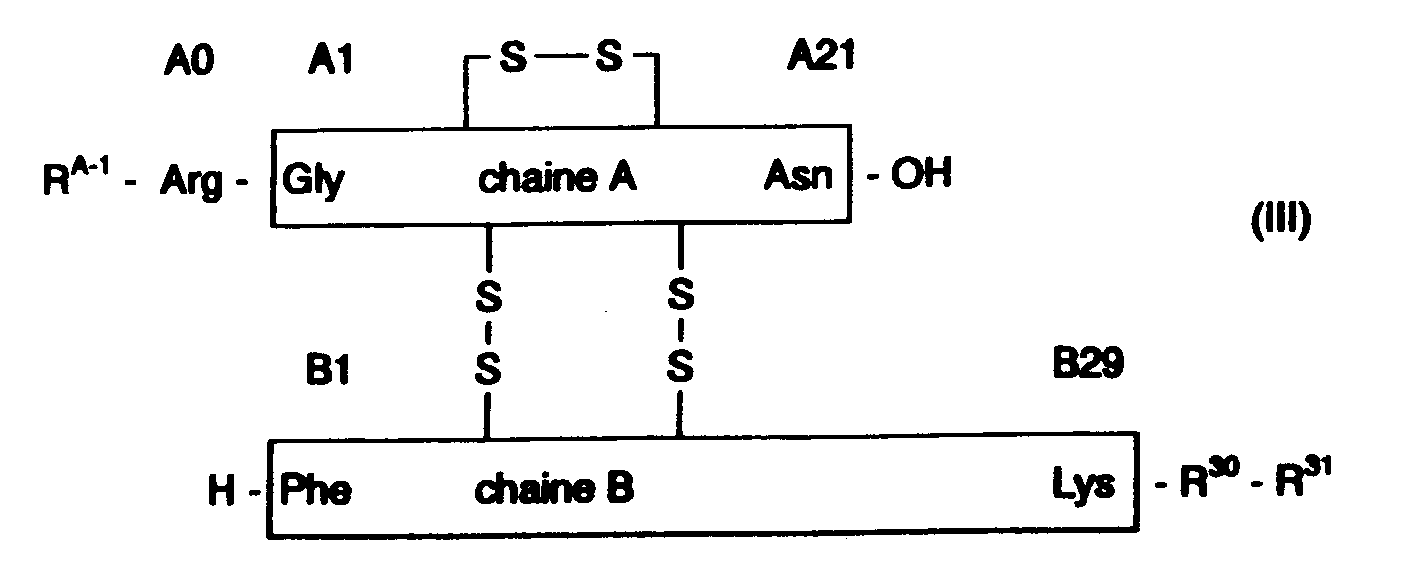 a)R³⁰ et R³¹ signifient ensemble OH oub)R³⁰ signifie un reste d'un L-aminoacide neutre codable génétiquement etR³¹ signifie OH ou 1 à 3 α-aminoacides, etc)RA-1 signifie un reste d' un L-aminoacide neutre codable génétiquement du groupe Thr, Ser ou Ala; ainsi que les sels physiologiquement acceptables du dérivé de l'insuline de formule III.
- Dérivés de l'insuline et leurs sels physiologiquement acceptables selon la revendication 1, caractérisés en ce que, dans la formule III,a)R³⁰ + R³¹ = OH oub)R³⁰ = reste d'Ala, Thr ou Ser, en particulier de Thr, et R³¹ = OH, etc)RA-1 = Thr.
- Dérivés de l'insuline et leurs sels physiologiquement acceptables selon la revendication 1 ou 2, caractérisés en ce que, dans la formule III
a) R³⁰ + R³¹ = OH et c) RA-1 = Thr. - Dérives de l'insuline et leurs sels physiologiquement acceptables selon une ou plusieurs des revendications 1 à 3, caractérisés en ce que, dans la formule III, la chaîne A et la chaîne B(B1 - B29) sont les séquences de l'insuline humaine, de porc, de lapin ou de boeuf, de préférence de l'insuline humaine, de porc ou de lapin.
- Dérivés de l'insuline selon une ou plusieurs des revendications 1 à 4, caractérisés par un point isoélectrique compris entre 5,5 et 9,0.
- Procédé pour la préparation des dérivés de l'insuline de formule III selon la définition énoncée dans une ou plusieurs des revendications 1 à 5, caractérisé en ce quea) un produit insulinique de formule IV
 AS = aminoacide(s) codables(s) génétiquement,x, z indépendants l'un de l'autre = 0 ou entier de 1 à 50, mais si x ≠ 0, alors z ≠ 0 également,R = groupe organique comprenant jusqu'à 50 atomes de C, de préférence un reste d' aminoacide génétiquement codable ou un reste peptidique constitué de deux ou de plusieurs aminoacides génétiquement codables, identiques ou différents,Y = Lys ou Arg,et les chaînes A et B(1 à 29) représentent de préférence les séquences de l'insuline humaine, de porc, de lapin ou de boeuf, en particulier de l'insuline humaine, de porc ou de lapin,
est mis contact avec une lysylendopeptidase, ce qui provoque la scission des liaisons à l'extrémité C-terminale des restes lysyle, et - dans le cas où Y = Lys - les composés de formule III où R³⁰ + R³¹ ensemble représentent OH et RA-1 est un acide aminé génétiquement codable sont obtenus, ou bien - dans le cas où Y = Arg - on les met encore en présence de trypsine ou d'une endopeptidase semblable à la trypsine, ce qui provoque la scission de la séquence pré-aminoacide R-Arg de la chaîne B et on obtient également un composé de formule III où R³⁰ + R³¹ ensemble représentent OH et RA-1 est un aminoacide génétiquement codable, ou bien en ce queb) un produit insulinique éventuellement protégé, de formule V,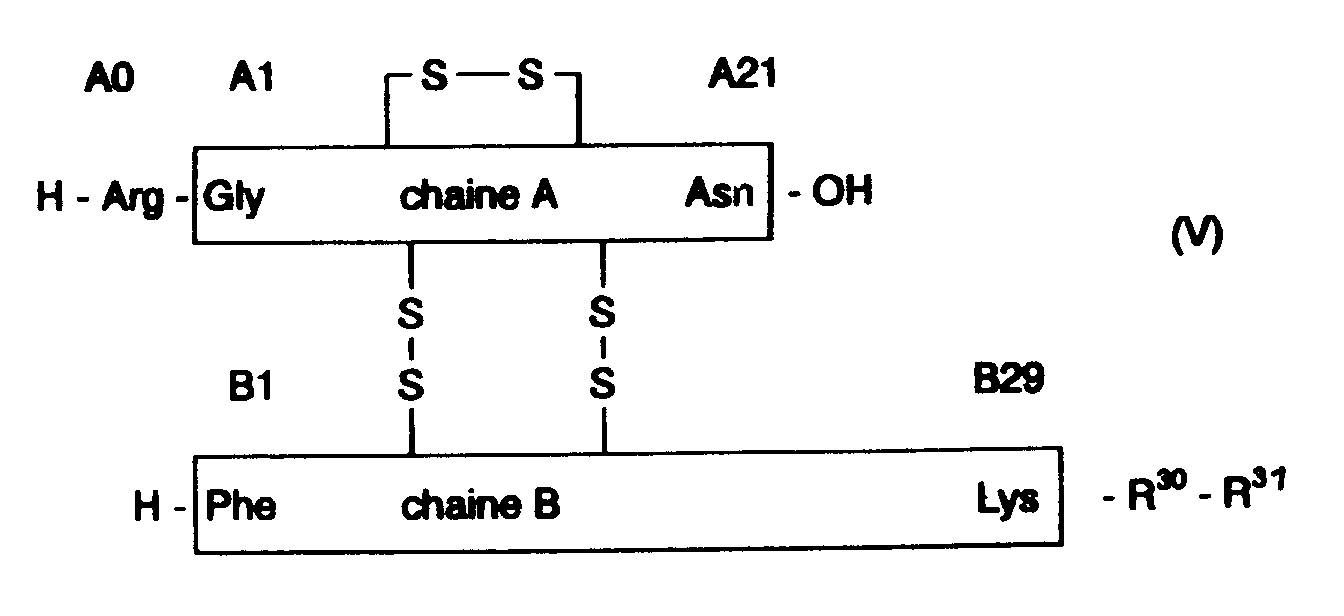
- Utilisation des dérivés de l'insuline et de leurs sels physiologiquement acceptables selon une ou plusieurs des revendications 1 à 5, en tant que principe actif dans des compositions pharmaceutiques pour le traitement du diabète sucré.
- Composition pharmaceutique caractérisée par sa teneur en au moins un des dérivés de l'insuline de formule III et/ou au moins un de ses sels physiologiquement acceptables selon la définition donnée dans une ou plusieurs des revendications 1 à 5, sous forme solubilisée, amorphe et/ou cristalline, de préférence amorphe et/ou cristalline.
- Composition pharmaceutique selon la revendication 8, caractérisée par sa teneur en au moins un des dérivés de l'insuline suivants - correspondant à la formule III -
(A-1)Thr-A0-Arg-insuline humaine,
(A-1)Thr-A0-Arg-insuline de porc,
(A-1)Thr-A0-Arg-insuline de lapin,
(A-1)Thr-A0-Arg-insuline de boeuf et
(A-1)Thr-A0-Arg-Des-B30-insuline humaine,
de préférence seulement la (A-1 )Thr-A0-Arg-Des-B30-insuline humaine et ses sels physiologiquement acceptables. - Composition pharmaceutique selon la revendication 8 ou 9 sous forme de solution ou suspension injectable de pH compris entre environ 3,0 et 9,0, de préférence entre environ 5,0 et 8,5.
- Procédé pour la préparation d'une composition pharmaceutique selon une ou plusieurs des revendications 8 à 10, caractérisé en ce que l'on met sous une forme appropriée de présentation, au moins un dérivé de l'insuline de formule III et/ou au moins un de ses sels physiologiquement acceptables, éventuellement avec d'autres (dérivés de l') insuline(s), modifié(e)s et/ou non modifié(e)s, avec un véhicule physiologiquement acceptable ainsi qu'éventuellement des substances additionnelles et/ou auxiliaires appropriées.
Applications Claiming Priority (2)
| Application Number | Priority Date | Filing Date | Title |
|---|---|---|---|
| DE3936876A DE3936876A1 (de) | 1989-11-06 | 1989-11-06 | Neue insulinderivate, verfahren zu deren herstellung, ihre verwendung und eine sie enthaltende pharmazeutische zubereitung |
| DE3936876 | 1989-11-06 |
Publications (2)
| Publication Number | Publication Date |
|---|---|
| EP0427162A1 EP0427162A1 (fr) | 1991-05-15 |
| EP0427162B1 true EP0427162B1 (fr) | 1996-05-08 |
Family
ID=6392948
Family Applications (1)
| Application Number | Title | Priority Date | Filing Date |
|---|---|---|---|
| EP90121101A Expired - Lifetime EP0427162B1 (fr) | 1989-11-06 | 1990-11-03 | Nouveaux dérivés de l'insuline, leur préparation, leur usage et une composition pharmaceutique les contenant |
Country Status (18)
| Country | Link |
|---|---|
| US (1) | US5149716A (fr) |
| EP (1) | EP0427162B1 (fr) |
| JP (1) | JP3131215B2 (fr) |
| KR (1) | KR910009930A (fr) |
| AT (1) | ATE137765T1 (fr) |
| AU (1) | AU6577290A (fr) |
| CA (1) | CA2029289A1 (fr) |
| DE (2) | DE3936876A1 (fr) |
| DK (1) | DK0427162T3 (fr) |
| ES (1) | ES2087879T3 (fr) |
| FI (1) | FI905439A7 (fr) |
| GR (1) | GR3020095T3 (fr) |
| HU (1) | HU205773B (fr) |
| IE (1) | IE903978A1 (fr) |
| IL (1) | IL96239A0 (fr) |
| NO (1) | NO904808L (fr) |
| PT (1) | PT95788A (fr) |
| ZA (1) | ZA908842B (fr) |
Families Citing this family (18)
| Publication number | Priority date | Publication date | Assignee | Title |
|---|---|---|---|---|
| US6875589B1 (en) * | 1988-06-23 | 2005-04-05 | Hoechst Aktiengesellschaft | Mini-proinsulin, its preparation and use |
| TW224471B (fr) * | 1991-11-26 | 1994-06-01 | Lilly Co Eli | |
| JP3406244B2 (ja) | 1999-04-30 | 2003-05-12 | 伊藤ハム株式会社 | 新規な融合蛋白質からの組み換えインスリンの製造方法 |
| AU2002346490A1 (en) * | 2001-12-20 | 2003-07-09 | Eli Lilly And Company | Insulin molecule having protracted time action |
| WO2004096854A2 (fr) * | 2003-04-29 | 2004-11-11 | Eli Lilly And Company | Analogues de l'insuline ayant une action prolongee |
| US7833513B2 (en) | 2004-12-03 | 2010-11-16 | Rhode Island Hospital | Treatment of Alzheimer's Disease |
| US8343914B2 (en) * | 2006-01-06 | 2013-01-01 | Case Western Reserve University | Fibrillation resistant proteins |
| EP2074140B8 (fr) * | 2006-10-04 | 2015-10-28 | Case Western Reserve University | Insuline et analogues de l'insuline résistants à la fibrillation |
| WO2009129250A2 (fr) * | 2008-04-14 | 2009-10-22 | Case Western Reserve University | Analogues de l'insuline à prendre au moment des repas de stabilité améliorée |
| AU2009240636A1 (en) * | 2008-04-22 | 2009-10-29 | Case Western Reserve University | Isoform-specific insulin analogues |
| KR20120129875A (ko) | 2008-07-31 | 2012-11-28 | 케이스 웨스턴 리저브 유니버시티 | 염소화 아미노산을 갖는 인슐린 유사체 |
| US9200053B2 (en) | 2008-07-31 | 2015-12-01 | Case Western Reserve University | Insulin analogues containing penta-fluoro-Phenylalanine at position B24 |
| PH12011502708B1 (en) | 2009-07-06 | 2017-11-10 | Sanofi Aventis Deutschland | Insulin preparations containing methionine |
| US8399407B2 (en) * | 2009-09-17 | 2013-03-19 | Case Western Reserve University | Non-standard insulin analogues |
| RU2012123642A (ru) | 2009-12-11 | 2014-01-20 | Кейз Вестерн Ризев Юнивесити | Аналоги инсулина, содержащие хлорированные аминокислоты |
| RU2447149C1 (ru) * | 2011-03-24 | 2012-04-10 | Винсорт Менеджемент Инк | РЕКОМБИНАНТНАЯ ПЛАЗМИДНАЯ ДНК pMSIN4, КОДИРУЮЩАЯ ГИБРИДНЫЙ ПОЛИПЕПТИД - ПРЕДШЕСТВЕННИК ИНСУЛИНА ЧЕЛОВЕКА, ШТАММ BL21(DE3)/pMSIN4-ПРОДУЦЕНТ РЕКОМБИНАНТНОГО ИНСУЛИНА ЧЕЛОВЕКА, СПОСОБ ПОЛУЧЕНИЯ РЕКОМБИНАНТНОГО ИНСУЛИНА ЧЕЛОВЕКА |
| EP3517122A1 (fr) | 2013-04-03 | 2019-07-31 | Sanofi | Traitement du diabète sucré par des formulations à action prolongée d'insulines |
| AU2015328222B9 (en) | 2014-10-06 | 2020-12-24 | Case Western Reserve University | Biphasic single-chain insulin analogues |
Family Cites Families (9)
| Publication number | Priority date | Publication date | Assignee | Title |
|---|---|---|---|---|
| DE3326472A1 (de) * | 1983-07-22 | 1985-02-14 | Hoechst Ag, 6230 Frankfurt | Neue insulin-derivate, verfahren zu deren herstellung und deren verwendung sowie pharmazeutische mittel zur behandlung des diabetes mellitus |
| DE3326473A1 (de) * | 1983-07-22 | 1985-01-31 | Hoechst Ag, 6230 Frankfurt | Pharmazeutisches mittel zur behandlung des diabetes mellitus |
| DE3327928A1 (de) * | 1983-08-03 | 1985-02-21 | Hoechst Ag, 6230 Frankfurt | Verfahren zur herstellung von insulin-derivaten |
| DE3333640A1 (de) * | 1983-09-17 | 1985-04-25 | Hoechst Ag, 6230 Frankfurt | Verfahren zur herstellung von insulin-derivaten, deren b-kette c-terminal verlaengert ist, neue basisch modifizierte insulin-derivate diese enthaltende mittel und ihre verwendung |
| DK113585D0 (da) * | 1985-03-12 | 1985-03-12 | Novo Industri As | Nye peptider |
| DK347086D0 (da) * | 1986-07-21 | 1986-07-21 | Novo Industri As | Novel peptides |
| DE3714866A1 (de) * | 1987-05-05 | 1988-11-24 | Hoechst Ag | Verfahren zur herstellung von fremdproteinen in streptomyceten |
| DE3837273A1 (de) * | 1987-05-05 | 1990-05-10 | Hoechst Ag | Verfahren zur herstellung eines insulin-vorprodukts in streptomyceten |
| DE3844211A1 (de) * | 1988-12-29 | 1990-07-05 | Hoechst Ag | Neue insulinderivate, verfahren zu deren herstellung, ihre verwendung und eine sie enthaltende pharmazeutische zubereitung |
-
1989
- 1989-11-06 DE DE3936876A patent/DE3936876A1/de not_active Withdrawn
-
1990
- 1990-10-26 US US07/603,835 patent/US5149716A/en not_active Expired - Lifetime
- 1990-11-02 FI FI905439A patent/FI905439A7/fi not_active Application Discontinuation
- 1990-11-03 DK DK90121101.1T patent/DK0427162T3/da active
- 1990-11-03 ES ES90121101T patent/ES2087879T3/es not_active Expired - Lifetime
- 1990-11-03 DE DE59010316T patent/DE59010316D1/de not_active Expired - Lifetime
- 1990-11-03 EP EP90121101A patent/EP0427162B1/fr not_active Expired - Lifetime
- 1990-11-03 AT AT90121101T patent/ATE137765T1/de not_active IP Right Cessation
- 1990-11-05 IE IE397890A patent/IE903978A1/en unknown
- 1990-11-05 CA CA002029289A patent/CA2029289A1/fr not_active Abandoned
- 1990-11-05 IL IL96239A patent/IL96239A0/xx unknown
- 1990-11-05 ZA ZA908842A patent/ZA908842B/xx unknown
- 1990-11-05 AU AU65772/90A patent/AU6577290A/en not_active Abandoned
- 1990-11-05 NO NO90904808A patent/NO904808L/no unknown
- 1990-11-05 JP JP02297376A patent/JP3131215B2/ja not_active Expired - Lifetime
- 1990-11-05 PT PT95788A patent/PT95788A/pt not_active Application Discontinuation
- 1990-11-05 HU HU907026A patent/HU205773B/hu not_active IP Right Cessation
- 1990-11-06 KR KR1019900017864A patent/KR910009930A/ko not_active Withdrawn
-
1996
- 1996-05-30 GR GR960401457T patent/GR3020095T3/el unknown
Non-Patent Citations (1)
| Title |
|---|
| "Binding of insulin to bovine liver plasma membrane" * |
Also Published As
| Publication number | Publication date |
|---|---|
| KR910009930A (ko) | 1991-06-28 |
| IE903978A1 (en) | 1991-05-08 |
| FI905439A7 (fi) | 1991-05-07 |
| DK0427162T3 (da) | 1996-09-16 |
| EP0427162A1 (fr) | 1991-05-15 |
| US5149716A (en) | 1992-09-22 |
| HUT55804A (en) | 1991-06-28 |
| ES2087879T3 (es) | 1996-08-01 |
| HU205773B (en) | 1992-06-29 |
| JPH03169895A (ja) | 1991-07-23 |
| IL96239A0 (en) | 1991-08-16 |
| PT95788A (pt) | 1991-09-13 |
| DE3936876A1 (de) | 1991-05-23 |
| ZA908842B (en) | 1991-08-28 |
| ATE137765T1 (de) | 1996-05-15 |
| DE59010316D1 (de) | 1996-06-13 |
| NO904808L (no) | 1991-05-07 |
| FI905439A0 (fi) | 1990-11-02 |
| NO904808D0 (no) | 1990-11-05 |
| HU907026D0 (en) | 1991-05-28 |
| JP3131215B2 (ja) | 2001-01-31 |
| AU6577290A (en) | 1991-05-09 |
| GR3020095T3 (en) | 1996-08-31 |
| CA2029289A1 (fr) | 1991-05-07 |
Similar Documents
| Publication | Publication Date | Title |
|---|---|---|
| EP0376156B1 (fr) | Nouveaux dérivés d'insuline, procédé de leur fabrication, leur utilisation et composés pharmaceutiques les contenant | |
| DE69632224T2 (de) | Reduzierung von Gelation von Fettsäureacylierten Proteinen unter Nutzung von Zitratpuffer | |
| EP1161452B1 (fr) | Dimeres d'insuline pontes de maniere covalente | |
| EP0132770B1 (fr) | Dérivés de l'insuline, procédés pour leur préparation, leur utilisation et compositions pharmaceutiques pour le traitement du diabète mellitus | |
| EP0368187B1 (fr) | Dérivés d'insuline, leur emploi et une composition pharmaceutique les contenant | |
| DE3685668T2 (de) | Peptide. | |
| EP0132769B1 (fr) | Produit pharmaceutique pour le traitement du diabète mellitus | |
| DE69631996T2 (de) | Verfahren zur Herstellung von acylierten Proteinpuder | |
| EP2229406B1 (fr) | Nouveaux dérivés d'insuline à profil temporel/d'action extrêmement retardé | |
| EP0140084B1 (fr) | Procédé pour la préparation de dérivés de l'insuline, dont la chaîne B est allongée en position C-terminale, dérivés de l'insuline modifiés par de la base, composés les contenant et leur utilisation | |
| EP0427162A1 (fr) | Nouveaux dérivés de l'insuline, leur préparation, leur usage et une composition pharmaceutique les contenant | |
| DE3687500T2 (de) | Insulinabkoemmlinge und arzneimittel die diese enthalten. | |
| EP2229407A2 (fr) | Nouveaux dérivés d'insuline à profil temporel/d'action extrêmement retardé | |
| DD273839A5 (de) | Verfahren zur herstellung neuer insulinderivate | |
| EP0056951B1 (fr) | Procédé de préparation d'insuline humaine ou de ses dérivés à partir d'insuline de porc ou de ses dérivés | |
| DE69003595T2 (de) | Mikroproteine, Verfahren zur Herstellung derselben und Anwendung dieser Mikroproteine als Arzneimittel. | |
| DE19735711A1 (de) | Verbessertes Verfahren zur Gewinnung von Insulinvorläufern mit korrekt verbundenen Cystinbrücken | |
| DE3104949A1 (de) | Verfahren zur herstellung von threonin(pfeil hoch)b(pfeil hoch)(pfeil hoch)3(pfeil hoch)(pfeil hoch)0(pfeil hoch)-estern menschlichen insulins sowie threonin(pfeil hoch)b(pfeil hoch)(pfeil hoch)3(pfeil hoch)(pfeil hoch)0(pfeil hoch)-ester menschlichen insulins | |
| EP0046979A1 (fr) | Analogues d'insuline | |
| EP0135720B1 (fr) | Procédé de préparation de dérivés d'insuline | |
| DE102008062136B4 (de) | Pharmazeutische Zusammensetzung auf Basis von Peptid aus Kamelmilch | |
| EP0089007B1 (fr) | Procédé de transformation d'analogues de préproinsulines en insulines | |
| DE69829953T2 (de) | Kristallisation von proteinen | |
| EP0622376B1 (fr) | Amorphes formes monosphériques de dérivés d'insuline | |
| DE102008025007A1 (de) | Neue Insulinderivate mit extrem verzögertem Zeit-/ Wirkungsprofil |
Legal Events
| Date | Code | Title | Description |
|---|---|---|---|
| PUAI | Public reference made under article 153(3) epc to a published international application that has entered the european phase |
Free format text: ORIGINAL CODE: 0009012 |
|
| 17P | Request for examination filed |
Effective date: 19901221 |
|
| AK | Designated contracting states |
Kind code of ref document: A1 Designated state(s): AT BE CH DE DK ES FR GB GR IT LI LU NL SE |
|
| 17Q | First examination report despatched |
Effective date: 19940728 |
|
| GRAH | Despatch of communication of intention to grant a patent |
Free format text: ORIGINAL CODE: EPIDOS IGRA |
|
| GRAA | (expected) grant |
Free format text: ORIGINAL CODE: 0009210 |
|
| AK | Designated contracting states |
Kind code of ref document: B1 Designated state(s): AT BE CH DE DK ES FR GB GR IT LI LU NL SE |
|
| REF | Corresponds to: |
Ref document number: 137765 Country of ref document: AT Date of ref document: 19960515 Kind code of ref document: T |
|
| REF | Corresponds to: |
Ref document number: 59010316 Country of ref document: DE Date of ref document: 19960613 |
|
| REG | Reference to a national code |
Ref country code: ES Ref legal event code: BA2A Ref document number: 2087879 Country of ref document: ES Kind code of ref document: T3 |
|
| ITF | It: translation for a ep patent filed | ||
| ET | Fr: translation filed | ||
| REG | Reference to a national code |
Ref country code: GR Ref legal event code: FG4A Free format text: 3020095 |
|
| REG | Reference to a national code |
Ref country code: ES Ref legal event code: FG2A Ref document number: 2087879 Country of ref document: ES Kind code of ref document: T3 |
|
| GBT | Gb: translation of ep patent filed (gb section 77(6)(a)/1977) |
Effective date: 19960730 |
|
| REG | Reference to a national code |
Ref country code: DK Ref legal event code: T3 |
|
| PLBE | No opposition filed within time limit |
Free format text: ORIGINAL CODE: 0009261 |
|
| STAA | Information on the status of an ep patent application or granted ep patent |
Free format text: STATUS: NO OPPOSITION FILED WITHIN TIME LIMIT |
|
| 26N | No opposition filed | ||
| REG | Reference to a national code |
Ref country code: GB Ref legal event code: IF02 |
|
| PGFP | Annual fee paid to national office [announced via postgrant information from national office to epo] |
Ref country code: LU Payment date: 20091118 Year of fee payment: 20 Ref country code: DK Payment date: 20091117 Year of fee payment: 20 Ref country code: CH Payment date: 20091113 Year of fee payment: 20 Ref country code: AT Payment date: 20091111 Year of fee payment: 20 Ref country code: ES Payment date: 20091201 Year of fee payment: 20 Ref country code: SE Payment date: 20091106 Year of fee payment: 20 |
|
| PGFP | Annual fee paid to national office [announced via postgrant information from national office to epo] |
Ref country code: NL Payment date: 20091104 Year of fee payment: 20 |
|
| PGFP | Annual fee paid to national office [announced via postgrant information from national office to epo] |
Ref country code: GB Payment date: 20091028 Year of fee payment: 20 Ref country code: FR Payment date: 20091123 Year of fee payment: 20 Ref country code: IT Payment date: 20091112 Year of fee payment: 20 |
|
| PGFP | Annual fee paid to national office [announced via postgrant information from national office to epo] |
Ref country code: GR Payment date: 20091015 Year of fee payment: 20 Ref country code: DE Payment date: 20091130 Year of fee payment: 20 Ref country code: BE Payment date: 20091130 Year of fee payment: 20 |
|
| REG | Reference to a national code |
Ref country code: NL Ref legal event code: V4 Effective date: 20101103 |
|
| REG | Reference to a national code |
Ref country code: CH Ref legal event code: PL |
|
| REG | Reference to a national code |
Ref country code: DK Ref legal event code: EUP |
|
| REG | Reference to a national code |
Ref country code: GB Ref legal event code: PE20 Expiry date: 20101102 |
|
| BE20 | Be: patent expired |
Owner name: *HOECHST A.G. Effective date: 20101103 |
|
| PG25 | Lapsed in a contracting state [announced via postgrant information from national office to epo] |
Ref country code: NL Free format text: LAPSE BECAUSE OF EXPIRATION OF PROTECTION Effective date: 20101103 |
|
| EUG | Se: european patent has lapsed | ||
| PG25 | Lapsed in a contracting state [announced via postgrant information from national office to epo] |
Ref country code: GB Free format text: LAPSE BECAUSE OF EXPIRATION OF PROTECTION Effective date: 20101102 |
|
| PG25 | Lapsed in a contracting state [announced via postgrant information from national office to epo] |
Ref country code: DE Free format text: LAPSE BECAUSE OF EXPIRATION OF PROTECTION Effective date: 20101103 |
|
| REG | Reference to a national code |
Ref country code: ES Ref legal event code: FD2A Effective date: 20130719 |
|
| PG25 | Lapsed in a contracting state [announced via postgrant information from national office to epo] |
Ref country code: ES Free format text: LAPSE BECAUSE OF EXPIRATION OF PROTECTION Effective date: 20101104 |