EP0429002A2 - Thermo-Druckkopf - Google Patents
Thermo-Druckkopf Download PDFInfo
- Publication number
- EP0429002A2 EP0429002A2 EP90121860A EP90121860A EP0429002A2 EP 0429002 A2 EP0429002 A2 EP 0429002A2 EP 90121860 A EP90121860 A EP 90121860A EP 90121860 A EP90121860 A EP 90121860A EP 0429002 A2 EP0429002 A2 EP 0429002A2
- Authority
- EP
- European Patent Office
- Prior art keywords
- fine wires
- pair
- electrode
- fine
- thermal recording
- Prior art date
- Legal status (The legal status is an assumption and is not a legal conclusion. Google has not performed a legal analysis and makes no representation as to the accuracy of the status listed.)
- Withdrawn
Links
Images


Classifications
-
- B—PERFORMING OPERATIONS; TRANSPORTING
- B41—PRINTING; LINING MACHINES; TYPEWRITERS; STAMPS
- B41J—TYPEWRITERS; SELECTIVE PRINTING MECHANISMS, i.e. MECHANISMS PRINTING OTHERWISE THAN FROM A FORME; CORRECTION OF TYPOGRAPHICAL ERRORS
- B41J2/00—Typewriters or selective printing mechanisms characterised by the printing or marking process for which they are designed
- B41J2/315—Typewriters or selective printing mechanisms characterised by the printing or marking process for which they are designed characterised by selective application of heat to a heat sensitive printing or impression-transfer material
- B41J2/32—Typewriters or selective printing mechanisms characterised by the printing or marking process for which they are designed characterised by selective application of heat to a heat sensitive printing or impression-transfer material using thermal heads
- B41J2/345—Typewriters or selective printing mechanisms characterised by the printing or marking process for which they are designed characterised by selective application of heat to a heat sensitive printing or impression-transfer material using thermal heads characterised by the arrangement of resistors or conductors
-
- B—PERFORMING OPERATIONS; TRANSPORTING
- B41—PRINTING; LINING MACHINES; TYPEWRITERS; STAMPS
- B41J—TYPEWRITERS; SELECTIVE PRINTING MECHANISMS, i.e. MECHANISMS PRINTING OTHERWISE THAN FROM A FORME; CORRECTION OF TYPOGRAPHICAL ERRORS
- B41J2/00—Typewriters or selective printing mechanisms characterised by the printing or marking process for which they are designed
- B41J2/315—Typewriters or selective printing mechanisms characterised by the printing or marking process for which they are designed characterised by selective application of heat to a heat sensitive printing or impression-transfer material
- B41J2/32—Typewriters or selective printing mechanisms characterised by the printing or marking process for which they are designed characterised by selective application of heat to a heat sensitive printing or impression-transfer material using thermal heads
- B41J2/335—Structure of thermal heads
Definitions
- the present invention relates to a thermal recording head for printing, and more specifically, a thermal recording head for use in a facsimile and an electronic printer and for heating corresponding to a signal current to develop a thermal recording media such as thermosensible paper to record information on the media.
- thermosensible paper As a recording media of a facsimile and there have been proposed various kinds of thermal recording heads for recording information on the paper.
- Figs. 5 and 6 respectively show general constructions of conventional thermal recording heads.
- a narrow comb-shaped electrode (a) and a narrow strip-shaped signal electrode (b) separated every recording dot are alternativeivelyly arranged to confront with each other as if the comb-shaped electrode (a) and the narrow strip-shaped signal electrode (b) are engaged with each other, and the narrow comb-shaped electrodes (a) are integrally connected to each other to construct a common electrode (A).
- Material for resistance heating element such as ruthenium oxide is coated on the whole portion where both the electrodes (a) and (b) are alternatively arranged to cross over the portion so as to construct the resistance heating element (C).
- the thermal recording head when a signal current corresponding to information to record is applied between each signal electrode (b) and the common electrode (A), the portion of the element (C) partially generates heat through which each signal electrode (b) is connected to the comb-shaped electrode (a). Then, the heat of the element (C) is transferred to a recording media for recording the information to record on the media.
- the element (C) of the thermal recording head is formed with thick-film technology, resulting in a relatively simple manufacturing process and lower manufacturing cost.
- a signal electrode (b) is linearly arranged confronting each comb-shaped electrode (a) of a common electrode (A) and a resistance heating element (C) is formed between each comb-shaped electrode (a) and each signal electrode (b) by metallizing etc.
- the comb-shaped electrode (a) and the signal electrode (b) are confronted to each other and the element (C) is formed with thin-film technology, resulting in relatively higher density of the electrodes.
- heat generation unit i.e., the magnitude of heat generation dot of a thermal recording head is required to become smaller and higher in density and, therefore each electrode must have a narrow width and the interval between the adjacent electrodes must become smaller.
- an electrode circuit for connecting to a resistance heating element to apply an electric current thereto is formed in the similar method as that in a normal printed-circuit.
- the width of the electrode and the interval between the electrodes have a limitation.
- an electrodes is formed exposing on the surface of an insulating substrate, and then when the width of the electrode becomes narrow or the interval between the electrodes becomes smaller, the electrodes are short-circuited or damaged with foreign substance attached to the electrodes in a manufacturing process, resulting in poor circuit, lack of reliability thereof, and poor product yield rate.
- only eight electrodes can be formed per 1mm, so that it is impossible that the product yield rate increases more than 80% in a conventional thermal recording head.
- the signal electrode (b) and the comb-shaped electrode (a) of the common electrode (A) are alternatively arranged, and thus the interval between the signal electrodes (b), i.e., the heat generation unit of the element becomes unnecessarily wider, resulting in prevention of high density of the electrodes.
- the element is formed with the thin-film technology such as metallizing method and then a scaled-up thermal recording head cannot enter a metallizing apparatus.
- an essential object of the present invention is to provide a thermal recording head to remedy the above-described issues and arranged with high density, improved product yield rate, and correspond to scaling-up of the head at lower manufacturing cost.
- a thermal recording head comprising: a pair of electrode fine wires of which a peripheral surface of each electrically conductive core is covered with an insulating layer, each electrode fine wire in the pair of fine wires being arranged to form each line while end surfaces of the pair of fine wires confront each other through a space; and a resistance heating element arranged in the space, electrically connected the cores exposed at the end surfaces of the pair of fine wires with each other to apply a signal current to the pair of fine wires, and generating heat in correspondence with the current.
- a thermal recording head comprising: a pair of electrode fine wires of which a peripheral surface of each electrically conductive core is covered with an insulating layer, the pair of fine wires being arranged to form a line while end surfaces of the pair of fine wires are lined up with each other; and a resistance heating element arranged at ends of the fine wires, electrically connected the cores exposed at the end surfaces of the pair of fine wires with each other to apply a signal current to the pair of fine wires, and generating heat in correspondence with the current.
- each core of the fine wires is covered with the insulating layer and the pair of fine wires are arranged to form one or two lines, the wire diameter of each fine wire can become smaller and thus the width of the electrode can be considerably reduced compared with that of a conventional electrode in a printed-circuit.
- the fine wires are arranged closely contacting with each other, the cores of the adjacent fine wires are electrically and reliably insulated through the insulating layers of the fine wires, resulting in prevention of short-circuit. Therefore, as compared with the electrode construction in a conventional printed-circuit, electrodes can be closely arranged with higher density according to the aspects of the present invention, resulting in small heat generation unit and high density arrangement of the electrodes.
- the core of each fine wire is covered with the insulating layer, it can prevent poor circuits such as short-circuit or cutoff caused by attaching foreign substance and damaging the core in a manufacturing process, resulting in considerable improvement of product yield rate.
- the number of the fine wires arranged can be arbitrarily increased and then the element can be formed on the fine wires with means for forming the element such as a coating means to construct a thermal recording head. Therefore, the size of the thermal recoding head can be arbitrarily designed.
- Figs. 1 and 2 show one embodiment of the present invention.
- Each of electrode fine wires 10 and 20 is so constructed that an electrically conductive core 30, made of electrically conductive metal such as copper, aluminum, or gold is covered with an insulating layer 40 such as polyurethane or polyimide.
- An insulating layer 40 such as polyurethane or polyimide.
- a large number of electrode fine wires 10 and 20 are arranged in parallel on an insulating substrate (not shown) made of synthetic resin etc. while the end surfaces of the fine wires 10 and 20 are lined up to each other.
- a plotter has a diameter of 40-70 ⁇ m.
- the fine wires 10 and 20 are similar to those for use in a precision micromotor for rotation of sound equipment.
- a groove-shaped space 60 with a specified width is formed between the end surfaces of a row of fine wires 10 and those of a row of fine wires 20 while the end surfaces of the two rows are confronted with each other.
- Each fine wire 10 in the row is linearly arranged confronting each fine wire 20 in the row.
- a large number of pairs each of which is comprised of the fine wires 10 and 20 are arranged in parallel.
- Each interval between the adjacent fine wires of each row is relatively small as shown in Fig. 2.
- An insulating layer 40 can be arranged between the adjacent fine wires of each row.
- the following manner is suitable: after an electrode fine wire is fixedly arranged at an insulating substrate, the middle of the fine wire is cut and removed therefrom by a specified width with a laser machining, with the result that a pair of electrode fine wires 10 and 20 are arranged while the cut end surface of the fine wires confront each other and the core 30 which the insulating layer 40 surrounds is exposed at each end surface of the fine wires 10 and 20.
- a large number of pairs of the fine wires 10 and 20 are fixedly arranged by the following manner as one example.
- the fine wires 10 and 20 are integrally fixed by burying in synthetic resin and then molding. Thereafter, the middle of each fine wire is cut and removed therefrom with the laser machining. As a result, a large number of pairs of electrode fine wires 10 and 20 are arranged while each cut end surface of the electrode fine wires 10 and 20 confronts each other through the space 60.
- the adjacent fine wires 10 and the adjacent fine wires 20 can be respectively arranged through a space or closely contacting with each other without a space.
- the adjacent fine wires 10 and the adjacent fine wires 20 can be respectively arranged so that the laterally opposing insulating layers 40 contacting the fine wires 10 and 20 can closely contact with each other.
- the magnitude of heat generation unit and the interval of a resistance heating element described below can be arbitrarily set.
- the fine wires 10 and 20 are connected to a suitable wiring circuit so that one of the fine wires 10 and 20, e.g. the fine wires 20, are common electrodes while the other of the fine wires 10 and 20, e.g. the fine wires 10, are signal electrodes.
- the concrete construction of the wiring circuit is similar to that of a drive circuit similarly to a normal thermal recording head, and then the detail description thereof is omitted.
- the drive circuit can be a normal printed-circuit. Connection between the fine wires 10 and 20 and the drive circuit can be performed with a normal bonding process etc.
- the connecting portions of the other ends of the fine wires 10 and 20 can be bent and elongated corresponding to the electrode arrangement of the drive circuit before the portions thereof are connected to the electrodes of the drive circuit.
- a resistance heating element 50 is arranged along the space 60 while burying the entire space 60 between the confronting end surfaces of the fine wires 10 and 20.
- the element 50 is normally made of resistance heating material similarly to a normal thermal recording head, such as material made by adding glass binder to ruthenium oxide.
- a paste of the above-described resistance heating material is coated over and filled in the space 60 between the fine wires 10 and 20, and then dried and burned.
- means for forming a resistance heating element with a thick-film technology in a known thermal recording head can be applied as the method for forming the element 50.
- each heat generation unit is constructed by each resistance heating element portion arranged between the confronting fine wires 10 and 20 in the continuously formed resistance heating element 50.
- the element 50 is reliably connected to each core 30 exposed at the end surfaces of the fine wires 10 and 20 and is formed so that the upper surface of the element 50 slightly rises than those of the fine wires 10 and 20.
- a protective layer 70 can be formed on the resistance heating element 50 in order to protect the element 50 and improve wear resistance thereof, similarly to a normal thermal recording head.
- the protective layer 70 can be formed with a normal film forming means.
- the other construction of the thermal recording head is similar to that of a normal thermal recording head.
- the thermal recording head is described below.
- a signal current is applied to the fine wire 10 serving as the signal electrode, an electric current flows from the end surface of the fine wire 10 to the end surface of the fine wire 20 through the element 50 to generate heat at only the part of the element 50 where the current flows.
- the signal current is controlled according to information to record, an electric current flows between desired electrode fine wires 10 and 20 to generate heat at the corresponding part of the element 50 during the flow of the current. Therefore, the heat generation unit of the element 50, i.e.
- the magnitude of heat generation dot and the interval of the element 50 can be arbitrarily set by adjusting the interval between the confronting fine wires 10 and 20, i.e. the width of the element 50, the interval between the adjacent fine wires 10, and/or the interval between the adjacent fine wires 20.
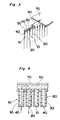
- Figs. 3 and 4 show another embodiment of the present invention which is slightly different from the embodiment shown in Figs. 1 and 2 in construction. Then, the description of the similar construction to the embodiment in Figs. 1 and 2 is omitted instead of addition of the same reference numerals.
- the cores 30 of the adjacent fine wires 10 and 20 are connected with each other through the element 50. That is, the fine wires 10 and 20 respectively serving as common electrodes and signal electrodes are alternatively and sequentially arranged to form only a line. Each of the electrode fine wires 10 and 20 is connected with each drive circuit.
- the element 50 is formed so as to cover the whole end surface of the row of fine wires 10 and 20 and connected with the cores 30 of each of the fine wires 10 and 20.
- the end surface of the element 50 is utilized as a heat generation portion. Therefore, an insulating base (not shown) for fixedly arranging the fine wires 10 and 20 is formed to the vicinity of the end surface of each of the fine wires 10 and 20, and at the end of the fine wires 10 and 20, the element 50 and the protective layer 70 are formed to construct a thermal recording head.
- the material and the basic construction of the fine wires 10 and 20 and the element 50 are similar to those of the aforementioned embodiment.
- the interval between the pair of adjacent fine wires 10 and 20 for flowing a signal current and the interval between another pair of fine wires 10 and 20 arranged outside thereof allow the magnitude of the heat generation unit and the interval of the element 50 to be arbitrarily set.
- a method for covering the whole end surfaces of the fine wires 10 and 20 to form the element 50 is, as one example, as follows;
- the fine wires 10 and 20 arranged to form a line are buried in synthetic resin and then integrally molded and the fine wires 10 and 20 are cut with the resin so that the end surfaces thereof are aligned with a line to expose, the aforementioned resistance heating material paste is coated over the whole end surfaces of the fine wires 10 and 20 and the resin.
- the thermal recording head according to the present invention can be applied to another apparatus such as various kinds of thermal recording heads of an electronic printer and a copying machine except for the thermal recording head of a plotter.
- the thermal recording heads of the embodiments of the present invention since as an electrode for applying an electric current to the resistance heating element, the electrode fine wire of which the peripheral surface of the conductive core is covered with the insulating layer is used, the interval between the electrodes can be considerably reduced in arrangement. Concretely, though only eight conventional electrodes per 1mm can be arranged in the use of a printed circuit, sixteen electrodes or more per 1mm can be arranged and the interval between the electrodes can be arbitrarily set by the embodiments of the present invention. Since the interval between the electrodes corresponds to the heat generation unit of the resistance heating element, the heat generation unit thereof can be smaller, resulting in fine and high quality of the recording information by means of the thermal recording head.
- the conductive cores of the electrodes fine wires are reliably separated from each other through the insulating layer so as not to short-circuit.
- the conductive cores are covered with the insulating layer to prevent any damage and cut off thereof. Therefore, the reliability of the electrodes can be improved and poor electrodes can be reduced in the manufacturing process, resulting in improvement of the product yield. Concretely, in a case where six electrodes are formed per 1mm, the product yield of the conventional printed circuit is about 10% while the product yield of the embodiment according to the present invention can be 90%.
- the number of the fine wires arranged to form one or two lines and the length of the resistance heating element for coating the end surfaces of the fine wires to form the element generally have no limitation, and thus the length of the thermal recording head and the number of the heat generation unit can be freely increased to easily correspond to scaling up of the thermal recording head.
Landscapes
- Electronic Switches (AREA)
Applications Claiming Priority (2)
| Application Number | Priority Date | Filing Date | Title |
|---|---|---|---|
| JP1300441A JPH03159754A (ja) | 1989-11-17 | 1989-11-17 | 感熱印字ヘッド |
| JP300441/89 | 1989-11-17 |
Publications (2)
| Publication Number | Publication Date |
|---|---|
| EP0429002A2 true EP0429002A2 (de) | 1991-05-29 |
| EP0429002A3 EP0429002A3 (en) | 1991-11-27 |
Family
ID=17884838
Family Applications (1)
| Application Number | Title | Priority Date | Filing Date |
|---|---|---|---|
| EP19900121860 Withdrawn EP0429002A3 (en) | 1989-11-17 | 1990-11-15 | Thermal recording head |
Country Status (3)
| Country | Link |
|---|---|
| EP (1) | EP0429002A3 (de) |
| JP (1) | JPH03159754A (de) |
| KR (1) | KR910009448A (de) |
-
1989
- 1989-11-17 JP JP1300441A patent/JPH03159754A/ja active Pending
-
1990
- 1990-11-15 EP EP19900121860 patent/EP0429002A3/en not_active Withdrawn
- 1990-11-17 KR KR1019900018672A patent/KR910009448A/ko not_active Withdrawn
Also Published As
| Publication number | Publication date |
|---|---|
| KR910009448A (ko) | 1991-06-28 |
| EP0429002A3 (en) | 1991-11-27 |
| JPH03159754A (ja) | 1991-07-09 |
Similar Documents
| Publication | Publication Date | Title |
|---|---|---|
| JPS6236873B2 (de) | ||
| EP3928992B1 (de) | Thermodruckkopf und thermodrucker | |
| JPH0557941A (ja) | サーマルヘツド及びその駆動用ic | |
| US4533921A (en) | Electroerosion printhead with tungsten electrodes, and a method for making same | |
| JPH041061A (ja) | 感熱記録ヘッド | |
| JP2818509B2 (ja) | サーマルヘッド | |
| JPH03159754A (ja) | 感熱印字ヘッド | |
| JPH0852890A (ja) | サーマルプリントヘッド | |
| JP3098362B2 (ja) | サーマルヘッド | |
| JPH041062A (ja) | 感熱記録ヘッド | |
| JP2002361919A (ja) | サーマルヘッド | |
| JPH0242737A (ja) | ワイヤボンディングパッド装置 | |
| CN108025558A (zh) | 热敏头以及热敏打印机 | |
| JPS63254058A (ja) | 放電プリンタヘツド | |
| JPS63221053A (ja) | 電極ヘツドの製造方法 | |
| JPH07323595A (ja) | サーマルプリントヘッド | |
| JPS59129171A (ja) | サ−マルヘツド | |
| JPH0632932B2 (ja) | サーマルヘッドの製造方法 | |
| JPS59187859A (ja) | 記録装置 | |
| JPS61171349A (ja) | 電極ヘツド | |
| JPH07276691A (ja) | サーマルプリントヘッド | |
| JPH08207332A (ja) | サーマルヘッド | |
| JPS636869B2 (de) | ||
| JPS5890968A (ja) | サ−マルヘツド | |
| JPS6023054A (ja) | 記録ヘツド |
Legal Events
| Date | Code | Title | Description |
|---|---|---|---|
| PUAI | Public reference made under article 153(3) epc to a published international application that has entered the european phase |
Free format text: ORIGINAL CODE: 0009012 |
|
| 17P | Request for examination filed |
Effective date: 19901115 |
|
| AK | Designated contracting states |
Kind code of ref document: A2 Designated state(s): DE FR GB |
|
| PUAL | Search report despatched |
Free format text: ORIGINAL CODE: 0009013 |
|
| AK | Designated contracting states |
Kind code of ref document: A3 Designated state(s): DE FR GB |
|
| STAA | Information on the status of an ep patent application or granted ep patent |
Free format text: STATUS: THE APPLICATION HAS BEEN WITHDRAWN |
|
| 18W | Application withdrawn |
Withdrawal date: 19921112 |