EP0429313A1 - Procédé de préparation de composite de polymère contenant des grains fins dispersés - Google Patents
Procédé de préparation de composite de polymère contenant des grains fins dispersés Download PDFInfo
- Publication number
- EP0429313A1 EP0429313A1 EP90312760A EP90312760A EP0429313A1 EP 0429313 A1 EP0429313 A1 EP 0429313A1 EP 90312760 A EP90312760 A EP 90312760A EP 90312760 A EP90312760 A EP 90312760A EP 0429313 A1 EP0429313 A1 EP 0429313A1
- Authority
- EP
- European Patent Office
- Prior art keywords
- polymer
- metal
- layer
- fine grains
- polymer layer
- Prior art date
- Legal status (The legal status is an assumption and is not a legal conclusion. Google has not performed a legal analysis and makes no representation as to the accuracy of the status listed.)
- Granted
Links
- 229920000642 polymer Polymers 0.000 title claims abstract description 164
- 239000002131 composite material Substances 0.000 title claims abstract description 58
- 238000004519 manufacturing process Methods 0.000 title claims abstract description 10
- 238000000034 method Methods 0.000 title claims description 28
- 229910052751 metal Inorganic materials 0.000 claims abstract description 77
- 239000002184 metal Substances 0.000 claims abstract description 77
- 229910044991 metal oxide Inorganic materials 0.000 claims abstract description 23
- 150000004706 metal oxides Chemical class 0.000 claims abstract description 23
- 229920001169 thermoplastic Polymers 0.000 claims abstract description 11
- PCHJSUWPFVWCPO-UHFFFAOYSA-N gold Chemical compound [Au] PCHJSUWPFVWCPO-UHFFFAOYSA-N 0.000 claims description 35
- 239000010931 gold Substances 0.000 claims description 33
- 229910052737 gold Inorganic materials 0.000 claims description 32
- 238000002844 melting Methods 0.000 claims description 14
- 230000008018 melting Effects 0.000 claims description 14
- -1 poly(vinylidene fluorides) Polymers 0.000 claims description 10
- 150000002739 metals Chemical class 0.000 claims description 9
- BQCADISMDOOEFD-UHFFFAOYSA-N Silver Chemical compound [Ag] BQCADISMDOOEFD-UHFFFAOYSA-N 0.000 claims description 8
- 238000001771 vacuum deposition Methods 0.000 claims description 8
- 229910052709 silver Inorganic materials 0.000 claims description 7
- 239000004332 silver Substances 0.000 claims description 7
- RYGMFSIKBFXOCR-UHFFFAOYSA-N Copper Chemical compound [Cu] RYGMFSIKBFXOCR-UHFFFAOYSA-N 0.000 claims description 6
- XEEYBQQBJWHFJM-UHFFFAOYSA-N Iron Chemical compound [Fe] XEEYBQQBJWHFJM-UHFFFAOYSA-N 0.000 claims description 6
- 229910052802 copper Inorganic materials 0.000 claims description 6
- 239000010949 copper Substances 0.000 claims description 6
- BASFCYQUMIYNBI-UHFFFAOYSA-N platinum Chemical compound [Pt] BASFCYQUMIYNBI-UHFFFAOYSA-N 0.000 claims description 4
- 238000007712 rapid solidification Methods 0.000 claims description 4
- 229920001903 high density polyethylene Polymers 0.000 claims description 3
- 229910052742 iron Inorganic materials 0.000 claims description 3
- 229920001684 low density polyethylene Polymers 0.000 claims description 3
- 230000002040 relaxant effect Effects 0.000 claims description 3
- 229910052684 Cerium Inorganic materials 0.000 claims description 2
- HCHKCACWOHOZIP-UHFFFAOYSA-N Zinc Chemical compound [Zn] HCHKCACWOHOZIP-UHFFFAOYSA-N 0.000 claims description 2
- GWXLDORMOJMVQZ-UHFFFAOYSA-N cerium Chemical compound [Ce] GWXLDORMOJMVQZ-UHFFFAOYSA-N 0.000 claims description 2
- 229920001778 nylon Polymers 0.000 claims description 2
- 229910052697 platinum Inorganic materials 0.000 claims description 2
- 229920006324 polyoxymethylene Polymers 0.000 claims description 2
- 229910052725 zinc Inorganic materials 0.000 claims description 2
- 239000011701 zinc Substances 0.000 claims description 2
- 239000010408 film Substances 0.000 description 28
- 229920000571 Nylon 11 Polymers 0.000 description 24
- 239000000463 material Substances 0.000 description 24
- 239000011521 glass Substances 0.000 description 17
- 238000001704 evaporation Methods 0.000 description 14
- 239000002861 polymer material Substances 0.000 description 12
- 238000010438 heat treatment Methods 0.000 description 11
- IJGRMHOSHXDMSA-UHFFFAOYSA-N Atomic nitrogen Chemical compound N#N IJGRMHOSHXDMSA-UHFFFAOYSA-N 0.000 description 8
- 238000010586 diagram Methods 0.000 description 8
- 230000000694 effects Effects 0.000 description 8
- 230000008020 evaporation Effects 0.000 description 8
- 229910001220 stainless steel Inorganic materials 0.000 description 8
- 239000010935 stainless steel Substances 0.000 description 8
- 230000000052 comparative effect Effects 0.000 description 7
- 238000001816 cooling Methods 0.000 description 7
- 238000009826 distribution Methods 0.000 description 6
- QPLDLSVMHZLSFG-UHFFFAOYSA-N Copper oxide Chemical compound [Cu]=O QPLDLSVMHZLSFG-UHFFFAOYSA-N 0.000 description 5
- 239000005751 Copper oxide Substances 0.000 description 5
- 238000002441 X-ray diffraction Methods 0.000 description 5
- 229910000431 copper oxide Inorganic materials 0.000 description 5
- BERDEBHAJNAUOM-UHFFFAOYSA-N copper(I) oxide Inorganic materials [Cu]O[Cu] BERDEBHAJNAUOM-UHFFFAOYSA-N 0.000 description 5
- KRFJLUBVMFXRPN-UHFFFAOYSA-N cuprous oxide Chemical compound [O-2].[Cu+].[Cu+] KRFJLUBVMFXRPN-UHFFFAOYSA-N 0.000 description 5
- 238000007738 vacuum evaporation Methods 0.000 description 5
- 230000005540 biological transmission Effects 0.000 description 4
- 239000011888 foil Substances 0.000 description 4
- 239000007788 liquid Substances 0.000 description 4
- 229910052757 nitrogen Inorganic materials 0.000 description 4
- 230000000149 penetrating effect Effects 0.000 description 4
- 239000010409 thin film Substances 0.000 description 4
- JHWNWJKBPDFINM-UHFFFAOYSA-N Laurolactam Chemical compound O=C1CCCCCCCCCCCN1 JHWNWJKBPDFINM-UHFFFAOYSA-N 0.000 description 3
- 229920000299 Nylon 12 Polymers 0.000 description 3
- 238000003917 TEM image Methods 0.000 description 3
- 229910052782 aluminium Inorganic materials 0.000 description 3
- XAGFODPZIPBFFR-UHFFFAOYSA-N aluminium Chemical compound [Al] XAGFODPZIPBFFR-UHFFFAOYSA-N 0.000 description 3
- 229920001940 conductive polymer Polymers 0.000 description 3
- 239000004020 conductor Substances 0.000 description 3
- 238000009792 diffusion process Methods 0.000 description 3
- 239000008188 pellet Substances 0.000 description 3
- 230000035515 penetration Effects 0.000 description 3
- 230000008569 process Effects 0.000 description 3
- 239000000126 substance Substances 0.000 description 3
- 239000000758 substrate Substances 0.000 description 3
- 238000002233 thin-film X-ray diffraction Methods 0.000 description 3
- WFKWXMTUELFFGS-UHFFFAOYSA-N tungsten Chemical compound [W] WFKWXMTUELFFGS-UHFFFAOYSA-N 0.000 description 3
- 239000003054 catalyst Substances 0.000 description 2
- 230000008859 change Effects 0.000 description 2
- 238000010276 construction Methods 0.000 description 2
- 230000007423 decrease Effects 0.000 description 2
- 239000006185 dispersion Substances 0.000 description 2
- 239000005337 ground glass Substances 0.000 description 2
- AMGQUBHHOARCQH-UHFFFAOYSA-N indium;oxotin Chemical compound [In].[Sn]=O AMGQUBHHOARCQH-UHFFFAOYSA-N 0.000 description 2
- 238000010030 laminating Methods 0.000 description 2
- 238000003475 lamination Methods 0.000 description 2
- 229940057995 liquid paraffin Drugs 0.000 description 2
- 239000011159 matrix material Substances 0.000 description 2
- 238000005259 measurement Methods 0.000 description 2
- 238000005245 sintering Methods 0.000 description 2
- 238000007711 solidification Methods 0.000 description 2
- 230000008023 solidification Effects 0.000 description 2
- 229910052721 tungsten Inorganic materials 0.000 description 2
- 239000010937 tungsten Substances 0.000 description 2
- ZRPAUEVGEGEPFQ-UHFFFAOYSA-N 2-[4-[2-(2,3-dihydro-1H-inden-2-ylamino)pyrimidin-5-yl]pyrazol-1-yl]-1-(2,4,6,7-tetrahydrotriazolo[4,5-c]pyridin-5-yl)ethanone Chemical compound C1C(CC2=CC=CC=C12)NC1=NC=C(C=N1)C=1C=NN(C=1)CC(=O)N1CC2=C(CC1)NN=N2 ZRPAUEVGEGEPFQ-UHFFFAOYSA-N 0.000 description 1
- JVKRKMWZYMKVTQ-UHFFFAOYSA-N 2-[4-[2-(2,3-dihydro-1H-inden-2-ylamino)pyrimidin-5-yl]pyrazol-1-yl]-N-(2-oxo-3H-1,3-benzoxazol-6-yl)acetamide Chemical compound C1C(CC2=CC=CC=C12)NC1=NC=C(C=N1)C=1C=NN(C=1)CC(=O)NC1=CC2=C(NC(O2)=O)C=C1 JVKRKMWZYMKVTQ-UHFFFAOYSA-N 0.000 description 1
- LOEBNUYIWNXXQK-UHFFFAOYSA-N N1C=CC=C1.[P] Chemical compound N1C=CC=C1.[P] LOEBNUYIWNXXQK-UHFFFAOYSA-N 0.000 description 1
- 239000004677 Nylon Substances 0.000 description 1
- 229920002292 Nylon 6 Polymers 0.000 description 1
- 229920002302 Nylon 6,6 Polymers 0.000 description 1
- XUIMIQQOPSSXEZ-UHFFFAOYSA-N Silicon Chemical compound [Si] XUIMIQQOPSSXEZ-UHFFFAOYSA-N 0.000 description 1
- LSJPEVAHEJVCIR-UHFFFAOYSA-N [P].NC1=CC=CC=C1 Chemical compound [P].NC1=CC=CC=C1 LSJPEVAHEJVCIR-UHFFFAOYSA-N 0.000 description 1
- 239000002253 acid Substances 0.000 description 1
- 239000006229 carbon black Substances 0.000 description 1
- 230000003197 catalytic effect Effects 0.000 description 1
- 238000006243 chemical reaction Methods 0.000 description 1
- 239000003086 colorant Substances 0.000 description 1
- 239000012769 display material Substances 0.000 description 1
- 239000003814 drug Substances 0.000 description 1
- 229940079593 drug Drugs 0.000 description 1
- 238000011067 equilibration Methods 0.000 description 1
- 238000004880 explosion Methods 0.000 description 1
- 239000000835 fiber Substances 0.000 description 1
- 229920001002 functional polymer Polymers 0.000 description 1
- 239000007789 gas Substances 0.000 description 1
- 229910052732 germanium Inorganic materials 0.000 description 1
- GNPVGFCGXDBREM-UHFFFAOYSA-N germanium atom Chemical compound [Ge] GNPVGFCGXDBREM-UHFFFAOYSA-N 0.000 description 1
- 230000009477 glass transition Effects 0.000 description 1
- 229910001922 gold oxide Inorganic materials 0.000 description 1
- 229910052736 halogen Inorganic materials 0.000 description 1
- 230000003993 interaction Effects 0.000 description 1
- 239000004973 liquid crystal related substance Substances 0.000 description 1
- 239000000696 magnetic material Substances 0.000 description 1
- 239000007769 metal material Substances 0.000 description 1
- 238000000465 moulding Methods 0.000 description 1
- 230000003287 optical effect Effects 0.000 description 1
- 229940023462 paste product Drugs 0.000 description 1
- 230000000704 physical effect Effects 0.000 description 1
- 238000005498 polishing Methods 0.000 description 1
- 229920006254 polymer film Polymers 0.000 description 1
- 229920002981 polyvinylidene fluoride Polymers 0.000 description 1
- 239000000843 powder Substances 0.000 description 1
- 239000012255 powdered metal Substances 0.000 description 1
- 230000009257 reactivity Effects 0.000 description 1
- 230000009467 reduction Effects 0.000 description 1
- 230000004044 response Effects 0.000 description 1
- 238000000926 separation method Methods 0.000 description 1
- 239000010703 silicon Substances 0.000 description 1
- 229910052710 silicon Inorganic materials 0.000 description 1
- 229910000108 silver(I,III) oxide Inorganic materials 0.000 description 1
- 238000010583 slow cooling Methods 0.000 description 1
- 239000007787 solid Substances 0.000 description 1
- 239000002904 solvent Substances 0.000 description 1
- 125000006850 spacer group Chemical group 0.000 description 1
- 230000000638 stimulation Effects 0.000 description 1
- 238000003860 storage Methods 0.000 description 1
- XLYOFNOQVPJJNP-UHFFFAOYSA-N water Substances O XLYOFNOQVPJJNP-UHFFFAOYSA-N 0.000 description 1
Images




Classifications
-
- B—PERFORMING OPERATIONS; TRANSPORTING
- B01—PHYSICAL OR CHEMICAL PROCESSES OR APPARATUS IN GENERAL
- B01J—CHEMICAL OR PHYSICAL PROCESSES, e.g. CATALYSIS OR COLLOID CHEMISTRY; THEIR RELEVANT APPARATUS
- B01J31/00—Catalysts comprising hydrides, coordination complexes or organic compounds
- B01J31/02—Catalysts comprising hydrides, coordination complexes or organic compounds containing organic compounds or metal hydrides
- B01J31/06—Catalysts comprising hydrides, coordination complexes or organic compounds containing organic compounds or metal hydrides containing polymers
-
- C—CHEMISTRY; METALLURGY
- C08—ORGANIC MACROMOLECULAR COMPOUNDS; THEIR PREPARATION OR CHEMICAL WORKING-UP; COMPOSITIONS BASED THEREON
- C08L—COMPOSITIONS OF MACROMOLECULAR COMPOUNDS
- C08L101/00—Compositions of unspecified macromolecular compounds
-
- B—PERFORMING OPERATIONS; TRANSPORTING
- B01—PHYSICAL OR CHEMICAL PROCESSES OR APPARATUS IN GENERAL
- B01J—CHEMICAL OR PHYSICAL PROCESSES, e.g. CATALYSIS OR COLLOID CHEMISTRY; THEIR RELEVANT APPARATUS
- B01J33/00—Protection of catalysts, e.g. by coating
-
- B—PERFORMING OPERATIONS; TRANSPORTING
- B01—PHYSICAL OR CHEMICAL PROCESSES OR APPARATUS IN GENERAL
- B01J—CHEMICAL OR PHYSICAL PROCESSES, e.g. CATALYSIS OR COLLOID CHEMISTRY; THEIR RELEVANT APPARATUS
- B01J37/00—Processes, in general, for preparing catalysts; Processes, in general, for activation of catalysts
- B01J37/02—Impregnation, coating or precipitation
- B01J37/0215—Coating
- B01J37/0219—Coating the coating containing organic compounds
-
- C—CHEMISTRY; METALLURGY
- C08—ORGANIC MACROMOLECULAR COMPOUNDS; THEIR PREPARATION OR CHEMICAL WORKING-UP; COMPOSITIONS BASED THEREON
- C08J—WORKING-UP; GENERAL PROCESSES OF COMPOUNDING; AFTER-TREATMENT NOT COVERED BY SUBCLASSES C08B, C08C, C08F, C08G or C08H
- C08J7/00—Chemical treatment or coating of shaped articles made of macromolecular substances
- C08J7/04—Coating
- C08J7/043—Improving the adhesiveness of the coatings per se, e.g. forming primers
-
- C—CHEMISTRY; METALLURGY
- C08—ORGANIC MACROMOLECULAR COMPOUNDS; THEIR PREPARATION OR CHEMICAL WORKING-UP; COMPOSITIONS BASED THEREON
- C08J—WORKING-UP; GENERAL PROCESSES OF COMPOUNDING; AFTER-TREATMENT NOT COVERED BY SUBCLASSES C08B, C08C, C08F, C08G or C08H
- C08J7/00—Chemical treatment or coating of shaped articles made of macromolecular substances
- C08J7/04—Coating
- C08J7/044—Forming conductive coatings; Forming coatings having anti-static properties
-
- C—CHEMISTRY; METALLURGY
- C08—ORGANIC MACROMOLECULAR COMPOUNDS; THEIR PREPARATION OR CHEMICAL WORKING-UP; COMPOSITIONS BASED THEREON
- C08J—WORKING-UP; GENERAL PROCESSES OF COMPOUNDING; AFTER-TREATMENT NOT COVERED BY SUBCLASSES C08B, C08C, C08F, C08G or C08H
- C08J7/00—Chemical treatment or coating of shaped articles made of macromolecular substances
- C08J7/04—Coating
- C08J7/06—Coating with compositions not containing macromolecular substances
-
- C—CHEMISTRY; METALLURGY
- C08—ORGANIC MACROMOLECULAR COMPOUNDS; THEIR PREPARATION OR CHEMICAL WORKING-UP; COMPOSITIONS BASED THEREON
- C08K—Use of inorganic or non-macromolecular organic substances as compounding ingredients
- C08K3/00—Use of inorganic substances as compounding ingredients
- C08K3/02—Elements
- C08K3/08—Metals
-
- C—CHEMISTRY; METALLURGY
- C08—ORGANIC MACROMOLECULAR COMPOUNDS; THEIR PREPARATION OR CHEMICAL WORKING-UP; COMPOSITIONS BASED THEREON
- C08K—Use of inorganic or non-macromolecular organic substances as compounding ingredients
- C08K3/00—Use of inorganic substances as compounding ingredients
- C08K3/18—Oxygen-containing compounds, e.g. metal carbonyls
- C08K3/20—Oxides; Hydroxides
- C08K3/22—Oxides; Hydroxides of metals
-
- B—PERFORMING OPERATIONS; TRANSPORTING
- B01—PHYSICAL OR CHEMICAL PROCESSES OR APPARATUS IN GENERAL
- B01J—CHEMICAL OR PHYSICAL PROCESSES, e.g. CATALYSIS OR COLLOID CHEMISTRY; THEIR RELEVANT APPARATUS
- B01J23/00—Catalysts comprising metals or metal oxides or hydroxides, not provided for in group B01J21/00
- B01J23/38—Catalysts comprising metals or metal oxides or hydroxides, not provided for in group B01J21/00 of noble metals
-
- B—PERFORMING OPERATIONS; TRANSPORTING
- B01—PHYSICAL OR CHEMICAL PROCESSES OR APPARATUS IN GENERAL
- B01J—CHEMICAL OR PHYSICAL PROCESSES, e.g. CATALYSIS OR COLLOID CHEMISTRY; THEIR RELEVANT APPARATUS
- B01J37/00—Processes, in general, for preparing catalysts; Processes, in general, for activation of catalysts
- B01J37/02—Impregnation, coating or precipitation
- B01J37/0238—Impregnation, coating or precipitation via the gaseous phase-sublimation
-
- Y—GENERAL TAGGING OF NEW TECHNOLOGICAL DEVELOPMENTS; GENERAL TAGGING OF CROSS-SECTIONAL TECHNOLOGIES SPANNING OVER SEVERAL SECTIONS OF THE IPC; TECHNICAL SUBJECTS COVERED BY FORMER USPC CROSS-REFERENCE ART COLLECTIONS [XRACs] AND DIGESTS
- Y10—TECHNICAL SUBJECTS COVERED BY FORMER USPC
- Y10T—TECHNICAL SUBJECTS COVERED BY FORMER US CLASSIFICATION
- Y10T428/00—Stock material or miscellaneous articles
- Y10T428/25—Web or sheet containing structurally defined element or component and including a second component containing structurally defined particles
-
- Y—GENERAL TAGGING OF NEW TECHNOLOGICAL DEVELOPMENTS; GENERAL TAGGING OF CROSS-SECTIONAL TECHNOLOGIES SPANNING OVER SEVERAL SECTIONS OF THE IPC; TECHNICAL SUBJECTS COVERED BY FORMER USPC CROSS-REFERENCE ART COLLECTIONS [XRACs] AND DIGESTS
- Y10—TECHNICAL SUBJECTS COVERED BY FORMER USPC
- Y10T—TECHNICAL SUBJECTS COVERED BY FORMER US CLASSIFICATION
- Y10T428/00—Stock material or miscellaneous articles
- Y10T428/25—Web or sheet containing structurally defined element or component and including a second component containing structurally defined particles
- Y10T428/256—Heavy metal or aluminum or compound thereof
-
- Y—GENERAL TAGGING OF NEW TECHNOLOGICAL DEVELOPMENTS; GENERAL TAGGING OF CROSS-SECTIONAL TECHNOLOGIES SPANNING OVER SEVERAL SECTIONS OF THE IPC; TECHNICAL SUBJECTS COVERED BY FORMER USPC CROSS-REFERENCE ART COLLECTIONS [XRACs] AND DIGESTS
- Y10—TECHNICAL SUBJECTS COVERED BY FORMER USPC
- Y10T—TECHNICAL SUBJECTS COVERED BY FORMER US CLASSIFICATION
- Y10T428/00—Stock material or miscellaneous articles
- Y10T428/25—Web or sheet containing structurally defined element or component and including a second component containing structurally defined particles
- Y10T428/256—Heavy metal or aluminum or compound thereof
- Y10T428/257—Iron oxide or aluminum oxide
Definitions
- This invention relates to a polymer composite with fine grains dispersed therein and a method for manufacturing the composite. More particularly, this invention relates to a polymer composite containing fine grains of a metal or metal oxide having a size of about 1,000 nm or less and a method for manufacturing the composite.
- the above-mentioned conductive polymers become insoluble even in a solvent and therefore are very difficult to process by molding.
- the polymers are difficult to process into thin film, film, wire, and the like. Also, these polymers experience a decline of conductivity induced when they are left in the air for many hours.
- Another polymer material having a polymer matrix packed with such conductors of metal fine grains such as metal powder, metal fiber, carbon black, and the like only has a conductivity of 1 x 10 ⁇ 4 to 1 S/cm. In the polymer material, conductivity is ensured because the conductors are in contact with each other. Unfortunately, the degree of the contact varies greatly in the matrix which results in resistance distribution.
- metal fine grains permit most of their atoms to be used to form a surface and they have a large proportion of atoms exposed on the surface, it is known that they are highly active physically as well as chemically and have markedly different properties from bulk metals that are not fine grains. Also because of the huge surface areas that these polymer materials possess, which are caused by the metal fine grains, these polymer materials have been conventionally attempted to be used for catalysts, heat exchange system, specific conduction material, magnetic material, photoelectric conversion material, vital material, drug material, and the like.
- the metallic fine grains Due to their high reactivity, the metallic fine grains are difficult to handle; for example, they are readily ignited, exploded or they themselves are resintered, aggregated, or make their sizes varied. In addition, they also change in physical and chemical properties which leads to very few industrial application.
- the present invention is directed to a polymer composite including a thermoplastic polymer and fine grains of at least one metal or metal oxide dispersed and separated within the thermoplastic polymer.
- the fine grains have a grain size of about 1,000 nanometers (nm) or less.
- the present invention is also directed to a method of manufacturing the polymer composite that includes the steps of providing a ground, forming a layer of a thermoplastic polymer in a thermodynamically nonequilibrated state on the ground, applying a metal layer to the surface of the polymer layer and relaxing the polymer layer to achieve thermodynamic equilibrium of the polymer layer which causes fine grains of the metal layer to be dispersed in the polymer layer.
- the polymer layer can be formed by vacuum evaporation on or by meeting the polymer followed by rapid cooling and solidification.
- a polymer composite which can also be referred to as a polymer complex, of this invention has the fine grains of a metal or metal oxide dispersed therein. Said fine grains are dispersed in a state of separation from each other in the polymer layer, possessing an excellent conductivity even in this dispersed condition. In addition, even though the fine grains of the metal or metal oxide present in the polymer layer are small in volume, the polymer composite exhibits a sufficient conductivity, is applicable as a bonding material and possesses photoelectric effect.
- thermodynamically nonequilibrated polymer layer in a method for manufacturing a polymer composite with the above-mentioned fine grains dispersed therein, after a polymer is melted, the resulting material is cooled rapidly and solidified, thus forming a thermodynamically nonequilibrated polymer layer.
- a metal layer provided on the surface of said layer can be diffused and penetrated into the polymer layer and can also be dispersed homogeneously in a highly physically and chemically stable state without causing the ignition, explosion or resintering of the fine grains.
- this composite exhibits chemical and physical stability over time, less resistance distribution and, moreover, has the effect that the polymer layer can be readily formed into thin film, film, wire material, and the like.
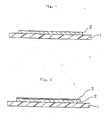
- Fig. 1 is a longitudinal cross-sectional view showing a polymer layer formed on a ground
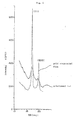
- Fig. 2 is a longitudinal cross-sectional view showing a metal layer stuck onto a polymer layer
- Fig. 3 is a longitudinal cross-sectional view showing a polymer layer with a metal layer after heating
- Fig. 4 is a longitudinal cross-sectional view of a present polymer composite obtained by a method in accordance with this invention.
- Fig. 5 is a diagram showing the dispersion of gold fine grains depicted from a transmission electron microphotograph of a polymer composite obtained in accordance with EXAMPLE 1;
- Fig. 6 is an X-ray diffraction pattern diagram of a polymer composite obtained in accordance with EXAMPLE 1;
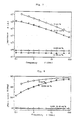
- Fig. 7 is a diagram showing the relation between the frequency and impedance Z of a polymer composite obtained in accordance with EXAMPLE 1;
- Fig. 8 is a diagram showing the relation between the frequency and phase angle ⁇ of said composite
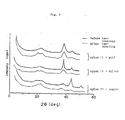
- Fig. 9 is a thin film X-ray diffraction pattern of a laminate of a polymer layer, metal film as obtained in accordance with the EXAMPLE 2 and a polymer composite;
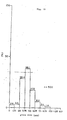
- Fig. 10 is a diagram showing the grain size distribution of gold fine grains which are dispersed in a polymer composite
- Fig. 11 is a diagram showing the grain size distribution of silver fine grains which are dispersed in a polymer composite
- Fig. 12 is a diagram showing the grain size distribution of copper oxide fine grains which are dispersed in a polymer composite.
- Fig. 13 is a diagram to explain a measuring method of photoelectric effect in EXAMPLE 10.
- a polymer composite of the present invention has fine grains dispersed therein.
- the fine grains have a size of 1,000 nanometers (nm) or less and are selected from a group consisting of metals or metal oxides and are dispersed independently from each other.
- a method for manufacturing a polymer composite with fine grains dispersed in accordance with this invention includes the following steps: melting a polymer material; rapidly solidifying the melted polymer to form a thermodynamically nonequilibrated polymer layer; providing a metal film stuck onto the surface of this polymer layer; and relaxing the polymer layer until it reaches equilibrium which results in metal or metal oxide fine-grains from said metal layer penetrating and dispersing in the polymer layer.
- the thermodynamically nonequilibrated polymer layer can be produced by vacuum evaporation.
- the fine grains dispersed in the polymer can be present in an amount in the range of about 0.1 to about 80 volume percent.
- the first step is to form a polymer layer in a thermodynamically nonequilibrated state; this step can be accomplished using, e.g., a vacuum evaporation method or a melting and rapid solidification method.
- the vacuum evaporation method that is exemplified by heating a polymer material in a vacuum for melting and evaporation and then solidifying said polymer layer 2 on a ground 1.
- a polymer layer can be obtained on a ground such as glass or the like at the vacuum of 1 x 10 ⁇ 4 to 1 x 10 ⁇ 6 Torr and the evaporation speed of 0.1 to 100 micrometers/minute ( ⁇ m/min), preferably 0.5 to 5 ⁇ m/min.
- the melting and rapid solidification method is exemplified by melting a polymer material at a temperature above the temperature of melting and immediately putting the material into a bath of liquid nitrogen or the like in the molten state for rapid cooling and then solidifying. Within the bath is ground 1 upon which the polymer layer 2 solidifies.
- the polymer material is melted and cooled at a cooling rate above the critical cooling temperature peculiar to the polymer material, and is then put in, for example, liquid nitrogen, to obtain the polymer layer.
- the polymer layer 2 thus obtained is formed on the ground 1 in a thermodynamically nonequilibrium state and changes to a thermodynamically equilibrium state over time.
- the polymer material used herein is a conventional thermoplastic polymer, for example, nylon 6, nylon 66, nylon 11, nylon 12, nylon 69, high density polyethylenes (HDPE), low density polyethylenes (LPDE), poly(vinylidene fluorides) (PVDF), poly(vinyl chlorides), and polyoxymethylenes.
- a conventional thermoplastic polymer for example, nylon 6, nylon 66, nylon 11, nylon 12, nylon 69, high density polyethylenes (HDPE), low density polyethylenes (LPDE), poly(vinylidene fluorides) (PVDF), poly(vinyl chlorides), and polyoxymethylenes.
- the polymer layer 2 in a thermodynamically nonequilibrium state has a metal layer 3 stuck onto the surface of said polymer layer 2.
- the metal layer 3 is laid on the polymer layer 2 by evaporating the metal layer 3 to the polymer layer 2 using the above-mentioned vacuum evaporator or by sticking metal foil or plate directly onto the solidified polymer layer 2.
- Representative metal materials include gold, silver, platinum, copper, iron, zinc, cerium, their oxides and the like.
- the polymer layer 2 is brought into an equilibrium state by heating to a temperature between the glass transition temperature and the melting temperature of the polymer or leaving naturally. In this step, it is preferable to keep the polymer layer with the adhered metal layer at a temperature below the melting temperature of the polymer material in an isothermal water bath and thus promote its state of relaxation. As a result, the metal of the metal layer 3, as shown in Fig. 3, becomes the fine grains 4 of the metal or metal oxide that diffuse and penetrate into the polymer layer 2.
- the fine grains 4 have a grain size of about 1,000 nm or less, preferably about 300 nm or less, and more preferably about 100 nm or less.
- Said fine grains 4 include the above-mentioned metals, and their oxides such as Cu2O , Fe3O , and ZnO.
- the polymer layer 2 when the polymer layer 2 is heated in this step, it is seen that the polymer layer 2 assumes its inherent color due to its interaction with the metal or metal oxide and that the fine grains 4 of the metal or metal oxide have penetrated into the polymer layer 2.
- the color can vary depending on the kind of metal or metal oxide, the fine grain size of the metal or metal oxide and the type of polymer utilized.
- a polymer composite 5 with the fine grains of the metal or metal oxide obtained in the above manner has the fine grains 4 separated and dispersed in an independent state.
- the polymer composite 5 has good conductivity despite the fact that the fine grains of the metal or metal oxide are not in contact with each other and are present in a relatively small amount.
- the polymer composite 5 in accordance with this invention has superior acid resistance, maintains stable physical property values such as conductivity, and possesses an excellent stability over time.
- the polymer composite 5 can be a conductive polymer or a conductive paste, with these fine grains dispersed therein.
- the polymer composite has the extremely large catalytic activity of a fine-grained metal and also takes a form in which the fine grains of the metal or metal oxide are covered with a polymer. It can be utilized in the following ways: stably maintained catalyst; magnetic memory in which a mass storage can be expected because of a fine-grained metal or metal oxide; light or heat response material utilizing the changes in the structure and distance between a polymer and the above-mentioned fine grains caused by stimulation of light or heat; optical material such as liquid crystal color display material due to the presentation of clear and inherent colors by proper selection of the types of polymer and metal; sintering accelerator and bonding material utilizing a decline in the sintering temperature of a powdered metal caused by the fine grains of the metal; heat exchange film due to a composite of a polymer and the fine grains of a metal or metal oxide utilizing the large specific heat capacity of the fine grains; bulk condenser material; and various gas sensors.
- a first sample was prepared with a vacuum evaporator into which a predetermined polymer pellet was put into a tungsten board, followed by a reduction of pressure to 1 x 10 ⁇ 6 Torr. Then, the tungsten board was heated under vacuum with the inter-electrode application of a voltage to melt the polymer.
- a polymer layer which is an evaporated film with a thickness of about 5 ⁇ m, was produced at a speed of about 1 ⁇ m/min and vacuum level of 1 x 10 ⁇ 4 Torr to 1 x 10 ⁇ 6 Torr on a ground (a glass sheet) placed on the upper part of a table.
- the molecular weight of this polymer layer represented about 1/2 to 1/10 of the pellet.
- a gold wire was coiled round the tungsten wire and melted by heating for evaporation in a vacuum of 1 x 10 ⁇ 4 to 1 x 10 ⁇ 6 Torr, causing a gold evaporated film to be stuck onto the polymer layer.
- the glass plate with this polymer layer and film stuck thereon was taken out from the vacuum evaporator and maintained for 30 minutes in an isothermal bath kept at 100°C, thus yielding a polymer composite.
- the gold color of the film surface disappeared, so that the composite as a whole turned to be clear and red.
- Fig. 5 shows a state of dispersed gold fine grains 4, which was depicted from a transmission electron microphotograph of a composite using nylon 11 as the polymer layer 2.
- gold takes the form of fine grains with a size of 1 to 10 nm and is distinctly dispersed in nylon 11.
- Fig. 6 further shows an X-ray diffraction pattern of said sample, from which it can be seen that a peak of diffraction appears at the same diffraction angle as that of gold evaporated on glass, revealing the same structure as bulk gold, but a large width of the diffraction peak gives evidence that gold became find grains.
- each polymer pellet was melted at a temperature above its melting temperature and then cooled slowly to form a polymer layer with a thickness of 10 ⁇ m in a thermodynamically equilibrium state.
- Each layer bad gold evaporated thereon then was taken out from the vacuum evaporator, and was allowed to stand for 30 minutes in an isothermal bath maintained at 100°C. There was no change in either the layer form or the gold color of the film surface.
- Table 1 presents each sample with reference to the construction, film coloration after heating, and size of gold fine grains measured with the transmission electron microscope.
- a polymer layer was formed on a glass plate by varying the vacuum evaporation speed of nylon 11 and then laminating with metal (gold) evaporated film to produce samples, each of which was in turn maintained at 120°C for 10 minutes to obtain a polymer composite.
- Table 2 displays the vacuum evaporation speed of nylon 11 and the state of the fine-grained gold in the polymer composite.
- Each kind of polymer was put into the space formed by two glass plates and a thickness-adjusting spacer placed between said glass plates, left in an isothermal bath for melting, and immediately put into liquid nitrogen for rapid cooling and solidification, thus leading to the production of a film-like, thermodynamically nonequilibrium polymer layer with a thickness of about 10 to about 100 ⁇ m.
- gold was vacuum-evaporated into the polymer layer in the same manner as in EXAMPLE 1, resulting in a laminated film which was maintained at 100°C for 30 minutes in the isothermal bath.
- the production of polymer layers in the comparative examples was performed by cooling the polymers, which were melted in the isothermal bath, slowly at room temperature.
- the metal film was applied by the vacuum evaporation method as in this EXAMPLE.
- metal fine grains were also diffused and penetrated into polymer layers obtained by the method of rapidly solidifying the polymers melted.
- the polymer layers of nylon 11 and nylon 12, respectively were produced on a glass ground by the vacuum evaporation method and, moreover, the polymer layers of nylon 11 and nylon 12, respectively, were produced on a glass ground by rapidly cooling and solidifying them with liquid nitrogen as in EXAMPLE 6.
- the polymer layers were laid on top of another so as to face each other, and with foil with a thickness of 0.2 ⁇ m allowed to lie between these polymer layers, a pressure of 1 kg/cm2 was placed on the glass ground to have the gold foil adhere to the polymer layers.
- metal fine grains were also diffused and penetrated into the polymer layer by the method of sticking metal foil directly onto the polymer layer.
- a bonding material was obtained by the same method as that in EXAMPLE 2, using a polymer composite with gold fine grains dispersed in 10 vol% in nylon 11 and a polymer composite with 18 vol% Cu2O dispersed in nylon 11 and which are taken off from the ground glass plate.
- the bonding material used in the comparative EXAMPLE 8-1 had gold grains with an average grain size of 0.5 to 2 ⁇ m dispersed in 50 wt% in liquid paraffin.
- the bonding material used in the comparative EXAMPLE 8-2 had copper grains with a mean grain size of 10 to 20 ⁇ m dispersed in 50 wt% in liquid paraffin.
- the bonding strength of the stainless steel plates thus obtained was measured with a tension tester.
- the results, in kilograms, are shown in Table 7. Furthermore, by polishing the bonded surface of each taken off stainless steel plate, the existence of a substance on said polished surface was confirmed from a peak of X-ray diffraction obtained by the thin film X-ray diffraction method with an angle of incidence of O.5°, thus allowing the study of whether the metal in the bonding material caused metalizing.
- Table 8 shows the results.
- the polymer composite in accordance with this invention can be fully used as a bonding material because nylon 11 is decomposed and evaporated during heat treatment, leading the metal to provide metalizing on the stainless steel plate.
- a method of sticking a polymer composite of this invention onto a bonded material was studied next.
- a polymer composite with 18 vol% Cu2O dispersed in nylon 11 was stuck, by the same vacuum evaporation method as in EXAMPLE 2, to a polymer composite with 18 vol% Cu2O dispersed in nylon 11 obtained in EXAMPLE 8 (which was taken off in a film shape from the ground glass plate).
- a paste product was obtained by dissolving the polymer composite in methacresol at a weight ratio of 1:1, and applying the paste to the surface of a bonded material, thus leading to bonding of stainless steel plates to each other in the same way as in EXAMPLE 8.
- heat treatment was performed at 700°C for 10 minutes.
- the polymer composite in accordance with this invention can be fully applied regardless of the form of the sticking material.
- Samples as shown in Fig. 13, were prepared by the following process. First, a glass substrate 10 (ITO glass, Central Glass Co., Ltd.) with the thin film 11 of indium tin oxide (ITO) laminated to the glass substrate 10 was placed in a vacuum evaporator, followed by lamination of a polymer composite 12 to said ITO by the same method as in EXAMPLE 2; then, it was again placed in the vacuum evaporator for lamination of the aluminum evaporated film 13 with a thickness of about 0.2 ⁇ m to the surface of the polymer composite 12, and terminals 14 and 14, respectively, were taken out from the aluminum evaporated film 13 and the thin film 11 of ITO, thus enabling the measurement of voltage.
- a glass substrate 10 ITO glass, Central Glass Co., Ltd.
- ITO indium tin oxide
- nylon 11 in bulk, germanium evaporated film, silicon evaporated film, and nylon 11 evaporated film were used as substitutes for the polymer composite.
Landscapes
- Chemical & Material Sciences (AREA)
- Organic Chemistry (AREA)
- Chemical Kinetics & Catalysis (AREA)
- Health & Medical Sciences (AREA)
- Medicinal Chemistry (AREA)
- Polymers & Plastics (AREA)
- Engineering & Computer Science (AREA)
- Materials Engineering (AREA)
- Compositions Of Macromolecular Compounds (AREA)
- Processes Of Treating Macromolecular Substances (AREA)
- Laminated Bodies (AREA)
- Physical Vapour Deposition (AREA)
Applications Claiming Priority (2)
| Application Number | Priority Date | Filing Date | Title |
|---|---|---|---|
| JP305752/89 | 1989-11-24 | ||
| JP30575289 | 1989-11-24 |
Publications (2)
| Publication Number | Publication Date |
|---|---|
| EP0429313A1 true EP0429313A1 (fr) | 1991-05-29 |
| EP0429313B1 EP0429313B1 (fr) | 1995-06-28 |
Family
ID=17948920
Family Applications (1)
| Application Number | Title | Priority Date | Filing Date |
|---|---|---|---|
| EP90312760A Expired - Lifetime EP0429313B1 (fr) | 1989-11-24 | 1990-11-23 | Procédé de préparation de composite de polymère contenant des grains fins dispersés |
Country Status (4)
| Country | Link |
|---|---|
| EP (1) | EP0429313B1 (fr) |
| JP (1) | JPH0699585B2 (fr) |
| KR (1) | KR940004870B1 (fr) |
| DE (1) | DE69020502T2 (fr) |
Cited By (3)
| Publication number | Priority date | Publication date | Assignee | Title |
|---|---|---|---|---|
| EP0858854B1 (fr) * | 1997-01-29 | 2003-04-02 | Mitsuboshi Belting Ltd. | Procédé de préparation d'une dispersion de particules métalliques ainsi que matière contenant des particules métalliques |
| WO2004019345A1 (fr) * | 2002-08-22 | 2004-03-04 | Agfa-Gevaert | Procede pour preparer une couche conductrice sensiblement transparente |
| US7118836B2 (en) | 2002-08-22 | 2006-10-10 | Agfa Gevaert | Process for preparing a substantially transparent conductive layer configuration |
Families Citing this family (6)
| Publication number | Priority date | Publication date | Assignee | Title |
|---|---|---|---|---|
| JP2798358B2 (ja) * | 1994-09-21 | 1998-09-17 | 三ツ星ベルト株式会社 | 微粒子を分散させた高分子複合物の製造方法 |
| EP0844217B1 (fr) * | 1996-11-21 | 2001-06-20 | Mitsuboshi Belting Ltd. | Couche colorée et cuite, et procédé pour la fabrication |
| JP4576947B2 (ja) * | 2004-09-21 | 2010-11-10 | 株式会社デンソー | 複合材料の製造方法 |
| KR102573812B1 (ko) * | 2016-10-06 | 2023-09-04 | 아이맥스 시어터스 인터내셔널 리미티드 | 시네마 발광 스크린 및 사운드 시스템 |
| CN110770815B (zh) | 2017-06-20 | 2023-03-10 | 图像影院国际有限公司 | 具有减小的纱门效应的有源显示器 |
| CN111108469B (zh) | 2017-09-20 | 2024-07-12 | 图像影院国际有限公司 | 具有拼块和数据处理的发光显示器 |
Citations (4)
| Publication number | Priority date | Publication date | Assignee | Title |
|---|---|---|---|---|
| US2947646A (en) * | 1958-01-07 | 1960-08-02 | Eastman Kodak Co | Colloidal dispersion of metals in plastics |
| US3082109A (en) * | 1958-09-30 | 1963-03-19 | Eastman Kodak Co | Collodial dispersion of metals in plastics |
| EP0125617A2 (fr) * | 1983-05-11 | 1984-11-21 | Nissan Chemical Industries Ltd. | Procédé pour préparer un polymère métallisé à partir de la composition polymère |
| EP0318196A2 (fr) * | 1987-11-25 | 1989-05-31 | Minnesota Mining And Manufacturing Company | Métaux colloidaux dispersés dans des monomères ou des polymères |
Family Cites Families (3)
| Publication number | Priority date | Publication date | Assignee | Title |
|---|---|---|---|---|
| JPS606738A (ja) * | 1983-06-24 | 1985-01-14 | Dainippon Ink & Chem Inc | 高比重複合樹脂材料 |
| JPS6176550A (ja) * | 1984-09-25 | 1986-04-19 | Idemitsu Kosan Co Ltd | 複合材料組成物 |
| JPH0768404B2 (ja) * | 1987-07-22 | 1995-07-26 | カルプ工業株式会社 | 金属系充填材含有延伸樹脂材料 |
-
1990
- 1990-10-05 JP JP26870990A patent/JPH0699585B2/ja not_active Expired - Fee Related
- 1990-11-20 KR KR1019900018755A patent/KR940004870B1/ko not_active Expired - Fee Related
- 1990-11-23 EP EP90312760A patent/EP0429313B1/fr not_active Expired - Lifetime
- 1990-11-23 DE DE69020502T patent/DE69020502T2/de not_active Expired - Fee Related
Patent Citations (4)
| Publication number | Priority date | Publication date | Assignee | Title |
|---|---|---|---|---|
| US2947646A (en) * | 1958-01-07 | 1960-08-02 | Eastman Kodak Co | Colloidal dispersion of metals in plastics |
| US3082109A (en) * | 1958-09-30 | 1963-03-19 | Eastman Kodak Co | Collodial dispersion of metals in plastics |
| EP0125617A2 (fr) * | 1983-05-11 | 1984-11-21 | Nissan Chemical Industries Ltd. | Procédé pour préparer un polymère métallisé à partir de la composition polymère |
| EP0318196A2 (fr) * | 1987-11-25 | 1989-05-31 | Minnesota Mining And Manufacturing Company | Métaux colloidaux dispersés dans des monomères ou des polymères |
Non-Patent Citations (3)
| Title |
|---|
| DATABASE WPI, no.72-40067t, Derwent Publications & SU-A-314781 (COLLOID CHEMISTRY AND WAT) * |
| DATABASE WPIL, no. 89-072689, Derwent & JP-A-1 024 832 (TOKYO KINGINSHI SEI) 26-01-1989 * |
| PATENT ABSTRACTS OF JAPAN vol. 5, no. 16 (C-041) 30 January 1981, & JP-A-55 144029 (MATSUSHITA ELECTRIC WORKS LTD.) 10 November 1980, * |
Cited By (3)
| Publication number | Priority date | Publication date | Assignee | Title |
|---|---|---|---|---|
| EP0858854B1 (fr) * | 1997-01-29 | 2003-04-02 | Mitsuboshi Belting Ltd. | Procédé de préparation d'une dispersion de particules métalliques ainsi que matière contenant des particules métalliques |
| WO2004019345A1 (fr) * | 2002-08-22 | 2004-03-04 | Agfa-Gevaert | Procede pour preparer une couche conductrice sensiblement transparente |
| US7118836B2 (en) | 2002-08-22 | 2006-10-10 | Agfa Gevaert | Process for preparing a substantially transparent conductive layer configuration |
Also Published As
| Publication number | Publication date |
|---|---|
| JPH0699585B2 (ja) | 1994-12-07 |
| DE69020502D1 (de) | 1995-08-03 |
| DE69020502T2 (de) | 1995-11-09 |
| EP0429313B1 (fr) | 1995-06-28 |
| JPH03273060A (ja) | 1991-12-04 |
| KR910009794A (ko) | 1991-06-28 |
| KR940004870B1 (ko) | 1994-06-02 |
Similar Documents
| Publication | Publication Date | Title |
|---|---|---|
| US5418056A (en) | Polymer composite with dispersed fine grains and a method for manufacturing the same | |
| EP0429313B1 (fr) | Procédé de préparation de composite de polymère contenant des grains fins dispersés | |
| KR100317404B1 (ko) | 나노구조의전극막을포함하는전기화학적셀또는분석물센서 | |
| US4194040A (en) | Article of fibrillated polytetrafluoroethylene containing high volumes of particulate material and methods of making and using same | |
| US5177662A (en) | Capacitance humidity sensor | |
| JPH06500826A (ja) | 電気化学的に適合性の導電性充填剤及びその製造方法 | |
| JPS59212263A (ja) | ポリプロピレン系複合延伸フイルム | |
| CN112164538A (zh) | 一种轻质、安全的导电薄膜及其制备方法 | |
| EP0376536A2 (fr) | Films minces et orientés de polymère contenant des composés organo-métalliques et leur procédé de fabrication | |
| JPS62176139A (ja) | 異方導電材料およびこれを用いた半導体装置の実装方法 | |
| JPH02192937A (ja) | 抗菌性フィルムの製造方法 | |
| JP2564193B2 (ja) | 固体電解質電池素子の製造方法 | |
| JP2678841B2 (ja) | 微粒子分散ぺースト及びこれを用いた金属膜の製造方法 | |
| CN112356528A (zh) | 一种带有粘接层的保护膜及其制备方法 | |
| US20100078065A1 (en) | Multilayered body comprising an electroconductive polymer layer and method for the production thereof | |
| FI130524B (en) | Dopant complex and electronic component | |
| JPS6258515A (ja) | 異方導電体 | |
| NO884229L (no) | Supraledende, formet gjenstand. | |
| JP3841608B2 (ja) | 透明箔粉及び該透明箔粉含有成形体 | |
| JPH0451571B2 (fr) | ||
| JP2657748B2 (ja) | 着色ガラスの製造方法 | |
| EP0177012B1 (fr) | Frittage de couches intermédiaires métalliques dans des films polymères organiques | |
| JP2623421B2 (ja) | 金属硫化物の微粒子を分散させた高分子複合物の製造方法 | |
| JPH04356529A (ja) | 微粒子を分散させた高分子複合物の製造方法 | |
| JP2592692B2 (ja) | 酸化物超電導体テープ材料の製造方法 |
Legal Events
| Date | Code | Title | Description |
|---|---|---|---|
| PUAI | Public reference made under article 153(3) epc to a published international application that has entered the european phase |
Free format text: ORIGINAL CODE: 0009012 |
|
| AK | Designated contracting states |
Kind code of ref document: A1 Designated state(s): DE FR GB |
|
| 17P | Request for examination filed |
Effective date: 19911120 |
|
| 17Q | First examination report despatched |
Effective date: 19940308 |
|
| GRAA | (expected) grant |
Free format text: ORIGINAL CODE: 0009210 |
|
| AK | Designated contracting states |
Kind code of ref document: B1 Designated state(s): DE FR GB |
|
| REF | Corresponds to: |
Ref document number: 69020502 Country of ref document: DE Date of ref document: 19950803 |
|
| ET | Fr: translation filed | ||
| PLBE | No opposition filed within time limit |
Free format text: ORIGINAL CODE: 0009261 |
|
| STAA | Information on the status of an ep patent application or granted ep patent |
Free format text: STATUS: NO OPPOSITION FILED WITHIN TIME LIMIT |
|
| 26N | No opposition filed | ||
| REG | Reference to a national code |
Ref country code: GB Ref legal event code: IF02 |
|
| PGFP | Annual fee paid to national office [announced via postgrant information from national office to epo] |
Ref country code: GB Payment date: 20051116 Year of fee payment: 16 |
|
| PGFP | Annual fee paid to national office [announced via postgrant information from national office to epo] |
Ref country code: FR Payment date: 20051117 Year of fee payment: 16 |
|
| PGFP | Annual fee paid to national office [announced via postgrant information from national office to epo] |
Ref country code: DE Payment date: 20060102 Year of fee payment: 16 |
|
| PG25 | Lapsed in a contracting state [announced via postgrant information from national office to epo] |
Ref country code: DE Free format text: LAPSE BECAUSE OF NON-PAYMENT OF DUE FEES Effective date: 20070601 |
|
| GBPC | Gb: european patent ceased through non-payment of renewal fee |
Effective date: 20061123 |
|
| REG | Reference to a national code |
Ref country code: FR Ref legal event code: ST Effective date: 20070731 |
|
| PG25 | Lapsed in a contracting state [announced via postgrant information from national office to epo] |
Ref country code: GB Free format text: LAPSE BECAUSE OF NON-PAYMENT OF DUE FEES Effective date: 20061123 |
|
| PG25 | Lapsed in a contracting state [announced via postgrant information from national office to epo] |
Ref country code: FR Free format text: LAPSE BECAUSE OF NON-PAYMENT OF DUE FEES Effective date: 20061130 |