EP0431329B1 - Farbphotographisches Silberhalogenidmaterial und Verfahren zur Bildung eines Farbstoffbildes - Google Patents
Farbphotographisches Silberhalogenidmaterial und Verfahren zur Bildung eines Farbstoffbildes Download PDFInfo
- Publication number
- EP0431329B1 EP0431329B1 EP90121222A EP90121222A EP0431329B1 EP 0431329 B1 EP0431329 B1 EP 0431329B1 EP 90121222 A EP90121222 A EP 90121222A EP 90121222 A EP90121222 A EP 90121222A EP 0431329 B1 EP0431329 B1 EP 0431329B1
- Authority
- EP
- European Patent Office
- Prior art keywords
- group
- silver halide
- photographic material
- formula
- color photographic
- Prior art date
- Legal status (The legal status is an assumption and is not a legal conclusion. Google has not performed a legal analysis and makes no representation as to the accuracy of the status listed.)
- Expired - Lifetime
Links
- -1 Silver halide Chemical class 0.000 title claims description 126
- 229910052709 silver Inorganic materials 0.000 title claims description 95
- 239000004332 silver Substances 0.000 title claims description 95
- 239000000463 material Substances 0.000 title claims description 75
- 238000000034 method Methods 0.000 title claims description 68
- 239000000839 emulsion Substances 0.000 claims description 71
- 150000001875 compounds Chemical class 0.000 claims description 63
- 238000002156 mixing Methods 0.000 claims description 46
- 239000003795 chemical substances by application Substances 0.000 claims description 40
- 239000003112 inhibitor Substances 0.000 claims description 34
- WVDDGKGOMKODPV-UHFFFAOYSA-N Benzyl alcohol Chemical compound OCC1=CC=CC=C1 WVDDGKGOMKODPV-UHFFFAOYSA-N 0.000 claims description 27
- 125000000217 alkyl group Chemical group 0.000 claims description 27
- 125000003118 aryl group Chemical group 0.000 claims description 26
- 125000004435 hydrogen atom Chemical group [H]* 0.000 claims description 22
- 229920000642 polymer Polymers 0.000 claims description 22
- 239000002904 solvent Substances 0.000 claims description 22
- 125000000623 heterocyclic group Chemical group 0.000 claims description 21
- 125000001931 aliphatic group Chemical group 0.000 claims description 18
- BUUPQKDIAURBJP-UHFFFAOYSA-N sulfinic acid Chemical compound OS=O BUUPQKDIAURBJP-UHFFFAOYSA-N 0.000 claims description 17
- 229910021607 Silver chloride Inorganic materials 0.000 claims description 16
- 125000003545 alkoxy group Chemical group 0.000 claims description 15
- 238000011161 development Methods 0.000 claims description 15
- 125000002496 methyl group Chemical group [H]C([H])([H])* 0.000 claims description 15
- 239000000178 monomer Substances 0.000 claims description 15
- 238000009835 boiling Methods 0.000 claims description 14
- 125000000626 sulfinic acid group Chemical group 0.000 claims description 14
- 150000003839 salts Chemical class 0.000 claims description 13
- 125000004104 aryloxy group Chemical group 0.000 claims description 12
- 125000004432 carbon atom Chemical group C* 0.000 claims description 12
- HKZLPVFGJNLROG-UHFFFAOYSA-M silver monochloride Chemical compound [Cl-].[Ag+] HKZLPVFGJNLROG-UHFFFAOYSA-M 0.000 claims description 12
- 229910052736 halogen Inorganic materials 0.000 claims description 11
- 125000005843 halogen group Chemical group 0.000 claims description 11
- 150000002367 halogens Chemical class 0.000 claims description 11
- 239000000126 substance Substances 0.000 claims description 11
- 239000006185 dispersion Substances 0.000 claims description 10
- 235000019445 benzyl alcohol Nutrition 0.000 claims description 9
- GZTPJDLYPMPRDF-UHFFFAOYSA-N pyrrolo[3,2-c]pyrazole Chemical group N1=NC2=CC=NC2=C1 GZTPJDLYPMPRDF-UHFFFAOYSA-N 0.000 claims description 8
- 238000005859 coupling reaction Methods 0.000 claims description 7
- IKQCSJBQLWJEPU-UHFFFAOYSA-N 2,5-dihydroxybenzenesulfonic acid Chemical class OC1=CC=C(O)C(S(O)(=O)=O)=C1 IKQCSJBQLWJEPU-UHFFFAOYSA-N 0.000 claims description 5
- JKFYKCYQEWQPTM-UHFFFAOYSA-N 2-azaniumyl-2-(4-fluorophenyl)acetate Chemical compound OC(=O)C(N)C1=CC=C(F)C=C1 JKFYKCYQEWQPTM-UHFFFAOYSA-N 0.000 claims description 5
- 229910021612 Silver iodide Inorganic materials 0.000 claims description 5
- SJOOOZPMQAWAOP-UHFFFAOYSA-N [Ag].BrCl Chemical compound [Ag].BrCl SJOOOZPMQAWAOP-UHFFFAOYSA-N 0.000 claims description 5
- 125000003282 alkyl amino group Chemical group 0.000 claims description 5
- 125000002490 anilino group Chemical group [H]N(*)C1=C([H])C([H])=C([H])C([H])=C1[H] 0.000 claims description 5
- 150000001768 cations Chemical class 0.000 claims description 5
- 229940045105 silver iodide Drugs 0.000 claims description 5
- 125000004414 alkyl thio group Chemical group 0.000 claims description 4
- 125000003277 amino group Chemical group 0.000 claims description 4
- 125000003710 aryl alkyl group Chemical group 0.000 claims description 4
- 229920001577 copolymer Polymers 0.000 claims description 4
- 125000005647 linker group Chemical group 0.000 claims description 4
- 125000000999 tert-butyl group Chemical group [H]C([H])([H])C(*)(C([H])([H])[H])C([H])([H])[H] 0.000 claims description 4
- 125000003342 alkenyl group Chemical group 0.000 claims description 3
- 125000000753 cycloalkyl group Chemical group 0.000 claims description 3
- 125000002887 hydroxy group Chemical group [H]O* 0.000 claims description 3
- ISWSIDIOOBJBQZ-UHFFFAOYSA-N phenol group Chemical group C1(=CC=CC=C1)O ISWSIDIOOBJBQZ-UHFFFAOYSA-N 0.000 claims description 3
- 125000001997 phenyl group Chemical group [H]C1=C([H])C([H])=C(*)C([H])=C1[H] 0.000 claims description 3
- 238000006479 redox reaction Methods 0.000 claims description 3
- 125000003368 amide group Chemical group 0.000 claims description 2
- 229920001519 homopolymer Polymers 0.000 claims description 2
- 125000000020 sulfo group Chemical group O=S(=O)([*])O[H] 0.000 claims description 2
- 125000004964 sulfoalkyl group Chemical group 0.000 claims description 2
- OKTJSMMVPCPJKN-UHFFFAOYSA-N Carbon Chemical compound [C] OKTJSMMVPCPJKN-UHFFFAOYSA-N 0.000 claims 1
- 229910052799 carbon Inorganic materials 0.000 claims 1
- 239000010410 layer Substances 0.000 description 89
- 230000008569 process Effects 0.000 description 49
- 239000000243 solution Substances 0.000 description 44
- 239000000975 dye Substances 0.000 description 41
- 239000000203 mixture Substances 0.000 description 34
- 238000012545 processing Methods 0.000 description 32
- XLYOFNOQVPJJNP-UHFFFAOYSA-N water Substances O XLYOFNOQVPJJNP-UHFFFAOYSA-N 0.000 description 21
- 108010010803 Gelatin Proteins 0.000 description 19
- 239000008273 gelatin Substances 0.000 description 19
- 229920000159 gelatin Polymers 0.000 description 19
- 235000019322 gelatine Nutrition 0.000 description 19
- 235000011852 gelatine desserts Nutrition 0.000 description 19
- 239000002585 base Substances 0.000 description 16
- 238000005406 washing Methods 0.000 description 16
- 238000000576 coating method Methods 0.000 description 13
- 229910052751 metal Inorganic materials 0.000 description 13
- 239000002184 metal Substances 0.000 description 13
- BQCADISMDOOEFD-UHFFFAOYSA-N Silver Chemical compound [Ag] BQCADISMDOOEFD-UHFFFAOYSA-N 0.000 description 12
- 239000011248 coating agent Substances 0.000 description 12
- 239000003960 organic solvent Substances 0.000 description 11
- 239000003381 stabilizer Substances 0.000 description 11
- 150000005208 1,4-dihydroxybenzenes Chemical class 0.000 description 10
- 239000002253 acid Substances 0.000 description 10
- 230000000087 stabilizing effect Effects 0.000 description 10
- 125000001424 substituent group Chemical group 0.000 description 10
- 206010070834 Sensitisation Diseases 0.000 description 9
- 230000008313 sensitization Effects 0.000 description 9
- 239000006097 ultraviolet radiation absorber Substances 0.000 description 9
- 150000004982 aromatic amines Chemical class 0.000 description 8
- 239000003086 colorant Substances 0.000 description 8
- LSNNMFCWUKXFEE-UHFFFAOYSA-L sulfite Chemical class [O-]S([O-])=O LSNNMFCWUKXFEE-UHFFFAOYSA-L 0.000 description 8
- XEEYBQQBJWHFJM-UHFFFAOYSA-N Iron Chemical compound [Fe] XEEYBQQBJWHFJM-UHFFFAOYSA-N 0.000 description 7
- LSNNMFCWUKXFEE-UHFFFAOYSA-N Sulfurous acid Chemical compound OS(O)=O LSNNMFCWUKXFEE-UHFFFAOYSA-N 0.000 description 7
- 238000004061 bleaching Methods 0.000 description 7
- 125000002252 acyl group Chemical group 0.000 description 6
- 239000013078 crystal Substances 0.000 description 6
- 230000000694 effects Effects 0.000 description 6
- 239000002245 particle Substances 0.000 description 6
- 230000003595 spectral effect Effects 0.000 description 6
- CDAWCLOXVUBKRW-UHFFFAOYSA-N 2-aminophenol Chemical class NC1=CC=CC=C1O CDAWCLOXVUBKRW-UHFFFAOYSA-N 0.000 description 5
- 230000015572 biosynthetic process Effects 0.000 description 5
- 230000008878 coupling Effects 0.000 description 5
- 238000010168 coupling process Methods 0.000 description 5
- LNTHITQWFMADLM-UHFFFAOYSA-N gallic acid Chemical compound OC(=O)C1=CC(O)=C(O)C(O)=C1 LNTHITQWFMADLM-UHFFFAOYSA-N 0.000 description 5
- 230000005764 inhibitory process Effects 0.000 description 5
- 125000000472 sulfonyl group Chemical group *S(*)(=O)=O 0.000 description 5
- 239000004094 surface-active agent Substances 0.000 description 5
- MYRTYDVEIRVNKP-UHFFFAOYSA-N 1,2-Divinylbenzene Chemical compound C=CC1=CC=CC=C1C=C MYRTYDVEIRVNKP-UHFFFAOYSA-N 0.000 description 4
- QIGBRXMKCJKVMJ-UHFFFAOYSA-N Hydroquinone Chemical compound OC1=CC=C(O)C=C1 QIGBRXMKCJKVMJ-UHFFFAOYSA-N 0.000 description 4
- 150000007513 acids Chemical class 0.000 description 4
- 125000004442 acylamino group Chemical group 0.000 description 4
- 238000006243 chemical reaction Methods 0.000 description 4
- 239000000084 colloidal system Substances 0.000 description 4
- 230000000295 complement effect Effects 0.000 description 4
- 238000009826 distribution Methods 0.000 description 4
- 230000002401 inhibitory effect Effects 0.000 description 4
- 125000001434 methanylylidene group Chemical group [H]C#[*] 0.000 description 4
- 229910052757 nitrogen Inorganic materials 0.000 description 4
- 229920005989 resin Polymers 0.000 description 4
- 239000011347 resin Substances 0.000 description 4
- 230000035945 sensitivity Effects 0.000 description 4
- 238000000926 separation method Methods 0.000 description 4
- 125000005420 sulfonamido group Chemical group S(=O)(=O)(N*)* 0.000 description 4
- CPELXLSAUQHCOX-UHFFFAOYSA-M Bromide Chemical compound [Br-] CPELXLSAUQHCOX-UHFFFAOYSA-M 0.000 description 3
- KAKZBPTYRLMSJV-UHFFFAOYSA-N Butadiene Chemical compound C=CC=C KAKZBPTYRLMSJV-UHFFFAOYSA-N 0.000 description 3
- XEKOWRVHYACXOJ-UHFFFAOYSA-N Ethyl acetate Chemical compound CCOC(C)=O XEKOWRVHYACXOJ-UHFFFAOYSA-N 0.000 description 3
- LYCAIKOWRPUZTN-UHFFFAOYSA-N Ethylene glycol Chemical compound OCCO LYCAIKOWRPUZTN-UHFFFAOYSA-N 0.000 description 3
- VTLYFUHAOXGGBS-UHFFFAOYSA-N Fe3+ Chemical compound [Fe+3] VTLYFUHAOXGGBS-UHFFFAOYSA-N 0.000 description 3
- FYYHWMGAXLPEAU-UHFFFAOYSA-N Magnesium Chemical compound [Mg] FYYHWMGAXLPEAU-UHFFFAOYSA-N 0.000 description 3
- OKKJLVBELUTLKV-UHFFFAOYSA-N Methanol Chemical compound OC OKKJLVBELUTLKV-UHFFFAOYSA-N 0.000 description 3
- 101100221809 Neurospora crassa (strain ATCC 24698 / 74-OR23-1A / CBS 708.71 / DSM 1257 / FGSC 987) cpd-7 gene Proteins 0.000 description 3
- 239000004698 Polyethylene Substances 0.000 description 3
- GWEVSGVZZGPLCZ-UHFFFAOYSA-N Titan oxide Chemical compound O=[Ti]=O GWEVSGVZZGPLCZ-UHFFFAOYSA-N 0.000 description 3
- 239000006096 absorbing agent Substances 0.000 description 3
- 238000010521 absorption reaction Methods 0.000 description 3
- 230000009471 action Effects 0.000 description 3
- 150000001412 amines Chemical class 0.000 description 3
- 230000000844 anti-bacterial effect Effects 0.000 description 3
- 125000005110 aryl thio group Chemical group 0.000 description 3
- 239000003899 bactericide agent Substances 0.000 description 3
- 125000003354 benzotriazolyl group Chemical class N1N=NC2=C1C=CC=C2* 0.000 description 3
- MTHSVFCYNBDYFN-UHFFFAOYSA-N diethylene glycol Chemical compound OCCOCCO MTHSVFCYNBDYFN-UHFFFAOYSA-N 0.000 description 3
- 150000002148 esters Chemical class 0.000 description 3
- 238000005562 fading Methods 0.000 description 3
- 150000004694 iodide salts Chemical class 0.000 description 3
- 229910052742 iron Inorganic materials 0.000 description 3
- 239000011777 magnesium Substances 0.000 description 3
- 229910052749 magnesium Inorganic materials 0.000 description 3
- 238000004519 manufacturing process Methods 0.000 description 3
- 125000004433 nitrogen atom Chemical group N* 0.000 description 3
- 230000000269 nucleophilic effect Effects 0.000 description 3
- 239000003921 oil Substances 0.000 description 3
- 239000000049 pigment Substances 0.000 description 3
- 229920000573 polyethylene Polymers 0.000 description 3
- 239000003755 preservative agent Substances 0.000 description 3
- 239000011241 protective layer Substances 0.000 description 3
- MCSKRVKAXABJLX-UHFFFAOYSA-N pyrazolo[3,4-d]triazole Chemical compound N1=NN=C2N=NC=C21 MCSKRVKAXABJLX-UHFFFAOYSA-N 0.000 description 3
- 230000002829 reductive effect Effects 0.000 description 3
- 238000011160 research Methods 0.000 description 3
- 230000001235 sensitizing effect Effects 0.000 description 3
- ADZWSOLPGZMUMY-UHFFFAOYSA-M silver bromide Chemical compound [Ag]Br ADZWSOLPGZMUMY-UHFFFAOYSA-M 0.000 description 3
- 229910052717 sulfur Inorganic materials 0.000 description 3
- FTNJQNQLEGKTGD-UHFFFAOYSA-N 1,3-benzodioxole Chemical class C1=CC=C2OCOC2=C1 FTNJQNQLEGKTGD-UHFFFAOYSA-N 0.000 description 2
- KJCVRFUGPWSIIH-UHFFFAOYSA-N 1-naphthol Chemical compound C1=CC=C2C(O)=CC=CC2=C1 KJCVRFUGPWSIIH-UHFFFAOYSA-N 0.000 description 2
- LEJBBGNFPAFPKQ-UHFFFAOYSA-N 2-(2-prop-2-enoyloxyethoxy)ethyl prop-2-enoate Chemical compound C=CC(=O)OCCOCCOC(=O)C=C LEJBBGNFPAFPKQ-UHFFFAOYSA-N 0.000 description 2
- XFCMNSHQOZQILR-UHFFFAOYSA-N 2-[2-(2-methylprop-2-enoyloxy)ethoxy]ethyl 2-methylprop-2-enoate Chemical compound CC(=C)C(=O)OCCOCCOC(=O)C(C)=C XFCMNSHQOZQILR-UHFFFAOYSA-N 0.000 description 2
- RNMCCPMYXUKHAZ-UHFFFAOYSA-N 2-[3,3-diamino-1,2,2-tris(carboxymethyl)cyclohexyl]acetic acid Chemical compound NC1(N)CCCC(CC(O)=O)(CC(O)=O)C1(CC(O)=O)CC(O)=O RNMCCPMYXUKHAZ-UHFFFAOYSA-N 0.000 description 2
- KUDUQBURMYMBIJ-UHFFFAOYSA-N 2-prop-2-enoyloxyethyl prop-2-enoate Chemical compound C=CC(=O)OCCOC(=O)C=C KUDUQBURMYMBIJ-UHFFFAOYSA-N 0.000 description 2
- DBCAQXHNJOFNGC-UHFFFAOYSA-N 4-bromo-1,1,1-trifluorobutane Chemical compound FC(F)(F)CCCBr DBCAQXHNJOFNGC-UHFFFAOYSA-N 0.000 description 2
- QGZKDVFQNNGYKY-UHFFFAOYSA-N Ammonia Chemical compound N QGZKDVFQNNGYKY-UHFFFAOYSA-N 0.000 description 2
- SOGAXMICEFXMKE-UHFFFAOYSA-N Butylmethacrylate Chemical compound CCCCOC(=O)C(C)=C SOGAXMICEFXMKE-UHFFFAOYSA-N 0.000 description 2
- OYPRJOBELJOOCE-UHFFFAOYSA-N Calcium Chemical compound [Ca] OYPRJOBELJOOCE-UHFFFAOYSA-N 0.000 description 2
- VTYYLEPIZMXCLO-UHFFFAOYSA-L Calcium carbonate Chemical compound [Ca+2].[O-]C([O-])=O VTYYLEPIZMXCLO-UHFFFAOYSA-L 0.000 description 2
- RTZKZFJDLAIYFH-UHFFFAOYSA-N Diethyl ether Chemical class CCOCC RTZKZFJDLAIYFH-UHFFFAOYSA-N 0.000 description 2
- KCXVZYZYPLLWCC-UHFFFAOYSA-N EDTA Chemical compound OC(=O)CN(CC(O)=O)CCN(CC(O)=O)CC(O)=O KCXVZYZYPLLWCC-UHFFFAOYSA-N 0.000 description 2
- WSFSSNUMVMOOMR-UHFFFAOYSA-N Formaldehyde Chemical compound O=C WSFSSNUMVMOOMR-UHFFFAOYSA-N 0.000 description 2
- MHAJPDPJQMAIIY-UHFFFAOYSA-N Hydrogen peroxide Chemical compound OO MHAJPDPJQMAIIY-UHFFFAOYSA-N 0.000 description 2
- VQTUBCCKSQIDNK-UHFFFAOYSA-N Isobutene Chemical compound CC(C)=C VQTUBCCKSQIDNK-UHFFFAOYSA-N 0.000 description 2
- RRHGJUQNOFWUDK-UHFFFAOYSA-N Isoprene Chemical compound CC(=C)C=C RRHGJUQNOFWUDK-UHFFFAOYSA-N 0.000 description 2
- PXHVJJICTQNCMI-UHFFFAOYSA-N Nickel Chemical compound [Ni] PXHVJJICTQNCMI-UHFFFAOYSA-N 0.000 description 2
- 239000000020 Nitrocellulose Substances 0.000 description 2
- KDLHZDBZIXYQEI-UHFFFAOYSA-N Palladium Chemical compound [Pd] KDLHZDBZIXYQEI-UHFFFAOYSA-N 0.000 description 2
- PPBRXRYQALVLMV-UHFFFAOYSA-N Styrene Chemical compound C=CC1=CC=CC=C1 PPBRXRYQALVLMV-UHFFFAOYSA-N 0.000 description 2
- XLOMVQKBTHCTTD-UHFFFAOYSA-N Zinc monoxide Chemical compound [Zn]=O XLOMVQKBTHCTTD-UHFFFAOYSA-N 0.000 description 2
- FJWGYAHXMCUOOM-QHOUIDNNSA-N [(2s,3r,4s,5r,6r)-2-[(2r,3r,4s,5r,6s)-4,5-dinitrooxy-2-(nitrooxymethyl)-6-[(2r,3r,4s,5r,6s)-4,5,6-trinitrooxy-2-(nitrooxymethyl)oxan-3-yl]oxyoxan-3-yl]oxy-3,5-dinitrooxy-6-(nitrooxymethyl)oxan-4-yl] nitrate Chemical compound O([C@@H]1O[C@@H]([C@H]([C@H](O[N+]([O-])=O)[C@H]1O[N+]([O-])=O)O[C@H]1[C@@H]([C@@H](O[N+]([O-])=O)[C@H](O[N+]([O-])=O)[C@@H](CO[N+]([O-])=O)O1)O[N+]([O-])=O)CO[N+](=O)[O-])[C@@H]1[C@@H](CO[N+]([O-])=O)O[C@@H](O[N+]([O-])=O)[C@H](O[N+]([O-])=O)[C@H]1O[N+]([O-])=O FJWGYAHXMCUOOM-QHOUIDNNSA-N 0.000 description 2
- 125000004423 acyloxy group Chemical group 0.000 description 2
- 125000004397 aminosulfonyl group Chemical group NS(=O)(=O)* 0.000 description 2
- XYXNTHIYBIDHGM-UHFFFAOYSA-N ammonium thiosulfate Chemical compound [NH4+].[NH4+].[O-]S([O-])(=O)=S XYXNTHIYBIDHGM-UHFFFAOYSA-N 0.000 description 2
- 150000001450 anions Chemical class 0.000 description 2
- 150000008430 aromatic amides Chemical class 0.000 description 2
- 239000007844 bleaching agent Substances 0.000 description 2
- 239000011575 calcium Substances 0.000 description 2
- 229910052791 calcium Inorganic materials 0.000 description 2
- OSGAYBCDTDRGGQ-UHFFFAOYSA-L calcium sulfate Chemical compound [Ca+2].[O-]S([O-])(=O)=O OSGAYBCDTDRGGQ-UHFFFAOYSA-L 0.000 description 2
- 125000003917 carbamoyl group Chemical group [H]N([H])C(*)=O 0.000 description 2
- 125000001951 carbamoylamino group Chemical group C(N)(=O)N* 0.000 description 2
- 230000008859 change Effects 0.000 description 2
- 239000003638 chemical reducing agent Substances 0.000 description 2
- 229910052801 chlorine Inorganic materials 0.000 description 2
- 125000004093 cyano group Chemical group *C#N 0.000 description 2
- 239000000539 dimer Substances 0.000 description 2
- 125000001495 ethyl group Chemical group [H]C([H])([H])C([H])([H])* 0.000 description 2
- STVZJERGLQHEKB-UHFFFAOYSA-N ethylene glycol dimethacrylate Substances CC(=C)C(=O)OCCOC(=O)C(C)=C STVZJERGLQHEKB-UHFFFAOYSA-N 0.000 description 2
- 229910052731 fluorine Inorganic materials 0.000 description 2
- 230000002209 hydrophobic effect Effects 0.000 description 2
- 239000004816 latex Substances 0.000 description 2
- 229920000126 latex Polymers 0.000 description 2
- 230000008018 melting Effects 0.000 description 2
- 238000002844 melting Methods 0.000 description 2
- DZVCFNFOPIZQKX-LTHRDKTGSA-M merocyanine Chemical compound [Na+].O=C1N(CCCC)C(=O)N(CCCC)C(=O)C1=C\C=C\C=C/1N(CCCS([O-])(=O)=O)C2=CC=CC=C2O\1 DZVCFNFOPIZQKX-LTHRDKTGSA-M 0.000 description 2
- 229910021645 metal ion Inorganic materials 0.000 description 2
- 229920001220 nitrocellulos Polymers 0.000 description 2
- 230000003647 oxidation Effects 0.000 description 2
- 238000007254 oxidation reaction Methods 0.000 description 2
- 125000004430 oxygen atom Chemical group O* 0.000 description 2
- 239000012071 phase Substances 0.000 description 2
- CMCWWLVWPDLCRM-UHFFFAOYSA-N phenidone Chemical compound N1C(=O)CCN1C1=CC=CC=C1 CMCWWLVWPDLCRM-UHFFFAOYSA-N 0.000 description 2
- 150000002989 phenols Chemical class 0.000 description 2
- BASFCYQUMIYNBI-UHFFFAOYSA-N platinum Chemical compound [Pt] BASFCYQUMIYNBI-UHFFFAOYSA-N 0.000 description 2
- 229920000139 polyethylene terephthalate Polymers 0.000 description 2
- 239000005020 polyethylene terephthalate Substances 0.000 description 2
- 239000002243 precursor Substances 0.000 description 2
- 238000002360 preparation method Methods 0.000 description 2
- 230000002335 preservative effect Effects 0.000 description 2
- 230000002265 prevention Effects 0.000 description 2
- 239000002356 single layer Substances 0.000 description 2
- GEHJYWRUCIMESM-UHFFFAOYSA-L sodium sulfite Chemical compound [Na+].[Na+].[O-]S([O-])=O GEHJYWRUCIMESM-UHFFFAOYSA-L 0.000 description 2
- 238000003860 storage Methods 0.000 description 2
- 125000004434 sulfur atom Chemical group 0.000 description 2
- 238000003786 synthesis reaction Methods 0.000 description 2
- 125000003396 thiol group Chemical group [H]S* 0.000 description 2
- 150000003585 thioureas Chemical class 0.000 description 2
- 238000007740 vapor deposition Methods 0.000 description 2
- 239000012463 white pigment Substances 0.000 description 2
- QGKMIGUHVLGJBR-UHFFFAOYSA-M (4z)-1-(3-methylbutyl)-4-[[1-(3-methylbutyl)quinolin-1-ium-4-yl]methylidene]quinoline;iodide Chemical compound [I-].C12=CC=CC=C2N(CCC(C)C)C=CC1=CC1=CC=[N+](CCC(C)C)C2=CC=CC=C12 QGKMIGUHVLGJBR-UHFFFAOYSA-M 0.000 description 1
- BJEPYKJPYRNKOW-REOHCLBHSA-N (S)-malic acid Chemical compound OC(=O)[C@@H](O)CC(O)=O BJEPYKJPYRNKOW-REOHCLBHSA-N 0.000 description 1
- WBYWAXJHAXSJNI-VOTSOKGWSA-M .beta-Phenylacrylic acid Natural products [O-]C(=O)\C=C\C1=CC=CC=C1 WBYWAXJHAXSJNI-VOTSOKGWSA-M 0.000 description 1
- JLHMJWHSBYZWJJ-UHFFFAOYSA-N 1,2-thiazole 1-oxide Chemical class O=S1C=CC=N1 JLHMJWHSBYZWJJ-UHFFFAOYSA-N 0.000 description 1
- BCMCBBGGLRIHSE-UHFFFAOYSA-N 1,3-benzoxazole Chemical class C1=CC=C2OC=NC2=C1 BCMCBBGGLRIHSE-UHFFFAOYSA-N 0.000 description 1
- ALAVMPYROHSFFR-UHFFFAOYSA-N 1-methyl-3-[3-(5-sulfanylidene-2h-tetrazol-1-yl)phenyl]urea Chemical compound CNC(=O)NC1=CC=CC(N2C(=NN=N2)S)=C1 ALAVMPYROHSFFR-UHFFFAOYSA-N 0.000 description 1
- YGDWUQFZMXWDKE-UHFFFAOYSA-N 1-oxido-1,3-thiazole Chemical class [O-]S1=CN=C=C1 YGDWUQFZMXWDKE-UHFFFAOYSA-N 0.000 description 1
- VZYDKJOUEPFKMW-UHFFFAOYSA-N 2,3-dihydroxybenzenesulfonic acid Chemical class OC1=CC=CC(S(O)(=O)=O)=C1O VZYDKJOUEPFKMW-UHFFFAOYSA-N 0.000 description 1
- SMZOUWXMTYCWNB-UHFFFAOYSA-N 2-(2-methoxy-5-methylphenyl)ethanamine Chemical compound COC1=CC=C(C)C=C1CCN SMZOUWXMTYCWNB-UHFFFAOYSA-N 0.000 description 1
- JAHNSTQSQJOJLO-UHFFFAOYSA-N 2-(3-fluorophenyl)-1h-imidazole Chemical compound FC1=CC=CC(C=2NC=CN=2)=C1 JAHNSTQSQJOJLO-UHFFFAOYSA-N 0.000 description 1
- QTLHLXYADXCVCF-UHFFFAOYSA-N 2-(4-amino-n-ethyl-3-methylanilino)ethanol Chemical compound OCCN(CC)C1=CC=C(N)C(C)=C1 QTLHLXYADXCVCF-UHFFFAOYSA-N 0.000 description 1
- YEVQZPWSVWZAOB-UHFFFAOYSA-N 2-(bromomethyl)-1-iodo-4-(trifluoromethyl)benzene Chemical compound FC(F)(F)C1=CC=C(I)C(CBr)=C1 YEVQZPWSVWZAOB-UHFFFAOYSA-N 0.000 description 1
- GOXQRTZXKQZDDN-UHFFFAOYSA-N 2-Ethylhexyl acrylate Chemical compound CCCCC(CC)COC(=O)C=C GOXQRTZXKQZDDN-UHFFFAOYSA-N 0.000 description 1
- NIXOWILDQLNWCW-UHFFFAOYSA-N 2-Propenoic acid Natural products OC(=O)C=C NIXOWILDQLNWCW-UHFFFAOYSA-N 0.000 description 1
- HWSSEYVMGDIFMH-UHFFFAOYSA-N 2-[2-[2-(2-methylprop-2-enoyloxy)ethoxy]ethoxy]ethyl 2-methylprop-2-enoate Chemical compound CC(=C)C(=O)OCCOCCOCCOC(=O)C(C)=C HWSSEYVMGDIFMH-UHFFFAOYSA-N 0.000 description 1
- AGMNQPKGRCRYQP-UHFFFAOYSA-N 2-[2-[2-[bis(carboxymethyl)amino]ethylamino]ethyl-(carboxymethyl)amino]acetic acid Chemical compound OC(=O)CN(CC(O)=O)CCNCCN(CC(O)=O)CC(O)=O AGMNQPKGRCRYQP-UHFFFAOYSA-N 0.000 description 1
- UOMQUZPKALKDCA-UHFFFAOYSA-K 2-[2-[bis(carboxylatomethyl)amino]ethyl-(carboxymethyl)amino]acetate;iron(3+) Chemical compound [Fe+3].OC(=O)CN(CC([O-])=O)CCN(CC([O-])=O)CC([O-])=O UOMQUZPKALKDCA-UHFFFAOYSA-K 0.000 description 1
- DMQQXDPCRUGSQB-UHFFFAOYSA-N 2-[3-[bis(carboxymethyl)amino]propyl-(carboxymethyl)amino]acetic acid Chemical compound OC(=O)CN(CC(O)=O)CCCN(CC(O)=O)CC(O)=O DMQQXDPCRUGSQB-UHFFFAOYSA-N 0.000 description 1
- QQQMJWSOHKTWDZ-UHFFFAOYSA-N 2-[amino(carboxymethyl)amino]acetic acid Chemical compound OC(=O)CN(N)CC(O)=O QQQMJWSOHKTWDZ-UHFFFAOYSA-N 0.000 description 1
- XWSGEVNYFYKXCP-UHFFFAOYSA-N 2-[carboxymethyl(methyl)amino]acetic acid Chemical compound OC(=O)CN(C)CC(O)=O XWSGEVNYFYKXCP-UHFFFAOYSA-N 0.000 description 1
- HSJKGGMUJITCBW-UHFFFAOYSA-N 3-hydroxybutanal Chemical class CC(O)CC=O HSJKGGMUJITCBW-UHFFFAOYSA-N 0.000 description 1
- VPWNQTHUCYMVMZ-UHFFFAOYSA-N 4,4'-sulfonyldiphenol Chemical class C1=CC(O)=CC=C1S(=O)(=O)C1=CC=C(O)C=C1 VPWNQTHUCYMVMZ-UHFFFAOYSA-N 0.000 description 1
- ZFIQGRISGKSVAG-UHFFFAOYSA-N 4-methylaminophenol Chemical compound CNC1=CC=C(O)C=C1 ZFIQGRISGKSVAG-UHFFFAOYSA-N 0.000 description 1
- XBTWVJKPQPQTDW-UHFFFAOYSA-N 4-n,4-n-diethyl-2-methylbenzene-1,4-diamine Chemical compound CCN(CC)C1=CC=C(N)C(C)=C1 XBTWVJKPQPQTDW-UHFFFAOYSA-N 0.000 description 1
- FFAJEKUNEVVYCW-UHFFFAOYSA-N 4-n-ethyl-4-n-(2-methoxyethyl)-2-methylbenzene-1,4-diamine Chemical compound COCCN(CC)C1=CC=C(N)C(C)=C1 FFAJEKUNEVVYCW-UHFFFAOYSA-N 0.000 description 1
- JHWGFJBTMHEZME-UHFFFAOYSA-N 4-prop-2-enoyloxybutyl prop-2-enoate Chemical compound C=CC(=O)OCCCCOC(=O)C=C JHWGFJBTMHEZME-UHFFFAOYSA-N 0.000 description 1
- MFGQIJCMHXZHHP-UHFFFAOYSA-N 5h-imidazo[1,2-b]pyrazole Chemical class N1C=CC2=NC=CN21 MFGQIJCMHXZHHP-UHFFFAOYSA-N 0.000 description 1
- FIHBHSQYSYVZQE-UHFFFAOYSA-N 6-prop-2-enoyloxyhexyl prop-2-enoate Chemical compound C=CC(=O)OCCCCCCOC(=O)C=C FIHBHSQYSYVZQE-UHFFFAOYSA-N 0.000 description 1
- HRPVXLWXLXDGHG-UHFFFAOYSA-N Acrylamide Chemical compound NC(=O)C=C HRPVXLWXLXDGHG-UHFFFAOYSA-N 0.000 description 1
- NLHHRLWOUZZQLW-UHFFFAOYSA-N Acrylonitrile Chemical compound C=CC#N NLHHRLWOUZZQLW-UHFFFAOYSA-N 0.000 description 1
- QGZKDVFQNNGYKY-UHFFFAOYSA-O Ammonium Chemical compound [NH4+] QGZKDVFQNNGYKY-UHFFFAOYSA-O 0.000 description 1
- 241000894006 Bacteria Species 0.000 description 1
- 229930185605 Bisphenol Natural products 0.000 description 1
- WKBOTKDWSSQWDR-UHFFFAOYSA-N Bromine atom Chemical compound [Br] WKBOTKDWSSQWDR-UHFFFAOYSA-N 0.000 description 1
- 229920002284 Cellulose triacetate Polymers 0.000 description 1
- ZAMOUSCENKQFHK-UHFFFAOYSA-N Chlorine atom Chemical compound [Cl] ZAMOUSCENKQFHK-UHFFFAOYSA-N 0.000 description 1
- RYGMFSIKBFXOCR-UHFFFAOYSA-N Copper Chemical class [Cu] RYGMFSIKBFXOCR-UHFFFAOYSA-N 0.000 description 1
- FEWJPZIEWOKRBE-JCYAYHJZSA-N Dextrotartaric acid Chemical compound OC(=O)[C@H](O)[C@@H](O)C(O)=O FEWJPZIEWOKRBE-JCYAYHJZSA-N 0.000 description 1
- 229920001174 Diethylhydroxylamine Polymers 0.000 description 1
- BWGNESOTFCXPMA-UHFFFAOYSA-N Dihydrogen disulfide Chemical compound SS BWGNESOTFCXPMA-UHFFFAOYSA-N 0.000 description 1
- 239000003109 Disodium ethylene diamine tetraacetate Substances 0.000 description 1
- ZGTMUACCHSMWAC-UHFFFAOYSA-L EDTA disodium salt (anhydrous) Chemical compound [Na+].[Na+].OC(=O)CN(CC([O-])=O)CCN(CC(O)=O)CC([O-])=O ZGTMUACCHSMWAC-UHFFFAOYSA-L 0.000 description 1
- LFQSCWFLJHTTHZ-UHFFFAOYSA-N Ethanol Chemical compound CCO LFQSCWFLJHTTHZ-UHFFFAOYSA-N 0.000 description 1
- DBVJJBKOTRCVKF-UHFFFAOYSA-N Etidronic acid Chemical compound OP(=O)(O)C(O)(C)P(O)(O)=O DBVJJBKOTRCVKF-UHFFFAOYSA-N 0.000 description 1
- PXGOKWXKJXAPGV-UHFFFAOYSA-N Fluorine Chemical compound FF PXGOKWXKJXAPGV-UHFFFAOYSA-N 0.000 description 1
- AVXURJPOCDRRFD-UHFFFAOYSA-N Hydroxylamine Chemical compound ON AVXURJPOCDRRFD-UHFFFAOYSA-N 0.000 description 1
- CERQOIWHTDAKMF-UHFFFAOYSA-N Methacrylic acid Chemical compound CC(=C)C(O)=O CERQOIWHTDAKMF-UHFFFAOYSA-N 0.000 description 1
- VVQNEPGJFQJSBK-UHFFFAOYSA-N Methyl methacrylate Chemical compound COC(=O)C(C)=C VVQNEPGJFQJSBK-UHFFFAOYSA-N 0.000 description 1
- QPCDCPDFJACHGM-UHFFFAOYSA-N N,N-bis{2-[bis(carboxymethyl)amino]ethyl}glycine Chemical compound OC(=O)CN(CC(O)=O)CCN(CC(=O)O)CCN(CC(O)=O)CC(O)=O QPCDCPDFJACHGM-UHFFFAOYSA-N 0.000 description 1
- JYXGIOKAKDAARW-UHFFFAOYSA-N N-(2-hydroxyethyl)iminodiacetic acid Chemical compound OCCN(CC(O)=O)CC(O)=O JYXGIOKAKDAARW-UHFFFAOYSA-N 0.000 description 1
- BXUURYQQDJGIGA-UHFFFAOYSA-N N1C=NN2N=CC=C21 Chemical class N1C=NN2N=CC=C21 BXUURYQQDJGIGA-UHFFFAOYSA-N 0.000 description 1
- 229910019142 PO4 Inorganic materials 0.000 description 1
- AVKHCKXGKPAGEI-UHFFFAOYSA-N Phenicarbazide Chemical class NC(=O)NNC1=CC=CC=C1 AVKHCKXGKPAGEI-UHFFFAOYSA-N 0.000 description 1
- 229920003171 Poly (ethylene oxide) Polymers 0.000 description 1
- 239000004952 Polyamide Substances 0.000 description 1
- 239000002202 Polyethylene glycol Substances 0.000 description 1
- 239000004793 Polystyrene Substances 0.000 description 1
- 239000004372 Polyvinyl alcohol Substances 0.000 description 1
- NPYPAHLBTDXSSS-UHFFFAOYSA-N Potassium ion Chemical compound [K+] NPYPAHLBTDXSSS-UHFFFAOYSA-N 0.000 description 1
- KJTLSVCANCCWHF-UHFFFAOYSA-N Ruthenium Chemical compound [Ru] KJTLSVCANCCWHF-UHFFFAOYSA-N 0.000 description 1
- FKNQFGJONOIPTF-UHFFFAOYSA-N Sodium cation Chemical compound [Na+] FKNQFGJONOIPTF-UHFFFAOYSA-N 0.000 description 1
- NINIDFKCEFEMDL-UHFFFAOYSA-N Sulfur Chemical compound [S] NINIDFKCEFEMDL-UHFFFAOYSA-N 0.000 description 1
- FEWJPZIEWOKRBE-UHFFFAOYSA-N Tartaric acid Natural products [H+].[H+].[O-]C(=O)C(O)C(O)C([O-])=O FEWJPZIEWOKRBE-UHFFFAOYSA-N 0.000 description 1
- ATJFFYVFTNAWJD-UHFFFAOYSA-N Tin Chemical compound [Sn] ATJFFYVFTNAWJD-UHFFFAOYSA-N 0.000 description 1
- GSEJCLTVZPLZKY-UHFFFAOYSA-N Triethanolamine Chemical compound OCCN(CCO)CCO GSEJCLTVZPLZKY-UHFFFAOYSA-N 0.000 description 1
- XTXRWKRVRITETP-UHFFFAOYSA-N Vinyl acetate Chemical compound CC(=O)OC=C XTXRWKRVRITETP-UHFFFAOYSA-N 0.000 description 1
- BZHJMEDXRYGGRV-UHFFFAOYSA-N Vinyl chloride Chemical compound ClC=C BZHJMEDXRYGGRV-UHFFFAOYSA-N 0.000 description 1
- 235000010724 Wisteria floribunda Nutrition 0.000 description 1
- HCHKCACWOHOZIP-UHFFFAOYSA-N Zinc Chemical class [Zn] HCHKCACWOHOZIP-UHFFFAOYSA-N 0.000 description 1
- NNLVGZFZQQXQNW-ADJNRHBOSA-N [(2r,3r,4s,5r,6s)-4,5-diacetyloxy-3-[(2s,3r,4s,5r,6r)-3,4,5-triacetyloxy-6-(acetyloxymethyl)oxan-2-yl]oxy-6-[(2r,3r,4s,5r,6s)-4,5,6-triacetyloxy-2-(acetyloxymethyl)oxan-3-yl]oxyoxan-2-yl]methyl acetate Chemical compound O([C@@H]1O[C@@H]([C@H]([C@H](OC(C)=O)[C@H]1OC(C)=O)O[C@H]1[C@@H]([C@@H](OC(C)=O)[C@H](OC(C)=O)[C@@H](COC(C)=O)O1)OC(C)=O)COC(=O)C)[C@@H]1[C@@H](COC(C)=O)O[C@@H](OC(C)=O)[C@H](OC(C)=O)[C@H]1OC(C)=O NNLVGZFZQQXQNW-ADJNRHBOSA-N 0.000 description 1
- ULQMPOIOSDXIGC-UHFFFAOYSA-N [2,2-dimethyl-3-(2-methylprop-2-enoyloxy)propyl] 2-methylprop-2-enoate Chemical compound CC(=C)C(=O)OCC(C)(C)COC(=O)C(C)=C ULQMPOIOSDXIGC-UHFFFAOYSA-N 0.000 description 1
- 230000001133 acceleration Effects 0.000 description 1
- 238000009825 accumulation Methods 0.000 description 1
- 238000007259 addition reaction Methods 0.000 description 1
- 239000000654 additive Substances 0.000 description 1
- 239000003513 alkali Substances 0.000 description 1
- 229910052783 alkali metal Inorganic materials 0.000 description 1
- 150000001340 alkali metals Chemical class 0.000 description 1
- 239000012670 alkaline solution Substances 0.000 description 1
- 125000004453 alkoxycarbonyl group Chemical group 0.000 description 1
- 125000004466 alkoxycarbonylamino group Chemical group 0.000 description 1
- 230000002152 alkylating effect Effects 0.000 description 1
- 125000000304 alkynyl group Chemical group 0.000 description 1
- 239000000956 alloy Substances 0.000 description 1
- 229910045601 alloy Inorganic materials 0.000 description 1
- XYLMUPLGERFSHI-UHFFFAOYSA-N alpha-Methylstyrene Chemical compound CC(=C)C1=CC=CC=C1 XYLMUPLGERFSHI-UHFFFAOYSA-N 0.000 description 1
- BJEPYKJPYRNKOW-UHFFFAOYSA-N alpha-hydroxysuccinic acid Natural products OC(=O)C(O)CC(O)=O BJEPYKJPYRNKOW-UHFFFAOYSA-N 0.000 description 1
- 229910052782 aluminium Inorganic materials 0.000 description 1
- XAGFODPZIPBFFR-UHFFFAOYSA-N aluminium Chemical compound [Al] XAGFODPZIPBFFR-UHFFFAOYSA-N 0.000 description 1
- 150000001408 amides Chemical class 0.000 description 1
- 229910021529 ammonia Inorganic materials 0.000 description 1
- SWLVFNYSXGMGBS-UHFFFAOYSA-N ammonium bromide Chemical compound [NH4+].[Br-] SWLVFNYSXGMGBS-UHFFFAOYSA-N 0.000 description 1
- 239000003963 antioxidant agent Substances 0.000 description 1
- 230000003078 antioxidant effect Effects 0.000 description 1
- 235000006708 antioxidants Nutrition 0.000 description 1
- 125000005162 aryl oxy carbonyl amino group Chemical group 0.000 description 1
- 125000005161 aryl oxy carbonyl group Chemical group 0.000 description 1
- 125000003289 ascorbyl group Chemical class [H]O[C@@]([H])(C([H])([H])O*)[C@@]1([H])OC(=O)C(O*)=C1O* 0.000 description 1
- 239000012298 atmosphere Substances 0.000 description 1
- 125000004429 atom Chemical group 0.000 description 1
- DCEHTYYYUBZERB-UHFFFAOYSA-K azanium;2-[2-[bis(carboxylatomethyl)amino]ethyl-(carboxylatomethyl)amino]acetate;iron(3+);dihydrate Chemical compound [NH4+].O.O.[Fe+3].[O-]C(=O)CN(CC([O-])=O)CCN(CC([O-])=O)CC([O-])=O DCEHTYYYUBZERB-UHFFFAOYSA-K 0.000 description 1
- 239000000987 azo dye Substances 0.000 description 1
- IRERQBUNZFJFGC-UHFFFAOYSA-L azure blue Chemical compound [Na+].[Na+].[Na+].[Na+].[Na+].[Na+].[Na+].[Na+].[Al+3].[Al+3].[Al+3].[Al+3].[Al+3].[Al+3].[S-]S[S-].[O-][Si]([O-])([O-])[O-].[O-][Si]([O-])([O-])[O-].[O-][Si]([O-])([O-])[O-].[O-][Si]([O-])([O-])[O-].[O-][Si]([O-])([O-])[O-].[O-][Si]([O-])([O-])[O-] IRERQBUNZFJFGC-UHFFFAOYSA-L 0.000 description 1
- QVQLCTNNEUAWMS-UHFFFAOYSA-N barium oxide Chemical compound [Ba]=O QVQLCTNNEUAWMS-UHFFFAOYSA-N 0.000 description 1
- 229910001864 baryta Inorganic materials 0.000 description 1
- 150000001556 benzimidazoles Chemical class 0.000 description 1
- 150000008366 benzophenones Chemical class 0.000 description 1
- IOJUPLGTWVMSFF-UHFFFAOYSA-N benzothiazole Chemical class C1=CC=C2SC=NC2=C1 IOJUPLGTWVMSFF-UHFFFAOYSA-N 0.000 description 1
- AOJOEFVRHOZDFN-UHFFFAOYSA-N benzyl 2-methylprop-2-enoate Chemical compound CC(=C)C(=O)OCC1=CC=CC=C1 AOJOEFVRHOZDFN-UHFFFAOYSA-N 0.000 description 1
- 239000011230 binding agent Substances 0.000 description 1
- 150000003842 bromide salts Chemical class 0.000 description 1
- GDTBXPJZTBHREO-UHFFFAOYSA-N bromine Substances BrBr GDTBXPJZTBHREO-UHFFFAOYSA-N 0.000 description 1
- 229910052794 bromium Inorganic materials 0.000 description 1
- 239000000872 buffer Substances 0.000 description 1
- CQEYYJKEWSMYFG-UHFFFAOYSA-N butyl acrylate Chemical compound CCCCOC(=O)C=C CQEYYJKEWSMYFG-UHFFFAOYSA-N 0.000 description 1
- 125000000484 butyl group Chemical group [H]C([*])([H])C([H])([H])C([H])([H])C([H])([H])[H] 0.000 description 1
- 229910052793 cadmium Inorganic materials 0.000 description 1
- BDOSMKKIYDKNTQ-UHFFFAOYSA-N cadmium atom Chemical class [Cd] BDOSMKKIYDKNTQ-UHFFFAOYSA-N 0.000 description 1
- 229910000019 calcium carbonate Inorganic materials 0.000 description 1
- 239000011203 carbon fibre reinforced carbon Substances 0.000 description 1
- 150000004649 carbonic acid derivatives Chemical class 0.000 description 1
- 239000013522 chelant Substances 0.000 description 1
- 239000002738 chelating agent Substances 0.000 description 1
- 239000000460 chlorine Substances 0.000 description 1
- 125000001309 chloro group Chemical group Cl* 0.000 description 1
- 229930016911 cinnamic acid Natural products 0.000 description 1
- 235000013985 cinnamic acid Nutrition 0.000 description 1
- 229910017052 cobalt Inorganic materials 0.000 description 1
- 239000010941 cobalt Substances 0.000 description 1
- GUTLYIVDDKVIGB-UHFFFAOYSA-N cobalt atom Chemical compound [Co] GUTLYIVDDKVIGB-UHFFFAOYSA-N 0.000 description 1
- 230000000052 comparative effect Effects 0.000 description 1
- 239000002131 composite material Substances 0.000 description 1
- 238000011109 contamination Methods 0.000 description 1
- 229910052802 copper Inorganic materials 0.000 description 1
- 239000010949 copper Chemical class 0.000 description 1
- 125000000392 cycloalkenyl group Chemical group 0.000 description 1
- OIWOHHBRDFKZNC-UHFFFAOYSA-N cyclohexyl 2-methylprop-2-enoate Chemical compound CC(=C)C(=O)OC1CCCCC1 OIWOHHBRDFKZNC-UHFFFAOYSA-N 0.000 description 1
- 125000000113 cyclohexyl group Chemical group [H]C1([H])C([H])([H])C([H])([H])C([H])(*)C([H])([H])C1([H])[H] 0.000 description 1
- 150000001991 dicarboxylic acids Chemical class 0.000 description 1
- 150000001993 dienes Chemical class 0.000 description 1
- FVCOIAYSJZGECG-UHFFFAOYSA-N diethylhydroxylamine Chemical compound CCN(O)CC FVCOIAYSJZGECG-UHFFFAOYSA-N 0.000 description 1
- 238000009792 diffusion process Methods 0.000 description 1
- 150000005205 dihydroxybenzenes Chemical class 0.000 description 1
- 238000002845 discoloration Methods 0.000 description 1
- 235000019301 disodium ethylene diamine tetraacetate Nutrition 0.000 description 1
- 239000002612 dispersion medium Substances 0.000 description 1
- 238000004821 distillation Methods 0.000 description 1
- 125000002228 disulfide group Chemical group 0.000 description 1
- SRPOMGSPELCIGZ-UHFFFAOYSA-N disulfino carbonate Chemical compound OS(=O)OC(=O)OS(O)=O SRPOMGSPELCIGZ-UHFFFAOYSA-N 0.000 description 1
- GVGUFUZHNYFZLC-UHFFFAOYSA-N dodecyl benzenesulfonate;sodium Chemical compound [Na].CCCCCCCCCCCCOS(=O)(=O)C1=CC=CC=C1 GVGUFUZHNYFZLC-UHFFFAOYSA-N 0.000 description 1
- PZZHMLOHNYWKIK-UHFFFAOYSA-N eddha Chemical compound C=1C=CC=C(O)C=1C(C(=O)O)NCCNC(C(O)=O)C1=CC=CC=C1O PZZHMLOHNYWKIK-UHFFFAOYSA-N 0.000 description 1
- 238000007720 emulsion polymerization reaction Methods 0.000 description 1
- SUPCQIBBMFXVTL-UHFFFAOYSA-N ethyl 2-methylprop-2-enoate Chemical compound CCOC(=O)C(C)=C SUPCQIBBMFXVTL-UHFFFAOYSA-N 0.000 description 1
- DEFVIWRASFVYLL-UHFFFAOYSA-N ethylene glycol bis(2-aminoethyl)tetraacetic acid Chemical compound OC(=O)CN(CC(O)=O)CCOCCOCCN(CC(O)=O)CC(O)=O DEFVIWRASFVYLL-UHFFFAOYSA-N 0.000 description 1
- 238000011156 evaluation Methods 0.000 description 1
- 238000001704 evaporation Methods 0.000 description 1
- 230000008020 evaporation Effects 0.000 description 1
- 239000011737 fluorine Substances 0.000 description 1
- 125000001153 fluoro group Chemical group F* 0.000 description 1
- 239000011888 foil Substances 0.000 description 1
- 238000010528 free radical solution polymerization reaction Methods 0.000 description 1
- 229940074391 gallic acid Drugs 0.000 description 1
- 235000004515 gallic acid Nutrition 0.000 description 1
- 238000005246 galvanizing Methods 0.000 description 1
- 239000011521 glass Substances 0.000 description 1
- PCHJSUWPFVWCPO-UHFFFAOYSA-N gold Chemical compound [Au] PCHJSUWPFVWCPO-UHFFFAOYSA-N 0.000 description 1
- 229910052737 gold Inorganic materials 0.000 description 1
- 239000010931 gold Substances 0.000 description 1
- 150000004820 halides Chemical class 0.000 description 1
- 150000002391 heterocyclic compounds Chemical class 0.000 description 1
- LNCPIMCVTKXXOY-UHFFFAOYSA-N hexyl 2-methylprop-2-enoate Chemical compound CCCCCCOC(=O)C(C)=C LNCPIMCVTKXXOY-UHFFFAOYSA-N 0.000 description 1
- LNMQRPPRQDGUDR-UHFFFAOYSA-N hexyl prop-2-enoate Chemical compound CCCCCCOC(=O)C=C LNMQRPPRQDGUDR-UHFFFAOYSA-N 0.000 description 1
- 150000002429 hydrazines Chemical class 0.000 description 1
- 150000003840 hydrochlorides Chemical class 0.000 description 1
- DOUHZFSGSXMPIE-UHFFFAOYSA-N hydroxidooxidosulfur(.) Chemical compound [O]SO DOUHZFSGSXMPIE-UHFFFAOYSA-N 0.000 description 1
- 125000002883 imidazolyl group Chemical group 0.000 description 1
- 230000006872 improvement Effects 0.000 description 1
- 239000012535 impurity Substances 0.000 description 1
- 150000002500 ions Chemical class 0.000 description 1
- 229910052741 iridium Inorganic materials 0.000 description 1
- GKOZUEZYRPOHIO-UHFFFAOYSA-N iridium atom Chemical compound [Ir] GKOZUEZYRPOHIO-UHFFFAOYSA-N 0.000 description 1
- 230000001788 irregular Effects 0.000 description 1
- 239000011133 lead Chemical class 0.000 description 1
- 239000007788 liquid Substances 0.000 description 1
- 229940057995 liquid paraffin Drugs 0.000 description 1
- 239000007791 liquid phase Substances 0.000 description 1
- 230000014759 maintenance of location Effects 0.000 description 1
- 239000001630 malic acid Substances 0.000 description 1
- 235000011090 malic acid Nutrition 0.000 description 1
- 150000002739 metals Chemical class 0.000 description 1
- 125000004184 methoxymethyl group Chemical group [H]C([H])([H])OC([H])([H])* 0.000 description 1
- WBYWAXJHAXSJNI-UHFFFAOYSA-N methyl p-hydroxycinnamate Natural products OC(=O)C=CC1=CC=CC=C1 WBYWAXJHAXSJNI-UHFFFAOYSA-N 0.000 description 1
- LVHBHZANLOWSRM-UHFFFAOYSA-N methylenebutanedioic acid Natural products OC(=O)CC(=C)C(O)=O LVHBHZANLOWSRM-UHFFFAOYSA-N 0.000 description 1
- 230000004048 modification Effects 0.000 description 1
- 238000012986 modification Methods 0.000 description 1
- 150000002763 monocarboxylic acids Chemical class 0.000 description 1
- AJDUTMFFZHIJEM-UHFFFAOYSA-N n-(9,10-dioxoanthracen-1-yl)-4-[4-[[4-[4-[(9,10-dioxoanthracen-1-yl)carbamoyl]phenyl]phenyl]diazenyl]phenyl]benzamide Chemical compound O=C1C2=CC=CC=C2C(=O)C2=C1C=CC=C2NC(=O)C(C=C1)=CC=C1C(C=C1)=CC=C1N=NC(C=C1)=CC=C1C(C=C1)=CC=C1C(=O)NC1=CC=CC2=C1C(=O)C1=CC=CC=C1C2=O AJDUTMFFZHIJEM-UHFFFAOYSA-N 0.000 description 1
- NPKFETRYYSUTEC-UHFFFAOYSA-N n-[2-(4-amino-n-ethyl-3-methylanilino)ethyl]methanesulfonamide Chemical compound CS(=O)(=O)NCCN(CC)C1=CC=C(N)C(C)=C1 NPKFETRYYSUTEC-UHFFFAOYSA-N 0.000 description 1
- YPHQUSNPXDGUHL-UHFFFAOYSA-N n-methylprop-2-enamide Chemical compound CNC(=O)C=C YPHQUSNPXDGUHL-UHFFFAOYSA-N 0.000 description 1
- 125000001624 naphthyl group Chemical group 0.000 description 1
- 230000007935 neutral effect Effects 0.000 description 1
- 229910052759 nickel Inorganic materials 0.000 description 1
- 150000002815 nickel Chemical class 0.000 description 1
- MGFYIUFZLHCRTH-UHFFFAOYSA-N nitrilotriacetic acid Chemical compound OC(=O)CN(CC(O)=O)CC(O)=O MGFYIUFZLHCRTH-UHFFFAOYSA-N 0.000 description 1
- 229910000510 noble metal Inorganic materials 0.000 description 1
- 235000012149 noodles Nutrition 0.000 description 1
- 229910052762 osmium Inorganic materials 0.000 description 1
- SYQBFIAQOQZEGI-UHFFFAOYSA-N osmium atom Chemical compound [Os] SYQBFIAQOQZEGI-UHFFFAOYSA-N 0.000 description 1
- 125000001820 oxy group Chemical group [*:1]O[*:2] 0.000 description 1
- 125000005740 oxycarbonyl group Chemical group [*:1]OC([*:2])=O 0.000 description 1
- BHAAPTBBJKJZER-UHFFFAOYSA-N p-anisidine Chemical compound COC1=CC=C(N)C=C1 BHAAPTBBJKJZER-UHFFFAOYSA-N 0.000 description 1
- 150000004989 p-phenylenediamines Chemical class 0.000 description 1
- 229910052763 palladium Inorganic materials 0.000 description 1
- HVAMZGADVCBITI-UHFFFAOYSA-M pent-4-enoate Chemical compound [O-]C(=O)CCC=C HVAMZGADVCBITI-UHFFFAOYSA-M 0.000 description 1
- UCUUFSAXZMGPGH-UHFFFAOYSA-N penta-1,4-dien-3-one Chemical class C=CC(=O)C=C UCUUFSAXZMGPGH-UHFFFAOYSA-N 0.000 description 1
- 125000002958 pentadecyl group Chemical group [H]C([*])([H])C([H])([H])C([H])([H])C([H])([H])C([H])([H])C([H])([H])C([H])([H])C([H])([H])C([H])([H])C([H])([H])C([H])([H])C([H])([H])C([H])([H])C([H])([H])C([H])([H])[H] 0.000 description 1
- 229960003330 pentetic acid Drugs 0.000 description 1
- WVDDGKGOMKODPV-ZQBYOMGUSA-N phenyl(114C)methanol Chemical compound O[14CH2]C1=CC=CC=C1 WVDDGKGOMKODPV-ZQBYOMGUSA-N 0.000 description 1
- 235000021317 phosphate Nutrition 0.000 description 1
- ZJAOAACCNHFJAH-UHFFFAOYSA-N phosphonoformic acid Chemical class OC(=O)P(O)(O)=O ZJAOAACCNHFJAH-UHFFFAOYSA-N 0.000 description 1
- 150000003013 phosphoric acid derivatives Chemical class 0.000 description 1
- 125000005936 piperidyl group Chemical group 0.000 description 1
- 229910052697 platinum Inorganic materials 0.000 description 1
- 229920002401 polyacrylamide Polymers 0.000 description 1
- 229920002647 polyamide Polymers 0.000 description 1
- 229920000768 polyamine Polymers 0.000 description 1
- 229920006289 polycarbonate film Polymers 0.000 description 1
- 229920006267 polyester film Polymers 0.000 description 1
- 229920001223 polyethylene glycol Polymers 0.000 description 1
- 239000004848 polyfunctional curative Substances 0.000 description 1
- 229920002223 polystyrene Polymers 0.000 description 1
- 229920002451 polyvinyl alcohol Polymers 0.000 description 1
- 229910001414 potassium ion Inorganic materials 0.000 description 1
- 239000000843 powder Substances 0.000 description 1
- 238000001556 precipitation Methods 0.000 description 1
- 125000001436 propyl group Chemical group [H]C([*])([H])C([H])([H])C([H])([H])[H] 0.000 description 1
- 230000001681 protective effect Effects 0.000 description 1
- NDGRWYRVNANFNB-UHFFFAOYSA-N pyrazolidin-3-one Chemical class O=C1CCNN1 NDGRWYRVNANFNB-UHFFFAOYSA-N 0.000 description 1
- 125000003226 pyrazolyl group Chemical group 0.000 description 1
- 125000004076 pyridyl group Chemical group 0.000 description 1
- 150000003242 quaternary ammonium salts Chemical class 0.000 description 1
- 125000005493 quinolyl group Chemical group 0.000 description 1
- 238000010526 radical polymerization reaction Methods 0.000 description 1
- 230000009467 reduction Effects 0.000 description 1
- 238000002310 reflectometry Methods 0.000 description 1
- 230000002441 reversible effect Effects 0.000 description 1
- 229910052703 rhodium Inorganic materials 0.000 description 1
- 239000010948 rhodium Substances 0.000 description 1
- MHOVAHRLVXNVSD-UHFFFAOYSA-N rhodium atom Chemical compound [Rh] MHOVAHRLVXNVSD-UHFFFAOYSA-N 0.000 description 1
- 239000012487 rinsing solution Substances 0.000 description 1
- 230000005070 ripening Effects 0.000 description 1
- 238000005096 rolling process Methods 0.000 description 1
- 238000007788 roughening Methods 0.000 description 1
- 229910052707 ruthenium Inorganic materials 0.000 description 1
- 238000004904 shortening Methods 0.000 description 1
- 125000004469 siloxy group Chemical group [SiH3]O* 0.000 description 1
- 239000011734 sodium Substances 0.000 description 1
- 229910052708 sodium Inorganic materials 0.000 description 1
- 229940080264 sodium dodecylbenzenesulfonate Drugs 0.000 description 1
- 229910001415 sodium ion Inorganic materials 0.000 description 1
- 159000000000 sodium salts Chemical class 0.000 description 1
- 235000010265 sodium sulphite Nutrition 0.000 description 1
- GGCZERPQGJTIQP-UHFFFAOYSA-N sodium;9,10-dioxoanthracene-2-sulfonic acid Chemical compound [Na+].C1=CC=C2C(=O)C3=CC(S(=O)(=O)O)=CC=C3C(=O)C2=C1 GGCZERPQGJTIQP-UHFFFAOYSA-N 0.000 description 1
- 239000007787 solid Substances 0.000 description 1
- 125000005504 styryl group Chemical group 0.000 description 1
- 125000005415 substituted alkoxy group Chemical group 0.000 description 1
- 125000000547 substituted alkyl group Chemical group 0.000 description 1
- 125000003107 substituted aryl group Chemical group 0.000 description 1
- 238000006467 substitution reaction Methods 0.000 description 1
- 125000000475 sulfinyl group Chemical group [*:2]S([*:1])=O 0.000 description 1
- 239000011593 sulfur Substances 0.000 description 1
- 150000003464 sulfur compounds Chemical class 0.000 description 1
- 150000003467 sulfuric acid derivatives Chemical class 0.000 description 1
- 235000002906 tartaric acid Nutrition 0.000 description 1
- 239000011975 tartaric acid Substances 0.000 description 1
- 238000012360 testing method Methods 0.000 description 1
- 229910052716 thallium Chemical class 0.000 description 1
- BKVIYDNLLOSFOA-UHFFFAOYSA-N thallium Chemical class [Tl] BKVIYDNLLOSFOA-UHFFFAOYSA-N 0.000 description 1
- 229920005992 thermoplastic resin Polymers 0.000 description 1
- 150000003548 thiazolidines Chemical class 0.000 description 1
- 125000004149 thio group Chemical group *S* 0.000 description 1
- 150000003567 thiocyanates Chemical class 0.000 description 1
- DHCDFWKWKRSZHF-UHFFFAOYSA-L thiosulfate(2-) Chemical compound [O-]S([S-])(=O)=O DHCDFWKWKRSZHF-UHFFFAOYSA-L 0.000 description 1
- 150000004764 thiosulfuric acid derivatives Chemical class 0.000 description 1
- 239000011135 tin Substances 0.000 description 1
- 229910052718 tin Inorganic materials 0.000 description 1
- OGIDPMRJRNCKJF-UHFFFAOYSA-N titanium oxide Inorganic materials [Ti]=O OGIDPMRJRNCKJF-UHFFFAOYSA-N 0.000 description 1
- JOXIMZWYDAKGHI-UHFFFAOYSA-N toluene-4-sulfonic acid Chemical class CC1=CC=C(S(O)(=O)=O)C=C1 JOXIMZWYDAKGHI-UHFFFAOYSA-N 0.000 description 1
- 125000004306 triazinyl group Chemical group 0.000 description 1
- 125000001425 triazolyl group Chemical group 0.000 description 1
- 125000002023 trifluoromethyl group Chemical group FC(F)(F)* 0.000 description 1
- 238000000108 ultra-filtration Methods 0.000 description 1
- 229920003176 water-insoluble polymer Polymers 0.000 description 1
- 239000001043 yellow dye Substances 0.000 description 1
- 229910052725 zinc Inorganic materials 0.000 description 1
- 239000011701 zinc Chemical class 0.000 description 1
- 239000011787 zinc oxide Substances 0.000 description 1
Classifications
-
- G—PHYSICS
- G03—PHOTOGRAPHY; CINEMATOGRAPHY; ANALOGOUS TECHNIQUES USING WAVES OTHER THAN OPTICAL WAVES; ELECTROGRAPHY; HOLOGRAPHY
- G03C—PHOTOSENSITIVE MATERIALS FOR PHOTOGRAPHIC PURPOSES; PHOTOGRAPHIC PROCESSES, e.g. CINE, X-RAY, COLOUR, STEREO-PHOTOGRAPHIC PROCESSES; AUXILIARY PROCESSES IN PHOTOGRAPHY
- G03C7/00—Multicolour photographic processes or agents therefor; Regeneration of such processing agents; Photosensitive materials for multicolour processes
- G03C7/30—Colour processes using colour-coupling substances; Materials therefor; Preparing or processing such materials
- G03C7/392—Additives
- G03C7/39208—Organic compounds
- G03C7/39212—Carbocyclic
- G03C7/39216—Carbocyclic with OH groups
-
- G—PHYSICS
- G03—PHOTOGRAPHY; CINEMATOGRAPHY; ANALOGOUS TECHNIQUES USING WAVES OTHER THAN OPTICAL WAVES; ELECTROGRAPHY; HOLOGRAPHY
- G03C—PHOTOSENSITIVE MATERIALS FOR PHOTOGRAPHIC PURPOSES; PHOTOGRAPHIC PROCESSES, e.g. CINE, X-RAY, COLOUR, STEREO-PHOTOGRAPHIC PROCESSES; AUXILIARY PROCESSES IN PHOTOGRAPHY
- G03C7/00—Multicolour photographic processes or agents therefor; Regeneration of such processing agents; Photosensitive materials for multicolour processes
- G03C7/30—Colour processes using colour-coupling substances; Materials therefor; Preparing or processing such materials
- G03C7/3029—Materials characterised by a specific arrangement of layers, e.g. unit layers, or layers having a specific function
-
- G—PHYSICS
- G03—PHOTOGRAPHY; CINEMATOGRAPHY; ANALOGOUS TECHNIQUES USING WAVES OTHER THAN OPTICAL WAVES; ELECTROGRAPHY; HOLOGRAPHY
- G03C—PHOTOSENSITIVE MATERIALS FOR PHOTOGRAPHIC PURPOSES; PHOTOGRAPHIC PROCESSES, e.g. CINE, X-RAY, COLOUR, STEREO-PHOTOGRAPHIC PROCESSES; AUXILIARY PROCESSES IN PHOTOGRAPHY
- G03C7/00—Multicolour photographic processes or agents therefor; Regeneration of such processing agents; Photosensitive materials for multicolour processes
- G03C7/30—Colour processes using colour-coupling substances; Materials therefor; Preparing or processing such materials
- G03C7/392—Additives
- G03C7/396—Macromolecular additives
Definitions
- the present invention relates to a silver halide color photographic material and a method of forming a color image that can be processed rapidly and that can give high image quality, less in mixing of colors and excellent in color separation.
- silver halide photographic materials are continuously processed by automatic processors installed in respective photofinishing laboratories, and as one of their services for customers it is required that the silver halide photographic material be developed and returned to the customer on the same day that the silver halide photographic material is brought to the laboratory, and recently it is even required that the silver halide photographic material be developed and returned to the customer within one hour after receipt of the silver halide photographic material.
- rapid processing is increasingly required. Development of rapid processing is earnestly needed because the shortening of the processing time leads to an improvement in production efficiency and makes it possible to lower the cost.
- a color developer With a view to lowering the load of solution-preparation work of color developers and to protecting the environment, in recent years it has been desired that a color developer be free from benzyl alcohol. It is also desired that a color developer does not contain a sulfite, which is used as an antioxidant of color-developing agents in color developers, because, for example, sulfites react with couplers competing with the.oxidized product of the color-developing agent, thereby lowering the image density, or the color-formed dye density fluctuates correspondingly to a change in the amount of the sulfite in the color developer due to the reaction.
- a sulfite which is used as an antioxidant of color-developing agents in color developers
- the first object of the present invention is to provide a silver halide photographic material suitable for rapid processing.
- the second object of the present invention is to provide a silver halide photographic material less in mixing of colors and excellent in color separation and color reproduction, even when processed rapidly.
- the third object of the present invention is to provide a method for forming a color image that can give a color photograph less in mixing of colors and excellent in color separation and color reproduction.
- the inventors have studied keenly and have found that when an oil-soluble color-mixing inhibitor that will undergo redox reaction with the oxidized product of a developing agent is used in combination with a sulfinic acid-containing polymer, the color-mixing-inhibiting effect is increased synergistically, and when a color-mixing-inhibition booster, described below, is used in addition thereto, the color-inhibiting effect is greatly increased further, leading to the present invention.
- X in formula (I) represents a hydrogen atom or a lower alkyl group having 1 to 4 carbon atoms or an aralkyl group having 7 to 20 carbon atoms, preferably represents a hydrogen atom or a methyl group.
- Y represents a sulfinic acid group or a sulfinic acid groupforming a base.
- the cation that forms the sulfinate is a monovalent to trivalent one. If the cation is a divalent or trivalent one, the anion corresponding to the cation may include anions other than monomer units represented by formula (I).
- Preferable cations are an ammonium ion and metal ions, with particular preference given to alkali ions (e.g., a sodium ion and potassium ion).
- the sulfinic acid-containing polymer used in the present invention may be synthesized by using two or more ethylenically unsaturated monomers having at least one sulfinic acid group.
- an ethylenically unsaturated monomer having a sulfinic acid group and an ethylenically unsaturated monomer having no sulfinic acid group may be used together.
- ethylenically unsaturated monomer that can be used additionally in this way are ethylene, propylene, 1-butene, isobutene, styrene, ⁇ -methylstyrene, vinylketones, monoethylenically unsaturated esters of aliphatic acids (e.g., vinyl acetate and ally acetate), esters or amides (e.g., methyl methacrylate, ethyl methacrylate, n-butyl methacrylate, n-hexyl methacrylate, cyclohexyl methacrylate, benzyl methacrylate, n-butyl acrylate, n-hexyl acrylate, 2-ethylhexyl acrylate, acrylamide, and N-methyl acrylamide) of ethylenically unsaturated monocarboxylic acids or dicarboxylic acids (e.g., acrylic acid, methacryl
- the ethylenically unsaturated monomer having no sulfinic acid group can be added in any amount as required, preferably it is added in an amount of 0 to 1000 mol% and particularly preferably 0 to 200 mol% based on the monomer having a sulfinic acid group.
- the polymer is a copolymer obtained by using a monomer having at least two copolymerizable ethylenically unsaturated groups.
- Examples of such a monomer include for example divinylbenzene, ethylene glycol dimethacrylate, diethylene glycol dimethacrylate, triethylene glycol dimethacrylate, ethylene glycol diacrylate, diethylene glycol diacrylate, 1,6-hexanediol diacrylate, neopentyl glycol dimethacrylate, and tetramethylene diacrylate and, of these, divinylbenzene and ethylene glycol dimethacrylate are particularly preferable.
- the amount of such a monomer having two or more ethylenically unsaturated groups to be used is preferably 0 to 60 mol%, and particularly preferably 0 to 30 mol% of all the monomer components in the present sulfinic acid-containing polymer.
- the molecular weight of the sulfinic acid-containing polymer to be used in the present invention is suitably 5,000 to 1000,000, and preferably 10,000 to 100,000.
- the synthesis of the above polymers may be carried out by generally well known radical polymerization processes (for example, details are shown by Takayuki Otsu and Masaetsu Kinoshita in "Kobunshi Gosei-no Jikkenho," Kagakudojin, 1972, pages 124 to 154) and particularly preferably the solution polymerization process or the emulsion polymerization process is used.
- the sulfinic acid-containing polymer represented by formula (I) of the present invention may be added to a non-photosensitive layer by dissolving the sulfinic acid-containing polymer in water or a water-miscible organic solvent, such as methanol. If the compound of the present invention is soluble in oils, the compound may be added by the oil-in-water dispersion process known as the oil-protect process.
- a non-photosensitive layer mentioned above an intermediate layer that will be provided between photosensitive layers and a layer that will be provided between a photosensitive layer and a protective layer (e.g., an ultraviolet absorber-containing layer) can be exemplified.
- the amount of the sulfinic acid-containing compound represented by formula (I) of the present invention to be used may be varied within a wide range, it is preferable that the amount per non-photosensitive layer will be generally 5 to 300 mg/m, and more preferably 7 to 200 mg/m.
- A preferably represents a bivalent electron attractive group represented by
- the aliphatic group represented by R1, R2 or R3 includes substituted or unsubstituted straight-chain or branched alkyl, aralkyl, alkenyl, alkynyl, cycloalkyl, and cycloalkenyl groups.
- the aryl group includes substituted and unsubstituted aryl groups such as phenyl, 4-t-butylphenyl, 2,4-di-t-amylphenyl, and naphtyl.
- the alkoxy group includes substituted and unsubstituted alkoxy groups such as methoxy, ethoxy, benzyloxy, heterodecyloxy, and octadecyloxy.
- the aryloxy group includes substituted and unsubstituted aryloxy groups such as phenoxy, 2-methylphenoxy, and naphthoxy.
- the alkylamino group includes substituted and unsubstituted alkylamino groups such as methylamino, butylamino, and octylamino.
- the anilino group includes phenylamino, 2-chloroanilino, 3-dodecyloxycarbonylanilino.
- heterocyclic group pyrazolyl, imidazolyl, triazolyl, pyridyl, quinolyl, piperidyl, and triazinyl can be mentioned, which may be applied to the heterocyclic moiety of the heterocyclic amino group.
- the halogen atom includes for example chlorine, bromine, and fluorine.
- substituents of the substituted alkyl group, the substituted aryl group, the substituted alkoxy group, the substituted aryloxy group, the substituted alkylamino group, the substituted anilino group, the substituted heterocyclic amino group, and the substituted heterocyclic group represented R1, R2 and R3 are a halogen atom, an alkyl group, an aryl group, a heterocyclic group, a cyano group, an alkoxy group, an aryloxy group, a heterocyclic oxy group, an acyloxy group, a carbamoyloxy group, a silyloxy group, a sulfonyloxy group, an acylamino group, an anilino group, a ureido group, an imido group, a sulfamoylamino group, a carbamoylamino group, an alkylthio group, an arylthio group, a heterocyclic
- the oil-soluble compound of formula (II) has preferably 10 or more carbon atoms in the molecule in all.
- oil-soluble color mixing inhibition promotors represented by formulae (II) and (III) of the present invention are given below, but the compounds of the present invention are not limited by them.
- (III-1) CH3(CH2)10CH2OH (III-2) CH3(CH2)11CH2OH (III-3) CH3(CH2)12CH2OH (III-4) CH3(CH2)13CH2OH (III-5) CH3(CH2)14CH2OH (III-6) CH3(CH2)15CH2OH (III-7) CH3(CH2)16CH2OH (III-8) CH3(CH2)17CH2OH (III-9) CH3(CH2)18CH2OH (III-12) C10H21O(CH2)5O(CH2)2OH
- the color-mixing inhibition promotor of the present invention is added by the oil-in-water dispersion process known as the oil-protect process.
- a color-mixing inhibitor and a color-mixing-inhibition promotor of the present invention are dissolved in a solvent and the solution is dispersed into an aqueous gelatin solution containing a surface-active agent, thereby co-emulsifying them.
- the solution prepared in the above manner may be added water or an aqueous gelatin solution to produce an oil-in-water dispersion by phase inversion.
- the color-mixing inhibitor is an oil and also serves as a solvent, the solvent mentioned above may not be used.
- the particle diameter of the oil droplets is suitably 0.04 to 0.35 ⁇ m, preferably 0.04 to 0.25 ⁇ m, and more preferably 0.04 to 0.20 ⁇ m, on the average.
- the weight ratio of the color-mixing-inhibition promotor/color-mixing inhibitor is preferably from 0.05 to 2, and more preferably from 0.1 to 1.
- the amount of the color mixing inhibitor is preferably 7 to 400 mg/m, and more preferably 10 to 240 mg/m.
- the non-photosensitive layer (color-mixing-inhibiting layer) containing the color-mixing inhibitor, the sulfinic acid-containing polymer, and the color-mixing-inhibition promotor is, for example, an intermediate layer provided between photosensitive layers, or a layer (e.g., a layer containing an ultraviolet absorber) provided between a photosensitive layer and a protective layer.
- oil-soluble color-mixing inhibitor that can be used in the present invention
- various reducing agents such as hydroquinones
- the most typical ones are alkylhydroquinones, and to use them as a color-mixing inhibitor in an intermediate layer
- U.S. Patent Nos. 2,360,290, 2,419,613, 2,403,721, 3,960,570, and 3,700,453 and JP-A Nos. 106329/1974 and 156438/1975 describe monoalkyl-substituted
- U.S. Patent Nos. 2,728,659, 2,732,300, 3,243,294, and 3,700,453 and JP-A Nos. 156438/1975, 9528/1978, 55121/1978, 29637/1979, and 55339/1985 describe dialkyl-substituted, hydroquinones.
- Alkylhydroquinones preferably used as the color-mixing inhibitor of the present invention are those represented by the following formula (HQ-1): wherein R1 and R each represent a hydrogen atom or a substituted or unsubstituted alkyl group having 1 to 20 carbon atoms (e.g., methyl, t-butyl, n-octyl, sec-octyl, t-octyl, sec-dodecyl, t-pentadecyl, and sec-octadecyl), and one of R1 and R is an alkyl group.
- R1 and R each represent a hydrogen atom or a substituted or unsubstituted alkyl group having 1 to 20 carbon atoms (e.g., methyl, t-butyl, n-octyl, sec-octyl, t-octyl, sec-dodecyl, t-pentadec
- Hydroquinone sulfonates can also be used preferably as a color-mixing inhibitor as described, for example, in JP-A No. 172,040/1985.
- hydroquinone sulfonates preferably used as a color-mixing inhibitor of the present invention are those represented by the following formula (HQ-2): wherein R3 represents a substituted or unsubstituted alkyl, alkylthio, amido, or alkyloxy group, and R4 represents a sulfo group or a sulfoalkyl group (e.g., sulfopropyl).
- Amidohydroquinones can also be used preferably as a color-mixing inhibitor.
- JP-A Nos. 202465/1984, 103638/1987, and 150346/1987 describe them.
- Amidohydroquinones preferably used as a color-mixing inhibitor in the present invention are those having the following formula (RD-1): wherein R5 represents a hydrogen atom, a halogen atom, or a substituted or unsubstituted alkyl group, A represents or -SO2-, and R6 represents a substituted or unsubstituted alkyl or aryl group.
- hydroquinones having an electron-attractive substituent described, for example, in JP-A Nos. 43521/1980, 109344/1981, and 22237/1982 can also be used preferably as a color-mixing inhibitor.
- Specific examples of hydroquinones preferable as a color mixing inhibitor are given below.
- Reducing agents that have a skeleton other than that of hydroquinone may be used as a color-mix inhibitor.
- examples of them can be mentioned gallic acid amides described in, for example, JP-A No. 156933/1983, and sulfonamidophenols described in, for example, JP-A Nos. 5247/1984 and 202465/1984. Specific examples of them are shown below.
- hydroquinones to be able to add for gradation adjustment in the silver halide emulsion layer of the present invention hydroquinones mentioned above as a color-mixing inhibitor are preferable, and in particular, alkylhydroqinones and hydroquinone sulfonates are more preferable.
- any organic substance being compatible with oil-soluble photographically useful substance and being liquid or solid at ordinary temperature may be used, and compounds represented by the following formulae (III s ) to (VII s ) are preferable.
- Formula (IV s ) W1 - C O O W2 Formula (VII s ) W1 - O - W2 wherein W1, W2, and W3 each represent a substituted or unsubstituted, alkyl group, cycloalkyl group, alkenyl group, aryl group, or heterocyclic group, W4 represents W1, O-W1 or S-W1, n is an integer of 1 to 5, when n is 2 or over, W4 groups may be the same or different, and in formula (VII s ), W1 and W2 may together form a condensed ring.
- the amount of high-boiling solvent to be used may change in an wide range due to the kind and the amount of color-mixing inhibitor, the ratio of high-boiling solvent to color-mixing inhibitor is preferably 0.05 : 1 to 20 : 1, and more preferably 0.1 : 1 to 10 : 1.
- the color photographic material of the present invention can be constituted by applying at least each of a blue-sensitive silver halide emulsion layer, a green-sensitive silver halide emulsion layer, and a red-sensitive silver halide emulsion layer on a base.
- the above silver halide emulsion layers are applied in the above-stated order on the base, but the order may be changed.
- Color reproduction by the subtractive color process can be performed by incorporating, into these photosensitive emulsion layers, silver halide emulsions sensitive to respective wavelength ranges, and so-called colored-couplers capable of forming dyes complementary to light to which the couplers are respectively sensitive, that is, capable of forming yellow complementary to blue, magenta complementary to green, and cyan complementary to red.
- the constitution may be such that the photosensitive layers and the color formed from the couplers do not have the above relationship.
- the coating amount of silver halide is 1.5 g/m or less, preferably 0.8 g/m or less and 0.2 g/m or more, in terms of silver.
- a coating amount of 0.8 g/m or less is very preferable in view of rapidness, processing-stability, and storage-stability of image after processing (in particular, restraint of yellow stain).
- the coating silver amount is preferably 0.2 g/m or over, in view of image-density. From these points of view the coating amount of silver halide in terms of silver is more preferably 0.2 to 0.75 g/m, particularly preferably 0.2 to 0.7 g/m.
- the silver halide emulsion used in the present invention one comprising silver chlorobromide or silver chloride of silver chloride content 90 mol% or over and being substantially free from silver iodide can be preferably used.
- substantially free from silver iodide means that the silver iodide content is 1 mol% or below, and preferably 0.2 mol% or below.
- the halogen compositions of the emulsions may be the same or different from grain to grain, if emulsions whose grains have the same halogen composition are used, it is easy to make the properties of the grains homogeneous.
- halogen composition distribution in a silver halide emulsion grain for example, a grain having a so-called uniform-type structure, wherein the composition is uniform throughout the silver halide grain, a grain having a so-called layered-type structure, wherein the halogen composition of the core of the silver halide-grain is different from that of the shell (which may comprises a single layer or layers) surrounding the core, or a grain having a structure with nonlayered parts different in halogen composition in the grain or on the surface of the grain (if the nonlayered parts are present on the surface of the grain, the structure has parts different in halogen composition joined onto the edges, the corners, or the planes of the grain) may be suitably selected and used.
- the boundary section between parts different in halogen composition may be a clear boundary, or an unclear boundary, due to the formation of mixed crystals caused by the difference in composition, or it may have positively varied continuous structures.
- a high-silver-chloride emulsion may be used preferably.
- the content of silver chloride of the high-silver-chloride emulsion is preferably 90 mol% or over, more preferably 95 mol% or over.
- the structure is preferably such that the silver bromide localized layer in the layered form or nonlayered form is present in the silver halide grain and/or on the surface of the silver halide grain as mentioned above.
- the silver bromide content of the composition of the above-mentioned localized layer is preferably at least 10 mol%, and more preferably over 20 mol%.
- the localized layer may be present in the grain, or on the edges, or corners of the grain surfaces, or on the planes of the grains, and a preferable example is a localized layer epitaxially grown on each corner of the grain.
- an emulsion whose silver chloride is almost pure that is, whose silver chloride content is 98 to 100 mol%, is also preferably used.
- the average grain size of the silver halide grains contained in the silver halide emulsion used in the present invention is preferably 0.1 to 2 ⁇ m.
- the grain size distribution thereof is preferably one that is a so-called monodisperse dispersion, having a deviation coefficient (obtained by dividing the standard deviation of the grain size by the average grain size) of 20 % or below, and desirably 15 % or below.
- a deviation coefficient obtained by dividing the standard deviation of the grain size by the average grain size
- monodisperse emulsions as mentioned above are blended to be used in the same layer, or are applied in layers.
- the shape of the silver halide grains contained in the photographic emulsion use can be made of grain in a regular crystal form, such as cubic, tetradecahedral, or octahedral, or grains in an irregular crystal form, such as spherical or planar, or grains that are a composite of these. Also, a mixture of silver halide grains having various crystal forms can be used. In the present invention, of these, grains containing grains in a regular crystal form in an amount of 50 % or over, preferably 70 % or over, and more preferably 90 % or over, are preferred.
- an emulsion wherein the tabular grains having an average aspect ratio (the diameter of a circle calculated/the thickness) of 5 or over, and preferably 8 or over, exceed 50 % of the total of the grains in terms of the projected area, can be preferably used.
- the silver chloromide emulsion used in the present invention can be prepared by methods described, for example, by P. Glafkides, in Chimie et Phisique Photographique (published by Paul Montel, 1967), by G.F. Duffin in Photographic Emulsion Chemistry (published by Focal Press, 1966), and by V.L. Zelikman et al. in Making and Coating Photographic Emulsion (published by Focal Press, 1964). That is, any of the acid process, the neutral process, the ammonia process, etc. can be used, and to react a soluble silver salt and a soluble halide, for example, any of the single-jet process, the double-jet process, or a combination of these can be used.
- a process of forming grains in an atmosphere having excess silver ions can also be used.
- the controlled double-jet process a silver halide emulsion wherein the crystal form is regular and the grain sizes are nearly uniform can be obtained.
- various polyvalent metal ion impurities can be introduced during the formation or physical ripening of the emulsion grains.
- examples of such compounds to be used include salts of cadmium, zinc, lead, copper, and thallium, and salts or complex salts of an element of Group VIII, such as iron, ruthenium, rhodium, palladium, osmium, iridium, and platinum.
- an element of Group VIII such as iron, ruthenium, rhodium, palladium, osmium, iridium, and platinum.
- the elements of Group VIII can be preferably used.
- the amount of these compounds to be added varies over a wide range according to the purpose, preferably the amount is 10 ⁇ 9 to 10 ⁇ mol for the silver halide.
- the silver halide emulsion used in the present invention is generally chemically sensitized and spectrally sensitized.
- sulfur sensitization wherein typically an unstable sulfur compound is added
- noble metal sensitization represented by gold sensitization, or reduction sensitization
- the compounds used in the chemical sensitization preferably those described in JP-A No. 215272/1987, page 18 (the right lower column) to page 22 (the right upper column), are used.
- the spectral sensitization is carried out for the purpose of providing the emulsions of the layers of the photographic material of the present invention with spectral sensitivities in desired wavelength regions.
- the spectral sensitization is preferably carried out by adding dyes that absorb light in the wavelength ranges corresponding to the desired spectral sensitivities, that is, by adding spectrally sensitizing dyes.
- the spectrally sensitizing dyes used herein for example, those described by F.M. Harmer in Heterocyclic compounds - Cyanine dyes and related compounds (published by John Wiley & Sons [New York, London], 1964) can be mentioned.
- specific examples of the compounds and the spectral sensitization method those described in the above JP-A No. 215272/1987, page 22 (the right upper column) to page 38, are preferably used.
- various compounds or their precursors can be added for the purpose of stabilizing the photographic performance or preventing fogging that will take place during the process of the production of the photographic material, or during the storage or photographic processing of the photographic material.
- these compounds those described in the above-mentioned JP-A No. 215272/1987, pages 39 to 72, are preferably used.
- emulsion used in the present invention use is made of a so-called surface-sensitive emulsion, wherein a latent image is formed mainly on the grain surface, or of a so-called internal-image emulsion, wherein a latent image is formed mainly within the grains.
- a yellow coupler When the present invention is used for color photographic materials, generally in the color photographic material are used a yellow coupler, a magenta coupler, and a cyan coupler, which will couple with the oxidized product of the aromatic amine color-developing agent to form yellow, magenta, and cyan.
- Cyan couplers, magenta couplers, and yellow couplers preferably used in the present invention are those represented by the following formulae (C-1), (C-II), (M-I), (M-II), and (Y):
- R1, R2, and R4 each represent a substituted or unsubstituted aliphatic, aromatic, or heterocyclic group
- R3, R5, and R6 each represent a hydrogen atom, a halogen atom, an aliphatic group, an aromatic group, or an acylamino group
- R3 and R2 together may represent a group of nonmetallic atoms to form a 5- or 6-membered ring
- Y1 and Y2 each represent a hydrogen atom or a group that is capable of coupling off with the oxidation product of a developing agent
- n is 0 or 1.
- R5 preferably represents an aliphatic group such as a methyl group, an ethyl group, a propyl group, a butyl group, a pentadecyl group, a tertbutyl group, a cyclohexyl group, a cyclohexylmentyl group, a phenylthiomethyl group, a dodecyloxyphenylthiomethyl group, a butaneamidomethyl group, and a methoxymethyl group.
- imidazo[1,2-b]pyrazoles described in U.S. Patent No. 4,500,630 are preferable in view of reduced yellow subsidiary absorption of the color-formed dye and light-fastness, and pyrazolo[1,5-b][1,2,4] triazoles described in U.S. Patent No. 4,540,654 are particularly preferable.
- pyrazolotriazole couplers wherein a branched alkyl group is bonded directly to the 2-, 3-, or 6-position of a pyrazolotriazole ring, as described in JP-A No. 65245/1976, pyrazoloazole couplers containing a sulfonamido group in the molecule, as described in JP-A No. 65246/1986, pyrazoloazole couplers having an alkoxyphenylsulfonamido ballasting group, as described in JP-A No. 147254/1986, and pyrazolotriazole couplers having an aryloxy group or an alkoxy group in the 6-position, as described in European Patent (Publication) Nos. 226,849 and 294,785, is preferable.
- R11 represents a halogen atom, an alkoxy group, a trifluoromethyl group, or an aryl group
- R12 represents a hydrogen atom, a halogen atom, or an alkoxy group.
- A represents -NHCOR13, -NHSO2-R3, -SO2NHR13, -COOR13, or wherein R13 and R14 each represent an alkyl group, an aryl group, or an acyl group.
- Y5 represents a coupling split-off group.
- Substituents of R12, R13, and R14 are the same as those allowable for R1, and the coupling split-off group Y5 is of the type that will split off preferably at an oxygen atom or a nitrogen atom, and particularly preferably it is of the nitrogen atom split-off type.
- couplers represented by formulae (C-I), (C-II), (M-I), (M-II) and (Y) are listed below.
- the couplers represented by formulae (C-I) to (Y) are contained in the silver halide emulsion layer constituting the photographic layer generally in an amount of 0.1 to 1.0 mol, preferably 0.1 to 0.5 mol, per mol of the silver halide.
- the oil-in-water dispersion method known can be used for the addition, that is, after the coupler is dissolved in a solvent, it is emulsified and dispersed into an aqueous gelatin solution containing a surface-active agent.
- the coupler solution containing a surface-active agent can be added to water or an aqueous gelatin solution to form an oil-in-water dispersion with phase reversal of the emulsion.
- an alkali-soluble coupler it can be dispersed by the so-called Fisher dispersion method.
- the low-boiling organic solvent can be removed from the coupler dispersion by means of distillation, noodle washing, ultrafiltration, or the like, followed by mixing with the photographic emulsion.
- the dispersion medium for the couplers it is preferable to use a high-boiling organic solvent and/or a water-insoluble polymer compound having a dielectric constant of 2 to 20 (25°C) and a refractive index of 1.5 to 1.7 (25°C).
- any compound other than compounds represented by formulae (III s ) to (VII s ) can also be used if the compound has a melting point of 100°C or below and a boiling point of 140°C or over, and if the compound is incompatible with water and is a good solvent for the coupler.
- the melting point of the high-boiling organic solvent is 80°C or below.
- the boiling point of the high-boiling organic solvent is 160°C or over, and more preferably 170°C or over.
- the couplers can also be emulsified and dispersed into an aqueous hydrophilic colloid solution by impregnating them into a loadable latex polymer (e.g., U.S. Patent No. 4,203,716) in the presence or absence of the above-mentioned high-boiling organic solvent, or by dissolving them in a polymer insoluble in water and soluble in organic solvents.
- a loadable latex polymer e.g., U.S. Patent No. 4,203,716
- homopolymers and copolymers described in International Publication Patent No. WO 88/00723, pages 12 to 30, are used, and particularly the use of acrylamide polymers is preferable because, for example, dye images are stabilized.
- the photographic material that is prepared by using the present invention may contain, as color antifoggant, for example, another hydroquinone derivative, an aminophenol derivative, a gallic acid derivative, or an ascorbic acid derivative.
- color antifoggant for example, another hydroquinone derivative, an aminophenol derivative, a gallic acid derivative, or an ascorbic acid derivative.
- various anti-fading agent can be used. That is, as organic anti-fading additives for cyan, magenta and/or yellow images, hydroquinones, 6-hydroxychromans, 6-hydroxycoumarans, spirochromans, p-alkoxyphenols, hindered phenols, including bisphenols, gallic acid derivatives, methylenedioxybenzenes, aminophenols, hindered amines, and ether or ester derivatives obtained by silylating or alkylating the phenolic hydroxyl group of these compounds can be mentioned typically.
- Metal complexes such as (bissalicylaldoximato)nickel complex and (bis-N,N-dialkyldithiocarbamato)nickel complexes can also be used.
- organic anti-fading agents are described in the following patent specifications:
- Hydroquinones are described, for example, in U.S. Patent Nos. 2,360,290, 2,418,613, 2,700,453, 2,701,197, 2,728,659, 2,732,300, 2,735,765, 3,982,944, and 4,430,425, British Patent No. 1,363,921, and U.S. Patent Nos. 2,710,801 and 2,816,028; 6-hydroxychromans, 5-hydroxycoumarans, and spirochromans are described, for example, in U.S. Patent Nos. 3,432,300, 3,573,050, 3,574,627, 3,698,909, and 3,764,337 and JP-A No. 152225/1987; spiroindanes are described in U.S. Patent No.
- hindered amines are described, for example, in U.S. Patent Nos. 3,336,135, 4,268,593, British Patent Nos. 1,326,889, 1,354,313, and 1,410,846, JP-B No. 1420/1976, and JP-A Nos. 114036/1983, 53846/1984, and 78344/1984; and metal complexes are described, for example, in U.S. Patent Nos. 4,050,938 and 4,241,155 and British Patent 2,027,731(A).
- these compounds can be added to the photosensitive layers by coemulsifying them with the corresponding couplers, with the amount of each compound being generally 5 to 100 wt% for the particular coupler.
- aryl-substituted benzotriazole compounds e.g., those described in U.S. Patent No. 3,533,794
- 4-thiazolidone compounds e.g., those described in U.S. Patent Nos. 3,314,794 and 3,352,681
- benzophenone compounds e.g., those described in JP-A No. 2784/1971
- cinnamic acid ester compounds e.g., those described in U.S. Patent Nos. 3,705,805 and 3,707,395
- butadiene compounds e.g., those described in U.S. Patent No. 4,045,229
- benzoxazole compounds e.g., those described in U.S.
- Patent Nos. 3,406,070, 3,677,672, and 4,271,207 can be used.
- Ultraviolet-absorptive couplers e.g., ⁇ -naphthol type cyan dye forming couplers
- ultraviolet-absorptive polymers can, for example, be used also. These ultraviolet-absorbers may be mordanted in a particular layer.
- a compound (F), which will chemically bond to the aromatic amide developing agent remaining after the color-developing process, to form a chemically inactive and substantially colorless compound, and/or a compound (G), which will chemically bond to the oxidized product of the aromatic amide color developing agent remaining after the color-developing process, to form a chemically inactive and substantially colorless compound are used simultaneously or separately, for example, to prevent the occurrence of stain due to the formation of a color-developed dye by the reaction of the couplers with the color-developing agent remaining in the film during storage after the processing or with the oxidized product of the color-developing agent, and to prevent other side effects.
- Preferable as compound (F) are those that can react with p-anisidine a the second-order reaction-specific rate k2 (in trioctyl phosphate at 80°C) in the range of 1.0 l/mol ⁇ sec to 1 x 10 ⁇ 5 l/mol ⁇ sec.
- the second-order reaction- specific rate can be determined by the method described in JP-A No. 158545/1983.
- compound (F) More preferable as compound (F) are those that can be represented by the following formula (FI) or (FII): Formula (FI) R11 - (A1) n - X1 wherein R11 and R12 each represent an aliphatic group, an aromatic group, or a heterocyclic group, n is 1 or 0, A1 represents a group that will react with an aromatic amine developing agent to form a chemical bond therewith, X1 represents a group that will react with the aromatic amine developing agent and split off, B1 represents a hydrogen atom, an aliphatic group, an aromatic group, a heterocyclic group, an acyl group, or a sulfonyl group, Y1 represents a group that will facilitate the addition of the aromatic amine developing agent to the compound represented by formula (FII), and R11 and X1, or Y1 and R12 or B1, may bond together to form a ring structure.
- R11 and X1, or Y1 and R12 or B1 may bond together to form
- compound (G) which will chemically bond to the oxidized product of the aromatic amine developing agent remaining after color development processing, to form a chemically inactive and colorless compound
- GI formula (GI): Formula (GI) R13 - Z wherein R13 represents an aliphatic group, an aromatic group, or a heterocyclic group, Z represents a nucleophilic group or a group that will decompose in the photographic material to release a nucleophilic group.
- the compounds represented by formula (GI) are ones wherein Z represents a group whose Pearson's nucleophilic n CH3I value (R.G. Pearson, et al., J. Am. Chem. Soc ., 90 , 319 (1968)) is 5 or over, or a group derived therefrom.
- the photographic material prepared in accordance with the present invention may contain, in the hydrophilic colloid layer, water-soluble dyes as filter dyes or to prevent irradiation, and for other purposes.
- dyes include oxonol dyes, hemioxonol dyes, styryl dyes, merocyanine dyes, cyanine dyes, and azo dyes.
- oxonol dyes, hemioxonol dyes, and merocyanine dyes are useful.
- gelatin is advantageously used, but other hydrophilic colloids can be used alone or in combination with gelatin.
- gelatin may be limetreated gelatin or acid-processed gelatin. Details of the manufacture of gelatin is described by Arthur Veis in The Macromolecular Chemistry of Gelatin (published by Academic Press, 1964).
- a base to be used in the present invention a transparent film, such as cellulose nitrate film, and polyethylene terephthalate film or a reflection-type base that is generally used in photographic materials can be used.
- a reflection-type base is more preferable.
- the “reflection base” to be used in the present invention is one that enhances reflectivity, thereby making sharper the dye image formed in the silver halide emulsion layer, and it includes one having a base coated with a hydrophobic resin containing a dispersed light-reflective substance, such as titanium oxide, zinc oxide, calcium carbonate, and calcium sulfate, and also a base made of a hydrophobic resin containing a dispersed light-reflective substance.
- baryta paper polyethylene-coated paper, polypropylene-type synthetic paper, a transparent base having a reflective layer, or additionally using a reflective substance, such as glass plate, polyester films of polyethylene terephthalate, cellulose triacetate, or cellulose nitrate, polyamide film, polycarbonate film, polystyrene film, and vinyl chloride resin.
- a reflective substance such as glass plate, polyester films of polyethylene terephthalate, cellulose triacetate, or cellulose nitrate, polyamide film, polycarbonate film, polystyrene film, and vinyl chloride resin.
- a base having a metal surface of mirror reflection or secondary diffuse reflection may be used.
- a metal surface having a spectral reflectance in the visible wavelength region of 0.5 or more is preferable and the surface is preferably made to show diffuse reflection by roughening the surface or by using a metal powder.
- the surface may be a metal plate, metal foil or metal thin layer obtained by rolling, vapor deposition or galvanizing of metal such as, for example, aluminum, tin, silver, magnesium and alloy thereof. Of these, a base obtained by vapor deposition of metal is preferable. It is preferable to provide a layer of water resistant resin, in particular, a layer of thermoplastic resin.
- the opposite side to metal surface side of the base according to the present invention is preferably provided with an antistatic layer. The details of such base are described, for example, in JP-A Nos. 210346/1986, 24247/1988, 24251/1988 and 24255/1988.
- a white pigment is kneaded well in the presence of a surface-active agent, and it is preferable that the surface of the pigment particles has been treated with a divalent to tetravalent alcohol.
- the occupied area ratio (%) per unit area prescribed for the white pigments finely divided particles can be obtained most typically by dividing the observed area into contiguous unit areas of 6 ⁇ m x 6 ⁇ m, and measuring the occupied area ratio (%) (Ri) of the finely divided particles projected onto the unit areas.
- the deviation coefficient of the occupied area ratio (%) can be obtained based on the ratio s/ R ⁇ , wherein s stands for the standard deviation of Ri, and R ⁇ stands for the average value of Ri.
- the number (n) of the unit areas to be subjected is 6 or over. Therefore, the deviation coefficient s/ R ⁇ can be obtained by
- the deviation coefficient of the occupied area ratio (%) of the finely divided particles of a pigment is 0.15 or below, and particularly 0.12 or below. If the variation coefficient is 0.08 or below, it can be considered that the substantial dispersibility of the particles is substantially "uniform.”
- the color developer used for the development processing of the photographic material of the present invention is an aqueous alkaline solution whose major component is an aromatic primary amine color-developing agent.
- the color-developing agent aminophenol compounds are useful, though p-phenylene diamine compounds are preferably used, and typical examples thereof include 3-methyl-4-amino-N,N-diethylaniline, 3-methyl-4-amino-N-ethyl-N- ⁇ -hydroxyethylaniline, 3-methyl-4-amino-N-ethyl-N- ⁇ -methanesulfonamidoethylaniline, and 3-methyl-4-amino-N-ethyl-N- ⁇ -methoxyethylaniline, and their sulfates, hydrochlorides, and p-toluenesulfonates. A combination of two or more of these compounds may be used in accordance with the purpose.
- the color developer generally contains, for example, buffers, such as carbonates or phosphates of alkali metals, and development inhibitors or antifoggants, such as bromide salts, iodide salts, benzimidazoles, benzothiazoles, or mercapto compounds.
- buffers such as carbonates or phosphates of alkali metals
- development inhibitors or antifoggants such as bromide salts, iodide salts, benzimidazoles, benzothiazoles, or mercapto compounds.
- the color developer may, if necessary, contain various preservatives, such as hydroxylamine, diethylhydroxylamine, sulfites, hydrazines for example N,N-biscarboxymethylhydrazine, phenylsemicarbazides, triethanolamine, and catecholsulfonic acids, organic solvents such as ethylene glycol and diethylene glycol, development accelerators such as benzyl alcohol, polyethylene glycol, quaternary ammonium salts, and amines, dye forming couplers, competing couplers, auxiliary developers such as 1-phenyl-3-pyrazolidone, tackifiers, and various chelate agents as represented by aminopolycarboxylic acids, aminopolyphosphonic acids, alkylphosphonic acids, and phosphonocarboxylic acids, typical example thereof being ethylenediaminetetraacetic acid, nitrilotriacetic acid, diethylenetriaminepentaacetic acid, cyclohexanediaminetetraace
- black and white developers known black and white developing agents, such as dihydroxybenzenes, for example hydroquinone, 3-pyrazolidones, for example 1-phenyl-3-pyrazolidone, and aminophenols, for example N-methyl-p-aminophenol, can be used alone or in combination.
- the pH of this color developer and black-and-white developing solution is 9 to 12.
- the replenishing amount of these developing solutions is generally 3 l or below per square meter of the color photographic material to be processed, though the replenishing amount changes depending on the type of color photographic material, and if the concentration of bromide ions in the replenishing solution is lowered previously, the replenishing amount can be lowered to 500 ml or below per square meter of the color photographic material. If it is intended to lower the replenishing amount, it is preferable to prevent the evaporation of the solution and oxidation of the solution with air by reducing the area of the solution in processing tank that is in contact with the air.
- the opened surface ratio is preferably 0.1 cm ⁇ 1 or less, more preferably 0.001 to 0.05cm ⁇ 1.
- Methods for reducing the opened surface ratio include a utilization of movable lids as described in JP-A NO. 241342/1987 and a slit-developing process as described in JP-A No. 216050/1988, besides a method of providing a shutting materials such as floating lids.
- the processing time of color developing is settled, in generally, between 2 and 5 minutes, the time can be shortened by, for example, processing at high temperature and at high pH, and using a color developer having high concentration of color developing agent.
- a developer substantially free from benzyl alcohol it is preferable to use a developer substantially free from benzyl alcohol.
- substantially free from means that the concentration of benzyl alcohol is preferably 2 ml/l or below, and more preferably 0.5 ml/l or below, and most preferably benzyl alcohol is not contained at all.
- the developer used in the present invention is substantially free from sulfite ions.
- Sulfite ions serve as a preservative of developing agents, and at the same time have an action for dissolving silver halides, and they react with the oxidized product of the developing agent, thereby exerting an action to lower the dye-forming efficiency. It is presumed that such actions are one of causes for an increase in the fluctuation of the photographic characteristics.
- substantially free from sulfite ions means that preferably the concentration of sulfite ins is 3.0 x 10 ⁇ 3 mol/l or below, and most preferably sulfite ions are not contained at all.
- the photographic emulsion layer are generally subjected to a bleaching process after color development.
- the beaching process can be carried out together with the fixing process (bleach-fixing process), or it can be carried out separately from the fixing process. Further, to quicken the process bleach-fixing may be carried out after the bleaching process. In accordance with the purpose, the process may be arbitrarily carried out using a bleach-fixing bath having two successive tanks, or a fixing process may be carried out before the bleach-fixing process, or a bleaching process.
- the bleaching agent use can be made of, for example, compounds of polyvalent metals, such as iron (III).
- organic complex salts of iron (III) such as complex salts of aminopolycarboxylic acids, for example ethylenediaminetetraacetic acid, diethylenetriaminetetraacetic acid, cyclohexanediaminetetraacetic acid, methyliminodiacetic acid, 1,3-diaminopropanetetraacetic acid, and glycoletherdiaminetetraacetic acid, citric acie, tartaric acid, and malic acid.
- aminopolycarboxylic acid iron (III) complex salts including ethylenediaminetetraacetic acid iron (III) complex salts are preferable in view of rapid-processing and the prevention of pollution problem.
- aminopolycarboxylic acid iron (III) complex salts are particularly useful in a bleaching solution as well as a bleach-fixing solution.
- the pH of the bleaching solution or the bleach-fixing solution using these aminopolycarboxylic acid iron (III) complex salts is generally 4.0 to 8.0, by if it is required to quicken the process, the process can be effected at a low pH.
- a bleach-accelerating agent may be used if necessary.
- useful bleach-accelerating agents are compounds having a mercapto group or a disulfide linkage, described in U.S. Patent No. 95630/1978, and Research Disclosure No. 17129 (July, 1978); thiazolidine derivatives, described in JP-A No. 140129/1975; thiourea derivatives, described in U.A. Patent No. 3,706,561; iodide salts, described in JP-A No. 16235/1983; polyoxyethylene compounds in West German Patent No. 2,748,460; polyamine compounds, described in JP-B No. 8836/1970; and bromide ions.
- thiosulfates As a fixing agent can be mentioned thiosulfates, thiocyanates, thioether-type compounds, thioureas, and large amounts of iodide salts, although thiosulfate is used usually, and in particular ammonium thiosulfate is widely used.
- thiosulfate is used usually, and in particular ammonium thiosulfate is widely used.
- sulfite salt bisulfite salt, or carbonyl-bisulfite adduct is preferably.
- the silver halide color photographic material of the present invention undergoes, after a desilvering process such as fixing or bleach-fix, a washing step and/or a stabilizing step.
- the amount of washing water may be set within a wide range depending on the characteristics (e.g., due to the materials used, such as couplers), the application of the photographic material, the washing temperature, the number of washing tanks (the number if steps), the type of replenishing system, including, for example, the counter-current system and the direct flow system and other various conditions.
- the relationship between the number of water-washing tanks and the amount of washing water in the multi-stage counter current system can be found according to the method described in Journal of Society of Motion Picture and Television Engineers , Vol. 64, pages 248 to 253 ( May 1955).
- the pH of the washing water used in processing the present photographic material is 4 to 9, preferably 5 to 8.
- the washing water temperature and the washing time to be set may very depending, for example, on the characteristics and the application of the photographic material, and they are generally selected in the range of 15 to 45°C for sec to 10 min, and preferably in the range of 25 to 40°C for 30 sec to 5 min.
- the photographic material of the present invention can be processed directly with a stabilizing solution instead of the above washing.
- a stabilizing process any of known processes, for example, a multi-step counter-current stabilizing process or its low-replenishing-amount process, described in JP-A Nos. 8543/1982, 14834/1983, and 220345/1985.
- the above washing process is further followed by stabilizing process, and as an example thereof can be mentioned a stabilizing bath that is used as a final bath for color photographic materials for photography, which contains formalin and a surface-active agent.
- a stabilizing bath that is used as a final bath for color photographic materials for photography, which contains formalin and a surface-active agent.
- each kind of the chelating agents and bactericides may be added.
- the over-flowed solution due to the replenishing of washing solution and/or stabilizing solution may be reused in other steps, such as a desilvering step.
- the silver halide color photographic material of the present invention may contain therein a color-developing agent for the purpose of simplifying and quickening the process.
- a color-developing agent for the purpose of simplifying and quickening the process.
- a precursor for color-developing agent for example, indoaniline-type compounds described in U.S. Patent No. 3,342,597, Schiff base-type compounds described in U.S. Patent No. 3,342,599 and Research Disclosure Nos. 14850 and 15159, aldol compounds described in Research Disclosure No. 13924, and metal salt complexes described in U.S. Patent No. 3,719,492, and urethane-type compounds described in JP-A No. 135628/1978 can be mentioned.
- the present silver halide color photographic material may contain, if necessary, various 1-phenyl-3-pyrazolicones. Typical compounds are described in JP-A Nos. 64339/1981, 144547/1982, and 115438/1983.
- the various processing solutions used for the present invention may be used at 10 to 50°C. Although generally a temperature of 33 to 38°C may be standard, a higher temperature can be used to accelerate the process to reduce the processing time, or a lower temperature can be used to improve the image quality or the stability of the processing solution. Also, to save the silver of the photographic material, a process using hydrogen peroxide intensification or cobalt intensification described in West German Patent No. 2,226,770 and U.S. Patent No. 3,674,499 may be carried out.
- a color photograph wherein yellow is brightly formed, because the yellow color-formed part is substantially free from mixing of magenta, can be obtained.
- This effect is particularly remarkable when a pyrazoloazole coupler is used as a magenta coupler and/or processing is carried out using a color developer substantially free from both benzyl alcohol and sulfite ions.
- a multilayer photographic material (101) was prepared by multi-coatings composed of the following layer composition on a two-side polyethylene laminated paper support. Coating solutions were prepared as follows:
- Another emulsion was prepared by adding two kinds of blue-sensitive sensitizing dye, shown below, to a blend of silver chlorobromide emulsions (cubic grains, 3 : 7 (silver mol ratio) blend of grains having 0.88 ⁇ m and 0.7 ⁇ m of average grain size, and 0.08 and 0.10 of deviation coefficient of grain size distribution, respectively, each in which 0.2 mol% of silver bromide was located at the surface of grains) in such amounts that each dye corresponds 2.0 x 10 ⁇ 4 mol to the large size emulsion and 2.5 x 10 ⁇ 4 mol to the small size emulsion, per mol of silver, and then sulfur-sensitized.
- the thus-prepared emulsion and the above-obtained emulsified dispersion were mixed together and dissolved to give the composition shown below, thereby preparing the first layer coating solution.
- Coating solutions for the second to seventh layers were also prepared in the same manner as the first-layer coating solution.
- a gelatin hardener for the respective layers l-hydroxy-3,5-dichloro-s-treazine sodium salt was used.
- Blue-sensitive emulsion layer and (each 2.0 x 10 ⁇ 4 mol to the large size emulsion and 2.5 x 10 ⁇ 4 mol to the small size emulsion, per mol of silver halide.)
- Green-sensitive emulsion layer Green-sensitive emulsion layer
- Red-sensitive emulsion layer
- 1-(5-methylureidophenyl)-5-mercaptotetrazole was added to the blue-sensitive emulsion layer, the green-sensitive emulsion layer, and the red-sensitive emulsion layer in amount of 8.5 x 10 ⁇ 5 mol, 7.7 x 10 ⁇ 4 mol, and 2.5 x 10 ⁇ 4 mol, per mol of silver halide, respectively.
- each layer is shown below.
- the figures represent coating amount (g/m).
- the coating amount of each silver halide emulsion is given in terms of silver.
- Second Layer (Color-mix preventing layer):
- UV-1 Ultraviolet absorber
- Cpd-5 Color-mix inhibitor
- Solv-5) Solvent
- UV-1 Ultraviolet absorber
- Cpd-5 Colot-mix inhibitor
- Solv-5 Solvent
- photographic materials (102 to 114) were prepared in the same way as for photographic material (101), except that the second layer (color-mix-inhibiting layer) was changed.
- these photographic papers were given gradation exposure of a three-color separation filter for sensitometry by using a sensitometer (manufactured by Fuji Photo Film Co., Ltd., FWH model, the color temperature of the source of light being 3200 K).
- the exposure was carried out so that the exposure amount would be 250 CMS with an exposure time of 0.1 sec.
- compositions of each processing solution were as follows:
- the magenta density due to subsidiary absorption of the yellow dye (0.33 in this case) was subtracted from the above measured magenta density, and the difference was assigned as the scale ( ⁇ D G ) of the extent of the mixing of colors. Accordingly, if there is no mixing of colors, ⁇ D G 0.00.
- Table 1 The results are indicated in Table 1.
- samples 115 to 119 were prepared in the manner as sample 1010, except that above described magenta coupler M-4 was used in stead of magenta coupler (ExM), and the same evaluation was effected. Results are shown in Table 2. The effect of color-mixing inhibition of the present invention was confirmed.
Landscapes
- Physics & Mathematics (AREA)
- General Physics & Mathematics (AREA)
- Spectroscopy & Molecular Physics (AREA)
- Silver Salt Photography Or Processing Solution Therefor (AREA)
Claims (17)
- Farbfotographisches Silberhalogenidmaterial, welches auf einer Grundlage umfaßt: mindestens eine Silberhalogenidemulsionsschicht, enthaltend mindestens einen Kuppler, der einen Farbstoff durch die Kupplungsreaktion mit dem oxidierten Produkt eines aromatischen primären Amin-Entwicklungsmittels bilden kann, und Silberchlorid oder Silberchlorbromid, das 90 Mol% oder mehr Silberchlorid umfaßt und das im wesentlichen frei von Silberiodid ist, und mindestens eine nicht-lichtempfindliche Schicht, enthaltend mindestens einen öllöslichen Farbvermischungsinhibitor, welcher eine Redoxreaktion mit dem oxidierten Produkt des Entwicklungsmittels eingehen kann, und mindestens ein Homopolymer oder Copolymer mit wiederkehrenden Einheiten, dargestellt durch die folgende Formel (I):

- Farbfotographisches Silberhalogenidmaterial nach Anspruch 1, worin die nicht-lichtempfindliche Schicht weiterhin mindestens eine der im wesentlichen nicht-diffusionsfähigen öllöslichen Verbindungen enthält, die durch die folgenden Formeln (II) und (III) dargestellt sind:

Formel (III) H O - R₃
worin R₃ eine aliphatische Gruppe mit insgesamt 12 oder mehr Kohlenstoffatomen bedeutet. - Farbfotographisches Silberhalogenidmaterial nach Anspruch 1, worin der Kuppler ein Pyrazoloazolkuppler ist.
- Farbfotographisches Silberhalogenidmaterial nach Anspruch 1, worin X in Formel (I) ein Wasserstoffatom oder eine Methylgruppe bedeutet.
- Farbfotographisches Silberhalogenidmaterial nach Anspruch 1, worin L in Formel (I) gewählt ist aus der Gruppe bestehend aus





- C O₂ C H₂ C H = C H C H₂ -,
- C O N H C H₂ C H = C H C H₂ -
- Farbfotographisches Silberhalogenidmaterial nach Anspruch 1, worin Y in Formel (I) eine Sulfinsäuregruppe bedeutet, die mit einem einwertigen bis dreiwertigen Kation eine Base bildet.
- Farbfotographisches Silberhalogenidmaterial nach Anspruch 1, worin das sulfinsäurehaltige Polymer, das durch Formel (I) dargestellt ist, unter Verwendung von zwei oder mehr ethylenisch ungesättigten Monomeren mit mindestens einer Sulfinsäuregruppe synthetisiert wird.
- Farbfotographisches Silberhalogenidmaterial nach Anspruch 1, worin das sulfinsäurehaltige Polymer, das durch Formel (I) dargestellt ist, unter Verwendung eines ethylenisch ungesättigten Monomers mit einer Sulfinsäuregruppe und eines ethylenisch ungesättigten Monomers ohne Sulfinsäuregruppe synthetisiert wird.
- Farbfotographisches Silberhalogenidmaterial nach Anspruch 1, worin das Molekulargewicht des sulfinsäurehaltigen Polymers, das durch Formel (I) dargestellt ist, im Bereich von 5000 bis 1000000 liegt.
- Farbfotographisches Silberhalogenidmaterial nach Anspruch 1, worin die Menge der sulfinsäurehaltigen Verbindung, die durch Formel (I) dargestellt ist, 5 bis 300 mg/m in einer der nicht-lichtempfindlichen Schichten des farbfotographischen Silberhalogenidmaterials beträgt.
- Farbfotographisches Silberhalogenidmaterial nach Anspruch 2, worin A in Formel (II) eine zweiwertige elektronenziehende Gruppe, dargestellt durch

- Farbfotographisches Silberhalogenidmaterial nach Anspruch 2, worin die Gesamtzahl der Kohlenstoffe der öllöslichen Verbindung, die durch Formel (II) dargestellt ist, 10 oder mehr beträgt.
- Farbfotographisches Silberhalogenidmaterial nach Anspruch 2, worin das Gewichtsverhältnis des Farbvermischungsinhibierungs-Verstärkers zu dem Farbvermischungsinhibitor im Bereich von 0,05 bis 2 liegt.
- Farbfotographisches Silberhalogenidmaterial nach Anspruch 1, worin der Farbvermischungsinhibitor in einer Menge von 7 bis 400 mg/m des farbfotographischen Silberhalogenidmaterials verwendet wird.
- Farbfotographisches Silberhalogenidmaterial nach Anspruch 1, worin der Farbvermischungsinhibitor gewählt ist aus der Gruppe bestehend aus Alkylhydrochinonen, die durch die folgende Formel (HQ-1). dargestellt sind, Hydrochinonsulfonaten, die durch die folgende Formel (HQ-2) dargestellt sind, und Amidohydrochinonen, die durch die folgende Formel (RD-1) dargestellt sind:
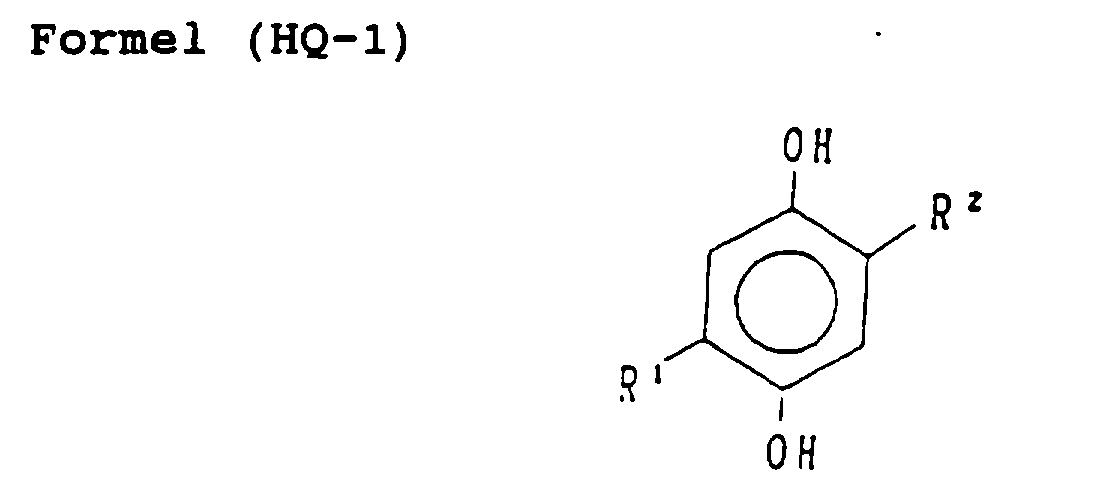


- Farbfotographisches Silberhalogenidmaterial nach Anspruch 2, worin ein hochsiedendes Lösungsmittel, das durch die folgende Formel (IIIs), (IVs), (Vs), (VIs), (VIIs) dargestellt ist, zum Herstellen von Dispersionen von öllöslichen Substanzen verwendet wird:

Formel (IVs) W₁ - C O O W₂


Formel (VIIs) W₁ - O - W₂
worin W₁, W₂ und W₃ jeweils eine substituierte oder unsubstituierte Alkylgruppe, Cycloalkylgruppe, Alkenylgruppe, Arylgruppe oder heterocyclische Gruppe bedeuten, W₄ W₁, O-W₁ oder S-W₁ bedeutet, n eine ganze Zahl von 1 bis 5 ist, wenn n 2 oder größer ist, die W₄-Gruppen gleich oder verschieden sein können, und in der Formel (VIIs), W₁ und W₂ zusammen einen kondensierten Ring bilden können. - Farbbilderzeugendes Verfahren, welches nach dem bildweisen Belichten eines farbfotographischen Silberhalogenidmaterials nach Anspruch 1 das Unterziehen des fotographischen Silberhalogenidmaterials einer Farbentwicklung mit einem Farbentwickler, der im wesentlichen frei von Benzylalkohol ist, umfaßt.
Applications Claiming Priority (2)
| Application Number | Priority Date | Filing Date | Title |
|---|---|---|---|
| JP289308/89 | 1989-11-07 | ||
| JP1289308A JPH03149545A (ja) | 1989-11-07 | 1989-11-07 | ハロゲン化銀カラー写真感光材料およびカラー画像形成法 |
Publications (3)
| Publication Number | Publication Date |
|---|---|
| EP0431329A2 EP0431329A2 (de) | 1991-06-12 |
| EP0431329A3 EP0431329A3 (en) | 1991-07-17 |
| EP0431329B1 true EP0431329B1 (de) | 1996-01-31 |
Family
ID=17741503
Family Applications (1)
| Application Number | Title | Priority Date | Filing Date |
|---|---|---|---|
| EP90121222A Expired - Lifetime EP0431329B1 (de) | 1989-11-07 | 1990-11-06 | Farbphotographisches Silberhalogenidmaterial und Verfahren zur Bildung eines Farbstoffbildes |
Country Status (4)
| Country | Link |
|---|---|
| US (1) | US5169742A (de) |
| EP (1) | EP0431329B1 (de) |
| JP (1) | JPH03149545A (de) |
| DE (1) | DE69025146T2 (de) |
Families Citing this family (7)
| Publication number | Priority date | Publication date | Assignee | Title |
|---|---|---|---|---|
| JPH055975A (ja) * | 1991-06-28 | 1993-01-14 | Konica Corp | ハロゲン化銀写真感光材料 |
| US6277537B1 (en) * | 1991-12-06 | 2001-08-21 | Eastman Kodak Company | Dye diffusion image separation systems with thermal solvents |
| JP2952540B2 (ja) * | 1992-03-04 | 1999-09-27 | 富士写真フイルム株式会社 | ハロゲン化銀カラー写真感光材料およびこれを用いたカラー画像形成法 |
| JP2855304B2 (ja) * | 1992-06-02 | 1999-02-10 | 富士写真フイルム株式会社 | ハロゲン化銀カラー写真感光材料 |
| US5480761A (en) * | 1993-06-08 | 1996-01-02 | Eastman Kodak Company | Aliphatic hydroxyl hydrogen bond donating groups on thermal solvents for image separation systems |
| US5468587A (en) * | 1993-06-08 | 1995-11-21 | Eastman Kodak Company | Hydrogen bond accepting groups on thermal solvents for image separation systems |
| US5480760A (en) * | 1993-06-08 | 1996-01-02 | Eastman Kodak Company | Sulfamoyl hydrogen bond donating groups on thermal solvents for image separation systems |
Family Cites Families (9)
| Publication number | Priority date | Publication date | Assignee | Title |
|---|---|---|---|---|
| JPS5429637A (en) * | 1977-08-09 | 1979-03-05 | Fuji Photo Film Co Ltd | Color photographic material |
| JPS56151937A (en) * | 1980-04-25 | 1981-11-25 | Fuji Photo Film Co Ltd | Color photographic sensitive silver halide material |
| JPS5773740A (en) * | 1980-10-27 | 1982-05-08 | Fuji Photo Film Co Ltd | Color photographic sensitive silver halide material |
| JPS59195239A (ja) * | 1983-04-19 | 1984-11-06 | Fuji Photo Film Co Ltd | カラ−写真感光材料 |
| JPH0656483B2 (ja) * | 1986-01-29 | 1994-07-27 | 富士写真フイルム株式会社 | カラ−画像形成法 |
| JP2563176B2 (ja) * | 1986-08-05 | 1996-12-11 | 富士写真フイルム株式会社 | ハロゲン化銀カラ−写真感光材料 |
| JP2542852B2 (ja) * | 1987-02-23 | 1996-10-09 | 富士写真フイルム株式会社 | ハロゲン化銀カラ−写真感光材料 |
| JP2640236B2 (ja) * | 1987-12-11 | 1997-08-13 | 富士写真フイルム株式会社 | ハロゲン化銀カラー写真感光材料 |
| JP2670859B2 (ja) * | 1989-06-30 | 1997-10-29 | 富士写真フイルム株式会社 | ハロゲン化銀カラー写真感光材料およびカラー画像形成法 |
-
1989
- 1989-11-07 JP JP1289308A patent/JPH03149545A/ja active Pending
-
1990
- 1990-10-31 US US07/606,858 patent/US5169742A/en not_active Expired - Lifetime
- 1990-11-06 EP EP90121222A patent/EP0431329B1/de not_active Expired - Lifetime
- 1990-11-06 DE DE69025146T patent/DE69025146T2/de not_active Expired - Fee Related
Also Published As
| Publication number | Publication date |
|---|---|
| EP0431329A3 (en) | 1991-07-17 |
| DE69025146T2 (de) | 1996-06-13 |
| US5169742A (en) | 1992-12-08 |
| DE69025146D1 (de) | 1996-03-14 |
| JPH03149545A (ja) | 1991-06-26 |
| EP0431329A2 (de) | 1991-06-12 |
Similar Documents
| Publication | Publication Date | Title |
|---|---|---|
| EP0355660B1 (de) | Farbphotographisches Silbenhalogenidmaterial | |
| EP0480292B1 (de) | Ein farbphotographisches Silberhalogenidmaterial | |
| US5166044A (en) | Silver halide emulsion and photographic material using same | |
| EP0423765B1 (de) | Fotografisches Silberhalogenidmaterial | |
| EP0431374B1 (de) | Farbkuppler für Fotografie und fotografisches Silberhalogenidmaterial, das diesen enthält | |
| EP0411513B1 (de) | Verarbeitungsverfahren für photographisches Silberhalogenidfarbmaterial | |
| EP0471347B1 (de) | Epoxy-Kupplerlösungsmittel | |
| US5698388A (en) | Silver halide color photographic material containing a stabilized high silver chloride emulsion | |
| EP0431329B1 (de) | Farbphotographisches Silberhalogenidmaterial und Verfahren zur Bildung eines Farbstoffbildes | |
| EP0399541B1 (de) | Farbphotographisches Silberhalogenidmaterial | |
| US5021328A (en) | Silver halide color photographic materials | |
| US5070003A (en) | Method for processing silver halide color photographic material | |
| EP0392481B1 (de) | Verfahren zur Bildherstellung | |
| JP2592677B2 (ja) | ハロゲン化銀カラー写真感光材料 | |
| US5200310A (en) | Silver halide photographic material | |
| US5124241A (en) | Silver halide color photographic material | |
| US5962208A (en) | Silver halide color photographic material containing a yellow coupler and a mercapto compound | |
| US5108886A (en) | Silver halide color photographic material | |
| JPH03223755A (ja) | ハロゲン化銀カラー写真感光材料 | |
| US5380638A (en) | Cyan dye-forming coupler and a silver halide color photographic material containing the same | |
| JP2870597B2 (ja) | カラー写真画像用有機着色物質を光に対して安定化する方法 | |
| JP2572276B2 (ja) | ハロゲン化銀カラー写真感光材料の処理方法 | |
| JPH0833639B2 (ja) | ハロゲン化銀カラー写真感光材料 | |
| JPH03209466A (ja) | ハロゲン化銀カラー写真感光材料 | |
| JPH03134659A (ja) | ハロゲン化銀カラー写真感光材料 |
Legal Events
| Date | Code | Title | Description |
|---|---|---|---|
| PUAI | Public reference made under article 153(3) epc to a published international application that has entered the european phase |
Free format text: ORIGINAL CODE: 0009012 |
|
| PUAL | Search report despatched |
Free format text: ORIGINAL CODE: 0009013 |
|
| AK | Designated contracting states |
Kind code of ref document: A2 Designated state(s): DE FR GB IT NL |
|
| AK | Designated contracting states |
Kind code of ref document: A3 Designated state(s): DE FR GB IT NL |
|
| RHK1 | Main classification (correction) |
Ipc: G03C 7/396 |
|
| 17P | Request for examination filed |
Effective date: 19920103 |
|
| 17Q | First examination report despatched |
Effective date: 19950405 |
|
| GRAA | (expected) grant |
Free format text: ORIGINAL CODE: 0009210 |
|
| AK | Designated contracting states |
Kind code of ref document: B1 Designated state(s): DE FR GB IT NL |
|
| PG25 | Lapsed in a contracting state [announced via postgrant information from national office to epo] |
Ref country code: IT Free format text: LAPSE BECAUSE OF FAILURE TO SUBMIT A TRANSLATION OF THE DESCRIPTION OR TO PAY THE FEE WITHIN THE PRESCRIBED TIME-LIMIT;WARNING: LAPSES OF ITALIAN PATENTS WITH EFFECTIVE DATE BEFORE 2007 MAY HAVE OCCURRED AT ANY TIME BEFORE 2007. THE CORRECT EFFECTIVE DATE MAY BE DIFFERENT FROM THE ONE RECORDED. Effective date: 19960131 Ref country code: NL Free format text: LAPSE BECAUSE OF FAILURE TO SUBMIT A TRANSLATION OF THE DESCRIPTION OR TO PAY THE FEE WITHIN THE PRESCRIBED TIME-LIMIT Effective date: 19960131 Ref country code: FR Effective date: 19960131 |
|
| REF | Corresponds to: |
Ref document number: 69025146 Country of ref document: DE Date of ref document: 19960314 |
|
| EN | Fr: translation not filed | ||
| NLV1 | Nl: lapsed or annulled due to failure to fulfill the requirements of art. 29p and 29m of the patents act | ||
| PLBE | No opposition filed within time limit |
Free format text: ORIGINAL CODE: 0009261 |
|
| STAA | Information on the status of an ep patent application or granted ep patent |
Free format text: STATUS: NO OPPOSITION FILED WITHIN TIME LIMIT |
|
| 26N | No opposition filed | ||
| REG | Reference to a national code |
Ref country code: GB Ref legal event code: IF02 |
|
| REG | Reference to a national code |
Ref country code: GB Ref legal event code: 732E |
|
| PGFP | Annual fee paid to national office [announced via postgrant information from national office to epo] |
Ref country code: DE Payment date: 20081103 Year of fee payment: 19 |
|
| PGFP | Annual fee paid to national office [announced via postgrant information from national office to epo] |
Ref country code: GB Payment date: 20081105 Year of fee payment: 19 |
|
| GBPC | Gb: european patent ceased through non-payment of renewal fee |
Effective date: 20091106 |
|
| PG25 | Lapsed in a contracting state [announced via postgrant information from national office to epo] |
Ref country code: DE Free format text: LAPSE BECAUSE OF NON-PAYMENT OF DUE FEES Effective date: 20100601 |
|
| PG25 | Lapsed in a contracting state [announced via postgrant information from national office to epo] |
Ref country code: GB Free format text: LAPSE BECAUSE OF NON-PAYMENT OF DUE FEES Effective date: 20091106 |