EP0432580A2 - Zweistufen-Verfahren zur Herstellung von Polycarbonaten auf Basis von speziellen Dihydroxydiphenylalkanen - Google Patents
Zweistufen-Verfahren zur Herstellung von Polycarbonaten auf Basis von speziellen Dihydroxydiphenylalkanen Download PDFInfo
- Publication number
- EP0432580A2 EP0432580A2 EP90122797A EP90122797A EP0432580A2 EP 0432580 A2 EP0432580 A2 EP 0432580A2 EP 90122797 A EP90122797 A EP 90122797A EP 90122797 A EP90122797 A EP 90122797A EP 0432580 A2 EP0432580 A2 EP 0432580A2
- Authority
- EP
- European Patent Office
- Prior art keywords
- hydroxyphenyl
- bis
- polycarbonates
- diphenols
- alkyl
- Prior art date
- Legal status (The legal status is an assumption and is not a legal conclusion. Google has not performed a legal analysis and makes no representation as to the accuracy of the status listed.)
- Granted
Links
- 229920000515 polycarbonate Polymers 0.000 title claims abstract description 32
- 239000004417 polycarbonate Substances 0.000 title claims abstract description 32
- 238000000034 method Methods 0.000 title claims abstract description 28
- 238000002360 preparation method Methods 0.000 title claims abstract description 9
- 238000009833 condensation Methods 0.000 claims description 10
- 125000004429 atom Chemical group 0.000 claims description 6
- 125000000217 alkyl group Chemical group 0.000 claims description 5
- 239000000155 melt Substances 0.000 claims description 5
- 239000001257 hydrogen Substances 0.000 claims description 4
- 229910052739 hydrogen Inorganic materials 0.000 claims description 4
- 239000007790 solid phase Substances 0.000 claims description 4
- 125000004169 (C1-C6) alkyl group Chemical group 0.000 claims description 3
- 125000004209 (C1-C8) alkyl group Chemical group 0.000 claims description 3
- 125000000041 C6-C10 aryl group Chemical group 0.000 claims description 3
- OKTJSMMVPCPJKN-UHFFFAOYSA-N Carbon Chemical compound [C] OKTJSMMVPCPJKN-UHFFFAOYSA-N 0.000 claims description 3
- 229910052799 carbon Inorganic materials 0.000 claims description 3
- 229910052736 halogen Inorganic materials 0.000 claims description 3
- 150000002367 halogens Chemical class 0.000 claims description 3
- 125000004435 hydrogen atom Chemical class [H]* 0.000 claims 2
- XKZQKPRCPNGNFR-UHFFFAOYSA-N 2-(3-hydroxyphenyl)phenol Chemical compound OC1=CC=CC(C=2C(=CC=CC=2)O)=C1 XKZQKPRCPNGNFR-UHFFFAOYSA-N 0.000 description 14
- 239000000243 solution Substances 0.000 description 11
- IISBACLAFKSPIT-UHFFFAOYSA-N bisphenol A Chemical compound C=1C=C(O)C=CC=1C(C)(C)C1=CC=C(O)C=C1 IISBACLAFKSPIT-UHFFFAOYSA-N 0.000 description 9
- YMWUJEATGCHHMB-UHFFFAOYSA-N Dichloromethane Chemical compound ClCCl YMWUJEATGCHHMB-UHFFFAOYSA-N 0.000 description 8
- 125000003118 aryl group Chemical group 0.000 description 7
- 238000006243 chemical reaction Methods 0.000 description 7
- 230000005494 condensation Effects 0.000 description 7
- -1 4- (4-hydroxyphenyl-isopropyl) phenyl Chemical group 0.000 description 6
- HEMHJVSKTPXQMS-UHFFFAOYSA-M Sodium hydroxide Chemical compound [OH-].[Na+] HEMHJVSKTPXQMS-UHFFFAOYSA-M 0.000 description 6
- 150000001875 compounds Chemical class 0.000 description 6
- 125000002496 methyl group Chemical group [H]C([H])([H])* 0.000 description 6
- 239000000203 mixture Substances 0.000 description 6
- 230000005501 phase interface Effects 0.000 description 6
- 239000002904 solvent Substances 0.000 description 6
- YGYAWVDWMABLBF-UHFFFAOYSA-N Phosgene Chemical compound ClC(Cl)=O YGYAWVDWMABLBF-UHFFFAOYSA-N 0.000 description 5
- 239000012298 atmosphere Substances 0.000 description 5
- 239000003054 catalyst Substances 0.000 description 5
- 239000000460 chlorine Substances 0.000 description 5
- 125000001997 phenyl group Chemical group [H]C1=C([H])C([H])=C(*)C([H])=C1[H] 0.000 description 5
- 125000000008 (C1-C10) alkyl group Chemical group 0.000 description 4
- ODJUOZPKKHIEOZ-UHFFFAOYSA-N 4-[2-(4-hydroxy-3,5-dimethylphenyl)propan-2-yl]-2,6-dimethylphenol Chemical compound CC1=C(O)C(C)=CC(C(C)(C)C=2C=C(C)C(O)=C(C)C=2)=C1 ODJUOZPKKHIEOZ-UHFFFAOYSA-N 0.000 description 4
- SDDLEVPIDBLVHC-UHFFFAOYSA-N Bisphenol Z Chemical compound C1=CC(O)=CC=C1C1(C=2C=CC(O)=CC=2)CCCCC1 SDDLEVPIDBLVHC-UHFFFAOYSA-N 0.000 description 4
- NBIIXXVUZAFLBC-UHFFFAOYSA-N Phosphoric acid Chemical compound OP(O)(O)=O NBIIXXVUZAFLBC-UHFFFAOYSA-N 0.000 description 4
- 125000001495 ethyl group Chemical group [H]C([H])([H])C([H])([H])* 0.000 description 4
- 239000011261 inert gas Substances 0.000 description 4
- 239000012074 organic phase Substances 0.000 description 4
- ISWSIDIOOBJBQZ-UHFFFAOYSA-N phenol group Chemical group C1(=CC=CC=C1)O ISWSIDIOOBJBQZ-UHFFFAOYSA-N 0.000 description 4
- 238000003756 stirring Methods 0.000 description 4
- XLYOFNOQVPJJNP-UHFFFAOYSA-N water Substances O XLYOFNOQVPJJNP-UHFFFAOYSA-N 0.000 description 4
- CSCPPACGZOOCGX-UHFFFAOYSA-N Acetone Chemical compound CC(C)=O CSCPPACGZOOCGX-UHFFFAOYSA-N 0.000 description 3
- WEVYAHXRMPXWCK-UHFFFAOYSA-N Acetonitrile Chemical compound CC#N WEVYAHXRMPXWCK-UHFFFAOYSA-N 0.000 description 3
- UHOVQNZJYSORNB-UHFFFAOYSA-N Benzene Chemical compound C1=CC=CC=C1 UHOVQNZJYSORNB-UHFFFAOYSA-N 0.000 description 3
- UFHFLCQGNIYNRP-UHFFFAOYSA-N Hydrogen Chemical compound [H][H] UFHFLCQGNIYNRP-UHFFFAOYSA-N 0.000 description 3
- QIGBRXMKCJKVMJ-UHFFFAOYSA-N Hydroquinone Chemical compound OC1=CC=C(O)C=C1 QIGBRXMKCJKVMJ-UHFFFAOYSA-N 0.000 description 3
- OKKJLVBELUTLKV-UHFFFAOYSA-N Methanol Chemical compound OC OKKJLVBELUTLKV-UHFFFAOYSA-N 0.000 description 3
- YXFVVABEGXRONW-UHFFFAOYSA-N Toluene Chemical compound CC1=CC=CC=C1 YXFVVABEGXRONW-UHFFFAOYSA-N 0.000 description 3
- ZMANZCXQSJIPKH-UHFFFAOYSA-N Triethylamine Chemical compound CCN(CC)CC ZMANZCXQSJIPKH-UHFFFAOYSA-N 0.000 description 3
- 239000006085 branching agent Substances 0.000 description 3
- 229910052794 bromium Inorganic materials 0.000 description 3
- 125000004432 carbon atom Chemical class C* 0.000 description 3
- 150000004649 carbonic acid derivatives Chemical class 0.000 description 3
- 229910052801 chlorine Inorganic materials 0.000 description 3
- 125000002887 hydroxy group Chemical group [H]O* 0.000 description 3
- 230000007935 neutral effect Effects 0.000 description 3
- 239000003960 organic solvent Substances 0.000 description 3
- GHMLBKRAJCXXBS-UHFFFAOYSA-N resorcinol Chemical compound OC1=CC=CC(O)=C1 GHMLBKRAJCXXBS-UHFFFAOYSA-N 0.000 description 3
- 229920001169 thermoplastic Polymers 0.000 description 3
- 239000004416 thermosoftening plastic Substances 0.000 description 3
- YIYBRXKMQFDHSM-UHFFFAOYSA-N 2,2'-Dihydroxybenzophenone Chemical compound OC1=CC=CC=C1C(=O)C1=CC=CC=C1O YIYBRXKMQFDHSM-UHFFFAOYSA-N 0.000 description 2
- VPVTXVHUJHGOCM-UHFFFAOYSA-N 2,4-bis[2-(4-hydroxyphenyl)propan-2-yl]phenol Chemical compound C=1C=C(O)C(C(C)(C)C=2C=CC(O)=CC=2)=CC=1C(C)(C)C1=CC=C(O)C=C1 VPVTXVHUJHGOCM-UHFFFAOYSA-N 0.000 description 2
- UIAFKZKHHVMJGS-UHFFFAOYSA-N 2,4-dihydroxybenzoic acid Chemical compound OC(=O)C1=CC=C(O)C=C1O UIAFKZKHHVMJGS-UHFFFAOYSA-N 0.000 description 2
- MAQOZOILPAMFSW-UHFFFAOYSA-N 2,6-bis[(2-hydroxy-5-methylphenyl)methyl]-4-methylphenol Chemical compound CC1=CC=C(O)C(CC=2C(=C(CC=3C(=CC=C(C)C=3)O)C=C(C)C=2)O)=C1 MAQOZOILPAMFSW-UHFFFAOYSA-N 0.000 description 2
- VXHYVVAUHMGCEX-UHFFFAOYSA-N 2-(2-hydroxyphenoxy)phenol Chemical compound OC1=CC=CC=C1OC1=CC=CC=C1O VXHYVVAUHMGCEX-UHFFFAOYSA-N 0.000 description 2
- XSVZEASGNTZBRQ-UHFFFAOYSA-N 2-(2-hydroxyphenyl)sulfinylphenol Chemical compound OC1=CC=CC=C1S(=O)C1=CC=CC=C1O XSVZEASGNTZBRQ-UHFFFAOYSA-N 0.000 description 2
- QUWAJPZDCZDTJS-UHFFFAOYSA-N 2-(2-hydroxyphenyl)sulfonylphenol Chemical compound OC1=CC=CC=C1S(=O)(=O)C1=CC=CC=C1O QUWAJPZDCZDTJS-UHFFFAOYSA-N 0.000 description 2
- XBQRPFBBTWXIFI-UHFFFAOYSA-N 2-chloro-4-[2-(3-chloro-4-hydroxyphenyl)propan-2-yl]phenol Chemical compound C=1C=C(O)C(Cl)=CC=1C(C)(C)C1=CC=C(O)C(Cl)=C1 XBQRPFBBTWXIFI-UHFFFAOYSA-N 0.000 description 2
- VEORPZCZECFIRK-UHFFFAOYSA-N 3,3',5,5'-tetrabromobisphenol A Chemical compound C=1C(Br)=C(O)C(Br)=CC=1C(C)(C)C1=CC(Br)=C(O)C(Br)=C1 VEORPZCZECFIRK-UHFFFAOYSA-N 0.000 description 2
- YMTYZTXUZLQUSF-UHFFFAOYSA-N 3,3'-Dimethylbisphenol A Chemical compound C1=C(O)C(C)=CC(C(C)(C)C=2C=C(C)C(O)=CC=2)=C1 YMTYZTXUZLQUSF-UHFFFAOYSA-N 0.000 description 2
- SUCTVKDVODFXFX-UHFFFAOYSA-N 4-(4-hydroxy-3,5-dimethylphenyl)sulfonyl-2,6-dimethylphenol Chemical compound CC1=C(O)C(C)=CC(S(=O)(=O)C=2C=C(C)C(O)=C(C)C=2)=C1 SUCTVKDVODFXFX-UHFFFAOYSA-N 0.000 description 2
- AZZWZMUXHALBCQ-UHFFFAOYSA-N 4-[(4-hydroxy-3,5-dimethylphenyl)methyl]-2,6-dimethylphenol Chemical compound CC1=C(O)C(C)=CC(CC=2C=C(C)C(O)=C(C)C=2)=C1 AZZWZMUXHALBCQ-UHFFFAOYSA-N 0.000 description 2
- BRPSWMCDEYMRPE-UHFFFAOYSA-N 4-[1,1-bis(4-hydroxyphenyl)ethyl]phenol Chemical compound C=1C=C(O)C=CC=1C(C=1C=CC(O)=CC=1)(C)C1=CC=C(O)C=C1 BRPSWMCDEYMRPE-UHFFFAOYSA-N 0.000 description 2
- XJGTVJRTDRARGO-UHFFFAOYSA-N 4-[2-(4-hydroxyphenyl)propan-2-yl]benzene-1,3-diol Chemical compound C=1C=C(O)C=C(O)C=1C(C)(C)C1=CC=C(O)C=C1 XJGTVJRTDRARGO-UHFFFAOYSA-N 0.000 description 2
- RQTDWDATSAVLOR-UHFFFAOYSA-N 4-[3,5-bis(4-hydroxyphenyl)phenyl]phenol Chemical compound C1=CC(O)=CC=C1C1=CC(C=2C=CC(O)=CC=2)=CC(C=2C=CC(O)=CC=2)=C1 RQTDWDATSAVLOR-UHFFFAOYSA-N 0.000 description 2
- OBZFGWBLZXIBII-UHFFFAOYSA-N 4-[3-(4-hydroxy-3,5-dimethylphenyl)-3-methylbutyl]-2,6-dimethylphenol Chemical compound CC1=C(O)C(C)=CC(CCC(C)(C)C=2C=C(C)C(O)=C(C)C=2)=C1 OBZFGWBLZXIBII-UHFFFAOYSA-N 0.000 description 2
- NIRYBKWMEWFDPM-UHFFFAOYSA-N 4-[3-(4-hydroxyphenyl)-3-methylbutyl]phenol Chemical compound C=1C=C(O)C=CC=1C(C)(C)CCC1=CC=C(O)C=C1 NIRYBKWMEWFDPM-UHFFFAOYSA-N 0.000 description 2
- CIEGINNQDIULCT-UHFFFAOYSA-N 4-[4,6-bis(4-hydroxyphenyl)-4,6-dimethylheptan-2-yl]phenol Chemical compound C=1C=C(O)C=CC=1C(C)CC(C)(C=1C=CC(O)=CC=1)CC(C)(C)C1=CC=C(O)C=C1 CIEGINNQDIULCT-UHFFFAOYSA-N 0.000 description 2
- IQNDEQHJTOJHAK-UHFFFAOYSA-N 4-[4-[2-[4,4-bis(4-hydroxyphenyl)cyclohexyl]propan-2-yl]-1-(4-hydroxyphenyl)cyclohexyl]phenol Chemical compound C1CC(C=2C=CC(O)=CC=2)(C=2C=CC(O)=CC=2)CCC1C(C)(C)C(CC1)CCC1(C=1C=CC(O)=CC=1)C1=CC=C(O)C=C1 IQNDEQHJTOJHAK-UHFFFAOYSA-N 0.000 description 2
- LIDWAYDGZUAJEG-UHFFFAOYSA-N 4-[bis(4-hydroxyphenyl)-phenylmethyl]phenol Chemical compound C1=CC(O)=CC=C1C(C=1C=CC(O)=CC=1)(C=1C=CC(O)=CC=1)C1=CC=CC=C1 LIDWAYDGZUAJEG-UHFFFAOYSA-N 0.000 description 2
- XKRFYHLGVUSROY-UHFFFAOYSA-N Argon Chemical compound [Ar] XKRFYHLGVUSROY-UHFFFAOYSA-N 0.000 description 2
- IJGRMHOSHXDMSA-UHFFFAOYSA-N Atomic nitrogen Chemical compound N#N IJGRMHOSHXDMSA-UHFFFAOYSA-N 0.000 description 2
- 229930185605 Bisphenol Natural products 0.000 description 2
- WKBOTKDWSSQWDR-UHFFFAOYSA-N Bromine atom Chemical compound [Br] WKBOTKDWSSQWDR-UHFFFAOYSA-N 0.000 description 2
- ZAMOUSCENKQFHK-UHFFFAOYSA-N Chlorine atom Chemical compound [Cl] ZAMOUSCENKQFHK-UHFFFAOYSA-N 0.000 description 2
- JUJWROOIHBZHMG-UHFFFAOYSA-N Pyridine Chemical compound C1=CC=NC=C1 JUJWROOIHBZHMG-UHFFFAOYSA-N 0.000 description 2
- KYPYTERUKNKOLP-UHFFFAOYSA-N Tetrachlorobisphenol A Chemical compound C=1C(Cl)=C(O)C(Cl)=CC=1C(C)(C)C1=CC(Cl)=C(O)C(Cl)=C1 KYPYTERUKNKOLP-UHFFFAOYSA-N 0.000 description 2
- 229910000147 aluminium phosphate Inorganic materials 0.000 description 2
- 239000008346 aqueous phase Substances 0.000 description 2
- QMKYBPDZANOJGF-UHFFFAOYSA-N benzene-1,3,5-tricarboxylic acid Chemical compound OC(=O)C1=CC(C(O)=O)=CC(C(O)=O)=C1 QMKYBPDZANOJGF-UHFFFAOYSA-N 0.000 description 2
- 125000001797 benzyl group Chemical group [H]C1=C([H])C([H])=C(C([H])=C1[H])C([H])([H])* 0.000 description 2
- 230000015572 biosynthetic process Effects 0.000 description 2
- VCCBEIPGXKNHFW-UHFFFAOYSA-N biphenyl-4,4'-diol Chemical group C1=CC(O)=CC=C1C1=CC=C(O)C=C1 VCCBEIPGXKNHFW-UHFFFAOYSA-N 0.000 description 2
- MVPPADPHJFYWMZ-UHFFFAOYSA-N chlorobenzene Chemical compound ClC1=CC=CC=C1 MVPPADPHJFYWMZ-UHFFFAOYSA-N 0.000 description 2
- ROORDVPLFPIABK-UHFFFAOYSA-N diphenyl carbonate Chemical group C=1C=CC=CC=1OC(=O)OC1=CC=CC=C1 ROORDVPLFPIABK-UHFFFAOYSA-N 0.000 description 2
- 238000001704 evaporation Methods 0.000 description 2
- 230000008020 evaporation Effects 0.000 description 2
- 238000005227 gel permeation chromatography Methods 0.000 description 2
- 125000004464 hydroxyphenyl group Chemical group 0.000 description 2
- 230000020477 pH reduction Effects 0.000 description 2
- 239000012071 phase Substances 0.000 description 2
- 150000002989 phenols Chemical class 0.000 description 2
- QCDYQQDYXPDABM-UHFFFAOYSA-N phloroglucinol Chemical compound OC1=CC(O)=CC(O)=C1 QCDYQQDYXPDABM-UHFFFAOYSA-N 0.000 description 2
- 229960001553 phloroglucinol Drugs 0.000 description 2
- 238000006068 polycondensation reaction Methods 0.000 description 2
- 229920000642 polymer Polymers 0.000 description 2
- 229960001755 resorcinol Drugs 0.000 description 2
- VZGDMQKNWNREIO-UHFFFAOYSA-N tetrachloromethane Chemical compound ClC(Cl)(Cl)Cl VZGDMQKNWNREIO-UHFFFAOYSA-N 0.000 description 2
- RIOQSEWOXXDEQQ-UHFFFAOYSA-N triphenylphosphine Chemical compound C1=CC=CC=C1P(C=1C=CC=CC=1)C1=CC=CC=C1 RIOQSEWOXXDEQQ-UHFFFAOYSA-N 0.000 description 2
- KYGLCUAXJICESS-UHFFFAOYSA-N 2-[2,3-di(propan-2-yl)phenyl]phenol Chemical class CC(C)C1=CC=CC(C=2C(=CC=CC=2)O)=C1C(C)C KYGLCUAXJICESS-UHFFFAOYSA-N 0.000 description 1
- NRGGMCIBEHEAIL-UHFFFAOYSA-N 2-ethylpyridine Chemical compound CCC1=CC=CC=N1 NRGGMCIBEHEAIL-UHFFFAOYSA-N 0.000 description 1
- ZEKCYPANSOJWDH-UHFFFAOYSA-N 3,3-bis(4-hydroxy-3-methylphenyl)-1H-indol-2-one Chemical compound C1=C(O)C(C)=CC(C2(C3=CC=CC=C3NC2=O)C=2C=C(C)C(O)=CC=2)=C1 ZEKCYPANSOJWDH-UHFFFAOYSA-N 0.000 description 1
- VPWNQTHUCYMVMZ-UHFFFAOYSA-N 4,4'-sulfonyldiphenol Chemical class C1=CC(O)=CC=C1S(=O)(=O)C1=CC=C(O)C=C1 VPWNQTHUCYMVMZ-UHFFFAOYSA-N 0.000 description 1
- UMPGNGRIGSEMTC-UHFFFAOYSA-N 4-[1-(4-hydroxyphenyl)-3,3,5-trimethylcyclohexyl]phenol Chemical compound C1C(C)CC(C)(C)CC1(C=1C=CC(O)=CC=1)C1=CC=C(O)C=C1 UMPGNGRIGSEMTC-UHFFFAOYSA-N 0.000 description 1
- CIIUIRUKNKELEO-UHFFFAOYSA-N 4-[2,5-di(propan-2-yl)phenyl]-2,6-dimethylphenol Chemical compound CC(C)C1=CC=C(C(C)C)C(C=2C=C(C)C(O)=C(C)C=2)=C1 CIIUIRUKNKELEO-UHFFFAOYSA-N 0.000 description 1
- BOCLKUCIZOXUEY-UHFFFAOYSA-N 4-[tris(4-hydroxyphenyl)methyl]phenol Chemical compound C1=CC(O)=CC=C1C(C=1C=CC(O)=CC=1)(C=1C=CC(O)=CC=1)C1=CC=C(O)C=C1 BOCLKUCIZOXUEY-UHFFFAOYSA-N 0.000 description 1
- 125000004203 4-hydroxyphenyl group Chemical group [H]OC1=C([H])C([H])=C(*)C([H])=C1[H] 0.000 description 1
- GIXXQTYGFOHYPT-UHFFFAOYSA-N Bisphenol P Chemical compound C=1C=C(C(C)(C)C=2C=CC(O)=CC=2)C=CC=1C(C)(C)C1=CC=C(O)C=C1 GIXXQTYGFOHYPT-UHFFFAOYSA-N 0.000 description 1
- GDOPTJXRTPNYNR-UHFFFAOYSA-N CC1CCCC1 Chemical compound CC1CCCC1 GDOPTJXRTPNYNR-UHFFFAOYSA-N 0.000 description 1
- XDTMQSROBMDMFD-UHFFFAOYSA-N Cyclohexane Chemical compound C1CCCCC1 XDTMQSROBMDMFD-UHFFFAOYSA-N 0.000 description 1
- HTLZVHNRZJPSMI-UHFFFAOYSA-N N-ethylpiperidine Chemical compound CCN1CCCCC1 HTLZVHNRZJPSMI-UHFFFAOYSA-N 0.000 description 1
- 239000002253 acid Substances 0.000 description 1
- 239000000654 additive Substances 0.000 description 1
- 150000001335 aliphatic alkanes Chemical class 0.000 description 1
- 150000008044 alkali metal hydroxides Chemical class 0.000 description 1
- 229910052786 argon Inorganic materials 0.000 description 1
- 229940114055 beta-resorcylic acid Drugs 0.000 description 1
- GDTBXPJZTBHREO-UHFFFAOYSA-N bromine Substances BrBr GDTBXPJZTBHREO-UHFFFAOYSA-N 0.000 description 1
- 150000001733 carboxylic acid esters Chemical class 0.000 description 1
- 239000000470 constituent Substances 0.000 description 1
- MGNCLNQXLYJVJD-UHFFFAOYSA-N cyanuric chloride Chemical compound ClC1=NC(Cl)=NC(Cl)=N1 MGNCLNQXLYJVJD-UHFFFAOYSA-N 0.000 description 1
- 150000001924 cycloalkanes Chemical class 0.000 description 1
- JGFBRKRYDCGYKD-UHFFFAOYSA-N dibutyl(oxo)tin Chemical compound CCCC[Sn](=O)CCCC JGFBRKRYDCGYKD-UHFFFAOYSA-N 0.000 description 1
- 150000002148 esters Chemical class 0.000 description 1
- RIFGWPKJUGCATF-UHFFFAOYSA-N ethyl chloroformate Chemical compound CCOC(Cl)=O RIFGWPKJUGCATF-UHFFFAOYSA-N 0.000 description 1
- 230000004927 fusion Effects 0.000 description 1
- 239000011521 glass Substances 0.000 description 1
- 239000008187 granular material Substances 0.000 description 1
- 125000005842 heteroatom Chemical group 0.000 description 1
- 150000004678 hydrides Chemical class 0.000 description 1
- 150000002431 hydrogen Chemical class 0.000 description 1
- 238000001746 injection moulding Methods 0.000 description 1
- 150000002484 inorganic compounds Chemical class 0.000 description 1
- 229910010272 inorganic material Inorganic materials 0.000 description 1
- 238000004519 manufacturing process Methods 0.000 description 1
- 238000005259 measurement Methods 0.000 description 1
- 230000008018 melting Effects 0.000 description 1
- 238000002844 melting Methods 0.000 description 1
- 238000000465 moulding Methods 0.000 description 1
- YCWSUKQGVSGXJO-NTUHNPAUSA-N nifuroxazide Chemical group C1=CC(O)=CC=C1C(=O)N\N=C\C1=CC=C([N+]([O-])=O)O1 YCWSUKQGVSGXJO-NTUHNPAUSA-N 0.000 description 1
- 229910052757 nitrogen Inorganic materials 0.000 description 1
- 239000012299 nitrogen atmosphere Substances 0.000 description 1
- 150000002894 organic compounds Chemical class 0.000 description 1
- 150000002902 organometallic compounds Chemical class 0.000 description 1
- 238000001556 precipitation Methods 0.000 description 1
- UMJSCPRVCHMLSP-UHFFFAOYSA-N pyridine Natural products COC1=CC=CN=C1 UMJSCPRVCHMLSP-UHFFFAOYSA-N 0.000 description 1
- 230000005855 radiation Effects 0.000 description 1
- 238000001953 recrystallisation Methods 0.000 description 1
- 238000001226 reprecipitation Methods 0.000 description 1
- 238000012552 review Methods 0.000 description 1
- 150000003839 salts Chemical class 0.000 description 1
- 238000003860 storage Methods 0.000 description 1
- 150000003510 tertiary aliphatic amines Chemical class 0.000 description 1
- 150000003512 tertiary amines Chemical class 0.000 description 1
- IMFACGCPASFAPR-UHFFFAOYSA-N tributylamine Chemical compound CCCCN(CCCC)CCCC IMFACGCPASFAPR-UHFFFAOYSA-N 0.000 description 1
- FIQMHBFVRAXMOP-UHFFFAOYSA-N triphenylphosphane oxide Chemical compound C=1C=CC=CC=1P(C=1C=CC=CC=1)(=O)C1=CC=CC=C1 FIQMHBFVRAXMOP-UHFFFAOYSA-N 0.000 description 1
- 238000005406 washing Methods 0.000 description 1
Classifications
-
- C—CHEMISTRY; METALLURGY
- C08—ORGANIC MACROMOLECULAR COMPOUNDS; THEIR PREPARATION OR CHEMICAL WORKING-UP; COMPOSITIONS BASED THEREON
- C08G—MACROMOLECULAR COMPOUNDS OBTAINED OTHERWISE THAN BY REACTIONS ONLY INVOLVING UNSATURATED CARBON-TO-CARBON BONDS
- C08G64/00—Macromolecular compounds obtained by reactions forming a carbonic ester link in the main chain of the macromolecule
- C08G64/20—General preparatory processes
-
- C—CHEMISTRY; METALLURGY
- C08—ORGANIC MACROMOLECULAR COMPOUNDS; THEIR PREPARATION OR CHEMICAL WORKING-UP; COMPOSITIONS BASED THEREON
- C08G—MACROMOLECULAR COMPOUNDS OBTAINED OTHERWISE THAN BY REACTIONS ONLY INVOLVING UNSATURATED CARBON-TO-CARBON BONDS
- C08G64/00—Macromolecular compounds obtained by reactions forming a carbonic ester link in the main chain of the macromolecule
- C08G64/04—Aromatic polycarbonates
-
- C—CHEMISTRY; METALLURGY
- C08—ORGANIC MACROMOLECULAR COMPOUNDS; THEIR PREPARATION OR CHEMICAL WORKING-UP; COMPOSITIONS BASED THEREON
- C08G—MACROMOLECULAR COMPOUNDS OBTAINED OTHERWISE THAN BY REACTIONS ONLY INVOLVING UNSATURATED CARBON-TO-CARBON BONDS
- C08G64/00—Macromolecular compounds obtained by reactions forming a carbonic ester link in the main chain of the macromolecule
- C08G64/20—General preparatory processes
- C08G64/30—General preparatory processes using carbonates
Definitions
- the preferred alkyl radical is methyl; the X atoms in the ⁇ -position to the di-phenyl-substituted C atom (C-1) are preferably not dialkyl-substituted, whereas the alkyl disubstitution in the ⁇ -position to C-1 is preferred.
- dihydroxydiphenylcycloalkanes of the formula (I) and the polycarbonates based on the dihydroxydiphenylcycloalkanes are described in German Offenlegungsschrift 38 32 396.
- the invention relates to a two-stage process for the preparation of polycarbonates based on the special dihydroxydiphenylcycloalkanes of the formula (I), which is characterized in that oligomeric polycarbonates are prepared in a first process step and then in the melt or by solid phase post-condensation in a second process step are condensed to high molecular weight polycarbonates.
- Both a diphenol of the formula (I) with the formation of homopolycarbonates and a plurality of diphenols of the formula (I) with the formation of copolycarbonates can be used in the process according to the invention.
- diphenols of the formula (I) can also be used in a mixture with other diphenols, for example with those of the formula HO-Z-OH (IV), for the production of high-molecular, thermoplastic, aromatic polycarbonates.
- Suitable other diphenols of the formula HO-Z-OH (IV) are those in which Z is an aromatic radical having 6 to 30 carbon atoms, which may contain one or more aromatic nuclei, may be substituted and aliphatic radicals or other cycloaliphatic radicals than that of the formula (I) or heteroatoms as bridge members.
- the other diphenols can be used both individually and in a mixture.
- the molar ratio of diphenols of the formula (I) to the other diphenols optionally to be used, for example those of the formula (IV), should increase between 100 mol% (I) to 0 mol% of other diphenol and 2 mol% (I) 98 mol% of other diphenol, preferably between 100 mol% (I) to 0 mol% of other diphenol and 15 mol% (I) to 85 mol% of other diphenol and in particular between 100 mol% (I) to 0 Mole% of other diphenol and 20 mole% (I) to 80 mole% of other diphenol and very particularly between 100 mole% (I) to 0 mole% of other diphenol and 25 mole% (I) to 75 mole% % other diphenol.
- the various diphenols can be linked to one another both statistically and in blocks.
- Some of the other three-functional compounds are 2,4-dihydroxybenzoic acid, trimesic acid, cyanuric chloride and 3,3-bis - (- 3-methyl-4-hydroxyphenyl) 2-oxo-2,3-dihydroindole.
- oligomeric polycarbonates are first prepared in a first process step, starting from diphenols (I) and optionally other diphenols.
- the oligomeric polycarbonates preferably have molecular weights M w ⁇ 10500.
- oligomers are preferred whose content of phenolic hydroxyl groups is ⁇ 500 ppm, preferably ⁇ 350 ppm and in particular ⁇ 250 ppm.
- the preparation of the oligomers is not critical. it takes place, for example, by reaction of diphenols of the formula (I) and, if appropriate, other diphenols with diaryl carbonate and / or di- (C 1 -C 11 -alkyl) carbonates at temperatures of 20-350 ° C.
- Preferred diaryl carbonate is diphenyl carbonate; when using dialkyl carbonates, preferred alkyl radicals are methyl and ethyl.
- the ratio of diphenols to diaryl carbonates is 1: 0.95 to 1: 2.2, preferably 1: 1.1 to 1: 1.9, in particular 1: 1.2 to 1: 1.75.
- the ratio of bisphenols to dialkyl carbonates is 1: 1.1 to 1:10, preferably 1: 1.2 to 1: 8.
- Catalysts can be used to accelerate the reaction.
- Suitable catalysts are basic organic and / or inorganic compounds, for example (earth) alkali metal hydroxides, alcoholates, salts, hydrides, pyridine.
- Organometallic compounds such as triphenylphosphine, triphenylphosphine oxide, organotin compounds such as dibutyltin oxide can also be used.
- the corresponding diaryl and / or di (C1-C10-alkyl) carboxylic acid esters can also be used.
- the oligomeric polycarbonates (V) can also be prepared in a manner known per se by the phase interface method (cf. H. Schnell, "Chemistry and Physics of Polycarbonates", Polymer Reviews, Vol. IX, page 33 ff., Interscience Publ., 1964) will.
- the diphenols of the formula (I) are dissolved in an aqueous alkaline phase. Mixtures of diphenols of the formula (I) and the other diphenols, for example those of the formula (IV), are used to produce copolycarbonates with other diphenols. Chain terminators are added to regulate the molecular weight.
- reaction with phosgene is carried out by the phase interface condensation method.
- the reaction temperature is between 0 ° C and 40 ° C.
- the optionally used 0.05 to 2 mol% of branching agents can either be introduced with the diphenols in the aqueous alkaline phase or added dissolved in the organic solvent before the phosgenation.
- Suitable organic solvents for the solution of the chain terminators and optionally for the branching agents and the mono- or bis-chlorocarbonic acid esters are, for example, methylene chloride, chlorobenzene, toluene, acetone, acetonitrile and mixtures of these solvents.
- the preparation of the oligomeric polycarbonates (V) by the phase interface process can be catalyzed in a conventional manner by catalysts such as tertiary amines, in particular tertiary aliphatic amines such as tributylamine or triethylamine; the catalysts can be used in amounts of 0.05 to 10 mol%, based on moles of diphenols used.
- the catalysts can be added before the start of phosgenation or during or after the phosgenation.
- the oligomeric polycarbonates (V) are isolated in a known manner. If the oligomers are prepared by the phase interface polycondensation process, they can be isolated, for example, by using the organic phase obtained in the phase interface polycondensation separated, washed neutral and electrolyte-free and then isolated as granules, for example using an evaporation extruder.
- the oligomers (V) can also be isolated from the solution by precipitation with a non-solvent such as methanol.
- the oligomers (V) can be further purified by washing with solvent, reprecipitation or recrystallization before being introduced into the second process stage.
- high molecular weight polycarbonates are produced from the oligomeric polycarbonates (V) in a second process step.
- the oligomers (V) are further condensed at temperatures of 140-350 ° C.
- the condensation can be carried out in conventional reaction vessels such as kettles, tubes and the like.
- the solid phase condensation is carried out in an inert atmosphere (nitrogen, argon). If the condensation is carried out in the melt, the pressure can be 0.1 to 2 bar.
- the resulting high molecular weight, thermoplastic, aromatic polycarbonates based on diphenols (I) as well any other diphenols are distinguished by advantageous properties.
- the present invention thus also relates to high molecular weight, thermoplastic, aromatic polycarbonates based on diphenols (I) produced by a two-stage process, characterized in that in a first process stage oligomers are produced which are condensed to polymers in a second process stage.
- the polycarbonates according to the invention can be processed into moldings by processing them, for example on an injection molding machine, if appropriate after adding additives, to give various articles in a known manner.
- the products are characterized by good mechanical properties such as high heat resistance. This means that high temperatures are required to isolate the products, for example using an evaporation extruder.
- a particular advantage of the process according to the invention is that the products can be produced and isolated at lower temperatures.
- the products produced by the process according to the invention have a good intrinsic color and are free of phenol and solvents.
- the products produced by the process according to the invention show better resistance to external influences such as thermal storage at elevated temperatures, UV radiation and weathering.
- the relative viscosity is measured on 0.5 wt .-% solution of the polycarbonate in CH2Cl2.
- the molecular weights are determined by gel permeation chromatography (GPC).
- Example 4 (condensation of the oligomer from Example 1)
- Example 5 (condensation of the oligomer from Example 2)
Landscapes
- Chemical & Material Sciences (AREA)
- Health & Medical Sciences (AREA)
- Chemical Kinetics & Catalysis (AREA)
- Medicinal Chemistry (AREA)
- Polymers & Plastics (AREA)
- Organic Chemistry (AREA)
- Polyesters Or Polycarbonates (AREA)
- Organic Low-Molecular-Weight Compounds And Preparation Thereof (AREA)
Abstract
Description
- Die Erfindung betrifft ein Zweistufen-Verfahren zur Herstellung von Polycarbonaten auf Basis von speziellen Dihydroxydiphenylcycloalkanen der Formel (I)

- R¹ und R²
- unabhängig voneinander Wasserstoff, Halogen, bevorzugt Chlor oder Brom, C₁-C₈-Alkyl, C₅-C₆-Cycloalkyl, C₆-C₁₀-Aryl, bevorzugt Phenyl, und C₇-C₁₂-Aralkyl, bevorzugt Phenyl-C₁-C₄-Alkyl, insbesondere Benzyl,
- m
- eine ganze Zahl von 4 bis 7, bevorzugt 4 oder 5,
- R³ und R⁴,
- für jedes x individuell wählbar, unabhängig voneinander Wasserstoff oder C₁-C₆-Alkyl
und - x
- Kohlenstoff bedeuten,
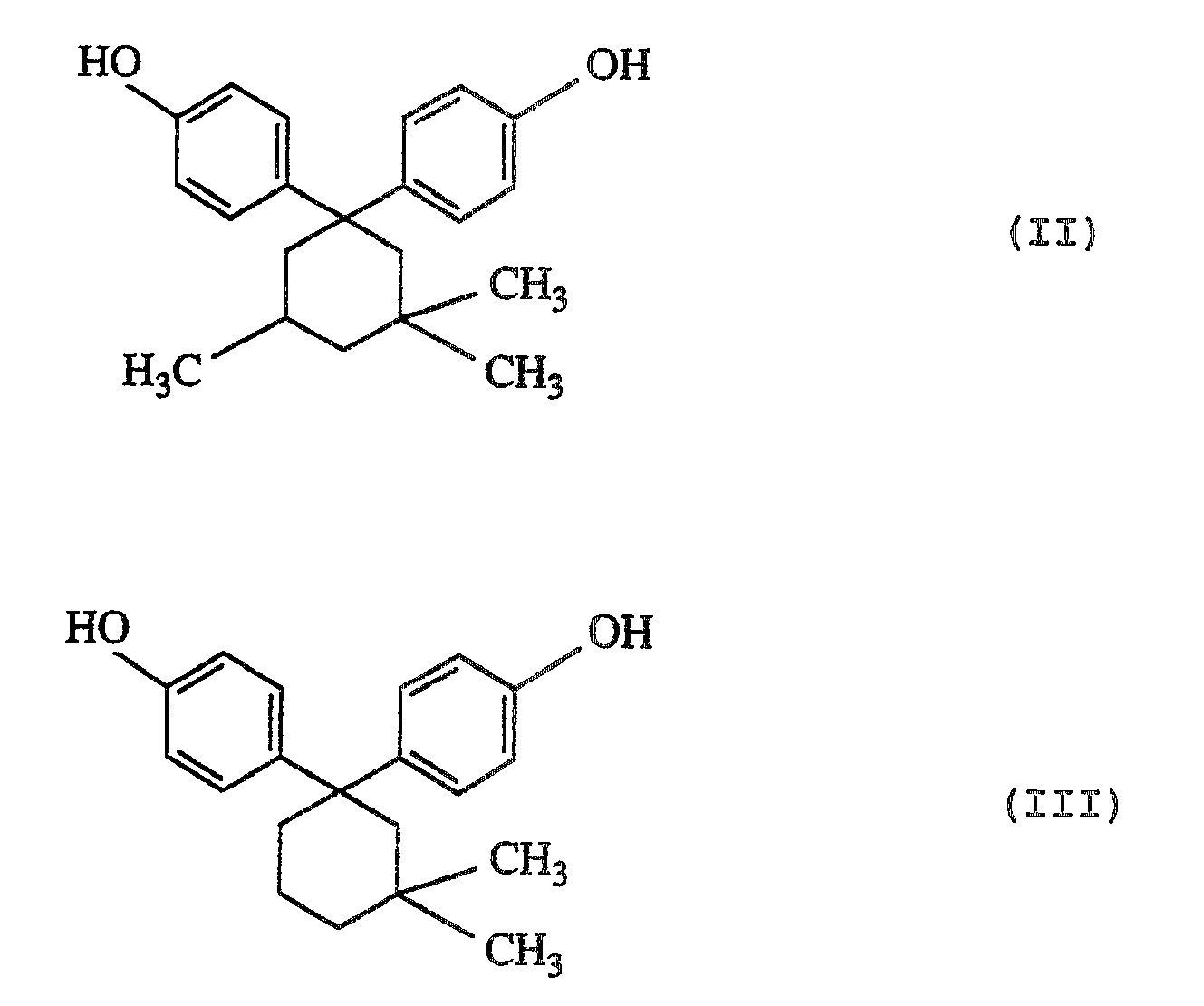
mit der Maßgabe, daß an mindestens einem Atom X R³ und R⁴ gleichzeitig Alkyl bedeuten. - Bevorzugt sind an 1 - 2 Atomen X, insbesondere nur an einem Atom X, R³ und R⁴ gleichzeitig Alkyl. Bevorzugter Alkylrest ist Methyl; die X-Atome in α-Stellung zu dem di-phenyl-substituierten C-Atom (C-1) sind bevorzugt nicht dialkylsubstituiert, dagegen ist die Alkyldisubstitution in ß-Stellung zu C-1 bevorzugt. Insbesondere sind Gegenstand der Erfindung Dihydroxydiphenylcycloalkane mit 5 und 6 Ring-C-Atomen im cycloaliphatischen Rest (m = 4 oder 5 in Formel (I) wie beispielsweise die Diphenole der Formeln
- Die Dihydroxydiphenylcycloalkane der Formel (I) sowie die Polycarbonate auf Basis der Dihydroxydiphenylcycloalkane sind in der deutschen Offenlegungsschrift 38 32 396 beschrieben.
- Gegenstand der Erfindung ist ein Zweistufen-Verfahren zur Herstellung von Polycarbonaten auf Basis der speziellen Dihydroxydiphenylcycloalkane der Formel (I), das dadurch gekennzeichnet ist, daß in einem ersten Verfahrensschritt oligomere Polycarbonate hergestellt werden und diese dann in der Schmelze oder durch Festphasennachkondensation in einem zweiten Verfahrensschritt zu hochmolekularen Polycarbonaten aufkondensiert werden.
- Nach dem erfindungsgemäßen Verfahren können sowohl ein Diphenol der Formel (I) unter Bildung von Homopolycarbonaten als auch mehrere Diphenole der Formel (I) unter Bildung von Copolycarbonaten verwendet werden.
- Außerdem können die Diphenole der Formel (I) auch im Gemisch mit anderen Diphenolen, beispielsweise mit denen der Formel HO-Z-OH (IV), zur Herstellung von hochmolekularen, thermoplastischen, aromatischen Polycarbonaten verwendet werden. Geeignete andere Diphenole der Formel HO-Z-OH (IV) sind solche, in denen Z ein aromatischer Rest mit 6 bis 30 C-Atomen ist, der einen oder mehrere aromatische Kerne enthalten kann, substituiert sein kann und aliphatische Reste oder andere cycloaliphatische Reste als die der Formel (I) oder Heteroatome als Brückenglieder enthalten kann.
- Beispiele für Diphenole der Formel (IV) sind
- Hydrochinon,
- Resorcin,
- Dihydroxydiphenyle,
- Bis-(hydroxyphenyl)-alkane,
- Bis-(hydroxyphenyl)-cycloalkane,
- Bis-(hydroxyphenyl)-ether,
- Bis-(hydroxyphenyl)-ketone,
- Bis-(hydroxyphenyl)-sulfone,
- Bis-(hydroxyphenyl)-sulfoxide,
- α,α'-Bis-(hydroxyphenyl)-diisopropylbenzole
- sowie deren kernalkylierte und kernhalogenierte Verbindungen.
- Diese und weitere geeignete andere Diphenole sind z.B. in den US-PS 3 028 365, 2 999 835, 3 148 172, 3 275 601, 2 991 273, 3 271 367, 3 062 781, 2 970 131 und 2 999 846, in den deut schen Offenlegungsschriften 1 570 703, 2 063 050, 2 063 052, 2 211 0956, der französischen Patentschrift 1 561 518 und in der Monographie "H. Schnell, Chemistry and Physics of Polycarbonates, Interscience Publishers, New York 1964", beschrieben.
- Bevorzugte andere Diphenole sind beispielsweise:
- 4,4'-Dihydroxydiphenyl,
- 2,2-Bis-(4-hydroxyphenyl)-propan,
- 2,4-Bis-(4-hydroxyphenyl)-2-methylbutan,
- 1,1-Bis-(4-hydroxyphenyl)-cyclohexan,
- α,α'-Bis-(4-hydroxyphenyl)-p-diisopropylbenzol,
- 2,2-Bis-(3-methyl-4-hydroxyphenyl)-propan,
- 2,2-Bis-(3-chlor-4-hydroxyphenyl)-propan,
- Bis-(3,5-dimethyl-4-hydroxyphenyl)-methan,
- 2,2-Bis-(3,5-dimethyl-4-hydroxyphenyl)-propan,
- Bis-(3,5-dimethyl-4-hydroxyphenyl)-sulfon,
- 2,4-Bis-(3,5-dimethyl-4-hydroxyphenyl)-2-methylbutan,
- 1,1-Bis-(3,5-dimethyl-4-hydrocxphenyl)-cyclohexan,
- α,α'-Bis-(3,5-dimethyl-4-hydroxyphenyl)-p-diisopropylbenzol,
- 2,2-Bis-(3,5-dichlor-4-hydroxyphenyl)-propan und
- 2,2-Bis-(3,5-dibrom-4-hydroxyphenyl)-propan.
- Besonders bevorzugte Diphenole der Formel (IV) sind beispielsweise:
- 2,2-Bis-(4-hydroxyphenyl)-propan,
- 2,2-Bis-(3,5-dimethyl-4-hydroxyphenyl)-propan und
- 1,1-Bis-(4-hydroxyphenyl)-cyclohexan.
- Insbesondere ist 2,2-Bis-(4-hydroxyphenyl)-propan bevorzugt.
- Die anderen Diphenole können sowohl einzeln als auch im Gemisch eingesetzt werden.
- Das molare Verhältnis von Diphenolen der Formel (I) zu den gegebenenfalls mitzuverwendenden anderen Diphenolen, beispielsweise denen der Formel (IV), soll zwischen 100 Mol-% (I) zu 0 Mol-% anderem Diphenol und 2 Mol-% (I) zu 98 Mol-% anderem Diphenol, vorzugsweise zwischen 100 Mol-% (I) zu 0 Mol-% anderem Diphenol und 15 Mol-% (I) zu 85 Mol-% anderem Diphenol und insbesondere zwischen 100 Mol-% (I) zu 0 Mol-% anderem Diphenol und 20 Mol-% (I) zu 80 Mol-% anderem Diphenol und ganz besonders zwischen 100 Mol-% (I) zu 0 Mol-% anderem Diphenol und 25 Mol-% (I) zu 75 Mol-% anderem Diphenol liegen. Dabei können die verschiedenen Diphenole sowohl statistisch als auch blockweise miteinander verknüpft sein.
- Als Verzweiger dienen, falls benutzt, in bekannter Weise geringe Mengen, vorzugsweise Mengen zwischen 0,05 und 2,0 Mol-% (bezogen auf eingesetzte Diphenole), an drei oder mehr als dreifunktionellen Verbindungen, insbesondere solchen mit drei oder mehr als drei phenolischen Hydroxylgruppen, um verzweigte Polycarbonate zu erhalten. Einige der verwendbaren Verbindungen mit drei oder mehr als drei phenolischen Hydroxylgruppen sind
- Phloroglucin,
- 4,6-Dimethyl-2,4,6-tri-(4-hydroxyphenyl)-hepten-2,
- 4,6-Dimethyl-2,4,6-tri-(4-hydroxyphenyl)-heptan,
- 1,3,5-Tri-(4-hydroxyphenyl)-benzol,
- 1,1,1-Tri-(4-hydroxyphenyl)-ethan,
- Tri-(4-hydroxyphenyl)-phenylmethan,
- 2,2-Bis-(4,4-bis-(4-hydroxyphenyl)-cyclohexyl)-propan,
- 2,4-Bis-(4-hydroxyphenyl-isopropyl)-phenol,
- 2,6-Bis-(2-hydroxy-5'-methyl-benzyl)-4-methylphenol,
- 2-(4-Hydroxyphenyl)-2-(2,4-dihydroxyphenyl)-propan
- Hexa-( 4-(4-hydroxyphenyl-isopropyl)-phenyl)-orthoterephthal-säureester,
- Tetra-(4-hydroxyphenyl)-methan,
- Tetra-(4-(4-hydroxyphenyl-isopropyl)-phenoxy)-methan
und - 1,4-Bis-((4'-,4''-dihydroxytriphenyl)-methyl)-benzol.
- Einige der sonstigen dreifunktionellen Verbindungen sind 2,4-Dihydroxybenzoesäure, Trimesinsäure, Cyanurchlorid und 3,3-Bis-(-3-methyl-4-hydroxyphenyl)2-oxo-2,3-dihydroindol.
- In dem erfindungsgemäßen Verfahren werden zunächst in einem ersten Verfahrensschritt, ausgehend von Diphenolen (I) sowie gegebenenfalls anderen Diphenolen, oligomere Polycarbonate hergestellt. Bevorzugt weisen die oligomeren Polycarbonate Molekulargewichte Mw < 10500 auf.
- Bevorzugte oligomere Polycarbonate sind Oligomere der Formel (V),


- Die Herstellung der Oligomeren ist unkritisch. sie erfolgt z.B. durch Reaktion von Diphenolen der Formel (I) sowie gegebenenfalls anderen Diphenolen mit Diarylcarbonat und/oder Di-(C₁-C₁₀-alkyl)-carbonaten bei Temperaturen von 20 - 350°C. Bevorzugtes Diarylcarbonat ist Diphenylcarbonat; bei Verwendung von Dialkylcarbonaten sind bevorzugte Alkylreste Methyl- und Ethyl. Das Verhältnis von Diphenolen zu Diarylcarbonaten beträgt 1 : 0,95 bis 1 : 2,2, bevorzugt 1 : 1,1 bis 1 : 1,9, insbesondere 1 : 1,2 bis 1 : 1,75. Das Verhältnis von Bisphenolen zu Dialkylcarbonaten beträgt 1 : 1,1 bis 1 : 10, bevorzugt 1 : 1,2 bis 1 : 8. Zur Beschleunigung der Reaktion können Katalysatoren eingesetzt werden. Geeignete Katalysatoren sind basische organische und/oder anorganische Verbindungen, z.B. (Erd-)alkalimetallhydroxide, -alkoholate, salze, -hydride, Pyridin. Es können auch metallorganische Verbindungen wie z.B. Triphenylphosphan, Triphenylphosphanoxid, Organozinnverbindungen wie z.B. Dibutylzinnoxid eingesetzt werden.
- Anstelle der Diphenole können auch die entsprechenden Diaryl-und/oder Di (C₁-C₁₀-alkyl)-carbonsäureester eingesetzt werden.
- Die oligomeren Polycarbonate (V) können auch nach dem Phasengrenzflächenverfahren (vgl. H. Schnell, "Chemistry and Physics of Polycarbonates", Polymer Reviews, Vol. IX, Seite 33 ff., Interscience Publ., 1964) in an sich bekannter Weise hergestellt werden. Hierbei werden die Diphenole der Formel (I) in wäßrig alkalischer Phase gelöst. Zur Herstellung von Co-Polycarbonaten mit anderen Diphenolen werden Gemische von Diphenolen der Formel (I) und den anderen Diphenolen, beispielsweise denen der Formel (IV), eingesetzt. Zur Regulierung des Molekulargewichtes werden Kettenabbrecher zugegeben. Dann wird in Gegenwart einer inerten, vorzugsweise Polycarbonat lösenden, organischen Phase mit Phosgen nach der Methode der Phasengrenzflächenkondesation umgesetzt. Die Reaktionstmpratur liegt zwischen 0°C und 40°C.
- Geeignete Kettenabbrecher sind Phenole, bevorzugt Phenol so-wie Verbindungen der Formel (VI)

- Q =
- Cl, Br, bevorzugt Cl
- R =
- Aryl, bevorzugt Phenyl, C₁-C₁₀-Alkyl, bevorzugt Methyl und Ethyl sind.
- Die gegebenenfalls mitzuverwendenden 0,05 bis 2 Mol-% an Verzweigern können entweder mit den Diphenolen in der wäßrig alkalischen Phase vorgelegt werden oder in dem organischen Lösungsmittel gelöst vor der Phosgenierung zugegeben werden.
- Neben den einzusetzenden Diphenolen der Formel (I) sowie den anderen Diphenolen (IV) können auch deren Mono- und/oder Bis-chlorkohlensäureester mitverwendet werden, wobei diese in organischen ösungsmitteln gelöst zugegeben werden.
- Geeignete organische Lösungsmittel für die Lösung der Kettenabbrecher sowie gebenenfalls für die Verzweiger und die Mono- bzw. Bis-chlor-kohlensäureester sind beispielsweise Methylenchlorid, Chlorbenzol, Toluol, Aceton, Acetonitril sowie Mischungen dieser Lösungsmittel.
- Die Herstellung der oligomeren Polycarbonate (V) nach dem Phasengrenzflächenverfahren kann in üblicher Weise durch Katalysatoren wie tertiäre Amine, insbesondere tertiäre aliphatische Amine wie Tributylamin oder Triethylamin katalysiert werden; die Katalysatoren können in Mengen von 0,05 bis 10 Mol-%, bezogen auf Mole an eingesetzten Diphenolen eingesetzt werden. Die Katalysatoren können vor Beginn der Phosgenierung oder während oder auch nach der Phosgenierung zugesetzt werden.
- Die Isolierung der oligomeren Polycarbonate (V) erfolgt in bekannter Weise. Wenn die Oligomeren nach dem Verfahren der Phasengrenzflächenpolykondensation hergestellt werden, so können sie z.B. isoliert werden, indem man die bei der Phasengrenzflächenpolykondensation erhaltene organische Phase abtrennt, neutral und elektrolytfrei wäscht und dann beispielsweise über einen Eindampfextruder als Granulat isoliert. Die Oligomeren (V) können aus der Lösung auch durch Fällung mit einem Nichtlösemittel wie z.B. Methanol isoliert werden.
- Die Oligomeren (V) können vor dem Einbringen in die zweite Verfahrensstufe durch Waschen mit Lösungsmittel, Umfällen bzw. Umkristallisation weiter gereinigt werden.
- In dem erfindungsgemäßen Verfahren werden in einem zweiten Verfahrensschritt aus den oligomeren Polycarbonaten (V) hochmolekulare Polycarbonate hergestellt.
- Hierzu werden die Oligomeren (V) bei Temperaturen von 140 - 350°C weiter aufkondensiert. Die Kondensation kann sowohl in der Schmelze als auch durch Festphasennachkondensation der Oligomeren (V) erfolgen. Im letzten Fall ist die Temperatur so zu wählen, daß sie zwischen der Temperatur T₁ = Tg - 40°C (Tg Glastemperatur) und dem Schmelzpunkt Tm der Oligomeren (V) liegt. Die Kondensation kann in üblichen Reaktionsgefäßen wie Kesseln, Rohren und dergleichen durchgeführt werden. In einer bevorzugten Ausführung wird die Festphasenkondensation in einer inerten Atmosphäre (Stickstoff, Argon) durchgeführt. Wird die Kondensation in der Schmelze durchgeführt, so kann der Druck 0,1 bis 2 bar betragen.
- Die resultierenden hochmolekularen, thermoplastischen, aromatischen Polycarbonate auf Basis von Diphenolen (I) sowie gegebenenfalls anderen Diphenolen zeichnen sich durch vorteilhafte Eigenschaften aus. Gegenstand der vorliegenden Erfindung sind somit auch hochmolekulare, thermoplastische, aromatische Polycarbonate auf Basis von Diphenolen (I) hergestellt durch ein zweistufiges Verfahren, dadurch gekennzeichnet, daß in einer ersten Verfahrensstufe Oligomere hergestellt werden, die in einer zweiten Verfahrensstufe zu Polymeren aufkondensiert werden.
- Die erfindungsgemäßen Polycarbonate können zu Formkörpern verarbeitet werden, indem man sie beispielsweise auf einer Spritzgußmaschine, gegebenenfalls nach Zusatz von Additiven, zu verschiedenen Artikel in bekannter Weise verarbeitet.
- Sie zeichnen sich durch gute mechanische Eigenschaften wie hohe Wärmeformbeständigkeit aus. Dies bedeutet, daß zur Isolierung der Produkte z.B. über einen Eindampfextruder hohe Temperaturen erforderlich sind. Ein besonderer Vorteil des erfindungsgemäßen Verfahrens besteht darin, daß die Herstellung und Isolierung der Produkte bei niedrigeren Temperaturen erfolgen kann. Ferner zeigen die nach dem erfindungsgemäßen Verfahren hergestellten Produkte eine gute Eigenfarbe und sind phenol- und lösungsmittelfrei. Insbesondere zeigen die nach dem erfindungsgemäßen Verfahren hergestellten Produkte eine bessere Beständigkeit gegen äußere Einflüsse wie Thermolagerung bei erhöhten Temperaturen, UV-Bestrahlung und Bewitterung.
- In den nachfolgenden Beispielen wird die relative Viskosität gemessen an 0,5 Gew.-%igen Lösung des Polycarbonats in CH₂Cl₂.
Die Molmassen werden durch Gelpermeationschromatographie (GPC) ermittelt. - 31,0 g (0,1 Mol) des Diphenols (II), 24,0 g (0,6 Mol) NaOH und 268 ml Wasser werden in einer Inertgas-Atmosphäre unter Rühren gelöst. Dann fügt man 260 ml Methylenchlorid zu. In die gut gerührte Lösung wurden bei pH 13 bis 14 und 21 bis 25°C 19,8 g (0,2 Mol) Phosgen eingeleitet. Gleichzeitig werden 5,425 g (0,05 Mol) Chlorameisensäureethylester zudosiert. Danach werden 0,4 ml Ethylpyridin zugegeben und noch 45 Minuten gerührt. Die bisphenolatfreie wäßrige Phase wird abgetrennt, die organische Phase nach Ansäuern mit Phosphorsäure mit Wasser neutral gewaschen und vom Lösungsmittel befreit.
- Man erhielt 30,1 g eines oligomeren Polycarbonates mit einer relativen Lösungsviskosität von 1,046.
Das Molekulargewicht wurde zu Mw = 3600 bestimmt. - 62,1 g (0,2 Mol) des Diphenols (II) und 48,0 g (1,2 Mol) NaOH werden in einer Inertgasatmosphäre in 606 ml Wasser gelöst. Dann gibt man 606 g Tetrachlorkohlenstoff zu. In die gut gerührte Lösung wird anschließend bei pH 13 bis 14 und 21 bis 25°C 39,6 g (0,4 Mol) Phosgen eingeleitet. Danach werden 0,3 ml N-Ethylpiperidin zugegeben und noch 45 Minuten gerührt. Die bisphenolatfreie wässrige Phase wird abgetrennt und die organische Phase nach Ansäuern mit Phosphorsäure mit Wasser neutral gewaschen und vom Lösungsmittel befreit. Das kristalline oligomere Polycarbonat hatte eine rel. Lösungsviskosität von 1,09 und eine Schmelzenthalpie von 16,6 J/g (DSC-Messung).
- 31,0 g (0,1 Mol) des Diphenols (II) und 30,6 g (0,143 Mol) Diphenylcarbonat werden in einer Inertgas-Atmosphäre unter Rühren auf 200°C aufgeheizt. Nach 15 Minuten heizt man auf 225°C auf und nach weiteren 15 Minuten auf 250°C. Man beläßt die Schmelze 30 Minuten bei dieser Temperatur. Anschließend werden bei reduziertem Druck (< 10 mbar) die flüchtigen Bestandteile entfernt. Das oligomere Polycarbonat (34 g) zeigte eine relative Lösungsviskosität von 1,070. Das Molekulargewicht wurde zu Mw = 5000 bestimmt.
- 5 g des Oligomeren gemäß Beispiel 1 wurden in einer Inertgasatmosphäre auf 160°C aufgeheizt und 2 h bei dieser Temperatur belassen. Das resultierende Polycarbonat zeigte eine rel. Lösungsviskosität von 1,055.
- 15 g des Oligomeren gemäß Beispiel 2 wurden in einem Rotationsverdampfer unter N₂-Atmosphäre zunächst 1 h auf 180°C, und dann 1 h auf 200°C aufgeheizt. Anschließend wurde weitere 5 h auf 220°C erhitzt. Das resultierende Polycarbonat zeigte eine rel. Lösungsviskosität von 1,146.
Claims (2)
- Zweistufenverfahren zur Herstellung von Polycarbonaten auf Basis von Dihydroxydiphenylcycloalkanen der Formel
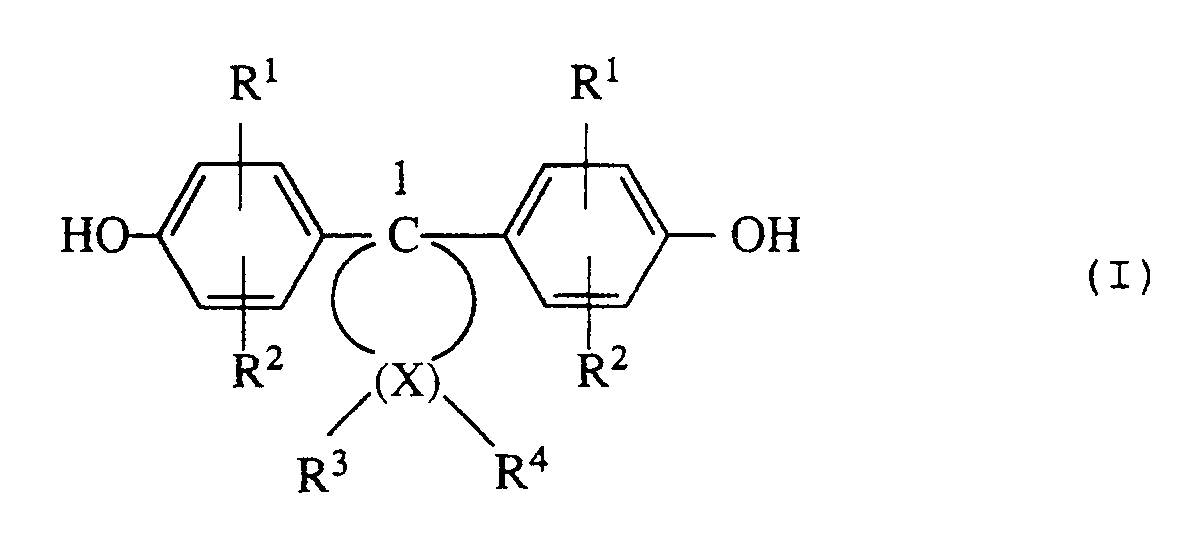 R¹ und R² unabhängig voneinander Wasserstoff,
Halogen, C₁-C₈-Alkyl, C₅-C₆-Cycloalkyl,
C₆-C₁₀-Aryl und C₇-C₁₂-Aralkyl,m eine ganze Zahl von 4 bis 7,R³ und R⁴ für jedes X individuell wählbar,
unabhängig voneinander Wasserstoff,
C₁-C₆-Alkyl undx Kohlenstoff bedeuten,
mit der Maßgabe, daß an mindestens einem
Atom X R³ und R⁴ gleichzeitig Alkyl
bedeuten,
dadurch gekennzeichnet, daß in einem ersten Verfahrensschritt oligomere Polycarbonate hergestellt werden und diese dann in der Schmelze oder durch Festphasennachkondensation in einem zweiten Verfahrensschritt zu hochmolekularen Polycarbonaten aufkondensiert werden. - Polycarbonate, erhältlich nach dem Verfahren gemäß Anspruch 1.
Applications Claiming Priority (2)
| Application Number | Priority Date | Filing Date | Title |
|---|---|---|---|
| DE3941014A DE3941014A1 (de) | 1989-12-12 | 1989-12-12 | Zweistufen-verfahren zur herstellung von polycarbonaten auf basis von speziellen dihydroxydiphenylalkanen |
| DE3941014 | 1989-12-12 |
Publications (3)
| Publication Number | Publication Date |
|---|---|
| EP0432580A2 true EP0432580A2 (de) | 1991-06-19 |
| EP0432580A3 EP0432580A3 (en) | 1991-10-30 |
| EP0432580B1 EP0432580B1 (de) | 1995-03-01 |
Family
ID=6395317
Family Applications (1)
| Application Number | Title | Priority Date | Filing Date |
|---|---|---|---|
| EP90122797A Expired - Lifetime EP0432580B1 (de) | 1989-12-12 | 1990-11-29 | Zweistufen-Verfahren zur Herstellung von Polycarbonaten auf Basis von speziellen Dihydroxydiphenylalkanen |
Country Status (5)
| Country | Link |
|---|---|
| US (1) | US5104963A (de) |
| EP (1) | EP0432580B1 (de) |
| JP (1) | JP2904914B2 (de) |
| DE (2) | DE3941014A1 (de) |
| ES (1) | ES2069662T3 (de) |
Cited By (1)
| Publication number | Priority date | Publication date | Assignee | Title |
|---|---|---|---|---|
| NL9302110A (nl) * | 1992-12-03 | 1994-07-01 | Bayer Ag | Werkwijze voor de bereiding van polycarbonaten. |
Families Citing this family (6)
| Publication number | Priority date | Publication date | Assignee | Title |
|---|---|---|---|---|
| DE4240588A1 (de) * | 1992-12-03 | 1994-06-09 | Bayer Ag | Verfahren zur Herstellung von Polycarbonaten |
| DE4243525A1 (de) * | 1992-12-22 | 1994-06-23 | Bayer Ag | Herstellung von Blendsystemen durch Kondensation von Oligocarbonaten in Gegenwart von Masse-ABS |
| US5807964A (en) * | 1997-03-17 | 1998-09-15 | General Electric Company | Process for the preparation of polycarbonates |
| US7122613B1 (en) * | 2002-12-20 | 2006-10-17 | General Electric Company | Method for the production of polycarbonates |
| JP2017105996A (ja) * | 2015-12-08 | 2017-06-15 | 本州化学工業株式会社 | 芳香族ポリカーボネートオリゴマー |
| EP3388468B1 (de) | 2015-12-08 | 2021-11-03 | Honshu Chemical Industry Co., Ltd. | Aromatischer polycarbonat-oligomer-feststoff |
Family Cites Families (12)
| Publication number | Priority date | Publication date | Assignee | Title |
|---|---|---|---|---|
| JPS536037B2 (de) * | 1974-12-09 | 1978-03-03 | ||
| US4180651A (en) * | 1978-02-28 | 1979-12-25 | General Electric Company | Polycarbonate composition having resistance to high heat distortion |
| US4452968A (en) * | 1981-11-30 | 1984-06-05 | General Electric Company | Synthesis of polycarbonate from dialkyl carbonate and bisphenol diester |
| JPS59166528A (ja) * | 1982-12-27 | 1984-09-19 | ゼネラル・エレクトリツク・カンパニイ | 改良された耐熱性を示すポリカ−ボネ−ト |
| US4469833A (en) * | 1983-05-27 | 1984-09-04 | General Electric Company | Flame retardant polycarbonate compositions |
| GB8716675D0 (en) * | 1987-07-15 | 1987-08-19 | Bp Chem Int Ltd | Polycarbonates |
| CA1305579C (en) * | 1987-09-28 | 1992-07-21 | Shinsuke Fukuoka | Method for producing a crystallized aromatic polycarbonate, and a crystallized aromatic polycarbonate obtained thereby |
| EP0329991A1 (de) * | 1988-02-04 | 1989-08-30 | Idemitsu Kosan Company Limited | Film aus aromatischem Polycarbonat |
| NO170326C (no) * | 1988-08-12 | 1992-10-07 | Bayer Ag | Dihydroksydifenylcykloalkaner |
| DE3844633A1 (de) * | 1988-08-12 | 1990-04-19 | Bayer Ag | Dihydroxydiphenylcycloalkane, ihre herstellung und ihre verwendung zur herstellung von hochmolekularen polycarbonaten |
| DE3926767A1 (de) * | 1988-12-21 | 1990-07-05 | Bayer Ag | Polycarbonate aus mehrfach substituierten cyclohexylidenbisphenolen |
| DE3929671A1 (de) * | 1989-09-07 | 1991-03-14 | Bayer Ag | Uv-absorberhaltige polycarbonate |
-
1989
- 1989-12-12 DE DE3941014A patent/DE3941014A1/de not_active Withdrawn
-
1990
- 1990-11-29 DE DE59008586T patent/DE59008586D1/de not_active Expired - Fee Related
- 1990-11-29 ES ES90122797T patent/ES2069662T3/es not_active Expired - Lifetime
- 1990-11-29 EP EP90122797A patent/EP0432580B1/de not_active Expired - Lifetime
- 1990-11-30 JP JP2336844A patent/JP2904914B2/ja not_active Expired - Fee Related
- 1990-12-04 US US07/622,058 patent/US5104963A/en not_active Expired - Lifetime
Cited By (2)
| Publication number | Priority date | Publication date | Assignee | Title |
|---|---|---|---|---|
| NL9302110A (nl) * | 1992-12-03 | 1994-07-01 | Bayer Ag | Werkwijze voor de bereiding van polycarbonaten. |
| BE1007816A3 (fr) * | 1992-12-03 | 1995-10-31 | Bayer Ag | Procede de preparation de polycarbonates. |
Also Published As
| Publication number | Publication date |
|---|---|
| EP0432580B1 (de) | 1995-03-01 |
| JP2904914B2 (ja) | 1999-06-14 |
| EP0432580A3 (en) | 1991-10-30 |
| DE59008586D1 (de) | 1995-04-06 |
| US5104963A (en) | 1992-04-14 |
| JPH03190924A (ja) | 1991-08-20 |
| DE3941014A1 (de) | 1991-06-13 |
| ES2069662T3 (es) | 1995-05-16 |
Similar Documents
| Publication | Publication Date | Title |
|---|---|---|
| EP0402678B1 (de) | Verwendung von Polycarbonatmischungen in der Optik | |
| EP1203041B1 (de) | Verfahren zur herstellung von modifizierten polycarbonaten | |
| EP1203042B1 (de) | Polycarbonat und dessen formkörper | |
| EP0006516B1 (de) | Verfahren zur Herstellung von aliphatisch-aromatischen Polycarbonaten mit Diphenolcarbonat-Endruppen, die nach dem Verfahren erhaltenen Polycarbonate und ihre Verwendung zur Herstellung von thermoplastisch verarbeitbaren, hochmolekularen, segmentierten, aliphatisch-aromatischen Polycarbonat-Elastomeren | |
| DE3844633A1 (de) | Dihydroxydiphenylcycloalkane, ihre herstellung und ihre verwendung zur herstellung von hochmolekularen polycarbonaten | |
| WO2008037364A1 (de) | Polycarbonate und copolycarbonate mit verbesserter metallhaftung | |
| DE3002762A1 (de) | Verfahren zur herstellung von heterocyclisch-aromatischen oligocarbonaten mit diphenolcarbonat-endgruppen und ihre verwendung zur herstellung von thermoplastischen, hochmolekularen heterocyclisch-aromatischen copolycarbonaten | |
| EP0726285B1 (de) | Zweistufen-Verfahren zur Herstellung von thermoplastischem Polycarbonat | |
| EP0432580B1 (de) | Zweistufen-Verfahren zur Herstellung von Polycarbonaten auf Basis von speziellen Dihydroxydiphenylalkanen | |
| EP0078943A1 (de) | Verfahren zur Herstellung von Polycarbonaten mit verbessertem Alterungsverhalten | |
| EP0481296A2 (de) | Herstellung von lösungsmittelfreiem Polycarbonat durch Festphasenpolykondensation von Oligomeren | |
| EP0414083B1 (de) | Stabilisierte Polycarbonate | |
| EP0065728B1 (de) | Neue Copolyestercarbonate und deren Abmischung mit bekannten Polycarbonaten zu thermoplastischen Formmassen | |
| EP0566952B1 (de) | Thermostabilisierung von aromatischen Polycarbonaten | |
| EP0374623B1 (de) | Polycarbonate aus mehrfach substituierten Cyclohexylidenbisphenolen | |
| EP0423562B1 (de) | Polycarbonate mit verbesserter Wärmeformbeständigkeit | |
| EP1203043B1 (de) | Oligomere bischlorkohlensäureester aus ausgewählten cycloaliphatischen bisphenolen und anderen bisphenolen | |
| EP0480237B1 (de) | Spezielle Dihydroxydiphenylbicycloalkane, ihre Herstellung und ihre Verwendung zur Herstellung von hochmolekularen Polycarbonaten | |
| EP0416404B1 (de) | UV-Absorberhaltige Polycarbonate | |
| DE3803939A1 (de) | Polycarbonate mit aralkylphenylendgruppen, ihre herstellung und verwendung | |
| DE3926766A1 (de) | Polycarbonate aus cycloalkylidenbisphenolen | |
| EP0457102A2 (de) | tert.-Alkylester-Bisphenole, Verfahren zu ihrer Herstellung und ihre Verwendung | |
| EP0678538B1 (de) | Verwendung von hydrierter Abietinsäure als Kettenabbrecher für die Herstellung von Polycarbonaten und von Polyestercarbonaten | |
| EP1556434B1 (de) | Polycarbonate, polyestercarbonate und polyester mit lateral-ständigen cycloalkyl-substituierten phenolen | |
| DE4003437A1 (de) | Spezielle dihydroxydiphenylcycloalkane, ihre herstellung und ihre verwendung zur herstellung von hochmolekularen polycarbonaten |
Legal Events
| Date | Code | Title | Description |
|---|---|---|---|
| PUAI | Public reference made under article 153(3) epc to a published international application that has entered the european phase |
Free format text: ORIGINAL CODE: 0009012 |
|
| 17P | Request for examination filed |
Effective date: 19901129 |
|
| AK | Designated contracting states |
Kind code of ref document: A2 Designated state(s): BE DE ES FR GB IT NL |
|
| PUAL | Search report despatched |
Free format text: ORIGINAL CODE: 0009013 |
|
| AK | Designated contracting states |
Kind code of ref document: A3 Designated state(s): BE DE ES FR GB IT NL |
|
| 17Q | First examination report despatched |
Effective date: 19940221 |
|
| GRAA | (expected) grant |
Free format text: ORIGINAL CODE: 0009210 |
|
| AK | Designated contracting states |
Kind code of ref document: B1 Designated state(s): BE DE ES FR GB IT NL |
|
| REF | Corresponds to: |
Ref document number: 59008586 Country of ref document: DE Date of ref document: 19950406 |
|
| GBT | Gb: translation of ep patent filed (gb section 77(6)(a)/1977) |
Effective date: 19950315 |
|
| ITF | It: translation for a ep patent filed | ||
| REG | Reference to a national code |
Ref country code: ES Ref legal event code: FG2A Ref document number: 2069662 Country of ref document: ES Kind code of ref document: T3 |
|
| ET | Fr: translation filed | ||
| PLBE | No opposition filed within time limit |
Free format text: ORIGINAL CODE: 0009261 |
|
| STAA | Information on the status of an ep patent application or granted ep patent |
Free format text: STATUS: NO OPPOSITION FILED WITHIN TIME LIMIT |
|
| 26N | No opposition filed | ||
| REG | Reference to a national code |
Ref country code: GB Ref legal event code: IF02 |
|
| PGFP | Annual fee paid to national office [announced via postgrant information from national office to epo] |
Ref country code: FR Payment date: 20021115 Year of fee payment: 13 |
|
| PGFP | Annual fee paid to national office [announced via postgrant information from national office to epo] |
Ref country code: GB Payment date: 20031224 Year of fee payment: 14 |
|
| PG25 | Lapsed in a contracting state [announced via postgrant information from national office to epo] |
Ref country code: FR Free format text: LAPSE BECAUSE OF NON-PAYMENT OF DUE FEES Effective date: 20040730 |
|
| REG | Reference to a national code |
Ref country code: FR Ref legal event code: ST |
|
| PG25 | Lapsed in a contracting state [announced via postgrant information from national office to epo] |
Ref country code: GB Free format text: LAPSE BECAUSE OF NON-PAYMENT OF DUE FEES Effective date: 20041129 |
|
| GBPC | Gb: european patent ceased through non-payment of renewal fee |
Effective date: 20041129 |
|
| PG25 | Lapsed in a contracting state [announced via postgrant information from national office to epo] |
Ref country code: IT Free format text: LAPSE BECAUSE OF NON-PAYMENT OF DUE FEES;WARNING: LAPSES OF ITALIAN PATENTS WITH EFFECTIVE DATE BEFORE 2007 MAY HAVE OCCURRED AT ANY TIME BEFORE 2007. THE CORRECT EFFECTIVE DATE MAY BE DIFFERENT FROM THE ONE RECORDED. Effective date: 20051129 |
|
| PGFP | Annual fee paid to national office [announced via postgrant information from national office to epo] |
Ref country code: NL Payment date: 20051130 Year of fee payment: 16 Ref country code: BE Payment date: 20051130 Year of fee payment: 16 |
|
| PGFP | Annual fee paid to national office [announced via postgrant information from national office to epo] |
Ref country code: DE Payment date: 20051216 Year of fee payment: 16 |
|
| PGFP | Annual fee paid to national office [announced via postgrant information from national office to epo] |
Ref country code: ES Payment date: 20061102 Year of fee payment: 17 |
|
| PG25 | Lapsed in a contracting state [announced via postgrant information from national office to epo] |
Ref country code: BE Free format text: LAPSE BECAUSE OF NON-PAYMENT OF DUE FEES Effective date: 20061130 |
|
| PG25 | Lapsed in a contracting state [announced via postgrant information from national office to epo] |
Ref country code: NL Free format text: LAPSE BECAUSE OF NON-PAYMENT OF DUE FEES Effective date: 20070601 Ref country code: DE Free format text: LAPSE BECAUSE OF NON-PAYMENT OF DUE FEES Effective date: 20070601 |
|
| NLV4 | Nl: lapsed or anulled due to non-payment of the annual fee |
Effective date: 20070601 |
|
| BERE | Be: lapsed |
Owner name: *BAYER A.G. Effective date: 20061130 |
|
| REG | Reference to a national code |
Ref country code: ES Ref legal event code: FD2A Effective date: 20071130 |
|
| PG25 | Lapsed in a contracting state [announced via postgrant information from national office to epo] |
Ref country code: ES Free format text: LAPSE BECAUSE OF NON-PAYMENT OF DUE FEES Effective date: 20071130 |