EP0434014B1 - Radialer Luftreifen für Pkw - Google Patents
Radialer Luftreifen für Pkw Download PDFInfo
- Publication number
- EP0434014B1 EP0434014B1 EP90124719A EP90124719A EP0434014B1 EP 0434014 B1 EP0434014 B1 EP 0434014B1 EP 90124719 A EP90124719 A EP 90124719A EP 90124719 A EP90124719 A EP 90124719A EP 0434014 B1 EP0434014 B1 EP 0434014B1
- Authority
- EP
- European Patent Office
- Prior art keywords
- tire
- carcass
- carcass line
- coordinates
- line
- Prior art date
- Legal status (The legal status is an assumption and is not a legal conclusion. Google has not performed a legal analysis and makes no representation as to the accuracy of the status listed.)
- Expired - Lifetime
Links
Images


Classifications
-
- B—PERFORMING OPERATIONS; TRANSPORTING
- B60—VEHICLES IN GENERAL
- B60C—VEHICLE TYRES; TYRE INFLATION; TYRE CHANGING; CONNECTING VALVES TO INFLATABLE ELASTIC BODIES IN GENERAL; DEVICES OR ARRANGEMENTS RELATED TO TYRES
- B60C9/00—Reinforcements or ply arrangement of pneumatic tyres
- B60C9/02—Carcasses
-
- B—PERFORMING OPERATIONS; TRANSPORTING
- B60—VEHICLES IN GENERAL
- B60C—VEHICLE TYRES; TYRE INFLATION; TYRE CHANGING; CONNECTING VALVES TO INFLATABLE ELASTIC BODIES IN GENERAL; DEVICES OR ARRANGEMENTS RELATED TO TYRES
- B60C3/00—Tyres characterised by the transverse section
- B60C3/04—Tyres characterised by the transverse section characterised by the relative dimensions of the section, e.g. low profile
Definitions
- the present invention relates to a pneumatic radial tire (hereinafter referred to as a radial tire) for a passenger vehicle, and more particularly, to a radial tire which improves the steering stability on a dry road (hereinafter referred to as dry performance), wear resistance and the wet performance.
- a pneumatic radial tire hereinafter referred to as a radial tire
- dry performance a dry road
- wear resistance a wet performance
- This equilibrium carcass line means a natural equilibrium configuration of a carcass layer formed as a result of the balance between the normal internal pressure of a tire and a reaction force generated in an area where the carcass layer and a belt layer overlap with each other and the tension of the carcass layer in a condition wherein no substantial force other than the normal internal pressure and the reaction force acts on the tire when the tire is inflated up to its normal internal pressure.
- British patent specification No. GB 2,006,695B proposes the improvement of the durability by providing the equilibrium carcass line such that a natural equilibrium configuration formed when no substantial force other than the internal pressure of the tire acts thereon is exhibited in an area extending from the maximum width position of the carcass layer toward the bead portion when the tire is inflated, and that a theoretical equilibrium configuration formed when no substantial force other than the internal pressure and the reaction force of the belt layer acts thereon is exhibited in the remaining area extending from the maximum width position toward the tread.
- the specification of United States Patent No. 4,513,802 proposes the reduction of the rolling resistance by increasing the height of the sidewall of the maximum width position of a tire.
- An object of the present invention is to provide a pneumatic radial tire for a passenger vehicle that greatly improves the wet performance together with the dry performance and wear resistance.
- a portion of a carcass line extending radially outwardly from the maximum width position in a carcass line of a tire fitted to a normal rim and inflated up to its normal internal pressure is required to substantially conform to an equilibrium carcass line represented by the following equations (1) and (2) calculated by using an internal pressure allotment ratio, g(y), of the carcass layer in the tread portion that is obtained by setting the distributional configuration index ⁇ in the following equation (3) at 4 or more, and to determine the width of the belt layer extending radially outwardly of the tire so as to range from 105 to 120 % of the ground-contacting width of the tread portion when loaded with a designed normal load.
- a normal rim and a normal internal pressure mean those defined in accordance with the types of tires in the standard of Japan Automibile Tire Manufacturers' Association (JATMA).
- JTMA Japan Automibile Tire Manufacturers' Association
- the ground-contacting width of the tread surface of the tire means a widthwise ground-contacting distance of the tire when loaded with a designed normal load in a state in which it is fitted to a normal rim defined in the standard of the above JATMA and is inflated up to its normal internal pressure.
- a carcass line means a curved configuration formed by a center line of a carcass layer in a cross-section of the tire cut in the direction of the meridian line thereof.
- Fig. 1 shows an example of a radial tire according to the present invention, and it comprises a pair of left and right bead portions 3, a pair of left and right sidewall portions 2 that continuously extend from the bead portions 3, respectively, and a tread portion 1 continuously extending to the respective sidewall portions 2.
- the ends of a carcass layer 4 are folded over around bead cores 5 of the bead portions 3 from the inside of the tire to the outside thereof, and two belt layers 7 extending in the circumferential direction of the tire are provided at the tread portion 1 of this carcass layer 4.
- organic fibers such as of nylon, rayon and polyester are commonly used for carcass cords constituting the carcass layer, and cords having a high elastic modulus such as steel cords and aramid fiber cords are used as belt cords constituting the belt layer 7.
- a belt cover layer having a cord angle of 0° with respect to the circumferential direction of the tire and comprising nylon cords may be disposed on the surface of the belt layer 7.
- the g(y) is a function representing the internal pressure allotment ratio of the carcass layer extending from the center of the tread portion toward the side (shoulder) portions and is expressed by the equation (3) above.
- the configuration of the equilibrium carcass line is a continuity of arcs having radius curvatures r1 expressed by the above equations (1) and (2).
- a line drawn down to the axle of the tire from the center C of the tread portion is y axis of coordinates with the axle of the tire being z axis of coordinates
- y A denotes y axis of coordinates for the carcass line at the center C of the tread portion
- y D denoting y axis of coordinates for the carcass line at the end portion Wb of the effective belt width
- y C denoting y axis of coordinates for the carcass line at the maximum width position in a tire carcass line Wmax
- y B denoting y axis of coordinates for the carcass line at the bead portion
- ⁇ denoting the internal pressure allotment ratio of the carcass layer at the center C of the tread portion.
- the equilibrium carcass line based on the equations of (1) and (2) can be directly determined by determining the g(y) of the equation (3).
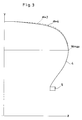
- Fig. 3 shows a continuity comprising arcs made based on the radius of curvatures calculated from the above equations (1) and (2), i.e., the configuration of the equilibrium carcass line.
- the solid line shows the carcass line of the tire of the present invention in which ⁇ is 4, while the dotted line shows the carcass line of the conventional tire in which ⁇ is 2. It will be seen when comparing the two carcass lines of the tire of the present invention and the conventional tire in Fig. 3 that the radius of curvature of the former gradually decreases toward the shoulder portion.
- the belt tension in the shoulder portions can be increased, thereby making it possible also to increase the apparent rigidity of the belt layer, the dry performance (steering stability) when driving on a corner can be improved.
- the width of the belt layer extending radially outwardly of the tire is made to range from 105 to 120 % of the ground-contacting width of the tread portion when the tire is loaded with a designed normal load.
- the width of the belt layer extending radially outwardly of the tire is not more than 100 % of the ground-contacting width of the tread portion when the tire is loaded with a designed normal load.
- the width of the belt layer of the relevant portion of the tire of the present invention is made to range from 105 to 120 %, and making full use of the aforementioned tendency of the belt tension in which the apparent rigidity of the shoulder portions greatly increases, the apparent rigidity of the shoulder portions is made to further increase.
- the tire of the present invention as described above is manufactured through the following procedure.
- an equilibrium carcass line is obtained by calculating radius of curvature r1 from the equations (3), and (1) and (2) with the distributional configuration index ⁇ of the carcass internal pressure allotment ratio being set at 4 or more. Then, the configuration of a carcass line is set such that the equilibrium carcass line so obtained conforms to the configuration of the portions extending radially outwardly from the maximum width position in the tire carcass line, and a predetermined padding is applied thereto, thereby determining the configuration of a mold. Following this, a tire mold having this mold configuration is made. A green tire having a targeted structure and a belt layer with a specified width is made, and molding and vulcanization are carried out using the above tire mold.
- a mold conforming to the carcass line of the tire of the present invention is prepared by applying plaster on the circumference of the tire after inflating the tire up to its normal internal pressure, and leaving the same in its inflated state so that the tire configuration is stabilized.
- the carcass line of the tire generated when the tire is inflated can be specified by cutting the tire in the radial direction and by drawing the cross-sectional configuration of the tire in such a manner as to let the external configuration of the tire follow a mold which is prepared as described above.
- a portion of the carcass line extending radially outwardly from the maximum width position in the carcass line of the tire fitted to a normal rim and inflated up to its normal internal pressure is configured so as to substantially conform to the equilibrium carcass line expressed by the afore-mentioned equations (1) and (2) calculated using the internal pressure allotment ratio, g(y), of the carcass layer in the tread portion that is obtained by setting the distributional configuration index ⁇ of the equation (3) at 4 or more, it is possible to increase the belt tension at the shoulder portions, thereby making it possible to increase the apparent rigidity of the belt layer.
- the width of the belt of the tire extending radially outwardly of the tire is made to range from 105 to 120 % of the ground-contacting width of the tread portion when the tire is loaded with a designed load, thereby making it possible to further increase the belt tension of the shoulder portions, the dry performance (steering stability) when driving on a corner can be remarkably improved, and since the reduction of the width of grooves at the shoulder portions is also made small, not only a good wear resistance can be ensured but also the wet performance can be remarkably improved.
- the belt layers, carcass layer, carcass configuration and width (belt width) of the belt layer extending radially outwardly of the tire are as follows.
- Steel cords of 1 x 5 (0.25) were bias-laminated at an angle of 24° to the circumferential direction of the tire with an end count of 40 per 50 mm.
- the belt width was made 110 % of the ground-contacting width of the tread surface when the tires were fitted to a rim of 15 x 5 1 ⁇ 2 JJ, were filled with air under an air pressure of 1.9 kg/cm2 and were loaded with a load of 505 kg.
- Polyester fiber cords of 1000 D/2 were disposed at an angle of 90° to the circumferential direction of the tire with an end count of 55 per 50 mm.
- At least a portion of the carcass line extending radially outwardly from the maximum width position in the carcass line of the tire fitted to a normal rim and inflated to its normal internal pressure was configured so as to conform to the equilibrium carcass line calculated from the equations (3), (1) and (2) with the distributional configuration index ⁇ of the carcass internal pressure allotment ratio g(y) being set at 4.
- This tire had the same construction as that of the tire of the present invention except that the carcass line configuration and the belt width were changed as follows.
- At least a portion of the carcass line extending radially outwardly from the maximum width position in the carcass line of the tire fitted to a normal rim and inflated to its normal internal pressure was configured so as to conform to the equilibrium carcass line calculated from the equations (3), (1) and (2) with the distribution configuration index ⁇ of the carcass internal pressure allotment ratio g(y) being set at 2.
- the belt width was made 100 % of the ground-contacting width of the tread surface of the tire that was measured under the same condition as the one in which the tire of the present invention was measured.
- This tire had the same construction as that of the tire of the present invention except that the carcass line configuration was changed as follows.
- At least a portion of the carcass line extending radially outwardly from the maximum width position of the tire fitted to a normal rim and inflated to its normal internal pressure was configured so as to conform to the equilibrium carcass line calculated from the equations (2), (1) and (2) with the distributional configuration index ⁇ of the carcass internal pressure allotment ratio g(y) being set at 2.
- This tire had the same constructions as that of the tire of the present invention except that the belt width was changed as follows.
- the belt width was made 100 % of the groun-contacting width of the tread surface of the tire that was measured under the same condition as the one in which the tire of the present invention was measured.
- the four types of tires were rated in terms of the condition in which hydroplaning was generated, and the cornering power as dry performance.
- test tires were fitted to rims of 15 x 51 ⁇ 2 JJ, and were filled with air under an air pressure of 1.9 kg/cm2. Then, these tires were fitted to domestic automobiles having a front-engine rear-drive layout, and the automobiles were driven at a certain speed on a circular course with a radius of 100 m having a 10 m long wet area with a water depth of 5 mm, and the speed at which the lateral acceleration G became maximum while passing through the wet area was measured.
- test tires were fitted to rims of 15 x 51 ⁇ 2 JJ, and were filled with air under an air pressure of 1.9 kg/cm2.
- a cornering power when loaded with a load of 505 kg was measured.
- the cornering power of the tire of the present invention is greater than those of the Conventional Tires I and II and the Comparison Tire, and is superior to those tires in the dry performance.
- the wet performance of the tire of the present invention is remarkably improved.
Landscapes
- Engineering & Computer Science (AREA)
- Mechanical Engineering (AREA)
- Tires In General (AREA)
Claims (4)
- Pneumatischer Radialreifen für ein Personenfahrzeug, dadurch gekennzeichnet, daß wenigstens ein Abschnitt der Karkassenlinie, der sich radial auswärts von der Stelle maximaler Breite in einer Karkassenlinie eines Reifens erstreckt, der auf eine normale Felge aufgezogen und bis zu seinem normalen Innendruck aufgeblasen ist, so konfiguriert ist, daß er im wesentlichen einer Gleichgewichtskarkassenlinie entspricht, die eine Kontinuität von Bögen mit Kurvenradien r₁ ist, die durch die folgenden Gleichungen (1) und (2) ausgedrückt ist, die unter Verwendung eines Innendruckverteilungsverhälnisses g(y) einer Karkassenschicht am Aufstandsabschnitt berechnet sind, das durch Setzen des Verteilungskonfigurationsindex α der folgenden Gleichung (3) auf 4 oder mehr erhalten wird, und daß die Breite der Gürtelschicht, die sich radial auswärts vom Reifen erstreckt, in einen Bereich von 105 bis 120% der bodenberührenden Breite des Aufstandsabschnitts bei einer Belastung mit einer vorgesehenen normalen Last gelegt wird, wobei:
für yD ≦ y ≦ yA,

 YA: y-Achse der Koordinaten für die Karkassenlinie im Zentrum des Aufstandsabschnitts;YD: y-Achse der Koordinaten für die Karkassenlinie am effektiven Breitenendabschnitt (Wb) der Gürtelschicht;yC: y-Achse der Koordinaten für die Karkassenlinie an der Stelle maximaler Breite (Wmax) in einer Reifenkarkassenlinie;YB: y-Achse der Koordinaten der Karkassenlinie am Wulstabschnitt; undη : das Innendruckverteilungsverhältnis der Karkassenschicht im Zentrum des Aufstandsabschnitts.
 - Pneumatischer Radialreifen nach Anspruch 1, wobei der Verteilungskonfigurationsindex α auf 4 bis 8 gesetzt ist.
- Pneumatischer Radialreifen nach Anspruch 1, wobei die Karkassenschnüre, die die Karkassenschicht bilden, organische Faserschnüre sind.
- Pneumatischer Radialreifen nach Anspruch 3, wobei die organischen Faserschnüre aus der Gruppe von Nylonschnüren, Rayonschnüren und Polyesterschnüren ausgewählt sind.
Applications Claiming Priority (2)
| Application Number | Priority Date | Filing Date | Title |
|---|---|---|---|
| JP1327421A JP2568925B2 (ja) | 1989-12-19 | 1989-12-19 | 乗用車用空気入りラジアルタイヤ |
| JP327421/89 | 1989-12-19 |
Publications (3)
| Publication Number | Publication Date |
|---|---|
| EP0434014A2 EP0434014A2 (de) | 1991-06-26 |
| EP0434014A3 EP0434014A3 (en) | 1991-11-13 |
| EP0434014B1 true EP0434014B1 (de) | 1994-03-09 |
Family
ID=18198979
Family Applications (1)
| Application Number | Title | Priority Date | Filing Date |
|---|---|---|---|
| EP90124719A Expired - Lifetime EP0434014B1 (de) | 1989-12-19 | 1990-12-19 | Radialer Luftreifen für Pkw |
Country Status (5)
| Country | Link |
|---|---|
| US (1) | US5178716A (de) |
| EP (1) | EP0434014B1 (de) |
| JP (1) | JP2568925B2 (de) |
| KR (1) | KR910011499A (de) |
| DE (1) | DE69007254T2 (de) |
Families Citing this family (6)
| Publication number | Priority date | Publication date | Assignee | Title |
|---|---|---|---|---|
| US5710718A (en) * | 1993-01-27 | 1998-01-20 | Bridgestone Corporation | Method of designing a pneumatic tire to achieve a best mode under given conditions |
| GB9813965D0 (en) | 1997-07-05 | 1998-08-26 | Hankook Tire Manufacturing Com | Radial tyre |
| KR101100541B1 (ko) * | 2007-02-14 | 2011-12-29 | 가부시키가이샤 브리지스톤 | 공기입 타이어 |
| JP5186810B2 (ja) * | 2007-05-29 | 2013-04-24 | 横浜ゴム株式会社 | タイヤの性能予測方法及びタイヤの性能予測用コンピュータプログラム、並びにタイヤの設計方法 |
| KR101856649B1 (ko) | 2012-03-13 | 2018-05-15 | 삼성전자주식회사 | 가습기 |
| US10336139B2 (en) | 2014-02-27 | 2019-07-02 | Compagnie Generale Des Etablissements Michelin | Body ply shape for a tire |
Family Cites Families (7)
| Publication number | Priority date | Publication date | Assignee | Title |
|---|---|---|---|---|
| FR2224313B1 (de) * | 1973-04-09 | 1976-05-21 | Michelin & Cie | |
| FR2303675A2 (fr) * | 1975-03-14 | 1976-10-08 | Uniroyal | Enveloppe de bandage pneumatique de roue |
| JPS54136001A (en) * | 1978-04-08 | 1979-10-22 | Bridgestone Corp | Flat radial tire |
| JPS582845B2 (ja) * | 1979-01-24 | 1983-01-19 | 株式会社ブリヂストン | 転り抵抗の低い抗すべり性、乗用車用ラジアルタイヤ |
| CA1309934C (en) * | 1986-11-05 | 1992-11-10 | Jolan Fredda Lobb | Radial ply aircraft tire and rim |
| GB2201925B (en) * | 1987-03-12 | 1991-02-27 | Dunlop Ltd | Radial ply tyre |
| JP2503015B2 (ja) * | 1987-06-02 | 1996-06-05 | 株式会社ブリヂストン | 偏平空気入りラジアルタイヤ |
-
1989
- 1989-12-19 JP JP1327421A patent/JP2568925B2/ja not_active Expired - Lifetime
-
1990
- 1990-09-20 KR KR1019900014877A patent/KR910011499A/ko not_active Abandoned
- 1990-12-05 US US07/622,570 patent/US5178716A/en not_active Expired - Lifetime
- 1990-12-19 DE DE69007254T patent/DE69007254T2/de not_active Expired - Fee Related
- 1990-12-19 EP EP90124719A patent/EP0434014B1/de not_active Expired - Lifetime
Non-Patent Citations (1)
| Title |
|---|
| BÖHM: 'ZUR STATISTIK UND DYNAMIK DES GÜRTELREIFENS ' * |
Also Published As
| Publication number | Publication date |
|---|---|
| JPH03189205A (ja) | 1991-08-19 |
| DE69007254T2 (de) | 1994-08-04 |
| US5178716A (en) | 1993-01-12 |
| DE69007254D1 (de) | 1994-04-14 |
| KR910011499A (ko) | 1991-08-07 |
| JP2568925B2 (ja) | 1997-01-08 |
| EP0434014A2 (de) | 1991-06-26 |
| EP0434014A3 (en) | 1991-11-13 |
Similar Documents
| Publication | Publication Date | Title |
|---|---|---|
| US5360044A (en) | Pneumatic radial tire with high cornering and steering stability | |
| US7036541B2 (en) | Pneumatic tire | |
| US6073668A (en) | Vehicle tire including tread portion having profile | |
| US5810953A (en) | Pneumatic tire including two grooves and two rubber parts | |
| EP0346106A1 (de) | Luftreifen | |
| US6371179B1 (en) | Pneumatic tire including shoulder blocks | |
| EP0435620B1 (de) | Radialreifen für einen Personenkraftwagen | |
| CA1213201A (en) | Pneumatic tire | |
| EP1491364A1 (de) | Luftreifen | |
| EP0434015B1 (de) | Radialer Luftreifen für Pkw | |
| EP0429903B1 (de) | Radialer Luftreifen für Personenkraftwagen | |
| EP0434014B1 (de) | Radialer Luftreifen für Pkw | |
| US6386256B1 (en) | Crown reinforcement for a tire | |
| EP0393965B1 (de) | Radialluftreifen mit verbesserter Laufleistung | |
| EP0748705B1 (de) | Luftreifen | |
| JPH04283108A (ja) | 重荷重用ラジアルタイヤ | |
| US5309966A (en) | Pneumatic radial tire with high cornering and steering stability | |
| JP4787425B2 (ja) | 空気入りタイヤ | |
| EP0508813A1 (de) | Geländeluftreifen | |
| EP3932695A1 (de) | Motorradreifen | |
| JP3064265B2 (ja) | 空気入りタイヤ | |
| JPH06255306A (ja) | 空気入りラジアルタイヤ | |
| EP1013477B1 (de) | Luftreifen | |
| US5323826A (en) | Pneumatic radial tire with high cornering and steering stability | |
| JPH06102401B2 (ja) | 空気入りラジアルタイヤ |
Legal Events
| Date | Code | Title | Description |
|---|---|---|---|
| PUAI | Public reference made under article 153(3) epc to a published international application that has entered the european phase |
Free format text: ORIGINAL CODE: 0009012 |
|
| AK | Designated contracting states |
Kind code of ref document: A2 Designated state(s): DE FR GB IT |
|
| PUAL | Search report despatched |
Free format text: ORIGINAL CODE: 0009013 |
|
| AK | Designated contracting states |
Kind code of ref document: A3 Designated state(s): DE FR GB IT |
|
| 17P | Request for examination filed |
Effective date: 19920124 |
|
| 17Q | First examination report despatched |
Effective date: 19930503 |
|
| GRAA | (expected) grant |
Free format text: ORIGINAL CODE: 0009210 |
|
| AK | Designated contracting states |
Kind code of ref document: B1 Designated state(s): DE FR GB IT |
|
| ITF | It: translation for a ep patent filed | ||
| REF | Corresponds to: |
Ref document number: 69007254 Country of ref document: DE Date of ref document: 19940414 |
|
| ET | Fr: translation filed | ||
| PGFP | Annual fee paid to national office [announced via postgrant information from national office to epo] |
Ref country code: GB Payment date: 19941209 Year of fee payment: 5 Ref country code: FR Payment date: 19941209 Year of fee payment: 5 |
|
| PGFP | Annual fee paid to national office [announced via postgrant information from national office to epo] |
Ref country code: DE Payment date: 19941222 Year of fee payment: 5 |
|
| PLBE | No opposition filed within time limit |
Free format text: ORIGINAL CODE: 0009261 |
|
| STAA | Information on the status of an ep patent application or granted ep patent |
Free format text: STATUS: NO OPPOSITION FILED WITHIN TIME LIMIT |
|
| 26N | No opposition filed | ||
| PG25 | Lapsed in a contracting state [announced via postgrant information from national office to epo] |
Ref country code: GB Effective date: 19951219 |
|
| GBPC | Gb: european patent ceased through non-payment of renewal fee |
Effective date: 19951219 |
|
| PG25 | Lapsed in a contracting state [announced via postgrant information from national office to epo] |
Ref country code: FR Effective date: 19960830 |
|
| PG25 | Lapsed in a contracting state [announced via postgrant information from national office to epo] |
Ref country code: DE Effective date: 19960903 |
|
| REG | Reference to a national code |
Ref country code: FR Ref legal event code: ST |
|
| PG25 | Lapsed in a contracting state [announced via postgrant information from national office to epo] |
Ref country code: IT Free format text: LAPSE BECAUSE OF NON-PAYMENT OF DUE FEES Effective date: 20051219 |