EP0435258A2 - Mehrpegelauswählkreis - Google Patents
Mehrpegelauswählkreis Download PDFInfo
- Publication number
- EP0435258A2 EP0435258A2 EP90125508A EP90125508A EP0435258A2 EP 0435258 A2 EP0435258 A2 EP 0435258A2 EP 90125508 A EP90125508 A EP 90125508A EP 90125508 A EP90125508 A EP 90125508A EP 0435258 A2 EP0435258 A2 EP 0435258A2
- Authority
- EP
- European Patent Office
- Prior art keywords
- voltage
- input terminals
- diode
- input
- circuit
- Prior art date
- Legal status (The legal status is an assumption and is not a legal conclusion. Google has not performed a legal analysis and makes no representation as to the accuracy of the status listed.)
- Granted
Links
Images





Classifications
-
- G—PHYSICS
- G09—EDUCATION; CRYPTOGRAPHY; DISPLAY; ADVERTISING; SEALS
- G09G—ARRANGEMENTS OR CIRCUITS FOR CONTROL OF INDICATING DEVICES USING STATIC MEANS TO PRESENT VARIABLE INFORMATION
- G09G3/00—Control arrangements or circuits, of interest only in connection with visual indicators other than cathode-ray tubes
- G09G3/20—Control arrangements or circuits, of interest only in connection with visual indicators other than cathode-ray tubes for presentation of an assembly of a number of characters, e.g. a page, by composing the assembly by combination of individual elements arranged in a matrix no fixed position being assigned to or needed to be assigned to the individual characters or partial characters
- G09G3/34—Control arrangements or circuits, of interest only in connection with visual indicators other than cathode-ray tubes for presentation of an assembly of a number of characters, e.g. a page, by composing the assembly by combination of individual elements arranged in a matrix no fixed position being assigned to or needed to be assigned to the individual characters or partial characters by control of light from an independent source
- G09G3/36—Control arrangements or circuits, of interest only in connection with visual indicators other than cathode-ray tubes for presentation of an assembly of a number of characters, e.g. a page, by composing the assembly by combination of individual elements arranged in a matrix no fixed position being assigned to or needed to be assigned to the individual characters or partial characters by control of light from an independent source using liquid crystals
- G09G3/3611—Control of matrices with row and column drivers
- G09G3/3696—Generation of voltages supplied to electrode drivers
-
- G—PHYSICS
- G09—EDUCATION; CRYPTOGRAPHY; DISPLAY; ADVERTISING; SEALS
- G09G—ARRANGEMENTS OR CIRCUITS FOR CONTROL OF INDICATING DEVICES USING STATIC MEANS TO PRESENT VARIABLE INFORMATION
- G09G3/00—Control arrangements or circuits, of interest only in connection with visual indicators other than cathode-ray tubes
- G09G3/20—Control arrangements or circuits, of interest only in connection with visual indicators other than cathode-ray tubes for presentation of an assembly of a number of characters, e.g. a page, by composing the assembly by combination of individual elements arranged in a matrix no fixed position being assigned to or needed to be assigned to the individual characters or partial characters
- G09G3/34—Control arrangements or circuits, of interest only in connection with visual indicators other than cathode-ray tubes for presentation of an assembly of a number of characters, e.g. a page, by composing the assembly by combination of individual elements arranged in a matrix no fixed position being assigned to or needed to be assigned to the individual characters or partial characters by control of light from an independent source
- G09G3/36—Control arrangements or circuits, of interest only in connection with visual indicators other than cathode-ray tubes for presentation of an assembly of a number of characters, e.g. a page, by composing the assembly by combination of individual elements arranged in a matrix no fixed position being assigned to or needed to be assigned to the individual characters or partial characters by control of light from an independent source using liquid crystals
- G09G3/3611—Control of matrices with row and column drivers
- G09G3/3674—Details of drivers for scan electrodes
-
- G—PHYSICS
- G09—EDUCATION; CRYPTOGRAPHY; DISPLAY; ADVERTISING; SEALS
- G09G—ARRANGEMENTS OR CIRCUITS FOR CONTROL OF INDICATING DEVICES USING STATIC MEANS TO PRESENT VARIABLE INFORMATION
- G09G3/00—Control arrangements or circuits, of interest only in connection with visual indicators other than cathode-ray tubes
- G09G3/20—Control arrangements or circuits, of interest only in connection with visual indicators other than cathode-ray tubes for presentation of an assembly of a number of characters, e.g. a page, by composing the assembly by combination of individual elements arranged in a matrix no fixed position being assigned to or needed to be assigned to the individual characters or partial characters
- G09G3/34—Control arrangements or circuits, of interest only in connection with visual indicators other than cathode-ray tubes for presentation of an assembly of a number of characters, e.g. a page, by composing the assembly by combination of individual elements arranged in a matrix no fixed position being assigned to or needed to be assigned to the individual characters or partial characters by control of light from an independent source
- G09G3/36—Control arrangements or circuits, of interest only in connection with visual indicators other than cathode-ray tubes for presentation of an assembly of a number of characters, e.g. a page, by composing the assembly by combination of individual elements arranged in a matrix no fixed position being assigned to or needed to be assigned to the individual characters or partial characters by control of light from an independent source using liquid crystals
- G09G3/3611—Control of matrices with row and column drivers
- G09G3/3674—Details of drivers for scan electrodes
- G09G3/3681—Details of drivers for scan electrodes suitable for passive matrices only
-
- G—PHYSICS
- G09—EDUCATION; CRYPTOGRAPHY; DISPLAY; ADVERTISING; SEALS
- G09G—ARRANGEMENTS OR CIRCUITS FOR CONTROL OF INDICATING DEVICES USING STATIC MEANS TO PRESENT VARIABLE INFORMATION
- G09G3/00—Control arrangements or circuits, of interest only in connection with visual indicators other than cathode-ray tubes
- G09G3/20—Control arrangements or circuits, of interest only in connection with visual indicators other than cathode-ray tubes for presentation of an assembly of a number of characters, e.g. a page, by composing the assembly by combination of individual elements arranged in a matrix no fixed position being assigned to or needed to be assigned to the individual characters or partial characters
- G09G3/34—Control arrangements or circuits, of interest only in connection with visual indicators other than cathode-ray tubes for presentation of an assembly of a number of characters, e.g. a page, by composing the assembly by combination of individual elements arranged in a matrix no fixed position being assigned to or needed to be assigned to the individual characters or partial characters by control of light from an independent source
- G09G3/36—Control arrangements or circuits, of interest only in connection with visual indicators other than cathode-ray tubes for presentation of an assembly of a number of characters, e.g. a page, by composing the assembly by combination of individual elements arranged in a matrix no fixed position being assigned to or needed to be assigned to the individual characters or partial characters by control of light from an independent source using liquid crystals
- G09G3/3611—Control of matrices with row and column drivers
- G09G3/3685—Details of drivers for data electrodes
-
- H—ELECTRICITY
- H03—ELECTRONIC CIRCUITRY
- H03K—PULSE TECHNIQUE
- H03K17/00—Electronic switching or gating, i.e. not by contact-making and –breaking
- H03K17/51—Electronic switching or gating, i.e. not by contact-making and –breaking characterised by the components used
- H03K17/56—Electronic switching or gating, i.e. not by contact-making and –breaking characterised by the components used by the use, as active elements, of semiconductor devices
- H03K17/687—Electronic switching or gating, i.e. not by contact-making and –breaking characterised by the components used by the use, as active elements, of semiconductor devices the devices being field-effect transistors
- H03K17/693—Switching arrangements with several input- or output-terminals, e.g. multiplexers, distributors
Definitions
- the present invention relates to a multi-level selecting circuit advantageously applicable to, for example, a driver for driving a liquid crystal display (LCD).
- LCD liquid crystal display
- An LCD driver may be constructed to generate three or more different voltages, select one of such voltages at a time, and feed the selected voltage to the LCD, as has been customary in the art.
- a selecting circuit is built in this type of LCD driver and is often implemented as a multi-level selecting circuit having a plurality of MOS transistors.
- a multi-level selecting circuit has a plurality of MOS transistors each connecting to respective one of input lines to which a plurality of different levels are applied. As any one of the transistors is turned on under external control, one of the different input levels associated with the conductive transistor is fed to the LCD.
- the MOS transistors of the above-stated multi-level selecting circuit are integrated on a single substrate by CMOS process technologies. Specifically, a plurality of p-MOS transistors and a plurality of n-MOS transistors are arranged on a single substrate. To form the p-MOS transistors, p-channels may be directly provided in the surface layer of an n-type substrate. Regarding the n-MOS transistors, a p-well is formed in the n-type substrate by ion injection, and then n-channels are provided in the surface layer of the p-well.
- Latch-up refers to a phenomenon that when an overvoltage is applied to the input side of the circuit, the parasitic transistor is rendered conductive to cause a great current to flow through the circuit. This problem is especially serious when it comes to an LCD driver, as follows.
- An LCD driver has a great number of multi-level selecting circuits connected to a level output circuit thereof. Hence, an overcurrent is apt to flow through the MOS transistors of the last-stage multi-level selecting circuit, causing the selecting circuit to latch up. When any one of the selecting circuits latches up, the MOS transistors thereof malfunction to disturb the operation of the LCD. No countermeasures against such latch-up have been proposed in the past in relation to a multi-level selecting circuits which drives an LCD or similar load.
- a multi-level selecting circuit comprises a selecting section provided in a semiconductor chip by a CMOS process for selecting one of a plurality of input levels at a time, input terminals provided on the semiconductor chip for feeding a plurality of levels to the selecting section, and an output terminal provided on the semiconductor chip for outputting one of the plurality of levels having been selected by the selecting section.
- the selecting section has a plurality of MOS transistors each being provided in the semiconductor chip and connected between respective one of the plurality of input terminals and the output terminal for feeding, when turned on by external control, the input level on the input terminal to the output terminal.
- Source connecting lines each is connected between respective one of the input terminals and a source electrode of respective one of the MOS transistors for feeding a voltage on the input terminal to the source electrode.
- a back-gate connecting line is connected between the input terminals and the back-gates of the MOS transistors for feeding a predetermined voltage applied to the input terminals to the back gates.
- the back-gate connecting line is substantially independent of the source connecting lines.
- a multi-level selecting circuit comprises a selecting section provided in a semiconductor chip by a CMOS process for selecting one of a plurality of input levels at a time, input terminals provided on the semiconductor chip for feeding a plurality of levels to the selecting section, and an output terminal provided on the semiconductor chip for outputting one of the plurality of levels having been selected by the selecting section.
- the selecting section comprises a plurality of MOS transistors each being provided in the semiconductor chip and connected between respective one of the plurality of input terminals and the output terminal for feeding, when turned on by external control, the input level on the input terminal to the output terminal.
- Source connecting lines each is connected between respective one of the input terminals and a source electrode of respective one of the MOS transistors for feeding a voltage on the input terminal to the source electrode.
- a diode is connected between one of the input terminals to which the highest or the lowest voltage is applied and another input terminal to which a medium voltage close to the highest or lowest voltage is applied.
- the diode has an anode thereof connected to the low voltage side and a cathode thereof connected to the high voltage side.
- a multi-level selecting circuit comprises a selecting section provided in a semiconductor chip by a CMOS process for selecting one of a plurality of input levels at a time, input terminals provided on the semiconductor chip for feeding a plurality of levels to the selecting section, and an output terminal provided on the semiconductor chip for outputting one of the plurality of levels having been selected by the selecting section.
- the selecting section comprises a plurality of MOS transistors each being provided in the semiconductor chip and connected between respective one of the plurality of input terminals and the output terminal for feeding, when turned on by external control, the input level on the input terminal to the output terminal.
- Source connecting lines each is connected between respective one of the input terminals and a source electrode of respective one of the MOS transistors for feeding a voltage on the input terminal to the source electrode.
- a back-gate connecting line is connected between the input terminals and the back-gates of the MOS transistors for feeding a predetermined voltage applied to the input terminals to the back-gates.
- the back-gate connecting line is substantially independent of the source connecting line.
- a diode is connected between one of the input terminals to which the highest voltage or the lowest voltage is applied and another input terminal to which a medium voltage close to the highest or lowest voltage is applied. The diode has an anode thereof connected to the low voltage side and a cathode thereof connected to the high voltage side.
- the multi-level selecting circuit embodying the present invention and applied to an LCD driver by way of example is shown.
- the multi-level selecting circuit generally 42, has a first to a fourth input terminals 1, 2, 3 and 4, and a single output terminal 5.
- the selecting circuit 42 selects one of different bias voltages each being applied to the input terminals 1 to 4 and feeds it out via the output terminal 5.
- a bias circuit 6 generates such different bias voltages to be applied to the input terminals 1 to 4.
- the bias circuit 6 includes a DC power source 7 and feeds a voltage of the positive side of the power source 7 directly to the first input terminal 1. Assuming that the output voltage of the power source 7 ranges from 5 volts to -15 volts, for example, then 5 volts is be fed to the input terminal 1.
- the bias circuit 6 further includes four resistors 8 to 11 and three operational amplifiers (OP AMPs) 12, 13 and 24.
- the resistors 8 to 11 are connected in series, and opposite terminals of the series connection are respectively connected to the positive and negative electrodes of the power source 7.
- the resistors 8 to 11 constitute a voltage divider 7a in combination.
- the junctions of the resistors 8 to 11 each is connected to the non-inverting input of respective one of the OP AMPs 12, 13 and 24, so that voltages appearing on the individual junctions are fed to the associated OP AMPs 12, 13 and 24.
- the voltage on the junction of the resistors 8 and 9 is applied to the non-inverting input of the OP AMP 12
- the potential on the junction of the resistors 9 and 10 is applied to the non-inverting input of the OP AMP 13
- the potential on the junction of the resistors 10 and 11 is applied to the non-inverting input of the OP AMP 24.
- the resistor 11 is implemented as a variable resistor.
- the OP AMPs 12, 13 and 24 each is provided with a voltage follower type configuration for feeding back the output voltage thereof directly to the non-inverting input. More specifically, the OP AMPs 12, 13 and 24 each outputs a voltage which has substantially the same level as the voltage applied to the non-inverting input and is not inverted in polarity.
- the voltage divider 7a equaly divides the output voltage of the DC power source 7, the OP AMPs 12, 13 and 24 produce respectively voltages of 0 volt, -5 volts and -10 volts on the output thereof. Such outputs of the OP AMPs 12, 13 and 24 are fed to the input terminals 2, 3 and 4, respectively.
- the selecting circuit 42 selects one of these input voltages at a time.
- the selecting circuit 42 has a first to a fourth MOS transistors 14 to 17 which are respectively connected between the first to fourth input terminals 1 to 4 and the output terminal 5.
- the MOS transistors 14 and 15 each is constituted by a p-MOS transistor while the MOS transistors 16 and 17 each is constituted by an n-MOS transistor.
- the transistor 14 has a source and a back-gate thereof connected to the input terminal 1 by a first source connecting line l 1.
- the transistor 15 has a source thereof connected to the input terminal 2 by a second source connecting line l 2 and a back-gate thereof connected to the input terminal 1 by the line l1 .
- the transistor 16 has a source thereof connected to the input terminal 3 by a third source connecting line l3 and a back-gate thereof connected to the input terminal 4 by a back-gate connecting line l6 . Further, the transistor 17 has a source thereof connected to the input terminal 4 by a fourth source connecting line l4 and a back-gate thereof connected to the input terminal 4 by the line l6 .
- a current limiting resistor 22 is provided on the source connecting line l 4.
- the back-gate connecting line l6 is connected to the input terminal 4, bypassing the resistor 22.
- a voltage clamping diode 45 is provided between the input terminals 3 and 4.
- a first to a fourth control signal input terminals 18 to 21 are connected to the gates of the MOS transistors 14 to 17, respectively.
- Control signals or selection signals 18a to 21a are respectively applied to the transistors 14 to 17 via the terminals 18 to 21 to selectively cause the sources and drains of the individual transistors into conduction.
- the control signals 18a to 21a render one of the transistors 14 to 17 conductive at a time and connects the conductive transistor to the output terminal 5. As a result, one of the voltages being applied to the input terminals 1 to 4 appears on the output terminal 5.
- FIGS. 2A to 2D A reference will be made to FIGS. 2A to 2D for describing the operation of the multi-level selecting circuit 42 in detail.
- the control signals 19a to 21a coupled to the control signal input terminals 19 to 21 each goes low while the control signal 18a applied to the control signal input terminal 18 goes high.
- the MOS transistor 15 is turned on, and the MOS transistors 14, 16 and 17 are turned off.
- the selecting circuit 42 selects the voltage V2 applied to the input terminal 2 thereof and feeds it out via the output terminal 5 as an output voltage V0.
- the control signals 18a and 19a go low and high, respectively. Then, the control signals 18a, 20a and 21a fed to the control signal input terminals 18, 20 and 21 each goes low while the control signal applied to the control signal input terminal 19 goes high. As a result, the transistor 14 is turned on while the other transistors 15, 16 and 17 are turned off.
- the selecting circuit 42 therefore, selects the voltage V1 appearing on the input terminal 1 thereof and delivers it via the output terminal as an output V0.
- the control signal input terminals 18, 19 and 21 each goes high while the control signal input terminal 20 goes low, rendering only the transistor 17 conductive.
- the selecting circuit 42 selects the voltage V4 and feeds it out via the output terminal 5.
- control signals 18a, 19a and 20a on the control signal input terminals 18, 19 and 20 each goes high while the control signal 21a on the control signal input terminal 21 goes low.
- the transistor 16 is turned on to cause thethe selecting circuit 42 to select the voltage V3 appearing on the input terminal 3.
- any one of the MOS transistors 14 to 17 is turned on as stated above, a current flows through corresponding one of the source connecting lines l 1 to l 4. Assuming that the transistor 17, for example, is turned on at the time t2, then a current I4, FIG. 1, flows through the source connecting line l 4 with the result that the voltage on the line l 4 drops, as depicted in FIG. 2F.
- the back-gate connecting line l 6 coupling the input terminal 4 to the back-gates of the transistors 16 and 17 is provided independently of the source connecting line l 4 in the vicinity of the input terminal 4. Therefore, no current flows through the back-gate connecting line l 6 which is adapted to apply a voltage to the back-gates of the transistors 16 and 17. As a result, the voltage does not drop at the back-gates of the transistors 16 and 17 despite the voltage drop on the source connecting line l 4, as shown in FIG. 2G.
- the resistance between the transistor 17 and the input terminal 4 is the sum of the resistance of the source connecting line l 4 and the resistance of the resistor 22.
- the current I4 flows through the source connecting line l 4, a voltage drop associated such a composite resistance and the current occurs thereon.
- the resistor 22 has a resistance of 50 ohms
- that the source connecting line l 4 has a resistance of 10 ohms
- the voltage drop is 18 volts
- the current I4 caused to flow through the line l 4 is 0.3 ampere. This current is only about one-third of a current particular to a prior art selecting circuit which will be described specifically later.
- the wiring interconnecting the input terminal 4 and the OP AMP 24 that feeds the voltage V4 to the input terminal 4 has a resistance.
- This coupled with the output impedance of the OP AMP 24 itself, causes the voltage on the source connecting line l 4 to drop in response to the current I4.
- the embodiment reduces the current I4 to about one-third of the current particular to a conventional circuit, the probability of latch-up is about one-third so long as the selecting circuit 42 is placed under the same ambient conditions as the conventional circuit.
- a diode 45 is connected at a cathode thereof to the input terminal 3 which receives a higher voltage than the input terminal 4.
- the anode of the diode 45 is connected to the input terminal 4.
- the diode 45 is connected between the input terminals 3 and 4 and has a forward characteristic from the terminal 4 side to the terminal 3 side. In this configuration, even when the voltage on the input terminal 4 becomes higher than the voltage on the input terminal 3, the voltage difference between the terminals 3 and 4 is clamped to a range lower than the forward voltage of the diode 45.
- the CMOS circuit has a p-n-p transistor 25 and n-p-n transistors 26 and 27 which are parasitic transistors, and resistors 28, 29, 30 and 31 which are parasitic resistors.
- the transistors 25 to 27 and resistors 28 to 31 constitute a parasitic thyristor T2 in combination.
- substantially the same components as the components shown in FIG. 1 are designated by the same reference numerals, and redundant description will be avoided for simplicity.
- the n-p-n transistor 26 is turned on when the voltage V4 on the input terminal 4 exceeds the voltage V3 on the input terminal 3 by more than 0. 7 volt. Then, a current which is ⁇ 26 (current amplification factor of the transistor 26) times as great as the current that flows from the input terminal 1 to the base of the n-p-n transistor 26 via the resistors 28 and 29 flows to the collector of the transistor 26 as a collector current.
- the collector current develops a voltage difference between opposite terminals of the resistor 28, the voltage difference acting on the base and emitter of the p-n-p transistor 25.
- the transistor 25 is rendered conductive to cause a collector current which is ⁇ 25 (current amplification factor of the transistor 25) times as great as the base current to flow through the collector thereof.
- the above-mentioned collector current flows through the resistors 30 and 31 to the input terminal 4.
- a voltage different is developed between opposite terminals of the resistor 31.
- This voltage difference is applied to the base and emitter of the n-p-n transistor 27.
- the voltage difference exceeds 0. 7 volt, it turns on the transistor 27 with the result that a current which is ⁇ 27 (current amplification factor of the transistor 27) times as great as the base current flows from the collector to the emitter.
- the sum of the base and collector currents flows as an emitter current through the resistor 22 which is connected to the emitter of the transistor 27 for the current limiting purpose.
- the resistance between the emitter of the n-p-n transistor 27 and the input terminal 4 has heretofore been 10 ohms which is the resistance of the source connecting line l 4, while it is 60 ohms in the illustrative embodiment which is the sum of the resistances of the line l 4 and resistor 22. More specifically, the resistance connected to the emitter in the embodiment is six times as great as the conventional resistance, so that the emitter current of the embodiment is only one-sixth of the conventional emitter current. Stated another way, the transistor 27 plays the role of an emitter follower, resulting in an increase in the input impedance thereof. Consequently, the collector current of the p-n-p transistor 25 increases and thereby frees the circuit from latch-up even when the voltages on opposite sides of the resistor 31 increase.
- the increase in the voltage appearing on the emitter of the n-p-n transistor 27 limits the collector current and thereby prevents the voltages on opposite terminals of the resistor 28 from undergoing a noticeable drop. In most cases, therefore, the voltage drop occurring on opposite terminals of the resistor 28 is suppressed to below the base-emitter voltage of the p-n-p transistor 25, eliminating the latch-up of the circuit. On the lapse of 3 microseconds, for example, the voltage on the input terminal 4 is restored to the original value V4, and the transistor 25 is turned off.
- the diode 45 is connected between the input terminals 3 and 4, as stated earlier. In this configuration, the voltage reversal between the input terminals 3 and 4 does not exceed the forward voltage of the diode 45, so that the latch-up ascribable to a voltage reversal is eliminated.
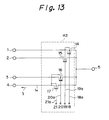
- FIGS. 13 to 15 the prior art selecting circuit, generally 42, is different from the embodiment of FIG. 1 in that the back-gate connecting line l 6 is absent, in that the back gates of the MOS transistors 16 and 17 arc connected to the source connecting line l 4, in that the line l 4 lacks the current limiting resistor 22, and in that the clamping diode 45 is absent.
- the prior art selecting circuit 42 is applied to an LCD driver having a great number of output terminals such as eighty output terminals and is fabricated by a p-well CMOS process.
- FIG. 14 shows a p-well type CMOS transistor applicable the above-described prior art multi-level selecting circuit.
- the selecting circuit has a p-n-p transistor 25, n-p-n transistors 26 and 27, and resistors 28, 29, 30 and 31 which constitute in combination a parasitic thyristor T1, as shown in FIG. 15.
- the voltage on the input terminal 4 exceeds the voltage on the input terminal 3 by 5 volts, for example, it turns on the transistor 26 since it is higher than the base-emitter voltage V be of the transistor 26 which is 0. 7 volt.
- Such a voltage difference of the resistor 31 is applied to between the base and the emitter of the transistor 27.
- V be of the transistor 27 which is 0. 7 volt
- the transistor 27 is turned on.
- a collector current ⁇ 27 times as great as the base current flows from the collector to the emitter of the transistor 27.
- the transistors 27 and 25, therefore, remain conductive even when the voltage on the input terminal 4 is restored to original in, for example, 1 microsecond to turn off the transistor 26.
- the parasitic thyristor T1 is not turned off to cause the selcting circuit 42 to latch up.
- FIGS. 1 to 5 has the back-gate connecting line l 6 independent of the source connecting line l 4, the current limiting resistor 22 connecting to the line l 4, and the clamping diode 45 between the input terminals 3 and 4. While the latch-up has been described as being triggered by the n-MOS transistor in the p-well structure shown in FIGS. 14 and 15, it also occurs when the p-MOS transistor 14 is turned on. Specifically, on the turn-on of the p-MOS transistor 14, the current flowing from the input terminal 1 through the transistor 14 and output terminal 5 will increase to cause the voltage on the source of the transistor 14 to noticeably drop (by more than 5. 7 volts).
- CMOS complementary metal-oxide-semiconductor
- An n-well type CMOS also suffers from such latch-up.
- the illustrative embodiment has been applied to the lowest voltage side of a p-well structure, it is similarly applicable to the highest voltage side of an n-well structure, although not shown or described herein.
- a current limiting resistor 23 is connected to the source connecting line l 1 that connects the input terminal 1 and the source of the MOS transistor 14.
- a back-gate connecting line l 5 is provided for feeding the voltage of the input terminal 1 to the back-gates of the MOS transistors 14 and 15.
- a diode 46 is connected between the input terminals 1 and 2.
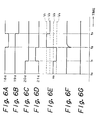
- both of the control signals 18a and 21a go low with the result that the voltage V1 on the input terminal 1 is selected. Further, at a time t3, the control signals 18a and 19a go high and low, respectively, causing the voltage V2 on the input terminal 2 to be selected.
- the back-gate connecting line l 5 is associated with the source connecting line l 1 for feeding the voltage V1 of the input terminal 1 to the back gates of the transistors 14 and 15, as stated earlier. Assume that the transistor 14 has been turned on, as shown in FIG. 6F, and the resultant current flowing through the source connecting line l 1 has caused the voltage on the line l 1 to drop. In this condition, the back-gate connecting line l 5 successfully prevents the voltage of the back gates of the transistors 14 and 15 from dropping, as shown in FIG. 6G.
- the source connecting line l 1 has the current limiting resistor 23 thereon, as stated previously.
- the resistance between the transistor 14 and the input terminal 1 is the sum of the resistance of the line l 1 itself and the resistance of the resistor 23. It follows that the current caused to flow through the line l 1 lowers the voltage on the line l 1 sharply. For example, assuming that the wiring resistance of the line l 1 is 10 ohms, that the resistance of the resistor 23 is 50 ohms, and that a voltage drop of 18 volts has occurred on the line l 1, then a current of 0. 3 ampere flows through the line l 1. At this instant, although the voltage applied to the transistor 14 drops by 18 volts to become lower than the voltage V2 applied to the input terminal 2, the selecting circuit 42 does not latch up since the back gates of the transistors 14 and 15 are held at the voltage V1.
- the diode 46 connected between the input terminals 1 and 2 is another implementation for eliminating the latch-up of the selecting circuit 42. Specifically, when the voltage between the input terminals 1 and 2 is reversed, the diode 46 clamps the reversed voltage to below the forward voltage thereof.
- the illustrative embodiment reduces the saturation current to about one-third of the conventional saturation current, but it is the same as the prior art regarding the non-saturation current.
- the embodiment drives a capacitive load such as an LCD, it needs an about 2. 5 times longer charging and discharging time. This, however, does not matter at all in practice since the charging and discharging time is as short as about 1 microsecond or so.
- the charging and discharging time may be increased to about 2. 5 microseconds due to the 2. 5 times longer charging and discharging time, it is not more than 72 microseconds to 36 microseconds with an LCD whose duty is about 1/200 to about 1/400, i.e. , the distortion of the waveform is not greater than about 3.5 percent to 7 percent.
- FIG. 7 shows a p-well type C-MOS representative of the selecting circuit 42 of FIG. 5.
- a parasitic thyristor included in the C-MOS of FIG. 7 is depicted in FIG. 8.
- a parasitic thyristor T3 is constituted by p-n-p transistors 32 and 25 and an n-p-n transistor 27 which are parasitic transistors, and resistors 28, 29, 30 and 31 which are parasitic resistors.
- the transistor 32 is turned on.
- a collector current which is ⁇ 32 (current amplification factor of the transistor 32) times as great as a base current flows to the collector of the transistor 32.
- This collector current flows through the resistors 30 and 31 to the input terminal 4, causing the voltages on opposite terminals of the resistor 31 to drop. Consequently, the voltages on opposite terminals of the resistor 31 are applied to the base and emitter of the transistor 27. Therefore, the transistor 27 is turned on when the voltage is lowered by more than 0. 7 volt.
- a collector current ⁇ 27 (current amplification factor of the transistor) times greater than a base current flows to the collector of the transistor 27.
- This collector current flows from the input terminal 1 to the collector of the transistor 27 via the resistors 28 and 29, causing the voltages on opposite terminals of the resistor 28 to drop.
- the voltages on opposite terminals of the resistor 28 are applied to the base and emitter of the transistor 27 with the result that the transistor 25 is rendered conductive. Consequently, a current ⁇ 25 (current amplification ratio of the transistor 25) times greater than a base current flows from the emitter to the collector of the transistor 25.
- the current limiting resistor 23 is connected to the emitter of the p-n-p transistor 25.
- a current which is the sum of the base current and collector current of the transistor 25 flows through the resistor 23, the voltages on opposite terminals of the resistor 23 are noticeably lowered.
- a great base current does not flow in the transistor 25.
- the resistance connected to the emitter of the transistor 25 is six times as high as the conventional resistance, the base current is reduced to one-sixth so long as the base voltage is the same as the conventional one. Stated another way, the transistor 25 plays the role of an emitter follower due to the current limiting resistor 23.
- the base current and, therefore, the collector current of the transistor 25 does not increase, preventing the selecting circuit from latching up. Since the collector current of the transistor 25 does not increase, the voltage drop of the resistor 31 that occurs when the voltage of the input terminal 1 is restored to original is less than 0. 7 volt and, therefore, does not cause latch-up. Further, the diode 46 connected between the input terminals 1 and 2 prevents the voltage reversal which may occur between the terminals 1 and 2 from exceeding the forward voltage of the diode 46. This eliminates the occurrence that the transistor 32 is turned on by a voltage reversal and, therefore, the latch-up ascribable to a voltage reversal.
- the illustrative embodiment will operated in the manner described even when applied to the highest voltage side of an n-well structure.
- such a diode When the diode 45 or 46 shown and described is built in an IC, such a diode may be associated with the highest or the lowest voltage input terminal and all of a plurality of medium voltage input terminals, or with only one of such input terminals. On the other hand, when the diode 45 or 46 is provided outside an IC, it is not necessary to provide each IC with more than one diodes, as will be described hereinafter.
- an OP AMP It is a common practice with an OP AMP to insert a low resistance such as 1 ohm on the output side for preventing it from oscillating and protecting it against damage in the event when the output is shorted.
- the current capacity of the output of an OP AMP is as small as 10 milliamperes to 100 milliamperes. Therefore, the current available with an OP AMP is not greater than 1 ampere to 2 amperes even when a power booster is connected to the output thereof. In this condition, the current of 8 amperes applied to an OP AMP causes the voltage to drop by at least about 8 volts. As a result, the back-gate voltage of the MOS transistor 16 exceeds the source voltage of the same, causing the circuit to latch up.
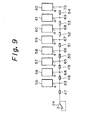
- FIG. 9 depicts wirings connecting the OP AMP 24 which feeds the fourth voltage V4, eight driver ICs 55 to 62 each driving eighty output, and impedances 47 to 54 representative of resistances involved in the wirings of a substrate and the connections of lines.
- the substrate and lines are generally made of copper, in which case the resistance component ranges from several tens to several hundreds of milliohms. Then, even if the line with the impedance 47 is as long as 1 meter, the resistance amounts to about several hundreds of milliohms. Assuming that the lines with the impedances 48 to 54 each extends over about 10 centimeters, then the resistance amounts to 10 milliohms and causes a voltage drop of about 1 volt to occur.
- the impedance 47 when the impedance 47 is 100 milliohms and the impedances 48 to 54 are 10 milliohms each, the total resistance is 170 milliohms and causes the voltage to drop by 1. 08 volts. Even if the the impedance 47 is 30 milliohms, the total resistance is 100 milliohms and, therefore, the voltage drop is 0. 52 volt.
- the inductance component is several microhenries for about 1 meter of wiring with the impedance 47 and is several hundred nanohenries for about 10 centimeters of wirings with the impedances 48 to 54.
- the current increases or decreases within 1 microsecond, it is at least 2 megahertz in terms of frequency.
- the impedances 48 to 54 are 1. 256 ohms.
- a voltage drop due to such impedances is 135. 648 volts.
- the voltage drop is 65. 312 volts.
- the voltage does not drop to such a degree since the difference between the maximum and minimum voltages is as small as 20 volts.
- the voltage eventually rises to the vicinity of the maximum voltage to latch up the circuit.
- the diode 45 or 46 is provided outside an IC, it is necessary to provide each IC with one diode.
- this diode When this diode is implemented as a Schottky diode, the voltage reversal can be clamped at 0. 2 volt. Assuming that the impedance 48 is 0. 314 ohm and the wiring associated therewith is 10 centimeters long, a current of 1. 75 amperes flows through the impedance 48 to raise the voltage on the junction 64 by 0. 5495 volt. However, the total voltage drop is 0. 7495 volt since the voltage on the junction 63 has already risen by 0. 2 volt. A diode, therefore, has to be connected between the terminals to which the voltages V4 and V3 of the IC 56 are applied. This diode is capable of clamping the voltage reversal at 0.
- a diode therefore, has to be connected between the input terminals 4 and 3 of the IC 58 and can clamp the voltage inversion at 0. 2 volt when implemented as a Schottky diode.
- a current of 1 ampere flows through the impedance 51 to increase the voltage on the junction 67 by 0. 514 volt, i.e. 0. 314 volt plus 0.2 volt. This voltage is lower than 0. 7 volt and does not cause latch-up to occur. Hence, it is not necessary to connect a diode between the input terminals 4 and 3 of the IC 59.
- a current of 0.75 ampere flows through the impedance 52 to increase the voltage on the junction 68 by 0.
- a diode is needed between the input terminals 4 and 3 of the IC 60.
- This diode can clamp the voltage reversal at 0. 2 volt when use is made of a Schottky diode.
- a current of 0. 5 ampere flows through the impedance 53 to increase the voltage on the junction 69 by 0. 357 volt which is the sum of 0. 157 volt and 0.2 volt. This voltage is lower than 0. 7 volt and not causative of latch-up, so that a diode is not needed between the input terminals 4 and 3 of the IC 61. Further, a current of 0.
- a diode has to be connected between the input terminals 4 and 3 of the ICs 55, 56, 58 and 60 and does not have to be connected between the input terminals 4 and 3 of the ICs 57, 59, 61 and 62. While the above description has concentrated on the input terminals 4 and 3, it is also true with the input terminals to which the highest voltage V1 and medium voltage V2 are applied.
- a back-gate connecting line may be provided on only one of the low voltage side and high voltage side.
- a back-gate connecting line may be provided on both of the low voltage and high voltage sides.
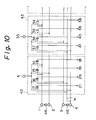
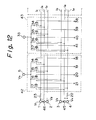
- the 10 to 12 show only two selecting circuits 42 and 43, the illustrative embodiments each has eighty such circuits, for example, each of which selects voltages applied to the input terminals 1, 2, 3 and 4.
- the selecting circuit 43 is identical in construction with the selecting circuit 42. Specifically, the selecting circuit 43 has MOS transistors 34 to 37 corresponding to the MOS transistors 14 to 17, an output terminal 33 corresponding to the output terminal 5, and control signal input terminals 38 to 41 corresponding to the control signal input terminals 18 to 21. When all the selecting circuits 42 and 43 are caused into an identical state by the control signals applied to the terminals 18 to 21 and 38 to 41, a maximum current flows. It is not necessary to provide all the selecting circuits with the current limiting resistors 22 and 23 and diodes 45 and 46.
- the resistors 22 and 23, for example, When the resistors 22 and 23, for example, are used, one of them may be provided on a common source connecting line of the selecting circuits 42, 43 and so on or in each of such circuits, as shown in the illustrative embodiments.
- the resistor When each selecting circuit is provided with a resistor, the resistor may be implemented with polysilicon or similar substance having a relatively high resistance and wired in a jumper configuration. This is successful in completing jumper wiring and forming the resistor at the same time. While the present invention has been shown and described in relation to a switch or selecting circuit using MOS transistors, it is similarly applicable to a switch using both of p-MOSs and n-MOSs.
Landscapes
- Engineering & Computer Science (AREA)
- Theoretical Computer Science (AREA)
- Physics & Mathematics (AREA)
- Crystallography & Structural Chemistry (AREA)
- Computer Hardware Design (AREA)
- General Physics & Mathematics (AREA)
- Chemical & Material Sciences (AREA)
- Electronic Switches (AREA)
- Liquid Crystal (AREA)
- Liquid Crystal Display Device Control (AREA)
- Control Of Voltage And Current In General (AREA)
- Control Of Indicators Other Than Cathode Ray Tubes (AREA)
- Metal-Oxide And Bipolar Metal-Oxide Semiconductor Integrated Circuits (AREA)
Applications Claiming Priority (2)
| Application Number | Priority Date | Filing Date | Title |
|---|---|---|---|
| JP343927/89 | 1989-12-29 | ||
| JP1343927A JP2843393B2 (ja) | 1989-12-29 | 1989-12-29 | 多値レベル出力回路 |
Publications (3)
| Publication Number | Publication Date |
|---|---|
| EP0435258A2 true EP0435258A2 (de) | 1991-07-03 |
| EP0435258A3 EP0435258A3 (en) | 1991-12-11 |
| EP0435258B1 EP0435258B1 (de) | 1998-03-04 |
Family
ID=18365322
Family Applications (1)
| Application Number | Title | Priority Date | Filing Date |
|---|---|---|---|
| EP90125508A Expired - Lifetime EP0435258B1 (de) | 1989-12-29 | 1990-12-27 | Mehrpegelauswählkreis mit einem Widerstand zur Begrenzung von Latch-up |
Country Status (4)
| Country | Link |
|---|---|
| US (1) | US5070255A (de) |
| EP (1) | EP0435258B1 (de) |
| JP (1) | JP2843393B2 (de) |
| DE (1) | DE69032090T2 (de) |
Cited By (1)
| Publication number | Priority date | Publication date | Assignee | Title |
|---|---|---|---|---|
| EP0611144A3 (de) * | 1993-02-09 | 1997-07-30 | Sharp Kk | Spannungserzeugungsschaltung, Steuerungsschaltung für gemeinsame Elektrode, Steuerungsschaltung für Signalleitung und Grauskala-Spannungserzeugungsschaltung für Anzeigevorrichtungen. |
Families Citing this family (23)
| Publication number | Priority date | Publication date | Assignee | Title |
|---|---|---|---|---|
| JPH04136981A (ja) * | 1990-09-28 | 1992-05-11 | Sharp Corp | 表示装置の駆動回路 |
| JP2719224B2 (ja) * | 1990-09-28 | 1998-02-25 | シャープ株式会社 | 表示装置の駆動回路 |
| JPH04191723A (ja) * | 1990-11-27 | 1992-07-10 | Toshiba Corp | 液晶駆動装置 |
| US5382838A (en) * | 1993-03-18 | 1995-01-17 | Northern Telecom Limited | Digital driver with class AB output stage |
| US5532712A (en) * | 1993-04-13 | 1996-07-02 | Kabushiki Kaisha Komatsu Seisakusho | Drive circuit for use with transmissive scattered liquid crystal display device |
| JP3234043B2 (ja) * | 1993-05-10 | 2001-12-04 | 株式会社東芝 | 液晶駆動用電源回路 |
| US5376829A (en) * | 1993-09-10 | 1994-12-27 | Sun Microsystems, Inc. | High-speed complementary multiplexer |
| KR0139657B1 (ko) * | 1994-11-09 | 1998-07-01 | 문정환 | 자동레벨선택기능을 가지는 신호수신장치 |
| US5517153A (en) * | 1995-06-07 | 1996-05-14 | Sgs-Thomson Microelectronics, Inc. | Power supply isolation and switching circuit |
| FR2735927B1 (fr) * | 1995-06-21 | 1997-08-01 | Sgs Thomson Microelectronics | Circuit de commutation permettant de fournir selectivement des tensions de signes differents |
| KR100202635B1 (ko) * | 1995-10-13 | 1999-06-15 | 구본준 | 리서프 이디모스 트랜지스터와 이를 이용한 고전압 아날로그의 멀티플렉서회로 |
| JP3411494B2 (ja) * | 1997-02-26 | 2003-06-03 | シャープ株式会社 | マトリクス型表示装置の駆動用電圧生成回路 |
| JP3488054B2 (ja) * | 1997-09-12 | 2004-01-19 | Necエレクトロニクス株式会社 | 液晶駆動用装置 |
| US6127879A (en) * | 1998-02-26 | 2000-10-03 | Lockheed Martin Corporation | Multi-channel overvoltage protection circuit |
| JP3660126B2 (ja) * | 1998-05-18 | 2005-06-15 | 株式会社ルネサステクノロジ | データ転送回路及び液晶表示装置 |
| US6512401B2 (en) * | 1999-09-10 | 2003-01-28 | Intel Corporation | Output buffer for high and low voltage bus |
| US7088170B2 (en) * | 2003-06-30 | 2006-08-08 | International Business Machines Corporation | Multiplexer and demultiplexer |
| US6847249B1 (en) * | 2003-10-09 | 2005-01-25 | Analog Devices, Inc. | Highest available voltage selector circuit |
| US20090079471A1 (en) * | 2007-09-25 | 2009-03-26 | Ting-Yuan Cheng | Low power buffer circuit |
| TWI482264B (zh) * | 2009-07-09 | 2015-04-21 | 奕力科技股份有限公司 | 半導體裝置 |
| US8129862B2 (en) * | 2009-10-23 | 2012-03-06 | Analog Devices, Inc. | Scalable highest available voltage selector circuit |
| KR20130046521A (ko) * | 2011-10-28 | 2013-05-08 | 에스케이하이닉스 주식회사 | 전압 선택 회로 및 이를 구비한 집적회로 |
| CN117811371B (zh) * | 2024-02-28 | 2024-06-25 | 杰华特微电子股份有限公司 | 最大输入电压选择输出电路、方法及应用其的芯片 |
Family Cites Families (9)
| Publication number | Priority date | Publication date | Assignee | Title |
|---|---|---|---|---|
| US4209713A (en) * | 1975-07-18 | 1980-06-24 | Tokyo Shibaura Electric Co., Ltd. | Semiconductor integrated circuit device in which difficulties caused by parasitic transistors are eliminated |
| GB2065404B (en) * | 1979-12-11 | 1984-05-31 | Casio Computer Co Ltd | Voltage selector circuit |
| US4356413A (en) * | 1980-08-20 | 1982-10-26 | Ibm Corporation | MOSFET Convolved logic |
| JPS5980010A (ja) * | 1982-10-27 | 1984-05-09 | テクトロニツクス・インコ−ポレイテツド | プログラマブルアツテネ−タ |
| US4734751A (en) * | 1985-05-20 | 1988-03-29 | General Electric Company | Signal scaling MESFET of a segmented dual gate design |
| JPH0831789B2 (ja) * | 1985-09-04 | 1996-03-27 | 沖電気工業株式会社 | 出力回路 |
| NL8601373A (nl) * | 1986-05-29 | 1987-12-16 | Philips Nv | Weergeefinrichting met verbeterde aansturing. |
| JP2604200B2 (ja) * | 1987-04-20 | 1997-04-30 | 株式会社日立製作所 | 液晶表示装置およびその駆動方法 |
| JPH01132212A (ja) * | 1987-11-18 | 1989-05-24 | Hitachi Ltd | 半導体装置 |
-
1989
- 1989-12-29 JP JP1343927A patent/JP2843393B2/ja not_active Expired - Fee Related
-
1990
- 1990-12-27 US US07/634,448 patent/US5070255A/en not_active Expired - Lifetime
- 1990-12-27 EP EP90125508A patent/EP0435258B1/de not_active Expired - Lifetime
- 1990-12-27 DE DE69032090T patent/DE69032090T2/de not_active Expired - Lifetime
Cited By (4)
| Publication number | Priority date | Publication date | Assignee | Title |
|---|---|---|---|---|
| EP0611144A3 (de) * | 1993-02-09 | 1997-07-30 | Sharp Kk | Spannungserzeugungsschaltung, Steuerungsschaltung für gemeinsame Elektrode, Steuerungsschaltung für Signalleitung und Grauskala-Spannungserzeugungsschaltung für Anzeigevorrichtungen. |
| US5929847A (en) * | 1993-02-09 | 1999-07-27 | Sharp Kabushiki Kaisha | Voltage generating circuit, and common electrode drive circuit, signal line drive circuit and gray-scale voltage generating circuit for display devices |
| US6310616B1 (en) | 1993-02-09 | 2001-10-30 | Sharp Kabushiki Kaisha | Voltage generating circuit, and common electrode drive circuit signal line drive circuit and gray-scale voltage generating circuit for display device |
| US6509895B2 (en) | 1993-02-09 | 2003-01-21 | Sharp Kabushiki Kaisha | Voltage generating circuit, and common electrode drive circuit, signal line drive circuit and gray-scale voltage generating circuit for display devices |
Also Published As
| Publication number | Publication date |
|---|---|
| DE69032090D1 (de) | 1998-04-09 |
| EP0435258B1 (de) | 1998-03-04 |
| DE69032090T2 (de) | 1998-10-08 |
| JP2843393B2 (ja) | 1999-01-06 |
| US5070255A (en) | 1991-12-03 |
| JPH03204226A (ja) | 1991-09-05 |
| EP0435258A3 (en) | 1991-12-11 |
Similar Documents
| Publication | Publication Date | Title |
|---|---|---|
| US5070255A (en) | Multi-level selecting circuit | |
| US6509781B2 (en) | Circuit and method for controlling a dynamic, bi-directional high voltage analog switch | |
| US4313065A (en) | Switching circuit with MOS field effect transistor | |
| US5124877A (en) | Structure for providing electrostatic discharge protection | |
| US4808845A (en) | High voltage pulse generating semiconductor circuit with improved driving arrangement | |
| US4471237A (en) | Output protection circuit for preventing a reverse current | |
| US6919873B2 (en) | Liquid crystal display apparatus having level conversion circuit | |
| EP3744576A1 (de) | Treiberschaltung, entsprechende vorrichtung und entsprechendes system | |
| EP0281113B1 (de) | Halbleiter - Pufferschaltung | |
| US6459598B1 (en) | Inverter device | |
| KR100636060B1 (ko) | 표시 장치의 구동 회로 및 플라즈마 디스플레이 장치 | |
| US3159751A (en) | Clamp circuit with a shunt unilateral discharge path | |
| US4967100A (en) | Capacitive load driving apparatus | |
| US5786709A (en) | Integrated circuit output driver incorporating power distribution noise suppression circuitry | |
| US5134323A (en) | Three terminal noninverting transistor switch | |
| JPH11239032A (ja) | モーター用h−ブリッジ電力増幅器 | |
| US5952869A (en) | High power MOS transistor | |
| CN101930716B (zh) | 显示面板驱动器 | |
| US6630863B2 (en) | Differential amplifier, semiconductor device, power supply circuit and electronic equipment using the same | |
| US5148049A (en) | Circuit for driving a capacitive load utilizing thyristors | |
| US7057867B1 (en) | Electrostatic discharge (ESD) protection clamp circuitry | |
| JP3258050B2 (ja) | 誘導性負荷用mosfetを備えた回路装置 | |
| US5825207A (en) | Output buffer circuit | |
| US6882512B2 (en) | Integrated circuit provided with a protection against electrostatic discharges | |
| US3727072A (en) | Input circuit for multiple emitter transistor |
Legal Events
| Date | Code | Title | Description |
|---|---|---|---|
| PUAI | Public reference made under article 153(3) epc to a published international application that has entered the european phase |
Free format text: ORIGINAL CODE: 0009012 |
|
| AK | Designated contracting states |
Kind code of ref document: A2 Designated state(s): DE FR NL |
|
| PUAL | Search report despatched |
Free format text: ORIGINAL CODE: 0009013 |
|
| AK | Designated contracting states |
Kind code of ref document: A3 Designated state(s): DE FR NL |
|
| 17P | Request for examination filed |
Effective date: 19920214 |
|
| 17Q | First examination report despatched |
Effective date: 19940405 |
|
| GRAG | Despatch of communication of intention to grant |
Free format text: ORIGINAL CODE: EPIDOS AGRA |
|
| GRAG | Despatch of communication of intention to grant |
Free format text: ORIGINAL CODE: EPIDOS AGRA |
|
| GRAH | Despatch of communication of intention to grant a patent |
Free format text: ORIGINAL CODE: EPIDOS IGRA |
|
| GRAH | Despatch of communication of intention to grant a patent |
Free format text: ORIGINAL CODE: EPIDOS IGRA |
|
| GRAA | (expected) grant |
Free format text: ORIGINAL CODE: 0009210 |
|
| AK | Designated contracting states |
Kind code of ref document: B1 Designated state(s): DE FR NL |
|
| REF | Corresponds to: |
Ref document number: 69032090 Country of ref document: DE Date of ref document: 19980409 |
|
| ET | Fr: translation filed | ||
| PLBE | No opposition filed within time limit |
Free format text: ORIGINAL CODE: 0009261 |
|
| STAA | Information on the status of an ep patent application or granted ep patent |
Free format text: STATUS: NO OPPOSITION FILED WITHIN TIME LIMIT |
|
| 26N | No opposition filed | ||
| PGFP | Annual fee paid to national office [announced via postgrant information from national office to epo] |
Ref country code: FR Payment date: 20021210 Year of fee payment: 13 |
|
| PG25 | Lapsed in a contracting state [announced via postgrant information from national office to epo] |
Ref country code: FR Free format text: LAPSE BECAUSE OF NON-PAYMENT OF DUE FEES Effective date: 20040831 |
|
| REG | Reference to a national code |
Ref country code: FR Ref legal event code: ST |
|
| PGFP | Annual fee paid to national office [announced via postgrant information from national office to epo] |
Ref country code: NL Payment date: 20091216 Year of fee payment: 20 |
|
| PGFP | Annual fee paid to national office [announced via postgrant information from national office to epo] |
Ref country code: DE Payment date: 20091224 Year of fee payment: 20 |
|
| REG | Reference to a national code |
Ref country code: NL Ref legal event code: V4 Effective date: 20101227 |
|
| PG25 | Lapsed in a contracting state [announced via postgrant information from national office to epo] |
Ref country code: NL Free format text: LAPSE BECAUSE OF EXPIRATION OF PROTECTION Effective date: 20101227 |
|
| PG25 | Lapsed in a contracting state [announced via postgrant information from national office to epo] |
Ref country code: DE Free format text: LAPSE BECAUSE OF EXPIRATION OF PROTECTION Effective date: 20101227 |