EP0436334B1 - Dérivés de 3-Aminopipéridine et N-hétérocycles apparentés - Google Patents
Dérivés de 3-Aminopipéridine et N-hétérocycles apparentés Download PDFInfo
- Publication number
- EP0436334B1 EP0436334B1 EP90313680A EP90313680A EP0436334B1 EP 0436334 B1 EP0436334 B1 EP 0436334B1 EP 90313680 A EP90313680 A EP 90313680A EP 90313680 A EP90313680 A EP 90313680A EP 0436334 B1 EP0436334 B1 EP 0436334B1
- Authority
- EP
- European Patent Office
- Prior art keywords
- methoxybenzylamino
- cis
- phenylpiperidine
- formula
- compound
- Prior art date
- Legal status (The legal status is an assumption and is not a legal conclusion. Google has not performed a legal analysis and makes no representation as to the accuracy of the status listed.)
- Expired - Lifetime
Links
- 0 CCNC([C@@](CI)C=CCCC1=CC=CC(C)(*)C=C1)C(c1ccccc1)c1ccccc1 Chemical compound CCNC([C@@](CI)C=CCCC1=CC=CC(C)(*)C=C1)C(c1ccccc1)c1ccccc1 0.000 description 7
Classifications
-
- C—CHEMISTRY; METALLURGY
- C07—ORGANIC CHEMISTRY
- C07D—HETEROCYCLIC COMPOUNDS
- C07D221/00—Heterocyclic compounds containing six-membered rings having one nitrogen atom as the only ring hetero atom, not provided for by groups C07D211/00 - C07D219/00
- C07D221/02—Heterocyclic compounds containing six-membered rings having one nitrogen atom as the only ring hetero atom, not provided for by groups C07D211/00 - C07D219/00 condensed with carbocyclic rings or ring systems
- C07D221/20—Spiro-condensed ring systems
-
- C—CHEMISTRY; METALLURGY
- C07—ORGANIC CHEMISTRY
- C07D—HETEROCYCLIC COMPOUNDS
- C07D211/00—Heterocyclic compounds containing hydrogenated pyridine rings, not condensed with other rings
- C07D211/04—Heterocyclic compounds containing hydrogenated pyridine rings, not condensed with other rings with only hydrogen or carbon atoms directly attached to the ring nitrogen atom
- C07D211/68—Heterocyclic compounds containing hydrogenated pyridine rings, not condensed with other rings with only hydrogen or carbon atoms directly attached to the ring nitrogen atom having one double bond between ring members or between a ring member and a non-ring member
- C07D211/72—Heterocyclic compounds containing hydrogenated pyridine rings, not condensed with other rings with only hydrogen or carbon atoms directly attached to the ring nitrogen atom having one double bond between ring members or between a ring member and a non-ring member with hetero atoms or with carbon atoms having three bonds to hetero atoms, with at the most one bond to halogen, directly attached to ring carbon atoms
- C07D211/74—Oxygen atoms
- C07D211/76—Oxygen atoms attached in position 2 or 6
-
- A—HUMAN NECESSITIES
- A61—MEDICAL OR VETERINARY SCIENCE; HYGIENE
- A61P—SPECIFIC THERAPEUTIC ACTIVITY OF CHEMICAL COMPOUNDS OR MEDICINAL PREPARATIONS
- A61P11/00—Drugs for disorders of the respiratory system
-
- A—HUMAN NECESSITIES
- A61—MEDICAL OR VETERINARY SCIENCE; HYGIENE
- A61P—SPECIFIC THERAPEUTIC ACTIVITY OF CHEMICAL COMPOUNDS OR MEDICINAL PREPARATIONS
- A61P11/00—Drugs for disorders of the respiratory system
- A61P11/08—Bronchodilators
-
- A—HUMAN NECESSITIES
- A61—MEDICAL OR VETERINARY SCIENCE; HYGIENE
- A61P—SPECIFIC THERAPEUTIC ACTIVITY OF CHEMICAL COMPOUNDS OR MEDICINAL PREPARATIONS
- A61P17/00—Drugs for dermatological disorders
-
- A—HUMAN NECESSITIES
- A61—MEDICAL OR VETERINARY SCIENCE; HYGIENE
- A61P—SPECIFIC THERAPEUTIC ACTIVITY OF CHEMICAL COMPOUNDS OR MEDICINAL PREPARATIONS
- A61P25/00—Drugs for disorders of the nervous system
-
- A—HUMAN NECESSITIES
- A61—MEDICAL OR VETERINARY SCIENCE; HYGIENE
- A61P—SPECIFIC THERAPEUTIC ACTIVITY OF CHEMICAL COMPOUNDS OR MEDICINAL PREPARATIONS
- A61P25/00—Drugs for disorders of the nervous system
- A61P25/04—Centrally acting analgesics, e.g. opioids
-
- A—HUMAN NECESSITIES
- A61—MEDICAL OR VETERINARY SCIENCE; HYGIENE
- A61P—SPECIFIC THERAPEUTIC ACTIVITY OF CHEMICAL COMPOUNDS OR MEDICINAL PREPARATIONS
- A61P25/00—Drugs for disorders of the nervous system
- A61P25/18—Antipsychotics, i.e. neuroleptics; Drugs for mania or schizophrenia
-
- A—HUMAN NECESSITIES
- A61—MEDICAL OR VETERINARY SCIENCE; HYGIENE
- A61P—SPECIFIC THERAPEUTIC ACTIVITY OF CHEMICAL COMPOUNDS OR MEDICINAL PREPARATIONS
- A61P25/00—Drugs for disorders of the nervous system
- A61P25/20—Hypnotics; Sedatives
-
- A—HUMAN NECESSITIES
- A61—MEDICAL OR VETERINARY SCIENCE; HYGIENE
- A61P—SPECIFIC THERAPEUTIC ACTIVITY OF CHEMICAL COMPOUNDS OR MEDICINAL PREPARATIONS
- A61P25/00—Drugs for disorders of the nervous system
- A61P25/24—Antidepressants
-
- A—HUMAN NECESSITIES
- A61—MEDICAL OR VETERINARY SCIENCE; HYGIENE
- A61P—SPECIFIC THERAPEUTIC ACTIVITY OF CHEMICAL COMPOUNDS OR MEDICINAL PREPARATIONS
- A61P25/00—Drugs for disorders of the nervous system
- A61P25/26—Psychostimulants, e.g. nicotine, cocaine
-
- A—HUMAN NECESSITIES
- A61—MEDICAL OR VETERINARY SCIENCE; HYGIENE
- A61P—SPECIFIC THERAPEUTIC ACTIVITY OF CHEMICAL COMPOUNDS OR MEDICINAL PREPARATIONS
- A61P25/00—Drugs for disorders of the nervous system
- A61P25/28—Drugs for disorders of the nervous system for treating neurodegenerative disorders of the central nervous system, e.g. nootropic agents, cognition enhancers, drugs for treating Alzheimer's disease or other forms of dementia
-
- A—HUMAN NECESSITIES
- A61—MEDICAL OR VETERINARY SCIENCE; HYGIENE
- A61P—SPECIFIC THERAPEUTIC ACTIVITY OF CHEMICAL COMPOUNDS OR MEDICINAL PREPARATIONS
- A61P25/00—Drugs for disorders of the nervous system
- A61P25/30—Drugs for disorders of the nervous system for treating abuse or dependence
-
- A—HUMAN NECESSITIES
- A61—MEDICAL OR VETERINARY SCIENCE; HYGIENE
- A61P—SPECIFIC THERAPEUTIC ACTIVITY OF CHEMICAL COMPOUNDS OR MEDICINAL PREPARATIONS
- A61P29/00—Non-central analgesic, antipyretic or antiinflammatory agents, e.g. antirheumatic agents; Non-steroidal antiinflammatory drugs [NSAID]
-
- A—HUMAN NECESSITIES
- A61—MEDICAL OR VETERINARY SCIENCE; HYGIENE
- A61P—SPECIFIC THERAPEUTIC ACTIVITY OF CHEMICAL COMPOUNDS OR MEDICINAL PREPARATIONS
- A61P37/00—Drugs for immunological or allergic disorders
-
- A—HUMAN NECESSITIES
- A61—MEDICAL OR VETERINARY SCIENCE; HYGIENE
- A61P—SPECIFIC THERAPEUTIC ACTIVITY OF CHEMICAL COMPOUNDS OR MEDICINAL PREPARATIONS
- A61P37/00—Drugs for immunological or allergic disorders
- A61P37/02—Immunomodulators
- A61P37/04—Immunostimulants
-
- A—HUMAN NECESSITIES
- A61—MEDICAL OR VETERINARY SCIENCE; HYGIENE
- A61P—SPECIFIC THERAPEUTIC ACTIVITY OF CHEMICAL COMPOUNDS OR MEDICINAL PREPARATIONS
- A61P37/00—Drugs for immunological or allergic disorders
- A61P37/08—Antiallergic agents
-
- A—HUMAN NECESSITIES
- A61—MEDICAL OR VETERINARY SCIENCE; HYGIENE
- A61P—SPECIFIC THERAPEUTIC ACTIVITY OF CHEMICAL COMPOUNDS OR MEDICINAL PREPARATIONS
- A61P9/00—Drugs for disorders of the cardiovascular system
- A61P9/08—Vasodilators for multiple indications
-
- C—CHEMISTRY; METALLURGY
- C07—ORGANIC CHEMISTRY
- C07D—HETEROCYCLIC COMPOUNDS
- C07D211/00—Heterocyclic compounds containing hydrogenated pyridine rings, not condensed with other rings
- C07D211/04—Heterocyclic compounds containing hydrogenated pyridine rings, not condensed with other rings with only hydrogen or carbon atoms directly attached to the ring nitrogen atom
- C07D211/06—Heterocyclic compounds containing hydrogenated pyridine rings, not condensed with other rings with only hydrogen or carbon atoms directly attached to the ring nitrogen atom having no double bonds between ring members or between ring members and non-ring members
- C07D211/36—Heterocyclic compounds containing hydrogenated pyridine rings, not condensed with other rings with only hydrogen or carbon atoms directly attached to the ring nitrogen atom having no double bonds between ring members or between ring members and non-ring members with hetero atoms or with carbon atoms having three bonds to hetero atoms with at the most one bond to halogen, e.g. ester or nitrile radicals, directly attached to ring carbon atoms
- C07D211/56—Nitrogen atoms
-
- C—CHEMISTRY; METALLURGY
- C07—ORGANIC CHEMISTRY
- C07D—HETEROCYCLIC COMPOUNDS
- C07D409/00—Heterocyclic compounds containing two or more hetero rings, at least one ring having sulfur atoms as the only ring hetero atoms
- C07D409/02—Heterocyclic compounds containing two or more hetero rings, at least one ring having sulfur atoms as the only ring hetero atoms containing two hetero rings
- C07D409/04—Heterocyclic compounds containing two or more hetero rings, at least one ring having sulfur atoms as the only ring hetero atoms containing two hetero rings directly linked by a ring-member-to-ring-member bond
-
- C—CHEMISTRY; METALLURGY
- C07—ORGANIC CHEMISTRY
- C07D—HETEROCYCLIC COMPOUNDS
- C07D409/00—Heterocyclic compounds containing two or more hetero rings, at least one ring having sulfur atoms as the only ring hetero atoms
- C07D409/14—Heterocyclic compounds containing two or more hetero rings, at least one ring having sulfur atoms as the only ring hetero atoms containing three or more hetero rings
Definitions
- the present invention relates to novel 3-amino-piperidine derivatives and related compounds, pharmaceutical compositions comprising such compounds and the use of such compounds in the treatment and prevention of inflammatory and central nervous system disorders, as well as several other disorders.
- the pharmaceutically active compounds of this invention are substance P antagonists.
- This invention also relates to novel intermediates used in the synthesis of such substance P antagonists.
- Substance P is a naturally occurring undecapeptide belonging to the tachykinin family of peptides, the latter being named because of their prompt stimulatory action on smooth muscle tissue. More specifically, substance P is a pharmacologically active neuropeptide that is produced in mammals (having originally been isolated from gut) and possesses a characteristic amino acid sequence that is illustrated by D. F. Veber et al . in U.S. Patent No. 4,680,283. The wide involvement of substance P and other tachykinins in the pathophysiology of numerous diseases has been amply demonstrated in the art. For instance, substance P has recently been shown to be involved in the transmission of pain or migraine (see B.E.B.
- the present invention relates to compounds of the formula wherein Y is (CH2) n wherein n is an integer from 1 to 4, and wherein any one of the carbon-carbon single bonds in said (CH2) n may optionally be replaced by a carbon-carbon double bond, and wherein any one of the carbon atoms of said (CH2) n may optionally be substituted with R4, and wherein any one of the carbon atoms of said (CH2) n may optionally be substituted with R7;
- Z is (CH2) m wherein m is an integer from 0 to 6, and wherein any one of the carbon-carbon single bonds of (CH2) m may optionally be replaced by a carbon-carbon double bond or a carbon-carbon triple bond, and any one of the carbon atoms of said (CH2) m may optionally be substituted with R8;
- R1 is hydrogen or (C1-C8) alkyl optionally substituted with hydroxy, (C1-C4)alkoxy or fluoro;
- R2 is a radical selected from
- the present invention also relates to the pharmaceutically acceptable acid addition salts of compounds of the formula I.
- the acids which are used to prepare the pharmaceutically acceptable acid addition salts of the aforementioned base compounds of this invention are those which form non-toxic acid addition salts, i.e., salts containing pharmacologically acceptable anions, such as the hydrochloride, hydrobromide, hydroiodide, nitrate, sulfate, bisulfate, phosphate, acid phosphate, acetate, lactate, citrate, acid citrate, tartrate, bitartrate, succinate, maleate, fumarate, gluconate, saccharate, benzoate, methanesulfonate, ethanesulfonate, benzenesulfonate, p-toluenesulfonate and pamoate [i.e., 1,1'-methylene-bis-(2-hydroxy-3- naphthoate)]salts.
- the present invention also relates to compounds of the formula wherein R1, R2, R3, R4, R5 and R7 are as defined for compounds of the formula I.
- the compounds of the formula VII are novel intermediates used in the synthesis of compounds of the formula I.
- the present invention also relates to the compound 3-amino-2-phenylpiperidine.
- halo as used herein, unless otherwise indicated, includes chloro, fluoro, bromo and iodo.
- alkyl as used herein, unless otherwise indicated, includes saturated monovalent hydrocarbon radicals having straight, branched or cyclic moieties or combinations thereof.
- one or more substituents includes from one to the maximum number of substituents possible based on the number of available bonding sites.
- Preferred compounds of the formula I are those wherein R1, R4, R5 R6 and R7 are hydrogen, R2 is phenyl, R3 is 2-methoxyphenyl, wherein the phenyl moiety may optionally be substituted with chlorine, fluorine, methyl, (C1-C6)alkoxy or trifluoromethane, m is 0 and n is 3 or 4.
- Specific preferred compounds of the formula I are: cis-3-(2-chlorobenzylamino)-2-phenylpiperidine; cis-3-(2-trifluoromethylbenzylamino)-2-phenylpiperidine; cis-3-(2-methoxybenzylamino)-2-(2-fluorophenyl)piperidine; cis-3-(2-methoxybenzylamino)-2-(2-chlorophenyl)piperidine; cis-3-(2-methoxybenzylamino)-2-(2-methylphenyl)piperidine; cis-3-(2-methoxybenzylamino)-2-(3-methoxyphenyl)piperidine; cis-3-(2-methoxybenzylamino)-2-(3-fluorophenyl)piperidine; cis-3-(2-methoxybenzylamino)-2-(3-fluorophenyl)piperidine; cis-3-(
- the present invention also relates to a pharmaceutical composition
- a pharmaceutical composition comprising a compound of the formula I, or a pharmaceutically acceptable salt thereof, together with a pharmaceutically acceptable diluent or carrier.
- the present invention also relates to the use of a compound of formula I for treating or preventing a condition selected from the group consisting of inflammatory diseases (e.g., arthritis, psoriasis, asthma and inflammatory bowel disease), anxiety, depression or dysthymic disorders, colitis, psychosis, pain, allergies such as eczema and rhinitis, chronic obstructive airways disease, hypersensitivity disorders such as poison ivy, vasospastic diseases such as angina, migraine and Reynaud's disease, fibrosing and collagen diseases such as scleroderma and eosinophilic fascioliasis, reflex sympathetic dystrophy such as shoulder/hand syndrome, addiction disorders such as alcoholism, stress related somatic disorders, peripheral neuropathy, neuralgia, neuropathological disorders such as Alzheimer's disease, AIDS related dementia, diabetic neuropathy and multiple sclerosis, disorders related to immune enhancement or suppression such as systemic lupus erythematosus, and rhe
- the compounds of the present invention are also of value in a method of antagonizing the effects of substance P in a mammal, including a human, which comprises administering to said mammal a substance P antagonizing amount of compound of the formula I, or a pharmaceutically acceptable salt thereof.
- the compounds of the present invention are also of value in a method of treating or preventing a disorder in a mammal, including a human, resulting from an excess of substance P, which comprises administering to said mammal a substance P antagonizing amount of a compound of the formula I, or a pharmaceutically acceptable salt thereof.
- the compounds of the present invention are also of value in a method of treating or preventing a condition selected from the group consisting of inflammatory diseases (e.g., arthritis, psoriasis, asthma and inflammatory bowel disease), anxiety, depression or dysthymic disorders, colitis, psychosis, pain, allergies such as eczema and rhinitis, chronic obstructive airways disease, hypersensitivity disorders such as poison ivy, vasospastic diseases such as angina, migraine and Reynaud's disease, fibrosing and collagen diseases such as scleroderma and eosinophilic fascioliasis, reflex sympathetic dystrophy such as shoulder/hand syndrome, addiction disorders such as alcoholism, stress related somatic disorders, peripheral neuropathy, neuralgia, neuropathological disorders such as Alzheimer's disease, AIDS related dementia, diabetic neuropathy and multiple sclerosis, disorders related to immune enhancement or suppression such as systemic lupus erythematosus, and rheumatic
- the compounds of the present invention are also of value in a method of treating or preventing a disorder in mammal, including a human, the treatment or prevention of which is effected or facilitated by a decrease in substance P mediated neurotransmission which comprises administering to said mammal an amount of a compound of the formula I, or a pharmaceutically acceptable salt thereof, effective in antagonizing the effect of substance P at its receptor site.
- the compounds of the present invention are also of value in a method of treating or preventing a disorder in mammal, including a human, the treatment or prevention of which is effected or facilitated by a decrease in substance P mediated neurotransmission which comprises administering to said mammal an amount of a compound of the formula I, or a pharmaceutically acceptable salt thereof, effective in treating or preventing such disorder.
- the invention includes compounds of the formula: wherein R2 to R8 and Z are as previously defined; compounds of the formula: wherein R2 to R7 are as previously defined; compounds of the formula: wherein R1 to R5 and R7 are as previously defined; and the 2S, 3S enantiomers of compounds of the formula I of the formula: wherein R2 to R5 and R7 are as previously defined.
- the compounds of the formula I have chiral centers and therefore exist in different enantiomeric forms.
- This invention relates to all optical isomers and all stereoisomers of compounds of the formula I, and mixtures thereof.
- Formulae I and VII above include compounds identical to those depicted but for the fact that one or more hydrogen or carbon atoms are replaced by radioactive isotopes thereof.
- Such radiolabelled compounds are useful as research and diagnostic tools in metabolism pharmokinetic studies and in binding assays. Specific applications in research include radioligand binding assays, autoradiography studies and in vivo binding studies, while specific applications in the diagnostic area include studies of the substance P receptor in the human brain in in vivo binding in the relevant tissues for inflammation, e.g. immune-type cells or cells that are directly involved in inflammatory bowel disorders and the like. Included among the radiolabelled forms of compounds of the formulae I and VII are the tritium and C14 isotopes thereof.
- the compounds of the formula I may be prepared as described in the following reaction schemes and discussion. Each of the formulae designated IA, IB, IC, and ID represents a different group of compounds having the general formula I. Unless otherwise indicated, R1, R2, R3, R4, R5, R6, R7, R8, Y,Z,n and m in the reaction schemes and discussion that follow are defined as above.
- Scheme 1 illustrates the preparation of compounds of the formulae IA, IB and IC.
- Formula IA represents compounds of the formula I wherein each of R1 and R6 is hydrogen, m is 0 and n is 3, with the proviso that R2 is not benzhydryl and neither R4 nor R7 is attached to the "6" position of the piperidine ring.
- Formula IB represents compounds of the formula I wherein R1 is hydrogen and n is 3, with the proviso that R2 is not benzhydryl and neither R4 nor R7 is attached to the "6" position of the piperidine ring.
- Formula IC represents compounds of the formula I wherein R6 is hydrogen, m is 0 and n is 3, with the proviso that R2 is not benzhydryl and neither R4 nor R7 is attached to the "6" position of the piperidine ring.
- a compound of the formula II is reacted with a compound of the formula in the presence of ammonium acetate, in a polar solvent such as ethanol, acetic acid or dimethyl sulfoxide.
- a polar solvent such as ethanol, acetic acid or dimethyl sulfoxide.
- Ethanol is the preferred solvent.
- Temperatures from about room temperature to about 150°C are suitable, with the reflux temperature of the solvent being preferred.
- This reaction yields, by intramolecular condensation, a compound of the formula III (Von M. Muhlstadt and B. Schulze, J. Prak. Chem , 317, 919 (1975)).
- the condensation product of formula III is then converted, via a Nef reaction, to an oxime of the formula IV.
- This reaction may be carried out using reagents such as agueous Ti(III) chloride, potassium permanganate, pyridine/hexamethylphosphoramide complex of molybdenum pentoxide, tributylphosphinediphenyl disulphide or ozone in the presence of a base. Suitable temperatures range from about -100°C to about 0°C.
- the reaction is performed by bubbling ozone through the reaction mixture in the presence of potassium t-butoxide at about -78°C, and then quenching the reaction mixture with hydroxylamine hydrochloride at ambient temperature.
- the oxime of formula IV is then reduced to yield both the cis and trans isomers of a compound of the formula V.
- Suitable reducing agents include Raney nickel/hydrogen, 10% palladium on charcoal/hydrogen, and aluminum amalgam.
- the reduction is carried out using Raney nickel in ethanol under a hydrogen gas pressure of about 3 atm and at a temperature of about 25°C. Temperatures from about 10°C to about 60°C and pressures from about 1 to about 10 atmospheres are also suitable.
- Reductive amination of the mixture of cis and trans isomers of the compound of the formula V from the above step with sodium cyanoborohydride or sodium triacetoxyborohydride and a compound of the formula R3CHO yields a mixture of the cis and trans isomers of a compound of the formula VI.
- This reaction is typically carried out in a polar solvent such as acetic acid or a lower alkanol, at a temperature from about 0°C to about 50°C. Methanol is the preferred solvent and about 25°C is the preferred temperature. It is also preferable that the pH of the reaction mixture be about 4 to about 5.
- the cis and trans isomers of the compound of the formula VI so formed can be easily separated by using silica-gel flash chromatography, eluting with 3% methanol in methylene chloride.
- Suitable reducing agents include borane dimethylsulfide in tetrahydrofuran ("THF"), lithium aluminum hydride, borane in THF and sodium borohydride-titanium (IV) chloride. Best results are obtained by using borane dimethylsulfide in THF.
- THF tetrahydrofuran
- IV sodium borohydride-titanium
- the compound of formula IA so formed may be converted to a compound of the formula IB having the same stereochemistry, as illustrated in scheme 1, by reacting it with a compound of the formula R6-( Z ) -X, wherein X is halo, Z is (CH2) m and wherein one of the carbon-carbon single bond of said (CH2) m may optionally be replaced by a carbon-carbon double bond, and wherein one of the carbons of said (CH2) m may optionally be substituted with R8.
- This reaction is typically carried out in the presence of a base such as triethylamine or potassium t-butoxide, in a polar solvent such as methylene chloride or dichloroethane, and at a temperature from about room temperature to about 150°C.
- the reaction is carried out at the reflux temperature in methylene chloride in the presence of triethylamine.
- a compound of the formula VI is reacted with a compound of the formula R1X, wherein X is halo, to yield a compound of the formula VII having the same stereochemistry (e.g. cis, trans or a mixture thereof).
- This reaction is typically carried out in the presence of a base such as triethylamine or potassium t-butoxide in a polar solvent such as methylene chloride or dichloroethane, at a temperature from about room temperature to about 150°C.
- a base such as triethylamine or potassium t-butoxide
- a polar solvent such as methylene chloride or dichloroethane
- Reduction of the compound of formula VII so formed yields a compound of the formula IC having the same stereochemistry.
- suitable reducing agents are lithium aluminum-hydride, borane dimethylsulfide in THF, borane in THF and sodium borohydride-titanium (IV) chloride. Best results are obtained using borane dimethylsulfide in THF.
- the reaction may be carried out at temperatures from about room temperature to about 150°C, and is preferably carried out at the reflux temperature of the solvent.
- Scheme 2 illustrates an alternate method of preparing compounds of the formula IB.
- the starting material for this method is a compound of the formula VI, which is illustrated in scheme 1.
- the basic nitrogen of the starting material is protected with a group such as t-butoxycarbonyl (Boc), trifluoroacetyl, carbobenzyloxy or carboethoxy, by reacting it, respectively, with di-t-butyl dicarbonate, trifluoroacetic anhydride, benzyl chloroformate or ethylchloroformate.
- t-butoxycarbonyl is illustrated in scheme 2.
- the reaction of the starting material with di-t-butyl dicarbonate is typically carried out in a polar solvent such as THF, dichloromethane or chloroform, at a temperature from about 0°C to about 100°C.
- a polar solvent such as THF, dichloromethane or chloroform
- the preferred solvent is dichloromethane and the preferred temperature is room temperature.
- the reaction is generally carried out for about 0.5 to 72 hours. This reaction yields a compound of the formula VIII having the same stereo- chemistry as the starting material.
- the compound of formula VIII so formed is then reacted with a compound of the formula X-( Z ) -R6 wherein X is halo, or CH3SO2O-( Z ) -R6, to form a compound of the formula IX having the same stereochemistry.
- Z is (CH2) m and one of the carbons of said (CH2) m may optionally be substituted with R8 and one of the carbon-carbon single bonds of said (CH2) m may optionally be replaced with a carbon-carbon double bond or a carbon-carbon triple bond.
- This reaction is generally carried out in the presence of a base such as potassium hydroxide, potassium t-butoxide, lithium diisopropylamine or sodium methoxide, in a polar solvent such as t-butanol or DMF, for about 0.5 to about 24 hours.
- a base such as potassium hydroxide, potassium t-butoxide, lithium diisopropylamine or sodium methoxide
- a polar solvent such as t-butanol or DMF
- Reaction temperatures will generally range from about -25°C to about 150°C.
- the preferred temperature is generally the reflux temperature of the solvent.
- the protecting group is then removed from the compound of formula IX by reacting it with an acid such as hydrochloric acid, trifluoroacetic acid or perchloric acid, to yield a compound of the formula X having the same stereochemistry.
- an acid such as hydrochloric acid, trifluoroacetic acid or perchloric acid
- Appropriate solvents for this reaction include polar solvents such as methylene chloride, dioxane, ether or THF, preferably dioxane.
- the reaction is typically run at a temperature from about -10°C to about 50°C, preferably about 25°C, for about 0.5 to about 24 hours.
- Scheme 3 illustrates a method of preparing compounds of the formula ID.
- Formula ID represents compounds of the formula I wherein each of R1 and R6 are hydrogen, m is 0 and n is 2, 3 or 4. This group of compounds includes those of the formula IA.
- the method of scheme 3 can be used to prepare the pure 2S,3S enantiomer, the pure 2R,3R enantiomer, or a racemic mixture of a compound of the formula ID, depending on whether the starting material is, respectively, the R-enantiomer, the S-enantiomer, or a racemic mixture of the starting material of formula XI.
- formula ID includes compounds of the formula IA
- the method of scheme 3 can be used to prepare compounds of the formula IA wherein R4 is attached to the "6" position of the nitrogen containing ring.
- the method of scheme 3 can also be used to prepare compounds of the formula ID wherein R2 is benzhydryl.
- compounds of the formula ID may be prepared as follows.
- the pure R-enantiomer, S-enantiomer or a racemic mixture of a compound of the formula XI is reacted with a nitrogen-protecting reagent such as t-butyldimethylsilyl chloride (TBDMS-Cl), t-butyldimethylsilyl triflate (TBDMS-OTf) or benzyl bromide/t-butoxide, preferably TBDMS-Cl, to form a compound of the formula XII.
- This reaction is typically carried out in a polar solvent such as DMF or triethyl- amine, preferably triethylamine, at a temperature of from about 0 to about 140°C. Room temperature is preferred.
- the above reaction is followed by a stereospecific alkylation of the compound of formula XII to form the trans stereoisomer of a compound of the formula XIII.
- the compound of formula XII is reacted with lithium diethylamide in a polar solvent such as ether or THF, preferably THF, at a temperature from about -100°C to about room temperature, preferably about -78°C.
- a compound of the formula is added to the reaction mixture to produce the trans isomer of a compound of the formula XIII.
- the cyclization of the compound of formula XIV to produce a compound of the formula XV is accomplished by heating the crude product of formula XIV from the foregoing reaction at a temperature from about 80°C to about 140°C, preferably at about 100°C, for about 5 minutes to about 2 days, preferably for about 15 minutes, in a high boiling solvent such as DMF or toluene, preferably in DMF. Generally, this reaction is conducted in the presence of sodium iodide and sodium bicarbonate. In the compound of formula XV produced by this reaction, R2 and -COOCH3 are cis to each other.
- the compound of formula XV is then treated with benzylchloroformate in a polar solvent such as water, water/acetone, chloroform, dichloroethane or ethyl acetate, in the presence of a base such as triethylamine or sodium bicarbonate, to yield the N-carbobenzyloxy piperidine (N-Cbz piperidine) of formula XVI having the same stereochemistry (i.e., wherein R2 and -COOCH3 are in the cis configuration).
- This reaction may be carried out at temperatures from about 0°C to about 100°C, preferably about 25°C, for about 5 minutes to 18 hours.
- reaction temperatures may range from about room temperature to about 100°C, with about 50°C being preferred.
- the conversion of the carboxamide group of the compound of formula XVII to form a compound of the formula XVIII having the same stereochemistry may be accomplished by a Hoffmann degradation using reagents such as bromine/sodium methoxide in methanol, lead tetraacetate in t-butyl alcohol, tin (IV) chloride, iodobenzene bis(trifluoroacetate) in aqueous acetonitrile, sodium bromide or benzyltrimethyl ammonium tribromide.
- the compound of formula XVII is treated with lead tetraacetate in t-butanol.
- This reaction is typically carried out at a temperature from about room temperature to the reflux temperature of the solvent, preferably at the reflux temperature, for about 15 minutes to about 10 hours, preferably for about 3 to about 5 hours.
- Reaction of the compound of formula XVIII with an acid such as hydrochloric acid, trifluroacetic acid or perchloric acid yields a compound of the formula XIX having the same stereochemistry.
- the solvent is typically a polar solvent such as methylene chloride, dioxane, ether or THF, preferably dioxane.
- This reaction is typically carried out at a temperature from about -10 to about 50°C, preferably at about 25°C, for about 0.5 to 24 hours.
- Reductive amination of the compound of the formula XIX from the above step with sodium cyanoborohydride or sodium triacetoxyborohydride and a compound of the formula R3CHO yields a compound of the formula XX having the same stereochemistry.
- This reaction is generally carried out in a polar solvent such as acetic acid or a lower alkanol, at a temperature from about 0 to about 50°C. Methanol is the preferred solvent and about 25°C is the preferred temperature. It is also preferred that the pH of the reaction mixture be about 4 to about 5.
- the compound of formula XX is converted into a compound of the formula ID wherein R2 and the amino group are cis to each other by reacting it with ammonium formate in the presence of palladium on charcoal (e.g. 10% palladium on charcoal).
- palladium on charcoal e.g. 10% palladium on charcoal
- a polar solvent such as ethyl acetate or a lower alkanol is used, and the reaction is run at a temperature from about room temperature to about 150°C for about 0.5 to about 24 hours.
- the reaction is conducted in ethanol at room temperature for about 3 to about 24 hours.
- the trans isomer of a compound of the formula ID may be prepared by the same procedure described above for obtaining the cis isomer, with the following modification.
- To prepare the trans isomer either the compound of formula XV or the compound of formula XVI, after its formation as described above, is treated with potassium t-butoxide or a lithium dialkylamide.
- the solvent for this reaction is generally a polar solvent such as THF or ether, and the reaction is generally conducted at a temperature from about -78°C to room temperature, preferably at about 0°C, for about 5 minutes to about 10 hours.
- Scheme 4 illustrates a preferred method of preparing compounds of the formula ID wherein n is 2.
- a compound of the formula XXI is treated with hydrogen gas in the presence of a metal catalyst such a palladium on charcoal, platinum on charcoal or platinum dioxide, preferably palladium on charcoal, and in the presence of an acid such as trifluroacetic acid or hydrochloric acid, to produce a compound of the formula XXII.
- a polar inert solvent is generally used.
- the preferred solvent is ethanol.
- This reaction is typically carried out at a pressure of about 1.5 atm to about 5 atm, preferably at about 3.0 atm, at a temperature from about 0°C-60°C, preferably at about 25°C.
- the compound of formula XXII so formed is then converted to a compound of the formula ID by the procedure illustrated in scheme 3 and described above.
- Enantiomerically pure compounds of the formula IC may be prepared as follows.
- a compound of the formula XX, prepared as described above, is alkylated by reacting it with a compound of the formula R1X, wherein X is halo.
- This reaction is usually conducted in the presence of a base such as triethylamine or potassium t-butoxide, in a polar solvent such as methylene chloride or dichloroethane, and at a temperature from about room temperature to about 200°C.
- a base such as triethylamine or potassium t-butoxide
- a polar solvent such as methylene chloride or dichloroethane
- the alkylated product which has the same stereochemistry as the starting material of formula XX, is then converted to a compound of the formula IC having the same stereochemistry, by reacting it with ammonium formate in the presence of palladium on charcoal (e.g. 10% palladium on charcoal).
- palladium on charcoal e.g. 10% palladium on charcoal
- a polar solvent such as ethyl acetate or a lower alkanol is used, and the reaction is run at a temperature from about room temperature to about 80°C for about 3 to about 24 hours.
- the reaction is preferably conducted in ethanol at room temperature for about 0.5 to about 24 hours.
- Enantiomerically pure compounds of the formula IB may be prepared by reacting the analogous compound of the formula ID, having the same stereochemistry, with a compound of the formula R6-( Z ) -X, wherein X is halo or mesylate.
- R6-( Z ) -R6 and CH3SO2O-( Z ) -R6 Z is (CH2) m and one of the carbons of said (CH2) m may optionally be substituted with R8 and one of the carbon-carbon single bonds of said (CH2) m may optionally be replaced with a carbon-carbon double bond.
- Z is (CH2) m and one of the carbons of said (CH2) m may optionally be substituted with R8 and one of the carbon-carbon single bonds of said (CH2) m may optionally be replaced with a carbon-carbon double bond.
- the reaction is performed in the same manner as described above for converting compounds of the formula IA into compounds of the formula IB.
- the hydrogenolysis reaction is usually carried out using a catalyst such as palladium on carbon or palladium hydroxide, in an inert solvent such as acetic acid or an alcoholic solvent, at a temperature from about 0°C to about 50°C. It is preferably carrier out at about room temperature in a methanol/ethanol solvent. It is also preferable to conduct this reaction in the presence of a mineral acid such as hydrochloric or sulfuric acid.
- a catalyst such as palladium on carbon or palladium hydroxide
- an inert solvent such as acetic acid or an alcoholic solvent
- An alternative method of preparing racemic 3-amino-2-phenylpiperidine is by reducing 3-amino-2-phenylpyridine.
- This reduction is generally accomplished using either sodium in alcohol, lithium aluminum hydride/aluminum trichloride, electrolytic reduction or hydrogen in the presence of a metal catalyst.
- the reduction with sodium is generally conducted in a boiling alcohol, preferably butanol, at a temperature from about 20°C to about the reflux temperature of the solvent, preferably at about 120°C.
- the reduction with lithium aluminum hydride/aluminum trichloride is usually carried out in ether, THF or dimethoxyethane, preferably ether, at a temperature from about 25°C to about 100°C, preferably at about room temperature.
- the electrolytic reduction is conducted, preferably, at room temperature, but temperatures from about 10°C to about 60°C are also suitable.
- Hydrogenation in the presence of a metal catalyst is the preferred method of reduction.
- Suitable hydrogenation catalysts include palladium, platinum, nickel and rhodium.
- the preferred catalyst for hydrogenation is platinum oxide.
- the reaction temperature may range from about 10°C to about 50°C, with about 25°C being preferred.
- the hydrogenation is generally carried out at a pressure from about 1.5 to about 4 atmospheres, preferably at about 3.0 atmospheres.
- the reaction of 3-amino-2-phenylpyridine with a compound of the formula R3CHO to produce the pyridine analog of the piperidine of formula IA is typically carried out in the presence of a reducing agent such as sodium cyanoborohydride, sodium triacetoxyborohydride, sodium borohydride, hydrogen and a metal catalyst, zinc and hydrochloric acid, or formic acid at a temperature from about -60°C to about 50°C.
- Suitable reaction inert solvents for this reaction include lower alcohols (e.g., methanol, ethanol and isopropanol), acetic acid and THF.
- the solvent is methanol
- the temperature is about 25°C
- the reducing agent is sodium cyanoborohydride.
- the reaction of 3-amino-2-phenylpyridine with a compound of the formula R3CHO may be carried out in the presence of a drying agent or using an apparatus designed to remove azeotropically the water generated, to produce an imine of the formula which is then reacted with a reducing agent as described above, preferably with sodium triacetoxyborohydride at about room temperature.
- the preparation of the imine is generally carried out in a reaction inert solvent such as benzene, xylene or toluene, preferably toluene, at a temperature from about 25°C to about 110°C, preferably at about the reflux temperature of the solvent.
- Suitable drying agents/solvent systems include titanium tetrachloride/dichloromethane and molecular sieves/THF. Titanium tetrachloride/dichloromethane is preferred.
- reaction of 3-amino-2-phenylpyridine with a compound of the formula R3CH2X is typically carried out in a reaction inert solvent such as dichloromethane or THF, preferably dichloromethane, at a temperature from about 0°C to about 60°C, preferably at about 25°C.
- a reaction inert solvent such as dichloromethane or THF, preferably dichloromethane
- the pyridine so formed is then reduced to form the desired piperidine of formula IA by the procedure described above for reducing 3-amino-2-phenylpyridine.
- pressure is not critical unless otherwise indicated. Pressures from about 0.5 atmospheres to about 5 atmospheres are generally acceptable, and ambient pressure, i.e. about 1 atmosphere, is preferred as a matter of convenience.
- novel compounds of the formula I and the pharmaceutically acceptable salts thereof are useful as substance P antagonists, i.e., they possess the ability to antagonize the effects of substance P at its receptor site in mammals, and therefore they are able to function as therapeutic agents in the treatment of the aforementioned disorders and diseases in an afflicted mammal.
- the compounds of the formula I which are basic in nature are capable of forming a wide variety of different salts with various inorganic and organic acids. Although such salts must be pharmaceutically acceptable for administration to animals, it is often desirable in practice to initially isolate a compound of the Formula I from the reaction mixture as a pharmaceutically unacceptable salt and then simply convert the latter back to the free base compound by treatment with an alkaline reagent and subsequently convert the latter free base to a pharmaceutically acceptable acid addition salt.
- the acid addition salts of the base compounds of this invention are readily prepared by treating the base compound with a substantially equivalent amount of the chosen mineral or organic acid in an aqueous solvent medium or in a suitable organic solvent, such as methanol or ethanol. Upon careful evaporation of the solvent, the desired solid salt is readily obtained.
- the compounds of Formula I and their pharmaceutically acceptable salts exhibit substance P receptor-binding activity and therefore are of value in the treatment and prevention of a wide variety of clinical conditions the treatment or prevention of which are effected or facilitated by a decrease in substance P mediated neurotransmission.
- Such conditions include inflammatory diseases (e.g., arthritis, psoriasis, asthma and inflammatory bowel disease), anxiety, depression or dysthymic disorders, colitis, psychosis, pain, allergies such as eczema and rhinitis, chronic obstructive airways disease, hypersensitivity disorders such as poison ivy, vasospastic diseases such as angina, migraine and Reynaud's disease, fibrosing and collagen diseases such as scleroderma and eosinophilic fascioliasis, reflex sympathetic dystrophy such as shoulder/hand syndrome, addiction disorders such as alcoholism, stress related somatic disorders, peripheral neuropathy, neuralgia, neuropathological disorders such as Alzheimer's disease, AIDS related dementia, diabetic neuropathy and multiple sclerosis, disorders related to immune enhancement or suppression such as systemic lupus erythematosus, and rheumatic diseases such as fibrositis.
- these compounds are readily adapted to therapeutic use as substance P antagonists for
- the compounds of the formula I and the pharmaceutically acceptable salts thereof can be administered via either the oral, parenteral or topical routes.
- these compounds are most desirably administered in dosages ranging from about 5.0 mg up to about 1500 mg per day, although variations will necessarily occur depending upon the weight and condition of the subject being treated and the particular route of administration chosen.
- a dosage level that is in the range of about 0.07 mg to about 21 mg per kg of body weight per day is most desirably employed. Variations may nevertheless occur depending upon the species of animal being treated and its individual response to said medicament, as well as on the type of pharmaceutical formulation chosen and the time period and interval at which such administration is carried out.
- dosage levels below the lower limit of the aforesaid range may be more than adequate, while in other cases still larger doses may be employed without causing any harmful side effect, provided that such larger doses are first divided into several small doses for administration throughout the day.
- the compounds of the invention may be administered alone or in combination with pharmaceutically acceptable carriers or diluents by either of the three routes previously indicated, and such administration may be carried out in single or multiple doses.
- the novel therapeutic agents of this invention can be administered in a wide variety of different dosage forms, i.e., they may be combined with various pharmaceutically acceptable inert carriers in the form of tablets, capsules, lozenges, troches, hard candies, powders, sprays, creams, salves, suppositories, jellies, gels, pastes, lotions, ointments, aqueous suspensions, injectable solutions, elixirs, syrups, and the like.
- Such carriers include solid diluents or fillers, sterile aqueous media and various non-toxic organic solvents, etc.
- oral pharmaceutical compositions can be suitably sweetened and/or flavored.
- the therapeutically-effective compounds of this invention are present in such dosage forms at concentration levels ranging from about 5.0% to about 70% by weight.
- tablets containing various excipients such as microcrystalline cellulose, sodium citrate, calcium carbonate, dicalcium phosphate and glycine may be employed along with various disintegrants such as starch (and preferably corn, potato or tapioca starch), alginic acid and certain complex silicates, together with granulation binders like polyvinylpyrrolidone, sucrose, gelatin and acacia.
- disintegrants such as starch (and preferably corn, potato or tapioca starch), alginic acid and certain complex silicates, together with granulation binders like polyvinylpyrrolidone, sucrose, gelatin and acacia.
- lubricating agents such as magnesium stearate, sodium lauryl sulfate and talc are often very useful for tabletting purposes.
- compositions of a similar type may also be employed as fillers in gelatin capsules; preferred materials in this connection also include lactose or milk sugar as well as high molecular weight polyethylene glycols.
- preferred materials in this connection also include lactose or milk sugar as well as high molecular weight polyethylene glycols.
- the active ingredient may be combined with various sweetening or flavoring agents, coloring matter or dyes, and, if so desired, emulsifying and/or suspending agents as well, together with such diluents as water, ethanol, propylene glycol, glycerin and various like combinations thereof.
- solutions of a therapeutic compound of the present invention in either sesame or peanut oil or in aqueous propylene glycol may be employed.
- the aqueous solutions should be suitably buffered (preferably pH greater than 8) if necessary and the liquid diluent first rendered isotonic.
- These aqueous solutions are suitable for intravenous injection purposes.
- the oily solutions are suitable for intraarticular, intramuscular and subcutaneous injection purposes. The preparation of all these solutions under sterile conditions is readily accomplished by standard pharmaceutical techniques well known to those skilled in the art.
- the activity of the compounds of the present invention as substance P antagonists is determined by their ability to inhibit the binding of substance P at its receptor sites in bovine caudate tissue, employing radioactive ligands to visualize the tachykinin receptors by means of autoradiography.
- the substance P antagonizing activity of the herein described compounds may be evaluated by using the standard assay procedure described by M. A. Cascieri et al., as reported in the Journal of Biological Chemistry , Vol. 258, p. 5158 (1983). This method essentially involves determining the concentration of the individual compound required to reduce by 50% the amount of radiolabelled substance P ligands at their receptor sites in said isolated cow tissues, thereby affording characteristic IC50 values for each compound tested.
- bovine caudate tissue is removed from a -70°C freezer and homogenized in 50 volumes (w./v.) of an ice-cold 50 mM Tris (i.e., trimethamine which is 2-amino-2-hydroxymethyl-1,3-propanediol) hydrochloride buffer having a pH of 7.7.
- Tris i.e., trimethamine which is 2-amino-2-hydroxymethyl-1,3-propanediol
- the homogenate is centrifuged at 30,000 x G for a period of 20 minutes.
- the pellet is resuspended in 50 volumes of Tris buffer, rehomogenized and then recentrifuged at 30,000 x G for another twenty- minute period.
- the pellet is then resuspended in 40 volumes of ice-cold 50 mM Tris buffer (pH 7.7) containing 2 mM of calcium chloride, 2 mM of magnesium chloride, 40 g/ml of bacitracin, 4 ⁇ g/ml of leupeptin, 2 ⁇ g of chymostatin and 200 g/ml of bovine serum albumin. This step completes the production of the tissue preparation.
- the radioligand binding procedure is then carried out in the following manner, viz., by initiating the reaction via the addition of 100 ⁇ l of the test compound made up to a concentration of 1 ⁇ M, followed by the addition of 100 ⁇ l of radioactive ligand made up to a final concentration 0.5 mM and then finally by the addition of 800 ⁇ l of the tissue preparation produced as described above.
- the final volume is thus 1.0 ml, and the reaction mixture is next vortexed and incubated at room temperature ( ca . 20°C) for a period of 20 minutes.
- the tubes are then filtered using a cell harvester, and the glass fiber filters (Whatman GF/B) are washed four times with 50 mM of Tris buffer (pH 7.7), with the filters having previously been presoaked for a period of two hours prior to the filtering procedure. Radioactivity is then determined in a Beta counter at 53% counting efficiency, and the IC50 values are calculated by using standard statistical methods.
- the glass fiber filters (Whatman GF/B) are washed four times with 50 mM of Tris buffer (pH 7.7), with the filters having previously been presoaked for a period of two hours prior to the filtering procedure. Radioactivity is then determined in a Beta counter at 53% counting efficiency, and the IC50 values are calculated by using standard statistical methods.
- the anti-psychotic activity of the compounds of the present invention as neuroleptic agents for the control of various psychotic disorders is determined primarily by a study of their ability to suppress substance P-induced or substance P agonist induced hypermotility in guinea pigs. This study is carried out by first dosing the guinea pigs with a control compound or with an appropriate test compound of the present invention, then injecting the guinea pigs with substance P or a substance P agonist by intracerebral administration via canula and thereafter measuring their individual locomotor response to said stimulus.
- reaction mixture was filtered through diatomaceous earth (Celite (trademark)) and the filtrate was concentrated using a rotary evaporator. The residue was suspended in water and the pH made basic. The aqueous phase was extracted with methylene chloride (4 x 200 ml) washed with water, brine, and then dried (anhyd. magnesium sulfate) and concentrated to give an oil (47.0 gms) which was flash chromatographed. Elution with 3% methanol in methylene chloride afforded a white solid (19.6 gms, m.p. 122°C).
- the mixture was partitioned between methylene chloride and aqueous sodium bicarbonate, the layers were separated and the aqueous phase was extracted with three portions of methylene chloride.
- the combined organic fractions were dried (sodium sulfate) and concentrated with a rotary evaporator.
- the crude material was purified by flash column chromatography using 3:97 methanol/chloroform as the eluant to obtain 42 mg of cis-N-ethyl-5-(2-methoxybenzylamino)- 2-oxo-6-phenylpiperidine.
- the hydrochloride salt of this material was prepared by treating a methylene chloride solution of the product with ether saturated with hydrogen chloride, concentrating, triturating with ether, scratching and repeating the concentration from ether. M.p. 176-178°C (HCl salt, dec).
- Examples 56-60 have the following general formula and were prepared by a procedure similar to that described in Example 1.
- Example 61-62 have the following general formula and were prepared by a procedure similar to that described in Example 1.
- Cis-methyl-2-phenylpiperidine-3-carboxylate (1.54 gm, 7.0 mmole), triethylamine (1.5 ml, 11.0 mmole) and benzyl chloroformate (1.5 ml, 11.0 mmole) were mixed in methylene chloride (45 ml) at 25C and stirred for 15 hours. At the end of this period, the reaction mixture was taken up in ether (100 ml), washed with water (2 x 50 ml) and dried (anhyd. magnesium sulfate). The solvent was removed under reduced pressure to afford a residue which was chromatographed on a flash SiO2-gel column.
- Cis-2-phenylpiperidine-1-(benzyloxycarbonyl)-3-carboxami-de (1.4 gm, 4.1 mmole) was dissoved in dry tert.-butanol (40 ml) at 50°C, and lead tetraacetate (1.9 gm, 4.3 mmole) was added. The resulting brown reaction mixture was refluxed for 0.5 hours. Additional lead tetraacetate (1.9 gm, 4.3 mmole) was added over a period of 1 hour. At the end of this period, the reaction mixture was poured into cold 1N hydrochloric acid and filtered through diatomaceous earth (Celite (trademark)).
- aqueous phase was extracted with ethyl acetate (3 x 100 ml) and the combined organic layers were washed successively with water, 5% aqueous sodium hydroxide, water, and brine and dried (anhyd. magnesium sulfate). Evaporation of the solvent under reduced pressure afforded a residue which was chromatographed on a SiO2-gel column. Elution with 25% ethyl acetate in hexane afforded chromato- graphically homogeneous cis-1-(benzoyloxycarbonyl)-3-(N-tert-butoxycarbonyl)-2-phenylpiperidine (1.1 gm) as oil.
- Cis-1-(benzyloxycarbonyl)-3-amino-2-phenylpiperidine (0.78 gm, 2.5 mmole) was dissolved in methanol (25 ml) and the pH of the medium was adjusted to 5 with the help of methanolic hydrochloric acid.
- crushed molecular sieves 1.0 gm
- sodium cyanoborohydride 0.163 gm, 2.5 mmole
- o-methoxybenzaldehyde 0.411 gm, 3.0 mmole
- reaction mixture was filtered through diatomaceous earth (Celite (trademark)) and the filtrate was taken up in aqueous ammonium hydroxide.
- the aqueous phase was extracted with methylene chloride (3 x 60 ml) and dried (anhyd. magnesium sulfate). The solvents were removed under reduced pressure to afford an oily residue (1.18 gm). This was dissolved in ethanol (27 ml) and 10% palladium on carbon (1.2 gm) and ammonium formate (0.864 gm, 14 mmole) were added. The resulting reaction mixture was stirred at 25C for 16 hrs.
- reaction mixture was filtered through diatomaceous earth (Celite (trademark)), which was washed with ethanol (50 ml) and methylene chloride (100 ml). The solvents were removed under vacuum to afford a solid which was taken up in aqueous ammonium hydroxide and extracted with methylene chloride (3 x 60 ml). The organic extracts were combined and dried (anhyd. magnesium sulfate). Evaporation of the solvents under pressure afforded a yellow oil from which cis-3-(2-methoxybenzylamino)- 2-phenylpiperidine (728 mg, 83%) was isolated as white solid by treatment with ether-HCl. This was crystallized from ethanol/methanol to afford the hydrochloride salt of the title compound (0.58 mg, m.p. 250C).
- HRMS Calc'd for C24H26N2: 342.2096. Found: 342.2057.
- Examples 71-75 have the following general formula and were prepared by a procedure similar to that described in Example 1.
- Examples 77-81 have the following general formula and were prepared similar to that described in Example 1.
- Example 85-89 The title compounds of Example 85-89 were prepared by a procedure similar to that described in Example 1.
- the hydrochloric acid extracts were basified with 1M aqueous sodium hydroxide and extracted with methylene chloride.
- the methylene chloride extracts were dried (sodium sulfate) and concentated to obtain 528 mg of colorless oil.
- the oil was dissolved in methylene chloride, and ether saturated with hydrogen chloride was added to the solution.
- the resulting white solid was collected by filtration and stirred in isopropanol at 60°C for 2 hours. Filtration afforded 414 mg of the title compound as its hydrochloride.
- Additional material 400 mg was obtained by extracting the initial basic layer with additional methylene chloride, drying (sodium sulfate) and concentration.
- the resulting oil was purified by flash column chromatography using 4.5-5% methanol/chloroform as the eluant to obtain 110 mg of the title compound, which was converted to its hydrochloride salt, mp 245-247°C. M.P. 245-247°C.
- Example 93 The title compound of Example 93 (1.9 g) was dissolved in 10 ml of acetic acid in a bottle. To the system was added 1.9 g of 5% platinum/carbon (60% water), and the mixture was shaken under hydrogen (40 p.s.i.) for 4 hours. The mixture was diluted with ethanol, filtered through diatomaceous earth (Celite (trademark)) and the filtrate was concentrated. Saturated aqueous sodium bicarbonate was added to the residue until the pH of the mixture was ca . 8, and the mixture was extracted with chloroform. The chloroform extracts were dried (sodium sulfate) and concentrated to obtain 1.6 g of the title compound as an oil.
- Example 95 The title compound of Example 95 is treated with borane dimethylsulfide, employing conditions analogous to those described in Example 1B, to obtain the title compound.
- the mixture was extracted with chloroform, dried (sodium sulfate) and concentrated to obtain 500 mg of an oil.
- the crude product was purified by flash column chromatography (20 g of silica gel) using 1:19 methanol/chloroform as the eluant to obtain 295 mg of the title compound, which was converted to its methanesulfonic acid salt.
- the title compound was prepared by a procedure similar to that described in Example 63.
Landscapes
- Health & Medical Sciences (AREA)
- Organic Chemistry (AREA)
- Chemical & Material Sciences (AREA)
- Engineering & Computer Science (AREA)
- Bioinformatics & Cheminformatics (AREA)
- Pharmacology & Pharmacy (AREA)
- Veterinary Medicine (AREA)
- Medicinal Chemistry (AREA)
- Nuclear Medicine, Radiotherapy & Molecular Imaging (AREA)
- Chemical Kinetics & Catalysis (AREA)
- General Chemical & Material Sciences (AREA)
- Life Sciences & Earth Sciences (AREA)
- Animal Behavior & Ethology (AREA)
- General Health & Medical Sciences (AREA)
- Public Health (AREA)
- Neurology (AREA)
- Neurosurgery (AREA)
- Biomedical Technology (AREA)
- Immunology (AREA)
- Psychiatry (AREA)
- Pulmonology (AREA)
- Pain & Pain Management (AREA)
- Heart & Thoracic Surgery (AREA)
- Cardiology (AREA)
- Anesthesiology (AREA)
- Addiction (AREA)
- Hospice & Palliative Care (AREA)
- Rheumatology (AREA)
- Dermatology (AREA)
- Hydrogenated Pyridines (AREA)
- Pharmaceuticals Containing Other Organic And Inorganic Compounds (AREA)
- Plural Heterocyclic Compounds (AREA)
- Pyrrole Compounds (AREA)
- Other In-Based Heterocyclic Compounds (AREA)
- Nitrogen Condensed Heterocyclic Rings (AREA)
- Macromolecular Compounds Obtained By Forming Nitrogen-Containing Linkages In General (AREA)
Claims (14)
- Composé de formule

Z représente (CH₂)m où m est un nombre entier de 0 à 6, et l'une quelconque des liaisons simples carbone-à-carbone du groupe (CH₂)m peut facultativement être remplacée par une double liaison carbone-à-carbone ou une triple liaison carbone-à-carbone, et l'un quelconque des atomes de carbone du groupe (CH₂)m peut facultativement être substitué par R⁸ ;
R¹ est de l'hydrogène ou un groupe alkyle en C₁ à C₈ facultativement substitué avec un radical hydroxy, alkoxy en C₁ à C₄ ou fluoro ;
R² est un radical choisi entre l'hydrogène, un radical alkyle en C₁ à C₆ à chaîne droite ou ramifiée, un radical cycloalkyle en C₃ à C₇ dans lequel l'un des groupes CH₂ peut facultativement être remplacé par un groupe NH, de l'oxygène ou du soufre ; un groupe aryle choisi entre phényle et naphtyle ; un groupe hétéroaryle choisi entre indanyle, thiényle, furyle, pyridyle, thiazolyle, isothiazolyle, oxazolyle, isoxazolyle, triazolyle, tétrazolyle et quinolyle ; un groupe phényl-(alkyle en C₂ à C₆), benzhydryle ou benzyle, où chacun des groupes aryle et hétéroaryle et les portions phényle du groupe benzyle, phényl-(alkyle en C₂ à C₆) et benzhydryle peut facultativement être substitué avec un ou plusieurs substituants choisis indépendamment entre des substituants halogéno, nitro, alkyle en C₁ à C₆, alkoxy en C₁ à C₆, trifluorométhyle, amino, (alkyle en C₁ à C₆)amino,
R⁵ est de l'hydrogène, un groupe phényle ou alkyle en C₁ à C₆ ;
ou bien R² et R⁵ forment, conjointement avec l'atome de carbone auquel ils sont attachés, un noyau saturé ayant 3 à 7 atomes de carbone, l'un des groupes CH₂ du noyau pouvant facultativement être remplacé par de l'oxygène, un radical NH ou du soufre ;
R³ est un groupe aryle choisi entre phényle et naphtyle ; un groupe hétéroaryle choisi entre indanyle, thiényle, furyle, pyridyle, thiazolyle, isothiazolyle, oxazolyle, isoxazolyle, triazolyle, tétrazolyle et quinolyle ; et un groupe cycloalkyle ayant 3 à 7 atomes de carbone dont l'un des groupes CH₂ peut facultativement être remplacé par NH, de l'oxygène ou du soufre ; chacun des groupes aryle et hétéroaryle peut facultativement être substitué avec un ou plusieurs substituants, le groupe cycloalkyle en C₃ à C₇ peut facultativement être substitué avec un ou deux substituants, chacun de ces substituants étant choisi indépendamment entre des substituants halogéno, nitro, alkyle en C₁ à C₆, alkoxy en C₁ à C₆, méthyle, trifluorométhyle, amino, (alkyle en C₁ à C₆)amino,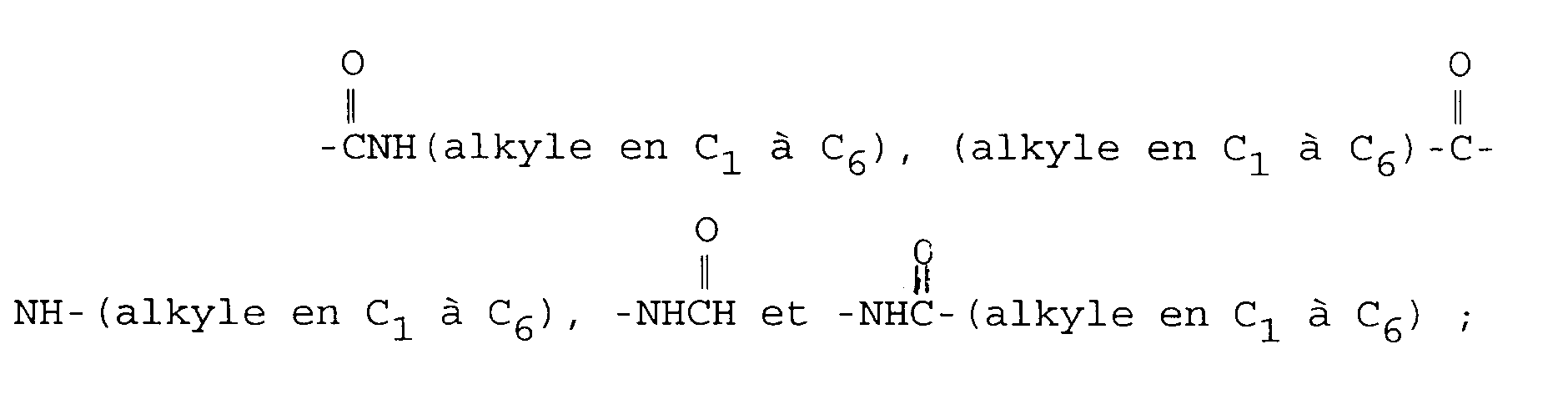
R⁴ et R⁷ sont tous deux choisis, indépendamment, entre l'hydrogène, des radicaux hydroxy, halogéno, amino, oxo, cyano, méthylène, hydroxyméthyle, halogénométhyle, (alkyle en C₁ à C₆)amino, di-(alkyle en C₁ à C₆)amino, alkoxy en
R⁶ est un groupe
R⁸ est un groupe oximino (=NOH) ou l'un des radicaux indiqués dans l'une quelconque des définitions de R², R⁴ et R⁷ ;
R⁹ est un groupe alkyle en C₁ à C₆, de l'hydrogène, un groupe phényle ou phényl-(alkyle en C₁ à C₆) ;
sous réserve que (a) lorsque m est égal à 0, R⁸ soit absent, (b) lorsque R⁴, R⁶, R⁷ ou R⁸ est tel que défini dans R², il ne puisse pas former, conjointement avec le carbone auquel il est attaché, un noyau avec R⁵, (c) lorsque R⁴ et R⁷ sont attachés au même atome de carbone, chacun d'eux soit indépendamment choisi entre de l'hydrogène, un radical fluoro et alkyle en C₁ à C₆, ou bien R⁴ et R⁷, conjointement avec l'atome de carbone auquel ils sont attachés, forment un noyau carbocyclique saturé en C₃ à C₆ qui donne un composé spiro avec le noyau contenant de l'azote auquel ils sont attachés et (d) l'un de R² et R⁵ doive représenter autre chose que de l'hydrogène ou un groupe alkyle en C₁ à C₆ non substitué ;
ou un sel d'addition d'acide pharmaceutiquement acceptable de ce composé. - Composé suivant la revendication 1, dans lequel R¹ représente H et n est égal à 3, de formule :

- Composé suivant la revendication 2, dans lequel R⁶ représente H et m est égal à 0 (Z absent), de formule :

- Composé suivant la revendication 1, dans lequel R⁶ représente H, n est égal à 3 et m est égal à 0 (Z absent, de formule :

- Composé suivant la revendication 1, dans lequel R¹, R⁴, R⁵, R⁶ et R⁷ représentent chacun H, n a la valeur 3 ou 4, m est égal à 0, R² et R³ sont chacun un groupe phényle facultativement substitué avec un ou plusieurs substituants choisis entre du chlore, du fluor, un groupe alkyle en C₁ à C₆, alkoxy en C₁ à C₆ et trifluorométhyle.
- Composé suivant la revendication 5, dans lequel R² est un groupe phényle et R³ est un groupe 2-méthoxyphényle dont la portion phényle peut facultativement être encore substituée avec du chlore, du fluor, un radical méthyle, alkoxy en C₁ à C₆ ou trifluorométhyle.
- L'énantiomère 2S, 3S d'un composé de formule (I) dans laquelle R¹ et R⁶ représentent H et m est égal à 0, de formule :

- Composé de formule IB suivant la revendication 2, qui est :
la (2S,3S)-1-(5-carbéthoxypent-1-yl)-3-(2-méthoxybenzylamino)-2-phénylpipéridine ;
la (2S,3S)-1-(6-hydroxy-hex-1-yl)-3(2-méthoxybenzylamino)-2-phénylpipéridine ;
la (2S,3S)-1-(4-hydroxy-4-phénylbut-1-yl)-3-(2-méthoxybenzylamino)-2-phénylpipéridine ;
la (2S,3S)-1-(4-oxo-4-phénylbut-1-yl)-3-(2-méthoxybenzylamino)-2-phénylpipéridine ;
la (2S,3S)-1-(5,6-dihydroxyhex-1-yl)-3-(2-méthoxybenzylamino)-2-phénylpipéridine ;
la cis-3-(5-fluoro-2-méthoxybenzylamino)-2-phénylpipéridine ;
la(2S,3S)-1-[4-(4-fluorophényl)-4-oxobut-1-yl]-3-(2-méthoxybenzylamino)-2-phénylpipéridine ;
la(2S,3S)-1-[4-(4-fluorophényl)-4-hydroxybut-1-yl]-3-(2-méthoxybenzylamino)-2-phénylpipéridine ;
la(2S,3S)-1-(4-benzamidobut-1-yl)-3-(2-méthoxybenzylamino)-2-phénylpipéridine ;
la (2S,3S)-3-(2-méthoxybenzylamino)-1-(5-N-méthylcarboxamidopent-1-yl)-2-phénylpipéridine ;
la (2S,3S)-1-(4-cyanobut-1-yl)-3-(2-méthoxybenzylamino)-2-phénylpipéridine ;
la (2S,3S)-1-[4-(2-naphtamido)but-1-yl]-3-(2-méthoxybenzylamino)-2-phénylpipéridine ;
la (2S,3S)-1-(5-benzamidopent-1-yl)-3-(2-méthoxybenzylamino)-2-phénylpipéridine ;
la (2S,3S)-1-(5-aminopent-1-yl)-3-(2-méthoxybenzylamino)-2-phénylpipéridine ;
la cis-3-(2,5-diméthoxybenzylamino)-1-[4-(4-fluorophényl)-4-oxobut-1-yl]-2-phénylpipéridine ;
la cis-3-(5-chloro-2-méthoxybenzylamino)-1-(5,6-dihydroxyhex-1-yl)-2-phénylpipéridine ; ou
la cis-1-(5,6-dihydroxyhex-1-yl)-3-(2,5-diméthoxybenzylamino)-2-phénylpipéridine. - Composé de formule IA suivant la revendication 3, qui est :
la cis-3-(2-chlorobenzylamino)-2-phénylpipéridine ;
la cis-3-(2-trifluorométhylbenzylamino)-2-phénylpipéridine ;
la cis-3-(2-méthoxybenzylamino)-2-(2-fluorophényl)pipéridine ;
la cis-3-(2-méthoxybenzylamino)-2-(2-chlorophényl)pipéridine ;
la cis-3-(2-méthoxybenzylamino)-2-(2-méthylphényl)-pipéridine ;
la cis-3-(2-méthoxybenzylamino)-2-(3-méthoxyphényl)pipéridine ;
la cis-3-(2-méthoxybenzylamino)-2-(3-fluorophényl)pipéridine ;
la cis-3-(2-méthoxybenzylamino)-2-(3-chlorophényl)pipéridine ;
la cis-3-(2-méthoxybenzylamino)-2-phénylpipéridine ;
la cis-3-(2-méthoxybenzylamino)-2-(3-méthylphényl)pipéridine ;
la cis-3-(2-méthoxybenzylamino)-2-(4-fluorophényl)pipéridine ;
la cis-3-(2-méthoxybenzylamino)-2-(3-thiényl)pipéridine ;
la 3-(2-méthoxybenzylamino)-4-méthyl-2-phénylpipéridine ;
la 3-(2-méthoxybenzylamino)-5-méthyl-2-phénylpipéridine ;
la 3-(2-méthoxybenzylamino)-6-méthyl-2-phénylpipéridine ;
la (2S,3S)-3-(2-méthoxybenzylamino)-2-phénylpipéridine ;
la cis-3-(2-méthoxy-5-méthylbenzylamino)-2-phénylpipéridine ;
la cis-3-(2-méthoxynapht-1-ylméthylamino)-2-phénylpipéridine ;
la (2S,3S)-3-(5-chloro-2-méthoxybenzylamino)-2-phénylpipéridine ;
la (2S,3S)-3-(2,5-diméthoxybenzylamino)-2-phénylpipéridine ;
la cis-3-(3,5-difluoro-2-méthoxybenzylamino)-2-phénylpipéridine ;
la cis-3-(4,5-difluoro-2-méthoxybenzylamino)-3-phénylpipéridine ;
la cis-2-phényl-3-[2-(prop-2-yloxy)benzylamino]pipéridine ;
le chlorhydrate de cis-3-(2,5-diméthoxybenzyl)amino-2-(3-méthoxyphényl)pipéridine ;
le dichlorhydrate de cis-3-(5-chloro-2-méthoxybenzyl)amino-2-(3-méthoxyphényl)pipéridine ;
le dichlorhydrate de cis-3-(5-chloro-2-méthoxybenzyl)amino-2-(3-chlorophényl)pipéridine ;
la 3-(2-méthoxybenzylamino)-2,4-diphénylpipéridine ; ou
la cis-3-(2-méthoxybenzylamino)-2-phénylpyrrolidinone. - Composé de formule I suivant la revendication 1, dans laquelle Y est un groupe (CH₂)n et n est égal à 4, et dans lequel R⁶ représente H et m est égal à 0 (Z absent), ledit composé étant le cis-3-(2-méthoxybenzylamino)-2-phénylazacycloheptane.
- Composé de formule

- Composition pharmaceutique comprenant un composé de formule I suivant l'une quelconque des revendications 1 à 10 ou un sel pharmaceutiquement acceptable de ce composé, conjointement avec un diluant ou support acceptable du point de vue pharmaceutique.
- Composé de formule (I) suivant l'une quelconque des revendications 1 à 10, destiné à être utilisé dans le traitement curatif ou préventif d'un état chez un mammifère qui est influencé ou facilité par une diminution de la neurotransmission sous la médiation de la substance P, comprenant son utilisation dans le traitement curatif ou préventif de maladies inflammatoires, de l'anxiété, de la colite, de troubes dépressifs ou dysthymiques, de psychoses, de douleurs, d'allergies, de bronchopneumopathie chronique obstructive,de troubles dus à l'hypersensibilité, de maladies angiospastiques, de troubles par formation d'un tissu fibreux et de troubles du collagène, de dystrophie sympathique réflexe, de troubles dues à la toxicomanie, de troubles somatiques en rapport avec le stress, de névopathie périphérique, de névralgie, de troubles neuropathologiques, de troubles en rapport avec la facilitation immunologique ou l'immunosuppression et de troubles rhumatismaux.
- Utilisation d'un composé de formule (I) suivant l'une quelconque des revendications 1 à 10 pour la préparation d'un médicament destiné à être utilisé dans le traitement curatif ou préventif de maladies inflammatoires, de l'anxiété, de la colite, de troubes dépressifs ou dysthymiques, de psychoses, de douleurs, d'allergies, de bronchopneumopathie chronique obstructive,de troubles dus à l'hypersensibilité, de maladies angiospastiques, de troubles par formation d'un tissu fibreux et de troubles du collagène, de dystrophie sympathique réflexe, de troubles dus à la toxicomanie, de troubles somatiques en rapport avec le stress, de névopathie périphérique, de névralgie, de troubles neuropathologiques, de troubles en rapport avec la facilitation immunologique ou l'immunosuppression et de troubles rhumatismaux.
Applications Claiming Priority (2)
| Application Number | Priority Date | Filing Date | Title |
|---|---|---|---|
| WOPCT/US90/00116 | 1990-01-04 | ||
| PCT/US1990/000116 WO1991009844A1 (fr) | 1990-01-04 | 1990-01-04 | Antagonistes de la substance p |
Related Child Applications (2)
| Application Number | Title | Priority Date | Filing Date |
|---|---|---|---|
| EP19930201034 Division EP0558156A3 (fr) | 1990-01-04 | 1990-12-14 | Intermédiaires pour 3-aminopipéridine |
| EP93201034.1 Division-Into | 1993-04-08 |
Publications (3)
| Publication Number | Publication Date |
|---|---|
| EP0436334A2 EP0436334A2 (fr) | 1991-07-10 |
| EP0436334A3 EP0436334A3 (en) | 1992-05-27 |
| EP0436334B1 true EP0436334B1 (fr) | 1994-12-07 |
Family
ID=22220614
Family Applications (2)
| Application Number | Title | Priority Date | Filing Date |
|---|---|---|---|
| EP19930201034 Ceased EP0558156A3 (fr) | 1990-01-04 | 1990-12-14 | Intermédiaires pour 3-aminopipéridine |
| EP90313680A Expired - Lifetime EP0436334B1 (fr) | 1990-01-04 | 1990-12-14 | Dérivés de 3-Aminopipéridine et N-hétérocycles apparentés |
Family Applications Before (1)
| Application Number | Title | Priority Date | Filing Date |
|---|---|---|---|
| EP19930201034 Ceased EP0558156A3 (fr) | 1990-01-04 | 1990-12-14 | Intermédiaires pour 3-aminopipéridine |
Country Status (27)
| Country | Link |
|---|---|
| EP (2) | EP0558156A3 (fr) |
| JP (1) | JPH0757748B2 (fr) |
| KR (1) | KR930009441B1 (fr) |
| CN (2) | CN1035944C (fr) |
| AT (1) | ATE115127T1 (fr) |
| AU (1) | AU625511B2 (fr) |
| BR (1) | BR9100016A (fr) |
| CA (1) | CA2033497C (fr) |
| CZ (1) | CZ289485B6 (fr) |
| DE (1) | DE69014848T2 (fr) |
| DK (1) | DK0436334T3 (fr) |
| ES (1) | ES2064667T3 (fr) |
| FI (2) | FI114096B (fr) |
| GR (1) | GR3014940T3 (fr) |
| HU (5) | HUT68179A (fr) |
| IE (1) | IE63770B1 (fr) |
| IL (3) | IL96821A (fr) |
| MY (1) | MY105438A (fr) |
| NO (1) | NO178187C (fr) |
| NZ (1) | NZ236581A (fr) |
| PL (5) | PL163967B1 (fr) |
| PT (1) | PT96405B (fr) |
| RU (1) | RU2105758C1 (fr) |
| UA (1) | UA41251C2 (fr) |
| WO (1) | WO1991009844A1 (fr) |
| YU (1) | YU48026B (fr) |
| ZA (1) | ZA9136B (fr) |
Cited By (10)
| Publication number | Priority date | Publication date | Assignee | Title |
|---|---|---|---|---|
| US7084152B2 (en) | 2000-07-11 | 2006-08-01 | Amr Technology, Inc. | 4-phenyl substituted tetrahydroisoquinolines therapeutic use thereof |
| US7163949B1 (en) | 1999-11-03 | 2007-01-16 | Amr Technology, Inc. | 4-phenyl substituted tetrahydroisoquinolines and use thereof |
| US7265116B2 (en) | 1999-11-03 | 2007-09-04 | Arm Technology, Inc. | Aryl and heteroaryl substituted tetrahydroisoquinolines and use thereof |
| JP2008517047A (ja) * | 2004-10-21 | 2008-05-22 | メルク シャープ エンド ドーム リミテッド | アルツハイマー病の治療用のピペリジン及び関連化合物 |
| US7541357B2 (en) | 2004-07-15 | 2009-06-02 | Amr Technology, Inc. | Aryl- and heteroaryl-substituted tetrahydroisoquinolines and use thereof to block reuptake of norepinephrine, dopamine, and serotonin |
| US7956050B2 (en) | 2005-07-15 | 2011-06-07 | Albany Molecular Research, Inc. | Aryl- and heteroaryl-substituted tetrahydrobenzazepines and use thereof to block reuptake of norepinephrine, dopamine, and serotonin |
| US8802696B2 (en) | 2009-05-12 | 2014-08-12 | Albany Molecular Research, Inc. | 7-([1,2,4]triazolo[1,5-a]pyridin-6-yl)-4-(3,4-dichlorophenyl)-1,2,3,4-tetrahydroisoqu inoli and use thereof |
| US8815894B2 (en) | 2009-05-12 | 2014-08-26 | Bristol-Myers Squibb Company | Crystalline forms of (S)-7-([1,2,4]triazolo[1,5-a]pyridin-6-yl)-4-(3,4-dichlorophenyl)-1,2,3,4-tetrahydroisoquinoline and use thereof |
| US9034899B2 (en) | 2009-05-12 | 2015-05-19 | Albany Molecular Research, Inc. | Aryl, heteroaryl, and heterocycle substituted tetrahydroisoquinolines and use thereof |
| US9498476B2 (en) | 2008-06-04 | 2016-11-22 | Albany Molecular Research, Inc. | Crystalline form of 6-[(4S)-2-methyl-4-(2-naphthyl)-1,2,3,4-tetrahydroisoquinolin-7-yl]pyridazin-3-amine |
Families Citing this family (115)
| Publication number | Priority date | Publication date | Assignee | Title |
|---|---|---|---|---|
| US5830863A (en) * | 1988-06-20 | 1998-11-03 | Merrell Pharmaceuticals Inc. | Neurokinin A antagonists |
| US6218364B1 (en) | 1988-06-20 | 2001-04-17 | Scott L. Harbeson | Fluorinated neurokinin A antagonists |
| US5332817A (en) * | 1990-01-04 | 1994-07-26 | Pfizer Inc. | 3-aminopiperidine derivatives and related nitrogen containing heterocycles |
| US5232929A (en) * | 1990-11-28 | 1993-08-03 | Pfizer Inc. | 3-aminopiperidine derivatives and related nitrogen containing heterocycles and pharmaceutical compositions and use |
| JPH0794439B2 (ja) * | 1990-05-31 | 1995-10-11 | フアイザー・インコーポレイテツド | 置換ピペリジンの製造法 |
| US5364943A (en) * | 1991-11-27 | 1994-11-15 | Pfizer Inc. | Preparation of substituted piperidines |
| JPH072740B2 (ja) * | 1990-06-01 | 1995-01-18 | フアイザー・インコーポレイテツド | 3―アミノ―2―アリールキヌクリジン |
| DE69106365T2 (de) * | 1990-07-23 | 1995-05-04 | Pfizer | Chinuclidinderivate. |
| AU647592B2 (en) * | 1991-03-26 | 1994-03-24 | Pfizer Inc. | Stereoselective preparation of substituted piperidines |
| US5716965A (en) * | 1991-05-22 | 1998-02-10 | Pfizer Inc. | Substituted 3-aminoquinuclidines |
| SK282203B6 (sk) * | 1991-06-20 | 2001-12-03 | Pfizer Inc. | Fluoroalkoxybenzylamínové deriváty heterocyklov obsahujúcich dusík, spôsob ich prípravy, medziprodukty, spôsob prípravy medziproduktov, použitie a farmaceutický prostriedok |
| TW202432B (fr) * | 1991-06-21 | 1993-03-21 | Pfizer | |
| CA2112397A1 (fr) * | 1991-08-20 | 1993-03-04 | Raymond Baker | Composes azacyclique, procedes pour les preparer et compositions pharmaceutiques les contenant |
| ES2149767T5 (es) | 1991-09-20 | 2005-06-16 | Glaxo Group Limited | Nuevo uso medico para antagonistas de taquiquininas. |
| GB9201179D0 (en) * | 1992-01-21 | 1992-03-11 | Glaxo Group Ltd | Chemical compounds |
| FR2688219B1 (fr) | 1992-03-03 | 1994-07-08 | Sanofi Elf | Sels d'ammonium quaternaires de composes aromatiques amines, leur preparation et compositions pharmaceutiques les contenant. |
| US5444074A (en) * | 1992-04-15 | 1995-08-22 | Merck Sharp & Dohme Limited | Piperidine tachykinin receptor antagonists |
| AU675786B2 (en) * | 1992-04-15 | 1997-02-20 | Merck Sharp & Dohme Limited | Azacyclic compounds |
| DE69331190T2 (de) * | 1992-05-18 | 2002-04-18 | Pfizer Inc., New York | Überbrückte azabicyclische derivate als substanz p antagonisten |
| CA2099233A1 (fr) * | 1992-06-29 | 1993-12-30 | Conrad P. Dorn | Antagonistes du recepteur de la tachykinine a base de morpholine et de thiomorpholine |
| US5719147A (en) * | 1992-06-29 | 1998-02-17 | Merck & Co., Inc. | Morpholine and thiomorpholine tachykinin receptor antagonists |
| US6048859A (en) | 1992-06-29 | 2000-04-11 | Merck & Co., Inc. | Morpholine and thiomorpholine tachykinin receptor antagonists |
| US5637699A (en) * | 1992-06-29 | 1997-06-10 | Merck & Co., Inc. | Process for preparing morpholine tachykinin receptor antagonists |
| ATE173725T1 (de) * | 1992-07-28 | 1998-12-15 | Merck Sharp & Dohme | Azazyklische verbindungen |
| AU4396193A (en) * | 1992-08-04 | 1994-03-03 | Pfizer Inc. | 3-benzylamino-2-phenyl-piperidine derivatives as substance p receptor antagonists |
| GB9216911D0 (en) * | 1992-08-10 | 1992-09-23 | Merck Sharp & Dohme | Therapeutic agents |
| US5387595A (en) * | 1992-08-26 | 1995-02-07 | Merck & Co., Inc. | Alicyclic compounds as tachykinin receptor antagonists |
| AU4973693A (en) * | 1992-09-10 | 1994-03-29 | Merck Sharp & Dohme Limited | Alcohols and ethers with aromatic substituents as tachykinin-antagonists |
| GB9220286D0 (en) * | 1992-09-25 | 1992-11-11 | Merck Sharp & Dohme | Therapeutic agents |
| US5344830A (en) * | 1992-12-10 | 1994-09-06 | Merck & Co., Inc. | N,N-diacylpiperazine tachykinin antagonists |
| US6369074B1 (en) * | 1992-12-10 | 2002-04-09 | Pfizer Inc. | Aminomethylene substituted non-aromatic heterocycles and use as substance P antagonists |
| ES2147759T3 (es) * | 1992-12-10 | 2000-10-01 | Pfizer | Heterociclos no aromaticos sustituidos con aminometileno y uso como antagonistas de la sustancia p. |
| US5830854A (en) * | 1992-12-14 | 1998-11-03 | Merck Sharp & Dohme, Limited | Method of treating cystic fibrosis using a tachykinin receptor antagonist |
| GB9300051D0 (en) * | 1993-01-04 | 1993-03-03 | Merck Sharp & Dohme | Therapeutic agents |
| WO1994019323A1 (fr) * | 1993-02-18 | 1994-09-01 | Merck Sharp & Dohme Limited | Composes azacycliques, compositions contenant ces composes et leur utilisation comme antagonistes de la tachykinine |
| US5496833A (en) * | 1993-04-13 | 1996-03-05 | Merck Sharp & Dohme Limited | Piperidine tachykinin receptor antagonists |
| DE69404306T2 (de) * | 1993-05-28 | 1997-10-30 | Pfizer | Verfahren zur herstellung und optischen auflösung von 2-phenyl-3-aminopiperidine |
| US5348955A (en) * | 1993-06-22 | 1994-09-20 | Merck & Co., Inc. | N,N-diacylpiperazines |
| GB9317104D0 (en) * | 1993-08-17 | 1993-09-29 | Zeneca Ltd | Therapeutic heterocycles |
| US5703065A (en) * | 1993-09-17 | 1997-12-30 | Pfizer Inc. | Heteroarylamino and heteroarylsulfonamido substituted 3-benyzlaminomethyl piperidines and related compounds |
| US6083943A (en) * | 1993-09-17 | 2000-07-04 | Pfizer Inc | Substituted azaheterocyclecarboxylic acid |
| DE69433744T2 (de) * | 1993-09-17 | 2004-10-14 | Pfizer Inc. | 3-amino-5-carboxy-substituierte piperidine und 3-amino-4-carboxy-substituierte pyrrolidine als tachykinin-antagonisten |
| IS4208A (is) * | 1993-09-22 | 1995-03-23 | Glaxo Group Limited | 3-(tetrazólýl-benzyl)amínó-piperadidín afleiður |
| TW263498B (fr) * | 1993-11-10 | 1995-11-21 | Takeda Pharm Industry Co Ltd | |
| JPH09508376A (ja) * | 1994-01-28 | 1997-08-26 | メルク シヤープ エンド ドーム リミテツド | アラルキル置換アザシクロ系の治療薬 |
| US5610165A (en) * | 1994-02-17 | 1997-03-11 | Merck & Co., Inc. | N-acylpiperidine tachykinin antagonists |
| IL112778A0 (en) * | 1994-03-04 | 1995-05-26 | Merck & Co Inc | Substituted heterocycles, their preparation and pharmaceutical compositions containing them |
| GB9408872D0 (en) * | 1994-05-03 | 1994-06-22 | Zeneca Ltd | Heterocyclic compounds |
| GB9418545D0 (en) * | 1994-09-15 | 1994-11-02 | Merck Sharp & Dohme | Therapeutic agents |
| FR2725900B1 (fr) * | 1994-10-21 | 1997-07-18 | Sanofi Sa | Utilisation d'antagonistes des recepteurs nk1 pour la preparation de medicaments a action cardioregulatrice |
| DE69534213T2 (de) * | 1994-10-25 | 2006-01-12 | Astrazeneca Ab | Therapeutisch wirksame Heterocyclen |
| US5998444A (en) * | 1995-10-24 | 1999-12-07 | Zeneca Ltd. | Piperidinyl compounds as NK1 or NK2 antagonists |
| US6008223A (en) * | 1994-10-27 | 1999-12-28 | Zeneca Limited | Therapeutic compounds |
| FR2728166A1 (fr) | 1994-12-19 | 1996-06-21 | Oreal | Composition topique contenant un antagoniste de substance p |
| FR2728169A1 (fr) | 1994-12-19 | 1996-06-21 | Oreal | Utilisation d'un antagoniste de substance p pour le traitement des prurits et des dysesthesies oculaires ou palpebrales |
| FR2728165A1 (fr) | 1994-12-19 | 1996-06-21 | Oreal | Utilisation d'un antagoniste de substance p pour le traitement des rougeurs cutanees d'origine neurogene |
| FR2729954B1 (fr) * | 1995-01-30 | 1997-08-01 | Sanofi Sa | Composes heterocycliques substitues, procede pour leur preparation et compositions pharmaceutiques les contenant |
| FR2729952B1 (fr) * | 1995-01-30 | 1997-04-18 | Sanofi Sa | Composes heterocycliques substitues, procede pour leur preparation et compositions pharmaceutiques les contenant |
| FR2741262B1 (fr) | 1995-11-20 | 1999-03-05 | Oreal | Utilisation d'un antagoniste de tnf-alpha pour le traitement des rougeurs cutanees d'origine neurogene |
| PT780375E (pt) | 1995-12-21 | 2002-12-31 | Pfizer | 3-¬(benzilo substituido em 5)amino|-2-phenilpiperidinas como antagonistas da substancia p |
| WO1998014193A1 (fr) * | 1996-10-04 | 1998-04-09 | Alcon Laboratories, Inc. | Utilisation d'un antagoniste de la substance p dans la fabrication d'un medicament pour traiter les douleurs oculaires |
| US5750549A (en) * | 1996-10-15 | 1998-05-12 | Merck & Co., Inc. | Cycloalkyl tachykinin receptor antagonists |
| CA2287487A1 (fr) * | 1997-04-24 | 1998-10-29 | Merck Sharp & Dohme Limited | Utilisation des antagonistes du recepteur de nk-1 dans le traitement des troubles alimentaires |
| CA2298779A1 (fr) * | 1997-08-04 | 1999-02-18 | Merck Sharp & Dohme Limited | Utilisation d'antagonistes du recepteur nk-1 pour le traitement de troubles du comportement agressifs |
| GB9716463D0 (en) * | 1997-08-04 | 1997-10-08 | Merck Sharp & Dohme | Therapeutic agents |
| GB9716457D0 (en) * | 1997-08-04 | 1997-10-08 | Merck Sharp & Dohme | Therapeutic agents |
| CA2298777A1 (fr) * | 1997-08-04 | 1999-02-18 | Merck Sharp & Dohme Limited | Utilisation d'antagonistes du recepteur nk-1 pour le traitement d'une manie |
| GB9816897D0 (en) * | 1998-08-04 | 1998-09-30 | Merck Sharp & Dohme | Therapeutic use |
| WO2000010545A2 (fr) * | 1998-08-25 | 2000-03-02 | Novartis Ag | Utilisations pharmaceutiques |
| OA12323A (en) | 2000-03-21 | 2006-05-15 | Smithkline Beecham Corp | Protease inhibitors. |
| AU2001292320A1 (en) * | 2000-10-02 | 2002-04-15 | Tanabe Seiyaku Co., Ltd. | Benzylamine compound, process for producing the same, and intermediate therefor |
| US6709651B2 (en) | 2001-07-03 | 2004-03-23 | B.M.R.A. Corporation B.V. | Treatment of substance P-related disorders |
| WO2003057668A1 (fr) * | 2001-12-28 | 2003-07-17 | Takeda Chemical Industries, Ltd. | Derive de cetone cyclique azote, procede permettant de produire ce derive et utilisation de ce derive |
| US7220098B2 (en) | 2003-05-27 | 2007-05-22 | General Electric Company | Wear resistant variable stator vane assemblies |
| ES2336130T3 (es) | 2004-10-18 | 2010-04-08 | Eli Lilly And Company | Derivados 1-(hetero)aril-3-amino-pirrolidina para uso como antagonistas del receptor de mglur3. |
| US7543992B2 (en) | 2005-04-28 | 2009-06-09 | General Electric Company | High temperature rod end bearings |
| ATE550019T1 (de) | 2005-05-17 | 2012-04-15 | Merck Sharp & Dohme | Cis-4-ä(4-chlorophenyl)sulfonylü-4-(2,5- difluorophenyl)cyclohexanepropansäure zur behandlug von krebs |
| KR20080048502A (ko) | 2005-09-29 | 2008-06-02 | 머크 앤드 캄파니 인코포레이티드 | 멜라노코르틴-4 수용체 조절제로서의 아실화스피로피페리딘 유도체 |
| GB0603041D0 (en) | 2006-02-15 | 2006-03-29 | Angeletti P Ist Richerche Bio | Therapeutic compounds |
| AU2007300627B2 (en) | 2006-09-22 | 2012-02-16 | Merck Sharp & Dohme Corp. | Method of treatment using fatty acid synthesis inhibitors |
| US20110218176A1 (en) | 2006-11-01 | 2011-09-08 | Barbara Brooke Jennings-Spring | Compounds, methods, and treatments for abnormal signaling pathways for prenatal and postnatal development |
| BRPI0806245B1 (pt) | 2007-01-10 | 2022-01-25 | Msd Italia S.R.L. | Compostos de fórmula i e seus usos |
| US8093268B2 (en) | 2007-01-24 | 2012-01-10 | Glaxo Group Limited | Pharmaceutical compositions comprising 2-methoxy-5-(5-trifluoromethyl-tetrazol-1-yl-benzyl)-(2S-phenylpiperidin-3S-yl-) |
| AU2008233662B2 (en) | 2007-04-02 | 2012-08-23 | Msd K.K. | Indoledione derivative |
| WO2009002495A1 (fr) | 2007-06-27 | 2008-12-31 | Merck & Co., Inc. | Dérivés de 4-carboxybenzylamino utilisés en tant qu'inhibiteurs de l'histone désacétylase |
| US8598184B2 (en) | 2008-03-03 | 2013-12-03 | Tiger Pharmatech | Protein kinase inhibitors |
| AR071997A1 (es) | 2008-06-04 | 2010-07-28 | Bristol Myers Squibb Co | Forma cristalina de 6-((4s)-2-metil-4-(2-naftil)-1,2,3,4-tetrahidroisoquinolin-7-il)piridazin-3-amina |
| UA105182C2 (ru) | 2008-07-03 | 2014-04-25 | Ньюрексон, Інк. | Бензоксазины, бензотиазины и родственные соединения, которые имеют ингибирующую nos активность |
| NZ593279A (en) * | 2009-01-27 | 2013-03-28 | Hoffmann La Roche | Aroylamino - and heteroaroylamino-substituted piperidines as glyt-1 inhibitors |
| EP2413932A4 (fr) | 2009-04-01 | 2012-09-19 | Merck Sharp & Dohme | Inhibiteurs de l'activité akt |
| CA2777043C (fr) | 2009-10-14 | 2015-12-15 | Schering Corporation | Piperidines substituees qui accroissent l'activite de p53, et utilisations de ces composes |
| EP2584903B1 (fr) | 2010-06-24 | 2018-10-24 | Merck Sharp & Dohme Corp. | Nouveaux composés hétérocycliques utilisés comme inhibiteurs de erk |
| CN103068980B (zh) | 2010-08-02 | 2017-04-05 | 瑟纳治疗公司 | 使用短干扰核酸(siNA)的RNA干扰介导的联蛋白(钙粘蛋白关联蛋白质),β1(CTNNB1)基因表达的抑制 |
| RU2745848C2 (ru) | 2010-08-17 | 2021-04-01 | Сирна Терапьютикс, Инк. | ОПОСРЕДУЕМОЕ РНК-ИНТЕРФЕРЕНЦИЕЙ ИНГИБИРОВАНИЕ ЭКСПРЕССИИ ГЕНОВ ВИРУСА ГЕПАТИТА B (HBV) С ПРИМЕНЕНИЕМ МАЛОЙ ИНТЕРФЕРИРУЮЩЕЙ НУКЛЕИНОВОЙ КИСЛОТЫ (миНК) |
| US8883801B2 (en) | 2010-08-23 | 2014-11-11 | Merck Sharp & Dohme Corp. | Substituted pyrazolo[1,5-a]pyrimidines as mTOR inhibitors |
| EP2613782B1 (fr) | 2010-09-01 | 2016-11-02 | Merck Sharp & Dohme Corp. | Dérivés d'indazole utilisables en tant qu'inhibiteurs de la voie erk |
| US9242981B2 (en) | 2010-09-16 | 2016-01-26 | Merck Sharp & Dohme Corp. | Fused pyrazole derivatives as novel ERK inhibitors |
| WO2012058210A1 (fr) | 2010-10-29 | 2012-05-03 | Merck Sharp & Dohme Corp. | INHIBITION FACILITÉE PAR L'INTERFÉRENCE D'ARN DE L'EXPRESSION D'UN GÈNE AU MOYEN D'ACIDES NUCLÉIQUES INTERFÉRENTS COURTS (siNA) |
| WO2012087772A1 (fr) | 2010-12-21 | 2012-06-28 | Schering Corporation | Dérivés d'indazole utiles en tant qu'inhibiteurs de erk |
| WO2012143879A1 (fr) | 2011-04-21 | 2012-10-26 | Piramal Healthcare Limited | Forme cristalline d'un sel d'un dérivé de morpholinosulfonylindole et son procédé de préparation |
| EP2770987B1 (fr) | 2011-10-27 | 2018-04-04 | Merck Sharp & Dohme Corp. | Nouveaux composés qui sont des inhibiteurs d'erk |
| EP3919620A1 (fr) | 2012-05-02 | 2021-12-08 | Sirna Therapeutics, Inc. | Compositions d'acide nucléique interférent court (sina) |
| CA2882950A1 (fr) | 2012-09-28 | 2014-04-03 | Merck Sharp & Dohme Corp. | Nouveaux composes inhibiteurs de erk |
| US10154988B2 (en) | 2012-11-14 | 2018-12-18 | The Johns Hopkins University | Methods and compositions for treating schizophrenia |
| SMT201700595T1 (it) | 2012-11-28 | 2018-03-08 | Merck Sharp & Dohme | Composizioni e metodi per trattare il cancro |
| WO2014100065A1 (fr) | 2012-12-20 | 2014-06-26 | Merck Sharp & Dohme Corp. | Imidazopyridines substituées en tant qu'inhibiteurs de hdm2 |
| WO2014120748A1 (fr) | 2013-01-30 | 2014-08-07 | Merck Sharp & Dohme Corp. | Purines 2,6,7,8-substituées utilisées en tant qu'inhibiteurs de hdm2 |
| WO2015034925A1 (fr) | 2013-09-03 | 2015-03-12 | Moderna Therapeutics, Inc. | Polynucléotides circulaires |
| US10975084B2 (en) | 2016-10-12 | 2021-04-13 | Merck Sharp & Dohme Corp. | KDM5 inhibitors |
| EP3706742B1 (fr) | 2017-11-08 | 2023-03-15 | Merck Sharp & Dohme LLC | Inhibiteurs de prmt5 |
| WO2019094312A1 (fr) | 2017-11-08 | 2019-05-16 | Merck Sharp & Dohme Corp. | Inhibiteurs de prmt5 |
| RU2020131446A (ru) * | 2018-02-26 | 2022-03-28 | Оспедале Сан Раффаэле С.Р.Л. | Антагонисты nk-1 для применения в лечении глазной боли |
| CA3108388A1 (fr) | 2018-08-07 | 2020-02-13 | Merck Sharp & Dohme Corp. | Inhibiteurs de prmt5 |
| WO2020033282A1 (fr) | 2018-08-07 | 2020-02-13 | Merck Sharp & Dohme Corp. | Inhibiteurs de prmt5 |
| EP3833667B1 (fr) | 2018-08-07 | 2024-03-13 | Merck Sharp & Dohme LLC | Inhibiteurs de prmt5 |
Family Cites Families (6)
| Publication number | Priority date | Publication date | Assignee | Title |
|---|---|---|---|---|
| BE535451A (fr) * | 1954-02-05 | |||
| GB1060160A (en) * | 1964-08-05 | 1967-03-01 | Allen & Hanburys Ltd | 4-phenylpiperidine derivatives |
| US3560510A (en) * | 1969-03-05 | 1971-02-02 | Aldrich Chem Co Inc | 2-benzhydrylquinuclidines |
| US3992389A (en) * | 1970-09-03 | 1976-11-16 | John Wyeth & Brother Limited | Heterocyclic compounds |
| MX18467A (es) * | 1988-11-23 | 1993-07-01 | Pfizer | Agentes terapeuticos de quinuclidinas |
| JPH0794439B2 (ja) * | 1990-05-31 | 1995-10-11 | フアイザー・インコーポレイテツド | 置換ピペリジンの製造法 |
-
1990
- 1990-01-04 UA UA5010406A patent/UA41251C2/uk unknown
- 1990-01-04 WO PCT/US1990/000116 patent/WO1991009844A1/fr not_active Ceased
- 1990-12-14 AT AT90313680T patent/ATE115127T1/de not_active IP Right Cessation
- 1990-12-14 DE DE69014848T patent/DE69014848T2/de not_active Expired - Fee Related
- 1990-12-14 EP EP19930201034 patent/EP0558156A3/fr not_active Ceased
- 1990-12-14 EP EP90313680A patent/EP0436334B1/fr not_active Expired - Lifetime
- 1990-12-14 DK DK90313680.2T patent/DK0436334T3/da active
- 1990-12-14 ES ES90313680T patent/ES2064667T3/es not_active Expired - Lifetime
- 1990-12-20 NZ NZ236581A patent/NZ236581A/xx unknown
- 1990-12-28 JP JP2409476A patent/JPH0757748B2/ja not_active Expired - Fee Related
- 1990-12-28 IL IL96821A patent/IL96821A/xx not_active IP Right Cessation
- 1990-12-28 IL IL112348A patent/IL112348A/en not_active IP Right Cessation
-
1991
- 1991-01-02 HU HU9203405A patent/HUT68179A/hu unknown
- 1991-01-02 HU HU9203404A patent/HU220602B1/hu unknown
- 1991-01-02 PL PL91288592A patent/PL163967B1/pl not_active IP Right Cessation
- 1991-01-02 HU HU916A patent/HUT60719A/hu unknown
- 1991-01-02 AU AU68621/91A patent/AU625511B2/en not_active Ceased
- 1991-01-02 HU HU9203403A patent/HUT68130A/hu unknown
- 1991-01-02 PL PL91293389A patent/PL164244B1/pl unknown
- 1991-01-02 PL PL91293390A patent/PL164203B1/pl not_active IP Right Cessation
- 1991-01-02 HU HU9203403A patent/HU222724B1/hu not_active IP Right Cessation
- 1991-01-02 PL PL91293392A patent/PL164205B1/pl not_active IP Right Cessation
- 1991-01-02 MY MYPI91000002A patent/MY105438A/en unknown
- 1991-01-02 CA CA002033497A patent/CA2033497C/fr not_active Expired - Fee Related
- 1991-01-02 PT PT96405A patent/PT96405B/pt active IP Right Grant
- 1991-01-02 PL PL91293391A patent/PL164204B1/pl not_active IP Right Cessation
- 1991-01-03 BR BR919100016A patent/BR9100016A/pt not_active Application Discontinuation
- 1991-01-03 IE IE791A patent/IE63770B1/en not_active IP Right Cessation
- 1991-01-03 KR KR1019910000001A patent/KR930009441B1/ko not_active Expired - Fee Related
- 1991-01-03 ZA ZA9136A patent/ZA9136B/xx unknown
- 1991-01-03 FI FI910034A patent/FI114096B/fi active
- 1991-01-03 YU YU491A patent/YU48026B/sh unknown
- 1991-01-03 CN CN91100039A patent/CN1035944C/zh not_active Expired - Fee Related
- 1991-01-03 NO NO910016A patent/NO178187C/no unknown
- 1991-01-04 CZ CS199110A patent/CZ289485B6/cs not_active IP Right Cessation
- 1991-12-23 RU SU5010406A patent/RU2105758C1/ru not_active IP Right Cessation
-
1993
- 1993-08-20 CN CN93116286A patent/CN1045595C/zh not_active Expired - Fee Related
-
1995
- 1995-01-16 IL IL11234895A patent/IL112348A0/xx unknown
- 1995-02-01 GR GR950400206T patent/GR3014940T3/el unknown
-
2004
- 2004-04-01 FI FI20040479A patent/FI20040479A7/fi not_active Application Discontinuation
Cited By (22)
| Publication number | Priority date | Publication date | Assignee | Title |
|---|---|---|---|---|
| US7612090B2 (en) | 1999-11-03 | 2009-11-03 | Albany Molecular Research, Inc. | Aryl and heteroaryl substituted tetrahydroisoquinolines and use thereof |
| US7163949B1 (en) | 1999-11-03 | 2007-01-16 | Amr Technology, Inc. | 4-phenyl substituted tetrahydroisoquinolines and use thereof |
| US7265116B2 (en) | 1999-11-03 | 2007-09-04 | Arm Technology, Inc. | Aryl and heteroaryl substituted tetrahydroisoquinolines and use thereof |
| US7309789B2 (en) | 2000-07-11 | 2007-12-18 | Amr Technology, Inc. | 4-phenyl substituted tetrahydroisoquinolines and therapeutic use thereof |
| US7084152B2 (en) | 2000-07-11 | 2006-08-01 | Amr Technology, Inc. | 4-phenyl substituted tetrahydroisoquinolines therapeutic use thereof |
| US7419985B2 (en) | 2000-07-11 | 2008-09-02 | Amr Technology, Inc. | 4-Phenyl substituted tetrahydroisoquinolines and therapeutic use thereof |
| US8236796B2 (en) | 2004-07-15 | 2012-08-07 | Albany Molecular Research, Inc. | Aryl- and heteroaryl-substituted tetrahydroisoquinolines and use thereof to block reuptake of norepinephrine, dopamine, and serotonin |
| US9085531B2 (en) | 2004-07-15 | 2015-07-21 | Albany Molecular Research, Inc. | Aryl- and heteroaryl-substituted tetrahydroisoquinolines and use thereof to block reuptake of norepinephrine, dopamine, and serotonin |
| US9499531B2 (en) | 2004-07-15 | 2016-11-22 | Albany Molecular Research, Inc. | Aryl- and heteroaryl-substituted tetrahydroisoquinolines and use thereof to block reuptake of norepinephrine, dopamine, and serotonin |
| US8227486B2 (en) | 2004-07-15 | 2012-07-24 | Albany Molecular Research, Inc. | Aryl- and heteroaryl-substituted tetrahydroisoquinolines and use thereof to block reuptake of norepinephrine, dopamine, and serotonin |
| US7541357B2 (en) | 2004-07-15 | 2009-06-02 | Amr Technology, Inc. | Aryl- and heteroaryl-substituted tetrahydroisoquinolines and use thereof to block reuptake of norepinephrine, dopamine, and serotonin |
| US8741901B2 (en) | 2004-07-15 | 2014-06-03 | Albany Molecular Research, Inc. | Aryl- and heteroaryl-substituted tetrahydroisoquinolines and use thereof to block reuptake of norepinephrine, dopamine, and serotonin |
| JP2008517047A (ja) * | 2004-10-21 | 2008-05-22 | メルク シャープ エンド ドーム リミテッド | アルツハイマー病の治療用のピペリジン及び関連化合物 |
| US8791101B2 (en) | 2005-07-15 | 2014-07-29 | Albany Molecular Research, Inc. | Aryl- and heteroaryl-substituted tetrahydrobenzazepines and use thereof to block reuptake of norepinephrine, dopamine, and serotonin |
| US9403776B2 (en) | 2005-07-15 | 2016-08-02 | Albany Molecular Research, Inc. | Aryl- and heteroaryl-substituted tetrahydrobenzazepines and use thereof to block reuptake of norepinephrine, dopamine, and serotonin |
| US7956050B2 (en) | 2005-07-15 | 2011-06-07 | Albany Molecular Research, Inc. | Aryl- and heteroaryl-substituted tetrahydrobenzazepines and use thereof to block reuptake of norepinephrine, dopamine, and serotonin |
| US9498476B2 (en) | 2008-06-04 | 2016-11-22 | Albany Molecular Research, Inc. | Crystalline form of 6-[(4S)-2-methyl-4-(2-naphthyl)-1,2,3,4-tetrahydroisoquinolin-7-yl]pyridazin-3-amine |
| US8802696B2 (en) | 2009-05-12 | 2014-08-12 | Albany Molecular Research, Inc. | 7-([1,2,4]triazolo[1,5-a]pyridin-6-yl)-4-(3,4-dichlorophenyl)-1,2,3,4-tetrahydroisoqu inoli and use thereof |
| US8815894B2 (en) | 2009-05-12 | 2014-08-26 | Bristol-Myers Squibb Company | Crystalline forms of (S)-7-([1,2,4]triazolo[1,5-a]pyridin-6-yl)-4-(3,4-dichlorophenyl)-1,2,3,4-tetrahydroisoquinoline and use thereof |
| US9034899B2 (en) | 2009-05-12 | 2015-05-19 | Albany Molecular Research, Inc. | Aryl, heteroaryl, and heterocycle substituted tetrahydroisoquinolines and use thereof |
| US9173879B2 (en) | 2009-05-12 | 2015-11-03 | Bristol-Myers Squibb Company | Crystalline forms of (S)-7-([1,2,4]triazolo[1,5-a ]pyridin-6-yl)-4-(3,4-dichlorophenyl)-1,2,3,4-tetrahydroisoquinoline and use thereof |
| US9604960B2 (en) | 2009-05-12 | 2017-03-28 | Albany Molecular Research, Inc. | Aryl, heteroaryl, and heterocycle substituted tetrahydroisoquinolines and use thereof |
Also Published As
Similar Documents
| Publication | Publication Date | Title |
|---|---|---|
| US5232929A (en) | 3-aminopiperidine derivatives and related nitrogen containing heterocycles and pharmaceutical compositions and use | |
| CA2033497C (fr) | Derives de la 3-aminopiperidine et heterocycles apparentes renfermant de l'azote | |
| EP0550635B1 (fr) | Analogues cycliques d'heterocycles non aromatiques contenant de l'azote | |
| CA2109415C (fr) | 3-aminoquinuclidines substitutees | |
| US7326722B2 (en) | N-[Phenyl(piperidin-2-yl)methyl]benzamide derivatives, their preparation and their application in therapy | |
| CA2067877C (fr) | Composes amines polycliques et leurs enantiomeres; methode de preparation; compositions pharmaceutiques qui en renferment | |
| US5332817A (en) | 3-aminopiperidine derivatives and related nitrogen containing heterocycles | |
| EP1499596B1 (fr) | Antagonistes muscariniques | |
| EP0654029A1 (fr) | Derives de la piperidine 3-benzylamino-2-phenyle en tant qu'antagonistes des recepteurs de la substance p | |
| CA2112397A1 (fr) | Composes azacyclique, procedes pour les preparer et compositions pharmaceutiques les contenant | |
| SK282203B6 (sk) | Fluoroalkoxybenzylamínové deriváty heterocyklov obsahujúcich dusík, spôsob ich prípravy, medziprodukty, spôsob prípravy medziproduktov, použitie a farmaceutický prostriedok | |
| US5214055A (en) | Aminopiperidine 4-oxo-4H-chromen-2-yl compounds | |
| US5716965A (en) | Substituted 3-aminoquinuclidines | |
| CA1202307A (fr) | (-)(hydroxy-3 phenyl)-3-n-n-propylpiperidine et ses derives | |
| JP2719063B2 (ja) | 置換3−アミノキヌクリジンp物質拮抗剤 | |
| HK1068136B (en) | Muscarinic antagonists |
Legal Events
| Date | Code | Title | Description |
|---|---|---|---|
| PUAI | Public reference made under article 153(3) epc to a published international application that has entered the european phase |
Free format text: ORIGINAL CODE: 0009012 |
|
| 17P | Request for examination filed |
Effective date: 19901224 |
|
| AK | Designated contracting states |
Kind code of ref document: A2 Designated state(s): AT BE CH DE DK ES FR GB GR IT LI LU NL SE |
|
| PUAL | Search report despatched |
Free format text: ORIGINAL CODE: 0009013 |
|
| AK | Designated contracting states |
Kind code of ref document: A3 Designated state(s): AT BE CH DE DK ES FR GB GR IT LI LU NL SE |
|
| 17Q | First examination report despatched |
Effective date: 19921106 |
|
| GRAA | (expected) grant |
Free format text: ORIGINAL CODE: 0009210 |
|
| AK | Designated contracting states |
Kind code of ref document: B1 Designated state(s): AT BE CH DE DK ES FR GB GR IT LI LU NL SE |
|
| REF | Corresponds to: |
Ref document number: 115127 Country of ref document: AT Date of ref document: 19941215 Kind code of ref document: T |
|
| XX | Miscellaneous (additional remarks) |
Free format text: TEILANMELDUNG 93201034.1 EINGEREICHT AM 14/12/90. |
|
| REF | Corresponds to: |
Ref document number: 69014848 Country of ref document: DE Date of ref document: 19950119 |
|
| ITF | It: translation for a ep patent filed | ||
| REG | Reference to a national code |
Ref country code: ES Ref legal event code: FG2A Ref document number: 2064667 Country of ref document: ES Kind code of ref document: T3 |
|
| ET | Fr: translation filed | ||
| REG | Reference to a national code |
Ref country code: DK Ref legal event code: T3 |
|
| REG | Reference to a national code |
Ref country code: GR Ref legal event code: FG4A Free format text: 3014940 |
|
| PLBE | No opposition filed within time limit |
Free format text: ORIGINAL CODE: 0009261 |
|
| STAA | Information on the status of an ep patent application or granted ep patent |
Free format text: STATUS: NO OPPOSITION FILED WITHIN TIME LIMIT |
|
| 26N | No opposition filed | ||
| REG | Reference to a national code |
Ref country code: GB Ref legal event code: IF02 |
|
| PGFP | Annual fee paid to national office [announced via postgrant information from national office to epo] |
Ref country code: LU Payment date: 20041001 Year of fee payment: 15 |
|
| PGFP | Annual fee paid to national office [announced via postgrant information from national office to epo] |
Ref country code: GR Payment date: 20041027 Year of fee payment: 15 |
|
| PGFP | Annual fee paid to national office [announced via postgrant information from national office to epo] |
Ref country code: AT Payment date: 20041104 Year of fee payment: 15 |
|
| PGFP | Annual fee paid to national office [announced via postgrant information from national office to epo] |
Ref country code: DK Payment date: 20041109 Year of fee payment: 15 |
|
| PGFP | Annual fee paid to national office [announced via postgrant information from national office to epo] |
Ref country code: NL Payment date: 20041111 Year of fee payment: 15 |
|
| PGFP | Annual fee paid to national office [announced via postgrant information from national office to epo] |
Ref country code: SE Payment date: 20041202 Year of fee payment: 15 |
|
| PGFP | Annual fee paid to national office [announced via postgrant information from national office to epo] |
Ref country code: CH Payment date: 20050107 Year of fee payment: 15 |
|
| PGFP | Annual fee paid to national office [announced via postgrant information from national office to epo] |
Ref country code: BE Payment date: 20050113 Year of fee payment: 15 |
|
| PGFP | Annual fee paid to national office [announced via postgrant information from national office to epo] |
Ref country code: FR Payment date: 20051201 Year of fee payment: 16 |
|
| PG25 | Lapsed in a contracting state [announced via postgrant information from national office to epo] |
Ref country code: AT Free format text: LAPSE BECAUSE OF NON-PAYMENT OF DUE FEES Effective date: 20051214 |
|
| PG25 | Lapsed in a contracting state [announced via postgrant information from national office to epo] |
Ref country code: SE Free format text: LAPSE BECAUSE OF NON-PAYMENT OF DUE FEES Effective date: 20051215 |
|
| PG25 | Lapsed in a contracting state [announced via postgrant information from national office to epo] |
Ref country code: CH Free format text: LAPSE BECAUSE OF NON-PAYMENT OF DUE FEES Effective date: 20051231 Ref country code: BE Free format text: LAPSE BECAUSE OF NON-PAYMENT OF DUE FEES Effective date: 20051231 Ref country code: LI Free format text: LAPSE BECAUSE OF NON-PAYMENT OF DUE FEES Effective date: 20051231 Ref country code: LU Free format text: LAPSE BECAUSE OF NON-PAYMENT OF DUE FEES Effective date: 20051231 |
|
| PG25 | Lapsed in a contracting state [announced via postgrant information from national office to epo] |
Ref country code: DK Free format text: LAPSE BECAUSE OF NON-PAYMENT OF DUE FEES Effective date: 20060102 |
|
| PG25 | Lapsed in a contracting state [announced via postgrant information from national office to epo] |
Ref country code: NL Free format text: LAPSE BECAUSE OF NON-PAYMENT OF DUE FEES Effective date: 20060701 |
|
| REG | Reference to a national code |
Ref country code: DK Ref legal event code: EBP |
|
| REG | Reference to a national code |
Ref country code: CH Ref legal event code: PL |
|
| EUG | Se: european patent has lapsed | ||
| NLV4 | Nl: lapsed or anulled due to non-payment of the annual fee |
Effective date: 20060701 |
|
| REG | Reference to a national code |
Ref country code: FR Ref legal event code: ST Effective date: 20070831 |
|
| BERE | Be: lapsed |
Owner name: *PFIZER INC. Effective date: 20051231 |
|
| PGFP | Annual fee paid to national office [announced via postgrant information from national office to epo] |
Ref country code: ES Payment date: 20071219 Year of fee payment: 18 |
|
| PGFP | Annual fee paid to national office [announced via postgrant information from national office to epo] |
Ref country code: IT Payment date: 20071215 Year of fee payment: 18 |
|
| PG25 | Lapsed in a contracting state [announced via postgrant information from national office to epo] |
Ref country code: FR Free format text: LAPSE BECAUSE OF NON-PAYMENT OF DUE FEES Effective date: 20070102 Ref country code: GR Free format text: LAPSE BECAUSE OF NON-PAYMENT OF DUE FEES Effective date: 19941207 |
|
| PGFP | Annual fee paid to national office [announced via postgrant information from national office to epo] |
Ref country code: GB Payment date: 20071106 Year of fee payment: 18 |
|
| PGFP | Annual fee paid to national office [announced via postgrant information from national office to epo] |
Ref country code: DE Payment date: 20071228 Year of fee payment: 18 |
|
| GBPC | Gb: european patent ceased through non-payment of renewal fee |
Effective date: 20081214 |
|
| PG25 | Lapsed in a contracting state [announced via postgrant information from national office to epo] |
Ref country code: DE Free format text: LAPSE BECAUSE OF NON-PAYMENT OF DUE FEES Effective date: 20090701 |
|
| PG25 | Lapsed in a contracting state [announced via postgrant information from national office to epo] |
Ref country code: GB Free format text: LAPSE BECAUSE OF NON-PAYMENT OF DUE FEES Effective date: 20081214 |
|
| REG | Reference to a national code |
Ref country code: ES Ref legal event code: FD2A Effective date: 20081215 |
|
| PG25 | Lapsed in a contracting state [announced via postgrant information from national office to epo] |
Ref country code: ES Free format text: LAPSE BECAUSE OF NON-PAYMENT OF DUE FEES Effective date: 20081215 |
|
| PG25 | Lapsed in a contracting state [announced via postgrant information from national office to epo] |
Ref country code: IT Free format text: LAPSE BECAUSE OF NON-PAYMENT OF DUE FEES Effective date: 20081214 |