EP0437459B1 - Procedes de determination de sequences d'adn grace a l'utilisation de la polymerase d'adn de thermus aquaticus - Google Patents
Procedes de determination de sequences d'adn grace a l'utilisation de la polymerase d'adn de thermus aquaticus Download PDFInfo
- Publication number
- EP0437459B1 EP0437459B1 EP89910787A EP89910787A EP0437459B1 EP 0437459 B1 EP0437459 B1 EP 0437459B1 EP 89910787 A EP89910787 A EP 89910787A EP 89910787 A EP89910787 A EP 89910787A EP 0437459 B1 EP0437459 B1 EP 0437459B1
- Authority
- EP
- European Patent Office
- Prior art keywords
- sequencing
- dgtp
- dna
- polymerase
- reaction
- Prior art date
- Legal status (The legal status is an assumption and is not a legal conclusion. Google has not performed a legal analysis and makes no representation as to the accuracy of the status listed.)
- Expired - Lifetime
Links
Images


Classifications
-
- C—CHEMISTRY; METALLURGY
- C12—BIOCHEMISTRY; BEER; SPIRITS; WINE; VINEGAR; MICROBIOLOGY; ENZYMOLOGY; MUTATION OR GENETIC ENGINEERING
- C12Q—MEASURING OR TESTING PROCESSES INVOLVING ENZYMES, NUCLEIC ACIDS OR MICROORGANISMS; COMPOSITIONS OR TEST PAPERS THEREFOR; PROCESSES OF PREPARING SUCH COMPOSITIONS; CONDITION-RESPONSIVE CONTROL IN MICROBIOLOGICAL OR ENZYMOLOGICAL PROCESSES
- C12Q1/00—Measuring or testing processes involving enzymes, nucleic acids or microorganisms; Compositions therefor; Processes of preparing such compositions
- C12Q1/70—Measuring or testing processes involving enzymes, nucleic acids or microorganisms; Compositions therefor; Processes of preparing such compositions involving virus or bacteriophage
- C12Q1/701—Specific hybridization probes
-
- C—CHEMISTRY; METALLURGY
- C12—BIOCHEMISTRY; BEER; SPIRITS; WINE; VINEGAR; MICROBIOLOGY; ENZYMOLOGY; MUTATION OR GENETIC ENGINEERING
- C12Q—MEASURING OR TESTING PROCESSES INVOLVING ENZYMES, NUCLEIC ACIDS OR MICROORGANISMS; COMPOSITIONS OR TEST PAPERS THEREFOR; PROCESSES OF PREPARING SUCH COMPOSITIONS; CONDITION-RESPONSIVE CONTROL IN MICROBIOLOGICAL OR ENZYMOLOGICAL PROCESSES
- C12Q1/00—Measuring or testing processes involving enzymes, nucleic acids or microorganisms; Compositions therefor; Processes of preparing such compositions
- C12Q1/68—Measuring or testing processes involving enzymes, nucleic acids or microorganisms; Compositions therefor; Processes of preparing such compositions involving nucleic acids
- C12Q1/6844—Nucleic acid amplification reactions
- C12Q1/686—Polymerase chain reaction [PCR]
-
- C—CHEMISTRY; METALLURGY
- C12—BIOCHEMISTRY; BEER; SPIRITS; WINE; VINEGAR; MICROBIOLOGY; ENZYMOLOGY; MUTATION OR GENETIC ENGINEERING
- C12Q—MEASURING OR TESTING PROCESSES INVOLVING ENZYMES, NUCLEIC ACIDS OR MICROORGANISMS; COMPOSITIONS OR TEST PAPERS THEREFOR; PROCESSES OF PREPARING SUCH COMPOSITIONS; CONDITION-RESPONSIVE CONTROL IN MICROBIOLOGICAL OR ENZYMOLOGICAL PROCESSES
- C12Q1/00—Measuring or testing processes involving enzymes, nucleic acids or microorganisms; Compositions therefor; Processes of preparing such compositions
- C12Q1/68—Measuring or testing processes involving enzymes, nucleic acids or microorganisms; Compositions therefor; Processes of preparing such compositions involving nucleic acids
- C12Q1/6869—Methods for sequencing
-
- Y—GENERAL TAGGING OF NEW TECHNOLOGICAL DEVELOPMENTS; GENERAL TAGGING OF CROSS-SECTIONAL TECHNOLOGIES SPANNING OVER SEVERAL SECTIONS OF THE IPC; TECHNICAL SUBJECTS COVERED BY FORMER USPC CROSS-REFERENCE ART COLLECTIONS [XRACs] AND DIGESTS
- Y10—TECHNICAL SUBJECTS COVERED BY FORMER USPC
- Y10S—TECHNICAL SUBJECTS COVERED BY FORMER USPC CROSS-REFERENCE ART COLLECTIONS [XRACs] AND DIGESTS
- Y10S435/00—Chemistry: molecular biology and microbiology
- Y10S435/81—Packaged device or kit
-
- Y—GENERAL TAGGING OF NEW TECHNOLOGICAL DEVELOPMENTS; GENERAL TAGGING OF CROSS-SECTIONAL TECHNOLOGIES SPANNING OVER SEVERAL SECTIONS OF THE IPC; TECHNICAL SUBJECTS COVERED BY FORMER USPC CROSS-REFERENCE ART COLLECTIONS [XRACs] AND DIGESTS
- Y10—TECHNICAL SUBJECTS COVERED BY FORMER USPC
- Y10S—TECHNICAL SUBJECTS COVERED BY FORMER USPC CROSS-REFERENCE ART COLLECTIONS [XRACs] AND DIGESTS
- Y10S436/00—Chemistry: analytical and immunological testing
- Y10S436/807—Apparatus included in process claim, e.g. physical support structures
- Y10S436/808—Automated or kit
Definitions
- the present invention provides methods for DNA sequencing utilizing the thermostable DNA polymerase, Taq polymerase, of Thermus aquaticus .
- DNA sequencing methods are of great practical utility in the fields of molecular biology, genetics, medical diagnostic technology, and forensics. The importance of DNA sequencing is evidenced by the significant commercial activity centered about the production and marketing of reagents and automated instruments for sequencing nucleic acids.
- DNA sequencing by the Sanger dideoxynucleotide method has undergone significant refinement in recent years, including the development of novel vectors (Yanisch-Perron et al. , 1985, Gene 33 :103-119), base analogs (Mills et al. , 1979, Proc. Natl. Acad. Sci. USA 76 :2232-2235, and Barr et al ., 1986, BioTechniques 4 :428-432), enzymes (Tabor et al. , 1987, Proc. Natl. Acad. Sci.
- the basic dideoxy sequencing procedure involves (i) annealing an oligonucleotide primer to a suitable single or denatured double stranded DNA template; (ii) extending the primer with DNA polymerase in four separate reactions, each containing one ⁇ -labeled dNTP or ddNTP (alternatively, a labeled primer can be used), a mixture of unlabeled dNTPs, and one chain-terminating dideoxynucleotide-5'-triphosphate (ddNTP); (iii) resolving the four sets of reaction products on a high-resolution polyacrylamide-urea gel; and (iv) producing an autoradiographic image of the gel that can be examined to infer the DNA sequence.
- fluorescently labeled primers or nucleotides can be used to identify the reation products.
- Known dideoxy sequencing methods utilize a DNA polymerase such as the Klenow fragment of E. coli DNA polymerase I, reverse transcriptase, or a modified T7 DNA polymerase. Protocols for sequencing with these enzymes, however, do not work with Taq polymerase.
- PCR polymerase chain reaction
- the PCR product can then either be subcloned into a vector suitable for sequence analysis or, alternatively, purified PCR products can be sequenced, as disclosed by Engelke et al ., 1988, Proc. Natl. Acad. Sci. USA, 85 :544-548; Wong et al ., 1987, Nature , 330 :384-386; and Stoflet et al ., 1988, Science , 229 :491-494.
- Taq DNA polymerase greatly simplifies the PCR procedure. Because this polymerase has a broad temperature optimum centered around 75°C and can survive repeated incubations at 95°C, fresh enzyme need not be added after each PCR cycle.
- Use of Taq DNA polymerase at high annealing and extension temperatures increases the specificity, yield, and length of products that can be amplified, and thus increases the sensitivity of PCR for detecting rare target sequences.
- Taq polymerase may be the polymerase of choice for automated and manual sequencing. However no details are given under which conditions Taq polymerase must be used in a sequencing reaction.
- Taq DNA polymerase Prior to the present invention however, Taq DNA polymerase had not been used in DNA sequencing methods. Taq DNA polymerase exhibits high processivity, a rapid rate of incorporation, and ability to utilize nucleotide analogs to terminate chain extension and to resolve gel compressions. These properties of Taq DNA polymerase are similar to those of a chemically modified bacteriophage T7 DNA polymerase recently described by Tabor et al ., 1987, Proc. Natl. Acad. Aci. USA 84 :4767-4771. In contrast to T7 DNA polymerase, however, Taq DNA polymerase is a single-chain enzyme which is highly thermostable, as described by Gelfand et al ., European Patent Publication 258,017.
- Taq polymerase has no detectable 3'-5'-exonuclease activity, and because the misincorporation rate is high unless certain dNTP and ddNTP concentrations are used, Taq polymerase has not previously been used for sequencing.
- the present invention provides efficient protocols for DNA sequencing with Taq polymerase, which can also be used for direct sequencing of PCR-amplified DNA.
- the dideoxynucleoside-5'-triphosphate chain termination procedure in the sequencing method of the present invention involves:
- the present invention also provides a kit for determining a nucleotide sequence for a nucleic acid segment by a dideoxynucleoside-5'-triphosphate chain termination procedure, characterized in that said kit comprises a Taq DNA polymerase and four different termination mixtures, each containing a chain-terminating dideoxynucleoside-5'-triphosphate (ddNTP) selected from the group of ddATP, ddCTP, ddGTP and ddTTP and a similar concentration of each of the four deoxyribonucleoside-5'-triphosphates (dNTPs) dATP, dCTP, dGTP and TTP.
- ddNTP dideoxynucleoside-5'-triphosphate
- the present invention provides an improved dideoxynucleotide method for determining the nucleotide sequence of a nucleic acid.
- This improved method involves utilization of the DNA polymerase from Thermus aquaticus , called Taq polymerase, for the extension of the primers used in the method.
- the method of the invention is especially preferred when practiced with single stranded DNA generated by a modified or asymmetric polymerase chain reaction to produce single stranded DNA.
- the present method offers significant advantages over known sequencing methods. Many of these advantages arise out of special attributes of Taq DNA polymerase, which will not function properly in dideoxy sequencing protocols designed for the Klenow fragment of E . coli DNA polymerase I, reverse transcriptase, or a modified form of T7 DNA polymerase. However, using the method of the present invention, one can generate sequence information with Taq polymerase in a manner not possible with any other known protocol.
- the sequencing reaction steps of the present method can be practiced over a broad range of termperatures, whereas prior art methods were inoperable at temperatures much higher than 50°C.
- temperatures of 50°C many single stranded DNAs can form secondary structure, such as a hairpin loop, that can seriously interfere with a dideoxy sequencing protocol, both through improper termination in the extension reaction and through the generation of aberrant migration patterns on sequencing gels.
- the ability to conduct the extension reaction at a higher temperature, i.e., 70°C, as provided by the present method results in a significant improvement in sequencing results with DNA that contains such secondary structure, because high temperature destabilizes secondary structure.
- the ability to use high temperatures with the present invention also results in increased primer specificity, which, in turn, provides cleaner (less background) and more readable sequence information.
- the present method also provides better sequencing results because of the ability to utilize structure-destabilizing base analogs such as 7-deazaguanine in the method.
- This analog can be used to prevent Hoogsteen bond formation in G + C-rich DNA, which, if not prevented, causes compressions in the DNA and aberrant migration patterns of DNA strands on sequencing gels.
- Another important advantage of the present method is the ability to generate sequence information over a long segment of nucleotides in a single sequencing reaction (which, as described below, is really 4 different reactions, one for each nucleotide: A, G, C, and T).
- Taq polymerase is fast and very processive, and products can be generated by the present method that yield signals in uniform intensity, whether the products are short (within 30 nucleotides of the primer) or long (over 1000 nucleotides from the primer).
- this advantage limited to sequence determination by the use of autoradiography.
- extension products in the present method makes possible, for the first time, an automated DNA sequencing instrument capable of determining over 1000 bases of nucleotide sequence in a single sequencing reaction, independent of the method used for detecting extension products.
- DNA sequencing instruments produced, at best, less than 600 bases of sequence per sequencing reaction.
- the PCR process has been automated, and assymetric PCR can be used for generating a single stranded DNA template for sequencing.
- the Taq polymerase is preferred for PCR, but prior to the present invention, not preferred for DNA sequencing. With the advent of the present invention, however, generation of template for sequencing and determination of sequence can be carried out in a single automated process.
- the present invention also relates to certain kits and buffers suitable for use in both PCR and the present method.
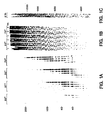
- Figure 1 shows autoradiographs of polyacrylamide-urea gels exhibiting the products of (A) labeling reactions, (B) sequencing (extension-termination) reactions performed at various temperatures, and (C) sequencing reaction products resolved during extended electrophoresis.
- the labeling reactions were performed as described in Example 4. The reactions were brought up to temperature before the addition of the enzyme. Aliquots were removed at 0.5, 1, 3, 5, 7, and 10 minutes.
- the extension-termination reactions were performed as described. All reactions were stopped with formamide-EDTA stop solution, denatured at 80°C for 3 minutes, and resolved on a buffer-gradient sequencing gel, (described by Biggin et al. , 1983, Proc. Natl. Acad. Sci.
- Figure 2 shows an autoradiograph of a polyacrylamide-urea gel comparing extension products generated with base analogs.
- the bracket indicates the limits of the palindrome.
- the correct sequence of the region is: 5'-CCAT GTGACCCTGCCCGACITCGACG GG AATT CCCGTC"GAAGTCGGGCAGGGTCAC C"ATA-3'.
- the complementary bases are underlined and the bases compressed in the dGTP reactions are in quotes.
- Figure 3 shows an autoradiograph of a polyacrylamide-urea gel on which are compared the extension products from (A) an M13-based single-stranded template, and (B) an asymmetric PCR template of the same sequence.
- the sequencing of the M13 clone was carried out as described in the accompanying Examples using a [ 32 P]-labeled primer.
- the asymmetric amplification and subsequent sequencing were performed as described, and all extension products were resolved on a buffer-gradient sequencing gel. Reaction sets were loaded: G, A, T, C.
- the Sanger and other dideoxynucleotide DNA sequencing protocols involve a series of four reactions, each of which involves the template-dependent extension of an oligonucleotide primer annealed to the nucleic acid to be sequenced, the template.
- the extension reaction is catalyzed by an agent for template-dependent polymerization.
- the template DNA is single stranded, so the primer can anneal to the template, and each of the four extension reactions is carried out in the presence of the four deoxyribonucleoside-5'-triphosphates (dATP, dCTP, dGTP, and TTP) or in a similar mixture containing one or more natural or synthetic analogs of dATP, dCTP, dGTP, or TTP and one dideoxynucleoside-5'-triphosphate (ddNTP). Incorporation of a ddNTP terminates the extension reaction, and the ddNTP concentration can be adjusted so that the reaction generates molecules of a broad range of chain lengths.
- dATP deoxyribonucleoside-5'-triphosphates
- ddNTP dideoxynucleoside-5'-triphosphate
- the four separate reactions are utilized so that in one reaction all extension products end with ddATP, in another with ddCTP, in another with ddGTP, and in the fourth with ddTTP.
- ddATP labeled ATP
- ddCTP in another with ddCTP
- ddGTP in another with ddGTP
- ddTTP in the fourth with ddTTP.
- labeled primers, dNTPs, or ddNTPs the products of the extension reaction can be detected. Separation of the products by size, i.e., on a sequencing gel in side-by-side lanes, and visualization or other detection of the extension reaction products allows the sequence of the template to be determined.
- the extension products in dideoxy sequencing methods were generated by agents for polymerization such as the Klenow fragment of E. coli DNA polymerase I, reverse transcriptase, or a modified T7 DNA polymerase.
- agents for polymerization such as the Klenow fragment of E. coli DNA polymerase I, reverse transcriptase, or a modified T7 DNA polymerase.
- the present invention provides a significantly improved method for dideoxynucleotide sequencing that utilizes the DNA polymerase from Thermus aquaticus , Taq polymerase, to catalyze the extension reaction.
- the present invention provides convenient and efficient methods for sequencing DNA with Taq DNA polymerase.
- the methods work equally well with either 5'-labeled primers or incorporation of label in a two-step reaction protocol. Both methods of incorporating label have been used to generate DNA sequencing ladders that are characteristically free of background bands or noticeable enzyme idiosyncrasies, uniform in intensity, and readable over long distances.
- the present protocols also gave very clean results in sequencing alkai-denatured double stranded DNA templates.
- Taq DNA polymerase the polymerase of choice for most sequencing applications. Sequencing results obtained using the present method were far superior to those obtained using either Klenow or AMV reverse transcriptase methodologies and were better than the results obtained using a method for sequencing with modified T7 DNA polymerase.
- One reason for these superior results is that, unlike any of these polymerases, Taq DNA polymerase works over a broad temperature optimum centered around 75°C. Regions of DNA secondary structure (hairpins) are commonly encountered and can strongly hinder a DNA polymerase and cause premature termination of the primer extension reaction. This result is observed as bands across all four sequencing lanes on sequencing gels and is cause for failure no matter how extension procedures are detected.
- Taq DNA polymerase is very processive. Within two minutes at 70°C, the Taq enzyme can replicate an entire 7.25 kb template. This equals a turnover rate in excess of 60 nucleotides per second. Taq DNA polymerase also has significant activity at lower temperatures with calculated turnover rates of 24, 1.5, and 0.25 nucleotides per second at 55°C, 37°C and 22°C, respectively.
- Taq DNA polymerase extension reaction In the absence of ddNTPs, a Taq DNA polymerase extension reaction, at 70°C and at a substantial substrate excess (0.1:1 molar ratio) of polymerase to primer/template, will extend most initiated primers completely prior to reinitiation on new substrate. Tne extension rate is relatively independent of enzyme concentration and demonstrates that Taq DNA polymerase has high processivity. Taq DNA polymerase also has very little if any proofreading activity.
- Taq enzyme makes the present method preferred over other sequencing methods. Polymerase pausing and premature termination of chain extension at sequences with secondary structure is reduced and discrimination against dideoxynucleotide analogs is diminished by the present method. These benefits make the invention preferred for use in automated sequencing instruments. Ironically, however, one of the beneficial properties of Taq polymerase for sequencing, the absence of significant Taq-associated 3' ⁇ 5'-exonuclease activity, undoubtedly prevented the development of Taq polymerase sequencing methods even after the purification of the enzyme by Gelfand et al . (European Patent Publication No. EPO 258,017). This is because absence of 3' ⁇ 5'-exonuclase activity results in a failure to remove misincorporated bases and results in chain termination.
- Misincorporation occurs at very low and generally unbalanced nucleotide concentrations typically used in prior art methods.
- the present inventors discovered that the rate is enhanced unacceptably for sequencing when one or more of the dNTPs are well below Km and/or when the concentration of one dNTP is very low relative to the other dNTPs.
- the present inventors also discovered that conditions which favor high fidelity and catalytic efficiency over long distances reactions are similar concentrations of each of the four dNTPs and ⁇ 10 ⁇ M for each dNTP.
- the chain extension reaction conditions of the present sequencing method are especially preferred when carried out in a buffer compatible with PCR, as is discussed more fully below.
- the buffer (described by Saiki et al ., 1988, Science 239 :487-494) for Taq polymerase PCR reactions (50 mM KCI; 10 mM Tris-HCl, pH 8.4; 2.5 mM MgCl 2 ; 200 ⁇ M of each dNTP; and 200 ⁇ g/mL of gelatin) was accordingly modified by the present inventors for DNA sequencing.
- the PCR buffer described by Saiki et al . contains KCI. For purposes of the present method, however, the best extensions occur in the absence of KCl.
- Taq DNA polymerase requires free magnesium ion; the concentration of magnesium ion should generally be at least 0.8 mM above that of the dNTPs and ddNTPS present in the sequencing reaction of the present invention.
- the preferred PCR buffer for use in conjunction with the present invention does not contain KCI, but does contain 0.05% Tween 20, 0.05% NP40, 3mM (or higher) MgCl 2 , in a buffer, 10mMTris-HCl is preferred, at pH 8.0 or higher.
- the reaction mixtures also contain primer, template, Taq polymerase, dNTPs, and ddNTPs.
- the present method can tolerate a wide variety of nucleotide concentrations, especially if each dNTP is present at concentrations greater than 10 ⁇ M.
- ddNTPs are expensive, and must be present in the extension reaction at a ratio to the corresponding dNTP for generation of meaningful sequence information. Consequently, lower dNTP concentrations are preferred for any dideoxy sequencing method.
- concentrations of less than 5 ⁇ M in each of four dNTPs and when the concentration of one dNTP was low relative to the other dNTPs, a high background of incorrect termination products was seen due to misincorporation of both dNTPs and ddNTPs.
- each ddNTP was empirically determined in a solution containing of all four dNTPs, each present at 10 ⁇ M.
- Taq DNA polymerase incorporated the four ddNTPs with varying efficiency, and much less efficiently than the corresponding dNTPs. Ratios that generated optimal distributions of chain termination products were: dGTP:ddGTP (1:6), dATP:ddATP (1:32), TTP:ddTTP (1:48), and dCTP:ddCTP (1:16).
- Taq DNA polymerase concentration was varied between 1 and 20 units per set of four reactions containing 0.2 pmol of single stranded DNA template, 0.5 pmol of primer, and the dNTP:ddNTP concentrations described above.
- the amount of extension products synthesized increased up to 10 units of polymerase per reaction set.
- ten units of Taq DNA polymerase represented approximately a 2.5-fold molar excess of enzyme over template-primer; however, a one:one ratio of Taq polymerase: template-primer is less costly and works well.
- the present invention also encompasses a variety of methods for incorporating labeled nucleotide during the sequencing reaction.
- One popular method involves the use of a labeled primer in the sequencing (chain extension and termination) reactions.
- Another method involves incorporation of a labeled nucleotide into the extending primer.
- a Klenow-type protocol where one labeled nucleotide is present at low concentration relative to the other three during primer extension, however, will not work with Taq polymerase due to misincorporation of dNTPs and ddNTPs.
- the apparent Km values for each of the four dNTPs is between 10 ⁇ M and 20 ⁇ M.
- ddNTPs present at 80-500 ⁇ M were inappropriately incorporated at high frequency with Taq Polymerase. Concentrations higher than 1 ⁇ M for an [ ⁇ - 35 S]-labeled dNTP are not practical. Also, because the Taq enzyme apparently lacks 3' ⁇ 5'-exonuclease (proofreading) activity, misincorporated dNTPs induce chain termination.
- the present invention provides a two-step procedure involving an initial low temperature labeling step using uniformly low concentrations of all four dNTPs (one of which is labeled) followed by the sequencing reaction step in the presence of ddNTPs and higher dNTP concentrations.
- the sequencing reaction can be performed at higher temperatures to achieve superior results.
- Minimum concentrations of 0.5 ⁇ M for each labeled dNTP are preferred in this step to generate easily readable signals from an overnight exposure, and increasing the concentration of one unlabeled dNTPs to 1.0 ⁇ M make the signals very clear. This benefit is seen regardless of which dNTP is increased, but increasing more than one is not necessary.
- the reaction sequencing reaction is initiated by the addition of balanced dNTPs ( ⁇ 10 ⁇ M each) and ddNTPs.
- dNTPs ⁇ 10 ⁇ M each
- ddNTPs ddNTPs
- temperature increase and higher dNTP concentrations ensure maximum processivity and fidelity from the present method.
- Sequencing reactions work well in a broad temperature range. The reactions performed at 55°C occurred at a slower rate, consistent with the extension rates described above, but there was no detectable difference in fidelity as compared with 70°C. Under these conditions, there was remarkable uniformity in the band intensities, and no detectable idiosyncratic band patterns.
- the same reaction conditions cover both short and long gel runs. DNA sequence information in excess of 1000 nucleotides from the priming site can be generated using the present method, as shown in Figure 1(c).
- the present method can also be carried out using the base analog 7-deaza-2'-deoxyguanosine-5'-triphosphate (c 7 dGTP) and high temperature to sequence through G+C-rich DNA and to eliminate band compressions.
- Band compressions resulting from abnormal gel migration of certain sequences are frequently encountered with G+C-rich DNA templates and occur even in cloned DNA sequences with no apparent abnormality in base composition. Such compressions can result in inconclusive or error-prone reading of sequencing gels.
- Substitution of dGTP with dITP or c 7 dGTP has been somewhat useful in resolving compression artifacts in known sequencing protocols.
- inosine-containing reactions required a 4-fold higher level of dITP as compared to dGTP, the labeling reaction needed 4 minutes, and the ratio of ddGTP to dITP was reduced 20-fold compared to dGTP.
- dITP deoxyinosine-5-triphosphate
- Terminations caused by inosine result both from a higher rate of misincorporation with dITP as compared to the other dNTPs and from the fact that Taq DNA polymerase lacks the necessary 3' ⁇ 5'-exonuclease activity for editing misincorporated bases. Terminations induced by dITP are greatly reduced if the reactions are initiated at 70°C.
- the present method is especially preferred for use with asymmetric PCR reactions using primers at concentrations designed to first amplify and then generate single stranded DNA (ssDNA) from any insert.
- ssDNA single stranded DNA
- Generation of single stranded DNA by a process termed assymetric PCR is described in Gyllensten and Erlich, 1988, Proc . Natl . Acad . Sci . USA 85 :7652-7656.
- This embodiment of the invention was illustrated by cloning DNA into the M13/pUC-lacZ polylinker and generating ssDNA by asymmetric PCR.
- Assymetric PCR was performed, as described in the accompanying examples, with one of the oligonucleotide primers present in a 100-fold greater concentration than the other, so that one of the two PCR primers was depleted during the early thermal cycles.
- the reaction generated single stranded product from the remaining primer.
- Sequencing of assymetric PCR-generated templates by the present method did not require purification of the product. Based on an estimated yield of 1 ⁇ g of single stranded product, one-third to one-half of the 2 nmol of each dNTP initially added are used up during the PCR cycles. In addition, the stability of the dNTPs during PCR was determined to be approximately 50% after 60 cycles of PCR. Accordingly, the termination mixes used in the present method are formulated to boost the dNTPs to a final concentration of about 10 ⁇ M or higher in the sequencing reaction, to supply specific ddNTPs at appropriate concentrations as determined above, and to provide additional DNA polymerase.
- a [ 32 P]-labeled sequencing primer can be used to avoid purifying the PCR product and to simplify the sequencing protocol to a single extension/termination step. It is obvious that a fluorescently-labeled sequencing primer(s) could also be used in the present methods; the products can then be analyzed on an automated DNA sequencing instrument.
- the present invention is illustrated below by sequencing inserts cloned into M13/pUC-based vectors, the method is applicable to direct sequencing of clones in lambda phage or any other cloning vector.
- Some variability in the ssDNA yield of the asymmetric PCR reaction has been observed for different primer pairs and ratios, and the reaction conditions for each amplification system will need to be adjusted to give the optimum results for a particular primer pair and template nucleic acid.
- the PCR dNTP concentrations may also need to be varied for products of different sizes and/or amplification efficiencies. Additionally, some investigators have increased the homogeneity of PCR products from genomic DNA by electrophoretic separation and reamplification of eluate from a selected gel slice.
- the present sequencing method is easily applied to this "secondary" form of PCR.
- Direct sequencing of PCR products from DNA by any method produces a "consensus" sequence; those bases which occur at a given position in the majority of the molecules will be the most visible on an autoradiograph and any low-frequency errors will be undetectable.
- the resulting sequence data will be only as clean as the amplified product. Heterogeneous products will naturally produce mixed ladders.
- the present invention makes possible the coupling of template preparation by PCR with direct sequencing. This advantage is significant in that it is now possible, by virtue of the present method, to automate both DNA template preparation by PCR and performance of the sequencing reactions in a manner compatible with current partially automated DNA sequencing instruments.
- Example 4 presents a preferred embodiment of the present invention.
- Taq DNA polymerase a single subunit enzyme, was purified from Thermus aquaticus , strain YT-1 (ATCC #2543). More recently, Taq DNA polymerase was purchased from Perkin Elmer-Cetus Instruments.
- the polymerase (5-80 units/ ⁇ L) was stored at -20°C in 20 mM Tris-HCl, pH 8.0; 100 mM KCl; 0.1 mM EDTA; 1 mM DTT; 200 ⁇ g/mL autoclaved gelatin; 0.5% NP40; 0.5% Tween-20; and 50% glycerol.
- the enzyme has an approximate specific activity of 200,000 units/mg, with one unit corresponding to 10 nmol of product synthesized in 30 minutes using activated salmon sperm DNA.
- 2'-deoxy and 2',3'-dideoxynucleotide-5'-triphosphates (dNTPs and ddNTPs) were obtained from Pharmacia.
- the annealing mixture contained 5 ⁇ L of oligonucleotide primer (0.1 pmol/ ⁇ L) in 6 x Taq Sequencing Buffer (TSB, 10 mM MgCl 2 and 10 mM Tris-HCl, pH 8.0, at room temperature) and 5 ⁇ L of template DNA (0.05 to 0.5 pmol).
- TTB Taq Sequencing Buffer
- the mixture was heated in a boiling water bath for three minutes, incubated at 42°C for 20 minutes, cooled to room temperature, and briefly spun to collect any condensation at the bottom of the tube.
- This Example describes how DNA can be generated for sequencing by the present method.
- the template for asymmetric PCR reactions was single stranded M13:mp10 DNA containing a 400 base insert in the Eco RI site of the polylinker.
- Oligonucleotides (20-mers) were synthesized to flank the polylinker immediately outside of the universal "-20" and "Reverse” sequencing primer binding sites, and these primers were designated RG05 ( 5' AGGGTTTTCCCAGTCACGAC 3 ) and RG02 ( 5' GTGTGGAATTGTGAGCGGAT 3 ), respectively.
- Each PCR reaction contained 20 pmol of one primer and 0.2 pmol of the other primer, 20 ⁇ M of each dNTP, 1 to 10 ng of DNA, 1X modified PCR buffer (10 mM Tris-HCl, pH 8.0; 3.0 mM MgCl 2 , and 0.05% of each of Tween 20 and NP40), and 2.5 units of Taq DNA polymerase in a total volume of 100 ⁇ L.
- the reactions were overlaid with 75 ⁇ L of mineral oil to prevent evaporation.
- Reactions were performed in 0.5 mL microcentrifuge tubes using the Perkin Elmer-Cetus Thermal Cycler.
- the programmed thermal profile was initiated with a denaturation at 93°C for 30 seconds, cooled for primer annealing at 50°C for one minute, heated up to the 72°C extension temperature over the course of 1.5 minutes, and held at 72°C for one minute to ensure completed extension. This profile was repeated for 35 cycles, and the final 72°C incubation was extended to 10 minutes.
- a 20 ⁇ L aliquot of each PCR reaction was removed to a 1.5 mL microcentrifuge tube and mixed with 0.5 ⁇ L of fresh Taq polymerase (48 unit/ ⁇ L), 1 ⁇ L of the appropriate [ 32 P]-labeled M13 forward or reverse sequencing primer ( 5' GTAAAACGACGGCCAGT 3' and 5' AACAGCTATGACCATG 3 ' respectively, 1.2 pmol per ⁇ L) and 10.5 ⁇ L of 1X modified PCR buffer.
- the PCR/primer preparation was immediately distributed in 7.5 ⁇ L aliquots into the wells containing the termination mixes and mixed with the pipettor.
- c 7 dGTP Labeling Mix should be used if c 7 dGTP will be used in the sequencing reactions. Use of c 7 dGTP is recommended for resolving sequences which cause compressions on the gel. Termination Mixes should be aliquoted into the microtiter plate wells prior to starting the labeling reaction. If labeled primers are to be used for sequencing, the ⁇ -[ 35 S]thio ⁇ dATP, Labeling Mix, and the labeling reaction incubation are omitted, and the volume is brought to 20 ⁇ l with 10 mM Tris-HCl, pH 8.5.
- the sequencing termination reactions may be carried out in a microtiter plate (Falcon #3911), using 4 wells per template/primer, labeled G, A, T, and C. Place 2 ⁇ L of the ddGTP Termination Mix in the well labeled G. Similarly, place 2 ⁇ L of the ddATP, ddTTP, and ddCTP Termination Mixes in the appropriately labeled wells. Note that the c 7 dGTP Termination Mixes should be used if c 7 dGTP was used in the labeling reaction.
- Taq DNA Polymerase Sequencing Buffer (5X Concentrate) is 50 mM Tris-HCl, pH 8.5; and 30 mM MgCl 2 .
- Enzyme Dilution Buffer is 10 mM Tris-HCl, pH 8.0; 0.5% Tween 20; and 0.5% NP40.
- Labeling Mix (c 7 dGTP) is 10 ⁇ M c 7 dGTP; 5 ⁇ M dCTP; and 5 ⁇ M TTP.
- dGTP Labeling Mix
- ddG Termination Mix (for c 7 dGTP) is 60 ⁇ M c 7 dGTP; 30 ⁇ M in each of dATP, TTP, and dCTP; and 180 ⁇ M ddGTP.
- ddG Termination Mix (for dGTP) is 30 ⁇ M in each dNTP and 180 ⁇ M ddGTP.
- Termination Mix (for c 7 dGTP) is 60 ⁇ M c 7 dGTP; 30 ⁇ M in each of dATP, TTP, dCTP; and 1 mM ddATP.
- ddA Termination Mix (for dGTP) is 30 ⁇ M in each dNTP and 1 mM ddATP.
- ddT Termination Mix (for c 7 dGTP) is 60 ⁇ M c 7 dGTP; 30 ⁇ M in each of dATP, TTP, and dCTP; and 1.5 mM ddTTP.
- ddT Termination Mix (for dGTP) is 30 ⁇ M in each dNTP and 1.5 mM ddTTP.
- ddC Termination Mix (for c 7 dGTP) is 60 ⁇ M c 7 dGTP; 30 ⁇ M in each of dATP, TTP, and dCTP; and 500 mM ddCTP.
- ddC Termination Mix (for dGTP) is 30 ⁇ M in each dNTP and 500 ⁇ M ddCTP.
- Taq DNA polymerase enzyme is stored at a concentration of 50 U/ ⁇ L.
- Stop Solution is 95% formamide; 20 ⁇ M EDTA; 0.1% bromophenol blue; and 0.1% xylene cyanol.
Landscapes
- Chemical & Material Sciences (AREA)
- Life Sciences & Earth Sciences (AREA)
- Organic Chemistry (AREA)
- Proteomics, Peptides & Aminoacids (AREA)
- Health & Medical Sciences (AREA)
- Engineering & Computer Science (AREA)
- Zoology (AREA)
- Wood Science & Technology (AREA)
- Immunology (AREA)
- General Engineering & Computer Science (AREA)
- General Health & Medical Sciences (AREA)
- Microbiology (AREA)
- Molecular Biology (AREA)
- Analytical Chemistry (AREA)
- Physics & Mathematics (AREA)
- Bioinformatics & Cheminformatics (AREA)
- Biochemistry (AREA)
- Biophysics (AREA)
- Biotechnology (AREA)
- Genetics & Genomics (AREA)
- Chemical Kinetics & Catalysis (AREA)
- Virology (AREA)
- Measuring Or Testing Involving Enzymes Or Micro-Organisms (AREA)
Claims (23)
- Procédé de détermination d'une séquence nucléotidique d'un segment d'acide nucléique, par une méthode de terminaison de chaîne aux didésoxynucléoside-5'-triphosphates, laquelle méthode comprend:(a) l'hybridation d'une amorce oligonucléotidique avec une matrice d'ADN double brin dénaturée ou simple brin appropriée;(b) l'extension de l'amorce à l'aide d'ADN polymérase dans quatre mélanges réactionnels distincts, contenant chacun un mélange des quatre désoxyribonucléoside-5'-triphosphates (dNTP) dATP, dCTP, dGTP et TTP et un didésoxynucléoside-5-triphosphate (ddNTP) de terminaison de chaîne, ou un mélange similaire dans lequel un ou plusieurs désoxyribonucléoside-5'-triphosphates est(sont) remplacé(s) par un analogue naturel ou synthétique de dATP, dCTP, dGTP ou TTP;caractérisé en ce que l'on utilise une ADN polymérase Taq et que les désoxyribonucléoside-5'-triphosphates dans l'étape (b) sont présents à des concentrations similaires.
- Procédé selon la revendication 1, caractérisé en ce que lesdites concentrations similaires sont ≥ 10 µM pour chaque désoxyribonucléoside-5'-triphosphate (dNTP).
- Procédé selon la revendication 1, caractérisé en ce que lesdites concentrations similaires vont de 5 µM à 30 µM pour chaque désoxyribonucléoside-5'-triphosphate (dNTP).
- Procédé selon les revendications 1 à 3, dans lequel le rapport dATP:ddATP est 1:32 et/ou le rapport dCTP/ddCTP est 1:16 et/ou le rapport dGTP:ddGTP est 1:6 et/ou le rapport TTP:ddTTP est 1:48.
- Procédé selon les revendications 1 à 4, caractérisé en ce que la réaction de l'étape (b) est effectuée à une température supérieure à 50°C, à savoir de 55 à 70°C.
- Procédé selon les revendications 1 à 4, caractérisé en ce que la réaction de l'étape (b) est effectuée à l'optimum de température de la polymérase Taq, centré autour de 75°C.
- Procédé selon l'une quelconque des revendications 1 à 6, dans lequel l'amorce utilisée dans l'étape (b) est marquée, de préférence marquée par fluorescence.
- Procédé selon l'une quelconque des revendications 1 à 6, dans lequel l'un des quatre dNTP ou ddNTP utilisés dans l'étape (b) est marqué.
- Procédé selon l'une quelconque des revendications 1 à 8, dans lequel les dNTP sont:dATP, dCTP, c7dGTP et TTP; oudATP, dCTP, dITP et TTP.
- Procédé selon l'une quelconque des revendications 1 à 9, caractérisé en ce qu'une étape de marquage est effectuée avant l'opération de terminaison de chaîne, ladite étape de marquage étant effectuée à une basse température initiale, de préférence à 37°C, et en présence de concentrations uniformément basses des quatre dNTP, dont l'un est marqué.
- Procédé selon la revendication 10, dans lequel la concentration dudit dNTP marqué est de 0,5 µM.
- Procédé selon la revendication 11, dans lequel la concentration d'un dNTP non marqué est augmentée jusqu'à 1,0 µM.
- Procédé selon l'une quelconque des revendications 10 à 12, dans lequel l'analogue de base 7-déazaguanine (c7dGTP) déstabilisant la structure est également présent dans l'étape de marquage effectuée avant l'opération de terminaison de chaîne.
- Procédé selon l'une quelconque des revendications 1 à 13, dans lequel ledit segment d'acide nucléique a été produit par une réaction d'amplification en chaîne par polymérase, éventuellement une réaction d'amplification en chaîne par polymérase asymétrique.
- Procédé selon l'une quelconque des revendications 1 à 14, dans lequel l'activité de la polymérase Taq est stimulée par la présence de détergents non ioniques.
- Procédé selon l'une quelconque des revendications 1 à 14, dans lequel l'activité de la polymérase Taq est stimulée par la présence de 0,05 % de Tween 20 et 0,05 % de NP40.
- Procédé selon l'une quelconque des revendications 1 à 16, dans lequel la concentration de KCl dans le mélange réactionnel de l'étape (b) est inférieure à 75 mM.
- Procédé selon l'une quelconque des revendications 1 à 16, dans lequel la concentration de KCl dans le mélange réactionnel de l'étape (b) est inférieure à 50 mM.
- Procédé selon l'une quelconque des revendications 1 à 16, dans lequel il n'y a pas de KCl présent dans le mélange réactionnel de l'étape (b).
- Procédé selon la revendication 19, dans lequel MgCl2 est présent à une concentration de 3 mM ou plus dans le mélange réactionnel de l'étape (b).
- Utilisation d'un procédé tel que revendiqué dans l'une quelconque des revendications 1 à 20, pour la détermination de la séquence nucléotidique d'un segment d'acide nucléique.
- Nécessaire pour la détermination d'une séquence nucléotidique d'un segment d'acide nucléique par une méthode de terminaison de chaîne aux didésoxynucléoside-5'-triphosphates, caractérisé en ce que ledit nécessaire comprend une ADN polymérase Taq et quatre mélanges de terminaison distincts, contenant chacun un didésoxynucléoside-5'-triphosphate (ddNTP) de terminaison de chaîne, choisi parmi ddATP, ddCTP, ddGTP et ddTTP et une concentration similaire de chacun des quatre désoxyribonucléoside-5'-triphosphates (dNTP) dATP, dCTP, dGTP et TTP.
- Nécessaire selon la revendication 22, comprenant en outre un tampon de dilution d'enzyme, comprenant des détergents non ioniques, de préférence 0,5 % de Tween 20 et 0,5 % de NP40.
Applications Claiming Priority (3)
| Application Number | Priority Date | Filing Date | Title |
|---|---|---|---|
| US07/249,367 US5075216A (en) | 1988-09-23 | 1988-09-23 | Methods for dna sequencing with thermus aquaticus dna polymerase |
| US249367 | 1988-09-23 | ||
| PCT/US1989/004093 WO1990003442A1 (fr) | 1988-09-23 | 1989-09-19 | PROCEDES DE DETERMINATION DE SEQUENCES D'ADN GRACE A L'UTILISATION DE LA POLYMERASE D'ADN DE $i(THERMUS AQUATICUS) |
Publications (2)
| Publication Number | Publication Date |
|---|---|
| EP0437459A1 EP0437459A1 (fr) | 1991-07-24 |
| EP0437459B1 true EP0437459B1 (fr) | 1997-10-29 |
Family
ID=22943169
Family Applications (1)
| Application Number | Title | Priority Date | Filing Date |
|---|---|---|---|
| EP89910787A Expired - Lifetime EP0437459B1 (fr) | 1988-09-23 | 1989-09-19 | Procedes de determination de sequences d'adn grace a l'utilisation de la polymerase d'adn de thermus aquaticus |
Country Status (8)
| Country | Link |
|---|---|
| US (1) | US5075216A (fr) |
| EP (1) | EP0437459B1 (fr) |
| JP (1) | JP2901194B2 (fr) |
| AT (1) | ATE159762T1 (fr) |
| AU (1) | AU647015B2 (fr) |
| CA (1) | CA1332561C (fr) |
| DE (1) | DE68928413T2 (fr) |
| WO (1) | WO1990003442A1 (fr) |
Families Citing this family (148)
| Publication number | Priority date | Publication date | Assignee | Title |
|---|---|---|---|---|
| US5656493A (en) * | 1985-03-28 | 1997-08-12 | The Perkin-Elmer Corporation | System for automated performance of the polymerase chain reaction |
| US5333675C1 (en) * | 1986-02-25 | 2001-05-01 | Perkin Elmer Corp | Apparatus and method for performing automated amplification of nucleic acid sequences and assays using heating and cooling steps |
| US5173411A (en) * | 1987-01-14 | 1992-12-22 | President And Fellows Of Harvard College | Method for determining the nucleotide base sequence of a DNA molecule |
| US5547839A (en) * | 1989-06-07 | 1996-08-20 | Affymax Technologies N.V. | Sequencing of surface immobilized polymers utilizing microflourescence detection |
| KR100236506B1 (ko) * | 1990-11-29 | 2000-01-15 | 퍼킨-엘머시터스인스트루먼츠 | 폴리머라제 연쇄 반응 수행 장치 |
| DE4214112A1 (de) * | 1991-08-02 | 1993-02-04 | Europ Lab Molekularbiolog | Neues verfahren zur sequenzierung von nukleinsaeuren |
| US5674679A (en) * | 1991-09-27 | 1997-10-07 | Amersham Life Science, Inc. | DNA cycle sequencing |
| US5314595A (en) * | 1992-04-03 | 1994-05-24 | United States Biochemical Corporation | Electrophoresis of nucleic acid fragments |
| US5830642A (en) * | 1992-04-03 | 1998-11-03 | Amersham Life Science, Inc. | Electrophoresis of nucleic acid fragments |
| US7465539B1 (en) | 1993-02-19 | 2008-12-16 | Takara Bio, Inc. | DNA polymerases with enhanced length of primer extension |
| US6410277B1 (en) * | 1993-02-19 | 2002-06-25 | Takara Shuzo Co., Ltd. | DNA polymersases with enhanced length of primer extension |
| US5436149A (en) * | 1993-02-19 | 1995-07-25 | Barnes; Wayne M. | Thermostable DNA polymerase with enhanced thermostability and enhanced length and efficiency of primer extension |
| US5550040A (en) * | 1993-06-23 | 1996-08-27 | Hoffman-La Roche Inc. | Method, reagents and kits for the detection of Neisseria gonorrhoeae |
| US5879656A (en) * | 1993-10-26 | 1999-03-09 | Thomas Jefferson University | Methods of treating metastatic colorectal cancer with ST receptor binding compounds |
| US5601990A (en) * | 1994-09-13 | 1997-02-11 | Thomas Jefferson University | Methods of diagnosing colorectal tumors and metastasis thereof |
| EP0734264B1 (fr) * | 1993-10-26 | 2004-02-18 | Thomas Jefferson University | Compositions se fixant specifiquement a des cellules cancereuses colo-rectales et procedes d'utilisation |
| US7097839B1 (en) * | 1993-10-26 | 2006-08-29 | Thomas Jefferson University | ST receptor binding compounds and methods of using the same |
| US7312052B1 (en) * | 1993-12-08 | 2007-12-25 | Stratagene California | Polymerase compositions and uses thereof |
| US5480783A (en) * | 1994-03-31 | 1996-01-02 | The Perkin-Elmer Corporation | Method for reducing background signals in DNA replication/detection assays |
| US6455251B1 (en) | 1994-09-13 | 2002-09-24 | Thomas Jefferson University | Methods of and kits and compositions for diagnosing colorectal tumors and metastasis thereof |
| US5919617A (en) * | 1994-12-21 | 1999-07-06 | Miami University | Methods and reagents for detecting fungal pathogens in a biological sample |
| US5876949A (en) * | 1995-05-31 | 1999-03-02 | The Trustees Of The University Of Pennsylvania | Antibodies specific for fragile X related proteins and method of using the same |
| US5885813A (en) * | 1995-05-31 | 1999-03-23 | Amersham Life Science, Inc. | Thermostable DNA polymerases |
| US6001645A (en) * | 1995-06-07 | 1999-12-14 | Promega Corporation | Thermophilic DNA polymerases from thermotoga neapolitana |
| US6077664A (en) * | 1995-06-07 | 2000-06-20 | Promega Corporation | Thermophilic DNA polymerases from Thermotoga neapolitana |
| US5750345A (en) * | 1995-10-31 | 1998-05-12 | Evanston Hospital Corporation | Detection of human α-thalassemia mutations and their use as predictors of blood-related disorders |
| US5888736A (en) * | 1995-12-22 | 1999-03-30 | Visible Genetics, Inc. | Method, compositions and kit for detection and identification of microorganisms |
| US5830657A (en) * | 1996-05-01 | 1998-11-03 | Visible Genetics Inc. | Method for single-tube sequencing of nucleic acid polymers |
| US6168918B1 (en) | 1996-01-31 | 2001-01-02 | American Home Products Corp. | Method of detecting foreign DNA integrated in eukaryotic chromosomes |
| US6413718B1 (en) | 1996-05-01 | 2002-07-02 | Visible Genetics Inc. | Method for sequencing of nucleic acid polymers |
| US6602659B1 (en) | 1996-05-03 | 2003-08-05 | Thomas Jefferson University | Methods of and kits and compositions for diagnosing colorectal tumors and metastasis thereof |
| US6455248B1 (en) | 1996-05-20 | 2002-09-24 | Miami University | Reagents and kits for detecting fungal pathogens in a biological sample |
| US5910409A (en) * | 1996-05-20 | 1999-06-08 | Miami University | Methods and reagents for detecting fungal pathogens in a biological sample |
| US5849546A (en) * | 1996-09-13 | 1998-12-15 | Epicentre Technologies Corporation | Methods for using mutant RNA polymerases with reduced discrimination between non-canonical and canonical nucleoside triphosphates |
| US6855545B1 (en) | 1996-10-04 | 2005-02-15 | Lexicon Genetics Inc. | Indexed library of cells containing genomic modifications and methods of making and utilizing the same |
| US7332338B2 (en) | 1996-10-04 | 2008-02-19 | Lexicon Pharmaceuticals, Inc. | Vectors for making genomic modifications |
| US6139833A (en) * | 1997-08-08 | 2000-10-31 | Lexicon Genetics Incorporated | Targeted gene discovery |
| US6207371B1 (en) | 1996-10-04 | 2001-03-27 | Lexicon Genetics Incorporated | Indexed library of cells containing genomic modifications and methods of making and utilizing the same |
| US20040072243A1 (en) * | 1996-10-11 | 2004-04-15 | Lexicon Genetics Incorporated | Indexed library of cells containing genomic modifications and methods of making and utilizing the same |
| US6291164B1 (en) | 1996-11-22 | 2001-09-18 | Invitrogen Corporation | Methods for preventing inhibition of nucleic acid synthesis by pyrophosphate |
| US20030215857A1 (en) * | 1996-12-20 | 2003-11-20 | Roche Diagnostics Gmbh | Method for the direct, exponential amplification and sequencing of DNA molecules and its application |
| DE19653439A1 (de) * | 1996-12-20 | 1998-07-02 | Svante Dr Paeaebo | Verfahren zur direkten, exponentiellen Amplifikation und Sequenzierung von DNA Molekülen und dessen Anwendung |
| DE19653494A1 (de) * | 1996-12-20 | 1998-06-25 | Svante Dr Paeaebo | Verfahren zur entkoppelten, direkten, exponentiellen Amplifikation und Sequenzierung von DNA Molekülen unter Zugabe einer zweiten thermostabilen DNA Polymerase und dessen Anwendung |
| US6605428B2 (en) | 1996-12-20 | 2003-08-12 | Roche Diagnostics Gmbh | Method for the direct, exponential amplification and sequencing of DNA molecules and its application |
| US5952200A (en) * | 1997-02-06 | 1999-09-14 | University Of South Carolina | Method of diagnosing cancer in human cells using a reverse transcriptase-polymerase chain reaction for identifying the presence of stromelysin-3 |
| AU6659298A (en) | 1997-02-18 | 1998-09-08 | Thomas Jefferson University | Compositions that bind to pancreatic cancer cells and methods of using the same |
| EP1007718B1 (fr) | 1997-03-21 | 2007-11-14 | Stratagene California | Extraits de facteur stimulant la polymerase (pef), complexes de proteines pef, proteine pef isolee, et procedes de purification et d'identification |
| US6391622B1 (en) * | 1997-04-04 | 2002-05-21 | Caliper Technologies Corp. | Closed-loop biochemical analyzers |
| US6235471B1 (en) | 1997-04-04 | 2001-05-22 | Caliper Technologies Corp. | Closed-loop biochemical analyzers |
| EP1959255A3 (fr) * | 1997-04-04 | 2008-09-24 | Caliper Life Sciences, Inc. | Analyseurs biochimiques en boucle fermée |
| US7135333B1 (en) | 1997-08-07 | 2006-11-14 | Thomas Jefferson University | Compositions that specifically bind to colorectal cancer cells and methods of using the same |
| US6120995A (en) * | 1997-08-07 | 2000-09-19 | Thomas Jefferson University | Compositions that specifically bind to colorectal cancer cells and methods of using the same |
| US6103468A (en) * | 1997-10-07 | 2000-08-15 | Labatt Brewing Company Limited | Rapid two-stage polymerase chain reaction method for detection of lactic acid bacteria in beer |
| CA2318880C (fr) * | 1998-02-04 | 2010-07-27 | Applied Biosystems, Llc | Determination d'un genotype d'un produit d'amplification sur des sites alleliques multiples |
| US6808921B1 (en) * | 1998-03-27 | 2004-10-26 | Lexicon Genetics Incorporated | Vectors for gene mutagenesis and gene discovery |
| US6436707B1 (en) * | 1998-03-27 | 2002-08-20 | Lexicon Genetics Incorporated | Vectors for gene mutagenesis and gene discovery |
| US20020064837A1 (en) * | 1998-05-08 | 2002-05-30 | Thuan Quoc Trinh | Method for synthesizing a nucleic acid molecule using a ribonuclease |
| WO2000008196A2 (fr) | 1998-08-06 | 2000-02-17 | Duke University | Urate oxydase |
| US6333403B1 (en) * | 1998-11-06 | 2001-12-25 | Myriad Genetics, Inc. | Chromosome 17p-linked prostate cancer susceptibility gene and a paralog and orthologous genes |
| EP1074633A1 (fr) * | 1999-07-05 | 2001-02-07 | LION Bioscience AG | Nucléotides et leur utilisation pour le séquencage de matrices riche en GC |
| GB9922971D0 (en) * | 1999-09-29 | 1999-12-01 | Secr Defence | Reaction system |
| US7118860B2 (en) | 1999-10-29 | 2006-10-10 | Stratagene California | Methods for detection of a target nucleic acid by capture |
| US7838225B2 (en) | 1999-10-29 | 2010-11-23 | Hologic, Inc. | Methods for detection of a target nucleic acid by forming a cleavage structure using a reverse transcriptase |
| US7824859B2 (en) * | 1999-10-29 | 2010-11-02 | Cytyc Corporation | Methods for detection of a target nucleic acid by forming a cleavage structure using an RNA polymerase |
| US6893819B1 (en) * | 2000-11-21 | 2005-05-17 | Stratagene California | Methods for detection of a nucleic acid by sequential amplification |
| ATE491031T1 (de) | 2000-02-17 | 2010-12-15 | Qiagen Gmbh | Thermostabile chimäre nukleinsäurepolymerasen und ihre verwendungen |
| US6632645B1 (en) | 2000-03-02 | 2003-10-14 | Promega Corporation | Thermophilic DNA polymerases from Thermoactinomyces vulgaris |
| US6436677B1 (en) | 2000-03-02 | 2002-08-20 | Promega Corporation | Method of reverse transcription |
| CA2404431C (fr) | 2000-03-27 | 2011-06-07 | Thomas Jefferson University | Guanylyl cyclase c servant a deceler les cancers de l'estomac et de l'oesophage |
| JP4721606B2 (ja) * | 2000-03-30 | 2011-07-13 | トヨタ自動車株式会社 | 単一核酸分子の塩基配列決定法 |
| US20080242627A1 (en) * | 2000-08-02 | 2008-10-02 | University Of Southern California | Novel rna interference methods using dna-rna duplex constructs |
| US7662791B2 (en) | 2000-08-02 | 2010-02-16 | University Of Southern California | Gene silencing using mRNA-cDNA hybrids |
| US7829276B2 (en) * | 2000-09-18 | 2010-11-09 | Thomas Jefferson University | Methods of using CRCA-1 as a stomach and esophageal cancer marker |
| DE10049211A1 (de) * | 2000-10-05 | 2002-04-18 | Qiagen Gmbh | Thermostabile Polymerase aus Thermococcus pacificus |
| GB0110476D0 (en) | 2001-04-30 | 2001-06-20 | Secr Defence | Reagent delivery system |
| US7026121B1 (en) | 2001-06-08 | 2006-04-11 | Expression Diagnostics, Inc. | Methods and compositions for diagnosing and monitoring transplant rejection |
| US6905827B2 (en) | 2001-06-08 | 2005-06-14 | Expression Diagnostics, Inc. | Methods and compositions for diagnosing or monitoring auto immune and chronic inflammatory diseases |
| US7235358B2 (en) | 2001-06-08 | 2007-06-26 | Expression Diagnostics, Inc. | Methods and compositions for diagnosing and monitoring transplant rejection |
| WO2003040376A1 (fr) * | 2001-11-02 | 2003-05-15 | Olga Makarova | Procede de mutagenese dirigee de molecules d'acides nucleiques au moyen d'une amorce unique |
| US7222059B2 (en) * | 2001-11-15 | 2007-05-22 | Siemens Medical Solutions Diagnostics | Electrophoretic trace simulator |
| US20030180741A1 (en) | 2001-12-21 | 2003-09-25 | Holly Hogrefe | High fidelity DNA polymerase compositions and uses therefor |
| US6977162B2 (en) | 2002-03-01 | 2005-12-20 | Ravgen, Inc. | Rapid analysis of variations in a genome |
| IL163600A0 (en) * | 2002-03-01 | 2005-12-18 | Ravgen Inc | Methods for detection of genetic disorders |
| EP1488006B1 (fr) * | 2002-03-20 | 2008-05-28 | InnovativeBio.Biz | Microcapsules encapsulant un melange de reaction d'amplification de l'acide nucleique et utilisation de celles-ci en tant que compartiments de reaction pour des reactions paralleles |
| US20030228611A1 (en) * | 2002-05-01 | 2003-12-11 | President And Fellows Of Harvard College | Nucleic acid memory device |
| US7442506B2 (en) | 2002-05-08 | 2008-10-28 | Ravgen, Inc. | Methods for detection of genetic disorders |
| US7727720B2 (en) | 2002-05-08 | 2010-06-01 | Ravgen, Inc. | Methods for detection of genetic disorders |
| US20030210489A1 (en) * | 2002-05-13 | 2003-11-13 | Yec Co., Ltd. | Data eraser and data erasing program |
| AU2004225520A1 (en) | 2003-03-25 | 2004-10-14 | Stratagene | DNA polymerase fusions and uses thereof |
| WO2004094986A2 (fr) | 2003-04-16 | 2004-11-04 | Handylab, Inc. | Systeme et procede de detection electrochimique de composes biologiques |
| EP1618210B1 (fr) | 2003-04-21 | 2010-09-01 | Roche Diagnostics GmbH | Liens entre des polymorphismes dans le gene frzb et l'osteoporose |
| US7892745B2 (en) | 2003-04-24 | 2011-02-22 | Xdx, Inc. | Methods and compositions for diagnosing and monitoring transplant rejection |
| EP1641938A2 (fr) * | 2003-06-30 | 2006-04-05 | AstraZeneca AB | Dosages par fluorescence de polymerase d'acide nucleique |
| US7179602B2 (en) * | 2003-09-04 | 2007-02-20 | Los Alamos National Security, Llc | Methods for sequencing GC-rich and CCT repeat DNA templates |
| CN1860232A (zh) * | 2003-09-30 | 2006-11-08 | 莱克康遗传公司 | 鉴别基因功能的方法和组合物 |
| EP1706502A4 (fr) * | 2003-11-26 | 2007-05-23 | Eppendorf Ag | Procedes et compositions pour l'amplification in vitro d'acide nucleique extrachromosomique |
| US8293471B2 (en) * | 2004-01-28 | 2012-10-23 | Marshall University Research Corporation | Apparatus and method for a continuous rapid thermal cycle system |
| WO2006029184A2 (fr) | 2004-09-08 | 2006-03-16 | Expression Diagnostics, Inc. | Genes permettant de diagnostiquer et de surveiller les troubles associes a l'inflammation |
| WO2006050499A2 (fr) * | 2004-11-03 | 2006-05-11 | Third Wave Technologies, Inc. | Dosage de detection en une seule etape |
| US7051536B1 (en) * | 2004-11-12 | 2006-05-30 | Bio-Rad Laboratories, Inc. | Thermal cycler with protection from atmospheric moisture |
| JP2006230342A (ja) * | 2005-02-28 | 2006-09-07 | Tokyo Univ Of Agriculture & Technology | 一本鎖核酸の分離方法および装置並びにマイクロアレイおよびdnaチップ。 |
| GB0514935D0 (en) | 2005-07-20 | 2005-08-24 | Solexa Ltd | Methods for sequencing a polynucleotide template |
| JP5106416B2 (ja) | 2006-01-06 | 2012-12-26 | アジレント・テクノロジーズ・インク | 濃縮(packed)DNAポリメラーゼを含む核酸複製のための反応緩衝液組成物 |
| RU2406093C2 (ru) | 2006-02-02 | 2010-12-10 | Корбетт Лайф Сайнс Пти Лтд | Устройство и способ ввода жидкой пробы в поток флюидного носителя и их применение для амплификации нуклеиновой кислоты |
| US10741034B2 (en) | 2006-05-19 | 2020-08-11 | Apdn (B.V.I.) Inc. | Security system and method of marking an inventory item and/or person in the vicinity |
| WO2008021431A2 (fr) | 2006-08-14 | 2008-02-21 | Xdx, Inc. | Méthodes et compositions permettant de diagnostiquer et de surveiller l'état de rejet de greffe et de troubles immunitaires |
| EP2102367A2 (fr) | 2006-11-09 | 2009-09-23 | XDX, Inc. | Procedes pour diagnostiquer et surveiller l'etat d'un lupus erythemateux systemique |
| US9938641B2 (en) * | 2006-12-18 | 2018-04-10 | Fluidigm Corporation | Selection of aptamers based on geometry |
| CN101675170B (zh) * | 2007-03-02 | 2013-09-18 | 考贝特研究控股公司 | 用于核酸扩增的装置和方法 |
| EP2190566B1 (fr) * | 2007-08-28 | 2012-10-03 | Corbett Research Pty Ltd | Dispositif de cyclage thermique comportant un accès d'échantillon pouvant être ouvert sélectivement |
| SG10201402188TA (en) * | 2007-11-30 | 2014-06-27 | Corbett Res Pty Ltd | Thermal cycling device |
| JP2011511635A (ja) * | 2008-02-11 | 2011-04-14 | ハダシット メディカル リサーチ サービシーズ アンド ディベロップメント リミテッド | 癌標識としての結腸癌関連転写因子1(ccat−1) |
| WO2009117327A2 (fr) * | 2008-03-15 | 2009-09-24 | Hologic, Inc. | Compositions et procédés pour analyse de molécules d’acide nucléique pendant des réactions d’amplification |
| EP2316030B1 (fr) | 2008-07-25 | 2019-08-21 | Wagner, Richard W. | Procédés de criblage de protéines |
| CA2638458A1 (fr) * | 2008-07-31 | 2010-01-31 | Spartan Bioscience Inc. | Recyclage thermique au moyen du positionnement d'une source de temperature allant de relative a fixe |
| WO2010033604A2 (fr) * | 2008-09-18 | 2010-03-25 | X-Bar Diagnostic System, Inc. | Système de détection d'adn portatif entièrement automatique |
| CA2742593C (fr) | 2008-11-03 | 2020-05-05 | Kapa Biosystems, Inc. | Adn polymerases chimeriques |
| WO2010062777A2 (fr) | 2008-11-03 | 2010-06-03 | Kapabiosystems | Adn polymérases de type a modifiées |
| US20110070590A1 (en) | 2009-09-22 | 2011-03-24 | Jan Rohozinski | Primers and Methods for Determining RhD Zygosity |
| JP2013518590A (ja) | 2010-02-02 | 2013-05-23 | アボツト・バイオテクノロジー・リミテツド | TNF−α阻害剤を用いる処置に対する応答性を予測するための方法および組成物 |
| WO2011127136A1 (fr) * | 2010-04-06 | 2011-10-13 | University Of Chicago | Compositions et procédés liés à la modification de 5-hydroxyméthylcytosine (5-hmc) |
| CN102917796B (zh) | 2010-04-20 | 2015-04-01 | 科贝特研究私人有限公司 | 温度控制方法和设备 |
| US8618253B2 (en) | 2010-05-25 | 2013-12-31 | Samsung Techwin Co., Ltd. | Modified RNAse H and detection of nucleic acid amplification |
| WO2012097318A2 (fr) | 2011-01-14 | 2012-07-19 | Kap Abiosystems | Adn polymérases modifiées destinées à améliorer l'amplification |
| EP2686441B1 (fr) | 2011-03-18 | 2019-05-08 | Eisai R&D Management Co., Ltd. | Procédé et utilisation pour prédire la réponse à l'éribuline |
| ES2776996T3 (es) | 2011-10-20 | 2020-08-03 | Novartis Ag | Biomarcadores predictivos de la sensibilidad al tratamiento por el activador del receptor de la acetilcolina nicotínico alfa 7 |
| CN104246458B (zh) | 2011-10-20 | 2018-11-02 | 凯杰器械有限公司 | 用于验证微环境中的温度测量结果的方法和系统 |
| EP2827991B1 (fr) | 2012-03-23 | 2019-05-29 | QIAGEN GmbH | Appareil de cycle thermique et procédé de chauffage et de refroidissement |
| US20140024541A1 (en) * | 2012-07-17 | 2014-01-23 | Counsyl, Inc. | Methods and compositions for high-throughput sequencing |
| EP2687294A1 (fr) | 2012-07-18 | 2014-01-22 | Qiagen Instruments AG | Rotor pour cycleur thermique et cycleur thermique |
| CN104837499B (zh) | 2012-12-11 | 2018-02-23 | 诺华有限公司 | 预测对α7烟碱型乙酰胆碱受体激活剂治疗响应性的生物标志物 |
| US9963740B2 (en) | 2013-03-07 | 2018-05-08 | APDN (B.V.I.), Inc. | Method and device for marking articles |
| WO2015054188A1 (fr) | 2013-10-07 | 2015-04-16 | Apdn (B.V.I), Inc. | Lecteur multimode d'image et spectral |
| WO2015054733A1 (fr) | 2013-10-15 | 2015-04-23 | Bio Molecular Systems Pty Ltd | Thermocycleur amélioré |
| EP3102701A1 (fr) | 2014-02-07 | 2016-12-14 | Novartis AG | Impact de facteurs génétiques sur la progression d'une maladie et réponse aux anticorps anti-c5 dans l'atrophie géographique |
| US10745825B2 (en) | 2014-03-18 | 2020-08-18 | Apdn (B.V.I.) Inc. | Encrypted optical markers for security applications |
| CN106103121B (zh) | 2014-03-18 | 2019-12-06 | 亚普蒂恩(B.V.I.)公司 | 用于安全应用的加密光学标记物 |
| CA3298934A1 (en) | 2015-09-18 | 2026-03-02 | Siemens Healthcare Diagnostics Inc. | Reagents and methods for analysis of hiv |
| CN108350407B (zh) | 2015-12-11 | 2022-07-08 | 杰诺玛迪克斯公司 | 用于核酸扩增的管密封系统和方法 |
| CN109070130B (zh) | 2016-04-11 | 2022-03-22 | 亚普蒂恩(B V I)公司 | 用于标记纤维素产品的方法 |
| EP3475706B1 (fr) | 2016-06-27 | 2021-08-11 | Juno Therapeutics, Inc. | Épitopes restreints au cmh-e, molécules de liaison, et procédés et utilisations associés |
| CN109476695A (zh) | 2016-06-27 | 2019-03-15 | 丹娜法伯癌症研究院 | 用于测定rna翻译速率的方法 |
| US20200182884A1 (en) | 2016-06-27 | 2020-06-11 | Juno Therapeutics, Inc. | Method of identifying peptide epitopes, molecules that bind such epitopes and related uses |
| US10995371B2 (en) | 2016-10-13 | 2021-05-04 | Apdn (B.V.I.) Inc. | Composition and method of DNA marking elastomeric material |
| US10920274B2 (en) | 2017-02-21 | 2021-02-16 | Apdn (B.V.I.) Inc. | Nucleic acid coated submicron particles for authentication |
| US11851679B2 (en) | 2017-11-01 | 2023-12-26 | Juno Therapeutics, Inc. | Method of assessing activity of recombinant antigen receptors |
| EP4363611A1 (fr) | 2021-06-30 | 2024-05-08 | Dana-Farber Cancer Institute, Inc. | Compositions et procédés d'enrichissement d'acides nucléiques à l'aide d'une réticulation induite par la lumière |
| WO2025049432A1 (fr) | 2023-08-28 | 2025-03-06 | Intellia Therapeutics, Inc. | Procédés d'édition de hla-a dans des cellules pré-criblées pour l'absence d'un ou des deux allèles d'hla-h*01 |
Family Cites Families (8)
| Publication number | Priority date | Publication date | Assignee | Title |
|---|---|---|---|---|
| US4683202A (en) * | 1985-03-28 | 1987-07-28 | Cetus Corporation | Process for amplifying nucleic acid sequences |
| CA1339653C (fr) * | 1986-02-25 | 1998-02-03 | Larry J. Johnson | Appareil servant a l'amplification automatisee de sequences nucleotidiques et d'essais au moyen de cycle de chauffage et de refroidissement |
| CA1338457C (fr) * | 1986-08-22 | 1996-07-16 | Henry A. Erlich | Enzyme thermostable purifiee |
| US4921794A (en) * | 1987-01-14 | 1990-05-01 | President And Fellows Of Harvard College | T7 DNA polymerase |
| US4795699A (en) * | 1987-01-14 | 1989-01-03 | President And Fellows Of Harvard College | T7 DNA polymerase |
| US4962020A (en) * | 1988-07-12 | 1990-10-09 | President And Fellows Of Harvard College | DNA sequencing |
| WO1990008839A1 (fr) * | 1989-02-06 | 1990-08-09 | Eastman Kodak Company | Concentre de reaction de mise en sequence d'adn polymerase thermostable |
| US5001050A (en) * | 1989-03-24 | 1991-03-19 | Consejo Superior Investigaciones Cientificas | PHφ29 DNA polymerase |
-
1988
- 1988-09-23 US US07/249,367 patent/US5075216A/en not_active Expired - Lifetime
-
1989
- 1989-09-19 EP EP89910787A patent/EP0437459B1/fr not_active Expired - Lifetime
- 1989-09-19 AU AU43003/89A patent/AU647015B2/en not_active Expired
- 1989-09-19 DE DE68928413T patent/DE68928413T2/de not_active Expired - Lifetime
- 1989-09-19 WO PCT/US1989/004093 patent/WO1990003442A1/fr not_active Ceased
- 1989-09-19 AT AT89910787T patent/ATE159762T1/de not_active IP Right Cessation
- 1989-09-19 JP JP1510171A patent/JP2901194B2/ja not_active Expired - Lifetime
- 1989-09-22 CA CA000612500A patent/CA1332561C/fr not_active Expired - Lifetime
Also Published As
| Publication number | Publication date |
|---|---|
| ATE159762T1 (de) | 1997-11-15 |
| DE68928413T2 (de) | 1998-06-04 |
| DE68928413D1 (de) | 1997-12-04 |
| US5075216A (en) | 1991-12-24 |
| AU647015B2 (en) | 1994-03-17 |
| CA1332561C (fr) | 1994-10-18 |
| AU4300389A (en) | 1990-04-18 |
| WO1990003442A1 (fr) | 1990-04-05 |
| JPH04501205A (ja) | 1992-03-05 |
| EP0437459A1 (fr) | 1991-07-24 |
| JP2901194B2 (ja) | 1999-06-07 |
Similar Documents
| Publication | Publication Date | Title |
|---|---|---|
| EP0437459B1 (fr) | Procedes de determination de sequences d'adn grace a l'utilisation de la polymerase d'adn de thermus aquaticus | |
| Innis et al. | DNA sequencing with Thermus aquaticus DNA polymerase and direct sequencing of polymerase chain reaction-amplified DNA. | |
| US5142033A (en) | Structure-independent DNA amplification by the polymerase chain reaction | |
| US5091310A (en) | Structure-independent dna amplification by the polymerase chain reaction | |
| US5432065A (en) | Cycle sequencing with non-thermostable DNA polymerases | |
| US6107032A (en) | Method for the direct, exponential amplification and sequencing of DNA molecules and its application | |
| US5683869A (en) | Method of nucleic acid sequencing | |
| US5599675A (en) | DNA sequencing by stepwise ligation and cleavage | |
| US5674679A (en) | DNA cycle sequencing | |
| US6225092B1 (en) | Method for the uncoupled, direct, exponential amplification and sequence of DNA molecules with the addition of a second thermostable DNA polymerase and its application | |
| JP3421664B2 (ja) | ヌクレオチド塩基の同定方法 | |
| US20100311055A1 (en) | Compositions and methods for terminating a sequencing reaction at a specific location in a target dna template | |
| CZ85095A3 (en) | Determination method of nucleotide sequence of an oligonucleotide sample | |
| EP0712927A2 (fr) | Polymerase d'ADN Bst avec activité exonucléase 3'-5' de correction de lecture | |
| WO1998021361A1 (fr) | Methode et necessaire correspondant pour sequençage isothermique d'acides nucleiques | |
| JPH0630640B2 (ja) | 熱安定性ポリメラーゼdnaシーケエンシング反応濃厚物 | |
| US9441271B2 (en) | Methods and compositions for amplification and sequencing of difficult DNA templates | |
| US5831065A (en) | Kits for DNA sequencing by stepwise ligation and cleavage | |
| Alphey | Chain Termination (Sanger Dideoxy) Method | |
| KR101231089B1 (ko) | 기지의 서열에 인접한 미지의 dna 서열을 증폭하는 방법 | |
| US7179602B2 (en) | Methods for sequencing GC-rich and CCT repeat DNA templates | |
| KR100812259B1 (ko) | 기지의 서열에 인접한 미지의 dna 서열을 증폭하는 방법 | |
| JP4105294B2 (ja) | オリゴヌクレオチドの標識法およびその利用 | |
| Pestana et al. | Traditional PCR | |
| WO2010017228A1 (fr) | Détection de séquence d’acide nucléique par amplification de ligature d’extension de lacune |
Legal Events
| Date | Code | Title | Description |
|---|---|---|---|
| PUAI | Public reference made under article 153(3) epc to a published international application that has entered the european phase |
Free format text: ORIGINAL CODE: 0009012 |
|
| 17P | Request for examination filed |
Effective date: 19910320 |
|
| AK | Designated contracting states |
Kind code of ref document: A1 Designated state(s): AT BE CH DE FR GB IT LI LU NL SE |
|
| RAP1 | Party data changed (applicant data changed or rights of an application transferred) |
Owner name: F. HOFFMANN-LA ROCHE AG |
|
| 17Q | First examination report despatched |
Effective date: 19930623 |
|
| GRAG | Despatch of communication of intention to grant |
Free format text: ORIGINAL CODE: EPIDOS AGRA |
|
| GRAG | Despatch of communication of intention to grant |
Free format text: ORIGINAL CODE: EPIDOS AGRA |
|
| GRAG | Despatch of communication of intention to grant |
Free format text: ORIGINAL CODE: EPIDOS AGRA |
|
| GRAH | Despatch of communication of intention to grant a patent |
Free format text: ORIGINAL CODE: EPIDOS IGRA |
|
| GRAH | Despatch of communication of intention to grant a patent |
Free format text: ORIGINAL CODE: EPIDOS IGRA |
|
| GRAA | (expected) grant |
Free format text: ORIGINAL CODE: 0009210 |
|
| AK | Designated contracting states |
Kind code of ref document: B1 Designated state(s): AT BE CH DE FR GB IT LI LU NL SE |
|
| REF | Corresponds to: |
Ref document number: 159762 Country of ref document: AT Date of ref document: 19971115 Kind code of ref document: T |
|
| REG | Reference to a national code |
Ref country code: CH Ref legal event code: EP |
|
| REF | Corresponds to: |
Ref document number: 68928413 Country of ref document: DE Date of ref document: 19971204 |
|
| ITF | It: translation for a ep patent filed | ||
| ET | Fr: translation filed | ||
| PLBE | No opposition filed within time limit |
Free format text: ORIGINAL CODE: 0009261 |
|
| STAA | Information on the status of an ep patent application or granted ep patent |
Free format text: STATUS: NO OPPOSITION FILED WITHIN TIME LIMIT |
|
| 26N | No opposition filed | ||
| REG | Reference to a national code |
Ref country code: GB Ref legal event code: IF02 |
|
| PGFP | Annual fee paid to national office [announced via postgrant information from national office to epo] |
Ref country code: LU Payment date: 20080731 Year of fee payment: 20 Ref country code: CH Payment date: 20080708 Year of fee payment: 20 |
|
| PGFP | Annual fee paid to national office [announced via postgrant information from national office to epo] |
Ref country code: FR Payment date: 20080904 Year of fee payment: 20 Ref country code: AT Payment date: 20080811 Year of fee payment: 20 Ref country code: IT Payment date: 20080912 Year of fee payment: 20 Ref country code: NL Payment date: 20080813 Year of fee payment: 20 |
|
| PGFP | Annual fee paid to national office [announced via postgrant information from national office to epo] |
Ref country code: GB Payment date: 20080808 Year of fee payment: 20 |
|
| PGFP | Annual fee paid to national office [announced via postgrant information from national office to epo] |
Ref country code: DE Payment date: 20080930 Year of fee payment: 20 |
|
| PGFP | Annual fee paid to national office [announced via postgrant information from national office to epo] |
Ref country code: BE Payment date: 20080925 Year of fee payment: 20 Ref country code: SE Payment date: 20080905 Year of fee payment: 20 |
|
| BE20 | Be: patent expired |
Owner name: F. *HOFFMANN-LA ROCHE A.G. Effective date: 20090919 |
|
| REG | Reference to a national code |
Ref country code: CH Ref legal event code: PL |
|
| REG | Reference to a national code |
Ref country code: GB Ref legal event code: PE20 Expiry date: 20090918 |
|
| NLV7 | Nl: ceased due to reaching the maximum lifetime of a patent |
Effective date: 20090919 |
|
| EUG | Se: european patent has lapsed | ||
| PG25 | Lapsed in a contracting state [announced via postgrant information from national office to epo] |
Ref country code: GB Free format text: LAPSE BECAUSE OF EXPIRATION OF PROTECTION Effective date: 20090918 Ref country code: NL Free format text: LAPSE BECAUSE OF EXPIRATION OF PROTECTION Effective date: 20090919 |