EP0438743A1 - Beschichtungsverfahren und Auftragseinrichtung zur Beschichtung laufender Warenbahnen aus Papier oder Karton - Google Patents
Beschichtungsverfahren und Auftragseinrichtung zur Beschichtung laufender Warenbahnen aus Papier oder Karton Download PDFInfo
- Publication number
- EP0438743A1 EP0438743A1 EP90124884A EP90124884A EP0438743A1 EP 0438743 A1 EP0438743 A1 EP 0438743A1 EP 90124884 A EP90124884 A EP 90124884A EP 90124884 A EP90124884 A EP 90124884A EP 0438743 A1 EP0438743 A1 EP 0438743A1
- Authority
- EP
- European Patent Office
- Prior art keywords
- coating
- roller
- layer
- web
- application
- Prior art date
- Legal status (The legal status is an assumption and is not a legal conclusion. Google has not performed a legal analysis and makes no representation as to the accuracy of the status listed.)
- Granted
Links
- 238000000576 coating method Methods 0.000 title claims abstract description 32
- 239000011248 coating agent Substances 0.000 title claims abstract description 26
- 239000011087 paperboard Substances 0.000 title claims abstract 3
- 239000000123 paper Substances 0.000 title description 4
- 238000000034 method Methods 0.000 claims abstract description 14
- 239000007787 solid Substances 0.000 claims description 10
- 239000011111 cardboard Substances 0.000 claims description 9
- 239000000463 material Substances 0.000 claims description 2
- 239000008199 coating composition Substances 0.000 claims 3
- 238000004519 manufacturing process Methods 0.000 claims 1
- 239000000049 pigment Substances 0.000 claims 1
- 239000000126 substance Substances 0.000 abstract 1
- 238000009499 grossing Methods 0.000 description 4
- 239000005995 Aluminium silicate Substances 0.000 description 2
- 235000012211 aluminium silicate Nutrition 0.000 description 2
- NLYAJNPCOHFWQQ-UHFFFAOYSA-N kaolin Chemical compound O.O.O=[Al]O[Si](=O)O[Si](=O)O[Al]=O NLYAJNPCOHFWQQ-UHFFFAOYSA-N 0.000 description 2
- 229920002472 Starch Polymers 0.000 description 1
- 230000000740 bleeding effect Effects 0.000 description 1
- 238000010073 coating (rubber) Methods 0.000 description 1
- 230000002860 competitive effect Effects 0.000 description 1
- 150000001875 compounds Chemical class 0.000 description 1
- 238000001035 drying Methods 0.000 description 1
- 230000002349 favourable effect Effects 0.000 description 1
- 239000003292 glue Substances 0.000 description 1
- 239000000203 mixture Substances 0.000 description 1
- 239000002245 particle Substances 0.000 description 1
- 102000004169 proteins and genes Human genes 0.000 description 1
- 108090000623 proteins and genes Proteins 0.000 description 1
- 238000007790 scraping Methods 0.000 description 1
- 235000019698 starch Nutrition 0.000 description 1
- 239000008107 starch Substances 0.000 description 1
- 229920003002 synthetic resin Polymers 0.000 description 1
- 239000000057 synthetic resin Substances 0.000 description 1
- 229920001169 thermoplastic Polymers 0.000 description 1
- 239000004416 thermosoftening plastic Substances 0.000 description 1
Images
Classifications
-
- D—TEXTILES; PAPER
- D21—PAPER-MAKING; PRODUCTION OF CELLULOSE
- D21H—PULP COMPOSITIONS; PREPARATION THEREOF NOT COVERED BY SUBCLASSES D21C OR D21D; IMPREGNATING OR COATING OF PAPER; TREATMENT OF FINISHED PAPER NOT COVERED BY CLASS B31 OR SUBCLASS D21G; PAPER NOT OTHERWISE PROVIDED FOR
- D21H23/00—Processes or apparatus for adding material to the pulp or to the paper
- D21H23/02—Processes or apparatus for adding material to the pulp or to the paper characterised by the manner in which substances are added
- D21H23/22—Addition to the formed paper
- D21H23/70—Multistep processes; Apparatus for adding one or several substances in portions or in various ways to the paper, not covered by another single group of this main group
-
- B—PERFORMING OPERATIONS; TRANSPORTING
- B05—SPRAYING OR ATOMISING IN GENERAL; APPLYING FLUENT MATERIALS TO SURFACES, IN GENERAL
- B05C—APPARATUS FOR APPLYING FLUENT MATERIALS TO SURFACES, IN GENERAL
- B05C1/00—Apparatus in which liquid or other fluent material is applied to the surface of the work by contact with a member carrying the liquid or other fluent material, e.g. a porous member loaded with a liquid to be applied as a coating
- B05C1/04—Apparatus in which liquid or other fluent material is applied to the surface of the work by contact with a member carrying the liquid or other fluent material, e.g. a porous member loaded with a liquid to be applied as a coating for applying liquid or other fluent material to work of indefinite length
- B05C1/08—Apparatus in which liquid or other fluent material is applied to the surface of the work by contact with a member carrying the liquid or other fluent material, e.g. a porous member loaded with a liquid to be applied as a coating for applying liquid or other fluent material to work of indefinite length using a roller or other rotating member which contacts the work along a generating line
- B05C1/0826—Apparatus in which liquid or other fluent material is applied to the surface of the work by contact with a member carrying the liquid or other fluent material, e.g. a porous member loaded with a liquid to be applied as a coating for applying liquid or other fluent material to work of indefinite length using a roller or other rotating member which contacts the work along a generating line the work being a web or sheets
- B05C1/083—Apparatus in which liquid or other fluent material is applied to the surface of the work by contact with a member carrying the liquid or other fluent material, e.g. a porous member loaded with a liquid to be applied as a coating for applying liquid or other fluent material to work of indefinite length using a roller or other rotating member which contacts the work along a generating line the work being a web or sheets being passed between the coating roller and one or more backing rollers
-
- B—PERFORMING OPERATIONS; TRANSPORTING
- B05—SPRAYING OR ATOMISING IN GENERAL; APPLYING FLUENT MATERIALS TO SURFACES, IN GENERAL
- B05C—APPARATUS FOR APPLYING FLUENT MATERIALS TO SURFACES, IN GENERAL
- B05C11/00—Component parts, details or accessories not specifically provided for in groups B05C1/00 - B05C9/00
- B05C11/02—Apparatus for spreading or distributing liquids or other fluent materials already applied to a surface ; Controlling means therefor; Control of the thickness of a coating by spreading or distributing liquids or other fluent materials already applied to the coated surface
- B05C11/023—Apparatus for spreading or distributing liquids or other fluent materials already applied to a surface
- B05C11/025—Apparatus for spreading or distributing liquids or other fluent materials already applied to a surface with an essentially cylindrical body, e.g. roll or rod
-
- B—PERFORMING OPERATIONS; TRANSPORTING
- B05—SPRAYING OR ATOMISING IN GENERAL; APPLYING FLUENT MATERIALS TO SURFACES, IN GENERAL
- B05C—APPARATUS FOR APPLYING FLUENT MATERIALS TO SURFACES, IN GENERAL
- B05C9/00—Apparatus or plant for applying liquid or other fluent material to surfaces by means not covered by any preceding group, or in which the means of applying the liquid or other fluent material is not important
- B05C9/06—Apparatus or plant for applying liquid or other fluent material to surfaces by means not covered by any preceding group, or in which the means of applying the liquid or other fluent material is not important for applying two different liquids or other fluent materials, or the same liquid or other fluent material twice, to the same side of the work
-
- B—PERFORMING OPERATIONS; TRANSPORTING
- B05—SPRAYING OR ATOMISING IN GENERAL; APPLYING FLUENT MATERIALS TO SURFACES, IN GENERAL
- B05C—APPARATUS FOR APPLYING FLUENT MATERIALS TO SURFACES, IN GENERAL
- B05C3/00—Apparatus in which the work is brought into contact with a bulk quantity of liquid or other fluent material
- B05C3/18—Apparatus in which the work is brought into contact with a bulk quantity of liquid or other fluent material only one side of the work coming into contact with the liquid or other fluent material
Definitions
- the invention relates to a coating method according to the preamble of claim 1 and corresponding application devices.
- a method for coating running material webs with two successive coating processes, the layer applied first being still moist when the second layer is applied, is known from US Pat. No. 3,202,536.
- the two coating stations are arranged here on a single roller guiding the web as well as on two successive rollers.
- a so-called air brush is used as the final smoothing element.
- a corresponding application device with a roller guiding the web on a coating device is also known from CA-PS 882 640.
- the layer is applied by an application roller and scraped off by a doctor blade. It is envisaged that a mixture for the coating mass of kaolin-containing mass as well as mass consisting of starch, protein or thermoplastic synthetic resin is used.
- the first application layer has a relatively high consistency, i.e. with a solids content of more than 55% and the second layer has a much lower consistency with a lower solids content of at most 45%, the main proportion being kaolin.
- the first layer is applied very thickly, so that it can first be smoothed using a doctor blade.
- the object of the invention is to provide a device and a method with which a perfect stroke application can also be achieved. This applies in particular to the use in cardboard, where the roughness of the surface of the raw cardboard is relatively large, so that with other coating processes, e.g. use a doctor blade as a leveling element, uncovered areas can appear on the protruding "mountains".
- the application mass is imprinted on the web from the surface of the first web guide roller, and there is certainly a brief deformation of the paper web.
- the amount applied or transferred is relatively small, in such a way that solid particles of the coating slip remain on the "mountains" of micro-roughness.
- the pressing pressure and the hydraulic pressure in the press nip result in a certain dewatering of the coating slip of the first layer, but a moisture content of the coating slip remains.
- the "pre-dewatering" in the press nip ensures that the coating compound adheres to the "mountains" of the web everywhere. A certain intermediate drying before the second layer application is possible.
- the second application layer is only metered by means of the grooves of a roller doctor provided with circumferential grooves, without acting on the layer with a further smoothing element.
- a bleeding is achieved to a sufficient extent, so that further smoothing, combined with possible disadvantages of scraping, is superfluous.
- the web is passed through a press nip formed between two rollers 1 and 2.
- the one roller which is provided with a rubberized surface, is assigned an application unit which has a nozzle chamber 6 and, at its outlet end, a roller doctor blade 7 provided with circumferential grooves and a holder 8 for the same.
- the hardness of the rubber coating of the roller 1 can be between 0 and 200, preferably 10 and 70 P and J.
- the application quantity for the case of cardboard is 6 to 40 ml / m2, preferably 12 to 22 ml / m2.
- the second layer is applied in a comparable arrangement with a doctor blade 11 and its holder 12 and nozzle chamber 9, but a leveling blade or a smooth doctor blade at point 10 can also be used as a leveling element.
- the consistencies in question are between 50 and 70%, preferably 50 and 60% maximum for the first application layer and between 60 and 70% maximum for the second application layer. It is to be regarded as favorable if a nozzle chamber 6, 9 is provided as the application unit, at the outlet-side end of which a roller doctor blade 7, 11 with its holder is close to the surface to be coated 8, 12 is arranged. So here you have the advantage over the air brush method that you can work with a relatively high consistency overall, but especially with the second application layer.
- the line pressures in the press nip between the first two rolls 1 and 2 are between 5 and 60 kN / m, preferably 20 to 40 kN / m.
- the arrangement according to FIG. 2 has only a total of two web guide rollers 21 and 22, each being assigned an application device of the type described. This arrangement is possible in the case of cardboard because it expands less than paper due to the moistening in the coating unit.
- FIG. 4 also shows that a transfer roller 17 for the coating slip can also be used for the second coating device. It is then to be doctored by one of the known metering elements.
- the first application layer can be dosed with a doctor blade instead of with the grooves of a roller squeegee, but here the work of the doctor blade must be monitored very closely.
Landscapes
- Paper (AREA)
- Coating Apparatus (AREA)
- Application Of Or Painting With Fluid Materials (AREA)
- Fats And Perfumes (AREA)
- Saccharide Compounds (AREA)
Abstract
Description
- Die Erfindung betrifft ein Beschichtungsverfahren entsprechend dem Oberbegriff des Patentanspruchs 1 sowie entsprechende Auftragseinrichtungen.
- Ein Verfahren zur Beschichtung laufender Warenbahnen mit zwei aufeinanderfolgenden Beschichtungsvorgängen, wobei die zuerst aufgetragene Schicht noch feucht ist, wenn die zweite Schicht aufgetragen wird, ist bekannt aus US-PS 3,202,536. Die beiden Beschichtungsstationen sind hier sowohl an einer einzigen, die Bahn führenden Walze angeordnet als auch an zwei aufeinanderfolgenden Walzen. Als abschließendes Glättungselement wird eine sogenannte Luftbürste verwendet. Eine Auftragseinrichtung entsprechender Art mit jeweils die Bahn an einer Beschichtungseinrichtung führenden Walze ist auch bekannt aus CA-PS 882 640. In diesem Fall wird die Schicht jeweils durch eine Auftragswalze aufgetragen und durch eine Streichklinge abgeschabt. Es ist vorgesehen, daß eine Mischung für die Beschichtungsmasse aus kaolinhaltiger Masse sowie aus Stärke, Protein oder thermoplastischem Kunstharz bestehender Masse benutzt wird.
- Im Falle der US 3,202,536 ist vorgesehen, daß die erste Auftragsschicht eine relativ hohe Konsistenz, d.h. mit einem Feststoffgehalt von mehr als 55 % und die zweite Schicht eine wesentlich niedrigere Konsistenz mit einem niedrigeren Feststoffgehalt von höchstens 45 % aufweist, wobei der Hauptanteil jeweils Kaolin ist.
- Entscheidend ist jedoch dabei, daß die erste Schicht sehr dick aufgetragen wird, so daß sie zunächst mittels Streichklinge geglättet werden kann.
- Die Anwendung einer Luftbürste ist heute jedoch wegen der großen Bahngeschwindigkeiten beim Auftragen sehr problematisch, praktisch kann die Luftbürste nur bis zu Geschwindigkeiten von 500 m/min. benutzt werden. Dies ist bei dem heutigen Konkurrenzdruck ein ganz schwerer Nachteil, obwohl die Luftbürste den großen Vorteil hat, daß mit ihr trotz relativ sparsamem Auftrag ein einwandfreier Strichauftrag erzielt werden kann.
- Die Aufgabe der Erfindung ist es, eine Einrichtung sowie ein Verfahren anzugeben, mit welchem ebenfalls ein einwandfreier Strichauftrag erzielbar ist. Dies gilt insbesondere für die Anwendung bei Karton, wo ja die Rauhigkeit der Oberfläche des Rohkartons relativ groß ist, so daß bei anderen Streichverfahren, die z.B. eine Streichklinge als Egalisierelement benutzen, es an den hervorstehenden "Bergen" zu unbedeckten Stellen kommen kann.
- Erfindungsgemäß wird praktisch beim ersten Schichtauftrag mittels des Preßdruckes in dem zwischen den beiden zusammenwirkenden Walzen gebildeten Preßspalt die Auftragsmasse von der Oberfläche der ersten Bahnführungswalze auf die Warenbahn abgedruckt, wobei es sicher zu einer kurzzeitigen Verformung der Papierbahn kommt. Die aufgetragene bzw. übertragene Menge ist dabei relativ gering, und zwar derart, daß ein Verbleiben von Feststoffpartikeln der Streichmasse auch auf den "Bergen" der Mikrorauhigkeit gewährleistet ist. Durch den Preßdruck und den hydraulischen Druck in dem Preßspalt erfolgt eine gewisse Entwässerung der Streichmasse der ersten Schicht, es bleibt aber ein Feuchtigkeitsgehalt der Streichmasse erhalten. Durch die "Vorentwässerung" im Preßspalt wird ein Anhaften der Streichmasse auch an den "Bergen" der Bahn überall sichergestellt. Eine gewisse Zwischentrocknung vor dem zweiten Schichtauftrag ist möglich.
- Für die Beschichtung von Karton hat es sich als günstig herausgestellt, wenn die zweite Auftragsschicht mittels der Rillen einer mit Umfangsrillen versehenen Rollrakel nur dosiert wird, ohne daß auf die Schicht mit einem weiteren Glättungselement eingewirkt wird. Bei einer entsprechenden Einstellung der Konsistenz der Streichmasse wird ein Verlaufen in ausreichendem Maße erreicht, so daß ein weiteres Glätten, verbunden mit eventuellen Nachteilen des Abschabens überflüssig ist.
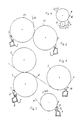
- Nachfolgend wird die Erfindung anhand der in den Figuren der Zeichnung dargestellten Ausführungsbeispiele erläutert, die jeweils prinzipmäßig das Auftragsverfahren darstellen.
- In Figur 1 ist vorgesehen, daß die Warenbahn durch einen zwischen zwei Walzen 1 und 2 gebildeten Preßspalt geführt wird. Dabei ist der einen Walze, die mit einer gummierten Oberfläche versehen ist, ein Auftragswerk zugeordnet, das eine Düsenkammer 6 und an ihrem austrittsseitigen Ende eine mit Umfangsrillen versehene Rollrakel 7 und einen Halter 8 für dieselbe aufweist. Die Härte des Gummiüberzugs der Walze 1 kann zwischen 0 und 200, vorzugsweise 10 und 70 P u.J, betragen. Die Auftragsmenge für den Fall von Karton ist mit 6 bis 40 ml/m², vorzugsweise 12 bis 22 ml/m², zu bemessen. Die zweite Schicht wird in einer vergleichbaren Anordnung mit Rollrakel 11 und deren Halter 12 sowie Düsenkammer 9 aufgetragen, wobei jedoch als Egalisierelement auch eine Streichklinge oder eine glatte Rollrakel an der Stelle 10 in Frage kommt.
- Die in Frage kommenden Konsistenzen, d.h. Feststoffgehalte, liegen für die erste Auftragsschicht zwischen 50 und 70 %, vorzugsweise 50 und 60 % maximal und für die zweite Auftragsschicht zwischen 60 und 70 % maximal. Es ist als günstig anzusehen, wenn als Auftragswerk jeweils eine Düsenkammer 6, 9 vorgesehen ist, an deren austrittsseitigem Ende in der Nähe der zu beschichtenden Oberfläche eine Rollrakel 7, 11 mit deren Halter 8, 12 angeordnet ist. Man hat also hier den Vorteil gegenüber dem Luftbürstenverfahren, daß man mit relativ hoher Konsistenz insgesamt, insbesondere aber bei der zweiten Auftragsschicht arbeiten kann. Die Liniendrücke im Preßspalt zwischen den beiden ersten Walzen 1 und 2 betragen zwischen 5 und 60 kN/m, vorzugsweise 20 bis 40 kN/m.
- Die Anordnung nach Figur 2 hat nur insgesamt zwei Bahnführungswalzen 21 und 22, wobei jeder eine Auftragseinrichtung der beschriebenen Art zugeordnet ist. Diese Anordnung ist im Falle von Karton möglich, weil dieser sich durch die Befeuchtung im Streichwerk weniger dehnt als Papier.
- Bei Karton ist eine günstige Möglichkeit, als Dosierelement eine mit Umfangsrillen versehene Rollrakel 11 mit Halter 12 am auslaufenden Ende der Düsenkammer 9 für die zweite Beschichtung (Enddosierung) vorzusehen und danach kein weiteres Glättelement anzuwenden. Dies ist in Figur 3 dargestellt. Damit kann ein sehr guter Strichauftrag bei relativ sparsamem Einsatz von Streichmasse erreicht werden.
- In Figur 4 ist noch dargestellt, daß für die zweite Beschichtungseinrichtung auch eine Übertragungswalze 17 für die Streichmasse Verwendung finden kann. Es ist danach ein Abrakeln durch eines der bekannten Dosierelemente vorzusehen.
- Man kann in einem bestimmten Anwendungsbereich, im Fall von Leimauftrag für Papier, die erste Auftragsschicht statt mit den Rillen einer Rollrakel auch mit einer Streichklinge dosieren, muß hier aber sehr genau das Arbeiten der Streichklinge überwachen.
Claims (11)
- Verfahren zur Beschichtung laufender Warenbahnen aus Papier oder Karton, wobei unmittelbar nacheinander zwei Schichten aufeinandergelegt werden, während die erste Schicht noch feucht ist und sowohl für den ersten als auch den zweiten Beschichtungsvorgang mindestens eine die Warenbahn führende, rotierbare Walze vorgesehen ist und mindestens die zweite Schicht direkt auf der Bahn aufgetragen und dosiert wird, dadurch gekennzeichnet, daß beim ersten Beschichtungsvorgang mittels einer Rollrakel, die mit feinen Umfangsrillen oder mit spiralförmigen Rillen, die jeweils eng aneinander liegen, versehen ist, die Auftragsschicht in so geringer Menge auf die Mantelfläche der die Warenbahn führenden, ersten Walze (1) dosiert aufgetragen wird, daß in einem nachgeschalteten, zwischen einer Gegenwalze (2) und der ersten Walze (1) gebildeten Preßspalt die Streichmasse auf die durch den Preßspalt geführte Warenbahn abgedruckt wird, so daß überall eine zumindest dünne Schicht an Beschichtungsmasse insbesondere hinsichtlich des festen bzw. Pigmentanteils verbleibt und daß der Feststoffgehalt der Beschichtungsmasse für die erste Auftragsschicht maximal 70 % beträgt.
- Verfahren nach Anspruch 1, dadurch gekennzeichnet, daß der Feststoffgehalt der Beschichtungsmasse für die erste Auftragsschicht zwischen 50 und 60 % beträgt.
- Verfahren nach Anspruch 1 oder 2, dadurch gekennzeichnet, daß bei der Beschichtung von Karton die Auftragsmenge für die erste Auftragsschicht zwischen 6 und 40 ml/m², insbesondere zwischen 12 und 22 ml/m², beträgt.
- Verfahren nach einem der Ansprüche 1 bis 3, dadurch gekennzeichnet, daß die zweite Beschichtung an der zweiten Bahnführungswalze durch eine mit Umfangsrillen versehene Rollrakel dosiert wird, wonach die Warenbahn von der zweiten Bahnführungswalze (3) abgeleitet wird, und daß der Feststoffanteil der zweiten Beschichtungsmasse maximal 70 % beträgt.
- Verfahren nach einem der Ansprüche 1 bis 4, dadurch gekennzeichnet, daß der Feststoffanteil der zweiten Beschichtungsmasse zwischen 60 und 70 % beträgt.
- Verfahren nach einem der Ansprüche 1 bis 4, dadurch gekennzeichnet, daß der Feststoffgehalt der zweiten Auftragsschicht mindestens 10 % absolut höher als der ersten Auftragsschicht ist.
- Verfahren nach einem der Ansprüche 1 bis 6, gekennzeichnet durch die Anwendung bei der Herstellung von beschichtetem Karton.
- Verfahren nach Anspruch 1, dadurch gekennzeichnet, daß der erste Auftrag durch eine Streichklinge oder eine geeignete Leiste anstelle der Rollrakel dosiert wird.
- Einrichtung zur Durchführung des Verfahrens, dadurch gekennzeichnet, daß als Auftragswerk jeweils eine Düsenkammer (6, 9) vorgesehen ist, an deren austrittsseitigem Ende in der Nähe der zu beschichtenden Oberfläche eine Rollrakel (7, 11) mit deren Halter (8, 12) angeordnet ist.
- Einrichtung nach Anspruch 9, dadurch gekennzeichnet, daß zumindest die erste Bahnführungswalze (1) mit einer Schicht aus Gummi oder ähnlichem beschichtet ist, die eine Härte zwischen 0 und 200 P u.J, vorzugsweise zwischen 10 und 70 P u.J aufweist.
- Einrichtung nach Anspruch 9 oder 10, dadurch gekennzeichnet, daß das zum Auftragen der zweiten Schicht dienende, zweite Auftragswerk an der der ersten Bahnführungswalze (21) zugeordneten, zweiten Bahnführungswalze (Preßwalze 22) vorgesehen ist.
Priority Applications (1)
| Application Number | Priority Date | Filing Date | Title |
|---|---|---|---|
| AT90124884T ATE95585T1 (de) | 1990-01-26 | 1990-12-20 | Beschichtungsverfahren und auftragseinrichtung zur beschichtung laufender warenbahnen aus papier oder karton. |
Applications Claiming Priority (2)
| Application Number | Priority Date | Filing Date | Title |
|---|---|---|---|
| DE4002256A DE4002256A1 (de) | 1990-01-26 | 1990-01-26 | Beschichtungsverfahren und auftragseinrichtung zur beschichtung laufender warenbahnen aus papier oder karton |
| DE4002256 | 1990-01-26 |
Publications (2)
| Publication Number | Publication Date |
|---|---|
| EP0438743A1 true EP0438743A1 (de) | 1991-07-31 |
| EP0438743B1 EP0438743B1 (de) | 1993-10-06 |
Family
ID=6398818
Family Applications (1)
| Application Number | Title | Priority Date | Filing Date |
|---|---|---|---|
| EP90124884A Revoked EP0438743B1 (de) | 1990-01-26 | 1990-12-20 | Beschichtungsverfahren und Auftragseinrichtung zur Beschichtung laufender Warenbahnen aus Papier oder Karton |
Country Status (9)
| Country | Link |
|---|---|
| EP (1) | EP0438743B1 (de) |
| JP (1) | JPH04313360A (de) |
| AT (1) | ATE95585T1 (de) |
| BR (1) | BR9006678A (de) |
| CA (1) | CA2035061A1 (de) |
| DE (2) | DE4002256A1 (de) |
| ES (1) | ES2044390T3 (de) |
| FI (1) | FI905757L (de) |
| NO (1) | NO176676C (de) |
Cited By (8)
| Publication number | Priority date | Publication date | Assignee | Title |
|---|---|---|---|---|
| EP0571351A1 (de) * | 1992-05-21 | 1993-11-24 | Valmet Paper Machinery Inc. | Beschichtungsvorrichtung zum Beschichten von Leimpresswalzen, Papier oder Karton |
| WO1994023127A1 (en) * | 1993-04-06 | 1994-10-13 | Veitsiluoto Oy | A method of coating paper and an apparatus therefor |
| EP0731213A3 (de) * | 1995-03-09 | 1996-10-16 | Draiswerke Gmbh | |
| EP0791687A1 (de) * | 1996-02-21 | 1997-08-27 | Voith Sulzer Papiermaschinen GmbH | Verfahren und Vorrichtungen zum Auftragen eines flüssigen oder pastösen Mediums auf eine laufende Materialbahn |
| EP0812958A1 (de) * | 1996-06-13 | 1997-12-17 | Voith Sulzer Papiermaschinen GmbH | Vorrichtung zum aufeinanderfolgenden Auftragen von zwei Schichten von flüssigen oder pastösen Medien auf eine Seite einer laufenden Materialbahn |
| EP0812957A1 (de) * | 1996-06-13 | 1997-12-17 | Voith Sulzer Papiermaschinen GmbH | Verfahren und Vorrichtung zur Beschichtung einer laufenden Materialbahn |
| WO1998020202A1 (en) * | 1996-11-04 | 1998-05-14 | Valmet Corporation | Method and arrangement for coating a moving paperboard web |
| EP0965684A3 (de) * | 1998-06-17 | 2000-07-05 | Voith Sulzer Papiertechnik Patent GmbH | Vorrichtung zum Auftragen eines flüssigen oder pastösen mediums auf eine laufende Materialbahn |
Families Citing this family (7)
| Publication number | Priority date | Publication date | Assignee | Title |
|---|---|---|---|---|
| DE4211401A1 (de) * | 1992-04-04 | 1993-10-07 | Voith Gmbh J M | Beschichtungseinrichtung für Bahnen aus Papier oder Karton |
| DE4224717B9 (de) * | 1992-07-27 | 2004-08-19 | Mitsubishi Hitec Paper Bielefeld Gmbh | Verfahren zur Herstellung eines druckempfindlichen Aufzeichnungsblattes |
| FI93665C (fi) * | 1992-11-13 | 1995-05-10 | Valmet Paper Machinery Inc | Menetelmä ja laitteisto paperirainan päällystämiseksi |
| DE4414949A1 (de) * | 1994-04-28 | 1995-11-02 | Voith Gmbh J M | Vorrichtung zum Auftragen von mindestens einem flüssigen Medium auf eine laufende Materialbahn |
| DE19958109A1 (de) * | 1999-12-02 | 2001-06-07 | Voith Paper Patent Gmbh | Vorrichtung zum indirekten Auftragen eines flüssigen oder pastösen Auftragsmediums auf eine laufende Materialbahn, insbesondere aus Papier oder Karton |
| DE10126365A1 (de) * | 2001-05-30 | 2002-12-05 | Voith Paper Patent Gmbh | Verfahren und Vorrichtung zum beidseitigen Auftragen von Auftragsmedium auf eine Materialbahn |
| PL422374A1 (pl) * | 2017-07-27 | 2019-01-28 | Kartonex Spółka Z Ograniczoną Odpowiedzialnością | Sposób impregnowania tektury falistej i zespół urządzeń do impregnowania tektury falistej |
Citations (2)
| Publication number | Priority date | Publication date | Assignee | Title |
|---|---|---|---|---|
| US2870738A (en) * | 1957-02-28 | 1959-01-27 | Black Clawson Co | Paper coating machine |
| US3202536A (en) * | 1961-11-08 | 1965-08-24 | Beloit Corp | Method and apparatus for coating paper |
Family Cites Families (1)
| Publication number | Priority date | Publication date | Assignee | Title |
|---|---|---|---|---|
| EP0352465A3 (de) * | 1988-07-27 | 1990-10-10 | J.M. Voith GmbH | Auftragseinrichtung zur Beschichtung laufender Warenbahnen sowie Verfahren zur Beschichtung |
-
1990
- 1990-01-26 DE DE4002256A patent/DE4002256A1/de not_active Withdrawn
- 1990-11-06 NO NO904827A patent/NO176676C/no unknown
- 1990-11-21 FI FI905757A patent/FI905757L/fi not_active IP Right Cessation
- 1990-12-20 EP EP90124884A patent/EP0438743B1/de not_active Revoked
- 1990-12-20 ES ES90124884T patent/ES2044390T3/es not_active Expired - Lifetime
- 1990-12-20 DE DE90124884T patent/DE59003011D1/de not_active Revoked
- 1990-12-20 AT AT90124884T patent/ATE95585T1/de active
- 1990-12-21 BR BR909006678A patent/BR9006678A/pt not_active Application Discontinuation
-
1991
- 1991-01-17 JP JP3017055A patent/JPH04313360A/ja active Pending
- 1991-01-28 CA CA002035061A patent/CA2035061A1/en not_active Abandoned
Patent Citations (2)
| Publication number | Priority date | Publication date | Assignee | Title |
|---|---|---|---|---|
| US2870738A (en) * | 1957-02-28 | 1959-01-27 | Black Clawson Co | Paper coating machine |
| US3202536A (en) * | 1961-11-08 | 1965-08-24 | Beloit Corp | Method and apparatus for coating paper |
Cited By (9)
| Publication number | Priority date | Publication date | Assignee | Title |
|---|---|---|---|---|
| EP0571351A1 (de) * | 1992-05-21 | 1993-11-24 | Valmet Paper Machinery Inc. | Beschichtungsvorrichtung zum Beschichten von Leimpresswalzen, Papier oder Karton |
| WO1994023127A1 (en) * | 1993-04-06 | 1994-10-13 | Veitsiluoto Oy | A method of coating paper and an apparatus therefor |
| EP0731213A3 (de) * | 1995-03-09 | 1996-10-16 | Draiswerke Gmbh | |
| EP0791687A1 (de) * | 1996-02-21 | 1997-08-27 | Voith Sulzer Papiermaschinen GmbH | Verfahren und Vorrichtungen zum Auftragen eines flüssigen oder pastösen Mediums auf eine laufende Materialbahn |
| EP0812958A1 (de) * | 1996-06-13 | 1997-12-17 | Voith Sulzer Papiermaschinen GmbH | Vorrichtung zum aufeinanderfolgenden Auftragen von zwei Schichten von flüssigen oder pastösen Medien auf eine Seite einer laufenden Materialbahn |
| EP0812957A1 (de) * | 1996-06-13 | 1997-12-17 | Voith Sulzer Papiermaschinen GmbH | Verfahren und Vorrichtung zur Beschichtung einer laufenden Materialbahn |
| WO1998020202A1 (en) * | 1996-11-04 | 1998-05-14 | Valmet Corporation | Method and arrangement for coating a moving paperboard web |
| US6217940B1 (en) | 1996-11-04 | 2001-04-17 | Valmet Corporation | Method and apparatus for coating a moving paperboard web |
| EP0965684A3 (de) * | 1998-06-17 | 2000-07-05 | Voith Sulzer Papiertechnik Patent GmbH | Vorrichtung zum Auftragen eines flüssigen oder pastösen mediums auf eine laufende Materialbahn |
Also Published As
| Publication number | Publication date |
|---|---|
| JPH04313360A (ja) | 1992-11-05 |
| NO176676C (no) | 1995-05-10 |
| DE59003011D1 (de) | 1993-11-11 |
| ATE95585T1 (de) | 1993-10-15 |
| ES2044390T3 (es) | 1994-01-01 |
| DE4002256A1 (de) | 1991-08-01 |
| CA2035061A1 (en) | 1991-07-27 |
| NO904827D0 (no) | 1990-11-06 |
| FI905757A7 (fi) | 1991-07-27 |
| FI905757L (fi) | 1991-07-27 |
| EP0438743B1 (de) | 1993-10-06 |
| NO176676B (no) | 1995-01-30 |
| NO904827L (no) | 1991-07-29 |
| FI905757A0 (fi) | 1990-11-21 |
| BR9006678A (pt) | 1991-10-01 |
Similar Documents
| Publication | Publication Date | Title |
|---|---|---|
| AT392426B (de) | Leimpresse mit zwei zueinander parallelen presswalzen | |
| EP2090695B1 (de) | Verfahren zur Herstellung eines scheuerfesten Overlays | |
| EP0438743B1 (de) | Beschichtungsverfahren und Auftragseinrichtung zur Beschichtung laufender Warenbahnen aus Papier oder Karton | |
| EP0352582B2 (de) | Verfahren zur Beschichtung laufender Bahnen aus Papier oder Karton | |
| DE69004595T2 (de) | Verfahren zum Auftragen von mikrokapselhaltigen Zusammensetzungen auf Papier. | |
| EP0791687B1 (de) | Verfahren und Vorrichtungen zum Auftragen eines flüssigen oder pastösen Mediums auf eine laufende Materialbahn | |
| DE2143950B2 (de) | Verfahren zur Herstellung von doppelt beschichtetem Papier | |
| DE202015009603U1 (de) | Auftragswerk für Papier-, Karton- oder Tissuebahn | |
| EP0609483B1 (de) | Verfahren und Vorrichtung zum Streichen einer Papierbahn | |
| EP0565979A1 (de) | Beschichtungseinrichtung für Bahnen aus Papier oder Karton | |
| EP0812957A1 (de) | Verfahren und Vorrichtung zur Beschichtung einer laufenden Materialbahn | |
| DE2657942A1 (de) | Verfahren und vorrichtung zum aufbringen einer zusaetzlichen schicht auf ein plattenfoermiges erzeugnis | |
| DE3040681A1 (de) | Vorrichtung zum impraegnieren von bahnfoermigem material | |
| DE102009008589B4 (de) | Verfahren und Anordnung zur Herstellung von mehrschichtig gestrichenem Papier | |
| DE4243518C2 (de) | Vorrichtungen zum Auftrag von Flüssigkeit auf beide Seiten einer Materialbahn und Verfahren zum Auftrag einer Flüssigkeit auf eine Materialbahn mit diesen Vorrichtungen | |
| DE3209511A1 (de) | Verfahren zum herstellen einer weichen und saugfaehigen bahn | |
| DE2542511C2 (de) | Verfahren zum Herstellen einer mehrschichtigen Bahn aus Zellulosematerial | |
| DE19912225C2 (de) | Verfahren und Vorrichtung zum Herstellen eines zumindest 2-lagigen Tissue-Produktes | |
| AT3875U1 (de) | Vorrichtung zur behandlung einer laufenden papier- oder kartonbahn sowie papier- oder kartonprodukt | |
| EP1278637A1 (de) | Dosiersystem zum einfärben von walzen in einer druckmaschine | |
| EP1712678B1 (de) | Auftragsverfahren | |
| AT500687A1 (de) | Verfahren und vorrichtung zum beschichten von pappe | |
| WO2005059245A1 (de) | Papiermaschine | |
| DE20221953U1 (de) | Vorrichtung zum Auftragen von flüssigem oder pastösem Auftragsmedium auf eine Materialbahn, insbesondere aus Papier oder Karton | |
| EP1460171B1 (de) | Verfahren zur Behandlung einer Faserstoffbahn |
Legal Events
| Date | Code | Title | Description |
|---|---|---|---|
| PUAI | Public reference made under article 153(3) epc to a published international application that has entered the european phase |
Free format text: ORIGINAL CODE: 0009012 |
|
| 17P | Request for examination filed |
Effective date: 19901220 |
|
| AK | Designated contracting states |
Kind code of ref document: A1 Designated state(s): AT CH DE ES FR GB IT LI SE |
|
| 17Q | First examination report despatched |
Effective date: 19920218 |
|
| GRAA | (expected) grant |
Free format text: ORIGINAL CODE: 0009210 |
|
| AK | Designated contracting states |
Kind code of ref document: B1 Designated state(s): AT CH DE ES FR GB IT LI SE |
|
| REF | Corresponds to: |
Ref document number: 95585 Country of ref document: AT Date of ref document: 19931015 Kind code of ref document: T |
|
| REF | Corresponds to: |
Ref document number: 59003011 Country of ref document: DE Date of ref document: 19931111 |
|
| GBT | Gb: translation of ep patent filed (gb section 77(6)(a)/1977) |
Effective date: 19931019 |
|
| ET | Fr: translation filed | ||
| ITF | It: translation for a ep patent filed | ||
| REG | Reference to a national code |
Ref country code: ES Ref legal event code: FG2A Ref document number: 2044390 Country of ref document: ES Kind code of ref document: T3 |
|
| PLBI | Opposition filed |
Free format text: ORIGINAL CODE: 0009260 |
|
| 26 | Opposition filed |
Opponent name: JAGENBERG AG Effective date: 19940628 |
|
| EAL | Se: european patent in force in sweden |
Ref document number: 90124884.9 |
|
| PGFP | Annual fee paid to national office [announced via postgrant information from national office to epo] |
Ref country code: GB Payment date: 19951124 Year of fee payment: 6 |
|
| PGFP | Annual fee paid to national office [announced via postgrant information from national office to epo] |
Ref country code: SE Payment date: 19951211 Year of fee payment: 6 Ref country code: AT Payment date: 19951211 Year of fee payment: 6 |
|
| PGFP | Annual fee paid to national office [announced via postgrant information from national office to epo] |
Ref country code: ES Payment date: 19951215 Year of fee payment: 6 |
|
| PGFP | Annual fee paid to national office [announced via postgrant information from national office to epo] |
Ref country code: FR Payment date: 19951227 Year of fee payment: 6 |
|
| PGFP | Annual fee paid to national office [announced via postgrant information from national office to epo] |
Ref country code: DE Payment date: 19960118 Year of fee payment: 6 |
|
| PGFP | Annual fee paid to national office [announced via postgrant information from national office to epo] |
Ref country code: CH Payment date: 19960228 Year of fee payment: 6 |
|
| RDAG | Patent revoked |
Free format text: ORIGINAL CODE: 0009271 |
|
| STAA | Information on the status of an ep patent application or granted ep patent |
Free format text: STATUS: PATENT REVOKED |
|
| REG | Reference to a national code |
Ref country code: CH Ref legal event code: PL |
|
| GBPR | Gb: patent revoked under art. 102 of the ep convention designating the uk as contracting state |
Free format text: 960523 |
|
| 27W | Patent revoked |
Effective date: 19960523 |